
Showing 7 items matching "enlistments in world war one from warrnambool and district."
-
 Flagstaff Hill Maritime Museum and Village
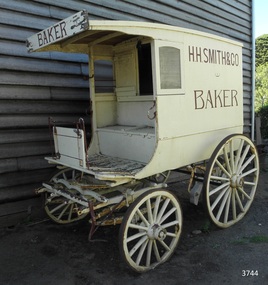
Vehicle - Wagon, H.H. Smith & Co. Baker, Circa 1930s - 1940s
... Smith was very interested and involved in the community in many roles, including being the Vice President of the first Warrnambool and District Historical Society. STEPHENSON’S BAKERY: – believed to be the past owner of the wagon. ...Smith was very interested and involved in the community in many roles, including being the Vice President of the first Warrnambool and District Historical Society. STEPHENSON’S BAKERY: – believed to be the past owner of the wagon. ...This baker’s wagon or cart transported and delivered bread and other baked goods in the Warrnambool area. It currently has advertising for H.H. Smith & Co. Henry Huntington Smith (1857-1941) owned and operated his Warrnambool bakery in the late 19th and early 20th century. However, the design of the wagon is similar to those used by local bakers in the 1930s and 1940s and probably originated from Stephenson’s Bakery in Warrnambool, which operated around that time. The wagon’s original internal shelves were removed in the early days of Flagstaff Hill so that children could have rides around the village in a horse-driven cart. BAKERS’ HISTORY There were many bakeries in Warrnambool in the 19th to mid-20th century. Each bread bakery made horse and cart deliveries in its allocated zone. SMITH’S BAKERY; – as shown on the wagon’s signage. Henry Huntington Smith (1857-1941) was born and educated in Warrnambool. He worked at Davis’ steam biscuit factory in Timor Street before he began his own bakery business in 1885 near the corner of Fairy and Koroit Streets. A few years later Smith built a new bakery on the corner of Fairy and Lava Street where it still stands today (2025) as Monaghan’s Pharmacy. The building was designed by James McLeod in 1892 as a bakehouse, shop and residence for Smith The address was known locally as Smith’s Corner. Next door to the bakery, at 136 Fairy Street, were stables built by Jobbins and McLeod in 1886 for William Cust. A photograph in the archives of the Warrnambool and District Historical Society shows the 1892 building with four fancy horse-drawn wagons on the street with white-clad drivers and a promotional stand erected with 5 bakers in uniform and the signage “H H Smith & Co, Pastry Cooks and Confectioners”. One of the wagons appears to have “H H Smith” painted on the side. H.H. Smith & Co. placed an Advertisement in the Weekly Times in December 1896 promoting its business as bakers, confectioners and pastry cooks, praising their shop as an ‘ornament to the town’ with ‘neat appointments’ and ‘dainty decorations’. It also boasted of supplying a large number of customers within a twelve-mile radius of Warrnambool. In November 1919 The Warrnambool Standard announced the marriage of Henry H Smith, Mayor of Warrnambool, to Jeannie Samson-Goodman in East Adelaide. In the same newspaper was a notice that Frank Crossley was to open as baker and pastry cook in H.H. Smith’s premises. As well as being the proprietor of the H.H. Smith Bakery, Henry Huntington Smith was a Councillor for the Warrnambool Municipality from 1913 to 1937 and Mayer for two terms. In December 1919 during his first term as Mayor, he was honoured for the work he had done with returning soldiers after World War I, receiving a document in recognition of this work, presented by the Mothers, Wives and Sisters of returned soldiers. Smith was very interested and involved in the community in many roles, including being the Vice President of the first Warrnambool and District Historical Society. STEPHENSON’S BAKERY: – believed to be the past owner of the wagon. The last owner of the bakery was Harold Stephenson. Stephenson was enlisted in the A.I.F. and was invalided home in 1943 before the end of the Second World War. He also served as a Councillor from 1958 to 1976, during which time he served six terms as Mayor for the City of Warrnambool (1966-1973) while he had the bakery. He was very involved in many local organisations including the Warrnambool Surf Life Saving Club and the Road Race Committee. He died in 1985, lauded as being one of Warrnambool’s “most distinguished civic leaders”. It has been said that the baker injured in World War II invented a special contraption to enable him to get up into the wagon and that he alerted his customers that he was in their vicinity by blowing a whistle. The customers would come out and choose their bread from the back of his wagon then pay him for it. However, another account is given by a man who once earned pocket money by helping the baker on his rounds. He says that it was Stephenson, the owner and manager of the bakery, and not the delivery baker who received a significant injury during the war, making him unable to climb the stairs of his upstairs accommodation at the bakery, therefore causing him to sleep downstairs. At this time in the early to late 1940 Stephenson’s bakery had three wagons, one for each of the delivery rounds. The wagons were painted black and yellow. Two of the drivers were Stan Lake and Ali (Alec) Dean who both had wagons with the covered cabin design. The third driver was Bill Lake who had a flat wagon. Stan Lake delivered in the area around Lava and Koroit Streets, Ali Dean had another round and Bill Lake had the Dennington area. Bread continued to be delivered into the 1960s but by this time the delivery vehicles were motorised. The goods produced at Stephenson’s bakery included bread baked in different shaped tins such as High Tin, Sandwich and Vienna. Some shapes were easily divided into half by breaking them apart, therefore the baker could make two-quarter loaves from a half loaf, satisfying different needs. There was the option of white or brown bread, sweet buns, fruit buns and Boston buns. The baker’s assistant was known to take great delight in ‘trimming’ the broken halves of excess bread and crust, enjoying his treat. THE BAKERY PREMISES: – Southeast corner of Fairy and Lava Streets, Warrnambool. The building retains the original cast iron veranda. Above the veranda, a motif of a wheat sheaf in ornamental plaster can be seen. Inside the building, there are still some of the original fittings. The building was classified by the National Trust in August 1979. After the Second World War, an official system of zoning was introduced as a fair way for the baking industry to operate. In 1949 different pricing was introduced by the Government for either delivered or retail purchased bread. Many of the small local bakeries went out of business after the Government banned zoning. The way was made open for the larger bread manufacturers to enter the local market with cheaper prices. Some of those companies were Mc Queens, Tip Top, Twisties, and Sunicrust, (Mc Queens ‘new’ bakery building was where the current Toyworld shop now stands, is, in the Ozone carpark.) O’Grady’s Bakery, later changing hands and known as Burkes Bakery, was on Fairy Street near the Timor Street intersection, on the North West side. There was also a bakery named Almay. The baker’s wagon is significant because of its association with H.H. Smith’s Bakery in Warrnambool.. The H.H. Smith’s Bakery building on the corner of Fairy and Lava Streets, built in 1892, is classified by the National Trust, August 1979. Smith Street Warrnambool was named after Henry Huntington Smith, who was a Warrnambool Councillor 1913 – 1937 and Mayor 1919 – 1921. Baker’s wagon, often referred to as a baker’s cart. Four wheeled horse-drawn delivery wagon, front wheels smaller than rear wheels. Wagon is clad with metal sheets and lined with varnished timber panels. Wheels have metal rims, wooden spokes and rear wheels have wooden brake pads. Horse shaft is timber with metal fittings. Front has a metal lamp holder, brake lever, metal hand grips and decorative metal foot plates. The wagon has suspension leaves on back and sides and double suspension leaves on the front. Driver’s area at front has a roof, glass side windows and wooden box seat with hinged compartment accessing wagon storage area. Door above back of seat has buckled leather handgrip strap attached, door slides open for access to wagon area. Back of wagon has a wooden step and a split door; top door has ventilation louvers, both doors have metal latches. Wagon is painted cream with brown trim and signage and green step. Remnants of red and green paint are visible; underside of seat panel is painted grey. Wagon advertises H.H. Smith & Co. Baker, a Warrnambool business established in 1885, but is of a more modern design seen around 1930’s and 1940’s and most likely belonging to Stephenson's bakery. Brown signwriting on sides of wagon “H.R. SMITH & CO. / BAKER” Brown signwriting across front of wagon “BAKER” warrnambool, shipwrecked-coast, flagstaff-hill, flagstaff-hill-maritime-museum, maritime-museum, shipwreck-coast, flagstaff-hill-maritime-village, shipwrecked-artefact, great ocean road, baker’s wagon, h.h. smith baker, warrnambool, henry h smith, jeannie samson-goodman, frank crossley, mayor of city of warrnambool, vice president of warrnambool and district historical society, stephenson’s bakery warrnambool, harold stephenson, warrnambool surf life saving club, road race committee, national trust building, stan lake, bill lake, ali dean, 19th and 20th century bakers, davies steam biscuit factory warrnambool, james mcleod building designer, jobbins and mcleod, william cust, h h smith & co, pastry cooks and confectioners, bakery trade, bread delivery wagon -
 Warrnambool and District Historical Society Inc.
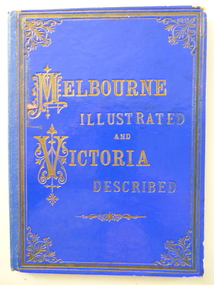
Book, Melbourne illustrated & Victoria described, c.1885
... World War One. Private Percy Palmer was listed as coming from the Warrnambool area even though his enlistment place was given as Bannockburn. ...This book was given to Henry Huntingdon Smith in 1918 by a grateful sister of a soldier killed in World War One. Private Percy Palmer was listed as coming from the Warrnambool area even though his enlistment place was given as Bannockburn. H.H.Smith (1857-1941) is an important figure in Warrnambool’s history. He had a bakery business at the corner of Lava and Fairy Streets. He was a Warrnambool Councillor and Mayor, a Hospital Committee member for 39 years, a Methodist church office-bearer and an active worker for the welfare of local returned soldiers. It was said that he greeted every returning soldier at the Warrnambool Railway Station. Mrs Sharpe was one of those who benefited from his solicitude and kindness.This is book is of antiquarian interest but more importantly it is a lovely memento of Henry Smith’s untiring concern for local soldiers returning from World War One and for their family members. This is a hard cover book of 38 pages. The cover is blue with gold lettering and gold ornamentation on the front and back covers. There are two sepia-coloured photographs of Melbourne at the front of the book and two blue stamps of the Warrnambool and District Historical Society at the front and the back of the book. The pages of the book have become detached from the binding. The inscription at the front of the book is handwritten in purple ink.‘Melbourne, Aug. 28, 1918, To Mr H. Smith as a small token for kindness shown on behalf of my dear late brother, Private Percy Palmer from N. Sharpe.’private percy palmer, world war one and warrnambool, henry huntingdon smith, warrnambool history -
 Warrnambool and District Historical Society Inc.
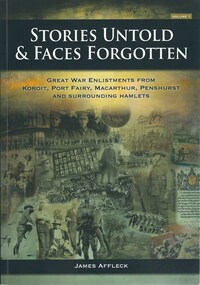
Book, James Affleck, Stories Untold and Faces Forgotten By James Affleck, 2015
... from various sources and link them effectively to the area of the Western district. They tell the stories of the many district soldiers of the first world war. Stories Untold and Faces Forgotten By James Affleck. soldiers from the western district WW1 codrington byaduk penshurst caramut warrnambool james affleck Stories of western district soldiers who enlisted in World War One. ...Stories of western district soldiers who enlisted in World War One.Volume 1 Cover has collage of photographs of soldiers over coloured with different shades of green. Title text is white on black banner. Back cover is in shades of green, yellow and black with photograph of soldier and his bride in the centre. 348 pages Volume 2 has the same front cover with a family plaque on the back cover commemorating the four Dix brothers. Page numbers continue into Volume 2 up to page 654. The full index of names is contained in Volume 2. non-fictionStories of western district soldiers who enlisted in World War One.stories untold and faces forgotten by james affleck., soldiers from the western district ww1, codrington, byaduk, penshurst, caramut, warrnambool, james affleck -
 Warrnambool and District Historical Society Inc.
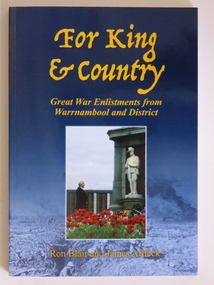
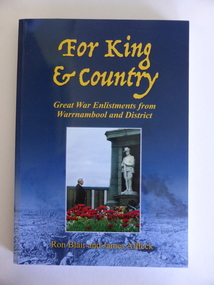
Book, For King & Country, 2016
... Enlistments in World War One from Warrnambool and district....It has been meticulously compiled from a variety of official war records and local information and is the most comprehensive work available on the records of World War One enlistments from Warrnambool and district. ...It is the 2016 second edition of the book by Blair & Affleck of Great War Enlistments from Warrnambool and District. It has a blue cover with an image of a World War One battle scene in the background covering both the front and the back cover. ...World War One Enlistments in World War One from Warrnambool and district. ...This book, a 2006 second edition of a book first published in 2004, includes additional material in the second edition. It has been meticulously compiled from a variety of official war records and local information and is the most comprehensive work available on the records of World War One enlistments from Warrnambool and district. Australia’s military involvement in World War One was highly significant and a most important event in the history of our growth as a nation and our newfound place on the world stage. This book is very important as it gives a comprehensive coverage of the people from Warrnambool and district who enlisted in World War One. It is an essential reference for researchers of those times and for family history recorders. This is a soft-cover book of 270 pages. It is the 2016 second edition of the book by Blair & Affleck of Great War Enlistments from Warrnambool and District. It has a blue cover with an image of a World War One battle scene in the background covering both the front and the back cover. The front cover has an inset colour photograph of the soldier figure from the Warrnambool War Memorial and the back cover has a colour photograph of the World War One Honor Roll from Christ Church, Warrnambool. The titles etc on the cover are printed in yellow. The book has a contents page, acknowledgements and introduction, an index, lists and descriptions of soldiers who died in the war and those who returned home, information on local Honour Boards and appendices.Front Cover: ‘For King & Country, Great War Enlistments from Warrnambool and District, Ron Blair and James Affleck, 2nd edition, 2016’ Spine: ‘For King and Country – Great War Enlistments from Warrnambool and District, Ron Blair and James Affleck’ world war one, enlistments in world war one from warrnambool and district., blair and affleck, warrnambool, history -
 Warrnambool and District Historical Society Inc.
Book, James Affleck et al, For King & Country, 2016
... It contains information on the World War One enlistments from Warrnambool and district. Both Ron Blair and James Affleck are researchers and writers of Australian military history, especially in relation to enlistment and service records of those who took part in World Wars One and Two....It contains information on the World War One enlistments from Warrnambool and district. Both Ron Blair and James Affleck are researchers and writers of Australian military history, especially in relation to enlistment and service records of those who took part in World Wars One and Two. ...This is the revised edition of the book, For King & Country by Ron Blair and James Affleck. It contains information on the World War One enlistments from Warrnambool and district. Both Ron Blair and James Affleck are researchers and writers of Australian military history, especially in relation to enlistment and service records of those who took part in World Wars One and Two.This book is an important one as it gives details of World War One enlistments and service records of those local people who served in this war. It is a valuable research tool for writers, researchers and descendants of those who served in the war. This is a soft cover book of 270 pages. The cover is blue with yellow lettering.The front cover has a colour photograph of the Warrnambool War Memorial and the back cover has a colour photograph of the Honour Board at Christ Church, Warrnambool. The book has Acknowledgements and Introductions, an Index, a Foreword, four Chapters and five Appendices, Honour Rolls, Poetry and Tables. There are many colour and black and white photographs and illustrations. world war one, western district military history, warrnambool war memorial, james affleck, ron blair -
 Warrnambool and District Historical Society Inc.
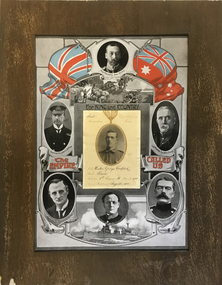
World War One Certificate (Coulstock), WW1 Certificate of Service, 1914
... World War One certificate featuring Walter Coulstock. Private Walter George Coulstock, an engineer, was born in Warrnambool and educated at the Warrnambool Academy. He enlisted at the age of 21 in August 1914, embarked in October 1914 and while travelling to Egypt he entered the machine gun section. He was wounded on the afternoon of the Landing and died of wounds in May 1915. He was buried at sea while in transit to Alexandria. Walter Coulstock was one of the many men and women from...World War One certificate featuring Walter Coulstock. Private Walter George Coulstock, an engineer, was born in Warrnambool and educated at the Warrnambool Academy. He enlisted at the age of 21 in August 1914, embarked in October 1914 and while travelling to Egypt he entered the machine gun section. He was wounded on the afternoon of the Landing and died of wounds in May 1915. He was buried at sea while in transit to Alexandria. Walter Coulstock was one of the many men and women from ...This item is a World War One certificate featuring Walter Coulstock. Private Walter George Coulstock, an engineer, was born in Warrnambool and educated at the Warrnambool Academy. He enlisted at the age of 21 in August 1914, embarked in October 1914 and while travelling to Egypt he entered the machine gun section. He was wounded on the afternoon of the Landing and died of wounds in May 1915. He was buried at sea while in transit to Alexandria. Walter Coulstock was one of the many men and women from Warrnambool and district who enlisted in World War One and who died on active service.This certificate is of considerable significance as it is memento of Walter Coulstock who died in World War One. The Coulstock family was a prominent one in the Warrnambool district in the 19th and early 20th centuries and Walter is one of the local heroes of the Great WarThis is a paper certificate mounted on a frame of plywood. The mount indicates that the certificate has previously been framed. The certificate has a grey background and contains images of the British and Australian flags in red, white and blue, six black and white photographs, an image of H.M.A.S. Australia, an image of a battle scene with artillerymen and black and red lettering. Pasted on to the centre part of the certificate is a yellow piece of paper with a photograph and information on Walter Coulstock. The plywood is broken at the bottom edge and is somewhat stained."For King and Country' 'The Empire Called Us' 'Walter George Coulstock, Private, 8th Battalion, Company B. Reg. No.481, Date of Enlistment August 1914walter coulstock, world war 1 certificate -
 Warrnambool and District Historical Society Inc.
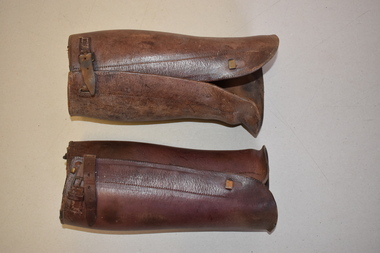
Spats, Early 20th century
... Many members of the G Company Mounted Rifles from Warrnambool and district enlisted in World War One and served with distinction in the Victorian Lighthorse units which evolved from the Mounted Rifles units. ...Many members of the G Company Mounted Rifles from Warrnambool and district enlisted in World War One and served with distinction in the Victorian Lighthorse units which evolved from the Mounted Rifles units. ...These spats appear to be part of an army uniform and may have been worn by a member of an Australian Lighthorse unit. The Victorian Mounted Rifles was established in 1885 by Colonel Tom Price who lived in his retirement years in Warrnambool. Many members of the G Company Mounted Rifles from Warrnambool and district enlisted in World War One and served with distinction in the Victorian Lighthorse units which evolved from the Mounted Rifles units. These spats are retained as they are possibly part of the uniform of an Australian Lighthorse soldier early in the 20th century and may have local provenance.These are two spats or leggings made of stiffened brown leather shaped to fit the lower calf of the leg. They have leather straps and metal buckles at the top end. australian lighthorse regiments, spats, history of warrnambool
