
Showing 11 items matching "entrances lonsdale "
-
 Dandenong & District Historical Society
Flyer, Zodiac, 11/11/2026
... ...Entrances Lonsdale & Thomas Sts...Under New Management Specialising in Businessmen's Luncheons Evening Dinners Vanity Court Dandenong Entrances Lonsdale & Thomas Sts Under New Management, Specialising in Businessmen's Luncheons, Evening Dinners, Zodiac Flyer ...non-fictionunder new management, specialising in businessmen's luncheons, evening dinners, vanity court dandenong, entrances lonsdale & thomas sts -
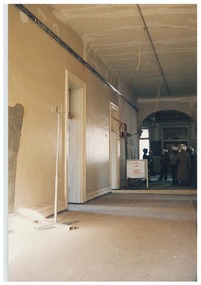 Queen Victoria Women's Centre
Photograph, c.1996
... Ground floor corridor, facing south towards the QVWC entrance and Lonsdale street. Taken during restoration inspection....Ground floor corridor, facing south towards the QVWC entrance and Lonsdale street. Taken during restoration inspection. ...Colour photograph. Ground floor corridor, facing south towards the QVWC entrance and Lonsdale street. Taken during restoration inspection.historic buildings, building construction -
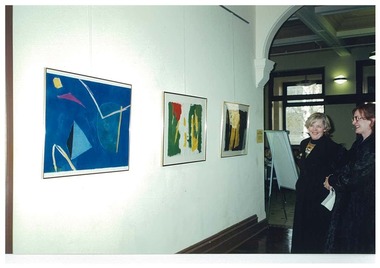 Queen Victoria Women's Centre
Photograph, 10 July 1998
... Taken from the corridor towards the south of the QVWC building towards the entrance and Lonsdale street....Taken from the corridor towards the south of the QVWC building towards the entrance and Lonsdale street. Photograph ...Colour photograph. Gallery space on ground floor corridor. Art is coloured abstract paintings from an unidentified artist. Two women appear right of frame. Taken from the corridor towards the south of the QVWC building towards the entrance and Lonsdale street.art exhibitions, historic buildings, cultural structures and establishments -
 Queen Victoria Women's Centre
Photograph, c.1996
... Ground floor facing south towards Lonsdale street. Entrances show where access corridors were to connect demolished buildings. ...Ground floor facing south towards Lonsdale street. Entrances show where access corridors were to connect demolished buildings. ...Colour photograph. Ground floor facing south towards Lonsdale street. Entrances show where access corridors were to connect demolished buildings. What was the cafe and in 2015 is the Breacan office. Taken during restoration inspectionhistoric buildings, building construction, cultural structures and establishments -
![Hardcover illustrated book. Dust jacket has orange toned front cover with historic images (Melbourne Hospital laundry [ca.1917] and a theatre nurse), a black and white photo of entrance to hospital, Lonsdale St site and a coloured photo of hospital at current site {ca.1997].
Contains a history of the Royal Melbourne Hospital, the first public hospital in Victoria, from its opening in 1848 in Lonsdale St up to 1998, contains over 100 historical photographs and illustrations.](/media/collectors/50187a8f023fd7201471f198/items/67639f847a79e07be7f8b278/item-media/6763a5eb7a79e07be7f8dda8/item-fit-380x285.jpg?cb=6) Alfred Hospital Nurses League - Nursing History Collection
Book - Illustrated book, Alan Gregory, The ever open door: a history of the Royal Melbourne Hospital 1848-1998, 1998
... Dust jacket has orange toned front cover with historic images (Melbourne Hospital laundry [ca.1917] and a theatre nurse), a black and white photo of entrance to hospital, Lonsdale St site and a coloured photo of hospital at current site {ca.1997]. ...Lonsdale St up to 1998, contains over 100 historical photographs and illustrations. On first page is a printed black and white donation sticker: black Maltese cross in circle, "This book was donated to Alfred Archival Association Nursing Division by 'AHNL (handwritten in ink). Also previous catalogue number handwritten in ink. Dust jacket has orange toned front cover with historic images (Melbourne Hospital laundry [ca.1917] and a theatre nurse), a black and white photo of entrance ...History of the Royal Melbourne Hospital, the first public hospital in Victoria, from its opening in 1848 in Lonsdale St up to 1998, contains over 100 historical photographs and illustrations.Illustrated book with dustjacket. Book is bound in dark blue fabric with hospital crest on front in gilt. title and publisher's mark printed in gilt on spinenon-fictionHistory of the Royal Melbourne Hospital, the first public hospital in Victoria, from its opening in 1848 in Lonsdale St up to 1998, contains over 100 historical photographs and illustrations.royal melbourne hospital-history, hospitals-victoria-history -
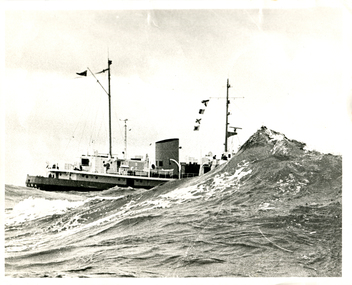 Queenscliffe Maritime Museum
Photograph - Monochrome, MV Wyuna
... MV Wyuna Port Phillip Pilot Service The rip The heads Queenscliff Point Lonsdale Black and white photograph of the Pilot Tender MV Wyuna partially obscured by a large wave at the rip, entrance to Port Phillip Bay. ...The ship was built in 1953 by Ferguson Shipbuilders of Port Glasgow, Scotland for the Port Phillip Sea Pilots organisation as a pilot cutter. Her role as a pilot cutter was to sail with pilots on board to meet ships entering Port Phillip Bay. Pilots would be transferred by the Wyuna's workboat to the vessel requiring pilotage while it was stopped dead in the water, with shelter provided by the vessel itself. In the early 1970s the pilot service started using fast launches to allow pilots to board while ships were still underway, and in 1979 the Wyuna was sold to the Australian Maritime College in Launceston, Tasmania as a training vessel. She continued in that role until 2004 when sold to Mineralogy Pty Ltd as an accommodation vessel. In September 2013 she was donated to the Western Port Oberon Association for the Victorian Maritime Centre currently at Crib Point. For a time she was docked at Beauty Point, Tasmania, and after being refurbished for 18 months she was to be moved to Docklands in Melbourne, Victoria. After this berth became unavailable the vessel was docked at Inspection Head Wharf in Beauty Point. After a period there it was towed into Bell Bay where she lays at anchor as of January 2016. When funding becomes available the Western Port Oberon Association has plans to display the vessel in a wet berth alongside the former Royal Australian Navy Oberon-class submarine HMAS Otama.Mr Henry HudsonBlack and white photograph of the Pilot Tender MV Wyuna partially obscured by a large wave at the rip, entrance to Port Phillip Bay.mv wyuna, port phillip pilot service, the rip, the heads, queenscliff, point lonsdale -
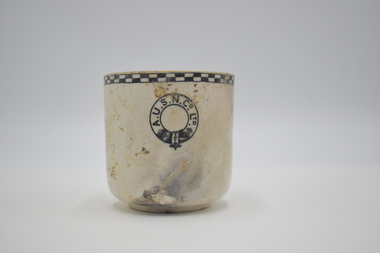 Geelong Naval and Maritime Museum
Teacup
... In the worsening weather a blur of lights at Barwon Heads was mistaken for Port Lonsdale, and the Orungal steamed ashore onto Formby Reef, just east of the entrance of the Barwon River - instead of passing safely through the middle of the Rip. ...In the worsening weather a blur of lights at Barwon Heads was mistaken for Port Lonsdale, and the Orungal steamed ashore onto Formby Reef, just east of the entrance of the Barwon River - instead of passing safely through the middle of the Rip. ...The Orungal was originally built in Glasgow in 1923 for the Khedival Mail Steamship & Graving Dock Company of Egypt and named the S.S. Fezara. Due to the effects on steamship companies of the Great Depression including the steep costs of building new ships and increases in running costs and port charges, no new passenger ships had been ordered in Australia since before World War One. To meet demand for passenger berths, the Fezara (5826 tons) along with its sister ship the Famaka (5856 tons, renamed Ormiston), were chartered by the Australasian United Steam Navigation Company Ltd (A.U.S.N.Co.) in 1927. Both the A.U.S.N.Co and the Khedival Mail Steamship Co. were part of the P&O Group. The Orungal operated in this role as an interstate passenger and mail steamer between 1927 and 1940, being used mainly on the Melbourne to Queensland and Western Australian runs, with 240 single class berths. Following the outbreak of World War Two six of the nine large passenger liners servicing mainland Australian passenger and mail trades were requisitioned by the Government to ferry equipment, troops and supplies. Some of them were converted to armed merchant cruisers and used for patrol work and escort duties in the Indian and Pacific Oceans. The Orungal had originally been requisitioned by the government along with the Zealandia on 25 June 1940, to transport troops to Darwin, but was returned to commercial service because "of her unsuitability", perhaps too slow for the demands of the work. Despite being rejected for patrol and convoy duties the Orungal still had a vital role as one of only three passenger liners left to service the mainland Australian trade. Following its requisitioning by the Government shortly after war broke out, it had been fitted out with defensive armament. On its final voyage arriving at Port Phillip Heads from Sydney, Captain Gilling was attempting to enter the Heads ahead of a worsening south-westerly storm and, with a minefield known to have been laid in the area, had been warned by the Navy not to deviate from the swept channel. The captain and crew held fears that in the stormy seas a mine may have been carried away. In the worsening weather a blur of lights at Barwon Heads was mistaken for Port Lonsdale, and the Orungal steamed ashore onto Formby Reef, just east of the entrance of the Barwon River - instead of passing safely through the middle of the Rip. At the Marine Board Inquiry Capt. Gilling - who had been master of the Orungal since 1926 - stated that after becoming uneasy about his position and changing course to starboard one point: " At 10.21 pm I ordered the engine room to stand by and gave instructions for the patent log to be hauled in and for the sounding-gear to be got ready. Approximately two minutes later, in a flash of lightning, I saw land off the port beam. I immediately recognised it as Barwon Heads, and ordered the helm to be put hard to starboard, but the vessel struck before she had time to answer the helm" Barwon Heads and Ocean Grove residents were startled to hear the shrill blast of the ship's whistle, followed by the bright flares and explosions of signal rockets. The Queenscliff lifeboat crew, who had responded to the tragic collision between the Goorangai and another passenger liner the Duntroon in Port Phillip Bay less than 24 hours earlier, were later praised for their efforts in safely taking off all the passengers and crew. Most of the passengers were asleep at the time of the wreck, and were woken up by the commotion, the ship shaking "from stem to stern" and stewards ordering them to lifeboat stations in driving rain. It was a dramatic time with the ship siren wailing and distress rockets being fired. It was reported that "When it was found the ship was safe, the passengers all went to the music room. There they sang and danced for several hours. The ship's orchestra played merrily, and amateur performers among the passengers clowned, danced and sang to keep the laughter going. In the early hours of the morning passengers went to their cabins, most of them to sleep soundly while the keel grated on the rocks". At dawn the Queenscliff lifeboat arrived at the scene having been launched at 2.30am, and cautiously approached the ship which was being "battered by mountainous seas". By 5am oil from a burst oil line was helping to calm seas around the Orungal sufficiently enough for the lifeboat to approach, and all the passengers and crew were taken off in several trips by the lifeboat. A Court of Inquiry later found that the wreck was caused by an abnormal set of current to the north-west and cleared the officers and crew of neglect of duty. The sight of a huge liner almost on the beach saw an unprecedented amount of traffic as people drove an estimated 10,000 cars, using some 60,000 gallons of fuel in a time of strict petrol rationing, to see the spectacle. Salvage operations began in an attempt to refloat the vessel, scheduled for the high tide on 15 December 1940. However, during these operations, at 2.30 am on 13 December 1940, a major fire broke out, believed to have been caused by spontaneous combustion in the boiler room. The ship was soon ablaze, with smoke pouring from its hatches and ventilators, and at mid-morning the magazine exploded fiercely. Of the 60 men working aboard the vessel two were severely burned and had to be taken to Geelong Hospital. The gathered spectators witnessed the eerie sight of the ship's hull glowing red when night fell. The well-known building demolition contractor Whelan the Wrecker bought the salvage rights, and methodically proceeded to dismantle the ship and its fittings. The drama was not yet over for the wreckers when - without warning - the burnt-out hulk was 'attacked' by RAAF for strafing practice. Salvage rights were transferred to another private owner in 1963. By 1945 the combined effects of the exposed location, fire and salvage had seen what was left of the wreck disappear beneath the waves. The site today is marked by two of the four Scotch type boilers sitting upright and exposed at low tide, just north-east of the small boats channel at the entrance to Barwon Heads. Large sections of steel hull plating and framing, and impressively large pieces of ships structure and machinery including masts, booms, deck winches, propeller shaft, flywheel, and a thrust block lie scattered about and make the site an interesting shallow dive. It is interesting to compare the site of the Orungal with the intact remains of similar large passenger ships scuttled in deep water in the Ships' Graveyard, such as the Milora and Malaita. The site is subject to waves and surge, and is best dived on flat calm days The teacup originated from the SS Orungal and was likely used heavily in the ship's life as a passenger, mail and cargo carrier around Australia. The teacup is significant for its connections to SS Orungal and of this ships connected story of being sunk in extraordinary circumstances in the local region. A.U.S.N. Co. Ltd. Teacup salvaged from SS Orungal ss orungal, fezara, world war two, barwon heads, ocean grove -
 Queen Victoria Women's Centre
Photograph, c.1996
... From Lonsdale street looking north towards building. Front entrance, constructing access ramp and restoring stairs. ...From Lonsdale street looking north towards building. Front entrance, constructing access ramp and restoring stairs. ...Colour photograph. From Lonsdale street looking north towards building. Front entrance, constructing access ramp and restoring stairs. 'The Queen Elizabeth Block' in gold above archway. Person in dark clothing in middle o frame. White sedan on right side of frame. Taken during restoration inspection.historic buildings, building construction -
 Queen Victoria Women's Centre
Photograph, August 1996
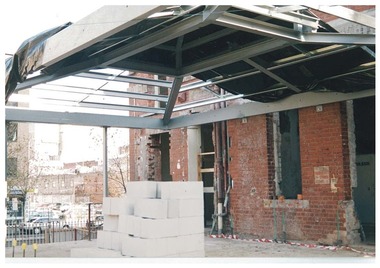
... Ground floor facing south towards Lonsdale street in what was to be the cafe and in 2015 is the Breacan office. Entrances show access corridors to former towers. ...Ground floor facing south towards Lonsdale street in what was to be the cafe and in 2015 is the Breacan office. Entrances show access corridors to former towers. ...Colour photograph. Ground floor facing south towards Lonsdale street in what was to be the cafe and in 2015 is the Breacan office. Entrances show access corridors to former towers. White besser blocks in foreground. New structure for roof seen with tarp. Taken during restoration inspection.building construction, historic buildings, cultural structures and establishments -
 Queen Victoria Women's Centre
Photograph, c.1995
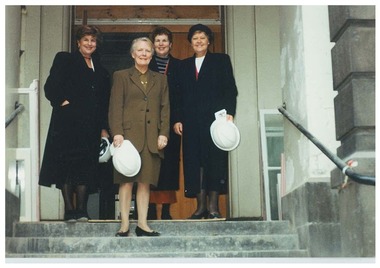
... On Lonsdale street and south entrance stairs of block during door of the building. ...On Lonsdale street and south entrance stairs of block during door of the building. ...Colour photograph. On Lonsdale street and south entrance stairs of block during door of the building. Four women with hard hats face towards camera. Left to right: Minister for Arts Lorraine Elliot, Minister for Women's Affairs Jan Wade, Chair Janet England, Minister for Aboriginal Affairs Ann Henderson parliamentary representatives, historic buildings, building construction -
 Queen Victoria Women's Centre
Photograph, 10 July 1998
... cafe historic buildings cultural structures and establishments architectural features fences entrances Colour photograph. Exterior view of QVWC building. Taken from Lonsdale street on the south east corner of QVWC facing towards the building. ...Colour photograph. Exterior view of QVWC building. Taken from Lonsdale street on the south east corner of QVWC facing towards the building. Depicts the cafe signage and fencing around the buildingcafe, historic buildings, cultural structures and establishments, architectural features, fences, entrances
