
Showing 82 items matching "environmental art"
-
 Hepburn Shire Council Art and Heritage Collection
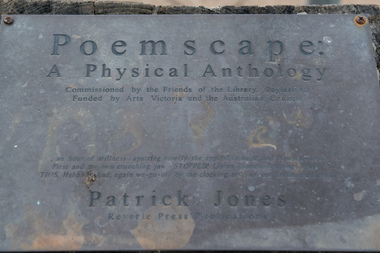
Public Art Work, Patrick Jones, 'Poemscape: a physical anthology' - Patrick Jones. 1999, 1999
... ...environmental art...Public Art Environmental installation work installed near the Daylesford Library. ...Public Art Environmental installation work installed near the Daylesford Library. ...The work was installed at the cnr of Bridgport St and the Midland Hwy, adjacent to the Daylesford Library, in 1999. The work was commissioned by the Friends of the Library, Daylesford and funded by Arts Victoria and the Australia Council. Poemscape: a physical anthology is a much loved site specific installation work commissioned by the Friends of the Library, funded by Arts Victoria and the Australia Council, made by Daylesford resident Patrick Jones in response to his interests in the provision of public food, the development of locavore sensibilities and the rethinking of economies of material accountability and regard. Patrick Jones is a poet and non-fiction writer, a visual artist and ecological thinker. In 2013 Patrick Jones was awarded the degree of Doctor in Creative Arts from the University of Western Sydney for his thesis, 'Walking for food. Regaining permapoesis.'Public Art Environmental installation work installed near the Daylesford Library. Poemscape: a physical anthology comprises of 19 apple trees (18 Fuji apple trees and 1 Granny Smith apple tree) planted on the corner of Bridgport St and the Midland Hwy, adjacent to the library. Adjacent to each tree is a hardwood plinth at topped with a laser engraved brass plate that has been screwed in place. The text of each plate is by 19 poets including the artist and Daylesford resident Patrick Jones, local poets Peter O'Mara, Toby Sime and Robert Campbell, Australian poets Geoff Page, Kath Walker, D T Sime, Judith Wright, Ramona Barry, Jack Davis, Robert Campbell, Christopher Brennan and International Poets Dylan Thomas - Welsh, Sylvia Plath - American, Choku Kanai - Japanese, William Blake - English, Duo Duo - Chinese (translated from the Chinese by John Rosenwald), Yannis Ritsos- Greek (translated from the Greek by Kimon Friar & Kostas Myrsiades), Michel Deguy - French (translated from the French by Clayton Eshleman), Seamus Heaney - Irish and Rainer Maria Rilke - German. The title plate adjacent to the Granny Smith apple tree is by the artist/poet - Patrick Jones. See photographs with images of each of the laser engraved brass plates. permapoesis, artist as family, patrick jones, william blake, kath walker, chaku kanai, peter o'mara, sylvia plath, dylan thomas, geoff page, duo duo, d.t. sime, judith wright, yannis ritsos, michel deguy, ramona barry, seamus heaney, jack davis, rainer maria rilke, robert campbell, christopher brennan, hepburn shire, daylesford library, public art, installation art, environmental art, hepburn shire public art collection -
 Hepburn Shire Council Art and Heritage Collection
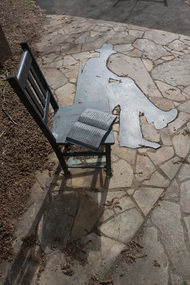
Public Art Work, Petrus Spronk, 'Memory of Place' - Petrus Spronk. 2000, 2005
... ...environmental art...Local Artist CV Artist Statement Significant artwork by nationally renowned local artist Petrus Spronk. local artist petrus spronk sculpture public art victoria daylesford mineral springs reserve environmental art hepburn shire public art collection hepburn shire hepburn springs hepburn springs mineral reserve bronze granite tourist attraction art clare gervasoni joan mcewen marie butler laurie sullivan bonnie howell vera lutea merv keating silent Artist signature - underneath Large Scale Outdoor Sculpture made up of a bronze chair with an open book, a bronze shadow and 6 story rocks 'Memory of Place' - Petrus Spronk. 2000 Public Art Work Petrus Spronk ...Local Artist CV Artist StatementSignificant artwork by nationally renowned local artist Petrus Spronk.Large Scale Outdoor Sculpture made up of a bronze chair with an open book, a bronze shadow and 6 story rocksArtist signature - underneathlocal artist, petrus spronk, sculpture, public art, victoria, daylesford, mineral springs reserve, environmental art, hepburn shire public art collection, hepburn shire, hepburn springs, hepburn springs mineral reserve, bronze, granite, tourist attraction, art, clare gervasoni, joan mcewen, marie butler, laurie sullivan, bonnie howell, vera, lutea, merv keating, silent -
 Hepburn Shire Council Art and Heritage Collection
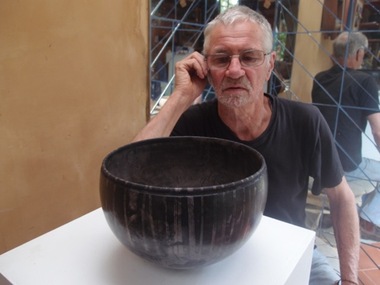
Public Art Work, Petrus Spronk, 'Silent/Listen Listen/Silent' - Petrus Spronk. 2001, 2001
... ...environmental art...Date of manufacture and installation: 2002 'Silent/Listen' was gifted by the artist, Petrus Spronk, to the people of Hepburn Springs in July 2001. petrus spronk public art sculpture environmental art hepburn shire public art collection hepburn shire listen silent hepburn springs mineral reserve granite Each granite stone is engraved on its uppermost surface. ...This work was first commissioned by the Melbourne city council as part of a celebration of the opening of the Birrarung Marr park. 25 victorian sculptors were given $2,500.00 to create a work which would be part of the park for about 6 months. Date of manufacture and installation: 2002 'Silent/Listen' was gifted by the artist, Petrus Spronk, to the people of Hepburn Springs in July 2001.Two smooth rectangular engraved granite slabs placed directly on the ground. Each granite stone is engraved on its uppermost surface. The left hand work is engraved with the text - 'silent' and the right hand work is engraved with 'listen'. Unsigned. Dated July 2001 petrus spronk, public art, sculpture, environmental art, hepburn shire public art collection, hepburn shire, listen, silent, hepburn springs mineral reserve, granite -
 Ararat Gallery TAMA
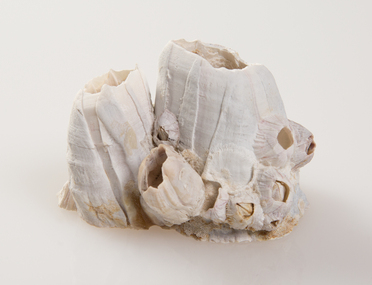
Annemieke Mein, Barnacles specimen, Found 1984
... art, natural history and craft. Her intricate stitched works bring to life insects, birds, plants, and the Australian landscape with astonishing detail and sensitivity. Combining technical mastery with deep environmental...art, natural history and craft. Her intricate stitched works bring to life insects, birds, plants, and the Australian landscape with astonishing detail and sensitivity. Combining technical mastery with deep environmental ...Annemieke Mein OAM is a Dutch-born Australian textile artist, based in Sale, Gippsland, who has drawn acclaim nationally and from abroad for her vivid recreations of Australian endemic fauna and flora. She was the first textile artist to be made a member of Wildlife Art Society of Australasia and the Australian Guild of Realist Artists. Mein is celebrated for making exquisite and accessible work that sits at the intersection of fine art, natural history and craft. Her intricate stitched works bring to life insects, birds, plants, and the Australian landscape with astonishing detail and sensitivity. Combining technical mastery with deep environmental awareness, Mein’s art resonates with audiences by celebrating the beauty of the natural world. She is admired not only for elevating textiles beyond the realm of domestic craft, but also for inspiring wonder and respect for Australia’s biodiversity. Her ability to blend fine art, storytelling, and natural history has made her one of Australia’s most beloved textile artists. -
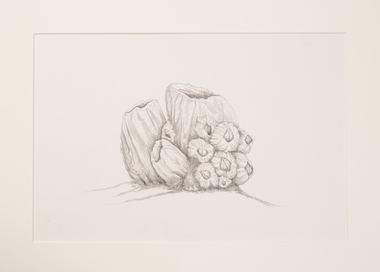 Ararat Gallery TAMA
Annemieke Mein, Study for Barnacles, 1984-1987
... art, natural history and craft. Her intricate stitched works bring to life insects, birds, plants, and the Australian landscape with astonishing detail and sensitivity. Combining technical mastery with deep environmental...art, natural history and craft. Her intricate stitched works bring to life insects, birds, plants, and the Australian landscape with astonishing detail and sensitivity. Combining technical mastery with deep environmental ...Annemieke Mein OAM is a Dutch-born Australian textile artist, based in Sale, Gippsland, who has drawn acclaim nationally and from abroad for her vivid recreations of Australian endemic fauna and flora. She was the first textile artist to be made a member of Wildlife Art Society of Australasia and the Australian Guild of Realist Artists. Mein is celebrated for making exquisite and accessible work that sits at the intersection of fine art, natural history and craft. Her intricate stitched works bring to life insects, birds, plants, and the Australian landscape with astonishing detail and sensitivity. Combining technical mastery with deep environmental awareness, Mein’s art resonates with audiences by celebrating the beauty of the natural world. She is admired not only for elevating textiles beyond the realm of domestic craft, but also for inspiring wonder and respect for Australia’s biodiversity. Her ability to blend fine art, storytelling, and natural history has made her one of Australia’s most beloved textile artists. -
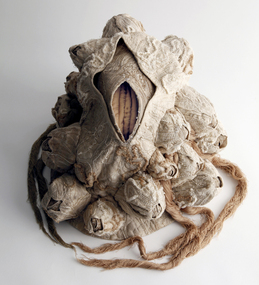 Ararat Gallery TAMA
Annemieke Mein, Barnacles, 1984-1987
... art, natural history and craft. Her intricate stitched works bring to life insects, birds, plants, and the Australian landscape with astonishing detail and sensitivity. Combining technical mastery with deep environmental...art, natural history and craft. Her intricate stitched works bring to life insects, birds, plants, and the Australian landscape with astonishing detail and sensitivity. Combining technical mastery with deep environmental ...Annemieke Mein OAM is a Dutch-born Australian textile artist, based in Sale, Gippsland, who has drawn acclaim nationally and from abroad for her vivid recreations of Australian endemic fauna and flora. She was the first textile artist to be made a member of Wildlife Art Society of Australasia and the Australian Guild of Realist Artists. Mein is celebrated for making exquisite and accessible work that sits at the intersection of fine art, natural history and craft. Her intricate stitched works bring to life insects, birds, plants, and the Australian landscape with astonishing detail and sensitivity. Combining technical mastery with deep environmental awareness, Mein’s art resonates with audiences by celebrating the beauty of the natural world. She is admired not only for elevating textiles beyond the realm of domestic craft, but also for inspiring wonder and respect for Australia’s biodiversity. Her ability to blend fine art, storytelling, and natural history has made her one of Australia’s most beloved textile artists. -
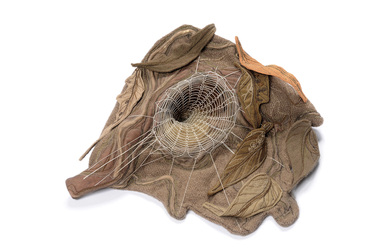 Ararat Gallery TAMA
Annemieke Mein, A Shovel of Soil, 1982
... art, natural history and craft. Her intricate stitched works bring to life insects, birds, plants, and the Australian landscape with astonishing detail and sensitivity. Combining technical mastery with deep environmental...art, natural history and craft. Her intricate stitched works bring to life insects, birds, plants, and the Australian landscape with astonishing detail and sensitivity. Combining technical mastery with deep environmental ...Annemieke Mein OAM is a Dutch-born Australian textile artist, based in Sale, Gippsland, who has drawn acclaim nationally and from abroad for her vivid recreations of Australian endemic fauna and flora. She was the first textile artist to be made a member of Wildlife Art Society of Australasia and the Australian Guild of Realist Artists. Mein is celebrated for making exquisite and accessible work that sits at the intersection of fine art, natural history and craft. Her intricate stitched works bring to life insects, birds, plants, and the Australian landscape with astonishing detail and sensitivity. Combining technical mastery with deep environmental awareness, Mein’s art resonates with audiences by celebrating the beauty of the natural world. She is admired not only for elevating textiles beyond the realm of domestic craft, but also for inspiring wonder and respect for Australia’s biodiversity. Her ability to blend fine art, storytelling, and natural history has made her one of Australia’s most beloved textile artists. -
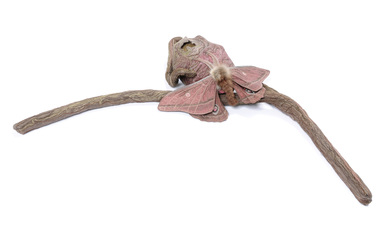 Ararat Gallery TAMA
Annemieke Mein, Pink Emperor Gum Moth, 1982
... art, natural history and craft. Her intricate stitched works bring to life insects, birds, plants, and the Australian landscape with astonishing detail and sensitivity. Combining technical mastery with deep environmental...art, natural history and craft. Her intricate stitched works bring to life insects, birds, plants, and the Australian landscape with astonishing detail and sensitivity. Combining technical mastery with deep environmental ...Annemieke Mein OAM is a Dutch-born Australian textile artist, based in Sale, Gippsland, who has drawn acclaim nationally and from abroad for her vivid recreations of Australian endemic fauna and flora. She was the first textile artist to be made a member of Wildlife Art Society of Australasia and the Australian Guild of Realist Artists. Mein is celebrated for making exquisite and accessible work that sits at the intersection of fine art, natural history and craft. Her intricate stitched works bring to life insects, birds, plants, and the Australian landscape with astonishing detail and sensitivity. Combining technical mastery with deep environmental awareness, Mein’s art resonates with audiences by celebrating the beauty of the natural world. She is admired not only for elevating textiles beyond the realm of domestic craft, but also for inspiring wonder and respect for Australia’s biodiversity. Her ability to blend fine art, storytelling, and natural history has made her one of Australia’s most beloved textile artists. -
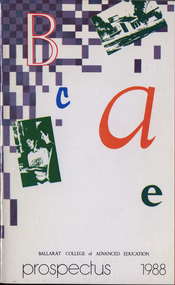 Federation University Historical Collection
Book, BCAE Prospectus 1988, 1988
... Art, Physics, Business Studies, Humanities and Librarianship. The tertiary division of the School of Mines was relocated to Mount Helen in 1970. The SCVB was established in 1925 by the Education Department as the Ballarat Teachers' College. It was one of two provincial teachers' colleges to be established. The first courses were concerned with primary teaching and manual arts but later the subject areas of Physical Education, Environmental...Art, Physics, Business Studies, Humanities and Librarianship. The tertiary division of the School of Mines was relocated to Mount Helen in 1970. The SCVB was established in 1925 by the Education Department as the Ballarat Teachers' College. It was one of two provincial teachers' colleges to be established. The first courses were concerned with primary teaching and manual arts but later the subject areas of Physical Education, Environmental ...The Ballarat College of Advanced Education was formed by the merging of the State College of Victoria at Ballarat (SCVB) and the Ballarat Institute of Advanced Education (BIAE). The parent body of BIAE was the Ballarat School of Mines, founded in 1870 to train personnel for mining activities. The first awards at diploma level were made in 1896 in the branches of English, Metallurgy and Geology. Over the years the range of courses broadened to include Art, Physics, Business Studies, Humanities and Librarianship. The tertiary division of the School of Mines was relocated to Mount Helen in 1970. The SCVB was established in 1925 by the Education Department as the Ballarat Teachers' College. It was one of two provincial teachers' colleges to be established. The first courses were concerned with primary teaching and manual arts but later the subject areas of Physical Education, Environmental Sciences, Music, Art and Craft became major strengths. The merger took place in 1976 and by 1980 all staff were located at the Mount Helen Campus. In 1988 Student accomdation included: * Mount Helen - 290 individual furnished study/bedrooms arranged in units of ten to fourten rooms. $64.05 including 4 evening meals * Gillies Street - 56 individaul study/bedrooms in two blocks each containing kitchen/dining room areas, a common room, as well as bathroom areas. Does not include meals. $37.80 per week. * Beaufort House - Managed by the Education Department, with BCAE playing a coordinating role in the placement of students. 75 single and shared accomodation with full board (14 meals per week) $73.80 per week * Nurses' Home - Ballarat Base Hospital authorities made approximately 100 individual study/bedrooms availabel to female students. (36.40 per week)White soft covered book with grey, blue, orange and green detail. It is the Ballarat College of Advanced Education Prospectus for 1988. It inclues admisson and application details, student services and facilities, open day, and undergraduate course information. ballarat college of advanced education, bcae, prospectus, vtac, international students, student accomodation, computer centre, library, childcare centre, campus shop, bean inn, applied science, arts, business, engineering, humanities, social sciences, librarianship, nursing, physical education, primary teaching, educaion, graduate diploma, sanyo micro-computers, apple iie computers, hewlett-packard 3000 model 70, hewlett-packard 9000/550 computer, cyber 180-835 at rmit, student union, gym, teacher resource centre -
 Federation University Art Collection
Artwork, other - Artwork, "West Park Proposition' by Ash Keating, 2013
... Artist Ash Keating works across a conceptual, site-responsive and often collaborative art practice that incorporates painting, sculpture, installation, video, performance and public interventions, and has referenced a wide range of social and environmental issues within his art. ...Artist Ash Keating works across a conceptual, site-responsive and often collaborative art practice that incorporates painting, sculpture, installation, video, performance and public interventions, and has referenced a wide range of social and environmental issues within his art. ...Ash KEATING Among fifteen finalists this artwork won the 2012 Guirguis New Art Prize, a prestigious national acquisitive biennial art prize administered by Federation University Australia. The Guirguis New Art Prize (GNAP) is a national acquisitive $20,000 contemporary art prize which presents a selection of Australia's most exciting contemporary artists with works that explore and embrace new ways of artistic expression, utilising existing mediums and new technologies in innovative ways. Initiated and generously supported by local Ballarat surgeon Mr Mark Guirguis, this prestigious art prize is administered by the Federation University Australia (FedUni). As a local philanthropist and art collector, in developing the Prize, Mark Guirguis' aims were to celebrate the significance of the arts to communities and to Ballarat, emphasising contemporary art and 'living' culture, and to highlight FedUni's Arts Academy. Artist Ash Keating works across a conceptual, site-responsive and often collaborative art practice that incorporates painting, sculpture, installation, video, performance and public interventions, and has referenced a wide range of social and environmental issues within his art. Frequently working beyond the gallery, and often harnessing community narrative and energy, his work also draws upon myth, ritual and ceremony. 'West Park Proposition', 2012, is a three channel and screen video installation, utilising multiple camera video documentation of an endurance painting intervention undertaken on the morning of 01 September 2012 on the east facing wall of a newly built tilt-slab industrial building, situated on the direct edge of the current urban and rural boundary in Truganina, Victoria. The multi-screen work documents an endurance guerilla-style action painting intervention and ritualised painting performance in which a symbolic violence is enacted against a storehouse of commodity production and consumption. Upon winning the award artists Ash Keating said; “The work was made near Ballarat on the Deer Park bypass. It is an aesthetic comment about the way these new tilt-slab industrial buildings spring up without caring for the environment." The work, which took eight hours to create, was about reclaiming the space from “cost-effective architecture” without any aesthetics. The inaugural judge for the Prize, Jason Smith, Director, Heide Museum of Modern Art (MoMA) said, "Selecting the winner of this inaugural GNAP was exhilarating and excruciating: exhilarating because the seriousness of each artist's enterprise, and their uncompromising resolution of concepts, has created an inaugural exhibition of exceptional power. This first GNAP is a survey of some of the most poetic and provocative imaginations working in Australia today. Selecting one winner from such a show in which each of these artists has in some way transformed my thinking about the world was the excruciating part. Ash Keating's work West Park Proposition, 2012 kept drawing me back in the several hours I spent viewing the works. It simultaneously affirms the political and critical role of the artist as a key agent of change and action, and someone who reminds us of the beauty and resilience of humanity and nature in the face of unrelenting change. As a work combining performance, collaboration and hope, Keating's West Park Proposition is a work of immense and compelling poetry."artist, artwork, keating, ash keating, guirguis, guirguis new art prize, gnap, gnap13 -
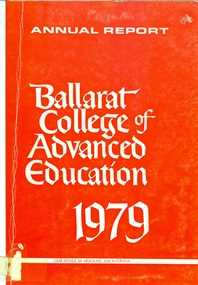 Federation University Historical Collection
Book, Ballarat College of Advanced Education Annual Report, 1979, 1979
... Environmental Science. Car parking facilities were extended at Mt Helen. ballarat college of advanced education bcae mt helen mount helen library computer Orange soft covered book of 35 pages. Contents include: Courses, student numbers, Victorian School of Forestry, financial statement, Education Building (T Building) completed, Gillies Street Campus, Art building under construction, Great Hall (1870s Founders Hall) completion date expected to be mid 1980, Centenary Appeal, E.J. ...In 1980 the President was M.B. John. In 1980 the administration staff moved out of the lower level of the library and the space was converted for teaching use. Extensive alterations were made to the lower level of the mechanical/Civil Engineering wing for the housing of Applied Geology and Environmental Science. Car parking facilities were extended at Mt Helen.Orange soft covered book of 35 pages. Contents include: Courses, student numbers, Victorian School of Forestry, financial statement, Education Building (T Building) completed, Gillies Street Campus, Art building under construction, Great Hall (1870s Founders Hall) completion date expected to be mid 1980, Centenary Appeal, E.J. Barker Library, Computer Centre, bookshop . ballarat college of advanced education, bcae, mt helen, mount helen, library computer -
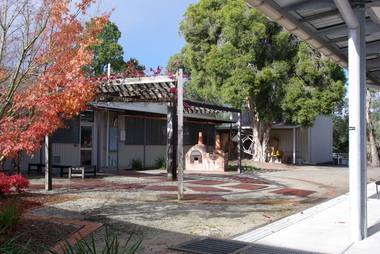 Federation University Historical Collection
Photograph, Clare Gervasoni, Federation University Gippsland Campus Art Courtyard, 2015, 01/06/2015
... environmental sustainability and regional capacity building has enabled it to develop in a way that draws on its proud heritage to inform its future. Its regional character sets a framework for the University’s priorities but does not constrain it from serving wider community interests, nationally and internationally. The name Federation University Australia was chosen to convey the scope and capacity of an expanded regional university with a federated network of campuses. churchill gippsland campus art ...Federation University Australia was established on 1 January 2014. Formerly known as the University of Ballarat, its enabling legislation was the University of Ballarat Amendment (Federation University Australia) Act 2013. On 1 January 2014, the University of Ballarat amalgamated with the Monash University Gippsland Campus to form Federation University Australia. The Gippsland Campus also had a long lineage dating back to 1928 with the establishment of the Yallourn Technical School which became a predecessor institution to the Gippsland College of Advanced Education formed in 1968. In 1990, it was renamed the Monash University College and in 1993 became the Gippsland Campus of Monash University. In 2016, Federation University Australia announced plans to take possession, over a two-year period, of Monash’s Berwick Campus in the south-east corridor of Melbourne. Federation University Australia, or FedUni, is headquartered in Ballarat and offers programs in Higher Education and Vocational Education and Training to regional Victoria and beyond. The University’s commitment to educational and social equity, teaching excellence, research distinction, environmental sustainability and regional capacity building has enabled it to develop in a way that draws on its proud heritage to inform its future. Its regional character sets a framework for the University’s priorities but does not constrain it from serving wider community interests, nationally and internationally. The name Federation University Australia was chosen to convey the scope and capacity of an expanded regional university with a federated network of campuses. Courtyard at the Gippsland Campus of Federation University.churchill, gippsland campus, art courtyard -
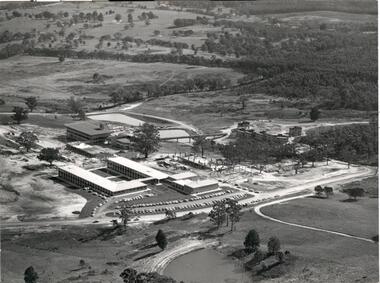 Federation University Historical Collection
Document, Mount Helen Campus Arboretum, c1992
... environmental initiative,” Ms Slade said. The tree planting project is a result of State Library Victoria’s ongoing partnership with Federation University. Construction of the Library’s second state-of-the-art...environmental initiative,” Ms Slade said. The tree planting project is a result of State Library Victoria’s ongoing partnership with Federation University. Construction of the Library’s second state-of-the-art ...A trail travels through the Arboretum where you may see resting kangaroos and wallabies, crosses a creek that holds a vulnerable colony of frogs commonly known as Victorian Smooth Froglet (Geocrinia victoriana), and admire the grass trees (Xanthorrhea australis) that grow on the campus behind accommodation. In 2018 2000 native trees planted by State Library Victoria and Federation University in the Arboretum .Planted with the help of locals, students, and kindergarten children as part of the joint project the plantings included indigenous trees, shrubs and grasses native to Ballarat. Federation University student Clancy Meaney is managing the tree planting project as part of her studies. “The arboretum is a fantastic resource that is used extensively by Federation University students as an outdoor classroom,” Ms Meaney said. “Being situated in between two main forests, our campus is also an important connection for native animals. These new trees will help migrating wildlife to move from one forest to the other.” State Library Victoria Project Management Office Director, Sarah Slade said the project was a wonderful opportunity to work with Mount Helen residents and the University to help protect the native landscape. “We’re thrilled to be able to give back to students, local residents and native flora and fauna through this valuable environmental initiative,” Ms Slade said. The tree planting project is a result of State Library Victoria’s ongoing partnership with Federation University. Construction of the Library’s second state-of-the-art storage facility, BOSS2 (Ballarat off-site store 2), is currently underway on the Federation University site. The existing storage facility at the Mount Helen Campus already holds more than half of the State Library’s collection, including newspapers, books, journals, textiles, paintings, architectural drawings, furniture and photographic glass plate negatives. In addition to State Library collection, BOSS2 will also provide two dedicated storage areas for the University’s collection. When completed, BOSS2 will provide additional storage of 25-30 linear kilometres, the equivalent of driving from Ballarat to Clunes or running 175 lengths of the MCG. The Mount Helen Campus Arboretum was established c1992.arboretum, mt helen campus arboretum, graeme ambrose, mt helen campus -
 Federation University Historical Collection
Photograph - Art Student, University of Ballarat Student study, c2005, c2005
... environmental sustainability and regional capacity building has enabled it to develop in a way that draws on its proud heritage to inform its future. Its regional character sets a framework for the University’s priorities but does not constrain it from serving wider community interests, nationally and internationally. The name Federation University Australia was chosen to convey the scope and capacity of an expanded regional university with a federated network of campuses. federation university mount helen campus Students alumni art ...Federation University Australia was established on 1 January 2014. Formerly known as the University of Ballarat, its enabling legislation was the University of Ballarat Amendment (Federation University Australia) Act 2013. Although formally created as a University in 1994, the University of Ballarat has a lineage back to 1870 with the establishment of the School of Mines Ballarat, making it the third institution of higher learning to be established in Australia and the first to be established in regional Australia. On 1 January 1994, Ballarat University College became the University of Ballarat and in 1998 the University merged with three TAFE Institutes to become a dual sector institution with multiple campuses. On 1 January 2014, the University of Ballarat amalgamated with the Monash University Gippsland Campus to form Federation University Australia. The Gippsland Campus also had a long lineage dating back to 1928 with the establishment of the Yallourn Technical School which became a predecessor institution to the Gippsland College of Advanced Education formed in 1968. In 1990, it was renamed the Monash University College and in 1993 became the Gippsland Campus of Monash University. In 2016, Federation University Australia announced plans to take possession, over a two-year period, of Monash’s Berwick Campus in the south-east corridor of Melbourne. Federation University Australia, or FedUni, is headquartered in Ballarat and offers programs in Higher Education and Vocational Education and Training to regional Victoria and beyond. The University’s commitment to educational and social equity, teaching excellence, research distinction, environmental sustainability and regional capacity building has enabled it to develop in a way that draws on its proud heritage to inform its future. Its regional character sets a framework for the University’s priorities but does not constrain it from serving wider community interests, nationally and internationally. The name Federation University Australia was chosen to convey the scope and capacity of an expanded regional university with a federated network of campuses.Colour photograph of students on the grass outside the Union Building on Mt Helen Campus.federation university, mount helen campus, students, alumni, art, painter -
 Federation University Historical Collection
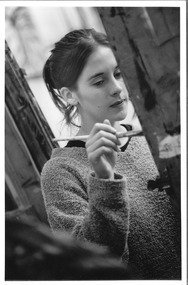
Photograph - Art Student, University of Ballarat Art Student, c2005, c2005
... environmental sustainability and regional capacity building has enabled it to develop in a way that draws on its proud heritage to inform its future. Its regional character sets a framework for the University’s priorities but does not constrain it from serving wider community interests, nationally and internationally. The name Federation University Australia was chosen to convey the scope and capacity of an expanded regional university with a federated network of campuses. federation university mount helen campus Students alumni art ...Federation University Australia was established on 1 January 2014. Formerly known as the University of Ballarat, its enabling legislation was the University of Ballarat Amendment (Federation University Australia) Act 2013. Although formally created as a University in 1994, the University of Ballarat has a lineage back to 1870 with the establishment of the School of Mines Ballarat, making it the third institution of higher learning to be established in Australia and the first to be established in regional Australia. On 1 January 1994, Ballarat University College became the University of Ballarat and in 1998 the University merged with three TAFE Institutes to become a dual sector institution with multiple campuses. On 1 January 2014, the University of Ballarat amalgamated with the Monash University Gippsland Campus to form Federation University Australia. The Gippsland Campus also had a long lineage dating back to 1928 with the establishment of the Yallourn Technical School which became a predecessor institution to the Gippsland College of Advanced Education formed in 1968. In 1990, it was renamed the Monash University College and in 1993 became the Gippsland Campus of Monash University. In 2016, Federation University Australia announced plans to take possession, over a two-year period, of Monash’s Berwick Campus in the south-east corridor of Melbourne. Federation University Australia, or FedUni, is headquartered in Ballarat and offers programs in Higher Education and Vocational Education and Training to regional Victoria and beyond. The University’s commitment to educational and social equity, teaching excellence, research distinction, environmental sustainability and regional capacity building has enabled it to develop in a way that draws on its proud heritage to inform its future. Its regional character sets a framework for the University’s priorities but does not constrain it from serving wider community interests, nationally and internationally. The name Federation University Australia was chosen to convey the scope and capacity of an expanded regional university with a federated network of campuses.Colour photograph of students on the grass outside the Union Building on Mt Helen Campus.federation university, mount helen campus, students, alumni, art, painter -
Marysville & District Historical Society
THE TRIANGLE NEWS-VOL 36 NO 4-FEBRUARY 6 2009
... environmental forum...disclaimer...fire calls...indidj art...marysville victoria australia dr lachlan fraser running australian ultramarathon runners assocn deadline advertising rates diary dates snippets from history gallipoli park joe white alex white kerami guest house wandsworth kerami crescent environmental forum disclaimer fire calls indidj art gallery australian & aboriginal art church notices mops women of hope bible quote men's fellowship breakfast life centre alexandra falls family fellowship mount cathedral baptist church buxton 10th anniversary founding fellowship ivor & yvonne jones buxton memorial hall buxton weather graphs marysville fire brigade children's services team trash & treasure stall holders wirreanda festival mystic mountains tourism marysville golfers alexandra cinema narby day narbethong hall bushdance & dinner outreach services murrindindi shire brewers choice home brew david kitchen gluten free beer community health services maryor's chair energy efficient homes councillor comment health & wellbeing new shire officer environment strategy yarra valley grape grazing country touch t.a.c. road safety planning permit notice of application payment of rates & charges marysville real estate marysville medical clinic THE TRIANGLE NEWS-VOL 36 NO 4-FEBRUARY 6 2009 ...marysville, victoria, australia, dr lachlan fraser, running, australian ultramarathon runners assocn, deadline, advertising rates, diary dates, snippets from history, gallipoli park, joe white, alex white, kerami guest house, wandsworth, kerami crescent, environmental forum, disclaimer, fire calls, indidj art gallery, australian & aboriginal art, church notices, mops, women of hope, bible quote, men's fellowship breakfast, life centre alexandra, falls family fellowship, mount cathedral baptist church buxton, 10th anniversary founding fellowship, ivor & yvonne jones, buxton memorial hall, buxton weather graphs, marysville fire brigade, children's services team, trash & treasure stall holders, wirreanda festival, mystic mountains tourism, marysville golfers, alexandra cinema, narby day, narbethong hall, bushdance & dinner, outreach services, murrindindi shire, brewers choice home brew, david kitchen, gluten free beer, community health services, maryor's chair, energy efficient homes, councillor comment, health & wellbeing, new shire officer, environment strategy, yarra valley grape grazing, country touch, t.a.c. road safety, planning permit notice of application, payment of rates & charges, marysville real estate, marysville medical clinic -
Federation University Historical Collection
Notes, Kath Cunningham, Ballarat Teachers' College Creative Activities Notes, 1962, 1962
... environmental sustainability and regional capacity building has enabled it to develop in a way that draws on its proud heritage to inform its future. Its regional character sets a framework for the University’s priorities but does not constrain it from serving wider community interests, nationally and internationally. The name Federation University Australia was chosen to convey the scope and capacity of an expanded regional university with a federated network of campuses. education creative activities art ...Ballarat Teachers' College notes on teaching Creative Studies and Needlework to primary school children. Federation University Australia was established on 1 January 2014. Formerly known as the University of Ballarat, its enabling legislation was the University of Ballarat Amendment (Federation University Australia) Act 2013. Although formally created as a University in 1994, the University of Ballarat has a lineage back to 1870 with the establishment of the School of Mines Ballarat, making it the third institution of higher learning to be established in Australia and the first to be established in regional Australia. On 1 January 1994, Ballarat University College became the University of Ballarat and in 1998 the University merged with three TAFE Institutes to become a dual sector institution with multiple campuses. On 1 January 2014, the University of Ballarat amalgamated with the Monash University Gippsland Campus to form Federation University Australia. The Gippsland Campus also had a long lineage dating back to 1928 with the establishment of the Yallourn Technical School which became a predecessor institution to the Gippsland College of Advanced Education formed in 1968. In 1990, it was renamed the Monash University College and in 1993 became the Gippsland Campus of Monash University. In 2016, Federation University Australia announced plans to take possession, over a two-year period, of Monash’s Berwick Campus in the south-east corridor of Melbourne. Federation University Australia, or FedUni, is headquartered in Ballarat and offers programs in Higher Education and Vocational Education and Training to regional Victoria and beyond. The University’s commitment to educational and social equity, teaching excellence, research distinction, environmental sustainability and regional capacity building has enabled it to develop in a way that draws on its proud heritage to inform its future. Its regional character sets a framework for the University’s priorities but does not constrain it from serving wider community interests, nationally and internationally. The name Federation University Australia was chosen to convey the scope and capacity of an expanded regional university with a federated network of campuses.A number of notes relating to teaching creative activities to primary school children. Includes needlework samples. education, creative activities, art, needlework, samples, apron -
Federation University Historical Collection
Book - Scrapbook, Ballarat Teachers' College Scrap Book, 1965, 1965
... environmental sustainability and regional capacity building has enabled it to develop in a way that draws on its proud heritage to inform its future. Its regional character sets a framework for the University’s priorities but does not constrain it from serving wider community interests, nationally and internationally. The name Federation University Australia was chosen to convey the scope and capacity of an expanded regional university with a federated network of campuses. ballarat teachers' college john gilbert george johnson ballarat teachers' college art collection monica miller monical miller retirement e. crimmins newsclippings Red covered scrapbook with blue spine and corners. ...The Ballarat Teachers' College is a predecessor institution of Federation University Australia. Federation University Australia was established on 1 January 2014. Formerly known as the University of Ballarat, its enabling legislation was the University of Ballarat Amendment (Federation University Australia) Act 2013. Although formally created as a University in 1994, the University of Ballarat has a lineage back to 1870 with the establishment of the School of Mines Ballarat, making it the third institution of higher learning to be established in Australia and the first to be established in regional Australia. On 1 January 1994, Ballarat University College became the University of Ballarat and in 1998 the University merged with three TAFE Institutes to become a dual sector institution with multiple campuses. On 1 January 2014, the University of Ballarat amalgamated with the Monash University Gippsland Campus to form Federation University Australia. The Gippsland Campus also had a long lineage dating back to 1928 with the establishment of the Yallourn Technical School which became a predecessor institution to the Gippsland College of Advanced Education formed in 1968. In 1990, it was renamed the Monash University College and in 1993 became the Gippsland Campus of Monash University. In 2016, Federation University Australia announced plans to take possession, over a two-year period, of Monash’s Berwick Campus in the south-east corridor of Melbourne. Federation University Australia, or FedUni, is headquartered in Ballarat and offers programs in Higher Education and Vocational Education and Training to regional Victoria and beyond. The University’s commitment to educational and social equity, teaching excellence, research distinction, environmental sustainability and regional capacity building has enabled it to develop in a way that draws on its proud heritage to inform its future. Its regional character sets a framework for the University’s priorities but does not constrain it from serving wider community interests, nationally and internationally. The name Federation University Australia was chosen to convey the scope and capacity of an expanded regional university with a federated network of campuses.Red covered scrapbook with blue spine and corners. Includes Ballarat Teachers' College staff and students, [hotography, newspaper clippings, George Johnson mural, retirement of Monica Miller.ballarat teachers' college, john gilbert, george johnson, ballarat teachers' college art collection, monica miller, monical miller retirement, e. crimmins, newsclippings -
 Federation University Historical Collection
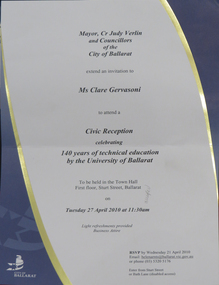
Invitation, City of Ballarat Reception Invitation to Mark the 140th Anniversary of the University of Ballarat, 2010, 27/04/2010
... environmental sustainability and regional capacity building has enabled it to develop in a way that draws on its proud heritage to inform its future. Its regional character sets a framework for the University’s priorities but does not constrain it from serving wider community interests, nationally and internationally. The name Federation University Australia was chosen to convey the scope and capacity of an expanded regional university with a federated network of campuses. The reception was attended by Clare Gervasoni, the University's Curator: Art...environmental sustainability and regional capacity building has enabled it to develop in a way that draws on its proud heritage to inform its future. Its regional character sets a framework for the University’s priorities but does not constrain it from serving wider community interests, nationally and internationally. The name Federation University Australia was chosen to convey the scope and capacity of an expanded regional university with a federated network of campuses. The reception was attended by Clare Gervasoni, the University's Curator: Art ...Federation University Australia was established on 1 January 2014. Formerly known as the University of Ballarat, its enabling legislation was the University of Ballarat Amendment (Federation University Australia) Act 2013. Although formally created as a University in 1994, the University of Ballarat has a lineage back to 1870 with the establishment of the School of Mines Ballarat, making it the third institution of higher learning to be established in Australia and the first to be established in regional Australia. On 1 January 1994, Ballarat University College became the University of Ballarat and in 1998 the University merged with three TAFE Institutes to become a dual sector institution with multiple campuses. On 1 January 2014, the University of Ballarat amalgamated with the Monash University Gippsland Campus to form Federation University Australia. The Gippsland Campus also had a long lineage dating back to 1928 with the establishment of the Yallourn Technical School which became a predecessor institution to the Gippsland College of Advanced Education formed in 1968. In 1990, it was renamed the Monash University College and in 1993 became the Gippsland Campus of Monash University. In 2016, Federation University Australia announced plans to take possession, over a two-year period, of Monash’s Berwick Campus in the south-east corridor of Melbourne. Federation University Australia, or FedUni, is headquartered in Ballarat and offers programs in Higher Education and Vocational Education and Training to regional Victoria and beyond. The University’s commitment to educational and social equity, teaching excellence, research distinction, environmental sustainability and regional capacity building has enabled it to develop in a way that draws on its proud heritage to inform its future. Its regional character sets a framework for the University’s priorities but does not constrain it from serving wider community interests, nationally and internationally. The name Federation University Australia was chosen to convey the scope and capacity of an expanded regional university with a federated network of campuses. The reception was attended by Clare Gervasoni, the University's Curator: Art & Historical Collections.City of Ballarat invitation to a civic reception celebrating 140 years of technical educatoin by the University of Ballarat. The reception was held in the Ballarat Town Hall. invitation, anniversary, city of ballarat, city of ballarat reception, judy verlin, university of ballarat, ballarat school of mines, 140th anniversary, ballarat school of mines 140th anniversary, ballarat town hall, city of ballarat logo, clare gervasoni -
 Glenelg Shire Council Cultural Collection
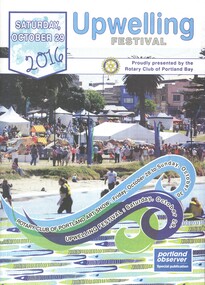
Programme, Rotary Club of Portland, Upwelling Festival 2016, 2016
... The Bonney Upwelling is a natural, environmental phenomenon which occurs each year where the spring winds shift to the south-east driving a change in ocean currents that power a seven month feeding frenzy of tuna, crayfish, giant crabs, squid, fish, sea birds, krill and blue whales. The Upwelling is at its greatest off the coast of Portland. The Festival features a parade, ocean and science talks, live music and art...The Bonney Upwelling is a natural, environmental phenomenon which occurs each year where the spring winds shift to the south-east driving a change in ocean currents that power a seven month feeding frenzy of tuna, crayfish, giant crabs, squid, fish, sea birds, krill and blue whales. The Upwelling is at its greatest off the coast of Portland. The Festival features a parade, ocean and science talks, live music and art ...The Upwelling Festival is a community celebration of the Bonney Upwelling. The Bonney Upwelling is a natural, environmental phenomenon which occurs each year where the spring winds shift to the south-east driving a change in ocean currents that power a seven month feeding frenzy of tuna, crayfish, giant crabs, squid, fish, sea birds, krill and blue whales. The Upwelling is at its greatest off the coast of Portland. The Festival features a parade, ocean and science talks, live music and artThe Upwelling Festival is an annual event in Portland which celebrates the unique environmental phenomenon happening off the coast of Portland. It is a community event of great significance.16 page booklet detailing the events of the 2016 Upwelling Festival. The booklet is printed in colour on thin paper. The front cover has the date of the festival to the left, next to the words, 'Upwelling Festival'. Underneath is an image of Portland foreshore with tens, people walking with kites and puppets as well as people in the water. The lower quarter of the front page has blue and green drawing depictions of eels and a wave design which contain the dates of the Rotary Club Art Show and the Upwelling Festival. The bottom right hand corner has the Portlan Observer logo. The back page features a full page advertisement for the Henty Bay Holiday Park.non-fictionbonney upwelling, blue whales, environment, portland, glenelg shire council, glenelg shire council cultural collection -
 Glenelg Shire Council Cultural Collection
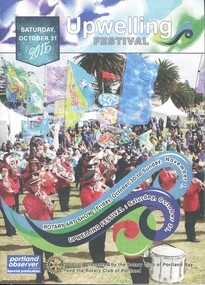
Programme, Rotary Club of Portland, Upwelling Festival 2015, 2015
... The Bonney Upwelling is a natural, environmental phenomenon which occurs each year where the spring winds shift to the south-east driving a change in ocean currents that power a seven month feeding frenzy of tuna, crayfish, giant crabs, squid, fish, sea birds, krill and blue whales. The Upwelling is at its greatest off the coast of Portland. The Festival features a parade, ocean and science talks, live music and art...The Bonney Upwelling is a natural, environmental phenomenon which occurs each year where the spring winds shift to the south-east driving a change in ocean currents that power a seven month feeding frenzy of tuna, crayfish, giant crabs, squid, fish, sea birds, krill and blue whales. The Upwelling is at its greatest off the coast of Portland. The Festival features a parade, ocean and science talks, live music and art ...The Upwelling Festival is a community celebration of the Bonney Upwelling. The Bonney Upwelling is a natural, environmental phenomenon which occurs each year where the spring winds shift to the south-east driving a change in ocean currents that power a seven month feeding frenzy of tuna, crayfish, giant crabs, squid, fish, sea birds, krill and blue whales. The Upwelling is at its greatest off the coast of Portland. The Festival features a parade, ocean and science talks, live music and artThe Upwelling Festival is an annual event in Portland which celebrates the unique environmental phenomenon happening off the coast of Portland. It is a community event of great significance.16 page booklet detailing the events of the 2015 Upwelling Festival. The booklet is printed in colour on thin paper. The front cover has the date of the festival to the left, next to the words, 'Upwelling Festival'. Underneath is an image of a brass band playing on Portland foreshore. Crowds surround the band and many are holding large colourful flags depicting marine images. The lower part of the image features a wave design which contain the dates of the Rotary Club Art Show and the Upwelling Festival. The bottom left hand corner has the Portland Observer logo. The back page features a full page advertisement for the Henty Bay Holiday Park.non-fictionbonney upwelling, blue whales, environment, portland, glenelg shire council, glenelg shire council cultural collection -
 Glenelg Shire Council Cultural Collection
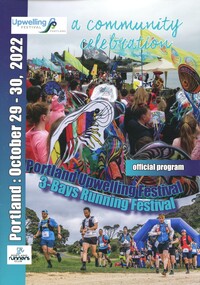
Programme, Upwelling Festival Committee, Upwelling Festival 2022: A Community Celebration, 2022
... The Bonney Upwelling is a natural, environmental phenomenon which occurs each year where the spring winds shift to the south-east driving a change in ocean currents that power a seven month feeding frenzy of tuna, crayfish, giant crabs, squid, fish, sea birds, krill and blue whales. The Upwelling is at its greatest off the coast of Portland. The Festival features a parade, ocean and science talks, live music and art...The Bonney Upwelling is a natural, environmental phenomenon which occurs each year where the spring winds shift to the south-east driving a change in ocean currents that power a seven month feeding frenzy of tuna, crayfish, giant crabs, squid, fish, sea birds, krill and blue whales. The Upwelling is at its greatest off the coast of Portland. The Festival features a parade, ocean and science talks, live music and art ...The Upwelling Festival is a community celebration of the Bonney Upwelling. The Bonney Upwelling is a natural, environmental phenomenon which occurs each year where the spring winds shift to the south-east driving a change in ocean currents that power a seven month feeding frenzy of tuna, crayfish, giant crabs, squid, fish, sea birds, krill and blue whales. The Upwelling is at its greatest off the coast of Portland. The Festival features a parade, ocean and science talks, live music and artThe Upwelling Festival is an annual event in Portland which celebrates the unique environmental phenomenon happening off the coast of Portland. It is a community event of great significance.8 page booklet detailing the events of the 2022 Upwelling Festival. The booklet is printed in colour on thick. glossy paper. The front cover features a blue margin down the left hand side in which are printed the words, ' Portland: October 29-30, 2022' vertically in white. Across the top in blue script is the title, 'a community celebration'. The top half of the front cover features a photograph of a crowd of people at Portland foreshore, many holding flags, kites and puppets. The lower half of the cover features a photograph pf runners. The two photos are separated by text which reads, ' Portland Upwelling Festival / 3-Bays Running Festival'. In the bottom left hand corner there is the Portland Runners Club logo.non-fictionbonney upwelling, blue whales, environment, portland, glenelg shire council, glenelg shire council cultural collection -
 Glenelg Shire Council Cultural Collection
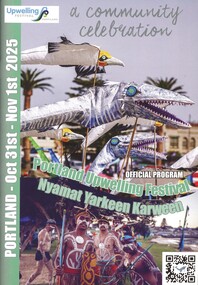
Programme, Upwelling Festival Committee, Upwelling Festival 2025: A Community Celebration, 2025
... The Bonney Upwelling is a natural, environmental phenomenon which occurs each year where the spring winds shift to the south-east driving a change in ocean currents that power a seven month feeding frenzy of tuna, crayfish, giant crabs, squid, fish, sea birds, krill and blue whales. The Upwelling is at its greatest off the coast of Portland. The Festival features a parade, ocean and science talks, live music and art...The Bonney Upwelling is a natural, environmental phenomenon which occurs each year where the spring winds shift to the south-east driving a change in ocean currents that power a seven month feeding frenzy of tuna, crayfish, giant crabs, squid, fish, sea birds, krill and blue whales. The Upwelling is at its greatest off the coast of Portland. The Festival features a parade, ocean and science talks, live music and art ...The Upwelling Festival is a community celebration of the Bonney Upwelling. The Bonney Upwelling is a natural, environmental phenomenon which occurs each year where the spring winds shift to the south-east driving a change in ocean currents that power a seven month feeding frenzy of tuna, crayfish, giant crabs, squid, fish, sea birds, krill and blue whales. The Upwelling is at its greatest off the coast of Portland. The Festival features a parade, ocean and science talks, live music and artThe Upwelling Festival is an annual event in Portland which celebrates the unique environmental phenomenon happening off the coast of Portland. It is a community event of great significance.8 page booklet detailing the events of the 2025 Upwelling Festival. The booklet is printed in colour on thick. glossy paper. The front cover features a green margin down the left hand side in which are printed the words, ' Portland: Oct 31st - Nov 1st , 2025' vertically in white. Across the top in dark green script is the title, 'a community celebration'. The top half of the front cover features a photograph of crafted kites/puppets of sea creatures and birds. The lower half of the cover features a photograph of the Gunditjmara dancers, Koondoon Yarkeen Karween. The two photos are separated by text which reads, ' Portland Upwelling Festival / Nyamat Yarkeen Karween'. In the bottom right hand corner there a QR code.non-fictionbonney upwelling, blue whales, environment, portland, glenelg shire council, glenelg shire council cultural collection, gunditjmara, nyamat mirring -
 Glenelg Shire Council Cultural Collection
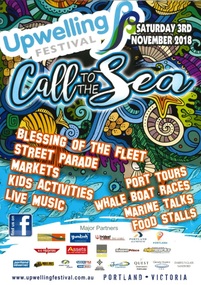
Poster - Upwelling Festival Poster, 2018, Upwelling Festival Committee, 2018
... The Bonney Upwelling is a natural, environmental phenomenon which occurs each year where the spring winds shift to the south-east driving a change in ocean currents that power a seven month feeding frenzy of tuna, crayfish, giant crabs, squid, fish, sea birds, krill and blue whales. The Upwelling is at its greatest off the coast of Portland. The Festival features a parade, ocean and science talks, live music and art...The Bonney Upwelling is a natural, environmental phenomenon which occurs each year where the spring winds shift to the south-east driving a change in ocean currents that power a seven month feeding frenzy of tuna, crayfish, giant crabs, squid, fish, sea birds, krill and blue whales. The Upwelling is at its greatest off the coast of Portland. The Festival features a parade, ocean and science talks, live music and art ...The Upwelling Festival is a community celebration of the Bonney Upwelling. The Bonney Upwelling is a natural, environmental phenomenon which occurs each year where the spring winds shift to the south-east driving a change in ocean currents that power a seven month feeding frenzy of tuna, crayfish, giant crabs, squid, fish, sea birds, krill and blue whales. The Upwelling is at its greatest off the coast of Portland. The Festival features a parade, ocean and science talks, live music and artThe Upwelling Festival is an annual event in Portland which celebrates the unique environmental phenomenon happening off the coast of Portland. It is a community event of great significance. Poster advertising Upwelling festival in Portland, Sat. 3 November 2018. The poster features colourful marine images such as fish, shells and tentacles. The images are drawn. The top left features the title Upwelling Festival on a slant with the date next to it. Underneath is written, 'Call to the Sea' in large blue script. At the bottom of the poster are a number of logos of partners to the Festival. The very bottom features - www.upwellingfestival.com.au portland upwelling festival, whales, whale, mammal, environmental, marine ecology -
 Glenelg Shire Council Cultural Collection
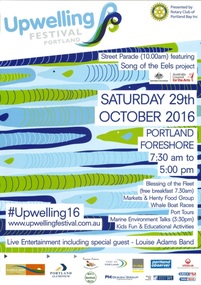
Poster - Upwelling Festival Poster, 2016, Upwelling Festival Committee, 2016
... The Bonney Upwelling is a natural, environmental phenomenon which occurs each year where the spring winds shift to the south-east driving a change in ocean currents that power a seven month feeding frenzy of tuna, crayfish, giant crabs, squid, fish, sea birds, krill and blue whales. The Upwelling is at its greatest off the coast of Portland. The Festival features a parade, ocean and science talks, live music and art...The Bonney Upwelling is a natural, environmental phenomenon which occurs each year where the spring winds shift to the south-east driving a change in ocean currents that power a seven month feeding frenzy of tuna, crayfish, giant crabs, squid, fish, sea birds, krill and blue whales. The Upwelling is at its greatest off the coast of Portland. The Festival features a parade, ocean and science talks, live music and art ...The Upwelling Festival is a community celebration of the Bonney Upwelling. The Bonney Upwelling is a natural, environmental phenomenon which occurs each year where the spring winds shift to the south-east driving a change in ocean currents that power a seven month feeding frenzy of tuna, crayfish, giant crabs, squid, fish, sea birds, krill and blue whales. The Upwelling is at its greatest off the coast of Portland. The Festival features a parade, ocean and science talks, live music and artThe Upwelling Festival is an annual event in Portland which celebrates the unique environmental phenomenon happening off the coast of Portland. It is a community event of great significance. Poster advertising Upwelling festival in Portland, Sat. 29 October 2016. The poster features blue and green depictions of eels. The images are drawn. The top left features the title Upwelling Festival Portland with 'Presented by Rotary Club of Portland Bay Inc' typed next to it. The poster details a programme of events including the Song of the Eels Project. Logos to the bottom of the poster.portland upwelling festival, whales, whale, mammal, environmental, marine ecology, gunditjmara, portland -
 Glenelg Shire Council Cultural Collection
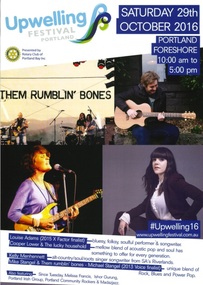
Poster - Upwelling Festival Poster, 2016, Upwelling Festival Committee, 2016
... The Bonney Upwelling is a natural, environmental phenomenon which occurs each year where the spring winds shift to the south-east driving a change in ocean currents that power a seven month feeding frenzy of tuna, crayfish, giant crabs, squid, fish, sea birds, krill and blue whales. The Upwelling is at its greatest off the coast of Portland. The Festival features a parade, ocean and science talks, live music and art...The Bonney Upwelling is a natural, environmental phenomenon which occurs each year where the spring winds shift to the south-east driving a change in ocean currents that power a seven month feeding frenzy of tuna, crayfish, giant crabs, squid, fish, sea birds, krill and blue whales. The Upwelling is at its greatest off the coast of Portland. The Festival features a parade, ocean and science talks, live music and art ...The Upwelling Festival is a community celebration of the Bonney Upwelling. The Bonney Upwelling is a natural, environmental phenomenon which occurs each year where the spring winds shift to the south-east driving a change in ocean currents that power a seven month feeding frenzy of tuna, crayfish, giant crabs, squid, fish, sea birds, krill and blue whales. The Upwelling is at its greatest off the coast of Portland. The Festival features a parade, ocean and science talks, live music and artThe Upwelling Festival is an annual event in Portland which celebrates the unique environmental phenomenon happening off the coast of Portland. It is a community event of great significance. Poster advertising Upwelling festival in Portland, Sat. 29 October 2016. The poster features four photographs of music acts performing at the festival. To the top is the festival title along side dates and times and to the bottom is the music line up - Louise Adams, Cooper Lower, Kelly Menhennett and Mike Stangelportland upwelling festival, whales, whale, mammal, environmental, marine ecology, gunditjmara, portland, live music -
 Glenelg Shire Council Cultural Collection
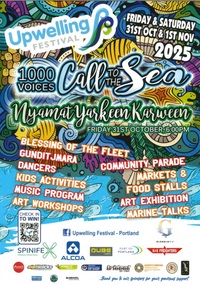
Poster - Upwelling Festival Poster, 2025, Upwelling Festival Committee, 2025
... The Bonney Upwelling is a natural, environmental phenomenon which occurs each year where the spring winds shift to the south-east driving a change in ocean currents that power a seven month feeding frenzy of tuna, crayfish, giant crabs, squid, fish, sea birds, krill and blue whales. The Upwelling is at its greatest off the coast of Portland. The Festival features a parade, ocean and science talks, live music and art...The Bonney Upwelling is a natural, environmental phenomenon which occurs each year where the spring winds shift to the south-east driving a change in ocean currents that power a seven month feeding frenzy of tuna, crayfish, giant crabs, squid, fish, sea birds, krill and blue whales. The Upwelling is at its greatest off the coast of Portland. The Festival features a parade, ocean and science talks, live music and art ...The Upwelling Festival is a community celebration of the Bonney Upwelling. The Bonney Upwelling is a natural, environmental phenomenon which occurs each year where the spring winds shift to the south-east driving a change in ocean currents that power a seven month feeding frenzy of tuna, crayfish, giant crabs, squid, fish, sea birds, krill and blue whales. The Upwelling is at its greatest off the coast of Portland. The Festival features a parade, ocean and science talks, live music and artThe Upwelling Festival is an annual event in Portland which celebrates the unique environmental phenomenon happening off the coast of Portland. It is a community event of great significance. Poster advertising Upwelling festival in Portland, Friday 31 October and Saturday 1 November. The poster features colourful marine and sea life images in the background. Over the top is the name of the festival as well as the script, 'Call to the Sea' and 'Nyamat Yarkeen Karween'. The bottom half of the poster features a list of events with logos of partners to the bottom of the poster.portland upwelling festival, whales, whale, mammal, environmental, marine ecology, gunditjmara, portland, live music -
 Eltham District Historical Society Inc
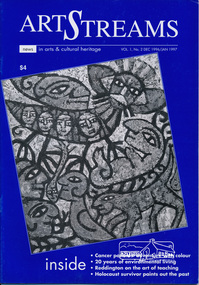
Journal, Peter Doughtery, ArtStreams: News in arts and cultural heritage; Vol. 1, No. 2, Dec 1996/Jan 1997, 1996
... Vol. 1, No. 2 Dec 1996/Jan 1997 CONTENTS ADVENTURE WITH COLOUR Teenage cancer patients challenge their illness with art 3 CD REVIEWS New music by local musicians 5 LIVE AND LET LIVE 20 years of environmental living 6 AUSTRALIA REVISITED Artist Charles Reddington ponders live 30 years on 8 POETRY REVIEW Anne Delaney looks at new work by Jennifer Harrison and Jordie Albiston 11 PHOTOGRAPHY Katherine Jones aims at hard edges 16 IMAGES FROM A DARK PAST Holocaust survivor paints out a traumatic part of his life 18 MORALITY OF JUSTICE The Truth Game - a play by Ray Mooney 21 ART FROM THE HEART An exhibition that crosses boundaries 22 SHORT STORY New story from an emerging writer 25 ART IN THE CEMETERY Darebin launches a new project to decorate its new mausoleum 28 LISTINGS Artists, performers and galleries 29 KEYWORDS 895 Main Road, 1994 Moet et Chandon Fellowship, Adventure with Colour, Alan Bonney, Alan Constable, Alun Leach-Jones, Amada Laming, Anne Connor & Associates, Anne Delaney, Anthony Day, Art Streams Magazine, Artist-in-residence, Arts by the Waters, Arts project Australia, Auschwitz, Banyule Jazz Festival, Barbara Veheary, Bend of Islands Conservation Association (BICA), Bend of Islands Estate, Bend of Islands, Bill Downing, Bulleen Art & Garden Centre, Bulleen Nursery, Caffe Poco, Carlton Courthouse Theatre, Catani Boulevard, Catherine Oxley Reserve, Charles Reddington, Charlie Dowley, Cheryl Daye, Chris McAuliffe, Clifton Pugh, Colin Lanceley, Cornelia Selover, Creativitie et Handicap Mental (CREAHM), Cynthia Hardman, Cyril Tawney, Damian Eyre, Daniel Lillford, Danuta Michalska, Darebin Arts and Entertainment Centre, Darebin City Council, Department of Fine Arts, Donald Campbell, Dora Zable, Dorothy Berry, dunmoochin, E.H. ...Vol. 1, No. 2 Dec 1996/Jan 1997 CONTENTS ADVENTURE WITH COLOUR Teenage cancer patients challenge their illness with art 3 CD REVIEWS New music by local musicians 5 LIVE AND LET LIVE 20 years of environmental living 6 AUSTRALIA REVISITED Artist Charles Reddington ponders live 30 years on 8 POETRY REVIEW Anne Delaney looks at new work by Jennifer Harrison and Jordie Albiston 11 PHOTOGRAPHY Katherine Jones aims at hard edges 16 IMAGES FROM A DARK PAST Holocaust survivor paints out a traumatic part of his life 18 MORALITY OF JUSTICE The Truth Game - a play by Ray Mooney 21 ART FROM THE HEART An exhibition that crosses boundaries 22 SHORT STORY New story from an emerging writer 25 ART IN THE CEMETERY Darebin launches a new project to decorate its new mausoleum 28 LISTINGS Artists, performers and galleries 29 KEYWORDS 895 Main Road, 1994 Moet et Chandon Fellowship, Adventure with Colour, Alan Bonney, Alan Constable, Alun Leach-Jones, Amada Laming, Anne Connor & Associates, Anne Delaney, Anthony Day, Art Streams Magazine, Artist-in-residence, Arts by the Waters, Arts project Australia, Auschwitz, Banyule Jazz Festival, Barbara Veheary, Bend of Islands Conservation Association (BICA), Bend of Islands Estate, Bend of Islands, Bill Downing, Bulleen Art & Garden Centre, Bulleen Nursery, Caffe Poco, Carlton Courthouse Theatre, Catani Boulevard, Catherine Oxley Reserve, Charles Reddington, Charlie Dowley, Cheryl Daye, Chris McAuliffe, Clifton Pugh, Colin Lanceley, Cornelia Selover, Creativitie et Handicap Mental (CREAHM), Cynthia Hardman, Cyril Tawney, Damian Eyre, Daniel Lillford, Danuta Michalska, Darebin Arts and Entertainment Centre, Darebin City Council, Department of Fine Arts, Donald Campbell, Dora Zable, Dorothy Berry, dunmoochin, E.H. ...Vol. 1, No. 2 Dec 1996/Jan 1997 CONTENTS ADVENTURE WITH COLOUR Teenage cancer patients challenge their illness with art 3 CD REVIEWS New music by local musicians 5 LIVE AND LET LIVE 20 years of environmental living 6 AUSTRALIA REVISITED Artist Charles Reddington ponders live 30 years on 8 POETRY REVIEW Anne Delaney looks at new work by Jennifer Harrison and Jordie Albiston 11 PHOTOGRAPHY Katherine Jones aims at hard edges 16 IMAGES FROM A DARK PAST Holocaust survivor paints out a traumatic part of his life 18 MORALITY OF JUSTICE The Truth Game - a play by Ray Mooney 21 ART FROM THE HEART An exhibition that crosses boundaries 22 SHORT STORY New story from an emerging writer 25 ART IN THE CEMETERY Darebin launches a new project to decorate its new mausoleum 28 LISTINGS Artists, performers and galleries 29 KEYWORDS 895 Main Road, 1994 Moet et Chandon Fellowship, Adventure with Colour, Alan Bonney, Alan Constable, Alun Leach-Jones, Amada Laming, Anne Connor & Associates, Anne Delaney, Anthony Day, Art Streams Magazine, Artist-in-residence, Arts by the Waters, Arts project Australia, Auschwitz, Banyule Jazz Festival, Barbara Veheary, Bend of Islands Conservation Association (BICA), Bend of Islands Estate, Bend of Islands, Bill Downing, Bulleen Art & Garden Centre, Bulleen Nursery, Caffe Poco, Carlton Courthouse Theatre, Catani Boulevard, Catherine Oxley Reserve, Charles Reddington, Charlie Dowley, Cheryl Daye, Chris McAuliffe, Clifton Pugh, Colin Lanceley, Cornelia Selover, Creativitie et Handicap Mental (CREAHM), Cynthia Hardman, Cyril Tawney, Damian Eyre, Daniel Lillford, Danuta Michalska, Darebin Arts and Entertainment Centre, Darebin City Council, Department of Fine Arts, Donald Campbell, Dora Zable, Dorothy Berry, dunmoochin, E.H. Cameron, Edward (Ned) Haughton, Edward Car, Elizabeth Vercoe, Eltham High School, Eltham Living and Learning Centre, Environmental Living Zone (ELZ), Eric Bogle, Eucalypso, Felix Tuszynski, Food For All Seasons, Frank Hodgkinson, Fulli Andrinopoulos, Gallery of Georges of Collins Street, Gallery of Slavic Art, Glen Agnes Bend of Islands Estate, Glen Agnes Estate, Gongflers drive, Greg O'Leary, Harold (Jimmy) Fuller, Helen O'Grady Children's Drama Academy, Henley Road, Ian Doolan Hamilton, Ian Gawler, Inside Out/Outside In, Ironbark Road, Janice McBride, Jennifer Harrison, Jennifer McGregor, Jessie Agnes Haughton, Jimmy Pike, Joan Blakey, John Mackay Northe, John Rasmussen, Jordie Albiston, Julian Martin, Kangaroo Ground, Katherine Jones, Kelvin Heffernan, Kew Coattage, Kitty Ginter, Lavita Mossop, Les darcy, Les Gyori, Life with Jane, Lorraine Larter, Luc Boulange, Luciana Giardina, Manningham Artspace, Manningham City Council, Mariann Moxon, Mark Capozzi, Mark Chapman, Mark Wilkinson, Maxine Ryder, Melbourne Police Pipe Band, Mick Woiwod, Mike O'Rourke, Monica Burns, Montsalvat, Myra Hilgendorf, Nancye Ball, Page family, Pam Crohan, Pam Dougherty, Poetry, Preston Public Cemetery, Ray Mooney, Richard Haese, Robert Hughes, Robyn Kirkpatrick, Roger Lemke, Ron Hanson, Sandra Harvey, Shire of Eltham Office site, Shire of Healesville, Shire of Nillumbik, Shire Offices, Sounds by the Waters, Stelio Costa, Steven Tynan, Steven Worrell, Stewart Whiffin, Sue Howard, Sue Whiffin, Sugarloaf Reservoir, Sydney Ball, The Art of Australia, The Mews, The Truth Game, Tom Fantl, Tony Inglese, Tuszynski Survey Exhibition, University of Melbourne, Valerio Ciccone, victorian artists supplies, Watson Creek Bridge, Watsons Creek, Wayne Marnell, Woody Guthrie, Yarra Brae Dam, Yarra River"Peter Dougherty has been involved in the local art scene for many years. As publisher and editor of the arts magazine Artstreams, his comments on the various branches of the arts are widely respected. His "The Arts" column in the Diamond Valley Leader presents a brief summary for a much wider cross section of the local community. Peter also operates his own gallery and the Artstreams Cafe at the St Andrews market. Peter has a wealth of knowledge about present day and historical aspects of local art and artists." - Eltham District Historical Society Newsletter No. 161, March 2005Colour front and back cover with feature articles and literary pieces with photographs and advertisements printed in black and white. 36 pages, 30 cm. Vol. 1, no. 1 (Nov. 1996) - Vol. 10, no. 5 (summer ed. 2005/06) art streams, feliz tuszynski, elizabeth vercoe, eucalypso, bend of islands, charles reddington, jennifer harrison, jordie albiston, katherine jones, anne bonney, mick woiwood, anne connor, anne delaney, ray mooney, pam dougherty, arts project australia, lavita mossop, preston public cemetery, helen o'grady children's drama academy, bulleen nursery -
 Eltham District Historical Society Inc
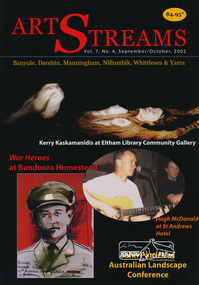
Journal, Peter Doughtery, ArtStreams: Banyule, Darebin, Manningham, Nillumbik, Whittlesea & Yarra; Vol. 7, No. 4, Sep-Oct 2002, 2002
... Vol. 7, No. 4, Sep-Oct 2002 CONTENTS Comment 2 War Heroes: the blood and the glory 3 Geoff Todd tells it all in paint John Patrick on trees and environmental survival 8 Pam Dougherty Short Story: Treading water 10 David Fettling Rivers of Life: Paintings by Kerry Kaskamanidis 13 Jill Orr: performance artist 14 John Jenkins Making Art with Liz Nettleton 16 Book review: Contemporary Aboriginal Art 18 Susan McCulloch Poetry News and Reviews 20 John Jenkins CD Reviews 22 Geoff Achison, Mirth, King Kadu On Various Bards 24 John di Mase Artin'about 27 Wining and Dining 30 Poetry by Ian McBryde 32 ...Vol. 7, No. 4, Sep-Oct 2002 CONTENTS Comment 2 War Heroes: the blood and the glory 3 Geoff Todd tells it all in paint John Patrick on trees and environmental survival 8 Pam Dougherty Short Story: Treading water 10 David Fettling Rivers of Life: Paintings by Kerry Kaskamanidis 13 Jill Orr: performance artist 14 John Jenkins Making Art with Liz Nettleton 16 Book review: Contemporary Aboriginal Art 18 Susan McCulloch Poetry News and Reviews 20 John Jenkins CD Reviews 22 Geoff Achison, Mirth, King Kadu On Various Bards 24 John di Mase Artin'about 27 Wining and Dining 30 Poetry by Ian McBryde 32 "Peter Dougherty has been involved in the local art scene for many years. ...Vol. 7, No. 4, Sep-Oct 2002 CONTENTS Comment 2 War Heroes: the blood and the glory 3 Geoff Todd tells it all in paint John Patrick on trees and environmental survival 8 Pam Dougherty Short Story: Treading water 10 David Fettling Rivers of Life: Paintings by Kerry Kaskamanidis 13 Jill Orr: performance artist 14 John Jenkins Making Art with Liz Nettleton 16 Book review: Contemporary Aboriginal Art 18 Susan McCulloch Poetry News and Reviews 20 John Jenkins CD Reviews 22 Geoff Achison, Mirth, King Kadu On Various Bards 24 John di Mase Artin'about 27 Wining and Dining 30 Poetry by Ian McBryde 32 "Peter Dougherty has been involved in the local art scene for many years. As publisher and editor of the arts magazine Artstreams, his comments on the various branches of the arts are widely respected. His "The Arts" column in the Diamond Valley Leader presents a brief summary for a much wider cross section of the local community. Peter also operates his own gallery and the Artstreams Cafe at the St Andrews market. Peter has a wealth of knowledge about present day and historical aspects of local art and artists." - Eltham District Historical Society Newsletter No. 161, March 2005Colour front and back cover with feature articles and literary pieces with photographs and advertisements printed in black and white. 36 pages, 30 cm. Vol. 1, no. 1 (Nov. 1996) - Vol. 10, no. 5 (summer ed. 2005/06) art streams, aboriginal reconciliation, bundoora homestead, jacqueline healy, willy wonka's ice cream gourmet food, melbourne rudolf steiner school, eltham fullife pharmacy, montsalvat, trees, landscape degeneration, urban development, david fettling, dynamic vegies, nillumbik artists' open studios, kerry kaskamanidis, jill orr, john jenkins, thompson's pharmacy, liz nettleton, st andrews hotel, hurstbridge nursery, chris pittard, mary-lou pittard, eltham wiregrass gallery, john di mase, eltham warrandyte pottery open studio, ian mcbryde, bulleen art & garden centre -
 Eltham District Historical Society Inc
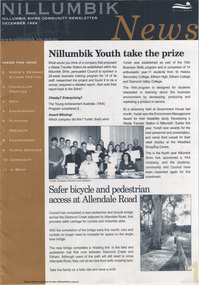
Journal - Newsletter, Nillumbik Shire Council, Nillumbik News, December 1999
... Includes articles on a youth project, bicycle bridge at Allendale Road, mayor's message, incuding year's report, Eltham festival, profiles of Councillors, latest acquistion for the Nillumbik Art Collection "Sensory Integration Invention A" by Cathy Smith and other art and culture news, agriculture and the new planning scheme with mention of local businesses. Planning issues with works to "underground" powerlines on the western side of Main Road in Eltham, plans for an environmental reserve in Falkiner Street, Eltham. ...Includes articles on a youth project, bicycle bridge at Allendale Road, mayor's message, incuding year's report, Eltham festival, profiles of Councillors, latest acquistion for the Nillumbik Art Collection "Sensory Integration Invention A" by Cathy Smith and other art and culture news, agriculture and the new planning scheme with mention of local businesses. Planning issues with works to "underground" powerlines on the western side of Main Road in Eltham, plans for an environmental reserve in Falkiner Street, Eltham. ...Community newsletter produced by the Shire of Nillumbik for December 1999. Includes articles on a youth project, bicycle bridge at Allendale Road, mayor's message, incuding year's report, Eltham festival, profiles of Councillors, latest acquistion for the Nillumbik Art Collection "Sensory Integration Invention A" by Cathy Smith and other art and culture news, agriculture and the new planning scheme with mention of local businesses. Planning issues with works to "underground" powerlines on the western side of Main Road in Eltham, plans for an environmental reserve in Falkiner Street, Eltham. Articles on radiant heat and new national road rules, Disability access policy, tennis, youth, Bend of Islands, VCAT order to reinstate vegetation removed illegally by an Eltham property owner, roundabout at Wattle Glen, and road sealing works.council newsletters, nillumbik news, nillumbik shire council, shire of nillumbik, youth, st helena secondary college, eltham high school, eltham college, eltham festival, vika bull, linda bull, paul french, dianne bullen, cr. phillip hughes, julie barber, nillumbik art collection, gayle knight, monty osewald, robyn harris, john harris, alec sutherland, falkiner street, jessica monk, kristian turner, gyuto monks of tibet, gyuto monks, haydie gooder, brougham street, radiant heat, road rules, disability, bend of islands, carol bonny, alan bonny, felicity faris, wattle glen, cr. bill penrose, norman golgerth, andre haemeyer, chris doherty, john munday
