
Showing 28 items matching "eucalyptus industry"
-
 Bendigo Historical Society Inc.
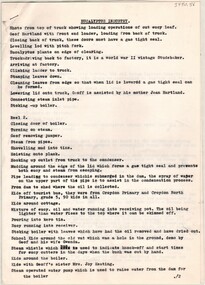
Document - AULSEBROOK COLLECTION: EUCALYPTUS INDUSTRY SCRIPT FOR A REEL AND ARTICLE ON THE EUCALYPTUS INDUSTRY
... AULSEBROOK COLLECTION: EUCALYPTUS INDUSTRY SCRIPT FOR A REEL AND ARTICLE ON THE EUCALYPTUS INDUSTRY...Eucalyptus oil...Bendigo industry...Aulsebrook collection: Eucalyptus Industry Script for and article on the Eucalyptus Industry and Hartland Farm history -5 pages, typed, -Script for 4 reels, and article on pages 4 and 5...Hartland's Farm Eucalyptus oil Bendigo industry Aulsebrook collection: Eucalyptus Industry Script for and article on the Eucalyptus Industry and Hartland Farm history -5 pages, typed, -Script for 4 reels, and article on pages 4 and 5 Document AULSEBROOK COLLECTION: EUCALYPTUS INDUSTRY SCRIPT FOR A REEL AND ARTICLE ON THE EUCALYPTUS INDUSTRY ...Aulsebrook collection: Eucalyptus Industry Script for and article on the Eucalyptus Industry and Hartland Farm history -5 pages, typed, -Script for 4 reels, and article on pages 4 and 5hartland's farm, eucalyptus oil, bendigo industry -
 Bendigo Historical Society Inc.
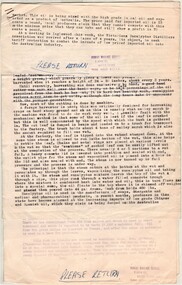
Document - AULSEBROOK COLLECTION: ARTICLE ON THE HISTORY OF EUCALYPTUS OIL INDUSTRY IN BENDIGO
... AULSEBROOK COLLECTION: ARTICLE ON THE HISTORY OF EUCALYPTUS OIL INDUSTRY IN BENDIGO...Eucalyptus oil...Bendigo industry...Aulsebrook Collection: Article on the history of Eucalyptus oil industry in Bendigo -4 pages stapled together, 1st page a small note, 2nd page typed article on the oil industry, 2 last pages, larger pages typed comprehensive information on the oil industry and specific types of oils...Eucalyptus oil Bendigo industry Aulsebrook Collection: Article on the history of Eucalyptus oil industry in Bendigo -4 pages stapled together, 1st page a small note, 2nd page typed article on the oil industry, 2 last pages, larger pages typed comprehensive information on the oil industry and specific types of oils Document AULSEBROOK COLLECTION: ARTICLE ON THE HISTORY OF EUCALYPTUS OIL INDUSTRY IN BENDIGO ...Aulsebrook Collection: Article on the history of Eucalyptus oil industry in Bendigo -4 pages stapled together, 1st page a small note, 2nd page typed article on the oil industry, 2 last pages, larger pages typed comprehensive information on the oil industry and specific types of oilseucalyptus oil, bendigo industry -
 Emerald Museum & Nobelius Heritage Park
Functional object - Green bottle, Melbourne Glass Bottle Works, 1900-1916
... ...Eucalyptus Industry...Emerald Victoria Australia Glassware medicines Eucalyptus Industry Two obscured letters "M" on base Green tinted rectangular bottle. ...Made by Melbourne Glass Bottle Works, later Australian Glass Manufacturers. Possibly used for eucalyptus oil.Green tinted rectangular bottle. Small chip on neck.Two obscured letters "M" on baseemerald, victoria, australia, glassware, medicines, eucalyptus industry -
Emerald Museum & Nobelius Heritage Park
Functional object - Eucalyptus oil bottle, Australian Glass Manufacturers et al, 1930+
... ...Eucalyptus Industry...Emerald Victoria Australia Glassware medicines Eucalyptus Industry Bosisto's Manufacturer's logo and marks on base (Australian Glass Manuf) G232, 366, MO. ...Clear glass bottle with rusted cap, heavily stained label for "Bosisto's" eucalyptus. Quarter contents remaining. Label dirty and unreadable in places, contents deterioratedManufacturer's logo and marks on base (Australian Glass Manuf) G232, 366, MO. Batch number on labelemerald, victoria, australia, glassware, medicines, eucalyptus industry, bosisto's -
Emerald Museum & Nobelius Heritage Park
Book - Eucalyptus Oil book, Peter and Tegan Abbott, Australia's Natural Wonder Eucalyptus Oil, 2000s
... ...Eucalyptus Industry...Bosisto's Eucalyptus Industry A book about eucalyptus oil inluding uses, production, history, real life stories, tips and recipes. ...This book about the uses etc of Eucalyptus is dedicated to Joseph Bosisto 1824 - 1898. He was an Australian pioneer, who in 1852 was the first person to produce eucalyptus oil commercially and who spent the next 45 years forstering its use worldwide. Bosisto set up distilleries in the Emerald and Macclesfield areas in the 1870s.The distillation of eucalyptus oil was one of the first industries in the Emerald area.A book about eucalyptus oil inluding uses, production, history, real life stories, tips and recipes. Dedicated to Joseph Bosisto.bosisto's, eucalyptus industry -
 Bendigo Historical Society Inc.
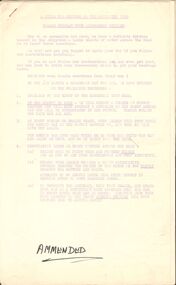
Document - PETER ELLIS COLLECTION: A GUIDE FOR DRIVERS ON THE WHIPSTICK TOUR
... ... Eucalyptus Oil Industry...The Bendigo Whipstick mentions area, suggestions of where the name Whipstick came from, shrubs and flowers with their flowering times, descriptions of some of them and some information on the Mallee Fowl. The Eucalyptus Oil Industry paragraph mentions the beginnings of the industry. ...The Bendigo Whipstick mentions area, suggestions of where the name Whipstick came from, shrubs and flowers with their flowering times, descriptions of some of them and some information on the Mallee Fowl. The Eucalyptus Oil Industry paragraph mentions the beginnings of the industry. ...A Guide for Drivers on the Whipstick Tour. First page gives assembly area, driving in convoy and negotiating water or boggy patches across the road. Amended written at the end of the page. Directions with mileage and items of interest for the tour on Sunday September 9th (no year). A Whipstick Map 1971 showing State Forest, Crown Lands, Uncleared Mallee - Private (shown in different colours) Water Reserve and Roads. Noted are Flora and Fauna - Plants, Birds & Mammals, and areas of State Forest and Southern State Forest with Mallee Scrub area noted. Also State Forest & Crown Lands Total Area and a map scale. The Bendigo Whipstick mentions area, suggestions of where the name Whipstick came from, shrubs and flowers with their flowering times, descriptions of some of them and some information on the Mallee Fowl. The Eucalyptus Oil Industry paragraph mentions the beginnings of the industry. Mentioned are the different uses of oils (perfumery, industrial and medicinal) and the different species of eucalypt used for each and various products. Also notes on the growing, harvesting and refining of eucalyptus. P Ellis at the end of the page. The next two and a half pages mentions reserves, and at the end acknowledgements. Includes a spare copy of 'The Bendigo Whipstick' by P Ellis.bendigo, history, early bendigo, peter ellis collection, a guide for drivers on the whipstick tour, the whipstick 1971 map, shire of marong, shire of east loddon, shire of huntly, borough of eaglehawk, city of bendigo, shire of strathfieldsaye, the bendigo whipstick, eucalyptus oil industry, eaglehawk town hall, lightning hill lookout, eaglehawk rifle range, new moon mines, blue jacket reservoir, maggetti's wine hall, camp hotel (ex), skylark dam, eucalyptus oil production, eucalyptus factory, whipstick eucalyptus farm, ruedin's eucalyptus factory, dutch bowls, governor philip, sir joseph banks, john white, baron von mueller, joseph bosisto, commonwealth government, perfumery oils, industrial oils, medicinal oils, p ellis, dr frith, csiro wildlife division, harley webster, forests commission, vincent serventy, victorian national parks association, bendigo field naturalists club -
 Dandenong & District Historical Society
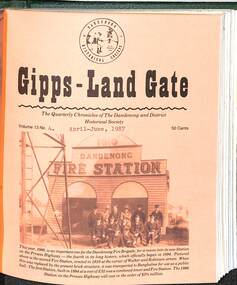
Journal, Dandenong & District Historical Society, Gipps-Land Gate Vol.13 No.4, 1987
... Keeping Posted Harking Back 75 Years Ago An Early Dandenong Industry Disappears - The Ordish Firebrick's 90-Year History Ends Eucalyptus Industry Was Mooted ...Keeping Posted Harking Back 75 Years Ago An Early Dandenong Industry Disappears - The Ordish Firebrick's 90-Year History Ends Eucalyptus Industry Was Mooted Gipps-Land Gate Vol.13 No.4 Journal Dandenong & District Historical Society ...An interesting group of Early Dandenong Personalities, Places and EventsA5 size publication of the Gipps-Land Gate, April-June, 1987 featuring an old picture of Dandenong on the cover. Keeping Posted Harking Back 75 Years Ago An Early Dandenong Industry Disappears - The Ordish Firebrick's 90-Year History Ends Eucalyptus Industry Was Mooted An interesting group of Early Dandenong Personalities, Places and Eventshotel history, early education in dandenong, interesting milestones, family histories -
 Bendigo Historical Society Inc.
Document - LYDIA CHANCELLOR COLLECTION: SHIRE OF MARONG 1864 - 1964
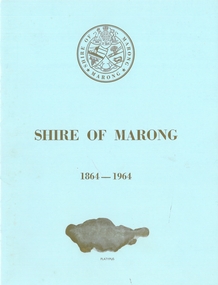
... Information includes history of municipality; mayors and councilors; eucalyptus industry; agriculture; 1911 tornado; Dunlop Rubber; Bradford Mills....Information includes history of municipality; mayors and councilors; eucalyptus industry; agriculture; 1911 tornado; Dunlop Rubber; Bradford Mills. ...Booklet, pale green cover, written on front 'Shire of Marong 1864-1964' Marong Shire Coat of Arms on top of page, an image of the 'Platypus' gold nugget found in the region, on the bottom of the front page. Information includes history of municipality; mayors and councilors; eucalyptus industry; agriculture; 1911 tornado; Dunlop Rubber; Bradford Mills.marong, shire of marong centenary -
 Bendigo Historical Society Inc.
Document - SANDER & SONS EUCALYPT EXTRACT
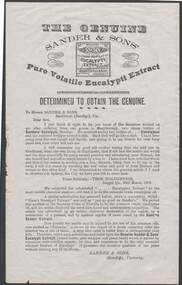
... Industry...eucalyptus oil...BENDIGO Industry eucalyptus oil Sander & Sons Bendigo. 19th Century Advertising testimonials. ...19th Century The Genuine Sander & Sons advertising testimonial for Pure Volatile Eucalypti Extract from Thos Holderness, Dappil, Qu, 26th March 1909. A different product purporting to be Eucalyptus oil was sent to above person. Sanders analysed above product and established inferior.bendigo, industry, eucalyptus oil, sander & sons bendigo. 19th century advertising testimonials. eucalyps oil -
 Bendigo Historical Society Inc.
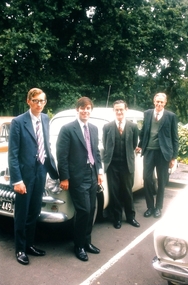
Slide - Peter Ellis Collection, Portrait, Cars and the Whipstick, c1970-1972
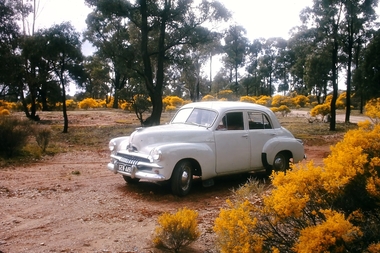
... When the numerous gold mines declined in production, the eucalyptus oil industry became an important source of work. ...When the numerous gold mines declined in production, the eucalyptus oil industry became an important source of work. ...When the numerous gold mines declined in production, the eucalyptus oil industry became an important source of work. The first eucalyptus oil producer in Bendigo was a chemist called Richard Sandner who operated a plant and refinery in Bridge Street from 1876. By 1900, many other distillers operated on the northern edge of Bendigo and in the Whipstick. In 1926, the Forest Commision established a eucalyptus distillery at Gunyah in Wellsford State Forest. See the Wellsford Forest Note for more information. Today, there are just two eucalypt distilleries operating in Bendigo. Most of the world’s eucalyptus oil is now produced overseas. Peter Ellis Collection: eight slides of his Holden FJ and a friend's car in the Whipstick Forest. Peter Ellis was a chemistry lecturer at the Bendigo Institute of Technolgyhistory, bendigo, peter ellis collection, bendigo institute of technology, b.i.t., whipstick bendigo, bendigo state forests, eucalyptus oil -
 Bendigo Historical Society Inc.
Slide - Peter Ellis Collection, the Whipstick and Eucalyptus Oil Production, c1970-1972
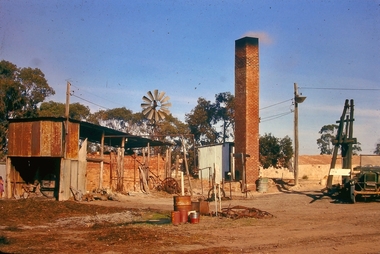
... When the numerous gold mines declined in production, the eucalyptus oil industry became an important source of work. ...When the numerous gold mines declined in production, the eucalyptus oil industry became an important source of work. ...When the numerous gold mines declined in production, the eucalyptus oil industry became an important source of work. The first eucalyptus oil producer in Bendigo was a chemist called Richard Sandner who operated a plant and refinery in Bridge Street from 1876. By 1900, many other distillers operated on the northern edge of Bendigo and in the Whipstick. In 1926, the Forest Commision established a eucalyptus distillery at Gunyah in Wellsford State Forest. See the Wellsford Forest Note for more information. Today, there are just two eucalypt distilleries operating in Bendigo. Most of the world’s eucalyptus oil is now produced overseas. Peter Ellis Collection: eight slides of Whirrakee Wattle regeneration near Bagshot, Eucalyptus History museum, Ruedin's Steam Traction engine, Eucalyptus oil condensor and a Mallee roller to rip out the eucalytpus trees. Peter was a chemistry lecturer at the Bendigo Institute of technology.history, bendigo, peter ellis collection, bendigo institute of technology, b.i.t., whipstick bendigo, bendigo state forests, eucalyptus oil, malle roller, whirrakee wattle, bagshot, steam traction engine, eucalyptus oil condensor -
 Bendigo Historical Society Inc.
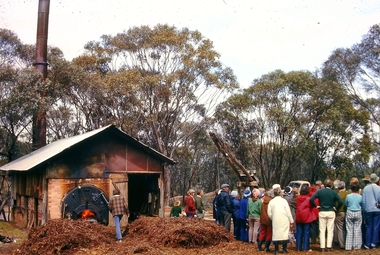
Slide - Peter Ellis Collection, the Whipstick and Eucalyptus Oil Production, Feb 1973
... When the numerous gold mines declined in production, the eucalyptus oil industry became an important source of work. ...When the numerous gold mines declined in production, the eucalyptus oil industry became an important source of work. ...When the numerous gold mines declined in production, the eucalyptus oil industry became an important source of work. The first eucalyptus oil producer in Bendigo was a chemist called Richard Sandner who operated a plant and refinery in Bridge Street from 1876. By 1900, many other distillers operated on the northern edge of Bendigo and in the Whipstick. In 1926, the Forest Commision established a eucalyptus distillery at Gunyah in Wellsford State Forest. See the Wellsford Forest Note for more information. Today, there are just two eucalypt distilleries operating in Bendigo. Most of the world’s eucalyptus oil is now produced overseas.Peter Ellis Collection: sixteen slides of the Eucalyptus History museum, Whipstick Forest, and a deputation ready to meet R J Hamer, the Premier of Victoria. Peter was a chemistry lecturer at the Bendigo Institute of technology.history, bendigo, peter ellis collection, bendigo institute of technology, b.i.t., whipstick bendigo, bendigo state forests, eucalyptus oil, whirrakee wattle, r j hamer -
 Bendigo Historical Society Inc.
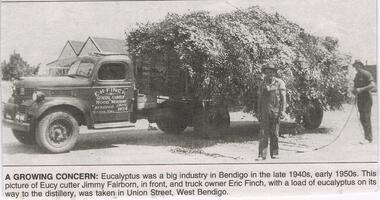
Newspaper - JENNY FOLEY COLLECTION: A GROWING CONCERN
... A growing concern: eucalyptus was a big industry in Bendigo in the late 1940s early 1950s. ...A growing concern: eucalyptus was a big industry in Bendigo in the late 1940s early 1950s. ...Bendigo advertiser "The way we were" from Wednesday, February 2, 2005. A growing concern: eucalyptus was a big industry in Bendigo in the late 1940s early 1950s. This picture of eucy cutter Jimmy Fairborn, in front, and truck owner Eric Finch, with a load of eucalyptus on its way to the distillery, was taken in Union Street, West Bendigo.. The clip is in a folder.newspaper, bendigo advertiser, the way we were -
 Bendigo Historical Society Inc.
Slide - Peter Ellis Collection, the Whipstick and Eucalyptus Oil Production, Solomon Gully Reserve Quarry Hill, Quarry Hill Golf Course Extensions Some history of the Whipstick, 1970-1990
... When the numerous gold mines declined in production, the eucalyptus oil industry became an important source of work. ...When the numerous gold mines declined in production, the eucalyptus oil industry became an important source of work. ...When the numerous gold mines declined in production, the eucalyptus oil industry became an important source of work. The first eucalyptus oil producer in Bendigo was a chemist called Richard Sandner who operated a plant and refinery in Bridge Street from 1876. By 1900, many other distillers operated on the northern edge of Bendigo and in the Whipstick. In 1926, the Forest Commision established a eucalyptus distillery at Gunyah in Wellsford State Forest. See the Wellsford Forest Note for more information. Today, there are just two eucalypt distilleries operating in Bendigo. Most of the world’s eucalyptus oil is now produced overseas. SOLOMON GULLY CIRCUIT WALK - Solomon Gully Nature Conservation Reserve. Rangers say this is a great place to see heaps of Bendigo Waxflowers. A 1.5km, unsurfaced track. It is rough and steep in places, but suitable for families. Closed shoes with a good drip are recommend. The track is popular with families and runners. There is parking available off Burnside St (opposite Quarry Hill / Bendigo Lawn Cemetery).Peter Ellis Collection, t16 slides of the Whipstick and Eucalyptus Oil Production, Solomon Gully Reserve Quarry Hill, Quarry Hill Golf Course Extensions Some history of the Whipstick.history, bendigo, peter ellis collection, whipstick bendigo, bendigo state forests, eucalyptus oil, solomon gully reserve quarry hill bendigo, whipstick hotel shamrock, magetti's wallace reef wine hall, whipstick, frederick the great mine sebastian, quarry hill golf course -
 Bendigo Historical Society Inc.
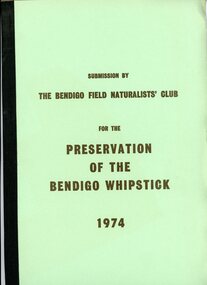
Document - PETER ELLIS COLLECTION: SUBMISSION BY THE BENDIGO FIELD NATURALIST CLUB FOR THE PRESERVATION OF THE WHIPSTICK 1974, 1974
... The Submission consists of: INTRODUCTION Opening Explanation Whipstick Eucalyptus Cutting for Oil Distallation (Photographs) Agricultural Intrusions into the Whipstick (Photographs) CONTENTS Illustrations The Significance of the Bendigo Whipstick Diary of Whipstick Conservation Events Socialogical Implications Conservation policies and reccomendations Agricultural Aspects Eucalyptus Oil Situation Alternatives for the Eucalyptus Oil Industry Future Conservation of the Whipstick Reccomendation for Acquisition Program...The Submission consists of: INTRODUCTION Opening Explanation Whipstick Eucalyptus Cutting for Oil Distallation (Photographs) Agricultural Intrusions into the Whipstick (Photographs) CONTENTS Illustrations The Significance of the Bendigo Whipstick Diary of Whipstick Conservation Events Socialogical Implications Conservation policies and reccomendations Agricultural Aspects Eucalyptus Oil Situation Alternatives for the Eucalyptus Oil Industry Future Conservation of the Whipstick Reccomendation for Acquisition Program Document PETER ELLIS COLLECTION: SUBMISSION BY THE BENDIGO FIELD NATURALIST CLUB FOR THE PRESERVATION OF THE WHIPSTICK 1974 ...PETER ELLIS COLLECTION: SUBMISSION BY THE BENDIGO FIELD NATURALIST CLUB FOR THE PRESERVATION OF THE WHIPSTICK 1974 The submission was sent to: the Minister for Local Government and the Town and Country Planning Board The Minisry for Conservation and its agency, the Forests Commission and Lands Department Federal Government Ministeries for Environment, Concervastion and Science, and the National Estate. Opening Paragraphs: This re-submission was compiled to bring to the attention of the authorities many aspects relating to the preservation of the Bendigo Whipstick which were not so apparent at the time of the earlier submission. In fact the 19721 submissions was mainly aimed at having reserved forest (which lie a opposite extremities to the Whipstick scrub) declared Forest Park. It is the central belt of Whipstick scrub that is of scientific interest and considered unipue and which we were primarily concerned in preserving and retaining as one viable ecological unit. The Submission consists of: INTRODUCTION Opening Explanation Whipstick Eucalyptus Cutting for Oil Distallation (Photographs) Agricultural Intrusions into the Whipstick (Photographs) CONTENTS Illustrations The Significance of the Bendigo Whipstick Diary of Whipstick Conservation Events Socialogical Implications Conservation policies and reccomendations Agricultural Aspects Eucalyptus Oil Situation Alternatives for the Eucalyptus Oil Industry Future Conservation of the Whipstick Reccomendation for Acquisition Programperson, individual, peter ellis oam -
 City of Moorabbin Historical Society (Operating the Box Cottage Museum)
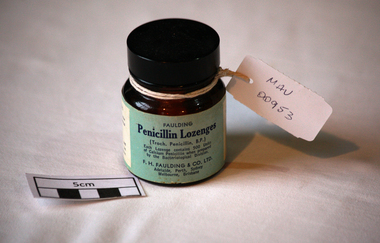
Manufactured Glass, brown bottle 'Penicillin Lozenges', 20thC
... Faulding's success was founded on eucalyptus oil, which formed the basis of an antiseptic marketed as "Solyptol" (for soluble eucalyptus oil). The test became the industry standard, and the British Pharmacopoeia standard method in 1898. ...Faulding's success was founded on eucalyptus oil, which formed the basis of an antiseptic marketed as "Solyptol" (for soluble eucalyptus oil). The test became the industry standard, and the British Pharmacopoeia standard method in 1898. ...F. H. Faulding & Co was a pharmaceutical company founded in Adelaide, South Australia in 1845 by Francis Hardey Faulding 1816 – 1868, a native of Swinfleet, Yorkshire, He arrived in Sydney on the Nabob in February 1842,and travelled on the brig Dorset to Adelaide in May, where he opened a pharmacy at 5 Rundle Street in 1845.The pharmacy flourished, so he purchased a warehouse in Clarence Place in the city and transferred the manufacturing and wholesale arms of the business there. In 1861 he entered into partnership with Luther Scammell (1826–1910).a Yorkshireman, who had received medical training at Guy's Hospital, and arrived in Adelaide in 1849. Faulding died in 1868 and Scammell took over the business, however he was forced to retire in 1889 when the Bank of Adelaide threatened foreclosure after a series of failed mining and pastoral speculations. Two of his sons, Luther Robert Scammell FCS LSA ( 1858 – 1940) and William J. Scammell ( 1856 – 1928) acquired the manufacturing and wholesaling operations, and the business name, in 1888; the retail shops were sold to reduce the debt to the bank.The company expanded under the two brothers and later two sons of each became directors of the company. In June 1921 Faulding & Co. became a private company, with L.R. Scammell as chairman and managing director. He continued to run the firm's affairs until 1935.Two of the Faulding company's major innovations were the development of a process for distillation of eucalyptus oil, and the development of the test for determining the eucalyptol content of the oil. Faulding's success was founded on eucalyptus oil, which formed the basis of an antiseptic marketed as "Solyptol" (for soluble eucalyptus oil). The test became the industry standard, and the British Pharmacopoeia standard method in 1898. Other well-known products were Milk Emulsion (a pleasant alternative to cod-liver oil), Solyptol Soap, (which won a gold medal at the Franco-British Exhibition in London in 1908), Solyptol disinfectant, junket tablets, cordials, essential oils for perfumery and reagents such as Epsom salts, most produced in its factory in Thebarton The Faulding Co. built success around optimising the delivery of oral dosage form drugs. A brown glass bottle with a plastic screw top that contained 'Penicillin Lozenges' made by F.H. Faulding Co. Ltd . AustraliaFAULDING / Penicillin Lozenges / ( Troch. Penicillin B.P.) /......... / F.H.Faulding & Co. Ltd. / Adelaide, Perth, Sydney, / Melbourne, Brisbane on back DIRECTIONS......pharmacy, medicines, f.h. faulding co. ltd, penicillin lozenges, antibiotics, dentists, glassware, bottles, moorabbin, bentleigh, cheltenham -
 Orbost & District Historical Society
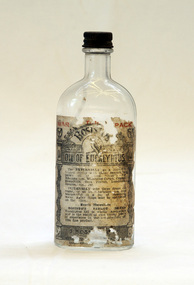
bottle, Probably WW11
... As a result of the collaboration with von Meuller the essential oil industry of Australia began in 1852, when Bosisto commenced operations in a small, rudely constructed still at Dandenong Creek, Victoria, using the leaves of a form of E. radiata (then known as E. amygdalina) which grew profusely in the district. Bosisto soon built other distilleries at Emerald, Menzies Creek and Macclesfield. World War II soldiers packed it in their mess kits to keep foot fungus in the tropics at bay. bottle eucalyptus ...Joseph Bosisto was a Yorkshireman who had qualified as a Pharmacist in Leeds and London. He arrived in Adelaide in 1848 at the age of 21. In 1851 he moved to Victoria in search of gold, but instead opened a pharmacy in Richmond, where he built a laboratory to investigate the chemical and medicinal properties of Australian plants. As a result of the collaboration with von Meuller the essential oil industry of Australia began in 1852, when Bosisto commenced operations in a small, rudely constructed still at Dandenong Creek, Victoria, using the leaves of a form of E. radiata (then known as E. amygdalina) which grew profusely in the district. Bosisto soon built other distilleries at Emerald, Menzies Creek and Macclesfield. World War II soldiers packed it in their mess kits to keep foot fungus in the tropics at bay. Small clear glass Eucalyptus Oil bottle with metal screw lid and large label on front.Front Label - War Time Pack Back - This bottle remains property of J Bosisto &Co Pty Ltd Richmond Victoria Bottom-F1196bottle eucalyptus-oil bosisto-joseph -
 Halls Gap & Grampians Historical Society
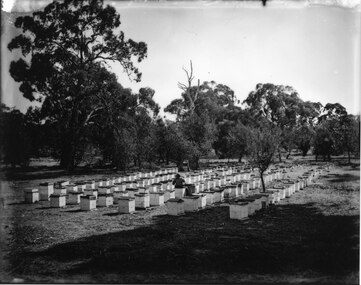
Photograph, C 1900s
... The photo shows Mr Russell at a bee site in the Cherrypool area. misc industries bee-keeping scenery cherrypool The photo shows a man standing among a large group of bee-hives. The hives are in six long rows in a fairly open area with eucalyptus trees scattered around it. ...The photo shows Mr Russell at a bee site in the Cherrypool area.The photo shows a man standing among a large group of bee-hives. The hives are in six long rows in a fairly open area with eucalyptus trees scattered around it.misc industries, bee-keeping, scenery, cherrypool -
 Halls Gap & Grampians Historical Society
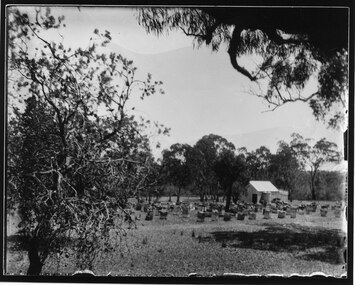
Photograph - B/W, C 1900s
... MISC INDUSTRIES Bee-keeping SCENERY Cherrypool The photo shows bee-hives in front of a shed in a cleared area surrounded by eucalyptus trees. ...Bee-hives in front of a shed in the Cherrypool area. The second (transparency) copy is No. 242 in the slide box.The photo shows bee-hives in front of a shed in a cleared area surrounded by eucalyptus trees. The faint outline of high mountains can bee seen in the background.misc industries, bee-keeping, scenery, cherrypool -
 Orbost & District Historical Society
bottle, first half 20th century
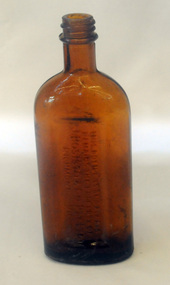
... Bosisto's bottles were generally used for eucalyptus oil. the eucalyptus oil industry was a significant early Victorian industry. ...In 1852 Bosisto opened Australia’s first commercial eucalyptus oil distillery, at Dandenong Creek in Victoria, followed by others at Emerald, Menzies Creek and Macclesfield. and began selling the oil locally. Eucalyptus oil was used as a liniment. Bosisto's bottles were generally used for eucalyptus oil. the eucalyptus oil industry was a significant early Victorian industry. Bosisto's products were commoly used in households of the first half of the 20th century. A flat-sided, brown, glass bottle with a threaded top. It has rounded shoulders.in rectangle on back - THIS BOTTLE IS AND ALWAYS REMAINS THE PROPERTY OF J. BOSISTO & COMPANTY LTD on base - F1196 M and 239 vertically -
 Bendigo Historical Society Inc.
Booklet - The Goldfields Landscape, David Bannear, 2001
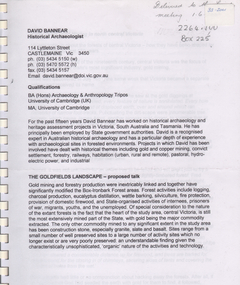
... industry...The railways...Eucalyptus...Subjects covered in the presentation include: Early 1850's Gold Mining in north central Victoria Botanising diggers Quartz mining Deep lead mining, The state of the forests at the end of the nineteenth century State of the Central Victoria forests Settlement Charcoal production Wattle bark industry The railways Eucalyptus production State nurseries and plantations Thinning of forests Royalty system Creswick School of Forestry and Forestry Commission 1919: Pines and unemployed schemes 1931 - 1940: The Great Depression 1939: Black Friday 1939-45: Alien or interment forestry camps 1939- 45: Second World War charcoal production 1944-45 Prisoner of War Camps 1949-51: Migrant or refugee camps ...Early 1850's Gold Mining in north central Victoria Botanising diggers Quartz mining Deep lead mining The state of the forests at the end of the nineteenth century State of the Central Victoria forests Settlement Charcoal production Wattle bark industry The railways Eucalyptus production State nurseries and plantations Thinning of forests Royalty system Creswick School of Forestry and Forestry Commission 1919: Pines and unemployed schemes 1931 - 1940: The Great Depression 1939: Black Friday 1939-45: Alien or interment forestry camps 1939- 45: Second World War charcoal production 1944-45 Prisoner of War Camps 1949-51: Migrant or refugee camps David Bannear Eleven page typed booklet with clear plastic cover and white plastic ring binding. ...Eleven page typed booklet with clear plastic cover and white plastic ring binding. Booklet contains a presentation delivered to the Bendigo Historical Society on 1st June 2001, by David Bannear, BA, MA (University of Cambridge) Historical Archaeologist. Subjects covered in the presentation include: Early 1850's Gold Mining in north central Victoria Botanising diggers Quartz mining Deep lead mining, The state of the forests at the end of the nineteenth century State of the Central Victoria forests Settlement Charcoal production Wattle bark industry The railways Eucalyptus production State nurseries and plantations Thinning of forests Royalty system Creswick School of Forestry and Forestry Commission 1919: Pines and unemployed schemes 1931 - 1940: The Great Depression 1939: Black Friday 1939-45: Alien or interment forestry camps 1939- 45: Second World War charcoal production 1944-45 Prisoner of War Camps 1949-51: Migrant or refugee camps early 1850's gold mining in north central victoria, botanising diggers, quartz mining, deep lead mining, the state of the forests at the end of the nineteenth century, state of the central victoria forests, settlement, charcoal production, wattle bark industry, the railways, eucalyptus production, state nurseries and plantations, thinning of forests, royalty system, creswick school of forestry and forestry commission, 1919: pines and unemployed schemes, 1931 - 1940: the great depression, 1939: black friday, 1939-45: alien or interment forestry camps, 1939- 45: second world war charcoal production, 1944-45 prisoner of war camps, 1949-51: migrant or refugee camps, david bannear -
 National Wool Museum
Clothing - 1984 Los Angeles Olympics Men's Opening Ceremony Shirt, c. 1984
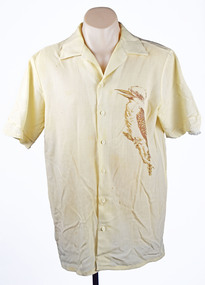
... eucalyptus bark Prue had brought back from central Australia. For the Opening Ceremony uniform, Prue designed a series of native fauna, a kookaburra for the men’s shirt and a pleated skirt with a rural scene of kangaroos, hills and plants. This presented an insurmountable printing challenge to the local printing industry...eucalyptus bark Prue had brought back from central Australia. For the Opening Ceremony uniform, Prue designed a series of native fauna, a kookaburra for the men’s shirt and a pleated skirt with a rural scene of kangaroos, hills and plants. This presented an insurmountable printing challenge to the local printing industry ...On the 1984 Los Angeles Olympic Uniforms donator Doug wrote- During the 1980s the Australian wool industry was at its most prosperous times with record numbers of sheep producing wool receiving ever increasing values due to the success of the Reserve Price Scheme, and the overall guidance of the Australian Wool Corporation (AWC). As a humble technician, my role was a low profile newly created position of “Controller, Technical Marketing” where wool was to be marketed on its technical properties, as distinct from the “Product Marketing Group” which exploited trhe traditional high profile approach of marketing wool;s superior fashion attributes. The Woolmark was the tool central to this approach. When the forthcoming Los Angeles Olympic Games was announced, the Product Marketing Group seized upon the chance to show the world that we could make top fashion garments and display them on our elite athletes on the world stage. A concept was launched using a contemporary top designer, Adel Weiss, with the most exclusive fabrics and knits available, and all with a lot of hype. This launch failed dismally for the following reasons- - The designer did a wonderful job presenting an excellent fashion range on perfect skinny models. The AOC however wanted a uniform which had an obvious Australian appearance when fitted to elite, and frequently muscular, athletes. - The fabrics chosen did not reflect the performance required by travelling athletes, there was no recognition of the need for ‘easy care.’ - There was no recognition given to the problem of measuring, manufacturing and distribution of a range of articles when the selected athlete could be domiciled anywhere in Australia. - There was no appreciation of such historical facts as Fletcher Jones, who had been unofficial suppliers dating back to the 1954 Olympics in Melbourne, and the Fletcher Jones board member, who was also an AWC board member, and was not in favour of the change. The project passed from Product Marketing to Public Relations, a big spending off-shoot of the AWC Chairman David Asimus, and due to the day to day operations of the project was passed to me and PR took care of the financial matters. The first task was to meet with the AOC and find out exactly their requirements. This lead to the production of a design and manufacturing brief, cointaining exact time lines for each event required to ensure an appropriate uniform on every athlete chosen to represent his/her country on the date given for the Opening Ceremony in Los Angeles. Working backwards the timeline becomes- 1. Noted the exact date of the Opening Ceremony. 2. Estimated the date for distributing completed garments to each athlete. 3. Estimated the time span available for measuring each athlete and commence making each component of the ensemble to the individual measurements of each athlete. 4. Decided the date for making the final choice of uniform design concept. 5. Decided the date for distribution of the design brief to selected designers. These five steps were spread out over a two year period. The Commonwealth Games occur midway between each Olympic Games, work on the Olympic uniform commences the week after the Commonwealth Games closing ceremony and MUST be ready by the prescribed day two years hence. The project also had to remain cognisant of trade politics existing within the span of the task, as well as the temperament of designers in general. It is no overstatement to say that in the past every designer in Australia believed they could, and should, be chosen to design the Australian Uniform. The final choice of designer almost always faced criticism from the fashion press and any designer who had been overlooked. However, with the contenders receiving an exacting brief the numbers of serious contenders greatly reduced. The Los Angeles Olympic Uniforms. A further reason for the AWC bid failure to design the LA uniform was that the AOC had already chosen Prue Acton to design it. This was based on her proven performance during previous games as she had a talent for creating good taste Australiana. Her design concepts also considered the effect when they were viewed on a single athlete as well as the impact when viewed on a 400 strong team coming on to the arena. A blazer trouser/skirt uniform in bright gold was chosen for the formal uniform. It was my task to select a pure wool faille fabric from Foster Valley weaving mill and have sufficient woven and ready within the prescribed timeline. The trouser/skirt fabric selected was a 60/40 wool polyester plain weave fabric from Macquarie Worsted. This fabric had a small effect thread of linen that was most attractive when dyed to match some eucalyptus bark Prue had brought back from central Australia. For the Opening Ceremony uniform, Prue designed a series of native fauna, a kookaburra for the men’s shirt and a pleated skirt with a rural scene of kangaroos, hills and plants. This presented an insurmountable printing challenge to the local printing industry as it had an unacceptably large repeat size and the number required (50) was also commercially unacceptable. The solution was a DIY mock up at RMIT and the employment of four student designers. The fabric selected for this garment was a light weight 19 micron, pure wool with a very high twist yarn in alternating S and Z twist, warp and weft. This fabric proved to be the solution to a very difficult problem, finding a wool product which is universally acceptable when worn next to the sin by young athletes competing in the heat of a Los Angeles summer. Modifications to this fabric were developed to exploit its success when facing the same problem in future games. Garment Making- The most exacting garment in the ensemble is the tailored blazer, plus the related trouser/skirt. Unfortunately tailoring athletes that come in various shapes and sizes such as; - Weight lifters develop an enormous chest, arms and neck size. A shirt made to a neck size of 52 would produce a shirt with cuffs extending well beyond the wearer’s hands. - Basketball players are up to 7 feet tall and garments relying ona chest measurement grading would produce a shirt with cuffs extending only to elbow length. - Swimmers develop enormous shoulders and slim hips, cyclists by contrast develop thighs I liken to tree trunks and a uniform featuring tight trousers must be avoided at all cost. Suffice to say many ensembles require specialist ‘one off’ treatment for many athletes. Meanwhile there is a comfortable in between group who can accept regular sizes so you can cater for these by having back up stock with plenty of built in contingencies. Athletes may be domiciled anywhere in Australia, this creates a fundamental problem of taking their measurements. The Fletcher Jones organisation was key to answering this problem due to their presence in every capital city, as well as many provincial towns around Australia. Each athlete on being selected for the Olympic Team was simultaneously requested to visit their nearest Fletcher Jones shop. The standardised measurement data collected was shared with the other manufacturers, e.g. Pelaco Shirts, Holeproof Socks and Knitwear, Maddison Belts, and even Hush Puppy Shoes. As the time for the Games approached the AOC made arrangements for combining meeting of all. Selected available athletes at the Australian Institute of Sport, Canberra, where, among other things, they were fitted and supplied with their uniform. The method evolved as follows.Men’s cream coloured button up, collared shirt. Images of a kookaburra have been printed onto the shirt, a single kookaburra on the left breast and a pair of kookaburras on the reverse of the shirt. The kookaburras are printed in a brown tone to complement the cream colour of the fabric.On tag - FMaustralian wool corporation, 1984 los angeles olympics, olympic uniforms, men's uniforms, sport, athletes -
 Stawell Historical Society Inc
Photograph, Eucalyptus Leaf Transport for Bennets Distillery by Crays Deep Lead, c.1944
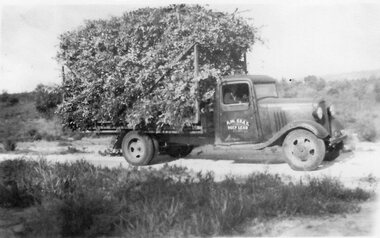
... Bennets Eucalyptus Distillery Deep Lead probably Alf Cray Industry A. W. Cray Deep Lead Two B/W photographs of trucks transporting leaves Eucalyptus Leaf Transport for Bennets Distillery by Crays Deep Lead Photograph ...Bennets Eucalyptus Distillery Deep Lead probably Alf CrayTwo B/W photographs of trucks transporting leavesA. W. Cray Deep Leadindustry -
 Tarnagulla History Archive
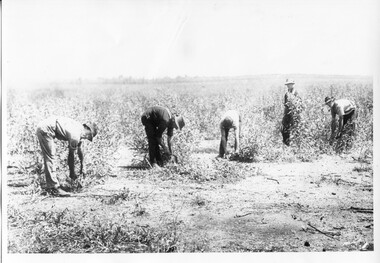
Photograph of Eucalyptus harvesters, Eucalyptus harvesters, circa 1890-1920
... Copy probably made by Murray Comrie in the 1960s. arnold west industries agriculture eucalyptus distilling forestry plants trees Monochrome photograph of men harvesting Eucalyptus foliage, possibly at or near Arnold West. ...Murray Comrie Collection. This is a reasonable copy of an older original. Copy probably made by Murray Comrie in the 1960s. Monochrome photograph of men harvesting Eucalyptus foliage, possibly at or near Arnold West.arnold west, industries, agriculture, eucalyptus, distilling, forestry, plants, trees -
 Tarnagulla History Archive
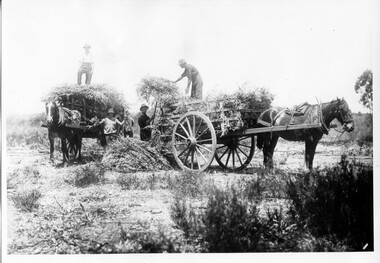
Photograph of Eucalyptus harvesters with wagons, Eucalyptus harvesters with wagons, circa 1890-1920
... Copy probably made by Murray Comrie in the 1960s. arnold west industries agriculture eucalyptus distilling forestry plants trees horses transport Monochrome photograph of men loading Eucalyptus foliage onto two horse-drawn wagons, possibly at or near Arnold West. ...Murray Comrie Collection. This is a reasonable copy of an older original. Copy probably made by Murray Comrie in the 1960s. Monochrome photograph of men loading Eucalyptus foliage onto two horse-drawn wagons, possibly at or near Arnold West.arnold west, industries, agriculture, eucalyptus, distilling, forestry, plants, trees, horses, transport -
 City of Melbourne Libraries
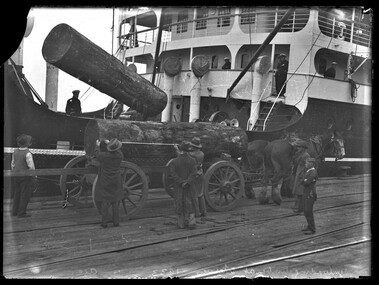
Photograph (item), Bull, Hugh Jones, 1897-1993, Unloading timber at Victoria Dock, 1933
... In the 1930s Australia actually had a growing timber industry, but much of the eucalyptus wood was being utilised for mass produced furniture, and much of this furniture would then have had a veneer applied to it. ...In the 1930s Australia actually had a growing timber industry, but much of the eucalyptus wood was being utilised for mass produced furniture, and much of this furniture would then have had a veneer applied to it. ...Photographer notations on slide: "Unloading Timber at Wharves 1933 Age B5" Published: Age (Melbourne, Vic.: 1854- ), Tuesday 15 August 1933 MAHOGANY FROM MANILA. (1933, August 15). The Age (Melbourne, Vic. : 1854 - 1954), p. 11. Retrieved January 16, 2026, from http://nla.gov.au/nla.news-article204377024 Published title: MAHOGANY FROM MANILA Published Caption: Age Tue 15 Aug 1933 Caption: Unloading Mahogany Logs brought from Manila, Philippine Islands, by the steamer Taiping, which berthed yesterday at Victoria Dock. The vessel discharged twenty logs, each weighing three tons, the first shipment of this type of timber landed in Melbourne. Research by Project Volunteer, Louise McKenzie: This photograph in many ways epitomises Melbourne in the 1930s. It is a time of enormous growth, development and change. But before delving into that, the photo itself is very powerful. The huge mahogany logs being unloaded appear to be so heavy that the ship itself seems to list to port as they are craned over the side. They are being levered into a cart to which two large and sturdy Clydesdale horses are hitched. In contrast to the traditional horses, the wharf is crisscrossed with modern railway tracks. Unloading is both mechanical and manual, and the scene is one of intense interest to a young boy bystander. The ship appears to be squat and solid, but the whole image also gives a feeling of movement and intensity. The mahogany being delivered to Melbourne would be intended for high quality furniture. In the 1930s Australia actually had a growing timber industry, but much of the eucalyptus wood was being utilised for mass produced furniture, and much of this furniture would then have had a veneer applied to it. The fact that it was economic to import this timber from the “Philippine Islands” – not a traditional trading market for Australia – reflects a Victorian economy that was strong enough to support a growing demand for good quality furniture Mahogany was described as a classic, strong hardwood, often used for dark opulent furniture. In the 1930s the importation of timber from Manila (Philippines) to Australia was a notable trade, particularly in Philippine Lauan (often referred to as Philippine Mahogany), which was used as a cheaper alternative to other hardwoods. 1930s furniture, dominated by the art deco style, used a mix of luxurious exotic woods like mahogany, macassar and ebony for high-end pieces, often veneered over less expensive woods such as walnut, birch and poplar, and with plywood, chrome and lacquer also popular for more practical, streamlined designs during the Depression era. By the mid 1930s timber mills were being relocated away from the immediate dock area, but the fact that these logs were being transported by horse-drawn cart implies that the load would not have had to be taken too far for milling. 1885 the Melbourne Harbour Trust Commissioners had decided that land in or near the city was far too valuable to be used as timber yards. Furthermore, large stacks of timber posed a fire risk. The Trust asked the Victorian Government to reserve a site on the east side of the Yarra River opposite Yarraville and Spotswood. Here, in 1889, the Trust began building six jetties and a wharf specifically for the landing of timber. Clydesdale horses were initially brought to Victoria from Tasmania in the 1830s, and with the 1850s gold rush they were imported direct from Scotland. Melbourne was from its earliest years an important centre of horse-breeding from both imported and colonial-bred stock, providing the well-built draught horse for pulling heavily loaded wagons, the harness horse for delivery work and drawing coaches, and the saddle-horse used for riding. Stud breeding facilities were advertised from the early 1840s. By the 1870s the horse export trade was thriving, and the Port of Melbourne was the country's busiest exporter of horses to Indian, Asian and New Zealand markets. Kirk's Melbourne Horse and Carriage Bazaar in Bourke Street first advertised for business in 1840, and by the 1850s Bourke Street West was famed for its horse bazaars and saleyards. The Victorian Clydesdale Horse Society reports that Clydesdale working horses were a vital part of Melbourne's infrastructure and agricultural industry in the 1930s, when they reached the peak of their popularity despite the increasing competition from mechanization. Their main roles and usage at this time were: • City Delivery: Clydesdales were a common sight for metropolitan deliveries, particularly for breweries (such as Carlton & United Breweries), milk runs, and bread deliveries. • Industrial Work: They were heavily used for hauling cargo at the docks, in construction, and at specialized sites like the Truganina Explosives Reserve, where they pulled wagons. • Agriculture: In surrounding rural areas, they were the primary power source for ploughing and agricultural machinery. • Specialization: By the 1930s, the Clydesdale was smaller and more compact than the Shire or Percheron breeds, making them ideal for navigation in urban environments. After the 1930s their numbers decreased due to the onset of WWI and mechanisation. Wartime petrol rationing led to a brief revival for the working horse, as suburban tradesmen, now used to motor delivery, took their old jinkers out of mothballs. By 1947, however, only 1.5% of city traffic was horse-drawn. In 1952 the large horse cartage company A. Kellet Pty Ltd sold its 250 horses and converted its Richmond stables to storage. In the 1950s at Station and Princes piers, wharf labourers refused to work with the six draught horses still being used to haul trolleys and which were soon superseded by the fork lift, semi-trailer and mobile crane. Where carefully trained horses had once shunted trains in city goods yards, a few hundred a week were now being killed at the abattoirs for pet and human consumption. The last MCC dray horse was withdrawn from service in 1958, but some of the few remaining working animals are used by the mounted police for crowd control at demonstrations and football games. The death knell had also sounded for the associated trades of farrier, saddler and blacksmith. Our photo, therefore, showing the wharf with both the haulage Clydesdales and the rail lines, is a strong visual summary of the social and economic changes experienced in Victoria in the 1930s and on towards the 1950s. Our photo is located at Victoria Dock (also known as Victoria Harbour) which is still an active component of Melbourne’s port system. In 1892 the West Melbourne Dock (later Victoria Dock) was opened, downstream and immediately west of the Spencer Street railway shunting yards. It contained a swing basin for ships, replacing the one which had been provided on the south side of the river, later to be the Duke and Orr dry dock, west of the Charles Grimes Bridge. Further west was the South Wharf along the river bank. The history of Victoria Dock is extremely well described by Ashley Smith in his 2 March 2022 article in Docklands News, and its accompanying aerial photo of the Dock taken in 1934. He writes: "In the early 1930s Victoria Dock was one of the biggest sites for trade and export in Melbourne. A constant queue of ships sailed in, unloaded their cargo, recharged and reloaded, then left for the next port. Around the time this photo was taken (found in a 1934 photo book), the trapezium-shaped basin had been through some changes since its construction in the 1890s. The 497-metre-long Central Pier, finished in 1919, now featured six sheds to house the ever-increasing volume of cargo. The entrance had also been widened in the 1920s to allow better access. Some of the berths featured three-ton jib electric cranes to help with loading cargo and a rail network connected to the State Railway service. By the time construction was completed, the dock was 39 hectares and hailed as the second-largest dock in the world (behind Cavendish Dock, Barrow-in-Furness). To further save costs, excavations were dug to a more reasonable seven metres below low water, instead of British engineer Sir John Coode’s recommended 8.3 metres. Even then, the costs were still around £900,000. It was envisaged, with the extra wharfage, that around thirty 90-metre ships could berth inside. On March 22, 1892, Victoria Dock was opened by Victoria’s Governor, the Earl of Hopetoun (later Australia’s first Governor-General) who opened the sluice to let the Yarra in. It took six days to fill the basin with The Leader newspaper estimating that it would take another six months to completely fill (March 26, 1892). In the end, it took nearly a year before the first ship was allowed to enter on February 20, 1893, when the steamer Hubbuck sailed in to unload 1200 tonnes of cargo in 15 hours. The Argus (February 23, 1893) reported that the ship’s captain, J. R. Brodie, called the Yarra “better than the Thames”, and compared Victoria Dock favourably to the Albert Dock (Liverpool)." This would be a good time to move our focus on to the Taiping, which is the transporter of these giant mahogany logs. The Taiping was a steel-hulled, single-screw passenger-cargo Chinese steamer, which today has the dubious legacy of being involved in a collision headlined as “The Chinese Titanic”. It was constructed by the Hong Kong and Shampoa Dock Company at its facility in Hong Kong, with completion in 1926 for service under the Australia Oriental Line. Her gross register tonnage measured 4,324 tons, reflecting her design for inter-island and coastal trade routes, accommodating both passengers and freight. She operated routes connecting Australian ports with East Asian destinations. As World War II approached, Taiping continued predominantly working the trade routes between China and Australia, until December 1941, when she evacuated women and children from Hong Kong to Manila just before Japanese forces overran the region. She then safely reached Australia despite enemy air raids. Taiping was then requisitioned by the Royal Navy and repurposed as a victualling stores issuing ship for the Eastern Fleet, supporting logistical needs in the Pacific and Indian oceans. Returned to the Australian Oriental Line in 1947, she underwent refitting and by mid-1948 was chartered to the Shanghai Shipping Company, and modified for greater passenger accommodation – approximately 500 passengers. In 1948/49 the Chinese Civil War took place. The Taiping departed Shanghai on 26 January 1949 as one of the final vessels evacuating civilians from to Keelung Harbour in Taiwan. Reports indicate that the Taiping carried double the rated capacity of passengers i.e. 1000. The ship carried families, military personnel, civilians, carrying personal belongings, gold and valuables in hope of resettlement in Nationalist Taiwan. It also held heavy cargo in the form of silver and gold bullion loaded by the Central Bank of China. Because of the risk of patrols, and to conserve fuel, the Captain took the ship away from the usual open-sea passage, and instead navigated along the coast. He also extinguished navigation lights to avoid detection. Shortly after midnight on 27 January 1949 the Taiping collided with the smaller cargo steamer Chien Yuan in the East China Sea near the Zhoushan Archipelago. The Chien Yuan was also operating in darkness. The subsequent collision was catastrophic. The Chien Yuan sank with in 5 minutes, with the loss of 72 of its 74 crew. The Taiping sustained severe structural compromise from the broadside strike and initially remained afloat, then made a swift descent into the freezing water, with no attempt at an organised evacuation. No formal recovery process was instigated, however a distress signal went out. 32 survivors were picked up by the Australian destroyer HMAS Warramunga (on patrol nearby), a passing US vessel found 2 more, and local Zhoushan fishermen retrieved others. In the end, only 37 people survived. The event is remembered as a poignant moment in the mass migration to Taiwan, with families tragically separated. A memorial to the disaster exists at the Keelung Harbour naval base on Taiwan. With its total of over 1,500 deaths, it constituted one of the worst peacetime maritime losses. It is sometimes referred to as the “Oriental Titanic” because of the similarly large loss of life and speed of demise with the RMS Titanic in 1912. A fictional depiction of this event appears in the John Woo movies “The Crossing (Part 1) (2014), and The Crossing II (2015), known in Chinese as “Taiping Wheel”. The narrative weaves a story around pre-disaster romances and wartime turmoil among passengers, culminating in the ship’s rapid sinking. “The production, a high-budget Sino-Taiwanese-Hong Kong co-effort, portrays the event as a microcosm of the 1940s Sino-Japanese and civil war legacies, though critics noted the melodramatic style prioritizing spectacle over historical precision.” In conclusion, it is nice to return to our photo, and observe the people involved in this moment. The dockworkers are, so typical of the 1930s, dressed in what looks to us like formal clothing – dark suits or coats, white shirts, and black hats. I am particularly drawn to the young boy, bare-headed, arms crossed, and so intent on the unloading process. He too is wearing a white shirt, black trousers and jacket, and black shoes. This is 1933 Melbourne – but the haircut he is sporting is now very “hipster” and modern in 2026 Melbourne. References: MAHOGANY FROM MANILA. (1933, August 15). The Age (Melbourne, Vic. : 1854 - 1954), p. 11. Retrieved January 30, 2026, from http://nla.gov.au/nla.news-article204377024 Wikipedia, Taiping steamer, https://en.wikipedia.org/wiki/Taiping_(steamer) Wikipedia, Victoria Dock, https://en.wikipedia.org/wiki/Victoria_Dock_(Melbourne) Docklands News, Ashley Smith, 2 Mar 2022, https://www.docklandsnews.com.au/victoria-dock/ Living Histories: Heritage Council of Victoria, Jill Barnard, 2008, Jetties and Piers, https://livinghistories.net.au/wp-content/uploads/2015/11/Jetties-ONL-intro_Part-1.pdf eMelbourne, Wharves and Docks, https://www.emelbourne.net.au/biogs/EM01612b.htm Australian Academy of Technological Sciences – Harvesting Wood, https://www.austehc.unimelb.edu.au/tia/225.html Old Treasury Building, On the Water – The Docks, https://tinyurl.com/3wkbk66m Old Treasury Building, On The Road, https://tinyurl.com/dw44yr3t Port of Melbourne, Victorian Places, https://www.victorianplaces.com.au/port-of-melbourne Docklands Heritage Study - Environmental History, https://mvga-prod-files.s3.ap-southeast-4.amazonaws.com/public/2024-05/docklands-heritage-review-thematic-environmental-history-1991.pdf eMelbourne, Horses, https://www.emelbourne.net.au/biogs/EM00723b.htm Victorian Clydesdale Horse Society, https://www.clydesdalesvic.org.au/history The Crossing, https://letterboxd.com/film/the-crossing-i/Photographer notations on slide: "Unloading Timber at Wharves 1933 Age B5"ships, shipping, timber industry, shipwrecks, horses, docks, wharves, 1930-1939, wars, docklands -
 Emerald Museum & Nobelius Heritage Park
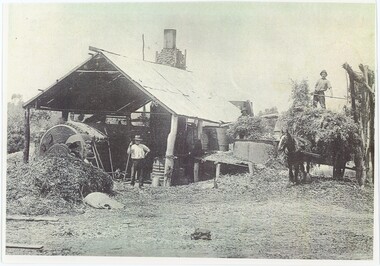
Photograph - Photograph of Eucalyptus Distillery, Emerald, 1916
... Bosisto's eucalyptus distillery was an early Emerald industry with global significance; eucalyptus oil was believed to be the first distinctively Australian product exported overseas. ...This photograph is believed to have been taken at the Bosisto's distillery on Woori Yallock Creek at what is now Butterfield Reserve, Emerald. Chemist and later parliamentarian Joseph Bosisto (1824-98) established a number of distilleries in the area through the 1860s and 70s; the Butterfield Reserve still is believed to have been established in 1876. This photo may have been taken around 1916, when Australia was still the world's leading supplier of eucalyptus oil - by this time a globally popular product. By the 1920s, Joby Brady and his son were running the distillery business.Bosisto's eucalyptus distillery was an early Emerald industry with global significance; eucalyptus oil was believed to be the first distinctively Australian product exported overseas. This photograph is a very clear representation of the industry - to the extent that it is even used repeatedly in Euca's webpages discussing the history of the industry.Captured in black and white, a working eucalyptus distillery processes large quantities of eucalyptus leaves into eucalyptus oil. Two men stand holding tools, one under the tin roof of the distillery and another on a horsecart carrying a new pile of leaves. Another stands behind the distillery, carrying more leaves. The largest pile of leaves is in front of the still. The still is sheltered by a tin roofed structure with open walls, wooden support beams, and a chimney in the background. Further in the background, trees can be barely seen. This photograph is a scanned copy, glossy on the obverse and with normal paper texture and handwritten notes on the reverse.Reverse: "Distilling Eucalyptus / Bosistoes. Woori Yallock creek Emerald / or Clematis. 1916? / Joby Brady carried on Bosistoes during 1920s / with his son on Woori Yallock Creek"emerald, native plants, 1910s -
 Emerald Museum & Nobelius Heritage Park
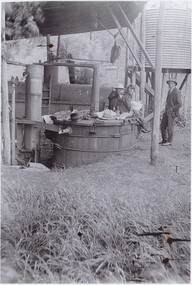
Photograph - Emerald Eucalyptus Distillery, 1920
... eucalyptus distillery, with another earlier site once occupying what is now Butterfield Reserve. The plantation and distillery was established with Camden Woolbut by Russel Grimwade (of the Felton Grimwade pharmaceutical firm) in partnership with the Bosisto corporation. This photograph captures a significant site to one of the few most important industries ...This is believed to be a photograph from Emerald's Mary Street eucalyptus distillery, that once covered an area between Mary Street and Lakeside Drive. This was not Emerald's only eucalyptus distillery, with another earlier site once occupying what is now Butterfield Reserve. The plantation and distillery was established with Camden Woolbut by Russel Grimwade (of the Felton Grimwade pharmaceutical firm) in partnership with the Bosisto corporation.This photograph captures a significant site to one of the few most important industries to historical Emerald.This item is a black and white photograph printed on modern photo paper. The reverse features annotations, an accession number and the Epson logo, The shot looks into a eucalyptus distillery under an open-walled structure. Captured are several pieces of equipment - a round tank built into the ground, a metal-enclosed piece of machinery in the background, and an elevated water tank outside of the structure. There are two women sitting on the partially buried tank, and a man besides them, standing outside of the structure. The bottom-right and top-left have abrasions from the original negative.Reverse: "Emerald Distillery / 1920 / Mary St Emerald / Eucalyptus Distillary" (sic) Reverse, Faded/Faint/Erased: "Arch Nobelius [illegible]"emerald, horticulture, 1920s, eucalyptus
