
Showing 117 items matching "examination records"
-
 Creswick Campus Historical Collection - University of Melbourne
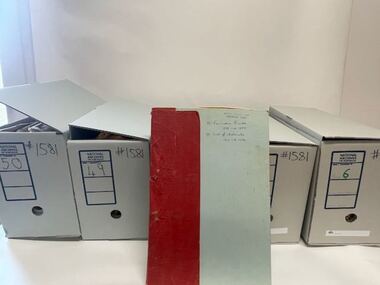
Administrative record - VSF Student examination records - 5 boxes, Board of Forestry Education et al, VSF Student examination results from 1919 to 1980
... VSF Student examination records - 5 boxes...Examination results - unsorted Documents VSF Student examination results from 1919 to 1980 Administrative record VSF Student examination records - 5 boxes Board of Forestry Education Forests Commission of Victoria Victorian School of Forestry ...Examination results - unsortedDocuments -
 University of Melbourne, Burnley Campus Archives
Book - Student Records, Burnley College of Horticulture. Examinations and Pass Standards. Diploma of Horticulture, 1958-1968
... ...examination records...The columns headed with year, group, subject (examination results) and remarks - P or N. Fails and repeats also recorded....Kneen (1946-1967) register students diploma of horticulture marks examination records 1958-1968 student register The list of all student names appearing in the enrollment register number 192. ...This register was compiled during the principalship of T.H. Kneen (1946-1967)Bound register of each year level of students enrolled for the Diploma of Horticulture between 1958 and 1966 (completion in 1968). Includes full record of marks for each subject by term. Insert (1) stuck inside front page is a one page foolscap sheet with typescript NOTICE outlining the instructions for examinations dated 1st June 1960. The book has hand ruled columns in red and black ink for group of students (names) - the pages cut for each year of the course (first to third). The columns headed with year, group, subject (examination results) and remarks - P or N. Fails and repeats also recorded.The list of all student names appearing in the enrollment register number 192. This are listed in the paper catelogue as well as in the item itself.register, students, diploma of horticulture, marks, examination records, 1958-1968, student register -
University of Melbourne, Burnley Campus Archives
Document, Rural training of ex-servicemen. Examination Results, 1949-1950
... Tables of examination results and individual records...servicemen training examinations results Tables of examination results and individual records Rural training of ex-servicemen. ...Tables of examination results and individual recordsservicemen, training, examinations, results -
 Bendigo Military Museum
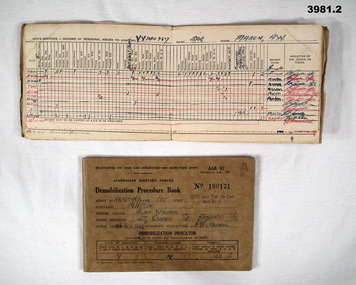
Administrative record - RECORD OF SERVICE, DEMOBILIZATION BOOKS
... .1) Record of Service book, A.A.B 83, 18 pages with details of clothing issued, inoculations, physical, courses attended as as a photo ID, original cover is missing. .2) Demobilization Procedure book A.A.B 87, No 180171, 30 pages, details of all examinations, record checks, rehabilitation and all sections signed and stamped off prior to discharge. ...Records personal military .1) Written on the front; VX140967 Pte Mason A.W, A.A.B 83. .2) VX140967, Pte Mason 2/10 Aust Port Op Coy AA TN C, Alan Walter, 25 Queen St Bendigo Vic. .1) Record of Service book, A.A.B 83, 18 pages with details of clothing issued, inoculations, physical, courses attended as as a photo ID, original cover is missing. .2) Demobilization Procedure book A.A.B 87, No 180171, 30 pages, details of all examinations, record checks, rehabilitation and all sections signed and stamped off prior to discharge. ...Items re Alan Walter Mason VX140967. refer Cat No 3979.2 for his service details..1) Record of Service book, A.A.B 83, 18 pages with details of clothing issued, inoculations, physical, courses attended as as a photo ID, original cover is missing. .2) Demobilization Procedure book A.A.B 87, No 180171, 30 pages, details of all examinations, record checks, rehabilitation and all sections signed and stamped off prior to discharge. .1) Written on the front; VX140967 Pte Mason A.W, A.A.B 83. .2) VX140967, Pte Mason 2/10 Aust Port Op Coy AA TN C, Alan Walter, 25 Queen St Bendigo Vic.records, personal, military -
 Eltham District Historical Society Inc
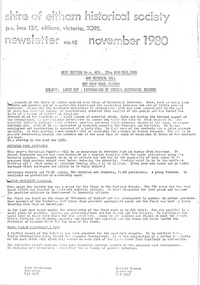
Newsletter, Newsletter, No. 15 November 1980
... Contents: • Next meeting: Lucky Dip – Examination of Council historical records • Werribee Park excursion • Eltham Community Festival • Yarra Valley Metropolitan Park ...Contents: • Next meeting: Lucky Dip – Examination of Council historical records • Werribee Park excursion • Eltham Community Festival • Yarra Valley Metropolitan Park The Shire of Eltham Historical Society was formed in October 1967. ...Contents: • Next meeting: Lucky Dip – Examination of Council historical records • Werribee Park excursion • Eltham Community Festival • Yarra Valley Metropolitan Park The Shire of Eltham Historical Society was formed in October 1967. The first newsletter of the Society was issued May 1978 and has been published continuously ever since on a bi-monthly basis. With the cessation of the Shire of Eltham in late 1994, the Society's name was revised to Eltham District Historical Society and this name first appeared with issue No. 103, July 1995. The collection of the Society's newsletters provides a valuable resource on the history of the Society's activities, office bearers and committee members, guest speakers and subjects of historical interest pertinent to the former Shire of Eltham and the Eltham District.A4 photocopied newsletter distributed to membersnewsletter, eltham district historical society, shire of eltham historical society -
 Ballarat Clarendon College
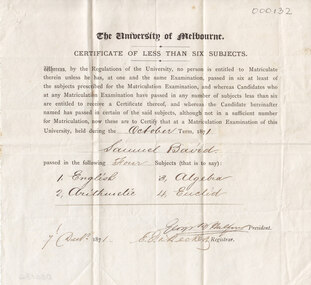
Certificate, The University of Melbourne matriculation examination certificate, 1873
... This infers that Samuel Baird sat some portion of the matriculation certificate over four examinations. Record 000131 is related to these items being a reference from the Principal Robert Oliver McCoy for Samuel Baird written in 1873. ...This infers that Samuel Baird sat some portion of the matriculation certificate over four examinations. Record 000131 is related to these items being a reference from the Principal Robert Oliver McCoy for Samuel Baird written in 1873. ...Samuel Baird attended Ballarat College 1864 - 1872. He was the first student enrolled at the school. His father, Samuel Baird, was the first engineer for the city of Ballarat. According to his grandson Samuel Baird was indentured to a local chemist in Ballarat. He moved to Melbourne and took over the chemist business Hood and Co in Elizabeth Street Melbourne. This business remained in the family for a further generation. This certificate is accompanied by an earlier certificate indicating that Samuel also sat a matriculation examination in October 1871 and passed in four subjects (000132.1). The certificates are accompanied by signed receipts from the University of Melbourne for matriculation examinations at a totla of four times - Receipt no 503 30 October 1871 for 5 subjects (000132.2) Receipt no 495 6 August 1872 less than six subjects (000132.3) Receipt no 696 29 October 1872 for 8 subjects (000132.4) Receipt no 195 14 February 1873 for matriculation exam (000132.5) for purchased copies of matriculation certificates. This infers that Samuel Baird sat some portion of the matriculation certificate over four examinations. Record 000131 is related to these items being a reference from the Principal Robert Oliver McCoy for Samuel Baird written in 1873. Historic significance for its connection with the first student of Ballarat College. Single sheet form printed on one side with handwritten insertions. Front: THE UNIVERSITY OF MELBOURNE / MATRICULATION EXAMINATION CERTIFICATE / At a Matriculation Examination held in the / October Term, 1872 / Samuel Baird / passed in the following six subjects: / 1. Latin 4. Arithmetic / 2. English 5. Algebra / 3. French 6. Euclid / [Signature] President / 14 Feb 1873 [Signature] Registrarsamuel-baird, 1864, ballarat-college, receipt, university-of-melbourne, matriculation -
 Federation University Historical Collection
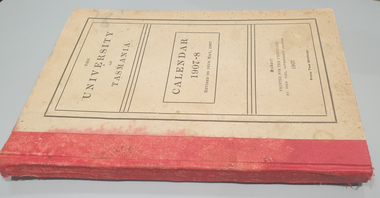
Book, John Vail, Government Printer, University of Tasmania Calendar, 1907-1908, 1907
... The book includes: Tasmanian University Actm 1890, High School Vesting Act, Statutes, Regulations, Rules, Public Examinations, Local Examinations in Music, Association with the University of Oxford, University Council, Graduates, Matriculated Students, Records and Close Lists, Annual Report for 1906, Benefaction and Donations, Rhodes SCholarship, Bequests, Women's University Union ...The book includes: Tasmanian University Actm 1890, High School Vesting Act, Statutes, Regulations, Rules, Public Examinations, Local Examinations in Music, Association with the University of Oxford, University Council, Graduates, Matriculated Students, Records and Close Lists, Annual Report for 1906, Benefaction and Donations, Rhodes SCholarship, Bequests, Women's University Union University of Tasmania Calendar, 1907-1908 Book Book John Vail, Government Printer ...Brown hardcovered book with read tape spine. The book includes: Tasmanian University Actm 1890, High School Vesting Act, Statutes, Regulations, Rules, Public Examinations, Local Examinations in Music, Association with the University of Oxford, University Council, Graduates, Matriculated Students, Records and Close Lists, Annual Report for 1906, Benefaction and Donations, Rhodes SCholarship, Bequests, Women's University Union university of tasmania, tasmania, education, women's university union, oxford university -
Federation University Historical Collection
Document - Document - Letter, Ballarat Junior Technical School: Request from Jack Dihm for his student record while at BJTS, 1953
... The reason being he is expecting to do further examinations for higher promotion in the Australian Regular Army. ballarat junior technical school l garner head master jack dihm school records period 1934-35 sargeant pacific islands regiment port moresby promotion australian regular army .1 Signature of Jack Dihm .1: Hand written letter in blue ink on lined paper .2: Yellow piece of paper typed .3: Yellow paper, typed. ...Letter from Sgt Jack Dihm, Pacific Islands Regiment in Port Moresby, requesting information of the standard he reached while at BJTS during the years of 1934-35. The reason being he is expecting to do further examinations for higher promotion in the Australian Regular Army..1: Hand written letter in blue ink on lined paper .2: Yellow piece of paper typed .3: Yellow paper, typed..1 Signature of Jack Dihmballarat junior technical school, l garner, head master, jack dihm, school records, period 1934-35, sargeant, pacific islands regiment, port moresby, promotion, australian regular army -
 Ballarat Clarendon College
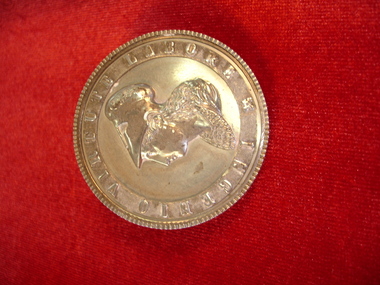
Medal, Christmas Examination medal 1868
... Significant, unique record of the school committment to academic excellence. james-boyd christmas-examination medal ballarat-college old-collegians dux matriculation 1868 Front: Minerva head in centre / INGENIO / VIRTUTE / LABORE Reverse: Standing lion with axe / MUNIFICENTIA / HENRICI / CUTHBERT Around edge of medal: JAMES BOYD / BALLARAT COLLEGE / CHRISTMAS EXAMINATION MEDAL 1868 Silver-plated round medal with Minerva head and words on front side, inscription engraved around edge and motif and words on reverse. ; medal is encased in brown leather covered, wooden box. ...The medal was presented to James Boyd, first Dux of Ballarat College in 1868 for his excellence in the Christmas Examinations. James passed his matriculation exams in the same year at 14 years of age. Known at school as Boyd 'Major', James went on to practise as a solicitor at Port Fairy. James attended many school functions throughout his life. Old Collegians re-presented this medal to James during the school's 50th anniversary celebration. The medal was re-presented in a silver plated box inscribed with the school crest and motto and the words 'Re-presented to / JAMES BOYD / December 1918 / on the anniversary of his Duxship of / BALLARAT COLLEGE / from Old Collegians. The re-boxed medal was presented to James Boyd at Speech Night 1918. A recod of this event states, 'At the conclusion of the prize list for the year Principal Mr A S M Polson announced - 'Dux of the College 1868 - James Boyd'. When My Boyd arose from where he had been sitting amongst the boys, he met with a tremendous ovation. he was cheered again and again, the College boys sang their Jubilee song with the refrain, 'Ah, me! Ah, me! merrily we sang with glee / Ten, twenty, thirty, forty, fifty years ago, Oh!'Significant, unique record of the school committment to academic excellence. Silver-plated round medal with Minerva head and words on front side, inscription engraved around edge and motif and words on reverse. ; medal is encased in brown leather covered, wooden box. Front: Minerva head in centre / INGENIO / VIRTUTE / LABORE Reverse: Standing lion with axe / MUNIFICENTIA / HENRICI / CUTHBERT Around edge of medal: JAMES BOYD / BALLARAT COLLEGE / CHRISTMAS EXAMINATION MEDAL 1868james-boyd, christmas-examination, medal, ballarat-college, old-collegians, dux, matriculation, 1868 -
 Flagstaff Hill Maritime Museum and Village
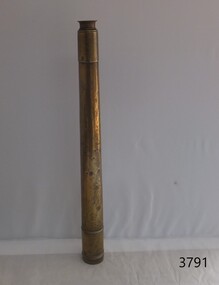
Instrument - Marine Telescope, 1870-1880
... examinations, however, he abandoned his plans. Instead, he apprenticed with his father, William Spencer Browning. At the same time, in the late 1840s, he was a student attending the Royal College of Chemistry several days per week. By the early 1870s, practical optics had become John Browning's primary interest, and he listed his occupation as an optician on the census records...examinations, however, he abandoned his plans. Instead, he apprenticed with his father, William Spencer Browning. At the same time, in the late 1840s, he was a student attending the Royal College of Chemistry several days per week. By the early 1870s, practical optics had become John Browning's primary interest, and he listed his occupation as an optician on the census records ...This telescope was amongst various items collected from a sea dive in Port Phillip Bay. The diver was the caretaker of the Port Lonsdale Lighthouse, who dived on various wrecks in the bay during the 1960's. After the caretaker's death, his son sold off many of the shipwreck artefacts. The telescope was purchased from the caretaker's son in the 1990's by a previous owner of the Marine Shop, Queenscliff, Victoria. John Browning was particularly well known for his scientific advances in the fields of spectroscopy, astronomy, and optometry. Between 1856 and 1872, Browning acquired provisional patents for designs of numerous scientific instruments. He was also the recipient of an award at the 1862 International Exhibition held in London. Also recognised for his temperature-compensated aneroid barometer. Browning's scientific instruments were used in physics, chemistry, and biology. The products he designed and manufactured included spectroscopes, telescopes, microscopes, barometers, photometers, cameras, ophthalmologist, and electrical equipment such as electric lamps. John Browning was born around 1831 in Kent, England. His father, William Spencer Browning, was a maker of nautical instruments. John Browning's great-grandfather was also an instrument maker as well as John’s brother Samuel Browning of the firms Spencer & Browning and Spencer, Browning & Rust, who also manufactured navigational instruments. The latter firm was in operation in London from 1784 to 1840 and was succeeded by the firm of Spencer, Browning & Co. John Browning initially intended to follow the medical profession and entered Guy's Hospital, a teaching hospital and a school of medicine. Despite having passed the required examinations, however, he abandoned his plans. Instead, he apprenticed with his father, William Spencer Browning. At the same time, in the late 1840s, he was a student attending the Royal College of Chemistry several days per week. By the early 1870s, practical optics had become John Browning's primary interest, and he listed his occupation as an optician on the census records from 1871 to 1901. He was well known among London's ophthalmic surgeons for his various ophthalmic instruments. He had a large part in reforming the art of crafting spectacles. Other achievements were as an author of the book, How to Use Our Eyes and How to Preserve them by the Aid of Spectacles. Published in 1883, the book included thirty-seven illustrations, including a diagram demonstrating the anatomy of the eye. In 1895, he was one of the founders of the "British Ophthalmology" the first professional organisation for optometry. He was not only its first president but also registered as its first member so many considered him to be the first professional optometrist. Other professional organisations he belonged too was as a member of “The Aeronautical Society of Great Britain”. In 1871 constructing the first wind tunnel located at Greenwich Marine Engineering Works. He was also a member of other scientific organisations, such as the “Microscopical Society of London”, the “Meteorological Society”, and the “Royal”. Then in 1908 the company of W. Watson & Son, opticians and camera makers, took over John Browning's company since 1901 John Browning had been semi-retired but in 1908 he fully retired and moved to Bournemouth in Hampshire. He died in Cheltenham, Gloucestershire in 1925.The telescope is significant for its association with one of the world’s leading scientific instrument makers and inventor of the 19th and early 20th century. It is believed the donation came off a wreck either in Port Philip Bay or between Point Lonsdale and the Nepean Heads making it a significant maritime historical artefact. Its provenance is good given it was taken off a wreck in this area by the Point Lonsdale lighthouse caretaker. Examples of John Browning's telescopes because of their scientific and historical importance are highly valued by collectors.Marine style single draw brass telescope with a sunshade. The single draw has no split and the second cartridge is held in a long brass tube within the single draw, mounted from the objective end. The eyepiece is flat and at the end of the first draw in a very faded engraving that is believed to read "John Browning, 63 Strand, and should read London under the word strand but this is hard to establish given the engravings condition. This interpretation of the engraving has been arrived at by examination of other John Browning telescope engraving examples."John Browning, engraved to the first tube in copper plate style "63 STRAND" Engraved under in capital textflagstaff hill, flagstaff hill maritime museum and village, warrnambool, maritime museum, maritime village, great ocean road, shipwreck coast, shipwreck artefact, port phillip bay, port lonsdale lighthouse, wreck, 1960’s diver, queenscliff marine shop, john browning, telescope, spectroscopy, optometry, scientific instruments, william spencer browning, optician, navigational instrument, microscopical society of london, aeronautical society, marine technology -
 Flagstaff Hill Maritime Museum and Village
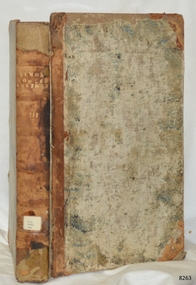
Book - Reference Fossils/Science, John Hill, A General Natural History, 1748
... records warrnambool children’s library a general natural history john hill A General Natural History is a massive, ambitious three-volume compendium written to survey the natural world. It is divided into three distinct parts, which were published sequentially between 1748 and 1752. Volume One contains The History of Fossils (1748). Despite the modern name, "fossils" back then referred to anything dug out of the earth. This volume focuses heavily on mineralogy, gemstones, rocks, and minerals, mapping them out based on a microscopic examination ...A General Natural History is a massive, ambitious three-volume compendium written to survey the natural world. It is divided into three distinct parts, which were published sequentially between 1748 and 1752. Volume One contains The History of Fossils (1748). Despite the modern name, "fossils" back then referred to anything dug out of the earth. This volume focuses heavily on mineralogy, gemstones, rocks, and minerals, mapping them out based on a microscopic examination. In Volume Two, A History of Plants (1751), Hill covers botany, describing the appearance, geographic range, and medicinal uses of various native and exotic plants (like the coffee tree, cacti, and various herbs). Volume Three concentrates on various animals and is called An History of Animals (1752). It's a zoological survey that starts with microscopic organisms before moving on to insects, marine life, reptiles, birds, and mammals. The book focused not just on describing these specimens, but also on outlining their "virtues and uses" in medicine and mechanics.A General Natural History Author: John Hill Publisher: Thomas Osborne Date: 1748 Badly damaged light brown hardcover with a damaged spine and lettering in gold. The spine has a Library label with an inscription.non-fictionA General Natural History is a massive, ambitious three-volume compendium written to survey the natural world. It is divided into three distinct parts, which were published sequentially between 1748 and 1752. Volume One contains The History of Fossils (1748). Despite the modern name, "fossils" back then referred to anything dug out of the earth. This volume focuses heavily on mineralogy, gemstones, rocks, and minerals, mapping them out based on a microscopic examination. In Volume Two, A History of Plants (1751), Hill covers botany, describing the appearance, geographic range, and medicinal uses of various native and exotic plants (like the coffee tree, cacti, and various herbs). Volume Three concentrates on various animals and is called An History of Animals (1752). It's a zoological survey that starts with microscopic organisms before moving on to insects, marine life, reptiles, birds, and mammals. The book focused not just on describing these specimens, but also on outlining their "virtues and uses" in medicine and mechanics.flagstaff hill, warrnambool, shipwrecked coast, flagstaff hill maritime museum, maritime museum, shipwreck coast, flagstaff hill maritime village, great ocean road, book, pattison collection, warrnambool library, warrnambool mechanics’ institute, ralph eric pattison, corangamite regional library service, warrnambool city librarian, mechanics’ institute library, victorian library board, warrnambool books and records, warrnambool children’s library, a general natural history, john hill -
 Flagstaff Hill Maritime Museum and Village
Book - Illustrated compendium of Lithographs/History, Charles Knight, Old England Vol 1, 1864
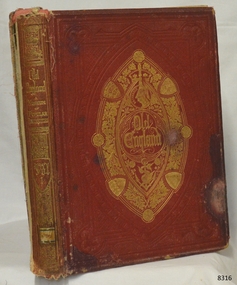
... records warrnambool children’s library old england vol 1 chromolithographs The full title of the work is ‘Old England: A Pictorial Museum of Regal, Ecclesiastical, Baronial, Municipal, and Popular Antiquities’. Edited by Charles Knight, this book serves as a massive, richly illustrated compendium of British social, architectural, and cultural history. It traces the development of England from prehistoric and Roman times, through the Middle Ages, and up to the 18th century. The label on the spine cover with typed text The front paste down paper has a Presentation sticker that read "State School No. 502 Stawell, Special Examination ...The full title of the work is ‘Old England: A Pictorial Museum of Regal, Ecclesiastical, Baronial, Municipal, and Popular Antiquities’. Edited by Charles Knight, this book serves as a massive, richly illustrated compendium of British social, architectural, and cultural history. It traces the development of England from prehistoric and Roman times, through the Middle Ages, and up to the 18th century.Old England Vol 1 Edited by Charles Knight Publisher: James Sangster & Co Date: 1864 Further Information: Red highly embossed hardcover with spine and lettering in gilt. Title to front cover in a egg shaped lozenge patterned in gilt. The spine has a Library label with an inscription.non-fictionThe full title of the work is ‘Old England: A Pictorial Museum of Regal, Ecclesiastical, Baronial, Municipal, and Popular Antiquities’. Edited by Charles Knight, this book serves as a massive, richly illustrated compendium of British social, architectural, and cultural history. It traces the development of England from prehistoric and Roman times, through the Middle Ages, and up to the 18th century.flagstaff hill, warrnambool, shipwrecked coast, flagstaff hill maritime museum, maritime museum, shipwreck coast, flagstaff hill maritime village, great ocean road, book, pattison collection, warrnambool library, warrnambool mechanics’ institute, ralph eric pattison, corangamite regional library service, warrnambool city librarian, mechanics’ institute library, victorian library board, warrnambool books and records, warrnambool children’s library, old england vol 1, chromolithographs -
 Flagstaff Hill Maritime Museum and Village
Domestic object - Soap, J W Lineker (Jean Winter Lineker) Pharmacist and Chemist, Mid-20th century
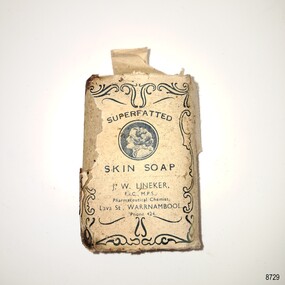
... records its origin: J. W. Lineker, pharmaceutical chemist, of Lava Street, Warrnambool. Although the manufacturer is unclear, the soap may have been made by the chemist herself. It was one of several items removed from the steam ferry Rowitta before the vessel was demolished in 2015, after around 40 years as a popular exhibit at Flagstaff Hill. The soap was likely part of a display inside the Rowitta. The wrapper identifies Jean Winder Lineker as a pharmaceutical chemist and lists her credentials, including Master of Pharmacy. In her earlier studies, she had passed the Pharmacy Board’s Intermediate Examination...records its origin: J. W. Lineker, pharmaceutical chemist, of Lava Street, Warrnambool. Although the manufacturer is unclear, the soap may have been made by the chemist herself. It was one of several items removed from the steam ferry Rowitta before the vessel was demolished in 2015, after around 40 years as a popular exhibit at Flagstaff Hill. The soap was likely part of a display inside the Rowitta. The wrapper identifies Jean Winder Lineker as a pharmaceutical chemist and lists her credentials, including Master of Pharmacy. In her earlier studies, she had passed the Pharmacy Board’s Intermediate Examination ...This early-to-mid 20th century bar, or cake, of Australian-made soap is carefully wrapped in card and finished with an attractive outer wrapper that promotes its gentle, moisturising qualities. The wrapper also records its origin: J. W. Lineker, pharmaceutical chemist, of Lava Street, Warrnambool. Although the manufacturer is unclear, the soap may have been made by the chemist herself. It was one of several items removed from the steam ferry Rowitta before the vessel was demolished in 2015, after around 40 years as a popular exhibit at Flagstaff Hill. The soap was likely part of a display inside the Rowitta. The wrapper identifies Jean Winder Lineker as a pharmaceutical chemist and lists her credentials, including Master of Pharmacy. In her earlier studies, she had passed the Pharmacy Board’s Intermediate Examination in 1924. By 1940, when she was granted probate from her late father’s will, Jean had relocated from Ballarat to 127 Fairy Street, Warrnambool, just around the corner from her Lava Street pharmacy. Jean was born at Dunkeld in 1900 to Adolphus Winter Lineker (ca. 1863–1934) and Jane Sophia Lineker, born Collins, who had married in 1899. The Lineker family had long associations with tailoring in western Victoria. An article in the Warrnambool Standard in October 1897 reported that A. W. Lineker, late of Melbourne, planned to open a tailoring establishment in Liebig Street, Warrnambool. By 1909, the family was in Portland, where they established the West End Tailoring Establishment in Julia Street. A comment in the local newspaper commends his window display; “Mr Lineker's windows attracted much attention throughout the evening, and most complimentary references were made to his neat dressing.” In 1912, they moved to Geelong and opened another tailor shop, before later moves to Ballarat, Brighton and Koroit. Adolphus died at Koroit in 1934, while Jane later returned to Dunkeld, where she died in 1940. Jane and Jean had been named joint executors of Adolphus’ will, but Jane died before probate was granted later that year. Other members of the Lineker family also operated tailoring businesses across the Western District in the late 19th and early 20th centuries. Everyday toiletries such as this offer a small but revealing insight into local retailing, personal care and pharmacy practice in regional Victoria during the mid-20th century. It is connected to pharmaceutical chemist Jean Winter Lineker, who lived in Warrnambool and ran her business there. Jean came from the well-known Lineker family: her father and other relatives operated several tailoring businesses across the western district of Victoria during the late 19th and early 20th centuries. Bar of soap: Superfatted Skin Soap within a rectangular, light coloured paper packet with navy-blue printed inscriptions on the front. The unsealed packet exposes a grey card lining and grey-fawn coloured soap. A decorative border encloses a female cameo portrait and details of the soap’s distributer. The soap originated from J. W. Lineker, pharmaceutical chemist, Lava St, Warrnambool. “SUPERFATTED / SKIN SOAP / J. W. LINEKER / FN. C., M.P.S.. / Pharmaceutical Chemist / Lava St, WARRNAMBOOL, / ‘Phone 424.” Logo within a circle: Portrait of a young lady showing the left side of her face.flagstaff hill maritime museum and village, great ocean road, shipwreck coast, warrnambool, superfatted skin soap, j. w. lineker, pharmaceutical chemist, lava st, fn. c, m.p.s., phone 424, australian made, soap, the rowitta, jean winder lineker, master of pharmacy, pharmacy board, intermediate examination, ballarat, 127 fairy street, adolphus winter lineker, jane sophia lineker, western victoria, tailor, portland, geelong, brighton, koroit, chemist, pharmacy -
 Ringwood and District Historical Society
Document - Report, History of Anderson's Creek 1856-1865 by W.W.L. Radden January 1965
... "Introduction: The notes which follow are based on an examination of some old Police records held in the Archives Department of the State Library of Victoria. ..."Introduction: The notes which follow are based on an examination of some old Police records held in the Archives Department of the State Library of Victoria. ...History of Anderson's Creek 1856-1865 - 7 foolscap pages and Warrandyte map prepared by W.W.L. Radden January 1965"Introduction: The notes which follow are based on an examination of some old Police records held in the Archives Department of the State Library of Victoria. The records are reports and instructions referring to the Police District of Bourke, and made in the years 1856 to 1865. ..." -
 Mortlake and District Historical Society
Letter for payment of account Mortlake Mill, March 7 1864
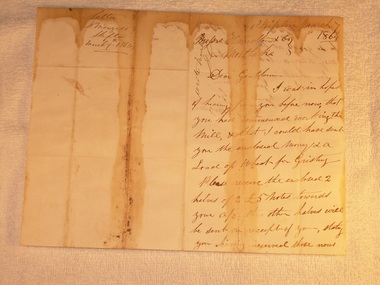
... Despite the apparent difficulties of conducting business in the 1850's, it is notable that commerce thrived at that time in country districts, as an examination of Mill accounts and records show. mortlake mill grain wheat hamilton geddes aikman laang dixie menzies skipton Skipton March 7 1864 [to] Messrs. ...This letter was sent by a customer D. Menzies at Skipton to the Mortlake Mill, detailing an unusual payment method for the processing of his wheat into flour. David Menzies was a Scots farmer who lived in Skipton c. 1860's on a bend in the Mount Emu Creek. He helped establish the local school and a lane in the township bears his name. The letter illustrates the nature of commerce and the difficulties of communication and life generally in the country at the time. The bluestone Mortlake Mill built in 1856, has been a prominent landmark in Mortlake for over 150 years. It played a significant role in the commercial life of the town and was initially a wind-mill to process district grain for sale. The goldrush at Ararat 100 km. away led to a temporarily increased population and demand for foodstuffs. In 1857 the Mill was sold to Aikman, Hamilton and Geddes who converted it to steampower and later built the prominent chimney, which is on the Heritage Register as part of the National Estate. D. Menzies at Skipton lived at least 85 km away - his wheat which urgently needed milling, faced a slow and arduous journey by bullock dray. After the demise of the Ararat goldfields and the decline in population (as well as the district soils proving unsuitable for sustained wheat cultivation), the operation of the Mill declined too and the proprietors increased their involvement in other activities - supply of building materials, timber felling and sawmills. Despite the apparent difficulties of conducting business in the 1850's, it is notable that commerce thrived at that time in country districts, as an examination of Mill accounts and records show.Handwritten letter dated 1864 (water-stained)Skipton March 7 1864 [to] Messrs. Hamilton & Co. Mortlake. Dear Gentlemen, I was in hope of hearing from you before now that you had commenced working the Mill, & that I could have sent you the enclosed money [for a] load of wheat for Gristing. Please receive the enclosed 2 halves of 2 [two] 5 [pound sign] notes forwarded to your account. the other halves will be sent on receipt of your stating you having received those notes sent. As I am out of flour be so good as say how soon I may send a load of wheat. In haste I am Gentlemen Yours truly D. Menziesmortlake mill grain wheat hamilton geddes aikman laang dixie menzies skipton -
 Halls Gap & Grampians Historical Society
Financial record - Invoice photocopy, C 1895
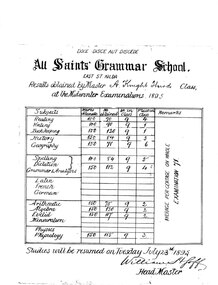
... Examinations, 1895. EDUCATION Report Cards PEOPLE Knight Photocopy of school results from All Saints' Grammar School, East St Kilda. Financial record ...A report from the Head Master of the All Saints' Grammar School, East St. Kilda, of the results obtained by Master A Knight, Third Class, at the Midwinter Examinations, 1895.Photocopy of school results from All Saints' Grammar School, East St Kilda.education, report cards, people, knight -
 Orbost & District Historical Society
certificates, 1909, 1911, 1912
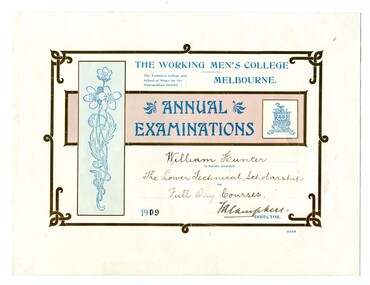
... records were meticulous. These certificates are part of his history. hunter-william-surveyor All four certificates awarded to "William Hunter" and signed by Mordaunt Arundel Hall (accountant & chief clerk WMC) as the Acting Director. Four card certificates of merit for "Annual Examinations ...These four certificates belonged to William Hunter. William Hunter (1893-1971) was a resident of Tatura and Mallacoota. He was a soldier, surveyor and amateur naturalist. The certificates include two first prizes for surveying, a technical scholarship for full day courses and a certificate for Applied Mechanics. William received his Surveying Certificate in April 1916. In June 1887, the Working Men's College opened after Francis Ormond, a noted Victorian philanthropist and member of parliament, suggested that a technical institute be built in Melbourne, offering further education for working men and women. He had offered to match the sum raised through public subscription if the government could provide a site for the College. William Hunter made valuable contributions to our knowledge of far East Gippsland plants. His records were meticulous. These certificates are part of his history.Four card certificates of merit for "Annual Examinations" from the Working Men's College, The Technical College and School of Mines for the Metropolitan District.All four certificates awarded to "William Hunter" and signed by Mordaunt Arundel Hall (accountant & chief clerk WMC) as the Acting Director.hunter-william-surveyor -
 Ringwood and District Historical Society
Photograph, Boiler explosion at Ringwood station 20th June 1894 for engine 297R. "Heard in Box Hill"
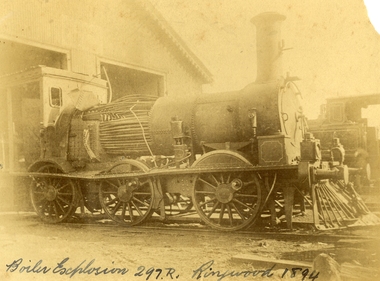
... record of the water used ?— Yes, the water in this case, I think, came from the Maroondah scheme. Mr Woodroffe said boilers were examined front time to time in the running sheds. In his opinion every possible care had been taken to keep the engine in proper care. There might, however, be lessons learnt from this. The Chairman: No doubt. From his examination...record of the water used ?— Yes, the water in this case, I think, came from the Maroondah scheme. Mr Woodroffe said boilers were examined front time to time in the running sheds. In his opinion every possible care had been taken to keep the engine in proper care. There might, however, be lessons learnt from this. The Chairman: No doubt. From his examination ...Black and white photographs - 2 copiesTyped below photograph, "Boiler explosion at Ringwood station 20/6/1894. Heard in Box Hill". Article from newspapers:- Weekly Times (Melbourne, Vic. : 1869 - 1954), Saturday 27 January 1894, page 21 Official enquiry. The Board of Enquiry appointed by the Railway Commissioners to enquire into the causes of the boiler explosion which shattered the locomotive at Ringwood on Saturday night, assembled at the Railway department on Wednesday to commence its deliberations, The board consisted of Mr R. Fulton, engineer, C. W. McLean; engineer to the Marine Board, and Mr Mephan Ferguson, iron-founder. There is some difficulty at the outset about the constitution of the board; It was suggested that the Apt of Parliament contemplated that boards of experts, after the manner of the present one, needed, to have their appointments confirmed by the Governor-in-Council. The point, however, was not considered sufficiently important to prevent the board from proceeding with evidence. Robert Greyford, stationmaster at Ringwood, was the first witness. He said he saw the explosion on Saturday night at about twenty minutes to 8. There was a rush to the engine to see what had happened, and the driver and fireman were both found on the platform of the engine. The driver seemed badly hurt, but the fireman, to all appearances, was not so badly injured. They were both attended to and sent up to Melbourne by the last suburban train. Witness had a look at the engine and found the dome and all the plates round the boiler blown clean, away. The springs were also blown clean away. The Chairman (Mr Fulton) : Did you measure the distance ? Witness: Yes; one of the plates was 209 yards away. A piece from the top of the boiler 15 pounds in weight he found driven into the hard beaten track 410 yards away. Several pieces of boiler plate were found scattered at various distances. The buildings roundabout were injured. The Chairman; Did you notice anything peculiar about either of the driver or the fireman ? — No ; nothing wrong, with either of them. If the engine was blowing off at all, it must have been very light. In your opinion, were they perfectly sober ? — Perfectly. In approaching the station, is there a down or an up grade? — A very slight down grade. How is the road from Healesville ? — Up and down all the way. It is down, grade for about 200 yards coming into Ringwood station. They shut off ; steam about a quarter of a mile away, and come in at a good pace. They generally put on 15 pounds of steam while they are in the station. Mr Ferguson : Had the driver the usual load on ? — Yes ; about the usual load. Witness added that he had known the driver personally for about 10 years, and he had always been a careful, steady, sober man. He did not know the fireman so well. John Palmer, porter at Ringwood station, also saw the explosion. He was attending to the train on its arrival. He was knocked down by the force of the explosion. When he got up he saw the engine driver being carried into the office covered in blood. He noticed nothing peculiar about the driver and fireman, nor about the engine. Mr McLean : How far were you from the engine when you were knocked down ? — From ten to fifteen yards. William Paul, the guard of the train to which the injured locomotive Was attached, said he was looking at the engine at the very moment the explosion occurred. It seemed to come from exactly under the dome. The force of it took him off his feet. He was about 15 yards from the tender. When he rose he tried to reach the engine, but could not do so on account of the steam and coal dust. He called out to know whether any of the passengers were injured, and got no response, so that he concluded they were all right. All the lamps but about half dozen were extinguished by the force of the explosion, although the glass was not broken. He could testify most distinctly that the driver and fireman were both sober. The driver was a man who never drank. The steam started to blow off about a minute and a half before the explosion took place. The last place at which the engine took water was Healesville. The Chairman : Do yon know anything of the quality of the water there ? Is it creek water ? — Yes ; it comes from the Graceburn River. You never heard of its quality ?— No. How long have you known this engine on the road— About 13 months. Hew long have you known the driver on this line ? — About six weeks. I have known the fireman several years. The driver was a strict teetotaller, and I never saw the fireman take anything to drink in his life. Mr T. H, Woodroffe, chief mechanical engineer of the Victorian Railways, produced a report he had written to the secretary, about this explosion. The document gave facts concerning the engine and the explosion. It stated that the rapture seemed to have occurred at the rim of the plates adjoining the fire box. The engine was built at the Phoenix Foundry, Ballarat, in 1883. It was repaired at various times, the last time being in July of last year when it was sent to the Port Melbourne shops, and was then tested to a cold water pressure of 195 and found all right. It was the custom to overhaul all locomotives about every five years. The Chairman : There were no very heavy repairs in July, 1893; were there? — Not to the boilers. The shop manager's report says that the plug and safety tap holes were repaired, five new copper studs put in firebox, ash-pan door repaired, tender cleaned and overhauled, and studs re-rivetted, and boiler tested to pressure of 195, cold water. Mr Woodroffe read the report of the repairs effected to the boiler in December, 1888. That would be the time the plate was put in the boiler. On that occasion three new plates were put in the bottom and the boiler tested up to 195. The Chairman: Do you keep a record of the water used ?— Yes, the water in this case, I think, came from the Maroondah scheme. Mr Woodroffe said boilers were examined front time to time in the running sheds. In his opinion every possible care had been taken to keep the engine in proper care. There might, however, be lessons learnt from this. The Chairman: No doubt. From his examination of the plates [the] witness did not think the state of them could have been detected from the outside. There were no signs of leakage or sweating or anything of that sort. The next witness- was Walter Stinton, workshop manager at Newport and he said that the injured engine had been repeatedly repaired under his charge. He gave a technical account of the repairs effected on various occasions. The testing of locomotives was under his special notice. They had a high pressure pipe running; round the works, and a pump set at 2001b. When the boiler was pumped full of water the pressure when applied up to 1951b. The board appointed by the department to inquire into the Ringwood locomotive boiler explosion sat again at Spencer street on 25th inst. Mr R. Fulton presided and the other members of the board were. Mr Mephan Ferguson and Mr C. W. McLean. Charles Grubb, foreman of the boiler-makers at the Newport workshops, said he had inspected the pieces of plate that had been blown out of the engine, and after examining them, pointed out to the Chief Mechanical Engineer the portion where the plate had started to burst. It was under the lap, on the right hand side of the boiler. The grooving might be accounted for by bad water. During the past twenty years he had examined all the boilers that came into the Williamstown workshops, and while some were hardly marked at all, others were very badly eaten away. The practice was to cut out the defective portions. In this case the boiler was repaired in a similar manner. The Chairman : Can you suggest any other way of repairing so as to prevent accident ? — No, unless by taking out a plate on one side from the joint, and carrying it further up so as to avoid the joints meeting, or by taking out the plate altogether. What would.be the cost .of putting in a new " plate I—Perhaps about double the price; but I wouldn't recommend that course. It would be putting a new plate against plates that have been in use ten years or so and that would not be advisable. I think the present system better. I consider the present system of repairing the best. This is the first we have had so bad like that, to my knowledge. You attributed this to bad water. Is there no other probable cause ? — Well; unless the iron be bad. This was Lowmoor iron. I think this accident was caused by the eating away of plates. This one was the worst I have seen, for the short time it had been running. We use three classes of iron — Lowmoor, Monkbridge and Bowling. By Mr Woodroffe (Chief Mechanical Engineer) ; There are engines still running that were repaired at the same time as this one, in 1888, and. in the same way. These are engines 339 and 333. They have been recently examined and are in splendid order. What in your experience, is the age of a boiler on the Victorian railways? — From 17 to 20 years our earlier boilers stood. The later boilers don't stand so well. How is that? — There is difference in construction, and the material is lighter. The old boilers had thicker plates. Have you been asked in any way to curtail boiler affairs? — No, sir; nor in any way. You have never hesitated to carry out any necessary repairs? — Never. Our orders have been to exercise every care in examining, repairing and renewing boilers. Witness said that his practice was when an engine came into the workshop to find out how long she had been running. If over five years, he informed the workshop manager, and they thought it necessary the tubes were taken nut. If everything was in good order witness reported to the manager. The cost of taking out the tubes and putting them in again was about L20. Mr Woodroffe : Have you ever hesitated to repair a boiler on the score of expense ? — No, never. Mr McLean : Hew do yon ascertain whether a boiler requires repairs?— I keep a record of every boiler examined. From every boiler that comes in I have the dome covers taken off, and when it is practical I get inside. l can almost tell from the top of a boiler what the bottom is like. If there is any doubt about it I have the tubes taken out. If I have suspicion of defective plate I cause to have bored a triangle in the plate at the point where there is the most wear. There is a travelling inspector who visits all the running sheds of the colony except Port Melbourne and tests the boilers. He reports to us and we note what he points out. Alfred Thompson, locomotive inspector of the eastern section, said he knew this engine, 297R. He read a list of her repairs. He heard of the accident on Saturday night and went up to Ringwood. The Chairman : Did you ever notice anything peculiar about the engine? — No, I considered her A1 and would not have hesitated to have put on 140lb pressure owing to the repairs she had undergone. Witness considered that the explosion was caused by the expansion and contraction of the plates ; and, no doubt, the plate had been eaten away through bad water. The other side of the boiler showed: signs of corrosion: By Mr Woodroffe ; Is every care taken with the boilers ? — Yes, every possible care is taken for the safety of boilers, Weekly Times (Melbourne, Vic. : 1869 - 1954), Saturday 27 January 1894, page 7 EXPLOSION OF A LOCOMOTIVE BOILER, NARROW ESACPE FROM FATALITIES. THE DAMAGED ENGINE. [See drawing of loco – saved in “Railways” folder] The explosion of a locomotive boiler at Ringwood on Saturday evening, formed the subject of much discussion in railway circles on Monday. The Minister arrived at the office at an unusually early hour and immediately entered into a consultation with the acting chairman, Mr Kibble, and Mr Commissioner Murray. As the result of the interview it was resolved to ask three gentlemen of acknowledged engineering experience to sib as a board with the . object of inquiring into the cause of the accident and furnishing a report. Mr Richardson and the Commissioners are tally seized of the importance of having a searching investigation into the accident, and, with Mr Murray, the former went to Ringwood to inspect the scene of the disaster. They will he accompanied by Mr Woodroffe. During the morning no official report had come to hand from the driver or fireman of the engine in reference to the accident, but that is thought to be due to the circumstance that they have not sufficiently recovered to be able to give a circumstantial account of what occurred. The engine was one of the old R's, and, Mr Kibble pronounced them to be about the best class of engines used. So far nothing can be said as to the probable cause of the accident, as the broken plating of the engine has not been submitted to the inspection of experts. Weekly Times (Melbourne, Vic. : 1869 - 1954), Saturday 27 January 1894, page 7 STATEMENT BY THE FIREMAN. This morning Thomas Miles, fireman on the engine the boiler of which exploded on Saturday night, is suffering from an injury to the spine, as well as a very severe shaking to the system. He states that he was fireman on the engine attached to the train which left Healesville on Saturday evening, at ten minutes to 8. Everything went all right until Ringwood was reached, when, .just as the train was about to continue its journey, a load explosion took place and Miles remembers nothing more until he was picked np on the platform ; and found himself suffering from a pain in the back, and an injury to his arm. He cannot think of any reason which could have caused the explosion, as there was plenty of water in the boiler, and everything seemed working all right. Mr R. Fulton, consulting engineer, of Queen street; Mr McLean, a member of the Marine Board ; and Mr Mephan Ferguson, engineer, have consented to act as a board to inquire into the cause of the engine boiler explosion at Ringwood on Saturday evening. The board has been appointed under section 117 of Act 1135, which provides that the Governor-in-Council may direct the taking of a such a step. Mr1 Fulton will act as chairman of the board, which met for the first time at the railway offices, Spencer street, this forenoon. Before separating the members of the Board paid a visit to the Prince's Bridge locomotive sheds in company with Mr Woodroffe, the chief mechanical engineer, for the purpose of inspecting the shattered boiler. It has been stated that the explosion is known to have been caused by a flaw in a plate which was put on the boiler about four years ago, but enquiries have tailed to elicit anything in support of that view. The engineers connected with the department are not inclined to say anything on the subject. Weekly Times (Melbourne, Vic. : 1869 - 1954), Saturday 14 April 1894, page 20 The Ringwood Boiler Explosion, The Minister of Railways has received the supplementary report of the board appointed by him to investigate the circumstances connected with the explosion of a locomotive boiler at Ringwood. In their first report the board did not attach blame to anyone. Mr Richardson felt satisfied that the responsibility of having the engines properly inspected and overhauled periodically could be fixed if the inquiry were extended. He therefore referred the matter again to the Board, who took further evidence. In the report now furnished, the Board hold Loco. Inspector Thompson blameable, but point out as a mitigating circumstance that he had not received "written instructions" respecting inspections and overhauls. Weekly Times (Melbourne, Vic. : 1869 - 1954), Saturday 7 July 1894, page 32 The Ringwood Boiler Explosion. The Minister of Railways takes exception to the tone of a paragraph appearing in a morning contemporary respecting the Ringwood boiler explosion. It makes it appear that Mr Richardson has referred the report of the board which considered the facts connected with the explosion to the Crown solicitor simply because he differed from the finding of the board. The Minister explains that when he received the report he found that the responsibility for having boilers properly inspected and overhauled had not been clearly fixed. He personally obtained farther evidence on that point, and arrived at a conclusion, from which the commissioners differed. As he did not like to take upon himself the responsibility of deciding upon the effect of the evidence, he submitted the matter to the Crown Solicitor, but that officer did not furnish him with the information sought. He has, therefore, referred the question to the Attorney-General, together with the draft of a regulation respecting boiler inspections and overhauls in the future. Mr Richardson says that his whole aim is to have the responsibility positively fixed. Weekly Times (Melbourne, Vic. : 1869 - 1954), Saturday 28 April 1894, page 23 The Minister of Railways has completed his consideration of the supplementary report received by him from the Ringwood Boiler Explosion Board. The report, it will be remembered, held Loco-Inspector Thompson blameable for the non-inspection of the boiler, but considered there was extenuating circumstances. There was a certain amount of doubt as to the absolute instructions given for overhauling engines periodically. Mr. Richardson is sending the report on to the Commissioners with instructions that the responsibility respecting inspection of boilers shall be made clear for the future. -
 Bendigo Military Museum
Book - EXAMINATION REPORT, ARMY, Australian Army, Chief of General Staff, Report on written Examinations for Promotion to Captain and Major, 1971
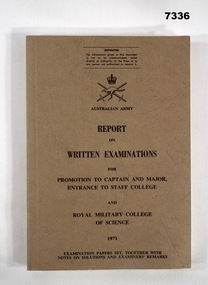
... examination papers, notes on solutions and examiners remarks. Part of the collection of KEVIN JOHN HERDMAN, No. 397661. See Cat. No. 5942P for details of his service record...examination papers, notes on solutions and examiners remarks. Part of the collection of KEVIN JOHN HERDMAN, No. 397661. See Cat. No. 5942P for details of his service record ...Restricted access report containing examination papers, notes on solutions and examiners remarks. Part of the collection of KEVIN JOHN HERDMAN, No. 397661. See Cat. No. 5942P for details of his service record.Soft cover bound report on Army Examinations. Brown soft back textured card cover. Title on front cover in black type with Australian Army Logo. 212 pages with cut edges. Pages glued to spine. Text on pages in black type.reports, promotion, examination, australian army, kevin john herdman -
 Bendigo Military Museum
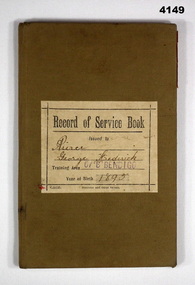
Administrative record - RECORD OF SERVICE BOOK WW1, 21.06.2011
... Record of Service book, 62 pages, khaki canvas covered with details relating to exemptions from training, change of address, equipment issue, medical examinations, fines and payments....Record of Service book, 62 pages, khaki canvas covered with details relating to exemptions from training, change of address, equipment issue, medical examinations, fines and payments. ...The item is a record of George Frederick Pierce’s “Senior cadet Training” in the 67th Bn Bendigo Militia Bn from 21.6.1911 to 31.12.1914 prior to enlisting in the AIF. Refer cat No 4136P for his AIF service, DCM award and his death. Part of the collection of William (Bill) Thomason, refer Cat No 4136P.Record of Service book, 62 pages, khaki canvas covered with details relating to exemptions from training, change of address, equipment issue, medical examinations, fines and payments.On the front in ink, “George Frederick Pierce”, stamped in purple “67B Bendigo”, in ink “1895”.records, military, service -
 Bendigo Military Museum
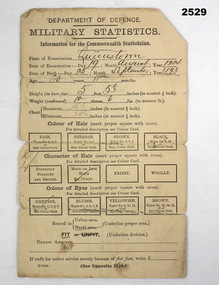
Administrative record - EXAMINATION REPORT 1914, 1914
... Returned to Aust 29.7.1915. military history - army documents - reports examination Medical Report completed for FRITZ FRA detailing his physical characteristics. Administrative record EXAMINATION REPORT 1914 ...Initial medical examination certificate for CLAUDE ARNOLD FRITZ FRA who enlisted in Queenstown, Tasmania on 22.8.1914. He was in D Company 12th Batt. Embarked 20.10.1914. Reg No 441. Returned to Aust 29.7.1915.Medical Report completed for FRITZ FRA detailing his physical characteristics.military history - army, documents - reports, examination -
 Bendigo Military Museum
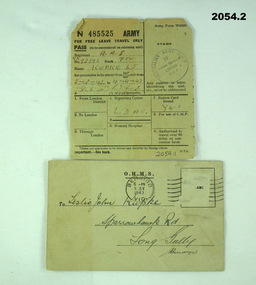
document - ARMY DOCUMENTS WW2, WWII
... examination in Bendigo on corner of Pall Mall and Bull St. Leslie John KUPKE (born Albury, enlisted Royal Park) initially signed Mobilization forms on 12.7.1943 as No V513056 age 18 years. He then transferred to the AIF on 3.12.1943 as No VX93892. He embarked for Bougainville with the the 15th Aust Infantry Battalion on 23.11.1944, hospital with Hookworm from 8.6.1945 to 30.6.1945, embarked for Australia returning on 1.6.1946, hospital with Malaria on 17.8.1946. On 21.1.1947 he embarked for England as a POW voyage guard and returned on 14.6.1947. Discharged from the Army 1.7.1947. documents-army records ...2054.1) Travel pass issued to L. J. KUPKE whilst attached to Australian Army Staff in London in 1947. 2054.2) Issued to L. J. KUPKE VX93892 requesting that he report for a medical examination in Bendigo on corner of Pall Mall and Bull St. Leslie John KUPKE (born Albury, enlisted Royal Park) initially signed Mobilization forms on 12.7.1943 as No V513056 age 18 years. He then transferred to the AIF on 3.12.1943 as No VX93892. He embarked for Bougainville with the the 15th Aust Infantry Battalion on 23.11.1944, hospital with Hookworm from 8.6.1945 to 30.6.1945, embarked for Australia returning on 1.6.1946, hospital with Malaria on 17.8.1946. On 21.1.1947 he embarked for England as a POW voyage guard and returned on 14.6.1947. Discharged from the Army 1.7.1947..1) Free leave travel pass issued to L. J. KUPKE VX93892. Army form W4098. .2) Notice to report for Medical Examination..1) Stamped by Australian Army Staff .2) Addressed to Leslie John KUPKE, Sparrowhawk Rd. Long Gully.documents-army records, travel -
 Bendigo Historical Society Inc.
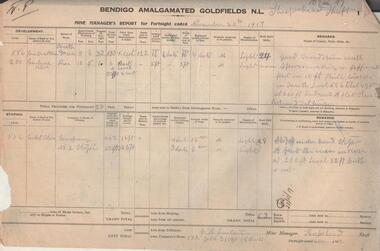
Administrative record - Bendigo Amalgamated Goldfields N.L. Mine Manager's Reports, 1917 - 1920
... examination held at the Bendigo Law Courts. Bendigo Margaret Roberts goldmining Bendigo Amalgamated Goldfields Sheepshead Shaft J.H. Lenten Mine Manager One hundred pages of fortnightly manager's reports for Bendigo Amalgamated Goldfields N.L., Sheepshead Shaft. Reports consist of two pages for each fortnight, signed by J.H. Lenten, Mine Manager. Dates of reports range from November 20th, 1917 to 5th May 1920. Categories reported on include: development, stoping, tons from tributors, tons Company's stone, plant and machinery, underground workings, number of rock drill shifts, firewood used, coal burnt, and general remarks. charcoal burnt., lifting water Administrative record ...In 1917 Bendigo Amalgamated Goldfield Ltd was formed from the amalgamation of 35 companies with operations on the Garden Gully, Sheepshead, Deborah and Derby lines of reef hoping to increase profits of these existing operations through economies of scale. This was difficult to achieve as the shafts involved were spread throughout the goldfield. Diamond drilling and good geological practices were introduced (Pabst was Chief Geologist) leading to some exploration success. However costs were rising rapidly and in 1923 the directors, deciding that mining would soon become unprofitable, dissolved the company returning assets to the original vendors. J.H. Lenten, Mine Manager, received his second class Mine Manager's certificate in September, 1914 at an examination held at the Bendigo Law Courts. One hundred pages of fortnightly manager's reports for Bendigo Amalgamated Goldfields N.L., Sheepshead Shaft. Reports consist of two pages for each fortnight, signed by J.H. Lenten, Mine Manager. Dates of reports range from November 20th, 1917 to 5th May 1920. Categories reported on include: development, stoping, tons from tributors, tons Company's stone, plant and machinery, underground workings, number of rock drill shifts, firewood used, coal burnt, and general remarks. charcoal burnt., lifting waterbendigo, margaret roberts, , goldmining, bendigo amalgamated goldfields, sheepshead shaft, j.h. lenten, mine manager -
 Monbulk RSL Sub Branch
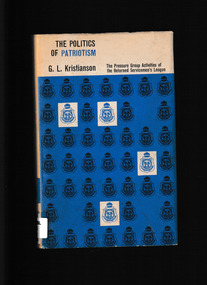
Book, GL Kristtianson, The politics of patriotism : the pressure group activities of the Returned Servicemen's League, 1966
... examination. It is not an 'official', or even an authorized account of the R.S.L.'s pressure group activities - while the League provided unrestricted access to its files and records, the organization's leaders exercised no censorship or control over the final results. ...s Australia's largest veterans' organization, the R.S.L. has been the subject of bitter controversy. The League has often been attacked, and as frequently defended, but it has never been examined in depth by an impartial observer. This book is the first detailed and dispassionate examination. It is not an 'official', or even an authorized account of the R.S.L.'s pressure group activities - while the League provided unrestricted access to its files and records, the organization's leaders exercised no censorship or control over the final results. The author examines the R.S.L.'s attempts to influence the Commonwealth government against a background of continual internal conflict over tactics. He describes the constant approaches to the government on pensions, medical benefits, war service homes, soldier settlement, employment preference, and gratuities, as well as on such controversial subjects as defence and anti-communism, all of which serve to mark the R.S.L. as one of Australia’s most active pressure groups. The book also points to the danger implicit in the R.S.L.'s attempt to monopolize the virtues which it claims are uniquely Australian. In its rigid enforcement of the exclusiveness of Anzac Day, it is argued, lie both the League's peculiar strength and its greatest problems.Index, ill, p.286.non-fictions Australia's largest veterans' organization, the R.S.L. has been the subject of bitter controversy. The League has often been attacked, and as frequently defended, but it has never been examined in depth by an impartial observer. This book is the first detailed and dispassionate examination. It is not an 'official', or even an authorized account of the R.S.L.'s pressure group activities - while the League provided unrestricted access to its files and records, the organization's leaders exercised no censorship or control over the final results. The author examines the R.S.L.'s attempts to influence the Commonwealth government against a background of continual internal conflict over tactics. He describes the constant approaches to the government on pensions, medical benefits, war service homes, soldier settlement, employment preference, and gratuities, as well as on such controversial subjects as defence and anti-communism, all of which serve to mark the R.S.L. as one of Australia’s most active pressure groups. The book also points to the danger implicit in the R.S.L.'s attempt to monopolize the virtues which it claims are uniquely Australian. In its rigid enforcement of the exclusiveness of Anzac Day, it is argued, lie both the League's peculiar strength and its greatest problems. australia - politics and government, pressure groups - australia -
 Bendigo Historical Society Inc.
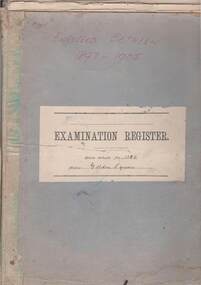
Document - GOLDEN SQUARE P.S. LAUREL ST. 1189 COLLECTION: ENROLMENTS BETWEEN 1897 - 1905
... On front sticker 'examination register, State School 1189, Golden Square' Written on top in purple ink 'enrolled between 1897 - 1905'. Appears to be record...On front sticker 'examination register, State School 1189, Golden Square' Written on top in purple ink 'enrolled between 1897 - 1905'. Appears to be record ...Grey cover register. On front sticker 'examination register, State School 1189, Golden Square' Written on top in purple ink 'enrolled between 1897 - 1905'. Appears to be record of enrolments through to 1908. Attendances marked up to 1912. Pages in poor condition.education, primary, golden square laurel st p.s. -
 Bendigo Historical Society Inc.
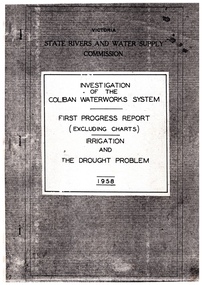
Administrative record - Commercial Egg Producers' Association of Victoria (CEPA) State Rivers and Water Supply Commission Report on the Drought Problem and Irrigation, 1958
... Examination of irrigation practices and their effectiveness under drought conditions. 3c. Identification of operational difficulties and potential solutions for water management during dry periods. The report serves as a foundational document for understanding the drought-related challenges faced by the Coliban Waterworks system in 1958 and sets the stage for further investigation and recommendations. Administrative record ...The Commercial Egg Producers' Association of Victoria was active by the 1930s, engaging in industry management and lobbying.The Commercial Egg Producer's Association (CEPA) had branches in Bendigo, South Bendigo, Eaglehawk, Wedderburn, Murrabit and Euroa.CEPA Commercial Egg Producer's Association (Bendigo Region) Commercial Egg Producers' Association of Victoria (CEPA) State Rivers and Water Supply Commission 69 Page Report on the Drought Problem and Irrigation. This document is an investigation report focused on the Coliban Waterworks system, specifically addressing the drought problems encountered in 1958. The key points include: 1. Purpose: The report aims to analyze the impact of drought on the Coliban Waterworks system and its irrigation operations. 2. Scope: It provides a progress update, excluding charts, on the system's performance and challenges during the drought period. 3. Focus Areas: 3a.Assessment of water supply and distribution issues caused by drought. 3b. Examination of irrigation practices and their effectiveness under drought conditions. 3c. Identification of operational difficulties and potential solutions for water management during dry periods. The report serves as a foundational document for understanding the drought-related challenges faced by the Coliban Waterworks system in 1958 and sets the stage for further investigation and recommendations.egg producer's information, correspondence, cepa, commercial egg producers' association -
 NMIT (Northern Melbourne Institute of TAFE)
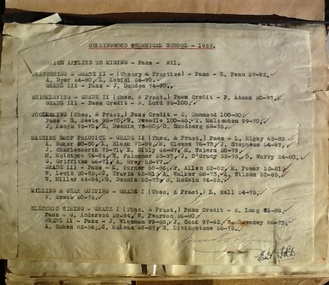
Examination results - CTS, Examination results. Collingwood Technical School. 1913-1920, 1913-1920
... Examination results (pass or fail) in all aspects of technical education from Mathematics to trade subjects. A key record ...Examination results (pass or fail) in all aspects of technical education from Mathematics to trade subjects.A key record of students and results from the early decades of Collingwood Technical School.Black hard cover book divided by tabs for each year. Results sheets have been pasted into book. On spine: CTS/ Examination results / 1913 ...1920.collingwood technical school, cts, examination results, exams, nmit, -
 NMIT (Northern Melbourne Institute of TAFE)
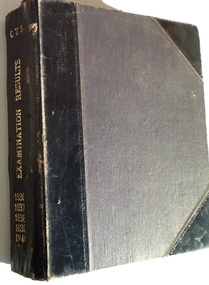
Examination results - CTS, Examination results. Collingwood Technical School. 1926-1930, 1926-1930
... Examination results (pass or fail) in all aspects of technical education from Mathematics to trade subjects. A key record ...Examination results (pass or fail) in all aspects of technical education from Mathematics to trade subjects.A key record of students and results from the early decades of Collingwood Technical School.Black hard cover book divided by tabs for each year. Results sheets have been pasted into book. On spine: CTS/ Examination results / 1926 ...1930.collingwood technical school, cts, examination results, exams, nmit, -
 NMIT (Northern Melbourne Institute of TAFE)
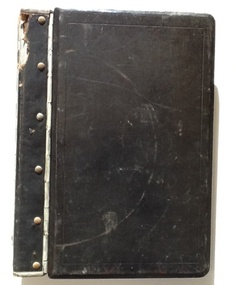
Examination results - CTS, Examination results. Collingwood Technical School. 1936-1940, 1936-1940
... Examination results...Exams...Student records...Collingwood Technical School CTS Examination results Exams Student records NMIT On spine: CTS/ Examination results / 1936 ...1940. ...Examination results (pass or fail) in all aspects of technical education from Mathematics to trade subjects.A key record of students and results from the early decades of Collingwood Technical School.Black hard cover book divided by tabs for each year. Results sheets have been pasted into book.On spine: CTS/ Examination results / 1936 ...1940.collingwood technical school, cts, examination results, exams, student records, nmit -
 NMIT (Northern Melbourne Institute of TAFE)
Enrolments and results - CTS. 1940s-1960s, Student enrolment and results cards, Collingwood Technical School. 1940s-1960s, 1940s-1960s
... A record of apprentices, employers and results spanning 3 decades in the mid 20th century, 1940s - 1960s.. Collingwood Technical School CTS Apprentices Students Examination results NMIT All handwritten details on each card. 1 large black folder containing enrolments and details of each student’s previous education and employment at time of enrolment. ...This folder contains enrolments and details of apprentices enrolled in trade course at Collingwood Technical School. Each student’s previous education and employment at time of enrolment is included, with results recorded on reverse of each sheet.A record of apprentices, employers and results spanning 3 decades in the mid 20th century, 1940s - 1960s..1 large black folder containing enrolments and details of each student’s previous education and employment at time of enrolment. Enrolment sheets are 14 x 23 cm.All handwritten details on each card.collingwood technical school, cts, apprentices, students, examination results, nmit,
