
Showing 4 items matching "exhibited at the lighthouse"
-
 Federation University Historical Collection
Book - Book - Scrapbook, Ballarat College of Advanced Education: Scrapbook of newspaper cutting, Book 14; November 1983 to June 1984
... ...exhibited at the lighthouse...The cuttings cover the period from 1 November 1983 to 20 June 1984. . employment advertisements application for enrolment outline of courses peter pilven - potter h r hughan award how to get organised organising personal files 400 million years old plants fossils at bcae new pottery kiln fund for grand piano bcae phys ed aims neville bunning at 81 living on a limited income visiting engineers from india and fiji industrial safety course dennis else student accommodation closure of hostels anne kilminster - northern territory mining education group visits ballarat lecturer's book out soon garry kinnane sandy blythe - paraplegic phys ed teacher ballarat's mature-age mafia lyn bowers heather howard pam bignell sue nichols death of tom turner principal of teachers' college 1950-1970 lynette snibson medal winner new bcae graduates kiran mazumdar visits from india neil trezise at bcae tertiary staff changes to save millions wayne herbertson toni shephard western mining award to chris elliot roped in for triple egg beater heated pool debate nurses will go to college from base to bcae paul rainbow awarded associateship exhibited at the lighthouse sculptor ken palmer chifley bust graduates finding good jobs sir george paton steve moneghetti hopes to run again Book with beige cover, front. ...Newspaper cuttings relating to Ballarat College of Advanced Education. These are from various newspapers and include The Age, Ballarat Courier, The Australian, The Herald. The cuttings cover the period from 1 November 1983 to 20 June 1984. . Book with beige cover, front. Spiral bound.employment advertisements, application for enrolment, outline of courses, peter pilven - potter, h r hughan award, how to get organised, organising personal files, 400 million years old, plants fossils at bcae, new pottery kiln, fund for grand piano, bcae phys ed aims, neville bunning at 81, living on a limited income, visiting engineers from india and fiji, industrial safety course, dennis else, student accommodation, closure of hostels, anne kilminster - northern territory, mining education group visits ballarat, lecturer's book out soon, garry kinnane, sandy blythe - paraplegic, phys ed teacher, ballarat's mature-age mafia, lyn bowers, heather howard, pam bignell, sue nichols, death of tom turner, principal of teachers' college 1950-1970, lynette snibson medal winner, new bcae graduates, kiran mazumdar visits from india, neil trezise at bcae, tertiary staff changes to save millions, wayne herbertson, toni shephard, western mining award to chris elliot, roped in for triple egg beater, heated pool debate, nurses will go to college, from base to bcae, paul rainbow awarded associateship, exhibited at the lighthouse, sculptor ken palmer, chifley bust, graduates finding good jobs, sir george paton, steve moneghetti hopes to run again -
 Flagstaff Hill Maritime Museum and Village
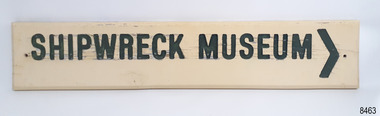
Sign - Shipwreck Museum sign, Flagstaff Hill Historic Park Planning Board, Shipwreck Museum, ca. 1975
... Lighthouse Keeper's Quarters until February 2023. This wing has now been restored and re-fitted to become a facility for short-term exhibitions. A section of the original internal wall frame and wallpaper that couldn’t be kept in the building due to preservation issues have been saved and become sort of the Flagstaff Hill Collection. The sign has guided the visitors of Flagstaff Hill Maritime Museum and Village to the exhibits ...This sign is painted on both sides. It was attached to the bluestone wall on the western wing of the Lighthouse Keeper's Quarters, the Assistant Keeper's Quarters, at Flagstaff Hill Maritime Museum and Village for almost 50 years. The Complex was opened to the public on December 11, 1975, and officially opened by Victorian Premier Sir Rupert Hamer on July 8th, 1977. The sign's reverse side reads "Loch Ard Peacock & Museum". The three rooms had displays behind glass showing various ships' fittings, cargo and personal belongings recovered from significant shipwrecks along the southwest coast of Victoria. There was also a display of information about the mysterious Mahogany Ship or Ancient Wreck. The shipwreck artefacts were recovered by local divers in the 1960s and early 1970s. Also on display was the famous Loch Ard Peacock, created in 1873, survived the shipwreck in 1878, was purchased by Flagstaff Hill in 1975 and announced as being on display in The Standard of September 15, 1975. In about 1984 the other side of the sign was painted "SHIPWRECK MUSEUM" and re-displayed on the building. The Loch Ard Peacock was by that time on display in the Entrance building; plans were underway on August 31st 1984 to build a Hall for its unique display. In February 2023 the sign was removed from the building, which was undergoing restoration and preparation for use as a new Temporary Exhibition space. The Loch Ard Peacock continued its journey around the Village; it was moved from the Entrance to the Village's newly completed Public Hal in 1986. It also spent a short time in the Stella Maris Tea Rooms. This was likely around 1998, when the Common School had moved from the Chartroom building to what had been the Public Hall. The Loch Ard Peacock was once again moved in around 2001, this time to be the central attraction and meeting place in the Great Circle Gallery, which opened on December 31st 2002. The sign continued to be displayed on the western wing of the Lighthouse Keeper's Quarters until February 2023. This wing has now been restored and re-fitted to become a facility for short-term exhibitions. A section of the original internal wall frame and wallpaper that couldn’t be kept in the building due to preservation issues have been saved and become sort of the Flagstaff Hill Collection. The sign has guided the visitors of Flagstaff Hill Maritime Museum and Village to the exhibits of artefacts from historic and significant shipwrecks. It has connected the current generations to the people and objects of the past, leading to a better understanding of our Colonial history.Sign, wooden, rectangular, with a hole through each short side. The front and reverse have different painted text. Cream paint for the background colour, green paint for the lettering, and the reverse has a white painted border. The front has an arrow painted on the right-hand side. The sign was used at Flagstaff Hill since its opening.Text on front "SHIPWRECK MUSEUM >" Text on back "LOCH ARD PEACOCK / & MUSEUM"flagstaff hill maritime museum and village, warrnambool, great ocean road, shipwreck coast, sign, building sign, shipwreck museum, loch ard peacock & museum, flagstaff hill history, assistant lighthouse keeper's cottage, assistand lighthouse keeper's quarters, public hall, common school, light keeper -
 Flagstaff Hill Maritime Museum and Village
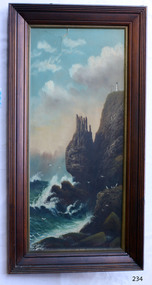
Painting - Oil painting, W. Langley-Taylor, Cape Schank [Schanck], Late 19th to early 20th century
... lighthouse and a flagstaff, birds in flight, waves breaking against rocks, and a blue sky with clouds. The title is painted at the lower left. The work is signed at lower right by the Victorian artist W. Langley-Taylor. A handwritten inscription in red crayon or heavy red pencil appears on the reverse. The board is fixed within the timber frame by small dark metal tacks. Metal eyes secure the hanging wire to the frame. Small round nail heads are visible around the frame, and both the board and the wood exhibit...lighthouse and a flagstaff, birds in flight, waves breaking against rocks, and a blue sky with clouds. The title is painted at the lower left. The work is signed at lower right by the Victorian artist W. Langley-Taylor. A handwritten inscription in red crayon or heavy red pencil appears on the reverse. The board is fixed within the timber frame by small dark metal tacks. Metal eyes secure the hanging wire to the frame. Small round nail heads are visible around the frame, and both the board and the wood exhibit ...This painting is one of a pair of large paintings by W. Langley-Taylor in our collection. Currently, no further information has been found about the artist but research is ongoing. The subjects of these paintings are seascapes of notable areas of the coast on each side of Port Phillip Bay, south of Melbourne, Victoria. The subject of this painting is Cape Schanck, Victoria, which is on the east side of Port Phillip Bay. It includes the Cape Schanck Lighthouse and its Flagstaff. The Cape Schanck Lighthouse was built in 1859 and is the second of Victoria’s coastal lights. It is 21 metres tall and made from limestone. Unusually, its stairway is made from stone rather than wrought iron. Gilded tours are available to explain its use and significance to visitors. The lighthouse keepers at Cape Schanck kept records of the ships that sailed past them along Bass Strait; ship’s names, direction, time and date and so on. The details would also be passed on to shipping agencies, Harbour Masters and newspapers, which published Arrivals and Departures into and out of shipping ports such as Port Phillip Bay and the Port of Melbourne. INSCRIPTIONS “Mrs M Irby” (and on the Eagle Rock, Warrnambool, painting “980/Regency”) The inscription “Mrs M Irby” is on the back of both paintings but the significance of the inscription has not yet been discovered. Perhaps she was connected with the ship or shipping company “Irby”. A ship named “Irby”, built in Merseyside, Liverpool in 1881 by R & J Evans, Birkenhead. It was a four-masted iron ship built for the White Star Line. Henry Wilson Hewitt bought her in 1882, then later she was owned by Chadwick & Pritchard. In 1888 she was registered under the Irby Ship Co. Ltd. (trading as J. Joyce) in Liverpool. In 1912 Galgate Co. Ltd owned her. She traded between London, England and Australia, and is recorded as being in Melbourne and Hobart. In 1919 the Irby was destroyed by a mine when on her way to England. Or perhaps her name and the inscription in pencil “980/Regency” on the Eagle Rock Warrnambool, painting could be a delivery address for the paintings, perhaps an apartment in a hotel. NOTE: The artist’s spelling of the title “Cape Schank, Vic.” is incorrect. The location in this painting is named Cape Schanck. This painting is geographically significant for its depiction of Victoria’s coastal scenery. It is also significant as one of a pair of seascapes depicting sites on either side of Port Phillip Bay. Historically, the painting is significant as an example of the late nineteenth- and early twentieth-century methods and materials used in frame construction.Oil on board, in a dark-stained wooden frame, portrait format. The composition depicts a seascape with cliffs, a lighthouse and a flagstaff, birds in flight, waves breaking against rocks, and a blue sky with clouds. The title is painted at the lower left. The work is signed at lower right by the Victorian artist W. Langley-Taylor. A handwritten inscription in red crayon or heavy red pencil appears on the reverse. The board is fixed within the timber frame by small dark metal tacks. Metal eyes secure the hanging wire to the frame. Small round nail heads are visible around the frame, and both the board and the wood exhibit colour change. The handwritten inscription runs vertically along the lower left edge of the board. The wire hangs in a shallow curve, and the mitred corners are reinforced with staples. The board shows some damage. The discolouration visible on both the board and frame may indicate the former presence of a backing paper, once attached to the reverse with tape and tacks.Painted on front “W.LANGLEY-TAYLOR.” and “CAPE SCHANK, VIC.” [NOTE: correct spelling is Schanck] Handwritten on back “Mrs. M. Irby” flagstaff hill, warrnambool, shipwrecked coast, flagstaff hill maritime museum, maritime museum, shipwreck coast, flagstaff hill maritime village, great ocean road, painting, oil painting, cape schanck painting, w. langley-taylor, wall decoration, seascape of victoria's coast, art, mrs m irby, victoria's coast, pair of paintings -
Port Melbourne Historical & Preservation Society
Photograph - Stearine Lighthouse, built of candle grease and exhibited at the Adelaide Exhibition, Mar 1923
... Brass framed Black and white photograph of Stearine Lighthouse built of candle grease and exhibited at the Adelaide Exhibition 1923...Industry - Manufacturing J Kitchen & Sons Pty Ltd Stearine Lighthouse Brass framed Black and white photograph of Stearine Lighthouse built of candle grease and exhibited at the Adelaide Exhibition 1923 Photograph Stearine Lighthouse, built of candle grease and exhibited at the Adelaide Exhibition ...Brass framed Black and white photograph of Stearine Lighthouse built of candle grease and exhibited at the Adelaide Exhibition 1923industry - manufacturing, j kitchen & sons pty ltd, stearine lighthouse
