
Showing 6 items matching "eye muscles"
-
 The Cyril Kett Optometry Museum
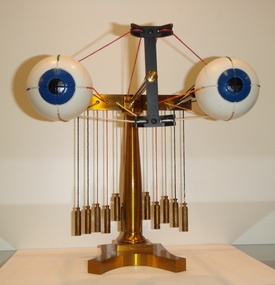
Ophthalmotrope, unknown, (estimated); mid 20th century
... ...eye muscles...Because of the complexity of the actions and counter actions of the eye muscles, ophthalmologists of the 19th century sought a practical solution with the construction of mechanical models. ...This ophthalmotrope is the one that was used as a teaching aid in the College from the mid 20th century. optometry ophthalmology ophthalmotrope eye eye movements extra ocular muscles eye muscles eye teaching Brass framed model to illustrate actions of extra-ocular muscles. ...This model was used in lectures in the College from the mid 20th century. An ophthalmotrope is a mechanical model constructed to demonstrate the movements of the eyes and the actions of the various muscles which produce them. The first ophthalmotrope was made by Theodore Reute in 1845 and it was he who gave it the name 'ophthalmotrope'. Frans Donders (1818-1889) became interested in eye movements on reading Reute's work, and his subsequent studies were of physiological interest and also provided the basis for principles underlying the correction of squint. Because of the complexity of the actions and counter actions of the eye muscles, ophthalmologists of the 19th century sought a practical solution with the construction of mechanical models. Reute's second model of 1857 was more sophisticated. Its eyeballs contained lenses and the optical system could be moved backwards and forwards to simulate accommodation. Later ophthalmotropes are known by Landolt, Knapp and Snellen.This ophthalmotrope is the one that was used as a teaching aid in the College from the mid 20th century.Brass framed model to illustrate actions of extra-ocular muscles. Two painted wooden globes mounted in brass frame with coloured strings attached to brass weights positioned to show actions of various extra-ocular muscles. Also wooden storage box. Materials: brass, metal, wood, string.optometry, ophthalmology, ophthalmotrope, eye, eye movements, extra ocular muscles, eye muscles, eye teaching -
 Vision Australia
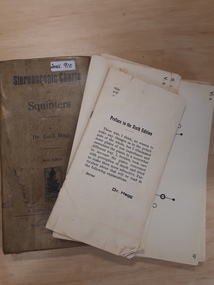
Education kit - Object, A. Francke, Stereoscopic charts for squinters [by] Dr. Emil Hegg
... These featured images thought to strengthen the eye muscles....These featured images thought to strengthen the eye muscles. Equipment Emil Hegg 6th edition 1 rectangular fawn cardboard box sleeve which contains specially printed cards with pictures and text Stereoscopic charts for squinters [by] Dr. ...A set of 70 (incomplete as full set believed to be 85 cards) black and white and colour stereoscopic charts, divided into series Includes geometric, pictorial and photographic examples of charts and Schlechteres Auge test. An instructional leaflet is also included. These featured images thought to strengthen the eye muscles.1 rectangular fawn cardboard box sleeve which contains specially printed cards with pictures and text6th editionequipment, emil hegg -
 Northern District School of Nursing. Managed by Bendigo Historical Society Inc.
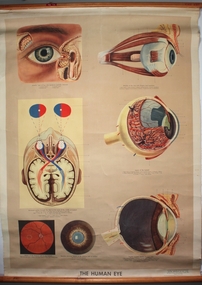
Poster - The Human Eye
... The main part of the chart has seven coloured diagrams including; Anterior view of the Eye Epidermis partly removed, Muscles of the Eye with Origins and Insertions, Horizontal section through the Scull at the Level of the middle of the Eyeball, Layers of the Eyeball, Interior of the Posterior half of the Eyeball, Bisection showing interior of the anterior half of the Eyeball, Sagittal (medial) Section through the orbit. ...The main part of the chart has seven coloured diagrams including; Anterior view of the Eye Epidermis partly removed, Muscles of the Eye with Origins and Insertions, Horizontal section through the Scull at the Level of the middle of the Eyeball, Layers of the Eyeball, Interior of the Posterior half of the Eyeball, Bisection showing interior of the anterior half of the Eyeball, Sagittal (medial) Section through the orbit. ...Educational teaching chart used at the Northern District School of Nursing, Rowan Street, Bendigo. The Northern District School of Nursing opened in 1950 in to address the issues around nurse recruitment, training and education that had previously been hospital based. The residential school was to provide theoretical and in-house education and practical training over three years. The students would also receive practical hands-on training in the wards of associated hospitals. The Northern District School of Nursing operated from Lister House, Rowan Street, Bendigo. It was the first independent school of nursing in Victoria and continued until it closed in 1989. Since 1918, Adam, Rouilly & Co has supplied innovative clinical skills simulators, skeletons, anatomical models & charts to medical education worldwideColoured educational chart of the Human Eye. Paper with wooden header and footer. The main part of the chart has seven coloured diagrams including; Anterior view of the Eye Epidermis partly removed, Muscles of the Eye with Origins and Insertions, Horizontal section through the Scull at the Level of the middle of the Eyeball, Layers of the Eyeball, Interior of the Posterior half of the Eyeball, Bisection showing interior of the anterior half of the Eyeball, Sagittal (medial) Section through the orbit. Written in the bottom right corner - Sole Agents for Great Britain, Eire and the Commonwealth. ADAM, ROUILLY & CO., LTD. 18, FITZORY STREET, FITZORY SQUARE, LONDON, W.1ndsn, educational chart, adam rouilly & co, the human eye, nurse education -
 Flagstaff Hill Maritime Museum and Village
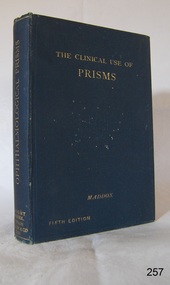
Book - Reference Book Ophthalmology, Ernest Edmund Maddox, The Clinical Use of Prisms, 1907
... (For more information on the Pattison Collection see item 3678 Flagstaff Hill collections) https://victoriancollections.net.au/items/5580c7e72162f114d8b758db flagstaff hill warrnambool shipwrecked-coast flagstaff-hill flagstaff-hill-maritime-museum maritime-museum shipwreck-coast flagstaff-hill-maritime-village the clinical use of prisms book ernest f. maddox The subject volume The Clinical Use of Prisms; and the Decentring of Lenses is a seminal treatise on ophthalmic optics, binocular vision, and the correction of eye muscle imbalances (strabismus and heterophoria). ...The subject volume The Clinical Use of Prisms; and the Decentring of Lenses is a seminal treatise on ophthalmic optics, binocular vision, and the correction of eye muscle imbalances (strabismus and heterophoria). The book covers two core clinical topics. Prismatic Refraction, how light bends through optical prisms, and how clinicians can use prisms to measure, diagnose, and relieve eye strain (asthenopia), double vision (diplopia), and misaligned line of sight. Decentring Lenses is the second and its focusing on the mathematical and practical rules for shifting the optical center of a spectacle lens relative to the patient's pupil. By decentring a standard spherical or cylindrical lens, allowing an optometrist or ophthalmologist to create an intentional "prismatic effect" without needing to grind a separate, heavy prism into the glassHard cover book,The Clinical Use of Prisms Author: Ernest Edmund Maddox Publisher: John Wright & Co Date: 1907 5th Edition Further Information: Front cover & spine blue cloth title, publisher details and author name in gilt lettering.non-fictionThe subject volume The Clinical Use of Prisms; and the Decentring of Lenses is a seminal treatise on ophthalmic optics, binocular vision, and the correction of eye muscle imbalances (strabismus and heterophoria). The book covers two core clinical topics. Prismatic Refraction, how light bends through optical prisms, and how clinicians can use prisms to measure, diagnose, and relieve eye strain (asthenopia), double vision (diplopia), and misaligned line of sight. Decentring Lenses is the second and its focusing on the mathematical and practical rules for shifting the optical center of a spectacle lens relative to the patient's pupil. By decentring a standard spherical or cylindrical lens, allowing an optometrist or ophthalmologist to create an intentional "prismatic effect" without needing to grind a separate, heavy prism into the glassflagstaff hill, warrnambool, shipwrecked-coast, flagstaff-hill, flagstaff-hill-maritime-museum, maritime-museum, shipwreck-coast, flagstaff-hill-maritime-village, the clinical use of prisms, book, ernest f. maddox -
 Vision Australia
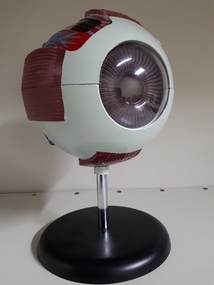
Education kit - Object, 3D model of eye
... eye connects to the brain. The eyeball divides in half to study the interior and shows attachments for all six muscles that move the eyeball, the optic nerve, and surrounding blood vessels. ...eye connects to the brain. The eyeball divides in half to study the interior and shows attachments for all six muscles that move the eyeball, the optic nerve, and surrounding blood vessels. ...This 3D model of the eye on shows the way they eye connects to the brain. The eyeball divides in half to study the interior and shows attachments for all six muscles that move the eyeball, the optic nerve, and surrounding blood vessels. Through the cornea the iris and pupil are visible. The iris, cornea and lens can be removed.1 pedestal mounted 3D model of the eye, hand painted in green, red, blue yellow and black equipment, model -
 Northern District School of Nursing. Managed by Bendigo Historical Society Inc.
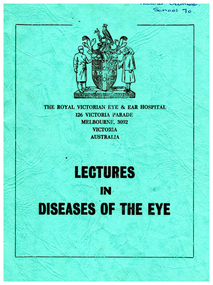
Book - Northern District School of Nursing Graduates Association - Lectures in Diseases of the Eye, Revised 1968
... eye anatomy, diseases, examination techniques, and ophthalmic nursing practices. Detailed coverage of the orbit, eyeball, fibrous coat, uvea, retina, lids, lacrimal apparatus, and conjunctiva. Explains the function of extra-ocular muscles...eye anatomy, diseases, examination techniques, and ophthalmic nursing practices. Detailed coverage of the orbit, eyeball, fibrous coat, uvea, retina, lids, lacrimal apparatus, and conjunctiva. Explains the function of extra-ocular muscles ...The Northern District School of Nursing in Victoria, Australia Graduates Association: History of the School Managed by a committee including hospital administrators, medical professionals, and nursing leaders from several regional hospitals. Associated with major hospitals in the Northern District, including Bendigo Base, Mildura Base, Castlemaine, Echuca, Swan Hill, St. Arnaud, and Kyneton District Hospitals. Provide high-quality theoretical and practical nursing training. Raise the standard of nursing education in the region. Maintain the highest principles of nursing practice. Applicants must be at least 17 years old and hold a Proficiency Certificate or higher educational qualification. Application involves submitting forms, certificates, an interview, an aptitude test, and a medical examination. A three-month probationary period follows initial acceptance. Preliminary Training School: Four-week introductory course covering basic nursing, anatomy, hygiene, and practical skills. Practical experience in various hospital departments, guided by senior staff. Study Block Plan: Includes several blocks of theoretical and practical instruction throughout the three-year program. Regular school exams and two state exams (First Professional and Final State) are required for progression and graduation. Nurses work a 40-hour week with at least one or two days off per week and three weeks of annual leave. Accommodation is provided in comfortable hostels with good facilities. Uniforms are supplied free; nurses provide their own shoes and stockings. Salaries and allowances are regulated, with deductions for board and free medical care. Additional Information Post-Graduate Opportunities. Senior positions require further experience and additional certificates (e.g., Midwifery, Infant Welfare).Diploma courses available in administration, teaching, and specialized nursing fields. Bursaries are available for advanced study.Career Prospects: Graduates can pursue roles in administration, teaching, ward and departmental leadership, district and visiting nursing, industrial and school nursing, and more. Opportunities existed both within hospitals and in community or specialized settings.FAQs and Practical Details. Minimal training costs (mainly exam fees and personal items).Living out allowances and travel expenses are covered. Four training intakes per year; waiting periods are short if qualifications are met.Northern District School of Nursing Graduates Association - Lectures in Diseases of the Eye Revised 1968 39 pages, owned by Heather Gamble School 70 This item contains the following documents: 3793.1a Lectures in Diseases of the Eye Revised 1968 3793.1b Front Cover and Contents Page This document is a comprehensive educational guide for nurses at The Royal Victorian Eye and Ear Hospital, focusing on eye anatomy, diseases, examination techniques, and ophthalmic nursing practices. Detailed coverage of the orbit, eyeball, fibrous coat, uvea, retina, lids, lacrimal apparatus, and conjunctiva. Explains the function of extra-ocular muscles and the mechanics of vision. Describes diseases affecting the orbit, cornea, sclera, uvea, retina, lids, lacrimal apparatus, and conjunctiva. Covers errors in the optical properties of the eye and their corrections.Includes information on glaucoma and diseases of the crystalline lens. Outlines examination techniques for various eye structures.Provides tests for retinal function and assessment of binocular vision.Injuries and Surgical CareDiscusses types of eye injuries, including contusions, penetrating wounds, and burns. Details pre-operative, operative, and post-operative care for intra-ocular operations. Offers guidance on ophthalmic nursing techniques.Lists pharmaceuticals, accessories, instruments, and equipment used in eye surgery.nurse training, lister house, lectures in disease of the eye
