
Showing 13 items matching "eyeglasses"
-
 Emerald Museum & Nobelius Heritage Park
Accessory - Eye glasses, W. Watson & Sons, 1920s-1940s
... eyeglasses...These magnifying eyeglasses belonged to Dr William Bottomley. Dr Bottomley received his Bachelor of Surgery from the University of Melbourne in 1906 and had a medical practice on Collins St, Melbourne. ...Small pair of magnifying eyeglasses made of silver-coloured metal. Lenses are thick and unframed....(Early designs of magnifying eyeglasses date back to 1876 - Kwitko et al., 1998.) ...These magnifying eyeglasses belonged to Dr William Bottomley. Dr Bottomley received his Bachelor of Surgery from the University of Melbourne in 1906 and had a medical practice on Collins St, Melbourne. He built a log cabin in Emerald which he would use on weekends.Dr Bottomley was a member of two syndicates who purchased land from Carl Axel Nobelius nursery property. Emerald Pty Ltd purchased 600 acres and with it developed the Emerald Country Club, including a golf course and properties. The Nobelius Station Estate purchased 300 acres, which includes sites of the current Nobelius Heritage Park and Emerald Lake Park. Bottomley Drive in Emerald is named after Dr Bottomley.This object is of historic significance as it provides insight into an early design of a late-nineteenth/early-twentieth century piece of medical equipment. (Early designs of magnifying eyeglasses date back to 1876 - Kwitko et al., 1998.) It is also of social significance as they belonged to Dr William Bottomley, who was instrumental in the establishment of the Emerald Country Club.Small pair of magnifying eyeglasses made of silver-coloured metal. Lenses are thick and unframed.eyeglasses, magnifying glasses, doctors (medical), medical equipment -
 Vision Australia
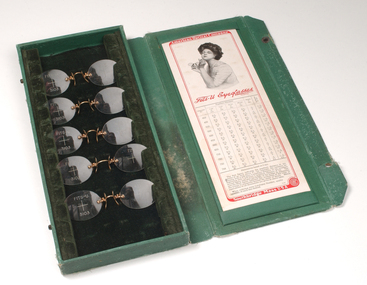
Equipment - Object, American Optical Company, Fits-u eyeglasses pince nez trial fitting setting, 1900s
... Fits-u eyeglasses pince nez trial fitting setting...1904 Ophthalmic Optician & Optometrist Canvas box which includes display models of different dimensions of pince nez Fits-u eyeglasses pince nez trial fitting setting Equipment Object American Optical Company ...To be fashionable, and possibly improve vision at the same time, the pince nez style of glasses became popular. The 'Fits-u' design has a mounting that allowed the bridge to stay solid, whilst the springs in the nose pads allowed for removal (unlike pince nez which had a springs in the bridge). Although complete, this box includes models with different distance dimensions and the height of the bridge, with these figures are etched onto the lenses. An order table is included in the box with the pupillary distance and height so the catalogue number and quality and quantity of each size can be ordered by the dispenser. The pupillary distance is used to design spectacle frames.Canvas box which includes display models of different dimensions of pince nez Handwritten on the back: James Korp Backhouse (?) 1904 Ophthalmic Optician & Optometristassistive devices, american optical company -
Emerald Museum & Nobelius Heritage Park
Container - Eyeglasses case, W. Watson & Sons, 1920s-1940s
... These magnifying eyeglasses belonged to Dr William Bottomley. Dr Bottomley received his Bachelor of Surgery from the University of Melbourne in 1906 and had a medical practice on Collins St, Melbourne. ...Burgundy-coloured, cylindrical eyeglasses case. Lid closes with a snap fastener. ...Container Eyeglasses case W. Watson & Sons ...These magnifying eyeglasses belonged to Dr William Bottomley. Dr Bottomley received his Bachelor of Surgery from the University of Melbourne in 1906 and had a medical practice on Collins St, Melbourne. He built a log cabin in Emerald which he would use on weekends. He was a member of two syndicates who purchased land from Carl Axel Nobelius nursery property. Emerald Pty Ltd purchased 600 acres and with it developed the Emerald Country Club, including a golf course and properties. The Nobelius Station Estate purchased 300 acres, which includes sites of the current Nobelius Heritage Park and Emerald Lake Park. Bottomley Drive in Emerald is named after Dr Bottomley.This object is of historic significance as it provides insight into an early design of a late-nineteenth/early-twentieth century piece of medical equipment. The object is also of social significance as they belonged to Dr William Bottomley, who was instrumental in the establishment of the Emerald Country Club.Burgundy-coloured, cylindrical eyeglasses case. Lid closes with a snap fastener. The inside of the lid has the maker's label and the outside has the model of glasses printed in gold lettering. Early designs of magnifying eyeglasses date back to 1876 (Kwitko et al., 1998).Exterior of lid: "SPEERA" / MAGNIFIERS. / Interior of lid: OPTICIANS TO / H.M. GOVERNMENT. / W. WATSON & SONS / ESTABLISHED 1837 TD / 313 / HIGH HOLBORN / LONDON / -
 City of Moorabbin Historical Society (Operating the Box Cottage Museum)
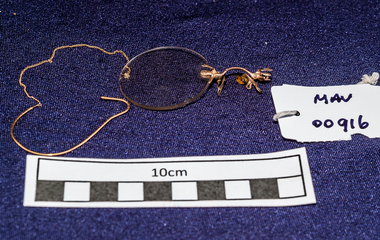
Personal Effects, lady’s Pince-nez ½ with fine gold chain, c1900
... Glasses, also known as eyeglasses or spectacles, are frames bearing lenses worn in front of the eyes. ... One half of a pair of lady’s Pince-nez eyeglasses with 1 gold rimmed glass lens , a gold style bridge and a fine gold chain that is attached to the side of the lens frame and to a shaped over- ear metal piece. ...Glasses, also known as eyeglasses or spectacles, are frames bearing lenses worn in front of the eyes. ...Glasses, also known as eyeglasses or spectacles, are frames bearing lenses worn in front of the eyes. They are normally used for vision correction or eye protection. Pince-nez is a French style of spectacles, popular in the 19th century, that are supported without earpieces, by pinching the bridge of the nose. The name comes from French pincer, "to pinch", and nez, "nose". Although pince-nez were used in Europe in the 15th, 16th, and 17th centuries, modern ones appeared in the 1840s and reached their peak popularity around 1880 to 1900 A solid bridge piece is moulded to fit the curvature of the bridge of the nose. They are anchored onto the bridge of the nose via two small spring-loaded clips terminating in special nose-pads made from bone or tortoise shell on metal called plaquettes, which are tweezered apart for placement on the face through applying pressure to two small lever-like finger-pieces located on the front of the bridge. Plaquettes could be either hinged and flexible, permitting a better fit, or static as in the older examples of this type.. They were popular from the 1890s through to the 1950s, One half of a pair of lady’s Pince-nez eyeglasses with 1 gold rimmed glass lens , a gold style bridge and a fine gold chain that is attached to the side of the lens frame and to a shaped over- ear metal piece. eyes, spectacles, eye glasses, optometry, moorabbin, bentleigh, cheltenham, market gardeners, pioneers, early settlers, pince-nez -
 City of Moorabbin Historical Society (Operating the Box Cottage Museum)
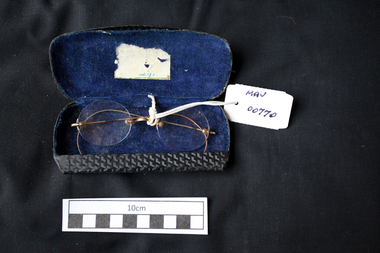
Optical Equipment, Spectacles, fine metal frame with case, 20thC
... Glasses, also known as eyeglasses or spectacles, are frames bearing lenses worn in front of the eyes. ...Glasses, also known as eyeglasses or spectacles, are frames bearing lenses worn in front of the eyes. ...Glasses, also known as eyeglasses or spectacles, are frames bearing lenses worn in front of the eyes. They are normally used for vision correction or eye protection. A pair of fine metal framed spectacles with a blue lined caseOPTICAL PRESCRIPTION SPECTACLES / 23/ COLLINS ST MELBOURNE/spectacles, optical equipment, moorabbin, cheltenham, bentleigh, early settlers -
 City of Moorabbin Historical Society (Operating the Box Cottage Museum)
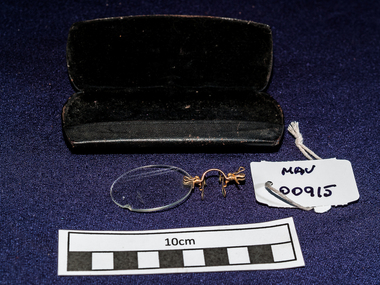
Personal Effects, Boy’s spectacles ½ in case, early 20thC
... Glasses, also known as eyeglasses or spectacles, are frames bearing lenses worn in front of the eyes. ...Glasses, also known as eyeglasses or spectacles, are frames bearing lenses worn in front of the eyes. ...Glasses, also known as eyeglasses or spectacles, are frames bearing lenses worn in front of the eyes. They are normally used for vision correction or eye protection. A young boy’s frameless spectacles - 1 glass lens with gold style bridge with a stiffened cardboard spectacle case eyes, spectacles, eye glasses, optometry, moorabbin, bentleigh, cheltenham, market gardeners, pioneers, early settlers, schools -
 Orbost & District Historical Society
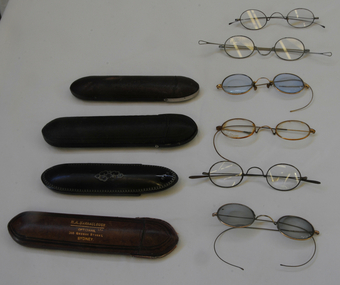
spectacles and cases, first half 20th century
... Similar to clothes, eyeglasses needed to be continually updated or a person could be perceived as old-fashioned. ...Similar to clothes, eyeglasses needed to be continually updated or a person could be perceived as old-fashioned. ...Women wore frames characterized by an upsweep on the top rim, a style that was very popular until the end of the 1950s, while men tended to sport gold wire frames. These glasses are probably men's glasses. By the latter half of the 20th century, spectacles were considered part of a person's wardrobe. Similar to clothes, eyeglasses needed to be continually updated or a person could be perceived as old-fashioned. More and more celebrities were influencing spectacle fashion.These items reflect how glasses styles have changed over time and are becoming a fashion accessory as well as a prosthesis and support for lenses, Six pairs of assorted glasses and 4 cases. spectacles -
 Blacksmith's Cottage and Forge
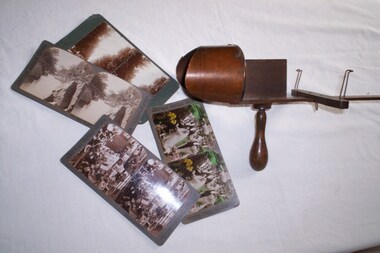
Stereoscope
... Three strategies have been used to accomplish this: have the viewer wear eyeglasses to combine separate images from two offset sources, have the viewer wear eyeglasses to filter offset images from a single source separated to each eye, or have the lightsource split the images directionally into the viewer's eyes (no glasses required). ...Three strategies have been used to accomplish this: have the viewer wear eyeglasses to combine separate images from two offset sources, have the viewer wear eyeglasses to filter offset images from a single source separated to each eye, or have the lightsource split the images directionally into the viewer's eyes (no glasses required). ...Stereoscopy (also called stereoscopic or 3-D imaging) refers to a technique for creating or enhancing the illusion of depth in an image by presenting two offset images separately to the left and right eye of the viewer. Both of these 2-D offset images are then combined in the brain to give the perception of 3-D depth. Three strategies have been used to accomplish this: have the viewer wear eyeglasses to combine separate images from two offset sources, have the viewer wear eyeglasses to filter offset images from a single source separated to each eye, or have the lightsource split the images directionally into the viewer's eyes (no glasses required). Stereographic cards and the stereoscope. Two separate images are printed side-by-side. When viewed without a stereoscopic viewer the user is required to force his eyes either to cross, or to diverge, so that the two images appear to be three. Then as each eye sees a different image, the effect of depth is achieved in the central image of the three. Stereograms cards are frequently used by orthoptists and vision therapists in the treatment of many binocular vision and accommodative disorders. Source: www.wikipedia.org Wooden viewer with two glass "windows", separating divider between them. Sliding cross-piece which holds the photocard between wire holders. Turned handle.home, stereoscope, photography, 3d, postcards, entertainment, viewers -
Emerald Museum & Nobelius Heritage Park
Functional object - Spectacles, Dobbie Bros, 1940s
... ...eyeglasses...Jim and Rita had two daughters, one being Vera, and the other Shirley. 1940s Spectacles eyeglasses Eyewear Dobbie Bros Rita Madigan Vera Madigan Madigan Emerald & District Collection Black celluloid circular spectacles with gold-coated/plated hook arms. ...The Madigan family were long term residents and business owners in Emerald. Jim Madigan was the local Butcher once he returned from World War 1. Rita's father owned the Emerald bakery since 1917. These spectacles belonged to Rita Madigan (nee McLean) in the 1940s and were donated to the Emerald Museum by Vera Madigan, one of Jim and Rita's daughters. Jim and Rita had two daughters, one being Vera, and the other Shirley.Black celluloid circular spectacles with gold-coated/plated hook arms. The small accompanying case is constructed with a hard plastic with a thin textured coating. The inside has a protective royal blue velvet coating. Inside the case there is a label identifying the Opticians as 'Dobbie Bros', located at 22 Bourke Street, Melbourne.1940s, spectacles, eyeglasses, eyewear, dobbie bros, rita madigan, vera madigan, madigan, emerald & district collection -
 Orbost & District Historical Society
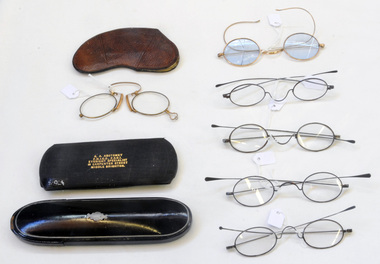
spectacles and spectacle cases, late 19th early 20th century
... As the 19th Century came to a close, more and more people wore their eyeglasses everyday. A popular style of inexpensive, everyday spectacles was the pince-nez. ...As the 19th Century came to a close, more and more people wore their eyeglasses everyday. A popular style of inexpensive, everyday spectacles was the pince-nez. ...This collection of glasses and cases was donated by Miss Connie Cruickshank. She was part of the family of Orbost's first doctor, Dr James Kerr. As the 19th Century came to a close, more and more people wore their eyeglasses everyday. A popular style of inexpensive, everyday spectacles was the pince-nez. French for "pinch nose," the pince-nez was first developed in France circa 1840 and began to be imported after the 1850s. Pince-nez have no temples, but are fit snugly on the bridge of the nose. Pince- nez could be uncomfortable to wear and broke often from falling off the nose. These items demonstrate how glasses' styles have changed over time. One pair of pince-nez glasses and its brown leather case shaped to fit. One solid black wooden case with a small hinged door at one end. One blue/black case with the words A A Abotomey 14 Carpenter Street Middle Brighton in gold lettering. Five pairs of spectacles, one with blue coloured glass with crack in one lens.A A Abotomey 14 Carpenter Street, Middle Brightonspectacles spectacles-cases pinz-nez -
 Bendigo Military Museum
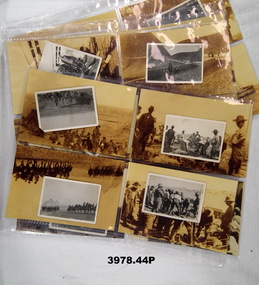
Photograph - PHOTOGRAPHS WW1, Originals: 1915
... Hand written on the rear in pen: .1) Housing parade on the desert Egypt, bugler band 6th Battalion. .2) Australian Field Artillery exercising horses near the pyramids. .3) Some of the buglers of the 6th Battalion with their identification disks as eyeglasses. .4) Serving out rations. .5) 6th Battalion having a short halt during a route march on the desert. .6) 18 Pounder Field Gun Australian Artillery. .7) 'Come to the Cook House Door' 6th Battalion AIF. .8) Lieut WATSON - Machine Gun being vaccinated by Lieut BALFE A Coy. ...Refer Reg No 1377 for his service details. photography military ww1 Hand written on the rear in pen: .1) Housing parade on the desert Egypt, bugler band 6th Battalion. .2) Australian Field Artillery exercising horses near the pyramids. .3) Some of the buglers of the 6th Battalion with their identification disks as eyeglasses. .4) Serving out rations. .5) 6th Battalion having a short halt during a route march on the desert. .6) 18 Pounder Field Gun Australian Artillery. .7) 'Come to the Cook House Door' 6th Battalion AIF. .8) Lieut WATSON - Machine Gun being vaccinated by Lieut BALFE A Coy. ...The photos in the collection relate to Thomas Robert JONES No 1982 AIF. Refer Reg No 1377 for his service details..1) - .22) Photos, black / white, showing men, training, the desert, Dardanelles, Turkish prisoners, leaving Egypt. .23) - .44) Enlargement copies of photos .1) - .22), sepia.Hand written on the rear in pen: .1) Housing parade on the desert Egypt, bugler band 6th Battalion. .2) Australian Field Artillery exercising horses near the pyramids. .3) Some of the buglers of the 6th Battalion with their identification disks as eyeglasses. .4) Serving out rations. .5) 6th Battalion having a short halt during a route march on the desert. .6) 18 Pounder Field Gun Australian Artillery. .7) 'Come to the Cook House Door' 6th Battalion AIF. .8) Lieut WATSON - Machine Gun being vaccinated by Lieut BALFE A Coy. Both these Officers are amongst the fallen. .9) 6th Battalion AIF preparing to leave Mena Camp for the Dardanelles. .10) A Turk captured on the morning of 25th April 1915 on board the troop ship Galeka. .11) Wounded alongside of hospital ship Galeka. .12) HMS Vengeance at the Dardanelles. .13) Hospital ship Sudan off Gaba Tepe. .14) Observation balloon off Cape Helles. .15) British Destroyer off Cape Helles. .16) Cape Helles, Dandanelles. .17) Turkish prisoners captured at the Suez _ _ _ Barracks, Cairo. .18) Turkish prisoners. .19) <> Guides near pyramids Mena. .20) Method of irrigation on the Nile, Egypt. .21) Going on leave into Cairo. .22) View of Cairo mosques in foreground taken from the Citadel. .23) - .44) On rear in stamp form: Dennis Major, 7 Bancroft St Bendigo Vic 3550. Tel & fax 03 544 2445 photography, military, ww1 -
 City of Moorabbin Historical Society (Operating the Box Cottage Museum)
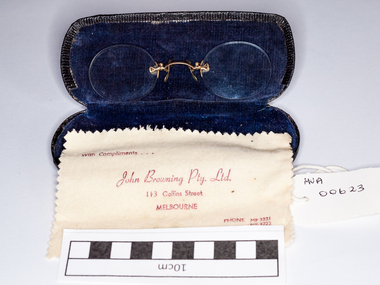
Optical Equipment, Spectacles, Pince - nez with case, 20thC
... Pince-nez spectacles are in a style popular in the 19th century, which are supported without earpieces, by pinching the bridge of the nose. optometrists spectacles. eyeglasses moorabbin brighton early settlers pioneers cheltenham cleaning cloth - 'With Compliments / John Browning Pty. ...Pince-nez spectacles are in a style popular in the 19th century, which are supported without earpieces, by pinching the bridge of the nose.A pair of Pince-nez eye glasses in a leather case, with a soft cleaning cloth.cleaning cloth - 'With Compliments / John Browning Pty. Ltd. / 113 Collins Street / MELBOURNE / PHONE MF 3221/ MF 3222optometrists, spectacles. eyeglasses, moorabbin, brighton, early settlers, pioneers, cheltenham -
 City of Moorabbin Historical Society (Operating the Box Cottage Museum)
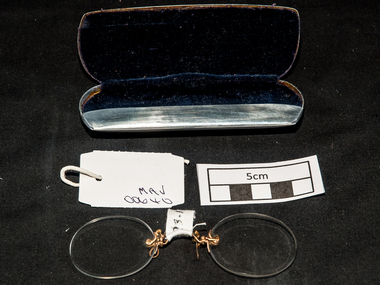
Optical Equipment, Spectacles, Pince - nez with case, c1900
... Pince-nez spectacles are in a style popular in the 19th century, which are supported, without earpieces, by pinching the bridge of the nose. optometrists spectacles. eyeglasses moorabbin brighton early settlers pioneers cheltenham A pair of Pince-nez eye glasses in a hinged silver case. ...Pince-nez spectacles are in a style popular in the 19th century, which are supported, without earpieces, by pinching the bridge of the nose.A pair of Pince-nez eye glasses in a hinged silver case. optometrists, spectacles. eyeglasses, moorabbin, brighton, early settlers, pioneers, cheltenham
