
Showing 18 items matching "fabric sculpture"
-
 Wyndham Art Gallery (Wyndham City Council)
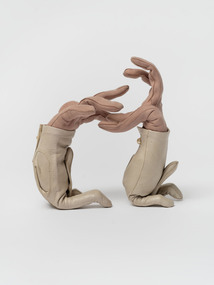
Sculpture - #59 (trust fall duo), Hannah Gartside, 2015
... ...Fabric sculpture...Textile art Fabric sculpture Soft sculpture Installation art Contemporary sculpture Feminism Women's histories Embodiment The body Sculpture #59 (trust fall duo) Sculpture #59 (trust fall duo) Hannah Gartside ...In this nest of bunnies fashioned from gloves, it’s as if Hannah Gartside has bundled the world’s most tender feelings and given them aesthetic form through droopy ears, leather pot bellies, sweetly curved behinds, comically suggestive poses. Through Bunnies in Love, Lust and Longing, Gartside has taken second-hand leather gloves from the 1950s and 60s, some as early as the 1910s, and curved these once-worn textiles over steel armature, bending animal pelt into warm, playful, living beings. Tiarney Miekus, 2025 textile art, fabric sculpture, soft sculpture, installation art, contemporary sculpture, feminism, women's histories, embodiment, the body, sculpture -
 Federation University Historical Collection
Book - Book - Scrapbook, Ballarat School of Mines: Scrapbook of Newspaper Cuttings, Book 45, September 1990 to November 1990
... The papers concerned are The Courier, Ballarat, The Australian, The Age over the period of 8 September 1990 to 24 November 1990. teaching positions advertised pre-employment courses courses available enrolment for smb courses discovery day at smb ricky dixon bricklaying contest brotherhood of st laurence employment action centre work skill australia expo judy-ann williams - wins work skill finals graig bennetts winning apprentice pottery workshop with gwyn hanssen-pigott students reunion 1940s-1960s bunning exhibition geoff mainwaring and robert tantau vocational information centre co-ordinator martin murley crowd control course at smb bouncer darren quick grant rundell art exhibition fee proposed for tafe students smb hospitality awards department of employment education and training deet smb 120th year phoebe rimmer designs sebastopol borough logo smb staff work at gallery betty collier's "emu"jobs illustrated unit exhibition "walter the shark" by smb staff val d'angri fabric restoration paul lambeth photography betty collier metal sculptures prue venables and neville french ceramics alister heighway painter disability awareness day runaway cars art at smb student exhibition tuition fees for tafe students home care workers course at smb open day Book with yellow cover, front, spiral bound. ...Collection of newspaper articles related to Ballarat School Of Mines.They cover activities and advertisements for staff. The papers concerned are The Courier, Ballarat, The Australian, The Age over the period of 8 September 1990 to 24 November 1990.Book with yellow cover, front, spiral bound. teaching positions advertised, pre-employment courses, courses available, enrolment for smb courses, discovery day at smb, ricky dixon bricklaying contest, brotherhood of st laurence employment action centre, work skill australia expo, judy-ann williams - wins work skill finals, graig bennetts winning apprentice, pottery workshop with gwyn hanssen-pigott, students reunion 1940s-1960s, bunning exhibition, geoff mainwaring and robert tantau, vocational information centre co-ordinator martin murley, crowd control course at smb, bouncer darren quick, grant rundell art exhibition, fee proposed for tafe students, smb hospitality awards, department of employment education and training, deet, smb 120th year, phoebe rimmer designs sebastopol borough logo, smb staff work at gallery, betty collier's "emu"jobs illustrated unit, exhibition "walter the shark" by smb staff, val d'angri fabric restoration, paul lambeth photography, betty collier metal sculptures, prue venables and neville french ceramics, alister heighway painter, disability awareness day, runaway cars, art at smb student exhibition, tuition fees for tafe students, home care workers course at smb, open day -
 Flagstaff Hill Maritime Museum and Village
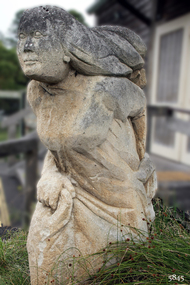
Sculpture - Limestone, Lady in the Wind
... The sculpture titled "Lady in the Wind" by Robert Ulmann. Subject is a robed woman moving forward, long hair streaming behind her, clutching fabric of skirt in each hand. .... / Presented by Ivor and Deirdre Scott " The sculpture titled "Lady in the Wind" by Robert Ulmann. Subject is a robed woman moving forward, long hair streaming behind her, clutching fabric of skirt in each hand. ...The late Robert Ulmann (1927-1999) was a well-known local Warrnambool artist, creating murals, sculptures and art works. The sculpture 'Lady in the Wind' was presented to Flagstaff Hill Maritime Village by Dr Ivor (Ivor Philip Quentin Scott 16-08/1928 - 1/11/2016) and his wife Deirdre Scott (dec.). This sculpture is significant for being a creation of Robert Ulmann, well known local Warrnambool artist. The sculpture titled "Lady in the Wind" by Robert Ulmann. Subject is a robed woman moving forward, long hair streaming behind her, clutching fabric of skirt in each hand. Created in 1975. Made of Mount Gambier stone. Plaque describing the sculpture is on a nearby wall. The sculpture was presented to Flagstaff hill by Ivor and Deirdre Scott."Robert Ulmann / "LADY IN THE WIND " ' Sculpture, Mt Gambier Stone, 1975. / Presented by Ivor and Deirdre Scott "flagstaff hill, warrnambool, shipwrecked-coast, flagstaff-hill, flagstaff-hill-maritime-museum, maritime-museum, shipwreck-coast, flagstaff-hill-maritime-village, robert ulmann, sculpture in warrnambool, lady in the wind sculpture, warrnambool artist, flagstaff hill maritime village sculpture, ivor philip quentin scott, deirdre scott, ivor scott, lady in the wind -
 Flagstaff Hill Maritime Museum and Village
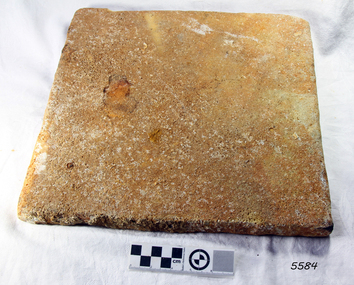
Marble Tile, circa 1878
... fabric. The resulting ‘true’ marbles of, for example, White Carrara (Tuscany, Italy), Verdi (green) Antico (Thessaly, Greece), and Rouge (red) Languadoc (Carcassone, France), were highly prized in classical decoration (sculpture and friezes) and architecture (temples and arches). ...fabric. The resulting ‘true’ marbles of, for example, White Carrara (Tuscany, Italy), Verdi (green) Antico (Thessaly, Greece), and Rouge (red) Languadoc (Carcassone, France), were highly prized in classical decoration (sculpture and friezes) and architecture (temples and arches). ...The artefact is a white marble tile raised from the wreck of the LOCH ARD (1878). The cargo manifest of the sunken vessel has the entry “Marble £400”. This is placed directly following the entry “Glass (604 cases)”. This conjunction suggests the marble tile was originally part of a consignment intended for use in a ‘high end’ residential or public building project in the gold and wool rich Colony of Victoria. Traditionally, white or cream marble was imported into Britain from the Mediterranean region of Europe, where beds of sedimentary limestone (calcium and magnesium carbonate) had been buried over a long geological period of time. Deep in the earth’s crust, it had been subjected to immense pressures and high temperatures, sufficient to completely re-crystallise the original deposits. Marble beds began as layers of sediment at the bottom of ancient tropical seas, forming from the skeletal remains of calcareous fossils, shell, and coral fragments. The metamorphic process of prolonged compression and heating recrystallised this skeletal material, destroying all signs of the original sedimentary fabric. The resulting ‘true’ marbles of, for example, White Carrara (Tuscany, Italy), Verdi (green) Antico (Thessaly, Greece), and Rouge (red) Languadoc (Carcassone, France), were highly prized in classical decoration (sculpture and friezes) and architecture (temples and arches). Marble was found in nineteenth century Australia, but in small, uneconomic deposits, not suitable for commercial quarrying. The comparative expense of imported marble restricted its use in colonial buildings to carved fireplaces and mantel pieces, or outdoor ornaments such as fountains, statuary and grave stones. If Carrara marble floor tiles were used, they were used sparingly, as an arresting feature in entrance halls for instance. However, most prominent private and public construction used timber flooring, waxed or ‘japanned’, with carpet runners and rugs (for example the Austin’s Barwon Park Mansion, 1871), or laid tessellated and ceramic tiles of baked clay infused with colour (for example the Chirnside’s Werribee Park Mansion, 1878). HISTORY OF THE LOCH ARD The LOCH ARD belonged to the famous Loch Line which sailed many ships from England to Australia. Built in Glasgow by Barclay, Curdle and Co. in 1873, the LOCH ARD was a three-masted square rigged iron sailing ship. The ship measured 262ft 7" (79.87m) in length, 38ft (11.58m) in width, 23ft (7m) in depth and had a gross tonnage of 1693 tons. The LOCH ARD's main mast measured a massive 150ft (45.7m) in height. LOCH ARD made three trips to Australia and one trip to Calcutta before its final voyage. LOCH ARD left England on March 2, 1878, under the command of Captain Gibbs, a newly married, 29 year old. She was bound for Melbourne with a crew of 37, plus 17 passengers and a load of cargo. The general cargo reflected the affluence of Melbourne at the time. On board were straw hats, umbrella, perfumes, clay pipes, pianos, clocks, confectionary, linen and candles, as well as a heavier load of railway irons, cement, lead and copper. There were items included that intended for display in the Melbourne International Exhibition in 1880. The voyage to Port Phillip was long but uneventful. At 3am on June 1, 1878, Captain Gibbs was expecting to see land and the passengers were becoming excited as they prepared to view their new homeland in the early morning. But LOCH ARD was running into a fog which greatly reduced visibility. Captain Gibbs was becoming anxious as there was no sign of land or the Cape Otway lighthouse. At 4am the fog lifted. A man aloft announced that he could see breakers. The sheer cliffs of Victoria's west coast came into view, and Captain Gibbs realised that the ship was much closer to them than expected. He ordered as much sail to be set as time would permit and then attempted to steer the vessel out to sea. On coming head on into the wind, the ship lost momentum, the sails fell limp and LOCH ARD's bow swung back. Gibbs then ordered the anchors to be released in an attempt to hold its position. The anchors sank some 50 fathoms - but did not hold. By this time LOCH ARD was among the breakers and the tall cliffs of Mutton Bird Island rose behind the ship. Just half a mile from the coast, the ship's bow was suddenly pulled around by the anchor. The captain tried to tack out to sea, but the ship struck a reef at the base of Mutton Bird Island, near Port Campbell. Waves broke over the ship and the top deck was loosened from the hull. The masts and rigging came crashing down knocking passengers and crew overboard. When a lifeboat was finally launched, it crashed into the side of LOCH ARD and capsized. Tom Pearce, who had launched the boat, managed to cling to its overturned hull and shelter beneath it. He drifted out to sea and then on the flood tide came into what is now known as LOCH ARD Gorge. He swam to shore, bruised and dazed, and found a cave in which to shelter. Some of the crew stayed below deck to shelter from the falling rigging but drowned when the ship slipped off the reef into deeper water. Eva Carmichael had raced onto deck to find out what was happening only to be confronted by towering cliffs looming above the stricken ship. In all the chaos, Captain Gibbs grabbed Eva and said, "If you are saved Eva, let my dear wife know that I died like a sailor". That was the last Eva Carmichael saw of the captain. She was swept off the ship by a huge wave. Eva saw Tom Pearce on a small rocky beach and yelled to attract his attention. He dived in and swam to the exhausted woman and dragged her to shore. He took her to the cave and broke open case of brandy which had washed up on the beach. He opened a bottle to revive the unconscious woman. A few hours later Tom scaled a cliff in search of help. He followed hoof prints and came by chance upon two men from nearby Glenample Station three and a half miles away. In a state of exhaustion, he told the men of the tragedy. Tom returned to the gorge while the two men rode back to the station to get help. By the time they reached LOCH ARD Gorge, it was cold and dark. The two shipwreck survivors were taken to Glenample Station to recover. Eva stayed at the station for six weeks before returning to Ireland, this time by steamship. In Melbourne, Tom Pearce received a hero's welcome. He was presented with the first gold medal of the Royal Humane Society of Victoria and a £1000 cheque from the Victorian Government. Concerts were performed to honour the young man's bravery and to raise money for those who lost family in the LOCH ARD disaster. Of the 54 crew members and passengers on board, only two survived: the apprentice, Tom Pearce and the young woman passenger, Eva Carmichael, who lost all of her family in the tragedy. Ten days after the LOCH ARD tragedy, salvage rights to the wreck were sold at auction for £2,120. Cargo valued at £3,000 was salvaged and placed on the beach, but most washed back into the sea when another storm developed. The wreck of LOCH ARD still lies at the base of Mutton Bird Island. Much of the cargo has now been salvaged and some was washed up into what is now known as LOCH ARD Gorge. Cargo and artefacts have also been illegally salvaged over many years before protective legislation was introduced. One of the most unlikely pieces of cargo to have survived the shipwreck was a Minton porcelain peacock - one of only nine in the world. The peacock was destined for the Melbourne International Exhibition in 1880. It had been well packed, which gave it adequate protection during the violent storm. Today, the Minton peacock can be seen at the Flagstaff Hill Maritime Museum in Warrnambool. From Australia's most dramatic shipwreck it has now become Australia's most valuable shipwreck artefact and is one of very few 'objects' on the Victorian State Heritage Register. The wreck of the LOCH ARD is of State significance — Victorian Heritage Register S417 Flagstaff Hill’s collection of artefacts from LOCH ARD is significant for being one of the largest collections of artefacts from this shipwreck in Victoria. It is significant for its association with the shipwreck, which is on the Victorian Heritage Register (VHR S417). The collection is significant because of the relationship between the objects, as together they have a high potential to interpret the story of the LOCH ARD. The LOCH ARD collection is archaeologically significant as the remains of a large international passenger and cargo ship. The LOCH ARD collection is historically significant for representing aspects of Victoria’s shipping history and its potential to interpret sub-theme 1.5 of Victoria’s Framework of Historical Themes (living with natural processes). The collection is also historically significant for its association with the LOCH ARD, which was one of the worst and best known shipwrecks in Victoria’s history. A square marble tile retrieved from the wreck of the LOCH ARD. Most of its surface is covered by a thin layer of limestone and marine growth encrustation that is stained rust-red. The tile is ‘rough-worked’, cut to shape and size, but not smoothed or polished. There is a companion tile in similar condition in the Flagstaff Hill collection. From visual observation of the original surface (at low magnification) the tile appears to be of white Carrara-type marble.flagstaff hill, warrnambool, shipwrecked coast, flagstaff hill maritime museum, maritime museum, shipwreck coast, flagstaff hill maritime village, great ocean road, loch line, loch ard, captain gibbs, eva carmichael, tom pearce, glenample station, mutton bird island, loch ard gorge, white marble, marble tile, carrara marble, imported marble, colonial architecture, victorian building materials -
 Flagstaff Hill Maritime Museum and Village
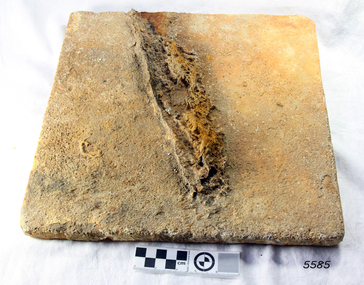
Marble Tile, circa 1878
... fabric. The resulting ‘true’ marbles of, for example, White Carrara (Tuscany, Italy), Verdi (green) Antico (Thessaly, Greece), and Rouge (red) Languadoc (Carcassone, France), were highly prized in classical decoration (sculpture and friezes) and architecture (temples and arches). ...fabric. The resulting ‘true’ marbles of, for example, White Carrara (Tuscany, Italy), Verdi (green) Antico (Thessaly, Greece), and Rouge (red) Languadoc (Carcassone, France), were highly prized in classical decoration (sculpture and friezes) and architecture (temples and arches). ...The artefact is a white marble tile raised from the wreck of the LOCH ARD (1878). The cargo manifest of the sunken vessel has the entry “Marble £400”. This is placed directly following the entry “Glass (604 cases)”. This conjunction suggests the marble tile was originally part of a consignment intended for use in a ‘high end’ residential or public building project in the gold and wool rich Colony of Victoria. Traditionally, white or cream marble was imported into Britain from the Mediterranean region of Europe, where beds of sedimentary limestone (calcium and magnesium carbonate) had been buried over a long geological period of time. Deep in the earth’s crust, it had been subjected to immense pressures and high temperatures, sufficient to completely re-crystallise the original deposits. Marble beds began as layers of sediment at the bottom of ancient tropical seas, forming from the skeletal remains of calcareous fossils, shell, and coral fragments. The metamorphic process of prolonged compression and heating recrystallised this skeletal material, destroying all signs of the original sedimentary fabric. The resulting ‘true’ marbles of, for example, White Carrara (Tuscany, Italy), Verdi (green) Antico (Thessaly, Greece), and Rouge (red) Languadoc (Carcassone, France), were highly prized in classical decoration (sculpture and friezes) and architecture (temples and arches). Marble was found in nineteenth century Australia, but in small, uneconomic deposits, not suitable for commercial quarrying. The comparative expense of imported marble restricted its use in colonial buildings to carved fireplaces and mantel pieces, or outdoor ornaments such as fountains, statuary and grave stones. If Carrara marble floor tiles were used, they were used sparingly, as an arresting feature in entrance halls for instance. However, most prominent private and public construction used timber flooring, waxed or ‘jappaned’, with carpet runners and rugs (for example the Austin’s Barwon Park Mansion, 1871), or laid tessellated and ceramic tiles of baked clay infused with colour (for example the Chirnside’s Werribee Park Mansion, 1878). HISTORY OF THE LOCH ARD The LOCH ARD belonged to the famous Loch Line which sailed many ships from England to Australia. Built in Glasgow by Barclay, Curdle and Co. in 1873, the LOCH ARD was a three-masted square rigged iron sailing ship. The ship measured 262ft 7" (79.87m) in length, 38ft (11.58m) in width, 23ft (7m) in depth and had a gross tonnage of 1693 tons. The LOCH ARD's main mast measured a massive 150ft (45.7m) in height. LOCH ARD made three trips to Australia and one trip to Calcutta before its final voyage. LOCH ARD left England on March 2, 1878, under the command of Captain Gibbs, a newly married, 29 year old. She was bound for Melbourne with a crew of 37, plus 17 passengers and a load of cargo. The general cargo reflected the affluence of Melbourne at the time. On board were straw hats, umbrella, perfumes, clay pipes, pianos, clocks, confectionary, linen and candles, as well as a heavier load of railway irons, cement, lead and copper. There were items included that intended for display in the Melbourne International Exhibition in 1880. The voyage to Port Phillip was long but uneventful. At 3am on June 1, 1878, Captain Gibbs was expecting to see land and the passengers were becoming excited as they prepared to view their new homeland in the early morning. But LOCH ARD was running into a fog which greatly reduced visibility. Captain Gibbs was becoming anxious as there was no sign of land or the Cape Otway lighthouse. At 4am the fog lifted. A man aloft announced that he could see breakers. The sheer cliffs of Victoria's west coast came into view, and Captain Gibbs realised that the ship was much closer to them than expected. He ordered as much sail to be set as time would permit and then attempted to steer the vessel out to sea. On coming head on into the wind, the ship lost momentum, the sails fell limp and LOCH ARD's bow swung back. Gibbs then ordered the anchors to be released in an attempt to hold its position. The anchors sank some 50 fathoms - but did not hold. By this time LOCH ARD was among the breakers and the tall cliffs of Mutton Bird Island rose behind the ship. Just half a mile from the coast, the ship's bow was suddenly pulled around by the anchor. The captain tried to tack out to sea, but the ship struck a reef at the base of Mutton Bird Island, near Port Campbell. Waves broke over the ship and the top deck was loosened from the hull. The masts and rigging came crashing down knocking passengers and crew overboard. When a lifeboat was finally launched, it crashed into the side of LOCH ARD and capsized. Tom Pearce, who had launched the boat, managed to cling to its overturned hull and shelter beneath it. He drifted out to sea and then on the flood tide came into what is now known as LOCH ARD Gorge. He swam to shore, bruised and dazed, and found a cave in which to shelter. Some of the crew stayed below deck to shelter from the falling rigging but drowned when the ship slipped off the reef into deeper water. Eva Carmichael had raced onto deck to find out what was happening only to be confronted by towering cliffs looming above the stricken ship. In all the chaos, Captain Gibbs grabbed Eva and said, "If you are saved Eva, let my dear wife know that I died like a sailor". That was the last Eva Carmichael saw of the captain. She was swept off the ship by a huge wave. Eva saw Tom Pearce on a small rocky beach and yelled to attract his attention. He dived in and swam to the exhausted woman and dragged her to shore. He took her to the cave and broke open case of brandy which had washed up on the beach. He opened a bottle to revive the unconscious woman. A few hours later Tom scaled a cliff in search of help. He followed hoof prints and came by chance upon two men from nearby Glenample Station three and a half miles away. In a state of exhaustion, he told the men of the tragedy. Tom returned to the gorge while the two men rode back to the station to get help. By the time they reached LOCH ARD Gorge, it was cold and dark. The two shipwreck survivors were taken to Glenample Station to recover. Eva stayed at the station for six weeks before returning to Ireland, this time by steamship. In Melbourne, Tom Pearce received a hero's welcome. He was presented with the first gold medal of the Royal Humane Society of Victoria and a £1000 cheque from the Victorian Government. Concerts were performed to honour the young man's bravery and to raise money for those who lost family in the LOCH ARD disaster. Of the 54 crew members and passengers on board, only two survived: the apprentice, Tom Pearce and the young woman passenger, Eva Carmichael, who lost all of her family in the tragedy. Ten days after the LOCH ARD tragedy, salvage rights to the wreck were sold at auction for £2,120. Cargo valued at £3,000 was salvaged and placed on the beach, but most washed back into the sea when another storm developed. The wreck of LOCH ARD still lies at the base of Mutton Bird Island. Much of the cargo has now been salvaged and some was washed up into what is now known as LOCH ARD Gorge. Cargo and artefacts have also been illegally salvaged over many years before protective legislation was introduced. One of the most unlikely pieces of cargo to have survived the shipwreck was a Minton porcelain peacock - one of only nine in the world. The peacock was destined for the Melbourne International Exhibition in 1880. It had been well packed, which gave it adequate protection during the violent storm. Today, the Minton peacock can be seen at the Flagstaff Hill Maritime Museum in Warrnambool. From Australia's most dramatic shipwreck it has now become Australia's most valuable shipwreck artefact and is one of very few 'objects' on the Victorian State Heritage Register. HISTORY OF THE LOCH ARD The LOCH ARD belonged to the famous Loch Line which sailed many ships from England to Australia. Built in Glasgow by Barclay, Curdle and Co. in 1873, the LOCH ARD was a three-masted square rigged iron sailing ship. The ship measured 262ft 7" (79.87m) in length, 38ft (11.58m) in width, 23ft (7m) in depth and had a gross tonnage of 1693 tons. The LOCH ARD's main mast measured a massive 150ft (45.7m) in height. LOCH ARD made three trips to Australia and one trip to Calcutta before its final voyage. LOCH ARD left England on March 2, 1878, under the command of Captain Gibbs, a newly married, 29 year old. She was bound for Melbourne with a crew of 37, plus 17 passengers and a load of cargo. The general cargo reflected the affluence of Melbourne at the time. On board were straw hats, umbrella, perfumes, clay pipes, pianos, clocks, confectionary, linen and candles, as well as a heavier load of railway irons, cement, lead and copper. There were items included that intended for display in the Melbourne International Exhibition in 1880. The voyage to Port Phillip was long but uneventful. At 3am on June 1, 1878, Captain Gibbs was expecting to see land and the passengers were becoming excited as they prepared to view their new homeland in the early morning. But LOCH ARD was running into a fog which greatly reduced visibility. Captain Gibbs was becoming anxious as there was no sign of land or the Cape Otway lighthouse. At 4am the fog lifted. A man aloft announced that he could see breakers. The sheer cliffs of Victoria's west coast came into view, and Captain Gibbs realised that the ship was much closer to them than expected. He ordered as much sail to be set as time would permit and then attempted to steer the vessel out to sea. On coming head on into the wind, the ship lost momentum, the sails fell limp and LOCH ARD's bow swung back. Gibbs then ordered the anchors to be released in an attempt to hold its position. The anchors sank some 50 fathoms - but did not hold. By this time LOCH ARD was among the breakers and the tall cliffs of Mutton Bird Island rose behind the ship. Just half a mile from the coast, the ship's bow was suddenly pulled around by the anchor. The captain tried to tack out to sea, but the ship struck a reef at the base of Mutton Bird Island, near Port Campbell. Waves broke over the ship and the top deck was loosened from the hull. The masts and rigging came crashing down knocking passengers and crew overboard. When a lifeboat was finally launched, it crashed into the side of LOCH ARD and capsized. Tom Pearce, who had launched the boat, managed to cling to its overturned hull and shelter beneath it. He drifted out to sea and then on the flood tide came into what is now known as LOCH ARD Gorge. He swam to shore, bruised and dazed, and found a cave in which to shelter. Some of the crew stayed below deck to shelter from the falling rigging but drowned when the ship slipped off the reef into deeper water. Eva Carmichael had raced onto deck to find out what was happening only to be confronted by towering cliffs looming above the stricken ship. In all the chaos, Captain Gibbs grabbed Eva and said, "If you are saved Eva, let my dear wife know that I died like a sailor". That was the last Eva Carmichael saw of the captain. She was swept off the ship by a huge wave. Eva saw Tom Pearce on a small rocky beach and yelled to attract his attention. He dived in and swam to the exhausted woman and dragged her to shore. He took her to the cave and broke open case of brandy which had washed up on the beach. He opened a bottle to revive the unconscious woman. A few hours later Tom scaled a cliff in search of help. He followed hoof prints and came by chance upon two men from nearby Glenample Station three and a half miles away. In a state of exhaustion, he told the men of the tragedy. Tom returned to the gorge while the two men rode back to the station to get help. By the time they reached LOCH ARD Gorge, it was cold and dark. The two shipwreck survivors were taken to Glenample Station to recover. Eva stayed at the station for six weeks before returning to Ireland, this time by steamship. In Melbourne, Tom Pearce received a hero's welcome. He was presented with the first gold medal of the Royal Humane Society of Victoria and a £1000 cheque from the Victorian Government. Concerts were performed to honour the young man's bravery and to raise money for those who lost family in the LOCH ARD disaster. Of the 54 crew members and passengers on board, only two survived: the apprentice, Tom Pearce and the young woman passenger, Eva Carmichael, who lost all of her family in the tragedy. Ten days after the LOCH ARD tragedy, salvage rights to the wreck were sold at auction for £2,120. Cargo valued at £3,000 was salvaged and placed on the beach, but most washed back into the sea when another storm developed. The wreck of LOCH ARD still lies at the base of Mutton Bird Island. Much of the cargo has now been salvaged and some was washed up into what is now known as LOCH ARD Gorge. Cargo and artefacts have also been illegally salvaged over many years before protective legislation was introduced. One of the most unlikely pieces of cargo to have survived the shipwreck was a Minton porcelain peacock - one of only nine in the world. The peacock was destined for the Melbourne International Exhibition in 1880. It had been well packed, which gave it adequate protection during the violent storm. Today, the Minton peacock can be seen at the Flagstaff Hill Maritime Museum in Warrnambool. From Australia's most dramatic shipwreck it has now become Australia's most valuable shipwreck artefact and is one of very few 'objects' on the Victorian State Heritage Register. The wreck of the LOCH ARD is of State significance — Victorian Heritage Register S417 Flagstaff Hill’s collection of artefacts from LOCH ARD is significant for being one of the largest collections of artefacts from this shipwreck in Victoria. It is significant for its association with the shipwreck, which is on the Victorian Heritage Register (VHR S417). The collection is significant because of the relationship between the objects, as together they have a high potential to interpret the story of the LOCH ARD. The LOCH ARD collection is archaeologically significant as the remains of a large international passenger and cargo ship. The LOCH ARD collection is historically significant for representing aspects of Victoria’s shipping history and its potential to interpret sub-theme 1.5 of Victoria’s Framework of Historical Themes (living with natural processes). The collection is also historically significant for its association with the LOCH ARD, which was one of the worst and best known shipwrecks in Victoria’s history. A square marble tile retrieved from the wreck of the LOCH ARD. Most of its surface is covered by a thin layer of limestone and marine growth encrustation that is stained rust-red. There is a piece of corroded iron encrusted at an oblique angle on the tile’s rear face. The tile is ‘rough-worked’, cut to shape and size, but not smoothed or polished. There is a companion tile in similar condition in the Flagstaff Hill collection. From visual observation of the original surface (at low magnification) the tile appears to be of white Carrara-type marble.flagstaff hill, warrnambool, shipwrecked coast, flagstaff hill maritime museum, maritime museum, shipwreck coast, flagstaff hill maritime village, great ocean road, loch line, loch ard, captain gibbs, eva carmichael, tom pearce, glenample station, mutton bird island, loch ard gorge, white marble, marble tile, carrara marble, colonial architecture, victorian building materials -
 Geelong Gallery
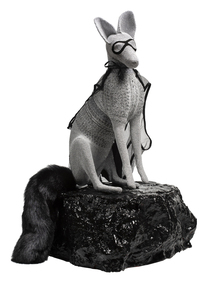
Sculpture - Moonlight becomes you (silver fox), WEAVER, Louise, 2019
... ) fox: hand crocheted cotton, lamb�s wool synthetic yarns and reflective tape over high density foam, papier mache, wire, mirrored acrylic, cotton fabric and synthetic fabrics, synthetic polymer emulsion and glass beads; 2 5) various fibres; 6) base: enamel gloss paint on fibreglass Sculpture Moonlight becomes you (silver fox) WEAVER, Louise ...) fox: hand crocheted cotton, lamb�s wool synthetic yarns and reflective tape over high density foam, papier mache, wire, mirrored acrylic, cotton fabric and synthetic fabrics, synthetic polymer emulsion and glass beads; 2 5) various fibres; 6) base: enamel gloss paint on fibreglass -
 Wangaratta Art Gallery
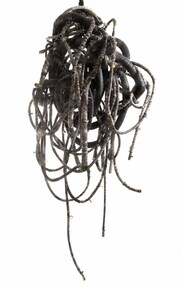
Sculpture, Cheryl Kennedy et al, Thirst, 2019
... A sculpture made out of recycled hoses and irrigation fittings that have been wrapped and tied in overdyed yarn, string, fabric strips...wangaratta art gallery wcta sculpture cheryl kennedy linda mcclean A sculpture made out of recycled hoses and irrigation fittings that have been wrapped and tied in overdyed yarn, string, fabric strips Thirst Sculpture Cheryl Kennedy Linda McLean ...Yearn Hunger Thirst Always on the edge of oblivion, craving sustenance in a dry land. McLean and Kennedy have collected dry materials: hollow pipes, old hoses and worn metal hose fittings. The materials were then wrapped with dyed, frayed fabric, string and yarn to create a piece that expresses the collective longing for rain.Wangaratta Art Gallery Collection. Winner of the Wangaratta Contemporary Textile Award 2019.A sculpture made out of recycled hoses and irrigation fittings that have been wrapped and tied in overdyed yarn, string, fabric stripswangaratta art gallery, wcta, sculpture, cheryl kennedy, linda mcclean -
 Wangaratta Art Gallery
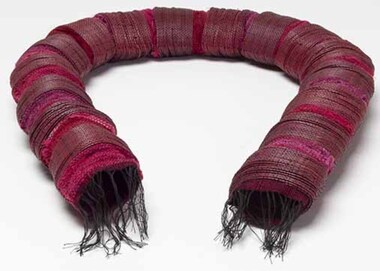
Textile, Liz Williamson, Rose Round, 2011
... A handwoven textile sculpture made from red fabrics and threads shaped into a tubular shape....textile liz williamson A handwoven textile sculpture made from red fabrics and threads shaped into a tubular shape. ...Wangaratta Art Gallery CollectionA handwoven textile sculpture made from red fabrics and threads shaped into a tubular shape.textile, liz williamson -
 Wangaratta Art Gallery
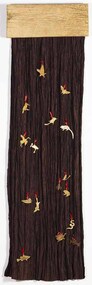
Sculpture, Rose Wedler, Milagros, 2006
... A rectangular sculpture that features a light wood beam with a brown fabric hang from it, with small golden animal pendants attached to the fabric....rose wedler sculpture milagros A rectangular sculpture that features a light wood beam with a brown fabric hang from it, with small golden animal pendants attached to the fabric. ...Milagros is inspired by the Mexican tradition of pinning ‘ex-votos’ or ‘milagros’ onto the robes of Patron Saints when requesting a miracle. Ex-votos or milagros are votive offerings of small metal shapes which represent a visual form of people’s prayers. The central question in this piece is:If the creatures of the river could, which ones would be asking their Patron Saints for a miracle or two? Most of the wetland and river fauna which are depicted in Milagros are listed as endangered or vulnerable and are recorded as belonging to the area of the Ovens River stretching from Wangaratta to the Murray.Wangaratta Art Gallery CollectionA rectangular sculpture that features a light wood beam with a brown fabric hang from it, with small golden animal pendants attached to the fabric.rose wedler, sculpture, milagros -
 Embroiderers Guild, Victoria
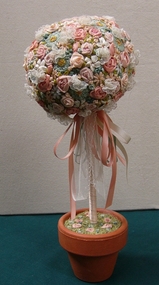
Textile - Topiary Tree, Mrs Dorothy Addlem, 1992
... Embroidery Soft sculpture Australia 1980-2000 Creative Embroidery Small stylised tree - a sphere made of a mixture of pink, aqua and green surface stitchery and ribbon embroidery and lace, closely covering the green cotton base fabric. ...Small stylised tree - a sphere made of a mixture of pink, aqua and green surface stitchery and ribbon embroidery and lace, closely covering the green cotton base fabric. This is set on a ribbon wrapped stem, decorated with ribbon and lace loops, which stands in a small terra cotta pot. embroidery, soft sculpture, australia, 1980-2000, creative embroidery -
 Embroiderers Guild, Victoria
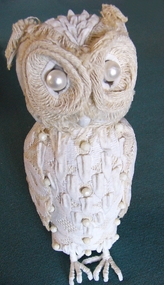
Textile - Owl, Miss Leslie Uren, 1960-80
... Embroidery Creative Soft sculpture 1960-80 Australia Embroidered felt owl. The front is covered with a collage of cream and white fabrics, representing wings and feathers, with beads on front and large pearl beads for eyes. ...Designed and made by Miss Leslie Uren.Embroidered felt owl. The front is covered with a collage of cream and white fabrics, representing wings and feathers, with beads on front and large pearl beads for eyes.embroidery, creative, soft sculpture, 1960-80, australia -
 Ararat Gallery TAMA
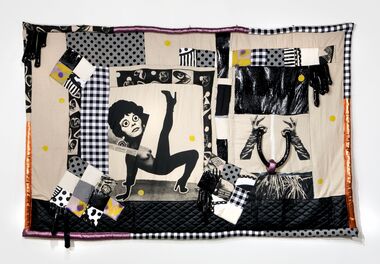
Sarah Contos, Total Control, 2015
... sculpture and installation. Contos explores identity, eroticism, femininity, materiality, popular culture and history. She describes her life in relation to contradictions, saying: “I make quilts for art but never for warmth. I watch cooking shows but never cook. I want to cover my home in florals, but it ends up in wine stains.” Total Control is a quilted textile work notable for its screen-printed surface of imagery sourced from 1970s editions of the provocative Australasian Post magazine. Contos’ use of dangling fabric...sculpture and installation. Contos explores identity, eroticism, femininity, materiality, popular culture and history. She describes her life in relation to contradictions, saying: “I make quilts for art but never for warmth. I watch cooking shows but never cook. I want to cover my home in florals, but it ends up in wine stains.” Total Control is a quilted textile work notable for its screen-printed surface of imagery sourced from 1970s editions of the provocative Australasian Post magazine. Contos’ use of dangling fabric ...Sarah Contos is a multidisciplinary artist working across various modes of collage, sculpture and installation. Contos explores identity, eroticism, femininity, materiality, popular culture and history. She describes her life in relation to contradictions, saying: “I make quilts for art but never for warmth. I watch cooking shows but never cook. I want to cover my home in florals, but it ends up in wine stains.” Total Control is a quilted textile work notable for its screen-printed surface of imagery sourced from 1970s editions of the provocative Australasian Post magazine. Contos’ use of dangling fabric tubes, coils and pillows, and fabric patches draw allusions to the body; these elements are both familiar and confronting. -
 Ararat Gallery TAMA
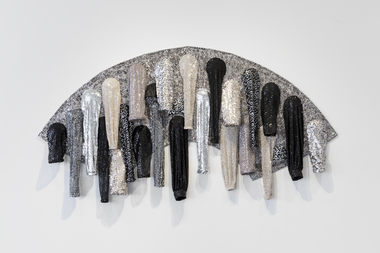
Hannah Gartside, Waiting, 2023
... Hannah Gartside works across sculpture, installation and video. Her artworks transform found fabrics and clothing to articulate experiences and sensations of longing, tenderness, care and desire. ...Hannah Gartside works across sculpture, installation and video. Her artworks transform found fabrics and clothing to articulate experiences and sensations of longing, tenderness, care and desire. ...Hannah Gartside works across sculpture, installation and video. Her artworks transform found fabrics and clothing to articulate experiences and sensations of longing, tenderness, care and desire. The artist writes: “Waiting is a large-scale, found textile assemblage. This artwork continues my use of found, second-hand women’s clothing and accessories to tell transformation stories. Twenty-seven sleeves have been carefully unpicked from variously patterned black, silver and grey sequinned party dresses and blouses, and applied onto a silvery sequinned base fabric arc (the arc was once the skirt component of a party dress). These are celebratory fabrics worn for special events. I have stitched circles of firm millinery wire into the hem at the wrist of each sleeve, and added soft shoulder pads at the head to suggest an invisible arm in each sleeve. Viewed through my metamorphosis short story ‘Frances, the moth’ (which describes a lonely woman who transforms into a moth after cutting herself out a cape using a pair of magical scissors), the sleeves in Waiting refer loosely in shape and form to a group of moth or butterfly cocoons suspended in time. They hang winking and sparkling, waiting patiently for change.” -
Ballarat Heritage Services
Work on paper, Bede TANGUTALUM, Yam, 1991
... sculpture,printmaking and painting. Tungutalum learned carving from his father, the well-known sculptor Gabriel Tungutalum, and was taught how to cut woodblocks for printing while attending Xavier Boys School at Nguiu. He refined and developed these techniques in the late 1960s and early 1970s. His earliest prints date from the late 1960s. In 1969, with fellow Tiwi artist Giovanni Tipungwuti, Bede Tungutalum established Tiwi Design, an art centre dedicated to the production of hand-printed fabrics...sculpture,printmaking and painting. Tungutalum learned carving from his father, the well-known sculptor Gabriel Tungutalum, and was taught how to cut woodblocks for printing while attending Xavier Boys School at Nguiu. He refined and developed these techniques in the late 1960s and early 1970s. His earliest prints date from the late 1960s. In 1969, with fellow Tiwi artist Giovanni Tipungwuti, Bede Tungutalum established Tiwi Design, an art centre dedicated to the production of hand-printed fabrics ...Bede TANGUTALUM (1952- ) Wurrumiyanga (Nguiu), Bathurst Island Tiwi People Bede Tungutalum works across a range of media, including carved and painted wooden sculpture,printmaking and painting. Tungutalum learned carving from his father, the well-known sculptor Gabriel Tungutalum, and was taught how to cut woodblocks for printing while attending Xavier Boys School at Nguiu. He refined and developed these techniques in the late 1960s and early 1970s. His earliest prints date from the late 1960s. In 1969, with fellow Tiwi artist Giovanni Tipungwuti, Bede Tungutalum established Tiwi Design, an art centre dedicated to the production of hand-printed fabrics featuring traditional Indigenous designs.Framed lithograph depicting yams, printed in colour inks, from multiple stonesbede tangutalum, tiwi, wurrumiyanga, bathurst island, tiwi design, yam, aboriginal -
 Federation University Art Collection
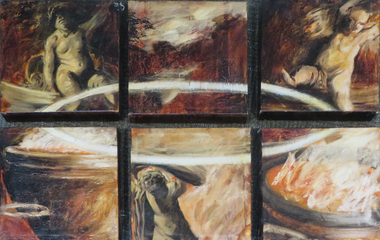
Painting - Artwork, 'Ring of the Nibellings' by David Noonan, 1989
... sculpture. His works often evoke the subconscious realm through their fragmented imagery, allusive qualities and complex layering of historical and cultural references. (https://www.ngv.vic.gov.au/essay/david-noonan-untitled/, accessed 17 January 2020) David Noonan has become known for large-scale monochromatic collages on linen comprised of fabrics which are torn, folded, cut, stitched and combined with silkscreened images. ...sculpture. His works often evoke the subconscious realm through their fragmented imagery, allusive qualities and complex layering of historical and cultural references. (https://www.ngv.vic.gov.au/essay/david-noonan-untitled/, accessed 17 January 2020) David Noonan has become known for large-scale monochromatic collages on linen comprised of fabrics which are torn, folded, cut, stitched and combined with silkscreened images. ...David NOONAN (1969- ) Born Ballarat, Victoria. Lives and works Melbourne, Victoria and London, United Kingdom. Leaving secondary school as soon as he could, David Noonan enrolled in a Visual Art Course at the Ballarat School of Mines. He described this time as 'an inspiring time, with every art form covered and treated with passion and rigour.' He studied ceramics, photography, painting and knew that he had to be an artist. (https://art150.unimelb.edu.au/articles/david-noonan-making-art-in-a-dark-and-quiet-place, accessed 17 January 2020). Between 1987 and 1989 David Noonan completed a Bachelor of Fine Art at Ballarat University College, Victoria, Australia (Now Federation University Australia). He undertook Post Graduate Studies at the Victorian College of the Arts, Melbourne in 1991 and 1992. Since 2005 he has been based in London with his work featuring in a number of major international exhibitions of contemporary art, including 'Altermodern', the 2009 Tate Triennial at Tate Britain, London. Producing works in a range of media including painting, photography, film, print-making, collage and sculpture David Noonan's work often evoke the subconscious realm through their fragmented imagery, allusive qualities and complex layering of historical and cultural references. Animals, actors and masked figures are recurring motifs that imbue his works with a magical atmosphere that is suggestive of childhood memories or half-forgotten dreams. ( produced works in a range of media including painting, photography, film, print-making, collage and sculpture. His works often evoke the subconscious realm through their fragmented imagery, allusive qualities and complex layering of historical and cultural references. (https://www.ngv.vic.gov.au/essay/david-noonan-untitled/, accessed 17 January 2020) David Noonan has become known for large-scale monochromatic collages on linen comprised of fabrics which are torn, folded, cut, stitched and combined with silkscreened images. This approach was used to produce his 2018 atmospheric film 'A dark and quiet place'. Noonan is interested in combining art and traditional craft techniques. (https://artgalleryofballarat.com.au/gallery_exhibitions/david-noonan-stagecraft/, accessed 17 January 2020) This item is part of the Federation University Art Collection. The Art Collection features over 2000 works and was listed as a 'Ballarat Treasure' in 2007. Six stretched canvases making up the work 'Ring of the Nibellings'. art, artwork, david noonan, oil on canvas, alumni -
 Federation University Art Collection
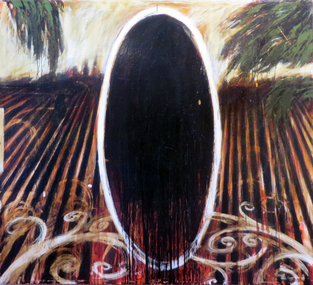
Painting, 'Through a Dark Glass Darkly' by David Noonan, c1989
... sculpture. His works often evoke the subconscious realm through their fragmented imagery, allusive qualities and complex layering of historical and cultural references. (https://www.ngv.vic.gov.au/essay/david-noonan-untitled/, accessed 17 January 2020) David Noonan has become known for large-scale monochromatic collages on linen comprised of fabrics which are torn, folded, cut, stitched and combined with silkscreened images. ...sculpture. His works often evoke the subconscious realm through their fragmented imagery, allusive qualities and complex layering of historical and cultural references. (https://www.ngv.vic.gov.au/essay/david-noonan-untitled/, accessed 17 January 2020) David Noonan has become known for large-scale monochromatic collages on linen comprised of fabrics which are torn, folded, cut, stitched and combined with silkscreened images. ...David NOONAN (1969- ) Born Ballarat, Victoria. Lives and works Melbourne, Victoria and London, United Kingdom. Leaving secondary school as soon as he could, David Noonan enrolled in a Visual Art Course at the Ballarat School of Mines. He described this time as 'an inspiring time, with every art form covered and treated with passion and rigour.' He studied ceramics, photography, painting and knew that he had to be an artist. (https://art150.unimelb.edu.au/articles/david-noonan-making-art-in-a-dark-and-quiet-place, accessed 17 January 2020). Between 1987 and 1989 David Noonan completed a Bachelor of Fine Art at Ballarat University College, Victoria, Australia (Now Federation University Australia). He undertook Post Graduate Studies at the Victorian College of the Arts, Melbourne in 1991 and 1992. Since 2005 he has been based in London with his work featuring in a number of major international exhibitions of contemporary art, including 'Altermodern', the 2009 Tate Triennial at Tate Britain, London. Producing works in a range of media including painting, photography, film, print-making, collage and sculpture David Noonan's work often evoke the subconscious realm through their fragmented imagery, allusive qualities and complex layering of historical and cultural references. Animals, actors and masked figures are recurring motifs that imbue his works with a magical atmosphere that is suggestive of childhood memories or half-forgotten dreams. ( produced works in a range of media including painting, photography, film, print-making, collage and sculpture. His works often evoke the subconscious realm through their fragmented imagery, allusive qualities and complex layering of historical and cultural references. (https://www.ngv.vic.gov.au/essay/david-noonan-untitled/, accessed 17 January 2020) David Noonan has become known for large-scale monochromatic collages on linen comprised of fabrics which are torn, folded, cut, stitched and combined with silkscreened images. This approach was used to produce his 2018 atmospheric film 'A dark and quiet place'. Noonan is interested in combining art and traditional craft techniques. (https://artgalleryofballarat.com.au/gallery_exhibitions/david-noonan-stagecraft/, accessed 17 January 2020) This item is part of the Federation University Art Collection. The Art Collection features over 2000 works and was listed as a 'Ballarat Treasure' in 2007.A large painting on canvas. art, artwork, david noonan, noonan, alumni, oil on canvas, available -
 Embroiderers Guild, Victoria
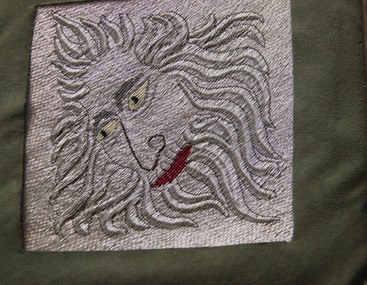
Textile - Metal Thread Embroidery "Sculptured Head", "Sculptured Head" Edna Wark, 1982
... Mounted behind soft, green velvet fabric frame. "Sculptured Head" Edna Wark Textile Metal Thread Embroidery "Sculptured Head" ...Made by founding member of The Embroiderers Guild Victoria, Edna Wark in 1982Metal thread embroidery with aluminium passing thread couched over laid string with a small amount of silk embroidery. Mounted behind soft, green velvet fabric frame. -
 School of Health and Biomedical Sciences, RMIT University
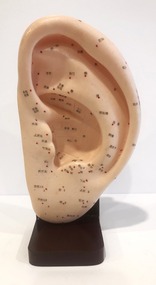
Sculpture - Acupuncture ear model and vaccaria seeds
... There are ten (10) sheets of vaccaria seeds with each sheet holding sixty (60) seeds on translucent orange sheets with small, square fabric backing at the rear of each seed compartment. Sculpture Acupuncture ear model and vaccaria seeds ...Large soft, hollow plastic model of ear with red spots and black Chinese script on purpose made, removable dark brown wood stand. Ear is attached to mount by two small horizontal wood dowels that meet holes in rear face of ear. One (1) pack of vaccaria seeds in small plastic snap lock plastic bag. There are ten (10) sheets of vaccaria seeds with each sheet holding sixty (60) seeds on translucent orange sheets with small, square fabric backing at the rear of each seed compartment. acupuncture, chinese medicine, vaccaria, herbal medicine, rmit chinese medicine collection
