
Showing 17 items matching "fairfield hospital melbourne"
-
 Alfred Hospital Nurses League - Nursing History Collection
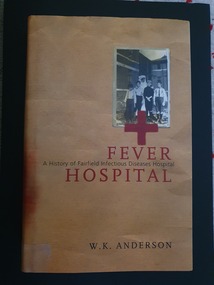
Book - Illustrated book, William Keys Anderson, Fever Hospital: a history of Fairfield Infectious Diseases Hospital, 2002
... Fairfield Hospital (Melbourne-Vic)-history...Also on front cover is a copy of black and white photograph: young patients 'well on the way to recovery' in the 1930's (Fairfield Hospital Archives, Austin Hospital Melbourne). Book contains many illustrations....Also on front cover is a copy of black and white photograph: young patients 'well on the way to recovery' in the 1930's (Fairfield Hospital Archives, Austin Hospital Melbourne). Book contains many illustrations. ...A record of the work and achievement of Fairfield hospital in the context of Australian developments in medicine and health. The story of Fairfield Hospital is central to the story of infectious diseases in Victoria. Fairfield Infectious Diseases Hospital opened in 1904 as a fever hospital, later becoming one of the world's foremost centres for the treatment of infectious diseases, especially HIV/AIDS.Hardcover book bound in red, with tile and author's name printed in gold on spine. Dust jacket has an ochre coloured background, title and authors name on front cover and spine. Also on front cover is a copy of black and white photograph: young patients 'well on the way to recovery' in the 1930's (Fairfield Hospital Archives, Austin Hospital Melbourne). Book contains many illustrations.non-fictionA record of the work and achievement of Fairfield hospital in the context of Australian developments in medicine and health. The story of Fairfield Hospital is central to the story of infectious diseases in Victoria. Fairfield Infectious Diseases Hospital opened in 1904 as a fever hospital, later becoming one of the world's foremost centres for the treatment of infectious diseases, especially HIV/AIDS.fairfield hospital (melbourne-vic)-history, hospitals-victoria-history, communicable diseases -
 St Vincent's Hospital Melbourne Archives
Badge - Nursing badges belonging to Josephine Zehnter, circa 1931-1941
... Hospital Melbourne...Women's Hospital Melbourne...Fairfield...The Melbourne hospital badges are from St Vincent's Hospital, the Women's Hospital and the Fairfield Hospital. ...Josephine Zehnter St Vincents Hospital Melbourne Women's Hospital Melbourne Fairfield Hospital Melbourne Nursing Metal lapel nurses' badges. ...Four nurses' graduation badges indicating Josephine Zehnter's nursing training and clinical working settings. The Melbourne hospital badges are from St Vincent's Hospital, the Women's Hospital and the Fairfield Hospital. There is also a badge stating SRN, which means Senior Registered Nurse. josephine zehnter, st vincents hospital melbourne, women's hospital melbourne, fairfield hospital melbourne, nursing -
St Vincent's Hospital Melbourne Archives
Book, Practical Nursing including Hygiene and Dietetics by W.T. Gordon Pugh M.D.B.S, in 1937
... St Vincent's Hospital Melbourne nurse training...Fairfield...Hospital Melbourne which included the history and evolution of nursing and its practices to the time of 1937. Medical and surgical techniques, materia medica, midwifery and children's nursing, many illnesses or diseases that nurses may encounter in hospital and other settings. The book includes photographed or illustrations of smallpox, tuberculosis of lung and types of splints and more. Margaret Glennen M.T. Gordon Pugh M.D St Vincent's Hospital Melbourne nurse training Fairfield ...One of the textbooks used by Margaret Glennen during her nurse training at St Vincent's Hospital Melbourne which included the history and evolution of nursing and its practices to the time of 1937. Medical and surgical techniques, materia medica, midwifery and children's nursing, many illnesses or diseases that nurses may encounter in hospital and other settings. The book includes photographed or illustrations of smallpox, tuberculosis of lung and types of splints and more. Inside cover is handwritten "Nurse M Glennen, St Vincents Hospital." margaret glennen, m.t. gordon pugh m.d, st vincent's hospital melbourne nurse training, fairfield hospital melbourne, invalid convalescent and home cookery -
St Vincent's Hospital Melbourne Archives
Album - Recollections of a Trainee Nurse at St Vincent's Hospital 1940-1943 by Eileen Doris Vaughan nee Cattanach -including cartoons by Minon Phillips
... Hospital Melbourne...Nurse training...The Second World War...Fairfield...Hospital Melbourne. Eileen speaks of the close-knit camaraderie, of sharing each other's trials and tribulations through three war torn years and beyond. She describes her nursing vocation as "the satisfaction of giving help to those in need". Eileen Vaughan nee Cattanach Minon Phillips St Vincent's Hospital Melbourne Nurse training The Second World War Fairfield ...Handwritten at age ninety- eight, Eileen nee Cattanach compiled two folders of nursing memories, including stories, accompanying photographs, cartoons and anecdotes of earlier training days at St Vincent's Hospital Melbourne. Eileen speaks of the close-knit camaraderie, of sharing each other's trials and tribulations through three war torn years and beyond. She describes her nursing vocation as "the satisfaction of giving help to those in need".Photographs have names and inscriptions, anecdotes written sideways on margins.eileen vaughan nee cattanach, minon phillips, st vincent's hospital melbourne, nurse training, the second world war, fairfield hospital melbourne -
St Vincent's Hospital Melbourne Archives
Book, Lectures for nurses by G.N. Burbidge, 3rd ed., 1935
... One of the textbooks used by Margaret Glennen during her nurse training at St Vincent's Hospital Melbourne in 1943. Author Gwen Burbidge, SRN was a Nurse Educator at Fairfield Hospital Melbourne from 1939-1960. ...One of the textbooks used by Margaret Glennen during her nurse training at St Vincent's Hospital Melbourne in 1943. Author Gwen Burbidge, SRN was a Nurse Educator at Fairfield Hospital Melbourne from 1939-1960. ...One of the textbooks used by Margaret Glennen during her nurse training at St Vincent's Hospital Melbourne in 1943. Author Gwen Burbidge, SRN was a Nurse Educator at Fairfield Hospital Melbourne from 1939-1960. Inside front cover is handwritten M. Glennen St Vincent's Hospital Fitzroy, N6. The cost of the book is written as eight shillings and threepence.margaret glennen, g.n.burbidge, st vincent's hospital melbourne -
 Greensborough Historical Society
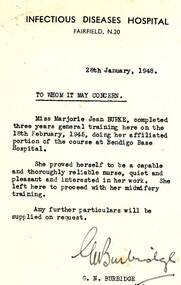
Document - Personal reference, Fairfield Infectious Diseases Hospital, Professional reference for Marjorie Jean Burke, 28/01/1948
... Professional reference for Marjory Jean Burke issued by the matron of Fairfield Infectious Diseases Hospital in Melbourne....Professional reference for Marjory Jean Burke issued by the matron of Fairfield Infectious Diseases Hospital in Melbourne. Miss Burke was a nurse, midwife and infant welfare sister. ...Professional reference for Marjory Jean Burke issued by the matron of Fairfield Infectious Diseases Hospital in Melbourne.Miss Burke was a nurse, midwife and infant welfare sister. This collection covers her many qualifications throughout Australia and Great Britain, including references both professional and personal. When Miss Burke returned to Australia, she was employed at Diamond Valley Community Hospital as a nurse in 1953 and as Deputy Matron 1954-1971.Reference typed on cream letterhead.marjorie jean burke, nurses, diamond valley community hospital, fairfield infectious diseases hospital -
 Geoffrey Kaye Museum of Anaesthetic History
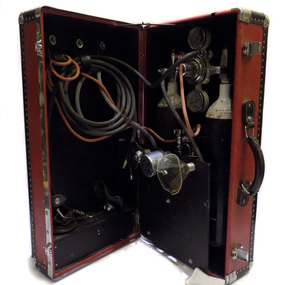
Equipment - Resuscitator Unit, c. 1960
... The R.M. resuscitator was also used in more inventive ways. At Fairfield Hospital in Melbourne, a group of physiotherapists and doctors did some innovative work with polio patients, teaching them glossopharyngeal (or “frog”) breathing, as a means of becoming less dependent on ventilators. ...The R.M. resuscitator was also used in more inventive ways. At Fairfield Hospital in Melbourne, a group of physiotherapists and doctors did some innovative work with polio patients, teaching them glossopharyngeal (or “frog”) breathing, as a means of becoming less dependent on ventilators. ...Mechanical resuscitation devices, such as the Pulmotor and Lungmotor, were popular in the early part of the twentieth century. Their use waned in the 1920s as significant bodies like the British Medical Research Council and American Red Cross refused to endorse them. The most popular of the resuscitators to emerge in the 1930s was the E&J (Ericson and Johnson) resuscitator. The device was soon widely available, vigorously promoted with support from many medical practitioners. They were soon to be found in hospitals, emergency services like the ambulance and fire brigade, and voluntary life-saving organisations. In Australia, Norman James, director of anaesthesia at the Royal Melbourne Hospital, developed an interest in equipment for ambulances and the resuscitation of drowning victims. Little in the way of practical, portable equipment was available to either the ambulances or the voluntary life-saving organisations, such as Surf Life Saving Australia (SLSA); American resuscitators, like the E&J, were expensive and bulky to import. James designed a simple portable resuscitation device for local use after being approached by Jack Conabere, secretary of the Elwood Life Saving Club (ELSC). The resulting Royal Melbourne Hospital resuscitator, or the R.M. resuscitator as it was marketed, was a simpler, manual version of those available overseas. It was gas driven with a plunger, marked “Press”, and a safety valve. The small working unit attached directly to the facemask. Once the patient was positioned facedown and the airway cleared of debris, the mask was placed firmly over the face. The plunger allowed gas to flow and lung inflation; releasing the plunger allowed expiration. This simple resuscitator was marketed by Commonwealth Industrial Gases (CIG) and became very popular in Australia with volunteer and professional rescue organisations. It represents one of the many innovations in resuscitation equipment that resulted from cooperation between volunteer life savers and medical practitioners. Norman James worked closely with Jack Conabere and the Government Pathologist to develop the equipment. ELSC was the first life saving club to use the resuscitator on the beach. While conducting an early training exercise on 23 December 1951, they used it to successfully resuscitate a man who had drowned after capsizing his home made yacht. The R.M. resuscitator was also used in more inventive ways. At Fairfield Hospital in Melbourne, a group of physiotherapists and doctors did some innovative work with polio patients, teaching them glossopharyngeal (or “frog”) breathing, as a means of becoming less dependent on ventilators. In 1981, the Australian Standards Association stated that the RM head failed to meet its revised standards and it was withdrawn from the market. Red leather suitcase with black leather trim with metal studs. There are clip locks for locking the suitcase in the closed position. The suitcase contains equipment for oxygen resuscitation. There is a space allocated for two oxygen cylinders, however there are no cylinders present.Embossed into metal plaque: The C.I.G. / Oxy-viva / PORTABLE UNIVERSAL OXYGEN RESUSCITATORresuscitation, portable, surf life saving australia, royal melbourne hospital, rm resuscitator -
NMIT (Northern Melbourne Institute of TAFE)
Book: Fever Hospital: a history of Fairfield Infectious Diseases Hospital
... Fairfield Infectious Diseases Hospital Fairfield Hospital. Hardcover book of 274 pages published 2002 by Melbourne University Press. ...Hardcover book of 274 pages published 2002 by Melbourne University Press.fairfield infectious diseases hospital, fairfield hospital. -
 Alfred Hospital Nurses League - Nursing History Collection
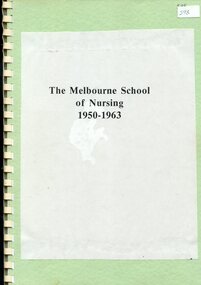
Book - Illustrated book (photocopy), Norman J Marshall, The Melbourne School of Nursing 1950-1963, 1985
... The Melbourne School of Nursing was formed in 1950 when the Royal Melbourne Hospital’s School of Nursing joined with those of the Queen Victoria Hospital, Fairfield Hospital and the Royal Women’s Hospital . ...The Melbourne School of Nursing was formed in 1950 when the Royal Melbourne Hospital’s School of Nursing joined with those of the Queen Victoria Hospital, Fairfield Hospital and the Royal Women’s Hospital . ...History of the Melbourne School of Nursing, includes list of all graduatesIllustrated book with white comb binding. Has clear plastic protective covers front and back. Title printed [in black ink] on white paper and fixed to larger pale green cardboardnon-fictionHistory of the Melbourne School of Nursing, includes list of all graduatesmelbourne school of nursing-history, the royal melbourne hospital and associated hospitals school of nursing, the royal melbourne hospital -
 Kew Historical Society Inc
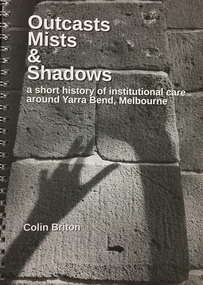
Book, Outcasts, Mists & Shadows: a short history of institutional care around Yarra Bend, Melbourne / by Colin Briton, 2017, 2017
... Self-published book on institutional care around Yarra Bend, Melbourne, including sections on: Merri Creek Protectorate Station and Aboriginal School (1841-51), Yarra Bend Lunatic Asylum (1848-1925), Fairfield Infectious Diseases Hospital (1904-96), Fairhaven (1927-51), Fairlea Women's Prison (1956-96), Thomas Embling Hospital (2000- ), Abbotsford Convent (1863-1975), Kew Lunatic Asylum / Willsmere Hospital (1872-1988), Kew Cottages (1887-2008), Caritas Christi Hospice (1938- ), Villa Alba / Henry Pride hospital services (1954-98), Royal Talbot Rehabilitation Centre (at Kew since 1961), National Guide Dog Training Centre / Guide Dogs Victoria (1962- ). ...merri creek protectorate station and aboriginal school (1841-51), yarra bend lunatic asylum (1848-1925), fairfield infectious diseases hospital (1904-96), fairhaven (1927-51), fairlea women's prison (1956-96), thomas embling hospital (2000- ), abbotsford convent (1863-1975), kew lunatic asylum / willsmere hospital (1872-1988), kew cottages (1887-2008), caritas christi hospice (1938- ), villa alba / henry pride hospital services (1954-98), royal talbot rehabilitation centre (at kew since 1961), national guide dog training centre / guide dogs victoria (1962- ) "Donated by the author March 2017" Self-published book on institutional care around Yarra Bend, Melbourne, including sections on: Merri Creek Protectorate Station and Aboriginal School (1841-51), Yarra Bend Lunatic Asylum (1848-1925), Fairfield Infectious Diseases Hospital (1904-96), Fairhaven (1927-51), Fairlea Women's Prison (1956-96), Thomas Embling Hospital (2000- ), Abbotsford Convent (1863-1975), Kew Lunatic Asylum / Willsmere Hospital (1872-1988), Kew Cottages (1887-2008), Caritas Christi Hospice (1938- ), Villa Alba / Henry Pride hospital services (1954-98), Royal Talbot Rehabilitation Centre (at Kew since 1961), National Guide Dog Training Centre / Guide Dogs Victoria (1962- ). ...Self-published book on institutional care around Yarra Bend, Melbourne, including sections on: Merri Creek Protectorate Station and Aboriginal School (1841-51), Yarra Bend Lunatic Asylum (1848-1925), Fairfield Infectious Diseases Hospital (1904-96), Fairhaven (1927-51), Fairlea Women's Prison (1956-96), Thomas Embling Hospital (2000- ), Abbotsford Convent (1863-1975), Kew Lunatic Asylum / Willsmere Hospital (1872-1988), Kew Cottages (1887-2008), Caritas Christi Hospice (1938- ), Villa Alba / Henry Pride hospital services (1954-98), Royal Talbot Rehabilitation Centre (at Kew since 1961), National Guide Dog Training Centre / Guide Dogs Victoria (1962- ). ISBN: 978-0-6480223-0-5"Donated by the author March 2017"merri creek protectorate station and aboriginal school (1841-51), yarra bend lunatic asylum (1848-1925), fairfield infectious diseases hospital (1904-96), fairhaven (1927-51), fairlea women's prison (1956-96), thomas embling hospital (2000- ), abbotsford convent (1863-1975), kew lunatic asylum / willsmere hospital (1872-1988), kew cottages (1887-2008), caritas christi hospice (1938- ), villa alba / henry pride hospital services (1954-98), royal talbot rehabilitation centre (at kew since 1961), national guide dog training centre / guide dogs victoria (1962- ) -
 Surrey Hills Historical Society Collection
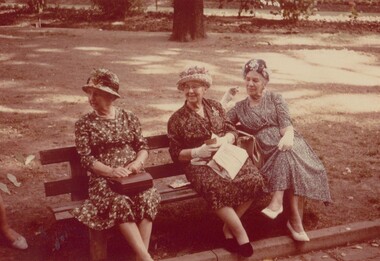
Photograph, Three Deakin sisters, 1964
... Address : 114 Station Street, Fairfield, Next of kin : mother, Mrs Janet Deakin (nee Longmore), 114 Station Street, Fairfield, father, Thomas Henry Deakin Elsie Deakin enlisted at 35 years of age on 10 May, 1915 and served locally before volunteering for overseas duty on 9 August, 1916. Her three years of training were completed at the Melbourne General Hospital...Address : 114 Station Street, Fairfield, Next of kin : mother, Mrs Janet Deakin (nee Longmore), 114 Station Street, Fairfield, father, Thomas Henry Deakin Elsie Deakin enlisted at 35 years of age on 10 May, 1915 and served locally before volunteering for overseas duty on 9 August, 1916. Her three years of training were completed at the Melbourne General Hospital ...These are the 4 surviving daughters of Thomas Henry Deakin (1845-1915), born in Monmouthshire, Wales and his wife Janet (Jessie) Longmore (1851-1939), born in Morayshire, Scotland. The couple also had 2 sons: John Henry (1879-1962) and William Andrew (1883-1939). A fifth daughter Daisy Jessie was born in 1880 and died the same year at the age of 7 months. Elsie Longmore Deakin (1881-1969) was a nurse ans remained single; Minnie Winifred (1886-1966) married Charles Williamson in 1923; Lily Vipond (1890-1943) married David Mair in 1910 and Jessie Alice, known as Alice, married Hector Williamson in 1921. Hector and Charles were brothers. Elsie Longmore Deakin enlisted AANS aged 35 years in 10 May 1915; embarked on the Mooltan on 22 August 1916. Address : 114 Station Street, Fairfield, Next of kin : mother, Mrs Janet Deakin (nee Longmore), 114 Station Street, Fairfield, father, Thomas Henry Deakin Elsie Deakin enlisted at 35 years of age on 10 May, 1915 and served locally before volunteering for overseas duty on 9 August, 1916. Her three years of training were completed at the Melbourne General Hospital. She embarked with the rank of Sister for India and was appointed to the Victoria Hospital, Bombay. In January, 1917, when she was transferred to England and a Military Hospital at Bagthorpe later to the 1 Australian Auxiliary Hospital, and in January of the following years to 25 (British) GH in France but returned a few weeks later to England and the 1 AAH after suffering a seriously strained left ankle. She returned to France post-war and served another four months before being returned to Australia in May, 1919. Her appointment was terminated as medically unfit on 9 June, 1919. Born South Melbourne, she died in Elsternwick on 14 October, 1969, aged 87. (REF: http://www.ozsportshistory.com/wardeaths/women_a_e.html) There is a photo of her in uniform on this site and also on http://ww1nurses.gravesecrets.net/de.html LtoR: Alice, Minnie, Lily, Elsie. This is part of a large donation relating to the Deakin, Mair and Young families. The donor thought this was taken during the 1950s but the Kodak stamp identifies it as later.This is part of a large collection of material related to the Deakin, Mair and Young families with multiple connections to Surrey Hills and Mont Albert.A colour photo with a cream edge of 3 well-dressed women sitting on a public bench in what looks to be a park. All are wearing hats and carrying handbags. Two are wearing gloves. On rear in blue biro - "Aunties / Elsie Minnie & Alice / Mum's RIGHT TO LEFT In black biro) / Beryl / YOUNG / My Mothers Sisters / (Lily Vipond Deakin / MAIR." Some of the handwriting is thought to be that of the donor's mother, Beryl Mair. There may be another hand. It appears that not all the inscriptions were added at the same time. There is also a photographic processing stamp in red: " THIS IS A / KODACHROME PRINT / Made by / KODAK / FEBRUARY 1964 M" elsie longmore deakin, minnie winifred deakin, minnie winifred williamson, lily vipond deakin, lily vipond mair, jessie alice deakin, alice deakin, jessie alice williamson, alice williamson -
 Surrey Hills Historical Society Collection
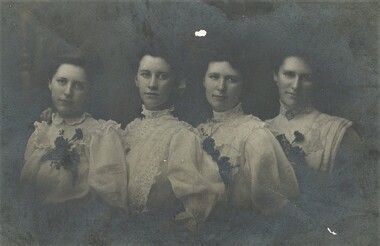
Photograph, The four Deakin sisters as young women, 1905
... Address : 114 Station Street, Fairfield, Next of kin : mother, Mrs Janet Deakin (nee Longmore), 114 Station Street, Fairfield, father, Thomas Henry Deakin Elsie Deakin enlisted at 35 years of age on 10 May, 1915 and served locally before volunteering for overseas duty on 9 August, 1916. Her three years of training were completed at the Melbourne General Hospital...Address : 114 Station Street, Fairfield, Next of kin : mother, Mrs Janet Deakin (nee Longmore), 114 Station Street, Fairfield, father, Thomas Henry Deakin Elsie Deakin enlisted at 35 years of age on 10 May, 1915 and served locally before volunteering for overseas duty on 9 August, 1916. Her three years of training were completed at the Melbourne General Hospital ...These are the 4 surviving daughters of Thomas Henry Deakin (1845-1915), born in Monmouthshire, Wales and his wife Janet (Jessie) Longmore (1851-1939), born in Morayshire, Scotland. The couple also had 2 sons: John Henry (1879-1962) and William Andrew (1883-1939). A fifth daughter Daisy Jessie was born in 1880 and died the same year at the age of 7 months. Elsie Longmore Deakin (1881-1969) was a nurse ans remained single; Minnie Winifred (1886-1966) married Charles Williamson in 1923; Lily Vipond (1890-1943) married David Mair in 1910 and Jessie Alice, known as Alice, married Hector Williamson in 1921. Hector and Charles were brothers. Elsie Longmore Deakin enlisted AANS aged 35 years in 10 May 1915; embarked on the Mooltan on 22 August 1916. Address : 114 Station Street, Fairfield, Next of kin : mother, Mrs Janet Deakin (nee Longmore), 114 Station Street, Fairfield, father, Thomas Henry Deakin Elsie Deakin enlisted at 35 years of age on 10 May, 1915 and served locally before volunteering for overseas duty on 9 August, 1916. Her three years of training were completed at the Melbourne General Hospital. She embarked with the rank of Sister for India and was appointed to the Victoria Hospital, Bombay. In January, 1917, when she was transferred to England and a Military Hospital at Bagthorpe later to the 1 Australian Auxiliary Hospital, and in January of the following years to 25 (British) GH in France but returned a few weeks later to England and the 1 AAH after suffering a seriously strained left ankle. She returned to France post-war and served another four months before being returned to Australia in May, 1919. Her appointment was terminated as medically unfit on 9 June, 1919. Born South Melbourne, she died in Elsternwick on 14 October, 1969, aged 87. (REF: http://www.ozsportshistory.com/wardeaths/women_a_e.html) There is a photo of her in uniform on this site and also on http://ww1nurses.gravesecrets.net/de.html LtoR: Alice, Minnie, Lily, Elsie. This is part of a large donation relating to the Deakin, Mair and Young families.A black & white photo with a cream edge of 4 well-dressed young women in a head and shoulders formal pose. It is likely a studio photo. All wear white frilly or lacy blouses and 3 are carrying bunches of flowers.1. On rear: Top in blue biro - "Elsie Minnie Lily Alice DEAKIN / Mum's (crossing out) sisters On the basis of inscriptions in family autograph books, this writing belongs to Lily's daughter, Beryl Mair. 2. The rear has 4 remnant glued labels roughly torn from larger labels - the type once common for labelling jars and bottles. Partially beneath these is writing in another hand in black ink: " ..th love and be.. / ..shes ---------your /(crossing out) then name removed (superficial paper loss. 3, "YOUNG" in blue biro in lower LH corner. This may be the donor's handwriting. It may have been added in the course of sorting photos into Young antecedent photos; there are no members of the Young family in the photo itself. elsie longmore deakin, minnie winifred deakin, minnie winifred williamson, lily vipond deakin, lily vipond mair, jessie alice deakin, alice deakin, jessie alice williamson, alice williamson -
 Surrey Hills Historical Society Collection
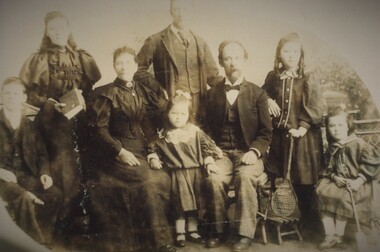
Photograph, Thomas Henry and Janet Longmore Deakin and family, 1895, Original: 1895
... Address : 114 Station Street, Fairfield, Next of kin : mother, Mrs Janet Deakin (nee Longmore), 114 Station Street, Fairfield, father, Thomas Henry Deakin Elsie Deakin enlisted at 35 years of age on 10 May, 1915 and served locally before volunteering for overseas duty on 9 August, 1916. Her three years of training were completed at the Melbourne General Hospital...Address : 114 Station Street, Fairfield, Next of kin : mother, Mrs Janet Deakin (nee Longmore), 114 Station Street, Fairfield, father, Thomas Henry Deakin Elsie Deakin enlisted at 35 years of age on 10 May, 1915 and served locally before volunteering for overseas duty on 9 August, 1916. Her three years of training were completed at the Melbourne General Hospital ...Thomas Henry Deakin (1845-1915), born in Monmouthshire, Wales and his wife Janet (Jessie) Longmore (1851-1939), born in Morayshire, Scotland had 2 sons: John Henry (1879-1962) and William Andrew (1883-1939) and 4 surviving daughters. A fifth daughter Daisy Jessie was born in 1880 and died the same year at the age of 7 months. Elsie Longmore Deakin (1881-1969) was a nurse and remained single; Minnie Winifred (1886-1966) married Charles Williamson in 1923; Lily Vipond (1890-1943) married David Mair in 1910 and Jessie Alice, known as Alice, married Hector Williamson in 1921. Hector and Charles were brothers. LtoR: William Andrew (seated), Elsie Longmore (standing), Janet (Jessie) Mair nee Longmore (seated), Jessie Alice (standing beside her mother), John Henry (standing), Thomas Henry (seated), Minnie Winifred (standing), Lily Vipond (seated). Elsie Longmore Deakin enlisted AANS aged 35 years in 10 May 1915; embarked on the Mooltan on 22 August 1916. Address : 114 Station Street, Fairfield, Next of kin : mother, Mrs Janet Deakin (nee Longmore), 114 Station Street, Fairfield, father, Thomas Henry Deakin Elsie Deakin enlisted at 35 years of age on 10 May, 1915 and served locally before volunteering for overseas duty on 9 August, 1916. Her three years of training were completed at the Melbourne General Hospital. She embarked with the rank of Sister for India and was appointed to the Victoria Hospital, Bombay. In January, 1917, when she was transferred to England and a Military Hospital at Bagthorpe later to the 1 Australian Auxiliary Hospital, and in January of the following years to 25 (British) GH in France but returned a few weeks later to England and the 1 AAH after suffering a seriously strained left ankle. She returned to France post-war and served another four months before being returned to Australia in May, 1919. Her appointment was terminated as medically unfit on 9 June, 1919. Born South Melbourne, she died in Elsternwick on 14 October, 1969, aged 87. (REF: http://www.ozsportshistory.com/wardeaths/women_a_e.html) There is a photo of her in uniform on this site and also on http://ww1nurses.gravesecrets.net/de.html This is part of a large donation relating to the Deakin, Mair and Young families.The connection with Surrey Hills area is through Lily Vipond Deakin who married David Miller Mair and came to live in Mont Albert.A sepia copy photo of a family in a formal pose taken against a studio backdrop. The group comprises a mother and father with 2 boys and 4 girls. The 3 older girls are carrying - REAR: In blue biro - "Top HENRY ...............GRANDFATHER.....ALF / ANDREW .......Thomas Henry (crossed out) ..........MOTHER - JANET / DEAKIN" Middle: "ELSie minnie Lily" Below: "ALICE FRONT" Bottom: "LONGMORE"xelsie longmore deakin, minnie winifred deakin, minnie winifred williamson, lily vipond deakin, lily vipond mair, jessie alice deakin, alice deakin, jessie alice williamson, alice williamson, william andrew deakin, janet (jessie) longmore, janet (jessie) deakin, thomas henry deakin, john henry deakin -
!['Save Fairfield Hospital' badge, [1990s]](/media/collectors/5bb42dc221eaf31100db1d3b/items/5c9af03221ea720f88da88fb/item-media/5c9af03f21ea720f88daaa65/item-fit-380x285.jpg?cb=6) Australian Nursing & Midwifery Federation
Australian Nursing & Midwifery Federation'Save Fairfield Hospital' badge, [1990s]
... Fairfield Hospital in 1948. In its later years, the hospital was a centre for AIDS treatment in Victoria, and a passionate campaign fought against its planned closure in the 1990s. Fairfield Hospital finally closed in June 1996. One section of the site was gazetted as a Public Park and Memorial Garden (containing an AIDS Garden). medicine health public institutions fairfield victoria city of darebin melbourne politics political protest public protest campaigning badges buttons pins public health infectious diseases aids Circular white and red plastic badge. ...Fairfield Hospital opened in 1904 as the Queen's Memorial Infectious Diseases Hospital, the first purpose-built isolation hospital for infectious diseases in Victoria. Its 22-acre site was located on a bank of the Yarra River. It was renamed Fairfield Hospital in 1948. In its later years, the hospital was a centre for AIDS treatment in Victoria, and a passionate campaign fought against its planned closure in the 1990s. Fairfield Hospital finally closed in June 1996. One section of the site was gazetted as a Public Park and Memorial Garden (containing an AIDS Garden).Circular white and red plastic badge. Silver metal, plastic-coated, with safety pin fastener adhered to back. Badge printed with the red text 'SAVE FAIRFIELD HOSPITAL'. Silver metal, plastic-coated, with safety pin fastener adhered to back.medicine, health, public institutions, fairfield, victoria, city of darebin, melbourne, politics, political protest, public protest, campaigning, badges, buttons, pins, public health, infectious diseases, aids -
 Royal District Nursing Service (now known as Bolton Clarke)
Photograph - Digital image, c.1922
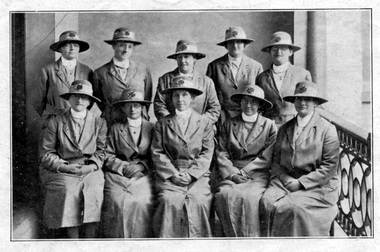
... Fairfield. Of the 1666 patients on the books 394 were midwifery patients nursed in their own homes. It is believed the Matron in the photograph is Matron Reynolds. In February 1885 it was recognized that nursing care was needed for the sick poor in inner Melbourne. The Melbourne District Nursing Society (MDNS) was founded on the 17th of February with one Trained nurse (Nurse) who qualified under the Hospital ...The photograph appeared in the MDNS Annual Report of 1922 and is taken on the veranda of the Melbourne District Nursing Society (MDNS) Nurses Home at 39 Victoria Parade, Collingwood. The Sisters lived and worked out of the Nurses Home from June 1914 to 1953. They attended the disadvantaged in the inner suburbs of Melbourne. The Sisters and Matron are wearing the grey uniform and hat with a red Maltese cross is in the centre of the hatband which was introduced in 1921. These Sisters, plus two others visited 29.079 visits in the metropolitan area and in suburbs as far distant as Elwood, Glen Huntly, Deepdene, Essendon and Fairfield. Of the 1666 patients on the books 394 were midwifery patients nursed in their own homes. It is believed the Matron in the photograph is Matron Reynolds. In February 1885 it was recognized that nursing care was needed for the sick poor in inner Melbourne. The Melbourne District Nursing Society (MDNS) was founded on the 17th of February with one Trained nurse (Nurse) who qualified under the Hospital training system, commencing on the 1st of May, and a second employed six months later, both working in the now CBD, ie from Spencer Street to Spring Street and from Victoria Parade to Flinders Street. From its inception the Society was at the forefront of health care. They provided high quality nursing care; educated their patients in the curing and prevention of disease; teaching the importance of cleanliness and good nutrition, both by verbal instruction and demonstration, even supplying soup and milk when needed. At that time they walked the streets and lane ways amid the slums of inner Melbourne carrying their nursing bag containing lotion, ointments, powders, liniment, bandages, dressings, a case of spirits, and the Nurse's own clean apron. The also supplied equipment, such as earthenware hot water bottles, splints, urinals, bed pans, bed cradles, feeding mugs, and air-cushions as well as providing clean bed linen and nightdresses and clothes as necessary. In 1891 the first Nurses Home was rented for 1 year at £65 per annum at 66 Cardigan Street, Carlton; Nurses wages were now £60 per annum. A Doctor gave lectures from the Home to the public on the understanding and prevention of diseases. The Society decided to commence a Midwifery Service and Nurse Fowler, who had previously worked for the Society, was re-employed as their first trained Midwife. She began home births in August 1893 giving them Ante Natal care, taking midwifery bundles and providing clothes for the babe as needed. Following birth, she gave Post-natal care to the mother and babe twice a day for three days and then daily for a week, and longer if required. She resigned after twelve months and Nurse Wilkie was appointed to the position. As well as walking, the Nurses used Public transport in the limited areas it ran, though a taxi was used by the Nurses and Midwife in emergencies and at night. Late in 1891 the Society moved to larger rented premises at 49 Drummond Street and in 1902 moved to 188 Leicester Street, Carlton. The Nurses were becoming exhausted, particularly in the heat of summer. Permission to use bicycles was given to them in 1898 and the Society decided to purchase their own in 1903. A business man offered ‘new free wheel’ bicycles at £13 each, which included maintenance for one year. Bells and wooden frames were added at a cost of £5 per frame so the Nurses could carry extra equipment. Nurses bags were strapped to the handlebars. Soup was made for those in need 2-3 times a week, and if patients could not arrange to have it collected, the soup was delivered by the Nurses on their bicycles. Their use caused a change in uniform, with white pith helmets, and veils covering them and tied under their chins, now being used. In 1904 the Society relocated to rented premises at 5 Royal Terrace, Nicholson Street in Fitzroy. In 1913 a Nurse had her ‘board and residence, uniforms, bicycles and laundry expenses’ provided and was paid £50 a year for her first six months. At the end of a year her salary was increased by £5, and later she earned £60 a year. Over the years the Nurses complained their veils became wet in the rain and asked for a change of uniform, but this did not occur until 1921. In 1914 the Society was at last able to purchase their own premises, 'Floraston' 39 Victoria Parade in Collingwood. During the Spanish Influenza epidemic, in 1919, MDNS appealed for assistance to procure Motor vehicles so the Nurses could visit an influx of cases. Through trusts, grants and donations four 'Ford 'T Model' cars were procured which enabled the Nurses to triple their visits. It was recorded on the 21st of May, that the seven Nurses had visited 1,212 persons with influenza in the last three months, how many visits to each is not known. In the whole of 1918 the Nurses, including midwifery cases, visited 1,100 persons. It was also recorded on May 7th the Nurses were delivering 100 quarts of soup to the needy each morning. In winter they also carried wood in the cars to distribute to their destitute patients as needed. In 1921-22 many of the people nursed by the Trained nurses (Sisters) suffered from malignant and tubercular disease, often the Sister would visit to find the patient was desperately ill living in a room alone and no one there to even give them a drink. In these cases the Sister would send them to hospital, but if possible most cases were nursed in their home. During July 1921- 30 June 1922 the four Midwifery trained Sisters averaged 8 confinement cases a week and sometimes gave Post Natal care to 15 to 18 patients a day. At the time of confinement a Student from the Women's Hospital accompanied the MDNS Sister and if complications occurred the patient was transferred to the Women's Hospital. The Society often had to provide blankets, sheets, set of baby clothes and night gowns for the mother. In many instances the Society provided milk for many months. The midwifery Sisters often travelled long distances in the cars Through constant use the cars were in such a poor state they were sold in 1927 and the Sisters went back to using public transport, as well as their bicycles which continued to be used in inner areas until 1945.. The Midwives used taxis when a birth was imminent. Black and white photograph showing 9 Sisters, 5 standing at rear and Matron, in the centre, of 4 seated Sisters on a balcony wearing their Melbourne District Nursing Society (MDNS) uniforms of grey coats, with revered collars and belt, over their partly seen grey uniforms with white collars. Five of the Sisters are wearing glasses. All are wearing grey brimmed hats with a Maltese cross in the centre of the lighter colour hatband. Part of deep metal scroll work of the veranda rail can be seen. A concrete wall is behind the Sisters.mdns, mdns matron, miss reynolds, royal district nursing service, rdns, melbourne district nursing society, mdns uniforms -
 Returned Nurses RSL Sub-branch
Newspaper - Newspaper clipping (inlc duplicate), Annie Gillison, A gentle champion fights on, 24 April [1988]
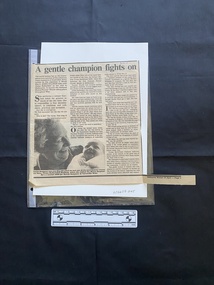
... Melbourne from her home in Perth to launch the National Mutual Nurses' Month, taking place throughout May. The biggest woman's project of the bicentennial, Nurses' Month will involve nurses throughout Australia. Though Vivian is now retired she is still very involved and concerned about the nursing world. Possibly best known as the courageous lone survivour of the massacre of Australian Army nurses by the Japanese in World War Two, Vivian went on to be matron of the Repatriation Hospital and then Fairfield...Melbourne from her home in Perth to launch the National Mutual Nurses' Month, taking place throughout May. The biggest woman's project of the bicentennial, Nurses' Month will involve nurses throughout Australia. Though Vivian is now retired she is still very involved and concerned about the nursing world. Possibly best known as the courageous lone survivour of the massacre of Australian Army nurses by the Japanese in World War Two, Vivian went on to be matron of the Repatriation Hospital and then Fairfield ...Vivian Statham (nee Bullwinkel) visits Melbourne from her home in Perth to launch the National Mutual Nurses' Month, taking place throughout May. The biggest woman's project of the bicentennial, Nurses' Month will involve nurses throughout Australia. Though Vivian is now retired she is still very involved and concerned about the nursing world. Possibly best known as the courageous lone survivour of the massacre of Australian Army nurses by the Japanese in World War Two, Vivian went on to be matron of the Repatriation Hospital and then Fairfield Hospital. A newspaper clipping of a story consisting of three large columns of text and a large black and white photo of an older woman (head and sholders) holding a baby'WWII ' '[blue ink, top right, both copies] 'Progress Press. APRIL 1988'[black ink bottom left, one copy]world war 2, wwii, ww2, world war ii, vivian bullwinkel, red cross, mercy hospital, michael willessee, st kilda road, edith cavell, britich, belgium, german, nurses' memorial centre, lucas sampson, kerrie sampson, yarraville west -
![Medal - Court-mounted set of miniature medals: Royal Red Cross, Australian Service Medal 1945-75 with PNG clasp, Elizabeth II Silver Jubilee Medal 1977, Defence Force Service Medal, National Medal and Australian Defence Medal, [unknown]](/media/collectors/64a5077bc83bd7b7b94f4211/items/6a697004154863c24685a486/item-media/6a6971d6154863c246863334/item-fit-380x285.jpg?cb=6) Returned Nurses RSL Sub-branch
Returned Nurses RSL Sub-branchMedal - Court-mounted set of miniature medals: Royal Red Cross, Australian Service Medal 1945-75 with PNG clasp, Elizabeth II Silver Jubilee Medal 1977, Defence Force Service Medal, National Medal and Australian Defence Medal, [unknown]
... Fairfield, Melbourne on 5 September 1925. Educated at the Catholic Ladies College, East Melbourne, on completion of her Intermediate Certificate, Vines undertook secretarial training before working at the Department of Aircraft Productions and then the Gun Turret Factory at Fairfield where she was still working when World War II ended in 1945. It was while she was working in the X-Ray Department at St Vincent’s Hospital...Fairfield, Melbourne on 5 September 1925. Educated at the Catholic Ladies College, East Melbourne, on completion of her Intermediate Certificate, Vines undertook secretarial training before working at the Department of Aircraft Productions and then the Gun Turret Factory at Fairfield where she was still working when World War II ended in 1945. It was while she was working in the X-Ray Department at St Vincent’s Hospital ...These medals were awarded to Patricia Catherine Vines of the Australian Navy and Royal Australian Navy Nursing Service (RANNS). Extracts from Sea Power Centre website (listed in references): "Patricia Catherine Vines was born in Fairfield, Melbourne on 5 September 1925. Educated at the Catholic Ladies College, East Melbourne, on completion of her Intermediate Certificate, Vines undertook secretarial training before working at the Department of Aircraft Productions and then the Gun Turret Factory at Fairfield where she was still working when World War II ended in 1945. It was while she was working in the X-Ray Department at St Vincent’s Hospital that she decided to become a nurse, beginning her training in December 1948 and becoming a Registered Nurse in 1952, and a qualified midwife two years later. In 1959, in search of something different, Vines applied for a civilian nursing role at HMAS Cerberus, Flinders Naval Depot where she was employed until leaving to travel to New Zealand, Canada and the United States in 1962." "Commander Vines was presented with a Royal Red Cross in early 1972. The medal, presented by the Governor of Victoria, Sir Rohan Delacombe, was awarded for ‘exceptional competence and devotion to duty’. Also awarded were Sergeant Leslie Bending of the Naval Police (left) who received the British Empire Medal for dedicated service, and Lieutenant Commander Winston James (right) who received the Distinguished Service Cross in recognition of outstanding leadership and bravery while serving as commander of the RAN Helicopter Flight in Vietnam. During that time (1971-1980) she was also appointed an Honorary Nursing Sister to Queen Elizabeth II. In 1972 Patricia was awarded a Royal Red Cross (RRC) 2nd Class in the New Year Honours List and in January 1981 this was upgraded to a Royal Red Cross 1st class. The awards officially recognised her exceptional devotion and competency in performance of nursing duties in the RAN." "Following a 16-year career in the Navy and having reached retirement age, Patricia Vines retired from the RAN in 1980 and ran her own nursing business in Melbourne until 1995. Patricia Catherine Vines passed away in Melbourne on 15 February 2010, aged 85 years." Vines was a consistent paid member of the Returned Nurses Club (Returned Nurses Sub Branch RSL Victoria) from 1989 to her passing.A mounted set of six miniature medals (approximately a quarter of the size of the medals they represent) of various coloured metals with ribbons of many colours. The Royal Red Cross miniature medal is in the "shape of a golden cross... the obverse enamelled red, with a circular medallion, bearing an effigy of the reigning monarch [Queen Elizabeth II] at its centre. The words "Faith", "Hope" and "Charity" are inscribed on the upper limbs of the cross, with the year "1883" in the lower limb. The reverse is plain except a circular medallion bearing the royal cypher of the reigning monarch" [Wikipedia - see References], on this miniature medal the initials are ER. The ribbon is a dark blue stripe between crimson edge stripes and forms a landscape oriented bow that the medal hangs from the middle. The Australian Service Medal 1945-75 is "nickel-silver with the Australian Coat of Arms surrounded by the words The Australian Service Medal 1945-1975 on the obverse. The reverse has a Federation Star... The ribbon has central stripes of yellow and green, flanked by navy blue, khaki and light blue stripes from the Australia Service Medal 1939-45. A nickel-silver clasp with the name of the theatre or action for which the award is made is presented with the medal." [Australian Government Defence website - see References] This miniature has the PNG clasp and the navy blue stripe has faded to look more purple in colour. The Elizabeth II Silver Jubilee Medal 1977 comprises a "silver disc with, on the obverse, the words ELIZABETH II DEI GRA. REGINA FID. DEF. (Latin abbreviation for "Elizabeth II, by the Grace of God, Queen, Defender of the Faith") surrounding an effigy of Queen Elizabeth II, symbolising her role as fount of honour.[6] On the reverse is a crown atop a wreath that contains the words THE 25th YEAR OF THE REIGN OF QUEEN ELIZABETH II 6 February 1977 in six lines... The ribbon is white with cardinal red bands along the edges...and a... garter blue stripe down the centre, bisected by another... line of cardinal red" [Wikipedia - see References] The Defence Force Service Medal is a "cupro-nickel circular chamfered medal. The obverse has the Joint Service emblem. The reverse is inscribed For Efficient Service In The Permanent Forces around the circumference. The ribbon has 3 equal stripes of gold and azure-blue edged with azure-blue. The colours were the national colours of Australia at the time of introduction." [Australian Government Defence website - see References] the blue stripes have faded to look more purple in colour. The National Medal is "bronze. The obverse shows the Arms of the Commonwealth of Australia within a rim carrying the inscription The National Medal For Service. The reverse is plain. The ribbon has 15 alternating gold and blue stripes. The colours were the national colours of Australia at the time of introduction." [Australian Government Defence website - see References] Again, blue has faded to purple on the ribbon. The Australian Defence Medal is "cupronickel. The obverse has a stylised version of the Commonwealth Coat of Arms as used on the Australia Service Medal 1939-45. This is surrounded by the inscription The Australian Defence Medal above a sprig of wattle. The reverse has the inscription For Service below the Crown of St Edward surrounded by 2 sprays of wattle leaves and blossom. The ribbon is red with black edges, the colours of the Flanders poppy that represent the Anzac spirit of the Australian armed forces. The white stripes divide the ribbon into 3 to denote the three Services and represent service contributing to the peace of Australia." [Australian Government Defence website - see References] The miniature medals are court-mounted on a rigid backing with a long pin and the backing covered with a full size strip of ribbon in the Royal Red Cross medal colours.royal red cross, royal australian naval nursing service, royal australian navy, ranns, ran, papua new guinea, medals
