
Showing 40 items matching "family care-giving"
-
 Federation University Historical Collection
Book, University of Ballarat Annual Research Conference 2000: Abstracts, 08/09/2000
... ...family care-giving...university of ballarat university research conference bruce armstrong peter arnold adil bagirov beverly blaskett patrice braun maryann brown fred cahir kate callister patricia cartwright john cowley sarah davis briony dow john fisher christopher fox michael gathercole rosemary green julie heron deborah hiskin gavin hurst tariq khan maylene kule lin zheng david manterfield john mcdonald tunde meikle elaine millls ross morgan john morris angela murphy john nicholson pauline nunan dora pearce leeane pitman patrick prevett paula ransom natisha sands simon sim jeff stweart john struhs elizabeth swayn michael tuck margaret zeegers breat cancer diagnosis and prognosis professional reading circles tertiary undergraduate literacy integration program carp gendered communication kidmap agricultural restructure on farm families psychiatric nursing heat pump design mixed species eucalypt foothill forest stawell goldmines heat stress management accessing foucault e-commerce helen hayes indigenous heritage family care-giving 96 page book with research abstracts University of Ballarat Annual Research Conference 2000: Abstracts Book ...96 page book with research abstractsnon-fictionuniversity of ballarat, university research conference, bruce armstrong, peter arnold, adil bagirov, beverly blaskett, patrice braun, maryann brown, fred cahir, kate callister, patricia cartwright, john cowley, sarah davis, briony dow, john fisher, christopher fox, michael gathercole, rosemary green, julie heron, deborah hiskin, gavin hurst, tariq khan, maylene kule, lin zheng, david manterfield, john mcdonald, tunde meikle, elaine millls, ross morgan, john morris, angela murphy, john nicholson, pauline nunan, dora pearce, leeane pitman, patrick prevett, paula ransom, natisha sands, simon sim, jeff stweart, john struhs, elizabeth swayn, michael tuck, margaret zeegers, breat cancer diagnosis and prognosis, professional reading circles, tertiary undergraduate literacy integration program, carp, gendered communication, kidmap, agricultural restructure on farm families, psychiatric nursing, heat pump design, mixed species eucalypt foothill forest, stawell goldmines, heat stress management, accessing foucault, e-commerce, helen hayes, indigenous heritage, family care-giving -
 Flagstaff Hill Maritime Museum and Village
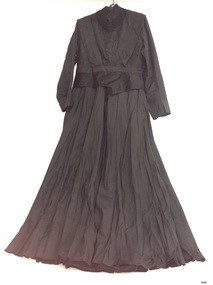
Clothing - Mourning Outfit, Late 19th to early-20th centuries
... family and community life, particularly in rural and remote areas. People were bonded through work, religion, disasters, tragedy and social activities, supporting one another. They came together from near and far on such an occasion, giving each other the care...family and community life, particularly in rural and remote areas. People were bonded through work, religion, disasters, tragedy and social activities, supporting one another. They came together from near and far on such an occasion, giving each other the care ...This Edwardian-era mourning outfit was worn by a wealthy woman from the rural area of Willaura, southeast of the Grampians. It was inherited by the donor from his mother, who had purchased it from a clearing sale in the 1960s. The jacket has a peplum or flounce below the waistline, a fashion that was seen in the 1860s and is still around in the 1900s. The outfit represents the female mourning fashion and wardrobe from the late 19th to early 20th centuries. Such garments were a necessary inclusion as death often occurred to the young, due to illness, accidents and hard work - it was a regular part of life in rural Victoria. Mourning outfits were part of a person’s wardrobe and often passed from one generation to the next. This particular outfit appears to have been adjusted at some stage to allow for a wider waistline. The original skirt may have been replaced by the one that is now part of this outfit; the skirt is all machine-sewn, unlike the jacket and petticoat. The fabric of the skirt may be silk or it could be a synthetic fibre such as artificial silk or rayon; both were available in the 1800s,but nylon wasn’t invented until the 1930s. This skirt has sunray pleating, which was advertised on skirts for sale in the 1890s, and 1909, and was part of a fashionable bridal gown train in the 1930s. The mourning of death was part of both family and community life, particularly in rural and remote areas. People were bonded through work, religion, disasters, tragedy and social activities, supporting one another. They came together from near and far on such an occasion, giving each other the care that was needed and showing respect for the member who had passed away.This three-piece silk Edwardian mourning outfit is significant historically for its connection with rural Victoria and the social and religious customs surrounding the death of a family or community member. The high-quality outfit is also significant for representing the financial management of the times, being tailored by a dressmaker for a person of means and then adjusted to fit at least one different-sized person. Ladies’ Edwardian mourning outfit; three-piece tailored suit comprising of a black silk long sleeve, short-waist fitted and lined Jacket, a long sunray pleated skirt and long, lined petticoat. Items have been machine-sown and hand-sewn by a dressmaker. The skirt has handmade buttons of the same fabric.Handwritten in ballpoint pen “Jenny” and “Mrs Sheila Handscombe, Wallaura, Jenny”flagstaff hill maritime museum and village, warrnambool, shipwreck coast, edwardian era, tailor-made, dressmaker, mourning outfit, handmade garment, mourning dress, death mourning, sunray pleats, western district victoria -
 Flagstaff Hill Maritime Museum and Village
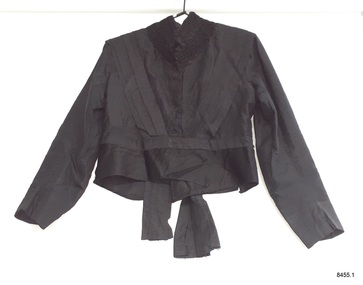
Clothing - Mourning Outfit, jacket, Late 19th to early-20th centuries
... family and community life, particularly in rural and remote areas. People were bonded through work, religion, disasters, tragedy and social activities, supporting one another. They came together from near and far on such an occasion, giving each other the care...family and community life, particularly in rural and remote areas. People were bonded through work, religion, disasters, tragedy and social activities, supporting one another. They came together from near and far on such an occasion, giving each other the care ...This Edwardian era mourning outfit was worn by a wealthy woman from the rural area of Willaura, southeast of the Grampians. It was inherited by the donor from his mother, who had purchased it from a clearing sale in the 1960s. The jacket has a peplum or flounce below the waistline, a fashion that was seen in the 1860s and is still around in the 1900s. The outfit represents the female mourning fashion and wardrobe from the late 19th to early 20th centuries. Such garments were a necessary inclusion as death occurred often to the young, due to illness, accidents and hard work - it was a regular part of life in rural Victoria. Mourning outfits were a part of a person’s wardrobe and often passed from one generation to the next. This particular outfit appears to have been adjusted at some stage to allow for a wider waistline. The original skirt may have been replaced by the one that is now part of this outfit; the skirt is all machine-sewn, unlike the jacket and petticoat. The fabric of the skirt may be silk or it could be a synthetic fibre such as artificial silk or rayon; both were available in the 1800s,but nylon wasn’t invented until the 1930s. This skirt has sunray pleating, which was advertised on skirts for sale in the 1890s, and 1909, and was part of a fashionable bridal gown train in the 1930s. The mourning of death was part of both family and community life, particularly in rural and remote areas. People were bonded through work, religion, disasters, tragedy and social activities, supporting one another. They came together from near and far on such an occasion, giving each other the care that was needed and showing respect for the member who had passed away.This three-piece silk Edwardian mourning outfit is significant historically for its connection with rural Victoria and the social and religious customs surrounding the death of a family or community member. The high-quality outfit is also significant for representing the financial management of the times, being tailored by a dressmaker for a person of means and then adjusted to fit at least one different-sized person. The black silk tailor-made jacket is one of three pieces of a ladies’ Edwardian mourning outfit. It has long sleeves, a stand-up collar trimmed with appliqued black crochet lace, and pleated sashes on the left and right sides from front to back fastened at the shoulder and waist. The jacket has a peplum or flounce below the waistline. The front of the jacket has brass hooks and fabric eye fastenings. The back of the jacket has two tails. The jacket is lined and the shoulders are padded. It has been machine sewn and finished with hand stitching. A white card is tied with a ribbon inside and has an inscription. The poplin skirt on the jacket has been cut up to the waist at the side seams. There is an attached card with an inscription, handwritten in ballpoint pen.“Jenny” and “Mrs Sheila Handscombe, Wallaura, Jenny”flagstaff hill maritime museum and village, warrnambool, shipwreck coast, edwardian era, tailor-made, dressmaker, mourning outfit, handmade garment, mourning dress, death mourning, sunray pleats, sunburst pleats, western district victoria, mourning jacket -
 Flagstaff Hill Maritime Museum and Village
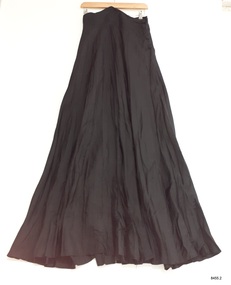
Clothing - Mourning Outfit, skirt, Late 19th to early-20th centuries
... family and community life, particularly in rural and remote areas. People were bonded through work, religion, disasters, tragedy and social activities, supporting one another. They came together from near and far on such an occasion, giving each other the care...family and community life, particularly in rural and remote areas. People were bonded through work, religion, disasters, tragedy and social activities, supporting one another. They came together from near and far on such an occasion, giving each other the care ...This Edwardian-era mourning outfit was worn by a wealthy woman from the rural area of Willaura, southeast of the Grampians. It was inherited by the donor from his mother, who had purchased it from a clearing sale in the 1960s. The jacket has a peplum or flounce below the waistline, a fashion that was seen in the 1860s and is still around in the 1900s. The outfit represents the female mourning fashion and wardrobe from the late 19th to early 20th centuries. Such garments were a necessary inclusion as death often occurred to the young, due to illness, accidents and hard work - it was a regular part of life in rural Victoria. Mourning outfits were part of a person’s wardrobe and often passed from one generation to the next. This particular outfit appears to have been adjusted at some stage to allow for a wider waistline. The original skirt may have been replaced by the one that is now part of this outfit; the skirt is all machine-sewn, unlike the jacket and petticoat. The fabric of the skirt may be silk or it could be a synthetic fibre such as artificial silk or rayon; both were available in the 1800s, but nylon wasn’t invented until the 1930s. This skirt has sunray pleating, which was advertised on skirts for sale in the 1890s, and 1909, and was part of a fashionable bridal gown train in the 1930s. The mourning of death was part of both family and community life, particularly in rural and remote areas. People were bonded through work, religion, disasters, tragedy and social activities, supporting one another. They came together from near and far on such an occasion, giving each other the care that was needed and showing respect for the member who had passed away.This three-piece silk Edwardian mourning outfit is significant historically for its connection with rural Victoria and the social and religious customs surrounding the death of a family or community member. The high-quality outfit is also significant for representing the financial management of the times, being tailored by a dressmaker for a person of means and then adjusted to fit at least one different-sized person. The full-length black silk tailor-made skirt is one of three pieces of a ladies’ Edwardian mourning outfit. The skirt is made from black silky fabric. The garment has only two seams; at the side closure and the centre back. The whole skirt has sunray pleats; narrow pleats at the waist that fan outwards towards the hem. The top of the skirt is finished with a waistband that is shaped as an upward V shape in the centre. The side seam is closed with four self-fabric buttons with silver metal backing. The shirt has been machine sewn.flagstaff hill maritime museum and village, warrnambool, shipwreck coast, edwardian era, tailor-made, dressmaker, mourning outfit, mourning dress, death mourning, sunray pleats, western district victoria, full-length skirt -
 Flagstaff Hill Maritime Museum and Village
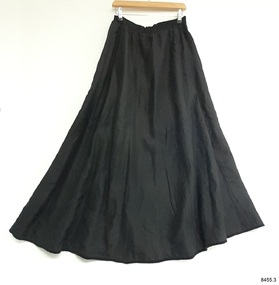
Clothing - Mourning Outfit, petticoat, Late 19th to early-20th centuries
... family and community life, particularly in rural and remote areas. People were bonded through work, religion, disasters, tragedy and social activities, supporting one another. They came together from near and far on such an occasion, giving each other the care...family and community life, particularly in rural and remote areas. People were bonded through work, religion, disasters, tragedy and social activities, supporting one another. They came together from near and far on such an occasion, giving each other the care ...This Edwardian-era mourning outfit was worn by a wealthy woman from the rural area of Willaura, southeast of the Grampians. It was inherited by the donor from his mother, who had purchased it from a clearing sale in the 1960s. The jacket has a peplum or flounce below the waistline, a fashion that was seen in the 1860s and is still around in the 1900s. The outfit represents the female mourning fashion and wardrobe from the late 19th to early 20th centuries. Such garments were a necessary inclusion as death often occurred to the young, due to illness, accidents and hard work - it was a regular part of life in rural Victoria. Mourning outfits were part of a person’s wardrobe and often passed from one generation to the next. This particular outfit appears to have been adjusted at some stage to allow for a wider waistline. The original skirt may have been replaced by the one that is now part of this outfit; the skirt is all machine-sewn, unlike the jacket and petticoat. The fabric of the skirt may be silk or it could be a synthetic fibre such as artificial silk or rayon; both were available in the 1800s,but nylon wasn’t invented until the 1930s. This skirt has sunray pleating, which was advertised on skirts for sale in the 1890s, and 1909, and was part of a fashionable bridal gown train in the 1930s. The mourning of death was part of both family and community life, particularly in rural and remote areas. People were bonded through work, religion, disasters, tragedy and social activities, supporting one another. They came together from near and far on such an occasion, giving each other the care that was needed and showing respect for the member who had passed away.This three-piece silk Edwardian mourning outfit is significant historically for its connection with rural Victoria and the social and religious customs surrounding the death of a family or community member. The high-quality outfit is also significant for representing the financial management of the times, being tailored by a dressmaker for a person of means and then adjusted to fit at least one different-sized person. The full-length black silk tailor-made petticoat is one of three pieces of a ladies’ Edwardian mourning outfit. The petticoat is made from black silk lined with lightweight cotton. The petticoat and lining are constructed from eight panels each, brought together at the waist and gently gathered into the band. The back seam opening is fastened with brass hooks and fabric eyes. The lining has been reinforced with a heavier-weight hem. The hemline is finished with black velvet ribbon than encloses both the petticoat and lining. flagstaff hill maritime museum and village, warrnambool, shipwreck coast, edwardian era, tailor-made, dressmaker, mourning outfit, handmade garment, mourning dress, death mourning, sunray pleats, western district victoria, petticoat, undergarment, slip -
 Ringwood and District Historical Society
Work on paper, Southwood Primary School, School Oath, 1996
... I love my family and respect my teachers and friends. I will care for others and follow the rules of my school and country. I will give...I love my family and respect my teachers and friends. I will care for others and follow the rules of my school and country. I will give ...A4 pageI love my family and respect my teachers and friends. I will care for others and follow the rules of my school and country. I will give honour and effort to all that I do. I am proud to live in Australia and to be a student at Southwood Primary School. -
 Flagstaff Hill Maritime Museum and Village
Clothing - Petticoat
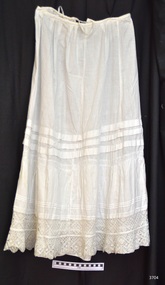
... give flexibility to the length. The clothing once belonged to members of a family who migrated from Faversham, Kent, England to Sydney, Australia in the late 19th - early 20th century and was passed down through the family. The items have been worn and have also been well cared...give flexibility to the length. The clothing once belonged to members of a family who migrated from Faversham, Kent, England to Sydney, Australia in the late 19th - early 20th century and was passed down through the family. The items have been worn and have also been well cared ...This petticoat was donated along with other well kept items of women's clothing. the pin tucks and lace trim could have been made to give flexibility to the length. The clothing once belonged to members of a family who migrated from Faversham, Kent, England to Sydney, Australia in the late 19th - early 20th century and was passed down through the family. The items have been worn and have also been well cared for.This object is significant as an example of an item in common use in the 19th and early 20th centuries.Petticoat, ladies size, cotton, waist to floor, drawstring waist closure, bottom lace trim is lined, pin tucks in lower skirt. Machine made lace, machine stitched. C. 1900.flagstaff hill, warrnambool, shipwrecked coast, flagstaff hill maritime museum, maritime museum, shipwreck coast, flagstaff hill maritime village, great ocean road, ladies garments 19th century, cotton garments 19th century, ladies undergarment, petticoat c 1900, ladies' clothing, ladies' fashion, underwear, petticoat -
Port Melbourne Historical & Preservation Society
Photograph - Photographs (proof sheets), Sister Norma Barnett as Honorary Mayor of Port Phillip, 1999
... giving, etc). Accessorised with chain (which is not available). Donated by her family following the 'Women of Port Melbourne' exhibtion after Norma's death Dick GROSS Anne DUNN Julie STATKUS Janne RAY Sister Norma Jean Barnett Local Government - City of Port Phillip South Port Community Nursing Home Health - Aged Care Four proof sheets of official photographs of occasions on which a floor length purple velvet robe, edged with fake ermine trim and black braiding was worn by Sister Norma BARNETT during her five days as Honorary Mayor of Port Phillip in March 1999. ...Taken of Sister Norma BARNETT during her five days as honorary Mayor of Port Phillip in March 1999. The robe was made by her friends and was worn for a variety of mayoral duties (prize giving, etc). Accessorised with chain (which is not available). Donated by her family following the 'Women of Port Melbourne' exhibtion after Norma's deathFour proof sheets of official photographs of occasions on which a floor length purple velvet robe, edged with fake ermine trim and black braiding was worn by Sister Norma BARNETT during her five days as Honorary Mayor of Port Phillip in March 1999. Negatives in Supplementary file.dick gross, anne dunn, julie statkus, janne ray, sister norma jean barnett, local government - city of port phillip, south port community nursing home, health - aged care -
 Sunshine and District Historical Society Incorporated
Newsletter - Sunshine City Council Residential Newsletter Reports, Sunshine City Council, (i) December 1988 (2) July 1990
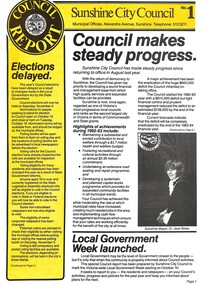
... Council Report No 12 Headings December 1988|A message from your Mayor Ian Mill|Making millions from Sunshines garbage|Tip tickets|Use Proper garbage bins|Waster Paper pickup service|Council acts to minimise hardship on rates|Sunshines Management Team|$1.5 million for Nursing Home|Sunshine District Centre will boost Commerce|Government Grants|Hunt Club lives againFree help in Family Planning|August Election results|Mayor and Mayoress meet the Pope|Mayor meets Asian delegates|Librays new computer linkup gives better cheaper service|Council services in the holidays|A new Fitness Centre free to use anytime|Sunshines Sports Calendar Girls|Sunshines Own Postcard|Sunshine City Council. Council Report No 14 Headings July 1999|Council Electrions in August|West Sunshine Community Centre|Waste Paper Pick Ups End|Other Recycling News|Marie Mill Community Centre|Location of Polling Places|Family services|Foster Care...Council Report No 12 Headings December 1988|A message from your Mayor Ian Mill|Making millions from Sunshines garbage|Tip tickets|Use Proper garbage bins|Waster Paper pickup service|Council acts to minimise hardship on rates|Sunshines Management Team|$1.5 million for Nursing Home|Sunshine District Centre will boost Commerce|Government Grants|Hunt Club lives againFree help in Family Planning|August Election results|Mayor and Mayoress meet the Pope|Mayor meets Asian delegates|Librays new computer linkup gives better cheaper service|Council services in the holidays|A new Fitness Centre free to use anytime|Sunshines Sports Calendar Girls|Sunshines Own Postcard|Sunshine City Council. Council Report No 14 Headings July 1999|Council Electrions in August|West Sunshine Community Centre|Waste Paper Pick Ups End|Other Recycling News|Marie Mill Community Centre|Location of Polling Places|Family services|Foster Care ...Distributed to residents and rate payersSunshine City Council. Council Report No 12 Headings December 1988|A message from your Mayor Ian Mill|Making millions from Sunshines garbage|Tip tickets|Use Proper garbage bins|Waster Paper pickup service|Council acts to minimise hardship on rates|Sunshines Management Team|$1.5 million for Nursing Home|Sunshine District Centre will boost Commerce|Government Grants|Hunt Club lives againFree help in Family Planning|August Election results|Mayor and Mayoress meet the Pope|Mayor meets Asian delegates|Librays new computer linkup gives better cheaper service|Council services in the holidays|A new Fitness Centre free to use anytime|Sunshines Sports Calendar Girls|Sunshines Own Postcard|Sunshine City Council. Council Report No 14 Headings July 1999|Council Electrions in August|West Sunshine Community Centre|Waste Paper Pick Ups End|Other Recycling News|Marie Mill Community Centre|Location of Polling Places|Family services|Foster Care|Family Support|Emergency Crisis Assistance| Financial counselling|Family Counselling|Vice Regal Visit to Sunshine|Out of School Hours Programs|About the Library|The Hunt Club community Centre|Leisure and Swimming Centrews|Labour Market Programssunshine city council -
 Uniting Church Archives - Synod of Victoria
BW photo, Undated
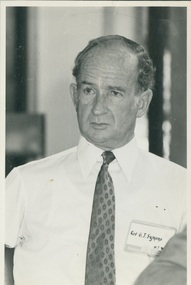
... care giver until 1965. A book entitled "They Crossed A Continent", the story of Margaret Somerville's epic journey, will tell you how it all began. As government and social philosophies changed, these houses became homes for the profoundly disabled. In 1980, with expanded community services, Somerville Homes became Somerville Community Services Incorporated Somerville Community Services Inc is a non-government, not for profit, youth, family and community welfare organisation indigenous to the Northern Territory. ...care giver until 1965. A book entitled "They Crossed A Continent", the story of Margaret Somerville's epic journey, will tell you how it all began. As government and social philosophies changed, these houses became homes for the profoundly disabled. In 1980, with expanded community services, Somerville Homes became Somerville Community Services Incorporated Somerville Community Services Inc is a non-government, not for profit, youth, family and community welfare organisation indigenous to the Northern Territory. ...Somerville Homes came into existence in 1965. The homes were named in honour of Margaret Somerville MBE who helped evacuate 95 children from Croker Island to Sydney in 1942 and who returned to Croker Island with the children after the war and continued as a house mother and care giver until 1965. A book entitled "They Crossed A Continent", the story of Margaret Somerville's epic journey, will tell you how it all began. As government and social philosophies changed, these houses became homes for the profoundly disabled. In 1980, with expanded community services, Somerville Homes became Somerville Community Services Incorporated Somerville Community Services Inc is a non-government, not for profit, youth, family and community welfare organisation indigenous to the Northern Territory. We maintain strong constitutional links with the Uniting Church in Australia but we are governed by an independent and professional Board of Directors, ensuring that the organisation has the capacity to respond to the needs of people whatever their circumstances. Somerville recognises that being disadvantaged in a modern Western society is a condition relative to general living standards. We give priority to advocacy and improving the resources of people who are uninformed or ill-informed about community services and opportunities which may improve their circumstances. Somerville supports actions aimed at creating increased opportunities for people to become personally involved in a sharing and caring society. We promote opportunities for church and other local voluntary organisations to play a more effective part in meeting the needs of the community. Somerville monitors and evaluates its own service programs, adapting them to changing community needs and circumstances. We also monitor Federal and Territory programs affecting community and the way services and funding affect the position of individuals, couples and families in community. The organisation is financed by public donations, church and service club grants, business support, government grants, sponsorship and the organisation fundraising activities. Rev. Gordon J Symons, upper body photo of middle-aged man in white shirt and tie.Rev. Gordon Symons; Somerville Homes, Darwin. New Spectator (12 September 1972) p1rev. gordon symons; somerville christian homes -
 Box Hill Historical Society
Book, From Burwood to bestchance : 120 years of care and education, 2016
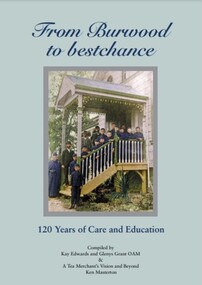
... care Burwood Children's Home bestchance Family day care Illustrated history of Burwood Boys Home, Child and Family Care, and bestchance, Child, Family Care. From original beginnings in 1895 when founder Robert Campbell Edwards established a home for the waifs of Melbourne, to the present organisation caring for families and children, providing child care, early intervention programs, special primary education ( Cheshire School) and adult training. In 2007, Ken Masterton's book "A Tea Merchant's Vision and Beyond - a history of the Burwood Boys' Home" (which is reproduced in full in this edition) begins with the vision of tea merchant Robert Campbell Edwards and "gives ...Illustrated history of Burwood Boys Home, Child and Family Care, and bestchance, Child, Family Care. From original beginnings in 1895 when founder Robert Campbell Edwards established a home for the waifs of Melbourne, to the present organisation caring for families and children, providing child care, early intervention programs, special primary education ( Cheshire School) and adult training. In 2007, Ken Masterton's book "A Tea Merchant's Vision and Beyond - a history of the Burwood Boys' Home" (which is reproduced in full in this edition) begins with the vision of tea merchant Robert Campbell Edwards and "gives a valuable summary of the organisation's achievements".xvi, 202 pages : illustrations (some colour), portraits (some colour), colour maps; includes Appendices lists of leadership and Life Governors 1895 to 2016 non-fictionIllustrated history of Burwood Boys Home, Child and Family Care, and bestchance, Child, Family Care. From original beginnings in 1895 when founder Robert Campbell Edwards established a home for the waifs of Melbourne, to the present organisation caring for families and children, providing child care, early intervention programs, special primary education ( Cheshire School) and adult training. In 2007, Ken Masterton's book "A Tea Merchant's Vision and Beyond - a history of the Burwood Boys' Home" (which is reproduced in full in this edition) begins with the vision of tea merchant Robert Campbell Edwards and "gives a valuable summary of the organisation's achievements".burwood boys' home, child care, burwood children's home, bestchance, family day care -
 Ballarat Tramway Museum
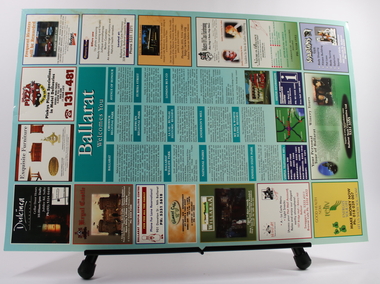
Poster, "Ballarat Welcomes You", 1998
... Gives details of weekends, public/schools holiday running, and contact details. Tram in photo is No. 26, but very dark. All ads in full colour. Other advertisers are Dulcinea, Kryal Castle, Ballarat Tenpin Bowling Centre, Gumnut Cafe, Willabaa, Swaggers Cafe, Browse Cafe, Reliv health, Ballarat Taxis Co-op, Spartans gym, Nature In Balance, Master of Class Hairdressing, Exquisite Furniture, Pinky's Pizza, Budget and Ballarat Family Care Pharmacy. ...Gives details of weekends, public/schools holiday running, and contact details. Tram in photo is No. 26, but very dark. All ads in full colour. Other advertisers are Dulcinea, Kryal Castle, Ballarat Tenpin Bowling Centre, Gumnut Cafe, Willabaa, Swaggers Cafe, Browse Cafe, Reliv health, Ballarat Taxis Co-op, Spartans gym, Nature In Balance, Master of Class Hairdressing, Exquisite Furniture, Pinky's Pizza, Budget and Ballarat Family Care Pharmacy. ...Plasticised card wall hanging poster to display in local tourism centres, motels, shops etc, publicising some of the tourist features of Ballarat and District. Surround base information is a series of adverts including BTM. Gives details of weekends, public/schools holiday running, and contact details. Tram in photo is No. 26, but very dark. All ads in full colour. Other advertisers are Dulcinea, Kryal Castle, Ballarat Tenpin Bowling Centre, Gumnut Cafe, Willabaa, Swaggers Cafe, Browse Cafe, Reliv health, Ballarat Taxis Co-op, Spartans gym, Nature In Balance, Master of Class Hairdressing, Exquisite Furniture, Pinky's Pizza, Budget and Ballarat Family Care Pharmacy. Also has a item on the London Bus Co., area map, telephone numbers and visitor information centre. Has four pieces of double side tape in corners on rear.trams, tramways, btm, ballarat tourism -
 Melbourne Legacy
Film, The Legacy Story
... care of children - health and fitness - is explained. Also shown are the January seaside camp activities, annual Christmas picnic with 1000 guests, and a Legatee visiting one of his families with helpful advice. Craig House, Perth Legacy's co-ed residence is featured, followed by the annual presentation of debutantes. 10 mins 41 sec. A visual record of life in the 1950s and the huge number of children to have lost their father in WWII. The commitment of Legacy to giving ...16 mm Black and white film with sound produced by Southern Cross Films, Perth. It begins with archival film from WWII, explains the meaning and symbolism of the Legacy badge,and shows young girls taking the Legacy oath. There were 1900 orphans in W. Australia and the film explains the origins of Legacy. Perth Legacy's Board of Management is shown and care of children - health and fitness - is explained. Also shown are the January seaside camp activities, annual Christmas picnic with 1000 guests, and a Legatee visiting one of his families with helpful advice. Craig House, Perth Legacy's co-ed residence is featured, followed by the annual presentation of debutantes. 10 mins 41 sec.A visual record of life in the 1950s and the huge number of children to have lost their father in WWII. The commitment of Legacy to giving them a better childhood and the amount of work done by Legatees is impressive.Blue metal canister and film on a spool labelled as The Legacy Story. The 16mm film runs for 10 mins 41 secs.Canister lid exterior, Label, HERSCHELLES FILM LABORATORIES, East Melbourne, Australia SUBJECT, “THE LEGACY STORY’, copy, length 404’ reel no. Canister base exterior, Label from Legacy Club Melbourne. 45 Market St, Melbourne, C.1. Typed label say '16mm Sound film of Perth Legacy's Activities. Purchased by Melbourne Legacy with Perth Legacy's permission and with authority of L/tee Morrie Tonkin and Board of Management of Melbourne Legacy. June 1965. I.E.L.'legacy promotion, activities, junior legatee, marketing -
 Melbourne Legacy
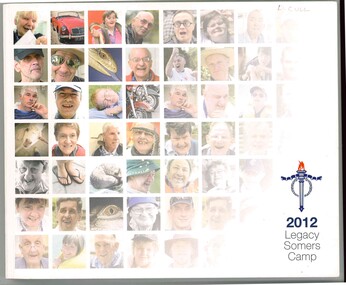
Book, Legacy Somers Camp 2012, 2012
... caring and concerned organisation." Most junior legatees are helped until they reach 18 years of age. However, the group of disabled dependents are helped for their whole life. Which gives peace of mind to the family...caring and concerned organisation." Most junior legatees are helped until they reach 18 years of age. However, the group of disabled dependents are helped for their whole life. Which gives peace of mind to the family ...A book of photos that records the activities of the dependents with disabilities group during Legacy's Somers Camp in 2012. It is full of photos without captions but the enjoyment of the participants is clear. Part of the introduction says: "Our sixty dependants enjoyed 12 days in each others company supported by a team of generous volunteers. Melbourne Legacy's support of or Dependants with Disabilities represents a very important part of the work which Legacy does. Our widows are reassured in the knowledge that their children will have support throughout their lives from a caring and concerned organisation." Most junior legatees are helped until they reach 18 years of age. However, the group of disabled dependents are helped for their whole life. Which gives peace of mind to the family that Legacy will always be there to care. Photographed by Andrew Gooden.Legacy have pledged to look after the disabled dependents for their entire lifeColour book x 60 pages of photos from disabled dependent activities in 2012.disabled dependents, handicapped dependents, activities -
 Melbourne Legacy
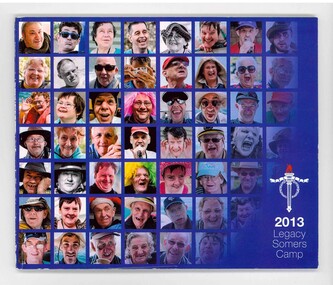
Book, Legacy Somers Camp 2013, 2013
... caring and concerned organisation." Most junior legatees are helped until they reach 18 years of age. However, the group of disabled dependents are helped for their whole life. Which gives peace of mind to the family...caring and concerned organisation." Most junior legatees are helped until they reach 18 years of age. However, the group of disabled dependents are helped for their whole life. Which gives peace of mind to the family ...A book of photos that records the activities of the dependents with disabilities group during Legacy's Somers Camp in 2013. It is full of photos without captions but the enjoyment of the participants is clear. Part of the introduction says: "Our sixty dependants enjoyed 12 days in each others company supported by a team of generous volunteers. Melbourne Legacy's support of or Dependants with Disabilities represents a very important part of the work which Legacy does. Our widows are reassured in the knowledge that their children will have support throughout their lives from a caring and concerned organisation." Most junior legatees are helped until they reach 18 years of age. However, the group of disabled dependents are helped for their whole life. Which gives peace of mind to the family that Legacy will always be there to care. Photographed by Andrew Gooden.Legacy have pledged to look after the disabled dependents for their entire lifeColour book x 100 pages of photos from disabled dependent activities in 2013.disabled dependents, handicapped dependents, activities -
 Federation University Art Collection
Painting - Artwork - Painting, 'Bushfood' by Anne Ferguson, 09/2006
... Ann FERGUSON (1939- ) Country: Wingetllina Area: Alice Spring, Kalka/Pipalyatjara Language group: Pitjantjarara Ann Ferguson (Ann Cleary Nyankulya Bnaka) is a member of the Stolen Generation, she was removed from her family and take to Kalgoorlie Mission, South Australia. She started painting in 1973 when her care givers noticed her artistic talent. ...Ann FERGUSON (1939- ) Country: Wingetllina Area: Alice Spring, Kalka/Pipalyatjara Language group: Pitjantjarara Ann Ferguson (Ann Cleary Nyankulya Bnaka) is a member of the Stolen Generation, she was removed from her family and take to Kalgoorlie Mission, South Australia. She started painting in 1973 when her care givers noticed her artistic talent. ...Ann FERGUSON (1939- ) Country: Wingetllina Area: Alice Spring, Kalka/Pipalyatjara Language group: Pitjantjarara Ann Ferguson (Ann Cleary Nyankulya Bnaka) is a member of the Stolen Generation, she was removed from her family and take to Kalgoorlie Mission, South Australia. She started painting in 1973 when her care givers noticed her artistic talent. Ann Ferguson is also a basket weaver, carver and lino block printmaker at Indulkana Community, South Australia, Acrylic painting on stretched canvasaboriginal, bushfood, anne ferguson, bush food, bush foods, ann cleary, ann ferguson, indulkana -
Kew Historical Society Inc
Journal, Kewriosity : September 1992
... Work at home as a family day care giver / p5. Nutrition information win prizes / p6. ...Opportunity for employers & unemployed young people / p1.Kew Festival and education / p1. Kew's Community Bus / p1. Chief Executive's Column [Influences on rates and charges for 1992/93]; City of Kew Streetscaping Committee / Malcolm Hutchinson p2. Mayor's Comment / Cr Roger Streeton p3. Diary Dates for September/October [1992] / p4. Municipal Health Plan have your say? / p5. Volunteer wanted [Kew Cottges] / p5. Work at home as a family day care giver / p5. Nutrition information win prizes / p6. Holiday fun for children & teenagers / p7. What do women at mid-life want? / p7. Be wise with medicines month / p7. 12 month trials of multi-dwelling development code / p7. Pictures of Kew [Mrs June Stratford, Head of Carey Junior School; Octagonal shelter, Boroondara Cemetery; St Anthony's Home for Children 1922-76; The Hartwell Players] / p8.Kewriosity was a local newsletter combining Kew Council and community news. It was published between November 1983 and June 1994, replacing an earlier Kewriosity [broad] Sheet (1979-84). In producing Kewriosity, Council aimed to provide a range of interesting and informative articles covering its deliberations and decision making, together with items of general interest and importance to the Kew community and information not generally available through daily media outlets.non-fictionOpportunity for employers & unemployed young people / p1.Kew Festival and education / p1. Kew's Community Bus / p1. Chief Executive's Column [Influences on rates and charges for 1992/93]; City of Kew Streetscaping Committee / Malcolm Hutchinson p2. Mayor's Comment / Cr Roger Streeton p3. Diary Dates for September/October [1992] / p4. Municipal Health Plan have your say? / p5. Volunteer wanted [Kew Cottges] / p5. Work at home as a family day care giver / p5. Nutrition information win prizes / p6. Holiday fun for children & teenagers / p7. What do women at mid-life want? / p7. Be wise with medicines month / p7. 12 month trials of multi-dwelling development code / p7. Pictures of Kew [Mrs June Stratford, Head of Carey Junior School; Octagonal shelter, Boroondara Cemetery; St Anthony's Home for Children 1922-76; The Hartwell Players] / p8. publications -- city of kew (vic.), kewriosity, council newsletters, community newsletters -
Kew Historical Society Inc
Journal, Kewriosity : August 1990
... Family day care / p5. Centenary celebrations for Kew East [Primary School] / p5. Courses, coffee and a chat [ Kew Community House] / p5. Govt amends Kew Planning Scheme [Willsmere] / p5. Backyard burning banned / p5. Kew Community House [courses] / p6. Clean up for Studley Park [Boroondara Bushwalkers] / p6. Council re-assesses proposal [skateboard bowl at Victoria Park] / p6. Meetings promote care giver ...Council assistance available to maintain homes / p1. Rates reminder / p1. No elections / p1. Dates for August / p2. Breast information session / p2. One act plays [Track Players] / p2. Strategies for success / p2. Rotary changeover [Kew Rotary Club] / p2. Kew's kindergartens to open doors / p3. Budget to take care of basics / p3. Urban women have a taste for country life [Kew/Balwyn Country Women's Association CWA] / p3. Your community bus needs you / p3. Recruiting drive [Meals on Wheels] / p3. Notices / p4. Major donation to St George's [Hospital] [Kew Rotary Club] / p4. Carey's new head / p4. Library corner / p4. Update on traffic / p4. Family day care / p5. Centenary celebrations for Kew East [Primary School] / p5. Courses, coffee and a chat [ Kew Community House] / p5. Govt amends Kew Planning Scheme [Willsmere] / p5. Backyard burning banned / p5. Kew Community House [courses] / p6. Clean up for Studley Park [Boroondara Bushwalkers] / p6. Council re-assesses proposal [skateboard bowl at Victoria Park] / p6. Meetings promote care giver act / p7. Council seeks community reps / p7. Kew Primary promotes its assets / p7. Recipe for success [Children's International Summer Villages] / p8. Special paper collection / p8. "Kew is for Living" [Kew Festival] / p8.Kewriosity was a local newsletter combining Kew Council and community news. It was published between November 1983 and June 1994, replacing an earlier Kewriosity [broad] Sheet (1979-84). In producing Kewriosity, Council aimed to provide a range of interesting and informative articles covering its deliberations and decision making, together with items of general interest and importance to the Kew community and information not generally available through daily media outlets.non-fictionCouncil assistance available to maintain homes / p1. Rates reminder / p1. No elections / p1. Dates for August / p2. Breast information session / p2. One act plays [Track Players] / p2. Strategies for success / p2. Rotary changeover [Kew Rotary Club] / p2. Kew's kindergartens to open doors / p3. Budget to take care of basics / p3. Urban women have a taste for country life [Kew/Balwyn Country Women's Association CWA] / p3. Your community bus needs you / p3. Recruiting drive [Meals on Wheels] / p3. Notices / p4. Major donation to St George's [Hospital] [Kew Rotary Club] / p4. Carey's new head / p4. Library corner / p4. Update on traffic / p4. Family day care / p5. Centenary celebrations for Kew East [Primary School] / p5. Courses, coffee and a chat [ Kew Community House] / p5. Govt amends Kew Planning Scheme [Willsmere] / p5. Backyard burning banned / p5. Kew Community House [courses] / p6. Clean up for Studley Park [Boroondara Bushwalkers] / p6. Council re-assesses proposal [skateboard bowl at Victoria Park] / p6. Meetings promote care giver act / p7. Council seeks community reps / p7. Kew Primary promotes its assets / p7. Recipe for success [Children's International Summer Villages] / p8. Special paper collection / p8. "Kew is for Living" [Kew Festival] / p8. publications -- city of kew (vic.), kewriosity, council newsletters, community newsletters -
 Royal District Nursing Service (now known as Bolton Clarke)
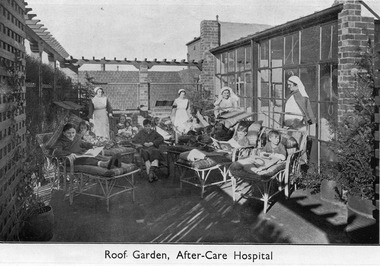
Photograph - Digital Image, c.1935
... Care, setting a high standard with equipment, keeping records and providing leaflets with instructions in how to keep healthy during pregnancy, what complications to look for and what to do when labour commenced. In 1934 the Society were pioneers again when they opened the first Women’s Welfare Clinic, including at the time a very controversial Family Planning Clinic, the first of its kind in Australia which was opened to support women at risk following multiple and difficult pregnancies, giving advice on birth-control. ...This digital image shows the sun roof on the Melbourne District Nursing Society After-Care Hospital, 45 Victoria Parade, Collingwood. It shows some of the children nursed at the home. Many children were nursed there long term during the Poliomyelitis epidemic in the 1930s. It also shows uniforms worn by nurses and Sisters in the 1930s. The Melbourne District Nursing Society After-Care Home was originally established to provide nurse-managed convalescent care to poor and underprivileged patients who could not look after themselves at home due to illness, or on release from hospital. Opening in 1926 following a public appeal for funds, at a cost of £27,000, the Home included maternity, children’s and adult wards as well as accommodation for Matron, twelve Sisters and four domestic staff. Many children were nursed there, some long term, during the Polio epidemic and the Society employed two School Teachers. The Society now ran two divisions, the After-Care with its own Sisters and nurses and the District division. The Society were the first in Melbourne, in early 1928, to recognize some patients leaving the After-Care, and many at home, needed further social care and they set up ‘Almoners’ from their committee to visit these patients and be intermediaries in getting them social assistance. It was late the following year before the first training of Almoners took place in Melbourne. In 1930 the Society employed a full time kindergarten teacher to visit poor children in their homes. That year the Society were pioneers in opening an Ante-Natal Clinic at the After-Care, setting a high standard with equipment, keeping records and providing leaflets with instructions in how to keep healthy during pregnancy, what complications to look for and what to do when labour commenced. In 1934 the Society were pioneers again when they opened the first Women’s Welfare Clinic, including at the time a very controversial Family Planning Clinic, the first of its kind in Australia which was opened to support women at risk following multiple and difficult pregnancies, giving advice on birth-control. At first the clinic was attended by their own patients, but then accepting patients from public hospitals until their own clinics were opened. . Major extensions in 1934 led to the After-Care 'Home' having a name change to 'Hospital'. A trained Almoner was employed in 1934 but she resigned after twelve months due to the work load. Unable to procure another due to a shortage of trained Almoners, a Social Service Officer was employed at the After-Care who successfully gained better housing from the Housing Commission for families living under unsuitable conditions. Following Government intervention, the After-Care Hospital was separated from the Melbourne District Nursing Society in 1957. The After-care Hospital continued to operate at the same address until 1985 when it became the Melbourne Geriatric Centre. This digital Image shows two nurses and two Trained nurses (Sisters) supervising convalescing children in the roof garden of the Melbourne District Nursing Society After-Care Hospital . The two nurses are with the rear children, one on the left and one on the right. Both are wearing long white aprons over their long sleeved dark grey uniforms, and both are wearing white caps over their dark hair. On the right rear, in front of a row of glass windows, the upper portion of a Sister can be seen wearing a white uniform and white veil. In the right front is another Sister who is wearing glasses and is wearing a white uniform and dark coloured cape. She is wearing a white veil over her short dark hair. There are three boys and four girls resting on cane lounges; some are reading books and one girl is holding a doll. Another boy, who is wearing a dressing gown, is sitting on a cane chair. There is a trellis and a wall of windows on the left of the image and some brick work and a wall of windows on the right hand side behind the Sisters.. Some pots with low and tall plants can be seen.A tiled hip roof of a building can be seen in the rear of the image.mdns, melbourne district nursing society, after- care hospital, nurses uniforms -
 Royal District Nursing Service (now known as Bolton Clarke)
Photograph - Photograph, black and white, c.1930
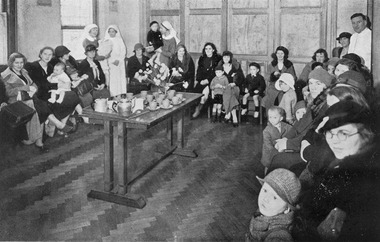
... Care, setting a high standard with equipment, keeping records and providing leaflets with instructions in how to keep healthy during pregnancy, what complications to look for and what to do when labour commenced. In 1934 the Society were pioneers again when they opened the first Women’s Welfare Clinic in Melbourne giving advice on birth-control, at first attended by their own patients, but then accepting patients from public hospitals until their own clinics were opened. A Social Service Officer was employed at the After-Care who successfully gained better housing from the Housing Commission for families ...The photograph is taken in the Waiting room of the Ante-natal Clinic at the Melbourne District Nursing Society After-Care Home at 45 Victoria Parade, Collingwood. On the 23rd of September 1930 the Ante-Natal Clinic opened at the MDNS After- Care Home. This photograph also shows Matron and Sister's uniforms in the 1930sThe Melbourne District Nursing Society (MDNS) were pioneers in recognizing the need for premises where patients too ill to be in their own home, but not ill enough to go to hospital, was needed, and the Society built, then opened, the After-Care Home, (later called After-Care Hospital), in 1926, for these patients, and patients from Hospitals. Many children were nursed there, some long term during the Polio epidemic and the Society employed two School Teachers. The Society now ran two divisions, the After-Care with its own Trained nurses and the District division. The Society were the first in Melbourne, in early 1928, to recognize some patients leaving the After-Care, and many at home, needed further social care and they set up ‘Almoners’ from their committee to visit these patients and be intermediaries in getting them social assistance. It was late the following year before the first training of Almoners took place in Melbourne. In 1930 the Society employed a full time kindergarten teacher to visit poor children in their homes. That year the Society were pioneers in opening an Ante-Natal Clinic at the After-Care, setting a high standard with equipment, keeping records and providing leaflets with instructions in how to keep healthy during pregnancy, what complications to look for and what to do when labour commenced. In 1934 the Society were pioneers again when they opened the first Women’s Welfare Clinic in Melbourne giving advice on birth-control, at first attended by their own patients, but then accepting patients from public hospitals until their own clinics were opened. A Social Service Officer was employed at the After-Care who successfully gained better housing from the Housing Commission for families living under unsuitable conditions. In 1957 the Hospital and Charities Commission decided to take over the After-Care Hospital, so the Melbourne District Nursing Society and After-Care Hospital separated and the Melbourne District Nursing Service was formed, setting up Headquarters at 452 St. Kilda Road, Melbourne. On the 5th of October 1966 the name changed to Royal District Nursing Service (RDNS) after being granted Royal patronage. Black and white photograph showing seventeen seated ladies, some partly hidden, six small children, and the Matron and two Sisters of the Melbourne District Nursing Society After Care Home. The Matron is wearing a white uniform and veil, and the two Sisters are wearing grey uniforms with white collars and veils, one is holding a baby and the other a small child dressed in dark clothing, they are on the far left and rear of the photograph. The ladies are wearing either grey or black clothing, several are wearing hats and some are wearing berets. They have short or shoulder length dark or lighter coloured hair. A Doctor, with short dark hair and wearing a white coat, is standing at the far right on the photograph. On the left, a window can be seen behind one of the Sisters. The wall at the rear of the room is paneled. after-care home, mdns, melbourne district nursing society, ante-natal clinic -
 Royal District Nursing Service (now known as Bolton Clarke)
Photograph - Digital image, c.1930
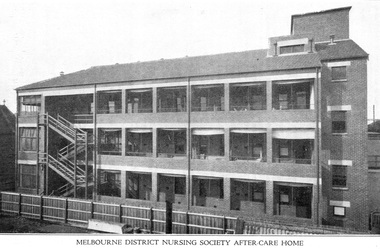
... giving advice on birth-control, at first attended by their own patients, but then accepting patients from public hospitals until their own clinics were opened. A trained Almoner was employed, but left after twelve months due to the amount of work required. Trained Almoners were in short supply so a Social Service Officer was employed at the After-Care who successfully gained better housing from the Housing Commission for families ...The Melbourne District Nursing Society After-Care Home was built in 1926 to give short term care to MDNS patients who were too ill to remain in their home, but not ill enough to go to hospital. Melbourne hospitals also sent patients there who required further care after discharge from hospital. After convalescence they returned to their homes. Many children were nursed there, particularly during the Polio epidemic.The Society were pioneers in recognizing the need for premises where patients too ill to be in their own home, but not ill enough to go to hospital, was needed, and the Society built, then opened, the After-Care Home in 1926, (from 1934 called After-Care Hospital), for these patients, and patients from Hospitals. Many children were nursed there, some long term, during the Polio epidemic and the Society employed two School Teachers. The Society now ran two divisions, the After-Care with its own Trained nurses and the District division. The Society were the first in Melbourne, in early 1928, to recognize some patients leaving the After-Care, and many at home, needed further social care and they set up ‘Almoners’ from their Committee to visit these patients and be intermediaries in getting them social assistance. It was late the following year before the first training of Almoners took place in Melbourne. In 1930 the Society employed a full time kindergarten teacher to visit poor children in their homes. That year the Society were pioneers in opening an Ante-Natal Clinic at the After-Care, setting a high standard with equipment, keeping records and providing leaflets with instructions in how to keep healthy during pregnancy, what complications to look for, and what to do when labour commenced. In 1934 the Society were pioneers again when they opened the first Women’s Welfare Clinic in Melbourne giving advice on birth-control, at first attended by their own patients, but then accepting patients from public hospitals until their own clinics were opened. A trained Almoner was employed, but left after twelve months due to the amount of work required. Trained Almoners were in short supply so a Social Service Officer was employed at the After-Care who successfully gained better housing from the Housing Commission for families living under unsuitable conditions. In the 1950s the Hospital and Charities Commission decided to take over the After-Care Hospital, so the Melbourne District Nursing Society and After-Care Hospital separated and the Melbourne District Nursing Service was formed, setting up Headquarters at 452 St. Kilda Road. In 1966 Royal patronage was given and the name changed to Royal District Nursing Service (RDNS).Digital image of the rear of the extended Melbourne District Nursing Society After-Care Home 45 Victoria Parade, Collingwood. It shows a three story brick building with a tiled hip roof and open verandas running along each story with windows seen behind. A zigzag stair case runs down the left hand side of the building and on the right hand side of the image you can see a section set back with one window on each floor. Behind this section, part of another multi story building is seen. A wooden paling fence is seen in the foreground of the photograph. On the far right, part of another brick building with hip roof can be seen melbourne district nursing society, mdns, melbourne district nursing society and after-care home, rdns, royal district nursing service -
 Royal District Nursing Service (now known as Bolton Clarke)
Photograph - Digital image, c.1934
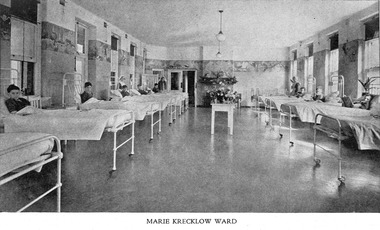
... In 1934 the Society were pioneers again when they opened the first Women’s Welfare Clinic in Melbourne giving advice on birth-control, at first attended by their own patients, but then accepting patients from public hospitals until their own clinics were opened.A trained Almoner was employed at the hospital but left after twelve months due to the volume of work. Unable to employ another trained Almoner due to a shortage of them, a Social Service Officer was employed at the After-Care who successfully gained better housing from the Housing Commission for families living under unsuitable conditions. ...In 1934 the Trustees of the Marie Krecklow Estate donated 500 pounds to furnish and equip an empty Ward in the Melbourne District Nursing Society After-Care Hospital in the memory of Mrs. Marie Krecklow. This image shows the furnishings in the Ward of the Hospital at 45 Victoria Parade, Collingwood. The boys in this image are receiving nursing care before returning home following their recuperation. Many children were nursed at the hospital, some long term during the Polio epidemic. The Society were pioneers in recognizing the need for premises where patients too ill to be in their own home, but not ill enough to go to hospital, was needed, and the Society built, then opened, the Melbourne District Nursing Society After-Care Home in 1926, (from 1934 called After-Care Hospital), for these patients, and patients from Melbourne Hospitals who required recuperation before returning home. Many children were nursed there, some long term during the Polio epidemic and the Society employed two School Teachers. The Society now ran two divisions, the After-Care with its own Trained nurses and the District division. The Society were the first in Melbourne, in early 1928, to recognize some patients leaving the After-Care, and many at home, needed further social care and they set up ‘Almoners’ from their committee to visit these patients and be intermediaries in getting them social assistance. It was late the following year before the first training of Almoners took place in Melbourne. In 1930 the Society employed a full time kindergarten teacher to visit poor children in their homes. That year the Society were pioneers in opening an Ante-Natal Clinic at the After-Care, setting a high standard with equipment, keeping records and providing leaflets with instructions in how to keep healthy during pregnancy, what complications to look for and what to do when labour commenced. In 1934 the Society were pioneers again when they opened the first Women’s Welfare Clinic in Melbourne giving advice on birth-control, at first attended by their own patients, but then accepting patients from public hospitals until their own clinics were opened.A trained Almoner was employed at the hospital but left after twelve months due to the volume of work. Unable to employ another trained Almoner due to a shortage of them, a Social Service Officer was employed at the After-Care who successfully gained better housing from the Housing Commission for families living under unsuitable conditions. In the 1950s the Hospital and Charities Commission decided to take over the After-Care Hospital, so the Melbourne District Nursing Society and After-Care Hospital separated and the Melbourne District Nursing Service was formed, setting up Headquarters at 452 St. Kilda Road. In 1966, following Royal patronage the name was changed to Royal District Nursing Service (RDNS).Digital mage showing the 'Marie Krecklow Ward' in the Melbourne District Nursing Society After-Care Hospital. The image shows five iron hospital beds along the left hand side and five iron hospital beds along the right hand side of the ward. Eight young boys, most with short dark hair and one with short blonde hair, are leaning against pillows sitting up in the beds. Some pillows are propped against an iron support which slopes from the headrest. Three sets of windows can be seen on either side of the ward which is painted grey and a wide floral border to the picture rails, then white paint above the picture rail which continues over the ceiling. A white table with vases of flowers is in the centre rear of the image. A Sister, wearing a white uniform and veil and a dark cape stands at the rear left hand side of the image, and two nurses wearing white aprons over dark uniforms and white caps stand half way down the ward, one on either side. mdns, melbourne district nursing society, after- care hospital, after-care home, rdns, royal district nursing service, mrs marie krecklow -
 Royal District Nursing Service (now known as Bolton Clarke)
Photograph - Digital image, c.1930
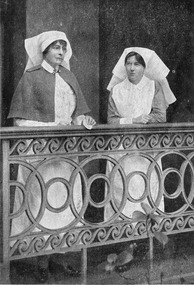
... giving advice on birth-control, at first attended by their own patients, but then accepting patients from public hospitals until their own clinics were opened. A trained Almoner was employed in 1934 but only stayed twelve months due to the amount of work required. Due to shortage of trained Almoners, a Social Service Officer was employed at the After-Care who successfully gained better housing from the Housing Commission for families ...This image shows two of the 'Melbourne District Nursing Society After Care Home' Sisters who worked in the After Care section of the Society during the 1930s. The image was taken on the balcony of the After Care Home at 39 Victoria Parade, Collingwood. It depicts the style of uniforms worn by trained nurses (Sisters) in that era. The Society were pioneers in recognizing the need for premises where patients too ill to be in their own home, but not ill enough to go to hospital, was needed, and the Melbourne District Nursing Society (MDNS) built, then opened, the After-Care Home in 1926, (from 1934 called After-Care Hospital), for these patients, and patients from Melbourne Hospitals who required recuperation before returning to their home. Many children were nursed there, some long term during the Polio epidemic, and the Society employed two School Teachers. The Society now ran two divisions, the After-Care with its own nursing staff and the District division. The Society were the first in Melbourne, in early 1928, to recognize some patients leaving the After-Care, and many at home, needed further social care and they set up ‘Almoners’ from their committee to visit these patients and be intermediaries in getting them social assistance. It was late the following year before the first training of Almoners took place in Melbourne. In 1930 the Society employed a full time kindergarten teacher to visit poor children in their homes. That year the Society were pioneers in opening an Ante-Natal Clinic at the After-Care, setting a high standard with equipment, keeping records and providing leaflets with instructions in how to keep healthy during pregnancy, what complications to look for and what to do when labour commenced. In 1934 the Society were pioneers again when they opened the first Women’s Welfare Clinic in Melbourne giving advice on birth-control, at first attended by their own patients, but then accepting patients from public hospitals until their own clinics were opened. A trained Almoner was employed in 1934 but only stayed twelve months due to the amount of work required. Due to shortage of trained Almoners, a Social Service Officer was employed at the After-Care who successfully gained better housing from the Housing Commission for families living under unsuitable conditions. In the 1950s the Hospital and Charities Commission decided to take over the After-Care Hospital, so the Melbourne District Nursing Society and After-Care Hospital separated and the Melbourne District Nursing Service was formed, setting up Headquarters at 452 St. Kilda Road. With Royal patronage the name changed in 1966 to Royal District Nursing Service (RDNS).Digital image of two Sisters from the Melbourne District Nursing Society (MDNS) After-Care Home standing on the balcony of their building. The Sister on the left hand side is wearing a dark cape over her white uniform; she wears a white veil over her dark hair. The Sister on the right hand side is wearing a long white apron over her grey uniform which has white cuffs on the sleeves. She is wearing a white veil over her dark hair. They are leaning on the scrolled metal rail of the balcony which runs along the grey building; part of which can be seen behind them.mdns, melbourne district nursing society, after- care hospital, after-care home, rdns, royal district nursing service, nurses uniforms -
 Royal District Nursing Service (now known as Bolton Clarke)
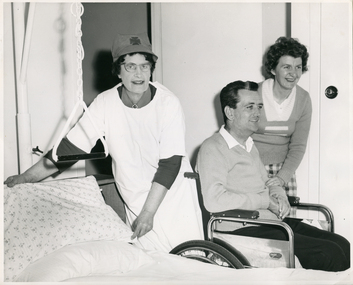
Photograph - Photograph, black and white, 30 06 1965
... care to patients in their own homes. They nursed patients referred by Hospitals and General Practitioners giving treatments, such as injections, wound care and doing many other procedures, as well as assisting them with 'general care' when required. The Sisters needed to transfer the patients when required and also taught family ...The MDNS Sister has given nursing care to the gentleman and has transferred him safely into the wheelchair. Whilst doing this the Sister demonstrated the transfer technique to the lady in the photograph who is probably his wife. The Sister is wearing the MDNS uniform of the day, a grey cotton dress and red cardigan, under her white gown. She has a red Maltese cross applied to the centre of her grey peaked hat.From its founding in 1885 the Hospital Trained nurses of the then named Melbourne District Nursing Society (MDNS), later named Royal District Nursing Service (RDNS) gave high quality nursing care to patients in their own homes. They nursed patients referred by Hospitals and General Practitioners giving treatments, such as injections, wound care and doing many other procedures, as well as assisting them with 'general care' when required. The Sisters needed to transfer the patients when required and also taught family members safe transferring techniques to enable them to care for their loved ones. RDNS employed a Physiotherapist who taught staff the correct techniques, not only for safety of the patient, but to reduce physical strain on patient’s family members and the RDNS nursing staff . Where possible the Sisters worked towards independence, using equipment such as shower seats, rails and hand showers. The Sisters liaised with the patient's Doctor and supported and advised the patient and Carer of any further help to assist them.On the left of the black and white photograph is a Melbourne District Nursing Service, (MDNS) Sister, who is wearing glasses and is looking at the camera. She is wearing a white gown over her uniform, with the grey collar and the dark sleeves of her cardigan in view and her grey peaked hat, with an emblazoned Maltese cross in the centre front, sits over her short dark curly hair. Both of her arms are extended and resting on either side of a pillow she is straightening. The Sister is standing next to wheelchair bound man who has short dark hair and is wearing dark trousers and a light coloured jumper. On the right hand side of the wheelchair a lady, wearing a light blouse, grey jumper and tartan skirt, is standing with her left hand resting on the left arm of the man.They are both smiling and looking slightly towards the right in the photograph A 'monkey bar hand grip' is attached to the bed by a pole and hangs on a white chair over the bed. A window covered by a blind is behind the Sister, with a light curtain to the left..Photographers stamp. Quote No. DW 84mdns, melbourne district nursing service, patient care, rdns, royal district nursing service -
 Royal District Nursing Service (now known as Bolton Clarke)
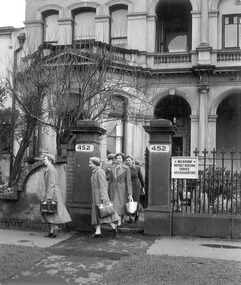
Photograph - Photograph, black and white:, c.1960
... Care, setting a high standard with equipment, keeping records and providing leaflets with instructions in how to keep healthy during pregnancy, what complications to look for and what to do when labour commenced. In 1934 the Society were pioneers again when they opened the first Women’s Welfare Clinic in Melbourne giving advice on birth-control, at first attended by their own patients, but then accepting patients from public hospitals until their own clinics were opened. A Social Service Officer was employed at the After-Care who successfully gained better housing from the Housing Commission for families ...This photograph was taken just a few years after the District division of the 'Melbourne District Nursing Society and After Care Hospital' separated in 1957. The District Division then became known as 'Melbourne District Nursing Service'. They moved into their Headquarters at 452 St. Kilda Road, Melbourne which was used as the Nurses Home as well as for Administrative purposes. The Sisters left from there each day to do their rounds and returned to do their book work before retiring at the end of the day. This photograph depicts the winter uniform worn at this time; a grey felt beret which had a red Maltese cross attached in the centre; a grey cotton frock and red cardigan, and a grey woolen coat, some with a grey belt, worn over their uniform.In 1885, 50 years after Melbourne was founded, it was recognized that nursing care was needed for the sick poor in inner Melbourne. The Melbourne District Nursing Society (MDNS), the first Society of its kind in Australia, was founded in February 1885 with one Trained nurse (Nurse), and a second employed six months later, working in the now CBD ie. from Spencer Street to Spring Street and from Victoria Parade to Flinders Street. From its inception the Society was at the forefront of health care. They provided high quality trained nursing care; educated their patients in the curing and prevention of disease; teaching the importance of cleanliness and good nutrition, both by verbal instruction and demonstration, even supplying soup and milk when needed. At that time they walked the streets and lane ways amid the slums of inner Melbourne carrying their nursing bag containing lotion and dressings, and supplying equipment on loan, such as feeding mugs, bedpans, air-cushions, splints, bed cradles feeding mugs and providing clean bed linen and nightdresses as necessary. Trained midwives began home births in August 1893 taking midwifery bundles and providing clothes for the babe and mother as needed. The Society were pioneers in recognizing the need for premises where patients too ill to be in their own home, but not ill enough to go to hospital, was needed, and the Society built, then opened, the After-Care Home, (later called After-Care Hospital), in 1926, for their patients, and patients from Hospitals. Many children were nursed there, some long term during the Polio epidemic; the Society employed two School Teachers. The Society now ran two divisions, the After-Care with its own Trained nurses (Sisters) and nurses and the District division. The Society were the first in Melbourne, in early 1928, to recognize some patients leaving the After-Care, and many at home, needed further social care and they set up ‘Almoners’ from their Committee to visit these patients and be intermediaries in getting them social assistance. It was late the following year before the first training of Almoners took place in Melbourne. In 1930 the Society employed a full time kindergarten teacher to visit poor children in their homes. That year the Society were pioneers in opening an Ante-Natal Clinic at the After-Care, setting a high standard with equipment, keeping records and providing leaflets with instructions in how to keep healthy during pregnancy, what complications to look for and what to do when labour commenced. In 1934 the Society were pioneers again when they opened the first Women’s Welfare Clinic in Melbourne giving advice on birth-control, at first attended by their own patients, but then accepting patients from public hospitals until their own clinics were opened. A Social Service Officer was employed at the After-Care who successfully gained better housing from the Housing Commission for families living under unsuitable conditions. In 1957 the Hospital and Charities Commission decided to take over the After-Care Hospital, so the 'Melbourne District Nursing Society and After-Care Hospital' separated and the 'Melbourne District Nursing Service' was formed, setting up Headquarters at 452 St. Kilda Road. Royal patronage was granted in 1966, now becoming the Royal District Nursing Service, (RDNS). Liaison with public hospitals began with a District nurse attached to a hospital visiting patients before going home. Education continued to be at the forefront of District with research by RDNS Educators and programs being implemented. Initial visits not only assessed the specific nursing situation but the situation as a whole. Their patients ranged in age from babes, children, adults to the elderly and referrals were taken from Hospitals, General Practitioners and allied Health facilities. Some of the care the Sisters provided is as follows: – Post-Natal care given to mother and babe, Wound Care following various types of surgery, accidents, burns, cancer, leg ulcers etc. Supervising and teaching Diabetic Care, including teaching and supervising people with Diabetes to administer their own Insulin, and administering Insulin to those unable to give their own injections. Administering other injections and setting up weekly medication boxes. The Sisters performed Catheterizations on adults suffering from conditions such as Quadriplegia, Paraplegia, Multiple Sclerosis (MS), Motor Neurone Disease (MND) and Guillan-Barre Syndrome, and when required at school on children for e.g. those with Spina Bifida. The Sisters visited those requiring Cystic Fibrosis support and care; those requiring Haemo-Oncology care, including visiting children at school; those requiring Home Enteral Feeding care, and those requiring IV therapy at home and home Dialysis. Palliative Care was given including pain relief with the use of syringe drivers, personal care as needed, and advice and support to both patient and family. The Sisters provided Stoma management to those needing Urostomy, Ileostomy and Colostomy care and those requiring Continence care. HIV/AIDS nursing care was provided; visits to Homeless Persons were made. Personal care was given to patients ranging in age and with varying mobility problems, such as Amputees, those with MS, MND, Guillan-Barre Syndrome, Poliomyelitis, Quadriplegia, Paraplegia, Acquired Brain Injury, to those following a Cerebrovascular Accident (Stroke), those with severe Arthritis and those with a form of Dementia. When necessary the elderly were assisted with personal care and advice given on safety factors with the use of hand rails, bath or shower seats, and hand showers. Rehabilitation with an aim towards independence remained at the forefront of the Sister’s minds and when possible using aids and instruction on safe techniques enabled the person to become fully independent. All care included giving advice and support to the patient and their Carers. The Sisters liaised with the persons Doctor, Hospital and allied Health personal when necessary.Black and White photograph of seven (some partly hidden) Melbourne District Nursing Service (MDNS) Sisters wearing full winter uniform of grey berets and grey long coats, with lapels, over their uniform which is partly seen on one Sister. Some are on a path, and others walking to the open metal gate; one Sister is between two tall, square, dark grey concrete columns. Looking at the photograph, two Sisters have turned left onto the footpath. These two Sisters are carrying oblong leather type bags in their left hand and the Sister between the columns is carrying a white soft material type bag. The Sisters seen have short dark hair under their berets. White plaques with the black numbers '452' are attached to the top 1/3 of each column and an arched grey concrete fence with brick top runs to the left. Behind this are two medium size leafless trees. A metal spiked fence runs from the column to the right of the photograph. Attached to this, near the column, is a white plaque with 'Melbourne District Nursing Service Headquarters' written in black. In the rear is a light grey two story Italian style building with a polygon shaped bay window to the left on the ground floor. It has a long window in the front and another on the side. To the right of this is a veranda with two concrete arches, separated by a roman column. A door can be seen behind the first arch. Above the bay window on the second story are three long arched windows, and to the right of that an arched opening with a roman column separating the partially seen next window. A concrete balustrade is seen at the front of the second story.melbourne district nursing service, headquarters, mdns, nurses, nurses uniforms, royal district nursing service, rdns -
 Royal District Nursing Service (now known as Bolton Clarke)
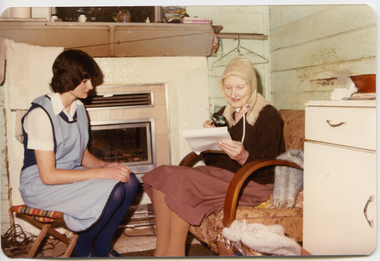
Photograph - Photograph, colour, c.1975
... giving information and instructions on diabetic care.. Education was an integral part of Melbourne District Nursing Society (MDNS), from its inception in 1885, later, in 1966, called Royal District Nursing Service, (RDNS). From 1885, only Trained Nurses (Nurses) who trained through the Hospital training system were employed by the Society, and on visits to patients they taught the necessity of hygiene and cleanliness, as well as the need for a good diet, to bring about good health. Doctor’s lectures were later given at the MDNS home to instruct patients and their families ...This photograph is taken in Mrs. McDonald's home and she is reading information provided to her by Sister Faye Cook of the Royal District Nursing Service (RDNS) who is visiting to provide her with nursing care. Written communication is required between Mrs. McDonald and Sr. Cook. Sisters from the Royal District Nursing Service (RDNS) used various means to communicate with their patients who had various health conditions. Sometimes this was by written word, using interpreters or using digital devices. The RDNS Education department wrote instructions for patients to follow for various conditions and treatments to assist them in their care. The attending Sister discussed the instructions and left the leaflet with the patient. Examples of instruction included on how to sterilize dressings and equipment in the home and another giving information and instructions on diabetic care.. Education was an integral part of Melbourne District Nursing Society (MDNS), from its inception in 1885, later, in 1966, called Royal District Nursing Service, (RDNS). From 1885, only Trained Nurses (Nurses) who trained through the Hospital training system were employed by the Society, and on visits to patients they taught the necessity of hygiene and cleanliness, as well as the need for a good diet, to bring about good health. Doctor’s lectures were later given at the MDNS home to instruct patients and their families on prevention of disease. Education to patients continued throughout the years regarding health care and the use of equipment in the home. In 1961, Education programs commenced at MDNS with their Trained nurses (Sisters) receiving In-service education. Sr. Pat (Paddy) Rowley was a leader in this In-service Education and established the MDNS, later called RDNS, Department of Community Nursing Education in 1962. Staff could also apply for scholarships to further their education outside of RDNS. Many of their senior Sisters received Postgraduate diplomas from the College of Nursing in Community Health Nursing, Education, and Administration, and several travelled overseas visiting nursing organizations viewing their public health and district nursing systems. Many programs were run at RDNS, including: a Post Basic Course, Cardiac Rehabilitation Nursing, Haematology/Oncology Nursing, Palliative Care program, Diabetic Stabilization Program, Leg Ulcer Management Program, Wound Care Specialist Program, HIV/AIDS Nursing Care, Cystic Fibrosis Home Support, Veterans Home Care Program, Breast Cancer Support Program, Continence Management Program, Stomal Therapy Program, In-Home Lactation Support Program and the Homeless Persons Program. RDNS staff attended several hospitals to observe and learn special care needed to some clients, e.g. to the Austin Hospital to learn the care required for paraplegic and quadriplegic clients at home, and to Mount Royal Hospital to observe the care of clients in the Rehabilitation ward. A Community Nursing Education Program was extended to student nurses from hospitals and to other nursing organizations. These Education programs kept the RDNS Sisters abreast of new techniques, such as changes in technology for e.g. new testing methods in detecting glucose levels in Diabetic patients. Sr. Nan Deakin did a Post Basic Course in Psychiatric Nursing and included this area in her education lectures. Sr. Daphne Geldard specialized in the area of Alzheimer’s disease and Dementia. These Sisters visited patients in District areas with the regular RDNS Sister when required. Every member of staff, both professional and non professional staff, received regular education in the Education Department. In 1980, a Home Health Aide pilot study, funded by the Federal Government, the Brotherhood of St. Laurence and RDNS, with the program written and taught by Sr. Rowley, was evaluated as successful, and Home Health Aides were employed and worked in RDNS Centres under the supervision of the RDNS Registered Nurses. Coloured photograph of Sister Faye Cook of the Royal District Nursing Service (RDNS), sitting with Mrs McDonald who is reading the top page of a white writing pad. On the left, sitting 'side on' looking at Mrs McDonald, is Sister Cook who has short dark hair, and is wearing her pale blue RDNS apron over her RDNS royal blue V neck tunic style frock which is over her short sleeve white blouse; she is wearing blue stockings. She is seated on a striped low stool in Mrs. McDonald's room. Mrs.McDonald is to her right, and is seated in a bone and brown patterned lounge chair with wooden arms. She has a bone coloured wrap over her hair, and is wearing a dark brown V neck jumper over a deep pink frock. She is hoding a magnifying glass in her right hand and is reading information on a white writing pad which she is holding in her left hand. In the rear of the photograph is a gas type fire set into a fireplace. A white cupboard with a drawer is seen to the right hand side. The wall behind is vertical boards.Red coloured 'Kodak' stamps. Handwritten information.royal district nursing service, rdns, rdns education, mrs mcdonald, sister faye cook -
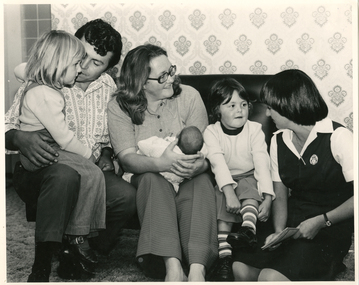 Royal District Nursing Service (now known as Bolton Clarke)
Photograph - Photograph, black and white, Barry Sutton, 23.02.1978
... Now as Royal District Nursing Service (RDNS), this service was extended to a Domiciliary Infant and Maternal Care, (DIMC) service operating from most Centres and visiting early discharged, often 24 hours after birth, maternity cases from hospitals to give post-natal care to the mother and babe. melbourne district nursing society mdns royal district nursing service rdns dimc mdns midwifery rdns domiciliary infant and maternal care Photographer stamp. Quote No EA 28 Black and white photograph of a Royal District Nursing Service (RDNS), Sister visiting a family ...The RDNS Sister is giving Post Natal care to the Mother and babe. She is wearing her RDNS summer uniform which is a white short sleeve blouse under a royal blue V necked tunic dress with the RDNS insignia emblazoned on the upper left.In August 1893 Melbourne District Nursing Society (MDNS), commenced a Midwifery Service with Nurse Fowler, who was trained in General nursing and Midwifery nursing, being the first Midwife employed. Mothers were assessed for suitability of a home birth or if they required delivery at the Women’s Hospital. The Midwife worked in conjunction with the Doctors at the Women’s Hospital and if a complication arose the patient was transferred to their care. Following birth they gave Post-Natal care to both the mother and babe. In 1898 the service ceased due to lack of funds but recommenced in 1906, and in the August 1925 Annual Report the number of MDNS home births was recorded at 478. MDNS built the After-Care Home and an Anti-Natal Clinic was opened in 1930. The last Ante-Natal clinic was held there in December 1951 and the MDNS Midwifery service ceased in February 1952. In 1964 MDNS commenced a Post-Natal Service with general and midwifery trained MDNS nurses working from a room at Footscray Hospital, and visiting early discharged Footscray Hospital maternity cases at home. Now as Royal District Nursing Service (RDNS), this service was extended to a Domiciliary Infant and Maternal Care, (DIMC) service operating from most Centres and visiting early discharged, often 24 hours after birth, maternity cases from hospitals to give post-natal care to the mother and babe.Black and white photograph of a Royal District Nursing Service (RDNS), Sister visiting a family in their home. The family are sitting on a dark coloured couch. From left to right:- The father, who has short dark hair and is wearing a light coloured patterned shirt and dark pants, is looking at his young blond haired daughter who is sitting on his right knee. She is wearing a light coloured top and darker coloured bib and brace pants. The mother, who has long dark hair and wears glasses,.is next to him and is smiling and looking towards the RDNS Sister. She is wearing a long sleeve buttoned grey top and darker coloured slacks, and is holding her babe in her lap with both hands supporting the baby's head. The babe has sparse dark hair and is wrapped in a white bunny rug. Next is a young girl, who has short dark hair and is wearing a light coloured top, darker coloured slacks and has her hands on the top of her left striped sock. Seated on the far right is the RDNS Sister, who has short straight dark hair, and has her face turned towards the child and mother. She is wearing her RDNS uniform of a short sleeve white blouse under a dark V neck tunic style dress which has the RDNS insignia on its upper left. The Sister has a pen attached to the V neck of the tunic and is holding a note book in her hands. She has a watch with a dark band attached to her left wrist. In the background part of a wooden and glass door can be seen and a patterned wallpapered adorns the wall behind the couch.Photographer stamp. Quote No EA 28melbourne district nursing society, mdns, royal district nursing service, rdns, dimc, mdns midwifery, rdns domiciliary infant and maternal care -
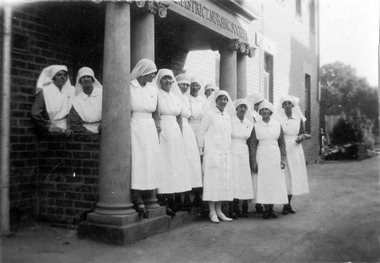 Royal District Nursing Service (now known as Bolton Clarke)
Photograph - Photograph, black and white, c.1930
... giving advice on birth-control, at first attended by their own patients, but then accepting patients from public hospitals until their own clinics were opened. A trained Almoner was employed by the Society in 1934, doing a great deal of work with Midwifery patients, but she resigned after twelve months due to the amount of work. Due to a lack of trained Almoners, the Society employed a Social Service Officer at the After-Care who successfully gained better housing from the Housing Commission for families ...The Matron and Sisters in this photograph worked in the Melbourne District Nursing Society After Care Home, (later called Hospital) full time and administered nursing care to patients who ranged in age from babes to adults. The Society also had a District Nursing division and these Sisters only worked in the community giving nursing care to patients in their homes.The Melbourne District Nursing Society were pioneers in recognizing the need for premises where patients too ill to be in their own home, but not ill enough to go to hospital, was needed, and the Society built, then opened, the After-Care Home in 1926, (from 1934 called After-Care Hospital), for these patients, and patients from Hospitals. Many children were nursed there, some long term during the Polio epidemic and the Society employed two School Teachers. The Society now ran two divisions, the After-Care with its own Sisters and nurses, and the District division. The Society were the first in Melbourne, in early 1928, to recognize some patients leaving the After-Care, and many at home, needed further social care and they set up ‘Almoners’ from their committee to visit these patients and be intermediaries in getting them social assistance. It was late the following year before the first training of Almoners took place in Melbourne. In 1930 the Society employed a full time kindergarten teacher to visit poor children in their homes. That year the Society were pioneers in opening an Ante-Natal Clinic at the After-Care, setting a high standard with equipment, keeping records, and providing leaflets with instructions in how to keep healthy during pregnancy, what complications to look for and what to do when labour commenced. In 1934 the Society were pioneers again when they opened the first Women’s Welfare Clinic in Melbourne giving advice on birth-control, at first attended by their own patients, but then accepting patients from public hospitals until their own clinics were opened. A trained Almoner was employed by the Society in 1934, doing a great deal of work with Midwifery patients, but she resigned after twelve months due to the amount of work. Due to a lack of trained Almoners, the Society employed a Social Service Officer at the After-Care who successfully gained better housing from the Housing Commission for families living under unsuitable conditions.A black and white photograph of Matron and twelve Trained nurses (Sisters) standing at the front entrance of the Melbourne District Nursing Society After Care Home, In the front of the portico is the Matron and four Sisters. Matron is dressed in a white long uniform dress and white veil over her short dark hair, and is wearing white stockings and white shores. To her right are four Sisters. Behind them are five Sisters, one standing between the left pair of round columns of the portico and the others to her right finishing just before the second set of columns. Two Sisters are to the left of the left hand column in front of the brick wall of the building. A short brick wall runs from the column to the building and hides the lower half of these Sisters. All the Sisters are dressed with white long aprons with white belts, which are covering their uniforms, only their dark grey sleeves and white collars can be seen. They are wearing white veils covering most of their short dark hair, grey stockings and black shoes. At the top of the portico can be seen the words 'District Nursing Society'. Part of the two story brick building can be seen behind the group; two long windows are visible on the upper and lower sections. To the right of the building some shrubs and a tree can be seen.nurses, after care hospital, uniforms, after-care home, melbourne district nursing society, mdns, rdns, royal district nursing service -
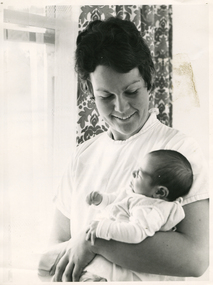 Royal District Nursing Service (now known as Bolton Clarke)
Photograph - Photograph, black and white, Barry Sutton, 17.10.1973
... Family Planning Clinic in 1934. In 1964 MDNS commenced a Post-Natal service with General and Midwifery trained MDNS Sisters working from a room on the ground floor at the Footscray Hospital Nurses quarters, and visiting early discharged Footscray Hospital maternity cases at home. Later, as Royal District Nursing Service (RDNS), this service was extended and renamed as Domiciliary Infant and Maternal Care, (DIMC) service operating from most Centres and visiting early discharged, often 24 hours after birth, maternity cases from hospitals to give Post-natal care to the mother and babe. ...Sister Snyders is based at RDNS Essendon Centre. She is a trained midwife working in the RDNS Domiciliary Infant and Maternal Care (DIMC), section and is attending a recently born baby in her home to give Post-Natal care. Often mothers and babes came home early from hospital, many after 24 hours of birth, and RDNS Sisters attended for several days to check babies progress, including - colour, feeding regime, weight, take a PKU test and give any advise needed to the mother. They also gave Post-Natal care to the mother. In August 1893 Melbourne District Nursing Society (MDNS), commenced a Midwifery Service with Nurse Fowler, who was trained in General nursing and Midwifery nursing, being the first Midwife employed. Mothers were assessed for suitability of a home birth or if they required delivery at the Women’s Hospital. The Midwife worked in conjunction with the Doctors at the Women’s Hospital and if a complication arose before or after birth the patient was transferred to their care. Following birth, the Midwife gave Post-Natal care to both the mother and babe commencing with visits twice a day. In 1898 the service ceased due to lack of funds but recommenced in 1906, and in the August 1925 Annual Report the number of MDNS home births was recorded at 478. MDNS built the After-Care Home and a pioneering Anti-Natal Clinic was opened in 1930. The last Ante-Natal clinic was held there in December 1951 and the MDNS Midwifery service ceased in February 1952. MDNS established Melbourne's first Family Planning Clinic in 1934. In 1964 MDNS commenced a Post-Natal service with General and Midwifery trained MDNS Sisters working from a room on the ground floor at the Footscray Hospital Nurses quarters, and visiting early discharged Footscray Hospital maternity cases at home. Later, as Royal District Nursing Service (RDNS), this service was extended and renamed as Domiciliary Infant and Maternal Care, (DIMC) service operating from most Centres and visiting early discharged, often 24 hours after birth, maternity cases from hospitals to give Post-natal care to the mother and babe. Many of the RDNS Sisters who carried out DIMC visits also had their Triple i.e. Infant and Child Welfare Certificate, though Midwifery trained nurses also made visits. This black and white photograph shows a close up view of Sister (Sr.) Mary-Ann Snyders from Royal District Nursing Service (RDNS), who is standing and cradling a recently born baby in the crook of her left arm; her supporting arm extends along the babe and her right arm is under babe. Sr. Snyders has short dark hair and is wearing a white gown over her uniform. She is smiling down at the babe, who has dark hair and is wearing a check bib over a white nightdress. To the left, voile curtains are seen over a window and in the background, part of an open patterned curtain is seen.Barry Sutton LW 4royal district nursing service, rdns, rdns dimc, sister mary-ann snyders -
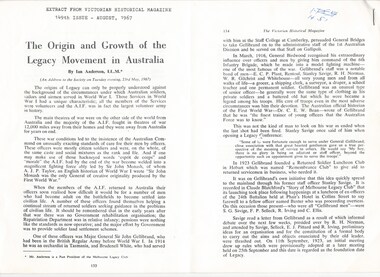 Melbourne Legacy
Document - Speech, The Origin and Growth of the Legacy Movement in Australia. (H51), 1967
... It was L/ Frank Doolan that proposed the 'real field for the movement's work lay in the care, guidance and encouragement of the families of those comrades who, through death, were themselves no longer there to give those benefits, and that as the children of deceased ex-servicemen were growing up, the cases were increasing in which some deputy was needed to take up among them the work for their deceased fathers, and to act virtually as a guardian or sponsor with the help and advice our dead comrade would have given.' ...It was L/ Frank Doolan that proposed the 'real field for the movement's work lay in the care, guidance and encouragement of the families of those comrades who, through death, were themselves no longer there to give those benefits, and that as the children of deceased ex-servicemen were growing up, the cases were increasing in which some deputy was needed to take up among them the work for their deceased fathers, and to act virtually as a guardian or sponsor with the help and advice our dead comrade would have given.' ...A photocopy of an article in the 'Victorian Historical Magazine', 149th Issue August 1967. It was an account of a speech by Legatee Ian Anderson to the Historical Society on 23 May 1967. Legatee Anderson was president of Melbourne Legacy Club in 1964. This is a very good quality account of details of Legacy up to the 1960s. The article outlines the key figures and events in the creation of Legacy in 1923. He mentions 8 of the members at the founding meeting in September 1923 were from the 24th Battalion. The name 'Legacy' was suggested by L/ Frank Selleck. Also the first two years of Legacy focused on the rehabilitation of returned servicemen and finding them work. It was L/ Frank Doolan that proposed the 'real field for the movement's work lay in the care, guidance and encouragement of the families of those comrades who, through death, were themselves no longer there to give those benefits, and that as the children of deceased ex-servicemen were growing up, the cases were increasing in which some deputy was needed to take up among them the work for their deceased fathers, and to act virtually as a guardian or sponsor with the help and advice our dead comrade would have given.' It mentions the Central Liaison Committee, the Co-ordinating Council, the dates of the formation of other clubs, the Code of Legacy, the residences, the annual demonstrations, also the camps and classes provided for children. He quotes L/ Stan Savige in a speech to the Annual Conference in 1950 and also part of the speech given to farewell L/ Savige after his death. The notation H51 in blue pen shows that it was part of the archive project that was trying to capture the history of Legacy. A highly detailed account of the formation and evolution of Legacy between 1923 and 1967.White A4 photocopy of an article about Legacy published in the Victorian Historical Magazine x 6 pages.Handwritten H51 in blue pen. Typed 'Extract from Victorian Historical Magazine, 149th Issue - August 1967' on top of first page.history, speech, founding legatee
