
Showing 6 items matching "family history component"
-
 Federation University Historical Collection
Book - Book - Scrapbook, Ballarat School of MInes: Scrapbook of Newspaper Cuttings, Book 67, December 1994 to March 1995
... ...family history component...The papers concerned are The Courier, Ballarat, The Australian, The Age over the period of 24 December 1994 to 9 March 1995. teaching positions advertised pre-employment courses courses available enrolment for smb courses smb help farmers tafe meets student needs historically a great city geoffrey blainey carole seymour victorian public service medal kevin martin ararat sm clinton miller draughtsman international skills olympics france mature age students ararat $12m information technology centre at ballarat university $6m for smb brewery site english course for overseas students university placements kennett funding for country tafe basic engineering courses at tafe libraries to combine resources bill hitchens ballarat university australian catholic university veronica moriarty barry firth smb training that suits veryone youth theatre workshops building links with industry family history component ballarat region's workskill peter morey sharon graham Book with yellow cover, front, spiral bound. ...Collection of newspaper articles related to Ballarat School Of Mines.They cover activities and advertisements for staff. The papers concerned are The Courier, Ballarat, The Australian, The Age over the period of 24 December 1994 to 9 March 1995.Book with yellow cover, front, spiral bound. teaching positions advertised, pre-employment courses, courses available, enrolment for smb courses, smb help farmers, tafe meets student needs, historically a great city, geoffrey blainey, carole seymour, victorian public service medal, kevin martin ararat sm, clinton miller draughtsman, international skills olympics france, mature age students ararat, $12m information technology centre at ballarat university, $6m for smb brewery site, english course for overseas students, university placements, kennett funding for country tafe, basic engineering courses at tafe, libraries to combine resources, bill hitchens, ballarat university, australian catholic university, veronica moriarty, barry firth, smb, training that suits veryone, youth theatre workshops, building links with industry, family history component, ballarat region's workskill, peter morey, sharon graham -
 Flagstaff Hill Maritime Museum and Village
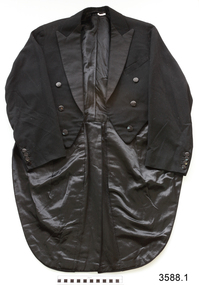
Formal suit, 1925
... family of Doctor William Roy Angus, Surgeon and Oculist, according to the doner.. There is another name on some of the garments, possibly because the suit components were acquired second hand at the time when Dr Angus was in his early practice days. It is part of the “W.R. Angus Collection” that includes historical medical equipment, surgical instruments and material once belonging to Dr Edward Ryan and Dr Thomas Francis Ryan, (both of Nhill, Victoria) as well as Dr Angus’ own belongings. The Collection’s history...family of Doctor William Roy Angus, Surgeon and Oculist, according to the doner.. There is another name on some of the garments, possibly because the suit components were acquired second hand at the time when Dr Angus was in his early practice days. It is part of the “W.R. Angus Collection” that includes historical medical equipment, surgical instruments and material once belonging to Dr Edward Ryan and Dr Thomas Francis Ryan, (both of Nhill, Victoria) as well as Dr Angus’ own belongings. The Collection’s history ...This formal suit, comprising tails coat, trousers, waistcoat and shirt, is believed by Berry McDade (daughter of Dr Angus) to be the one donated to Flagstaff Hill Maritime Village by the family of Doctor William Roy Angus, Surgeon and Oculist, according to the doner.. There is another name on some of the garments, possibly because the suit components were acquired second hand at the time when Dr Angus was in his early practice days. It is part of the “W.R. Angus Collection” that includes historical medical equipment, surgical instruments and material once belonging to Dr Edward Ryan and Dr Thomas Francis Ryan, (both of Nhill, Victoria) as well as Dr Angus’ own belongings. The Collection’s history spans the medical practices of the two Doctors Ryan, from 1885-1926 plus that of Dr Angus, up until 1969. ABOUT THE “W.R.ANGUS COLLECTION” Doctor William Roy Angus M.B., B.S., Adel., 1923, F.R.C.S. Edin.,1928 (also known as Dr Roy Angus) was born in Murrumbeena, Victoria in 1901 and lived until 1970. He qualified as a doctor in 1923 at University of Adelaide, was Resident Medical Officer at the Royal Adelaide Hospital in 1924 and for a period was house surgeon to Sir (then Mr.) Henry Simpson Newland. Dr Angus was briefly an Assistant to Dr Riddell of Kapunda, then commenced private practice at Curramulka, Yorke Peninsula, SA, where he was physician, surgeon and chemist. In 1926, he was appointed as new Medical Assistant to Dr Thomas Francis Ryan (T.F. Ryan, or Tom), in Nhill, Victoria, where his experiences included radiology and pharmacy. In 1927 he was Acting House Surgeon in Dr Tom Ryan’s absence. Dr Angus had become engaged to Gladys Forsyth and they decided he would take time to further his studies overseas in the UK in 1927. He studied at London University College Hospital and at Edinburgh Royal Infirmary and in 1928, was awarded FRCS (Fellow from the Royal College of Surgeons), Edinburgh. He worked his passage back to Australia as a Ship’s Surgeon on the on the Australian Commonwealth Line’s SS Largs Bay. Dr Angus married Gladys in 1929, in Ballarat. (They went on to have one son (Graham 1932, born in SA) and two daughters (Helen (died 12/07/1996) and Berenice (Berry), both born at Mira, Nhill ) Dr Angus was a ‘flying doctor’ for the A.I.M. (Australian Inland Ministry) Aerial Medical Service in 1928 . The organisation began in South Australia through the Presbyterian Church in that year, with its first station being in the remote town of Oodnadatta, where Dr Angus was stationed. He was locum tenens there on North-South Railway at 21 Mile Camp. He took up this ‘flying doctor’ position in response to a call from Dr John Flynn; the organisation was later known as the Flying Doctor Service, then the Royal Flying Doctor Service. A lot of his work during this time involved dental surgery also. Between 1928-1932 he was surgeon at the Curramulka Hospital, Yorke Peninsula, South Australia. In 1933 Dr Angus returned to Nhill where he’d previously worked as Medical Assistant and purchased a share of the Nelson Street practice and Mira hospital from Dr Les Middleton one of the Middleton Brothers, the current owners of what was once Dr Tom Ryan’s practice. Dr L Middleton was House Surgeon to the Nhill Hospital 1926-1933, when he resigned. [Dr Tom Ryan’s practice had originally belonged to his older brother Dr Edward Ryan, who came to Nhill in 1885. Dr Edward saw patients at his rooms, firstly in Victoria Street and in 1886 in Nelson Street, until 1901. The Nelson Street practice also had a 2 bed ward, called Mira Private Hospital ). Dr Edward Ryan was House Surgeon at the Nhill Hospital 1884-1902 . He also had occasions where he successfully performed veterinary surgery for the local farmers too. Dr Tom Ryan then purchased the practice from his brother in 1901. Both Dr Edward and Dr Tom Ryan work as surgeons included eye surgery. Dr Tom Ryan performed many of his operations in the Mira private hospital on his premises. He too was House Surgeon at the Nhill Hospital 1902-1926. Dr Tom Ryan had one of the only two pieces of radiology equipment in Victoria during his practicing years – The Royal Melbourne Hospital had the other one. Over the years Dr Tom Ryan gradually set up what was effectively a training school for country general-practitioner-surgeons. Each patient was carefully examined, including using the X-ray machine, and any surgery was discussed and planned with Dr Ryan’s assistants several days in advance. Dr Angus gained experience in using the X-ray machine there during his time as assistant to Dr Ryan. Dr Tom Ryan moved from Nhill in 1926. He became a Fellow of the Royal Australasian College of Surgeons in 1927, soon after its formation, a rare accolade for a doctor outside any of the major cities. He remained a bachelor and died suddenly on 7th Dec 1955, aged 91, at his home in Ararat. Scholarships and prizes are still awarded to medical students in the honour of Dr T.F. Ryan and his father, Dr Michael Ryan, and brother, John Patrick Ryan. ] When Dr Angus bought into the Nelson Street premises in Nhill he was also appointed as the Nhill Hospital’s Honorary House Surgeon 1933-1938. His practitioner’s plate from his Nhill surgery states “HOURS Daily, except Tuesdays, Fridays and Saturday afternoons, 9-10am, 2-4pm, 7-8pm. Sundays by appointment”. This plate is now mounted on the doorway to the Port Medical Office at Flagstaff Hill Maritime Village, Warrnambool. Dr Edward Ryan and Dr Tom Ryan had an extensive collection of historical medical equipment and materials spanning 1884-1926 and when Dr Angus took up practice in their old premises he obtained this collection, a large part of which is now on display at the Port Medical Office at Flagstaff Hill Maritime Village in Warrnambool. During his time in Nhill Dr Angus was involved in the merging of the Mira Hospital and Nhill Public Hospital into one public hospital and the property titles passed on to Nhill Hospital in 1939. In 1939 Dr Angus and his family moved to Warrnambool where he purchased “Birchwood,” the 1852 home and medical practice of Dr John Hunter Henderson, at 214 Koroit Street. (This property was sold in1965 to the State Government and is now the site of the Warrnambool Police Station. ). The Angus family was able to afford gardeners, cooks and maids; their home was a popular place for visiting dignitaries to stay whilst visiting Warrnambool. Dr Angus had his own silk worm farm at home in a Mulberry tree. His young daughter used his centrifuge for spinning the silk. Dr Angus was appointed on a part-time basis as Port Medical Officer (Health Officer) in Warrnambool and held this position until the 1940’s when the government no longer required the service of a Port Medical Officer in Warrnambool; he was thus Warrnambool’s last serving Port Medical Officer. (The duties of a Port Medical Officer were outlined by the Colonial Secretary on 21st June, 1839 under the terms of the Quarantine Act. Masters of immigrant ships arriving in port reported incidents of diseases, illness and death and the Port Medical Officer made a decision on whether the ship required Quarantine and for how long, in this way preventing contagious illness from spreading from new immigrants to the residents already in the colony.) Dr Angus was a member of the Australian Medical Association, for 35 years and surgeon at the Warrnambool Base Hospital 1939-1942, He served as a Surgeon Captain during WWII1942-45, in Ballarat, Victoria, and in Bonegilla, N.S.W., completing his service just before the end of the war due to suffering from a heart attack. During his convalescence he carved an intricate and ‘most artistic’ chess set from the material that dentures were made from. He then studied ophthalmology at the Royal Melbourne Eye and Ear Hospital and created cosmetically superior artificial eyes by pioneering using the intrascleral cartilage. Angus received accolades from the Ophthalmological Society of Australasia for this work. He returned to Warrnambool to commence practice as an ophthalmologist, pioneering in artificial eye improvements. He was Honorary Consultant Ophthalmologist to Warrnambool Base Hospital for 31 years. He made monthly visits to Portland as a visiting surgeon, to perform eye surgery. He represented the Victorian South-West subdivision of the Australian Medical Association as its secretary between 1949 and 1956 and as chairman from 1956 to 1958. In 1968 Dr Angus was elected member of Spain’s Barraquer Institute of Barcelona after his research work in Intrasclearal cartilage grafting, becoming one of the few Australian ophthalmologists to receive this honour, and in the following year presented his final paper on Living Intrasclearal Cartilage Implants at the Inaugural Meeting of the Australian College of Ophthalmologists in Melbourne In his personal life Dr Angus was a Presbyterian and treated Sunday as a Sabbath, a day of rest. He would visit 3 or 4 country patients on a Sunday, taking his children along ‘for the ride’ and to visit with him. Sunday evenings he would play the pianola and sing Scottish songs to his family. One of Dr Angus’ patients was Margaret MacKenzie, author of a book on local shipwrecks that she’d seen as an eye witness from the late 1880’s in Peterborough, Victoria. In the early 1950’s Dr Angus, painted a picture of a shipwreck for the cover jacket of Margaret’s book, Shipwrecks and More Shipwrecks. She was blind in later life and her daughter wrote the actual book for her. Dr Angus and his wife Gladys were very involved in Warrnambool’s society with a strong interest in civic affairs. Their interests included organisations such as Red Cross, Rostrum, Warrnambool and District Historical Society (founding members), Wine and Food Society, Steering Committee for Tertiary Education in Warrnambool, Local National Trust, Good Neighbour Council, Housing Commission Advisory Board, United Services Institute, Legion of Ex-Servicemen, Olympic Pool Committee, Food for Britain Organisation, Warrnambool Hospital, Anti-Cancer Council, Boys’ Club, Charitable Council, National Fitness Council and Air Raid Precautions Group. He was also a member of the Steam Preservation Society and derived much pleasure from a steam traction engine on his farm. He had an interest in people and the community He and his wife Gladys were both involved in the creation of Flagstaff Hill, including the layout of the gardens. After his death (28th March 1970) his family requested his practitioner’s plate, medical instruments and some personal belongings be displayed in the Port Medical Office surgery at Flagstaff Hill Maritime Village, and be called the “W. R. Angus Collection”. The W.R. Angus Collection is significant for still being located at the site it is connected with, Doctor Angus being the last Port Medical Officer in Warrnambool. The collection of medical instruments and other equipment is culturally significant, being an historical example of medicine from late 19th to mid-20th century. Dr Angus assisted Dr Tom Ryan, a pioneer in the use of X-rays and in ocular surgery. Formal suit, worn by Dr Angus, Coat (.1): black double-breasted with tails, black round flat, shank buttons, quilting inside (under armholes), label "BRAHAM & CO / 614 ALDERSGATE ST E.C / Mr G Hobson, 1925 Aug". Trousers (.2): black, button fly, black braid stripe, nametag "J.C. RENYARD" stamped number on front right pocket lining "163332-2-3398F" Waistcoat (.3): black, 4x 4-holed black buttons. Shirt (.4); white cotton, long sleeves, round neck, long tailed, bib front, 4x button holes each side, stamp around neck "4.AM:25", label "THE AINSLY SHIRT", name in pen "R115 RENYARD", remnants of red cotton stitching on neck (W.R. Angus Collection)Jacket has label label "BRAHAM & CO / 614 ALDERSGATE ST E.C / Mr G Hobson, 1925 Aug Trousers nametag "J.C. RENYARD" stamped number on front right pocket lining "163332-2-3398F" Shirt has stamp around neck label "THE AINSLY SHIRT", name in pen "R115 RENYARDflagstaff hill, warrnambool, shipwrecked-coast, flagstaff-hill, flagstaff-hill-maritime-museum, maritime-museum, shipwreck-coast, flagstaff-hill-maritime-village, formal sout, tails suit, dr w r angus, the ailsley shirt, ophthalmology, formal clothing, mira hospital, nhill base hospital -
 City of Melbourne Libraries
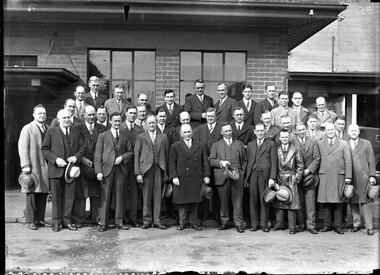
Photograph, Bull, Hugh Jones, 1897-1993, Steel manufacturers, McPherson's Ltd, Melbourne
... history', Hard Bakka Steel Fabrication, https://www.hardbakka.com.au/component/virtuemart/steel-manufacturing-in-australia-a-brief-history?Itemid=494 McPherson's Limited, University of Melbourne Archives, https://archives.library.unimelb.edu.au/nodes/view/58364 Source of Description: 'Nuts and Bolts: A story of a family and a firm', Barbara Hamer (2006), McPherson’s Printing Group 'Photograph of 'Bolt works picnic' 1920', University of Melbourne Archives, https://archives.library.unimelb.edu.au/assets/display/1287217-max?...history', Hard Bakka Steel Fabrication, https://www.hardbakka.com.au/component/virtuemart/steel-manufacturing-in-australia-a-brief-history?Itemid=494 McPherson's Limited, University of Melbourne Archives, https://archives.library.unimelb.edu.au/nodes/view/58364 Source of Description: 'Nuts and Bolts: A story of a family and a firm', Barbara Hamer (2006), McPherson’s Printing Group 'Photograph of 'Bolt works picnic' 1920', University of Melbourne Archives, https://archives.library.unimelb.edu.au/assets/display/1287217-max? ...Photographer notations on slide: Steel Manuf’rs at McPherson’s Ltd 1933 Published: The Age, 30 August 1933 BUREAU OF STEEL MANUFACTURERS OF AUSTRALIA. (1933, August 30). The Age (Melbourne, Vic. : 1854 - 1954), p. 11. Retrieved January 25, 2026, from http://nla.gov.au/nla.news-article204372874 Published title: Bureau of Steel Manufacturers of Australia Published caption: A group of Inter-State Visitors, from the Bureau of Steel Manufacturers of Australia, on a tour of inspection at the Bolt Works of McPhersons Pty. Ltd., Burnley-Richmond, yesterday. Research by Project Volunteer, Louise McKenzie: The photo shows a line up of 36 men, in three rows, in front of a building. They are mostly dressed in dark 3-piece suits, or camel coats. But one gentleman stands out in his full length leather coat! Striped ties are popular, and they are all holding hats. One man, at the rear towards the right, looks a bit younger with his thick, black, brylcreamed hair.. These interstate gentlemen are described in the newspaper caption as representatives of the Bureau of Steel Manufacturers "...on a tour of inspection at the Bolt Works of McPhersons Pty Ltd, Burnley, Richmond." Interestingly, the Bureau of Steel Manufacturers of Australia (BOSMA) still exists, and is the industry body for major Australian steel producers like BlueScope, Liberty, and InfraBuild, representing their interests, engaging with government, and participating in standards setting for the domestic steel market, with a history dating back to 1923. While BOSMA focuses on primary manufacturing, the Australian Steel Institute (ASI) serves as the broader peak body for the entire steel supply chain, from mills to end-users, promoting and supporting the industry. But at the time of this photo, the Australian steel industry was just starting to make headway. As the AST website explains, "Steelmaking in Australia began just a decade prior to the start of the 1851 Gold Rush whilst Australia was still divided into colonies. Iron ore deposits were discovered in 1840 at Iron Knob, South Australia but a lack of equipment meant that the process of producing steel was impossible. Even attempts at smelting the iron ore in a blast furnace to create pig iron were unsuccessful due to the poor quality of iron ore and coke available to the budding industry. In the other colonies at the time, such as Victoria, Tasmania, and New South Wales, there were minor discoveries of iron ore but poor technical expertise and limited quantity meant that the quality of steel was poor. Compared to the far superior steel being imported from Britain at the time, the steel manufacturing industry simply couldn’t compete and was unviable. By the 1870s, almost all steel production in Australia had been abandoned. The situation began to change at the turn of the century. Rapid growth sparked higher demand for industrial machinery made from steel and infrastructure such as rail. It became apparent that there was a need for locally manufactured steel and soon there would be an answer. In 1901, the year Australia united into a federation, the nation’s first blast furnace went into production at Eskbank near Lithgow in New South Wales. The development was spearheaded by William Stafford and his son Esk, and Stafford is known as the father of Australian steel production. In 1915, production expanded with another steel mill in Newcastle that was opened by BHP. It sourced coke from local mines and iron ore from South Australia, creating a domestic loop for steel manufacturing. In the following years, more steelworks opened in Whyalla, South Australia and Port Kembla in NSW. Steel manufacturing in Australia was now underway." The company mentioned in the photo’s notation and in the newspaper caption, was McPhersons, "...an Australian hardware firm, for many years a leading merchant of woodworking and metal-working machinery... [and founded by] Thomas McPherson (c.1823–1888) who had a home "Dudley House" at 142 Dudley Street, West Melbourne. [The] ironmongery business [was located] in 1860 at 149 Spencer Street, Melbourne. Merchandise carried included bells, lathes, horseshoes and steam engines." (Wikipedia - McPherson's Pty Ltd) Anyone who has read Robyn Annear’s excellent award-winning 2014 book Bearbrass – the name for early Melbourne - will remember only too well her description of West Melbourne, from where the city of Melbourne as we know it, emerged. Her book resurrects the village that was early Melbourne – from the arrival of white settlers in 1835 until the first gold rushes shook the town – and brings it to life in vivid colour. The McPherson family, whose arrival in Bearbrass coincides with this period (Thomas arrived in 1852), became intimately involved in the growth and development of Melbourne. Thomas was Mayor of Melbourne (1870-1871); his eldest son Hunter became a successful Sydney businessman; second son Edward and third son William inherited the company, and ran it together until 1896 when Edward killed himself. William had a notable career in politics as treasurer of Victoria 1917-1923, in which year he was knighted. 1928-1929 he was Premier of Victoria, and a noted philanthropist. The family were significant property owners in the city of Melbourne: 149 Spencer Street, 582-588 Collins Street, 554-566 Collins Street, together with a property on Jeffcott Street, West Melbourne, and factories in Sunshine, Tottenham, Kensington and Richmond – all by the mid 1940s. By that time they also had controlling interests in several Australasian industries, including Ajax Bolt and Rivet Pty Ltd of NZ, F W Hercus Manufacturing Co Ltd, manufacturers in South Australia of lathes, guillotines and other heavy machinery, also of Patience and Nicholson (P & N), manufacturers in Maryborough, Victoria, of twist drills and thread-forming tools; also Wiltshire Files on Sunshine Road, Tottenham, manufacturing files and rasps. The Acme Machine Tool Company became a branch of McPhersons, and the company claimed to have supplied, from their own manufacture, all five million rivets (some 3,600 tonnes) used in the building of the Sydney Harbour Bridge – described as a steel through arch bridge, which opened in 1932; the tallest of its kind in the world (Wikipedia – Sydney Harbour Bridge) McPherson’s was also innovative in other ways. It published a comprehensive catalogue, extensively detailed with prices, available free of charge to farmers and other businesses. In 1908 it had 148 pages. By 1937 it had grown to 372 pages. The University of Melbourne’s Archives entry on McPherson’s Limited notes: "After the outbreak of the Second World War, McPherson’s factories worked at full capacity and were crucial to Australia’s war efforts. On 5 December 1944 McPherson's converted to a public company named McPherson's Ltd, with William Edward as Chairman of Directors. By the start of the 1950s the company had a very different Board of Directors; in 1947 the Managing Director Oliver Addison died, and his replacement Marshall Eady died only six months later. Both had been Directors since McPherson’s became a proprietary company in 1913. Another Director, Philip Bevan, died in 1948 and this was followed by the death of William Edward in 1950. S.B Holder, F.G. Thorpe, H.L. Hastie, F. Grassick and D.G. Syme all joined the Board before 1950. The company continued to prosper for many years after the death of William Edward. His son, William David, was invited to join the McPherson’s Ltd Board in 1951. He married Angela Cumming in 1955 and soon after was sent to Brisbane as Director in Charge to oversee the building of a new warehouse. The opening of this warehouse in Queensland meant that the company now had major outlets in five states. As time went on, manufacturing in Australia began to decline and imports of everyday tools began arriving from Asia. These tools were being produced with much lower labour costs and could be sold at cheaper prices. William David retired in 1984 and eventually parts of the company were divested, such as the Richmond Bolt Works which closed in the early 1990s. Since the 1980s, McPherson's has diversified into housewares, printing, and health and beauty care products." This article also contains photos, one of which is a photograph of 'Bolt works picnic' 1920, showing workers in their shirt sleeves participating in a tug of war in a rural "picnic" setting. McPherson’s premises at 554-566 Collins Street more than lasted the test of time and is listed as historically significant. The magnificent art deco building from the 1930s in the heart of Melbourne was first commissioned in 1934 and completed in 1937. It is an imposing building fronting almost a quarter of the city block between Spencer Street and King Street, and was designed to be a warehouse, office and showroom for the hardware empire. International architects Stuart P Calder, and Reid and Pearson designed the four-storey building with a basement level and a stair tower at the centre that provides access to what was a tennis court on the roof. It is considered an example of the streamlined modern style in Melbourne and shows how the McPherson company, protected from taxes after World War I, was able to manufacture goods without being affected by the competition. The building has survived, and its current iteration is as the home to il Mercato Centrale – an Italian style artisan market concept. The University of Melbourne Archives hold a particularly good image of the building from its heyday, complete with Collins Street lamps on the pavement outside the store. And to return to our image, sited at "Bolt Works of McPhersons". Today this segment of McPhersons is still very well known - Ajax. A good summary of the company’s history, and the development of the name and business, can be found on the Mine Suppliers Online website: "AJAX Fasteners can trace its heritage back to 1900, when the Acme Bolt Company was established in West Melbourne, Victoria. In 1909, William McPherson used the company as the basis for establishing McPherson’s Bolt Works – adopting the brand ‘Ajax’ – and moved it to Richmond. Over the years, the company changed many times in response to industry needs to ensure that it remained the premier manufacturer of high quality fasteners in Australia. Many other names in the industry, such as Firth Cleveland, Spurway Cooke and Nettlefolds were merged or acquired into the company. McPhersons ended their 80-year ownership of Ajax in the early 90s when they sold their shares to National Consolidated, which was also a major shareholder at the time. In 1997, Ajax Fasteners moved to new purpose-built premises in Braeside, Victoria. Soon after, National Consolidated was taken over by the diversified manufacturer Austrim. The group soon acquired the iconic Nylex, and adopted the name Nylex Corporation. In January 2007, ACME Operations Pty Ltd acquired Ajax Fasteners and continues to operate the business today from the Braeside plant. The name ACME provides a nostalgic return by the new owners to the company’s heritage, when the Acme Bolt Company was founded in July 1900." REFERENCES: BUREAU OF STEEL MANUFACTURERS OF AUSTRALIA. (1933, August 30). The Age (Melbourne, Vic. : 1854 - 1954), p. 11. Retrieved January 25, 2026, from http://nla.gov.au/nla.news-article204372874 Wikipedia, McPherson’s Pty Ltd, https://en.wikipedia.org/wiki/McPherson%27s_Pty_Ltd Wikipedia, Richmond, Victoria, https://en.wikipedia.org/wiki/Richmond,_Victoria Industry: From the mid-19th century, Richmond was a centre of manufacturing industry, including many large complexes such as the Bryant & May match factory, Jaques Limited engineering works, the Wertheim Piano factory and Pelaco. Wikipedia, Sydney Harbour Bridge, https://en.wikipedia.org/wiki/Sydney_Harbour_Bridge eMelbourne, Manufacturing, https://www.emelbourne.net.au/biogs/EM00896b.htm 'New life for Melbourne's McPherson Building', The Urban Developer, https://www.theurbandeveloper.com/articles/mcphersons-building-melbourne-il-mercato-centrale-food-retail-destination Bureau Of Steel Manufacturers Of Australia Limited, http://www.bosma.org.au/ 'A Brief History of Steel Manufacturing in Australia', AST, https://astraders.com.au/a-brief-history-of-steel-manufacturing-in-australia/ 'Steel manufacturing in Australia: a brief history', Hard Bakka Steel Fabrication, https://www.hardbakka.com.au/component/virtuemart/steel-manufacturing-in-australia-a-brief-history?Itemid=494 McPherson's Limited, University of Melbourne Archives, https://archives.library.unimelb.edu.au/nodes/view/58364 Source of Description: 'Nuts and Bolts: A story of a family and a firm', Barbara Hamer (2006), McPherson’s Printing Group 'Photograph of 'Bolt works picnic' 1920', University of Melbourne Archives, https://archives.library.unimelb.edu.au/assets/display/1287217-max?u=dea2e4d2fd07ac822e624f1e7d39adb3 'Photograph of the exterior of the McPhersons Department store at 546 Collins Street, Melbourne.', University of Melbourne Archives, https://archives.library.unimelb.edu.au/assets/display/1287215-max?u=12430d30453a77059b7d10d49006a521 Robyn Annear, Bearbrass: imagining early Melbourne, Black Inc., 2014 (originally published 1995 by Mandarin) 'Company details', Ajax Fasteners, http://www.minesuppliersonline.com.au/australia/braeside/hardware/ajax-fasteners 'Former McPherson's Building', Victorian Heritage Database, https://vhd.heritagecouncil.vic.gov.au/places/741Photographer notations on slide: "Steel manuf'rs at McPherson's Ltd 1933 B5".1930-1939, industrial workers, clothing and dress, 1930, iron and steel industry, businesses, bridges, industry, melbourne, gold rush, moderne style architecture -
 Federation University Art Collection
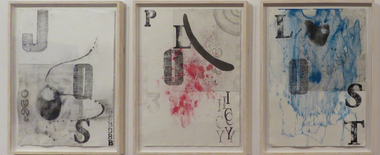
Work on paper, Patrice Mahoney, 'Jobs, Policy and LOST' (tryptich) by Patrice Mahoney, 2014
... components of her work. This work expresses the artist's frustration with unjust situations experienced by traditional owners of Nganyaywana country. The word 'Policy' refers to White Australia Policy, 'Lost' the hundreds of lost family members, and 'Jobs' highlights the difficulty of Aboriginal peple obtaining work, especially outside Aboriginal positions and policy. The number 3 symbolises Patrice Mahoney's siblings, with black used to denote family history...components of her work. This work expresses the artist's frustration with unjust situations experienced by traditional owners of Nganyaywana country. The word 'Policy' refers to White Australia Policy, 'Lost' the hundreds of lost family members, and 'Jobs' highlights the difficulty of Aboriginal peple obtaining work, especially outside Aboriginal positions and policy. The number 3 symbolises Patrice Mahoney's siblings, with black used to denote family history ...These works are a display of my frustration of hour our family were lucky we were not beheaded, scalped, taken away and impaled as a warning to others not to enter farming lands, which had been traditional lands of the Nganyaywana country. The word 'Policy' represents the White Australia Policy, the word "Lost' stands for those lost including hundreds of family members, 'Jobs' asks why Aboriginal people can only find employment if through Aboriginal positions and policies. The number 3 symbolises myself and my siblings, red is for bloodshed, blue is for secrets and black the family history. Patrice MUTHAYMILES MAHONEY OAM Anewan/Nganyaywan/Dunghutti country. Patrice Mahoney is a printmaker, sculptor, weaver, drawer and painter. Her work challenges mainstream and Aboriginal Australians and is profoundly influenced by space, place and country, taking inspiration from nature, environment and looking forward to a time when she can return to her family's traditional country to make work. In 2012 the artist completed a Bachelor of Visual and Media Arts at Monash University’s Churchill campus (from 2014 Federation University's Churchill Campus). The Victorian Indigenous Art Awards 2014 were exhibited and judged at the Art Gallery of Ballarat.This unique edition triptych involves the techniques of intaglio copper plate, pigment, soft ground, open bite, aquatint, spit-bite, stamping, relief, drawing and burnishing on paper. It was awarded the 2014 Victorian Indigenous Art Awards Federation University Acquisitive Award for for work by a Victorian regional artist. Text, colour, metaphor and Aboriginal symbolism are important components of her work. This work expresses the artist's frustration with unjust situations experienced by traditional owners of Nganyaywana country. The word 'Policy' refers to White Australia Policy, 'Lost' the hundreds of lost family members, and 'Jobs' highlights the difficulty of Aboriginal peple obtaining work, especially outside Aboriginal positions and policy. The number 3 symbolises Patrice Mahoney's siblings, with black used to denote family history. The violently splattered red represents bloodshed, with the blue washing across the work obscuring details and representing secrets. The Selection Panel of the 2014 Victorian Indigenous Art Awards made the following comments on the work: 'The selection panel for the Federation University Acquisitive Award for 2014 were highly impressed by this work and applauded the vigorous use of symbolism and metaphor in a well scripted visual composition. The poignancy of connectedness to the past, memory, place and country is palpable and enhanced by the suggestive employment of text and minimal colour. A provocative and evocative work of art!artist, artwork, patrice mahoney, aboriginal, victorian indigenous awards, jobs, culture, printmaking, drawing, policies, lost, victorian indigenous art awards, available, alumni -
Kew Historical Society Inc
Archive (collection) - Subject Files, Kew Historical Society, 1958-present
... histories of families and buildings, personal accounts, etc. - relating to people, places and events. The series as a whole is sorted alphabetically. Each component...histories of families and buildings, personal accounts, etc. - relating to people, places and events. The series as a whole is sorted alphabetically. Each component ...Various partiesReference, Research, InformationAlphabetic orderSubject Files have been created and compiled by members since 1958. The Files are defined as a Series. They include primary and secondary resources - newspaper and journal clippings, brochures, short histories of families and buildings, personal accounts, etc. - relating to people, places and events. The series as a whole is sorted alphabetically. Each component of the series is grouped by Secondary Values (the values of records to users) rather than by Primary Values (Provenance Order). There are approximately 500 separate Subject Files. While some files contain a small number of records, others contain numerous documents and manuscripts. The Subject Files are housed in four, four-drawer locked filing cabinets in the foyer of the Kew Heritage Centre in the Kew Library, and are housed in labelled, archivally sound folders.kew, boroondara, melbourne, victoriakew, boroondara, melbourne, victoria -
 Sunbury Family History and Heritage Society Inc.
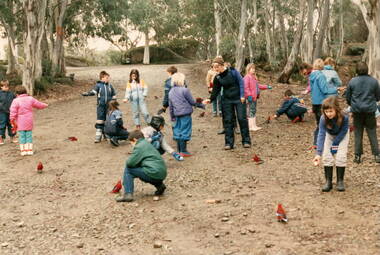
Photograph, School Camp, 1988
... Family History and Heritage Society Inc. Sunbury Global Learning Centre Macedon Street Sunbury melbourne The photograph was taken when the students from Bulla and Mickleham Primary Schools combined to attend a camp at Beechworth in 1988. During that time the children were engaged in a number of different outdoor activities as a component ...The photograph was taken when the students from Bulla and Mickleham Primary Schools combined to attend a camp at Beechworth in 1988. During that time the children were engaged in a number of different outdoor activities as a component of their outdoor education. Recognising some of the native birds of the area was one of their activities where the children experiences the birds actually landing on them.The varied activities that the children engaged in at the school camp helped to give them a better appreciation and understanding of the natural environment. A non-digital coloured photograph of a group of children with some adults in a bushland area, trying to encourage a flock of crimson rosellas to come closer by feeding them.school camps, beechworth, native birds, crimson rosellas
