
Showing 93 items matching "farm implement"
-
 Sunshine and District Historical Society Incorporated
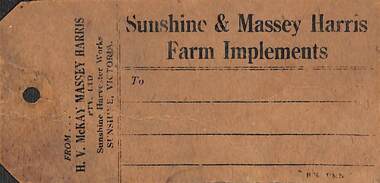
Administrative record - H.V. McKay Massey Harris Farm Implement Destination Tag
... McKay Massey Harris Farm Implement Destination Tag...Sunshine & Massey Harris Farm Implements from H.V. McKay Massey Harris Pty ltd Sunshine Harvester Works Sunshine Victoria...McKay Massey Harris Farm Implement Destination Tag ...Paper tag with holeSunshine & Massey Harris Farm Implements from H.V. McKay Massey Harris Pty ltd Sunshine Harvester Works Sunshine Victoriah.v. mckay massey harris, sunshine harvester works, farm machinery -
 Greensborough Historical Society
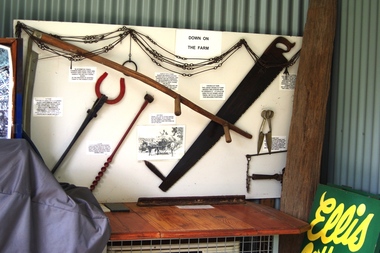
Photograph - Digital image, Marilyn Smith, Ellis Cottage, May 2016: Farm Implement Display, 27/05/2016
... Ellis Cottage, May 2016: Farm Implement Display...This photo shows a farm implement display in the Historical Centre....This photo shows a farm implement display in the Historical Centre. ellis cottage nillumbik historical society inc. ...In May 2016, the Nillumbik Historical Society invited Greensborough Historical Society to visit its historical centre at Ellis Cottage in Diamond Creek. Ellis Cottage was built in 1865 and is made of local uncut stone. The cottage is a typical farmers residence of this period. The stone construction is unique in this district as most construction is weatherboard. This photo shows a farm implement display in the Historical Centre.Digital colour photographellis cottage, nillumbik historical society inc. -
 Orbost & District Historical Society
farm implement
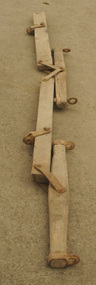
... farm implement...It appears to be a 2-horse set of swinglebars with a double-bar. which has been added to and repaired. farm implement ...This is a very common 'farm' style of old swinglebar. Blacksmiths and agricultural machinery suppliers made them by the thousands. They were used most commonly on heavy vehicles pulled by horses. This one would have been used on a farming property on the Orbost district.This item is an example of an early farming implement used in the Orbost district. It also demonstrates the improvisation skills of the agricultural community.Four pieces of wood connected by iron fittings. Two pieces have iron loops at both ends. The two straight pieces appear to be newer. There are two swingle trees. It appears to be a 2-horse set of swinglebars with a double-bar. which has been added to and repaired.agricultural-implement horses farming swinglebar -
 Sunshine and District Historical Society Incorporated
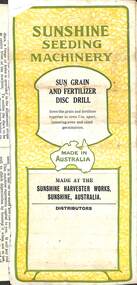
Manual - H.V. McKay Massey Harris And Massey Harris Farm Implement Manuals
... McKay Massey Harris And Massey Harris Farm Implement Manuals...McKay Massey Harris And Massey Harris Farm Implement Manuals ...2068.01 - H.V. McKay Massey Harris Sun Grain And Fertilizer Disc Drill 2068.02 - H.V. McKay Massey Harris 12 Disc Sun Grain Drill List Of Duplicate Parts 2068.03 - H.V. McKay Massey Harris 6B Reaper And Binder List Of Duplicate Parts List 39 3904 2068.04 - H.V. McKay Massey Harris 6B Reaper And Binder List Of Duplicate Parts List No 39 4004 2068.05 - H.V. McKay Massey Harris The Sunshine Auto Header 2068.06 - H.V. McKay Massey Harris Australian Farm Machinery 2068.07 - H.V. McKay Massey Harris The Sunshine Striiper Harvester Type AL 2068.08 - H.V. McKay Massey Harris The New Sunshine Milker 2068.09 - H.V. McKay Massey Harris Sunshine Header Harvesters 2068.10 - Massey Harris No 6 Left Hand Binder Repair Parts List 2068.11 - Massey Harris No 10A Binder Repair Parts Lints 2068.12 - Massey Harris No 14 Binder Repair Parts List 2068.13 - Massey Harris No 1 Binder Repair Parts List 2068.14 - Massey Harris No 6B Reaper And Binderh.v. mckays massey ferguson, sunshine harvester works -
 Emerald Museum & Nobelius Heritage Park
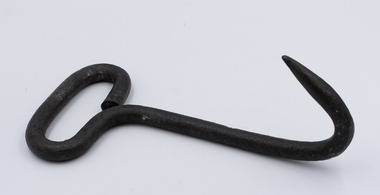
Tool - Farm Implement – hook with handle, c. 1940s
... Farm Implement – hook with handle...The other end of the hook's shank is wrapped into a large handle. Tool Farm Implement – hook with handle ...This hook was used by George and Noel A'Vard on their farm from the 1940s to lift bags of potatoes, chaff, and animal food. Sack or bag hooks were designed to make carrying these heavy bags far easier. The pointed end was sharp enough to pierce a woven bag and the handle was designed to fit ergonomically into the palm of a farmer's hand. This saved them from having to bend to pick the bags up or strain their fingers by gripping the necks of many bags over the course of a long and laborious day. Many sack hooks had a wooden handle which was attached to the shank later in the construction process, but the A'Vard family's hook is made from one continuous piece of iron, likely shaped with a tool by a local blacksmith in the early-mid 20th century.This hook is a prime example of the many tools farmers in Emerald and its surrounding agricultural areas used around their properties to ease the strain of manual labour. Prior to the mass mechanisation of farms, difficult tasks were done by hand, and any tool that could assist in their completion would have been greatly valued. A large, rusted iron or steel hook, tapered to a sharp point at one end. The other end of the hook's shank is wrapped into a large handle.emerald, a'vard family, 20th century, 1940s, farming -
 Emerald Museum & Nobelius Heritage Park
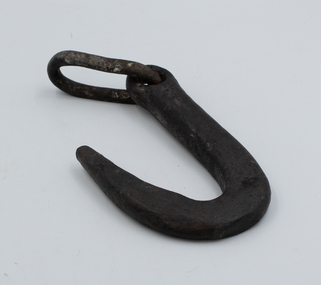
Tool - Farm Implement – Large Hook, c. 1940s
... Farm Implement – Large Hook...farm from the 1940s to hitch animal trailers or other dragged farming tools. The loop, which passes through the eye of the hook, would have once been attached to a sturdy chain and used to attach various implements for towing, dragging, or lifting heavy farming equipment or items. ...An iron loop is threaded through the eye of the hook. Tool Farm Implement – Large Hook ...This hook was used by George and Noel A'Vard on their farm from the 1940s to hitch animal trailers or other dragged farming tools. The loop, which passes through the eye of the hook, would have once been attached to a sturdy chain and used to attach various implements for towing, dragging, or lifting heavy farming equipment or items. It may have assisted on the A'Vard fields, or in any number of tasks that were unable to be completed with only human labour.This hook is a prime example of the many tools farmers in Emerald and its surrounding agricultural areas used around their properties to ease the strain of manual labour. Prior to the mass mechanisation of farms, difficult tasks were done by hand, and any tool that could assist in their completion would have been greatly valued.A large, rusted iron hook with a blunt point on one end. An iron loop is threaded through the eye of the hook.emerald, a'vard family, 20th century, 1940s, farming -
 Orbost & District Historical Society
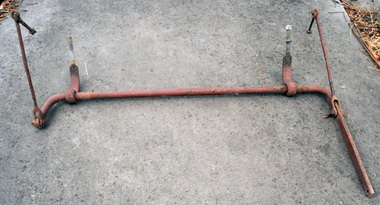
brake/lifting mechanism, first half 20th century
... farm-implement agriculture...An iron brake mechanism possibly from a farm implement. It has been painted red.It was probably used to control height on braking when attached to an agricultural implement. ...farm-implement agriculture An iron brake mechanism possibly from a farm implement. ...An iron brake mechanism possibly from a farm implement. It has been painted red.It was probably used to control height on braking when attached to an agricultural implement. farm-implement agriculture -
 Sunshine and District Historical Society Incorporated
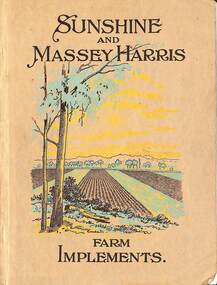
Book - Sunshine And Massey Harris Farm Implements, 2003
... Sunshine And Massey Harris Farm Implements...McKay Massey Harris Sunshine Harvester Works Farm Machinery Sunshine And Massey Harris Farm Implements Soft covered book Sunshine And Massey Harris Farm Implements Book Sunshine And Massey Harris Farm Implements ...Soft covered bookh.v. mckay massey harris, sunshine harvester works, farm machinery -
 Bendigo Historical Society Inc.
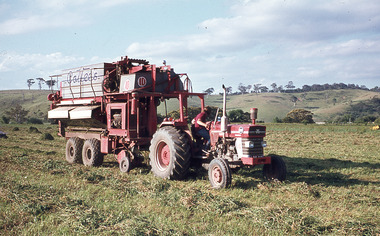
Slide - Mouat Crawford Collection: Farming Life in the Wimmera, c1960s
... Farming in the Wimmera. Tractor and farm implement. Used as a teaching aid....AGRICULTURE Farm Crop wimmera tractor mouat crawford collection Agfacolor Farming in the Wimmera. Tractor and farm implement. Used as a teaching aid. Slide Mouat Crawford Collection: Farming Life in the Wimmera ...Farming in the Wimmera. Tractor and farm implement. Used as a teaching aid.Agfacoloragriculture, farm, crop, wimmera, tractor, mouat crawford collection -
 Whitehorse Historical Society Inc.
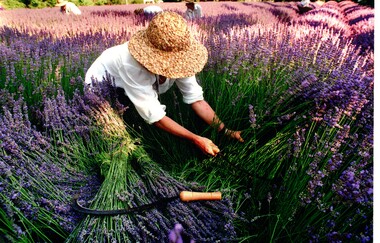
Photograph - Coloured Photograph, Sickle and Lavender
... ...Farm Implement...Tools Farm Implement Lavender A coloured photograph showing a lady using a sickle to harvest lavender. ...A coloured photograph showing a lady using a sickle to harvest lavender.tools, farm implement, lavender -
 Flagstaff Hill Maritime Museum and Village
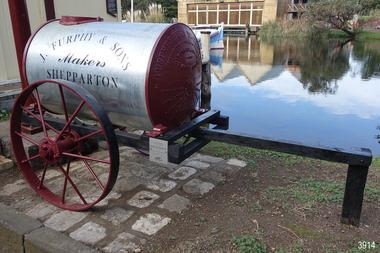
Vehicle - Furphy Water Cart, J. Furphy & Sons, c. 1942
... ...Farm equipment...Implement...Warrnambool flagstaff hill maritime museum water cart Furphy cart Furphy tank Furphy Farm water cart Furphy John Furphy John Furphy & Sons Furphy Foundry Kyneton Shepparton Mobile water tank Jinker Hutchinson & Walker Blacksmith Farm equipment Implement maker Tool maker Horse drawn Stork and baby Good better best Barrel Tank first world war wwI Eastern Front Gallipoli j furphy & sons Hub perimeter, embossed “J. ...This horse-drawn, two-wheeled cart with a tank, is known as a Furphy Farm Water Cart that was made in Shepparton, northern Victoria, c. 1942. John Furphy (1842-1920) was born in Moonee Ponds, in 1842 to Irish immigrant parents and subsequently raised in the Yarra Valley before the family moved to Kyneton in central Victoria, where he completed an apprenticeship with the firm Hutcheson and Walker. Murphy began operations of his own at a site on Piper Street in Kyneton in 1864. He relocated for a business opportunity and founded the first blacksmiths and wheelwrights shop in the newly surveyed town of Shepparton in 1873. Furphy invented many farming tools and machines including a patented grain-stripper, and won awards at the 1888-89 Melbourne International Exhibition. His most famous invention is the Furphy Farm Water Cart, designed in the 1880s, at a time when water for most households and farms was carted on wagons in wooden barrels. The Furphy’s water cart is a single item that combines a water metal tank and a cart. The design of the cart was simple yet effective, and became popular very quickly and established itself as a vital piece of farming equipment. The water cart has had a number of words cast into its ends over many years. References to the foundry’s location in Shepparton, as well as advertising of other products also manufactured by J. Furphy & Sons were present on the ends. However, the most significant set of words to feature on the tank, was a poem encouraging continual improvement: ‘Good Better Best, Never Let it Rest, Until your Good is Better, And your Better Best’. During The Great War (1914-1918), the water cart was used by the Australian militarily at a large AIF (Australian Imperial Force) camp in Broadmeadows (Melbourne) where thousands of men were camped for months, before being transported aboard. Furphy Water Carts provided water to the troops, and were usually placed near the camp latrines, which was one of the few places the troops could share gossip and tall tales away from the prying eyes and ears of their officers. The water cart drivers were also notorious sources of information, despite most of their news being hearsay, or totally unreliable. By the time the men of the AIF were in engaged in combat on the Gallipoli Peninsula and the Western Front, the carts used for water supply had no markings and became simply referred to as Furphys. This owed as much to the coining of the term ‘Furphy’, Australian slang for suspect information or rumour. After a number of decades as principally a soldier’s word, 'Furphy' entered the broader Australian vernacular and was used mainly by the political class until recently when the term was taken up by a Australian brewer as a beer brand. This Furphy Water Cart was purchased by Friends of Flagstaff Hill in 2014. The support of local individuals, organisations and businesses enabled its restoration and later its installation alongside the existing late-19th century water pipe stand and 1940s hand pump The Furphy Farm Water Cart is of historical significance as it represents a famous Australian time-saving and energy-saving invention of the 1880s, replacing the labour intensive activity of collecting and dispensing water from barrels and casks on the back of carts. The water cart’s connection with manufacturing companies J. Furphy & Sons and Furphy Foundry are significant for being early Australian businesses that are still in operation today. Furphy carts are of military significance for the role they played during The Great War (1914-1918) in Australian army camps, and theatres of war in Europe and the Middle East, to supply the AIF troops with fresh water. A wooden framed, two-wheeled, horse-drawn cart, fitted with a horizontally mounted, cylindrical metal tank. The tank is made of rolled, sheet steel with a riveted seam, and cast iron ends with cast iron ends. The spoked metal wheels have fitted flat iron tyres and metal hubs. A metal pipe is joined to the outlet. The tank is silver coloured, the ends, wheels and trims are crimson, and the script lettering on tank sides is black. There are inscriptions on the tank, ends, and hubs. The water tank was made in 1942 in Shepparton, Australia, by J. Furphy & Sons and has a capacity of 180 gallons (848 litres). Hub perimeter, embossed “J. FURPHY & SONS” “KEEP THE / BOLTS TIGHT” Hub centre embossed [indecipherable] Tank, each side, painted “J. FURPHY & SONS / Makers / SHEPPARTON” Tank ends, embossed – “FURPHY’S FARM WATER CART” “BORN ABOUT 1880 – STILL ‘GOING STRONG’ 1942” “j. FURPHY & SONS / MAKERS / SHEPPARTON - VIC “ “S - - - - - L MANUFACTURERS” [SPECIAL] “SPIKE ROLLERS” “SINGLE TREES” “PLOUGH WHEELS” “IRON CASTINGS” “LAND GRADERS” “STEEL DELVERS” “CAST IRON PIG” “CHAIN YOKES” “GOOD – BETTER – BEST / NEVER LET IT REST / TILL YOUR GOOD IS BETTER / AND YOUR BETTER – BEST” Image [Stork carrying a baby] above shorthand, transcribed "Produce and populate or perish" Image [Furphy Pig Feeder] beside ‘Cast Iron Pig’ Shorthand, transcribed “"Water is the gift of God but beer and whiskey are concoctions of the Devil, come and have a drink of water"warrnambool, flagstaff hill maritime museum, water cart, furphy cart, furphy tank, furphy farm water cart, furphy, john furphy, john furphy & sons, furphy foundry, kyneton, shepparton, mobile water tank, jinker, hutchinson & walker, blacksmith, farm equipment, implement maker, tool maker, horse drawn, stork and baby, good, better, best, barrel, tank, first world war, wwi, eastern front, gallipoli, j furphy & sons -
 Kiewa Valley Historical Society
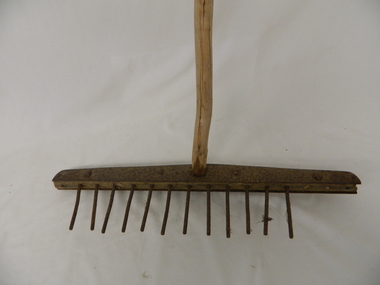
Rake - Tea Tree, mid to late 1900's
... farm...rural...implement...implements enjoyed by gardeners in the towns and cities of the 1800's and the early 1900's. This "home made" garden rake highlights the ingenuity of the "Australian" character per se. A slice of this ingenuity can be seen by the amount of inventions, per capita, produced within Australia throughout its history. timber dairy farm rural implement Handle is a long, stripped branch of tea tree. ...This "homemade rake" is constructed from a branch of a tea tree. This item demonstrates that in the mid to late 1800's the isolation of the Kiewa Valley was more pronounced than during the early 1900's. The availability of gardening implements to the residences within the Kiewa Valley was scarce to non existence. with the upgrading of roads into the valley and the boost to the Valley's population (S.E.C. Kiewa Valley Hydro Electricity Scheme) transport into the valley, firstly via commercial Hawkers in their mobile caravans and later by commercial trucks. This "home made" rake is very significant because it highlights the ingenuity of local farmers and graziers in overcoming the semi isolation of the Kiewa Valley and its regions from the commercial availability of gardening implements enjoyed by gardeners in the towns and cities of the 1800's and the early 1900's. This "home made" garden rake highlights the ingenuity of the "Australian" character per se. A slice of this ingenuity can be seen by the amount of inventions, per capita, produced within Australia throughout its history.Handle is a long, stripped branch of tea tree. The head of the rake is a 2.3 cm. wide piece of wood, compressed between two 0.5 cm. pieces of metal joined with bolts, nuts and rivets. The holes drilled into the wood hold metal tines 10.5 cms. high. There should be 16 tines but 4 are missing. This type of rake is/ was used in dairiestimber, dairy, farm, rural, implement -
 Kiewa Valley Historical Society
Squeegee - Tea Tree, circa mid to late 1900's
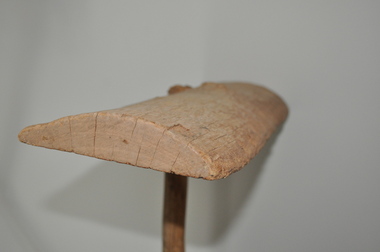
... farm...rural...implement...Part of the natural psyche of the rural Australian inhabitants is the ability to produce inventions that overcome physical restrictive conditions, "the man/woman of all trades" is an apt description of the pioneers of yesteryear and of those to come. timber dairy farm rural implement The squeegee handle is a long branch made from a tea tree, inserted into the upper flat side of a slab of tea tree wood which is flat on one side and curved on the other, the natural curve of the tree trunk. ...This "home made" squeegee was manufactured in the mid to late 1900's by an ingenuous dairyman as a solution to the removal of cow "pats" from the concrete floors of his "milking" sheds. The tea tree made squeegee (being made from nature's anti bacterial material) was an excellent hygienic implement to use. This "home made" wooden squeegee is very significant to the Kiewa Valley and its surrounding regions because it highlights the natural ingenuity found in the pioneer farmer, grazier and other rural folk. It demonstrates the "mother of invention and adaptation" is very strong in rural areas where "off the shelf" products were a rare quantity. Part of the natural psyche of the rural Australian inhabitants is the ability to produce inventions that overcome physical restrictive conditions, "the man/woman of all trades" is an apt description of the pioneers of yesteryear and of those to come.The squeegee handle is a long branch made from a tea tree, inserted into the upper flat side of a slab of tea tree wood which is flat on one side and curved on the other, the natural curve of the tree trunk. This squeegee was used on dairies for removing cow manure.timber, dairy, farm, rural, implement -
 Warrnambool and District Historical Society Inc.
Medal - Medal VHAS, Villiers and Heytesbury Agricultural Association, Circa 1880
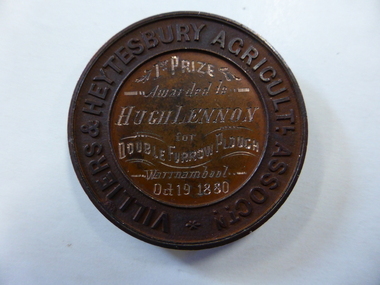
... The reverse is cast with horse, cow and sheep standing above wheat sheaf and farm implements. The edge of the medallion is plain....The reverse is cast with horse, cow and sheep standing above wheat sheaf and farm implements. The edge of the medallion is plain. ...Historical information: this medallion has historical details on three fronts. Firstly the Villiers & Heytesbury Agricultural Association. This association began with the first meeting held on May 17th 1853 at Woodford. The minutes of that meeting read “That in the opinion of this meeting, the formation of an agricultural association would be of great benefit to persons in this district engaged in farming and pastoral pursuits. It initially embraced the following: ploughing, agricultural produce, machines and implements, and livestock of all descriptions. The first show was held at Warrnambool on April 10th 1855 on a green bounded by Fairy, Henna, and Koroit Streets. It was held there until 1875 when it moved to the present Showgrounds site in Koroit Street. At the 37th Annual show in 1890 Warrnambool held its first Grand National Show, being granted by the Chamber of Agriculture in turn, in Victoria. It became known as the Warrnambool Agricultural Society in 1911. Secondly the winner, Mr Hugh Lennon. He was one of the most successful innovators and manufacturers of agricultural implements in early Australia. Although born in Ireland, he served an apprenticeship in Scotland in mechanical engineering. The Lennon plough became known Australia wide. For many years he operated his business at the northern of Elizabeth Street in Melbourne. He was active in local affairs. He died in 1886 at the age of 52. Thirdly, Stokes and Martin. Thomas Stokes came to Australia in the 1850’s and established a successful business at Mincing Lane Melbourne, manufacturing buttons, medals and tokens. Martin joined the partnership in 1873, which lasted until a disastrous fire in 1893. The business was renamed Stokes & Sons Pty Ltd and it became a public company in 1962. It is currently situated at Ringwood in the business of spare parts for electrical equipment The Villiers and Heytesbury Agricultural Association was a significant event and organisation within the Western District over a large number of years. It was one of the earliest organisations in the district and is testament to its importance to the agricultural, social, and cultural life of the district. It is significant that this particular medallion was awarded to an innovator in the ploughing industry and that it was made by a company which is still in business 130 years later. Circular copper medallion cast with Villiers & Heytesbury Agricultural Assoctn around edge with winner and event details engraved in centre. The reverse is cast with horse, cow and sheep standing above wheat sheaf and farm implements. The edge of the medallion is plain.Villiers & Heytesbury Agricultl Assoctn around rim. 1st Prize awarded to Hugh Lennon for double furrow plough, Warrnambool Oct 19 1880. Stokes & Martin Melbourne in small lettering on the reverse.warrnambool, villiers & heytesbury, hugh lennon, stokes & martin, lennon plow, lennon plough -
 Warrnambool and District Historical Society Inc.
Medal, Villers & Heytesbury, 1879
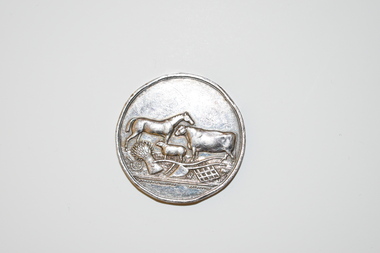
... It has etched printing on one side and raised images of farm animals and farm implements on the other side. It also has etched printing around the edge of the medal. ...It has etched printing on one side and raised images of farm animals and farm implements on the other side. It also has etched printing around the edge of the medal. ...This splendid medal was awarded by the Villiers and Heytesbury Agricultural Association in 1879. This association held its first show in Port Fairy in 1854 and in Warrnambool in 1855. It continues to this day under the name of the Warrnambool and District Agricultural Society. The medal was awarded to James Astley Bromfield, am early Warrnambool chemist who arrived in Victoria in 1852 and is significant in Warrnambool’s history. He produced the 1856 map of the Warrnambool district with the first landowners, a seminal resource for historians and was prominent in community affairs, especially in horse racing. He was also a Warrnambool and Shire Councillor. The medal was awarded for the best blood yearling of 1879 and this was Fright, one of the progeny of the famous stud horse Panic (second in the Melbourne Cup, 1865), His progeny won many hurdle races and flat races including the Melbourne Cup. The medal features also the names of two donors of prizes to James Bromfield, Henry Phillips and Francis Tozer, both pioneer men in Warrnambool’s horse racing history. Henry Phillips was the first President of the Warrnambool Amateur Turf Club and had the horse Panic standing at his 1000 acre stud, Bryan O’Lynn, at Purnim in the Western District. Francis Tozer was an owner, breeder and steward in racing circles and in the 1870s had the 2000 acre stud farm, Wangoom Park, at Wangoom, near Warrnambool.This is a most significant item as it was awarded to James Astley Bromfield, an early Warrnambool chemist and a person concerned with the history of the early settlement of Warrnambool and one prominent in community affairs in Warrnambool in the 19th century. The item also has connections with the famous stud horse, Panic and two other noted personalities of Warrnambool and district, Francis Tozer and Henry Phillips. The item also is of intrinsic monetary value as a 19th century medal from the Villiers and Heytesbury Agricultural Association. This is a round silver medal. It has etched printing on one side and raised images of farm animals and farm implements on the other side. It also has etched printing around the edge of the medal. There are some slight dents around the edge of the medal.‘Villiers & Heytesbury Agricultural Association 1st Prize Awarded to J. A. Bromfield for Blood Yearling 1879 ‘Fright by Panic’ Warrnambool Oct. 16 1879’ ‘Also Phillips and Tozer’s Special Prizes’ james astley bromfield, warrnambool, villiers and heytesbury agricultural association, henry phillips, warrnambool, francis tozer, warrnambool, history of warrnambool -
 Orbost & District Historical Society
iron chain, First half 20th century
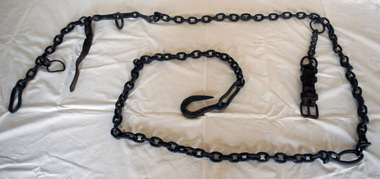
... This was probably used on a farming property and would have been attached to various horse-drawn farm implements and machinery....This was probably used on a farming property and would have been attached to various horse-drawn farm implements and machinery. Horses were a vital part of the agricultural industry in Orbost before the mechanisation of farm machinery. ...This was probably used on a farming property and would have been attached to various horse-drawn farm implements and machinery.Horses were a vital part of the agricultural industry in Orbost before the mechanisation of farm machinery. This item is associated with that time.A heavy iron chain for attaching to a horse drawn implement. It has a strong hook at one end and a large ring at the other. It has several ring attachments and straps which have been added with wiring.chain farming -
 Greensborough Historical Society
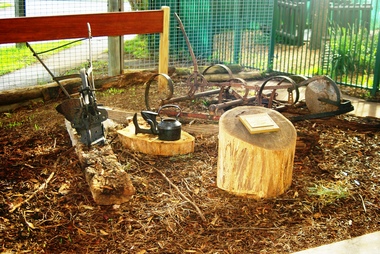
Photograph (Framed), Partington Family farm implements at GHS, 27/10/2013
... Farm implements donated by the Partington family were located on display at the GHS Resource Centre in 2013, unfortunately, several items were later stolen....Farm implements donated by the Partington family were located on display at the GHS Resource Centre in 2013, unfortunately, several items were later stolen. farm implements partington family Colour photograph in black frame Partington Family farm implements at GHS Photograph (Framed) Marilyn Smith Marilyn Smith ...Farm implements donated by the Partington family were located on display at the GHS Resource Centre in 2013, unfortunately, several items were later stolen.Colour photograph in black framefarm implements, partington family -
 Ringwood and District Historical Society
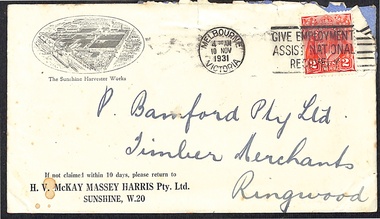
Document, Sunshine Harvester Works Price List (Cover Letter, Price List, and Envelop) to Bamford Bros Ringwood. 9/11/1931
... Dated 9th November 1931 enclosing Price List of Sunshine Farm Implements. Outer envelope included with pre-printed Sunshine Harvester Works engraving. ...Dated 9th November 1931 enclosing Price List of Sunshine Farm Implements. Outer envelope included with pre-printed Sunshine Harvester Works engraving. ...Quarto sized covering letter from H.V. McKay Massey Harris Pty Ltd, Sunshine Harvester Works to Messr P. Bamford Pty Ltd, Timber Merchants, Ringwood. Dated 9th November 1931 enclosing Price List of Sunshine Farm Implements. Outer envelope included with pre-printed Sunshine Harvester Works engraving. -
 Hume City Civic Collection
Photograph, Late 1980's
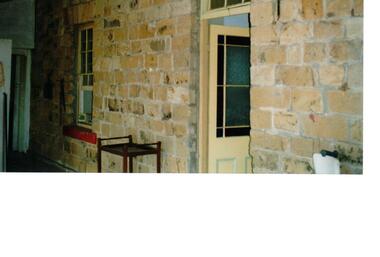
... At the extreme end of the porch there is a doorway. Farm implements are hanging on the wall....At the extreme end of the porch there is a doorway. Farm implements are hanging on the wall. Photograph ...The Duncan family have occupied 'Glencoe' since 1888 when John Duncan purchased it from M. O'Brien. In 1972 Glencoe was the site for the Sunbury Pop Festival.A coloured photograph of the front facade of a sandstone building. A double hung 8 pane sash window is on the LHS of the wall and a doorway with a 2 panelled and glass door is in the foreground. The woodwork is painted cream. A tea trolley is near the door. The verandah roof is lined with fibro cement. At the extreme end of the porch there is a doorway. Farm implements are hanging on the wall.sandstone buildings, duncan, george, glencoe homestead, sunbury pop festival, george evans collection -
 Flagstaff Hill Maritime Museum and Village
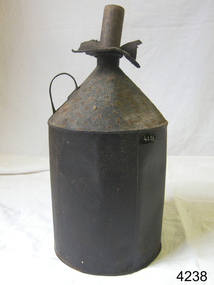
Container - Galvanised liquid storage, 1900+
... Item was probably used as a storage container for Kerosene or oil possibly fuel or some other liquid, the spout indicates it was used to fill other objects such as machines or farm implements etc....Item was probably used as a storage container for Kerosene or oil possibly fuel or some other liquid, the spout indicates it was used to fill other objects such as machines or farm implements etc. It appears the item is quite old and could date from around the turn of the 20th century around 1900 -1920 flagstaff hill warrnambool shipwrecked-coast flagstaff-hill flagstaff-hill-maritime-museum maritime-museum shipwreck-coast flagstaff-hill-maritime-village None Round container galvanised with conical top and metal handle. ...Item was probably used as a storage container for Kerosene or oil possibly fuel or some other liquid, the spout indicates it was used to fill other objects such as machines or farm implements etc.It appears the item is quite old and could date from around the turn of the 20th century around 1900 -1920Round container galvanised with conical top and metal handle. Has cloth & wood stopper in top. Noneflagstaff hill, warrnambool, shipwrecked-coast, flagstaff-hill, flagstaff-hill-maritime-museum, maritime-museum, shipwreck-coast, flagstaff-hill-maritime-village -
 Bendigo Historical Society Inc.
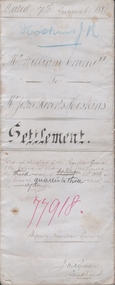
Legal record - EMMETT William, Watson, James & Rogers, Rogers Collection, 1886
... Dated August 1886 * Account of Sales of horses, cattle, Farm implements etc. sold at auction on account of William Emmett by R O'Neil, Auctioneer....Dated August 1886 * Account of Sales of horses, cattle, Farm implements etc. sold at auction on account of William Emmett by R O'Neil, Auctioneer. ...In the early 1980s the firm of Watson, James & Rogers merged with the partnership of Every & Every and became the iconic “Rogers & Every” as known today. The firm is still located on Bull Street. https://rogersevery.com.au/about/* Indenture between William Emmett of Mologa, Farmer, and John Roberts Hoskins of Sandhurst, Timber merchant. Dated August 1886. * Assignment between William Emmett of Mologa, Farmer, and John Roberts Hoskins of Sandhurst, Timber merchant. Dated August 1886 * Account of Sales of horses, cattle, Farm implements etc. sold at auction on account of William Emmett by R O'Neil, Auctioneer.Signaturesr o'neill, j r hoskins, timber merchant -
 Orbost & District Historical Society
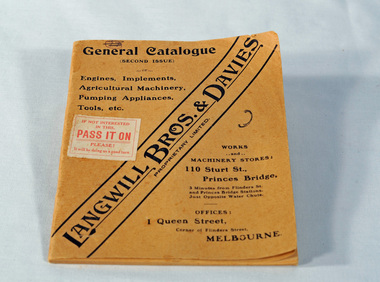
catalogue, Fraser & Jenkinson, Langwill Bros & Davies Pty Ltd, early 20th century
... Langwill Bros & Davies of Melbourne were agents for imported farm pump engines, windmills and other farm implements.. Because of war shortages, they started building the engines themselves under the Challenge brand in 1916. "..with the exception of the magneto, every part of the engine is manufactured in Australia from Australian raw material." ...Langwill Bros & Davies of Melbourne were agents for imported farm pump engines, windmills and other farm implements.. Because of war shortages, they started building the engines themselves under the Challenge brand in 1916. "..with the exception of the magneto, every part of the engine is manufactured in Australia from Australian raw material." ...Langwill Bros & Davies of Melbourne were agents for imported farm pump engines, windmills and other farm implements.. Because of war shortages, they started building the engines themselves under the Challenge brand in 1916. "..with the exception of the magneto, every part of the engine is manufactured in Australia from Australian raw material." They also sold imported Challenge windmills.This item is associated with the history of agriculture in early Orbost and is a useful research tool.A small light brown covered catalogue which has "Langwill Bros. & Davies Pty Ltd" diagonally across front in black print, items on offer and details of the company. There is a white stamp on the front with red print - "If you're not interested in this; PASS IT ON; Please; It will be doing us a good turn".catalogue farm-machinery langwill-davies -
![Photograph - Digital image, Marilyn Smith, Greensborough Historical Society Resource Centre Front Garden Implements [Donation from the Partington Family Farm], 17/06/2014](/media/collectors/4f729f5697f83e03086015b8/items/58677586d0cde904fc057a07/item-media/586775edd0cde904fc0590c6/item-fit-380x285.jpg?cb=6) Greensborough Historical Society
Greensborough Historical SocietyPhotograph - Digital image, Marilyn Smith, Greensborough Historical Society Resource Centre Front Garden Implements [Donation from the Partington Family Farm], 17/06/2014
... In 2013, Gary Partington generously donated farm implements to Greensborough Historical Society. ...In 2013, Gary Partington generously donated farm implements to Greensborough Historical Society. ...In 2013, Gary Partington generously donated farm implements to Greensborough Historical Society. These implements had been used at the family property "Willis Vale" up to the 1960s. From June 2013 until December 2016 these implements were sited in the front garden at the GHS Resource Centre. Unfortunately, the plough, shoe last and kitchen kettle were stolen in December 2016. Digital copy of colour photograph.greensborough historical society, partington family -
 Greensborough Historical Society
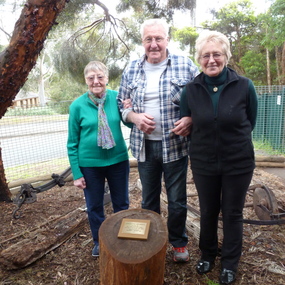
Photograph - Photograph - Digital Image, Heritage Weekend October 2013 - unveiling of Partington Plaque, 26/10/2013
... In 2013, Gary Partington generously donated farm implements to Greensborough Historical Society. ...In 2013, Gary Partington generously donated farm implements to Greensborough Historical Society. ...In 2013, Gary Partington generously donated farm implements to Greensborough Historical Society. These implements had been used at the family property "Willis Vale" up to the 1960s. Members of the Partington family farmed the area from the 1840s. In this photo, Elinor, Gary and Faye stand behind the plaque that explained the provenance of the displayed implements. Unfortunately, one of these items was stolen in December 2016. More photos of this event can be found at the GHS Resource Centre.Digital copy of colour photograph.greensborough historical society, partington family -
 Charlton Golden Grains Museum Inc
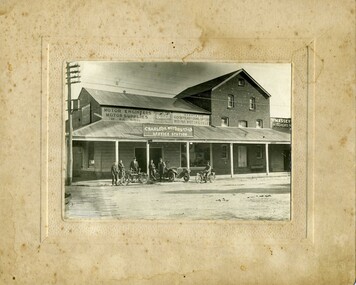
Photograph, Charlton Motors Pty Ltd Service Station c. 1918, c.1918
... Massey Harris Farm Implements c. 1918. Former Malcolm's steam operated Flour Mill 1876 - 1911. ...Massey Harris Farm Implements c. 1918. Former Malcolm's steam operated Flour Mill 1876 - 1911. ...Charlton Motors Pty Ltd Service Station, corner of High & Armstrong Streets. Motor engineers, motor supplies of all kinds. Agents for Goodyear and Dunlop tyres, Buick cars, Indian motorcycles. Massey Harris Farm Implements c. 1918. Former Malcolm's steam operated Flour Mill 1876 - 1911. Group of six men, five standing, one on a motor bike. Car across footpath. Wischers written on building next door.Black & white photograph, mounted, unframed. Group of six men, five standing, one on a motor bike. Car across footpath. Sign on building reads "Charlton Motors Pty Ltd Service Station". Advertising for Dunlop & Goodyear Tyres, Buick and Indian Motorcycles. The words Massey and Wischers are written on the building next door.charlton motors, service station, malcolm's flour mill, wischers, massey harris, high street, charlton, business, industry -
 Charlton Golden Grains Museum Inc
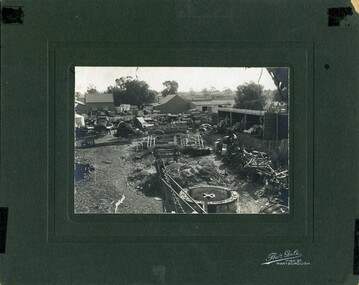
Photograph, Gale, Thomas, Charlton Foundry yard c. 1910, c.1910
... Foundry backyard showing farm machinery and implements. Three workmen in the yard. ...Foundry backyard showing farm machinery and implements. Three workmen in the yard. ...Charlton Foundry established in 1885 by Munros. Taken over by Dabron and Forbes in 1899. Taken over by Dabrons in 1905 to 1965 when it closed.Black & white photograph, mounted, unframed. Taken by Thos Gale Photographer Maryborough. Foundry backyard showing farm machinery and implements. Three workmen in the yard. Thos Gale High St Maryboroughmunro, dabron, forbes, charlton, foundry, business, industry -
 Orbost & District Historical Society
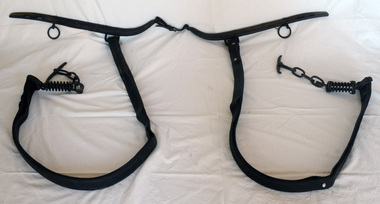
hames and traces, late 19th century - first half 20th century
... This pair of hames would have been used on a farm in the Orbost district for pulling ploughs or other farm implements....This pair of hames would have been used on a farm in the Orbost district for pulling ploughs or other farm implements. Horses were a vital part of the agricultural industry in Orbost before the mechanisation of farm machinery. ...Hames are attached to a horse collar used to distribute the load around a horse's neck and shoulders when pulling a wagon or plough. The collar often supports and pads a pair of curved metal or wood pieces, called hames, to which the traces, which attach to the wagon or plough, of the harness are attached. The collar allows the horse to use its full strength when pulling. This pair of hames would have been used on a farm in the Orbost district for pulling ploughs or other farm implements.Horses were a vital part of the agricultural industry in Orbost before the mechanisation of farm machinery. This item is associated with that time.Wooden hames with leather traces which have chains and springs (to absorb shock) on each end.equestrian rural farming harness traces -
 Bendigo Historical Society Inc.
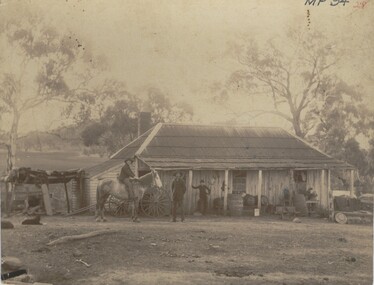
Photograph - FARMHOUSE NEAR MT SUGARLOAF - SLAB HUT, c.1880
... An important photo of early settlers showing type and construction of farmhouse, type of farm implements and clothing...An important photo of early settlers showing type and construction of farmhouse, type of farm implements and clothing Photograph FARMHOUSE NEAR MT SUGARLOAF - SLAB HUT ...Sepia photograph. Slab hut with bark roof, verandah. One brick chimney, weatherboard skillion at L end. One male under verandah. One male in yard. One male mounted on horse. Barrels, wheelbarrow, four wheeled horse drawn vehicle under or near verandah. Inscriptions on front 'MP94', in red ballpoint ink '28'.On Back in grey lead 'Axedale family near Sugarloaf'.( near Fosterville ) On back in red ball point pen '28'. History of object: Previous Acc. No. 'MP 94'. An important photo of early settlers showing type and construction of farmhouse, type of farm implements and clothingBendigo Advertiserbuildings, residential, cottage -
 Bacchus Marsh & District Historical Society
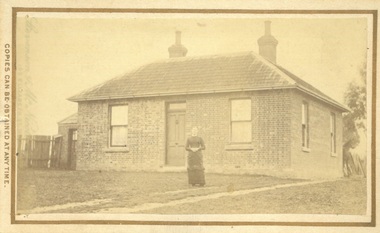
Photograph, James Reid House 182 Main Street Bacchus Marsh 1883
... Before the industrialisation of manufacturing, wheels and other components of vehicles for transport, all metal objects, including farm implements, building requirements and domestic utensils were made by hand. ...Before the industrialisation of manufacturing, wheels and other components of vehicles for transport, all metal objects, including farm implements, building requirements and domestic utensils were made by hand. ...James Reid was born in Scotland near Glasgow and came to Victoria as a young man in 1854. Shortly after arriving he came to Bacchus Marsh where he lived until his death in 1902 at the age of 74 years. For most of these years he conducted a wheelwrights and coach builders business in Bacchus Marsh. In the nineteenth and early twentieth centuries, wheelwrights and blacksmiths played an essential role in the functioning of the whole community. Before the industrialisation of manufacturing, wheels and other components of vehicles for transport, all metal objects, including farm implements, building requirements and domestic utensils were made by hand. As mechanisation of industry increased, the smith commonly performed the role of farrier in the times when horse power was pivotal to all aspects of society. Small sepia unframed photograph on card with gold border framing photograph. Housed in the album, 'Photographs of Bacchus Marsh and District in 1883 by Stevenson and McNicoll' The photo shows a plain brick house with a central front door with a window on either side. There are a further two windows along the side of the house. On the left-hand side of the building there is a smaller room with its own entry door. The main roof is tiled with shingles or slate and features two substantial chimneys. At the front of the house stands a young woman with her hands clasped. A horse can be seen at the rear of the house. From the photo of the James Reid Wheelwright and Blacksmith Shop, Victorian Collections No.VC 618, we know that this house stood to the rear of the workshop. The wheel tracks which can be seen lead out to Main Street. On the front: Stevenson & McNicoll. Photo. 108 Elizabeth St. Melbourne. COPIES CAN BE OBTAINED AT ANY TIME. On the back: LIGHT & TRUTH inscribed on a banner surmounted by a representation of the rising sun. Copies of this Portrait can be had at any time by sending the Name and Post Office Money Order or Stamps for the amount of order to STEVENSON & McNICOLL LATE BENSON & STEVENSON, Photographers. 108 Elizabeth Street, MELBOURNE houses bacchus marsh, stevenson and mcnicoll 1883 photographs of bacchus marsh and district, james reid 1828?-1902, wheelrights bacchus marsh -
 City of Moorabbin Historical Society (Operating the Box Cottage Museum)
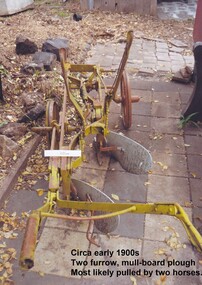
Tool - Farm Machinery, Horse-drawn Furrow Plough, Early 20th Century
... Late 1800s-early 1900s A horse-drawn furrow plough is an example of the type of farm implement widely used by pioneer market gardeners in the Moorabbin Shire following 'Dendy's Special Survey' of 1841 and the Crown Land Sale in 1852. ...Late 1800s-early 1900s A horse-drawn furrow plough is an example of the type of farm implement widely used by pioneer market gardeners in the Moorabbin Shire following 'Dendy's Special Survey' of 1841 and the Crown Land Sale in 1852. ...Late 1800s-early 1900s A horse-drawn furrow plough is an example of the type of farm implement widely used by pioneer market gardeners in the Moorabbin Shire following 'Dendy's Special Survey' of 1841 and the Crown Land Sale in 1852. Land allotments were bought by pioneer settlers who established or rented allotments for market gardens in the area. They supplied produce to the markets in St Kilda and Melbourne. During the gold-rush of the 1850s the rapidly increasing population of Melbourne saw a huge demand and a rise in prices for all foodstuffs, including the vegetables and fruit grown in the Shire of Moorabbin. This heralded a time of prosperity for market gardeners, and an equally rapid expansion of the numbers of vegetable and produce growers in the area. The 'knock-on effect" resulted in an increased interest and development of the community in the Shire of Moorabbin.Following 'Dendy's Special Survey' of 1841 and the Crown Land Sale in 1852, land allotments were bought by pioneer settlers who established or rented allotments for market gardens in the area and they supplied produce to the markets in St Kilda and Melbourne. During the gold-rush of the 1850s the rapidly increasing population of Melbourne saw a huge demand and a rise in prices for all foodstuffs, including the vegetables and fruit grown in the Shire of Moorabbin. Circa late 1800's to early 1900s. A horse-drawn furrow plough was the most common type of agricultural implement used by the pioneers of the 1800s and continued on into the 1940s when motorised tractors came into use. This plough is an example of a two furrow, mullboard plough which would most likely have been pulled by two horses. The long handle was used to lower the silver plates, (mullboards), to the chosen depth of soil. Painted yellow. Although this Box Cottage museum plough is unbranded, the most widely used plough in the Shire of Moorabbin was made by Oliver. This plough appears to be identical to that brand. brighton, moorabbin, pioneers, fruit, bentleigh, vineyards, vegetables, plough, market gardens, plow
