
Showing 23 items matching "fashion - australia - melbourne (vic)"
-
 Kew Historical Society Inc
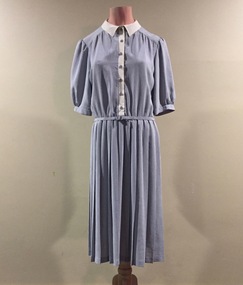
Clothing - Grey and Cream Crepe Dress, Nouvelle, 1960s
... ...fashion - australia - melbourne (vic)...Fashion & Design collection of the Kew Historical Society includes examples of women’s, men’s, children’s and infants’ clothing from the 18th, 19th and 20th centuries. Items in the collection were largely produced for, or purchased by women in Melbourne, and includes examples of outerwear, protective wear, nightwear, underwear and costume accessories. nouvelle women's clothing day dresses fashion - australia - melbourne (vic) fashion - melbourne - 1950s Label: Nouvelle Grey coloured crepe dress with cream coloured collar and neckline to waist. ...The Fashion & Design collection of the Kew Historical Society includes examples of women’s, men’s, children’s and infants’ clothing from the 18th, 19th and 20th centuries. Items in the collection were largely produced for, or purchased by women in Melbourne, and includes examples of outerwear, protective wear, nightwear, underwear and costume accessories.Grey coloured crepe dress with cream coloured collar and neckline to waist. The dress has three quarter length banded sleeve and a pleated skirtLabel: Nouvellenouvelle, women's clothing, day dresses, fashion - australia - melbourne (vic), fashion - melbourne - 1950s -
 National Wool Museum
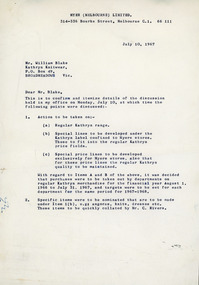
Letter, 10/7/1967
... Australian social and manufacturing history. Business Business history Manufacturing Knitting Machine Fashion Textile Production Business Archives Manufacturing Documents Myer Myer Emporium Myer (Melbourne) MYER (MELBOURNE) LIMITED. 314-336 Bourke Street, Melbourne C.1. 66 111 July 10, 1967 Mr. William Blake Kathryn Knitwear. P.O. Box 49. BROADMEADOWS Vic ...Kathryn Knitwear, founded by Robert Blake, manufactured high quality children’s knitwear in Melbourne from the 1940s – 1980s. Robert Blake began manufacturing children’s knitwear in his bedroom in Strathmore using a hand powered machine in the late 1940s. The operation moved to Ascot Vale and Essendon, before eventually establishing a factory in Moonee Ponds in the early 1950s. The business continued to expand, necessitating a move to a new factory in Broadmeadows. By 1962, the Broadmeadows factory was producing an average of 20,000 garments per month, which increased to 24,000 by 1964. Robert Blake’s Son, Brendan recalls that “The Kathryn brand was famous around Australia, anywhere children needed to keep warm and dress smartly. It also won a number of wool fashion awards”, including the 1969 Wool Awards, which was held by the Australian Wool Bureau and published in Women’s Weekly. The Kathryn range was designed for durability, comfort and care, without sacrificing style. They used patterning techniques that increase stretchiness, comfort and fit, as well as integrating decorative elements into the fabric to prevent them from being bulky, uncomfortable or tight. Making longevity of style a priority, Brendan Blake remembers that “there was one particular garment that was in the range for at least thirty years”. He also recalls “In the past, when women have found out that I was associated with Kathryn Knitwear, they would often relate to me the story of a garment they had purchased or received as a gift and, when their child had grown out of it, they would hand it on to another child. Several ladies have told me of purchasing garments for their daughters’ glory box, or saving a particular garment after their daughter had grown out of it. Brendan Blake: “At the peak of their operation they employed approximately two hundred people, mainly women and girls. A family would often seek to send their daughter to work in this company because they knew they would be looked after and safe. One lady wrote to me telling me that working at the Moonee Ponds Factory prior to getting married was the happiest time of her life.” In 1963, workers at the Kathryn factory earned £13 per week, which was 8 shillings and 8 pence higher than the minimum weekly wage for female workers in the textile manufacturing industry (£12 11s 4d). By 1970, the Kathryn Knitwear brand expanded from children’s knitwear into womenswear under the brand name ‘Lady Kathryn’, and for boys and men under ‘Robert Blake’. Continuing to diversify their distribution, they also began exporting ‘Kathryn’ garments to New Zealand, the Pacific Islands, and Japan. ‘Kathryn Knitwear’ was well-known for their early adoption of modern materials and techniques that had broad appeal to their customer base. This is shown in their early use of the acrylic fibre ‘Orlon’ in the 50s and 60s and ‘Superwash’ wool in the 1970s. Many of Kathryn Knitwear’s styles, particularly those that were long running staples of the brand, were available in both wool and Orlon to suit the consumer’s preference. Far from the humble origins of one man in his bedroom with a hand-cranked machine; at its closure in 1980, the Broadmeadows factory of ‘Kathryn’ housed more than 100 machines, including 53 sewing machines and 45 knitting machines. Robert Blake was “a passionate advocate for wool and Australian Made” throughout his whole life. A strong thread that ties through the lifespan of Robert Blake and Kathryn Knitwear is a balance between adopting new innovations without sacrificing the core values of durability, comfort, care and style that had made the brand so well known. Their legacy forms an integral part of both Australian social and manufacturing history.Letter from Myer (Melbourne) Limited to William Blake. The letter confirms and details of a meeting held to discuss business arrangements between Kathryn Knitwear and Myer. Due to the lack of signatory, it is likely there was originally additional pages that have been lost. It is typewritten in blue ink on white paper, with smudges and pen marks evident.MYER (MELBOURNE) LIMITED. 314-336 Bourke Street, Melbourne C.1. 66 111 July 10, 1967 Mr. William Blake Kathryn Knitwear. P.O. Box 49. BROADMEADOWS Vic. Dear Mr. Blake. This is to confirm and itemize details of the discussion held in my office on Monday, July 10, at which time the following points were discussed: - 1. Action to be taken on:- (a) Regular Kathryn range. (b) Special lines to be developed under the Kathryn label confined to Myers stores. These to fit into the regular Kathryn price fields. (c) Special price lines to be developed exclusively for Myers stores, also that for these price lines the regular Kathryn quality to be maintained. With regard to Items A and B of the above, it was decided that purchases were to be taken out by departments on regular Kathryn merchandise for the financial year August 1, 1966 to July 31, 1967, and targets were to be set for each department for the same period for 1967-1968. 2. Specific items were to be nominated that are to be made under Item 1(b), eg: angoras, knits, dresses, etc. these items to be quickly collated by Mr C. Rivers.business, business history, manufacturing, knitting machine, fashion textile production, business archives, manufacturing documents, myer, myer emporium, myer (melbourne) -
 Kew Historical Society Inc
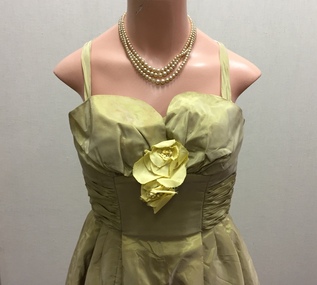
Clothing - Shot Silk Dance Frock & Wrap, Park Avenue Gowns, c.1960
... Fashion & Design collection of the Kew Historical Society includes examples of women’s, men’s, children’s and infants’ clothing from the 18th, 19th and 20th centuries. Items in the collection were largely produced for, or purchased by women in Melbourne, and includes examples of outerwear, protective wear, nightwear, underwear and costume accessories.This 'dance frock' by Park Avenue Gowns is one of a number of garments in the collection by this designer. women's clothing cocktail dresses dance frocks australian fashion - 1960s fashion designers - melbourne (vic) - park avenue gowns Label : "Park Avenue Gowns" Metallic thread silk cocktail dress and wrap by Park Avenue Gowns, 1960. ...The Fashion & Design collection of the Kew Historical Society includes examples of women’s, men’s, children’s and infants’ clothing from the 18th, 19th and 20th centuries. Items in the collection were largely produced for, or purchased by women in Melbourne, and includes examples of outerwear, protective wear, nightwear, underwear and costume accessories.This 'dance frock' by Park Avenue Gowns is one of a number of garments in the collection by this designer.Metallic thread silk cocktail dress and wrap by Park Avenue Gowns, 1960. Virtually identical dresses by the designer were featured in the Australian Women's Weekly in 1960, described as 'dance frocks', to which the wide flairing skirt would be well suited.Label : "Park Avenue Gowns"women's clothing, cocktail dresses, dance frocks, australian fashion - 1960s, fashion designers - melbourne (vic) - park avenue gowns -
 Kew Historical Society Inc
Clothing, Chiffon Velvet Wedding Dress, 1934
... Fashion & Design collection of the Kew Historical Society includes examples of women’s, men’s, children’s and infants’ clothing from the 18th, 19th and 20th centuries. Items in the collection were largely produced for, or purchased by women in Melbourne, and includes examples of outerwear, protective wear, nightwear, underwear and costume accessories. wedding dresses australian fashion - 1930s laurie dean marriages -- mildura (vic.) fashion design fashion -- 1930s Cream coloured full length crushed velvet, wedding dress originally worn by Laurie Dean (nee Jenkins) at her wedding in Mildura, August 1934. ...The Fashion & Design collection of the Kew Historical Society includes examples of women’s, men’s, children’s and infants’ clothing from the 18th, 19th and 20th centuries. Items in the collection were largely produced for, or purchased by women in Melbourne, and includes examples of outerwear, protective wear, nightwear, underwear and costume accessories.Cream coloured full length crushed velvet, wedding dress originally worn by Laurie Dean (nee Jenkins) at her wedding in Mildura, August 1934.wedding dresses, australian fashion - 1930s, laurie dean, marriages -- mildura (vic.), fashion design, fashion -- 1930s -
![The Scientific Savant in Nineteenth Century Australia / [by] Australian Academy of Science](/media/collectors/550653872162f11fb04854aa/items/5ed043e1dcf9cd08346b7493/item-media/5ed04634dcf9cd08346b840c/item-fit-380x285.jpg?cb=6) Kew Historical Society Inc
Kew Historical Society IncBook, Historical Records of Australian Science, The Scientific Savant in Nineteenth Century Australia, 1997
... fashion and artefacts. Reference books have entered the collection through donation, presentation, collection and purchase. royal botanic gardens - melbourne (vic.) ferdinand von mueller Scientific savant in nineteenth century Australia. 1996 commemorative conferences, Royal Botanic Gardens, Melbourne, Sunday 29th September to Saturday 5th October 1996 held at the University of Melbourne, the scientific savant in 19th century Australia, celebration of the life, times and legacy of Ferdinand von Mueller, program & abstracts 23 pages : map ; 30 cm. ...Scientific savant in nineteenth century Australia. 1996 commemorative conferences, Royal Botanic Gardens, Melbourne, Sunday 29th September to Saturday 5th October 1996 held at the University of Melbourne, the scientific savant in 19th century Australia, celebration of the life, times and legacy of Ferdinand von Mueller, program & abstracts23 pages : map ; 30 cm.non-fictionScientific savant in nineteenth century Australia. 1996 commemorative conferences, Royal Botanic Gardens, Melbourne, Sunday 29th September to Saturday 5th October 1996 held at the University of Melbourne, the scientific savant in 19th century Australia, celebration of the life, times and legacy of Ferdinand von Mueller, program & abstractsroyal botanic gardens - melbourne (vic.), ferdinand von mueller -
Kew Historical Society Inc
Book, Book Collectors' Society of Australia, Batman & Fawkner: Discovery of the River Yarra; an episode, 1965
... fashion and artefacts. Reference books have entered the collection through donation, presentation, collection and purchase. batman john -- 1801-1839 fawkner john pascoe -- 1792-1869 melbourne (vic.) - history - 1834-1851. Originally printed by H. Cordell, 59 Queen St., 1881. Limited edition of 250 copies 11 p. 2 facsims. 23 cm. Batman & Fawkner: Discovery of the River Yarra; an episode Book Book Collectors' Society of Australia ...Originally printed by H. Cordell, 59 Queen St., 1881. Limited edition of 250 copies11 p. 2 facsims. 23 cm. non-fictionOriginally printed by H. Cordell, 59 Queen St., 1881. Limited edition of 250 copiesbatman john -- 1801-1839, fawkner john pascoe -- 1792-1869, melbourne (vic.) - history - 1834-1851. -
Kew Historical Society Inc
Book, Arthur de Quetteville Robin, Charles Perry, Bishop of Melbourne : the challenges of a colonial episcopate, 1847-76, 1967
... fashion and artefacts. Reference books have entered the collection through donation, presentation, collection and purchase. Catholic Church - Bishops -- Melbourne (Vic.) Charles Perry, Bishop of Melbourne : the challenges of a colonial episcopate, 1847-76 Book Arthur de Quetteville Robin University of Western Australia Press ...non-fictioncatholic church - bishops -- melbourne (vic.) -
Kew Historical Society Inc
Book, Houghton Mifflin Australia, Images of Melbourne : a sketchbook, 1989
... fashion and artefacts. Reference books have entered the collection through donation, presentation, collection and purchase. Drawing -- Australian Melbourne (Vic ...Ferntree Gully, Vic. : Houghton Mifflin Australia, 1989 63 p. : ill. ; 21 cm. non-fictiondrawing -- australian, melbourne (vic.) in art, melbourne (vic.) -- description and travel -
Kew Historical Society Inc
Book, Geoffrey W Leeper, Introducing Victoria, 1955
... fashion and artefacts. Reference books have entered the collection through donation, presentation, collection and purchase. victoria -- history victoria -- description and travel victoria -- natural resources Melbourne : Australian and New Zealand Association for the Advancement of Science ; Carlton, Vic. : Melbourne University Press, 1955 x, 306 p., 32 p. of plates (some col.) : ill., col. maps ; 22 cm. ...Melbourne : Australian and New Zealand Association for the Advancement of Science ; Carlton, Vic. : Melbourne University Press, 1955 x, 306 p., 32 p. of plates (some col.) : ill., col. maps ; 22 cm. non-fictionvictoria -- history, victoria -- description and travel, victoria -- natural resources -
Kew Historical Society Inc
Book, Frederick Howard, Kent Hughes: a biography of Colonel The Hon. Sir Wilfred Kent Hughes, 1972
... fashion and artefacts. Reference books have entered the collection through donation, presentation, collection and purchase. Kent Hughes W.S. (Wilfrid Selwyn) 1895-1970 Australia -- Politics 1927-1970 Sir Wilfrid Selwyn Kent- Hughes 1895-1970 Biographies -- Australia -- Politics and government -- 20th century Limited edition of 500 copies. Available from Ramsay, Ware Publishing Pty Ltd, 552 Victoria Road, North Melbourne, Vic ...Limited edition of 500 copies. Available from Ramsay, Ware Publishing Pty Ltd, 552 Victoria Road, North Melbourne, Vic. 3051.South Melbourne : Macmillan for the Kent Hughes Memorial Committee, 1972 ix,255p. : plates ; 23cm. non-fictionLimited edition of 500 copies. Available from Ramsay, Ware Publishing Pty Ltd, 552 Victoria Road, North Melbourne, Vic. 3051.kent hughes w.s. (wilfrid selwyn) 1895-1970, australia -- politics 1927-1970, sir wilfrid selwyn kent- hughes 1895-1970, biographies -- australia -- politics and government -- 20th century -
 Kew Historical Society Inc
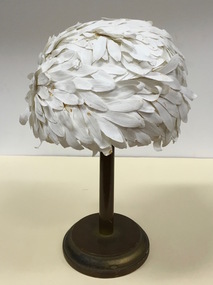
Headwear - White Petal Covered Hat, Beryl Richards, 1960s
... fashion and design collection is comprised of costumes, hats, shoes and personal accessories. Many of these items were purchased or handmade in Victoria; some locally in Kew. The extensive hat collection comprises items dating from the 1860s to the 1970s. While most of the hats in the collection were created by milliners for women, there are a number of early and important men’s hats in the collection. The headwear collection is particularly significant in that it includes the work of notable Australian and international milliners. beryl richards milliners -- melbourne (vic ...The Kew Historical Society’s fashion and design collection is comprised of costumes, hats, shoes and personal accessories. Many of these items were purchased or handmade in Victoria; some locally in Kew. The extensive hat collection comprises items dating from the 1860s to the 1970s. While most of the hats in the collection were created by milliners for women, there are a number of early and important men’s hats in the collection. The headwear collection is particularly significant in that it includes the work of notable Australian and international milliners.Woman’s hat retailed by Beryl Richards of Melbourne which is constructed on a stiffened net and covered with pieces of white fabric cut to simulate the shape of petals.Label: Beryl Richards Hats - Melbourneberyl richards, milliners -- melbourne (vic.), women's clothing -- hats, headwear -
 Kew Historical Society Inc
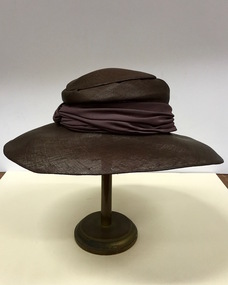
Headwear - Brown Straw Cartwheel Hat, Trude Jonas, c. 1954
... fashion and design collection is comprised of costumes, hats, shoes and personal accessories. Many of these items were purchased or handmade in Victoria; some locally in Kew. The extensive hat collection comprises items dating from the 1860s to the 1970s. While most of the hats in the collection were created by milliners for women, there are a number of early and important men’s hats in the collection. The headwear collection is particularly significant in that it includes the work of notable Australian and international milliners. milliners -- malvern (vic.) milliners -- melbourne ...Trude Jonas was a Melbourne milliner with her business operating from 159 Mavern Road, Malvern.The Kew Historical Society’s fashion and design collection is comprised of costumes, hats, shoes and personal accessories. Many of these items were purchased or handmade in Victoria; some locally in Kew. The extensive hat collection comprises items dating from the 1860s to the 1970s. While most of the hats in the collection were created by milliners for women, there are a number of early and important men’s hats in the collection. The headwear collection is particularly significant in that it includes the work of notable Australian and international milliners.Elegant broad rimmed purple straw woman’s hat retailed by Trude Jonas with a purple ribbon of the same colour at the base of the crown.Label: Trude Jonas. Model Hats, 159 Glenferrie Rd., Malvern.milliners -- malvern (vic.), milliners -- melbourne -- trude jonas, trude jonas -- model hats -
 Kew Historical Society Inc
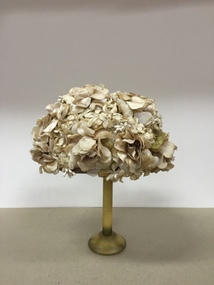
Headwear - Ivory Silk Floral Hat, Harbig, 1950s
... fashion and design collection is comprised of costumes, hats, shoes and personal accessories. Many of these items were purchased or handmade in Victoria; some locally in Kew. The extensive hat collection comprises items dating from the 1860s to the 1970s. While most of the hats in the collection were created by milliners for women, there are a number of early and important men’s hats in the collection. The headwear collection is particularly significant in that it includes the work of notable Australian and international milliners. milliners -- melbourne (vic ...The firm of Harbig was a Melbourne millinery company owned by Mr and Mrs Richard Ernest Harbig. In 1949, an article in the West Australian newspaper reported their return from the United States. It records that: 'FEATHERS SYDNEY, Sept. 14: Mr. and Mr. Richard Harbig, Melbourne milliners who reached Sydney by air tonight from America, gave these details of hat trends for next winter. Shapes: Head-hugging cloches to suit short hair, cut away at the back to clear high collars, and built up and out at the front to give height. Materals: Felts, velours, velvets, and a new long-haired fur fabric called flamond. Colours: Muted pastels, few jewel shades, and no vivid colours. Trimmings: Little veiling, "but feathers and feathers and feathers".'The Kew Historical Society’s fashion and design collection is comprised of costumes, hats, shoes and personal accessories. Many of these items were purchased or handmade in Victoria; some locally in Kew. The extensive hat collection comprises items dating from the 1860s to the 1970s. While most of the hats in the collection were created by milliners for women, there are a number of early and important men’s hats in the collection. The headwear collection is particularly significant in that it includes the work of notable Australian and international milliners.Rounded hat covered with ivory coloured silk, simulated flowers attached to a stiffened net. Label: Harbigmilliners -- melbourne (vic.) -- harbig, women's clothing -- hats, headwear -
 Kew Historical Society Inc
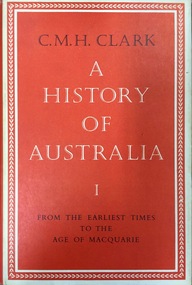
Book, Melbourne University Press, A History of Australia: From the earliest times to the age of Macquarie, 1962
... fashion and artefacts. Reference books have entered the collection through donation, presentation, collection and purchase. The volume formed part of the professional library of the historian Dorothy Rogers. australia - history manning clark To Mrs Rogers. Wishing you a happy birthday. Love Jan. 1963 [Carlton, Vic.] : Melbourne ...[Carlton, Vic.] : Melbourne University Press ; London ; New York : Cambridge University Press, 1962-<1987> v. <1-6> : ill., maps, ports. ; 24 cm. non-fictionaustralia - history, manning clark -
 Kew Historical Society Inc
Book, AH Massina & Co, The First Ninety Years: the printing house of Massina Melbourne 1859-1949, 1949
... fashion and artefacts. Reference books have entered the collection through donation, presentation, collection and purchase. The volume formed part of the professional library of the historian Dorothy Rogers. massina, alfred henry australian journal newspaper publishing - australia Melbourne [Vic.] : A.H. ...Melbourne [Vic.] : A.H. Massina, 1949 165 p. : ill., ports. ; 23 cm. non-fictionmassina, alfred henry, australian journal, newspaper publishing - australia -
 Kew Historical Society Inc
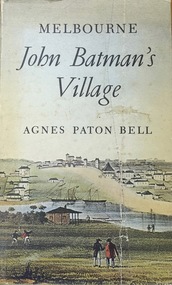
Book, Agnes P Bell, Melbourne: John Batman’s Village, 1965
... fashion and artefacts. Reference books have entered the collection through donation, presentation, collection and purchase. The volume formed part of the professional library of the historian Dorothy Rogers. batman, john, 1801-1839 melbourne (vic.) -- history. settlement and contacts - colonisation - 1851- A history of Melbourne, tracing its development from the riverside village founded by John Batman to the metropolis of the 1960s; includes description of Aboriginal corroborees and other early encounters with the Aboriginal inhabitants of the area. Owner signature: Dorothy Rogers Melbourne, Vic. : Cassell Australia ...A history of Melbourne, tracing its development from the riverside village founded by John Batman to the metropolis of the 1960s; includes description of Aboriginal corroborees and other early encounters with the Aboriginal inhabitants of the area.Melbourne, Vic. : Cassell Australia, 1965 xiv, 178p. : ill. (some col.), facsims., map, porto. ; 25cm. non-fictionA history of Melbourne, tracing its development from the riverside village founded by John Batman to the metropolis of the 1960s; includes description of Aboriginal corroborees and other early encounters with the Aboriginal inhabitants of the area.batman, john, 1801-1839, melbourne (vic.) -- history., settlement and contacts - colonisation - 1851- -
 Kew Historical Society Inc
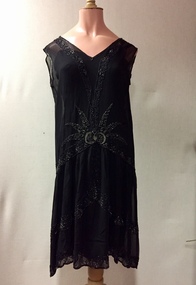
Clothing - Black Crepe Evening Dress with Silver Thread & Glass Beads, c. 1924-27
... Fashion (or clothing/costumes) in the collection was largely produced for, or purchased by women in Melbourne, and includes examples of outerwear, protective wear, nightwear, underwear and costume accessories. This short, beaded 'flapper' dress was worn by Mrs Udora Freame to a ball at the Hawthorn Town Hall in the 1920s. Donated by her daughter, the dress is the earliest item of fashion in the collection where provenance can be linked to a local civic event. women's clothing australian fashion - 1920s evening dresses udora freame evening wear flapper dresses mayoral balls -- hawthorn (vic.) ...The Fashion & Design collection of the Kew Historical Society includes examples of women’s, men’s, children’s and infants’ clothing from the 18th, 19th and 20th centuries. Fashion (or clothing/costumes) in the collection was largely produced for, or purchased by women in Melbourne, and includes examples of outerwear, protective wear, nightwear, underwear and costume accessories. This short, beaded 'flapper' dress was worn by Mrs Udora Freame to a ball at the Hawthorn Town Hall in the 1920s. Donated by her daughter, the dress is the earliest item of fashion in the collection where provenance can be linked to a local civic event.Sleeveless black chiffon 'flapper' evening dress with v-neck. The dress is embroidered with silver thread using chain stitch and glass beads simulating Parisian jet.women's clothing, australian fashion - 1920s, evening dresses, udora freame, evening wear, flapper dresses, mayoral balls -- hawthorn (vic.) -
 Kew Historical Society Inc
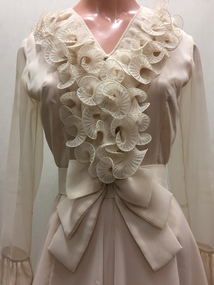
Clothing - Silk Organza Wedding Dress, Oggi Fashion House, 1971
... Fashion & Design collection of the Kew Historical Society includes examples of women’s, men’s, children’s and infants’ clothing from the 18th, 19th and 20th centuries. Items in the collection were largely produced for, or purchased by women in Melbourne, and includes examples of outerwear, protective wear, nightwear, underwear and costume accessories. oggi - 103-105 collins street - melbourne (vic) women's clothing wedding dresses janet (brock) walker australian fashion - 1970s Wedding dress, purchased by Janet Elizabeth Brock in December 1971 from Oggi of Collins Street. ...Fashion by Oggi, as the sign above the door proclaimed, was located at the Paris End of Collins Street, on the south side, virtually opposite Lilian Weightman’s Le Louvre boutique. Janet Brock, who at the time was working in the Central Business District of Melbourne, had stopped to admire a mauve version of the dress that was displayed in the window, and, on making inquiries from the proprietress, ordered a made-to-measure cream-coloured copy. Her marriage occurred shortly after the death of her father, and took place on 18 December 1971 at the Kew Presbyterian Church in Cotham Road, where the Rev. Peter Mackie was the celebrant. The Fashion & Design collection of the Kew Historical Society includes examples of women’s, men’s, children’s and infants’ clothing from the 18th, 19th and 20th centuries. Items in the collection were largely produced for, or purchased by women in Melbourne, and includes examples of outerwear, protective wear, nightwear, underwear and costume accessories.Wedding dress, purchased by Janet Elizabeth Brock in December 1971 from Oggi of Collins Street. The wedding dress, reaching just below the knee, is lined in silk with a double outer layer of organza. The striking decoration of the monochromatic cream dress is achieved through the use of wide ruffled organza frills at the neck, on the sleeves and at the flared hem of the dress. The dress has a discrete v-neckline with small, self-covered buttons at centre front. At the back, the dress is closed with a nylon zip. In addition to the elaborate stiffened frills, the dress features a wide fabric belt with a double bow, worn at the front. oggi - 103-105 collins street - melbourne (vic), women's clothing, wedding dresses, janet (brock) walker, australian fashion - 1970s -
 Kew Historical Society Inc
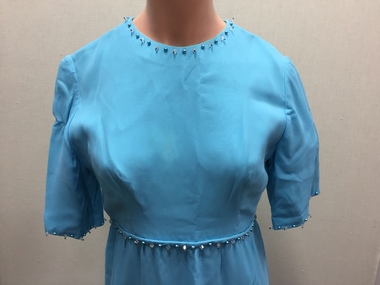
Clothing - Blue silk evening dress, Oggi, 1967
... Fashion & Design collection of the Kew Historical Society includes examples of women’s, men’s, children’s and infants’ clothing from the 18th, 19th and 20th centuries. Items in the collection were largely produced for, or purchased by women in Melbourne, and includes examples of outerwear, protective wear, nightwear, underwear and costume accessories. evening dresses women's clothing oggi - 103-105 collins street - melbourne (vic) miss teenage of victoria quest australian fashion - 1960s evening wear oggi Desley reid Turquoise chiffon and taffeta evening dress, with empire waistline and beading to the neck and waist. ...The Fashion & Design collection of the Kew Historical Society includes examples of women’s, men’s, children’s and infants’ clothing from the 18th, 19th and 20th centuries. Items in the collection were largely produced for, or purchased by women in Melbourne, and includes examples of outerwear, protective wear, nightwear, underwear and costume accessories.Turquoise chiffon and taffeta evening dress, with empire waistline and beading to the neck and waist. The gown was purchased in 1967 from Oggi of Collins Street and worn by the donor’s mother, Mrs Ada Wallis, to the Miss Teenage of Victoria award ceremony at the Melbourne Town Hall, as the mother of a participant.evening dresses, women's clothing, oggi - 103-105 collins street - melbourne (vic), miss teenage of victoria quest, australian fashion - 1960s, evening wear, oggi, desley reid -
 Kew Historical Society Inc
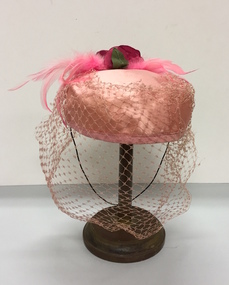
Headwear - Pink Silk & Net 'Pillbox' Hat, Stella Long, 1960s
... Melbourne milliners during the 1950s and 1960s. The Kew Historical Society’s fashion and design collection is comprised of costumes, hats, shoes and personal accessories. Many of these items were purchased or handmade in Victoria; some locally in Kew. The extensive hat collection comprises items dating from the 1860s to the 1970s. While most of the hats in the collection were created by milliners for women, there are a number of early and important men’s hats in the collection. The headwear collection is particularly significant in that it includes the work of notable Australian and international milliners. milliners -- melbourne (vic ...Stella Long's millinery business was located in the Block Arcade Melbourne. She was one of the best known Melbourne milliners during the 1950s and 1960s.The Kew Historical Society’s fashion and design collection is comprised of costumes, hats, shoes and personal accessories. Many of these items were purchased or handmade in Victoria; some locally in Kew. The extensive hat collection comprises items dating from the 1860s to the 1970s. While most of the hats in the collection were created by milliners for women, there are a number of early and important men’s hats in the collection. The headwear collection is particularly significant in that it includes the work of notable Australian and international milliners.Pale pink silk circular hat bordered with darker pink satin, and crowned with pink feathers and a silk rose, all draped with pink net. The hat was retailed by Stella Long, 14 Block Arcade, Melbourne. Label: Original model from Stella Long. 14 Block Arcade Melb. 638507.milliners -- melbourne (vic. -- stella long, milliners -- stella long -- block arcade, women's clothing -- hats, headwear -
 City of Melbourne Libraries
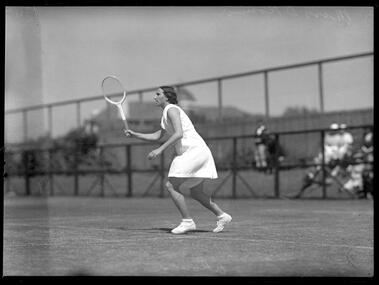
Photograph, Bull, Hugh Jones, 1897-1993, Tennis player, Dorothy Round, Albert Grounds, Melbourne
... FASHIONS OF THE TENNIS COURTS. (1934, December 6). The Sydney Morning Herald (NSW : 1842 - 1954), p. 7 (Women's Supplement). Retrieved September 20, 2023, from http://nla.gov.au/nla.news-article28021332 Leading Tennis Referee Condemns Wearing of Shorts (1933, October 5). The Herald (Melbourne, Vic. : 1861 - 1954), p. 11. Retrieved September 20, 2023, from http://nla.gov.au/nla.news-article243193607 DOROTHY ROUND Chooses Going-Away TROUSSEAU (1937, September 4). The Australian...FASHIONS OF THE TENNIS COURTS. (1934, December 6). The Sydney Morning Herald (NSW : 1842 - 1954), p. 7 (Women's Supplement). Retrieved September 20, 2023, from http://nla.gov.au/nla.news-article28021332 Leading Tennis Referee Condemns Wearing of Shorts (1933, October 5). The Herald (Melbourne, Vic. : 1861 - 1954), p. 11. Retrieved September 20, 2023, from http://nla.gov.au/nla.news-article243193607 DOROTHY ROUND Chooses Going-Away TROUSSEAU (1937, September 4). The Australian ...Dorothy Round in shorts English-born Dorothy Round (1909-1982) plays tennis at Albert Park Cricket Ground, wearing her signature white sleeveless dress with divided skirt, pleated to form loose shorts. Dorothy won Wimbledon in 1934 and 1937, and the Australian Open in 1935. In the early 1930s, many women players in Europe and USA swapped stockings and long skirts for bare legs, short skirts and shorts. In October 1933, Mr Harley Malcolm, Secretary of Lawn Tennis Association Australia (LTAA) declared, “I consider shorts not regulation costume and would stop both men and women, particularly women, wearing them. I think women’s desire to strut themselves in such a costume is unreasonable.” However by November, the Victorian Lawn Tennis Association (VLTA) officially allowed shorts at Kooyong for both sexes. At the July 1934 Wimbledon Women’s Final, played in front of the King and Queen, Dorothy wore a sleeveless dress with the skirt divided. Her American competitor, Helen Jacobs, wore white tailored shorts with a black stripe on either side, described as “mannish, though businesslike”. In October, Australian tennis player Mrs Nell Hopman warned, “When Miss Dorothy Round arrives in a few weeks’ time, the LTAA will have to reconsider its decision about women playing in dresses, as she is sure to bring a trunkful of shorts. Miss Round has a “shorts only” rule which I fancy she will stick to here. She is the most stylish player I saw abroad.” The papers also reported that “Mrs Hopman saw no “he girls” among tennis players in Europe. Even the almost universal rule for shorts did not make them look masculine.” Dorothy said, “I wear shorts because they do not get in the way as a frock does. Mine are made in one piece and this avoids any tightness around the waist.” Featured in "Newsworthy: Melbourne in photographs 1933-1936" exhibition at East Melbourne Library, October to December 2023. Exhibition caption by project volunteer, Fiona Collyer. Photographer notations on slide: "Mrs D Round; D Round B6" Description: Dorothy Round plays tennis at Albert Grounds, Albert Park, Melbourne. She is wearing her signature white sleeveless dress with divided skirt, pleated to form loose shorts. Research by project volunteer, Fiona Collyer: Dorothy Round (1909-1982) was an English tennis champion from Dudley, Worcestershire. She won the Wimbledon Women’s Singles in 1934 and 1937. In 1935 she won the Australian Championships Women’s Singles in Melbourne. Dorothy won the Mixed Doubles at Wimbledon in 1934, 1935 and 1936. Dorothy was a staunch Methodist and taught Sunday School at Dudley Wesleyan Methodist Church throughout her career. She did not drink, smoke, dance or play tennis on Sundays and declined to compete in the 1933 French Open as tennis officials refused to comply to her scheduling preferences of No Sundays. During the Wightman Cup in New York when play was rained out on the Saturday, Dorothy refused to return on the Sunday. Officials reluctantly agreed to reschedule the clash for Monday, where she put in a sub par performance, prompting the New York Times to quip “Miss Round doesn’t play on Sundays, and doesn’t play particularly well on Mondays!”. In the early 1930s many women tennis players in Europe and USA abandoned their stockings and long skirts for bare legs, short skirts and shorts and some men swapped their long flannel trousers for shorts. British player Henry “Bunny” Austin was the first top male player to wear shorts at Centre Court Wimbledon in 1933, and his sister Joan Lycett nee Austin became the first female player to play without stockings on Centre Court, appearing with bare legs and ankle socks in 1931. In 1933 Mr Harley Malcolm, Secretary of the Lawn Tennis Association Australia (LTAA) and referee of big tournaments , said “the rules say regulation costume must be worn – I consider shorts are not regulation costume and would stop both men and women, particularly women, wearing them. I think women’s desire to strut themselves in such a costume is unreasonable.” (Herald 5/10/1933) However, by November 1933 the Victorian Lawn Tennis Assn officially allowed shorts as regulation dress at Kooyong for both sexes. One speaker suggested that as the majority of women were knock-kneed, the privilege of wearing shorts would not be taken up extensively by them. He added that women were not intended by nature to wear such garments. Another member mentioned that men were rather handsome objects and “works of art” and would carry off the short pants vogue nicely. (Sun Sydney 15/11/33) At the 1934 Wimbledon Singles Finals, playing in front of King George V and Queen Mary, Dorothy wore her signature outfit of sleeveless white dress with the skirt divided and pleated to form loose shorts and American Helen Jacobs wore white tailored shorts with a black stripe on either side described as “mannish, though business like.” In the lead up to Dorothy’s arrival in Australia to compete in the Australian Championship of 1935, there was much speculation written in the press about Dorothy’s preference for wearing shorts. Tennis player Mrs Nell Hopman warned “When Miss Dorothy Round arrives in a few weeks’ time, the Australian Lawn Tennis Association will have to reconsider its decision about women playing in dresses, as she is sure to bring a trunkful of shorts.” “Miss Round has a “shorts only” rule which I fancy she will stick to here. She is the most stylish player abroad.” Mrs Hopman saw no “he girls” among the tennis players in Europe. Even the almost universal rule for shorts did not make them look masculine. Mrs Hopman brought back a couple of pleated pairs that tennis player and designer Mrs Fearnley-Whittingstall (nee Eileen Bennett) made popular and worn by most English players. “They are really quite radical for they look no more startling than a short, pleated skirt” she said. (Newcastle Sun 1/10/1934) Writing for the Sydney Morning Herald 6/12/34, Dorothy said ”I have heard that a photograph of a player wearing shorts was sent to the Queen for her approval and I understand that she said in reply “that they were very attractive”. The Queen is a frequent and interested visitor to Wimbledon so this story is most credible and possibly explains the lack of official opposition to shorts this year.” “I wear shorts because they do not get in the way as a frock does. You have probably noticed that mine are made in one piece and this avoids any tightness around the waist. I don’t know whether shorts have come to stay. They do not suit everybody and the majority of the men don’t like the women in them and this may help condemn the fashion. I really think the men dislike them because too many people who shorts obviously do not suit rushed to be in the fashion and the result was devastating. For my part, I hope that this comfortable fashion endures.” Dorothy’s doubles partner, English tennis champion Fred Perry, did not approve of shorts for men and was particularly perturbed at the idea of women wearing them. Fred always wore long, white flannel trousers and white collared polo shirt on the tennis court. In July 1935 Dorothy took up a post as a dress designer and sportswear design advisor at British outfitters Jaeger. She published two books – “Modern Lawn Tennis” in 1935 and ”Tennis for Girls” in 1938 – described as cheerful and sensible guides. In 1937, Dorothy married Dr Douglas Leigh Little at Dudley Wesleyan Methodist Church. Her wedding dress was designed by renowned fashion designer Teddy Tinling who specialised in designing tennis dresses. (Tinling designed the dress worn by Billie Jean King for the famous “Battle of the Sexes” tennis match against Bobby Riggs in 1973.) News reel co. Gaumont British News filmed the wedding, showing 10,000 people, mostly women, surging towards the couple, describing it as a riot, and quipping that Dorothy’s forehand was useful when cutting the wedding cake. The city of Dudley gifted the couple an antique walnut bedroom suite chosen by them. Dorothy and Douglas had a son, Ian, and a daughter, Patricia. She gave up competitive tennis to coach and write newspaper articles. In later life she took up golf. Dorothy died of cancer in 1982 aged 73. She was inducted into the International Tennis Hall of Fame 1986. In 2004 a bronze bust of Dorothy was installed at Wimbledon, and in 2013 a life size bronze statue was erected at Priory Park, Dudley. References: MRS. HOPMAN RETURNS (1934, October 1). The Newcastle Sun (NSW : 1918 - 1954), p. 9. Retrieved September 20, 2023, from http://nla.gov.au/nla.news-article166292409 FIGURED IT OUT (1933, November 15). The Sun (Sydney, NSW : 1910 - 1954), p. 13 (FINAL EXTRA). Retrieved September 20, 2023, from http://nla.gov.au/nla.news-article230199908 FASHIONS OF THE TENNIS COURTS. (1934, December 6). The Sydney Morning Herald (NSW : 1842 - 1954), p. 7 (Women's Supplement). Retrieved September 20, 2023, from http://nla.gov.au/nla.news-article28021332 Leading Tennis Referee Condemns Wearing of Shorts (1933, October 5). The Herald (Melbourne, Vic. : 1861 - 1954), p. 11. Retrieved September 20, 2023, from http://nla.gov.au/nla.news-article243193607 DOROTHY ROUND Chooses Going-Away TROUSSEAU (1937, September 4). The Australian Women's Weekly (1933 - 1982), p. 39. Retrieved September 20, 2023, from http://nla.gov.au/nla.news-article51588090 Ban On Shorts For Tennis Girls? (1934, April 15). The Sun (Sydney, NSW : 1910 - 1954), p. 3. Retrieved February 5, 2024, from http://nla.gov.au/nla.news-article230535547 Dorothy Round Little - one of Britain's greatest champions, 13 September 2009, Tennis Forum, https://www.tennisforum.com/threads/dorothy-round-little-one-of-britains-greatest-champions.409612/Photographer notations on slide: "Mrs D Round; D Round B6".tennis, clothing and dress, 1930-1939 -
 Kew Historical Society Inc
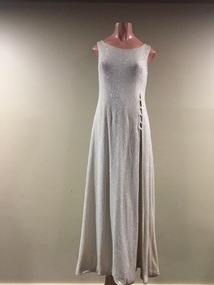
Hostess Gown with Matching Integrated Tights, Jinoel of Melbourne, 1968-71
... McIntyre's choice of this garment highlights how Melbourne's creative vanguard expressed their design ethos across both the built environment and personal style during the late 1960s and early 1970s. australian fashion - melbourne - 1960s jinoel of melbourne (vic) mcintyre collection evening wear women's clothing dione mcintyre Label: JINOEL OF MELBOURNE A two-piece illusion evening ensemble featuring a sleeveless, floor-length maxi outer dress in an off-white/stone Lurex georgette fabric. ...This dress is aestheticaly and historically significant as an intersection of Melbourne's mid-century fashion elite and its pioneering architectural movement. Designed by acclaimed couturier Jill Kemelfield (née Marty), it reflected her emerging interest in the late Mod / Space-Age glamour era, This avant-garde hostess gown was owned and worn by Dione McIntyre, one of Melbourne’s most celebrated and influential modernist architects.The dress’s design—which brilliantly blends the outer elegance of a traditional evening gown with the internal, functional structure of integrated catsuit tights—perfectly mirrors the core philosophy of mid-century modernism: where form flawlessly meets innovative function. McIntyre's choice of this garment highlights how Melbourne's creative vanguard expressed their design ethos across both the built environment and personal style during the late 1960s and early 1970s.A two-piece illusion evening ensemble featuring a sleeveless, floor-length maxi outer dress in an off-white/stone Lurex georgette fabric. The dress features a high boat/slash neckline, clean princess-line tailoring through the bodice, and a full column skirt. The left lateral seam features a high-thigh split fastened with a vertical line of matching cloth buttons or loop details. Built directly into the internal structure of the dress chassis is a pair of in-sewn matching tights/catsuit bodysuit legs, constructed from the same reflective Lurex textile to allow for dramatic, uninhibited leg movement when the side slit parts.Label: JINOEL OF MELBOURNEaustralian fashion - melbourne - 1960s, jinoel of melbourne (vic), mcintyre collection, evening wear, women's clothing, dione mcintyre -
 National Wool Museum
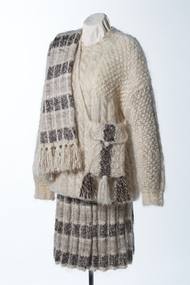
Clothing - Knitted Outfit, Inge Cammans, 1998
... Vic. 3885 / (051) 55 9296 / AUSTRALIA tag [back]: Theo Cammans / is an exceptionally talented individual. / He is responsible for not only / the beautiful paintings and / woodwork throughout the / shop, but also fashions the / unique Buchan Marble / into many varied and / stunning designs. / Inge Cammans / using her own hand spun / wool she has made multi / award winning garments / and wall hangings. / Each item in unique and / renowned world wide / She has taken first prize at - / National Wool Awards, / Melbourne, Lakes, Bairnsdale, Omeo / Paris Exhibitor front [rosette]: OMEO & DIST. ...Vic. 3885 / (051) 55 9296 / AUSTRALIA tag [back]: Theo Cammans / is an exceptionally talented individual. / He is responsible for not only / the beautiful paintings and / woodwork throughout the / shop, but also fashions the / unique Buchan Marble / into many varied and / stunning designs. / Inge Cammans / using her own hand spun / wool she has made multi / award winning garments / and wall hangings. / Each item in unique and / renowned world wide / She has taken first prize at - / National Wool Awards, / Melbourne, Lakes, Bairnsdale, Omeo / Paris Exhibitor front [rosette]: OMEO & DIST. ...Inge Cammans was born Ingenborg Flachs on 13 March 1932 in the Netherlands. She married Theodore Cammans on 27 April 1959 in Valkenburg. Inge was a dressmaker, and Theo a butcher. Later that year they emigrated to Canada, then in the mid 1960’s arrived in Australia. After arriving in Australia, they settled in East Gippsland. After some time in Sale, they moved to the small country town of Buchan and for two years they operated the local butcher shop and then took over the kiosk at Buchan Caves Reserve, which they ran for 13 years while raising their four children. Around 1980 they retired to the main street of Buchan. There they bought and restored the "Callemondah" property and opened a small craft and gallery space called the Buchan Black Marble Hut to display and sell Theo’s beautiful woodwork, stone craft and paintings. Although they were quite busy with the tourist trade, Inge fast became restless and borrowed a spinning wheel from a friend to try out. She taught herself how to spin and knit over the course of two months. From there, Inge went on to win a vast array of awards for her knitting - the house was full of walls upon walls covered in certificates, sashes, newspaper articles and pennants. She never used dye and only ever worked with natural wool, and would regularly travel out to the local farms to choose the colour of sheep she wanted. She would take the fleece to spin and then design and knit, crochet or latch hook every item from scratch, often inspired by techniques from dressmaking, and make knitted garments appear or behave the same way, despite its very different construction. This outfit was made by Inge in 1998. She was intrigued to figure out how to create the kilt pleats, the plaid pattern and the structure of the head piece. It was never intended to be worn out and about. She did knit items to wear, gift or sell, but the vast majority of her creative pieces were specifically intended as show submissions. This outfit was entered in the National Wool Awards competition in 1999 and won first prize. Hand knitted cream and brown outfit consisting of a skirt (kilt), jumper, hat (beret), scarf, socks and bag. Outfit is made using hand spun wool from local East Gippsland area, Perendale and Mohair. An artist tag and rosette award accompany the outfit.tag [front]: [handwritten] SCOTTISH OUTFIT / DESIGNED HAND- / SPUN + KNITTED OUT / OF PERRIDALE + / MOHAIR BY / Inge Cammans / [printed] BUCHAN / BLACK MARBLE HUT / GALLERY / Main Street, Box 9, / Buchan, Vic. 3885 / (051) 55 9296 / AUSTRALIA tag [back]: Theo Cammans / is an exceptionally talented individual. / He is responsible for not only / the beautiful paintings and / woodwork throughout the / shop, but also fashions the / unique Buchan Marble / into many varied and / stunning designs. / Inge Cammans / using her own hand spun / wool she has made multi / award winning garments / and wall hangings. / Each item in unique and / renowned world wide / She has taken first prize at - / National Wool Awards, / Melbourne, Lakes, Bairnsdale, Omeo / Paris Exhibitor front [rosette]: OMEO & DIST. A.&P. SOCIETY / WOOL DESIGN AWARDS / 1stknitting handicrafts, cammans, mr theo, knitting, handicrafts, east gippsland, inge cammas, buchan, migration, buchan black marble hut, awards
