
Showing 186 items matching "fashion cotton"
-
 National Wool Museum
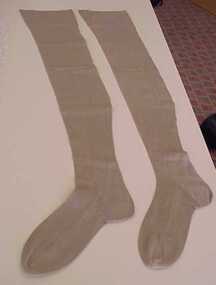
Stockings
... Fashion Cotton...Pair cotton lisle stockings, made in England. Fashion Cotton Lisle Fashion Cotton Suede Lisle / Fully Fashioned / Made in England B.H.F. ...Pair cotton lisle stockings, made in England.Suede Lisle / Fully Fashioned / Made in England B.H.F.fashion cotton, lisle, fashion, cotton -
 National Wool Museum
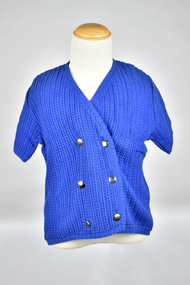
Textile - Children's Cardigan, Kathryn Knitwear, c.1960
... ...Fashion Cotton...Their legacy forms an integral part of both Australian social and manufacturing history. knitwear children's knitwear clothing children's clothing cardigan manufacturing Fashion Textile Production Machine Knitting Fashion Cotton .1) [white label at back neck with blue stitching] KATHRYN REGD. ...Kathryn Knitwear, founded by Robert Blake, manufactured high quality children’s knitwear in Melbourne from the 1940s – 1980s. Robert Blake began manufacturing children’s knitwear in his bedroom in Strathmore using a hand powered machine in the late 1940s. The operation moved to Ascot Vale and Essendon, before eventually establishing a factory in Moonee Ponds in the early 1950s. The business continued to expand, necessitating a move to a new factory in Broadmeadows. By 1962, the Broadmeadows factory was producing an average of 20,000 garments per month, which increased to 24,000 by 1964. Robert Blake’s Son, Brendan recalls that “The Kathryn brand was famous around Australia, anywhere children needed to keep warm and dress smartly. It also won a number of wool fashion awards”, including the 1969 Wool Awards, which was held by the Australian Wool Bureau and published in Women’s Weekly. The Kathryn range was designed for durability, comfort and care, without sacrificing style. They used patterning techniques that increase stretchiness, comfort and fit, as well as integrating decorative elements into the fabric to prevent them from being bulky, uncomfortable or tight. Making longevity of style a priority, Brendan Blake remembers that “there was one particular garment that was in the range for at least thirty years”. He also recalls “In the past, when women have found out that I was associated with Kathryn Knitwear, they would often relate to me the story of a garment they had purchased or received as a gift and, when their child had grown out of it, they would hand it on to another child. Several ladies have told me of purchasing garments for their daughters’ glory box, or saving a particular garment after their daughter had grown out of it. Brendan Blake: “At the peak of their operation they employed approximately two hundred people, mainly women and girls. A family would often seek to send their daughter to work in this company because they knew they would be looked after and safe. One lady wrote to me telling me that working at the Moonee Ponds Factory prior to getting married was the happiest time of her life.” In 1963, workers at the Kathryn factory earned £13 per week, which was 8 shillings and 8 pence higher than the minimum weekly wage for female workers in the textile manufacturing industry (£12 11s 4d). By 1970, the Kathryn Knitwear brand expanded from children’s knitwear into womenswear under the brand name ‘Lady Kathryn’, and for boys and men under ‘Robert Blake’. Continuing to diversify their distribution, they also began exporting ‘Kathryn’ garments to New Zealand, the Pacific Islands, and Japan. ‘Kathryn Knitwear’ was well-known for their early adoption of modern materials and techniques that had broad appeal to their customer base. This is shown in their early use of the acrylic fibre ‘Orlon’ in the 50s and 60s and ‘Superwash’ wool in the 1970s. Many of Kathryn Knitwear’s styles, particularly those that were long running staples of the brand, were available in both wool and Orlon to suit the consumer’s preference. Cotton is a common material for knitwear worn in the warmer months, as it is very breathable and absorbs moisture easily. While we mostly associate knitwear with keeping us warm in the cold, the market for Australian knitwear would be very limited without options to wear all year round. Far from the humble origins of one man in his bedroom with a hand-cranked machine; at its closure in 1980, the Broadmeadows factory of ‘Kathryn’ housed more than 100 machines, including 53 sewing machines and 45 knitting machines. Robert Blake was “a passionate advocate for wool and Australian Made” throughout his whole life. A strong thread that ties through the lifespan of Robert Blake and Kathryn Knitwear is a balance between adopting new innovations without sacrificing the core values of durability, comfort, care and style that had made the brand so well known. Their legacy forms an integral part of both Australian social and manufacturing history.Royal blue double breasted cardigan 'Reefer Jacket' with short sleeves in a textured rib stitch with six chrome metal buttons in two rows down centre front. Style 319/J .2 is sample tag with manufacturing information, including sizes and colours available.1) [white label at back neck with blue stitching] KATHRYN REGD. CREATED BY ALL COTTON / 24 / ROBERT BLAKE .2) [sample label] [OBVERSE] STYLE: 319/J – Reefer Jacket – Combed Cot. SIZE: 22” 24” 26” 28” 30” 32” PRICE: 20/- 21/- 22/6 24/- 26/- 27/6 COLOR: NAVY ONLY. [REVERSE] KATHRYN Garments are • PRE-SHRUNK • STANDARD MEASUREMENTS • FIT EXACTLY • LAUNDER PERFECTLY Designed and Manufactured by ROBERT BLAKE, MELBOURNEknitwear, children's knitwear, clothing, children's clothing, cardigan, manufacturing, fashion textile production, machine knitting, fashion cotton -
 National Wool Museum
Textile - Dress, 1980
... ...fashion...cotton...This dress was worn with a hat and coat ensemble between 1980 and 2014. dress costume fashion cotton Cotton dress with belt, buttons down the front from chest to waist and a collar. ...Fabric for dress purchased from Cleggs, Elizabeth St Melbourne. Made at Deniliquin TAFE "Garment Assembly" course which ran for 2 years. Mrs Sayer was always crafty but not great at other subjects. This dress was worn with a hat and coat ensemble between 1980 and 2014.Cotton dress with belt, buttons down the front from chest to waist and a collar. Orange floral colours.dress, costume, fashion, cotton -
 Whitehorse Historical Society Inc.
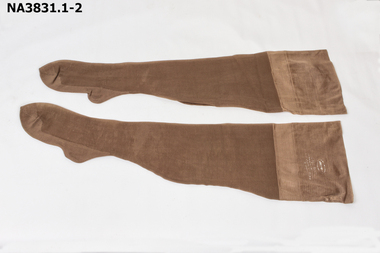
Clothing - Stockings
... Nylon fully fashioned stockings , top in cotton....Collected by Dora Sommers costume female female underwear Nylon fully fashioned stockings , top in cotton. Clothing Stockings ...Collected by Dora SommersNylon fully fashioned stockings , top in cotton.costume, female, female underwear -
Southern Sherbrooke Historical Society Inc.
Textile - Helen Gibson collection - material, cottons, etc
... cotton bag, embroidered in white blanket stitch (14 inches wide X 10 1/2 inches high). VSSH0444 - A collection of artificial flowers for hats and dresses. All kept in a blue cardboard box with attached lid. Inside lid is note saying "I wish dear love to darling Helen from Auntie Molly Christmas 1930". Includes: -1 black feather. -1 velvet belt with jewel encrusted buckle (made up of pretend diamonds). -1 rose accessory made from light pink silk (to be sewn or attached on). -1 velvet pink flower dress accessory. -1 orange velvet and silk flower fashion accessory. -2 burgundy velvet and silk flowers (with yellow stemen) fashion accessory. -1 white and burgundy silk flower chain with yellow stemen, fashion accessory. -1 lavender coloured floral fashion accessory with yellow and red stemen. -1 white and red feather floral fashion accessory. -1 pink, burnt orange and ivory velvet floral chain fashion accessory with green stemens. -1 small ivory and pink floral cotton bouquet fashion accessory with green foilage. -1 small burnt orange velveteen three-flower chain fashion accessory, with yellow-green stemen. -1 tiny bouquet of lavender-coloured forget-me-nots, fashion accessory. -1 burnt orange, brown and ivory velveteen bouquet on an apricot ribbon, fashion accessory. -1 small light blue and ivory floral bouquet fashion accessory with green and brown foilage. -1 floral brooch consisting of 3 white and yellow flowers and 5 multicoloured fruits. ...cotton bag, embroidered in white blanket stitch (14 inches wide X 10 1/2 inches high). VSSH0444 - A collection of artificial flowers for hats and dresses. All kept in a blue cardboard box with attached lid. Inside lid is note saying "I wish dear love to darling Helen from Auntie Molly Christmas 1930". Includes: -1 black feather. -1 velvet belt with jewel encrusted buckle (made up of pretend diamonds). -1 rose accessory made from light pink silk (to be sewn or attached on). -1 velvet pink flower dress accessory. -1 orange velvet and silk flower fashion accessory. -2 burgundy velvet and silk flowers (with yellow stemen) fashion accessory. -1 white and burgundy silk flower chain with yellow stemen, fashion accessory. -1 lavender coloured floral fashion accessory with yellow and red stemen. -1 white and red feather floral fashion accessory. -1 pink, burnt orange and ivory velvet floral chain fashion accessory with green stemens. -1 small ivory and pink floral cotton bouquet fashion accessory with green foilage. -1 small burnt orange velveteen three-flower chain fashion accessory, with yellow-green stemen. -1 tiny bouquet of lavender-coloured forget-me-nots, fashion accessory. -1 burnt orange, brown and ivory velveteen bouquet on an apricot ribbon, fashion accessory. -1 small light blue and ivory floral bouquet fashion accessory with green and brown foilage. -1 floral brooch consisting of 3 white and yellow flowers and 5 multicoloured fruits. ... -
 Flagstaff Hill Maritime Museum and Village
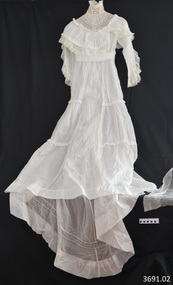
Clothing - Wedding Dress, c. 1860
... It shows the careful workmanship of the dressmaker. flagstaff hill warrnambool shipwrecked coast flagstaff hill maritime museum maritime museum shipwreck coast flagstaff hill maritime village great ocean road bridal clothing wedding gown wedding dress silk bridal veil 19th century wedding dress bridal gown mid-19th century 1860s dressmaking fashion wedding bride bridal fashion antique Wedding dress or Bridal Gown circa 1860, comprising wedding dress and veil. A gown of very fine cotton with long sleeves, a high neck and waist, and a tiered skirt. ...This beautiful, dainty wedding or bridal gown was made for a petite fiture and dates to around the 1860s. The wedding dress is a fine example of bridal fashion of the 1860s. It shows the careful workmanship of the dressmaker.Wedding dress or Bridal Gown circa 1860, comprising wedding dress and veil. A gown of very fine cotton with long sleeves, a high neck and waist, and a tiered skirt. The neckline features a lace insert and a decorative panel in the body of the dress, with a train at the back. It has a hook and eye closure. The veil is silk. The dainty gown is a modern Size 8.flagstaff hill, warrnambool, shipwrecked coast, flagstaff hill maritime museum, maritime museum, shipwreck coast, flagstaff hill maritime village, great ocean road, bridal clothing, wedding gown, wedding dress, silk bridal veil, 19th century wedding dress, bridal gown, mid-19th century, 1860s, dressmaking, fashion, wedding, bride, bridal fashion, antique -
 Flagstaff Hill Maritime Museum and Village
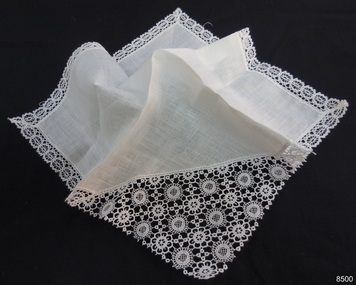
Accessory - Handkerchief, 20th century
... This handkerchief is a representation of fine needlework and women's fashion accessories in the late 19th and early 20th century. flagstaff hill warrnambool shipwrecked coast flagstaff hill maritime museum maritime museum shipwreck coast flagstaff hill maritime village great ocean road handkerchief lace handkerchief woman's handkerchief women's accessory fine fabric craftwork White fine lawn cotton handkerchief, square with machine made lace handstitched to lawn. ...This fine lawn handkerchief has machine made lace trim. Although lace was being machine made from the 1600’s the design of the lace on this handkerchief is circa 1900’s. This handkerchief is a representation of fine needlework and women's fashion accessories in the late 19th and early 20th century.White fine lawn cotton handkerchief, square with machine made lace handstitched to lawn. Features two separate types of lace which are carefully cut on the edges. The design of the lace is circa 1900s.flagstaff hill, warrnambool, shipwrecked coast, flagstaff hill maritime museum, maritime museum, shipwreck coast, flagstaff hill maritime village, great ocean road, handkerchief, lace handkerchief, woman's handkerchief, women's accessory, fine fabric craftwork -
 Flagstaff Hill Maritime Museum and Village
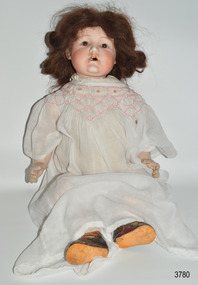
Leisure object - Porcelain Doll, 1920-1941
... Doll is wearing old fashioned cream coloured knitted woollen singlet, cream flannel vest with draw-string cotton bodice and scalloped edge. ...Doll is wearing old fashioned cream coloured knitted woollen singlet, cream flannel vest with draw-string cotton bodice and scalloped edge. ...Unable to determine a specific company that manufactured this doll many Japanese companies manufactured dolls of this type for export and these were only marked "Nippon" to show country of manufacture. These dolls marked this way were in production from around 1920 until 1941 when Japanese toy factories began to manufacturing items for war.Unable to be determined provenance relating to specific Japanese manufacturer. The doll is an example of a children's toy from the 1920s-1940s.Porcelain Doll in white fabric dress Doll, female, has porcelain face, composite body with swivel head and limbs. Head has long brown curly mohair wig attached into a hole in the pate; several doll-sized hairpins hold hair in place. Face has open mouth showing two porcelain front teeth, brown eyes of hand blown glass and hand painted features. Back of neck has two pressed holes above maker’s mark. Doll has removable white silk socks and brown shoes with tied ankle strap and hard soles. Doll is wearing old fashioned cream coloured knitted woollen singlet, cream flannel vest with draw-string cotton bodice and scalloped edge. The doll also has a more modern style white cotton dress with pink smocking. Inscription pressed into back of neck, shaded with pencil, "Nippon"Maker’s Mark “NIPPON” (See media section this document for a list of possible manufactures of doll)flagstaff hill, warrnambool, shipwrecked coast, flagstaff hill maritime museum, maritime museum, shipwreck coast, flagstaff hill maritime village, great ocean road, doll, nippon, nippon novelty company, porcelain, japanese doll manufacturer, porcelain doll, vintage doll -
 Flagstaff Hill Maritime Museum and Village
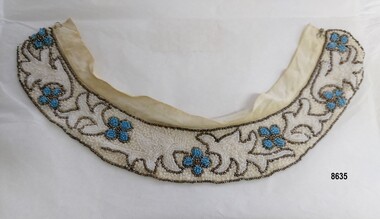
Clothing - Beaded collar, circa mid 20th century
... Flagstaff Hill Maritime Museum and Village Warrnambool Great Ocean Road fashion beaded collar beading decorative fashion collar lady's fashion Lady's beaded collar with a decorative floral design of flowers made with blue beads, outlined with bronze beads on a white beaded background. Bronze beads have also been used to "draw" leaf shapes and tendrils and outline a border all around the collar. A hook and eye are attached to a fine cotton ...This beaded dress collar is of a style from the mid 20th century - possibly even as early as the 1930's. It is designed to be easily removed and worn with different outfits - e.g. a dress, knitted top or blouse. Articles from Australian newspapers (particularly the Women's fashion pages) in the decades from the 1930's through to the 1950's often mentioned society ladies wearing "beaded collars" when describing their fashions and in the 1950's "beaded collars" were being made and imported from Japan however this particular collar appears to have been handmade. Unfortunately the maker of this collar is unknown.This item is an example of how women in the mid 20th century used their needlework skills to personalise and embellish an item of clothing (a collar) designed in a practical way to be able to be used with different items of clothing. Lady's beaded collar with a decorative floral design of flowers made with blue beads, outlined with bronze beads on a white beaded background. Bronze beads have also been used to "draw" leaf shapes and tendrils and outline a border all around the collar. A hook and eye are attached to a fine cotton bias band at the top of the collar and the beading is sewn onto a fine net lining.flagstaff hill maritime museum and village, warrnambool, great ocean road, fashion, beaded collar, beading, decorative fashion, collar, lady's fashion -
 Flagstaff Hill Maritime Museum and Village
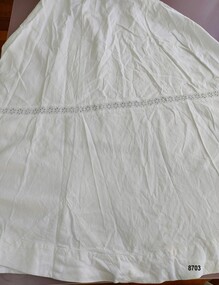
Textile - Skirt, circa 1910
... cotton. The top of the skirt is made from five pieces of fabric, sewn together and inserted into a simple waistband. It has an opening with room for 6 hook and eyes (but only the middle three remain). The top section of the skirt is separated from the bottom section by a strip of eyelet embroidery that has been inserted in a horizontal line at the back but becomes slightly diagonal at the front causing the two ends to cross in a decorative X fashion. ...cotton. The top of the skirt is made from five pieces of fabric, sewn together and inserted into a simple waistband. It has an opening with room for 6 hook and eyes (but only the middle three remain). The top section of the skirt is separated from the bottom section by a strip of eyelet embroidery that has been inserted in a horizontal line at the back but becomes slightly diagonal at the front causing the two ends to cross in a decorative X fashion. ...This item is one of a collection of clothing items that belonged to the Stephenson family who lived at 22 McCracken Street, Kensington, Melbourne. Matthew Stephenson (1861 – 1943) who had grown up on the Bendigo goldfields and shifted to Melbourne in the early 1900’s was a train driver and later, a fireman with the railways. His wife Elizabeth Jane (Betsy) Wigley (1865 – 1953) also grew up on the goldfields around Majorca and Bendigo. They married in 1885 in Bendigo. They had two daughters – Ethel Evelyn Stephenson (1886 – 1956) and Lillian or Lila (1891 – 1977) who were milliners and dressmakers and who continued to live in the family home after the death of their parents. The family are recorded as living at 22 McCracken Street, Kensington, as early as 1914. It is not known who made or owned the clothing that makes up this collection but as it appears to be from the late Victorian and early Edwardian era, the different pieces were probably made and worn by any of the three ladies of the house – Betsy, Ethel and/or Lila. During W.W.2, a local Warrnambool couple (Meryl and Tony Everard) boarded with them – Tony was in the airforce training paratroopers to jump into (and survive) enemy territory and his wife Meryl worked in the Methodist baby Home. The Everards developed a close friendship with the Stephensons and were responsible for clearing out the house (and finding this clothing collection) after Lila died in 1977. This skirt features broderie anglaise trim. Although broderie anglaise was a lace that could be made by hand, it was very time consuming to make. St Gallen was a city in Switzerland that had become known for producing quality textiles. At the beginning of the 19th century, the first embroidery machines were developed in St Gallen. Factories used embroidery machines but people also had them in their homes. They were able to produce broderie anglaise for export. By the early 20th century, machine made lace, fabric, ribbons etc. were being sold in drapers shops all over England and Wales to women who were making clothes and furnishings for their families. It is highly likely that the lady who made this skirt brought the lengths of broderie anglaise already made to embellish and personalise her skirt.This item is an example of the needlework skills of women in the late 19th century - creating pintucks and adding lace to personalise and embellish a practical item of clothing. A full length lady's skirt of heavy textured ribbed twill cotton. The top of the skirt is made from five pieces of fabric, sewn together and inserted into a simple waistband. It has an opening with room for 6 hook and eyes (but only the middle three remain). The top section of the skirt is separated from the bottom section by a strip of eyelet embroidery that has been inserted in a horizontal line at the back but becomes slightly diagonal at the front causing the two ends to cross in a decorative X fashion. The bottom of the skirt is the same heavy cotton as the top and one seam features a V shaped insert or patch.flagstaff hill maritime museum and village, great ocean road, shipwreck coast, warrnambool, broderie anglaise, needlework, sewing, stephenson family, skirt, lady's skirt -
 Flagstaff Hill Maritime Museum and Village
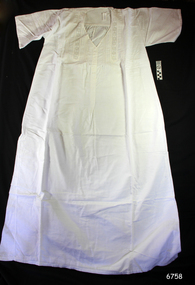
Clothing - Nightgown, Vera and Aurelia Giles, 1880-1920
... The Giles family collection has social significance at a local level, because it illustrates the level of material support the Warrnambool community gave to Flagstaff Hill when the Museum was established. warrnambool shipwrecked-coast flagstaff-hill flagstaff-hill-maritime-museum shipwreck-coast nightie giles collection henry giles tower hill cooramook warrnambool breakwater mailor’s flat wangoom 19th century household goods sleep wear nightgown nightdress night dress nightwear sleepwear clothing fashion 19th century handmade clothing None Nightgown, white cotton with Broderie Anglaise yoke. ...There are many 19th century items of furniture, linen and crockery donated to Flagstaff Hill Maritime Village by Vera and Aurelin Giles. The items are associated with the Giles Family and are known as the “Giles Collection”. These items mostly came from the simple home of Vera’s parents-in-law, Henry Giles and his wife Mary Jane (nee Freckleton), whose photos are in the parlour. They married in 1880. Henry Giles was born at Tower Hill in 1858. He was a labourer on the construction of the Breakwater before leaving in 1895 to build bridges in N.S.W. for about seven years. Mary Jane was born in 1860 at Cooramook. She attended Mailor’s Flat State School where she was also a student teacher before, as family legend has it, she became a governess at “Injemiara” where her grandfather, Francis Freckleton, once owned land. Henry and Mary’s family of six, some of whom were born at Mailor’s Flat and later children at Wangoom, lived with their parents at Wangoom and Purnim west, where Henry died in 1933 and Mary Jane in 1940. The Giles family collection has social significance at a local level, because it illustrates the level of material support the Warrnambool community gave to Flagstaff Hill when the Museum was established.Nightgown, white cotton with Broderie Anglaise yoke. Nonewarrnambool, shipwrecked-coast, flagstaff-hill, flagstaff-hill-maritime-museum, shipwreck-coast, nightie, giles collection, henry giles, tower hill, cooramook, warrnambool breakwater, mailor’s flat, wangoom, 19th century household goods, sleep wear, nightgown, nightdress, night dress, nightwear, sleepwear, clothing, fashion, 19th century, handmade clothing -
 Flagstaff Hill Maritime Museum and Village
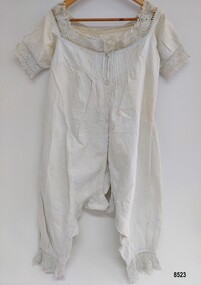
Clothing - Combination Undergarment, Eliza Towns, Late 19th century
... cotton fabric, Eliza Towns has incorporated pin tucks, hand embroidery and crocheted lace to embellish her garment. The collection of women’s late-19th-century undergarments is an example of clothing that women would include in their wardrobes. The garments add to the study of the evolution of women's fashions ...This item of underclothing, called a "combination" is one of several linen and clothing items that were made and belonged to Mrs. Eliza Towns and donated to Flagstaff Hill Maritime Museum and Village. Eliza was born Eliza Gould in 1857 in South Melbourne (Emerald Hill) and in 1879 married Charles Towns. In the early 1880's they moved to Nhill in western Victoria and remained there for the rest of their married life. Charles was a jeweller and later became an accountant and for many years was involved with the Shire Council, the local show committee (A & P Society), the Hospital Committee and the Board of the local newspaper (the Nhill Free Press). They had three children and lived a life that would be regarded as comfortably "middle class". Eliza probably had a treadle sewing machine and would have made many of her own clothes as well as clothes for her children - adding her own handmade embroidered or crocheted decorative trim. Combination undergarments combined the chemise and drawers into one garment. The combination is divided, or bifurcated, from the waist to the crutch for easier urinating. This one-piece type of underwear was worn by females from the 1860s and into the early 1900s. The 19th Century garments had front button closures like this one, and those made in the 1900s more often had back closures. Combination underwear was popular because the all-in-one design had far fewer gathers and bulk, making the other clothing look much smoother. Their primary use was to protect clothing from perspiration and because they were made with cotton or linen, were easy to wash. Although they were worn under the corset, next to the skin (and therefore not meant to be seen), they were often decorated with lace and embroidery. Although these combinations are made with a plain cotton fabric, Eliza Towns has incorporated pin tucks, hand embroidery and crocheted lace to embellish her garment. The collection of women’s late-19th-century undergarments is an example of clothing that women would include in their wardrobes. The garments add to the study of the evolution of women's fashions and practicality for the early Australian settlers. The careful needlework in these handmade garments and hand-worked lace trims reflect the maker’s dedication to making even serviceable garments beautiful to look at and wear.Women’s white cotton and lace all-In-one combination undergarment. The handmade underwear is a combined chemise and bloomers. It has three buttons in the front and a handmade drawstring cord around the square neckline. It is trimmed with crocheted lace (with a floral design) on the neckline, sleeves and pants. It had pintucks and feather stitching on the bodice and the left and right sides are divided from the waist to the crutch. The back of the garment is plain with a gathered section at the lower back.flagstaff hill maritime museum and village, maritime museum, maritime village, warrnambool, great ocean road, victorian era, combination undergarment, all-in-one underwear, combination, ‘combinations’, one-piece underwear, one-piece undergarment, chemise and bloomers, combination chemise and bloomers, divided, bifurcated, split, chemise and drawers, women’s underwear, ladies’ underwear, undergarment, women’s clothing, women’s fashion, lingerie, 19th-century undergarment, handmade clothing, handmade lace, crocheted lace, towns family, nhill, eliza towns -
 City of Moorabbin Historical Society (Operating the Box Cottage Museum)
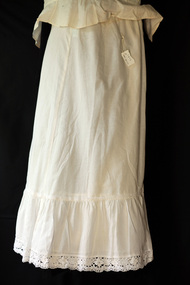
Clothing - Clothing, lady’s half petticoat, c1970
... fashions and they opened in smart South Kensington, London. In 1970 they opened franchises in Australia, Canada, Japan, San Francisco that sold their range of fabrics, dresses and accessories. In 1980 home furnishings were added to the range. Laura died in an accident 1985, Bernard retired in1993 and the company is now Public Listed on Stock Exchange. ‘Laura Ashley’ clothing, fabric and accessories were very popular in Melbourne in 1970’s. clothing brighton moorabbin dressmaking market gardeners early settlers craftwork textiles laura ashley Laura Ashley Pty Ltd A lady’s white cotton ...Laura and Bernard Ashley began printing fabric in their London kitchen in 1953. Commencing with head scarves and place-mats they gradually developed table-ware and bed sheets. In 1960 they entered the Fashion world with blouses and smocks . The ‘swinging sixties’ saw them in great demand for the feminine florals and flounces of the ‘maxi’ fashions and they opened in smart South Kensington, London. In 1970 they opened franchises in Australia, Canada, Japan, San Francisco that sold their range of fabrics, dresses and accessories. In 1980 home furnishings were added to the range. Laura died in an accident 1985, Bernard retired in1993 and the company is now Public Listed on Stock Exchange.‘Laura Ashley’ clothing, fabric and accessories were very popular in Melbourne in 1970’s.A lady’s white cotton half petticoat with crocheted flounce, Laura Ashley Pty Ltdclothing, brighton, moorabbin, dressmaking, market gardeners, early settlers, craftwork, textiles, laura ashley -
 City of Moorabbin Historical Society (Operating the Box Cottage Museum)
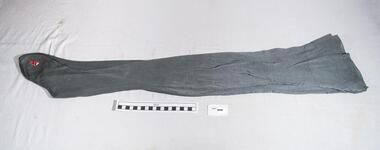
Clothing - Clothing, lady's stockings, Circa 1920s- 30s
... A pair of Beau Monde, size 8 1/2, unworn ladies grey cotton lisle stockings. Back seam, with fully fashioned heel and toe. ...These stockings were very popular with women c1920 -- 30 clothing lingerie hosiery moorabbin bentleigh cheltenham beau monde pty ltd market gardeners early settlers maggs nancy BEAU MONDE / Size 8 1/2 A pair of Beau Monde, size 8 1/2, unworn ladies grey cotton lisle stockings. Back seam, with fully fashioned heel and toe. ...These stockings were very popular with women c1920 -- 30A pair of Beau Monde, size 8 1/2, unworn ladies grey cotton lisle stockings. Back seam, with fully fashioned heel and toe. (Stockings were held up by a garter belt.)BEAU MONDE / Size 8 1/2 clothing, lingerie, hosiery, moorabbin, bentleigh, cheltenham, beau monde pty ltd, market gardeners, early settlers, maggs nancy -
 City of Moorabbin Historical Society (Operating the Box Cottage Museum)
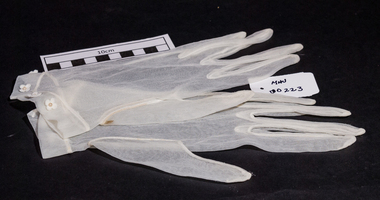
Accessory - Clothing, lady's cream nylon gloves, c1950
... fashions can be made cheaply because the cost of labour is inexpensive The family of Carole Pedersen-Green were early settlers in Moorabbin Shire. Carole was a founding member of CMHS clothing gloves nylon moorabbin bentleigh brighton early settlers market gardeners hong kong pedersen-green carole green carole denmark A pair of cream, nylon, lady's wrist length gloves There are 4 cotton flower shapes at centre back of wrist with a tiny pearl in each centre Accessory Clothing, lady's cream nylon gloves Unrecorded ...Ladies' gloves for formal and semi-formal wear come in three lengths for women: wrist, elbow, and opera or full-length (over the elbow, usually reaching to the biceps but sometimes to the full length of the arm). In the late 19thC and early 20thC Gloves were expected to be worn for both daytime and evening wear with most types of outfits. The most expensive gloves are custom-made of kid leather. These gloves were probably made in Hong Kong, then as now, a place where fashions can be made cheaply because the cost of labour is inexpensiveThe family of Carole Pedersen-Green were early settlers in Moorabbin Shire. Carole was a founding member of CMHSA pair of cream, nylon, lady's wrist length gloves There are 4 cotton flower shapes at centre back of wrist with a tiny pearl in each centreclothing, gloves, nylon, moorabbin, bentleigh, brighton, early settlers, market gardeners, hong kong, pedersen-green carole, green carole, denmark -
 City of Moorabbin Historical Society (Operating the Box Cottage Museum)
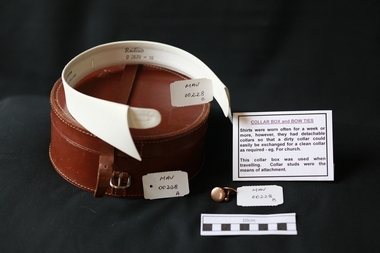
Accessory - Clothing, menswear 4 x collars and studs with leather box, early 20thC
... The Blackburn family were early settlers in Moorabbin Shire menswear clothing shirts collars early settlers fashion cheltenham moorabbin dairy farmers market gardeners Inside collar : a) Radiac / 0 2639 - 16 / ALL COTTON / MADE IN IRELAND; b) LAUNDRY / FOR BEST RESULT DIP / IN THIN COOKED STARCH/ Semi / 161/2 ; c) nil d) nil 4 x mens white, stiffly starched, detachable collars and 2 x brass studs with the leather box used for storage and transport of these items. ...In the 19thC and early 20thC men often wore their shirts for a week or more. However the collars were detachable so that they could be changed when they became dirty or for special occasions eg Church on Sundays Collar studs were used to attach the collar to the shirt. The leather box was used for storage and when travelling. The collars were very stiffly starched so as to maintain their shape.The Blackburn family were early settlers in Moorabbin Shire4 x mens white, stiffly starched, detachable collars and 2 x brass studs with the leather box used for storage and transport of these items. Each collar has 3 button holes - 2 at neck and 1 centre back for attachment to the shirt. The Leather box has saddle stitching and a strap with a metal buckle for securingInside collar : a) Radiac / 0 2639 - 16 / ALL COTTON / MADE IN IRELAND; b) LAUNDRY / FOR BEST RESULT DIP / IN THIN COOKED STARCH/ Semi / 161/2 ; c) nil d) nilmenswear, clothing, shirts, collars, early settlers, fashion, cheltenham, moorabbin, dairy farmers, market gardeners -
 City of Moorabbin Historical Society (Operating the Box Cottage Museum)
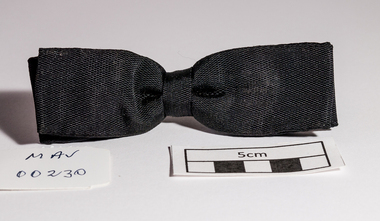
Accessory - Clothing, bow tie, black , spring clip, 20thC
... cotton, or a mixture of fabrics. The Bow tie originated among Croatian mercenaries during the Prussian wars of the 17th century when the Croat mercenaries used a scarf around the neck to hold together the opening of their shirts. This was soon adopted under the name cravat, derived from the French for "Croat", by the upper classes in France, then a leader in fashion...cotton, or a mixture of fabrics. The Bow tie originated among Croatian mercenaries during the Prussian wars of the 17th century when the Croat mercenaries used a scarf around the neck to hold together the opening of their shirts. This was soon adopted under the name cravat, derived from the French for "Croat", by the upper classes in France, then a leader in fashion ...The Bow Tie is a type of men's necktie that consists of a ribbon of fabric tied around the collar in a symmetrical manner such that the two opposite ends form loops. Ready-tied Bow ties are available, in which the distinctive Bow is sewn and a band goes around the neck and clips to secure. Bow ties may be made of any fabric material, but most are made from silk, polyester, cotton, or a mixture of fabrics. The Bow tie originated among Croatian mercenaries during the Prussian wars of the 17th century when the Croat mercenaries used a scarf around the neck to hold together the opening of their shirts. This was soon adopted under the name cravat, derived from the French for "Croat", by the upper classes in France, then a leader in fashion, and flourished in the 18th and 19th centuries. The most traditional Bow ties are usually of a fixed length and are made for a specific size neck. Sizes can vary between approximately 14 and 20 inches just like a comparable shirt collar. Fixed-length Bow ties are preferred when worn with the most formal wing-collar shirts, so as not to expose the buckle or clasp of an adjustable Bow tie. Bow ties are worn by magicians, country doctors, paediatricians, lawyers, professors musicians and by people hoping to look like the above and clowns also wear oversized ones. In the 1980’s fashionable and professional women wore a type of Bow tie. Most men only wear Bow ties with formal dress. A man's pre-tied black bow tie with a metal spring clip to attach to the shirt collar. The 2 spring clips have 'alligator teeth' to grip the collaron spring clip MADE IN AUSTRALIA SPRINGmenswear, clothing, bow ties, cheltenham, moorabbin, bentleigh, early settlers, pioneers, market gardeners, male neckwear -
 City of Moorabbin Historical Society (Operating the Box Cottage Museum)
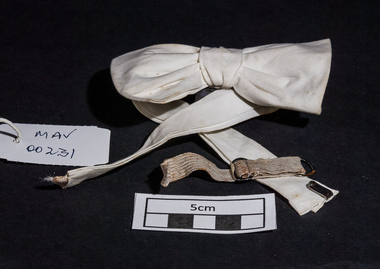
Clothing - Clothing, bow tie, white , elastic clip, 20thC
... cotton, or a mixture of fabrics. The Bow tie originated among Croatian mercenaries during the Prussian wars of the 17th century when the Croat mercenaries used a scarf around the neck to hold together the opening of their shirts. This was soon adopted under the name cravat, derived from the French for "Croat", by the upper classes in France, then a leader in fashion...cotton, or a mixture of fabrics. The Bow tie originated among Croatian mercenaries during the Prussian wars of the 17th century when the Croat mercenaries used a scarf around the neck to hold together the opening of their shirts. This was soon adopted under the name cravat, derived from the French for "Croat", by the upper classes in France, then a leader in fashion ...The Bow Tie is a type of men's necktie that consists of a ribbon of fabric tied around the collar in a symmetrical manner such that the two opposite ends form loops. Ready-tied Bow ties are available, in which the distinctive Bow is sewn and a band goes around the neck and clips to secure. Bow ties may be made of any fabric material, but most are made from silk, polyester, cotton, or a mixture of fabrics. The Bow tie originated among Croatian mercenaries during the Prussian wars of the 17th century when the Croat mercenaries used a scarf around the neck to hold together the opening of their shirts. This was soon adopted under the name cravat, derived from the French for "Croat", by the upper classes in France, then a leader in fashion, and flourished in the 18th and 19th centuries. The most traditional Bow ties are usually of a fixed length and are made for a specific size neck. Sizes can vary between approximately 14 and 20 inches just like a comparable shirt collar. Fixed-length Bow ties are preferred when worn with the most formal wing-collar shirts, so as not to expose the buckle or clasp of an adjustable Bow tie. Bow ties are worn by magicians, country doctors, paediatricians, lawyers, professors musicians and by people hoping to look like the above and clowns also wear oversized ones. In the 1980’s fashionable and professional women wore a type of Bow tie. Most men only wear Bow ties with formal dress. A pre tied white Bow tie sewn on a neckband with an elastic clip fastenermenswear, clothing, bow ties, cheltenham, moorabbin, bentleigh, early settlers, pioneers, market gardeners, male neckwear -
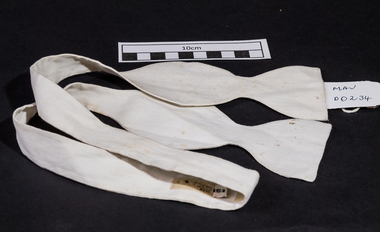 City of Moorabbin Historical Society (Operating the Box Cottage Museum)
Clothing - Clothing, bow tie white, fixed length, 20thC
... cotton, or a mixture of fabrics. The Bow tie originated among Croatian mercenaries during the Prussian wars of the 17th century when the Croat mercenaries used a scarf around the neck to hold together the opening of their shirts. This was soon adopted under the name cravat, derived from the French for "Croat", by the upper classes in France, then a leader in fashion...cotton, or a mixture of fabrics. The Bow tie originated among Croatian mercenaries during the Prussian wars of the 17th century when the Croat mercenaries used a scarf around the neck to hold together the opening of their shirts. This was soon adopted under the name cravat, derived from the French for "Croat", by the upper classes in France, then a leader in fashion ...The Bow Tie is a type of men's necktie that consists of a ribbon of fabric tied around the collar in a symmetrical manner such that the two opposite ends form loops. Ready-tied bow ties are available, in which the distinctive bow is sewn and a band goes around the neck and clips to secure. Bow ties may be made of any fabric material, but most are made from silk, polyester, cotton, or a mixture of fabrics. The Bow tie originated among Croatian mercenaries during the Prussian wars of the 17th century when the Croat mercenaries used a scarf around the neck to hold together the opening of their shirts. This was soon adopted under the name cravat, derived from the French for "Croat", by the upper classes in France, then a leader in fashion, and flourished in the 18th and 19th centuries. The most traditional Bow ties are usually of a fixed length and are made for a specific size neck. Sizes can vary between approximately 14 and 20 inches just like a comparable shirt collar. Fixed-length Bow ties are preferred when worn with the most formal wing-collar shirts, so as not to expose the buckle or clasp of an adjustable bow tie. Bow ties are worn by magicians, country doctors, lawyers, paediatricians, professors musicians and by people hoping to look like the above and clowns also wear oversized ones. In the 1980’s fashionable and professional women wore a type of Bow tie. Most men only wear Bow ties with formal dress. This white bow tie is a 'fixed length' type that needs to be tied by the person wearing it. MAKO SIZE 15 1/2 menswear, clothing, shirts, collars, early settlers, fashion, cheltenham, moorabbin, dairy farmers, market gardeners, bow ties, mako pty ltd -
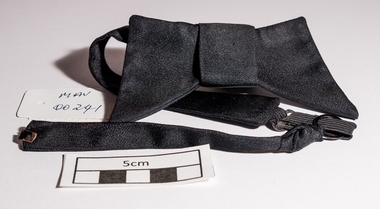 City of Moorabbin Historical Society (Operating the Box Cottage Museum)
Accessory - Clothing, black bow tie, c1960
... cotton, or a mixture of fabrics. The Bow tie originated among Croatian mercenaries during the Prussian wars of the 17th century when the Croat mercenaries used a scarf around the neck to hold together the opening of their shirts. This was soon adopted under the name cravat, derived from the French for "Croat", by the upper classes in France, then a leader in fashion...cotton, or a mixture of fabrics. The Bow tie originated among Croatian mercenaries during the Prussian wars of the 17th century when the Croat mercenaries used a scarf around the neck to hold together the opening of their shirts. This was soon adopted under the name cravat, derived from the French for "Croat", by the upper classes in France, then a leader in fashion ...The Bow Tie is a type of men's necktie that consists of a ribbon of fabric tied around the collar in a symmetrical manner such that the two opposite ends form loops. Ready-tied bow ties are available, in which the distinctive bow is sewn and a band goes around the neck and clips to secure. Bow ties may be made of any fabric material, but most are made from silk, polyester, cotton, or a mixture of fabrics. The Bow tie originated among Croatian mercenaries during the Prussian wars of the 17th century when the Croat mercenaries used a scarf around the neck to hold together the opening of their shirts. This was soon adopted under the name cravat, derived from the French for "Croat", by the upper classes in France, then a leader in fashion, and flourished in the 18th and 19th centuries. The most traditional Bow ties are usually of a fixed length and are made for a specific size neck. Sizes can vary between approximately 14 and 20 inches just like a comparable shirt collar. Fixed-length Bow ties are preferred when worn with the most formal wing-collar shirts, so as not to expose the buckle or clasp of an adjustable bow tie. Bow ties are worn by magicians, country doctors, lawyers, paediatricians, professors musicians and by people hoping to look like the above and clowns also wear oversized ones. In the 1980’s fashionable and professional women wore a type of Bow tie. Most men only wear Bow ties with formal dress. A man's pre tied black bow tie with an elastic fastening clipmenswear, neckties, bow ties, cheltenham. moorabbin, bentleigh -
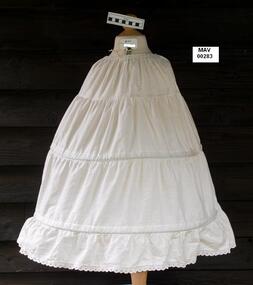 City of Moorabbin Historical Society (Operating the Box Cottage Museum)
Clothing - Clothing, lady's 1/2 petticoat hooped, c1950
... Hooped cotton petticoats were used to support a polished cotton gathered calf length skirt during the RockNRoll era in the 1950,s Typical petticoat during the 1950,s clothing petticoats fashion moorabbin bentleigh cheltenham A lady's white cotton 1/2 petticoat with elasticised waist and 3 rows of inserted hoops. ...Hooped cotton petticoats were used to support a polished cotton gathered calf length skirt during the RockNRoll era in the 1950,s Typical petticoat during the 1950,sA lady's white cotton 1/2 petticoat with elasticised waist and 3 rows of inserted hoops. clothing, petticoats, fashion, moorabbin, bentleigh, cheltenham -
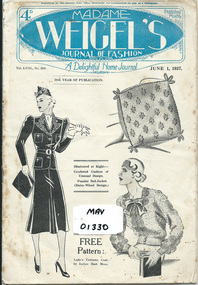 City of Moorabbin Historical Society (Operating the Box Cottage Museum)
Booklet - Madame Weigel's Journal of Fashion, A Delightful Home Journal June 1 1937, c1937
... Madame Weigel was one of the most remarkable of early Australasian business women. haberdashery, cotton, lace, pillow cases, sheets, clothing, dressmaking, needlework, market gardens, dairy farms, lacework, craftwork, moorabbin shire, bentleigh, moorabbin, cheltenham,reed gladys, clark judy Front Cover ; Registered at the General Post Office Melbourne for transmission by post as a Newspaper / 4d / Published Monthly / MADAME / WEIGEL'S / JOURNAL OF FASHION / Vol LV111 No. 688 / A Delightful Home Journal / JUNE 1, 1937 / 58th YEAR OF PUBLICATION / Illustrated at Right - / Crocheted Cushion of / Unusual Design. ...Gladys Reed was a member of the Ormond Choral Society c 1950. who performed plays and musicals the City of Moorabbin and she used these patterns to make clothes etc.for her family and the Choral Society. Madame Weigel who migrated to Melbourne in1877 with her husband Oscar; began publishing in 1878 and distributed paper patterns of the latest fashions, throughout Australia and New Zealand, She and Oscar became the first commercial manufacturers of paper patterns in Australasia, and to publish Weigel's Journal of Fashion (1880-1915) and Madame Weigel's Journal of Fashion (1915-1950). Madame Weigel had an enormous following of women who used her patterns across the generations, and across the life cycle from babies to 'matrons'. Madame Weigel died in 1940 aged 92 years. Finally, after 91 years of business and millions of patterns sold, Madame Weigel's paper pattern business closed in 1969.Gladys Reed was a member of the Ormond Choral Society c 1950. who performed plays and musicals in the City of Moorabbin and used these patterns for clothes etc for members of her family and the Choral Society. Madame Weigel was one of the most remarkable of early Australasian business women.A black and white booklet of 37 pages with advertisements, sketches, articles, photographs, knitting,crochet and tapestry instructions, dressmaking patterns and recipes. Volume LV111 pages 122 - 159 completeFront Cover ; Registered at the General Post Office Melbourne for transmission by post as a Newspaper / 4d / Published Monthly / MADAME / WEIGEL'S / JOURNAL OF FASHION / Vol LV111 No. 688 / A Delightful Home Journal / JUNE 1, 1937 / 58th YEAR OF PUBLICATION / Illustrated at Right - / Crocheted Cushion of / Unusual Design./popular Bed-Jacket. / ( Daisy Wheel Design) /Illustrated at Left - FREE Pattern ; / Lady's Costume Coat. / 34 Inches Bust Meas. Back Cover : Advertisement for Bushells Blue Label Tea / Printed and Published by Geo. Humphries for Madame Weigel Pty Ltd , Lennox and Rowena Sts., Richmond. Vic.haberdashery, cotton, lace, pillow cases, sheets, clothing, dressmaking, needlework, market gardens, dairy farms, lacework, craftwork, moorabbin shire, bentleigh, moorabbin, cheltenham,reed gladys, clark judy -
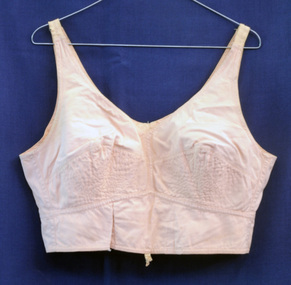 Orbost & District Historical Society
brassiere, La Mode, c. 1930s-1940s
... Belonged to Marjorie McKeown (need Ford) womens-corsetry womens-undergarments fashion La Mode (manufacturer) Size 42 A brassiere of apricot / pink cotton fabric with metal suspender clips around the bottom and 18 small metal clasps down the back. ...Belonged to Marjorie McKeown (need Ford)A brassiere of apricot / pink cotton fabric with metal suspender clips around the bottom and 18 small metal clasps down the back. Size 42. La Mode (manufacturer) Size 42womens-corsetry womens-undergarments fashion -
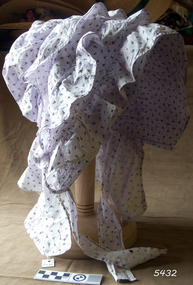 Flagstaff Hill Maritime Museum and Village
Bonnet, late 1800s - early 1900s
... This style of bonnet was commonly worn outdoors by women in South West Victoria in the late 1800s - early 1900s The bonnet is significant as a typical of women's outdoor headwear in Australia in the late 19th and early 20th century. flagstaff hill warrnambool shipwrecked-coast flagstaff-hill flagstaff-hill-maritime-museum maritime-museum shipwreck-coast flagstaff-hill-maritime-village ladies bonnet outdoor bonnet hat bonnet headwear ladies clothing late 19th century bonnet early 20th century bonnet women's fashion australian fashion australian millinery Ladies outdoor bonnet, white cotton with narrow mauve stripes and small flowers. ...This style of bonnet was commonly worn outdoors by women in South West Victoria in the late 1800s - early 1900sThe bonnet is significant as a typical of women's outdoor headwear in Australia in the late 19th and early 20th century.Ladies outdoor bonnet, white cotton with narrow mauve stripes and small flowers. Bonnet is trimmed with frills and straps to tie under the chin. Dated late 19th to early 20th century.flagstaff hill, warrnambool, shipwrecked-coast, flagstaff-hill, flagstaff-hill-maritime-museum, maritime-museum, shipwreck-coast, flagstaff-hill-maritime-village, ladies bonnet, outdoor bonnet, hat, bonnet, headwear, ladies clothing, late 19th century bonnet, early 20th century bonnet, women's fashion, australian fashion, australian millinery -
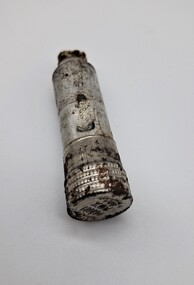 Glenelg Shire Council Cultural Collection
Functional object - Lighter Wick, Mini Fox
... Cigarette cigarette lighter Fashion Accessory Portland Glenelg Shire smoking Patent / Mini Fox / Made in Austria Silver coloured metal cylindrical lighter wick. The base of the cylinder has several rows of dotted patters around the circumference. The base is slightly rusted. It is pencil-shaped at the top and has a cotton ...This lighter wick would have been part of a lighter with the wick in built. It would have operated with lighter fluid. Helps to tell the story of male accessories and fashion.Silver coloured metal cylindrical lighter wick. The base of the cylinder has several rows of dotted patters around the circumference. The base is slightly rusted. It is pencil-shaped at the top and has a cotton wick coming out of the top opening. The base has a makers mark stamped on attributing it to Mini Fox.Patent / Mini Fox / Made in Austriacigarette, cigarette lighter, fashion, accessory, portland, glenelg shire, smoking -
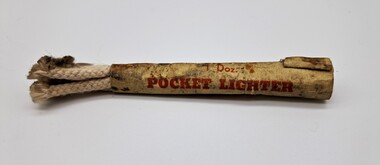 Glenelg Shire Council Cultural Collection
Functional object - Pocket Lighter Wicks
... Smoking Cigarettes Wicks Accessories Men's Fashion Portland Glenelg Shire 1 Doz. / Pocket Lighter Wicks / Australia Made A set of 5 cotton wicks encased in a paper wrapper. ...Spare wicks were required for pocket lighters which used lighter fluid and had in built wicks.A set of 5 cotton wicks encased in a paper wrapper. The top of the wicks are visible over the paper wrapper. The wrapper is cream coloured with red lettering on it.1 Doz. / Pocket Lighter Wicks / Australia Madesmoking, cigarettes, wicks, accessories, men's fashion, portland, glenelg shire -
 Montmorency–Eltham RSL Sub Branch
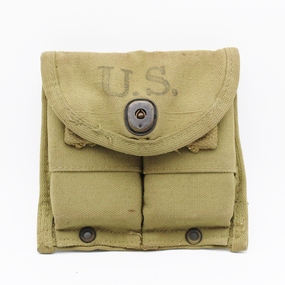
Artwork, other - Pouch, Magazine, US .30 calibre M1 Carbine, 1944
... pouch magazine m1 carbine cotton canvas Front of flap reads U.S, inside flap reads Camlin Fashions of America Inc. 1944 Khaki webbing pouch for two .30 Calibre, M1 Carbine 15 round magazines. ...Khaki webbing pouch for two .30 Calibre, M1 Carbine 15 round magazines. Metal Lift-the-Dot studs.Front of flap reads U.S, inside flap reads Camlin Fashions of America Inc. 1944pouch, magazine, m1 carbine, cotton canvas -
 Flagstaff Hill Maritime Museum and Village
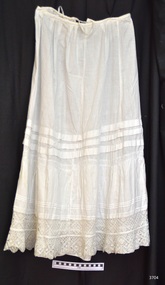
Clothing - Petticoat
... cotton garments 19th century...ladies undergarment...petticoat c 1900...ladies' clothing...ladies' fashion...This object is significant as an example of an item in common use in the 19th and early 20th centuries. flagstaff hill warrnambool shipwrecked coast flagstaff hill maritime museum maritime museum shipwreck coast flagstaff hill maritime village great ocean road ladies garments 19th century cotton garments 19th century ladies undergarment petticoat c 1900 ladies' clothing ladies' fashion underwear petticoat Petticoat, ladies size, cotton, waist to floor, drawstring waist closure, bottom lace trim is lined, pin tucks in lower skirt. ...This petticoat was donated along with other well kept items of women's clothing. the pin tucks and lace trim could have been made to give flexibility to the length. The clothing once belonged to members of a family who migrated from Faversham, Kent, England to Sydney, Australia in the late 19th - early 20th century and was passed down through the family. The items have been worn and have also been well cared for.This object is significant as an example of an item in common use in the 19th and early 20th centuries.Petticoat, ladies size, cotton, waist to floor, drawstring waist closure, bottom lace trim is lined, pin tucks in lower skirt. Machine made lace, machine stitched. C. 1900.flagstaff hill, warrnambool, shipwrecked coast, flagstaff hill maritime museum, maritime museum, shipwreck coast, flagstaff hill maritime village, great ocean road, ladies garments 19th century, cotton garments 19th century, ladies undergarment, petticoat c 1900, ladies' clothing, ladies' fashion, underwear, petticoat -
 Flagstaff Hill Maritime Museum and Village
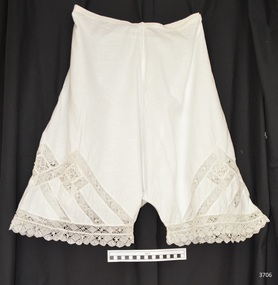
Clothing - Bloomers
... cotton garments 19th century...ladies undergarment...bloomers c 1900...bloomers...underwear...ladies' underwear...ladies' fashion...This object is significant as an example of an item in common use in the 19th and early 20th centuries. flagstaff hill warrnambool shipwrecked coast flagstaff hill maritime museum maritime museum shipwreck coast flagstaff hill maritime village great ocean road ladies garments 19th century cotton garments 19th century ladies undergarment bloomers c 1900 bloomers underwear ladies' underwear ladies' fashion lace inserts Inscription is illegible Bloomers, cotton, machine made lace inserts and trim around legs. ...This bloomers were donated along with other well kept items of women's clothing. The clothing once belonged to members of a family who migrated from Faversham, Kent, England to Sydney, Australia in the late 19th - early 20th century and was passed down through the family. The items have been worn and have also been well cared for.This object is significant as an example of an item in common use in the 19th and early 20th centuries.Bloomers, cotton, machine made lace inserts and trim around legs. Waist has elastic (no longer stretching). Inscription is illegible. C. 1900. Inscription is illegibleflagstaff hill, warrnambool, shipwrecked coast, flagstaff hill maritime museum, maritime museum, shipwreck coast, flagstaff hill maritime village, great ocean road, ladies garments 19th century, cotton garments 19th century, ladies undergarment, bloomers c 1900, bloomers, underwear, ladies' underwear, ladies' fashion, lace inserts -
 Flagstaff Hill Maritime Museum and Village
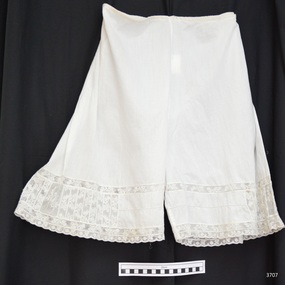
Clothing - Bloomers
... cotton garments 19th century...ladies undergarment...bloomers c 1900...bloomers...ladies' underwear...underwear...ladies' fashion...This object is significant as an example of an item in common use in the 19th and early 20th centuries. flagstaff hill warrnambool shipwrecked coast flagstaff hill maritime museum maritime museum shipwreck coast flagstaff hill maritime village great ocean road ladies garments 19th century cotton garments 19th century ladies undergarment bloomers c 1900 bloomers ladies' underwear underwear ladies' fashion Victorian fashion ladies' clothing Illegible inscription on waistband Bloomers, cotton, pulled thread embroidery and machine made lace inserts, lace trim around legs. ...This pair of bloomers was donated along with other well kept items of women's clothing. The clothing once belonged to members of a family who migrated from Faversham, Kent, England to Sydney, Australia in the late 19th - early 20th century and was passed down through the family. The items have been worn and have also been well cared for.This object is significant as an example of an item in common use in the 19th and early 20th centuries.Bloomers, cotton, pulled thread embroidery and machine made lace inserts, lace trim around legs. Waist has elastic (no longer stretching). Inscription is illegible. C. 1900Illegible inscription on waistbandflagstaff hill, warrnambool, shipwrecked coast, flagstaff hill maritime museum, maritime museum, shipwreck coast, flagstaff hill maritime village, great ocean road, ladies garments 19th century, cotton garments 19th century, ladies undergarment, bloomers c 1900, bloomers, ladies' underwear, underwear, ladies' fashion, victorian fashion, ladies' clothing
