
Showing 46 items matching "federal director"
-
 Melbourne Tram Museum
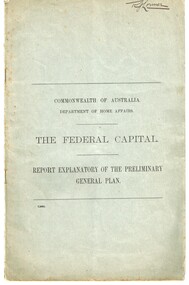
Document - Report, Walter Burley Griffin, Federal Capital Director of Design and Construction, "The Federal Capital - Report Explanatory on the Preliminary General Plan", Oct. 2013
... Signed Walter Burley Griffin, Federal Capital Director of Design and Construction, October 1913....Walter Burley Griffin, Federal Capital Director of Design and Construction...Signed Walter Burley Griffin, Federal Capital Director of Design and Construction, October 1913. ...Report - 16 pages + two plans within a grey cover stapled - titled "Commonwealth of Australia Department of Home Affairs - The Federal Capital - Report Explanatory on the Preliminary General Plan" - looking at the site, functions and layout of the proposed capital city of Australia - Canberra. Includes some notes on railways and a rapid transit facility. Signed Walter Burley Griffin, Federal Capital Director of Design and Construction, October 1913.Has in ink in the top right hand corner "Mr. Lormer"trams, tramways, commonwealth government, planning, canberra -
 Federation University Historical Collection
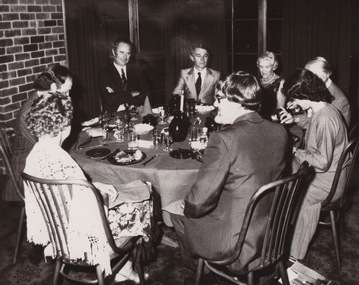
Photograph - Photograph - black and white, Ballarat College of Advanced Education: Dinner with special guest, Barry Jones, Labour Member of Parliament; 1977/78
... ...federal director...Tippett. Jim Reid - Federal Director of the National Safety Council of Australia....Tippett. Jim Reid - Federal Director of the National Safety Council of Australia. ballarat school of mines ballarat college of advanced education e j barker principal of smb foundation director of bcae e j tippett president of smb council victorian institute of colleges hon barry jones member of state parliament member of federal parliament minister for industry science and technology ann tippett jim reid national safety council of australia federal director Fourteen black and white photographs taken at a dinner - Ballarat College of Advanced Education. ...Victorian Institute of Occupational Safety and Health (VIOSH) Australia is the Asia-Pacific centre for teaching and research in occupational health and safety (OHS) and is known as one of Australia's leaders on the field. VIOSH has a global reputation for its innovative approach within the field of OHS management. VIOSH had its first intake of students in 1979. At that time the Institution was known as the Ballarat College of Advanced Education. In 1990 it became known as Ballarat University College, then in 1994 as University of Ballarat. It was 2014 that it became Federation University. VIOSH Australia students are safety managers, senior advisors and experienced OHS professionals. They come from all over Australia and industry. Students are taught active research and enquiry; rather than textbook learning and a one-size fits all approach. VIOSH accepts people into the Graduate Diploma of Occupational Hazard Management who have no undergraduate degree - on the basis of extensive work experience and knowledge. Photographs were posted to Ballarat College of Advanced Education from Melbourne. At this time VIOSH was in the planning stage and it was two years later that the first Intake of students started. People known in the photographs are: E.J. Barker, E.J. Tippett, Mr Jim Reid and Barry Jones. E.J. Barker (Jack) was the Principal of SMB from 1964-1976. He then became the Foundation Director of Ballarat Institute/College of Advanced Education from 1976-1987. The Library Building at Mount Helen Campus if named after him. E.J. Tippett was a member of SMB Council from 1934-1960. He was President of the Council from 1940-1960. He was a member of the Interim Council established to plan the development of the Victorian Institute of Colleges. He then became a member of the Council of the Victorian Institute of Colleges. The Library Building at SMB is named after him. In 1975 he was recognised by the State Government and awarded an MBE. Hon Barry Jones, Member of State Government from 1972 to 1977. He then entered Federal Parliament and was a member from 1977 to 1998. During his time he was Minister for Industry, Science and Technology from1983 to 1990. Ann Tippett - wife of E.J. Tippett. Jim Reid - Federal Director of the National Safety Council of Australia.Fourteen black and white photographs taken at a dinner - Ballarat College of Advanced Education.ballarat school of mines, ballarat college of advanced education, e j barker, principal of smb, foundation director of bcae, e j tippett, president of smb council, victorian institute of colleges, hon barry jones, member of state parliament, member of federal parliament, minister for industry science and technology, ann tippett, jim reid, national safety council of australia, federal director -
 Warrnambool and District Historical Society Inc.
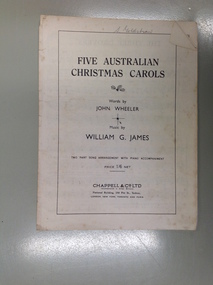
Work on paper - Booklet, Five Australian Christmas Carols
... He became the first Federal director of Music for the ABC until 1957. ...He became the first Federal director of Music for the ABC until 1957. ...Five Australian Christmas Carols was written by John Wheeler and music by William G James. William James came from Ballarat and John Wheeler was from Colac. James was a concert pianist who graduated from the Melbourne Conservatorium. He went to London and played the Proms and wrote a series of Australian themed songs for Dame Nellie Melba. He became the first Federal director of Music for the ABC until 1957. It was at the ABC that he met Wheeler a staff writer who wrote verse and songs. These five carols which have a distinct Australian flavor, were written between 1848 and 1957.While this collection has no direct link to Warrnambool, the works contained in the collection Five Australian Christmas Carols would have social significance as the carols would be familiar to a number of people. They remain some of the few carols with which Australians would identify as being typically Christmas time in Australia with the mention of weather and nature at that time of the year.1Five Australian Christmas Carols with words by John Wheeler and music by William G James contains five Australian carols, The Three drovers, The Silver stars are in the Sky, Christmas Day, Carol of the Birds, Christmas Bush For His Adorning. 12 Pages. S Goldstraw handwritten on front cover.john wheeler, william james, australian christmas carols, warrnambool -
 Uniting Church Archives - Synod of Victoria
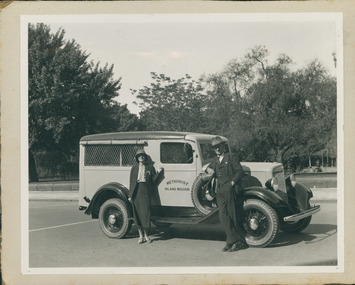
Photograph, C1955
... Henry(Harry) Griffith was Director of Federal Inland Mission from 1953-59....Henry(Harry) Griffith was Director of Federal Inland Mission from 1953-59. Griffiths, Henry Griffiths, Dorothy Methodist Inland Mission Gloss, black and white image of Rev. ...Rev. Henry(Harry) Griffith was Director of Federal Inland Mission from 1953-59.Gloss, black and white image of Rev. Henry Griffith and Dorothy Griffith with an Inland Mission car.griffiths, henry, griffiths, dorothy, methodist, inland mission -
 Federation University Historical Collection
Book, Standardization of Australia's Railway Gauges, 1945, 1945
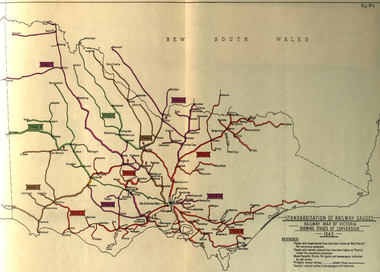
... Seconded to the Federal Government in World War II, he played a pivotal role in the manufacture of fighter aircraft in the defence of Australia. As Director...Seconded to the Federal Government in World War II, he played a pivotal role in the manufacture of fighter aircraft in the defence of Australia. As Director ...Sir Harold Winthrop Clapp KBE (7 May 1875 – 21 October 1952) was a transport administrator who over the course of thirty years had a profound effect on Australia's railway network. In two decades as its Chairman of Commissioners, he revolutionised Victorian Railways, with unprecedented attention to customer service and innovations such as more powerful locomotives, air-conditioned carriages, and faster services culminating in the introduction of the flagship Spirit of Progress express train. Seconded to the Federal Government in World War II, he played a pivotal role in the manufacture of fighter aircraft in the defence of Australia. As Director-General of Australia's Land Transport Board, he presented a report on railway gauge standardisation that ultimately led to the eventual linking of all Australian mainland capital cities by a uniform rail gauge. (http://en.wikipedia.org/wiki/Harold_Winthrop_Clapp, accessed 02/10/2013)Grey, soft covered, stapled report of 89 pages. "Standardization of Australia's Railway Gauges" by Harold Clapp is a report and recommendation regarding the standarization of Australia's railway gauges. The contents include: * Lines suggested for conversion or new lines to be constructed * scheme of conversion of tracks and structures * scheme of conversion of locomotives and rolling stock * Estimated costs * Associated works * Estimated manpower which the project will absorb in its various phases *Standardization of rolling stock * Other considerations associated with the project * Estimated time involved in the various phases of the work. The report includes 8 maps: * Map of Australia showing the various proposals referred to *Map of Australian railways showing extent of standard gauge if proposals are carried out * Map of Australian railways as of 30 June 1944 *Map of Australia showing principal mileages referred to in the report * Railway Map of Western Australia, 1945 * Railway Map of South Australia, 1945 * Railway Map of Victoria, 1945 * Railway Map of Melbourne Suburbs, 1945 railway, guage, standardization, standardisation, fremantle, perth, kalgoorlie, peterborough, silverton, tramway, tram, train, townsville, dajarra, bourke, cunnamulla, charleville, blackall, longreach, winton, hughenden, townsville, gajarra, birdum, darwin, narrow gauge -
 Federation University Historical Collection
Photograph - Photograph - Colour, Installation of University of Ballarat Chancellor Paul Hemming, 2012, 17/0/2012
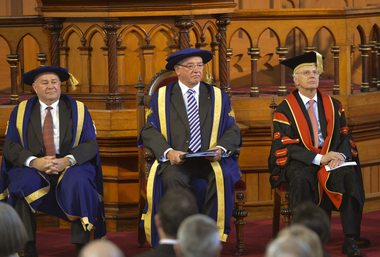
... He was a founding director of Beyondblue and has been president of the Royal Australian College of General Practitioners. He was also president of the Australian Medical Association Victoria and has served on numerous federal government medical bodies and tribunals. ...He was a founding director of Beyondblue and has been president of the Royal Australian College of General Practitioners. He was also president of the Australian Medical Association Victoria and has served on numerous federal government medical bodies and tribunals. ...In April 2012 former Royal Australian College of General Practitioners president Dr Paul Hemming was appointed the University of Ballarat’s new chancellor. Dr Hemming was a deputy chancellor of the university since 2011 and a member of the university council since 2007, and replaces outgoing chancellor Robert Smith. He was a founding director of Beyondblue and has been president of the Royal Australian College of General Practitioners. He was also president of the Australian Medical Association Victoria and has served on numerous federal government medical bodies and tribunals. Chancellors are appointed to chair the university's council (governing body) as the senior office holder of the University. They also confer the academic awards of the university, and represent the university at meetings, functions and ceremonies. At the installation of Dr Hemming as the Fifth Chancellor Of The University Of Ballarat Governor of Victoria Alex Chrnov said: "I join Bonnie Fagan in acknowledging the traditional owners of this land and I pay my respects to their elders past and present. It is my great pleasure, as Governor of Victoria and Visitor to the University of Ballarat, to install Dr Paul Hemming as the fifth Chancellor of this University. I extend to him and his family my warmest congratulations on this appointment and wish him all the best in his new role. I have no doubt that he will be an industrious and wise leader of this University. Although the University of Ballarat is one of Australia’s newest Universities, it is the third oldest Tertiary institution in our country with the School of Mines being established in 1870. It has much to be proud of, and should be recognised for its commitment to being one of our most outstanding regionally focused higher education institutions. It offers on six campuses a diverse, yet suitably targeted, group of learning models that include higher education, TAFE and senior secondary school education, and is one of the few universities in the country that has an associated Technology Park. This University is uniquely placed to provide higher education in Regional Victoria. For example, I understand that by 2020 the population in the Ballarat area will increase by 20% so this University will have the responsibility and opportunity to provide educational opportunities for this growing population. The role of the Governor can be divided into three parts – ceremonial, constitutional and community engagement. It is the third aspect of the role that is most time consuming and, I add, enjoyable. It includes making official visits to Regional areas of Victoria. To date Elizabeth and I have been on 16 such visits and the thing that stands out is that despite the challenges that face Regional communities whether it be through natural disasters, or the economy more broadly – the stoicism, volunteerism and self reliance are always present. Ballarat is an example of such resilience and confidence in its future that can be dated back to this University’s inception. When the School of Mines was established in 1870 on the back of the gold rush era of the 1850s, the local community had vision and faith in its future that is reflected in the building of this institution. It is not dissimilar to Melbourne, where its relatively few citizens established the iconic pillars of our society like the State Library, the University of Melbourne, Parliament Houses and the National Gallery of Victoria. The contribution by the University of Ballarat to Regional Victoria cannot be overstated. Not only does it provide top educational opportunities for students from the Region but its graduates almost invariably end up working in Regional Australia, and often in their own local communities. More specifically, almost three out of every four of the graduates from this University end up finding employment in Regional areas. Such figures highlight the University’s significant contribution to the Regional economy. But its impact is not limited to our Regional areas – it extends to other parts of Australia and overseas. But like so many other higher education institutions in Australia, the University of Ballarat is facing challenges brought about by events such as global uncertainties and the high Australian dollar that impact on the inflow of international students, and dealing with students, more and more of whom come from the lower socio economic sector. It is in those circumstances that the Chancellor must show leadership that involves, amongst others, objectively guiding the Council and supporting the Vice-Chancellor, albeit without becoming involved in the day to day micro management of the University. A strong, trusting and respectful working relationship between the Chancellor and the Vice-Chancellor is, I believe, critical to the sound progress of a University. Before I turn more specifically to Dr Hemming, I would like to reflect briefly on his immediate predecessor, Emeritus Professor Robert Smith. I am sure that Dr Hemming has already found in Professor Smith an invaluable source of assistance. He was a skilled and effective leader not only here, but also in the broader higher education sector. I mention by way of example his instigation and leadership two years ago of the much acclaimed Chancellors’ Conference that was held in Melbourne. There was great diffidence amongst the Chancellors in having it at all. It was a little like herding cats. But Bob Smith spearheaded the organisation of it, with great attention to detail. And it was his hard work and leadership that resulted in the Conference being such a success and of assistance to all Chancellors who attended. It was an illustration of Bob Smith’s skills as a leader in the sector and of this University. And the sector, just as this University remains indebted to him. And I have no doubt that Dr Hemming will similarly lead this University through the challenging, yet exciting, times that lie ahead. He is eminently qualified to do so, in terms of his personal attributes, academic achievements and experience in governance. With his extensive medical career as a General Practitioner, service on a number of Federal Government medical boards and tribunals, and having been a Founding Director of ‘Beyondblue’, President of the Royal Australian College of General Practitioners and President of the Australian Medical Association (Victoria), his list of personal and professional achievements, as well as his strong sense of public and community duty, is impressive. Importantly, Dr Hemming has a long standing connection with the Ballarat community, having moved here with his family from the United Kingdom in 1977. He is now even accepted as a “local” I am told. Given his range of experience to which I have referred and the time he has already spent on the Council and Standing Committees of this University, he is obviously well placed to take part in leading this University. So it is a great pleasure for me to install Dr Hemming as the fifth Chancellor of the University of Ballarat." (http://www.governor.vic.gov.au/victorias-governor/publications/speeches/speech/speech/104) Colour photographS of three men in academic regalia sitting inside the Ballarat Uniting Church, Lydiard Street South. Chancellor Dr Paul Hemming sit in the centre, with Vice-Chancellor Professor david Battersby on the left. Also audience images, academics and a dinner at Craig's Hotel.university of ballarat, federation university, regalia, chancellor, vice chancellor, paul hemming, david battersby, alex chrnov, todd walker, andy smith, craig's hotel, academics -
 Federation University Historical Collection
Booklet - Booklet - Programme, VIOSH: BCAE Occupational Hazard Management: 7th Annual Dinner Programme and Menu, 1985
... director...clive peterson...national safety council of australia...federal...Guests were welcomed by Mr Jack Barker, Director of Ballarat C.A.E. Following the entree, Federal President Mr Clive Peterson presented the National Safety Council Trophy. ...Guests were welcomed by Mr Jack Barker, Director of Ballarat C.A.E. Following the entree, Federal President Mr Clive Peterson presented the National Safety Council Trophy. ...Victorian Institute of Occupational Safety and Health (VIOSH) Australia is the Asia-Pacific centre for teaching and research in occupational health and safety (OHS) and is known as one of Australia's leaders on the field. VIOSH has a global reputation for its innovative approach within the field of OHS management. VIOSH had its first intake of students in 1979. At that time the Institution was known as the Ballarat College of Advanced Education. In 1990 it became known as Ballarat University College, then in 1994 as University of Ballarat. It was 2014 that it became Federation University. VIOSH Australia students are safety managers, senior advisors and experienced OHS professionals. They come from all over Australia and industry. Students are taught active research and enquiry; rather than textbook learning and a one-size fits all approach. VIOSH accepts people into the Graduate Diploma of Occupational Hazard Management who have no undergraduate degree - on the basis of extensive work experience and knowledge. Booklet for the Occupational Hazard Management 7th Annual Dinner, held on Thursday 11th July 1985, 7.00pm. Guests were welcomed by Mr Jack Barker, Director of Ballarat C.A.E. Following the entree, Federal President Mr Clive Peterson presented the National Safety Council Trophy. Safety Institute of Australia, Victorian Division President Mr Frank Kuffer presented the Dissertation Award. This was followed by the Main Course and then an Address by Neville Betts, graduate of OHM and Manager, Health and Safety, Telecom Australia - "The relevance of a graduate diploma in the real world". Dessert and coffee/port followed. Four A$ sheets - type written. One pink and three white Booklet - pink, 4 pages plus coverSymbol of Ballarat College of Advanced Educationviosh, victorian institute of occupational safety and health, ballarat college of advanced education, occupational hazard management, annual dinner, jack barker, director, clive peterson, national safety council of australia, federal president, safety institute of australia victorian division, president, frank kuffer, neville betts, ohm graduate, manager, health and safety, telecom australia -
 Federation University Historical Collection
Photograph, John Kerrin and John Sharpham, c1990
... John KErrin (Federal Minister in the Hawke/Keating Government) and John Sharpham (Director of Ballarat College of Advanced Education and Ballarat University College....John Kerrin john sharpham John KErrin (Federal Minister in the Hawke/Keating Government) and John Sharpham (Director of Ballarat College of Advanced Education and Ballarat University College. ...John KErrin (Federal Minister in the Hawke/Keating Government) and John Sharpham (Director of Ballarat College of Advanced Education and Ballarat University College.john kerrin, john sharpham -
 Federation University Historical Collection
Document - Document - News Release, VIOSH: Federal Department of Employment and Industrial Relations; Occupational Health and Safety for Women, 6 April 1984
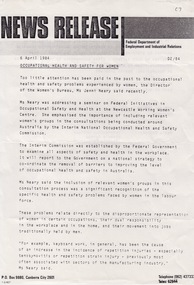
... federal department of employment and industrial relations...director...The Director of the Women's Bureau, Ms Jenni Neary spoke on Federal Initiatives in Occupational Safety and Health at the Newcastle Working Women's Centre. ...The Director of the Women's Bureau, Ms Jenni Neary spoke on Federal Initiatives in Occupational Safety and Health at the Newcastle Working Women's Centre. ...Victorian Institute of Occupational Safety and Health (VIOSH) Australia is the Asia-Pacific centre for teaching and research in occupational health and safety (OHS) and is known as one of Australia's leaders on the field. VIOSH has a global reputation for its innovative approach within the field of OHS management. VIOSH had its first intake of students in 1979. At that time the Institution was known as the Ballarat College of Advanced Education. In 1990 it became known as Ballarat University College, then in 1994 as University of Ballarat. It was 2014 that it became Federation University. VIOSH Australia students are safety managers, senior advisors and experienced OHS professionals. They come from all over Australia and industry. Students are taught active research and enquiry; rather than textbook learning and a one-size fits all approach. VIOSH accepts people into the Graduate Diploma of Occupational Hazard Management who have no undergraduate degree - on the basis of extensive work experience and knowledge. The Director of the Women's Bureau, Ms Jenni Neary spoke on Federal Initiatives in Occupational Safety and Health at the Newcastle Working Women's Centre. She emphasised the importance of including women's groups in the consultations being held around Australia. This was a significant recognition of the specific health and safety problems faced by women in the labour force.A4 page printed both sidesBarbara Fergusson viosh, victorian institute of occupational safety and health, federal department of employment and industrial relations, director of the women's bureau, newcastle working women's centre, jenni neary, information officer, barbara fergusson, consultations -
 City of Moorabbin Historical Society (Operating the Box Cottage Museum)
Document - Program Official Opening Cheltenham Post Office, Government Printer, 1974
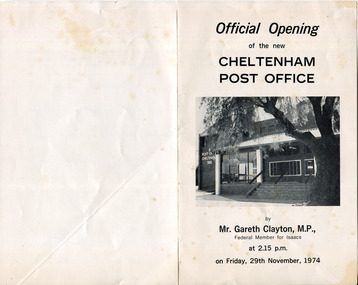
... Mr G Clayton Federal MP Isaacs, opened the Post Office with Moorabbin City Council Mayor C.R McHutchison, Mr WJB Pollock, Director Posts and Telegraphs, and hands the Key of the post Office to Mr L De Longville Postmaster....Mr G Clayton Federal MP Isaacs, opened the Post Office with Moorabbin City Council Mayor C.R McHutchison, Mr WJB Pollock, Director Posts and Telegraphs, and hands the Key of the post Office to Mr L De Longville Postmaster. ...John Hitchen was the manager of the first Cheltenham Post Office that opened 1/8/1857 in a boot and shoe store. Mail was transported to and from St Kilda to Cheltenham by coach 6 days a week and an additional service twice weekly to Tootgarook via Frankston also by coach. 1868 Post office Savings Bank began operation and the Telegraph office was established at the Railway Station 1885. A new building was built 1891 in Point Nepean Road for the official Cheltenham Post Office and a new manual telephone exchange began 1899 with 24 subscribers. By 1909 100 subscribers, 1951 there were 1700 and in 1974 12,000 subscribers . Hence this new building was designed by Oscar A. T. Gimsey & Assoc. and built by T W Morris & Sons Mordialloc. Mr G Clayton Federal MP Isaacs, opened the Post Office with Moorabbin City Council Mayor C.R McHutchison, Mr WJB Pollock, Director Posts and Telegraphs, and hands the Key of the post Office to Mr L De Longville Postmaster.The Post Office was an integral part to the development and prosperity of the Cheltenham area as the area grew from pioneer settlers in the 1850's to flourishing market gardens c1900 and industrial diversity of 1974.Program for the 'Official Opening of the Cheltenham Post Office' November 29th 1974 with a black and white photo of the building.city of moorabbin, county of bourke, moorabbin roads board, parish of moorabbin, shire of moorabbin, henry dendy's special survey 1841, were j.b., bent thomas, o'shannassy john, king richard, charman s, highett william, ormond francis, maynard dennis, post office, telegraph, st kilda station, tootgarook, frankston, clayton g mhr, mchutchison r.p mayor, pollock w j b mp, market gardens, early settlers, horse coach, de longville l postmaster -
 Eltham District Historical Society Inc
Colour Print, David Taylor, c.1976
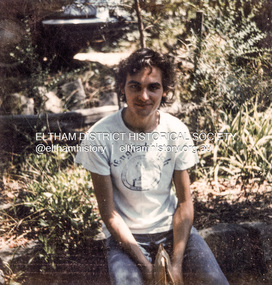
... David was a career public servant and worked for both the federal and state governments in a variety of roles from 1977 to 2024. His last role was as Assistant Director, Public Record Office Victoria (2016 - 2024) where he was responsible for overseeing the management of, and access to, the State’s archival collection. ...David was a career public servant and worked for both the federal and state governments in a variety of roles from 1977 to 2024. His last role was as Assistant Director, Public Record Office Victoria (2016 - 2024) where he was responsible for overseeing the management of, and access to, the State’s archival collection. ...David Taylor was born at Greensborough’s Diamond Valley Community Hospital. His parents purchased the family home which was at 216 Rattray Road Montmorency in the mid-1950s where he lived until the early 1980’s. David attended St Francis Xavier Primary School, Montmorency from 1962-1967. He then attended the newly opened Parade College Bundoora from 1968 to 1971 and completed his secondary education at Eltham High School in 1972-3. David was a career public servant and worked for both the federal and state governments in a variety of roles from 1977 to 2024. His last role was as Assistant Director, Public Record Office Victoria (2016 - 2024) where he was responsible for overseeing the management of, and access to, the State’s archival collection. He lives in a mud brick residence built by local Eltham artist, Janet Boddy, in the early 1970’s. In September 2022. David purchased and subsequently renovated “The Studio”. david taylor collection, david taylor -
 Eltham District Historical Society Inc
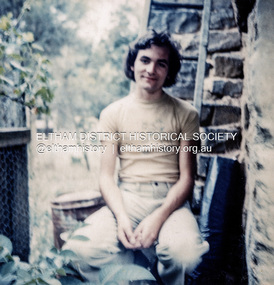
Colour Print, David Taylor, David Taylor outside Peter Garner's mudbrick studio, c.1976
... David was a career public servant and worked for both the federal and state governments in a variety of roles from 1977 to 2024. His last role was as Assistant Director, Public Record Office Victoria (2016 - 2024) where he was responsible for overseeing the management of, and access to, the State’s archival collection. ...David was a career public servant and worked for both the federal and state governments in a variety of roles from 1977 to 2024. His last role was as Assistant Director, Public Record Office Victoria (2016 - 2024) where he was responsible for overseeing the management of, and access to, the State’s archival collection. ...David Taylor was born at Greensborough’s Diamond Valley Community Hospital. His parents purchased the family home which was at 216 Rattray Road Montmorency in the mid-1950s where he lived until the early 1980’s. David attended St Francis Xavier Primary School, Montmorency from 1962-1967. He then attended the newly opened Parade College Bundoora from 1968 to 1971 and completed his secondary education at Eltham High School in 1972-3. David was a career public servant and worked for both the federal and state governments in a variety of roles from 1977 to 2024. His last role was as Assistant Director, Public Record Office Victoria (2016 - 2024) where he was responsible for overseeing the management of, and access to, the State’s archival collection. He lives in a mud brick residence built by local Eltham artist, Janet Boddy, in the early 1970’s. In September 2022. David purchased and subsequently renovated “The Studio”. david taylor collection, david taylor, peter garner adobe studio -
 Eltham District Historical Society Inc
Film - Video (VHS), VideoCAM, Eltham Woods Children's Resource Centre Opening (Series 69, Item 5), 5 Mar 1988
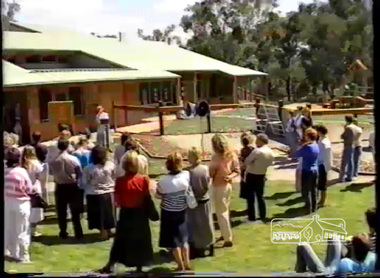
... He also thanked Bev Vern, Council's preschool advisor who assisted in developing the programs; Grant Roberts from Federal Office of Childcare for assisting the Cooperative in setting up the funding program; the builders George Takola and George Apted; Michelle Matello who undertook the needs analysis that identified another preschool was required; Cathy King who assisted in the development of the childcare program; Pat Grundy and Susan Forbes, Council officers who assisted with the development of the services and the members of the preschool committee. In addition, local residents and in particular Helen, Peter and Chris who advised Council of their concerns and worked with Council to overcome these issues; members of the Interim Steering Committee and the Directors...He also thanked Bev Vern, Council's preschool advisor who assisted in developing the programs; Grant Roberts from Federal Office of Childcare for assisting the Cooperative in setting up the funding program; the builders George Takola and George Apted; Michelle Matello who undertook the needs analysis that identified another preschool was required; Cathy King who assisted in the development of the childcare program; Pat Grundy and Susan Forbes, Council officers who assisted with the development of the services and the members of the preschool committee. In addition, local residents and in particular Helen, Peter and Chris who advised Council of their concerns and worked with Council to overcome these issues; members of the Interim Steering Committee and the Directors ...Shire of Eltham Archives: Series 69, Item 5 Video opens with panning view of completed kinder from Frank Street followed by images of the centre under construction then opening day speeches. Introduction and welcome by Mandy Press (Executive Officer, Shire of Eltham) with speeches by the Hon. Pauline Toner, Member for Eltham and Shire president, Cr. Alan Baker. The Hon. Pauline Toner acknowledged Shire President Alan Baker and her parliamentary colleagues Vin Heffernan, Neil Brown and Bob Halderson and Councillors; three levels of Government which led to the achievement of the kinder, and gave special thanks to the Council and parents for the forward planning to accommodate children from babyhood to school with childcare, kinder and baby health facilities all combined in one facility in the middle of parkland in a residential area. Shire President Cr Alan Baker then followed to formally open the centre. The site had been identified in early 1985 at that stage only as a pre-school but with an opportunity to develop, the additional services were driven by Cr Baker. Though a very long name, its simple message is "Care for Kids." Designed by architect Neil Biggins of Clark, Hopkins and Clark. Cr Baker stated that the theme of "people living in the environment" was very much encapsulated by the facility. Cr Baker informed that the construction of the facility had led to some concerns with a reduction in open space and potential traffic generated to the facility and those users of the facility were asked to ensure their use is sensitive to the local residents. Cr Baker talked about the financial costs and how the Federal grant funding was no longer as plentiful as previous and that the Victorian Government had come to the assistance thanks to Pauline Toner covering some other costs as well as the ongoing running costs of around $40,000. The Federal Government contributed $233,000 out of a childcare component rather than preschool. Cr Baker thanked Mandy Press again as well as Shire Engineer, John Stanton. Cr Baker also acknowledged Ed Latanzio who was in charge of the project, along with his colleague Alan Lansdowne; Gary Bartlett and his team for the exterior surroundings to the facility. He mentioned that Neil Biggins the architect had said not many Shire Councils show the same commitment to the exterior surroundings as the interior which was a credit to the Council and Gary Bartlett. He also thanked Bev Vern, Council's preschool advisor who assisted in developing the programs; Grant Roberts from Federal Office of Childcare for assisting the Cooperative in setting up the funding program; the builders George Takola and George Apted; Michelle Matello who undertook the needs analysis that identified another preschool was required; Cathy King who assisted in the development of the childcare program; Pat Grundy and Susan Forbes, Council officers who assisted with the development of the services and the members of the preschool committee. In addition, local residents and in particular Helen, Peter and Chris who advised Council of their concerns and worked with Council to overcome these issues; members of the Interim Steering Committee and the Directors of the Childcare Co-op. Cr Baker stated that the Co-op nature of the facility and the location of the three services under one roof was unique and the task of the programs was to be led by Annie, Dianne and Lynn Afternoon tea and activities followed the unveiling of the plaque. The video shows some of the children's entertainment and their engagement as well as interior and exterior views.VHS Video cassette Converted to MP4 file format 00:26:02; 302MBshire of eltham, video recording, shire of eltham archives, eltham shire council, alan lansdowne, bev vern, bob halderson, cathy king, clark hopkins and clark, councillors, cr. alan baker, ed latanzio, eltham, eltham woods childcare co-operative, federal government, federal office of childcare, frank street, gary bartlett, george apted, george takola, grant roberts, john stanton, mandy press, michelle matello, neil biggins, neil brown, pat grundy, pauline toner, people living in the environment, susan forbes, victorian government, vin heffernan -
 Bendigo Military Museum
Photograph - Visit by the Minister for Defence to the Army Survey Regiment, Fortuna, Bendigo, c1984
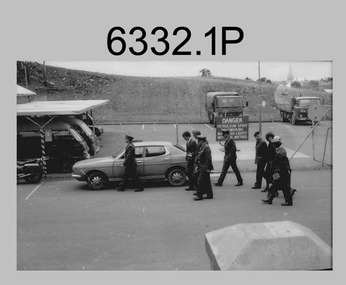
... Federal Member for Bendigo. He later moved on to Victorian state politics, serving as Treasurer from 2000 to 2007 and Premier from 2007 to 2010. Key Army Survey Regiment personnel identified include COL Alex Laing, the Director of Survey from 1983 to 1988 and CO LTCOL Jorge Gruszka who led the unit from 1982 to 1985. ...Federal Member for Bendigo. He later moved on to Victorian state politics, serving as Treasurer from 2000 to 2007 and Premier from 2007 to 2010. Key Army Survey Regiment personnel identified include COL Alex Laing, the Director of Survey from 1983 to 1988 and CO LTCOL Jorge Gruszka who led the unit from 1982 to 1985. ...This collection of 22 photos was most likely taken in 1984. Mr Gordon Scholes AO was the Minister for Defence in the Hawke Government from 1983 to 1984. It’s evident in these photos he was taken on a tour through the production areas. Mr John Brumby AO at this time was the Federal Member for Bendigo. He later moved on to Victorian state politics, serving as Treasurer from 2000 to 2007 and Premier from 2007 to 2010. Key Army Survey Regiment personnel identified include COL Alex Laing, the Director of Survey from 1983 to 1988 and CO LTCOL Jorge Gruszka who led the unit from 1982 to 1985. The rank of the senior officer is not known, however would have been a Major-General or above, due to the presence of the aide-de-camp (female captain). This is a set of 22 photographs of a visit to the Army Survey Regiment, Bendigo circa 1984, by Mr Gordon Scholes AO, who was the Minister for Defence. The photographs were printed on photographic paper and are part of the Army Survey Regiment’s Collection. Photographs .1P to .11P, .14P to .17P and .19P to .22P were scanned at 600 dpi. Photographs .12P to .13P and .18P were scanned at 300 dpi. .1) - Photo, black and white, c1984. L to R: unidentified, Mr John Brumby AO, Mr Gordon Scholes AO CO LTCOL Jorge Gruszka, unidentified, D-SVY COL Alex Laing, unidentified (x3). .2) - Photo, black and white, c1984. L to R: unidentified, CO LTCOL Jorge Gruszka AO, Mr John Brumby AO, Mr Gordon Scholes AO, unidentified (x4), D-SVY COL Alex Laing. .3) - Photo, black and white, c1984. L to R: unidentified (x2), Mr John Brumby, unidentified, CO LTCOL Jorge Gruszka AO, Mr Gordon Scholes AO, CAPT Danny Galbraith. .4) - Photo, black and white, c1984. L to R: unidentified, CO LTCOL Jorge Gruszka AO, Mr Gordon Scholes AO Mr John Brumby AO, unidentified. .5) - Photo, black and white, c1984. L to R: unidentified, Mr Gordon Scholes AO, unidentified, CO LTCOL Jorge Gruszka AO Mr John Brumby AO, unidentified. .6) - Photo, black and white, c1984. L to R: MAJ Daryl Hockings CSM, unidentified (x2). .7) - Photo, black and white, c1984. L to R: CAPT Danny Galbraith, unidentified (x2), Mr John Brumby AO, unidentified, CO LTCOL Jorge Gruszka AO, Mr Gordon Scholes AO, unidentified (x2). .8) - Photo, black and white, c1984. L to R: unidentified, Mr Gordon Scholes AO, CO LTCOL Jorge Gruszka AO, MAJ Daryl Hockings CSM, D-SVY COL Alex Laing, unidentified. .9) - Photo, black and white, c1984. L to R: unidentified, Mr John Brumby AO, CAPT Bob John, CO LTCOL Jorge Gruszka, Mr Gordon Scholes AO, unidentified (x2), MAJ Graham Baker, unidentified, MAJ Daryl Hockings CSM. .10) - Photo, black and white, c1984. L to R: Mr John Brumby AO, CAPT Bob John, Mr Gordon Scholes AO, unidentified (x2), MAJ Graham Baker, unidentified, MAJ Daryl Hockings CSM. .11) - Photo, black and white, c1984. L to R: unidentified, CO LTCOL Jorge Gruszka, Mr Gordon Scholes AO, unidentified (x2), MAJ Graham Baker, unidentified (x2). .12) - Photo, black and white, c1984. L to R: unidentified, CO LTCOL Jorge Gruszka, Mr Gordon Scholes AO. .13) - Photo, black and white, c1984. L to R: unidentified, Mr John Brumby AO, Mr Gordon Scholes AO, D-SVY COL Alex Laing, CO LTCOL Jorge Gruszka. .14) - Photo, black and white, c1984. L to R: unidentified, Mr Gordon Scholes AO, unidentified media, D-SVY COL Alex Laing, unidentified, CO LTCOL Jorge Gruszka, unidentified media (x2). .15) - Photo, black and white, c1984. L to R: unidentified, D-SVY COL Alex Laing, unidentified (x2), Mr Gordon Scholes AO, unidentified media (x3). .16) - Photo, black and white, c1984. L to R: unidentified (x5), CO LTCOL Jorge Gruszka, Mr Gordon Scholes AO. .17) - Photo, black and white, c1984. L to R: unidentified (x2), D-SVY COL Alex Laing, unidentified (x3), CO LTCOL Jorge Gruszka, Mr Gordon Scholes AO, Mr John Brumby AO. .18) - Photo, black and white, c1984. L to R: unidentified, CO LTCOL Jorge Gruszka, Mr Gordon Scholes AO. .19) - Photo, black and white, c1984. L to R: unidentified, CO LTCOL Jorge Gruszka, Mr John Brumby AO, D-SVY COL Alex Laing, unidentified, Mr Gordon Scholes AO, unidentified (x2). .20) - Photo, black and white, c1984. L to R: D-SVY COL Alex Laing, unidentified (x2). .21) - Photo, black and white, c1984. L to R: Mr John Brumby AO, unidentified, D-SVY COL Alex Laing, unidentified. .22) - Photo, black and white, c1984. L to R: unidentified (x3), Mr Gordon Scholes AO, Mr John Brumby AO, CO LTCOL Jorge Gruszka. .1P to .22P – no annotationsroyal australian survey corps, rasvy, army survey regiment, army svy regt, fortuna, asr -
Bendigo Historical Society Inc.
Administrative record - Commercial Egg Producers' Association of Victoria (CEPA) Central Council Correspondence, 1979
... Federal Council of Poultry Farmers' Associations of Australia. Inclusion Request: The sender, K. Fitzgibbon (Secretary), asks for a specific item to be added to the agenda for the upcoming Annual and General Meeting.Investigation of Surplus Egg Sales:The agenda item proposes an investigation into the sale of surplus eggs from fertile egg farms. 8504.35aa This document is a formal letter from CEPA to the Victorian Egg Marketing Board. The Association is submitting research project suggestions for consideration by the Board. 8504.35ab The document is a protest letter addressed to the State Director...Federal Council of Poultry Farmers' Associations of Australia. Inclusion Request: The sender, K. Fitzgibbon (Secretary), asks for a specific item to be added to the agenda for the upcoming Annual and General Meeting.Investigation of Surplus Egg Sales:The agenda item proposes an investigation into the sale of surplus eggs from fertile egg farms. 8504.35aa This document is a formal letter from CEPA to the Victorian Egg Marketing Board. The Association is submitting research project suggestions for consideration by the Board. 8504.35ab The document is a protest letter addressed to the State Director ...The Commercial Egg Producers' Association of Victoria was active by the 1930s, engaging in industry management and lobbying.The Commercial Egg Producer's Association (CEPA) had branches in Bendigo, South Bendigo, Eaglehawk, Wedderburn, Murrabit and Euroa.CEPA Commercial Egg Producer's Association (Bendigo Region) correspondence, for the year 1979. This item includes the following documents: 8504.35a Minutes of Branch half yearly conference 1979 8504.35b The document is a letter from K. Fitzgibbon, Secretary of the Central Council, addressed to Mr. C. L. Jefferson, Secretary of the Victorian Egg Marketing Board. Congratulation on Meeting Reduction:The Central Council commends the A.E.B. and C.E.M.A.A. for reducing their meetings to two per year. 8504.35c This document is a letter from K. Fitzgibbon, Secretary of the association, addressed to Mr. D. J. Foster, Chairman of the Federal Council of Poultry Farmers' Association of Australia. Gratitude for Legislative SupportThe letter expresses appreciation for Mr. Foster's persistent efforts to maintain demand and supply management legislation for poultry in the state. 8504.35d This document is a formal letter to the Poultry Research Advisory Council, dated January 6, 1980, expressing support for ongoing efforts and making key recommendations 8504.35e Letter to the Department of Agriculture, Division of Animal Healy re a possible outbreak of an exotic disease. 8504.35f The document is a letter addressed to the Minister of Agriculture, summarizing The importance of Random Sample Laying Tests 8504.35g The document is a letter from the Secretary of an agricultural association expressing concerns about the upcoming inquiry into the Egg Board. The association acknowledges the government's decision to extend the Egg Industry Stabilization Act Legislation for another 12 months. 8504.35h This document is a thank-you letter from the secretary of an association addressed to Hon. John Radford, M.L.C. The association expresses gratitude to John Radford for his support and efforts regarding the Egg Industry Stabilization Act. 8504.35i The document is a formal letter from the association to the Victorian Egg Marketing Board, proposing that with regards to the Producer Price Increase that the they suggest that the advance price paid to egg producers should be increased.The recommended increase should be in line with the Consumer Price Index (CPI), not just based on cost of production. 8504.35j Notice of half yearly conference 8504.35k The document is a letter from the Commercial Egg & Producers Association of Victoria expressing urgent concern about the government's reported intention to discontinue the Egg Industry Stabilization Act as of March 1980. The association requests that John Radford raise this issue with the Minister of Agriculture and, if the statement is accurate, arrange an immediate meeting with the Liberal Party Parliamentary Agriculture Committee to present their case. 8504.35l This document is a formal letter addressed to Mr. Cecil Burgin, Convenor of the Agricultural Committee of the Parliamentary Liberal Party. The letter is signed by K. Fitzgibbon, Secretary, and highlights the urgency and significance of resolving disagreements over the egg industry legislation. 8504.35m This document is a formal letter to the Secretary of the Liberal Party in Victoria. CPA requests the names and contact details of the Agricultural Committee of the Parliamentary Liberal Party. 8504.35n The Commercial Egg Producers' Association of Victoria expresses disappointment with the Minister of Agriculture's stance on the indefinite continuation of the Egg Industry Stabilisation Legislation. 8504.35o The document is a protest letter from the Commercial Egg Producers' Association of Victoria, addressed to Mrs. Jeanette Patrick, Secretary of the Liberal Party. The Association is protesting the selection of members for the New Victorian Egg Board. 8504.35p Notable recipients include Mr. B. Reid, Mr. D. McClure, Mr. W. Ebery, Mr. J. Radford, Mr. E. Hann (M.L.A., Echuca), Mr. P. Ross-Edwards (Leader National Party), and Mr. N. McKenzie (Executive Officer, Poultry Section V.F.U., Melbourne) 8504.35q This document outlines the formal hierarchy and key officials in the government. 8504.35r Newspaper article: "Stability and Efficiency in the Australian Egg IndustryDemand and supply management has made the Australian egg industry the most stable among major producers globally." 8504.35s The document is a letter from the Commercial Egg Producers' Association of Victoria expressing concerns about recent changes to the Victorian Egg Board. Concerns Over Appointment Process. The Association is troubled by how the new appointments were made, feeling the process lacked transparency and justification. 8504.35t The document highlights concerns about the political influence and governance of the Victorian Egg Producers Board:Board Member Changes: The Minister has replaced three Board members and the Chairman, which is the maximum allowed in a year. 8504.35u CEPA Annual Conference business Paper June 1979 8504.35v Notice of annual meeting 8504.35w This document is a formal letter from K. Fitzgibbon, Secretary of the association, addressed to the Minister of Agriculture. It responds to a previous request for nominations to fill a vacancy on the Victorian Egg Marketing Board. Three candidates are nominated for the vacancy: L. F. Bessy: Recognized for previous contributions to the Board and known qualifications.Ronald Robins (Harcourt): Has 30 years of experience in the poultry industry, currently operates 12,000 layers, is a director and past Chairman of the Commercial Egg Producers Co-operative, and is a member of the local fire brigade.John Scott (Maiden Gully): Has 21 years of experience in the poultry industry, currently operates 3,000 laying hens, involved in all aspects of poultry production, is President of the South Bendigo Branch E.P.A., and a member of the local fire brigade. 8504.35x The document is a formal letter addressed to the Minister of Agriculture, highlighting concerns about uncertainty regarding the future of the Stabilization Act in Victoria. There is widespread panic selling of hen quotas in rural areas due to rumors about possible changes, such as quotas being tied to farms, surrendered to the Licensing Committee, or prices being pegged. 8504.35y This document is a letter addressed to the Premier of Victoria, expressing concerns about uncertainty regarding the continuation of the Stabilization Act for poultry farmers. There is widespread panic selling of hen quotas among poultry farmers in rural areas due to rumors about potential changes to quota regulations, such as quotas being tied to farms, surrendered to the Licensing Committee, or prices being pegged. 8504.35z The document is a formal request addressed to the Secretary of the Federal Council of Poultry Farmers' Associations of Australia. Inclusion Request: The sender, K. Fitzgibbon (Secretary), asks for a specific item to be added to the agenda for the upcoming Annual and General Meeting.Investigation of Surplus Egg Sales:The agenda item proposes an investigation into the sale of surplus eggs from fertile egg farms. 8504.35aa This document is a formal letter from CEPA to the Victorian Egg Marketing Board. The Association is submitting research project suggestions for consideration by the Board. 8504.35ab The document is a protest letter addressed to the State Director of the Liberal Party of Australia. Objection to Ministerial Appointments:Members at a recent conference unanimously objected to V.E.B. (Victorian Egg Board) members being appointed by the Minister of Agriculture.The method is described as undemocratic. 8504.35ac The document is a formal protest letter expressing concerns about the appointment process for V.E.B. (Victorian Egg Board) members. Objection to Ministerial Appointments:The letter strongly opposes the practice of the Minister of Agriculture appointing V.E.B. members, describing it as undemocratic. 8504.35ad The document is a formal protest letter expressing concerns about the appointment process for V.E.B. (Victorian Egg Board) members. Objection to Ministerial Appointments:The letter strongly opposes the practice of the Minister of Agriculture appointing V.E.B. members, describing it as undemocratic. 8504.35ae The document is a formal protest letter expressing concerns about the appointment process for V.E.B. (Victorian Egg Board) members. Objection to Ministerial Appointments:The letter strongly opposes the practice of the Minister of Agriculture appointing V.E.B. members, describing it as undemocratic. 8504.35af The document is a letter from the Secretary of CEPA addressed to the State Director of the Liberal Party of Australia. The poultry industry in Victoria is approaching the final year of its current licensing legislation.The association is seeking political support for the continuation of Licensing and Demand Supply Management policies in Victoria. 8504.35ag The document is a letter from the Secretary of CEPA addressed to the State Director of the Liberal Party of Australia. The poultry industry in Victoria is approaching the final year of its current licensing legislation.The association is seeking political support for the continuation of Licensing and Demand Supply Management policies in Victoria. 8504.35ah The document is a letter from the Secretary of CEPA addressed to the State Director of the Liberal Party of Australia. The poultry industry in Victoria is approaching the final year of its current licensing legislation.The association is seeking political support for the continuation of Licensing and Demand Supply Management policies in Victoria. 8504.35ai The document is a letter from the Secretary of CEPA addressed to the State Director of the Liberal Party of Australia. The poultry industry in Victoria is approaching the final year of its current licensing legislation.The association is seeking political support for the continuation of Licensing and Demand Supply Management policies in Victoria. 8504.35aj The document is a letter from the Secretary of CEPA addressed to the State Director of the Liberal Party of Australia. The poultry industry in Victoria is approaching the final year of its current licensing legislation.The association is seeking political support for the continuation of Licensing and Demand Supply Management policies in Victoria. 8504.35ak The document is a letter from the Commercial Egg Producers' Association, written by Secretary K. Fitzgibbon, addressing Mr. S. McDonald regarding compensation payments for fire damage 8504.35al 8504.35ak The document is a letter from the Commercial Egg Producers' Association, written by Secretary K. Fitzgibbon, addressing Mr. B. Reid regarding compensation payments for fire damage 8504.35am The document is a letter from the Commercial Egg Producers' Association, written by Secretary K. Fitzgibbon, addressing Mr. W. Ebery regarding compensation payments for fire damage 8504.35an 8504.35am The document is a letter from the Commercial Egg Producers' Association, written by Secretary K. Fitzgibbon, addressing Mr. D. McClure regarding compensation payments for fire damage 8504.35ao This document is a formal letter from the Central Council of the Commercial Egg Producers Association of Victoria, dated January 10, 1979. The letter recommends that all non-government delegate members attending Poultry Research Advisory Council meetings should be reimbursed for out-of-pocket and travel expenses 8504.35ap The document is a letter from the Secretary of CEPA to the Director General of Agriculture, highlighting two main concerns: Retention of Genetic Laying Stock in Victoria:The Association urges efforts to retain genetic laying stock, especially in light of suggestions to sell the flock at Dookie.There is awareness of remaining pure-bred stock in Victoria, and a question is raised about their availability for sale to new breeders.Concerns About Cage-Kept Birds:The Association addresses ongoing public discussion about keeping birds in cages.They express concern that the Department of Agriculture's actions, such as inviting Dr. Linda Murphy to a Field Day, may increase publicity on this issue. 8504.35aq The document is a formal letter from the Secretary of the Commercial Egg Producers Association Co-operative Ltd. to Mr. W Cramer. The Association wishes to maintain a close relationship with the Heat Board. They express willingness to act as an agent for the Wheat Board if possible. 8504.35ar Minutes of the CEPA General Council Annual conference June 1979 8504.35as Minutes of a branch meeting of CEPA 8504.35at Government of Victoria Agnote Jan 1979 39/79 Disposal of Pesticide containers and surplus pesticide 8504.35au Government of Victoria Agnote Mar 1979 637/79 Safety with agricultural chemicals 8504.35av This document is a formal letter from the National Bank of Australasia Limited addressed to the Commercial Egg Producers Association of Victoria. Confirmation of Good Standing. The bank confirms that Bruce Noel Moresi and Robyn Elizabeth Moresi are customers considered to be in good standing for their business engagements. 8504.35aw Letter of reference from Fitzpatrick's View point Eaglehawk 8504.35ax CEPA half yearly conference Dec 1979 Agenda and Resolutions 8504.35ay Reference from the Bendigo College of Advanced Education Dec 1979 8504.35az Part minutes, report and General Business of a meeting. 8504.35aaa CEPA Notice of half yearly conference Dec 1979egg producer's information, correspondence, cepa, commercial egg producers' association -
 Bendigo Historical Society Inc.
Memorabilia - WW11 CLOTHING RATION CARD, 1948
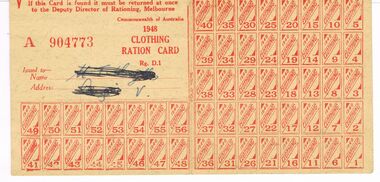
... A man's suit was worth 38 coupons and a pair of socks were 4 coupons GOVERNMENT Federal clothing ration card WW11 Clothing Ration Card: Beige card with blue flecks and red print: *V If this card is found it must be returned at once to the deputy Director of Rationing, Melbourne. ...Clothing rationing was gazetted in May 1942 and continued until June 1948. It allowed each person 112 coupons per year and each item of clothing had a coupon value. eg. A man's suit was worth 38 coupons and a pair of socks were 4 couponsWW11 Clothing Ration Card: Beige card with blue flecks and red print: *V If this card is found it must be returned at once to the deputy Director of Rationing, Melbourne. Commonwealth of Australia. A 904773. 1648 Clothing Ration Card Rig. D.1 Issued.. Name.. Address... The card has small tickets with 1948 and Clothing on each individual numbered tickets. Numbered from 1 to 56. The persons name has been scrubbed out with ink. Along the centre is a line which says *Fold Here* Box 625government, federal, clothing ration card -
 Bendigo Historical Society Inc.
Memorabilia - WW11 MEAT RATION CARD
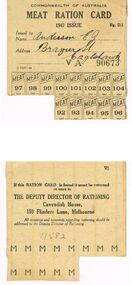
... Federal meat ration card WW11 Meat Ration Card WW11 Meat Ration Card: Beige card with black print. *Commonwealth of Australia Meat Ration Card 1947 Issue Rig. D.1. Issued to Name.* In black ink hand written is *Anderson D.J. Address is. Brazier St, Eaglehawk. V A 90673. C7507/46. Underneath are small tickets individually numbered between 92 and 104 with the word MEAT across the face and 1947 at the bottom of each. On the back is *Vi. If this ration card is found it must be returned at once to The Deputy Director ...Meat rations applied to red meat only. Initially it allowed 21/4 pounds per adult, per week. By the end of the war this had reduced to 2 pounds.WW11 Meat Ration Card: Beige card with black print. *Commonwealth of Australia Meat Ration Card 1947 Issue Rig. D.1. Issued to Name.* In black ink hand written is *Anderson D.J. Address is. Brazier St, Eaglehawk. V A 90673. C7507/46. Underneath are small tickets individually numbered between 92 and 104 with the word MEAT across the face and 1947 at the bottom of each. On the back is *Vi. If this ration card is found it must be returned at once to The Deputy Director of Rationing Cavendish House, 159 Flinders Lane, Melbourne. All enquiries and comments regarding rationing should be addressed to the Deputy Director Rationing. Repeated capital M M is at the bottom. Box 625government, federal, meat ration card, ww11 meat ration card -
 Bendigo Historical Society Inc.
Ephemera - MISS G ALICE JONES COLLECTION: WWII MEAT RATION CARD, 1940's
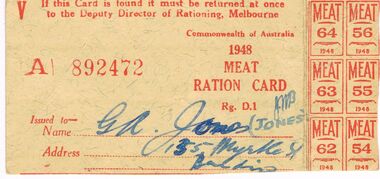
... Federal meat ration card WW11 G. A. Jones WWII Meat Ration Card: beige card with blue flecks and red print. "V If this card is found it must be returned at once to the Deputy Director of Rationing Melbourne. ...Meat rations applied to red meat only. Initially it allowed 21/4 pounds per adult, per week. By the end of the war this had reduced to 2 pounds.WWII Meat Ration Card: beige card with blue flecks and red print. "V If this card is found it must be returned at once to the Deputy Director of Rationing Melbourne. Commonwealth of Australia. A. 892472 1948 Meat Ration Card. Rig. D.1. Issued to Name". Hand written in blue ink is "G.A. Jones" (Hones) with signature and Address."135 Myrtle Street Bendigo". To the right of the card is small numbered tickets with "MEAT and 1948" across. Tickets are numbered 62,63,64,54,55,56.government, federal, meat ration card, ww11 g. a. jones -
 Bendigo Historical Society Inc.
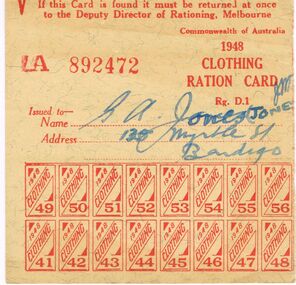
Ephemera - MISS G ALICE JONES COLLECTION: WWII CLOTHING RATION CARD, 1948
... Federal clothing ration card WW11. G. Alice Jones. Clothing Ration Cards WWII Clothing Ration Card: beige card with blue flecks, red print "V If this Card is found it must be returned at once to the Deputy Director of Rationing. ...Clothing rationing was gazetted in May 1942 and continued until June 1948. It allowed each person 112 coupons per year and each item of clothing had a coupon value. eg. A man's suit was worth 38 coupons and a pair of socks were 4 couponsWWII Clothing Ration Card: beige card with blue flecks, red print "V If this Card is found it must be returned at once to the Deputy Director of Rationing. Melbourne. Commonwealth of Australia. LA 892472. 1948 Clothing Ration Card Rig. D.1 Issued to Name". Hand written in blue ink is "G. A. Jones" (Jones and signature. Address:- 135 Myrtle St. Bendigo. Underneath are small numbered tickets from 41 to 56 with 1948 and Clothing printed across the face.government, federal, clothing ration card, ww11. g. alice jones. clothing ration cards -
 Bendigo Historical Society Inc.
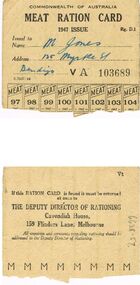
Ephemera - MISS G ALICE JONES COLLECTION: COMMONWEALTH OF AUSTRALIA MEAT RATION CARD, 1947
... Federal meat ration card WW11. G. Alice Jones Commonwealth of Australia Meat Ration Card: beige card with blue flecks and black print. At the top "Commonwealth of Australia Meat Ration Card 1947 Issue Rig. D.1". Issued to name in blue ink is "M. Jones. Address 135 Myrtle St Bendigo. V A 103689 C.7507/46". Underneath is the small numbered ration meat tickets numbered 97 to 104 with meat across the face and 1947 at the bottom. On the back is "Vt. If this RATION CARD is found it must be returned at once to The Deputy Director ...Meat rations applied to red meat only. Initially it allowed 21/4 pounds per adult, per week. By the end of the war this had reduced to 2 pounds.Commonwealth of Australia Meat Ration Card: beige card with blue flecks and black print. At the top "Commonwealth of Australia Meat Ration Card 1947 Issue Rig. D.1". Issued to name in blue ink is "M. Jones. Address 135 Myrtle St Bendigo. V A 103689 C.7507/46". Underneath is the small numbered ration meat tickets numbered 97 to 104 with meat across the face and 1947 at the bottom. On the back is "Vt. If this RATION CARD is found it must be returned at once to The Deputy Director of Rationing Cavendish House, 1598 Flinders Lane, Melbourne. All enquiries and comments regarding rationing should be addressed to the Deputy Director of Rationing". A line of "M M M" is across the bottom.government, federal, meat ration card, ww11. g. alice jones -
Bendigo Historical Society Inc.
Document - CAPITAL THEATRE, MELBOURNE SYMPHONY ORCHESTRA, c1954
... Manager for Victoria: Conrad Charlton. Director of Music: W G James. Federal Concert Manager: R G Lamb. ...Manager for Victoria: Conrad Charlton. Director of Music: W G James. Federal Concert Manager: R G Lamb. ...Manager for Victoria: Conrad Charlton. Director of Music: W G James. Federal Concert Manager: R G Lamb. ...Capital Theatre, Bendigo, Melbourne Symphony Orchestra Orchestra. Direction: Australian Broadcasting Commission. Conductor: Joseph Post. Solo Violinist: Bertha Jorgenson. Wednesday 30th June, 8pm. Programme 6d. Australian Broadcasting Commission, Chairman: R J F Boyer, M.A. Vice-Chairman: E R Dawes. Members: Sir John Medley, M.A. Mrs Ivy Kent, J S Hanlon. General Manager: Charles Moses. Manager for Victoria: Conrad Charlton. Director of Music: W G James. Federal Concert Manager: R G Lamb. Concert Manager for Victoria: Dorrie O'Neal. Joseph Post. With this concert appearance, for which he is coming specially from Sydney, Joseph Post is making a return visit among his former orchestra, for he was stationed in Melbourne as resident conductor of the ABC's Melbourne Orchestra for several years. When the Sydney Symphony was formed on a permanent basis, with Eugene Goosens in charge, Mr Post was appointed his deputy as junior conductor to the Sydney Symphony - at the same time resuming his earlier position as director of the . . . Photo of Joseph Post. Bertha Jorgensen It is a notable occasion for music lovers when Melbourne's esteemed 'First Lady' of the Orchestra steps out of her place as leader and is heard as soloist. Bertha Jorgensen gave her first public performance as a five year old prodigy in Castlemaine, where she then lived, and a few years later she began travelling each week the 60 miles to Melbourne for lessons with Alberto Zelman, Junior. At fifteen, still adorned with pigtail, she came to Melbourne with her family and joined his orchestra. Since then Miss Jorgensen has been constantly engaged in orchestral work, and in attaining the exacting role of leader of the Melbourne Symphony is holder of a unique position. No other major orchestra in the world is led by a woman, and many are the evidences of amazement expressed by visiting conductors. Some have been taken aback and inclined to scepticism at the outset, but all have gone away with high praise for her ability. Photo of Bertha Jorgensen. Programme. Oberon. Jesu, Joy of Man's Desiring. Gavotte. L'Apres-Midi D'un Faune. Violin concerto. Allegro Moderato. Adagio. Allegro energico. Symphony. Adagio. Allegro molto. Largo. Scherzo. Allegro. Scherzo. Allegro vivace. Poco Sostenuto. Allegro con fuoco. Personnel of the Orchestra Conductor: Joseph Post. Soloist Bertha Jorgensen, Violinist. Leader of the Orchestra: Bertha Jorgenson. Violins 1: Jorgenson B. Hutchens H. Schieblich F. Prockter M. Di Gilio A. Morton K. Glassford W J. Haslam J. Violins 2: Lenzer H. Bradley R. Pattison B. Gaunson B. Tregear U. Clancy I. Violas: Kerr C. Jones G K. Roberts, W. Yoxon T. 'Cellos: Bate M. Prockter G. Fox E. Kalmikov Z. Basses: Fraillon G C. Morton W. Howley T. Flutes: Walklate A. Middlebrough G. Oboes: Richmond E. Moore K. Clarinets: White T. Anderson A. Hunt N. (Bass Clar). Bassoons: Morgan F. Horns: Norton K. Miller G. Grieves G. Hudson F. Trumpets: Simpson M. Geary J. Trombones: Codes S. McGlade J. Willis H. Tymps: Craige G. Percussion: Lighton E. Harp: Bendall A. _ Direction: Australian Broadcasting Commission, Bendigo Town Hall - Saturday, 14th August, Ginette Neveu, Violin Genius, Accompanist: Jean Neveu. Gunette, who will appear in Bendigo before her Melbourne appearances, had played with enormous success throughout the Continent, England and the Americas. During her American tour last year she was immediately re-engaged for . . . Extracts from New York Press notices agter her performances of the Brahms Violin Concert last season. . . Programme Chaconne. Sonata. Poeme. Hora Stacco. 24th Caprice. Variation on a Theme of Rossini. Bookings at Allan's from Monday, 9th August. Advertisments: R O Henderson (Beehive) Pty Ltd. Bendigo. Seymour Furs, Melbourne. C1943, 54 or 65program, theatre, melbourne symphony orchestra, capital theatre, bendigo, melbourne symphony orchestra orchestra. direction: australian broadcasting commission. conductor: joseph post. solo violinist: bertha jorgenson. wednesday 30th june, 8pm. programme 6d. australian broadcasting commission, chairman: r j f boyer, m.a. vice-chairman: e r dawes. members: sir john medley, m.a. mrs ivy kent, j s hanlon. general manager: charles moses. manager for victoria: conrad charlton. director of music: w g james. federal concert manager: r g lamb. concert manager for victoria: dorrie o'neal. photo of joseph post.bertha jorgensen gave her first public performance as a five year old prodigy in castlemaine, where she then lived lessons with alberto zelman. at fifteen she came to melbourne and joined his orchestra. miss jorgensen has attained the role of leader of the melbourne symphony a unique position. no other major orchestra in the world is led by a woman. some have been taken aback and inclined to scepticism, but all have gone away with high praise for her ability. photo of bertha jorgensen. programme. oberon. jesu, joy of man's desiring. gavotte. l'apres-midi d'un faune. violin concerto. allegro moderato. adagio. allegro energico. symphony. adagio. allegro molto. largo. scherzo. allegro. scherzo. allegro vivace. poco sostenuto. allegro con fuoco. conductor: joseph post. soloist bertha jorgensen, violinist. leader of the orchestra: bertha jorgenson. violins 1: jorgenson b. hutchens h. schieblich f. prockter m. di gilio a. morton k. glassford w j. haslam j. violins 2: lenzer h. bradley r. pattison b. gaunson b. tregear u. clancy i. violas: kerr c. jones g k. roberts, w. yoxon t. 'cellos: bate m. prockter g. fox e. kalmikov z. basses: fraillon g c. morton w. howley t. flutes: walklate a. middlebrough g. oboes: richmond e. moore k. clarinets: white t. anderson a. hunt n. (bass clar). bassoons: morgan f. horns: norton k. miller g. grieves g. hudson f. trumpets: simpson m. geary j. trombones: codes s. mcglade j. willis h. tymps: craige g. percussion: lighton e. harp: bendall a. saturday, 14th august, ginette neveu, violin genius, accompanist: jean neveu. gunette, who will appear in bendigo before her melbourne appearances, had played with enormous success throughout the continent, england and the americas. during her american tour last year she was immediately re-engaged for . . . extracts from new york press notices agter her performances of the brahms violin concert last season. . . programme chaconne. sonata. poeme. hora stacco. 24th caprice. variation on a theme of rossini. bookings at allan's from monday, 9th august. advertisments: r o henderson (beehive) pty ltd. bendigo. seymour furs, melbourne. c1943, 54 or 65 -
 Warrnambool and District Historical Society Inc.
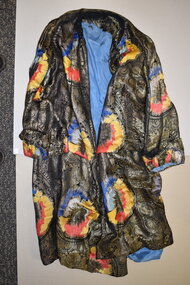
Garment, Dress coat
... In 1892 Louisa married John Cam the director of the Hawthorn Brick Company. It is understood Louisa wore the coat to the opening of the first Federal Parliament in the Exhibition Buildings in Melbourne in 1901....In 1892 Louisa married John Cam the director of the Hawthorn Brick Company. It is understood Louisa wore the coat to the opening of the first Federal Parliament in the Exhibition Buildings in Melbourne in 1901. ...This opera coat was made for Louisa Jane Cam, nee Rust, born 24/6/1873. Her parents were John Rust born in Hamburg, Germany and Jane Mc Meekin from Port Patrick, Scotland. In 1892 Louisa married John Cam the director of the Hawthorn Brick Company. It is understood Louisa wore the coat to the opening of the first Federal Parliament in the Exhibition Buildings in Melbourne in 1901.This item being an early nineteenth century opera coat has aesthetic interest. It is also important because of its provenance being worn by Louisa Cam at a significant event in Australia's history.A three quarter length Mandarin styled gold threaded brocade, lined coat dress with long sleeves. The fabric is black with gold patterns of leaves and circles. Large circles feature gold, red, yellow, pale and dark blue flower like images surrounded by gold fringes. The yolk section finishes with a small pleat over the flared bottom section. Edging around the neck is black lace. It is understood a fur collar was previously in place. The cuffs of the sleeves are pleated and have a wide frill above the pleating. The lining is pale blue silk . At the end of the sleeves the lining has hand ruched binding. Nil -
 National Wool Museum
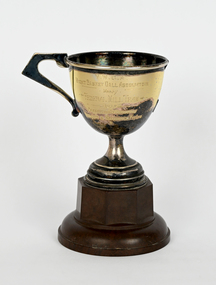
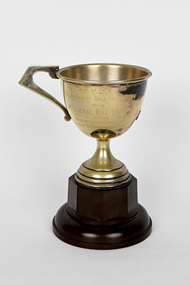
Award - YWCA Night Basket Ball Association Cup, 1936
... YWCA / NIGHT BASKET BALL ASSOCIATION / WON BY / FEDERAL MILL TEAM / 1936 // PRESENTED BY DIRECTORS / BRIGHT & HITCHCOCK PTY LTD...Woollen Mills Textile Mills - sporting teams Textile Mills - staff sporting teams Classweave Industries Pty Ltd Federal Woollen Mills Ltd sport Woollen Mills Textile Mills - sporting teams Textile Mills - staff sporting teams Working Life YWCA / NIGHT BASKET BALL ASSOCIATION / WON BY / FEDERAL MILL TEAM / 1936 // PRESENTED BY DIRECTORS / BRIGHT & HITCHCOCK PTY LTD Small trophy cup, round bowl with one side handle. ...Acquired when "Classweave Industries" closed down. Small trophy cup, round bowl with one side handle. Bowl is engraved. The cup is screwed to a brown bakelite hexagonal-shaped base.YWCA / NIGHT BASKET BALL ASSOCIATION / WON BY / FEDERAL MILL TEAM / 1936 // PRESENTED BY DIRECTORS / BRIGHT & HITCHCOCK PTY LTDwoollen mills textile mills - sporting teams textile mills - staff sporting teams, classweave industries pty ltd federal woollen mills ltd, sport, woollen mills, textile mills - sporting teams, textile mills - staff, sporting teams, working life -
 National Wool Museum
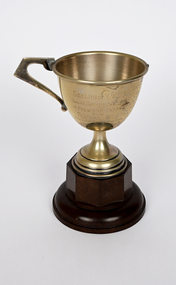
Award - YWCA Night Basket Ball Association Cup, 1937
... YWCA / NIGHT BASKET BALL ASSOCIATION / Won by / FEDERAL MILL TEAM / 1937 / PRESENTED BY DIRECTORS / BRIGHT & HITCHCOCK PTY LTD...Woollen Mills Textile Mills - sporting teams Textile Mills - staff sporting teams Classweave Industries Pty Ltd Federal Woollen Mills Ltd sport Woollen Mills Textile Mills - sporting teams Textile Mills - staff sporting teams Working Life YWCA / NIGHT BASKET BALL ASSOCIATION / Won by / FEDERAL MILL TEAM / 1937 / PRESENTED BY DIRECTORS / BRIGHT & HITCHCOCK PTY LTD Small trophy cup, round bowl with one side handle. ...Acquired when "Classweave Industries" closed down.Small trophy cup, round bowl with one side handle. Bowl is inscribed. The cup is screwed to a brown bakelite hexagonal-shaped base, round at lower edge.YWCA / NIGHT BASKET BALL ASSOCIATION / Won by / FEDERAL MILL TEAM / 1937 / PRESENTED BY DIRECTORS / BRIGHT & HITCHCOCK PTY LTDwoollen mills textile mills - sporting teams textile mills - staff sporting teams, classweave industries pty ltd federal woollen mills ltd, sport, woollen mills, textile mills - sporting teams, textile mills - staff, sporting teams, working life -
 National Wool Museum
Award - YWCA Night Basket Ball Association Cup, 1938
... YWCA / NIGHT BASKET BALL ASSOCIATION / PREMIERS 1938 / Won by / FEDERAL MILL / Presented by the Directors / BRIGHT & HITCHCOCK PTY LTD...Acquired when "Classweave Industries" closed down Woollen Mills Textile Mills - sporting teams Textile Mills - staff sporting teams Classweave Industries Pty Ltd Federal Woollen Mills Ltd sport Woollen Mills Textile Mills - sporting teams Textile Mills - staff sporting teams Working Life YWCA / NIGHT BASKET BALL ASSOCIATION / PREMIERS 1938 / Won by / FEDERAL MILL / Presented by the Directors / BRIGHT & HITCHCOCK PTY LTD Small trophy cup, round bowl with one side handle. ...Acquired when "Classweave Industries" closed downSmall trophy cup, round bowl with one side handle. Bowl is inscribed. The cup is screwed to a brown bakelite hexagonal-shaped base, round at lower edge.YWCA / NIGHT BASKET BALL ASSOCIATION / PREMIERS 1938 / Won by / FEDERAL MILL / Presented by the Directors / BRIGHT & HITCHCOCK PTY LTDwoollen mills textile mills - sporting teams textile mills - staff sporting teams, classweave industries pty ltd federal woollen mills ltd, sport, woollen mills, textile mills - sporting teams, textile mills - staff, sporting teams, working life -
 National Wool Museum
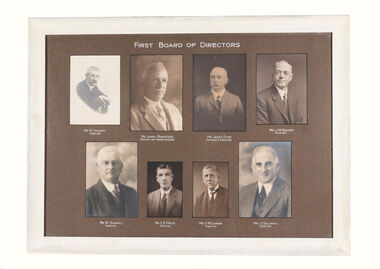
Photograph, First Board of Directors
... Acquired when "Classweave Industries" closed down woollen mills - history woollen mills textile mills - staff classweave industries pty ltd federal woollen mills ltd woollen mills - history woollen mills textile mills - staff First Board of Directors Mr R Vincent, Director; Mr James Robertson, Director and General Manager; Mr James Dyer, Chairman of Directors; Mr J M Badger, Secretary; Mr W Stawell, Director; Mr S E Price, Director; Mr D McLennan, Director; Mr J Solomon, Director. ...Acquired when "Classweave Industries" closed downFramed image First Board of Directors Mr R Vincent, Director; Mr James Robertson, Director and General Manager; Mr James Dyer, Chairman of Directors; Mr J M Badger, Secretary; Mr W Stawell, Director; Mr S E Price, Director; Mr D McLennan, Director; Mr J Solomon, Director.woollen mills - history woollen mills textile mills - staff, classweave industries pty ltd federal woollen mills ltd, woollen mills - history, woollen mills, textile mills - staff -
 Sunshine and District Historical Society Incorporated
Archive - Thomas "Tom" Hoole Documents Relating To His Life And History, 1930s - 1990s
... Birth Certificate Thomas Hoole 23 July 1927|2 Photograph copies no details|Envelope 22 April 1961|Letter to Thomas Hoole from Industrial Service Engineers 20 April 1961|Certificate City and Guilds of London Institute passed Final Examination in Patternmaking 5 February 1959|Award entitlements for New Employees Massey Ferguson Australia Limited commenced 18 April 1961 Awards Hours of work Pay Day Parcels Safety First Injuries Sick Leave Tax Deductions Tools Smoking Cut Luncheon Service Parking Facilities Change of Address|Indenture of Apprenticeship 28 August 1945 between Industrial Service Engineers Pty Ltd 212 Whitehall Street Footscray|Envelope 39 Rosamond Road North Footscray|Drivers Licence 20 January 1957|Preston Motors Registration GRZ165|Letter from Industrial Engineering Ltd 23 January 1959 Thomas Hoole passed examinatons|Certificate Junior Technical December 1943|Merit Certificate 12 November 1943|Reference from Dr FJ Menadue 9 October 1943|Extract of Entry Birth Certificate 5 October 1943|Date List|Certificate for Training within Industry Job Safety Course for Supervisors and Foremen 24 November 1967|Invitation by the Managing Director of Massey Ferguson Mr HP Weber inviting Mr T Hoole attend the opening of The new Foundry at Sunshine 16 November 1967 and a letter detailing the opening|Menu from Hotel Federal Melbourne signed|Massey Feguson Records questionnaire 15 March 1976|Yarraville Tennis Club Life Membership 18 July 1971|Certificate of Registration of Trailer 6 March 1969 $3.50 per annum|Certificate of Massey Ferguson Training within Industry Program 1967 Job Relations Job Instruction Job Methods Job Safety|Mrs Joan Hoole Proposal for life Membership Sunshine Golf Club 1971|Pamphlet Matthew Robert Hoole 13 March 1998|Funeral Pamphlet Joan Hoole 12 December 1933 to 22 May 2015|Newspaper article 12 May 2005 Elderly man killed wife hurt in single car crash|Notes provided by daughter...Thomas "Tom" Hoole Birth Certificate Thomas Hoole 23 July 1927|2 Photograph copies no details|Envelope 22 April 1961|Letter to Thomas Hoole from Industrial Service Engineers 20 April 1961|Certificate City and Guilds of London Institute passed Final Examination in Patternmaking 5 February 1959|Award entitlements for New Employees Massey Ferguson Australia Limited commenced 18 April 1961 Awards Hours of work Pay Day Parcels Safety First Injuries Sick Leave Tax Deductions Tools Smoking Cut Luncheon Service Parking Facilities Change of Address|Indenture of Apprenticeship 28 August 1945 between Industrial Service Engineers Pty Ltd 212 Whitehall Street Footscray|Envelope 39 Rosamond Road North Footscray|Drivers Licence 20 January 1957|Preston Motors Registration GRZ165|Letter from Industrial Engineering Ltd 23 January 1959 Thomas Hoole passed examinatons|Certificate Junior Technical December 1943|Merit Certificate 12 November 1943|Reference from Dr FJ Menadue 9 October 1943|Extract of Entry Birth Certificate 5 October 1943|Date List|Certificate for Training within Industry Job Safety Course for Supervisors and Foremen 24 November 1967|Invitation by the Managing Director of Massey Ferguson Mr HP Weber inviting Mr T Hoole attend the opening of The new Foundry at Sunshine 16 November 1967 and a letter detailing the opening|Menu from Hotel Federal Melbourne signed|Massey Feguson Records questionnaire 15 March 1976|Yarraville Tennis Club Life Membership 18 July 1971|Certificate of Registration of Trailer 6 March 1969 $3.50 per annum|Certificate of Massey Ferguson Training within Industry Program 1967 Job Relations Job Instruction Job Methods Job Safety|Mrs Joan Hoole Proposal for life Membership Sunshine Golf Club 1971|Pamphlet Matthew Robert Hoole 13 March 1998|Funeral Pamphlet Joan Hoole 12 December 1933 to 22 May 2015|Newspaper article 12 May 2005 Elderly man killed wife hurt in single car crash|Notes provided by daughter Documents relating to the life and history of Tom Hoole certificates Archive Thomas "Tom" Hoole Documents Relating To His Life And History ...Birth Certificate Thomas Hoole 23 July 1927|2 Photograph copies no details|Envelope 22 April 1961|Letter to Thomas Hoole from Industrial Service Engineers 20 April 1961|Certificate City and Guilds of London Institute passed Final Examination in Patternmaking 5 February 1959|Award entitlements for New Employees Massey Ferguson Australia Limited commenced 18 April 1961 Awards Hours of work Pay Day Parcels Safety First Injuries Sick Leave Tax Deductions Tools Smoking Cut Luncheon Service Parking Facilities Change of Address|Indenture of Apprenticeship 28 August 1945 between Industrial Service Engineers Pty Ltd 212 Whitehall Street Footscray|Envelope 39 Rosamond Road North Footscray|Drivers Licence 20 January 1957|Preston Motors Registration GRZ165|Letter from Industrial Engineering Ltd 23 January 1959 Thomas Hoole passed examinatons|Certificate Junior Technical December 1943|Merit Certificate 12 November 1943|Reference from Dr FJ Menadue 9 October 1943|Extract of Entry Birth Certificate 5 October 1943|Date List|Certificate for Training within Industry Job Safety Course for Supervisors and Foremen 24 November 1967|Invitation by the Managing Director of Massey Ferguson Mr HP Weber inviting Mr T Hoole attend the opening of The new Foundry at Sunshine 16 November 1967 and a letter detailing the opening|Menu from Hotel Federal Melbourne signed|Massey Feguson Records questionnaire 15 March 1976|Yarraville Tennis Club Life Membership 18 July 1971|Certificate of Registration of Trailer 6 March 1969 $3.50 per annum|Certificate of Massey Ferguson Training within Industry Program 1967 Job Relations Job Instruction Job Methods Job Safety|Mrs Joan Hoole Proposal for life Membership Sunshine Golf Club 1971|Pamphlet Matthew Robert Hoole 13 March 1998|Funeral Pamphlet Joan Hoole 12 December 1933 to 22 May 2015|Newspaper article 12 May 2005 Elderly man killed wife hurt in single car crash|Notes provided by daughterthomas "tom" hoole -
 Robin Boyd Foundation
Newspaper - Clipping, The Sun, "Robin Boyd 'of the world'" and "Opera house 'is for mushrooms'", 19.10.1971
... The first article reports on the speech given by Mr WW Shugg, Federal President of RAIA as a memorial tribute to Robin Boyd at the RAIA building. The second article reports on the disparaging opinion of Mr Colin Badger, director of the Council of Adult Education, on the Sydney Opera House....The first article reports on the speech given by Mr WW Shugg, Federal President of RAIA as a memorial tribute to Robin Boyd at the RAIA building. The second article reports on the disparaging opinion of Mr Colin Badger, director of the Council of Adult Education, on the Sydney Opera House. ...The first article reports on the speech given by Mr WW Shugg, Federal President of RAIA as a memorial tribute to Robin Boyd at the RAIA building. The second article reports on the disparaging opinion of Mr Colin Badger, director of the Council of Adult Education, on the Sydney Opera House.p 11shugg, memorial service, sydney opera house, walsh st library -
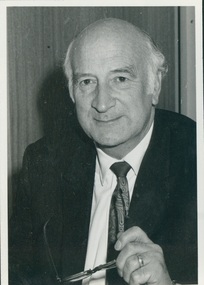 Uniting Church Archives - Synod of Victoria
BW photo (glossy), Undated
... Harry Mackay; Methodist/Uniting Church minister; Director of Federal Methodist Inland Mission; President of Conference...He joined the Victorian Home Mission Department as Director and became Director of the Federal Methodist Inland Mission. Reverend Mackay was President of Conference in 1970. ...Harry Mackay; Methodist/Uniting Church minister; Director of Federal Methodist Inland Mission; President of Conference Rev HG Mackay Rev. ...Reverend Harry G Mackay 1914-1988 was born in Sheffield and served as probationer to Malvern South and Burnie. He was ordained in 1945 and served as Military Chaplain in Aice Springs, then serving at Toorak, Mildura, North Balwyn, and Forest Street Bendigo. He joined the Victorian Home Mission Department as Director and became Director of the Federal Methodist Inland Mission. Reverend Mackay was President of Conference in 1970. Rev. Harry G. Mackay, head and shoulders portrait BW.Rev HG Mackayrev. harry mackay; methodist/uniting church minister; director of federal methodist inland mission; president of conference -
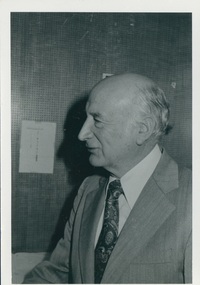 Uniting Church Archives - Synod of Victoria
BW photo (glossy), Undated, c.1970s-early 1980s
... Harry Mackay; Methodist/Uniting Church minister; Director of Federal Methodist Inland Mission; President of Conference...He joined the Victorian Home Mission Department as Director and became Director of the Federal Methodist Inland Mission. Reverend Mackay was President of Conference in 1970. ...Harry Mackay; Methodist/Uniting Church minister; Director of Federal Methodist Inland Mission; President of Conference HG Mackay Rev. ...Reverend Harry G Mackay 1914-1988 was born in Sheffield and served as probationer to Malvern South and Burnie. He was ordained in 1945 and served as Military Chaplain in Aice Springs, then serving at Toorak, Mildura, North Balwyn, and Forest Street Bendigo. He joined the Victorian Home Mission Department as Director and became Director of the Federal Methodist Inland Mission. Reverend Mackay was President of Conference in 1970. Rev. Harry G. Mackay, head and shoulders portrait, (his) left side view.HG Mackayrev. harry mackay; methodist/uniting church minister; director of federal methodist inland mission; president of conference
