
Showing 9 items matching "field staff room"
-
 University of Melbourne, Burnley Campus Archives
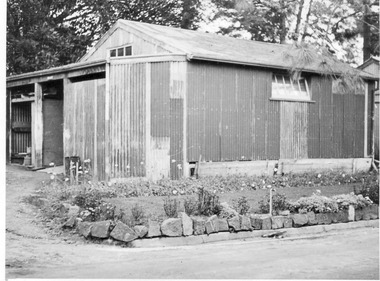
Photograph - Black and white print, E.M. Gibson, Pasture Branch Equipment Shed, c. 1951
... field staff...e. m. gibson collection...field staff room...Black and white photograph of the "Pasture Branch (Agrostology) Equipment Shed & general store & field staff room. 250 yards from nearest part of Pasture Field." ...pasture branch agrostology equipment shed general store field staff e. m. gibson collection field staff room 315/12 Black and white photograph of the "Pasture Branch (Agrostology) Equipment Shed & general store & field staff room. 250 yards from nearest part of Pasture Field." ...Black and white photograph of the "Pasture Branch (Agrostology) Equipment Shed & general store & field staff room. 250 yards from nearest part of Pasture Field." E M Gibson315/12pasture branch, agrostology, equipment shed, general store, field staff, e. m. gibson collection, field staff room -
 Federation University Historical Collection
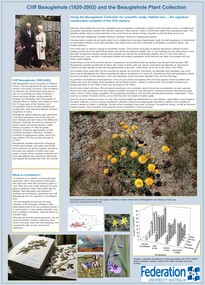
Poster, Michael McBain, Cliff Beauglehole Plant Collection
... Field Naturalists Club, this set of herbarium specimens are from Cliff Beauglehole's collections in the Ballarat area. The club decided to hand over the plant collection to the University of Ballarat (now Federation University). They were freeze-dried to kill unwanted insects and are now house in a climate conrolled room, and available to students, staff...Field Naturalists Club, this set of herbarium specimens are from Cliff Beauglehole's collections in the Ballarat area. The club decided to hand over the plant collection to the University of Ballarat (now Federation University). They were freeze-dried to kill unwanted insects and are now house in a climate conrolled room, and available to students, staff ...The Beauglehole Collection is held in the FedUni Science Herbarium (Mt Helen Y Building). Cliff Beauglehole (1920-2002) was an orchardist at Portland, Victoria. Over his lifetime he collected over 90,000 plant specimens as part of a comprehensice study of Victoria's plans, and wrote thirteen books under the title "The Distribution and Conservation of Vascular Plants in Victoria. Originally held by the Ballarat Field Naturalists Club, this set of herbarium specimens are from Cliff Beauglehole's collections in the Ballarat area. The club decided to hand over the plant collection to the University of Ballarat (now Federation University). They were freeze-dried to kill unwanted insects and are now house in a climate conrolled room, and available to students, staff and others for scientific study. Listing of specimens held in the Federation University Cliff Beauglehole Collection, and interpretation poster. herbarium, botany, botanical, text panel, cliff beauglehole, beauglehole collection, ballarat field naturalists club, plant specimens -
 Kiewa Valley Historical Society
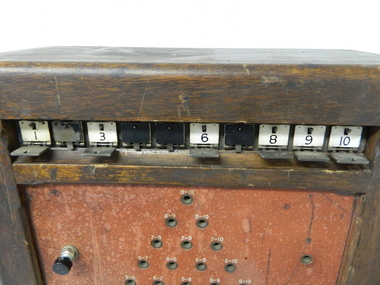
Console Telephone 10 shutter, circa early 1900s
... field relating to operational safety and work related controls. The success of any large undertaken relies heavily upon good communications. In the hospital this method of communications is still used i.e. patient to ward station. This flag system link a patient's room to the controlling nursing station. Identification of the patient needing help is crucial for swift action from the available medical staff ...This manual telephone exchange console is an important piece of equipment which provided the most efficient method of long distance communications in the 1950's to the 1980's. Communications were critical, not only for the regional Hospital, but also for large construction sites i.e. the Kiewa Hydro Scheme, especially if they are in dense rugged mountainous regions. The degree of Occupation Health and Welfare on industrial sites were at a bare minimum compared to the work scene after the 1980's.This telephone exchange console is highly significant to both the Kiewa Valley and Mount Beauty region because it was so important in the communications field relating to operational safety and work related controls. The success of any large undertaken relies heavily upon good communications. In the hospital this method of communications is still used i.e. patient to ward station. This flag system link a patient's room to the controlling nursing station. Identification of the patient needing help is crucial for swift action from the available medical staff. Similarly in large construction sites such as the Kiewa Hydro Scheme, successful instant communications was also essential. This switchboard required a 50 volt supply to successfully operate and was in use when both telecommunications and postal were under the one Federal Government carrier i.e. The Post Master General. A benefit with a line communication system (such as the one that fed this console was that interference from atmospheric conditions did not impede the connection.This console telephone switchboard (manual) unit has a shutter operation (precursor to the light indicator) to identify the caller to the telephone switchboard operator. This switchboard has a ten point indication shutter system allowing the operator to clearly identify where the caller is located. The console has a 44 connection point holes with their configurations in a triangular shape. The shutters are held closed by a small lever at the top which is opened by a small electrical charge from the incoming call. The operator uses a wind up handle to power a magneto connector(handle on the console's right side). The telephone hand set is located on the left side of the console. sec vic kiewa hydro scheme, alternate energy supplies, alpine population growth and communications -
 National Vietnam Veterans Museum (NVVM)
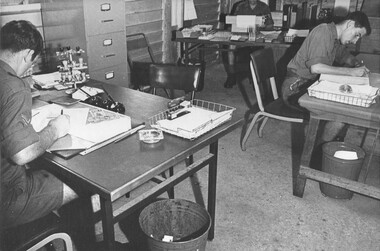
Photograph, Gibbons, Denis, Pay Office
... A black and white photograph of clerical staff at the orderly room and pay office of the 1st Australian Field Hospital, Vung Tau, South Veitnam. ...Photograph Clerical Staff 1st Australian Field Hospital Vung Tau Gibbons Collection Catalogue Pay and Petty Cash US Military Dollars Vietnamese Piastre A black and white photograph of clerical staff at the orderly room and pay office of the 1st Australian Field Hospital, Vung Tau, South Veitnam. ...Denis Gibbons (1937 – 2011) Trained with the Australian Army, before travelling to Vietnam in January 1966, Denis stayed with the 1st Australian Task Force in Nui Dat working as a photographer. For almost five years Gibbons toured with nine Australian infantry battalions, posting compelling war images from within many combat zones before being flown out in late November 1970 after sustaining injuries. The images held within the National Vietnam Veterans Museum make up the Gibbons Collection. A black and white photograph of clerical staff at the orderly room and pay office of the 1st Australian Field Hospital, Vung Tau, South Veitnam. They prepare and check pay and petty cash claims for members of the unit using US dollars, Military script and Vietnamese Piastre.photograph, clerical staff, 1st australian field hospital, vung tau, gibbons collection catalogue, pay and petty cash, us military dollars, vietnamese piastre -
 Puffing Billy Railway
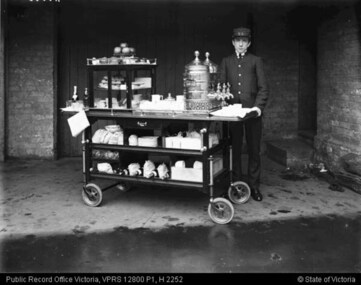
Equipment - Refreshments services Trolley, 1990s
... They were staffed predominately by women, who provided everything from a cup of tea to a three course meal. Most refreshment room services were closed in the 1970s. Reference from : Fielding...They were staffed predominately by women, who provided everything from a cup of tea to a three course meal. Most refreshment room services were closed in the 1970s. Reference from : Fielding ...The Refreshment Services Branch was established in 1920, and initially focused on providing station-based refreshment rooms and the dining car service. Its scope expanded to include diverse activities such as stall rental; sales of advertising space on railways infrastructure; laundry services; operation of a hair-dressing salon, a bakery, a butchery and a poultry farm; and the management of the chalet guesthouse at Mt Buffalo. The majority of staff worked in refreshment rooms and dining cars, both of which were a popular feature of the railway service. Previous to 1920 refreshment services had been provided by contractors, but after many complaints the Department decided to provide a standardised service across the system. It grew quickly: five years after it was established the Branch employed approximately 500 staff. Station refreshment facilities ranged from elaborate dining rooms to decorated push-carts. They were staffed predominately by women, who provided everything from a cup of tea to a three course meal. Most refreshment room services were closed in the 1970s. Reference from : Fielding, K. (2012) Victorian Railways - Refreshment Services Branch in Museums Victoria Collections http://collections.museumvictoria.com.au/articles/11470Historic - Replica of a a Victorian Railways Refreshment Services Serving Trolley used on Puffing Billy Railway Replica large wooden serving cart with fitted wooden cabinet featuring sliding glass doors and one glass shelf. Cart has chrome handles, two wooden shelves, a wooden drawer with chrome handle and a small chalkboard adhered to end. Cart has four small black rubber and metal wheels and a metal foot brake.puffing billy, serving trolley, replica, dining cart, refreshment services, victorian railways -
 Musculoskeletal Health Australia (now held by the Glen Eira Historical Society)
Photograph - Group photo, 2003
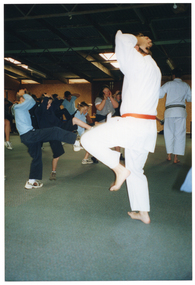
... field or through a martial arts class indoors. They also attended an education session conducted by AV staff. This photo depicts two martial arts instructors taking the students through some kicking techniques. arthritis foundation of victoria afv osteoporosis victoria ov arthritis victoria av rural and regional education rare outreach exercise martial arts karate bone strength bone health joint health school visit school program 2003 Colour photo of two martial arts instructors teaching a group of school students some martial arts techniques in a large carpeted room. ...In 2003, Arthritis Victoria (AV) held an outreach event at a school in Stawell as part of its Rural And Regional Education (RARE) Program. Students were taken through a range of exercises on a sporting field or through a martial arts class indoors. They also attended an education session conducted by AV staff. This photo depicts two martial arts instructors taking the students through some kicking techniques.Colour photo of two martial arts instructors teaching a group of school students some martial arts techniques in a large carpeted room. One of the instructors is teaching the students how to kick.arthritis foundation of victoria, afv, osteoporosis victoria, ov, arthritis victoria, av, rural and regional education, rare, outreach, exercise, martial arts, karate, bone strength, bone health, joint health, school visit, school program, 2003 -
 Musculoskeletal Health Australia (now held by the Glen Eira Historical Society)
Photograph - Group photo, 2003
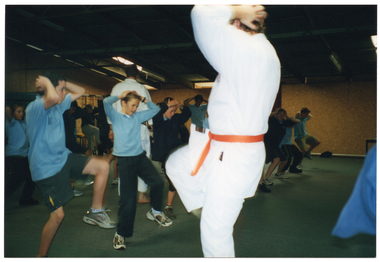
... field or through a martial arts class indoors. They also attended an education session conducted by AV staff. This photo depicts two martial arts instructors taking the students through some kicking techniques. arthritis foundation of victoria afv osteoporosis victoria ov arthritis victoria av rural and regional education rare outreach exercise martial arts karate bone strength bone health joint health school visit school program 2003 Colour photo of a martial arts instructor teaching a group of school students some martial arts techniques in a large carpeted room. ...In 2003, Arthritis Victoria (AV) held an outreach event at a school in Stawell as part of its Rural And Regional Education (RARE) Program. Students were taken through a range of exercises on a sporting field or through a martial arts class indoors. They also attended an education session conducted by AV staff. This photo depicts two martial arts instructors taking the students through some kicking techniques.Colour photo of a martial arts instructor teaching a group of school students some martial arts techniques in a large carpeted room. The instructor is teaching the students how to practice maintaining their balance while kicking with one leg.arthritis foundation of victoria, afv, osteoporosis victoria, ov, arthritis victoria, av, rural and regional education, rare, outreach, exercise, martial arts, karate, bone strength, bone health, joint health, school visit, school program, 2003 -
 Musculoskeletal Health Australia (now held by the Glen Eira Historical Society)
Photograph - Group photo, 2003
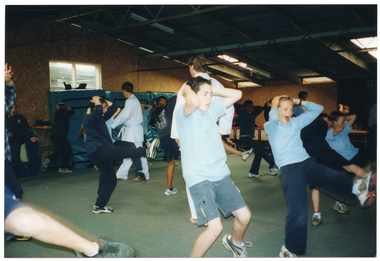
... field or through a martial arts class indoors. They also attended an education session conducted by AV staff. This photo depicts two martial arts instructors taking the students through some kicking techniques. arthritis foundation of victoria afv osteoporosis victoria ov arthritis victoria av rural and regional education rare outreach exercise martial arts karate bone strength bone health joint health school visit school program 2003 Colour photo of two martial arts instructors teaching a group of school students some martial arts techniques in a large carpeted room. ...In 2003, Arthritis Victoria (AV) held an outreach event at a school in Stawell as part of its Rural And Regional Education (RARE) Program. Students were taken through a range of exercises on a sporting field or through a martial arts class indoors. They also attended an education session conducted by AV staff. This photo depicts two martial arts instructors taking the students through some kicking techniques.Colour photo of two martial arts instructors teaching a group of school students some martial arts techniques in a large carpeted room. The instructors are observing the students' technique as they practice kicking.arthritis foundation of victoria, afv, osteoporosis victoria, ov, arthritis victoria, av, rural and regional education, rare, outreach, exercise, martial arts, karate, bone strength, bone health, joint health, school visit, school program, 2003 -
 Emerald Museum & Nobelius Heritage Park
Photograph - Emerald Primary School, Unknown photographer, 1970s
... field. The original building constructed to house the school was described variously as 'the tin shed' and 'a hut with a chimney.' It opened in February 1901. The buildings depicted in the photograph show a selection of school buildings and portable classrooms just before major construction works began in late 1977. Five existing portable classrooms were halved in size and moved to a different location before work on a brick wing containing classrooms, an arts and craft room and staff...field. The original building constructed to house the school was described variously as 'the tin shed' and 'a hut with a chimney.' It opened in February 1901. The buildings depicted in the photograph show a selection of school buildings and portable classrooms just before major construction works began in late 1977. Five existing portable classrooms were halved in size and moved to a different location before work on a brick wing containing classrooms, an arts and craft room and staff ...Local farmers and business-owners who settled in Emerald after the initial gold rush period first petitioned for a school in the local area in 1876, with at least two petitions to the Education department lodged by 1877. Emerald School no. 2110 opened as a temporary 'half time' school (meaning that the single teacher split their time between two schools) in temporary facilities in January 1879 while a permanent location was selected. Lobbying by townspeople in 1899 identified the present location of Emerald School no. 3381, within the original township boundary near the football field. The original building constructed to house the school was described variously as 'the tin shed' and 'a hut with a chimney.' It opened in February 1901. The buildings depicted in the photograph show a selection of school buildings and portable classrooms just before major construction works began in late 1977. Five existing portable classrooms were halved in size and moved to a different location before work on a brick wing containing classrooms, an arts and craft room and staff facilities began in early 1978. A 1915 classroom, which may be the building on the left of the image, was modified into administrative offices at the same time. At the time of writing (2023) Emerald Primary School is the largest primary school in the area, with nearly 500 students.The item is significant as it presents a view of Emerald Primary School (Township School no. 3381) in the late 1970s before extensive building works changed the appearance of the school. The tree depicted in the image, a mature Sequoia, or Californian Redwood, was destroyed to build an additional brick wing during these works. Additionally, it is possible that the building on the left-hand side of the image is one of two 1915 classrooms present on the site.Black and white rectangular photograph of the emerald Primary School printed on print media paper. The image depicts the exterior of Emerald Primary School, looking into the school grounds from the street, as it appeared in the late 1970s. In the foreground of the photograph is a gravel path and waist-height chain-link fence. Inside the fence to the left of the image is a large tree and to the right is a sign saying 'Emerald Primary School.' In the background of the photograph are two pale-coloured weatherboard school buildings, one of which has two brick chimneys.Obverse: EMERALD / PRIMARY SCHOOL /1970s, emerald, victoria, australia, emerald primary school, township school no. 3381, township school no. 2110, education, school children, families, sequoia, californian redwood
