
Showing 6 items matching "first night flight"
-
 Moorabbin Air Museum
Book - Pilot training - general aviation, The Pilot's Night Flying Handbook
... ...First night flight...Pilot training - general aviation Outfitting the aircraft Lights at night Vision & vertigo Weather after sunset First night flight Nighttime navigation Cross country after dark Electrical failures Guide to techniques & safety procedures of night flying for private pilot, circa 1976 The Pilot's Night Flying Handbook Book Pilot training - general aviation ...Guide to techniques & safety procedures of night flying for private pilot, circa 1976non-fictionGuide to techniques & safety procedures of night flying for private pilot, circa 1976outfitting the aircraft, lights at night, vision & vertigo, weather after sunset, first night flight, nighttime navigation, cross country after dark, electrical failures -
 Federation University Historical Collection
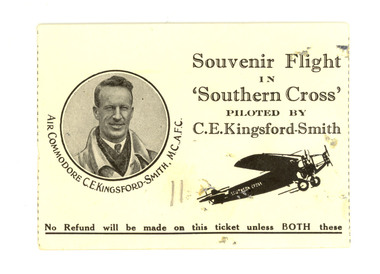
Souvenir - Ticket Stub, Ticket for a souvenir Flight with Charles Kingsford-Smith, c1932
... first west–east trans-Pacific flight in 1934. In 1932 was selling joy-flights at ten shillings a trip. Most of his flights, including the joy flights, were made in the three-engine Fokker plane known as the 'Southern Cross', now preserved in a special display area at Brisbane Airport. In late 1935 Kingsford Smith took off on the second leg of a flight from England to Australia with John ‘JT’ Pethybridge. The plane and pilots were never seen again, believed to have crashed into the sea at night...first west–east trans-Pacific flight in 1934. In 1932 was selling joy-flights at ten shillings a trip. Most of his flights, including the joy flights, were made in the three-engine Fokker plane known as the 'Southern Cross', now preserved in a special display area at Brisbane Airport. In late 1935 Kingsford Smith took off on the second leg of a flight from England to Australia with John ‘JT’ Pethybridge. The plane and pilots were never seen again, believed to have crashed into the sea at night ...Sir Charles Edward Kingsford Smith (1897-1935) is one of Australia's most known Australia’s fliers. Born in 1897 at Hamilton, Qld. He spent his early life in Sydney enlisting in the AIF in 1915. He served at Gallipoli before transferring to the Royal Flying Corps in 1916. He was shot down and wounded in the foot in 1917. In 1929, Kingsford-Smith flew from Australia to England in the record-breaking time of 12 days, 18 hours. The following year he completed an east–west crossing of the Atlantic Ocean in 31 hours, followed by a record-breaking solo flight from England to Darwin in 10 days. He was knighted for services to aviation in 1932. He made the first west–east trans-Pacific flight in 1934. In 1932 was selling joy-flights at ten shillings a trip. Most of his flights, including the joy flights, were made in the three-engine Fokker plane known as the 'Southern Cross', now preserved in a special display area at Brisbane Airport. In late 1935 Kingsford Smith took off on the second leg of a flight from England to Australia with John ‘JT’ Pethybridge. The plane and pilots were never seen again, believed to have crashed into the sea at night somewhere off the coast of Burma. White ticket stub with black ink. It includes a photographic portrait of Charles Kingsford-Smith, and a drawing of the Southern Cross aeroplane. Gift of the Chatham-Holmes family.Printed on ticket 'Souvenir Flight in 'Southern Cross' piloted by C.E. Kingsford-Smith. No refund will be made on this ticket unless BOTH these"chatham, chatham family collection, kingsford-smith, charles kingsford-smith, smithy, southern cross, aeroplane, flight, joy ride, entertainment, airport, charles kingsford smith -
 Lara RSL Sub Branch
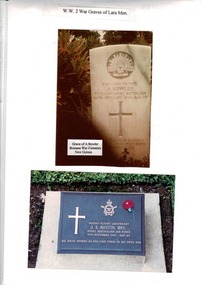
World War 2 War Graves of Lara Men, Photograph of Head Stone of grave site Pte. A. Bowler at Bomana War Cementary, New Guinea and Grave Site of Flight Lieutenant J.S. Austin DFC grave site Adelaide River, N. T
... night of 6 July, when Flight Lieutenant "Bunny" Austin (A16-207) led five Hudsons to bomb Koepang town. The next night he led back seven aircraft against the airfield at Penfoei, attacking before dawn on the 8th prior to United States Liberators bombing the runways and barracks. 75 Austin's aircraft was caught by Penfoei's master defensive searchlight, and Austin used violent evasion and switching on and off of his IFF equipment, a tactic used in Europe. The radar-controlled searchlights went out. Flying Officer Mick Helsham (A16-160) attacked first...night of 6 July, when Flight Lieutenant "Bunny" Austin (A16-207) led five Hudsons to bomb Koepang town. The next night he led back seven aircraft against the airfield at Penfoei, attacking before dawn on the 8th prior to United States Liberators bombing the runways and barracks. 75 Austin's aircraft was caught by Penfoei's master defensive searchlight, and Austin used violent evasion and switching on and off of his IFF equipment, a tactic used in Europe. The radar-controlled searchlights went out. Flying Officer Mick Helsham (A16-160) attacked first ...Flt Lt J S Austin DFC, 400363. No 608 Sqn RAF, Nos 32, 13 & 2 Sqns. Stock agent of Lara, Vic; b Melbourne 15 May 1918. Died of illness 9 Nov 1943. Timor was the target for the night of 6 July, when Flight Lieutenant "Bunny" Austin (A16-207) led five Hudsons to bomb Koepang town. The next night he led back seven aircraft against the airfield at Penfoei, attacking before dawn on the 8th prior to United States Liberators bombing the runways and barracks. 75 Austin's aircraft was caught by Penfoei's master defensive searchlight, and Austin used violent evasion and switching on and off of his IFF equipment, a tactic used in Europe. The radar-controlled searchlights went out. Flying Officer Mick Helsham (A16-160) attacked first to act as a pathfinder and mark the target for the other Hudsons and Liberators:Full service records of J. S. Austin held by Lara R.S.L.Plain Sheet A4 paper with 2 photographs 1. A. Bowler W. 9.8 cm H. 13.8 cm photograph 2. J.S. Austin W. 1`5.9 cm H. 10.0 cmA4 sheet heading as: W.W. 2 War Graves of Lara Men. Note on photograph 1. Grave of A. Bowler, Bomana War Cemetery.r.a.f., graves, lara -
 Lara RSL Sub Branch
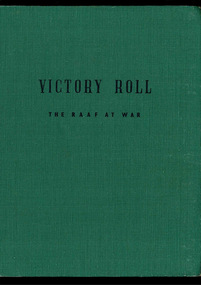
Book, Victory Roll - The RAAF at War, 1952
... first over malaya...jungle dawn...the victory in europe...story of a prison camp...night flight...In making final victory possible, we lost many comrades, to w home this book, together with those which preceded it, becomes a permanent memorial. wwii raaf end of conflict test pilot wewak the sisters fly on battle of borneo the biscuit bombers anzacs on bougainville raaf pacific return to timor pacific landing long range from darwin air victory over burma lifeline to china photo recce first over malaya jungle dawn the victory in europe story of a prison camp night flight over hamburg youth's prayer at a war memorial victory at the alps waaf's good service Message from the Chief of Air Staff.... ...The stories in 'Victory Roll' tell of some of the deeds performed in the final and victorious year of WWII. They add to a long tradition of gallant service and sacrifice and will serve as an eternal inspiration in the task of building a new world in which the spirit of the Four Freedoms must predominate. In making final victory possible, we lost many comrades, to w home this book, together with those which preceded it, becomes a permanent memorial.Green hardcover and spine with black text - 'Victory Roll The RAAF at war' on front cover and spine. The inside front and back covers have silhouette, green sepia pictures of a variety of aeroplane. Illustrations, photographs and cartoonsMessage from the Chief of Air Staff.... Air Vice Marshal, Chief of Ai Staff C.Joneswwii, raaf, end of conflict, test pilot, wewak, the sisters fly on, battle of borneo, the biscuit bombers, anzacs on bougainville, raaf pacific, return to timor, pacific landing, long range from darwin, air victory over burma, lifeline to china, photo recce, first over malaya, jungle dawn, the victory in europe, story of a prison camp, night flight over hamburg, youth's prayer at a war memorial, victory at the alps, waaf's good service -
 Melbourne Legacy
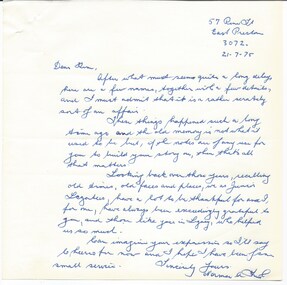
Letter, Intermediate Legacy Club, 1975
... first nighter, very well known to legatees of the time. Bill Johnston, a studious type, went to MHS and university, became a Solicitor. Served in the RAAF as a Flight...first nighter, very well known to legatees of the time. Bill Johnston, a studious type, went to MHS and university, became a Solicitor. Served in the RAAF as a Flight ...A letter written by Norm Smith and addressed to Kem Kemsley on 21 July 1975. It outlines recollections compiled by Norm Smith about the Intermediate Legacy Club (ILC) and individual members. His letter mentions 'Looking back over those years, recalling old time, old faces and places, we as Junior Legatees have a lot to be thankful for and I, for one, have always been exceedingly grateful to you, and those like you in legacy, who helped us so much.' Graham Billiet's letter dated 23 Mar 1974, mentions taking Frank Doolan to the reunion in 1974. Graham felt the ILC was winding down and was only running on half steam. He gives ILC members' addresses. Norm Smith's letter includes: Ted Kennedy, was the first president of the ILC, he was 'tall rangy lad with fiery red hair' who worked for United Distillers Ltd for 40 years (mostly in Brisbane where he joined Brisbane Legacy). Had been a keen junior legatee and taken part in Literary and Debating group and the Dramatic group where he met his future wife, Florence Pittard - which was the first marriage between junior legatees. He had been a naval cadet in the 1928 compulsory training and later joined the CMF where he was closely associated with L/ Stan Savige. He rose to rank of Major in AIF. Jack and Tom Kennedy, his brothers were in the Lacrosse team and his sister Molly in the JLC for years. G Billiet, a first nighter, very well known to legatees of the time. Bill Johnston, a studious type, went to MHS and university, became a Solicitor. Served in the RAAF as a Flight Lieut. Frank Corrie, prominent Junior Legatee in the Literary and Debating group, a fitter and turner by trade, was on JLC cricket and lacrosse teams, joined the AIF. Fred Hollingsworth, a motor mechanic, he joined CIG. He joined the AIF and served in the Middle East, and was one of the Rats of Tobruk as a sergeant. Bert Hollingsworth (brother of Fred) also in AIF and rank of Lieut. Is a past president of ILC. Bert Wood, a past president, worked for Victorian Railways, moved to Coolangatta. Dan Fitzgerald, active in the Drama group of JLC, worked as an announcer at the ABC. Alan Davidson, keen gymnast - particularly wrestling, helped with Alan Beattie (instructor of boys classes). Roy Davidson (brother of Alan) joined the AIF, afterwards joined M&MTB as a driver, married a Junior Legacy girl. Their younger brother Arthur was also in the lacrosse team. Roy Gilbert, keen junior legatee took part in Literary and Debating group and the Dramatic group and lacrosse team. Worked for Vacuum Oil Co., a past president of ILC and also married a Junior Legatee, Miss Lil Edmunds. Served in the AIF and was a Lieutenant in the Middle East. 'Jimmy' MacGregor, a colourful and handsome Junior Legatee, born in Collingwood, was one of L/ Stan Savige original contacts. Keen JLC gymnast and member of the football team. Worked at the Ret. Soldiers Woollen Mills in Geelong and was in the Geelong ILC. Frank 'Happy' Holliday, was in the lacrosse team, foundation member of ILC and past president. Served with the RAAF as an air frame fitter. Worked for L/ Con Fahle in the printing workshop for 40 years. Howard Auterey, joined the RAAF during the war and returned work for the State Saving bank before retiring in Warrnambool. Norman Smith, was working as an apprentice with M&MTB, took interest in Literary and Debating group and was in the lacrosse team. Was ILC president in 1946. Enliseted in the RAAF as airframe fitter. Retired from M&MTB after serving 50 years, married for 40 years to a daughter of an original Anzac who has also been an active member of the Ladies ILC for many years. Background: The ILC was formed in 1929. The idea of the club sprang from those boys who had outgrown the Junior Legacy Club. In the early days it fielded a lacrosse team and it was this that mainly held the members together (formed under guidance of L/ Jimmy Downing). Enthusiasm wained after a few years as it lacked a solid objective. The answer came from one of its members and in 1938 they founded the Don Esses Club. This was a club for the children of incapacitated ex-servicemen which met every Thursday night at 7.30 run by the ILC members. The name came from the signallers' code Disabled Servicemen's Sons. During the second world war 80% of the members of the ILC enlisted in the services. Leaving only 8 members that could not join due to ill health or reserved occupations. They continued the Don Esses and whatever aid they could to Legacy. ILC members had always helped Legacy where possible including being camp leaders or camp staff, with the annual demonstrations, and coffee stalls at the ANZAC dawn service. Post second world war some ILC members were nominated into Legacy, others drifted away in civil occupations. It was found difficult to recruit new blood into the ILC and eventually membership waned when the boys from the Don Esses clubs found other youth activities to join. The ILC ceased to meet regularly in the mid fifties. However a strong comradeship still existed between members and they would meet in one anothers homes. Members were always ready to help the senior Legacy Club in any way in their power and still helped at Christmas parties and summer camps. ILC was a service rendering organisation and was self governing. Non-sectarian and non-political, the members were ex-junior legatees over 18 years of age. After serving in World War 2 members were eligible to become members of Legacy. Was in a folder of material collated about the ILC by an early archive committee. A record of a Junior Legatee recording what he knew about ILC members and their life outside of Legacy in response to a request from L/ Kem Kemsley. It could have been part of the early archive committee working to capture Legacy history.White note paper x 18 pages handwritten by Norm Smith about the ILC members and a handwritten letter x 3 pages from Graham Billiet about ILC members with addresses.ilc, membership, junior legatee -
 Mrs Aeneas Gunn Memorial Library
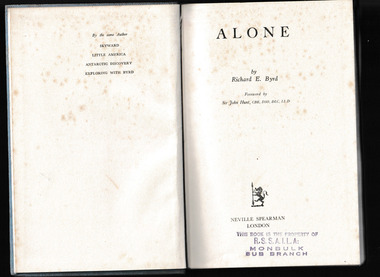
Book, Spearman, Alone, 1957
... first flights over the North and South Poles. His plan for this latest adventure was to spend six months alone near the bottom of the world, gathering weather data and indulging his desire "to taste peace and quiet long enough to know how good they really are." But early on things went terribly wrong. Isolated in the pervasive polar night ...When Admiral Richard E. Byrd set out on his second Antarctic expedition in 1934, he was already an international hero for having piloted the first flights over the North and South Poles. His plan for this latest adventure was to spend six months alone near the bottom of the world, gathering weather data and indulging his desire "to taste peace and quiet long enough to know how good they really are." But early on things went terribly wrong. Isolated in the pervasive polar night with no hope of release until spring, Byrd began suffering inexplicable symptoms of mental and physical illness. By the time he discovered that carbon monoxide from a defective stovepipe was poisoning him, Byrd was already engaged in a monumental struggle to save his life and preserve his sanity. When Alone was first published in 1938, it became an enormous bestseller. This edition keeps alive Byrd's unforgettable narrative for new generations of readers.Map, p.302.When Admiral Richard E. Byrd set out on his second Antarctic expedition in 1934, he was already an international hero for having piloted the first flights over the North and South Poles. His plan for this latest adventure was to spend six months alone near the bottom of the world, gathering weather data and indulging his desire "to taste peace and quiet long enough to know how good they really are." But early on things went terribly wrong. Isolated in the pervasive polar night with no hope of release until spring, Byrd began suffering inexplicable symptoms of mental and physical illness. By the time he discovered that carbon monoxide from a defective stovepipe was poisoning him, Byrd was already engaged in a monumental struggle to save his life and preserve his sanity. When Alone was first published in 1938, it became an enormous bestseller. This edition keeps alive Byrd's unforgettable narrative for new generations of readers. antarctica, polar exploration
