
Showing 172 items matching "first principles"
-
 Moorabbin Air Museum
Book (Item) - First Principles Of Flight
... First Principles Of Flight...First Principles Of Flight...By D.Hay Surgeoner First Principles Of Flight Book First Principles Of Flight ...By D.Hay Surgeoner -
Moorabbin Air Museum
Book (Item) - Flight First Principles - a general survey of fundamentals of aviation by Wright Smiley and Martin
... Flight First Principles - a general survey of fundamentals of aviation by Wright Smiley and Martin...Book Flight First Principles - a general survey of fundamentals of aviation by Wright Smiley and Martin ... -
 Bendigo Historical Society Inc.
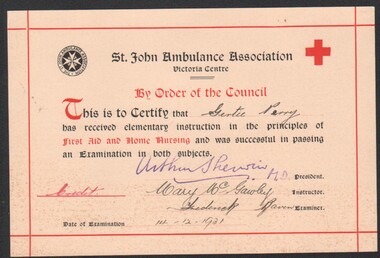
Certificate - Gertrude Perry Collection - St. John Ambulance Association to certify that Gertie Perry has received elementary instruction in the principles of First Aid and Home Nursing on 14/12/1931
... John Ambulance Association to certify that Gertie Perry has received elementary instruction in the principles of First Aid and Home Nursing on 14/12/1931...John Ambulance Association to certify that Gertie Perry has received elementary instruction in the principles of First Aid and Home Nursing on 14/12/1931. ...John Ambulance Association to certify that Gertie Perry has received elementary instruction in the principles of First Aid and Home Nursing on 14/12/1931. ...Gertrude Perry was born in California Gully in 1917. Her singing skills were recognized at an early age. She later sang with local choirs and sang on radio. She was involved with the Bendigo Operatic Society for many years. Gertrude began her working life in sales. After studying book keeping she worked at the Bendigo Ordnance Factory during WW2 and then worked for local solicitors and accountants. Gertrude was involved with many community and sporting organizations.Gertrude Perry Collection - St. John Ambulance Association to certify that Gertie Perry has received elementary instruction in the principles of First Aid and Home Nursing on 14/12/1931. Miss Perry was awarded a Credit for successfully passing the examinations on both subjects; and is signed by the President, Instructor and Examiner.physical culture class, fitness, exercise, st. john ambulance association -
Moorabbin Air Museum
Book - Flight handbooks, Flight Handbook
... First principles...Flight handbooks First principles Aerodynamics Aircraft structures Gliders & sailplanes Airscrews Aircraft power units Types of aircraft engines Supercharging Stratosphere flight Modern developments Aircraft instruments A manual of aeronautical theory & practice, circa 1944 Flight Handbook Book Flight handbooks ...A manual of aeronautical theory & practice, circa 1944non-fictionA manual of aeronautical theory & practice, circa 1944first principles, aerodynamics, aircraft structures, gliders & sailplanes, airscrews, aircraft power units, types of aircraft engines, supercharging, stratosphere flight, modern developments, aircraft instruments -
 Kilmore Historical Society
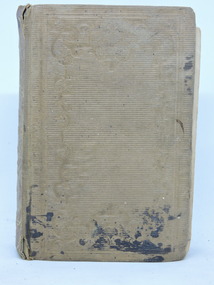
Scientific Dialogues, Joyces Scientific Dialogues, 1855
... Intended for the instruction and entertainment of young people in which the first principles of natural and experimental philosophy are fully explained. ...Intended for the instruction and entertainment of young people in which the first principles of natural and experimental philosophy are fully explained. ...Intended for the instruction and entertainment of young people in which the first principles of natural and experimental philosophy are fully explained. New edition complete in one volume.Brown cloth-bound hardcover book with embossed patterning on front and back covers. Ink staining to lower front cover, worn corners and top & bottom spine. Cover separating from body back & front. Missing flyleaf, loose front pages. Loose binding. Foxing throughout. 200 wood cut illustrations. 536 pp. Poor condition.Inside front cover, '132 Kilmore Mechanics Institute', handwritten cursive. Undecipherable name inscribed top of title page, 'Kilmore 17 Sept.1855'.kilmore mechanics institute library. -
Federation University Historical Collection
Booklet - Magazine, Ballarat School of Mines Students' Magazine, 1916, 1916
... Editorial, Fumes from the Lab, First Principles, Excursion to Melbourne, General Principles of the Cinematograph, Arts & Crafts gossip, In Memoriam, Public notices, Answers to correspondents, Echoes of the past, Science School, Technical Art School, Shun Military notes, The Camp Concert, The Junior Techs, Past members of the staff, Swinburne Technical School visit. ...Editorial, Fumes from the Lab, First Principles, Excursion to Melbourne, General Principles of the Cinematograph, Arts & Crafts gossip, In Memoriam, Public notices, Answers to correspondents, Echoes of the past, Science School, Technical Art School, Shun Military notes, The Camp Concert, The Junior Techs, Past members of the staff, Swinburne Technical School visit. ballarat school of mines magazine charles w. whyte patrick s. anderson william t. sayer william f. m. johnson robert m. sergeant harold t. w. dixon harrie wilson ernest s. morsehead carl jensen t. wilkins james fairbairn fairley l. c. blick f. maxwell n. turnball j. a. greenshields e. eimering l. tonkin h. smith r.cox r. o. buchanan l. vernon w. h. steane n. henry r. dale ted cannon john walter sutherland basil sawyer charles burbury herbert r. sleeman eustace m. weston oliver e. jaeger godfrey s. hart lionel j. lambert charles g. fraser l.w.g. buchner-malcolm james a. reid richard g. walker leslie j. coulter herbert e. hawkesworth leslie de jersey grut frederick g. brinsden lewis j. westcott angus d. gibson henry j. whittingham virgil tucker norman c. tinworth charles e. finnis benjamin h. bennett valentine g. anderson ernest s. anderson ralph i. moore john a. grant william gerldard francis c. hall harold g. cornell robert b. lamb sydney radcliff george a. denny frederick p. paul j. lipson hancock edgar c. hursfield david w. bonar wilfred l. allen william j. lakeland frederick a. marriott eric byron moore karl byron moore norman stuckey percy r. osborne john f. sporn horace l. giles maurice troup albert e. davies thos. h. trengrove garnet nightingale walter h. bennett cyril theimeyer stanley tomkins harold herbert viola jackson hilda wardle elsie naples jessie pridgeon gertrude owen alfred berryman herbert malin cedric white arthur lilburne donald j. johnson arthur kennedy eulalie perry rex l. cutter ronald ferguson murdoch spencer john b. sutcliffe elliott gower james leckie richard craze thos. r. pridgeon d. hambly harold n. ferguson mabel morris jack blaikie robert allen aubrey simmons janet white harold brown kenneth moss robert tremain j. m. hobba f. g. davis e.j. cannon reginald callister r.c. callister f.g. procter gladstone procter Blue soft covered magazine of 62 pages. ...Editorial, Fumes from the Lab, First Principles, Excursion to Melbourne, General Principles of the Cinematograph, Arts & Crafts gossip, In Memoriam, Public notices, Answers to correspondents, Echoes of the past, Science School, Technical Art School, Shun Military notes, The Camp Concert, The Junior Techs, Past members of the staff, Swinburne Technical School visit. Blue soft covered magazine of 62 pages.ballarat school of mines, magazine, charles w. whyte, patrick s. anderson, william t. sayer, william f. m. johnson, robert m. sergeant, harold t. w. dixon, harrie wilson, ernest s. morsehead, carl jensen, t. wilkins, james fairbairn fairley, l. c. blick, f. maxwell, n. turnball, j. a. greenshields, e. eimering, l. tonkin, h. smith, r.cox, r. o. buchanan, l. vernon, w. h. steane, n. henry, r. dale, ted cannon, john walter sutherland, basil sawyer, charles burbury, herbert r. sleeman, eustace m. weston, oliver e. jaeger, godfrey s. hart, lionel j. lambert, charles g. fraser, l.w.g. buchner-malcolm, james a. reid, richard g. walker, leslie j. coulter, herbert e. hawkesworth, leslie de jersey grut, frederick g. brinsden, lewis j. westcott, angus d. gibson, henry j. whittingham, virgil tucker, norman c. tinworth, charles e. finnis, benjamin h. bennett, valentine g. anderson, ernest s. anderson, ralph i. moore, john a. grant, william gerldard, francis c. hall, harold g. cornell, robert b. lamb, sydney radcliff, george a. denny, frederick p. paul, j. lipson hancock, edgar c. hursfield, david w. bonar, wilfred l. allen, william j. lakeland, frederick a. marriott, eric byron moore, karl byron moore, norman stuckey, percy r. osborne, john f. sporn, horace l. giles, maurice troup, albert e. davies, thos. h. trengrove, garnet nightingale, walter h. bennett, cyril theimeyer, stanley tomkins, harold herbert, viola jackson, hilda wardle, elsie naples, jessie pridgeon, gertrude owen, alfred berryman, herbert malin, cedric white, arthur lilburne, donald j. johnson, arthur kennedy, eulalie perry, rex l. cutter, ronald ferguson, murdoch spencer, john b. sutcliffe, elliott gower, james leckie, richard craze, thos. r. pridgeon, d. hambly, harold n. ferguson, mabel morris, jack blaikie, robert allen, aubrey simmons, janet white, harold brown, kenneth moss, robert tremain, j. m. hobba, f. g. davis, e.j. cannon, reginald callister, r.c. callister, f.g. procter, gladstone procter -
 Flagstaff Hill Maritime Museum and Village
Functional object - Urinal, circa 1825
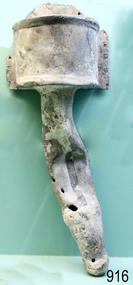
... principles. The wreck of the Children is of state significance as one of colonial Victoria’s earliest and most significant maritime disasters, and one of the first vessels lost in the Western District. ...The urinal was probably situated in the forward part of the ship rather than the stern, being one of two placed on either side of the deck and housed immediately adjacent to the doors into the forward castle, or crew sleeping quarters. The toilets on maritime vessels were (and still are) called the ‘heads’, after the sanitation arrangements common until the end of the eighteenth century. The name was given to the ‘head’ of the ship, forward of the forecastle and around the beak or bowsprit. These first lavatories were floored with grating or nets so the force of the sea could wash them clean, and they were always used on the lee or non-weather side so the effluent fell directly into the water rather than back on board. The Children's wrecking: The barque Children was one of the first vessels to be lost in the Western District. The vessel was wrecked to the east of Warrnambool on 14th January 1838. When it ran ashore in hurricane-force winds, 22 passengers and crew were fortunate to escape being battered to death on the rocks. The Children broke up within 20 minutes, sweeping sixteen of those on board to their deaths. After eleven days, the rescued survivors, all of whom were injured, had been taken to Portland. According to Lloyd's Shipping Register 1837-1839, the Children was built in 1825 at Liverpool and operated by owners Gordon & Co, of London. Registration number 123/1837, James Henty then bought her in 1837 as a three-masted barque of 254 tons, with a hull of “part pitch pine, felt sheathed” and “coppered in 1837” at Launceston, registered number 6/1837. In 1838, the Children, under her master Captain H. Browne, completed a successful round trip from Launceston to London (carrying wool and whale oil loaded in Portland), returning in late November of that year carrying a general cargo including house bricks used for ballast. On the 11th of January 1839, the Children sailed from Launceston for Adelaide, with 24 passengers, 14 crew, and an awkward mixed cargo, including 1500 sheep, 8 bullocks, 7 horses, farming implements, and six whaleboats with associated whaling gear. One account states that when the Children was “put out from port, she was light and badly ballasted”. The vessel immediately encountered four days of hurricane-force storms, eventually clearing on the early morning of the 14th. However, it was too late to take accurate measurements of the sun or stars to establish their position relative to the coast. The Children collided with a limestone stack at the entrance of what is now Childers Cove, and the seas smashed the vessel into pieces within half an hour. All the cargo and 16 lives were lost, including 9 children. The Henty brothers contributed £150 towards a fund for the 22 survivors at a memorial service held in Launceston later that year. It was a major financial setback for James Henty and his brothers, but one from which they recovered. In a submission to the Governor of New South Wales dated 24 March 1840, the Henrys summarised their work over the previous six years of establishing the Portland settlement, stating “Six stations have been occupied, one at Portland Bay three at the open country about 60 miles inland called ‘Merino Downs’ They have erected two houses at Portland Bay and two others at Merino Downs”.The urinal recovered from the Children's wreck is significant as part of the original fittings of the early 19th-century barque. The 1839 wreck and recovered artefacts are examples of the construction methods and materials used in that era and can be used to study the evolution of shipbuilding methods and principles. The wreck of the Children is of state significance as one of colonial Victoria’s earliest and most significant maritime disasters, and one of the first vessels lost in the Western District. This is recognised by its inclusion on the Victorian Heritage Register, VHR No. S116. Little is left on the seabed to mark the tragedy, apart from some of the house bricks intended for the Henty settlement. A lead urinal with a rounded back at the top splash plate with an attached semi-circular receptacle or basin (20cm deep and projecting forward 30cm). At the sides are flanges with bolt holes connecting to a ship's wall. The urinal is drained by a funnel-shaped outlet also made of lead, reducing from a 10cm radius to a joined 5 cm pipe. The urinal was recovered from the wreck of the CHILDREN.flagstaff hill, warrnambool, flagstaff-hill, flagstaff-hill-maritime-museum, shipwreck-coast, shipwreck artefact, the children, lead ship’s plumbing, crew urinal, the ‘heads’, ship plumbing, james henty, portland bay, urinal, ship's urinal, ship’s fitting, ship’s lead plumbing, ship’s toilet, ship’s urinal, children, childer’s cove, port campbell, 1839 shipwreck, james henty and co, henty brothers, captain h. browne, portland -
 Flagstaff Hill Maritime Museum and Village
Domestic object - Stove, 1850-1890
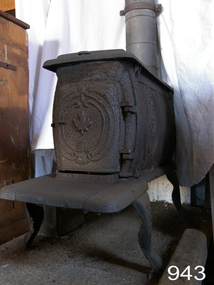
... first manufactured cast-iron stove was produced at Lynn, Mass., in 1642. This stove had no grates and was little more than a cast-iron box. About 1740 Benjamin Franklin invented the “Pennsylvania fireplace,” which incorporated the basic principles of the heating stove. ...first manufactured cast-iron stove was produced at Lynn, Mass., in 1642. This stove had no grates and was little more than a cast-iron box. About 1740 Benjamin Franklin invented the “Pennsylvania fireplace,” which incorporated the basic principles of the heating stove. ...In the industrialized world, as stoves replaced open fires and braziers as a source of more efficient and reliable heating, models were developed that could also be used for cooking, and these came to be known as kitchen stoves. The first manufactured cast-iron stove was produced at Lynn, Mass., in 1642. This stove had no grates and was little more than a cast-iron box. About 1740 Benjamin Franklin invented the “Pennsylvania fireplace,” which incorporated the basic principles of the heating stove. The Franklin stove burned wood on a grate and had sliding doors that could be used to control the draft (flow of air) through it. Because the stove was relatively small, it could be installed in a large fireplace or used free-standing in the middle of a room by connecting it to a flue. The Franklin stove warmed farmhouses, city dwellings, and frontier cabins throughout North America. Its design influenced the development of the pot-bellied stove, which was a familiar feature in some homes well into the 20th century. The first round cast-iron stoves with grates for cooking food on them were manufactured by Isaac Orr at Philadelphia, Pa., in 1800. The base-burning stove for burning anthracite coal was invented in 1833 by Jordan A. Mott. The subject item is a mid to late 19th century settlers stove probably of Canadian manufacture imported into Australia around this time. The stove gives us a social snapshot into what life must have been like for our early colonialists using this device for heating and cooking in their meagre homes. Cast iron stove with four-legs, 2 plates on top and a hinged front door. The door has been cast with a maple leaf design and the sides have a pattern cast into them.flagstaff hill, warrnambool, shipwrecked-coast, flagstaff-hill, flagstaff-hill-maritime-museum, maritime-museum, shipwreck-coast, flagstaff-hill-maritime-village, stove, domestic heating, domestic cooking, heater, cooking unit, pot belly stove, wood fired stove, wood stove -
 Flagstaff Hill Maritime Museum and Village
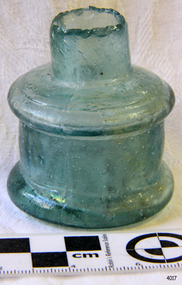
Container - Ink Bottle, Second half of 19th Century or first half of the 20th Century
... first beer pasteurised in glass was produced in Copenhagen in 1870. Pasteurisation of milk followed soon after. The moulding of a screw thread on a container was invented by John Mason in 1858. The principles...first beer pasteurised in glass was produced in Copenhagen in 1870. Pasteurisation of milk followed soon after. The moulding of a screw thread on a container was invented by John Mason in 1858. The principles ...Although glass containers for wine and beer are probably 1,600 years old, much of their use began only in the late 17th century. In the United States, large-scale production of bottles was pioneered by Caspar Wistar in 1739 at his New Jersey plant. In the 1770s the carbonation process for producing soft drinks was developed, and so began an entirely new bottling industry. At the Great Exhibition of 1851 in the Crystal Palace in London, one million “pop” bottles were consumed. The first beer pasteurised in glass was produced in Copenhagen in 1870. Pasteurisation of milk followed soon after. The moulding of a screw thread on a container was invented by John Mason in 1858. The principles of the “press-and-blow” process for making wide-mouth jars were shown in the United States by Philip Arbogast in 1882, and the “blow-and-blow” process for making narrow-neck containers was demonstrated by Howard Ashley in England in 1885. These processes employed manual delivery; fully automatic jar forming by a suction-and-blow process was perfected by Michael Owens over the period 1895–1917 at the Toledo (Ohio) Glass Company, which subsequently became the Owens Bottle Machine Company. The automatic single-gob feeder was developed in 1919–22 by Karl Peiler at the Hartford-Fairmont Company in Connecticut. Fully automatic machines followed, but the true rugged survivor, utilising fully automatic gob delivery to the maximum versatility, was the Individual Section, or IS, machine invented by Henry Ingle at the Hartford Empire Company in 1925. Source: https://www.britannica.com/topic/glass-properties-composition-and-industrial-production-234890/History-of-glassmakingUnlike item 4018, this is a much smaller ink bottle, and was probably used by an individual, as against the supply of ink to pupils from a much larger bottle.Cotton Reel Ink Bottle, green glass, small, chipped around the lip, bubbles in glass.None.flagstaff hill, warrnambool, shipwrecked-coast, flagstaff-hill, flagstaff-hill-maritime-museum, maritime-museum, shipwreck-coast, flagstaff-hill-maritime-village, ink, bottle, glass -
 Flagstaff Hill Maritime Museum and Village
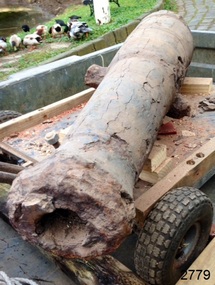
Weapon - Cannon, circa 1825
... first stages of further conservation. The signal cannon recovered from the Children's wreck is significant as part of the original fittings of the early 19th-century barque. It is an example of maritime defence in the early to mid-19th century. The 1839 wreck and recovered artefacts are examples of the construction methods and materials used in that era and can be used to study the evolution of shipbuilding methods and principles. ...In an article dated 26 March 1963, the Warrnambool Standard reported: “A cannon which has lain on the ocean floor since the barque, Children, was wrecked at Childer’s Cove on January 15, 1839, was raised by three Warrnambool skindivers at the weekend … The cannon, weighing about 750 lb. and 4-ft. 6-in. in length … is in excellent order considering the length of time it has remained underwater”. No conservation measures were taken at that time, other than chipping off the marine growth with hammers and cold chisels. The minutes for the 4 February 1974 meeting of the Flagstaff Hill Planning Board recorded that “a cannon recovered some time ago was lying in the garden of [one of the three original divers] and that it could be picked up at any time”. Peter Ronald, past Manager and Diver for Flagstaff Hill, notes that the CHILDREN cannon would have been recovered by the other divers around 1964. When the cannon came into care of Flagstaff Hill, it was given basic conservation relevant to the time. (At the same meeting, the Board was advised of the recovery of an anchor from the wreck of the CHILDREN by Flagstaff Hill divers (Peter Ronald, Colin Goodall and Gary Hayden, and Hank Howey and Andrew Coffee), and its interim relocation in the sea at the end of the Warrnambool Breakwater while awaiting conservation). About the ship CHILDREN 1825-1839: The sailing ship Children was a wooden, three-masted barque constructed of pitch pine in 1825 at Liverpool. It was felt sheathed and was coppered during an upgrade in 1837. The ship was only 29 metres long and 254 tons in weight; it had two decks and a square stern. The James Henty & Co., a pioneering family from Portland, Victoria, purchased the Children in 1837 for use as a coastal trader. The Children, under the command of Captain H. Browne, was on a voyage from Launceston to Adelaide when it foundered in rough conditions at Childers Cove, west of Peterborough, on 14 January 1839. On board were 14 crew members and 24 passengers, including 9 children. The ship’s cargo was awkwardly balanced: it carried 1500 sheep, 8 bullocks, 7 horses, 5000 London house bricks, 6 whaling boats with associated gear, and general trade goods including beef, pork, tobacco, tipe, butter, lime juice, horse hair, curtains, lead shot, beer and spirits. The hurricane-force winds drove the Children into the limestone stack at the entrance to the cove. The seas smashed it into pieces within twenty minutes. The bodies of sixteen of those who had lost their lives were spread across the shore, along with wreckage from the ship and the cargo of animals. Those who survived suffered injuries; they were rescued and taken by horse and cart to Campbell’s farm, near the whaling station at Port Fairy. They arrived at Portland eleven days after the wreck. The wrecking of the Children is one of colonial Victoria’s earliest and most significant maritime disasters. Little is left to mark the tragedy, apart from some house bricks intended for the Henty family’s Portland Bay settlement. Artefacts recovered in the 1960s to early 1970s include this signal cannon, an anchor, the bottom half of her ship’s bell, and two portions of a ship’s fitting, at one time thought to be a brass porthole frame, London housing bricks and timber flooring. Despite its poor condition, the CHILDREN’s signal cannon remains an important and interpretable record of its demise. From 2015, the CHILDREN cannon has been undergoing the first stages of further conservation.The signal cannon recovered from the Children's wreck is significant as part of the original fittings of the early 19th-century barque. It is an example of maritime defence in the early to mid-19th century. The 1839 wreck and recovered artefacts are examples of the construction methods and materials used in that era and can be used to study the evolution of shipbuilding methods and principles. The wreck of the Children is of state significance as one of colonial Victoria’s earliest and most significant maritime disasters, and one of the first vessels lost in the Western District. This is recognised by its inclusion on the Victorian Heritage Register, VHR No. S116. Little is left on the seabed to mark the tragedy, apart from some of the house bricks intended for the Henty settlement. Signal cannon: a 1.3 metre iron 6pdr cannon recovered from the wreck of the CHILDREN. The shape of the cannon tapers from a thick round breech to a flared muzzle, with an 8-centimetre bore, and two side trunnions for pivoting on a wooden gun carriage. It was recovered from the shipwreck site of the CHILDREN by local divers in 1963. This small muzzle-loading signal cannon is in poor and unrestored condition. The cannon’s upper profile of smooth grey metal casing has corroded off, leaving an extensively oxidised rough red surface of crumbling iron. The bottom half of the cannon remains intact, although the outer smooth casing also appears to be separating from the iron core of the barrel. The original grey casting is also missing from the breech and muzzle ends of the cannon. Corrosion and spalling of the upper surface layer of the cannon have removed the maker’s marks and specificationsflagstaff hill, flagstaff hill maritime museum and village, warrnambool, maritime museum, maritime village, great ocean road, shipwreck coast, shipwreck artefact, children, barque, three-masted, liverpool, childer’s cove, port campbell, 1839 shipwreck, 1939 wreck, james henty and co, henty brothers, captain h. browne, first mate t. gay, second mate w. wentworth, portland, portland bay, 1939, ship’s cannon, signal cannon, conservation of marine artefacts, 6pdr small bore cannon, defence -
 Flagstaff Hill Maritime Museum and Village
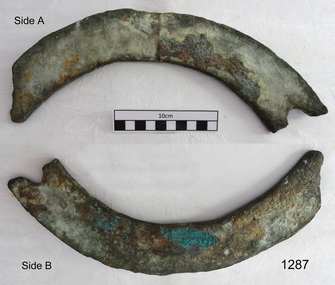
Functional object - Ship's Fitting, circa 1825
... principles. The wreck of the Children is of state significance as one of colonial Victoria’s earliest and most significant maritime disasters, and one of the first vessels lost in the Western District. ...This attractively patinated artefact was raised from the wreck site of the CHILDREN and was quite reasonably catalogued as a portion of a ship's porthole. This identification is unlikely, however, because the CHILDREN was built at Liverpool in 1824, and round portholes were not in common use until the 1850s. The catalogue identification has since been changed to "Ship's Fitting" Before the appearance of round portholes in the middle of the nineteenth century, the function of introducing light to lower decks was performed by square half-glassed ‘ports’ in the side of the hull (known as a port-sash), or ground-glass ‘bullseyes’ inserted in the deck (scuttles). In historical terms, ports were always square, cut into the timber originally to allow the firing of a ship's guns, and were closed in weather by a tight-fitting square hatch. Flagstaff Hill Shipwreck Museum has three portholes on display that illustrate the gradual development and adoption of circular brass portholes. First in sequence is a small 12.5cm diameter window (with a deep frame for thick wooden hulls) from the 1855 wreck of SCHOMBERG. The second and third are larger 25cm diameter windows (with a shallower frame for thinner iron hulls) from the 1892 wreck of the NEWFIELD and the 1908 wreck of the FALLS OF HALLADALE. Once the apparently obvious use of the brass object is discounted, an accurate and reliable alternative classification is difficult to specify. One artefact register notes it was ‘found in about the centre of the wreck site’. This would mitigate against the possibilities of (1) ‘horseshoe frame’ joining pieces of the keel and hull at the bow of the vessel, or (2) ‘deckseat’ for a binnacle at the stern. It may support the idea of a ‘head frame’ on a cooped companionway or a ‘deckseat’ for a mainmast pump. But this is only speculation. The actual identification is not known. The sip's fitting recovered from the Children's wreck is significant as part of the original fittings of the early 19th-century barque. The 1839 wreck and recovered artefacts are examples of the construction methods and materials used in that era and can be used to study the evolution of shipbuilding methods and principles. The wreck of the Children is of state significance as one of colonial Victoria’s earliest and most significant maritime disasters, and one of the first vessels lost in the Western District. This is recognised by its inclusion on the Victorian Heritage Register, VHR No. S116. Little is left on the seabed to mark the tragedy, apart from some of the house bricks intended for the Henty settlement. Ship's fitting, of heavy gauge brass circle, previously classified as a section of the ship's fitting, which was raised from the wreck of the Children. One end is broken off at an original bolt hole, and the other is severed or cut at an acute angle from the inner rim. The artefact is 6cm across and 1cm deep, indicating strength and function as a substantial and finished item of moulded metal. The upper face bears sedimentary accretion stained red/brown. The rear face has been gouged by hard or corrosive materials and bears brilliant blue/green oxidation.flagstaff hill, flagstaff hill maritime museum and village, warrnambool, maritime museum, maritime village, great ocean road, shipwreck coast, shipwreck artefact, children, childer’s cove, port campbell, 1839 shipwreck, james henty and co, henty brothers, captain h. browne, portland, portland bay, brass flange, brass rim, ship’s fitting -
 Flagstaff Hill Maritime Museum and Village
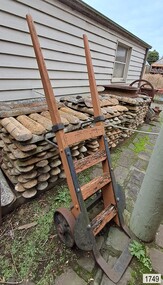
Functional object - Hand Trolley, Melbourne Steamship Company (MSS Co), Late 19th to mid-20th century
... principles of wheels and leverage, like a wheelbarrow, and can easily be wheeled from one place to another. Hand trolleys are still used by farmers, railway workers, shipping companies, porters, airports, hospitals, warehouses, logistical firms, furniture removalists, factory labourers and even in private homes when heavy loads need to be moved. Hand trolleys were first...principles of wheels and leverage, like a wheelbarrow, and can easily be wheeled from one place to another. Hand trolleys are still used by farmers, railway workers, shipping companies, porters, airports, hospitals, warehouses, logistical firms, furniture removalists, factory labourers and even in private homes when heavy loads need to be moved. Hand trolleys were first ...This hand trolley was originally marked M.S.S. Co., and likely to have once belonged to the Melbourne Steamship Company, often referred to by those initials. Flagstaff Hill’s collection has several other objects connected to the M.S.S. Co. The firm was established in 1873 under the name Hugh R. Reid and Company, renamed Melbourne Steamship Company Ltd in 1895, and became Melbourne’s foremost interstate shipping line. Warrnambool was one of the ports of call at least between 1922 and 1956; for example, on September 27 1934, the ship Coolana left Warrnambool on its way to Stanley, Burnie and Devonport, then on to Sydney and Newcastle, while other of its vessels were visiting Fremantle, Port Lincoln, Whyalla, Adelaide, and Melbourne. The firm remained in business until around 1960. A hand trolley can be loaded with heavy and bulky objects such as luggage, and stacks of boxes such as produce, cargo and equipment. It uses the principles of wheels and leverage, like a wheelbarrow, and can easily be wheeled from one place to another. Hand trolleys are still used by farmers, railway workers, shipping companies, porters, airports, hospitals, warehouses, logistical firms, furniture removalists, factory labourers and even in private homes when heavy loads need to be moved. Hand trolleys were first used in the 18th century in industries where children were used to move heavy loads. By using a hand trolley, the young labourers could move the piles of objects with the same efficiency as the adult workers. This hand trolley is significant for its likely connection to the Melbourne Steamship Company, or MSSCo, Melbourne’s foremost shipping line for interstate trade in the late nineteenth and early-to- mid twentieth century, representing many aspects of early trade within maritime Australia; Warrnambool was one of the ports visited by the company’s ships. The design of the hand trolley is an example of equipment used since the 18th century to move heavy loads at docks and shipyards. It is associated with the maritime industries of shipping, transportation, travel, and trade, as well as the colonial primary production sectors of farming, markets, and produce. The design represents an early step in the evolution of the simple hand trolley. More recently, as well as the continued use of this simple style of trolley, the design has been improved to include specialised trolleys that fold, climb stairs, move pianos and even easily turn corners on their spinning, pivoting wheels. Hand trolley: an L-shaped handcart with handles and supporting legs at one end, wheels at the other, and a ledge or platform to hold the load. This hand trolley has orange wooden slats and handles, two metal wheels, and a black metal frame with semi-circular side flanges. An inscription is stamped on one side.Stamped: "M.S.S.CO."warrnambool, flagstaff-hill, flagstaff-hill-maritime-museum, maritime-museum, shipwreck-coast, flagstaff-hill-maritime-village, hand trolley, sack truck, trolley, luggage trolley, hand truck, trundler, sack barrow, bag barrow, leverage, marine technology, cargo handling, docks, wharft, shipping, trade, vintage, antique, hand card, rolling cart, station trolley, dolly, stack truck, box cart, two-wheeler, material handling equipment, shipping trade, mss co, mssc, melbourne steamship company, interstate shipping, hugh r. reid and company -
 Flagstaff Hill Maritime Museum and Village
Equipment - Hand Trolley
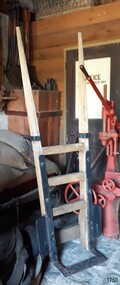
... principles of wheels and leverage, like a wheelbarrow, and can easily be wheeled from one place to another. Hand trolleys are still used by farmers, railway workers, shipping companies, porters, airports, hospitals, warehouses, logistical firms, furniture removalists, factory labourers and even in private homes when heavy loads need to be moved. Hand trolleys were first...principles of wheels and leverage, like a wheelbarrow, and can easily be wheeled from one place to another. Hand trolleys are still used by farmers, railway workers, shipping companies, porters, airports, hospitals, warehouses, logistical firms, furniture removalists, factory labourers and even in private homes when heavy loads need to be moved. Hand trolleys were first ...A hand trolley can be loaded with heavy and bulky objects such as luggage, and stacks of boxes such as produce, cargo and equipment. It uses the principles of wheels and leverage, like a wheelbarrow, and can easily be wheeled from one place to another. Hand trolleys are still used by farmers, railway workers, shipping companies, porters, airports, hospitals, warehouses, logistical firms, furniture removalists, factory labourers and even in private homes when heavy loads need to be moved. Hand trolleys were first used in the 18th century in industries where children were used to move heavy loads. By using a hand trolley, the young labourers could move the piles of objects with the same efficiency as the adult workers. The design of the hand trolley is an example of equipment used since the 18th century to move heavy loads at the docks and shipyards. It is associated with the maritime industries of shipping, transportation, travel and trade as well as the colonial primary production sectors of farming, markets and produce. The design represents an early step in the evolution of the simple hand trolley. More recently, as well as the continued use of this simple style of trolley, the design has been improved to include specialised trolleys that fold, climb stairs, move pianos and even easily turn corners on their spinning, pivoting wheels. Hand trolley: an L-shaped hand-operated trolley with handles and supporting legs at one end, wheels at the other, and a ledge or platform to hold the load. This hand trolley has orange wooden slats and handles, two metal wheels, and a black metal frame with curved corners on its rectangular side flanges.flagstaff hill, warrnambool, shipwreck coast, maritime museum, flagstaff hill maritime museum and village, vintage, antique, hand trolley, hand card, hand truck, rolling cart, luggage trolley, station trolley, dolly, stack truck, sack truck, trundler, box cart, sack barrow, bag barrow, two-wheeler, leverage, material handling equipment, marine technology, cargo handling, docks, shipping trade -
 Flagstaff Hill Maritime Museum and Village
Equipment - Anchor, Before 1831
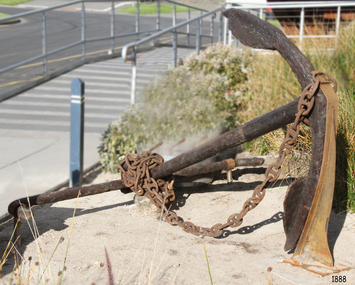
... principles. The wreck of the Children is of state significance as one of colonial Victoria’s earliest and most significant maritime disasters, and one of the first vessels lost in the Western District. ...The anchor is from the wooden sailing ship CHILDREN, which was wrecked at Childers Cove east of Warrnambool on the 14th of January 1839 with the loss of 16 lives. The Children anchor was raised from the wreck site by Flagstaff Hill Divers: Peter Ronald, Garry Hayden (Terang, still), Tim Goodall (now Warrnambool), and Colin Goodall (now Warrnambool), on Sunday, 3rd January 1974. A week or so later, it was dragged up the cliffs and taken to Warrnambool. It is now on display near the entrance to the Maritime Museum and Village. It appears to be a Pering’s Improved Anchor, developed at Portsmouth after 1813. The addition of broad curvature to the anchor arms provided a stronger purchase than the pre-existing Admiralty Old Pattern Long Shanked Anchor with straight arms. However, the evidence of hammer-welding of the separate pieces of the arms and palms to the central shank, peaked crown and flat palms, suggests the manufacture is before the 1831 Rodger’s Anchor design, which cast both arms and their flukes as one piece that was then attached to the shank by a bolt through the crown. This identification seems consistent with the date of the CHILDREN’s construction in 1824. The CHILDREN was a three-masted barque with a wooden hull built at Liverpool in England. The vessel was bought by the Henty family of Portland (Australia Felix) in 1837 for regular coastal trading between Van Diemens Land (now Tasmania), the Port Phillip District of New South Wales and South Australia. Only 255 tons burden (92 feet in length, with a beam of 25 feet and depth of 17 feet), it sailed from Launceston bound for Adelaide in late December 1838, on its first Australian voyage and under the English master who had brought the barque out, Captain H. Browne. On board the CHILDREN were 24 passengers, including 9 children, the captain and 14 crew; livestock of 1500 sheep, 8 bullocks and 7 horses; general cargo of beef, pork, tobacco, tripe, butter, limejuice, horse hair, currants, lead shot, beer and spirits; 5,000 house bricks from London; and six whaling boats with associated whaling gear. The vessel was battered by gale-force north-westerly winds shortly after setting out from Launceston on 11 January 1839, and adverse sailing conditions persisted for the next four days. At 11 pm on the 14th of January 1839, and many miles north and east of the captain’s navigated position, the CHILDREN struck the Pinnacle, a limestone stack off what is now called Childers Cove. Within half an hour, the ship was destroyed. As well as the loss of livestock and cargo, 16 passengers and crew perished, including the captain, six men, one woman and nine children. In 1931, shifting sands at Childers Cove uncovered the skeleton of an adult male. In 1951, another two skeletons were exposed by storms, an adult male and a child. In 1963, some district scuba divers retrieved a small signal cannon from the site. And in 1974, Flagstaff Hill recovered the anchor and some house bricks. The anchor recovered from the Children's wreck is significant as part of the equipment of the early 19th-century barque. The 1839 wreck and recovered artefacts are examples of the construction methods and materials used in that era and can be used to study the evolution of shipbuilding methods and principles. The wreck of the Children is of state significance as one of colonial Victoria’s earliest and most significant maritime disasters, and one of the first vessels lost in the Western District. This is recognised by its inclusion on the Victorian Heritage Register, VHR No. S116. Little is left on the seabed to mark the tragedy, apart from some of the house bricks intended for the Henty settlement. A large forged, wrought iron anchor from the wreck of the CHILDREN. Flat hammer-welded flukes on opposing curved arms and a peaked crown. It has a metal, elbowed stock or cross-bar and a heavy-duty pinned, flat-ring shackle for the anchor chain. It is in fair condition but extensively corroded after 135 years on the seabed. flagstaff hill, flagstaff hill maritime museum and village, warrnambool, maritime museum, maritime village, great ocean road, shipwreck coast, shipwreck artefact, children, barque, three-masted, liverpool, childer’s cove, port campbell, 1839 shipwreck, 1939 wreck, james henty and co, henty brothers, captain h. browne, first mate t. gay, second mate w. wentworth, portland, portland bay, anchor, ship’s anchor, peter ronald, garry hayden, tim goodall, colin goodall, pering’s improved anchor -
Federation University Historical Collection
Programme, Memorial Service Booklet for Hugh Dean Thomas Williamson, 1985
... "He witnessed first-hand the difficulties of rural life exacerbated by a world war that had stripped whole towns of their young men, and the long, lean years of the Depression were to define the way he lived the rest of his life. Hard work, constancy, eschewing wastage of any kind along with a hunger to seize opportunities wherever they presented themselves were the principles that informed his life and career and which, in time, gave rise to a commitment to others and to organisations and communities in which he saw the same ideals. ..."He witnessed first-hand the difficulties of rural life exacerbated by a world war that had stripped whole towns of their young men, and the long, lean years of the Depression were to define the way he lived the rest of his life. Hard work, constancy, eschewing wastage of any kind along with a hunger to seize opportunities wherever they presented themselves were the principles that informed his life and career and which, in time, gave rise to a commitment to others and to organisations and communities in which he saw the same ideals. ...Hugh D.T. WIlliamson C.B.E. was born in Ballarat on 04 February 1901 and died on 20 December 1985. "He witnessed first-hand the difficulties of rural life exacerbated by a world war that had stripped whole towns of their young men, and the long, lean years of the Depression were to define the way he lived the rest of his life. Hard work, constancy, eschewing wastage of any kind along with a hunger to seize opportunities wherever they presented themselves were the principles that informed his life and career and which, in time, gave rise to a commitment to others and to organisations and communities in which he saw the same ideals. Hugh attained the rank of Honorary Colonel in the Salvation Army and attained its highest award in 1978 when he was presented with its Distinguished Service Medal. In his time with the Salvation Army, Hugh helped establish the Red Shield Appeal and established scholarships to support senior officers to obtain business management training at the Australian Administrative Staff College in Mt Eliza (operated from a property formerly owned by Sir Reginald Ansett). He began his working life at age 16 at the Ballarat Banking Company. He steadily worked his way up through the ranks of the banking industry to become General Manager of the ANZ Bank from which he retired in 1961. Hugh was also a founding Trustee of the William Buckland Foundation, an association which strongly influenced his decision to set up his own foundation."Yellow Order of Service booklet for the funeral of Hugh Williamson. hugh williamson, hugh d.t. williamson, memorial service, martin carlson, j. davis mccaughey, francis macnab, frank linsell, john norman, ian harrison -
Federation University Historical Collection
Booklet - Booklet - Syllabus, Government Technical School, Hobart, Syllabus, 1892, 1892
... principles of technical education' in the Education Act (1885). Regulations specifying courses of instruction and establishing a committee of Technical Education followed in 1887. The first...principles of technical education' in the Education Act (1885). Regulations specifying courses of instruction and establishing a committee of Technical Education followed in 1887. The first ...The Tasmanian Parliament made provision for 'the teaching of the principles of technical education' in the Education Act (1885). Regulations specifying courses of instruction and establishing a committee of Technical Education followed in 1887. The first government Technical School opened in Hobart in 1888, offering evening classes in technical art and applied mechanics. Two months later a school was established in Launceston. Small classes were also held in regional centres and Schools of Mines were established in Zeehan, Queenstown and Beaconsfield. Curricula quickly expanded to include subjects ranging from mineralogy and metallurgy to commercial economy, beginning the long tradition of directly linking the schools with the interests of business and industry. The Technical Schools largely worked independently, with varying degrees of success, until 1916 when a Commission of Inquiry recommended the integration of technical education into the state education system. The outcome was a new Technical Education Branch, formed to administer Technical Schools and Schools of Mines and to provide a structured technical education system, comprising distinct trade certificates and applied sciences, engineering and arts diploma courses. Pale orange soft covered booklet.hobart, technical school, syllabus, malcolm kennedy, a. mault, r.s. pemberton, a. morton, a.j. taylor, henry lamb, j. mcmeekin, j.h. hunt, j.r. trantham-fryer, f.g. howell, w. middleton, trevor russell, j.f. echlin, w.f. ward, archibald park, a paton miller, committee members of technical education, department of art, department of mathematics, department of engineering, department of commercial economy, department of geology mineralogy mining, department of chemistry, department of pharmacy, department of veterinary science -
Federation University Historical Collection
Document - Document - Syllabus, Education Department: Technical Schools Syllabus, 1921
... A syllabus for each subject taught in Technical Schools that was provided by the Education Department of Victoria. .1: Syllabus for Heat Engines - side 1, Grade 1; side 2, Grade 2 .2: Syllabus for Refrigeration - Grade 1 and Grade 2 on side 1. .3: Syllabus for Farm Irrigation and Irrigation Engineering - side one, Farm Irrigation; side 2, Irrigation Engineering. .4: Mechanics and Mechanics applied to Mining - 4 pages covering Mechanics (Applied) Grade 1, Grade 2, Mechanics (Applied) Structures, Grade 3, Mechanics (Applied) Machines, Grade 3; Mechanics Applied to Mining and Theoretical Mechanics .5: Syllabus for Mechanics and Heat - First Grade Mechanics students will be required to know the general principles and formulae of the science, apparatus used method of using and to verify formulae experimentally. ...A syllabus for each subject taught in Technical Schools that was provided by the Education Department of Victoria. .1: Syllabus for Heat Engines - side 1, Grade 1; side 2, Grade 2 .2: Syllabus for Refrigeration - Grade 1 and Grade 2 on side 1. .3: Syllabus for Farm Irrigation and Irrigation Engineering - side one, Farm Irrigation; side 2, Irrigation Engineering. .4: Mechanics and Mechanics applied to Mining - 4 pages covering Mechanics (Applied) Grade 1, Grade 2, Mechanics (Applied) Structures, Grade 3, Mechanics (Applied) Machines, Grade 3; Mechanics Applied to Mining and Theoretical Mechanics .5: Syllabus for Mechanics and Heat - First Grade Mechanics students will be required to know the general principles and formulae of the science, apparatus used method of using and to verify formulae experimentally. ...A syllabus for each subject taught in Technical Schools that was provided by the Education Department of Victoria. .1: Syllabus for Heat Engines - side 1, Grade 1; side 2, Grade 2 .2: Syllabus for Refrigeration - Grade 1 and Grade 2 on side 1. .3: Syllabus for Farm Irrigation and Irrigation Engineering - side one, Farm Irrigation; side 2, Irrigation Engineering. .4: Mechanics and Mechanics applied to Mining - 4 pages covering Mechanics (Applied) Grade 1, Grade 2, Mechanics (Applied) Structures, Grade 3, Mechanics (Applied) Machines, Grade 3; Mechanics Applied to Mining and Theoretical Mechanics .5: Syllabus for Mechanics and Heat - First Grade Mechanics students will be required to know the general principles and formulae of the science, apparatus used method of using and to verify formulae experimentally. Second Grade course includes all subjects for Grade 1 plus Newton's proof of the parallelogram of forces, rotation round fixed axis, laws of rotary motion of a body, resistance, harmonic motion, friction,impulsive forces, barometer corrections and Heat and thermodynamics. Third Grade students, an intimate knowledge of the courses for first and second grades plus remaining portions of thermodynamics. A special course for Evening Students in Mechanics and Heat outlined. .6: Syllabus for Electricity - covers the requirements for First Grade, Second Grade and Grade 3. Areas covered are Magnets and Magnetism, Electroscopes and Electrification, Electronic Fields, Voltaic Electricity, Measurement of Current, Electromagnetism, Amperemeters, Resistance, Electrical Technology,A5 size pages, typed. Some are doubled sided.education department victoria, technical schools, syllabus, 1921, heat engines, refrigeration, farm irrigation, irrigation engineering, mechanic, mechanics applied to mining, mechanics and heat, electricity -
 Ballarat Clarendon College
Book, The laws and principles of whist stated and explained...by "Cavendish', 1895
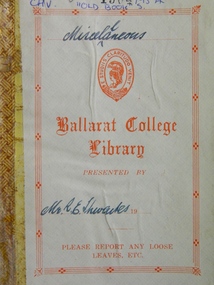
... first names of Principal Marryat had never been known by the school. The discovery of his presumed personal signature has added significantly to the school's written history. e-n-marryat ernest-neville-marryat ballarat-college principal 1910s r-e-thwaites Book plate on flyleaf: Crest / Ballarat College / Library / PRESENTED BY / Mr R E Thwaites Handwritten on second page: Ernest Neville Marryat / Christmas / 1897 Tan coloured cloth bound small book with gold lettering and borders on front cover and spine. The laws and principles ...This book was donated by Principal R E Thwaites to the Ballarat College Library, possibly during his years of tenure (1933-45). Fascinatingly the book contains the signiature of a previous principal Ernest Neville Marryat (tenure 1910-1912). Until 2014 when this book was catalogued to the Victorian Collections database the first names of Principal Marryat had never been known by the school. The discovery of his presumed personal signature has added significantly to the school's written history. Tan coloured cloth bound small book with gold lettering and borders on front cover and spine.Book plate on flyleaf: Crest / Ballarat College / Library / PRESENTED BY / Mr R E Thwaites Handwritten on second page: Ernest Neville Marryat / Christmas / 1897e-n-marryat, ernest-neville-marryat, ballarat-college, principal, 1910s, r-e-thwaites -
Federation University Historical Collection
Image, Robert Malachy Serjeant
... first certificate in “Geology as Applied to Mining” was awarded to Robert Serjeant in 1876. Robert Serjeant was an active and generous supporter of the School of Mines. As well as being a financial contributor, he lectured and examined in the Principles...first certificate in “Geology as Applied to Mining” was awarded to Robert Serjeant in 1876. Robert Serjeant was an active and generous supporter of the School of Mines. As well as being a financial contributor, he lectured and examined in the Principles ...ROBERT MALACHY SERJEANT (1828-1902) Robert Malachy Serjeant was born on 21 December 1828 at Callington, Cornwall. He was the son of Philip Davey Serjeant, a surgeon in the Royal Marines, and Eliza Malachy. Philip Serjeant died in 1834. His mother, Eliza, remarried John Burgh in 1836. He died in 1837. In September 1848 Eliza, Robert and his two sisters, Caroline and Susan, departed Plymouth on the William Moneya for Port Adelaide and arrived in January 1849. Once gold was discovered in Victoria, Serjeant made his way to Forest Creek (near Castlemaine) and he and his mate Mr Victor, were the first party to sink through the basalt in search of a deep lead. In 1854 he moved to Ballarat to work as a miner and enjoyed some success. In 1855 he was with a group that discovered a 500 ounce nugget. With his share of the sale he set himself up with the latest mining equipment, as well as beginning a lifelong interest in the share market. He became the Manager of the Chryseis, Isis and Garibaldi claims and then the Manager of the Band and Albion Consol Company. He held the position for thirty years and only resigned when the company amalgamated with the Sir Henry Loch Mine. Robert Malachy Serjeant became interested in Politics. The first election for Parliament Representatives for Ballarat was in 1855. Robert stood for election for the first time in 1859, representing Ballarat West. He was also elected to represent Ballarat West in 1874 and 1880. Robert Serjeant’s community involvement extended to Education. Years of discussion eventually saw the development of the Ballarat School of Mines, the first school of mines in Australia. The inaugural School Council was formed in 1870 with Sir Redmond Barry, the Chief Justice, as President and Robert Malachy Serjeant as a member of the council. He held a position on the council until illness forced him to retire in 1889. He was elected a Life Governor in 1889. He was also a Life Governor of the Ballarat Hospital. Robert Serjeant showed Prince Albert and Prince George (later King George V) around the Band and Albion Mine. At the age of 42, Robert enrolled as a student at the School of Mines in 1871. He obtained a Certificate of Competency in Assaying (including Metallurgy) in 1875. The first certificate in “Geology as Applied to Mining” was awarded to Robert Serjeant in 1876. Robert Serjeant was an active and generous supporter of the School of Mines. As well as being a financial contributor, he lectured and examined in the Principles and Practice of Mining. He was regarded as an authority on alluvial and quartz mining and was a member of the Ballarat Local Court and mining board. In 1977 Robert, Joseph Flude and Henry Caselli donated the patent rights of a novel Pyrites furnace to the school. The R.M. Serjeant Scholarship at the Ballarat School of Mines resulted after a reward was offered for the first to produce the best method of treating auriferous ores – other than the smelting method. The offer was open for two years but not awarded. The money for this was donated by Robert Serjeant to the amount of 256 Pounds. It was then used to fund the School of Mines Scholarship in Engineering (1889). It was first awarded in 1922. Robert Malachy Serjeant died on 25 October 1902 and was buried at the Ballaarat Old Cemetery. (Sometimes Malachy is incorrectly written as Malachi)Two photographic portraits of mine manager Robert Malachy Serjeant. Both portraits were purchased by the donor from the State Library of Victoria. robert malachy serjeant, r.m. sergeant, robert malachi serjeant, band of hope and albion consols -
Federation University Historical Collection
Photograph - Image, Yarrowee Hall, Redan, c1883
... first certificate in “Geology as Applied to Mining” was awarded to Robert Serjeant in 1876.
Robert Serjeant was an active and generous supporter of the School of Mines. As well as being a financial contributor, he lectured and examined in the Principles...first certificate in “Geology as Applied to Mining” was awarded to Robert Serjeant in 1876.
Robert Serjeant was an active and generous supporter of the School of Mines. As well as being a financial contributor, he lectured and examined in the Principles ...ROBERT MALACHY SERJEANT (1828-1902) Robert Malachy Serjeant was born on 21 December 1828 at Callington, Cornwall. He was the son of Philip Davey Serjeant, a surgeon in the Royal Marines, and Eliza Malachy. Philip Serjeant died in 1834. His mother, Eliza, remarried John Burgh in 1836. He died in 1837. In September 1848 Eliza, Robert and his two sisters, Caroline and Susan, departed Plymouth on the William Moneya for Port Adelaide and arrived in January 1849. Once gold was discovered in Victoria, Serjeant made his way to Forest Creek (near Castlemaine) and he and his mate Mr Victor, were the first party to sink through the basalt in search of a deep lead. In 1854 he moved to Ballarat to work as a miner and enjoyed some success. In 1855 he was with a group that discovered a 500 ounce nugget. With his share of the sale he set himself up with the latest mining equipment, as well as beginning a lifelong interest in the share market. He became the Manager of the Chryseis, Isis and Garibaldi claims and then the Manager of the Band and Albion Consol Company. He held the position for thirty years and only resigned when the company amalgamated with the Sir Henry Loch Mine. Robert Malachy Serjeant became interested in Politics. The first election for Parliament Representatives for Ballarat was in 1855. Robert stood for election for the first time in 1859, representing Ballarat West. He was also elected to represent Ballarat West in 1874 and 1880. Robert Serjeant’s community involvement extended to Education. Years of discussion eventually saw the development of the Ballarat School of Mines, the first school of mines in Australia. The inaugural School Council was formed in 1870 with Sir Redmond Barry, the Chief Justice, as President and Robert Malachy Serjeant as a member of the council. He held a position on the council until illness forced him to retire in 1889. He was elected a Life Governor in 1889. He was also a Life Governor of the Ballarat Hospital. Robert Serjeant showed Prince Albert and Prince George (later King George V) around the Band and Albion Mine. At the age of 42, Robert enrolled as a student at the School of Mines in 1871. He obtained a Certificate of Competency in Assaying (including Metallurgy) in 1875. The first certificate in “Geology as Applied to Mining” was awarded to Robert Serjeant in 1876. Robert Serjeant was an active and generous supporter of the School of Mines. As well as being a financial contributor, he lectured and examined in the Principles and Practice of Mining. He was regarded as an authority on alluvial and quartz mining and was a member of the Ballarat Local Court and mining board. In 1977 Robert, Joseph Flude and Henry Caselli donated the patent rights of a novel Pyrites furnace to the school. The R.M. Serjeant Scholarship at the Ballarat School of Mines resulted after a reward was offered for the first to produce the best method of treating auriferous ores – other than the smelting method. The offer was open for two years but not awarded. The money for this was donated by Robert Serjeant to the amount of 256 Pounds. It was then used to fund the School of Mines Scholarship in Engineering (1889). It was first awarded in 1922. Robert Malachy Serjeant died on 25 October 1902 and was buried at the Ballaarat Old Cemetery. (Sometimes Malachy is incorrectly written as Malachi)An copy of a photo of Yarrowee Hall, the home of of mine manager Robert Malachy Serjeant. robert malachy serjeant, r.m. sergeant, robert malachi serjeant, band of hope and albion consols, yarrowee hall, redan -
 Flagstaff Hill Maritime Museum and Village
Flag - The Mission to Seafarers, circa 2000
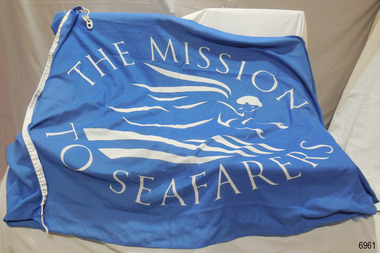
... first Secretary. Its Constitution declared: (1)) the Object is the spiritual welfare of the seafaring classes at home and abroad. (2) In pursuance of this Object, Society will use every means consistent with the principles and received practice of the Church of England. ...first Secretary. Its Constitution declared: (1)) the Object is the spiritual welfare of the seafaring classes at home and abroad. (2) In pursuance of this Object, Society will use every means consistent with the principles and received practice of the Church of England. ...The flag represents The Mission to Seafarers worldwide organisation. From about the year 2000 particular flag was once flown from Flagstaff Hill's masthead on top of the turret on the St Nicholas Seamen's Church but this practice ceased around 2010 for safety reasons. The Australian beginnings were in 1856 when the Church of England (Anglican Church) established the ‘Society for Promoting Missions to Seamen Afloat, at Home and Abroad. Lord Shaftesbury was the first President and Mr William Kingston was the first Secretary. Its Constitution declared: (1)) the Object is the spiritual welfare of the seafaring classes at home and abroad. (2) In pursuance of this Object, Society will use every means consistent with the principles and received practice of the Church of England. Mr Kingston’s wife and sister designed a flag to clearly depict the Society’s Objects. It depicted the first of the three angels in Revelation 14, who possessed ‘an eternal gospel to proclaim to those who dwell on the earth, to every nation and tribe and language and people. The ‘Flying Angel’ (the angel of Revelation) became the official logo of the Society and gained great popularity. In July 2000 the Missions to Seamen changed its name to the Mission to Seafarers to better reflect the group's function, an unbiased society that cares for all who earn their living at sea. The Logo was modernised and simplified, the word changed to 'seafarer' to be gender-neutral. The angel logo no longer holds a book (Bible). The organisation states: “The Mission to Seafarers is an Anglican organisation ... The Mission offers fellowship and a warm welcome in centres where seafarers can relax away from their ships, meet local people and contact their homes, from ports around the world. The Mission provides and promotes” … “The Mission to Seafarers now has a presence in 200 ports in 50 countries worldwide. This makes us the largest sea-port-based welfare organisation in the world. We provide support to seafarers 365 days per year, regardless of their rank, nationality, gender or religion” This flag was a gift from the Mission to Seafarers Victoria at the time of the organisation's change of name from the Missions to Seamen. It was flown from the Masthead on top of the turret on the St Nicholas Seamen's Church at Flagstaff Hill from the years 2000 to around 2010. The donation of this flag signifies the ongoing association between the historical organisation and St Nicholas Seamen's Church building at Flagstaff Hill', which displays an extensive collection of furniture and furnishings from that organisation's Williamstown branch. The design on the flag is an example of several updates of the flag over the organisation's lifetime.Flag, fine linen, The Mission to Seafarers. Rectangle of blue fabric with white text around white flying angel logo. Flag has a plastic hook on top of the halyard.Printed "THE MISSION TO SEAFARERS" and logo of FLYING ANGEL symbolflagstaff hill, warrnambool, shipwrecked coast, flagstaff hill maritime museum, maritime museum, shipwreck coast, flagstaff hill maritime village, great ocean road, missions to seamen victoria, mission to seafarers, flying angel’s club, st nicholas seaman’s church williamstown, mission to seafarers flag, flag, missions to seamen, turret -
Glenelg Shire Council Cultural Collection
Ceremonial object - Sash - Ancient Order of Foresters, n.d
... The Ancient Order of Foresters, which originated in England in the mid 1700s, established its first branch (Court) in Victoria in 1849. Foresters was set up as a non-profit organisation, the founding principles of the Society being to provide financial and social benefits as well as support to members and their families in times of unemployment, sickness, death, disability and old age. ...The Ancient Order of Foresters, which originated in England in the mid 1700s, established its first branch (Court) in Victoria in 1849. Foresters was set up as a non-profit organisation, the founding principles of the Society being to provide financial and social benefits as well as support to members and their families in times of unemployment, sickness, death, disability and old age. ...The Ancient Order of Foresters, which originated in England in the mid 1700s, established its first branch (Court) in Victoria in 1849. Foresters was set up as a non-profit organisation, the founding principles of the Society being to provide financial and social benefits as well as support to members and their families in times of unemployment, sickness, death, disability and old age. The Society is now known as the Foresters Friendly Society and in July 1999 was incorporated as a public company limited by shares and guarantee.Plain green sash, cloth, hemmed, a narrow piece of lighter green ribbon attached to one of the long sides, about a quarter of the way along. -
Glenelg Shire Council Cultural Collection
Accessory - Sash - Ancient Order of Foresters, n.d
... The Ancient Order of Foresters, which originated in England in the mid 1700s, established its first branch (Court) in Victoria in 1849. Foresters was set up as a non-profit organisation, the founding principles of the Society being to provide financial and social benefits as well as support to members and their families in times of unemployment, sickness, death, disability and old age. ...The Ancient Order of Foresters, which originated in England in the mid 1700s, established its first branch (Court) in Victoria in 1849. Foresters was set up as a non-profit organisation, the founding principles of the Society being to provide financial and social benefits as well as support to members and their families in times of unemployment, sickness, death, disability and old age. ...The Ancient Order of Foresters, which originated in England in the mid 1700s, established its first branch (Court) in Victoria in 1849. Foresters was set up as a non-profit organisation, the founding principles of the Society being to provide financial and social benefits as well as support to members and their families in times of unemployment, sickness, death, disability and old age. The Society is now known as the Foresters Friendly Society and in July 1999 was incorporated as a public company limited by shares and guarantee.Plain green sash, red fringe either end *T and a bunch of keys in gold and black, printed on to sashancient order of foresters, friendly society, sash -
Glenelg Shire Council Cultural Collection
Ceremonial object - Sash - Ancient Order of Foresters, n.d
... The Ancient Order of Foresters, which originated in England in the mid 1700s, established its first branch (Court) in Victoria in 1849. Foresters was set up as a non-profit organisation, the founding principles of the Society being to provide financial and social benefits as well as support to members and their families in times of unemployment, sickness, death, disability and old age. ...The Ancient Order of Foresters, which originated in England in the mid 1700s, established its first branch (Court) in Victoria in 1849. Foresters was set up as a non-profit organisation, the founding principles of the Society being to provide financial and social benefits as well as support to members and their families in times of unemployment, sickness, death, disability and old age. ...The Ancient Order of Foresters, which originated in England in the mid 1700s, established its first branch (Court) in Victoria in 1849. Foresters was set up as a non-profit organisation, the founding principles of the Society being to provide financial and social benefits as well as support to members and their families in times of unemployment, sickness, death, disability and old age. The Society is now known as the Foresters Friendly Society and in July 1999 was incorporated as a public company limited by shares and guarantee.Plain green sash, red fringe either end, sash in two pieces, there is also a hand-sewn seam. -
Glenelg Shire Council Cultural Collection
Book - Book - Ancient Order of Foresters (Application for Registration of the wife of a member marrying after Admission), 1960s
... The Ancient Order of Foresters, which originated in England in the mid 1700s, established its first branch (Court) in Victoria in 1849. Foresters was set up as a non-profit organisation, the founding principles of the Society being to provide financial and social benefits as well as support to members and their families in times of unemployment, sickness, death, disability and old age. ...The Ancient Order of Foresters, which originated in England in the mid 1700s, established its first branch (Court) in Victoria in 1849. Foresters was set up as a non-profit organisation, the founding principles of the Society being to provide financial and social benefits as well as support to members and their families in times of unemployment, sickness, death, disability and old age. ...The Ancient Order of Foresters, which originated in England in the mid 1700s, established its first branch (Court) in Victoria in 1849. Foresters was set up as a non-profit organisation, the founding principles of the Society being to provide financial and social benefits as well as support to members and their families in times of unemployment, sickness, death, disability and old age. The Society is now known as the Foresters Friendly Society and in July 1999 was incorporated as a public company limited by shares and guarantee.Book, hard back, red marbled covers (front cover faded), black binding, 'Ancient Order of Foresters United Melbourne District Friendly Society'. 'Application for Registration of the wife of a member marrying after Admission', black print on white label attached to front coverancient order of foresters, friendly society, membership -
Glenelg Shire Council Cultural Collection
Administrative record - Application Form - Ancient Order of Foresters Initiation as a Mortuary Benefit Member, n.d
... The Ancient Order of Foresters, which originated in England in the mid 1700s, established its first branch (Court) in Victoria in 1849. Foresters was set up as a non-profit organisation, the founding principles of the Society being to provide financial and social benefits as well as support to members and their families in times of unemployment, sickness, death, disability and old age. ...The Ancient Order of Foresters, which originated in England in the mid 1700s, established its first branch (Court) in Victoria in 1849. Foresters was set up as a non-profit organisation, the founding principles of the Society being to provide financial and social benefits as well as support to members and their families in times of unemployment, sickness, death, disability and old age. ...The Ancient Order of Foresters, which originated in England in the mid 1700s, established its first branch (Court) in Victoria in 1849. Foresters was set up as a non-profit organisation, the founding principles of the Society being to provide financial and social benefits as well as support to members and their families in times of unemployment, sickness, death, disability and old age. The Society is now known as the Foresters Friendly Society and in July 1999 was incorporated as a public company limited by shares and guarantee.Schedule K, form of application by a candidate for Initiation as a Mortuary Benefit Member. -
Glenelg Shire Council Cultural Collection
Ceremonial object - Sash - Ancient Order of Foresters, n.d
... The Ancient Order of Foresters, which originated in England in the mid 1700s, established its first branch (Court) in Victoria in 1849. Foresters was set up as a non-profit organisation, the founding principles of the Society being to provide financial and social benefits as well as support to members and their families in times of unemployment, sickness, death, disability and old age. ...The Ancient Order of Foresters, which originated in England in the mid 1700s, established its first branch (Court) in Victoria in 1849. Foresters was set up as a non-profit organisation, the founding principles of the Society being to provide financial and social benefits as well as support to members and their families in times of unemployment, sickness, death, disability and old age. ...The Ancient Order of Foresters, which originated in England in the mid 1700s, established its first branch (Court) in Victoria in 1849. Foresters was set up as a non-profit organisation, the founding principles of the Society being to provide financial and social benefits as well as support to members and their families in times of unemployment, sickness, death, disability and old age. The Society is now known as the Foresters Friendly Society and in July 1999 was incorporated as a public company limited by shares and guarantee.Plain green sash, red fringe at either end. *S embroidered in yellow. Remains of red ribbon attached to one, about 1/4 of the way along it. -
Glenelg Shire Council Cultural Collection
Administrative record - Minutes - Quarterly Meeting of the Ancient Order of Foresters 1903, Observer office Portland, Oct-03
... The Ancient Order of Foresters, which originated in England in the mid 1700s, established its first branch (Court) in Victoria in 1849. Foresters was set up as a non-profit organisation, the founding principles of the Society being to provide financial and social benefits as well as support to members and their families in times of unemployment, sickness, death, disability and old age. ...The Ancient Order of Foresters, which originated in England in the mid 1700s, established its first branch (Court) in Victoria in 1849. Foresters was set up as a non-profit organisation, the founding principles of the Society being to provide financial and social benefits as well as support to members and their families in times of unemployment, sickness, death, disability and old age. ...The Ancient Order of Foresters, which originated in England in the mid 1700s, established its first branch (Court) in Victoria in 1849. Foresters was set up as a non-profit organisation, the founding principles of the Society being to provide financial and social benefits as well as support to members and their families in times of unemployment, sickness, death, disability and old age. The Society is now known as the Foresters Friendly Society and in July 1999 was incorporated as a public company limited by shares and guarantee.Minutes of Quarterly Meeting of the Ancient Order of Foresters, held at Foresters Hall, Portland, Thursday Oct 22 1903. 8 pages, white paper, black print. -
Glenelg Shire Council Cultural Collection
Administrative record - Minutes of Quarterly Meeting of the Ancient Order of Foresters Society 1904, Oct-04
... The Ancient Order of Foresters, which originated in England in the mid 1700s, established its first branch (Court) in Victoria in 1849. Foresters was set up as a non-profit organisation, the founding principles of the Society being to provide financial and social benefits as well as support to members and their families in times of unemployment, sickness, death, disability and old age. ...The Ancient Order of Foresters, which originated in England in the mid 1700s, established its first branch (Court) in Victoria in 1849. Foresters was set up as a non-profit organisation, the founding principles of the Society being to provide financial and social benefits as well as support to members and their families in times of unemployment, sickness, death, disability and old age. ...The Ancient Order of Foresters, which originated in England in the mid 1700s, established its first branch (Court) in Victoria in 1849. Foresters was set up as a non-profit organisation, the founding principles of the Society being to provide financial and social benefits as well as support to members and their families in times of unemployment, sickness, death, disability and old age. The Society is now known as the Foresters Friendly Society and in July 1999 was incorporated as a public company limited by shares and guarantee.Minutes of Quarterly Meeting of the Ancient Order of Foresters Society, held at Foresters Hall Portland on Thursday Oct 27 1904. 8 pages, white paper, black print. -
Glenelg Shire Council Cultural Collection
Administrative record - Letter - Apology for non-attendance at a meeting Ancient Order of Foresters Society, 17/11/1908
... The Ancient Order of Foresters, which originated in England in the mid 1700s, established its first branch (Court) in Victoria in 1849. Foresters was set up as a non-profit organisation, the founding principles of the Society being to provide financial and social benefits as well as support to members and their families in times of unemployment, sickness, death, disability and old age. ...The Ancient Order of Foresters, which originated in England in the mid 1700s, established its first branch (Court) in Victoria in 1849. Foresters was set up as a non-profit organisation, the founding principles of the Society being to provide financial and social benefits as well as support to members and their families in times of unemployment, sickness, death, disability and old age. ...The Ancient Order of Foresters, which originated in England in the mid 1700s, established its first branch (Court) in Victoria in 1849. Foresters was set up as a non-profit organisation, the founding principles of the Society being to provide financial and social benefits as well as support to members and their families in times of unemployment, sickness, death, disability and old age. The Society is now known as the Foresters Friendly Society and in July 1999 was incorporated as a public company limited by shares and guarantee.Letter of apology for non-attendance at a meeting for Ancient Order of Foresters Society. Hand written, pencil on white lined paper, from John Beg to Court Prosperity.
