
Showing 11 items matching "flame tree"
-
 Stawell Historical Society Inc
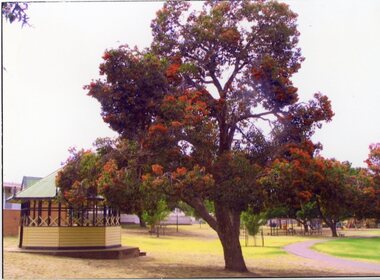
Photograph, Cato Park Flame Tree playground c 1995 -- 2 Photos -- Coloured
... Cato Park Flame Tree playground c 1995 -- 2 Photos -- Coloured...2 Colour Photos Gateway, Flame Tree and Playground in Cato lake c 1985. ...The flame tree in 67.18 shows the flame tree in flower beside the rotunda. ...2 Colour Photos Gateway, Flame Tree and Playground in Cato lake c 1985. ...2 Colour Photos Gateway, Flame Tree and Playground in Cato lake c 1985. This area was once the gateway to Cato lake but later moved. Both photos are near the lake as can be seen in 67.18a which has a view of the playground in the distance.Two colour photographs, one of the Gateway flame tree. the other a view of the edge of the lake with the playground in the distance. The flame tree in 67.18 shows the flame tree in flower beside the rotunda. The other photo 67.8a is a view of the edge of Cato lake with the playground in the background behind a group of trees. stawell -
 Federation University Art Collection
Painting - acrylic and gold leaf on canvas, Pauline O'Shannessy-Dowling, 'Flame Tree' by Pauline O'Shannessy-Dowling, 2005
... 'Flame Tree' by Pauline O'Shannessy-Dowling...The Art Collection features over 1000 works and was listed as a 'Ballarat Treasure' in 2007. art artwork pauline o'shannessy-dowling TAFE Business Collection landscame trees available 'Flame Tree' by Pauline O'Shannessy-Dowling Painting acrylic and gold leaf on canvas Pauline O'Shannessy-Dowling ...This item is part of the Federation University Art Collection. The Art Collection features over 1000 works and was listed as a 'Ballarat Treasure' in 2007.art, artwork, pauline o'shannessy-dowling, tafe business collection, landscame, trees, available -
 Federation University Art Collection
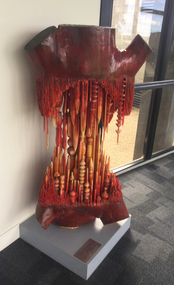
Sculpture, Judith Neuwiller, 'Flame Tree' by Judith Neuwiller, 1996
... 'Flame Tree' by Judith Neuwiller...Victorian College of the Arts in 1988. gippsland campus churchill judith neuwiller alumni sculpture GCAD Gippsland Centre of Art and Design Painted timber sculpture. 'Flame Tree' by Judith Neuwiller Sculpture Judith Neuwiller ...Judith NEUWILLER (later Judith AMBrOSE) Judith Neuwiller graduated with a Bachelor of Art (Visual Art), and Graduate Diploma of Visual Arts at the Gippsland Centre of Art and Design in 1987, and a Post Graduate Diploma of Fine Art. Victorian College of the Arts in 1988. Painted timber sculpture.gippsland campus, churchill, judith neuwiller, alumni, sculpture, gcad, gippsland centre of art and design -
 Emerald Museum & Nobelius Heritage Park
Drawing - Coloured pencil drawing by Kay Craig, Kay Craig, Brachychiton acerifolius, Circa 2012
... ...flame tree...Coloured pencil drawing detailing leaf and flower of Brachychiton acerifolius 'Flame Tree', mounted and and protected for display...The drawings of the exhibition were all drawn by members of the Emerald U3A. coloured pencil drawing painting U3A emerald museum Brachychiton acerifolius flame tree nobelius labelled front “3 Kay Craig” , Kay Craig business card attached to rear Coloured pencil drawing detailing leaf and flower of Brachychiton acerifolius 'Flame Tree', mounted and and protected for display Brachychiton acerifolius Drawing Coloured pencil drawing by Kay Craig Kay Craig ...Part of the Botanical Art Exhibition held at the Emerald Museum by Emerald U3A Botanical Artists, featuring trees and shrubs of the Nobelius Heritage Park circa October 2012.The object is artistic, historic and socially significant as it was part of the 2012 Botanical Art Exhibition held at the Emerald Museum circa October 2012. The exhibition featured trees and shrubs of the Nobelius nursery which was opened by the 'renowned botanical artist' Kay Craig. The drawings of the exhibition were all drawn by members of the Emerald U3A.Coloured pencil drawing detailing leaf and flower of Brachychiton acerifolius 'Flame Tree', mounted and and protected for displaylabelled front “3 Kay Craig” , Kay Craig business card attached to rearcoloured pencil, drawing, painting, u3a, emerald, museum, brachychiton, acerifolius, flame tree, nobelius -
 Department of Energy, Environment and Climate Action
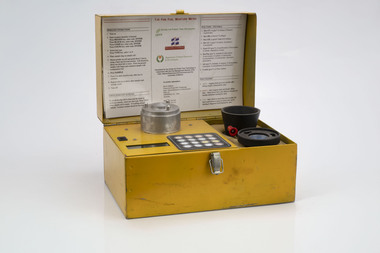
Prototype fuel moisture meter
... Fibrous and ribbon bark, together with elevated and near-surface scrub fuels act as ladders which lead flames into the tree canopy. But the availability of fuel to burn depends largely on its moisture content. ...Fibrous and ribbon bark, together with elevated and near-surface scrub fuels act as ladders which lead flames into the tree canopy. But the availability of fuel to burn depends largely on its moisture content. ...Bushfire behaviour is influenced by many things including temperature, relative humidity, forest type, fuel quantity and fuel dryness, topography and even slope. Wind has a dominant effect on the Rate of Spread (ROS), and also bushfire size, shape and direction. Fuel arrangement is as important as fuel quantity (tonnes/ha). Fibrous and ribbon bark, together with elevated and near-surface scrub fuels act as ladders which lead flames into the tree canopy. But the availability of fuel to burn depends largely on its moisture content. When it exceeds 20-25% not much will burn, whereas 12-15% is generally ideal for fuel reduction burning, but if the moisture content drops as low as 7-10% virtually everything will ignite, and fire behaviour becomes extreme. During the afternoon of the Ash Wednesday bushfires on 16 February 1983 fuel moisture contents were recorded at Stawell as low as 2.7%. Fine fuels like leaves and bark can rapidly absorb moisture after a shower of rain, or from the air when the Relative Humidity (RH) is high, and the temperature is low. Conversely, they can also dry out very quickly. So even though the overall fuel quantity in the forest doesn’t change, the fine fuel availability can increase rapidly from zero after rain to many tonnes per hectare as the fuel dries out. This can happen over a few hours on hot and windy days. Heavy fuels like logs on the ground take longer to dry out. Since the 1930s foresters, firefighters and researchers have been working to develop quick and reliable techniques for measuring fuel moisture content. One of the most accurate methods is slowly drying a sample of fuel in a conventional oven for 24-48 hours to remove all the moisture and measuring the weight difference, but this takes time and is not practical in the field when rapid measurements are needed. But oven drying is often used as a benchmark to compare other methods. Microwave ovens are faster but can cause uneven drying and even char the fuel. They are also not very practical for use in the field. Some mathematical models rely on weather records such as rainfall, wind speed, evaporation, cloud cover, shading, relative humidity, slope, aspect and season of the year to predict soil and fuel moisture. The Keetch-Byram Drought Index of soil dryness is the most common. But complex fuels with leaves, twigs, grass etc make the predictive models often inadequate for fine fuels. The most common technique in Victorian forests until recently was the trusty Speedy Moisture Meter. Originally developed in England during the 1920s for measuring moisture in wheat and other grains it was adapted for Australian forest fuels in the 1950s (I think). Fuel was first ground using a Spong mincer, often attached to the bullbar of a vehicle, and a small sample placed into the Speedy together with a measure of calcium carbide and then sealed. A chemical reaction created gas pressure which was read on the external dial. There were important techniques with cleaning, mincing and using the chemicals with the Speedy to give reliable readings, but it was quick, inexpensive, robust, portable and practical in the field. It was used routinely before igniting a fuel reduction burn or measuring fuel moisture differentials on slash burns. But in about 1996, Karen Chatto and Kevin Tolhurst from the Department’s Creswick Research Station developed the Wiltronics Fuel Moisture meter which measured electrical resistance. Wiltronics is an Australian owned company operating from Ballarat. The final result was a kit that was portable, accurate and could reliably measure fuel moisture contents between 3% and 200%. Although expensive, it is now widely used by fire agencies around the world which has virtually relegated the Speedy to the back cupboard.Prototype Fuel moisture meterT-H Fine Fuel Meterforests commission victoria (fcv), bushfire, forest measurement -
 Eltham District Historical Society Inc
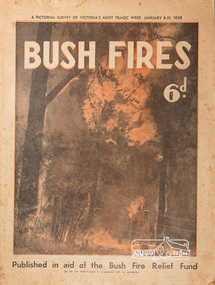
Magazine, Sun News-Pictorial, Bush Fires: A pictorial survey of Victoria's most tragic week, January 8-15, 1939, 1939
... Healewille. with flames visible from the town at one stage, was in a trough between two fires which burned four guest-houses, seven homes and left its surrounding beauty-spots wastes of bowed-over, blackened tree-fern fronds; with its famous Sanctuary, however, intact. ...Healewille. with flames visible from the town at one stage, was in a trough between two fires which burned four guest-houses, seven homes and left its surrounding beauty-spots wastes of bowed-over, blackened tree-fern fronds; with its famous Sanctuary, however, intact. ...THE WEEK REVIEWED (Article; Bush Fires: A pictorial survey of Victoria's most tragic week, January 8-15, 1939. Published in aid of the Bush Fire Relief Fund by the Sun News-Pictorial in co-operation with its newsagents, pp2-3) THE fiercest bush fires Australia has known since its discovery are quiescent at the moment, and Victoria, in the comparative coolness of the change which came with rain on Sunday night, has begun·to count its losses. In the fiery eight days, from Sunday to Sunday, at least sixty-six men, women and children have lost their lives in forest fires, or have succumbed to burns and shock; many others have died from heat; and several serious cases of burns are being treated in hospitals. Two babies in Narrandera district have died, and ten others are in hospital, because of milk soured by the record temperatures of those eight days. Forest damage totals at least a million pounds, and incalculable damage has been done to the seedlings which were to have been the forests of the future. Water conservation will be seriously affected by the silting-up of reservoirs and streams from which protective timber has been taken by the all-engulfing flames. More than a thousand houses have been destroyed, and these, with 40 mills, and schools, post-offices, churches, and other buildings, represent a loss of at least half a million. At least 1500 are homeless. For their aid, money raised in appeals has now passed the £50,000 mark, and the biggest relief organisation ever set up in peace time has swung into operation. The First Hint Victoria's first hint of what was to come appeared on Sunday, January 8, when most parts of the State awoke to find a blistering day awaiting. At 12.20 p.m., when the thermometer reached its highest for the day, 109.6 degrees, the first fire victims were at that moment going to their death on a bush track five feet wide off the main road to Narbethong. They were the forestry officers Charles Isaac Demby and John Hartley Barling, who went to warn Demby of his danger when he parted from his companions, and was himself surrounded by the treacherous fire. It was not until 8 o'clock next morning that the tragic news was flashed throughout the State. Searchers found the two charred bodies close together, one seeking protection in the nook of two logs. Barling's watch had stopped at 1.20. In the meantime, tragedy was spreading its cloak. By Monday, big fires were raging at Toolangi, Erica, Yallourn, Monbulk, Frankston, Dromana, Drouin South, Glenburn, and Blackwood, with smaller outbreaks at many other centres. In the ensuing week, while women and children were evacuated as fast as the flames would permit, Erica-scene of the 1926 fire disaster-thrice escaped doom by a change of wind. Indeed, those who have been in the fire country these past days say that the numbers of times a change of wind has saved towns from destruction is amazing. In the towns they speak of miracles. Monday's Miracles The escapes from Monett's Mill at Erica and from the Hardwood Company's Mill at Murrindindi, near where Demby and Barling went to their death, were Monday's miracles. Twenty came out alive from each mill. At the first a 60ft. dugout provided an oven-like refuge; at the second, 12 women and children survived in the smoke-filled gloom of a three-roomed cottage while their eight men, their clothes sometimes afire, poured water on the wooden walls. Three houses out of ten remained when the fire had passed. Record Temperatures Sunday had been the hottest Melbourne day for 33 years; Monday dropped to a 76.1 degree maximum; but Tuesday dawned hotter than ever, the mercury reaching 112.5. By now rumor was racing ahead of fact; whole towns were being reported lost; the alarm was raised for scores of missing persons. But fact soon overtook rumor, and within a few days the staggering toll began to mount to a figure beyond the wildest imaginings of the panic-stricken. Six died from heat on this torrid Tuesday, and the fires spread in a wide swathe from south-west to north-east across the State. Fish died in shallow streams. A curtain of smoke hid the sky from all Victoria, and hung far out to sea. It alarmed passengers on ships. On the Ormonde, on the voyage to Sydney from Burnie, women ran on deck, believing fire had broken out in the hold. Days later the smoke reached New Zealand. In Melbourne thousands of fire-volunteers were leaving in cars: vans, motor-buses-anything reliable on wheels-to aid the country in its grim fight. In the fires at Rubicon and. Narbethong, seventeen were facing death this day. But not till Wednesday, when Melbourne breathed again in a cool change, while the country still sweltered in temperatures up to 117 degrees, did the news come through the tree blocked roads. A woman and her little daughter, trapped on the road, were among those who died. Their bodies, and those of menfolk with them, were found strewn out at intervals along the road, where the furnace of the surrounding fire had dropped them in their tracks as they ran. Twelve died at a Rubicon mill, five on the road at Narbethong. At Alexandra, not far distant, a baby was born while the fires raged, and stretcher-bearers brought in the injured. On Thursday the State Government voted £5000 for the relief of fire victims. The Governor (Lord Huntingfield) and the Lord Mayor (Cr. Coles) visited some of the stricken areas, and dipped into their pockets personally. Later, the City Council, too, voted £5000. Friday, The 13th Friday, the Thirteenth, justified its evil name. A blistering northerly came early in the morning, presaging destruction, and forcing the mercury to a new record of 114 degrees. Racing fires killed at least ten in those terrible 12 hours. Four children were engulfed in the furnace at Colac. Panic drove them, uncontrollable, into the smoke-filled road when the fire raced down behind their home. They choked to death. In other parts fires were joining to make fronts of scores of miles. Kinglake was being menaced on two fronts, £60,000 worth of timber was going up in smoke in Ballarat district. Warburton was surrounded. Residents at Lorne, favoured resort, were being driven to the sea-front by a fire which destroyed at least 20 homes. Healewille. with flames visible from the town at one stage, was in a trough between two fires which burned four guest-houses, seven homes and left its surrounding beauty-spots wastes of bowed-over, blackened tree-fern fronds; with its famous Sanctuary, however, intact. Most of Omeo was destroyed this black day: Noojee. while 200 residents crouched in the river, was being reduced to a waste of buckled iron and smoking timber; Erica was once again saved by a change of wind. Beneath a pall of smoke, the Rubicon victims were buried at Alexandra. Friday night and the early hours of Saturday saw the streets of beleagured towns strewn with exhausted fire-fighters. Their flails beside them, ready for the next call, they lay where exhaustion overtook them-on footpaths, beside lamp-posts, in gutters, in cars, under trucks. Saturday's dawn brought clear skies and lower temperatures in many parts, and from the burnt-out areas came a great rush of tragic reports. The death-roll rushed past the fifty mark with incredible speed. Some had been trapped on roads, others at mills; some, after burying their treasures, had clung too long to the places they had made their homes for many years. Four men lost their lives because one went back for his dog. By Sunday, when the first of the saving rain came, nearly another score of names had been added to the list.Newspaper magazine, 48 pages (incl. covers). Fully digitised and searchable PDFPublished in aid of the Bush Fire Relief Fund by the Sun News-Pictorial in co-operation with its newsagents.bushfires, 1939 bushfires, black friday, warrandyte -
Bendigo Historical Society Inc.
Document - Forests Commission of Victoria Northern Area Fire Protection Policy, Statement, Future Bush Fire Policy, Plan for Fire Control, 1938-1939
... Flames leaped large distances, and giant trees were blown out of the ground by fierce winds. ...Flames leaped large distances, and giant trees were blown out of the ground by fierce winds. ...Fanned by powerful winds, the Black Friday fires (13 January 1939) swept rapidly across large areas of Victoria, causing widespread destruction. Flames leaped large distances, and giant trees were blown out of the ground by fierce winds. Large pieces of burning bark (embers) were carried for kilometres, starting new fires in places that had not previously been affected by flames. Almost two million hectares burned across the state. Large areas of state forest, containing giant stands of Mountain Ash and other valuable timbers, were destroyed. As a result, approximately 575,000 hectares of reserved forest and 780,000 hectares of Crown land burned.Four Files Forests Commission of Victoria Northern Area Report on the 1938-39 Fire Season; and the Fire Protection Policy in Respect of Field activities Prior to the Incidence of the 1939 Fires. history, bendigo, forests commision of victoria, 1939 bush fires -
 Bendigo Historical Society Inc.
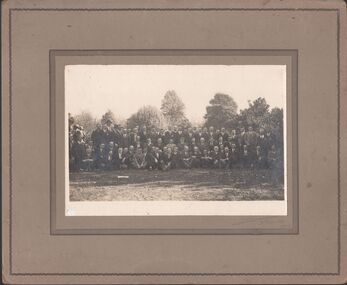
Photograph - Jack Lockett Collection: Photo of the 38th Battalion Reunion
... The 2000 Olympic flame was relayed from Olympia in Greece to Sydney by 13400 carriers including 11000 Australians, each carrier had their torch Jack Lockett Mabel Ingwersen 38th Battalion D Company Reunion A black and white photograph on a grey cardboard mount. Sixty-three men all but one dressed in suits, trees ...John Henry Lockett OAM (22 January 1891 – 25 May 2002) was the oldest man ever in Australia when he died aged 111 years, 123 days. As one of the last surviving veterans of World War I, he was acclaimed as a national hero during the last decade of his life. Lockett was born in the small Victorian town of Waanyarra, near Bendigo. He left school aged nine to work on a local farm. Later, he worked for his uncles in the Mallee. On 24 March 1916, he travelled to Mildura to enlist in the Australian Imperial Force. He served in France with the 38th Battalion, earning promotion to sergeant and was discharged on 20 September 1919. https://en.wikipedia.org/wiki/Jack_Lockett After the war, Jack returned to The Mallee and selected a 640 acres (260 ha) block of land in Linga, Victoria, deciding to make his living as a farmer. In 1923, he married Maybell Ingwerson and they had four children together. In 1963, the couple retired to Bendigo, leaving the farmland (which now covered more than 130,000 acres (53,000 ha), in the care of their children and grandchildren . The 2000 Olympic flame was relayed from Olympia in Greece to Sydney by 13400 carriers including 11000 Australians, each carrier had their torch A black and white photograph on a grey cardboard mount. Sixty-three men all but one dressed in suits, trees in the background and bare ground in the foreground. Twenty-nine in the back row, 11 sitting in the middle row with one man in centre in an Army Officer's uniform and 23 sitting on ground in the front row. Black hand-righting at the top on the back of the photo Reunion of 38th Batt NO 1194 D Company Jack Lockett RH Charlie Kemp 3rd FROM RIGHT CENTRE ROW Black print on white paper attached to the bottom of the back of the photo Reunion of the 38th Battalion No 1194 D Company Jack Lockett is 3rd from the right, centre row jack lockett, mabel ingwersen, 38th battalion d company reunion -
 Bendigo Historical Society Inc.
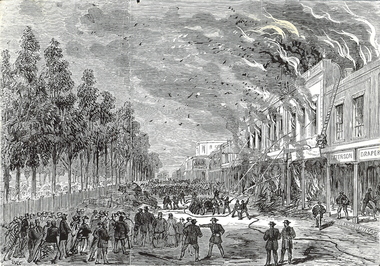
Photograph - BEEHIVE FIRE 1871, 25.8.1871
... black and white drawing (photo of same) Beehive Fire, crowd and firefighters in Pall Mall with flames appearing from ground floor and first floor of building. Adjacent shop 9 foreground N Knight, Paterson, Drapers, trees and fence bordering opposite side of road. ...PLACE Arcade beehive black and white drawing (photo of same) Beehive Fire, crowd and firefighters in Pall Mall with flames appearing from ground floor and first floor of building. Adjacent shop 9 foreground N Knight, Paterson, Drapers, trees and fence bordering opposite side of road. ...black and white drawing (photo of same) Beehive Fire, crowd and firefighters in Pall Mall with flames appearing from ground floor and first floor of building. Adjacent shop 9 foreground N Knight, Paterson, Drapers, trees and fence bordering opposite side of road. On back page no. 7 'Beehive Fire 25.8.1871'. Initials ORC bottom left cornerplace, arcade, beehive -
 Nillumbik Shire Council
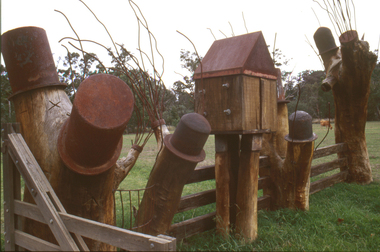
Sculpture: Tony Trembath (b.1946 Sale, Victoria), Tony Trembath, The Fences Act 1968 - Location: Edendale Farm (entrance) 30 Gastons Road, Eltham, 1989 - 1994
... tree trunks fitted with metal caps (chrome-nickel 'salt pots' that are shaped like tall bowler / top hats). Metal rods protrude from the trunks and some of these rods have metal birds. Two larger, sentinel-like stumps at the two outer ends have metal flame...tree trunks fitted with metal caps (chrome-nickel 'salt pots' that are shaped like tall bowler / top hats). Metal rods protrude from the trunks and some of these rods have metal birds. Two larger, sentinel-like stumps at the two outer ends have metal flame ...Eltham Council (now the Shire of Nillumbik) commissioned this work in 1989 to create an entrance / gateway to Edendale Community Farm. It was also aided by a grant from the Ministry of the Arts (now Arts Victoria). The former name of this work was "Gateway to Edendale Farm". Edendale Farm is a demonstration farm modelling sustainable environmental practices, providing support to the local residents of Nillumbik. Established in 1986, the land was purchased in 1970. It was previously an English gentleman's residence and was used for grazing. It consists of 5.6 hectares, with the Diamond Creek meandering through the property. The Victorian Fences Act 1968 governs liability of occupiers of adjoining lands to fence, and deals with disputes between neighbours regarding boundaries fences and costs. This work took into consideration ideas and suggestions from residents and committees, who required the use of recycled materials and that the work celebrate man's relationship with nature, animals and the earth, as well as relate to the fence-line on the far side of the carpark. Trembath also absorbed significant aspects of local history, making references to Eltham's agricultural past, the clearing of the land, the destruction of trees, the ruthless pruning of trees by suburban Councils and incorporated such Australian features as the post and rail fence. 'The Fences Act 1968' is significant for aesthetic, historic and social reasons at a regional level. It makes prominent the historical and social significance of Edendale and the rural aspects of Nillumbik. The use of existing tree stumps and salt pots in the work explores the iconography of the countryside such as the isolated farmhouse, pioneering farming practices, post and rail fencing and the regrowth of lopped trees. The title of the work, as well as the extensive community involvement in its creation, also makes reference to the Victorian Fences Act 1968, which makes neighbours jointly responsible for the cost of construction and maintenance of fences in the partitioning of land for settlement. 'The Fences Act 1968' has been classified as of regional significance by the National Trust of Australia. The work is an installation of wood and metal, approximately twenty five meters long. The design is very informal and rustic and runs the full width of the fence-line. It comprises groups of recycled tree trunks fitted with metal caps (chrome-nickel 'salt pots' that are shaped like tall bowler / top hats). Metal rods protrude from the trunks and some of these rods have metal birds. Two larger, sentinel-like stumps at the two outer ends have metal flame-like wings, which bend inward. To the left of the entrance, a simple architectural element indicates an isolated farmhouse. The rustic fence runs between the groups of tree trunks with native planting in clumps along it. The fence-line incorporates a functional engineered double gate and post and rail fencing. There may be many interpretations of the work and the intention is to stimulate interest and imagination rather than alienate. Interpretation is based on the personal experience that a visitor brings. The artist recommended that no explanation of the design logic be positioned with the work. N/Apublic art, sculpture, edendale, recycled, wood, metal, fences act 1968, gate, trembath, salt pot, tree stumps -
 Sunbury Family History and Heritage Society Inc.
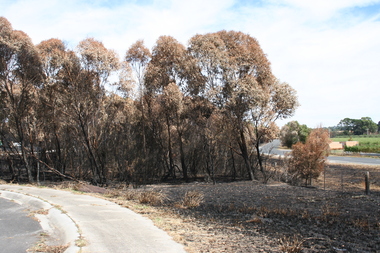
Photograph, Rosa McCall, February 2014
... The cluster of trees beside the Calder Highway, north of Sunbury, was burnt in February 2014 when a grassfire started along the road and a severe wind change from the south took the flames across the dry countryside beyond Riddells Creek and beyond Clarkefield. ...The cluster of trees beside the Calder Highway, north of Sunbury, was burnt in February 2014 when a grassfire started along the road and a severe wind change from the south took the flames across the dry countryside beyond Riddells Creek and beyond Clarkefield. ...The cluster of trees beside the Calder Highway, north of Sunbury, was burnt in February 2014 when a grassfire started along the road and a severe wind change from the south took the flames across the dry countryside beyond Riddells Creek and beyond Clarkefield. The Bendigo rail line was damaged resulting in it being closed for repairs. This was one of the many fires experienced over that hot summer when the countryside was parched.A coloured digital photograph of a cluster of burnt trees by a roadsidegrassfires, calder highway, riddells creek
