
Showing 15 items matching "flax growing"
-
 Emerald Museum & Nobelius Heritage Park
Book - History Book, M. Donaghy & Sons Pty. Ltd, One Hundred Years of Rope Making: a Story of Pioneering Achievement 1852-1952, 1952
... ...flax growing...Donaghy & Sons for manufacture of rope and twine, which Nobelius then bought back for use in his nursery. nurseries (plants) flax growing Carl Axel Nobelius Nobelius Nursery Gembrook Nurseries M. ...Tells the story of rope manufacture by M. Donaghy & Sons Pty Ltd, Geelong, one of two major manufacturers of rope and twine. The book was owned by Nobelius Nursery. C.A. Nobelius established a plantation of flax (phormium tenax) in the Emerald Lake Park area. A flax mill was situated near a dam (the present lake) for processing the flax. The processed flax was sent to M. Donaghy & Sons for manufacture of rope and twine, which Nobelius then bought back for use in his nursery.Soft cover, 53p.: ill.;nurseries (plants), flax growing, carl axel nobelius, nobelius nursery, gembrook nurseries, m. donaghy & sons pty ltd -
Emerald Museum & Nobelius Heritage Park
Audio - Audiotape interview of Herb Sherriff, Herb Sherriff, 10/08/1999 12:00:00 AM
... ...flax growing...Emerald Victoria Australia flax growing sherriff Emerald Flax Emerald Lake Oral history tape including information about Emerald Flax and Emerald Lake Audio Audiotape interview of Herb Sherriff Herb Sherriff ...Oral history tape including information about Emerald Flax and Emerald Lakeemerald, victoria, australia, flax growing, sherriff, emerald flax, emerald lake -
Emerald Museum & Nobelius Heritage Park
Tool - Scythe
... ...flax growing...Owned and used by the Charman family Emerald Victoria Australia horticulture nurseries (plants) flax growing Nobelius Nursery Charman Wooden handled metal scythe, outer side of blade has been painted redMetal|Wood Tool Scythe ...Owned and used by the Charman familyWooden handled metal scythe, outer side of blade has been painted redMetal|Woodemerald, victoria, australia, horticulture, nurseries (plants), flax growing, nobelius nursery, charman -
Emerald Museum & Nobelius Heritage Park
Equipment - Rope, Nobelius, early 1900s
... ...flax growing...Emerald Victoria Australia flax growing nurseries (plants) Nobelius Nursery Plaited rope made of flax Equipment Rope Nobelius ...Made from New Zealand flax grown by Nobelius - sent to Melbourne for manufacture.Plaited rope made of flaxemerald, victoria, australia, flax growing, nurseries (plants), nobelius nursery -
 Ithacan Historical Society
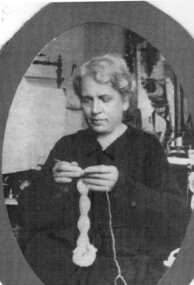
Photograph, Vasiliki Raftopoulos, c1930s
... As a child while growing up in the Romanian village of Brila, Toula also learned sewing and developed her skills making lace and embroidering items for her trousseau. Some of the linen she embroidered had been woven from flax...As a child while growing up in the Romanian village of Brila, Toula also learned sewing and developed her skills making lace and embroidering items for her trousseau. Some of the linen she embroidered had been woven from flax ...Vasiliki Raftopoulosi is pictured crocheting a very fine border in a traditional design. Vasiliki was the mother of Efstathia (Toula) Mavrokefalos (Black) and the grandmother of Nina and Olga Black, both well known in Melbourne's Greek community for their contribution to Greek language and culture. Vasiliki and her family left Ithaca for Romania when Toula was only six months old. As a child while growing up in the Romanian village of Brila, Toula also learned sewing and developed her skills making lace and embroidering items for her trousseau. Some of the linen she embroidered had been woven from flax on Ithaca by her own grandmother. On a visit to Ithaca Toula happened to be on the island at the very time that Constantine arrived, fresh from the war. Like many Ithacans Constantine had returned to Greece from Australia for the Balkan wars. Within three weeks they were married, and when Constantine returned to Melbourne in 1914 his new bride came with him. Many Greek women were skilled in the making of fine lace and crochet articles which they used and displayed in their homes. Finely stitched and woven linen items were an essential part of a young woman's dowry when she married.A black and white photograph in an oval frame of a lady crocheting a lace band. -
 Brighton Historical Society
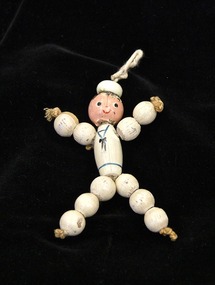
Doll, Bead doll, c.1937
... growing up in the Romanian village of Brila. She developed her skills making lace and embroidering items for her trousseau. Some of the linen she embroidered had been woven from flax on Ithaca by her own grandmother, Efstathia. ...growing up in the Romanian village of Brila. She developed her skills making lace and embroidering items for her trousseau. Some of the linen she embroidered had been woven from flax on Ithaca by her own grandmother, Efstathia. ...Made by the cousin of Brighton local Olga Black. The cousin gave her the doll in 1937, when Olga was around seven years old. Olga Maria Black was born in Melbourne in 1930, the daughter of Ithacan migrants Constantine and Toula Mavrokefalos. Constantine first emigrated to Australia in 1902, returning to Greece circa 1912-13 to serve his home country in the Balkan Wars. Toula's family had left Ithaca for Romania when she was only six months old, but she happened to be visiting the island at the very time that Constantine arrived, fresh from the war. Within three weeks they were married, and when Constantine returned to Melbourne in 1914 his new bride came with him. Constantine had trained as an accountant, but his qualifications were not recognised in Australia. Changing his surname to the Anglicised "Black", he started off working in his older brother Dionysios's cafés before going into business on his own. In 1917 he opened the Paris Residential Café at 54-56 Swanston Street, which offered both dining and accommodation. The business saw some years of success, but did not survive the Great Depression. Constantine died in 1944. Olga's mother Toula learned to sew as a child, while growing up in the Romanian village of Brila. She developed her skills making lace and embroidering items for her trousseau. Some of the linen she embroidered had been woven from flax on Ithaca by her own grandmother, Efstathia. During the Depression, when money was scarce, Toula embroidered at home, doing work for a factory in Flinders Lane. Using a cotton reel, a threepence and a sixpence she created and embroidered designs on hundreds of blouses. Olga spent her preschool days sitting at the table where her mother worked. Toula would involve Olga by allowing her to help choose the colour combinations. Toula lived with Olga in Brighton until her death in 1976. Olga inherited her mother's sewing skills. She re-invented some of Toula’s trousseau nightdresses and skilfully altered other clothing, making dresses which she wore around Brighton for many years.Handmade painted wooden bead doll representing a sailor. Cream coloured body and limbs and pink head. The body is made from one long oval bead and the limbs from small round beads.doll, child's toy, childhood, sailor, olga black -
 Brighton Historical Society
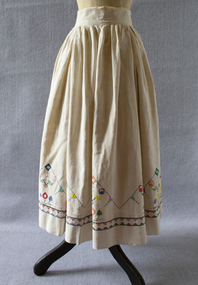
Skirt, late-nineteenth century & 1950s
... growing up in the Romanian village of Brila. She developed her skills making lace and embroidering items for her trousseau. Some of the linen she embroidered had been woven from flax on Ithaca by her own grandmother, Efstathia. ...growing up in the Romanian village of Brila. She developed her skills making lace and embroidering items for her trousseau. Some of the linen she embroidered had been woven from flax on Ithaca by her own grandmother, Efstathia. ...This skirt belonged to Olga Black, a long-time Brighton resident. The linen used for the skirt were woven by Olga's great-grandmother Efstathia in the late-nineteenth century with flax grown on the island of Ithaca. In the 1950s, Olga made the fabric into a skirt, embellishing it with hand embroidery. Olga Maria Black was born in Melbourne in 1930, the daughter of Ithacan migrants Constantine and Toula Mavrokefalos. Constantine first emigrated to Australia in 1902, returning to Greece circa 1912-13 to serve his home country in the Balkan Wars. Toula's family had left Ithaca for Romania when she was only six months old, but she happened to be visiting the island at the very time that Constantine arrived, fresh from the war. Within three weeks they were married, and when Constantine returned to Melbourne in 1914 his new bride came with him. Constantine had trained as an accountant, but his qualifications were not recognised in Australia. Changing his surname to the Anglicised "Black", he started off working in his older brother Dionysios's cafés before going into business on his own. In 1917 he opened the Paris Residential Café at 54-56 Swanston Street, which offered both dining and accommodation. The business saw some years of success, but did not survive the Great Depression. Constantine died in 1944. Olga's mother Toula learned to sew as a child, while growing up in the Romanian village of Brila. She developed her skills making lace and embroidering items for her trousseau. Some of the linen she embroidered had been woven from flax on Ithaca by her own grandmother, Efstathia. During the Depression, when money was scarce, Toula embroidered at home, doing work for a factory in Flinders Lane. Using a cotton reel, a threepence and a sixpence she created and embroidered designs on hundreds of blouses. Olga spent her preschool days sitting at the table where her mother worked. Toula would involve Olga by allowing her to help choose the colour combinations. Toula lived with Olga in Brighton until her death in 1976. Olga inherited her mother's sewing skills. She re-invented some of Toula’s trousseau nightdresses and skilfully altered other clothing, making dresses which she wore around Brighton for many years.Ankle-length full cream linen skirt with multi-coloured cross stitch embroidery featuring mountains, birds and trees. Fullness is pleated into wide waist band. Left side opening. The fabric widths have been whipped together by hand probably at the time the cloth was woven in the late-nineteenth century. The skirt is machine stitched.skirt, linen, hand woven, embroidery, ithaca, migration, greek diaspora, olga black -
 Brighton Historical Society
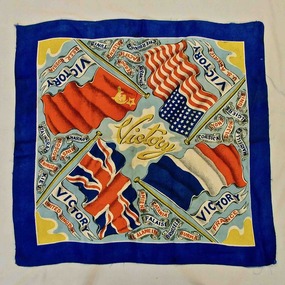
Scarf, Victory scarf, circa 1945
... growing up in the Romanian village of Brila. She developed her skills making lace and embroidering items for her trousseau. Some of the linen she embroidered had been woven from flax on Ithaca by her own grandmother, Efstathia. ...growing up in the Romanian village of Brila. She developed her skills making lace and embroidering items for her trousseau. Some of the linen she embroidered had been woven from flax on Ithaca by her own grandmother, Efstathia. ...This scarf belonged to Olga Black, a longtime Brighton resident. Olga Maria Black was born in Melbourne in 1930, the daughter of Ithacan migrants Constantine and Toula Mavrokefalos. Constantine first emigrated to Australia in 1902, returning to Greece circa 1912-13 to serve his home country in the Balkan Wars. Toula's family had left Ithaca for Romania when she was only six months old, but she happened to be visiting the island at the very time that Constantine arrived, fresh from the war. Within three weeks they were married, and when Constantine returned to Melbourne in 1914 his new bride came with him. Constantine had trained as an accountant, but his qualifications were not recognised in Australia. Changing his surname to the Anglicised "Black", he started off working in his older brother Dionysios's cafés before going into business on his own. In 1917 he opened the Paris Residential Café at 54-56 Swanston Street, which offered both dining and accommodation. The business saw some years of success, but did not survive the Great Depression. Constantine died in 1944. Olga's mother Toula learned to sew as a child, while growing up in the Romanian village of Brila. She developed her skills making lace and embroidering items for her trousseau. Some of the linen she embroidered had been woven from flax on Ithaca by her own grandmother, Efstathia. During the Depression, when money was scarce, Toula embroidered at home, doing work for a factory in Flinders Lane. Using a cotton reel, a threepence and a sixpence she created and embroidered designs on hundreds of blouses. Olga spent her preschool days sitting at the table where her mother worked. Toula would involve Olga by allowing her to help choose the colour combinations. Toula lived with Olga in Brighton until her death in 1976. Olga inherited her mother's sewing skills. She re-invented some of Toula’s trousseau nightdresses and skilfully altered other clothing, making dresses which she wore around Brighton for many years.Victory scarf with the flags of France, the United Kingdom, USA and the USSR. 'Victory' printed in yellow in the centre surrounded by names of countries and regions.scarf, world war ii, second world war, 1945, olga black -
 Brighton Historical Society
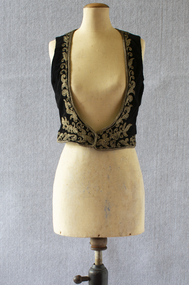
Waistcoat, 1950s
... growing up in the Romanian village of Brila. She developed her skills making lace and embroidering items for her trousseau. Some of the linen she embroidered had been woven from flax on Ithaca by her own grandmother, Efstathia. ...growing up in the Romanian village of Brila. She developed her skills making lace and embroidering items for her trousseau. Some of the linen she embroidered had been woven from flax on Ithaca by her own grandmother, Efstathia. ...This waistcoat belonged to Olga Black, a long-time Brighton resident. Part of a Greek national costume, it was designed by Olga in the 1950s, with the silver cornelli work completed by a Collins Street workshop. Olga Maria Black was born in Melbourne in 1930, the daughter of Ithacan migrants Constantine and Toula Mavrokefalos. Constantine first emigrated to Australia in 1902, returning to Greece circa 1912-13 to serve his home country in the Balkan Wars. Toula's family had left Ithaca for Romania when she was only six months old, but she happened to be visiting the island at the very time that Constantine arrived, fresh from the war. Within three weeks they were married, and when Constantine returned to Melbourne in 1914 his new bride came with him. Constantine had trained as an accountant, but his qualifications were not recognised in Australia. Changing his surname to the Anglicised "Black", he started off working in his older brother Dionysios's cafés before going into business on his own. In 1917 he opened the Paris Residential Café at 54-56 Swanston Street, which offered both dining and accommodation. The business saw some years of success, but did not survive the Great Depression. Constantine died in 1944. Olga's mother Toula learned to sew as a child, while growing up in the Romanian village of Brila. She developed her skills making lace and embroidering items for her trousseau. Some of the linen she embroidered had been woven from flax on Ithaca by her own grandmother, Efstathia. During the Depression, when money was scarce, Toula embroidered at home, doing work for a factory in Flinders Lane. Using a cotton reel, a threepence and a sixpence she created and embroidered designs on hundreds of blouses. Olga spent her preschool days sitting at the table where her mother worked. Toula would involve Olga by allowing her to help choose the colour combinations. Toula lived with Olga in Brighton until her death in 1976. Olga inherited her mother's sewing skills. She re-invented some of Toula’s trousseau nightdresses and skilfully altered other clothing, making dresses which she wore around Brighton for many years.Black velvet waistcoat, decorated with silver cornelli work. Pale blue cotton lining. Fastens with hooks and eyes.greece, ithaca, migration, olga black -
 Brighton Historical Society
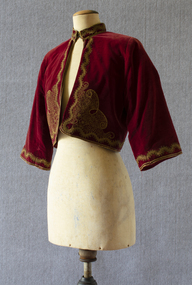
Jacket, Bolero, c.1948
... growing up in the Romanian village of Brila. She developed her skills making lace and embroidering items for her trousseau. Some of the linen she embroidered had been woven from flax on Ithaca by her own grandmother, Efstathia. ...growing up in the Romanian village of Brila. She developed her skills making lace and embroidering items for her trousseau. Some of the linen she embroidered had been woven from flax on Ithaca by her own grandmother, Efstathia. ...This bolero is part of a Greek national costume from the Peloponnese. Long-time Brighton resident Olga Black wore it to the 1956 Melbourne Olympic Games to represent her Greek heritage. She remembers the stands at the MCG being full of migrants wearing their traditional national costumes. Olga Maria Black was born in Melbourne in 1930, the daughter of Ithacan migrants Constantine and Toula Mavrokefalos. Constantine first emigrated to Australia in 1902, returning to Greece circa 1912-13 to serve his home country in the Balkan Wars. Toula's family had left Ithaca for Romania when she was only six months old, but she happened to be visiting the island at the very time that Constantine arrived, fresh from the war. Within three weeks they were married, and when Constantine returned to Melbourne in 1914 his new bride came with him. Constantine had trained as an accountant, but his qualifications were not recognised in Australia. Changing his surname to the Anglicised "Black", he started off working in his older brother Dionysios's cafés before going into business on his own. In 1917 he opened the Paris Residential Café at 54-56 Swanston Street, which offered both dining and accommodation. The business saw some years of success, but did not survive the Great Depression. Constantine died in 1944. Olga's mother Toula learned to sew as a child, while growing up in the Romanian village of Brila. She developed her skills making lace and embroidering items for her trousseau. Some of the linen she embroidered had been woven from flax on Ithaca by her own grandmother, Efstathia. During the Depression, when money was scarce, Toula embroidered at home, doing work for a factory in Flinders Lane. Using a cotton reel, a threepence and a sixpence she created and embroidered designs on hundreds of blouses. Olga spent her preschool days sitting at the table where her mother worked. Toula would involve Olga by allowing her to help choose the colour combinations. Toula lived with Olga in Brighton until her death in 1976. Olga inherited her mother's sewing skills. She re-invented some of Toula’s trousseau nightdresses and skilfully altered other clothing, making dresses which she wore around Brighton for many years.Red velvet bolero decrated with gold stitching and braid. Lined with red satin. Stand collar which fastens with two metal hooks and eyes. bolero, jacket, greece, ithaca, migration, olympic games, 1956 olympic games, olga black -
 Brighton Historical Society
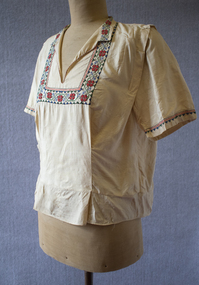
Blouse
... growing up in the Romanian village of Brila. She developed her skills making lace and embroidering items for her trousseau. Some of the linen she embroidered had been woven from flax on Ithaca by her own grandmother, Efstathia. ...growing up in the Romanian village of Brila. She developed her skills making lace and embroidering items for her trousseau. Some of the linen she embroidered had been woven from flax on Ithaca by her own grandmother, Efstathia. ...Silk blouse made by Toula Mavrokefalos, the mother of long-time Brighton resident Olga Black. Olga Maria Black was born in Melbourne in 1930, the daughter of Ithacan migrants Constantine and Toula Mavrokefalos. Constantine first emigrated to Australia in 1902, returning to Greece circa 1912-13 to serve his home country in the Balkan Wars. Toula's family had left Ithaca for Romania when she was only six months old, but she happened to be visiting the island at the very time that Constantine arrived, fresh from the war. Within three weeks they were married, and when Constantine returned to Melbourne in 1914 his new bride came with him. Constantine had trained as an accountant, but his qualifications were not recognised in Australia. Changing his surname to the Anglicised "Black", he started off working in his older brother Dionysios's cafés before going into business on his own. In 1917 he opened the Paris Residential Café at 54-56 Swanston Street, which offered both dining and accommodation. The business saw some years of success, but did not survive the Great Depression. Constantine died in 1944. Olga's mother Toula learned to sew as a child, while growing up in the Romanian village of Brila. She developed her skills making lace and embroidering items for her trousseau. Some of the linen she embroidered had been woven from flax on Ithaca by her own grandmother, Efstathia. During the Depression, when money was scarce, Toula embroidered at home, doing work for a factory in Flinders Lane. Using a cotton reel, a threepence and a sixpence she created and embroidered designs on hundreds of blouses. Olga spent her preschool days sitting at the table where her mother worked. Toula would involve Olga by allowing her to help choose the colour combinations. Toula lived with Olga in Brighton until her death in 1976. Olga inherited her mother's sewing skills. She re-invented some of Toula’s trousseau nightdresses and skilfully altered other clothing, making dresses which she wore around Brighton for many years.Cream silk short-sleeved blouse. Hand embroidered around inside of stand collar, centre front panel and sleeve edge in red, blue, black and green floral and geometric design.migration, ithaca, romania, olga black, toula mavrokefalos, toula black -
 Brighton Historical Society
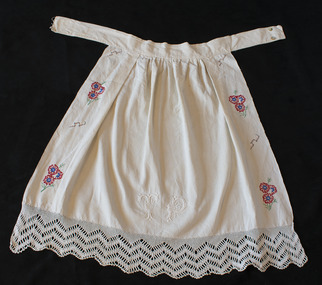
Apron, circa late 1800s, 1908 and 1950
... growing up in the Romanian village of Brila. She developed her skills making lace and embroidering items for her trousseau. Some of the linen she embroidered had been woven from flax on Ithaca by her own grandmother, Efstathia. ...growing up in the Romanian village of Brila. She developed her skills making lace and embroidering items for her trousseau. Some of the linen she embroidered had been woven from flax on Ithaca by her own grandmother, Efstathia. ...Three generations of women are represented in this apron. The linen used was woven by Olga's great-grandmother Efstathia in the late nineteenth century with flax grown on the island of Ithaca. Olga's mother Toula Raftopoulos added the whitework around 1908 at age 16 - the first piece of lacework she made on her own - and embroidered her initials on the front. Olga embellished the apron with coloured embroidery around 1950 at age 20. Olga Maria Black was born in Melbourne in 1930, the daughter of Ithacan migrants Constantine and Toula Mavrokefalos. Constantine first emigrated to Australia in 1902, returning to Greece circa 1912-13 to serve his home country in the Balkan Wars. Toula's family had left Ithaca for Romania when she was only six months old, but she happened to be visiting the island at the very time that Constantine arrived, fresh from the war. Within three weeks they were married, and when Constantine returned to Melbourne in 1914 his new bride came with him. Constantine had trained as an accountant, but his qualifications were not recognised in Australia. Changing his surname to the Anglicised "Black", he started off working in his older brother Dionysios's cafés before going into business on his own. In 1917 he opened the Paris Residential Café at 54-56 Swanston Street, which offered both dining and accommodation. The business saw some years of success, but did not survive the Great Depression. Constantine died in 1944. Olga's mother Toula learned to sew as a child, while growing up in the Romanian village of Brila. She developed her skills making lace and embroidering items for her trousseau. Some of the linen she embroidered had been woven from flax on Ithaca by her own grandmother, Efstathia. During the Depression, when money was scarce, Toula embroidered at home, doing work for a factory in Flinders Lane. Using a cotton reel, a threepence and a sixpence she created and embroidered designs on hundreds of blouses. Olga spent her preschool days sitting at the table where her mother worked. Toula would involve Olga by allowing her to help choose the colour combinations. Toula lived with Olga in Brighton until her death in 1976. Olga inherited her mother's sewing skills. She re-invented some of Toula’s trousseau nightdresses and skilfully altered other clothing, making dresses which she wore around Brighton for many years.Cream linen embroidered half apron. White lace along hem, along with white embroidered initials, "T.P." Coloured floral and abstract embroidery along sides in red, black, blue and green.olga black, toula raftopoulos, migration, embroidery -
 Brighton Historical Society
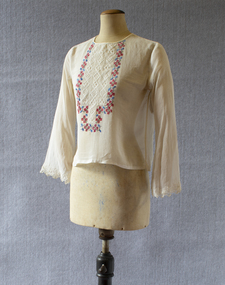
Top, circa 1910
... growing up in the Romanian village of Brila. She developed her skills making lace and embroidering items for her trousseau. Some of the linen she embroidered had been woven from flax on Ithaca by her own grandmother, Efstathia. ...growing up in the Romanian village of Brila. She developed her skills making lace and embroidering items for her trousseau. Some of the linen she embroidered had been woven from flax on Ithaca by her own grandmother, Efstathia. ...This top was made by Toula Mavrokefalos Black (nee Raftopoulos) as a teenager living in Romania. It was intended to be worn under suit jackets. Her daughter, Olga Black, is a longtime Brighton resident. Olga Maria Black was born in Melbourne in 1930, the daughter of Ithacan migrants Constantine and Toula Mavrokefalos. Constantine first emigrated to Australia in 1902, returning to Greece circa 1912-13 to serve his home country in the Balkan Wars. Toula's family had left Ithaca for Romania when she was only six months old, but she happened to be visiting the island at the very time that Constantine arrived, fresh from the war. Within three weeks they were married, and when Constantine returned to Melbourne in 1914 his new bride came with him. Constantine had trained as an accountant, but his qualifications were not recognised in Australia. Changing his surname to the Anglicised "Black", he started off working in his older brother Dionysios's cafés before going into business on his own. In 1917 he opened the Paris Residential Café at 54-56 Swanston Street, which offered both dining and accommodation. The business saw some years of success, but did not survive the Great Depression. Constantine died in 1944. Olga's mother Toula learned to sew as a child, while growing up in the Romanian village of Brila. She developed her skills making lace and embroidering items for her trousseau. Some of the linen she embroidered had been woven from flax on Ithaca by her own grandmother, Efstathia. During the Depression, when money was scarce, Toula embroidered at home, doing work for a factory in Flinders Lane. Using a cotton reel, a threepence and a sixpence she created and embroidered designs on hundreds of blouses. Olga spent her preschool days sitting at the table where her mother worked. Toula would involve Olga by allowing her to help choose the colour combinations. Toula lived with Olga in Brighton until her death in 1976. Olga inherited her mother's sewing skills. She re-invented some of Toula’s trousseau nightdresses and skilfully altered other clothing, making dresses which she wore around Brighton for many years.Long-sleeved top of cream georgette with high round neck. Front features three handmade rectagular lace panel inserts, surrounded with floral cross stitch embroidery in red, blue, black and greentoula mavrokefalos, toula black, olga black, migration, embroidery -
 Brighton Historical Society
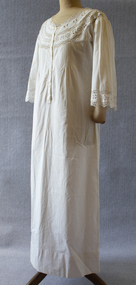
Nightgown, circa 1900
... growing up in the Romanian village of Brila. She developed her skills making lace and embroidering items for her trousseau. Some of the linen she embroidered had been woven from flax on Ithaca by her own grandmother, Efstathia. ...growing up in the Romanian village of Brila. She developed her skills making lace and embroidering items for her trousseau. Some of the linen she embroidered had been woven from flax on Ithaca by her own grandmother, Efstathia. ...This nightgown was made by Vasiliki Raftopoulos around 1900 for her daughter Toula's trousseau. Born in Ithaca, Toula's family migrated to Romania when she was only a baby. In 1914, Toula emigrated to Australia with her husband Constantine Mavrokefalos, where their daughter Olga Black was born in 1930. Olga is a longtime Brighton resident. BHS holds a collection of garments and textiles made by the women of Olga's family, spanning four generations. Constantine first emigrated to Australia in 1902, returning to Greece circa 1912-13 to serve his home country in the Balkan Wars. Toula's family had left Ithaca for Romania when she was only six months old, but she happened to be visiting the island at the very time that Constantine arrived, fresh from the war. Within three weeks they were married, and when Constantine returned to Melbourne in 1914 his new bride came with him. Constantine had trained as an accountant, but his qualifications were not recognised in Australia. Changing his surname to the Anglicised "Black", he started off working in his older brother Dionysios's cafés before going into business on his own. In 1917 he opened the Paris Residential Café at 54-56 Swanston Street, which offered both dining and accommodation. The business saw some years of success, but did not survive the Great Depression. Constantine died in 1944. Olga's mother Toula learned to sew as a child, while growing up in the Romanian village of Brila. She developed her skills making lace and embroidering items for her trousseau. Some of the linen she embroidered had been woven from flax on Ithaca by her own grandmother, Efstathia. During the Depression, when money was scarce, Toula embroidered at home, doing work for a factory in Flinders Lane. Using a cotton reel, a threepence and a sixpence she created and embroidered designs on hundreds of blouses. Olga spent her preschool days sitting at the table where her mother worked. Toula would involve Olga by allowing her to help choose the colour combinations. Toula lived with Olga in Brighton until her death in 1976. Olga inherited her mother's sewing skills. She re-invented some of Toula’s trousseau nightdresses and skilfully altered other clothing, making dresses which she wore around Brighton for many years.Women's white cotton nightgown, long with three quarter sleeves. Cotton lace on front and sleeves. Front fastening buttons. Pintucked with eyelets around neck.nightgown, toula black, toula mavrokefalos, vasiliki raftopoulos, olga black, 1900s, trousseau -
 Brighton Historical Society
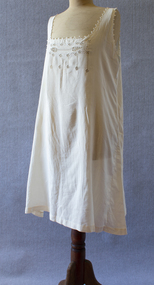
Nightgown, circa 1900
... growing up in the Romanian village of Brila. She developed her skills making lace and embroidering items for her trousseau. Some of the linen she embroidered had been woven from flax on Ithaca by her own grandmother, Efstathia. ...growing up in the Romanian village of Brila. She developed her skills making lace and embroidering items for her trousseau. Some of the linen she embroidered had been woven from flax on Ithaca by her own grandmother, Efstathia. ...This nightgown belonged to Toula Mavrokefalos Black, nee Raftopoulos (1892-1976). Born in Ithaca, Toula's family migrated to Romania when she was only a baby. She learned to sew as a child while growing up in the Romanian village of Brila. She developed her skills making lace and embroidering items for her trousseau. Some of the linen she embroidered had been woven from flax on Ithaca by her own grandmother, Efstathia. In 1914, Toula emigrated to Australia with her husband Constantine Mavrokefalos. During the Depression, when money was scarce, Toula embroidered at home, doing work for a factory in Flinders Lane. Using a cotton reel, a threepence and a sixpence she created and embroidered designs on hundreds of blouses. Her daughter Olga Black spent her preschool days sitting at the table where her mother worked. Toula would involve Olga by allowing her to help choose the colour combinations. Toula lived with Olga in Brighton until her death in 1976. Olga inherited her mother's sewing skills. She re-invented some of Toula’s trousseau nightdresses and skilfully altered other clothing, making dresses which she wore around Brighton for many years. BHS holds a collection of garments and textiles made by the women of Olga's family, spanning four generations.Women's cream cotton sleeveless nightgown. Cutwork embroidery on bodice. Blue stain under one arm.nightgown, toula black, toula mavrokefalos, 1900s
