
Showing 152 items matching "flight crews"
-
 Moorabbin Air Museum
Manual (Item) - USAF Flight Crews Check Lists
... USAF Flight Crews Check Lists...USAF Flight Crews Check Lists...USAF Flight Crews Check Lists Manual USAF Flight Crews Check Lists ... -
Moorabbin Air Museum
Manual (item) - Douglas DC-6 Operations Manuals, Douglas Service DC-6 Air Conditioning System Operation for Flight Crews
... Douglas Service DC-6 Air Conditioning System Operation for Flight Crews...Douglas Service DC-6 Air Conditioning System Operation for Flight Crews Manual Douglas DC-6 Operations Manuals ...Douglas Aircraft Co.Ltd. -
Moorabbin Air Museum
Book (Item) - Airplane Performance and Operation - a manual for flight crews by R Dixon Speas
... Airplane Performance and Operation - a manual for flight crews by R Dixon Speas...Book Airplane Performance and Operation - a manual for flight crews by R Dixon Speas ... -
 Bendigo Military Museum
Letter - LETTER, ROYAL AUSTRALIAN AIRFORCE
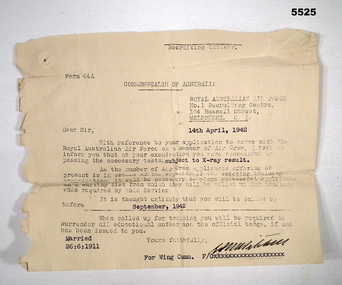
... ...Flight Crews...Victor Evans No.418655, successful applicant to join RAAF flight crews. Stated training at capacity currently and expected to be called up in Sept 1942. ...RAAF Training Flight Crews Letter to say application was successful. ...The letter was answer to H. Victor Evans No.418655, successful applicant to join RAAF flight crews. Stated training at capacity currently and expected to be called up in Sept 1942. Refer Cat 1760.4 (Box 41).Single sheet of yellowed paper with tattered edges. Address on one side and letter on the other which then folded to make the envelope.Letter to say application was successful. But put on waiting list as training at capacity. Says Form 44A and has stamp saying married on 26/6/1911. Signed by the Wing Commander. Address of applicant typed on front.raaf training, flight crews -
 Running Rabbits Military Museum operated by the Upwey Belgrave RSL Sub Branch
Photograph
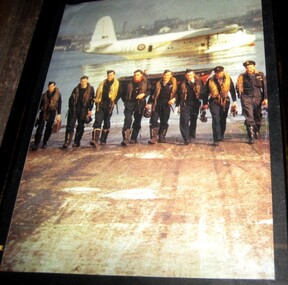
... Flight Crew leaving Seaplane...Picture WW2 RAAF Flight Crew leaving Seaplane Photograph ...Flight Crew leaving Seaplanepicture, ww2, raaf -
Running Rabbits Military Museum operated by the Upwey Belgrave RSL Sub Branch
Uniform Complete
... RAAF Flight Crew current...Model Modern RAAF RAAF Flight Crew current Uniform Complete ...RAAF Flight Crew currentmodel, modern, raaf -
Moorabbin Air Museum
Accessory (Item) - Life Preserver Model AV-35A Part No S-21150-7300 For Demo Air Crew Only, Life Preserver Model AV-35A
... Life preserver vest for demonstration only by flight crew, suitable for Adult/Child...Life preserver vest for demonstration only by flight crew, suitable for Adult/Child Life Preserver Model AV-35A Accessory Life Preserver Model AV-35A Part No S-21150-7300 For Demo Air Crew Only ... -
 Moorabbin Air Museum
Book (item) - Department Of Civil Aviation Flight Crew Licences For A.G.Wookey
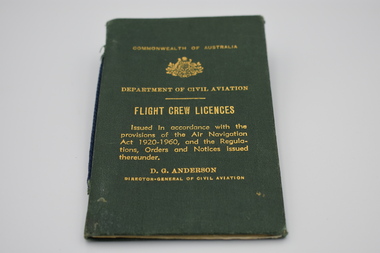
... Department Of Civil Aviation Flight Crew Licences For A.G.Wookey...Department Of Civil Aviation Flight Crew Licences For A.G.Wookey...Department Of Civil Aviation Flight Crew Licences For A.G.Wookey, containing Private Pilot Licence Aeroplanes and Flight Radiotelephone Operator Licence No.005686 ...Department Of Civil Aviation Flight Crew Licences For A.G.Wookey, containing Private Pilot Licence Aeroplanes and Flight Radiotelephone Operator Licence No.005686 Department Of Civil Aviation Flight Crew Licences For A.G.Wookey Book Department Of Civil Aviation Flight Crew Licences For A.G.Wookey ... -
 National Vietnam Veterans Museum (NVVM)
Photograph - Two Coloured Photograph is a Timber Frame Titled CO 2 Sqn and His Navigator -Farewell the last flight and Ground crew with pilot of The Last Flight Dave Smith, 1962 - 1972
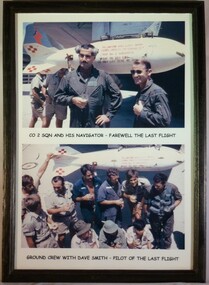
... Two Coloured Photograph is a Timber Frame Titled CO 2 Sqn and His Navigator -Farewell the last flight and Ground crew with pilot of The Last Flight Dave Smith ...The top one is titled CO 2 Sqn and His Navigator -Farewell the last flight and shows the CO talking to another crewman. The bottom photograph is of several ground crew with pilot of the Last flight Dave Smith. ...Co 2 SQN and his Navigator - Farewell The Last Flight / Ground crew with Dave Smith - Pilot of The Last Flight....crew are all having a farewell drink. Photograph Two Coloured Photograph is a Timber Frame Titled CO 2 Sqn and His Navigator -Farewell the last flight and Ground crew with pilot of The Last Flight Dave Smith ...Two Coloured Photograph is a Timber Frame. The top one is titled CO 2 Sqn and His Navigator -Farewell the last flight and shows the CO talking to another crewman. The bottom photograph is of several ground crew with pilot of the Last flight Dave Smith. The crew are all having a farewell drink.Co 2 SQN and his Navigator - Farewell The Last Flight / Ground crew with Dave Smith - Pilot of The Last Flight.flying officer david robert smith, o224754, no 2 squadron, raaf, royal australian air force, last flight, photograph -
Frankston RSL Sub Branch
Uniform - Airman's Gauntlets, WW2 RAAF Airman's Gauntlets Pair
... Gauntlets used by all RAAF flight crew to combat altitude-induced extreme cold....Gauntlets used by all RAAF flight crew to combat altitude-induced extreme cold. ...Gauntlets used by all RAAF flight crew to combat altitude-induced extreme cold.Brown leather gloves with forearm extension and wool lining in hand area.Nil -
 Bendigo Military Museum
Headwear - CAP, PEAKED
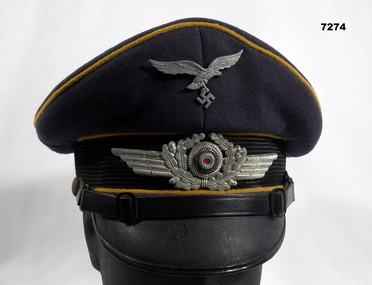
... German peaked hat worn by members of Luftwaffe Flight crews WW2 Circa 1939-45. Is in an NCO pattern and noted as yellow Waffenfabre....German peaked hat worn by members of Luftwaffe Flight crews WW2 Circa 1939-45. Is in an NCO pattern and noted as yellow Waffenfabre. ...German peaked hat worn by members of Luftwaffe Flight crews WW2 Circa 1939-45. Is in an NCO pattern and noted as yellow Waffenfabre.Dark blue peaked hat. Top part is dark blue felt with orange edging and emblem of silver eagle carrying a Swaztika. Middle band black cotton material with emblem of silver laurel wreath surrounding a small silver button with blue inner circle and red dot and wings coming out from each side. Bottom has black leather peak with a black buckled leather strap. Inside lined with black satiny material. A clear plastic diamond and a black leather band.No inscription on size inside.peaked cap, ww2, german uniform -
Moorabbin Air Museum
Manual (Item) - Hs748Ew Model 268 Flight Crew Checklist
... Hs748Ew Model 268 Flight Crew Checklist...HS748 Model 228 Aircraft Flight Crew Checklist Level of Importance: World. ...Manual Hs748Ew Model 268 Flight Crew Checklist ...Description: 50 pages. Published by RAAF. Published April 1984. AAP 7211.004-1CL. HS748 Model 228 Aircraft Flight Crew Checklist Level of Importance: World. -
Moorabbin Air Museum
Manual (Item) - Hs748 Model 268 Aircrew Checklist
... HS748 Electronic Warfare Aircraft Model 268 Flight Crew Checklist. Level of Importance: World. ...HS748 Electronic Warfare Aircraft Model 268 Flight Crew Checklist. Level of Importance: World. ...Description: 31 pages. Published by RAAF. Published September 1993. AAP 7211.015-1CL. HS748 Electronic Warfare Aircraft Model 268 Flight Crew Checklist. Level of Importance: World. -
 Sir Reginald Ansett Transport Museum
Headwear - Hat, Pillbox, 1972-1977
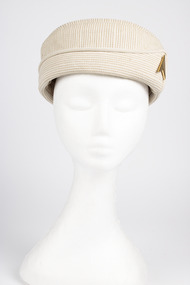
... Complements the collection of air flight crew attire 1969-1972....Complements the collection of air flight crew attire 1969-1972. Shirley Boles was an air hostess with ANA in the early days of Ansett. ...Donated to Sir Reginald Ansett Transport Museum by Shirley Boles Ansett Airlines of Australia 1969-1972 Uniform designed for Hostess/Stewardess uniform. Complements the collection of air flight crew attire 1969-1972.Shirley Boles was an air hostess with ANA in the early days of Ansett. Shirley has made a considerable contribution of items to the Sir Reginald Ansett Transport Museum. She was a popular staff member who worked for many years with the company.Beige coloured pillbox hat , with flat crown and straight, upright sides. Turned up brim featuring peaked detail on one side. Piped edging. Heavy-duty poly-cotton (?) fabric with reinforcing stitching. Fawn grosgrain ribbon interfacing inside. Cream bemsilk lining. Gold coloured badge features 1968-1981 Ansett Logo A Delta "by Nivek Headwear Reg. Melb" on label inside. Pencil numeral 20 & 1/2 hand written on label. Commercial Name Tag hand sown Shirley Boles customer service staff, pill-box hat, 1970s, beige, hostess, stewardess, shirley boles, flight attendants, 1969-1972 -
 National Vietnam Veterans Museum (NVVM)
Document - 'The Blood Chit", 1968
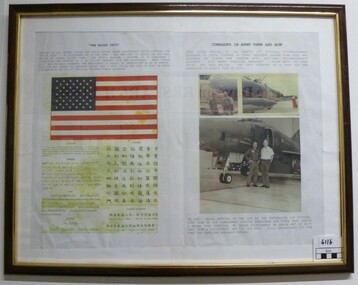
... "The Blood Chit" carried by all United States Air Force Flight crews operating in South Vietnam, the "blood chit" so nick-named by flight crew - was designed to assist in the safe return of downed flight crew. ..."The Blood Chit" carried by all United States Air Force Flight crews operating in South Vietnam, the "blood chit" so nick-named by flight crew - was designed to assist in the safe return of downed flight crew. ..."The Blood Chit" carried by all United States Air Force Flight crews operating in South Vietnam, the "blood chit" so nick-named by flight crew - was designed to assist in the safe return of downed flight crew. The "chits" message - written in 15 languages - identified the carrier as a US citizen seeking food and assistance. Each "blood chit" was serially numbered and registered to assist in identification by US Forces. This one was issued to Squadron Leader Alan R Reed during his tour of duty in South Vietnam with the US 12th Tactical Reconnaissance Squadron. COMRADES IN ARM THEN AND NOW: Soon after arrival at the USAF'S 12th Tactical Reconnaissance Squadron in South Vietnam in 1968, Squadron Leader Alan Reed was assigned in an almost new Phantom RF74C (AF67442) Reconnaissance Aircraft - nicked name "Carolina Kangaroo" along with its crew chief, Sgt Dale Miller. The trio operated as a team for the remainder of Alan's tour of duty. In 1981, while serving in the USA as the Australian Air Attache, Alan (now an Air Commodore) visited Bergstrom Air Force Base during a major USAF exercise. By sheer coincidence he again met up with Dale (now a Lieutenant) and his old RF4C - still operational but now sans the Carolina Kangaroo emblem.Black and Gold Framed Article of "The Blood Chit"- Accompanied with U.S.A. Flag and explanation. Also two coloured and one black and white photo of Alan Reed and Crew Chief Sgt. Dale Miller beside the RF-4C Phantom nicknamed, "Carolina Kangaroo".alan reed, rf-4c phantom, "carolina kangaroo"., sgt dale miller, united states air force, 12th tactical reconnaissance squadron, blood chit, us forces, squadron leader alan reed, usaf, bergstrom air force base, royal australian air force, 052363, pilot, headquarters, australian force vietnam, raaf element -
 Bendigo Military Museum
Photograph - PHOTOGRAPH, RAAF, FRAMED, CWW2
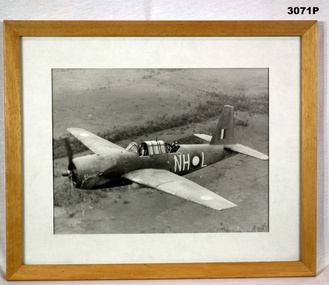
... Black & white photo of a military aircraft in flight with 2 crew visible in cockpit. Background of ground & small trees. ...Black & white photo of a military aircraft in flight with 2 crew visible in cockpit. Background of ground & small trees. ...This is a photograph of a Vultee Vengeance dive bomber. Made in USA in WW2. The RAAF equipped five squadrons with this type. Sqn Numbers 12, 21, 23, 24, 25. They were in service with the RAAF 1942 to 1946.Varnished timber frame with off white coloured mount with glass. Black & white photo of a military aircraft in flight with 2 crew visible in cockpit. Background of ground & small trees. On fuselage: “Dianne” & letters “NHL”photography - photographs, frame accessories, trades - carpentry, military history - air force -
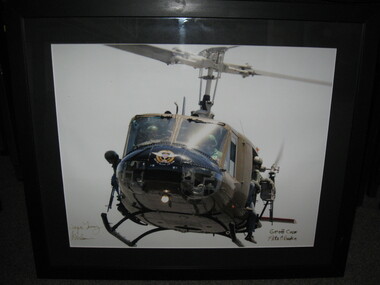 National Vietnam Veterans Museum (NVVM)
Photograph
... A coloured photograph in a black frame of a helicoper and crew in flight. Handwritten information of the back identifying RAN HF Emu Swuadron. ...Photograph Cerberus Collection EMU RAN There are the signatures of the four crewmen on the photograph A coloured photograph in a black frame of a helicoper and crew in flight. Handwritten information of the back identifying RAN HF Emu Swuadron. ...A coloured photograph in a black frame of a helicoper and crew in flight. Handwritten information of the back identifying RAN HF Emu Swuadron. On front of the helicopter is the ingignia of the RAn Emu Squadron with the words "Get The Bloody Job Done"There are the signatures of the four crewmen on the photographphotograph, cerberus collection, emu, ran -
Moorabbin Air Museum
Archive (Item) - Box Baa 107 Boeing (Gaf / Asta) Collection
... Description: AP(RAN) 201 Vol 8 - JINDIVIK Mk 203B FLIGHT MANUAL Crew Operating Notes for Hutts Equipped Jindivik Mk 203B 700 Series B3B-00-170 GAF/20/1 TONIC TOWED TARGET SYSTEM Mk 4 and Mk 5 ASTA Project Report B4A-C00-051 DESIGN SUMMARY - JINDIVIK Level of Importance: National. ...Description: AP(RAN) 201 Vol 8 - JINDIVIK Mk 203B FLIGHT MANUAL Crew Operating Notes for Hutts Equipped Jindivik Mk 203B 700 Series B3B-00-170 GAF/20/1 TONIC TOWED TARGET SYSTEM Mk 4 and Mk 5 ASTA Project Report B4A-C00-051 DESIGN SUMMARY - JINDIVIK Level of Importance: National. ...Description: AP(RAN) 201 Vol 8 - JINDIVIK Mk 203B FLIGHT MANUAL Crew Operating Notes for Hutts Equipped Jindivik Mk 203B 700 Series B3B-00-170 GAF/20/1 TONIC TOWED TARGET SYSTEM Mk 4 and Mk 5 ASTA Project Report B4A-C00-051 DESIGN SUMMARY - JINDIVIK Level of Importance: National. Historical Details: DAP/GAF/ASTA constructed many overseas designs under licence in Australia (Beaufort, Beaufighter, Lincoln, Canberra and F18) however they also designed and constructed a number of significant local designs that were successful in oversea's markets includiCAC -
Moorabbin Air Museum
Document (item) - John Porter Collection
... Serice and Pay Book - John Porter Aircraft Radiotelegraph Operator's Certificate and Licence - John Porter Flight Crew Licences - John Porter RAAF Odd Bods U.K. 1939-1945 - cloth badge. ...Serice and Pay Book - John Porter Aircraft Radiotelegraph Operator's Certificate and Licence - John Porter Flight Crew Licences - John Porter RAAF Odd Bods U.K. 1939-1945 - cloth badge. ... -
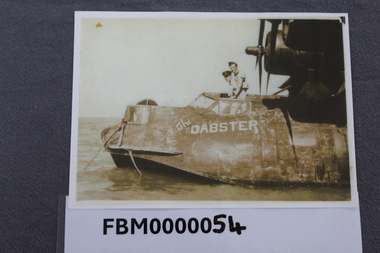 Lake Boga Flying Boat Museum
Photograph
... Flown by Flight Officer Righetti and crew, they completed the first submarine patrols and bombing missions to Ambon (Indonesia) and Kavieng (New Guinea) in 1941. ...Flown by Flight Officer Righetti and crew, they completed the first submarine patrols and bombing missions to Ambon (Indonesia) and Kavieng (New Guinea) in 1941. ...Catalina A24-64, known as "The Dabster", Australian slang for "the best", was No 6 in a sortie of 15 aircraft. Flown by Flight Officer Righetti and crew, they completed the first submarine patrols and bombing missions to Ambon (Indonesia) and Kavieng (New Guinea) in 1941. The A24-64 was one of the Catalinas painted black for nighttime missions, called the Black Cats. 24 Catalinas were used to lay mines at a low altitude to prevent the Japanese from leaving Manila Bay in the Philippines. The Dabster flew her final mission on 14 December 1944, going down in Manila Bay.Catalinas were serviced at the No 1 Flying Boat Repair Depot during World War II.Black and white photo of "The Dabster" Catalina, moored on water, two servicemen standing in the cockpitwwii, catalina, the dabster, no 1 flying boat repair depot, black cats -
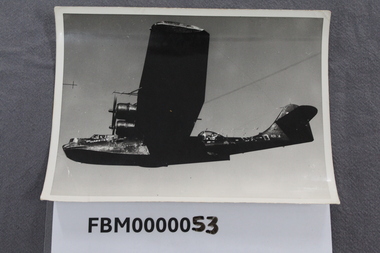 Lake Boga Flying Boat Museum
Photograph
... Flown by Flight Officer Righetti and crew, they completed the first submarine patrols and bombing missions to Ambon (Indonesia) and Kavieng (New Guinea) in 1941. ...Flown by Flight Officer Righetti and crew, they completed the first submarine patrols and bombing missions to Ambon (Indonesia) and Kavieng (New Guinea) in 1941. ...Catalina A24-64, known as "The Dabster", Australian slang for "the best", was No 6 in a sortie of 15 aircraft. Flown by Flight Officer Righetti and crew, they completed the first submarine patrols and bombing missions to Ambon (Indonesia) and Kavieng (New Guinea) in 1941. The A24-64 was one of the Catalinas painted black for nighttime missions, called the Black Cats. 24 Catalinas were used to lay mines at a low altitude to prevent the Japanese from leaving Manila Bay in the Philippines. The Dabster flew her final mission on 14 December 1944, going down in Manila Bay.Catalinas were serviced at the No 1 Flying Boat Repair Depot during World War II.Black and white photograph of "The Dabster" Catalina flying in the sky, serviceman in gun blister wavingwwii, catalina, the dabster, no 1 flying boat repair depot, black cats -
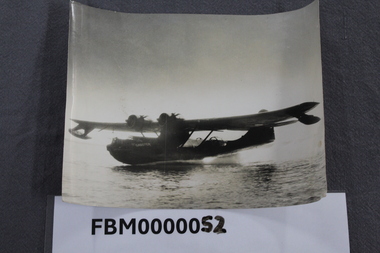 Lake Boga Flying Boat Museum
Photograph
... Flown by Flight Officer Righetti and crew, they completed the first submarine patrols and bombing missions to Ambon (Indonesia) and Kavieng (New Guinea) in 1941. ...Flown by Flight Officer Righetti and crew, they completed the first submarine patrols and bombing missions to Ambon (Indonesia) and Kavieng (New Guinea) in 1941. ...Catalina A24-64, known as "The Dabster", Australian slang for "the best", was No 6 in a sortie of 15 aircraft. Flown by Flight Officer Righetti and crew, they completed the first submarine patrols and bombing missions to Ambon (Indonesia) and Kavieng (New Guinea) in 1941. The A24-64 was one of the Catalinas painted black for nighttime missions, called the Black Cats. 24 Catalinas were used to lay mines at a low altitude to prevent the Japanese from leaving Manila Bay in the Philippines. The Dabster flew her final mission on 14 December 1944, going down in Manila Bay.Catalinas were serviced at the No 1 Flying Boat Repair Depot during World War II.Black and white photograph of "The Dabster" Catalina alighting or taking off the water, wing floats partially loweredwwii, catalina, the dabster, no 1 flying boat repair depot, black cats -
 Lake Boga Flying Boat Museum
Photograph
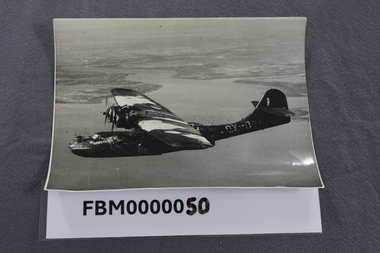
... Flown by Flight Officer Righetti and crew, they completed the first submarine patrols and bombing missions to Ambon (Indonesia) and Kavieng (New Guinea) in 1941. ...Flown by Flight Officer Righetti and crew, they completed the first submarine patrols and bombing missions to Ambon (Indonesia) and Kavieng (New Guinea) in 1941. ...Catalina A24-64, known as "The Dabster", Australian slang for "the best", was No 6 in a sortie of 15 aircraft. Flown by Flight Officer Righetti and crew, they completed the first submarine patrols and bombing missions to Ambon (Indonesia) and Kavieng (New Guinea) in 1941. The A24-64 was one of the Catalinas painted black for nighttime missions, called the Black Cats. 24 Catalinas were used to lay mines at a low altitude to prevent the Japanese from leaving Manila Bay in the Philippines. The Dabster flew her final mission on 14 December 1944, going down in Manila Bay.Catalinas were serviced at the No 1 Flying Boat Repair Depot during World War II.Black and white photograph of "The Dabster" Catalina flying over the sea with land in back groundcatalina, dabster, wwii, no 1 flying boat repair depot -
 Lake Boga Flying Boat Museum
Photograph
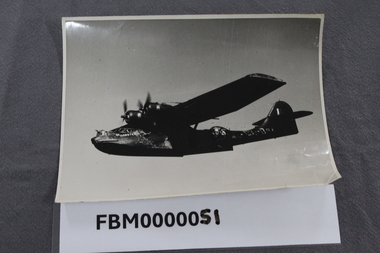
... Flown by Flight Officer Righetti and crew, they completed the first submarine patrols and bombing missions to Ambon (Indonesia) and Kavieng (New Guinea) in 1941. ...Flown by Flight Officer Righetti and crew, they completed the first submarine patrols and bombing missions to Ambon (Indonesia) and Kavieng (New Guinea) in 1941. ...Catalina A24-64, known as "The Dabster", Australian slang for "the best", was No 6 in a sortie of 15 aircraft. Flown by Flight Officer Righetti and crew, they completed the first submarine patrols and bombing missions to Ambon (Indonesia) and Kavieng (New Guinea) in 1941. The A24-64 was one of the Catalinas painted black for nighttime missions, called the Black Cats. 24 Catalinas were used to lay mines at a low altitude to prevent the Japanese from leaving Manila Bay in the Philippines. The Dabster flew her final mission on 14 December 1944, going down in Manila Bay.Catalinas were serviced at the No 1 Flying Boat Repair Depot during World War II.Black and white photograph of "The Dabster" Catalina flying in the skywwii, catalina, the dabster, no 1 flying boat repair depot, black cats -
 Federation University Historical Collection
Assemblage, National Aeronautics & Space Administration (NASA) presentation to the Students of the Ballarat College of Advanced Education
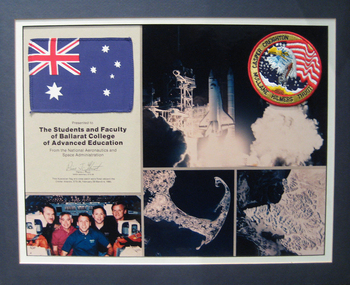
... The Australian Flag and NASA Astronauts crew patch were flown aboard the Orbiter Atlantis, STS-36, 28 February to 4 March 1990. Astronaut Pierre Thout's first flight was as a mission specialist on the crew of STS-36 which launched from the Kennedy Space Center, Florida, on February 28, 1990, aboard the Space Shuttle Atlantis. ...The Australian Flag and NASA Astronauts crew patch were flown aboard the Orbiter Atlantis, STS-36, 28 February to 4 March 1990. Astronaut Pierre Thout's first flight was as a mission specialist on the crew of STS-36 which launched from the Kennedy Space Center, Florida, on February 28, 1990, aboard the Space Shuttle Atlantis. ...The assemblage was presented to the students of Ballarat College of Advanced Education (BCAE) by a NASA astronaut. The Australian Flag and NASA Astronauts crew patch were flown aboard the Orbiter Atlantis, STS-36, 28 February to 4 March 1990. Astronaut Pierre Thout's first flight was as a mission specialist on the crew of STS-36 which launched from the Kennedy Space Center, Florida, on February 28, 1990, aboard the Space Shuttle Atlantis. This mission carried Department of Defense payloads and a number of secondary payloads. Following 72 orbits of the Earth in 106 hours, the STS-36 mission concluded with a lakebed landing at Edwards Air Force Base, California, on March 4, 1990, after travelling 1.87 million miles. bcae, nasa, space, pierre thuot, creighton, caspar, mullane, hilmers -
 Lara RSL Sub Branch
Book, Nautical Press, HMAS Melbourne 25 Years
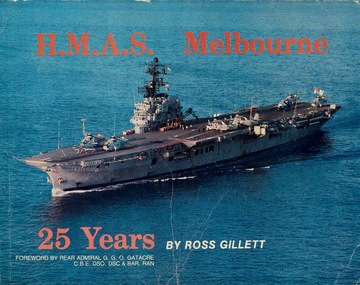
... flight deck. Delays in construction and integrating the enhancements meant that the carrier was not commissioned until 1955. Melbourne never fired a shot in anger during her career, having only peripheral, non-combat roles in relation to the Indonesia-Malaysia confrontation and the Vietnam War. However, she was involved in two major collisions with allied vessels. On the evening of 10 February 1964, Melbourne collided with and sank HMAS Voyager when the Daring class destroyer altered course across her bow. Eighty-two of Voyager's crew...flight deck. Delays in construction and integrating the enhancements meant that the carrier was not commissioned until 1955. Melbourne never fired a shot in anger during her career, having only peripheral, non-combat roles in relation to the Indonesia-Malaysia confrontation and the Vietnam War. However, she was involved in two major collisions with allied vessels. On the evening of 10 February 1964, Melbourne collided with and sank HMAS Voyager when the Daring class destroyer altered course across her bow. Eighty-two of Voyager's crew ...HMAS Melbourne (R21) was a Majestic-class light aircraft carrier of the Royal Australian Navy (RAN). Operating from 1955 until 1982, she was the third and final conventional aircraft carrier to serve in the RAN. Melbourne was the only British Commonwealth naval vessel to sink two friendly warships in peacetime collisions. The ship was laid down for the British Royal Navy as the lead ship of the Majestic class in April 1943, and was launched as HMS Majestic (R77) in February 1945. At the end of World War II, work on the ship was suspended until she was purchased by the RAN in 1947. At the time of purchase, it was decided to incorporate new aircraft carrier technologies into the design, making Melbourne the third ship to be constructed with an angled flight deck. Delays in construction and integrating the enhancements meant that the carrier was not commissioned until 1955. Melbourne never fired a shot in anger during her career, having only peripheral, non-combat roles in relation to the Indonesia-Malaysia confrontation and the Vietnam War. However, she was involved in two major collisions with allied vessels. On the evening of 10 February 1964, Melbourne collided with and sank HMAS Voyager when the Daring class destroyer altered course across her bow. Eighty-two of Voyager's crew were killed, and two Royal Commissions were held to investigate the incident. The second collision occurred in the early morning of 3 June 1969, when Melbourne collided with and sank the Allen M. Sumner class destroyer USS Frank E. Evans in similar circumstances. Seventy-four United States Navy (USN) personnel died, and a joint USN–RAN Board of Inquiry was held. These incidents, along with several minor collisions, shipboard accidents, and aircraft losses, led to the reputation that Melbourne was jinxed. Melbourne was paid off from RAN service in 1982. A proposal to convert her for use as a floating casino failed, and a 1984 sale was cancelled, before she was sold in 1985 and towed to China for breaking. The scrapping was delayed so Melbourne could be studied by the People's Liberation Army Navy (PLAN) as part of a secret project to develop a Chinese aircraft carrier and used to train PLAN aviators in carrier flight operations. HMAS Melbourne was decommissioned on 30 June 1982, having spent 62,036 hours underway and having steamed 868,893 nautical miles. A proposal to convert her for use as a floating casino failed, and a 1984 sale was cancelled, before she was sold for scrap in 1985 and towed to China for breaking. The scrapping was delayed so Melbourne could be studied by the People's Liberation Army Navy (PLAN) as part of a secret project to develop a Chinese aircraft carrier and used to train PLAN aviators in carrier flight operations.The pictorial history of HMAS Melbourne with rare photos. Now a scarce title and highly desirable title that is now long out of print. Has provenance history of all ships movements from 1955 till decommissioned.HMAS Melbourne 25 YearsOn the front page is a picture of HMAS Melbourne with the words at top "H.M.A.S. Melbourne. At bottom are the words in orange, '25 Years'. In white, are the words 'by Ross Gillett' then 'Forward by Rear Admiral G.G.O. Gatacre C.B.E. DSO. DSC & Bar, RAN'. On the rear page is a list of all the Captains that served on the HMAS Melbourne between 1955-1980.hmas melbourne, aircraft carrier, royal australian navy, australian navy, westland whirlwind, sea venom, fairy gannet, bristol sycamore, westland wessex, douglas skyhawk, grumman tracker, westland sea king, fleet air arm, hmas albatross, nowra -
 Flagstaff Hill Maritime Museum and Village
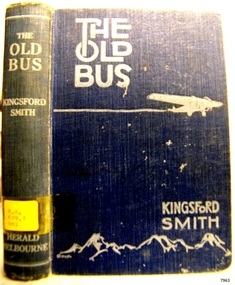
Book, The Old Bus
... Sadly Kingsford Smith’s “Southern Cloud” was lost during a flight from Sydney to Melbourne in 1931 with no surviving crew or passengers; in 1958 the wreckage was discovered in the Snowy Mountains. ...Sadly Kingsford Smith’s “Southern Cloud” was lost during a flight from Sydney to Melbourne in 1931 with no surviving crew or passengers; in 1958 the wreckage was discovered in the Snowy Mountains. ...Sir Charles Edward Kingsford Smith is a famous Australian, well known in civil aviation history for his courageous endeavours in flight. He broken many flight records for long distance and time travelled and he was also a war hero in World War 1. He has been referred to as being “known to millions of Australians as “Smithy” … he was one of Australia’s true twentieth-century legends”. In honour of his place amongst the world’s famous pioneers his image is featured on Australia’s $20 note, Sydney airport is named after him, there is a memorial to Kingsford Smith, Taylor and Ulm at the Anderson Park, also in Sydney and his plane “Southern Cross” is on view at Brisbane Airport. Kingsford Smith wrote ‘The Old Bus’ (1932) and he and Ulm were co-authors of ‘Story of 'Southern Cross' Trans-Pacific Flight’ (1928). His also wrote a book about his own life ‘My Flying Life’ which was published after his death in 1937. and the story of his life was filmed in Australia in 1946. A BRIEF HISTORY OF SIR CHARLES EDWARD KINGSFORD SMITH (1897 – 1935) … Kingsford Smith was born 9th February 1897 in Brisbane, Queensland, Australia. His parents were William Charles Smith and Catherine Mary, nee Kingsford. His mother’s maiden name of “Kingsford” was added to the family name when they spent time in Canada from around 1903 to 1907, after which they returned to Sydney, Australia. In 1915 Kingsford Smith enlisted in Australian Imperial Force. He served in 4th Signal Troop, 2nd Division Signal Company at Gallipoli Peninsular as a ‘sapper’ or combat engineer and later in Egypt and in France as a dispatch rider. In 1916 Kingsford Smith was transferred to the Australian Flying Corps as a sergeant. He was discharged after training in England and commissioned as a second lieutenant in the Royal Flying Corps. He was appointed fling officer and soon joined the 23rd Squadron in France. He brought down four machines in his first month there and also did invaluable work attacking enemy targets. He was wounded and shot down and later awarded the Military Cross ‘for conspicuous gallantry and devotion to duty’. He was promoted to lieutenant in 1918 and served as a Flying Instructor with the R.F.C. Kingsford Smith was not allowed to participate in the 1919 England to Australia air race because of assumed lack of navigational experience. He and his pilot friend Cyril Maddocks formed a business and flew joy-flights in both England and America. In America he did some stunt flying with a Flying Circus. Kingsford Smith returned to Australia in 1921 and found employment as a pilot. He soon realised the value of air transport in such a vast country. He formed a partnership with pilot Keith Anderson in 1924 and they purchased two Bristol Tourer biplanes. Their business broadened to include Charles Ulm and became the Interstate Flying services in Sydney. Together they performed important ‘demonstration’ flights including a flight around Australia in 10 days and 5 hours using very limited navigational equipment. Kingsford Smith immediately started to search for support to do a trans-Pacific flight. This support came from the New South Wales government, Sidney Myer and G. Allan Hancock, an American oil magnate. On 31st May 1928 Kingsford Smith, Charles Ulm and two American crewmen, Harry Lyan and Jim Warner, took off from Oakland, California and flew to Brisbane via Hawaii and Suva. This historic flight took 83 hours and 38 minutes. Their Fokker plane had three engines and was named the “Southern Cross”. This amazing achievement resulted in huge financial subscriptions. Kingsford Smith was awarded the Air Force Cross and appointed as honorary squadron leader, Royal Australian Air Force. Kingsford Smith flew his Southern Cross plane from Point Cook in Victoria to Perth nonstop. Then in September – October 1928, with Charles Ulm and an Australian crew, he piloted the Southern Cross from Sidney to Christchurch New Zealand. This flight showed that was possible for regular passenger and mail services across the Tasman Sea. Kingsford Smith flew his plane to England to an order for four aircraft, planning to use them for an inter-capital air service in Australia. Sadly on 1st April 1929 he was forced to land, having lost radio contact with the ground and having run into bad weather over north – west Australia. Keith Anderson and Robert Hitchcock both perished before the search party reached them. Once official enquiries were completed the flight to England continued in June and was completed in record time of 12 days and 18 hours. In January 1930 Kingsford Smith piloted the “Southern Cloud”, one of the new Avro Ten planes, on the first flight of his airline, the Australian National Airways, from Sydney to Melbourne. The “Southern Cross” was overhauled in Holland by the Fokker Aircraft Co. and in June 1930 Kingsford Smith achieved an east-west crossing of the Atlantic from Ireland to Newfoundland in 31.5 hours. Kingsford Smith returned to England and took delivery of an Avro Avian biplane that he named the “Southern Cross Junior” and flew solo from England to Darwin, Australia. This record breaking flight took less than 10 days. He beat four other planes that had left England before him and he was 5.5 days faster than Hinkler. Sadly Kingsford Smith’s “Southern Cloud” was lost during a flight from Sydney to Melbourne in 1931 with no surviving crew or passengers; in 1958 the wreckage was discovered in the Snowy Mountains. Later that year Kingsford Smith flew his “Southern Cloud” from Australia to Timor, collecting mail from a damaged Imperial Airways plane in Timor. Other flights followed. Kingsford Smith was knighted in 1932 for his services in Aviation. He returned to selling joy flights then established the Kingsford Smith Air Service, a flying training school in Sydney. In 1933 Kingsford Smith flew the amazing record flight in “Miss Southern Cross” – a Percival Gull - from London to Wyndham in Western Australia in just over ten days. The Australian Commonwealth then gave Kingsford Smith a large grant and he was also appointed as aviation consultant to Vacuum Oil Co. Another flying record was made when Kingsford Smith and Sir P.G. Taylor flow “Lady Southern Cross” from Brisbane to San Francisco in order to sell her there; the west-east-trans-Pacific flight made aviation history. They returned to Australia to make an attempt at the trans-Tasman flight but their attempt failed due to engine failure; they managed to get back to Sydney safely, minus most of their cargo. Kingsford Smith had his unsold “Lady Southern Cross” shipped back to England, from where he and J. T. Pethybridge in the “Lady Southern Cross” attempted another record breaking flight from England The Old Bus Author: Charles Kingsford Smith Publisher: Distibuted by Herald Feature Service Date; 1932Label on spine cover with typed text RA 629.1309 KIN flagstaff hill, warrnambool, shipwrecked coast, flagstaff hill maritime museum, maritime museum, shipwreck coast, flagstaff hill maritime village, great ocean road, the old bus, charles kingsford smith -
 Sorrento/Portsea RSL Sub Branch
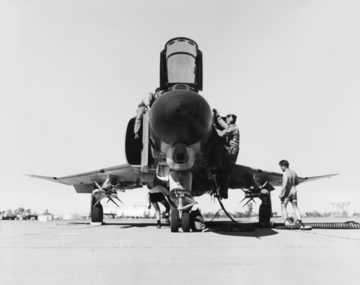
Photograph, F4E at RAAF Darwin, October 1972
... The F4E depicted was tasked to 'cold soak" Sidewinder and Sparrow missiles in the troposphere at 53,000 feetabove Darwin in a joint exercise for the RAAF and the United States Navy in 1972.The aircraft is being readied for flight by the aircrew and ground crew at RAAF Darwin....The F4E depicted was tasked to 'cold soak" Sidewinder and Sparrow missiles in the troposphere at 53,000 feetabove Darwin in a joint exercise for the RAAF and the United States Navy in 1972.The aircraft is being readied for flight by the aircrew and ground crew at RAAF Darwin. f4e raaf missle peace time darwin vietnam noelryan F4E at start up RAAF Darwin tarmac.Armed with Sidewinder and Sparrow missiles. ...The F4E depicted was tasked to 'cold soak" Sidewinder and Sparrow missiles in the troposphere at 53,000 feetabove Darwin in a joint exercise for the RAAF and the United States Navy in 1972.The aircraft is being readied for flight by the aircrew and ground crew at RAAF Darwin.F4E at start up RAAF Darwin tarmac.Armed with Sidewinder and Sparrow missiles. Photograph taken from the aircraft nose showing raised cockpit canopies,groundcrew and aircrew readying the airrcraft for flight. Note air start is connected Aircraft Serial No. A69-217.f4e, raaf, missle, peace time, darwin, vietnam, noelryan -
 Flagstaff Hill Maritime Museum and Village
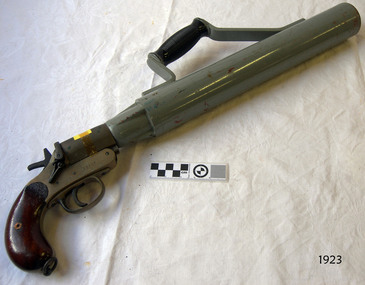
Equipment - Line throwing pistol, 1925-1945
... crew would send out equipment, including a breeches buoy, in which the stranded people could be pulled to shore. It has saved many lives at sea. The cartridge is loaded into the breech of the pistol and the rocket is inserted into the muzzle. On pulling the trigger, the gases generated by the fired cartridge eject the rocket on its correct line of flight...crew would send out equipment, including a breeches buoy, in which the stranded people could be pulled to shore. It has saved many lives at sea. The cartridge is loaded into the breech of the pistol and the rocket is inserted into the muzzle. On pulling the trigger, the gases generated by the fired cartridge eject the rocket on its correct line of flight ...This is a SPRA, or Schermuly’s Pistol Rocket Apparatus. The large firearm type pistol would have been used to throw a line between ships, usually in the event of saving lives. The line throwing pistol consists of a long barrel with handle attached, a pistol grip and trigger, which fires a short blank cartridge. Accessories for the pistol included: flares, 12 gauge adaptor (to shoot 12 gauge flares), a wood plunger, and boxes of faked line. The stamp on the handle, Crown over "NP" is a Birmingham Proof House mark that dates the pistol between 1904 and 1954. However Schermuly's line throwing pistol was invented in the 192s and used on British Naval Ships from 1929. The serial number '22507' is only 806 numbers later than one on sale as a British Military WWII issue SRPA '21701'. This pistol appears to be made 125-1945. The apparatus was used as a life saving device for crew and passengers on vessels in distress that were only a few hundred metres from shore, often eliminating the need to launch a boat and risk lives to go out to the vessel in dangerous conditions. It could also be used from ship to ship rescue. The pistol would launch a line from shore to the vessel. The line would be attached to the vessel, then shore crew would send out equipment, including a breeches buoy, in which the stranded people could be pulled to shore. It has saved many lives at sea. The cartridge is loaded into the breech of the pistol and the rocket is inserted into the muzzle. On pulling the trigger, the gases generated by the fired cartridge eject the rocket on its correct line of flight, and at the same time, burst through the waterproof disc and ignite the propellant mixture, which carries the rocket and line on the remainder of the flight. The rocket consists of a weldless steel case filled with propellant mixture sealed in by a waterproof disc. Fixed to the rocket case is a direction bridle, to the end of which a short length of flexible steel wire is attached, this in turn being connected to the end of the line to be thrown. A complete rocket set, or line throwing kit. would include a wood carrying case, two coils of faked line in separate compartments, three rockets and a can of six cartridges. William Schermuly (1857 – 1929) - Founder of the Schermuly business. In 1897 he invented a trough-fired, line throwing apparatus. In 1920 he and his third son, Alfred James Schermuly, invented the pistol rocket apparatus and promoted this overseas during the 1920s. The system was approved by the British Navy in 1929 through an Act of Parliament, which made it compulsory for ships over 500 tons to carry this equipment. The company, Schermuly Pistol Rocket Apparatus Ltd., grew quickly during and after World War II but business eased off during the 1970s before it eventually closed in the 1990s. Saving lives in Warrnambool – The coastline of South West Victoria is the site of over 600 shipwrecks and many lost lives; even in Warrnambool’s Lady Bay there were around 16 known shipwrecks between 1850 and 1905, with eight lives lost. Victoria’s Government responded to the need for lifesaving equipment and, in 1858, the provision of rocket and mortar apparatus was approved for the lifeboat stations. In 1859 the first Government-built lifeboat arrived at Warrnambool Harbour and a shed was soon built for it on the Tramway Jetty, followed by a rocket house in 1864 to safely store the rocket rescue equipment. In 1878 the buildings were moved to the Breakwater (constructed from 1874-1890), and in 1910 the new Lifeboat Warrnambool arrived with its ‘self-righting’ design. For almost a hundred years the lifesaving and rescue crews, mostly local volunteers, trained regularly to rehearse and maintain their rescue skills. They were summoned when needed by alarms, gunshots, ringing bells and foghorns. In July 1873 a brass bell was erected at Flagstaff Hill specifically to call the rescue crew upon news of a shipwreck. Some crew members became local heroes but all served an important role. Rocket apparatus was used as recently as the 1950s. This line-throwing pistol is part of he Rocket Launching Equipment used to perform life-saving rescue at sea from the 1920s. It is significant for its connection with local history, maritime history and marine technology. Lifesaving has been an important part of the services performed from Warrnambool's very early days, supported by State and Local Government, and based on the methods and experience of Great Britain. Hundreds of shipwrecks along the coast are evidence of the rough weather and rugged coastline. Ordinary citizens, the Harbour employees, and the volunteer boat and rescue crew, saved lives in adverse circumstances. Some were recognised as heroes, others went unrecognised. In Lady Bay, Warrnambool, there were around 16 known shipwrecks between 1850 and 1905. Many lives were saved but tragically, eight lives were lost.Pistol, line-throwing, SPRA (Schermuly's Pistol Rocket Apparatus). This line throwing pistol has a wooden pistol grip, brass trigger mechanism, and a long, wide, steel barrel with Bakelite handle attached to the top. Inscriptions are stamped onto the pistol.Stamped on handle: "5" and "[symbol of a Crown] above NP" , "22507", "[within oval] SPRA" Stamped on barrel: "L22507".gun, pistol, flagstaff hill, warrnambool, shipwrecked coast, flagstaff hill maritime museum, maritime museum, flagstaff hill maritime village, great ocean road, line throwing, line throwing pistol, spra, schermuly's pistol rocket apparatus, sea rescue, pyrotechnicks, marine technology, schermuly pistol rocket apparatus ltd., william schermuly, alfred schermuly, pistol line thrower, flagstaff hill maritime museum and village, maritime village, lady bay, warrnambool harbour, port of warrnambool, shipwreck, life-saving, lifesaving, rescue crew, rescue, rocket rescue, rocket crew, beach rescue, line rescue, rescue equipment, rocket firing equipment, rocket rescue equipment, maritime accidents, shipwreck victim, rocket equipment, rescue boat, lifeboat, volunteer lifesavers, volunteer crew, life saving rescue crew, lifesaving rescue crew, rocket apparatus, rocket rescue method, shore to ship, rocket apparatus rescue, stranded vessel, line throwing mortar, rocket rescue apparatus, line thrower, lifeboat warrnambool, rocket machine, rocket head, rocket launcher, rocket line, beach rescue set, rocket set, schermuly, line-firing pistol, line throwing gun, pistol rocket apparatus, line throwing cartridge, line-throwing rocket, firearm, life saving, lsrc -
 Bendigo Military Museum
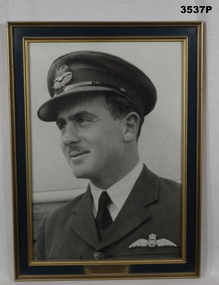
Photograph - PHOTOGRAPH RAAF, FRAMED, C. WW2
... Flight Lieutenant. On the 18.3 1943 during a low level attack on Japanese positions around Salamaua he hit his target but his plane was hit several times by flack and burst into flames but he landed it in the sea. Sgt B.G Eastwood No 13055 a crew...Flight Lieutenant. On the 18.3 1943 during a low level attack on Japanese positions around Salamaua he hit his target but his plane was hit several times by flack and burst into flames but he landed it in the sea. Sgt B.G Eastwood No 13055 a crew ...William Ellis NEWTON VC enlisted in the RAAF no 250748 on 5.2.1940 age 20 years 8 months. Serving with No 22Sqd RAAF flying Boston Bombers he arrived in New Guinea in May 1942. Along the way he was promoted to Pilot Officer, Flying Officer and then Flight Lieutenant. On the 18.3 1943 during a low level attack on Japanese positions around Salamaua he hit his target but his plane was hit several times by flack and burst into flames but he landed it in the sea. Sgt B.G Eastwood No 13055 a crew member went down with the aircraft. Newton and Flt Sgt J Lyon No 401706 swam to shore but were captured by the Japanese. Newton was taken to Lae for interrogation and then returned to Salamaua and was executed by decapitation and his body thrown in bomb crater on 29.3.1943. His body was later recovered in late 1943 when Australian troops captured Salamaua. Lyons was executed at Lae by bayoneting in the back. The award to Newton of the Victoria Cross was for low level attacks in the Salamaua area which inflicted heavy losses on Japanese installations one of which his plane was hit by flak heavily and he successfully flew it back some 180 miles and landed. The award also included the attack for which he was executed. Newtons and war crimes records are some 800 plus pages with photos, statements etc. Refer also Cat No 3456.Black & white photo, head & shoulders portrait of F/LT W. E. NEWTON V.C. He is wearing a peaked cap, collar & tie with RAAF wings badge on L side of jacket. In a green / gold wooden frame with glass front. Fawn paper backing. Gold plaque in middle beneath photo.Engraved on plaque: “F/LT W. E. NEWTON V.C. 22 Squadron RAAF”photograph, raaf, vc, newton
