
Showing 25 items matching "flour containers"
-
 Mont De Lancey
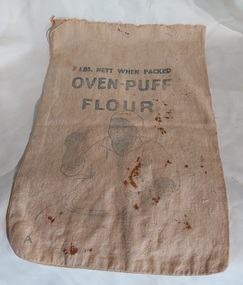
Domestic object - Flour Bag, WatsonMilling Company. Pty.Ltd, 1950's
... ...Flour containers...Flour Flour bags Flour containers Food storage bags ' 7LBS. NETT WHEN PACKED OVEN-PUFF FLOUR' There is an outline image of a black woman wearing a headscarf below the branding. ...This brand of Oven-Puff Flour may refer to self-raising flour. It is noted that self-rising flour (as it was called then) was invented in England in 1845. This flour was commonly branded as "Mammy Oven Puff". Mammy Products Pty Ltd operated during the mid-1900s, producing these specialty baking goods. Advertisements from the late 1930s and 1940s show the flour was marketed as "something different" for home bakers. Flour bags were used for bulk purchases of flour in early to mid 20th century. They would have been laundered and re-used for storage. In earlier times empty flour bags were washed and boiled and then made into tea towels or children’s bloomers, or underwear.A vintage small cream coloured draw string cotton flour bag with the brand Oven-Puff Flour printed in faded pale blue lettering on both sides. 7lbs. Nett when Packed is at the top of the bag. There is an outline image of a black woman wearing a headscarf below the branding. This flour was commonly branded as "Mammy Oven Puff". Mammy Products Pty Ltd. ' 7LBS. NETT WHEN PACKED OVEN-PUFF FLOUR' There is an outline image of a black woman wearing a headscarf below the branding. 'Watson Milling Company. Pty. Ltd.' Is stamped in faded blue on the back of the bag at the bottom. flour, flour bags, flour containers, food storage bags -
 Mont De Lancey
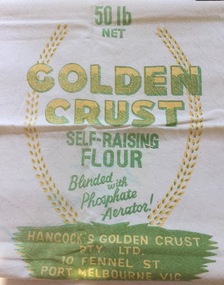
Domestic object - Flour bag, Hancock's Golden Crust Pty. Ltd, 1920's - 1950's
... ...Flour containers...Flour Flour bags Flour containers Food storage bags 'Golden Crust Self-Raising Flour 50 lb - Blended with Phosphate Aerator!' ...Self-rising flour was invented in England in 1845. The inventor, Henry Jones, sought to greatly improve the palatability of the “molar breaking” bread, hard tack, for British sailors. However, it took over 10 years of trying to convince the British command of the Navy to get behind it. In 1855, self-rising flour was finally put to use to make fresh bread for sailors during the Crimean War.Flour bags were used for bulk purchases of flour in early to mid 20th century. They would have been laundered and re-used for storage. In earlier times empty flour bags were washed and boiled and then made into tea towels or children’s bloomers, or underwear.A vintage white calico flour bag with the brand Golden Crust Self-Raising Flour printed in yellow and green lettering on the front, surrounded by two curved lines of wheat stalks each side. The manufacturing details are printed at the bottom with 50 lb Net at the top. 'Golden Crust Self-Raising Flour 50 lb - Blended with Phosphate Aerator!' 'Hancock's Golden Crust Pty.Ltd. 10 Fennel St Port Melbourne Vic'flour, flour bags, flour containers, food storage bags -
 Hume City Civic Collection
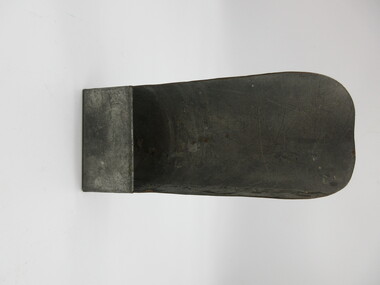
Scoop
... This tin scoop would have been used in the kitchen at the Sunbury Asylum to distribute bulk food such as sugar, flour etc from larger containers....A tin scoop used to distribute sugar, flour etc from storage containers....This tin scoop would have been used in the kitchen at the Sunbury Asylum to distribute bulk food such as sugar, flour etc from larger containers. sunbury asylum george evans collection A tin scoop used to distribute sugar, flour etc from storage containers. ...This tin scoop would have been used in the kitchen at the Sunbury Asylum to distribute bulk food such as sugar, flour etc from larger containers.A tin scoop used to distribute sugar, flour etc from storage containers.sunbury asylum, george evans collection -
 Bendigo Historical Society Inc.
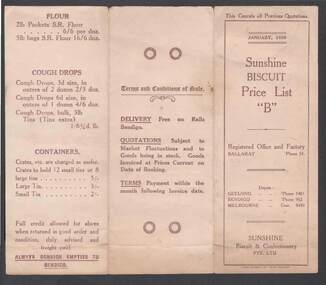
Document - SUNSHINE BISCUIT PRICE LIST 'B'
... Prices of Various Dry Biscuits, Semi-Sweet Biscuits, Sweet Biscuits, Rich Dessert and Cream Biscuits, Specialties, Holiday Mixture, Cakes, Sunshine Party Packets,Flour, Cough Drops and containers....Prices of Various Dry Biscuits, Semi-Sweet Biscuits, Sweet Biscuits, Rich Dessert and Cream Biscuits, Specialties, Holiday Mixture, Cakes, Sunshine Party Packets,Flour, Cough Drops and containers. Document SUNSHINE BISCUIT PRICE LIST 'B' ...Sunshine Biscuit Price List 'B' dated January 1926. Registered Office Ballarat, Phone 53. Depots, Geelong, Bendigo, Melbourne. Terms and Conditions of Sale Listed. Delivery Free on Rails Bendigo. Quotations Subject to Market Fluctations and to goods in Stock. Terms Payment within the Month following Invoice Date. Prices of Various Dry Biscuits, Semi-Sweet Biscuits, Sweet Biscuits, Rich Dessert and Cream Biscuits, Specialties, Holiday Mixture, Cakes, Sunshine Party Packets,Flour, Cough Drops and containers.bendigo, industry, biscuit making, sunshine biscuit co. 1926 price list of biscuits -
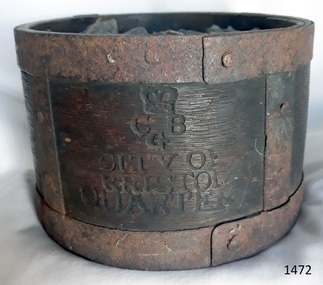 Flagstaff Hill Maritime Museum and Village
Functional object - Standard Measure, Late 18th to early 19th century (before the standardised measurement was introduced in England in 1824)
... flour. The term referred to varying quantities until the modern units of measurement were defined in the 19th century. Cities in England used to have official standard weights and measures for that city or area. These containers...flour. The term referred to varying quantities until the modern units of measurement were defined in the 19th century. Cities in England used to have official standard weights and measures for that city or area. These containers ...The peck has been in use since the early 14th century when it was introduced as a measure for flour. The term referred to varying quantities until the modern units of measurement were defined in the 19th century. Cities in England used to have official standard weights and measures for that city or area. These containers were marked with the city's name and emblem, merchant’s weights and measures would then be checked against this to make sure they weren't trying to cheat their customers. The item in the collection is a standard measure approved by Bristol City and used by that City’s grocers to measure dry goods such as peas, beans, sugar, flour, meal etc., and its metal banding ensures that the measure cannot be reduced in size to cheat customers. Additional Information: The British Imperial System evolved from the thousands of Roman, Celtic, Anglo-Saxon, and customary local units employed in the middle Ages. Traditional names such as pound, foot, and gallon were widely used, but the values so designated varied with time, place, trade, product specifications, and dozens of other requirements. Early royal standards were established to enforce uniformity took the name Winchester, after the ancient tenth century capital of Britain. King Henry VII reaffirmed the customary Winchester standards for capacity and length and distributed royal standards throughout the realm. This process was repeated about a century later in the reign of Queen Elizabeth I. In the 16th century, the rod (5.5 yards, or 16.5 feet) was defined (once again as a learning device and not as a standard) defined by the length of the left feet of 16 men lined up heel to toe as they emerged from the church. By the 17th century usage and legal statute had established the acre, rod, and furlong at their present values together with other historic units such as the peck. Establishment of the System: The Weights and Measures Act of 1824 and the Act of 1878 established the British Imperial System based on precise definitions of selected existing units. The 1824 act sanctioned a single imperial gallon to replace the wine, ale, and corn (wheat) gallons that were in general use. The new gallon was defined as equal in volume to 10 pounds avoirdupois of distilled water weighed at 62°F with the barometer at 30 inches, or 277.274 cubic inches (later corrected to 277.421 cubic inches). The two new basic standard units were the imperial standard yard and the troy pound, which was later restricted to weighing drugs, precious metals, and jewels. In 1963 an act of parliament abolished archaic measures as the rod and chaldron and a metric system was adopted. An early example of a dry measuring container giving a snapshot of how imperial weights and measures developed in England to evolve the British measurement system into the metric arrangement that most countries have adopted today including Australia. It has social significance as an item that was in everyday use by grocers and other merchants to measure dry goods in the late 18th to early 19th centuries and used specifically in the Bristol region of England as an officially recognised measurement.Standard Measure; Half Peck dry measure. Wooden measurement container with iron banding and hand made rivets container is a Quarter Peck official measurement container. Inscriptions are impressed into the sides of the wooden body. The container has the official crown and emblem of the City of Bristol, indicating this item was the Bristol City standard quarter peck measurement.Impressed into the timber on the front, a crown emblem over "C B G / CITY OF BRISTOL / QUARTER", on one side "HALF" , another side "PECK". Handwritten in white chalk on the base is "1458"flagstaff hill, warrnambool, shipwrecked-coast, flagstaff-hill-maritime-museum, flagstaff-hill-maritime-village, weights and measures, quarter peck, measurement container, dry grocery measure, bristol city measurement standard, city of bristol, british weights and measures, 18th and 19th centure standard measures -
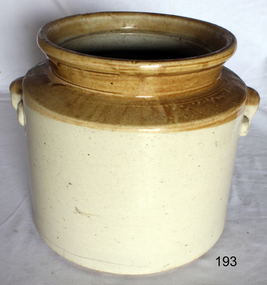 Flagstaff Hill Maritime Museum and Village
Ceramic - Stoneware Container, 1900 to 1940
... Or larger containers for kitchen flour. Items age is difficult to determine given the same techniques for making stoneware are in use today. ...Or larger containers for kitchen flour. Items age is difficult to determine given the same techniques for making stoneware are in use today. ...Stoneware is a rather broad term for pottery or other ceramics that is fired at a relatively high temperature. A modern technical definition is a vitreous or semi-vitreous ceramic made primarily from stoneware clay or non-refractory fire clay. Whether vitrified or not, it is non-porous, it may or may not be glazed. Historically, across the world, it has been developed after earthenware and before porcelain and has often been used for high-quality as well as utilitarian wares. As a rough guide, modern earthen wares are normally fired in a kiln at temperatures in the range of about 1,000°C (1,830 °F) to 1,200 °C (2,190 °F); stoneware's at between about 1,100 °C (2,010 °F) to 1,300 °C (2,370 °F); and porcelains at between about 1,200 °C (2,190 °F) to 1,400 °C (2,550 °F). Historically, reaching high temperatures was a long-lasting challenge, and temperatures somewhat below these were used for a long time. Earthenware can be fired effectively as low as 600°C, achievable in primitive pit firing, but 800 °C was more typical. Stoneware also needs certain types of clays, more specific than those able to make earthenware, but can be made from a much wider range than porcelain. A domestic item used to store food products as glazing makes the container non-porous, often used for pickling. Or larger containers for kitchen flour. Items age is difficult to determine given the same techniques for making stoneware are in use today. Stoneware containers were made by many potteries in Australia and England. They were in common domestic use before plastics were invented around 1940 to store goods so this subject item is probably from around 1900 to the 1940s. Item's significance is difficult to determine given it is not associated with a place, person, historic event, or manufacturer. Its significance lies with its use as a domestic object giving today a view into our social past.Stoneware circular container with wide opening, brown top and off white base. Handholds moulded on each side glazed finish, cracks in base.Noneflagstaff hill, warrnambool, shipwrecked coast, flagstaff hill maritime museum, shipwreck coast, flagstaff hill maritime village, great ocean road, container, stoneware container, kitchen storage, kitchen ware -
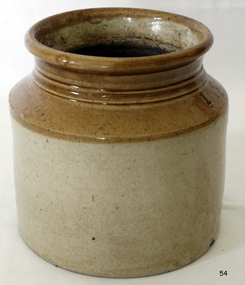 Flagstaff Hill Maritime Museum and Village
Ceramic - Stoneware Container, 1900 to 1940
... Or larger containers for kitchen flour. Items age is difficult to determine given the same techniques for making stoneware are in use today. ...Or larger containers for kitchen flour. Items age is difficult to determine given the same techniques for making stoneware are in use today. ...Stoneware is a rather broad term for pottery or other ceramics that is fired at a relatively high temperature. A modern technical definition is a vitreous or semi-vitreous ceramic made primarily from stoneware clay or non-refractory fire clay. Whether vitrified or not, it is non-porous, it may or may not be glazed. Historically, across the world, it has been developed after earthenware and before porcelain and has often been used for high-quality as well as utilitarian wares. As a rough guide, modern earthen wares are normally fired in a kiln at temperatures in the range of about 1,000°C (1,830 °F) to 1,200 °C (2,190 °F); stoneware's at between about 1,100 °C (2,010 °F) to 1,300 °C (2,370 °F); and porcelains at between about 1,200 °C (2,190 °F) to 1,400 °C (2,550 °F). Historically, reaching high temperatures was a long-lasting challenge, and temperatures somewhat below these were used for a long time. Earthenware can be fired effectively as low as 600°C, achievable in primitive pit firing, but 800 °C was more typical. Stoneware also needs certain types of clays, more specific than those able to make earthenware, but can be made from a much wider range than porcelain. A domestic item used to store food products as glazing makes the container non-porous, often used for pickling. Or larger containers for kitchen flour. Items age is difficult to determine given the same techniques for making stoneware are in use today. Stoneware containers were made by many potteries in Australia and England. They were in common domestic use before plastics were invented around 1940 to store goods so this subject item is probably from around 1900 to the 1940s. Item's significance is difficult to determine given it is not associated with a place, person, historic event, or manufacturer. Its significance lies with its use as a domestic object giving today a view into our social past.Stoneware circular container with wide opening, brown top and off white base glazed finish Marked "1" on brown glazed rimflagstaff hill, warrnambool, shipwrecked coast, flagstaff hill maritime museum, shipwreck coast, flagstaff hill maritime village, great ocean road, container, stoneware container, kitchen storage, kitchen ware -
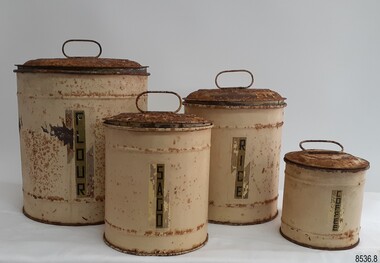 Flagstaff Hill Maritime Museum and Village
Container - Kitchen Canister set, Late 19th to early 20th century
... container...vintage...flour...Flagstaff Hill Flagstaff Hill Maritime Museum and Village Warrnambool Maritime Museum Maritime Village Great Ocean Road Shipwreck Coast canister set kitchen storage food storage metal canisters dry food storage food packaging kitchen container vintage flour rice sago coffee kitchenalia late 19th to early 20th centuries nesting canisters Labels, in descending order: "FLOUR" "RICE" "SAGO" "COFFEE" Canister set; four cylindrical cream coloured metal canisters with domed lids that have lift-up handles on top. ...This set of kitchen dry food canisters is made of metal; each container has a different height, width and capacity. The rolled thin metal has created a strong, round design with decorative rings on the circumference. The base and close-fitting lid protect the contents from vermin and most insects, and the handle on top aids in the removal of the lid. Metal containers like these are reusable and can be re-purposed, which is advantageous when living in regional or rural areas. The type of manufacture indicates that the set was made in the late 19th to early 20th century. Gradually, colourful and attractive plastic kitchenware began to replace metalware. One of the canisters is labelled 'coffee'; coffee plants and seeds were transported from Brazil into Australia in 1788 when the First Fleet arrived although their growth was unsuccessful. However, by the 1920s, a tenth of the Australian population was drinking readily stored coffee. Large quantities of harvested grains such as maize, wheat and barley were protected from pests by being stored in airy buildings, often raised from the ground. This was an age-old practice used by civilizations such as the ancient Egyptians and early Hebrews. Smaller quantities of food for short-term use in the homes were stored in woven baskets or clay pots.This set of kitchen food containers is an example of colonial food storage used in a domestic setting to store and preserve dry ingredients. These canisters give a snapshot of early domestic life in Australia. Canister set; four cylindrical cream coloured metal canisters with domed lids that have lift-up handles on top. They are made from rolled metal and the bases and lids have a side seam. Each canister is a different size and displays a label for different contents. The adhesive labels are vertical, and a gold colour with black vertical text. The cream paint has brush strokes and small areas have exposed green paint under the cream. The insides of the bases are painted dark grey but the lids have no paint underneath. The empty canisters can fit one inside the other. Labels, in descending order: "FLOUR" "RICE" "SAGO" "COFFEE"flagstaff hill, flagstaff hill maritime museum and village, warrnambool, maritime museum, maritime village, great ocean road, shipwreck coast, canister set, kitchen storage, food storage, metal canisters, dry food storage, food packaging, kitchen container, vintage, flour, rice, sago, coffee, kitchenalia, late 19th to early 20th centuries, nesting canisters -
 Flagstaff Hill Maritime Museum and Village
Container - Copper Drum, 1903
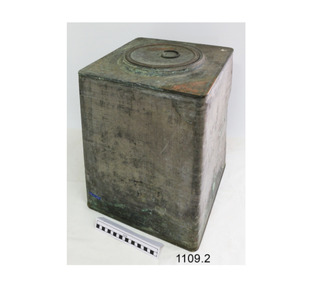
... The container once empty of explosives was used for many years as a flour bin on board the crayfish ketch "Lady Brassey" by Mr Charlie Washbourne, Crib Point, Australia (on the Mornington Peninsula in Victoria). ...The container once empty of explosives was used for many years as a flour bin on board the crayfish ketch "Lady Brassey" by Mr Charlie Washbourne, Crib Point, Australia (on the Mornington Peninsula in Victoria). ...This copper and tin container was used for the storage and transport of cordite that replaced black powder in 1889 as a military propellant. The stamped of a government broad arrow and date 1903 show the item was made for the war department and not for commercial use. The container once empty of explosives was used for many years as a flour bin on board the crayfish ketch "Lady Brassey" by Mr Charlie Washbourne, Crib Point, Australia (on the Mornington Peninsula in Victoria). The ketch Lady Brassey was probably named after Anna or "Annie" Brassey (née Allnutt), Baroness Brassey (7 October 1839 – 14 September 1887) who was an English traveller and writer. Her bestselling book A Voyage in the Sunbeam, Our Home on the Ocean for Eleven Months (1878) describes a voyage around the world including a visit to Australia.The explosives container is an example of how explosive compounds were stored and transported at the turn of the 20th century. It is significate as it is in very good condition and an artefact from Australia's colonial history around the Federation, just as the country was gaining independence from Britain.Metal box with tin sides, copper top and base and round, double layered lid that has a folding, D shaped handle. Referred to as a cordite container or copper drum. Inscriptions are stamped onto the drum and are on a sticker under the lid.Handle stamped "S & Co. 1900" on lid. Base is stamped "R.G.D. 1903" (meaning the container seals are resistant to Rapid Gas Decompression (RGD)") Logo: triangular "(vertical arrow) / A T " between letters and date. Base also has blue plastic label "N.T. 55" Sticker: "B55". flagstaff hill, warrnambool, flagstaff hill maritime museum, maritime museum, shipwreck coast, flagstaff hill maritime village, great ocean road, copper container, gunpowder container, government issue container, r.g.d. 1903, lady brassey, charlie washbourne, crib point, baroness brassey, cordite container, copper drum, gun powder container, gun powder, black powder, black powder container, explosives storage, crayfish ketch -
 Flagstaff Hill Maritime Museum and Village
Ceramic - Stoneware Bottle, 1890-1940
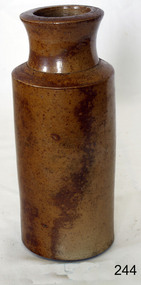
... Or larger containers for kitchen flour. Items age is difficult to determine given the same techniques for making stoneware are in use today. ...Or larger containers for kitchen flour. Items age is difficult to determine given the same techniques for making stoneware are in use today. ...Stoneware is a rather broad term for pottery or other ceramics that is fired at a relatively high temperature. A modern technical definition is a vitreous or semi-vitreous ceramic made primarily from stoneware clay or non-refractory fire clay. Whether vitrified or not, it is non-porous, it may or may not be glazed. Historically, across the world, it has been developed after earthenware and before porcelain and has often been used for high-quality as well as utilitarian wares. As a rough guide, modern earthen wares are normally fired in a kiln at temperatures in the range of about 1,000°C (1,830 °F) to 1,200 °C (2,190 °F); stoneware's at between about 1,100 °C (2,010 °F) to 1,300 °C (2,370 °F); and porcelains at between about 1,200 °C (2,190 °F) to 1,400 °C (2,550 °F). Historically, reaching high temperatures was a long-lasting challenge, and temperatures somewhat below these were used for a long time. Earthenware can be fired effectively as low as 600°C, achievable in primitive pit firing, but 800 °C was more typical. Stoneware also needs certain types of clays, more specific than those able to make earthenware, but can be made from a much wider range than porcelain. A domestic item used to store food products as glazing makes the container non-porous, often used for pickling. Or larger containers for kitchen flour. Items age is difficult to determine given the same techniques for making stoneware are in use today. Stoneware containers were made by many potteries in Australia and England. They were in common domestic use before plastics were invented around 1940 to store goods so this subject item is probably from around 1900 to the 1940s.Item's significance is difficult to determine given it is not associated with a place, person, historic event, or manufacturer. Its significance lies with its use as a domestic object giving today a view into our social past.Brown salt glaze stoneware bottle None (possibly made by Royal Doulton UK)flagstaff hill, warrnambool, flagstaff hill maritime museum, maritime museum, flagstaff hill maritime village, great ocean road, bottle, stoneware bottle, storage, kitchen ware, salt glazed, stoneware, shipwreck coast -
 Flagstaff Hill Maritime Museum and Village
Ceramic - Jug, 1900 - 1940
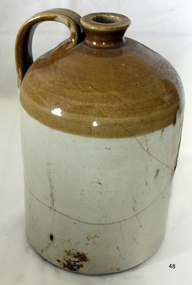
... Or larger containers for kitchen flour. Items age is difficult to determine given the same techniques for making stoneware are in use today. ...Or larger containers for kitchen flour. Items age is difficult to determine given the same techniques for making stoneware are in use today. ...Stoneware is a rather broad term for pottery or other ceramics that is fired at a relatively high temperature. A modern technical definition is a vitreous or semi-vitreous ceramic made primarily from stoneware clay or non-refractory fire clay. Whether vitrified or not, it is non-porous, it may or may not be glazed. Historically, across the world, it has been developed after earthenware and before porcelain and has often been used for high-quality as well as utilitarian wares. As a rough guide, modern earthen wares are normally fired in a kiln at temperatures in the range of about 1,000°C (1,830 °F) to 1,200 °C (2,190 °F); stoneware's at between about 1,100 °C (2,010 °F) to 1,300 °C (2,370 °F); and porcelains at between about 1,200 °C (2,190 °F) to 1,400 °C (2,550 °F). Historically, reaching high temperatures was a long-lasting challenge, and temperatures somewhat below these were used for a long time. Earthenware can be fired effectively as low as 600°C, achievable in primitive pit firing, but 800 °C was more typical. Stoneware also needs certain types of clays, more specific than those able to make earthenware, but can be made from a much wider range than porcelain. A domestic item used to store food products as glazing makes the container non-porous, often used for pickling. Or larger containers for kitchen flour. Items age is difficult to determine given the same techniques for making stoneware are in use today. Stoneware containers were made by many potteries in Australia and England. They were in common domestic use before plastics were invented around 1940 to store goods so this subject item is probably from around 1900 to the 1940s.Item's significance and origin of manufacture is difficult to determine given it is not associated with a place, person, historic event, or manufacturer. Its significance lies with its use as a domestic object giving today a view into our social past. Stoneware jug badly cracked and repaired with handle and short neckNoneflagstaff hill, warrnambool, shipwrecked coast, flagstaff hill maritime museum, maritime museum, shipwreck coast, flagstaff hill maritime village, great ocean road, jug, stoneware jug, earthenware jug, kitchen storage -
 Flagstaff Hill Maritime Museum and Village
Ceramic - Jug, 1920-1940
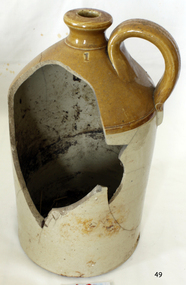
... Or larger containers for kitchen flour. Items age is difficult to determine given the same techniques for making stoneware are in use today. ...Or larger containers for kitchen flour. Items age is difficult to determine given the same techniques for making stoneware are in use today. ...Stoneware is a rather broad term for pottery or other ceramics that is fired at a relatively high temperature. A modern technical definition is a vitreous or semi-vitreous ceramic made primarily from stoneware clay or non-refractory fire clay. Whether vitrified or not, it is non-porous, it may or may not be glazed. Historically, across the world, it has been developed after earthenware and before porcelain and has often been used for high-quality as well as utilitarian wares. As a rough guide, modern earthenwares are normally fired in a kiln at temperatures in the range of about 1,000°C (1,830 °F) to 1,200 °C (2,190 °F); stoneware's at between about 1,100 °C (2,010 °F) to 1,300 °C (2,370 °F); and porcelains at between about 1,200 °C (2,190 °F) to 1,400 °C (2,550 °F). Historically, reaching high temperatures was a long-lasting challenge, and temperatures somewhat below these were used for a long time. Earthenware can be fired effectively as low as 600°C, achievable in primitive pit firing, but 800 °C was more typical. Stoneware also needs certain types of clays, more specific than those able to make earthenware, but can be made from a much wider range than porcelain. A domestic item used to store food products as glazing makes the container non-porous, often used for pickling. Or larger containers for kitchen flour. Items age is difficult to determine given the same techniques for making stoneware are in use today. Stoneware containers were made by many potteries in Australia and England. They were in common domestic use before plastics were invented around 1940 to store goods so this subject item is probably from around 1900 to the 1940s. Item's significance is difficult to determine given it is not associated with a place, person, historic event, or manufacturer. Its significance lies with its use as a domestic object giving today a view into our social past.Brown Stoneware jug with short neckThe number "1" under neck flagstaff hill, warrnambool, shipwrecked coast, flagstaff hill maritime museum, shipwreck coast, flagstaff hill maritime village, great ocean road, jug, stoneware jug, salt glaze -
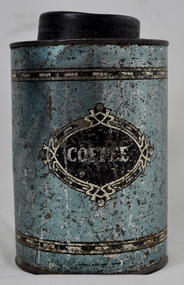 Kiewa Valley Historical Society
Tin Coffee Cylindrical, circa mid to late 1900's
... This "insignificant" coffee tin is very significant as it demonstrates that the Kiewa Valley was becoming more accessible to reliable coffee supplies and general food items.The container was part of a "set" of containers that included tea, sugar,biscuits,flour, rice and other family condiments. ...This "coffee" tin has by the "art deco" appearance its origins in the late 1950's to 1960's. This time period was one of accelerated growth both in the physical (housing) sense and the mental (new ideas and inventions) changes in "attitudes". These occurred more rapidly in cities but had its effects on the rural environment. The drinking of coffee was spurred on by easier distribution of imported food and drinks. Advertising by stronger radio links and then by television brought the variety of foods and drinks to semi isolated rural regions. The accessibility through greater information channels becoming available brought with it unbelievable ranges of goods and foodstuffs. Rural regions still relied on bulk supplies and relatively larger storage containers than those in cities. This "bulk" buying and storage "syndrome" was a lingering result of many years of "drought" periods when road transports met delays from flooded roadways in supplying population centres in the Kiewa Valley. The construction phases in building the SEC Vic Hydro electricity Scheme in the eastern sections of the Victorian Alps brought many changes to the quiet rural regions in the Kiewa Valley. Changes in population and social mores. The influx of a varied , mostly temporary, and "European flavoured cuisine" changes the "cuppa tea only" flavour to the have a "coffee break". The subliminal influence of the "American" films changed those children growing up in the post 1950s from the "English tea" to the "American coffee". This "Americanisation process has influenced not only rural Australia but also other areas throughout the world.This "insignificant" coffee tin is very significant as it demonstrates that the Kiewa Valley was becoming more accessible to reliable coffee supplies and general food items.The container was part of a "set" of containers that included tea, sugar,biscuits,flour, rice and other family condiments. This type of kitchen storage containers was brought about through changing patterns in tea and coffee useage and overall consumption. Household demands for faster "self help" cooking especially beveridges and the greater choice of kitchen "utensils" was brought on by easier access to products due to a lessening of the area's "isolation" by having a reliable (all weather) road system and an ever increasing population growth. The need for travelling goods/merchant supply caravans to service the area became a diminishing factor, as a result of the establishment of grocery stores in Tawonga and Mount Beauty in the supply of previously "hard to get" groceries. This transition was precipitated by the SEC Vic Hydro Scheme of the 1940's to 1960's which increased the valley's population level three fold.This cylindrical tin has a pull/push lid(for easy access to the contents). The container is labelled for "coffee" however it has no commercial manufacturer's label to establish that it was bought with coffee ingredients in it. The majority of the container's external surface has a "metallic" light blue colour with two sets of silver rings confining black (horizontal spotted) rectangles. "COFFEE" within an elongated spherical "art deco" four pointed banner of silver and black colouringkitchen containers, domestic food storage, bulk stocks of dried condiments -
![[1] Three Bears Porridge Flaked Oatmeal Bag (Front)](/media/collectors/510b3f7f023fd725b4cd51fe/items/683baf6c69688f11138d56ba/item-media/683bf711460ecdfee7105b40/item-fit-380x285.jpg?cb=6) Arapiles Historical Society
Arapiles Historical SocietyContainer - Roy SCHMIDT Collection - Cotton Flour Bags (3)
... flour bag made of cream-coloured calico or cotton. The front of the bag is printed in bold blue ink with branding and export information. It prominently features a large triangular logo reading “Blue Triangle Brand” and numerous lines of text in block and stylised fonts. The bag is open at the top with frayed edges, suggesting it was once machine-stitched shut and later opened. Container ...[1] Three Bears Porridge Flaked Oatmeal Bag: This textile bag originates from Canadian Cereal Mills Ltd., which marketed "Three Bears" flaked oatmeal. Popular in the early 1900s to mid-century, this product combined functional packaging with a child-friendly incentive — a cut-out cloth doll. The practice of printing toys, games, or clothing patterns on flour or oat sacks was a common marketing strategy, encouraging reuse and appealing to families during times when thrift and creativity were essential, especially during the Depression and wartime years. The Three Bears brand played off the enduring popularity of children’s nursery tales, while the doll encouraged children (and parents) to reuse packaging creatively. This object captures a unique intersection of food marketing, household resourcefulness, and early 20th-century domestic life. [2] Mammy Self-Raising Flour Bag: This item is a mid-20th-century Australian flour bag, branded “Mammy Oven Puff”, produced by A. Mammy Products Pty Ltd in West Footscray, Victoria. The use of the name "Mammy" and the caricatured illustration draws on a now widely recognised and offensive racial stereotype originating from American minstrel culture, commonly used in product branding in the early-to-mid 20th century. While the bag reflects a specific period in Australian domestic and commercial packaging history, it also exemplifies racially insensitive advertising that would be considered inappropriate and harmful by today’s standards. Such items are preserved today in museum collections to help document past social attitudes, consumer culture, and the evolution of racial representation in advertising. [3] Bandung Blue Triangle Brand Flour Bag: This bag represents a mid-20th-century Australian flour export product, particularly aimed at international markets such as Indonesia (as indicated by "Bandung"). The “Blue Triangle Brand” was likely a registered trademark used by a Melbourne-based flour mill engaged in both local and overseas trade. The use of durable cloth bags for bulk flour was common prior to the widespread adoption of paper and plastic packaging. These bags were often reused domestically for household textiles, clothing patterns, or storage. The export reference (Bandung) underscores Australia's historical agricultural trade ties with Southeast Asia, especially in wheat and flour exports. – Roy SCHMIDT resided with his siblings Mabel and Jack at ‘Parklands’ 85 Lake Avenue Natimuk home of Heinrich Friederick ‘Heiny’ & Minna Christina SUDHOLZ nee LANGE and their children Louis, Sophie, Alma, Lena (Roy's Mother), Florence 'Florrie' and Edward ‘Ted’.[1] Three Bears Porridge Flaked Oatmeal Bag: A vintage cloth oatmeal bag printed with black ink on both sides. One side is branded with "Three Bears Porridge – Flaked Oatmeal", showing an image of three bears behind a gate, referencing the well-known “Goldilocks and the Three Bears” fairytale. The opposite side features a printed cut-out doll design, showing a young girl with curly hair holding a bouquet of flowers, intended to be sewn into a stuffed toy. Instructions note that the reverse side (the doll’s back) could be obtained from a second bag. The design combines product branding with a promotional activity for children, typical of early- to mid-20th-century grocery packaging aimed at reuse. [2] Mammy Self-Raising Flour Bag: A small vintage cloth flour bag with printed branding in faded red, blue, and black inks. The front of the bag features a central image of a caricatured smiling African American woman wearing a headscarf. The text is unevenly faded but legible in parts. The bag has a rectangular shape with an open top edge and signs of previous use, including creasing and some fraying at the corners. [3] Bandung Blue Triangle Brand Flour Bag: A large, rectangular vintage cloth flour bag made of cream-coloured calico or cotton. The front of the bag is printed in bold blue ink with branding and export information. It prominently features a large triangular logo reading “Blue Triangle Brand” and numerous lines of text in block and stylised fonts. The bag is open at the top with frayed edges, suggesting it was once machine-stitched shut and later opened.[1] Three Bears Porridge Flaked Oatmeal Bag: Front side (branding side): "THREE BEARS Porridge – FLAKED OATMEAL" "7 Lbs. Net." “Packed and guaranteed by Canadian Cereal Mills Ltd., Toronto” Reverse side (doll pattern): "This is the Front for Three Bears Cut-out Doll" "In order to complete this Doll it will be necessary to obtain the Back Design from another Bag of Three Bears Rolled Oats or Oatmeal." [2] Mammy Self-Raising Flour Bag: Main product name: “MAMMY OVEN PUFF SELF-RAISING FLOUR” Additional text: “The Only Creamed Flour” “Prepared with phosphate aerator” “A. MAMMY PRODUCTS PTY. LTD., Sunshine Rd., West Footscray. Phone: FW 7321” “7 LBS. NET” (near top edge, very faded) [3] Bandung Blue Triangle Brand Flour Bag: The bag is printed with the following: “10270” “G.W.C | H.L” “BANDUNG” “BEST AUSTRALIAN” “BLUE TRIANGLE BRAND” (inside the triangle logo) “GROWER & GRINDERS” (curved around the logo) “Patent Roller” “MELBOURNE” “FLOUR” “50 LBS. GROSS WHEN PACKED” These inscriptions indicate that this flour bag was manufactured in Melbourne, Australia, and was likely exported to Bandung, Indonesia.farm equipment, flour, milling, oats, mammy, bandung blue, schmidt, sudholz, parklands -
 Dutch Australian Heritage Centre Victoria
Flour Jar (Meel Pot)
... container. The decorations are of flowers and ferns. A dark grey, cylindrical pottery canister with dark blue decorations. Flour ...A dark grey, cylindrical pottery canister with dark blue decorations.An engraving of the word Meel with a dotted border is on the front of the jar. A protruding handle is found on each side of the container. The decorations are of flowers and ferns. -
Port Melbourne Historical & Preservation Society
Container - Bags, Robert Harper & Co, 1900 - 1925
... Business and Traders - Bakers Industry - Food Robert Harper & Co Ltd Three calico bags with colourful trade information printing; flour and rolled oats, two bags clearly Robert Harper and Company Limited, early 20th Century. .01 "Three Bears Porridge Rolled Oats" 7 lbs .02 "Harpers Star Avena Brand Rolled Oats"- on the back "The SilverStar Rice Starch" 7 lbs .03 "Empire Self Raising Flour" 25 lbs Container Bags, Robert Harper & Co ...Three calico bags with colourful trade information printing; flour and rolled oats, two bags clearly Robert Harper and Company Limited, early 20th Century. .01 "Three Bears Porridge Rolled Oats" 7 lbs .02 "Harpers Star Avena Brand Rolled Oats"- on the back "The SilverStar Rice Starch" 7 lbs .03 "Empire Self Raising Flour" 25 lbsbusiness and traders - bakers, industry - food, robert harper & co ltd -
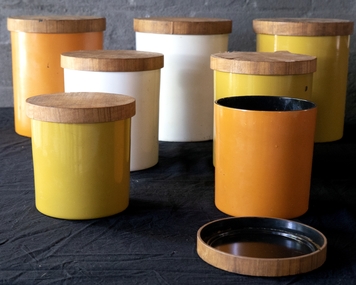 Robin Boyd Foundation
Functional object - Canister set
... flour, sugar, rice and biscuits etc. Both Robin and Patricia liked melamine, and also had melamine serving dishes. cookware Walsh St kitchenware robin boyd Seven melamine containers with coloured exteriors (ranging from white through yellowy-green, orange and black) with black interiors and teak lids. ...Robin Boyd developed a close friendship with the founder of the Bauhaus in Weimar Germany, Walter Gropius, who had moved to the USA in the 1930s. Through this connection, Boyd was invited to be the Massachusetts Institute of Technology (MIT) Bemis Professor at the School in the North American academic year 1956-7. During this time, the Boyds purchased this set of melamine kitchen canisters. They were used for flour, sugar, rice and biscuits etc. Both Robin and Patricia liked melamine, and also had melamine serving dishes. Seven melamine containers with coloured exteriors (ranging from white through yellowy-green, orange and black) with black interiors and teak lids. Height ranges from 100-200mm, width ranges from 110-170mm, Base measures 100-155mmcookware, walsh st kitchenware, robin boyd -
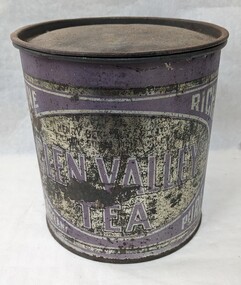 Numurkah & District Historical Society
Container - Tin Container (Glen Valley)
... flour, sugar and other commodities. He founded Henry Berry and Company (Australasia) Ltd1 which became one of the largest importers and distributors in Australia. Glen Valley Tea Tin container ...Henry Berry was a British-born merchant who came to Melbourne in 1856 and established a successful business in salt and general goods. He later expanded into tea, flour, sugar and other commodities. He founded Henry Berry and Company (Australasia) Ltd1 which became one of the largest importers and distributors in Australia.Round tin container with purple and sliver coloured background, and purple writing. has round pull-off lidGlen Valley Tea glen valley, tea, tin container, henry berry -
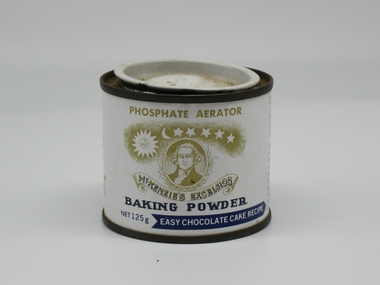 Hume City Civic Collection
Container - Tin, McKenzies Baking Powder
... flour may not be available. McKenzies Baking Powder was a well known product used in the home. social history Cooking Food McKENZIES EXCELSIOR/BAKING POWDER/NET 125g EASY CHOCOLATE CAKE RECIPE Small tin with white and gold printing and with a white lid. It has a recipe printed on the back. McKenzies Baking Powder Container ...The baking powder contents of this tin would have been used in cooking. Baking powder is a raising agent and in cake recipes can be added to plain flour when self raising flour may not be available. McKenzies Baking Powder was a well known product used in the home.Small tin with white and gold printing and with a white lid. It has a recipe printed on the back.McKENZIES EXCELSIOR/BAKING POWDER/NET 125g EASY CHOCOLATE CAKE RECIPEsocial history, cooking, food -
 Parks Victoria - Days Mill and Farm
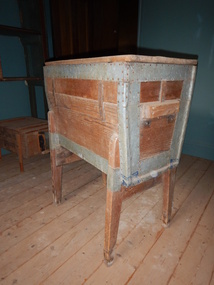
Container - Flour bin
... Metal brackets are nailed to the four sides of the top and bottom bin as well as the corner sides. Container Flour bin ...of critical significance WOODEN BIN WITH LID AND LEGS - rectangular wooden bin with loose lid and 4 legs. Metal brackets are nailed to the four sides of the top and bottom bin as well as the corner sides. -
 Surrey Hills Historical Society Collection
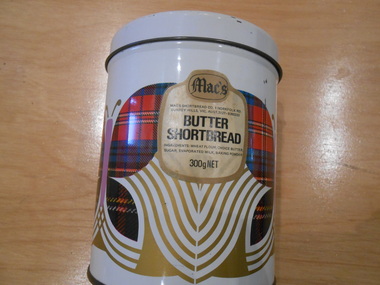
Container - Biscuit tin, Mac's Butter Shortbread tin
... AUST. 3127 - 8360333 / BUTTER / SHORTBREAD / INGREDIENTS: WHEAT FLOUR, CHOICE BUTTER, / SUGAR, EVAPORATED MILK, BAKING POWDER / 300 g NET" A cylindrical tin with a silvered interior and the outside finished in a white enamel paint, on which there is a geometric design incorporating a butterfly. Mac's Butter Shortbread tin Container ...Mac's Shortbread Co dates its history back to a family bakery in Abbotsford opened in the 1860's producing bread for the goldfields. This eventually became McAlpine's Flour. This business was sold in 1960 and the family then purchased a cake shop, leading to building a biscuit factory. (This is thought to have been the Surrey Hills site). The company outgrew this and moved to 5 Tate Drive, Kerang. (Further research required.) Australia adopted metric units of measurement in July 1974, so this object was manufactured after 1974.This tin is material evidence of the small area of industrial activities that once existed in Surrey Hills.A cylindrical tin with a silvered interior and the outside finished in a white enamel paint, on which there is a geometric design incorporating a butterfly.On a label incorporated in the design: "Mac's / MAC'S SHORTBREAD CO. 1 NORFOLK RD./ SURREY HILLS, VIC. AUST. 3127 - 8360333 / BUTTER / SHORTBREAD / INGREDIENTS: WHEAT FLOUR, CHOICE BUTTER, / SUGAR, EVAPORATED MILK, BAKING POWDER / 300 g NET"bakeries, surrey hills, mac's shortbread, norfolk road -
Surrey Hills Historical Society Collection
Container - Biscuit tin, Mac's Butter Shortbread tin
... ./ PRODUCT OF AUSTRALIA MADE BY MAC'S SHORTBREAD CO., 1 NORFOLK ROAD, SURREY HILLS, VICTORA INGREDIENTS WHEAT FLOUR, CHOICE BUTTER, SUGAR, LEAVENING, YOLKINE / Bar code 9 310034 305318 A cylindrical tin with a silvered interior and the outside finished in a white enamel paint, on which are a pattern of gold lions and tartan structures Mac's Butter Shortbread tin Container Biscuit tin ...Mac's Shortbread Co dates its history back to a family bakery in Abbotsford opened in the 1860's producing bread for the goldfields. This eventually became McAlpine's Flour. This business was sold in 1960 and the family then purchased a cake shop, leading to building a biscuit factory. (This is thought to have been the Surrey Hills site). The company outgrew this and moved to Kerang. (Further research required.)This tin is material evidence of the small area of industrial activities that once existed in Surrey Hills.A cylindrical tin with a silvered interior and the outside finished in a white enamel paint, on which are a pattern of gold lions and tartan structures1. Mac's / BUTTER SHORTBREAD 300g NET./ PRODUCT OF AUSTRALIA MADE BY MAC'S SHORTBREAD CO., 1 NORFOLK ROAD, SURREY HILLS, VICTORA INGREDIENTS WHEAT FLOUR, CHOICE BUTTER, SUGAR, LEAVENING, YOLKINE / Bar code 9 310034 305318bakeries, surrey hills, mac's shortbread, norfolk road -
 Surrey Hills Historical Society Collection
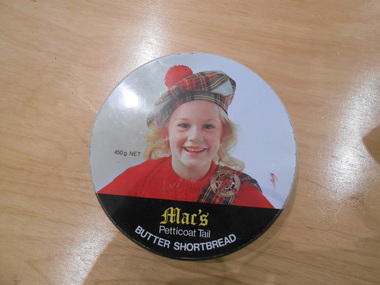
Container - Biscuit tin, Mac's Petticoat Tail Butter Shortbread tin
... ./ BAKED IN AUSTRALIA BY MAC"S SHORTBREAD CO., 1 NORFOLK ROAD, SURREY HILLS, VICTORA AUSTRALIA PHONE 8360333 INGREDIENTS WHEAT FLOUR, CHOICE BUTTER, SUGAR, EVAPORATED MILK BAKING POWDER A round tin with a silvered interior and the outside finished in a white enamel paint with the head and shoulders of a blond girl in red jumper, tartan sash and brooch and a tartan tam o'shanter hat. Mac's Petticoat Tail Butter Shortbread tin Container ...Mac's Shortbread Co dates its history back to a family bakery in Abbotsford opened in the 1860's producing bread for the goldfields. This eventually became McAlpine's Flour. This business was sold in 1960 and the family then purchased a cake shop, leading to building a biscuit factory. (This is thought to have been the Surrey Hills site). The company outgrew this and moved to Kerang. (Further research required.)This tin is material evidence of the small area of industrial activities that once existed in Surrey Hills.A round tin with a silvered interior and the outside finished in a white enamel paint with the head and shoulders of a blond girl in red jumper, tartan sash and brooch and a tartan tam o'shanter hat.1. Mac's / Petticoat Tail BUTTER SHORTBREAD 450g NET./ BAKED IN AUSTRALIA BY MAC"S SHORTBREAD CO., 1 NORFOLK ROAD, SURREY HILLS, VICTORA AUSTRALIA PHONE 8360333 INGREDIENTS WHEAT FLOUR, CHOICE BUTTER, SUGAR, EVAPORATED MILK BAKING POWDERbakeries, surrey hills, mac's shortbread, norfolk road -
 Mont De Lancey
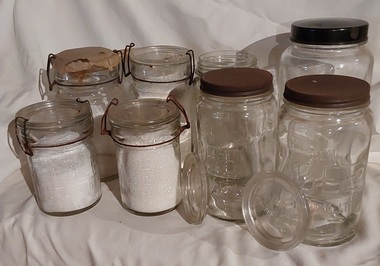
Domestic object - Glass Preserving Jars, Agee, 1900's
... containers On the front of the jar: 'Improved Agee Utility'. On the base is embossed: 'F 121' and 'M. Eight mixed Agee glass preserving or storage jars. They have embossed Agee branding on the front. 1 large 'Special' jar with a black bakelite screw-on lid and wide ridge on? 2x medium 'Victory' jars with clipped wire springs and glass lids. One of these jars has flour ...Agee jars, known for food preserving, originated in New Zealand and were initially recognizable by their banded collar neck and glass lids. The company later transitioned to screw-on metal lids, releasing the Agee Utility jars around the 1940s or 1950s. These jars are a piece of New Zealand's canning history, with older models featuring glass lids and the newer ones using screw-on metal lids. Eight mixed Agee glass preserving or storage jars. They have embossed Agee branding on the front. 1 large 'Special' jar with a black bakelite screw-on lid and wide ridge on? 2x medium 'Victory' jars with clipped wire springs and glass lids. One of these jars has flour in it and the other has brown paper on the lid. 3 medium 'Utility' jars; two have metal lids and one has no lid. 2 small 'Victory' jars with clipped wire springs and glass lids. One has salt, one has sugar inside. 2 single spare small glass lids.A cylindrical, glass Agee preserving jar with a screw on metal lid.On the front of the jar: 'Improved Agee Utility'. On the base is embossed: 'F 121' and 'M.food preserving jars, food storage containers, containers -
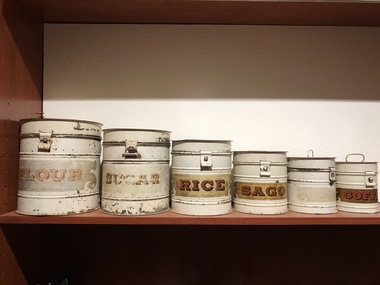 Mont De Lancey
Food Canisters/Tins
... canisters Food storage containers 1. Flour 2. Sugar 3. Rice 4. Sago 5. 'illegible' 6. ...Set of 6 food canisters, with hinged lids and a metal carry handle.1. Flour 2. Sugar 3. Rice 4. Sago 5. 'illegible' 6. Coffeecanisters, food storage containers
