
Showing 25 items matching "flower production"
-
 University of Melbourne, Burnley Campus Archives
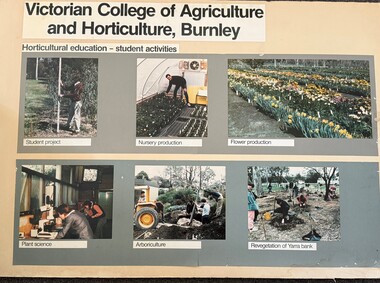
Sign - Display, VCAH, Student Activities - Horticultural Education, 1988-1993
... ...flower production...Victorian College of Agriculture and Horticulture, Burnley Horticultural Education - Student Activities Student Project Nursery Production Flower production Plant science Arboriculture Revegetation of Yarra Bank...Student display teaching display VCAH Burnley Horticultural education advertising nursery flower production plant science arboriculture revegetation of yarra bank Victorian College of Agriculture and Horticulture, Burnley Horticultural Education - Student Activities Student Project Nursery Production Flower production Plant science Arboriculture Revegetation of Yarra Bank Rigid cardboard display of 6 photographs with descriptive labels. ...Rigid cardboard display of 6 photographs with descriptive labels. Probably part of an exhibition.Victorian College of Agriculture and Horticulture, Burnley Horticultural Education - Student Activities Student Project Nursery Production Flower production Plant science Arboriculture Revegetation of Yarra Bankstudent display, teaching display, vcah burnley, horticultural education, advertising, nursery, flower production, plant science, arboriculture, revegetation of yarra bank -
 Federation University Historical Collection
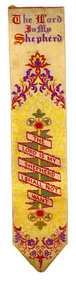
Accessory - Bookmark, Adam And Charles Black, The English Lakes and Religious Bookmark, 1949
... productions seem to have been bookmarkers... The pictures included portraits of celebrities and local scenes, scriptural texts, hymns and psalms, and verses from the poets. Stevens also introduced to the Admiralty a hat ribbon with the name of the ship woven in gold wire. This he patented; it was adopted and for many years the firm was the sole supplier to the Admiralty Contracts Department. https://stevengraphs.com/thomstevandh.html Also found in the book was a small card with dried flowers glued with the words 'Flowers from the Holy Land' and a WW2 photograph of the bust of a man in uniform with a cap....productions seem to have been bookmarkers... The pictures included portraits of celebrities and local scenes, scriptural texts, hymns and psalms, and verses from the poets. Stevens also introduced to the Admiralty a hat ribbon with the name of the ship woven in gold wire. This he patented; it was adopted and for many years the firm was the sole supplier to the Admiralty Contracts Department. https://stevengraphs.com/thomstevandh.html Also found in the book was a small card with dried flowers glued with the words 'Flowers from the Holy Land' and a WW2 photograph of the bust of a man in uniform with a cap. holmes ec holmes ascot religious religion bookmark english lakes w.t. palmer chatham-holmes collection flowers from the the holy land stevengraph .1) Inside front cover "E.S. ...This bookmark was found in a book called 'The English Lakes' owned by Elizabeth Chatham-Holmes. The bookmark is a Stevenograph. In 1854 Thomas Stevens began with weaving plain and fancy ribbons, but was soon experimenting with a development of jacquard weaving to produce pictures. For this, the picture was plotted on squared paper, in the fashion of a cross-stitch embroidery design, and a large card then perforated to represent each colour appearing in every "line" of the picture. The cards, arranged in an endless chain and attached to the loom, controlled the manipulation of the warp threads. Each time the shuttle crossed the loom a different card came into use, changing the arrangement of the warp threads and, consequently, the pattern woven..When the industry collapsed in 1860, Stevens determined to make use of his experiments by producing pictures in such variety as to appeal to all tastes. The earliest productions seem to have been bookmarkers... The pictures included portraits of celebrities and local scenes, scriptural texts, hymns and psalms, and verses from the poets. Stevens also introduced to the Admiralty a hat ribbon with the name of the ship woven in gold wire. This he patented; it was adopted and for many years the firm was the sole supplier to the Admiralty Contracts Department. https://stevengraphs.com/thomstevandh.html Also found in the book was a small card with dried flowers glued with the words 'Flowers from the Holy Land' and a WW2 photograph of the bust of a man in uniform with a cap..1) Red hard covered book called 'The English Lakes' by W.T. Palmer. .2) Woven silk bookmark with white (now cream) and yellow background and red, purple, green and yellow detail and the start of Psalm 23 woven into the bookmark. Possibly made in the late nineteenth century. .3) Small card with dried flowers glued with the words Flowers from the Holy Land .4) WW2 photograph of the bust of a man in uniform with a cap. .1) Inside front cover "E.S. Holmes Ascot" .2) Woven into the bookmark - The Lord is my Shepard I shall not want, & T. Stevens, Coventry .3) Printed on the front - Flowers from the Holy Land, Placed on the Holy Sepulchreholmes, ec holmes, ascot, religious, religion, bookmark, english lakes, w.t. palmer, chatham-holmes collection, flowers from the the holy land, stevengraph -
 Flagstaff Hill Maritime Museum and Village
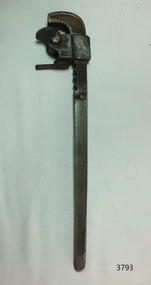
Tool - Wrench, Late 19th Century
... production of steel items. The item is giving a snapshot of early colonial and European trades persons tools and gives an interesting insight into the development and progression of European tool and steel development and innervation prior to the First World War. manufactures tools engineering blacksmith workshop tool dropforged handmade wrench adjustable wrench phoenix steel j e bleckmann solingen murzzuschlag steel mill cutlery steel foundery Machine stamped on handle of wrench LOTUS L R GEBRAUCHS under has MUNSTER, J E BLECKMANN, SOLINGEN Germany. [ Translated: LR Gebrauchs= use,usage, or custom application] [Lotos] Translated: Lotus ie flower] [Solingen =town in Rhine valley] Drop hand forged steel wrench with unusual locking mechanism to size jaw opening made by J E Bleckmann, Solingen Germany. ...Johann Elias Bleckmann (1784-1856) founded a steel goods shop in Ronsdorf near Dusseldorf Germany. After completing a business education in his father's business, his son Johann Heinrich August Bleckmann (1826-1891) gained further experience through travel in North and South America. When his father died, he took over the steel goods store and moved it to Solingen. He bought a hammer mill in Mürzzuschlag Styria (Austria) in 1862 and converted it into a modern crucible casting steel smelter. His "Phoenix Steel", which he produced himself, achieved worldwide renown. He then went on to establish a file and tool factory and later founded a steel and plate rolling mill. Apart from cutlery blades, the company's self-produced steel was also processed into tools, scythes, rifle parts, etc. His sons Eugen and Walter continued after his death in 1891 at the Phoenix steelworks. However, by the end of the First World War, the two brothers fell into economic difficulties as a result of eliminating a large part of their foreign trade. In 1921, the company was converted into a public limited company and merged three years later with the company Schoeller & Stahlwerke. Made by Bleckmanns a significant Austrian manufacture of cutlery and tools in a recognized area of Germany famous for the production of steel items. The item is giving a snapshot of early colonial and European trades persons tools and gives an interesting insight into the development and progression of European tool and steel development and innervation prior to the First World War.Drop hand forged steel wrench with unusual locking mechanism to size jaw opening made by J E Bleckmann, Solingen Germany.Machine stamped on handle of wrench LOTUS L R GEBRAUCHS under has MUNSTER, J E BLECKMANN, SOLINGEN Germany. [ Translated: LR Gebrauchs= use,usage, or custom application] [Lotos] Translated: Lotus ie flower] [Solingen =town in Rhine valley]manufactures, tools, engineering, blacksmith, workshop tool, dropforged, handmade, wrench, adjustable wrench, phoenix steel, j e bleckmann, solingen, murzzuschlag, steel mill, cutlery, steel foundery -
 Glenelg Shire Council Cultural Collection
Card - Card - thank you from K. S. Anderson to Betty Vivian, n.d
... flowers on front cover. Blank inside, handwritten message from K.S. Anderson. Card Card - thank you from K. S. Anderson to Betty Vivian Helene Jones Productions ...Thank you card from K.S. Anderson to Betty Vivian for her card to him on his 90th birthday. White card, Australian scene and wild flowers on front cover. Blank inside, handwritten message from K.S. Anderson.k s anderson, betty vivian, vivian family records, greetings card -
Ringwood and District Historical Society
Clocktower Theatre Company, Clocktower Theatre Co.- correspondence and programmes related to various productions 1971-1979, 1971-1979
... Clocktower Theatre Company productions between 1971 and 1979 included "The Grass is Greener", "The Anniversary", Blithe Spirit", "Cactus Flower" and "The Chicken Girl"....Clocktower Theatre Company productions between 1971 and 1979 included "The Grass is Greener", "The Anniversary", Blithe Spirit", "Cactus Flower" and "The Chicken Girl". ...Clocktower Theatre Company productions between 1971 and 1979 included "The Grass is Greener", "The Anniversary", Blithe Spirit", "Cactus Flower" and "The Chicken Girl".|Inaugural Letter from Noel W. Tolley and Peter L O'Connell to a meeting chaired by Mayor, Pat Palmer.Three bundles of various productions of the Clocktower Theatre - correspondence connected with them and programmes for the plays presented. +Additional Keywords: Tolley, Noel W. / O'Connell, Peter L. / Palmer, Patricia (Mayor) -
 City of Moorabbin Historical Society (Operating the Box Cottage Museum)
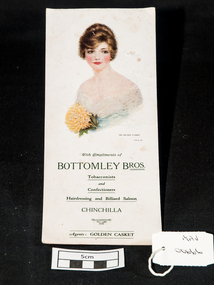
Leaflet, advertising ink-blotter, c1960
... production of ‘BIC’ Biros that no longer need blotting paper to dry the ink. An example of 1960's advertising and a piece of used blotting paper that shows its function for drying Fountain Pen ink moorabbin bentleigh ormond cheltenham holidays travel tourists fountain pens, bic biros, Front is : Colour picture of the bust of a lady with Coiffed head and holding a yellow flower / THE GOLDEN FLOWER / THE O CO / With Compliments of/ BOTTOMLEY BROS/ Tobacconists / and / Confectioners/ Hairdressing and Billiard Saloon / CHINCHILLA / Agents : GOLDEN CASKET Back is : used pink blotting paper An advertising leaflet with ink -blotting paper backing. c 1950. ...In the 1960's the general prosperity in Australia enabled City of Moorabbin citizens to travel interstate and overseas to tourist destinations for holidays. This is a souvenir from Queensland. c1960 Fountain pens were used by most people prior to the mass production of ‘BIC’ Biros that no longer need blotting paper to dry the ink.An example of 1960's advertising and a piece of used blotting paper that shows its function for drying Fountain Pen inkAn advertising leaflet with ink -blotting paper backing. c 1950. Coloured photograph of a lady promoting a business for Hairdressing and Billiard Saloon in Chinchilla, QueenslandFront is : Colour picture of the bust of a lady with Coiffed head and holding a yellow flower / THE GOLDEN FLOWER / THE O CO / With Compliments of/ BOTTOMLEY BROS/ Tobacconists / and / Confectioners/ Hairdressing and Billiard Saloon / CHINCHILLA / Agents : GOLDEN CASKET Back is : used pink blotting papermoorabbin, bentleigh, ormond, cheltenham, holidays, travel, tourists, fountain pens, bic biros, -
 Mission to Seafarers Victoria
Flyer, Sensory Experiments, 2019
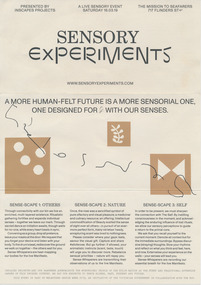
... Kyle Mac, Design and Web Amara Speechley, Curated by, Marketing, PR & Partnerships Damien Boecasse and Erika Hirzinger, Event Production & Project Management Event Partners Justin James, Edibles Hattie Molloy and Emma Proudfoot, Flower Art Mihan Aromatics, Scent Design Chelsea Kate Evans, Performance Direction Samantha Iliov and Holly Simpson, Ensemble Studio, Costume Rachelle Austin, Olivia Reddan and Holly White, Set Stylists Isabel Johnson, Ed Supreme, Messaging and Copy Arup, Soundscape Design Hayden Sommerville, Videography Belle Nowak, Social Media Pord, Wine Tasting Noomi, Seating Website inscapesprojects.com Instagram: @inscapesprojects...Kyle Mac, Design and Web Amara Speechley, Curated by, Marketing, PR & Partnerships Damien Boecasse and Erika Hirzinger, Event Production & Project Management Event Partners Justin James, Edibles Hattie Molloy and Emma Proudfoot, Flower Art Mihan Aromatics, Scent Design Chelsea Kate Evans, Performance Direction Samantha Iliov and Holly Simpson, Ensemble Studio, Costume Rachelle Austin, Olivia Reddan and Holly White, Set Stylists Isabel Johnson, Ed Supreme, Messaging and Copy Arup, Soundscape Design Hayden Sommerville, Videography Belle Nowak, Social Media Pord, Wine Tasting Noomi, Seating Website inscapesprojects.com Instagram: @inscapesprojects cultural events sensory experiments ngv national gallery of victoria melbourne design week 2019 community norla dome incas projects A4 size flyer on creamy colour paper Sensory Experiments Flyer ...Melbourne Design Week: 14-24 March 2019 Sat 16 Mar 19, 2pm–10pm Norla Dome The Mission to Seafarers Victoria 717 Flinders St Docklands Indulge in a fleshy live experience. Reconnect with your primal being through a progression of sensorial confrontations. Recalibrate your connection to the world around you – the future depends on it. Sensory Experiments is a call for change – a Manifesto for Sensory Intelligence. Part social experiment, part philosophical inquiry and a fully immersive performance piece, this innovative project is forged from a collaboration between two of the city’s (and, indeed, the world’s) most progressive and inquiring minds. An eclectic cohort of creative contributors has been assembled to design a provocative experience intended to awaken the senses. Allow internationally renowned chef Justin James (Executive Chef of Vue de monde and Iki Jime and previously of Eleven Madison Park & Noma Copenhagen) to reignite your sense of taste. Avail yourself to floral artist Hattie Molloy’s interrogation of sensual perception with her reckoning of the Sublime. Absorb and participate in live-choreographed performances, and be aurally challenged by the masters behind the Sydney Opera House’s iconic acoustics. Come, bear witness, bring curiosity. Immerse yourself in this never-before seen collective. Guided by Sense Whisperers, you’ll wander through a series of live, uniquely designed corporeal experiences. Your emotional and physical responses will leave a digital imprint as the results of Sensory Experiments are transmitted in real time. Connect to self, connect to others, and connect to nature – and leave your mark on a living, breathing manifesto for living. Project Partners Matt Tambellini, More Studio and Mr. Kyle Mac, Design and Web Amara Speechley, Curated by, Marketing, PR & Partnerships Damien Boecasse and Erika Hirzinger, Event Production & Project Management Event Partners Justin James, Edibles Hattie Molloy and Emma Proudfoot, Flower Art Mihan Aromatics, Scent Design Chelsea Kate Evans, Performance Direction Samantha Iliov and Holly Simpson, Ensemble Studio, Costume Rachelle Austin, Olivia Reddan and Holly White, Set Stylists Isabel Johnson, Ed Supreme, Messaging and Copy Arup, Soundscape Design Hayden Sommerville, Videography Belle Nowak, Social Media Pord, Wine Tasting Noomi, Seating Website inscapesprojects.com Instagram: @inscapesprojectsA4 size flyer on creamy colour papercultural events, sensory experiments, ngv, national gallery of victoria, melbourne design week, 2019, community, norla dome, incas projects -
 Orbost & District Historical Society
bowl, Mid 20th century
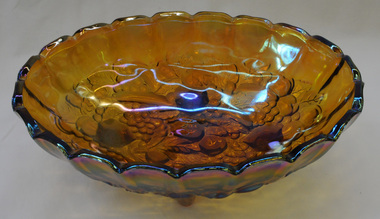
... Most carnival glass was made between 1907 and 1925, with production tapering off by the end 1931 during the great depression. the name "carnival glass" came about because when the demand for the glass tapered off it was often given away as prizes at carnivals. Large amber coloured glass bowl. It has four short legs moulded to the base. It is very ornate and solid. On the base is a pattern of fruit and flowers ...Carnival glass is an inexpensive pressed glass, made as both functional and ornamental objects. Most carnival glass was made between 1907 and 1925, with production tapering off by the end 1931 during the great depression. the name "carnival glass" came about because when the demand for the glass tapered off it was often given away as prizes at carnivals.Large amber coloured glass bowl. It has four short legs moulded to the base. It is very ornate and solid. On the base is a pattern of fruit and flowers. The rim is fluted and the bowl is oval shaped. It is carnival glass. -
 Bendigo Historical Society Inc.
Document - VIKKI SPICER COLLECTION: BENDIGO OPERATIC SOCIETY PROGRAMME BOOKLET, Friday 19th Sept, 1958
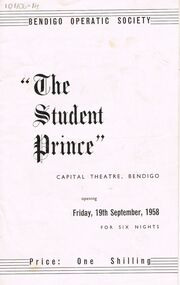
... Production Songs include: 'Golden Days,' 'Garlands Bright With Glowing Flowers,' 'I'm Coming at Your Call,' 'Deep in My Heart' 'Hail, Youth and Love,' 'Farewell Dear,' 'Just We Two,' and 'Sing a Little Song.' ...Production Songs include: 'Golden Days,' 'Garlands Bright With Glowing Flowers,' 'I'm Coming at Your Call,' 'Deep in My Heart' 'Hail, Youth and Love,' 'Farewell Dear,' 'Just We Two,' and 'Sing a Little Song.' ...Bendigo Operatic Society 'The Student Prince' Capital Theatre Bendigo Opening Friday, 19th September, 1958 For Six Nights. Price One Shilling. Allans Pty Ltd & J.C. Williams Ltd Arrangement. Producer Cid Ellwood, Musical Director Max O'Loghlen. Music Sigmund Romberg, Lyrics & Book Dorothy Donnelly. Production Songs include: 'Golden Days,' 'Garlands Bright With Glowing Flowers,' 'I'm Coming at Your Call,' 'Deep in My Heart' 'Hail, Youth and Love,' 'Farewell Dear,' 'Just We Two,' and 'Sing a Little Song.' Cast: Fred Trewarne, Reg Boromeo, Adrian Van Dyk, Andrew Nelson, Bram Schrever(autograph), Charles Phillips, Vincent D'Araugo, Max Beckwith, Barbara McGregor, Joseph Quigg(autograph), Robert Nicholls, Harry Brewer, Leonard Carr(autograph), Colin Irvine, Margaret Rule, Alfred Annison, Brian Brewer, Gertrude Perry, Aileen Simmonds, Rosalie Spencely (autograph).Cambridge Press Bendigo.clubs and associations, theatre, bendigo operatic society, https://en.wikipedia.org/wiki/the_student_prince -
 Bendigo Historical Society Inc.
Clothing - GERTRUDE PERRY COLLECTION: FLOWERED HEADPIECE FOR DRAMA PERFORMANCE
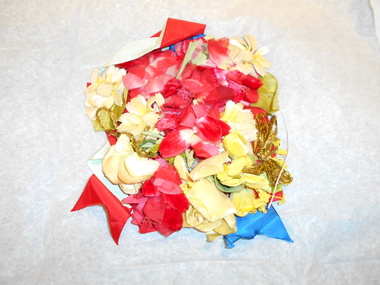
... Flowers attached to satin backing board. Board has large pin with elastic attached to secure to head. Falling from base of board are four satin ribbons, presumably to cascade down from headpiece. Could be from the 'Wildflowers' drama production...Flowers attached to satin backing board. Board has large pin with elastic attached to secure to head. Falling from base of board are four satin ribbons, presumably to cascade down from headpiece. Could be from the 'Wildflowers' drama production ...Flowers attached to satin backing board. Board has large pin with elastic attached to secure to head. Falling from base of board are four satin ribbons, presumably to cascade down from headpiece. Could be from the 'Wildflowers' drama production in which Gertrude Perry was a lead.person, bendigo, gertrude perry -
 National Vietnam Veterans Museum (NVVM)
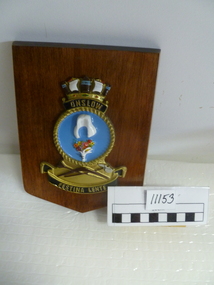
Plaque, Onslow
... Plaque Aboriginal Onslow Wooden shield with emblem gold bordered ships crown, blue centre with legal wig and bouquet of flowers and aboriginal weapons below Onslow Plaque Plaque Townsend Productions ...Wooden shield with emblem gold bordered ships crown, blue centre with legal wig and bouquet of flowers and aboriginal weapons belowplaque, aboriginal, onslow -
 Bendigo Historical Society Inc.
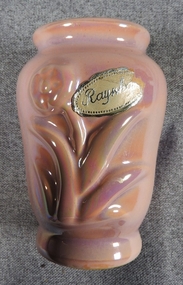
Ceramic - Raynham Vase, small pink cylindrical vase, Raynham Ceramic Pty. Ltd, 1948 - 1964
... The external surface has a pink metallic shimmering finish (lustreware) with an indentation of a flower and a small, damaged cream coloured stick-on label - Raynham. The inside is pink smooth gloss surface and a small red stick-on label - GUARANTEED Raynham PRODUCTION AUSTRALIA The vase is slightly wider at the top than its base. ...The external surface has a pink metallic shimmering finish (lustreware) with an indentation of a flower and a small, damaged cream coloured stick-on label - Raynham. The inside is pink smooth gloss surface and a small red stick-on label - GUARANTEED Raynham PRODUCTION AUSTRALIA The vase is slightly wider at the top than its base. ...Raynham (Ray) Cook started his pottery in 1946 in the garage in the back yard of 218 Murrumbeena Rd East Bentleigh Victoria and moved to a factory in North Rd East Bentleigh in 1948. The company was named Raynham Ceramic Pty. Ltd. after his first name and produced all sorts of light weight slipware. some speckled lustreware vases. He had a second pottery at 237 East Boundary Rd East Bentleigh and also operated from Carey St East Bentleigh after buying out Guy Boyd. Ray was a pioneer in Australia of the electric pottery kiln which was very novel in the 1940's Ray's greatest attribute was probably his design skills. All Raynham pottery was his designs. One of his key employees was "Paddy" McDonald who undertook the majority of the thrown pottery. Ray Cook sold the company to Bendigo Pottery in the early 1970's who continued to use the Raynham brand for a short time. Most examples by that company have the same form but are unmarked. A small cylindrical vase. The external surface has a pink metallic shimmering finish (lustreware) with an indentation of a flower and a small, damaged cream coloured stick-on label - Raynham. The inside is pink smooth gloss surface and a small red stick-on label - GUARANTEED Raynham PRODUCTION AUSTRALIA The vase is slightly wider at the top than its base. Markings on the base - Raynham 27, From Marge & Rex Sa.... Birthday 1962ray cook, raynham ceramic pty. ltd., slipcast vases, paddy mcdonald, bendigo pottery -
 Wangaratta RSL Sub Branch
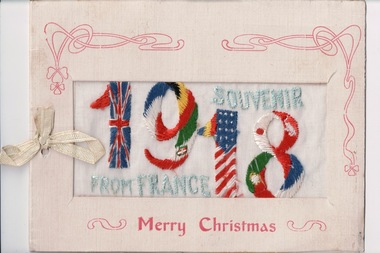
Card - Embroidered Card, c. 1918
... production line. Designs endorsing patriotism and unity were popular amongst Allied troops. wwi postcard embroidered postcard Front: "1918 / souvenir from France" (embroidered) "Merry Christmas" (printed) White rectangular bi-fold card with window mounted embroidery of the colours and flags of different countries in the shape of 1918. Inside is glossy paper with decorative flowers ...Embroidered post card made in France which reads to... W West from Worthy. Embroidered silk postcards became a booming industry during the First World War that was largely driven by women. Many French women embroidered strips of silk in their homes before sending them to a factory to be mounted on card by a largely female production line. Designs endorsing patriotism and unity were popular amongst Allied troops.White rectangular bi-fold card with window mounted embroidery of the colours and flags of different countries in the shape of 1918. Inside is glossy paper with decorative flowers and printed and handwritten messages. Bound with yellow ribbon.Front: "1918 / souvenir from France" (embroidered) "Merry Christmas" (printed) wwi, postcard, embroidered postcard -
 Embroiderers Guild, Victoria
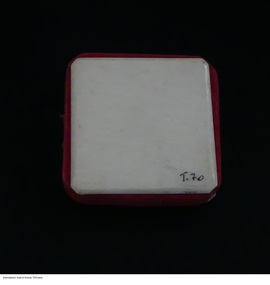
Tool - Ivory pin cushion, 19th century
... production of them and many 'receptacles' to protect and keep them were made. Disc style pin cushions were very popular, this one has been made with elegantly carved ivory making it a status symbol. Era of improving technology for making pins, growing middle class with a taste for luxury needlework tools Pin disc ivvory Low relief flowers with leaves - possibly lilac on decorated side. ...Pins are essential sewing tool, the second half of the 19th century saw mass production of them and many 'receptacles' to protect and keep them were made. Disc style pin cushions were very popular, this one has been made with elegantly carved ivory making it a status symbol. Era of improving technology for making pins, growing middle class with a taste for luxury needlework toolsSquare double sided ivory pin cushion with floral covering on one leaf, the other plain. Cushion covered in red velvetLow relief flowers with leaves - possibly lilac on decorated side.pin disc, ivvory -
 National Wool Museum
Textile - Children's Cardigan, Kathryn Knitwear, c.1950-1966
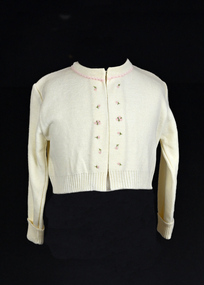
... Children's knitwear knitwear clothing children's clothing Cardigan manufacturing fashion textile production machine knitting embroidery embroiderer floral embroidery floral motif Flowers picot scalloped edge [label stitched to back neck] Kathryn Reg’d / 100% Orlon / 22 Cream Children’s cardigan hand embroidered with pink flower buds with green foliage down the centre front edges. ...Kathryn Knitwear, founded by Robert Blake, manufactured high quality children’s knitwear in Melbourne from the 1940s – 1980s. Robert Blake began manufacturing children’s knitwear in his bedroom in Strathmore using a hand powered machine in the late 1940s. The operation moved to Ascot Vale and Essendon, before eventually establishing a factory in Moonee Ponds in the early 1950s. The business continued to expand, necessitating a move to a new factory in Broadmeadows. By 1962, the Broadmeadows factory was producing an average of 20,000 garments per month, which increased to 24,000 by 1964. Robert Blake’s Son, Brendan recalls that “The Kathryn brand was famous around Australia, anywhere children needed to keep warm and dress smartly. It also won a number of wool fashion awards”, including the 1969 Wool Awards, which was held by the Australian Wool Bureau and published in Women’s Weekly. The Kathryn range was designed for durability, comfort and care, without sacrificing style. They used patterning techniques that increase stretchiness, comfort and fit, as well as integrating decorative elements into the fabric to prevent them from being bulky, uncomfortable or tight. Making longevity of style a priority, Brendan Blake remembers that “there was one particular garment that was in the range for at least thirty years”. He also recalls “In the past, when women have found out that I was associated with Kathryn Knitwear, they would often relate to me the story of a garment they had purchased or received as a gift and, when their child had grown out of it, they would hand it on to another child. Several ladies have told me of purchasing garments for their daughters’ glory box, or saving a particular garment after their daughter had grown out of it. The decoration on this garment was embroidered by hand by a skilled worker at the Kathryn Knitwear factory Brendan Blake: “At the peak of their operation they employed approximately two hundred people, mainly women and girls. A family would often seek to send their daughter to work in this company because they knew they would be looked after and safe. One lady wrote to me telling me that working at the Moonee Ponds Factory prior to getting married was the happiest time of her life.” In 1963, workers at the Kathryn factory earned £13 per week, which was 8 shillings and 8 pence higher than the minimum weekly wage for female workers in the textile manufacturing industry (£12 11s 4d). By 1970, the Kathryn Knitwear brand expanded from children’s knitwear into womenswear under the brand name ‘Lady Kathryn’, and for boys and men under ‘Robert Blake’. Continuing to diversify their distribution, they also began exporting ‘Kathryn’ garments to New Zealand, the Pacific Islands, and Japan. ‘Kathryn Knitwear’ was well-known for their early adoption of modern materials and techniques that had broad appeal to their customer base. This is shown in their early use of the acrylic fibre ‘Orlon’ in the 50s and 60s and ‘Superwash’ wool in the 1970s. Many of Kathryn Knitwear’s styles, particularly those that were long running staples of the brand, were available in both wool and Orlon to suit the consumer’s preference. Orlon was developed by DuPont in the 1940s and became the first commercially successful acrylic fibre in the 1950s and 1960s. The development of Orlon coincided with an increase in availability of washing machines in everyday Australian homes. The great appeal of Orlon was that while wool garments still had to be hand-washed, Orlon’s shrink-resistant nature made it machine washable and dryable. This was a very appealing prospect, especially for the seemingly unending task of cleaning active children’s clothing. Machine washable wool would not be available until the development of the ‘Superwash’ treatment by the Australian Wool Board and CSIRO in 1970. Far from the humble origins of one man in his bedroom with a hand-cranked machine; at its closure in 1980, the Broadmeadows factory of ‘Kathryn’ housed more than 100 machines, including 53 sewing machines and 45 knitting machines. Robert Blake was “a passionate advocate for wool and Australian Made” throughout his whole life. A strong thread that ties through the lifespan of Robert Blake and Kathryn Knitwear is a balance between adopting new innovations without sacrificing the core values of durability, comfort, care and style that had made the brand so well known. Their legacy forms an integral part of both Australian social and manufacturing history.Cream Children’s cardigan hand embroidered with pink flower buds with green foliage down the centre front edges. The round collar has pink picot/scalloped edge. Cardigan closes in the centre front at the base of the collar with a metal hook and hand-worked thread bar.[label stitched to back neck] Kathryn Reg’d / 100% Orlon / 22children's knitwear, knitwear, clothing, children's clothing, cardigan, manufacturing, fashion textile production, machine knitting, embroidery, embroiderer, floral embroidery, floral motif, flowers, picot, scalloped edge -
 National Wool Museum
Textile - Children's Cardigan, Kathryn Knitwear, c.1965
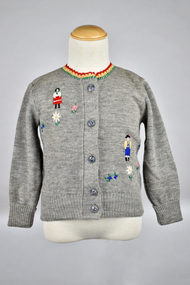
... Children's knitwear knitwear clothing children's clothing Cardigan manufacturing fashion textile production machine knitting embroidery embroiderer Folk Art folk embroidery [Label at back neck with blue lettering woven into label] KATHRYN REGD / 22 ALL WOOL CREATED BY ROBERT BLAKE Grey children’s cardigan with embroidered flowers and human figures in folk costume, and crocheted design around neck in green, yellow and red. ...Kathryn Knitwear, founded by Robert Blake, manufactured high quality children’s knitwear in Melbourne from the 1940s – 1980s. Robert Blake began manufacturing children’s knitwear in his bedroom in Strathmore using a hand powered machine in the late 1940s. The operation moved to Ascot Vale and Essendon, before eventually establishing a factory in Moonee Ponds in the early 1950s. The business continued to expand, necessitating a move to a new factory in Broadmeadows. By 1962, the Broadmeadows factory was producing an average of 20,000 garments per month, which increased to 24,000 by 1964. Robert Blake’s Son, Brendan recalls that “The Kathryn brand was famous around Australia, anywhere children needed to keep warm and dress smartly. It also won a number of wool fashion awards”, including the 1969 Wool Awards, which was held by the Australian Wool Bureau and published in Women’s Weekly. The Kathryn range was designed for durability, comfort and care, without sacrificing style. They used patterning techniques that increase stretchiness, comfort and fit, as well as integrating decorative elements into the fabric to prevent them from being bulky, uncomfortable or tight. Making longevity of style a priority, Brendan Blake remembers that “there was one particular garment that was in the range for at least thirty years”. He also recalls “In the past, when women have found out that I was associated with Kathryn Knitwear, they would often relate to me the story of a garment they had purchased or received as a gift and, when their child had grown out of it, they would hand it on to another child. Several ladies have told me of purchasing garments for their daughters’ glory box, or saving a particular garment after their daughter had grown out of it. Brendan Blake: “At the peak of their operation they employed approximately two hundred people, mainly women and girls. A family would often seek to send their daughter to work in this company because they knew they would be looked after and safe. One lady wrote to me telling me that working at the Moonee Ponds Factory prior to getting married was the happiest time of her life.” In 1963, workers at the Kathryn factory earned £13 per week, which was 8 shillings and 8 pence higher than the minimum weekly wage for female workers in the textile manufacturing industry (£12 11s 4d). By 1970, the Kathryn Knitwear brand expanded from children’s knitwear into womenswear under the brand name ‘Lady Kathryn’, and for boys and men under ‘Robert Blake’. Continuing to diversify their distribution, they also began exporting ‘Kathryn’ garments to New Zealand, the Pacific Islands, and Japan. The decoration on this garment was embroidered by hand by a skilled worker at the Kathryn Knitwear factory. ‘Kathryn Knitwear’ was well-known for their early adoption of modern materials and techniques that had broad appeal to their customer base. This is shown in their early use of the acrylic fibre ‘Orlon’ in the 50s and 60s and ‘Superwash’ wool in the 1970s. Many of Kathryn Knitwear’s styles, particularly those that were long running staples of the brand, were available in both wool and Orlon to suit the consumer’s preference. Wool has been renowned for its excellent properties for thousands of years, by people from all over the world. Not only good for thick winter woollens, it can help keep you cool in summer, as well as being durable and resistant to water, fire, ultraviolet light, stains and odour. Far from the humble origins of one man in his bedroom with a hand-cranked machine; at its closure in 1980, the Broadmeadows factory of ‘Kathryn’ housed more than 100 machines, including 53 sewing machines and 45 knitting machines. Robert Blake was “a passionate advocate for wool and Australian Made” throughout his whole life. A strong thread that ties through the lifespan of Robert Blake and Kathryn Knitwear is a balance between adopting new innovations without sacrificing the core values of durability, comfort, care and style that had made the brand so well known. Their legacy forms an integral part of both Australian social and manufacturing history.Grey children’s cardigan with embroidered flowers and human figures in folk costume, and crocheted design around neck in green, yellow and red. Left panel has embroidered figure of man with blue lederhosen and yellow shirt, black shoes and hat, hat has red accent. Right front panel depicts woman wearing red skirt with white stripe, white shirt, and green headscarf with black stockings and shoes. Flowers are embroidered in pink, white and blue with green and yellow accents for stems and flower centres. Cardigan closes in front with five marbled grey plastic buttons[Label at back neck with blue lettering woven into label] KATHRYN REGD / 22 ALL WOOL CREATED BY ROBERT BLAKEchildren's knitwear, knitwear, clothing, children's clothing, cardigan, manufacturing, fashion textile production, machine knitting, embroidery, embroiderer, folk art, folk embroidery -
 Brighton Historical Society
Top and pants ensemble, Watersun, Crop top and pants ensemble
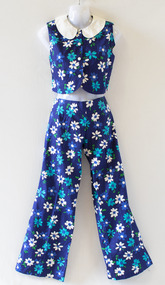
... productions melbourne designers Swing tag: "SIZE 34 / STYLE 186/11 / PRICE $13.00". Ensemble consisting of sleeveless crop top (.1) and full length pants (.2). Bold floral print features blue and white flowers ...Polish-born designer David Waters first began producing swimwear in 1952. His mother Halina had recently opened a stall at Melbourne Queen Victoria Markets and was looking for swimsuits to sell; unable to find any she liked, she asked David to design something. He began making swimming costumes using his mother's sewing machine, in between his shifts working at a knitting factory. He had soon set up a small business in his parents' home, cutting patterns in one room while a machinist sewed them together in the next. His company, which he named Watersun, would become an iconic Australian swimwear label. During the early 1960s, Watersun developed its "Unquestionable Bra", an inbuilt moulded bra which was marketed as giving wearers a more natural bustline than other labels. The company was also known for its matching swimwear and beachwear, producing dresses, kaftans, tops and skirts in identical colours and prints to those used for many of its swimsuits. By 1967, the company was reportedly one of Australia's two biggest swimwear manufacturers, with over one hundred employees. Watersun was sold to Ada Productions in 1984 and was later acquired by Trackerjack Australasia. This piece is believed to be one of a large quantity of samples, seconds and unsold Ada Productions stock donated to Brighton Historical Society in late 1990 by Brian Samuel, who worked at the company between 1979 and 1990.Ensemble consisting of sleeveless crop top (.1) and full length pants (.2). Bold floral print features blue and white flowers on a navy blue background. Top has a white Peter Pan collar. Swing tag attached.Swing tag: "SIZE 34 / STYLE 186/11 / PRICE $13.00".swimwear, watersun, david waters, ada productions, melbourne designers -
 Lakes Entrance Historical Society
Photograph - Myer Street Lakes Entrance Victoria 1999, M Holding
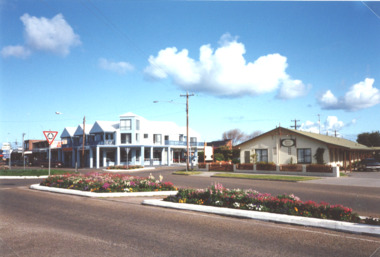
... Myer Street businesses and holiday units opposite Police Station Lakes Entrance Victoria 1999 Inscriptions and markings Languages Production methods Materials Dimensions No dimensions recorded Other measurements Duration Weight Weight unit Businesses Roads and Streets Colour photograph of roundabout at intersection of Myer Street with Church and Roadknight Streets taken from Police Station corner shows flower gardens in traffic islands, Myer Street businesses and holiday units opposite Police Station Lakes Entrance Victoria Photograph Myer Street Lakes Entrance Victoria 1999 M Holding ...Myer Street businesses and holiday units opposite Police Station Lakes Entrance Victoria 1999 Inscriptions and markings Languages Production methods Materials Dimensions No dimensions recorded Other measurements Duration Weight Weight unit Colour photograph of roundabout at intersection of Myer Street with Church and Roadknight Streets taken from Police Station corner shows flower gardens in traffic islands, Myer Street businesses and holiday units opposite Police Station Lakes Entrance Victoriabusinesses, roads and streets -
 Federation University Art Collection
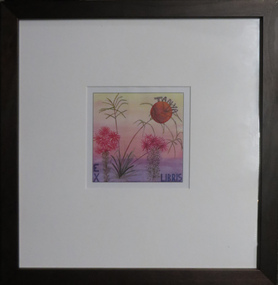
Work on paper - Bookplate, Ex Libris Bookplate for Tanya
... production of Ex Libris Bookplates. The competition is called The Australian Bookplate Design Award. The purpose of the competition is to increase interest in and to attract publicity to the artistic value of bookplates. Although the competition is referred to as 'Australian' there is a category of award open to International artists. Gift of the Keith Wingrove Memorial Trust, 2015 artwork artist keith wingrove memorial trust ex libris bookplate tanya flowers ...The Keith Wingrove Trust conducts a competition among Australian artists, graphic designers and students for the production of Ex Libris Bookplates. The competition is called The Australian Bookplate Design Award. The purpose of the competition is to increase interest in and to attract publicity to the artistic value of bookplates. Although the competition is referred to as 'Australian' there is a category of award open to International artists. Gift of the Keith Wingrove Memorial Trust, 2015 Framed original ex libris bookplate for Tanya. The work includes examples of flora.artwork, artist, keith wingrove memorial trust, ex libris, bookplate, tanya, flowers, framed bookplate -
 Kew Historical Society Inc
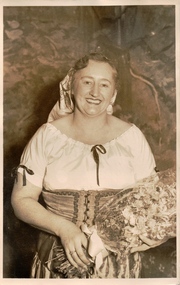
Photograph, Kew Light Opera Company, Marion Tilley in The Maid of the Mountains, 1956
... production. Marion Tilley was the creator of the scrapbook from which the photo is drawn. Here she stands at the end of the performance with a bouquet of flowers....production. Marion Tilley was the creator of the scrapbook from which the photo is drawn. Here she stands at the end of the performance with a bouquet of flowers. ...The Kew Light Opera Company was formed in 1952, and mounted a number of musical and variety productions each year until it was subsumed in the "Q" Theatre Guild in 1957. A partial record of performances by the company includes: 1952 Florodora, 1953 The Cingalee - San Toy or The Emperor's Own, 1954 While the Sun Shines - A Country Girl - Our Miss Gibbs, 1955 The Toreador - The Arcadians, 1956 The Maid of the Mountains - Whiteoaks - Goodnight Vienna!, 1957 A Country Girl. Most of the Company's performances took place in the Kew Recreation Hall in Wellington Street, Kew. The scrapbook of annotated photographs, programmes, and newspaper reviews of which this item is a part was assembled by Marion Tilley, wardrobe mistress for, and performer in, productions by the Kew Light Opera Company and the "Q" Theatre Guild. It is significant as a remarkably complete document of theatre performances in Kew, Victoria during the 1950s and 1960s. The scrapbook, and the items individually catalogued within it, have artistic and aesthetic significance within the history of performing arts in Victoria in the middle of the 20th Century. They have social significance in that they reveal socio-cultural values and preoccupations during the period. The records also act as a history of arts activities in the Kew Recreation Hall and later in the Kew City Hall as entertainment and community arts and music precincts.Sepia toned photograph of Marion Tilley, one of the 'Fisher Folk' in the production. Marion Tilley was the creator of the scrapbook from which the photo is drawn. Here she stands at the end of the performance with a bouquet of flowers.marion tilley, kew light opera company, kew recreation hall -- wellington street -- kew (vic.), performing arts -- kew (vic.), theatre memorabilia -
 Kew Historical Society Inc
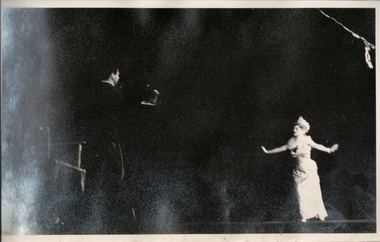
Photograph, Kew Light Opera Company, Goodnight Vienna!, 1957
... Black and white photograph of Joan Hutchinson, playing Cilli, an errand girl in a flower shop, in the Kew Light Opera Company's performance of Goodnight Vienna! in 1957. The theatre programme for the production notes that: "Joan Hutchinson (Cilli) made her first appearance with the Company as "Vittoria" in "The Maid of the Mountains" and was an instant success. ...Black and white photograph of Joan Hutchinson, playing Cilli, an errand girl in a flower shop, in the Kew Light Opera Company's performance of Goodnight Vienna! in 1957. The theatre programme for the production notes that: "Joan Hutchinson (Cilli) made her first appearance with the Company as "Vittoria" in "The Maid of the Mountains" and was an instant success. ...The Kew Light Opera Company was formed in 1952, and mounted a number of musical and variety productions each year until it was subsumed in the "Q" Theatre Guild in 1957. A partial record of performances by the company includes: 1952 Florodora, 1953 The Cingalee - San Toy or The Emperor's Own, 1954 While the Sun Shines - A Country Girl - Our Miss Gibbs, 1955 The Toreador - The Arcadians, 1956 The Maid of the Mountains - Whiteoaks - Goodnight Vienna!, 1957 A Country Girl. Most of the Company's performances took place in the Kew Recreation Hall in Wellington Street, Kew. The scrapbook of annotated photographs, programmes, and newspaper reviews of which this item is a part was assembled by Marion Tilley, wardrobe mistress for, and performer in, productions by the Kew Light Opera Company and the "Q" Theatre Guild. It is significant as a remarkably complete document of theatre performances in Kew, Victoria during the 1950s and 1960s. The scrapbook, and the items individually catalogued within it, have artistic and aesthetic significance within the history of performing arts in Victoria in the middle of the 20th Century. They have social significance in that they reveal socio-cultural values and preoccupations during the period. The records also act as a history of arts activities in the Kew Recreation Hall and later in the Kew City Hall as entertainment and community arts and music precincts.Black and white photograph of Joan Hutchinson, playing Cilli, an errand girl in a flower shop, in the Kew Light Opera Company's performance of Goodnight Vienna! in 1957. The theatre programme for the production notes that: "Joan Hutchinson (Cilli) made her first appearance with the Company as "Vittoria" in "The Maid of the Mountains" and was an instant success. Before coming to us she had played in "Alaya" by the Australian composer, Edith Harrhy, and now as "Cilli" has the opportunity of creating another successful memorable part."Inscribed beside the photo in the scrapbook by Marion Tilley: "Joan Hutchinson".performing arts -- kew (vic.), scrapbooks, marion tilley collection, kew light opera company, kew recreation hall, musical comedy -- melbourne -- victoria -
 Whitehorse Historical Society Inc.
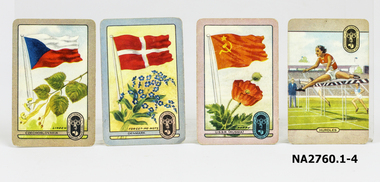
Card - Cards, Olympics, 1956
... Three cards represented/featured flags and floral emblem of each competing nation at the games and the fourth card features Olympic sports e.g. hurdles documents cards recreations sports Card 1 - 'Czechoslovakia - Linden XV1th Olympiad/ Melbourne 1956'|Card 2 - 'Denmark - Forget-me-nots XVI Olympiad/Melbourne 1956'|Card 3 - 'USSR (Russia) - Poppy - XVI Olympiad/ Melbourne 1956'|Card 4 - 'Hurdles' XVIth Olympiad/Melbourne 1956'|On back off all cards 'Exclusive Coles Production' Four small full colour printed cards from the 1956 Olympics in Melbourne. Three card depict National Flags along with a flower; the fourth card depicts a hurdles athlete and sports grandstand. ...Collectable Cards. Produced by Coles to commemorate the XVIth Olympiad held in Melbourne in 1956. Three cards represented/featured flags and floral emblem of each competing nation at the games and the fourth card features Olympic sports e.g. hurdlesFour small full colour printed cards from the 1956 Olympics in Melbourne. Three card depict National Flags along with a flower; the fourth card depicts a hurdles athlete and sports grandstand. Each card features Olympic Logo in one corner - see also History of object.Card 1 - 'Czechoslovakia - Linden XV1th Olympiad/ Melbourne 1956'|Card 2 - 'Denmark - Forget-me-nots XVI Olympiad/Melbourne 1956'|Card 3 - 'USSR (Russia) - Poppy - XVI Olympiad/ Melbourne 1956'|Card 4 - 'Hurdles' XVIth Olympiad/Melbourne 1956'|On back off all cards 'Exclusive Coles Production'documents, cards, recreations, sports -
Kew Historical Society Inc
Journal, Kewriosity : August 1989
... Flowers from Friends of Bodalla / p5. Kew Community House / p6. Write about life / p6. Council supports free public libraries / p6. Senior Citizens' Week 1990 / p7. Extra school crossing supervisors for Kew / p7. Give blood for life / p7. Council may vaccinate "staff at risk" [Hepatitis B] / p7. Asbestos scheduled for removal from Council Offices / p7. Neighbourhood Watch / p8. Greenfingers change venue [Kew Garden Club] / p8. New production ...Cricket with a difference [Kooyong Cricket Club, St Paul's School] / p1. No election for Kew / p1. Dates for August / p2. Changes to baby capsule loan scheme / p2. Council seeks comments on Area 7 Traffic Plan [Studley Park] / p2. Council to monitor Government policy on Kew Cottages Plan [deinstitutionalisation] / p3. Walpole Hill parking / p3. Fire and incinerator by-law under review / p3. Notices / p4. Local office gives tenants information [Inner Eastern Housing and Tenants' Information Service] / p4. New two-year-old session of occasional care [Kew Occasional Care Centre] / p4. Help for people with head injuries / p4. Free advice to home and business owners [Heritage Advisory Service] / p4. Images of Melbourne on local view [Ian Napier, Raya Gallery] / p5. "Sharps" Disposal Scheme planned for Kew / p5. Flowers from Friends of Bodalla / p5. Kew Community House / p6. Write about life / p6. Council supports free public libraries / p6. Senior Citizens' Week 1990 / p7. Extra school crossing supervisors for Kew / p7. Give blood for life / p7. Council may vaccinate "staff at risk" [Hepatitis B] / p7. Asbestos scheduled for removal from Council Offices / p7. Neighbourhood Watch / p8. Greenfingers change venue [Kew Garden Club] / p8. New production of The Lilac Domino [Viola Music Society] / p8. Why not croquet? [Kew Croquet Club] / p8. Footy News [Kew Football Club] / p8. Greenlink Kew / p8.Kewriosity was a local newsletter combining Kew Council and community news. It was published between November 1983 and June 1994, replacing an earlier Kewriosity [broad] Sheet (1979-84). In producing Kewriosity, Council aimed to provide a range of interesting and informative articles covering its deliberations and decision making, together with items of general interest and importance to the Kew community and information not generally available through daily media outlets.non-fictionCricket with a difference [Kooyong Cricket Club, St Paul's School] / p1. No election for Kew / p1. Dates for August / p2. Changes to baby capsule loan scheme / p2. Council seeks comments on Area 7 Traffic Plan [Studley Park] / p2. Council to monitor Government policy on Kew Cottages Plan [deinstitutionalisation] / p3. Walpole Hill parking / p3. Fire and incinerator by-law under review / p3. Notices / p4. Local office gives tenants information [Inner Eastern Housing and Tenants' Information Service] / p4. New two-year-old session of occasional care [Kew Occasional Care Centre] / p4. Help for people with head injuries / p4. Free advice to home and business owners [Heritage Advisory Service] / p4. Images of Melbourne on local view [Ian Napier, Raya Gallery] / p5. "Sharps" Disposal Scheme planned for Kew / p5. Flowers from Friends of Bodalla / p5. Kew Community House / p6. Write about life / p6. Council supports free public libraries / p6. Senior Citizens' Week 1990 / p7. Extra school crossing supervisors for Kew / p7. Give blood for life / p7. Council may vaccinate "staff at risk" [Hepatitis B] / p7. Asbestos scheduled for removal from Council Offices / p7. Neighbourhood Watch / p8. Greenfingers change venue [Kew Garden Club] / p8. New production of The Lilac Domino [Viola Music Society] / p8. Why not croquet? [Kew Croquet Club] / p8. Footy News [Kew Football Club] / p8. Greenlink Kew / p8. publications -- city of kew (vic.), kewriosity, council newsletters, community newsletters -
 Parks Victoria - Wilsons Promontory Lightstation
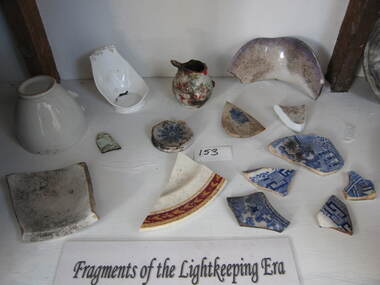
Fragments
... They include blue and white transfer-printed tableware in the ubiquitous ‘Willow’ pattern as well as floral designs with distinctively British flowers, both of which remained in constant production by all the major Staffordshire companies and were hugely popular with the Australian market. ...They include blue and white transfer-printed tableware in the ubiquitous ‘Willow’ pattern as well as floral designs with distinctively British flowers, both of which remained in constant production by all the major Staffordshire companies and were hugely popular with the Australian market. ...Used by lightkeeping families. The twenty shards of crockery represent tableware from the nineteenth and early twentieth centuries. The pieces were recovered from a rubbish dump in the grounds used by previous lightstation residents. They include blue and white transfer-printed tableware in the ubiquitous ‘Willow’ pattern as well as floral designs with distinctively British flowers, both of which remained in constant production by all the major Staffordshire companies and were hugely popular with the Australian market. Other pieces in the collection include part of a plate with a distinctive red and yellow border, a small Chinoiserie jug probably dating from the late nineteenth or early twentieth century, and fragments of heavier, more utilitarian white ceramic ware. A few of the shards are printed with trademarks or other insignia, and closer examination of these marks as well as the patterns should be able to yield information on their date and manufacturer. Most if not all the fragments are from affordable, everyday wares that were common in lower income homes. Numerous ceramic fragments are also held in the Cape Otway Lightstation collection.Domestic crockery fragments x 20. Some have been burnt. -
 Melbourne Tram Museum
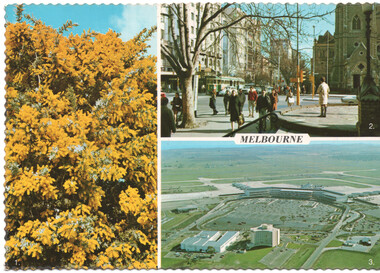
Postcard - Melbourne - Collins St and Tullamarine Airport, Bellevue Color Views, 1970
... Collage of three Melbourne views: 1 - Goldlen Wattle flower 2 - Collins St at Russell St with a W2 class tram in the view 3 - "Tullamarine Jetport Melbourne" with the airport terminal, Science Centre and the Travel lodge hotel in the view. Postcard by Bellevue Color Views Australia No. BV117 Melbourne Airport along with the Travellodge and Science Centre opened in 1970. Yields information the production ...Collage of three Melbourne views: 1 - Goldlen Wattle flower 2 - Collins St at Russell St with a W2 class tram in the view 3 - "Tullamarine Jetport Melbourne" with the airport terminal, Science Centre and the Travel lodge hotel in the view. Postcard by Bellevue Color Views Australia No. BV117 Melbourne Airport along with the Travellodge and Science Centre opened in 1970.Yields information the production of a postcard for visitors that featured a collage of three different views.Colour postcard with divided back, unused.Has a price of "50c" in pencil on rear.melbourne, airport, tullarmarine, wattle
