
Showing 6 items matching "fluorescent light"
-
 Mission to Seafarers Victoria
Photograph - Photograph, Black and white, Melbourne Harbour Trust, c. 1963
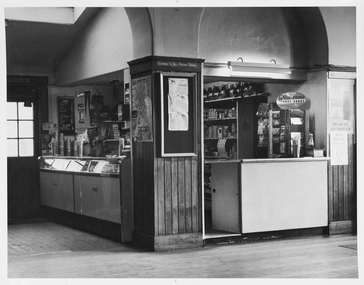
... ...fluorescent light...This is an example of the contemporaneous use of the canteen as primarily a supply shop and in a comparative fashion reveals some of the overall changes at the Mission. photograph canteen tab koalas blackboard archway pennant licensed-to-sell-postage-stamps mission to seamen mission to seafarers melbourne flying angel club map bar milkshake machine display case fluorescent light notice board wains coting postcards milkshake beverage plastichrome matches razors gillette straw melbourne harbour trust melbourne harbor trust donation tin lighthouse Purple stamp on central back of photograph. ...The canteen is part of the Mission to Seafarers building that has catered to visiting seafarers since 1917. The canteen is operated by the Flying Angel Club, which offered services to seafarers including food, drink and souvenirs from the canteen and events held in the main hall which invloved the use of the canteen. The Ladies Harbor Lights Guild also used the canteen facilities for functions and fundraisers held at the Mission to Seafarers. One of the flyer in Chinese helps dating the photograph between 1963-66 when Padre Wong was chaplain at the Mission.Historical record of the Mission to Seafarers canteen post-1963. This is an example of the contemporaneous use of the canteen as primarily a supply shop and in a comparative fashion reveals some of the overall changes at the Mission.A white-bordered, black and white photograph of the Mission to Seafarers Canteen. From the left hand side of the photograph the image portrays an external doorway with six glass windows, emitting light from behind. This leads to the dipslay cabinet and bench of the canteen which is reflecting light from the windowed door. Central to the image is a pillar which is three-quarters wood paling starting from the floor, of which a map is displayed on one edge and a notice board on the remaining visible edge of the pillar. A bench is visible to the right side of the pillar and the far right side of the photograph, posters are hung on the wall. Purple stamp on central back of photograph. "Melbourne Harbor/Trust Photograph/Negative No......." photograph, canteen, tab, koalas, blackboard, archway, pennant, licensed-to-sell-postage-stamps, mission to seamen, mission to seafarers, melbourne, flying angel club, map, bar, milkshake machine, display case, fluorescent light, notice board, wains coting, postcards, milkshake, beverage, plastichrome, matches, razors, gillette, straw, melbourne harbour trust, melbourne harbor trust, donation tin, lighthouse -
 Glenelg Shire Council Cultural Collection
Photograph - Photograph - White area pipes, n.d
... Narrow pipes running up wall and across ceiling; various other pipes, fluorescent light attached to ceiling pipes. Black pinboard on wall right, various notices attached to it. ...Narrow pipes running up wall and across ceiling; various other pipes, fluorescent light attached to ceiling pipes. Black pinboard on wall right, various notices attached to it. ...Port of Portland Authority Archivesport of portland archives -
 Returned Nurses RSL Sub-branch
Book - Paperback book, Richard Nile et al, Grit, 2003
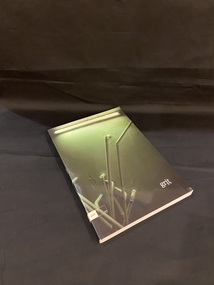
... There is a fluorescent strip light across the top and multiple water pipes coming out of the wall. ...There is a fluorescent strip light across the top and multiple water pipes coming out of the wall. ...Grit is an issue of the Journal of Australian Studies, no. 78, 2003--[Title page verso].Dark green paperback book with a dimly lit concrete wall on the cover . There is a fluorescent strip light across the top and multiple water pipes coming out of the wall. 'grit' is printed in white text in the lower right corner.non-fictionGrit is an issue of the Journal of Australian Studies, no. 78, 2003--[Title page verso].professions australia, nurses, gallipoli, australian nurses, janet butler -
 Bendigo Military Museum
Plaque - Mounted Klimsch Commodore Cartographic Camera Lenses, WYCOMBE Constructions Pty Ltd, 1997
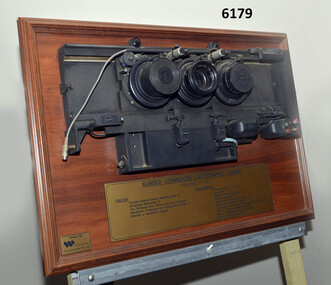
... Its characteristics were: Maximum Negative Size 1.27m sq, Copy Holder (Vacuum) 2m sq, Maximum Enlargement 400%, Maximum Reduction 13%, Automatic 60, 90 and 120cm Focal Length Lens, Transmission or Reflection Originals, Pulsed Xenon, Photo Flood or Fluorescent Tube Light Source, Maximum Reflection Original 1.3m x 1.85m, Maximum Transmission Original 1.3m x 1.85m, Exposure Light Monitoring System." ..."CHARACTERISTICS: Maximum Neg Size 1.27m sq, Copy Holder 2m sq, Maximum Enlargement 400%, Maximum Reduction 13%, Automatic 60, 90, 120cm Focal Length Lens, Transmission or Reflection Originals, Pulsed Xenon, Photo Flood or Fluorescent Tube Light Source, Maximum Reflection Original 1.3m x 1.85m, Maximum Transmission Original 1.3m x 1.85m, Exposure Light Monitoring System." ..."CHARACTERISTICS: Maximum Neg Size 1.27m sq, Copy Holder 2m sq, Maximum Enlargement 400%, Maximum Reduction 13%, Automatic 60, 90, 120cm Focal Length Lens, Transmission or Reflection Originals, Pulsed Xenon, Photo Flood or Fluorescent Tube Light Source, Maximum Reflection Original 1.3m x 1.85m, Maximum Transmission Original 1.3m x 1.85m, Exposure Light Monitoring System." ...These are the Lenses from the Klimsch Commodore Cartographic Camera that was located in Lithographic Squadron at the Army Survey Regiment, Fortuna, Bendigo. The KLIMSCH Commodore camera was originally introduced to the Survey Regiment in 1953 and was the largest in the Southern Hemisphere. It was replaced with a new model of the same size in 1977. These lenses are from this new model. The new model with its computer-based interface provided productivity gains with improved speed and its consistent results led to less wastage in time and materials. Its variomat lens system provided improved retention of map feature linear weights during the camera reduction process. The camera which was specially made for the Australian Army in Germany was fully automatic and power operated. It was claimed to be one of the biggest automatic cameras of its type in the world. It was made to the specifications of the Royal Australian Army Survey Corps to assist in the production of the very high standard maps for the Australian Army. THIS KLIMSCH COMMODORE CARTOGRAPHIC CAMERA was in operation 1977 - 1997". It was a Precision Darkroom Camera especially suited for Cartographic Reproduction of Line, Continous Tone, Halftone and Colour Separation. Reproduction of Negatives and Positives from a variety of Reflection or Transmission Originals. Its characteristics were: Maximum Negative Size 1.27m sq, Copy Holder (Vacuum) 2m sq, Maximum Enlargement 400%, Maximum Reduction 13%, Automatic 60, 90 and 120cm Focal Length Lens, Transmission or Reflection Originals, Pulsed Xenon, Photo Flood or Fluorescent Tube Light Source, Maximum Reflection Original 1.3m x 1.85m, Maximum Transmission Original 1.3m x 1.85m, Exposure Light Monitoring System." The camera was superseded by computerized image manipulation software associated with the Automap system. These significant and extremely high-quality Lenses were retrieved by WYCOMBE Constructions Pty Ltd during the demolishment of the camera in 1997 and then mounted on a display board. See also Item 6189.4P for more photographs of the camera.Lenses from the Klimsch Commodore Cartographic Camera mounted on a very heavy timber display board. The display board contains an engraved plate that describes the technical characteristics of the camera."KLIMSCH COMMODORE CARTOGRAPHIC CAMERA 1977 - 1997", "FUNCTION: Precision Darkroom Camera especially suited for Cartographic Reproduction of Line, Continous Tone, Halftone and Colour Separation. Reproduction of Negatives and Positives from a variety of Reflection or Transmission Originals." "CHARACTERISTICS: Maximum Neg Size 1.27m sq, Copy Holder 2m sq, Maximum Enlargement 400%, Maximum Reduction 13%, Automatic 60, 90, 120cm Focal Length Lens, Transmission or Reflection Originals, Pulsed Xenon, Photo Flood or Fluorescent Tube Light Source, Maximum Reflection Original 1.3m x 1.85m, Maximum Transmission Original 1.3m x 1.85m, Exposure Light Monitoring System." royal australian survey corps, rasvy, fortuna, army survey regiment, army svy regt, asr, litho -
 Bendigo Historical Society Inc.
Administrative record - Ex-Fortuna Survey Association Collection: Hazardous Material Survey Fortuna Facility Bendigo, Aug 1996
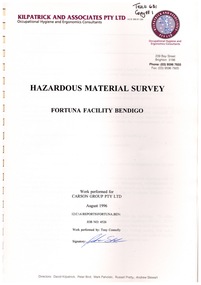
... Any work involving these fibres should comply with the National Standard and Code of Practice for Safe Use of Synthetic Mineral Fibre (1990). Older fluorescent light fittings and electrical transformers may contain PCBs. ...Any work involving these fibres should comply with the National Standard and Code of Practice for Safe Use of Synthetic Mineral Fibre (1990). Older fluorescent light fittings and electrical transformers may contain PCBs. ...This document presents the findings of a hazardous material survey conducted at the Fortuna Facility in Bendigo in August 1996. The Survey Objective was to Assess the presence, location, type, and condition of hazardous materials—specifically asbestos-containing materials, synthetic mineral fibre products, and polychlorinated biphenyls (PCBs)—and provide recommendations to minimize health and safety risks. Buildings 8, 10, 16, 16A, 16B, and 18, including associated structures, were examined. Asbestos-Containing Materials: Located in cement sheet, moulded cement vents, vinyl floor tiles, fibrous board, and electrical switchboards. Generally present a negligible or low exposure risk if left undisturbed. Removal is only recommended if maintenance, refurbishment, or demolition will disturb these materials. Fibrous asbestos board in the south ceiling space of Building 16 should be removed as soon as practicable.S ynthetic Mineral Fibre Products: Found in pipe, duct, and ceiling insulation. Pose negligible exposure risk under normal occupancy. Any work involving these fibres should comply with the National Standard and Code of Practice for Safe Use of Synthetic Mineral Fibre (1990). Older fluorescent light fittings and electrical transformers may contain PCBs. PCBs are hazardous due to their chemical properties and potential health risks. Recommendations Asbestos: Remove only if disturbance is likely, except for the specific board in Building 16, which should be removed promptly. Follow national safety standards during any work that may disturb these materials. PCBs: Be aware of potential presence in older electrical equipment and manage accordingly. The survey was conducted in accordance with Victorian Occupational Health and Safety (Asbestos) Regulations 1992. The document also includes appendices with general information and analytical results related to asbestos and synthetic mineral fibres.Hazardous Material Survey Fortuna Facility Bendigo, work performed for Carson Group Pty Ltd by Kilpatrick and Associates Pty Ltd, Occupational Hygeine and Ergonomics Consultants, 239 Bay Street, Brighton, 3186 This Document Contains the following Items: 11231.3b This document presents the findings of a hazardous material survey conducted at the Fortuna Facility in Bendigo in August 1996. The first four pages are copied here. 11231.3a Front Cover The document is coloured, bound with "Spiralex" and type-written. It contains 25 pages. bendigo, fortuna villa, history, army survey regiment -
 Federation University Historical Collection
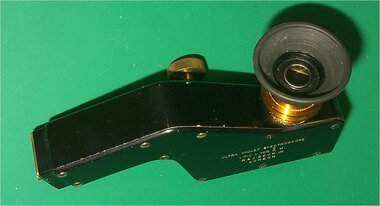
Instrument - Scientific Instrument, R. & J. Beck Ltd, Ultra-Violet Spectroscope
... A fluorescent screen seen with an illuminated scale shows the wavelength(s) of entering light. ...A fluorescent screen seen with an illuminated scale shows the wavelength(s) of entering light. ...A fluorescent screen seen with an illuminated scale shows the wavelength(s) of entering light. A Cylindrical Quartz Lens is provided to concentrate on the slit light from weak sources. The scale is illuminated by regular white light through a window. Ultra Violet Spectroscope. A black finished device with adjustable aperture in a storage box with eyepiece shield and clamping screw. scientific instrument, balance, spectoscope, ultra violet spectroscope, prism
