
Showing 25 items matching "fob watches"
-
 Mont De Lancey
Accessory - Pocket Watch, Unknown
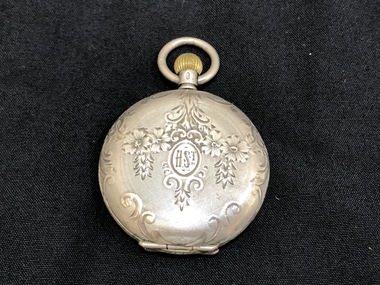
... ...Fob watches...The term 'fob' traces back to the 16th-century German word fuppe, meaning 'small pocket.' Fob watches evolved in the 17th century when King Charles II introduced waistcoats. ...The term 'fob' traces back to the 16th-century German word fuppe, meaning 'small pocket.' Fob watches evolved in the 17th century when King Charles II introduced waistcoats. ...The term 'fob' traces back to the 16th-century German word fuppe, meaning 'small pocket.' Fob watches evolved in the 17th century when King Charles II introduced waistcoats. Men placed their timepieces in these pockets, securing the watch to their clothing with a short ribbon, chain, or attached ornament (the 'fob').A silver pocket watch, with a white enamel dial and roman numerals. Also, a 'seconds' dial is inset into the main dial. The ornate casing designs on this fob and pocket watch features delicate, openwork metal calligraphy shaped into intricate floral designs. HST is engraved inside a small circle on the front of the casing."43404 5" inscription is on the inside of the lid casing. A floral pattern engraving is on the back and lid of the casing with the initials HST in a small circle on the front.pocket watches, watches, fob watches, timepieces -
 Mont De Lancey
Accessory - Pocket Watch, Classique, Unknown
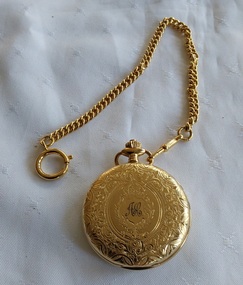
... ...Fob watches...The term 'fob' traces back to the 16th-century German word fuppe, meaning 'small pocket.' Fob watches evolved in the 17th century when King Charles II introduced waistcoats. ...The term 'fob' traces back to the 16th-century German word fuppe, meaning 'small pocket.' Fob watches evolved in the 17th century when King Charles II introduced waistcoats. ...The term 'fob' traces back to the 16th-century German word fuppe, meaning 'small pocket.' Fob watches evolved in the 17th century when King Charles II introduced waistcoats. Men placed their timepieces in these pockets, securing the watch to their clothing with a short ribbon, chain, or attached ornament (the 'fob'). Classique has been servicing the Australian watch industry for over 55 years. Australian owned and operated, this business is family owned and continues to produce the finest quality timepieces, assembled in our Sydney head office, fitted with accurate Swiss movement. Local history: The original owner of the watch being Bob Chapman given to his brother Bert (Albert) after the death of Albert. It was passed on to Les Chapman (Bert and Bob's brother).A gold 17 jewels Classique pocket watch with a white enamel dial and roman numerals. It also has a 'seconds' dial inset into the main dial. The ornate casing designs on this fob and pocket watch features delicate, openwork metal calligraphy shaped into intricate floral designs. A.C. ( Albert Chapman) is engraved inside a small circular decorative shape on the front of the casing. The back has 1994 engraved. At the top it has a gold ring attached to the winder with a curb chain to attach to clothing. It is in working order.'Always remembering the years we worked on the Farm Bob Chapman' is inscribed on the inside of the lid casing. A floral pattern engraving is on the back and lid of the casing with the initials AC inside a small decorative circular shape on the front. '17 jewels' 'Incabloc' 'Swiss Made' is printed above and below the 'seconds' hands circle at the bottom of the dial. On the back of the cover '1994' is engraved inside a crest.pocket watches, watches, fob watches, timepieces -
 Hand Tool Preservation Association of Australia Inc
Bag
... bag, with 4 keys fob watches...This item is part of the Thomas Caine Tool Collection, owned by The National Trust of Australia (Victoria) and curated by the Hand Tools Preservation Association of Australia. bag, with 4 keys fob watches Bag ...This item is part of the Thomas Caine Tool Collection, owned by The National Trust of Australia (Victoria) and curated by the Hand Tools Preservation Association of Australia.bag, with 4 keys fob watches -
 Clunes Museum
Photograph, KODAK, GOLD FOB WATCH
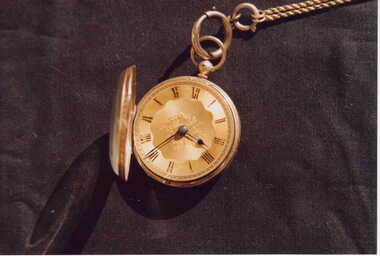
... PHOTOGRAPH GOLD FOB WATCHES...PHOTOGRAPH GOLD FOB WATCHES JEAN DICKSON PRESENTED TO MISS JEAN DICKSON BY HER FRIENDS AT CLUNES. ...PRESENTATION GIFT TO JEAN DICKSON ON THE OCCASION OF HER 21ST BIRTHDAY 1877..1 - .8 COLLECTION OF EIGHT PHOTOGRAPHS OF GOLD FOB WATCH AND CHAIN PRESENTED TO JEAN DICKSON ON HER 21ST BIRTHDAY 1877 AT CLUNES.PRESENTED TO MISS JEAN DICKSON BY HER FRIENDS AT CLUNES. TO COMMENORATE THIS HER TWENTY FIRST BIRTHDAY. BEING THE FIRST WHITE GIRL BORN HERE. CLUNES 2ND FEB. 1877.photograph gold fob watches, jean dickson -
 Stawell Historical Society Inc
Photograph - Committee F.R.C. 1904 & 05
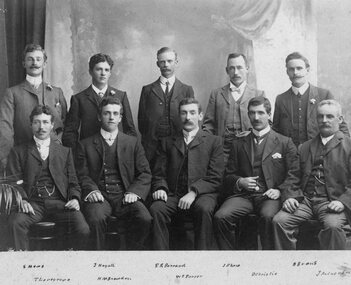
... Studio 2 Rows of men in 3 piece Suits & Bowtie, Fob watches....Studio 2 Rows of men in 3 piece Suits & Bowtie, Fob watches. Committee F.R.C. 1904 & 05 Photograph Committee F.R.C. 1904 & 05 ...B/W Photo on Foxed & burnt card. Studio 2 Rows of men in 3 piece Suits & Bowtie, Fob watches.Art Royal. Back Row S. Mews, J Hugall, E.R Farrand, J. Shaw, b. Evans. Front Row T. Longmure, H.M. Crowden. W.T. Farrer, D. Christie, J. Prince snr -
 Uniting Church Archives - Synod of Victoria
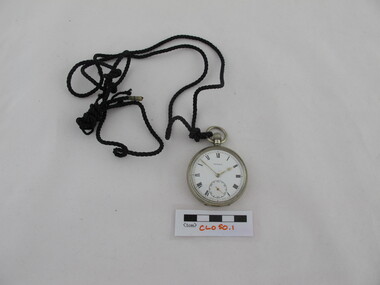
Accessory - Fob watch, Presbyterian Deaconess
... CL050.1 and CL050.2 fob watches with white enamel faces and on a black cotton cord. ...[Minutes of the Sixth Synod, Oct 1982] Presbyterian Deaconess Deaconess Hilda Elizabeth Foster "My Deaconess Badge" "Non ministrari sed ministrare" CL050.1 and CL050.2 fob watches with white enamel faces and on a black cotton cord. ...Hilda Elizabeth Foster (1890-1982) was commissioned as a Deaconess in 1914 giving a lifetime of service to the church particularly in the social care aspect of the Gospel. She was also a double certified nurse. Deaconess Hilda Foster began her work as a Deaconess in South Melbourne and then served for 13 years with the Presbyterian Sisterhood in North Fitzroy caring for unmarried mothers and their babies. In 1933 she was appointed Matron of the Presbyterian Girls' Home in Elsternwick where she worked for 15 years. She retired in 1948 when it was noted "In complete dedication matron has given herself to this care of souls". Deaconess Foster was awarded the British Empire Medal for her work in the Queen's birthday honours in 1981. Deaconess Foster was one of the first qualified Mother Christmasses in Australia. [Minutes of the Sixth Synod, Oct 1982]CL050.1 and CL050.2 fob watches with white enamel faces and on a black cotton cord. CL050.1 has Roman numerals and CL050.2 has Arabic numbers and a second hand inset. "My Deaconess Badge" "Non ministrari sed ministrare"presbyterian deaconess, deaconess hilda elizabeth foster -
 Bendigo Historical Society Inc.
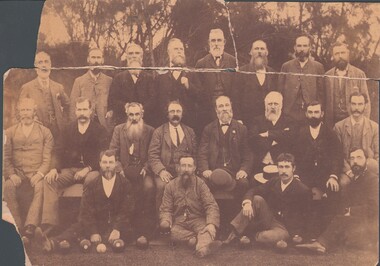
Photograph - HARRY BIGGS COLLECTION: BOWLS TEAM
... Photograph of a group of 20 men wearing suits nearly all of them, are three piece suits, many have fob watches. There are some lawn bowls on the grass in front of the group. ...PERSON Group bowls team Lawn Bowls Photograph of a group of 20 men wearing suits nearly all of them, are three piece suits, many have fob watches. There are some lawn bowls on the grass in front of the group. ...Photograph of a group of 20 men wearing suits nearly all of them, are three piece suits, many have fob watches. There are some lawn bowls on the grass in front of the group. The name H.J.G. Biggs is stamped on the back of the photoperson, group, bowls team, lawn bowls -
Stawell Historical Society Inc
Photograph - Group Portrait, George and Margaret Hunt in family group portrait
... Two men in 3 piece suites with fob watches, the left one with a cane....Two men in 3 piece suites with fob watches, the left one with a cane. George and Margaret Hunt in family group portrait Photograph Group Portrait ...Family portraits in front of tree in family garden. Elderly couple seated, the rest standing.B/W photograph close up Front is mature gentleman in Grey three-piece suite. Girl in dress with lace collar, wrists. Mature woman with glasses, white dress. Two men in 3 piece suites with fob watches, the left one with a cane. -
 Bendigo Historical Society Inc.
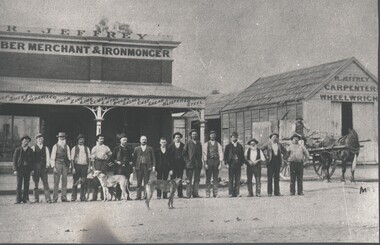
Photograph - HARRY BIGGS COLLECTION: R JEFFERY STORE & GROUP PHOTO
... The clothing of the era - hats, waistcoats, 3 piece suits & fob watches clearly seen....The clothing of the era - hats, waistcoats, 3 piece suits & fob watches clearly seen. Photograph HARRY BIGGS COLLECTION: R JEFFERY STORE & GROUP PHOTO ...Photograph. Harry Biggs Collection. 1 black & white photo. A group of 15 man, 3 greyhounds & a horse & dray & driver standing in front of R Jeffery Timber Merchant & Ironmonger, Eaglehawk. Beside the store is another building titled R Jeffery Carpenter Wheelwright. The clothing of the era - hats, waistcoats, 3 piece suits & fob watches clearly seen.place, building, commercial, harry biggs collection, r jeffery store & group photo, eaglehawk. -
 Flagstaff Hill Maritime Museum and Village
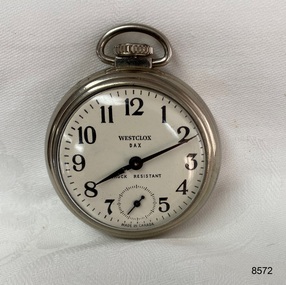
Instrument - Fob Watch, Mid 20th century
... Fob (or pocket) watches were developed in Europe in the 16th century. ...Fob (or pocket) watches were developed in Europe in the 16th century. ...Fob (or pocket) watches were developed in Europe in the 16th century. These watches were designed to be carried in a small pocket and attached through the means of a 'fob' which could be a chain or made from a variety of materials such as leather. This pocket watch was manufactured by the Western Clock Co. (Westclox) in the mid 20th century. The company was large and manufactured inexpensive watches with this style being an example of their ‘dollar watches’.This item is of social significance as an example of an inexpensive men's watch available during the mid 20th century.Men's silver pocket watch with a white dial, black arabic numerals and outer minute divisions around the edge. A seconds dial is in the place of the number 6. The face of the pocket watch is made from plastic. The word DAX was trademarked by the Western Clock Co. in 1915.The front dial of the watch has the words WESTCLOX, DAX, SHOCK RESISTANT and MADE IN CANADA.flagstaff hill maritime museum and village, warrnambool, great ocean road, shipwreck coast, fob watch, pocket watch, watch, horology, time keeper, made in canada, shock resistant, westclox, dollar watch -
 Flagstaff Hill Maritime Museum and Village
Instrument - Fob Watch, Moeris watchmakers, Early 1900s
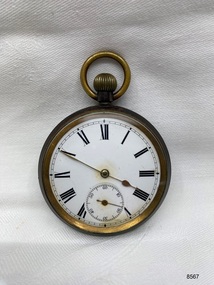
... Fob (or pocket) watches were developed in Europe in the 16th century and gained wide usage during the mid 18th century until World War 1 when the wristwatch was invented. ...Fob (or pocket) watches were developed in Europe in the 16th century and gained wide usage during the mid 18th century until World War 1 when the wristwatch was invented. ...Fob (or pocket) watches were developed in Europe in the 16th century and gained wide usage during the mid 18th century until World War 1 when the wristwatch was invented. These watches were designed to be carried in a small pocket and attached through the means of a 'fob' which could be a chain or made from a variety of materials such as leather. Their popularity peaked in the nineteenth century where they were an important part of middle and lower class society as well.This item is of social significance as fob / pocket watches were valued as an essential object in all levels of society in the late 19th century. For some occupations, such as the railroads, it was a necessary tool of the job. Being dated to the early 1900s gives the watch historical significance as possibly being used during the first World War.Pocket watch with possible gunmetal case and brass winder. The white dial has black Roman numerals on the face (note the use of four lines for the number 4 and no markings for the number 6). The face has a circular insert and hand to show the seconds. All hands are gold coloured with the hour hand having a leaf shape. The case has a back cover, which opens to reveal an inner cover, which protects the workings. Both covers are inscribed with the number 877396. The back cover has the words ACIER GARANTI stamped into it, which means steel guaranteed and may refer to the screws used in the workings.Stamped inside the back cover in an oval shape - ACIER GARANTI with N.F. stamped in between the words. The number 877396 is stamped inside the back cover and again inside the middle cover. There is an indecipherable marking near the number inside the back cover and another scratching on the inside of the back cover which may be letters or numbers. The workings are inscribed with the words SWISS MADE and the manufacturer's circular stamp 'MOERIS'. The markings F, S, A and R are on the workings.flagstaff hill maritime museum and village, warrnambool, great ocean road, shipwreck coast, fob watch, pocket watch, watch, 19th century, horology, time keeper, acier garanti, swiss made, moeris -
 Flagstaff Hill Maritime Museum and Village
Instrument - Fob Watch, 1940-60s
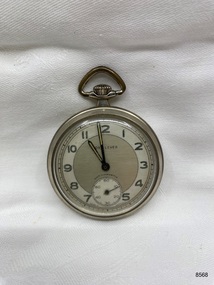
... Fob (or pocket) watches were developed in Europe in the 16th century and gained wide usage during the mid 18th century until World War 1 when the wristwatch was invented. ...fob watch dated between 1940-1960. The dial has an inner pewter circle, outer minute divisions and a circular insert and hand to show the seconds. The numbers are finely edged with a black line and the hands are two coloured. The back of the watch is patterned with fine lines and three rectangle shapes. The words 'ANTIMAGNETIC' are on the front of the watch. Anti-magnetic watches...This item is of social significance as fob / pocket watches were valued as an essential object in all levels of society. ...Fob (or pocket) watches were developed in Europe in the 16th century and gained wide usage during the mid 18th century until World War 1 when the wristwatch was invented. These watches were designed to be carried in a small pocket and attached through the means of a 'fob' which could be a chain or made from a variety of materials such as leather. Their popularity peaked in the nineteenth century where they were an important part of middle and lower class society as well.This item is of social significance as fob / pocket watches were valued as an essential object in all levels of society. For some occupations, such as the railroads, it was a necessary tool of the job. Steel York Lever open face pocket / fob watch dated between 1940-1960. The dial has an inner pewter circle, outer minute divisions and a circular insert and hand to show the seconds. The numbers are finely edged with a black line and the hands are two coloured. The back of the watch is patterned with fine lines and three rectangle shapes. The words 'ANTIMAGNETIC' are on the front of the watch. Anti-magnetic watches began to be made at the beginning of the 20th century as mechanical watches were affected by magnetic fields. The 'lever' set on watches was a requirement for railroad watches. It required a two step process for the hands to be adjusted. The front dial of the watch has the words 'YORK LEVER', 'ANTIMAGNETIC' and 'MADE IN GERMANY'. flagstaff hill maritime museum and village, warrnambool, great ocean road, shipwreck coast, fob watch, pocket watch, watch, horology, time keeper, york lever, anti-magnetic, made in germany -
 Flagstaff Hill Maritime Museum and Village
Instrument - Fob Watch, 1920-30s
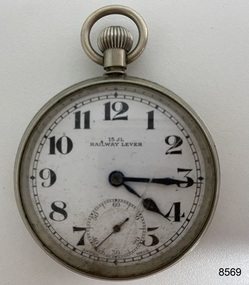
... Fob (or pocket) watches were developed in Europe in the 16th century and gained wide usage during the mid 18th century until World War 1 when the wristwatch was invented. ...fob watch dated 1920s-1930s. The white dial has large black arabic numerals and outer minute divisions around the edge. A circular insert and small hand to show the seconds is at the bottom of the watch face. The hour hand is a rounded leaf shape, and the minute hand a thin diamond shape. Both hands and the small rounded end of the second hand reflect a metallic blue sheen in the right lighting. The words RAILWAY LEVER, 15 JL and SWISS MADE are on the dial. The lever set on watches...Fob (or pocket) watches were developed in Europe in the 16th century and gained wide usage during the mid 18th century until World War 1 when the wristwatch was invented. ...Fob (or pocket) watches were developed in Europe in the 16th century and gained wide usage during the mid 18th century until World War 1 when the wristwatch was invented. These watches were designed to be carried in a small pocket and attached through the means of a 'fob' which could be a chain or made from a variety of materials such as leather. Their popularity peaked in the nineteenth century where they were an important part of middle and lower class society as well. The inclusion of the word RAILWAY on the face of the watch suggests a possible use by an employee of the railways. This item is of social significance as fob / pocket watches were valued as an essential object in all levels of society. For some occupations, such as the railroads, it was a necessary tool of the job. Steel Railway Lever open face pocket / fob watch dated 1920s-1930s. The white dial has large black arabic numerals and outer minute divisions around the edge. A circular insert and small hand to show the seconds is at the bottom of the watch face. The hour hand is a rounded leaf shape, and the minute hand a thin diamond shape. Both hands and the small rounded end of the second hand reflect a metallic blue sheen in the right lighting. The words RAILWAY LEVER, 15 JL and SWISS MADE are on the dial. The lever set on watches was a requirement for railroad watches. It required a two step process for the hands to be adjusted. 15 JL refers to the movement being a 15 jewel one.The front dial of the watch has the words 15 JL, RAILWAY LEVER, and SWISS MADE. flagstaff hill maritime museum and village, warrnambool, great ocean road, shipwreck coast, fob watch, pocket watch, watch, horology, time keeper, swiss made, railway lever, 15 jl, 15 jewel -
 Flagstaff Hill Maritime Museum and Village
Instrument - Clock, c. 1860s
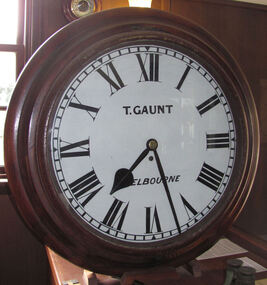
... watches, thermometers and jewellery. In 1854 Henry Walsh Jnr. began business in Warrnambool as a watchmaker and jeweller later becoming a Councillor with now a local street named after him. The Post Office was extensively remodelled in 1875-76. Early photographs of this building show that the clock was installed on the northern outside wall, Timor Street, under the arches and between the 2 centre windows, where it could be seen by passers-by. Although spring loaded clocks date back to the 15th century, and fob...watches, thermometers and jewellery. In 1854 Henry Walsh Jnr. began business in Warrnambool as a watchmaker and jeweller later becoming a Councillor with now a local street named after him. The Post Office was extensively remodelled in 1875-76. Early photographs of this building show that the clock was installed on the northern outside wall, Timor Street, under the arches and between the 2 centre windows, where it could be seen by passers-by. Although spring loaded clocks date back to the 15th century, and fob ...The clock was either made or sold by T. Gaunt & Co. of Melbourne, a manufacturer, importer and retailer of a wide variety of goods including jewellery, clocks and watches, navigational and measuring instruments, dinnerware, glassware and ornaments. Thomas Gaunt photograph was included in an album of security identity portraits of members of the Victorian Court, Centennial International Exhibition, Melbourne, 1888. Thomas Gaunt History: Thomas Gaunt established Melbourne's leading watchmaking, optical and jewellery business during the second half of the 19th century. Gaunt arrived in Melbourne in 1852, and by 1858 had established his own business at 14 Little Bourke Street. Around 1869 he moved to new premises in Bourke Street on the corner of Royal Arcade, Gaunt's shop quickly became a Melbourne institution. Gaunt proudly advertised that he was 'The only watch manufacturer in the Australian colonies'. While many watches and clocks may have had Gaunt's name on the dial, few would have been made locally. Gaunt did make some watches for exhibitions, and perhaps a few expensive watches for wealthy individuals. Gaunt's received a telegraph signal from Melbourne Observatory each day to correct his main clock and used this signal to rate and repair ship's chronometers and good quality watches. His main horological manufacturing was directed at turret clocks for town halls, churches and post offices. These tended to be specific commissions requiring individualised design and construction. He made the clock for the Melbourne Post Office lobby, to a design by Government Astronomer Robert Ellery, and won an award at the 1880-81 Melbourne International Exhibition for his turret clock for the Emerald Hill Town Hall. He became well known for his installation of a chronograph at Flemington Racecourse in 1876, which showed the time for the race, accurate to a quarter of a second. The firm also installed the clockwork and figures for Gog and Magog in the Royal Arcade. Thomas Gaunt also developed a department that focused on scientific instrumentation, making thermometers and barometers (from imported glass tubes), telescopes, surveying instruments and microscopes. Another department specialised in electroplating for trophies, awards and silverware, and the firm manufactured large amounts of ecclesiastical gold ware and silverware, for the church including St Patrick's Cathedral. There are no records that disclose the number of employees in the firm, but it was large enough for Gaunt to hold an annual picnic for the watchmakers and apprentices at Mordialloc from 1876; two years previously they had successfully lobbied Gaunt to win the eight hour day. Gaunt's workforce was reportedly very stable, with many workers remaining in the business for 15 to 30 years. Gaunt's wife Jane died on September 1894, aged 64. They had one son and six daughters, but only three daughters survived to adulthood. Two became nuns at the Abbotsford Convent and one daughter, Cecelia Mary Gaunt (died 28 July 1941), married William Stanislaus Spillane on 22 September 1886 and had a large family. Gaunt died at his home in Coburg, Victoria, leaving an estate valued at ₤41,453. The business continued as T. Gaunt & Co. after his death. Post Office and Clock History: Warrnambool’s Post Office has been in existence since 1857, when it was originally situated on the corner of Timor and Gilles Street. In March 1864 the Warrnambool Borough Council purchased this clock from Henry Walsh Jnr. for the sum of £25, “to be put up in front of the Post Office”. Henry Walsh Jnr was the eldest son of Melbourne’s Henry Walsh, maker and retailer of clocks, watches, thermometers and jewellery. In 1854 Henry Walsh Jnr. began business in Warrnambool as a watchmaker and jeweller later becoming a Councillor with now a local street named after him. The Post Office was extensively remodelled in 1875-76. Early photographs of this building show that the clock was installed on the northern outside wall, Timor Street, under the arches and between the 2 centre windows, where it could be seen by passers-by. Although spring loaded clocks date back to the 15th century, and fob and pocket watches evolving from these date to the 17th century, personal pocket watches were only affordable to the very fortunate. Public clocks such as this Post Office clock provided opportunity for all to know the time, and for those in possession of a personal watch to check and set their own timepieces to the correct time. During post office reservations during the 1970s the clock was removed and was eventually donated to the Flagstaff Collection. The Clock’s maker Thomas Gaunt, is historically significant and was an established and well renowned scientific instrument and clock maker in Melbourne during the 1860s. He was at that time the only watchmaker in the Australian colonies. In the 1870’s and 1880’s he won many awards for his clocks and was responsible for sending time signals to other clocks in the city and rural areas, enabling many businesses and organisations to accurate set their clocks each day. Warrnambool Borough Council purchased this clock from Henry Walsh Jnr. for the sum of £25 and the clock used to stand in front of the Warrnambool post office to allow ordinary citizens to set their time pieces as they walked by. The item is not only important because it was made by a significant early colonial clock maker and retailed by a locally known clock maker and jeweler but also that it was installed in the Warrnambool Post Office a significantly historical building in it's own right. Built in 1857 and regarded as one of the oldest postal facilities in Australia, with a listing on the National Heritage Database, (ID 15656). This 1864 hall clock originates from the Warrnambool Post Office. The clock glass is hinged to the top of the clock face and has a catch at the bottom. The metal rim of the glass is painted black. The clock face is metal, painted white, with black Roman numerals and markings for minutes and five minutes. The tip of the small hour hand is shaped like a leaf. "T. GAUNT / MELBOURNE" is printed in black on the clock face. The winding key hole is just below the centre of the clock face. The key winds a fusee chain mechanism, attached to the brass mainspring barrel that powers the pendulum with an 8-day movement. The speed of the clock can be adjusted by changing the position of the weight on the pendulum, lengthening or shortening the swing; raising the pendulum shortens its swing and speeds up the clock. The metal fusee mechanism has an inscription on it. The rectangular wooden casing is with a convex curve at the bottom that has a hinged door with a swivel latch. The original stained surface has been painted over with a matte black. There are two other doors that also allow access to the clock’s workings. The case fits over the pendulum and workings at the rear and attaches to the clock by inserting four wooden pegs into holes in the sides of the case then into the back of the clock. A flat metal plate has been secured by five screws onto the top of the case and a hole has been cut into it for the purpose of hanging up the clock. There is a nail inside the case, possibly used for a place to the key."T. GAUNT MELBOURNE" is printed on the clock face. “6 1 3” embossed on the back of the fusee mechanism behind the clock. warrnambool, shipwrecked coast, flagstaff hill, flagstaff hill maritime museum, maritime museum, shipwreck coast, flagstaff hill maritime village, shipwrecked artefact, clock, warrnambool post office, fusee, henry walsh jnr, thomas gaunt, t gaunt & co, post office clock -
 Flagstaff Hill Maritime Museum and Village
Instrument - Fob Watch, ca 1878
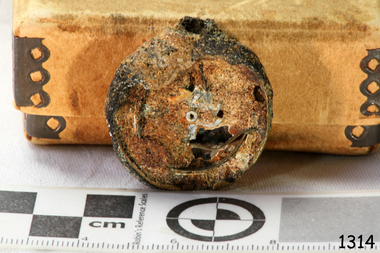
... fob watch...pocket watch...horology...accessory...time keeping...scientific instrument...ladies' watch...ladies' pocket watch...lady's watch...souvenir watch...survivor...clocks and watches...Flagstaff Hill Warrnambool Shipwreck Coast Flagstaff Hill Maritime Museum maritime museum Flagstaff Hill Maritime Village Great Ocean Road Loch Ard Eva Carmichael Tom Pearce Loch Ard Gorge Loch Ard souvenir Port Campbell Miss Carmichael Mrs Carmichael Dr Carmichael 1878 Loch Ard: the wreck that became a legend ladies fob watch gold watch fob watch pocket watch horology accessory time keeping scientific instrument ladies' watch ladies' pocket watch lady's watch souvenir watch survivor clocks and watches diagonally striped envelope lining Firenze Busta Earliera Florence italy Glencove Portsea Victoria 1905 1917 Nepean Hotel Moreton Morton Elizabeth Morton Mrs J. ...The story of this gold fob watch is intriguing. The letter is dated March 6, 1905, 27 years after the Loch Ard was wrecked. It appears to be a quick personal note from a relative or friend who briefly writes the history of the enclosed ‘souvenir’ watch, found in Loch Ard Gorge at Port Campbell. Although the finder is not named, it is likely the letter’s author. The writer mentions that the letter and watch would be sent once photographs of the area where the watch was found had been added. The fancy, lined envelope’s date stamp is October 12th, 1917 (12.10.17), almost 12 years after the letter was written. It has a postmark from Florence (Firenze), Italy. The handwriting on the envelope differs from that of the letter, and there is no further mention of photographs being included. The condition of the watch certainly shows the effects of time in the sea. Some inner workings can be seen through broken encrustations and missing sections of its case. The winding knob on the top is recognisable even though it is covered by sand and other adhesions from the sea. Its dainty size and gold case suggest that it was made for a well-to-do female. The watch, envelope and letter were donated along with a 1971 newspaper cutting, all neatly folded and tucked with the watch into a small, strong cardboard box with metal reinforcing on the corners and a fitted lid. The newspaper article gives context to the watch, telling the story of the Loch Ard shipwreck tragedy and the two survivors, but does not refer to the watch. Perhaps one of the 17 passengers sailing on the Loch Ard, including members of the Carmichael family, owned the watch, or maybe it was amongst the cargo, as the ship’s manifest includes ‘clocks and watches £25’. . Considering the dates of the letter and the envelope, did the finder of the ‘souvenir’ watch take it to Europe? Was it used for good luck during service in the military? . Comparing the different writing on the letter and the envelope, does it suggest that the watch’s finder was overseas and asked someone to send the envelope to the intended recipient, with postage from Italy? ABOUT the address, “Glencove”: The details on the envelope are faint and obscured by stiff creases in the paper. The address appears to be “Mrs J. Mortton, Glencove, Portsea, Victoria, Australia”; though the family at that address had the surname “Morton”. Mrs J. Morton, formerly Elizabeth Ford, married her second husband, James Morton, in 1904, the year before the date of the letter. The couple lived at the Nepean Hotel before they were at “Glencove”. Although they never owned that property, it was their home when James died in 1937. Elizabeth’s nephew, Alfred Sandle Ford (1894-1981), and a nephew-in-law were overseas during World War I. Alfred Ford had moved to Melbourne as a young boy with his father. He entered service as Second Lieutenant in 1915, naming his father, Alfred Sandle Ford, as his next of kin. He served in Egypt, France and Belgium with the Australian Imperial Forces as a member of the Field Artillery Brigades. He returned to Melbourne in 1919 and worked in Richmond and Box Hill. He later married Frances Whyburn. Previously, in 1872, Elizabeth Ford’s sister, Julia Ford, acquired the 1-acre property with a 3-room house that became known as “Glencove”, Portsea. The building was originally the first school in the area, established before Crown Land sales. In the Parish of Nepean, it was first assessed for rates in 1871. Julia Ford (1843-1912) and Elizabeth Ford (1859-1957) were daughters of James Sandle Ford (1811-1890), a well-known pioneer of Portsea, formerly a convict limeburner. James Ford acquired several Crown allotments in Portsea. In 1872, he converted his old hotel into the large residential establishment known as the Nepean Hotel, which his family largely ran until it was demolished in 1971. During those years, different family members lived at the Nepean Hotel or Glencove. In 1877, Julia Ford married a significant landowner, John Cain, a limeburner from Rye. They had five daughters, four of whom were never married; Kathleen (1880-1949), Mabel (1881-1973), who was the last family member to own the house until her death, Hilda (1884-1974) and Julia Ethel (1888-1949). Some of the newspaper records refer to “Glencove”, Portsea, inform that: 1927 - Dr. and Mrs. J. E. Shilliday are staying with Mrs. R. B. Sanderson at Glencove. (Australasian) 1937 - James Morton died at his property, Glencove, Portsea, aged 83 years (Argus) 1949 - Julia Ethel Cain died at Glencove, Portsea. (Argus) 1949 - Probate application by sisters of Julia Ethel Cain, deceased, formerly of Nepean Hotel, Portsea, but late of Glencove, Nepean Highway, Portsea. The connection of the watch with the sands of Loch Ard Gorge and to the ship Loch Ard contributes to our knowledge of personal items brought to Australia in 1878, whether as the belongings of a passenger or as cargo; a gold watch would be intended for a wealthy buyer. The little artefact helps us understand the survival of artefacts in the powerful sea, over a quarter of a century after the wreck of the ship. Although many people would have visited the shipwreck site, the length of time before it was found helps us understand the effects of the sea on shipwreck artefacts. The survival of the carefully packaged watch and related documents shows the respectful understanding of preservation of historic artefacts, even from almost 150 years ago at the time of writing (2025). Ladies' fob watch, thought to be gold. It is now covered in encrustation. A bump on the edge would be the winding mechanism for the watch. A small section of the back of the case has broken away, and an engraved surface can be seen. Face and hands are missing, revealing the spring workings inside. Donated with the watch were two documents and a newspaper cutting about the story of the shipwreck of the Loch Ard. They are all in a strong cardboard box with reinforced corners on the base and lid. Found at Loch Ard Gorge and said to have been from the Loch Ard. The three donated documents are: - 1. A rectangular envelope made of cream waxy paper lined with black and white diagonally striped paper. The top right corner, usually meant for a postage stamp, has been torn off, partly exposing text on a rectangular printed logo. A round black postmark stamp near the top centre shows the post office location and date. The address on the front is handwritten in black ink. The creases on the envelope suggest it has been folded three times. 2. A letter on cream rectangular paper features clear, handwritten script in black ink. The unevenly cut bottom edge has two short black vertical lines, possibly the tops of tall written letters. There are creases where the page has been folded three times. 3. A newspaper clipping featuring text, an illustration, and handwritten details of the newspaper’s source.1. Envelope: - Address: ”Australia (per Postage) / [looks like “Mrs J. Mortton”] / Glencove, (Portsea) / Victoria” Postmark: “FIRENZE” 12 10 17” “ - - - -PORTEN – (illegible)” Logo inside envelope: “BUSTA BRE--- / Earliera Lialia” [Italian; Busta = envelope, Earliera == earlier] 2. Letter: - “I am sending you a ‘souvenir’ from the wreck of the Loch Ard 28 years ago at Port Campbell. It is the remains of a lady’s gold watch found in the gorge where Miss Carmichael & Tom Pearce (the only two saved) were washed up. This souvenir was lying there ever since. I went down into the awful gorge & saw the cave where these two unfortunates (or fortunate perhaps, as they were saved) lived until rescued. I also saw the graves of those who were washed up from the wreck. One grave contains Dr and Mrs Carmichael & six of their children. Later on, when I can get some good views of that wild coast I will send them to you. 6/3/05.” 3. Newspaper cutting: - History of the Lochard. Refer to the Sydney Morning Herald, Nov. 28th, 1971: “Loch Ard: the wreck that became a legend” flagstaff hill, warrnambool, shipwreck coast, flagstaff hill maritime museum, maritime museum, flagstaff hill maritime village, great ocean road, loch ard, eva carmichael, tom pearce, loch ard gorge, loch ard souvenir, port campbell, miss carmichael, mrs carmichael, dr carmichael, 1878, loch ard: the wreck that became a legend, ladies fob watch, gold watch, fob watch, pocket watch, horology, accessory, time keeping, scientific instrument, ladies' watch, ladies' pocket watch, lady's watch, souvenir watch, survivor, clocks and watches, diagonally striped envelope lining, firenze, busta, earliera, florence, italy, glencove, portsea, victoria, 1905, 1917, nepean hotel, moreton, morton, elizabeth morton, mrs j. morton, james morton, elizabeth ford, julia ford, alfred sandle ford, frances whyburn, james sandle ford, john cain, kathleen cain, mabel cain, hilda cain, julia ethel cain, australian imperial forces, field artillery brigades, limeburner -
 Orbost & District Historical Society
fob chain
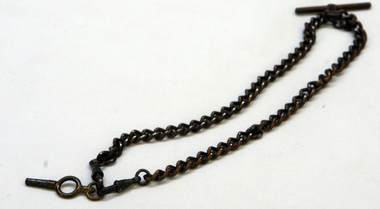
... A pocket watch (or fob watch) is a watch that is made to be carried in a pocket. Watches were also mounted on a short leather strap or fob, when a long chain would have been cumbersome or likely to catch on things. ...This fob could also provide a protective flap over their face. Watch chains were introduced about 100 years after pocket watches first appeared in the 16th century. ...A pocket watch (or fob watch) is a watch that is made to be carried in a pocket. Watches were also mounted on a short leather strap or fob, when a long chain would have been cumbersome or likely to catch on things. This fob could also provide a protective flap over their face. Watch chains were introduced about 100 years after pocket watches first appeared in the 16th century. This item is an example of a popular piece of men's jewellery often considered to be a symbol of importance.Man's double, silver fob chain with key for watch.On fob chain - GILTchain silver fob-chain jewelry costume-accessories- male -
 City of Moorabbin Historical Society (Operating the Box Cottage Museum)
Watches, small silver plated pocket, c1900
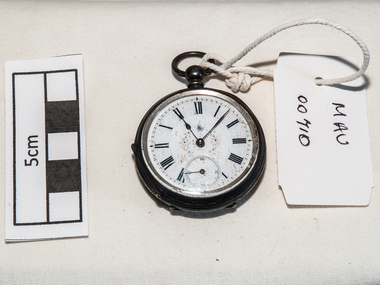
... Pocket Watches became popular in the late19th C. Gentlemen put their 'Fob' watch in their waistcoat pocket attached to a chain that had a bar that slipped through a button hole. ...Watches by a chain to their chatelaine. Nurses usually used a bar with a pin to attach the pocket watch to their uniform. All Train Conductors had a Fob ...Pocket Watches became popular in the late19th C. Gentlemen put their 'Fob' watch in their waistcoat pocket attached to a chain that had a bar that slipped through a button hole. Ladies attached their Watches by a chain to their chatelaine. Nurses usually used a bar with a pin to attach the pocket watch to their uniform. All Train Conductors had a Fob Watch to keep check of the Train Timetable.This small silver plated pocket watch with a hinged case has a white enamel dial with black Roman numerals, a seconds dial at 6 and black metal hands.unreadable on back of Casebrighton, moorabbin, pioneers, watchmaking, jewellers, market gardeners, early settlers, craftwork, watches, clocks -
 Bendigo Military Museum
Accessory - COMPASS & WATCH, Early 1900’s
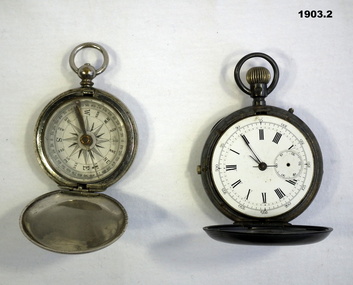
... Refer Cat No 1906 for service details also 1905P. horology-watches instruments - general Watch compass 1) Inside Face "H.SOUTHBY Bendigo", outside face "HS" 2) "CF 12355" 1) Compass Compass, round, metal, silver, face opens on a hinge with compass bearings in black over a white face. The inside face is engraved as is the outside of the hinged opening. A circular ring is on the top of the compass. 2) Watch Fob ...Both items belonged to Captain Henry SOUTHBY, 39th Batt AIF, KIA 12.10.1917. Refer Cat No 1906 for service details also 1905P.1) Compass Compass, round, metal, silver, face opens on a hinge with compass bearings in black over a white face. The inside face is engraved as is the outside of the hinged opening. A circular ring is on the top of the compass. 2) Watch Fob Watch, metal, round. One face opens to show time with white face and black numbering. The rear opens to show 9 small clock faces showing the time in 9 countries. The top has a circular ring.1) Inside Face "H.SOUTHBY Bendigo", outside face "HS" 2) "CF 12355"horology-watches, instruments - general, watch, compass -
 Bendigo Historical Society Inc.
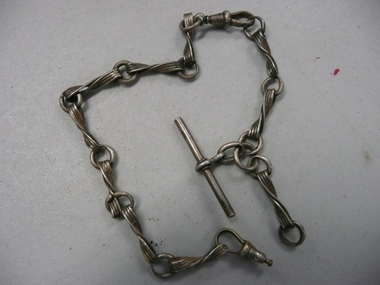
Accessory - FOB WATCH CHAIN
... HOROLOGY Watches chain F.W.C Fob watch chain, figure of 8 twists connected with rings, T bar for button hole hallmarked sterling silver, and 2 clasps. ...Fob watch chain, figure of 8 twists connected with rings, T bar for button hole hallmarked sterling silver, and 2 clasps.F.W.Chorology, watches, chain -
 Bendigo Historical Society Inc.
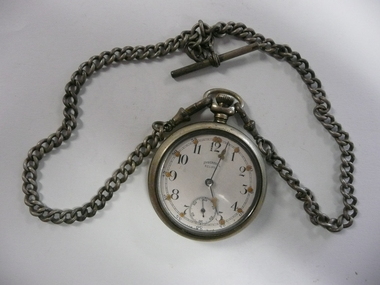
Accessory - POCKET WATCH AND FOB CHAIN, 1915
... HOROLOGY Watches Made in USA Ingersoll Eclipse Ingersoll eclipse pocket watch and fob chain EPNS case and chain, black numerals with gold dots with separate second hand at bottom. ...Ingersoll eclipse pocket watch and fob chain EPNS case and chain, black numerals with gold dots with separate second hand at bottom. Label inside reads Robt.H.Ingersoll & Bro makers Ely place London 15.5.15Made in USA Ingersoll Eclipsehorology, watches -
 Bendigo Historical Society Inc.
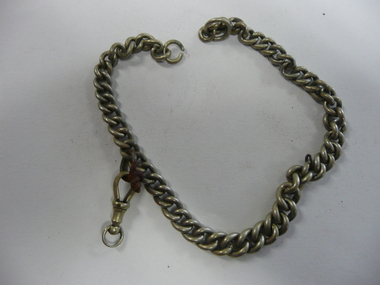
Accessory - FOB CHAIN
... HOROLOGY Watches Nickel plated fob chain for pocket watch. Accessory FOB CHAIN ...Nickel plated fob chain for pocket watch.horology, watches -
 Warrnambool and District Historical Society Inc.
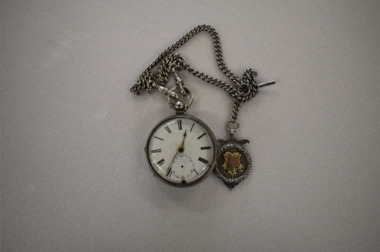
Accessory - Fob Watch, early 20th century
... watches became common after this time frame. This item has no known local provenance. This item is retained for display purposes only Vintage accessories Warrnambool History This is a round silver watch with a white face with roman numeral figures and gold hands.The face has a glass front which is loose in its mountings. The watch has a round clip at the top to which is attached a silver chain. At the end of the chain is a metal badge with a space to engrave a name but this is blank. Accessory Fob ...A watch of this type would have been a common item for a man to carry on his person in the late 19th and early 20th centuries. Wrist watches became common after this time frame. This item has no known local provenance.This item is retained for display purposes onlyThis is a round silver watch with a white face with roman numeral figures and gold hands.The face has a glass front which is loose in its mountings. The watch has a round clip at the top to which is attached a silver chain. At the end of the chain is a metal badge with a space to engrave a name but this is blank. vintage accessories, warrnambool history -
 Whitehorse Historical Society Inc.
Accessory - Watch
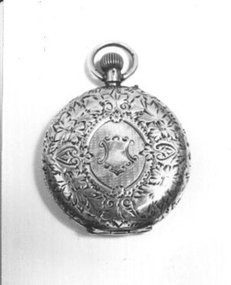
... horology watches Silver ladies fob watch decorated on lid - white face with black numerals Accessory Watch ...Silver ladies fob watch decorated on lid - white face with black numeralshorology, watches -
 Whitehorse Historical Society Inc.
Accessory - Watch
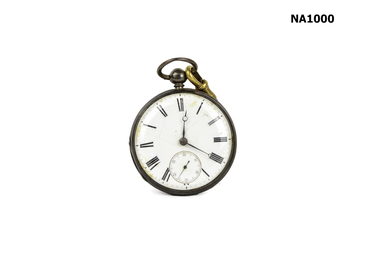
... horology watches Round silver fob watch with inset for second hand. ...Round silver fob watch with inset for second hand. White face with black roman numerals. Link for chain.horology, watches -
 Mont De Lancey
Watch, Westclox Dax, 1800's
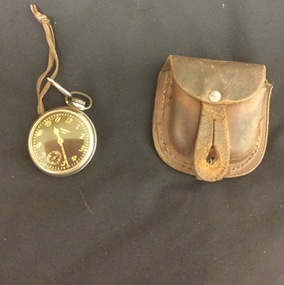
... Charles Cornell. pocket watches watches Fob watch in brown leather pouch. Watch Westclox Dax ...Belonged to Mrs. Ellen & Mr. Charles Cornell.Fob watch in brown leather pouch.pocket watches, watches
