
Showing 14 items matching "food storage bags"
-
 Mont De Lancey
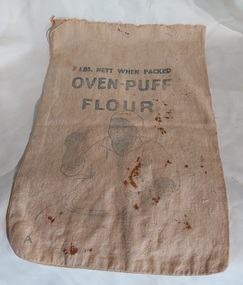
Domestic object - Flour Bag, WatsonMilling Company. Pty.Ltd, 1950's
... ...Food storage bags...bags were used for bulk purchases of flour in early to mid 20th century. They would have been laundered and re-used for storage. In earlier times empty flour bags were washed and boiled and then made into tea towels or children’s bloomers, or underwear. Flour Flour bags Flour containers Food ...This brand of Oven-Puff Flour may refer to self-raising flour. It is noted that self-rising flour (as it was called then) was invented in England in 1845. This flour was commonly branded as "Mammy Oven Puff". Mammy Products Pty Ltd operated during the mid-1900s, producing these specialty baking goods. Advertisements from the late 1930s and 1940s show the flour was marketed as "something different" for home bakers. Flour bags were used for bulk purchases of flour in early to mid 20th century. They would have been laundered and re-used for storage. In earlier times empty flour bags were washed and boiled and then made into tea towels or children’s bloomers, or underwear.A vintage small cream coloured draw string cotton flour bag with the brand Oven-Puff Flour printed in faded pale blue lettering on both sides. 7lbs. Nett when Packed is at the top of the bag. There is an outline image of a black woman wearing a headscarf below the branding. This flour was commonly branded as "Mammy Oven Puff". Mammy Products Pty Ltd. ' 7LBS. NETT WHEN PACKED OVEN-PUFF FLOUR' There is an outline image of a black woman wearing a headscarf below the branding. 'Watson Milling Company. Pty. Ltd.' Is stamped in faded blue on the back of the bag at the bottom. flour, flour bags, flour containers, food storage bags -
 Mont De Lancey
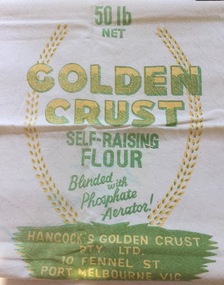
Domestic object - Flour bag, Hancock's Golden Crust Pty. Ltd, 1920's - 1950's
... ...Food storage bags...bags were used for bulk purchases of flour in early to mid 20th century. They would have been laundered and re-used for storage. In earlier times empty flour bags were washed and boiled and then made into tea towels or children’s bloomers, or underwear. Flour Flour bags Flour containers Food ...Self-rising flour was invented in England in 1845. The inventor, Henry Jones, sought to greatly improve the palatability of the “molar breaking” bread, hard tack, for British sailors. However, it took over 10 years of trying to convince the British command of the Navy to get behind it. In 1855, self-rising flour was finally put to use to make fresh bread for sailors during the Crimean War.Flour bags were used for bulk purchases of flour in early to mid 20th century. They would have been laundered and re-used for storage. In earlier times empty flour bags were washed and boiled and then made into tea towels or children’s bloomers, or underwear.A vintage white calico flour bag with the brand Golden Crust Self-Raising Flour printed in yellow and green lettering on the front, surrounded by two curved lines of wheat stalks each side. The manufacturing details are printed at the bottom with 50 lb Net at the top. 'Golden Crust Self-Raising Flour 50 lb - Blended with Phosphate Aerator!' 'Hancock's Golden Crust Pty.Ltd. 10 Fennel St Port Melbourne Vic'flour, flour bags, flour containers, food storage bags -
 Flagstaff Hill Maritime Museum and Village
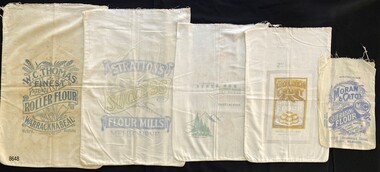
Textile - Flour Bags (5)
... bags...calico...domestic object...textile...food storage...bags were used when purchasing flour from the late 19th century to the mid 20th century. They were able to be reused for bulk storage of dry goods or sewn into domestic objects such as tea towels, pillowcases or waggas. The flour bags provide both a snapshot of different producers and stockists of flour in Victoria and an example of a useful domestic packaging product, from the early 20th century. Flagstaff Hill Maritime Museum and Village Great Ocean Road Shipwreck Coast flour bags calico domestic object textile food ...Flour bags were used when purchasing flour from the late 19th century to the mid 20th century. They were able to be reused for bulk storage of dry goods or sewn into domestic objects such as tea towels, pillowcases or waggas.The flour bags provide both a snapshot of different producers and stockists of flour in Victoria and an example of a useful domestic packaging product, from the early 20th century.A set of five flour bags originating from different Victorian places. Stratton's in Melbourne, McAlpin's in Melbourne / Ballarat, Moran & Cato's in Fitzroy, Golden Crust from South Yarra and W.C. Thomas from Warracknabeal. Each bag is made from calico with an image on the front that relates to the company.flagstaff hill maritime museum and village, great ocean road, shipwreck coast, flour bags, calico, domestic object, textile, food storage -
 Flagstaff Hill Maritime Museum and Village
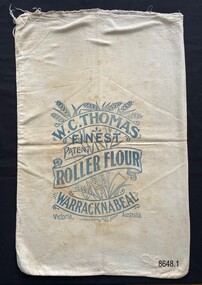
Textile - Flour bag - W.C.Thomas, Warracknabeal
... bags...calico...domestic object...textile...food storage...storage, flour bags were able to be reused for bulk storage of other dry goods or sewn into domestic objects such as tea towels, pillowcases or waggas. This is a good example of a flour bag from a prominent Victorian flourmill, operating from the late 19th century to the mid-20th century. Flagstaff Hill Maritime Museum and Village Great Ocean Road Shipwreck Coast flour bags calico domestic object textile food ...This flour bag came from the W.C. Thomas Flour Mill at Warracknabeal, Victoria. W.C. Thomas ran a number of flour mills throughout the Victorian wheat belt, with the Warracknabeal Mill operating from 1884 to 1964. After their use for flour storage, flour bags were able to be reused for bulk storage of other dry goods or sewn into domestic objects such as tea towels, pillowcases or waggas.This is a good example of a flour bag from a prominent Victorian flourmill, operating from the late 19th century to the mid-20th century.Calico flour bag for 'Roller Flour' from the flour mill of W.C. Thomas in Warracknabeal, a large wheat growing area in Victoria. The stencil on the front of the bag includes an image of wheat overlaid with the written information in scroll format.W.C. Thomas, Finest, Patent, Roller Flour, Warracknabeal, Victoria, Australia. Wheat image.flagstaff hill maritime museum and village, great ocean road, shipwreck coast, flour bags, calico, domestic object, textile, food storage, w.c. thomas, warracknabeal, flour mill -
 Flagstaff Hill Maritime Museum and Village
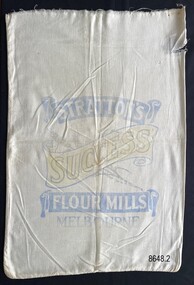
Textile - Flour bag - Stratton's, Melbourne
... bags were used when purchasing flour from the late 19th century to the mid 20th century. They were able to be reused for bulk storage of dry goods or sewn into domestic objects such as tea towels, pillowcases or waggas. The flour bag provides an example of a useful domestic packaging product, from the early 20th century. Flagstaff Hill Maritime Museum and Village Great Ocean Road Shipwreck Coast calico domestic object textile food ...Flour bags were used when purchasing flour from the late 19th century to the mid 20th century. They were able to be reused for bulk storage of dry goods or sewn into domestic objects such as tea towels, pillowcases or waggas.The flour bag provides an example of a useful domestic packaging product, from the early 20th century.Calico flour bag for 'Success Flour' from Stratton’s flour mill in Melbourne. The stencil on the front of the bag includes the image of a wheat stalk overlaid with the written information in scroll format.Stratton's, Success, Flour Mills, Melbourneflagstaff hill maritime museum and village, great ocean road, shipwreck coast, calico, domestic object, textile, food storage, stratton's, flour bag -
 Flagstaff Hill Maritime Museum and Village
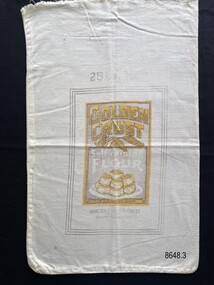
Textile - Flour bag - Golden Crust
... bags were used when purchasing flour from the late 19th century to the mid 20th century. They were able to be reused for bulk storage of dry goods or sewn into domestic objects such as tea towels, pillowcases or waggas. The flour bag provides an example of a useful domestic packaging product, from the early 20th century. Flagstaff Hill Maritime Museum and Village Great Ocean Road Shipwreck Coast calico domestic object textile food ...Flour bags were used when purchasing flour from the late 19th century to the mid 20th century. They were able to be reused for bulk storage of dry goods or sewn into domestic objects such as tea towels, pillowcases or waggas.The flour bag provides an example of a useful domestic packaging product, from the early 20th century.Calico flour bag for Golden Crust Self-raising flour, 25lb. The stencil on the bag includes the manufacturer’s address and images of heads of wheat and a plate of scones. 25lbs, Golden Crust, Self-raising Flour, Blended with Phosphate Aerator, Hancock’s Golden Crust Pty.Ltd. South Yarra, Vicflagstaff hill maritime museum and village, great ocean road, shipwreck coast, calico, domestic object, textile, food storage, flour bag, golden crust -
 Flagstaff Hill Maritime Museum and Village
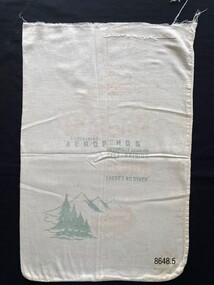
Textile - Flour bag - McAlpin's Flour containing Aerophos'
... bags were used when purchasing flour from the late 19th century to the mid 20th century. In Melbourne, McAlpin's were one of the best known suppliers of self-raising flour. The business first began as a bakery in 1879 and was taken over in 1959. This is a good example of a flour bag from a well know Victorian supplier prominent in the early twentieth century. Flagstaff Hill Maritime Museum and Village Great Ocean Road Shipwreck Coast calico domestic object textile food storage ...Flour bags were used when purchasing flour from the late 19th century to the mid 20th century. In Melbourne, McAlpin's were one of the best known suppliers of self-raising flour. The business first began as a bakery in 1879 and was taken over in 1959. This is a good example of a flour bag from a well know Victorian supplier prominent in the early twentieth century.Calico flour bag for McAlpin’s self-raising flour. The stencil on the bag is very faded especially where red ink has been used. It includes an image of mountains and fir trees in green ink and a stalk of wheat sweeping up from bottom right to top / middle left in red ink.McAlpin’s (faded red) CONTAINING AEROPHOS’, PHOSPHATE AERATOR, SELF-RAISING, FLOUR (faded red), “THERE’S NO OTHER” Faded red square with writing …. CALCIUM …. Faded red triangle with T inside it to the far right of the trees Faded red writing at the bottom of the bag: PREPARED WITH PHOSPHATE AERATOR, AEROPHOS 25 LBS NET flagstaff hill maritime museum and village, great ocean road, shipwreck coast, calico, domestic object, textile, food storage, flour bag, mcalpin's, self-raising flour -
 Flagstaff Hill Maritime Museum and Village
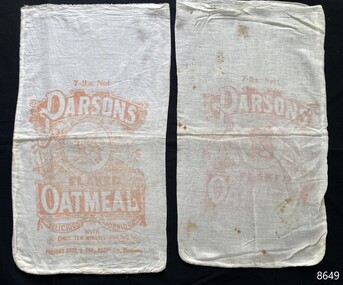
Textile - Parsons' Oatmeal Bags
... foods such as oats were packaged in cloth bags from the late 19th century to the mid 20th century. Parsons' Brothers and Company were involved in packaging a variety of produce for the Australian market including oatmeal for porridge. The oat bags provide a snapshot of a well-known Australian food company and how the bags were used to advertise other items available from the business. Flagstaff Hill Maritime Museum and Village Great Ocean Road Shipwreck Coast Warrnambool Calico Domestic object textile food storage ...Dry foods such as oats were packaged in cloth bags from the late 19th century to the mid 20th century. Parsons' Brothers and Company were involved in packaging a variety of produce for the Australian market including oatmeal for porridge.The oat bags provide a snapshot of a well-known Australian food company and how the bags were used to advertise other items available from the business.A set of two Oatmeal Bags from the Parsons' company. Each bag is made from calico with ornate writing and images on the front that relate to the product and company. The back of each bag is used to advertise a different product from the company – Saline Powder (8649.1) and Mustard (8649.2).Front (both): 7-lbs. Net, PARSONS', TRADE MARK, THE ORIGINAL FLAKED OATMEAL, DELICIOUS PORRIDGE, WITH ONLY TEN MINUTES BOILING, PARSONS BROS & COY., PROPY. LTD., MELBOURNE Back 8649.1 : TRY Parsons', PARSONS' SALINE POWDER, NET ? LB, SALINE POWDER, A COOL, REFRESHING AND HEALTHFUL DRINK Back 8649.2 : UNSURPASSED in Quality and Price, PARSONS' MUSTARD, (further writing is faded)flagstaff hill maritime museum and village, great ocean road, shipwreck coast, warrnambool, calico, domestic object, textile, food storage, parsons' bros, oatmeal, porridge -
 Flagstaff Hill Maritime Museum and Village
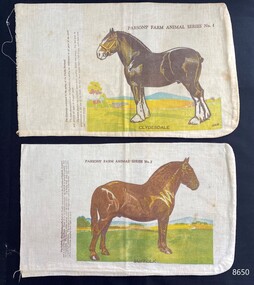
Textile - Parsons' Farm Animal Series Oat Bags
... bags used to store dry goods. Being presented as a ‘Farm Animal Series’ gives them added value as a collectable item and may have been an advertising ploy used by the company. Flagstaff Hill Maritime Museum and Village Great Ocean Road Shipwreck Coast Warrnambool Calico Domestic object textile food storage Parsons' Farm Animal Series oats Clydesdale Suffolk 8650.1 PARSONS' FARM ANIMAL SERIES No. 1, CLYDESDALE, The Clydesdale originated in the valley of the Clyde, Scotland. ...Dry foods for domestic use were packaged in cloth bags from the late 19th century to the mid 20th century. As the bags contain the name Parsons' it could be presumed that they were oat bags as the Parsons Company packaged a variety of groceries for the Australian market including oats. The bags provide an example of calico bags used to store dry goods. Being presented as a ‘Farm Animal Series’ gives them added value as a collectable item and may have been an advertising ploy used by the company.A set of two calico bags from the Parsons' company - most likely bought as oat bags. The two are: No 1. (Clydesdale) and No 3. (Suffolk) from the Parsons' Farm Animal Series. Each bag has a multicoloured ink picture and written information about the horse described on the bag.8650.1 PARSONS' FARM ANIMAL SERIES No. 1, CLYDESDALE, The Clydesdale originated in the valley of the Clyde, Scotland. The main characteristics of the Clydesdale are ability to acclimatise in all parts of the world and perform all types of draught work. Clydesdale breeders lay emphasis upon bone, quality, weight, and action. The feet must be proportionate to the size of the horse, the hoof-head should have a full crown, with heels wide and quarters strong. 8650.2 PARSONS' FARM ANIMAL SERIES No. 3, SUFFOLK, The Suffolk, often known as the Suffolk Punch, originated in the County of Suffolk, England and is noted for its hardiness. From 15 to 16 hands in height, the Suffolk in general is smaller than the Clydesdale. The head is rather coarse, with the neck short. The body long, deep and wide with a round full appearance. The croup is straight, the legs short and free from feather. The invariable colour is chestnut, varying from light to dark.flagstaff hill maritime museum and village, great ocean road, shipwreck coast, warrnambool, calico, domestic object, textile, food storage, parsons' farm animal series, oats, clydesdale, suffolk -
 Flagstaff Hill Maritime Museum and Village
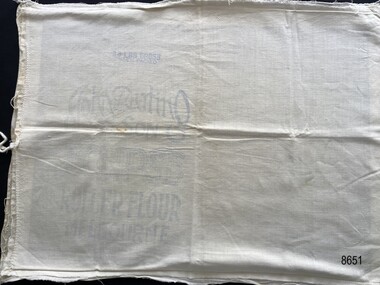
Textile - Flour Bag Pillowcase
... bags were recycled and repurposed into useful domestic objects in the early 20th century. Flagstaff Hill Maritime Museum and Village Great Ocean Road Shipwreck Coast Warrnambool Calico Domestic object textile food storage John Darling & Son Eclipse Roller Flour O-SO-LITE Flour pillowcase flour bag Side 1 25LBS GROSS WHEN PACKED, John Darling & Son, ECLIPSE, ROLLER FLOUR, MELBOURNE Side 2 O-SO-LITE, Self-raising, FLOUR, Creamy & Delicious, O-SO-LITE PRODUCTS, 412 COLLINS ST MELBOURNE, C.I. ...Flour bags were a useful source of material to be repurposed into domestic objects in the early 20th century. This object, fashioned from two well-known brands of flour bag, was most likely used as a pillowcase.The pillowcase provides an example of how flour bags were recycled and repurposed into useful domestic objects in the early 20th century.Two flour bags opened out and sewn together to create a possible pillowcase. The open end has a tie sewn to each side to enable the pillowcase to be closed. The bags have been sewn with the inscriptions on the inside of the pillowcase.Side 1 25LBS GROSS WHEN PACKED, John Darling & Son, ECLIPSE, ROLLER FLOUR, MELBOURNE Side 2 O-SO-LITE, Self-raising, FLOUR, Creamy & Delicious, O-SO-LITE PRODUCTS, 412 COLLINS ST MELBOURNE, C.I. Decoration of wheat stalks surround the inscription.flagstaff hill maritime museum and village, great ocean road, shipwreck coast, warrnambool, calico, domestic object, textile, food storage, john darling & son, eclipse roller flour, o-so-lite flour, pillowcase, flour bag -
 Orbost & District Historical Society
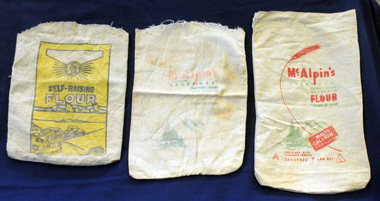
flour bags, mid 20th century
... flour-bags warren-helena mcalpin mcvitty food-storage...bags were used for bulk purchases of flour in early to mid 20th century. They would have been laundered and re-used for storage. In earlier times empty flour bags were washed and boiled and then made into tea towels or children’s bloomers, or underwear. The flour bags are good examples of packaging and design for Australian produce which sold across Australia and overseas in the mid 20th century. flour-bags warren-helena mcalpin mcvitty food-storage Three rectangular, open calico flour bags. 2491.1 is faded and has red and green print sketch of a fir tree with mountains in the background- "McAlpin's, Containing "Aerophos", Self-Raising Flour; "There's No Other". 2491.2 has similar print with a red stalk of wheat and "7lbs Net" and a C inside a triangle. 2491.3 has yellow background inside a rectangular frame with black print - "Tested ; Self-Raising Flour"; a drawing of a wheat field; "Medallion Brand ; Groves McVitty & Co Pty Ltd' 8 Market Street Melbourne. flour bags J.McAlpin & Sons, ...These three flour bags belonged to Helena Warren (nee McKeown) who was a self-taught photographer who became the local press correspondent and producer of postcard images. She was married to William John warren and lived in Newmerella. Flour bags were used for bulk purchases of flour in early to mid 20th century. They would have been laundered and re-used for storage. In earlier times empty flour bags were washed and boiled and then made into tea towels or children’s bloomers, or underwear. The flour bags are good examples of packaging and design for Australian produce which sold across Australia and overseas in the mid 20th century. Three rectangular, open calico flour bags. 2491.1 is faded and has red and green print sketch of a fir tree with mountains in the background- "McAlpin's, Containing "Aerophos", Self-Raising Flour; "There's No Other". 2491.2 has similar print with a red stalk of wheat and "7lbs Net" and a C inside a triangle. 2491.3 has yellow background inside a rectangular frame with black print - "Tested ; Self-Raising Flour"; a drawing of a wheat field; "Medallion Brand ; Groves McVitty & Co Pty Ltd' 8 Market Street Melbourne.flour-bags warren-helena mcalpin mcvitty food-storage -
 Friends of Westgarthtown
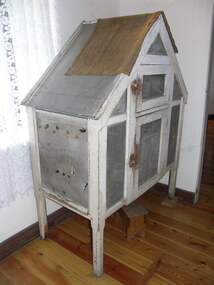
Functional object - Coolgardie Safe, Carl Ziebell, direct descendant, c. 1915
... foods in extreme heat before the availability of mechanical refrigeration. Using the same evaporative principles employed by explorer’s canvas water bags, the Coolgardie safe utilised a timber frame, zinc metal sheets, wire mesh panels and wet hessian cloth to create a naturally cooled storage chamber. ...This Coolgardie safe is a significant example of late-19th-century Australian ingenuity and domestic adaptation in response to the challenges of life in remote and harsh environments. Invented in the late 1890s by Arthur Patrick McCormick at Coolgardie, then the center of a major Western Australian gold rush, the safe represents an important technological response to the need for preserving perishable foods in extreme heat before the availability of mechanical refrigeration. Using the same evaporative principles employed by explorer’s canvas water bags, the Coolgardie safe utilised a timber frame, zinc metal sheets, wire mesh panels and wet hessian cloth to create a naturally cooled storage chamber. When placed in a draught or breeze, evaporation lowered the internal temperature, allowing miners, settlers and later rural households to keep meat, dairy and vegetables safe for longer periods. Sylvia Schultz (nee Ziebell) remembers the Coolgardie safe at Ziebell’s Farmhouse “was always positioned in the pantry where it is today, near the window to allow the breeze in”. Items the Ziebell’s stored in the safe included meats, milk and cream, and home-made goods. This object embodies a pivotal moment in Australia’s social and technological history, illustrating resourcefulness, adaptation to climate, and the lived realities of those who settled and worked in remote regions. As an early form of sustainable refrigeration, it contributes valuable interpretive depth to domestic, rural and goldfields history. Handmade food safe with white painted wooden frame and perforated zinc screen panels. Galvanised sheet roof. Raised four beveled legs. Two rectangular doors, bottom door large, opens to main area with one shelf. top door small, opens to triangular roof section. Movable latches of wood on both doors.No visible markingsdomestic items, food storage and preservation, food, safe, storage, pantry, carl ziebell -
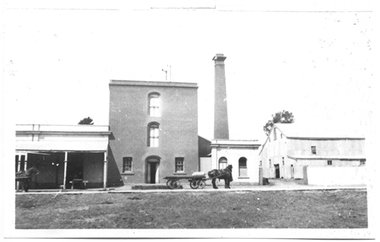 Tarnagulla History Archive
Photograph of Flour Mill, Tarnagulla, Flour Mill, Tarnagulla, circa 1920
... bags in storage. Thomas Comrie died on 4th August 1910. The Mill was carried on by his executors, then closed for a short period prior to being sold in September 1918 to a Mr. O. Albert of Talbot. Albert operated the Mill for a few years but during the 1920s it was closed down and then pulled down. It was later re-erected at Mildura where it operated for many years. This is a poor copy of an older original. Copy probably made by Murray Comrie in the late 1960s. tarnagulla commerce agriculture food ...Murray Comrie Collection. Information written by Murray Comrie: A meeting was called at the Golden Age Hotel on 11th June 1868 when it was resolved to build a flour mill. Tenders were called by H.C. Bristol, in the Tarnagulla Courier of January 10, 1874, for the erection of the mill. Building of the Mill commenced in 1874. Pipes were laid to Company's Dam to obtain water for the Mill's boilers. Steam was got up for the first time on 30th March, 1882. A boiler burst about April 29th. Two men (J.H. Smith and W. Hargreaves) died as a result and two others were seriously injured. The mill commenced operations on 13th June 1882 with Mr. W. Fitzgerald as manager. Thomas Comrie was the proprietor and was responsible for the Mill being built. The Mill operated with grinding stones until 1899 when new rollers and a considerable amount of new equipment was installed, including a new, more powerful engine to drive the Mill. In January 1901, 6,000 bags of wheat were received weekly and it was a common sight to see the streets lined with wagons. In 1913, 15,000 bags of wheat were bought at three shillings and four pence per bushell. In January 1914, wheat came in at the rate of 1500 bags a day with 20,000 bags in storage. Thomas Comrie died on 4th August 1910. The Mill was carried on by his executors, then closed for a short period prior to being sold in September 1918 to a Mr. O. Albert of Talbot. Albert operated the Mill for a few years but during the 1920s it was closed down and then pulled down. It was later re-erected at Mildura where it operated for many years. This is a poor copy of an older original. Copy probably made by Murray Comrie in the late 1960s. Monochrome photograph of the Flour Mill in Tarnagulla, around 1920.tarnagulla, commerce, agriculture, food production, mill, milling, horses, transport, buildings, commercial road, main street -
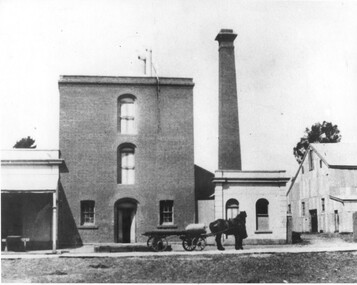 Tarnagulla History Archive
Photograph of Flour Mill, Tarnagulla, Flour Mill, Tarnagulla, circa 1920 (original image)
... bags in storage. Thomas Comrie died on 4th August 1910. The Mill was carried on by his executors, then closed for a short period prior to being sold in September 1918 to a Mr. O. Albert of Talbot. Albert operated the Mill for a few years but during the 1920s it was closed down and then pulled down. It was later re-erected at Mildura where it operated for many years. This is a poor copy of an older original. Copy probably made by Murray Comrie in the late 1960s. tarnagulla commerce agriculture food ...Murray Comrie Collection. Information written by Murray Comrie: A meeting was called at the Golden Age Hotel on 11th June 1868 when it was resolved to build a flour mill. Tenders were called by H.C. Bristol, in the Tarnagulla Courier of January 10, 1874, for the erection of the mill. Building of the Mill commenced in 1874. Pipes were laid to Company's Dam to obtain water for the Mill's boilers. Steam was got up for the first time on 30th March, 1882. A boiler burst about April 29th. Two men (J.H. Smith and W. Hargreaves) died as a result and two others were seriously injured. The mill commenced operations on 13th June 1882 with Mr. W. Fitzgerald as manager. Thomas Comrie was the proprietor and was responsible for the Mill being built. The Mill operated with grinding stones until 1899 when new rollers and a considerable amount of new equipment was installed, including a new, more powerful engine to drive the Mill. In January 1901, 6,000 bags of wheat were received weekly and it was a common sight to see the streets lined with wagons. In 1913, 15,000 bags of wheat were bought at three shillings and four pence per bushell. In January 1914, wheat came in at the rate of 1500 bags a day with 20,000 bags in storage. Thomas Comrie died on 4th August 1910. The Mill was carried on by his executors, then closed for a short period prior to being sold in September 1918 to a Mr. O. Albert of Talbot. Albert operated the Mill for a few years but during the 1920s it was closed down and then pulled down. It was later re-erected at Mildura where it operated for many years. This is a poor copy of an older original. Copy probably made by Murray Comrie in the late 1960s. Monochrome photograph of the Flour Mill in Tarnagulla, around 1920. Cropped version of 2019.0047.tarnagulla, commerce, agriculture, food production, mill, milling, horses, transport, buildings, commercial road, main street
