
Showing 4 items matching "food transportation"
-
 Cheese World Museum
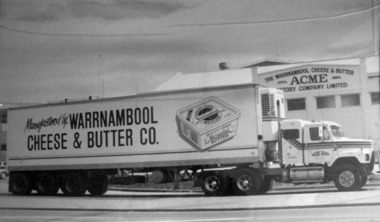
Photograph - Black and white photograph, Warrnambool Cheese and Butter Factory semi-trailer
... ...food transportation...warrnambool cheese and butter factory truck semi-trailer food transportation Warrnambool Cheese and Butter Factory semi-trailer Photograph Black and white photograph ...warrnambool, cheese and butter factory, truck, semi-trailer, food transportation -
 Kiewa Valley Historical Society
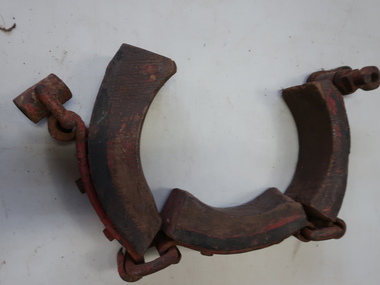
Dray Brake Band, Horse Equipment
... food. They were pulled by horses or bullocks. Drays were important for transportation in the Kiewa Valley. drays horses bullocks Made of timber and steel. ...Drays were used to transport heavy materials such as farm products, building supplies, food. They were pulled by horses or bullocks. Drays were important for transportation in the Kiewa Valley.Made of timber and steel. The piece of wood contacts the axle hub to brake the dray. Part of a brake for a dray. It is missing the actuator that is needed for tightening the band to operate as a brake.drays, horses, bullocks -
 Dutch Australian Heritage Centre Victoria
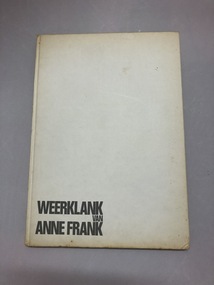
Book, Weerklank van Anne Frank (Echo of Anne Frank), 1970
... After their betrayal and transportation only her father Otto Frank survived. Her diary was saved by one of the helpers who brought them food and news during the 2 years in hiding. ...After their betrayal and transportation only her father Otto Frank survived. Her diary was saved by one of the helpers who brought them food and news during the 2 years in hiding. ...Anne Frank was one of a group of eight Jews in hiding from the Nazis. After their betrayal and transportation only her father Otto Frank survived. Her diary was saved by one of the helpers who brought them food and news during the 2 years in hiding. The diary bears witness to Anne's budding talent as a writer. It is also an invaluable record of a Jewish family in hiding during WWII. It has been translated into over 70 languages and formed the inspiration for several movies and plays. The house on the Prinsengracht quickly became a major Amsterdam tourist destination and is the home of the Anne Frank Foundation.120pp hard cover book about the world-wide reactions to Anne Frank's diary. Hence the title "Echo". It describes a stage play and quotes many reactions from readers worldwide. Some of these are in the form of poetry. Authors are Otto Frank and Henri van Praag, President of the Anne Frank Foundation."For my daughter Bettina Christina - to remember her Mam. Jan.1976." -
 Emerald Museum & Nobelius Heritage Park
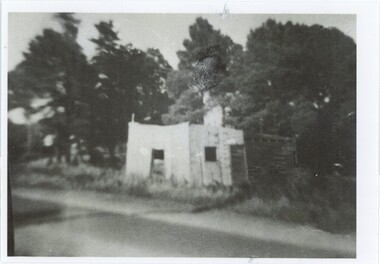
Photograph - Oat and Grain Store, 1961
... Oat and grain stores were important to horse-based transportation, the agriculture industry, and food supply until the mid-20th century. ...The oat and grain store was positioned opposite Emerald's original police station at 15 Kilvington Drive, on what is now the railway property near Puffing Billy Playground. The grain store was first built in the 1920s, used by Clyde Stapleton in the 1940s, and demolished not long after this photograph was taken in 1961.Oat and grain stores were important to horse-based transportation, the agriculture industry, and food supply until the mid-20th century.The main item is the black and white photograph, with a printed annotation pasted to the reverse; there is also a larger sepia copy. Both depict a stone or painted brick building by the side of the road, with a wooden annexe at the rear. There is no door on the building, which stands beside a road. In the background are several trees. The reverse of the sepia version has Kodak logos and handwritten pen annotations; the black and white copy has, besides the printed annotations, a handwritten title and accession number.Black & White, Reverse: "165 Oat & grain Store / P00529 / 165 Oat and grain store, built in the 1920s opposite the police / station (site of [crossed out: present playground] [handwritten: railway property]): [crossed out: Clive] [handwritten: Clyde] Stapleton used to come / from the city to shoe horses here in the 1940s/ The phootgraph was / taken in 1961 before the store was demolished. / [crossed out, handwritten: Legges used it as a store]" Sepia, Reverse: "Gary Steven's gave me this photo. 1961. / Original Oat & Grain Store / Clive Stapleton shod horses here / when he came up from Town. / Opposite Police Station (where the playground is)"agriculture, transport, 1960s, stapleton family
