
Showing 39 items matching "footwear shoes boots"
-
 Orbost & District Historical Society
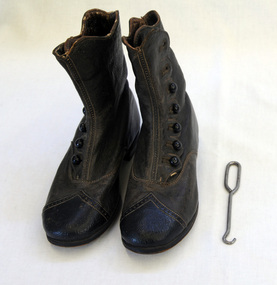
child's boots and hook, late 19th -early 20th century
... footwear shoes boots... fashion worn by children in the late 19th to early 20th century. footwear shoes boots On sole : size 6 Two small black leather boots. ...These were probably worn by a young girl as most girls wore side-button boots while the boys wore front-laced ones. The buttonhook was used to facilitate the closing of shoes, gloves or other apparel that uses buttons as fasteners. To use, the hook end is inserted through the buttonhole to capture the button by the shank and draw it through the opening.This item reflects the footwear fashion worn by children in the late 19th to early 20th century.Two small black leather boots. They are side buttoning boots with seven buttons (left boot is missing two). The button hook is metal.On sole : size 6footwear shoes boots -
 Kiewa Valley Historical Society
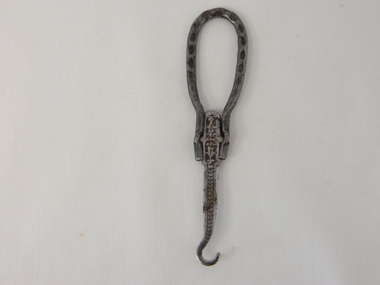
Hook Button, late 1800's to mid 1900's
... footwear...shoes and boots with buttons...This shift towards "the smaller" globe scenario has overcome the physical distances that were so apparent in the previous century. costume accessories footwear shoes and boots with buttons gloves costume This silver button/glove hook was based on late 1800's designs when buttons became more integrated and fashionable than "tie up" laces. ...This item and its use and design spans the 1800's to early 1900's both in its fashion and application requirements. The genteel factor must be made when applying it to the Kiewa Valley. The evolution of general clothing and apparel has moved from solid(long lasting) and sometimes expensive material and fasteners to a cheaper and more "throw away" fashion of sometimes monthly change in the later 1900's to 2000's.The significance of this item to a rural setting such as the Kiewa Valley not only points to an integration of "modern" fashion in semi remote rural Australian environments but also the limited connections to "high" fashion through magazines and audible (radio) and visual (cinema) advertising. It also "spotlights" the differences between the European and British social networking and lack of interaction between towns and counties to the "Australian" levels of interactions between rural and city environments. Although physical distances in Australia, during this period (1800's to early 1900's) was a retarding factor in the diffusion of the latest fashion apparel it was not as noticeable as when the global communication and the physical travel abilities were "exploded" in the latter 1900's. This shift towards "the smaller" globe scenario has overcome the physical distances that were so apparent in the previous century.This silver button/glove hook was based on late 1800's designs when buttons became more integrated and fashionable than "tie up" laces. This was more so in genteel fashion. The main hook extension from the "pronged" hand piece has been constructed in a way that allows for easy replacement by either longer or shorter hooks.costume accessories, footwear, shoes and boots with buttons, gloves, costume -
 Flagstaff Hill Maritime Museum and Village
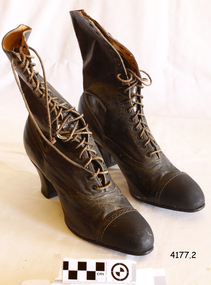
Footwear - Pair of Ladies' Boots, Second half of the 19th Century
... How lavish a woman’s boots were greatly depended upon how much money her family had and her place within society. While footwear was standard during this time, shoes were still quite a luxury to the modern Victorian. ...How lavish a woman’s boots were greatly depended upon how much money her family had and her place within society. While footwear was standard during this time, shoes were still quite a luxury to the modern Victorian. ...Starting in around 1850, women began wearing boots that resembled the ones already worn by men in high society. Women’s Victorian boots were slightly more feminine in nature, however, than those worn by their male counterparts. The boots first worn by women extended to the middle of the calf so that her ankle would stay properly covered underneath her many skirts. These boots often featured laces or a row of buttons to keep them secure to the foot and ankle. Although usually made from durable materials like rubber and leather, boots that were worn purely for fashion were sometimes made of more elegant materials like patent leather or dyed suede. Fashion boots from the Victorian era exude all of the opulence and decadence that are unique to that time period. Design elements like scalloped trims, intricate embroidery, and lace accents were also not uncommon when it came to elaborately designed Victorian boots. Unlike men’s boots, they also boasted a slight heel that was thinner and more feminine in design. How lavish a woman’s boots were greatly depended upon how much money her family had and her place within society. While footwear was standard during this time, shoes were still quite a luxury to the modern Victorian. Only very wealthy women owned multiple pairs of boots that featured eye-catching design elements. https://www.wardrobeshop.com/blogs/victorian-era/an-in-depth-look-at-victorian-footwear These boots appear to be of a practical nature, designed for comfort, warmth, and proof against the rain and mud, rather than high fashion.These ladies' boots are historically significant for their manufacture and use during the Victorian period.Pair of ankle length black ladies' boots with long tan coloured laces.flagstaff hill, warrnambool, shipwrecked-coast, flagstaff-hill, flagstaff-hill-maritime-museum, maritime-museum, shipwreck-coast, flagstaff-hill-maritime-village, boots, victorian, leather, footwear -
 Flagstaff Hill Maritime Museum and Village
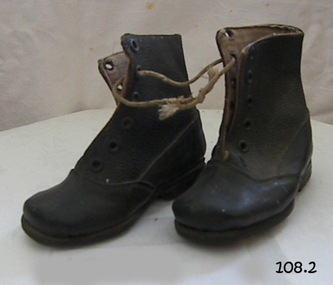
Footwear - Boots, 1900s
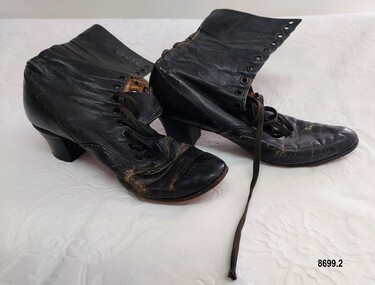
... Boots are believed to be one of the earliest shoes created when the evolution of footwear had begun. ...Boots are believed to be one of the earliest shoes created when the evolution of footwear had begun. ...Boots are believed to be one of the earliest shoes created when the evolution of footwear had begun. Boots form the building blocks of modern footwear which were merely a two-piece unit covering the foot and lower leg, a century ago. Throughout history, the importance of boots has been about fulfilling the needs of the wearer to be in sync with the prevailing culture. Boots were initially made of various materials like cotton, wool, silk, fur, felt, and leather (including caribou hide and sealskin. Around1000 B.C.E., men wore simple boots made of untanned leather with the fur turned in against the leg to keep it warm. These baglike boots were simple in design and then leashed to the leg by just a thong of leather. A mass produced pair of children's boots from the first quarter of the 20th century no significance other than the items age giving a snapshot into footwear of the period. Boots are unable to be linked to a significant person, family or event.One pair of Antique Victorian/Edwardian young boys-young girls shoes / boots. The boots are a black leather which lace up the front, laces missing bottom soles are leatherNoneflagstaff hill, warrnambool, shipwrecked coast, flagstaff hill maritime museum, shipwreck coast, flagstaff hill maritime village, great ocean road, boots, children's boots, footware -
 Flagstaff Hill Maritime Museum and Village
Footwear - Leather boots, Adler Boots and Shoes, circa 1920
... Footwear Leather boots Adler Boots and Shoes ...This item is one of a collection of clothing items that belonged to the Stephenson family who lived at 22 McCracken Street, Kensington, Melbourne. Matthew Stephenson (1861 – 1943) who had grown up on the Bendigo goldfields and shifted to Melbourne in the early 1900’s was a train driver and later, a fireman with the railways. His wife Elizabeth Jane (Betsy) Wigley (1865 – 1953) also grew up on the goldfields around Majorca and Bendigo. They married in 1885 in Bendigo. They had two daughters – Ethel Evelyn Stephenson (1886 – 1956) and Lillian or Lila (1891 – 1977) who were milliners and dressmakers and who continued to live in the family home after the death of their parents. The family are recorded as living at 22 McCracken Street, Kensington, as early as 1914. It is not known who made or owned the clothing that makes up this collection but as it appears to be from the late Victorian and early Edwardian era, the different pieces were probably made and worn by any of the three ladies of the house – Betsy, Ethel and/or Lila. During W.W.2, a local Warrnambool couple (Meryl and Tony Everard) boarded with them – Tony was in the airforce training paratroopers to jump into (and survive) enemy territory and his wife Meryl worked in the Methodist baby Home. The Everards developed a close friendship with the Stephensons and were responsible for clearing out the house (and finding this clothing collection) after Lila died in 1977. Starting in around 1850, women began wearing boots that resembled the ones already worn by men in high society. Victorian women's boots were slightly more feminine in nature, however, than those worn by their male counterparts. The boots first worn by women extended to the middle of the calf so that her ankle would stay properly covered underneath her many skirts. These boots often featured laces or a row of buttons to keep them secure to the foot and ankle. Although usually made from durable materials like rubber and leather, boots that were worn purely for fashion were sometimes made of more elegant materials like patent leather or dyed suede. Edwardian boots were lace up or button up. The most remarkable thing about women's shoes in the 1920's was that they were visible! This led to an increase in demand for new styles every season which made ordering custom fit shoes a thing of the past. New shoes were made in standard sizes, ready to buy from local clothing stores or mail order catalogues. Working women, however, tended to wear sensible, lace up shoes and boots. These boots appear to be of a practical nature, designed for comfort, warmth, and proof against the rain and mud, rather than high fashion. They feature the brand name "adler" printed on the inner sole and have stamped letters and numbers suggesting ready-made sizes.This pair of boots are a significant example of a working woman's footwear dating around the early 20th century.Pair of lady's black leather, lace up boots featuring 3.75 cm heels, 14 pairs of lacing eyelets, a black leather tongue and black shoelaces. The leather soles have tacks on the heels and near the instep. The boots have a black leather inner sole and the inner shaft and upper part of the boots are lined with a durable cotton type fabric. Both boots have ink markings (handwritten and stamped) at the top of the shaft lining and the inner sole of the left hand boot is labelled "adler".Both boots - "0/128 /X" (handwritten) and "6MC200" (stamped). Left boot inner sole - "adler" left boot upper shaft lining - "X/8FH?" (handwritten)flagstaff hill maritime museum and village, great ocean road, shipwreck coast, warrnambool, boots, lady's boots, footwear, leather boots, lace up boots, adler, stephenson family -
 City of Moorabbin Historical Society (Operating the Box Cottage Museum)
Manufactured Object, shoe polish gold kid, 20thC
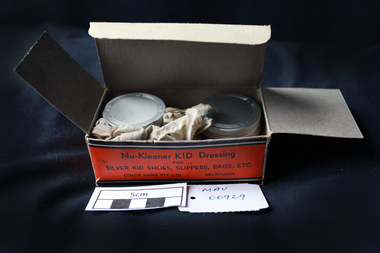
... Shoe polish is a waxy paste, cream, or liquid used to polish, shine, and waterproof leather shoes or boots to extend the footwear's life, and restore, maintain and improve their appearance. ...Shoe polish is a waxy paste, cream, or liquid used to polish, shine, and waterproof leather shoes or boots to extend the footwear's life, and restore, maintain and improve their appearance. ...Shoe polish is a waxy paste, cream, or liquid used to polish, shine, and waterproof leather shoes or boots to extend the footwear's life, and restore, maintain and improve their appearance. Shoe polish is not a cleaning product, and therefore the footwear should be both clean and dry before application. A cardboard box containing 1 jar of creme polish and 1 jar of gold powder with 2 cloths to be used for preserving 'silver kid shoes, slippers, bags etc.''top of box ' NU-KLEENER / SHOE DRESSING / GOLD KID / Cant B Beat ( drum soldier trade mark )' side THIS DRESSING IS SCIENTIFICALLY PREPARED BY EXPERTS TO ENSURE NOT ONLY A PERFECT FINISH, BUT ALSO AS A PRESERVATIVE OF THE ARTICLE TREATED,'/ Colour Shine Pty Ltd Melbourne. Instructions for use on either end of box . Inside lid a stamp 'Curton Co. Pty Ltd. Melbourne' Jar 1 'NU-KLEENER GOLD KID CREME' Jar 2 'NU-KLEENER GOLD KID POWDER'shoes, boots, clothing, boot preservation, leather, kid-leather, personal effects, handbags, moorabbin, colour shine pty ltd / curton co. pty. ltd -
 Glenelg Shire Council Cultural Collection
Footwear - Boots, Bedggood and Company, n.d
... shoe manufacturers was founded in 1854 by Daniel Bedggood. On arrival from England he set up a business in Richmond, Victoria to make working boots. He later began importing English footwear...boots. From Charles French's shop. Shoes made by Bedggood shoes. c) White cardboard box, 'Premier Brand' label on front, lid Footwear Boots Bedggood and Company ...Charles French was a shoe shop in Portland located on Percy Street. Advertised in the Portland Guardian in April 1916. This Melbourne firm of shoe manufacturers was founded in 1854 by Daniel Bedggood. On arrival from England he set up a business in Richmond, Victoria to make working boots. He later began importing English footwear. When branches were opened throughout Australia and business increased, the partnership, which included his three sons, was extended. The company was run by Bedggood's son John from the 1870s until 1911, then by John's son Daniel and later Horace Bedggood, as chairman of directors of Bedggood and Co. The company was deregistered on 21 July 1965.Pair of ladies lace-up boots, foot and heel white kid, top of boots white canvas, metal eyelets, white with brown leather strip as support also brown leather strip around inside top of boots. From Charles French's shop. Shoes made by Bedggood shoes. c) White cardboard box, 'Premier Brand' label on front, lidFront: Inside top of each boot '5E 352' Back: On sole of each boot, manufacturer's stampfemale fashion, womens wear, boots, charles french, portland business -
 Orbost & District Historical Society
boot buttons
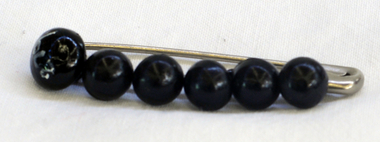
... boots became a fashion in the 1870s when hemlines were fashionable at the ankle, rather than dusting the top of the shoe. Previous to the high button boot was the ankle bootie favored by Queen Victoria. They laced up and gave no support to the ankle. But, when the dress hemline inched up a bit, more of the ankle was exposed. So, industrious shoe designers came up with a taller shaft of the boot, fastened with buttons rather than laces. This item is an example of early fashion. buttons costume accesories footwear ...From A. & D. Munro's bootmaker's shop. Archie Munro came to Orbost and started a boot shop in Cameron's barn where he was Acting Post Master.High button boots became a fashion in the 1870s when hemlines were fashionable at the ankle, rather than dusting the top of the shoe. Previous to the high button boot was the ankle bootie favored by Queen Victoria. They laced up and gave no support to the ankle. But, when the dress hemline inched up a bit, more of the ankle was exposed. So, industrious shoe designers came up with a taller shaft of the boot, fastened with buttons rather than laces. This item is an example of early fashion.Six small black boot buttons on a silver safety pin.buttons costume accesories footwear -
 City of Moorabbin Historical Society (Operating the Box Cottage Museum)
Clothing, button hook, c1900
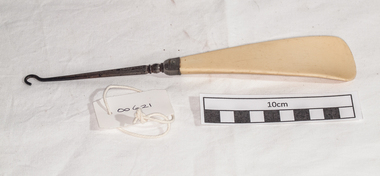
... shoes, gloves or other apparel that uses buttons as fasteners. It consists of a steel hook fixed to a handle that may be simple or decorative. The hook end is inserted through the buttonhole to capture the button by the shank and draw it through the opening. The family of May Curtis were early settlers in Moorabbin Shire clothing footwear gaiters boots ...A button hook is a tool used for the closing of shoes, gloves or other apparel that uses buttons as fasteners. It consists of a steel hook fixed to a handle that may be simple or decorative. The hook end is inserted through the buttonhole to capture the button by the shank and draw it through the opening.The family of May Curtis were early settlers in Moorabbin ShireA metal button hook for shoes and gaiters with an 'Ivorine' handleclothing, footwear, gaiters, boots, craftwork, ivorine, moorabbin, brighton, early settlers, pioneers, cheltenham, curtis may -
 City of Moorabbin Historical Society (Operating the Box Cottage Museum)
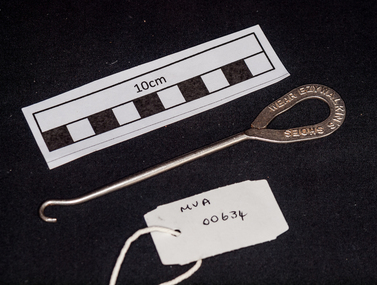
Clothing, button hook, c1900
... shoes, gloves or other apparel that uses buttons as fasteners. It consists of a steel hook fixed to a handle which may be simple or decorative. The hook end is inserted through the buttonhole to capture the button by the shank and draw it through the opening. Many were distributed as advertising for a Company, as this is for 'Ezywalkin' footwear Walter David Cookes established the Ezywalkin Shoe Company Pty Ltd in 1901 in Fremantle Western Australia. The Melbourne factory was established in 1910 clothing footwear gaiters boots ...A button hook is a tool used for the closing of shoes, gloves or other apparel that uses buttons as fasteners. It consists of a steel hook fixed to a handle which may be simple or decorative. The hook end is inserted through the buttonhole to capture the button by the shank and draw it through the opening. Many were distributed as advertising for a Company, as this is for 'Ezywalkin' footwearWalter David Cookes established the Ezywalkin Shoe Company Pty Ltd in 1901 in Fremantle Western Australia. The Melbourne factory was established in 1910A steel, button hook for shoes and gaiterson handle 'WEAR EZYWALKIN'S SHOES 'clothing, footwear, gaiters, boots, ezywalkin footwear, cookes walter david, company ltd, craftwork, moorabbin, brighton, early settlers, pioneers, cheltenham -
 City of Moorabbin Historical Society (Operating the Box Cottage Museum)
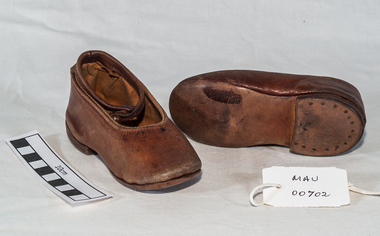
Clothing, child's brown shoes, c1900
... Early settlers in Moorabbin Shire had to be self reliant and made their own clothes, tools and utensils as they established their farms, market gardens and retail businesses, Bootmakers, farriers and blacksmiths were very important in these communities boots, shoes, footwear, bootmakers, leatherworkers, early settlers, pioneers, market gardeners, moorabbin, bentleigh, cheltemham, A pair of child's brown leather shoes c1890 with button hole straps Clothing, child's brown shoes Unrecorded bootmaker ...Early settlers in Moorabbin Shire had to be self reliant and made their own clothes, tools and utensils as they established their farms, market gardens and retail businesses, Bootmakers, farriers and blacksmiths were very important in these communitiesA pair of child's brown leather shoes c1890 with button hole strapsboots, shoes, footwear, bootmakers, leatherworkers, early settlers, pioneers, market gardeners, moorabbin, bentleigh, cheltemham, -
 City of Moorabbin Historical Society (Operating the Box Cottage Museum)
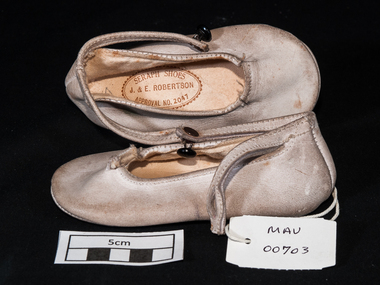
Clothing, Child's cream 'Seraph Shoes', c1928
... Shoe Company, Inc. has been producing and distributing the finest children’s footwear brands since 1928. Badorf Shoe Company, Inc. was started in Lititz, PA, by brothers Norman and Paul Badorf. The company was owned and operated by the Badorf family for nearly 40 years until its purchase by Ura Gingerich in 1967. Forty six years later, the family tradition has continued and the company is now operated by Ura’s son Duane Gingerich and grandsons, Justin and Brandon Gingerich. boots ...‘Seraph Shoes’ possibly manufactured by the Badorf Shoe Company Inc. Pensylvania USA Badorf Shoe Company, Inc. has been producing and distributing the finest children’s footwear brands since 1928. Badorf Shoe Company, Inc. was started in Lititz, PA, by brothers Norman and Paul Badorf. The company was owned and operated by the Badorf family for nearly 40 years until its purchase by Ura Gingerich in 1967. Forty six years later, the family tradition has continued and the company is now operated by Ura’s son Duane Gingerich and grandsons, Justin and Brandon Gingerich. A pair of child's cream leather shoes.SERAPH SHOES / J.E. ROBERTSON / APPROVAL No. 2047boots, shoes, footwear, bootmakers, leatherworkers, early settlers, pioneers, market gardeners, moorabbin, bentleigh, cheltemham -
 City of Moorabbin Historical Society (Operating the Box Cottage Museum)
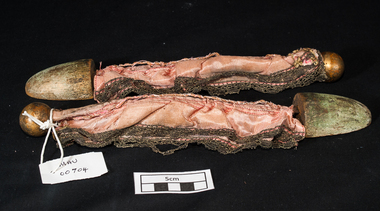
Clothing, shoe stretchers, 20thC
... boots, shoes, footwear, bootmakers, leatherworkers, early settlers, pioneers, market gardeners, moorabbin, bentleigh, cheltemham, shoe stretchers,...Shoe stretchers work best for suede, leather, and other natural materials. boots, shoes, footwear, bootmakers, leatherworkers, early settlers, pioneers, market gardeners, moorabbin, bentleigh, cheltemham, shoe stretchers, A pair of lady's wooden shoe stretchers, decorated with pink lace Clothing, shoe stretchers Unrecorded bootmaker ...Shoe stretchers can expand the width and the length of shoes. Shoes can shrink, feet can swell and bunions, corns or other foot imperfections can make the shoes hurt.. Shoe stretchers work best for suede, leather, and other natural materials. A pair of lady's wooden shoe stretchers, decorated with pink laceboots, shoes, footwear, bootmakers, leatherworkers, early settlers, pioneers, market gardeners, moorabbin, bentleigh, cheltemham, shoe stretchers, -
 Orbost & District Historical Society
boots, 1920's-1940's
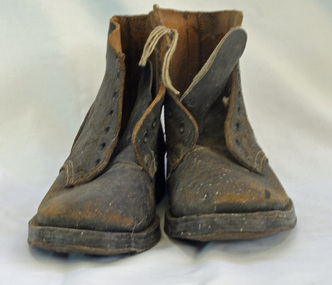
... These boots are an example of a successful Australian product which has been continuously manufactured since the early 20th century. boots footwear On the sole is a shoe shape with "Rossi" on the sole and "Shoes Made by Rossiter's LTD ALL LEATHER SOLE" on the heel. ...These boots are an example of a successful Australian product which has been continuously manufactured since the early 20th century.A pair of men's black leather work boots. They have steel toe caps and steel edging on the heel. There are 6 X 2 eyelets.There is a wooden sole studded leather. reinforcements. On the sole is a shoe shape with "Rossi" on the sole and "Shoes Made by Rossiter's LTD ALL LEATHER SOLE" on the heel.boots footwear -
 Kiewa Valley Historical Society
Boots, circa 1940s to 1950s
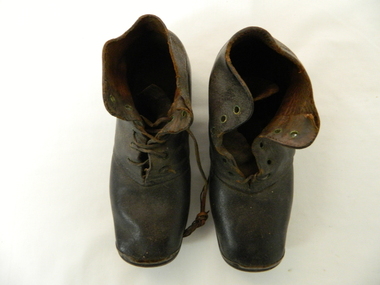
... boots suggests that it was not purchased locally or from any large town. It may have been introduced by a wandering caravan trader in clothes and shoes. In this era of rural development shoes, especially children footwear...boots suggests that it was not purchased locally or from any large town. It may have been introduced by a wandering caravan trader in clothes and shoes. In this era of rural development shoes, especially children footwear ...The construction of these boots suggests that it was not purchased locally or from any large town. It may have been introduced by a wandering caravan trader in clothes and shoes. In this era of rural development shoes, especially children footwear, were regarded as a longer term requirement that only required the soles and heels to be replaced. Multiple shoe types were not common only basics that could be handed down. The policy of one main work/play shoe and one church shoe (special occasion) was the norm at this point in history.Worn by Everil Fisher (girl) at Dederang in 1880. They have 'copper toes' and are 'Hob Nail' These items although very basic were what the region required and was applicable to all levels of society at this time. Durability and no fashion infiltration from larger cities resulted in a spartan attitude to basic living requirements. The rural regions of this area were more in focus to the character of the person rather than what was worn. The personal interactions of everyone in the region were more "true blue" than that of the cities. The concept of "mate-ship' far outweighed the type of fashion being wornBrown/Black ankle high boot for child age 4 (approx). Tongue and six eyelets with broken leather laces. Hob Nail visible on soles and heel. Copper Toes. costume, children's footwear, boots, anklets -
 Bendigo Historical Society Inc.
Accessory - LEATHER AND CLOTH VINTAGE/ANTIQUE METAL SHOE, BOOT & BUTTON HOOK. CATTRAN'S BOOTS BENDIGO
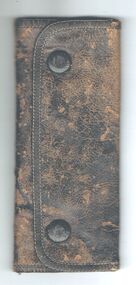
... COSTUME ACCESSORIES Footwear accessories CATTRANS BOOTS BENDIGO Worn black LEATHER AND CLOTH wallet with 2 x press studs containing 3 x Vintage antique metal show, boot and button hooks inside leather wrap wallet. Cattran's Boots Bendigo. Accessory LEATHER AND CLOTH VINTAGE/ANTIQUE METAL SHOE ...Worn black LEATHER AND CLOTH wallet with 2 x press studs containing 3 x Vintage antique metal show, boot and button hooks inside leather wrap wallet. Cattran's Boots Bendigo.costume accessories, footwear accessories, cattrans boots bendigo -
 Warrnambool and District Historical Society Inc.
Labels, Wainwright and Faulkner, C1900
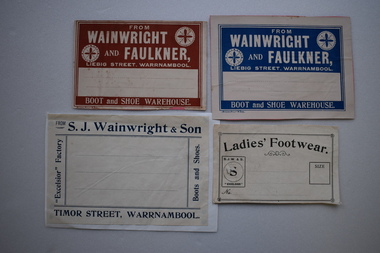
... BOOT AND SHOE WAREHOUSE MODERN PRINT WARRNAMBOOL .2 Identical to .1 .3 Ladies' Footwear. S.J.W &S. "EXCELSIOR" SIZE .4 FROM S. J. WAINWRIGHT & SON " EXCELSIOR" FACTORY. TIMOR STREET, WARRNAMBOOL . Boots...BOOT AND SHOE WAREHOUSE MODERN PRINT WARRNAMBOOL .2 Identical to .1 .3 Ladies' Footwear. S.J.W &S. "EXCELSIOR" SIZE .4 FROM S. J. WAINWRIGHT & SON " EXCELSIOR" FACTORY. TIMOR STREET, WARRNAMBOOL . Boots ...Mr Sidney (Sydney) Wainwright's father was established in the boot and shoe manufacturing business from 1877 in partnership with Shaddock and then Faulkner in Liebig Street, Warrnambool. By the late 1800s S.J. Wainwright and Son had 50 employees in the Timor Street factory which was one of the most extensive boot making businesses in the Western District.These labels are of some significance as Wainwright and Faulkner operated a important boot making business at the beginning of the 20th century in Timor Street, Warrnambool..1 White and blue rectangular label with text and decorations attached to a pink card. .2 Identical to .1 excepting the label is buff and the text is brown. .3 Buff rectangular label with black text and decorative border attached to a buff card. .4 Buff rectangular label with dark blue text and lines attached to white paper. .1 FROM WAINWRIGHT AND FAULKNER, LIEBIG STREET, WARRNAMBOOL. BOOT AND SHOE WAREHOUSE MODERN PRINT WARRNAMBOOL .2 Identical to .1 .3 Ladies' Footwear. S.J.W &S. "EXCELSIOR" SIZE .4 FROM S. J. WAINWRIGHT & SON " EXCELSIOR" FACTORY. TIMOR STREET, WARRNAMBOOL . Boots and Shoes.wainwright, faulkner, boot and shoe manufacture -
 Warrnambool and District Historical Society Inc.
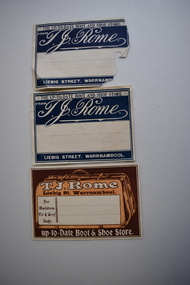
4x Labels, Rome, Early 20th Century
... footwear shop at 115 Liebig Street in 1907. He retired in 1962. Tommy Rome was also important as the person who recorded songs and skits on an Edison phonograph at the Warrnambool Industrial and Art Exhibition in 1897. These recordings survive today as the earliest surviving sound recordings in Australia. These are labels from a well known business in Warrnambool and so are of some significance. t.j.rome boots and shoes ...Thomas (Tommy) Rome was a prominent Warrnambool citizen who came to Warrnambool in 1888 and established his footwear shop at 115 Liebig Street in 1907. He retired in 1962. Tommy Rome was also important as the person who recorded songs and skits on an Edison phonograph at the Warrnambool Industrial and Art Exhibition in 1897. These recordings survive today as the earliest surviving sound recordings in Australia.These are labels from a well known business in Warrnambool and so are of some significance..1Rectangular paper label with brown and yellow background, white and brown text and a space for writing. The reverse is adhesive. .2 Rectangular paper white label with dark blue sections, a space for writing and dark blue and white text. The reverse is adhesive. It is damaged. .3 Identical to .2 .4 Identical to .2 ..1 T.J.Rome Liebig St. Warrnambool For Gladstone, Kit & Brief Bags. up=to=date Boot & Shoe Store. .2, .3, .4 THE UP-TO-DATE BOOT AND SHOE STORE FROM, T.J. Rome LIEBIG STREET,WARRNAMBOOL .t.j.rome, boots and shoes, warrnambool -
 Numurkah & District Historical Society
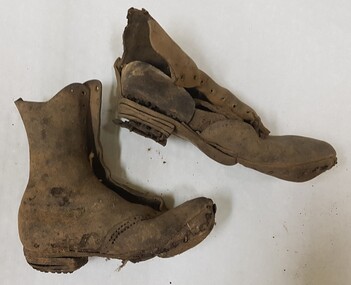
children's leather boots
... These boots were found under an old house that was being demolished shoes, boots, leather, child, footwear Hardened / weathered leather boots. ...These boots were found under an old house that was being demolishedHardened / weathered leather boots. Soles missing and some stitching worn away. Leather on one boot is curled up and missing one side section shoes, boots, leather, child,, footwear -
 Numurkah & District Historical Society
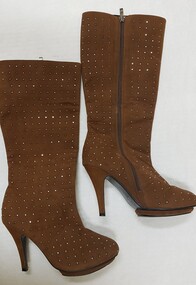
Suede Boots
... shoes, boots, ladies footwear, high heels Brown suede, knee-high, ladies boots, with silver studs in a regular pattern all over the boot. ...Brown suede, knee-high, ladies boots, with silver studs in a regular pattern all over the boot. High Heels, raised sole, pointy toes. Zip down the sideshoes, boots, ladies footwear, high heels -
 Numurkah & District Historical Society
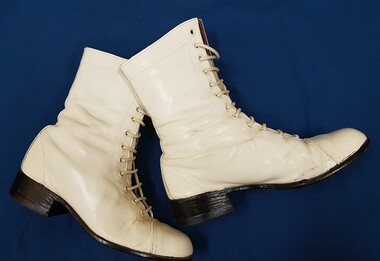
White marching boots
... shoes, boots, footwear, marching...shoes, boots, footwear, marching White leather marching boots, with lace up area from toe to above ankle. ...White leather marching boots, with lace up area from toe to above ankle. White shoe lacesshoes, boots, footwear, marching -
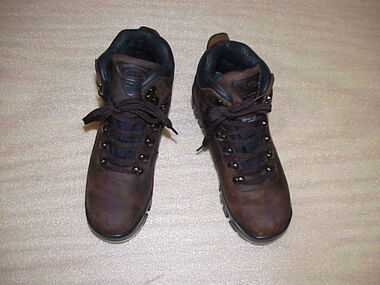 National Wool Museum
Shoes, Mens Hiking Boots
... boots are unused. Fashion Costume Shoes Leather sport Salt Lake City Land Rover Go Everywhere Footwear Du Pont Certified Thermolite Thin Insulation Land Rover Go Everywhere Footwear Pair of mens hiking boots as worn in the Opening Ceremony of the Winter Olympics, Salt Lake City, 2002 Mens Hiking Boots Shoes ...Part of the Mens Winter Olympic Uniform (as worn in the opening ceremony). However, these boots are unused.Pair of mens hiking boots as worn in the Opening Ceremony of the Winter Olympics, Salt Lake City, 2002Land Rover Go Everywhere Footwear Du Pont Certified Thermolite Thin Insulation Land Rover Go Everywhere Footwearfashion, costume, shoes, leather, sport, salt lake city -
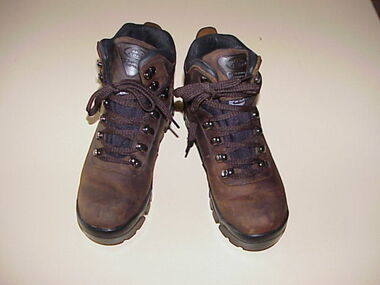 National Wool Museum
Shoes, Womens hiking boots
... Par tof the womens casual 'sportwool' uniform for the Winter Olympic games, 2002 Fashion Shoes Costume sport Salt Lake City LAND ROVER GO EVERYWHERE FOOTWEAR Du Pont certified Thermolite Thin insulation LAND ROVER GO EVERYWHERE FOOTWEAR Womens hiking boots Shoes ...Par tof the womens casual 'sportwool' uniform for the Winter Olympic games, 2002LAND ROVER GO EVERYWHERE FOOTWEAR Du Pont certified Thermolite Thin insulation LAND ROVER GO EVERYWHERE FOOTWEARfashion, shoes, costume, sport, salt lake city -
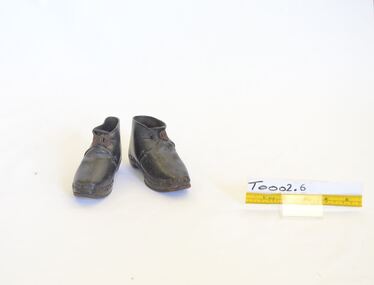 Brighton Historical Society
Footwear - Shoes, Children's shoes, circa 1860
... shoe, typewritten on paper: From "Barone", 9 Moule Ave., Brighton Pres. Aug 1970 Leather, wood and metal ankle boots c.1860. Dark brown leather upper constructed of two pieces, the foot secures with a metal clasp at the centre front ankle. The upper is adhered to the wooden sole with metal nails. The sole of the forefoot has been reinforced with a metal horseshoe around the edge. Children's shoes Footwear ...This item is from the "Barone" Collection. "Barone" (also known as "Seaview") was a stately Brighton home built at 9 Moule Avenue prior to 1855 and demolished in 1986. The house's residents included Edward Elgin Browne (during 1859-72), a Melbourne tea merchant, and the family and descendants of retired Scottish Army captain Archibald Black (during the period 1880-1970). Its neighbors included “St Ninians” owned by the Ward Cole family, “Seacombe” owned by the Moule family, and the home of James Grahame and his family. The items in the "Barone" collection were largely donated by two of the house's later owners, Mrs Doris Halkyard and Mrs Brian Brandt.Leather, wood and metal ankle boots c.1860. Dark brown leather upper constructed of two pieces, the foot secures with a metal clasp at the centre front ankle. The upper is adhered to the wooden sole with metal nails. The sole of the forefoot has been reinforced with a metal horseshoe around the edge. On one shoe, a modern inscription (ball point pen) : From "Barone" 9 Moule Ave Brighton. Sept 1970 On other shoe, typewritten on paper: From "Barone", 9 Moule Ave., Brighton Pres. Aug 1970children's shoe, barone, seaview, brighton, 1860s -
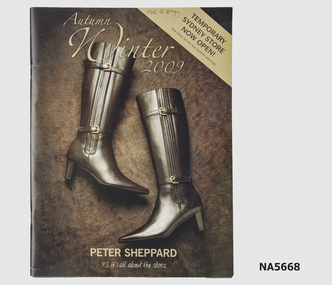 Whitehorse Historical Society Inc.
Book - Autumn Winter 2009 Peter Sheppard
... Footwear Book Peter Sheppard Peter Sheppard PS It's all about the shoes Booklet showing high heeled boots on the cover. ...Booklet showing footwear available from Peter Sheppard - Sydney, Melbourne and Brisbane.Booklet showing high heeled boots on the cover. Inside illustration of shoes available from Peter Sheppard shops.Peter Sheppard PS It's all about the shoesfootwear, book, peter sheppard -
 Whitehorse Historical Society Inc.
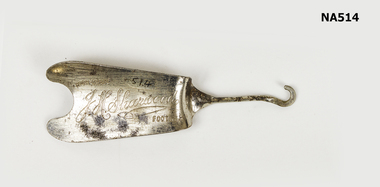
Accessory - Button Hook
... Sharwood footwear' Combined button hook for boots and shoe horn Accessory Button Hook ...Combined button hook for boots and shoe horn'High Grade/J.H. Sharwood footwear'costume accessories, footwear accessories -
 Whitehorse Historical Society Inc.
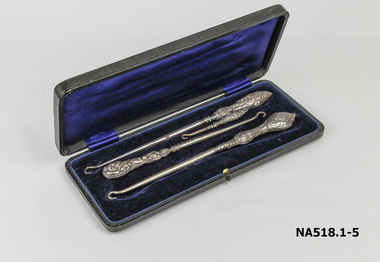
Accessory - Button Hook
... Used to catch buttons and pull them through eyelets on button up boots and shoes. costume accessories footwear accessories Button hook set - black oblong box lined with dark blue satin and velvet containing four button hooks of various sizes. ...Used to catch buttons and pull them through eyelets on button up boots and shoes.Button hook set - black oblong box lined with dark blue satin and velvet containing four button hooks of various sizes. Hooks are silver plated with ornate handles.costume accessories, footwear accessories -
 Whitehorse Historical Society Inc.
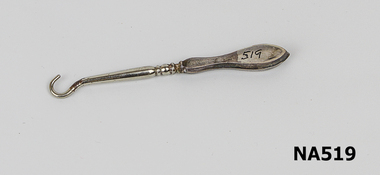
Accessory - Button Hook
... costume accessories footwear accessories Small silver coated button hook used to catch buttons and pull them through eyelets of boots and shoes. ...Small silver coated button hook used to catch buttons and pull them through eyelets of boots and shoes.costume accessories, footwear accessories -
 Whitehorse Historical Society Inc.
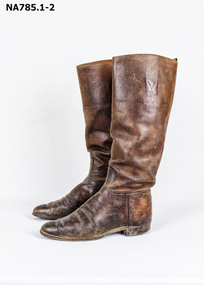
Footwear - Riding Boots, Boots
... Wooden shoe trees in boots - donated by Cotton Family costume male footwear High brown leather male riding boots. ...Wooden shoe trees in boots - donated by Cotton FamilyHigh brown leather male riding boots.costume, male footwear -
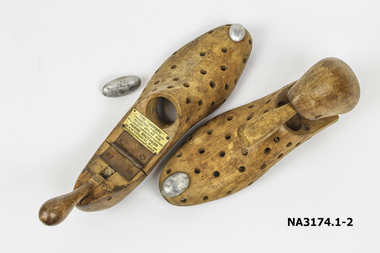 Whitehorse Historical Society Inc.
Functional object - Boot or shoe Trees, stretchers
... Used by donor's father approx. 80 years ago i.e.c1972 costume accessories footwear accessories The Horbro Wooden foot form - used for stretching boots or shoes. ...Used by donor's father approx. 80 years ago i.e.c1972Wooden foot form - used for stretching boots or shoes. Punched with holes to accept pressure point plugs. The form is hinged at the instep to enable forms to be pushed into the shoe.The Horbrocostume accessories, footwear accessories
