
Showing 80 items matching "fording the river"
-
 Camberwell RSL Sub-Branch
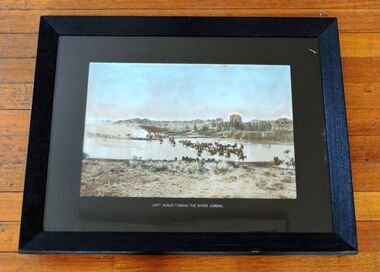
Photo, Australian Light Horse fording the Jordan River March 1918, 1918
... Australian Light Horse fording the Jordan River March 1918...Australian Light Horse fording the Jordan River March 1918...Unique photo of the Australian Light Horse in the field in Palestine Unique actual photo Australian Light Horse fording the Jordan River March 1918 Photo in Wooden Frame Australian Light Horse fording the Jordan River March 1918 Photo ...Unique photo of the Australian Light Horse in the field in PalestineUnique actual photoPhoto in Wooden FrameAustralian Light Horse fording the Jordan River March 1918 -
 4th/19th Prince of Wales's Light Horse Regiment Unit History Room
Framed Picture, Light Horse, c 1917
... Printed framed photo of Light Horse fording Jordan River during World War 1...Colarts Sydney Caption: Light Horse fording Jordan River...Colarts Sydney Caption: Light Horse fording Jordan River Printed framed photo of Light Horse fording Jordan River during World War 1 Light Horse Framed Picture ...Printed framed photo of Light Horse fording Jordan River during World War 1Colarts Sydney Caption: Light Horse fording Jordan River -
 Orbost & District Historical Society
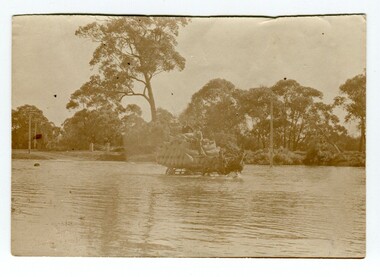
Photograph - crossing the Snowy River, c.1890s-1910
... ...fording the river...Snowy River fording the river On back, written in pencil: 'Snowy Bridge'. ...In the early days of European settlement of the Snowy River area in East Gippsland, from the 1870s onwards, the crossing of the Snowy River often posed difficulties. Presumably, this photograph was taken prior to the first bridge being built at Orbost in 1893.This photo is significant because it shows the difficulties in transport caused by the crossing of the Snowy River. A sepia coloured photograph of two men riding on top of a wagon load of filled bags, the wagon being pulled by two horses. They appear to be crossing a river with water around the wagon and horses. In the background is a river bank, telegraph poles, fence posts, and trees.On back, written in pencil: 'Snowy Bridge'.snowy river, fording the river -
 Marysville & District Historical Society
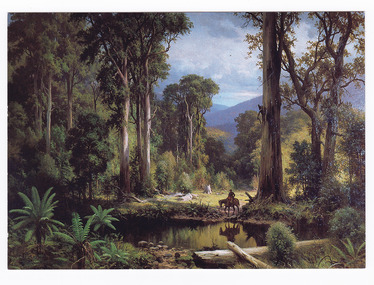
Postcard (item) - Colour postcard, Souvenirs Australia Pty. Ltd, A Ford on the Acheron River, 1881, Post 1995
... A Ford on the Acheron River, 1881...A postcard from a painting of a ford on the Acheron River that was painted in 1881 by H.J. ...A postcard from a painting of a ford on the Acheron River that was painted in 1881 by H.J. ...JOHNSTONE/ A FORD ON THE ACHERON RIVER, 1881/ OIL ON CANVAS, 171cm x 245cm/ BROKEN HILL CITY ART GALLERY/ DONATED BY MR. ...A postcard from a painting of a ford on the Acheron River that was painted in 1881 by H.J. ...A postcard from a painting of a ford on the Acheron River that was painted in 1881 by H.J. Johnstone.A postcard from a painting of a ford on the Acheron River that was painted in 1881 by H.J. Johnstone. The original painting is oil on canvas and was donated to the Broken Hill City Art Gallery in 1948 by Mr. O. Von Rieben. This postcard was produced by Souvenirs Australia Pty. Ltd. in Glynde, South Australia as a souvenir of Marysville.H.J. JOHNSTONE/ A FORD ON THE ACHERON RIVER, 1881/ OIL ON CANVAS, 171cm x 245cm/ BROKEN HILL CITY ART GALLERY/ DONATED BY MR. O. VON RIEBEN, 1948 Made in/ Australia by/ Souvenirs Aust./ Pty. Ltd./ Adelaide/ BHG 2 ADDRESS Published by/ Souvenirs Australia Pty. Ltd./ Glynde/ Copyright A PITT CARDacheron river, oil painting, h.j. johnstone, broken hill city art gallery, mr. o. von rieben, postcard, souvenirs australia, souvenir -
 Sunshine and District Historical Society Incorporated
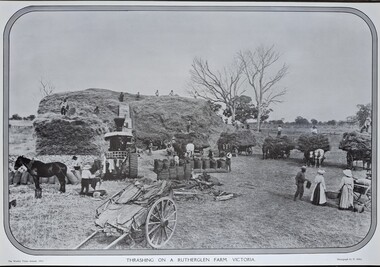
Photograph - Victorian Pioneering Farming / Transport Images
... 1/ Trashing on a Rutherglen Farm Victoria 1911 - Image of various farm machining being used with male and female workers|2/ Coach Road from Omeo to Bright - Image of a four horse drawned carriage with a view of the Victorian Alps in the blackground|3/ Fording the River - Image a bullock drawned carriage fording a river crossing...The pictures were hanging in the Melbourne Swiss Club|Items can been use in a teaching enviroment 1/ Trashing on a Rutherglen Farm Victoria 1911 - Image of various farm machining being used with male and female workers|2/ Coach Road from Omeo to Bright - Image of a four horse drawned carriage with a view of the Victorian Alps in the blackground|3/ Fording the River - Image a bullock drawned carriage fording a river crossing Collection of three black & white images mounted on board Photograph Victorian Pioneering Farming / Transport Images ...The pictures were hanging in the Melbourne Swiss Club|Items can been use in a teaching enviroment1/ Trashing on a Rutherglen Farm Victoria 1911 - Image of various farm machining being used with male and female workers|2/ Coach Road from Omeo to Bright - Image of a four horse drawned carriage with a view of the Victorian Alps in the blackground|3/ Fording the River - Image a bullock drawned carriage fording a river crossing -
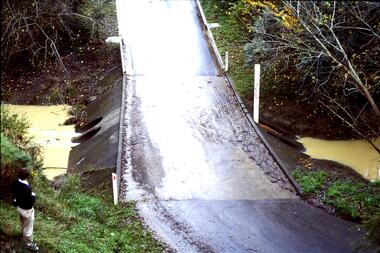 Greensborough Historical Society
Slide - Photograph, John Ramsdale, Ford over Plenty River to Partington's Flat: Slide 72, 1990s
... Ford over Plenty River to Partington's Flat: Slide 72...ford over plenty river...This is the ford over Plenty River to Partington's Flat...This is the ford over Plenty River to Partington's Flat Part of the John Ramsdale collection of slides and audio visual material. ford over plenty river plenty river partington's flat No caption. ...Photograph shows road or path over culvert. This is the ford over Plenty River to Partington's FlatPart of the John Ramsdale collection of slides and audio visual material.Colour photograph scanned from slide.No caption. Printed maker's mark on slide "Kodak Kodachrome Slide"ford over plenty river, plenty river, partington's flat -
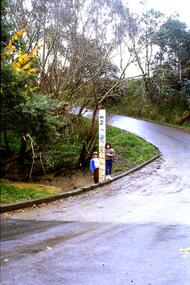 Greensborough Historical Society
Slide - Photograph, John Ramsdale, Ford over Plenty River at Partington's Flat: Slide 52, 1990s
... Ford over Plenty River at Partington's Flat: Slide 52......ford over plenty river...Photograph shows 2 children with flood height marker at the ford over Plenty River at Partington's Flat...Photograph shows 2 children with flood height marker at the ford over Plenty River at Partington's Flat Part of the John Ramsdale collection of slides and audio visual material. partingtons flat ford over plenty river plenty river No maker's marks. ...Photograph shows 2 children with flood height marker at the ford over Plenty River at Partington's FlatPart of the John Ramsdale collection of slides and audio visual material.Colour photograph scanned from slide.No maker's marks. No caption on slide.partingtons flat, ford over plenty river, plenty river -
4th/19th Prince of Wales's Light Horse Regiment Unit History Room
Display Binder, 2/4 Armoured Regiment Group, abt 2014
... By 1945 the United States publicity machine under General McArthur focussed on US campaigns to the North treating this action as a back water The unit's battle honours comprise South West Pacific 1945, Liberation of Australian New Guinea, Hawain River, Wewak, Wirui Mission, Slater's Knoll, Hongorai River, Egan's Ridge-Hongorai Ford, Hari River and Mivo River...By 1945 the United States publicity machine under General McArthur focussed on US campaigns to the North treating this action as a back water The unit's battle honours comprise South West Pacific 1945, Liberation of Australian New Guinea, Hawain River, Wewak, Wirui Mission, Slater's Knoll, Hongorai River, Egan's Ridge-Hongorai Ford, Hari River and Mivo River 2/4 Armoured Regiment is an antecedent unit of our modern Regiment ., Museum quality 3 ring, A3 size binder with clear inserts for documents and photos, in slip case. ...Provides an excellent account of the service of Australian 2/4 Armoured Regiment Group in New Guinea and Bougainville in World War 2. By 1945 the United States publicity machine under General McArthur focussed on US campaigns to the North treating this action as a back water The unit's battle honours comprise South West Pacific 1945, Liberation of Australian New Guinea, Hawain River, Wewak, Wirui Mission, Slater's Knoll, Hongorai River, Egan's Ridge-Hongorai Ford, Hari River and Mivo River2/4 Armoured Regiment is an antecedent unit of our modern Regiment ., Museum quality 3 ring, A3 size binder with clear inserts for documents and photos, in slip case. Presents history of Australian 2/4 Armoured Group in South West Pacific in World War 2 -
Sunshine and District Historical Society Incorporated
Photograph - Solomons Ford, n.d
... Ford... Maribyrnong River...Photo of Solomons Ford over Maribyrnong River Depicts animals drinking at the ford a person centre left and another near a wagon suggesting the animals may be part of bullock teams Also a house on the horizon...Solomons Ford Maribyrnong River Braybrook Photo of Solomons Ford over Maribyrnong River Depicts animals drinking at the ford a person centre left and another near a wagon suggesting the animals may be part of bullock teams Also a house on the horizon Solomons Ford Photograph Solomons Ford ...Photo of Solomons Ford over Maribyrnong River Depicts animals drinking at the ford a person centre left and another near a wagon suggesting the animals may be part of bullock teams Also a house on the horizonsolomons ford, maribyrnong river, braybrook -
Glenelg Shire Council Cultural Collection
Booklet - Booklet - Nelson and Glenelg River, Victoria, Compiled by N.F. Learmonth, Three Ways to Cross a River, Mar-63
... Booklet - 'Three Ways to Cross a River', a short history of Nelson, focussing on the crossings of the Glenelg River - ford, punt and bridge. Blue card, cover, black print. ...Booklet - 'Three Ways to Cross a River', a short history of Nelson, focussing on the crossings of the Glenelg River - ford, punt and bridge. Blue card, cover, black print. ...Booklet - 'Three Ways to Cross a River', a short history of Nelson, focussing on the crossings of the Glenelg River - ford, punt and bridge. Blue card, cover, black print. Complied to mark the occasion of the opening of the new Glenelg River bridge at Nelson, 14 Mar 1963 -
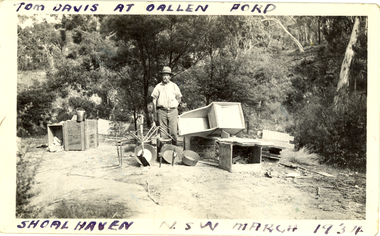 Federation University Historical Collection
Photograph - Photograph - black and white, Oallen Ford and Shoalhaven River, 1934, 1934
... Oallen Ford and Shoalhaven River, 1934...He is at Oallen Ford on the Shoalhaven River, New South Wales .2) A man stands beside a ute with 2 women standing on the tray. ...donald mather mather shoalhaven river mining ute utility car gold mining Two black and white photographs associated with Donald Mather. .1) A man, Tom Davis stands surrounded with gold mining equipment such as gold pans, cradles, picks and buckets. He is at Oallen Ford ...Two black and white photographs associated with Donald Mather. .1) A man, Tom Davis stands surrounded with gold mining equipment such as gold pans, cradles, picks and buckets. He is at Oallen Ford on the Shoalhaven River, New South Wales .2) A man stands beside a ute with 2 women standing on the tray. The photo was taken after crossing a ford at Shoalhaven, New South Walesdonald mather, mather, shoalhaven river, mining, ute, utility, car, gold mining -
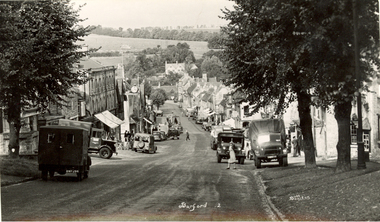 Federation University Historical Collection
Postcards - black and white, Butt Bourton, Burford
... Burford is a small town on the River Windrush in the Cotswold hills in west Oxfordshire, England, about 18 miles (29 km) west of Oxford, 22 miles (35 km) southeast of Cheltenham and only about 2 miles (3 km) from the Gloucestershire boundary. The toponym derives from the Old English words burh meaning fortified town or hilltown and ford...Burford is a small town on the River Windrush in the Cotswold hills in west Oxfordshire, England, about 18 miles (29 km) west of Oxford, 22 miles (35 km) southeast of Cheltenham and only about 2 miles (3 km) from the Gloucestershire boundary. The toponym derives from the Old English words burh meaning fortified town or hilltown and ford ...Burford is a small town on the River Windrush in the Cotswold hills in west Oxfordshire, England, about 18 miles (29 km) west of Oxford, 22 miles (35 km) southeast of Cheltenham and only about 2 miles (3 km) from the Gloucestershire boundary. The toponym derives from the Old English words burh meaning fortified town or hilltown and ford, the crossing of a river. (Wikipedia)A streetscape photographic view of Burford, England showing buildings, cars and people. chatham family archive, burford -
 Orbost & District Historical Society
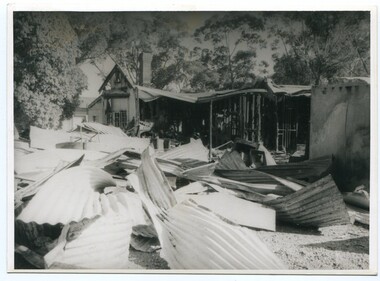
Photograph - Bemm River hotel fire
... There have been several Bemm River hotels since 1891 when the first Hotel was built by Henry Summer. This Hotel was located near a ford where traffic crossed the river. ...There have been several Bemm River hotels since 1891 when the first Hotel was built by Henry Summer. This Hotel was located near a ford where traffic crossed the river. ...Bemm River is a small township in East Gippsland. There have been several Bemm River hotels since 1891 when the first Hotel was built by Henry Summer. This Hotel was located near a ford where traffic crossed the river. Annie Morgan was the next person to have a roadside licence to sell liquor at Bemm River, also known as Sydenham Inlet Hotel. In 1927, a hotel was built on the present site at Bemm River, again with the Morgan family. Like many hotels, the Bemm River hotel has burned down or suffered damage through fires and was rebuilt. These photos are likely of a fire at the Hotel in 1994 which resulted in the hotel burning down. It was re-built in 2000 on the same site.History of Bemm River and its hotel5 b/w photos showing a building with severe fire damage, and two people in front of the photos (probably owners).nonebemm river, fire, hotels -
 Sunshine and District Historical Society Incorporated
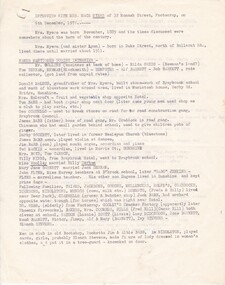
Archive - Interview With Mace Myers, Mace Myers, 6th December 1976
... Braybrook State School Braybrook Hotel Pennells Private School Pickett Street Footscray Sunshine Mechanics Hall Braybrook Public Hall Harrison's Hall (Next to the Deer Park Hotel) Maribyrnong River Fords (Mentions two fords across the river) Glengala Estate...Braybrook State School Braybrook Hotel Pennells Private School Pickett Street Footscray Sunshine Mechanics Hall Braybrook Public Hall Harrison's Hall (Next to the Deer Park Hotel) Maribyrnong River Fords (Mentions two fords across the river) Glengala Estate Typed summary of a transcript. ...Gladys Maissie "Mace" Babb (b28/10/1889 d22/1/1982) married George Napier Myers (b29/10/1879 d23/9/1948) in 1912 in Victoria. Mace was the daughter of James Babb, a pioneer of Braybrook who worked as a caretaker and road contractor. This document is a summary of transcript of an interview between Mrs Mace Myers, aged 87 years old, of her memory of early Braybrook, Braybrook Junction and Sunshine in the early 19th century. Many of the early settlers of the Braybrook District are mentioned throughout the transcript.Interview with Mrs Mace Myers of 32 Monash Street, Footscray on 6th December 1976. Named mentioned during the interview. Lynn Myers Mr Collins (Business at back of home) Hilda Greig Newman's Land Tom Derham Newman (Blacksmith) Dempster Alf Barnett Bob Barnett Donald McLeod (Built stonework of the Braybrook School) Mrs. Holcroft (Fruit and Vegetable Shop) Tom Babb (Boot Repairer) George Costello (Stone Breaker for a Road Construction Gang) James Babb (Boss of a Road Construction Gang) Chinaman (Gardener) Darby Rockett Ted Mackie Mrs. Boyd Tom Cannon Tilly Minns (Braybrook Hotel) Miss Wolley Billy Derham Mary Jane Barnett Jack Derham John Flynn Miss. Harvey "Gabo" Jenkins Eugene Flynn Tribe Jackson Gough Mullenger Rolfe Craddock Dickson Middleton Munro (Cows, milk, etc) Freda Roberts Billy Roberts Cranwell (Grocer & butcher shop) Jack Babb Dr. Webb Gooley's Cracket Factory (Apparently later Phoenix Fireworks) Baker Mrs. Coomber Fred Hill Oscar Hill Lizzie Watson Lizzie Scott Lucy McDonough Rose Barnett Msud Barnett Victor Barnett Jimmy Barnett Alf Barnett Mary Barnett Ivy Steens Blanch Stevens Nurse Kerr Dr. Adamson Locations mentioned during the interview. Braybrook State School Braybrook Hotel Pennells Private School Pickett Street Footscray Sunshine Mechanics Hall Braybrook Public Hall Harrison's Hall (Next to the Deer Park Hotel) Maribyrnong River Fords (Mentions two fords across the river) Glengala Estatemace myers, george napier myrers, gladys maissie babb -
 Sunshine and District Historical Society Incorporated
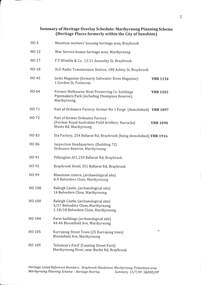
Document - Summary Of Heritage Overlay Schedule Maribyrnong Planning Scheme Places Formerly Within the City Of Sunshine 13th July 2009, Sunshine and District Historical Society Inc, 13th July 2009
... Wimble & Co 13 - 21 Annesley Street Braybrook HO17 3LO Radion Transmission Station 180 Ashley Street Braybrook HO18 Jacks Magazine (Formerly Saltwater River Magazine) 1 Gordon Street Footscray HO45 Former Melbourne Meat Preserving Co Buildings Pipemakers Park (Including Thompson Reserve) Maribyrnong HO 64) Part Of Ordnance Factory Former No 1 Forge (Demolished) HO71 Part Of Ordnance Factory Former Royal Australian Field Artillery Barracks Wests Road Maribyrnong HO72 ETA Factory 254 Ballarat Road Braybrook (Being Demolished) HO83 Inspection Headquarters (Building 72) Ordnance Reserve Maribyrnong HO86 Pilkington ACI 234 Ballarat Road Braybrook HO91 Braybrook Hotel 351 Ballarat Road Braybrook HO92 Bluestone Cistern (Archaeological Site) 8 - 9 Belvedere Close Maribyrnong HO99 Raleigh Castle (Archaeological Site) 14 Belvedere Close Maribyrnong HO100 Raleigh Castle (Archaeological Site) 15/17 & 1 - 18/18 Belvedere Close Maribyrnong HO100 Kurrajong Street Trees (25 Kurrajong Trees) Bloomfield Avenue Maribyrnong HO105 Solomon's Ford (Canning Street Ford) Maribyrnong River Near Burke Street Braybrook HO109 6738 - Summary Of Heritage Overlay Schedule Maribyrnong Planning Scheme Places Formerly Within the City Of Sunshine Page 2.jpg Pepper Trees, Sugar Gums, Kurrajongs and Canary Island Palms Maribyrnong River Plantation off Chifley Drive Maribyrnong HO110 Klipspringer 40 - 54 Cranwell Street Braybrook HO113 Pridham's Peerless Holdings 19 21 Evans Street Braybrook (Deleted from Overlay) HO118 Raleigh Manager's House (Archaeological Site) 1 & 3 Fabian Court Maribyrnong HO119 Raleigh Castle (Archaeological Site) 1 - 8/5 Fabian Court Maribyrnong HO120 Raleigh Manager's House (Archaeological Site) 2 & 4 Grandview Avenue Maribyrnong HO133 Ralph McKay 44 Hampstead Road Maidstone (Demolished) HO134 Pyrotechnic Division OFM 61 - 71 Hampstead Road Maribyrnong (HO135) Maribyrnong Reserve Grandstand off Hortense Street Maribyrnong HO137 Williamson House 182 Mitchell Street Maidstone HO141 Solomon's House (Archaeological Site) Medway Golf Club 57 Omar Street Maidstone Central Drawing Office (Building 71) Ordnance Reserve Maribyrnong (HO151) Pacific Carpets 35 - 65 Paramount Road corner Indwe Street Tottenham Dale Stables and Elm and Pepper Trees Plantation Street and Chifley Drive Maribyrnong HO153) Olex Cales 207 Sunshine Road Tottenham HO162 Whitshire Files 213 Sunshine Road Tottenham HO163 Black Arch Bridge off Sunshine Road Tottenham HO164 Dale House 44 The Esplanade Maribyrnong HO165 Hardiman House and Garden 76 The Esplanade Maribyrnong HO166 Raleigh Mansion (Archaeological Site) City View Reserve 11 City View Drive Maribyrnong...Wimble & Co 13 - 21 Annesley Street Braybrook HO17 3LO Radion Transmission Station 180 Ashley Street Braybrook HO18 Jacks Magazine (Formerly Saltwater River Magazine) 1 Gordon Street Footscray HO45 Former Melbourne Meat Preserving Co Buildings Pipemakers Park (Including Thompson Reserve) Maribyrnong HO 64) Part Of Ordnance Factory Former No 1 Forge (Demolished) HO71 Part Of Ordnance Factory Former Royal Australian Field Artillery Barracks Wests Road Maribyrnong HO72 ETA Factory 254 Ballarat Road Braybrook (Being Demolished) HO83 Inspection Headquarters (Building 72) Ordnance Reserve Maribyrnong HO86 Pilkington ACI 234 Ballarat Road Braybrook HO91 Braybrook Hotel 351 Ballarat Road Braybrook HO92 Bluestone Cistern (Archaeological Site) 8 - 9 Belvedere Close Maribyrnong HO99 Raleigh Castle (Archaeological Site) 14 Belvedere Close Maribyrnong HO100 Raleigh Castle (Archaeological Site) 15/17 & 1 - 18/18 Belvedere Close Maribyrnong HO100 Kurrajong Street Trees (25 Kurrajong Trees) Bloomfield Avenue Maribyrnong HO105 Solomon's Ford (Canning Street Ford) Maribyrnong River Near Burke Street Braybrook HO109 6738 - Summary Of Heritage Overlay Schedule Maribyrnong Planning Scheme Places Formerly Within the City Of Sunshine Page 2.jpg Pepper Trees, Sugar Gums, Kurrajongs and Canary Island Palms Maribyrnong River Plantation off Chifley Drive Maribyrnong HO110 Klipspringer 40 - 54 Cranwell Street Braybrook HO113 Pridham's Peerless Holdings 19 21 Evans Street Braybrook (Deleted from Overlay) HO118 Raleigh Manager's House (Archaeological Site) 1 & 3 Fabian Court Maribyrnong HO119 Raleigh Castle (Archaeological Site) 1 - 8/5 Fabian Court Maribyrnong HO120 Raleigh Manager's House (Archaeological Site) 2 & 4 Grandview Avenue Maribyrnong HO133 Ralph McKay 44 Hampstead Road Maidstone (Demolished) HO134 Pyrotechnic Division OFM 61 - 71 Hampstead Road Maribyrnong (HO135) Maribyrnong Reserve Grandstand off Hortense Street Maribyrnong HO137 Williamson House 182 Mitchell Street Maidstone HO141 Solomon's House (Archaeological Site) Medway Golf Club 57 Omar Street Maidstone Central Drawing Office (Building 71) Ordnance Reserve Maribyrnong (HO151) Pacific Carpets 35 - 65 Paramount Road corner Indwe Street Tottenham Dale Stables and Elm and Pepper Trees Plantation Street and Chifley Drive Maribyrnong HO153) Olex Cales 207 Sunshine Road Tottenham HO162 Whitshire Files 213 Sunshine Road Tottenham HO163 Black Arch Bridge off Sunshine Road Tottenham HO164 Dale House 44 The Esplanade Maribyrnong HO165 Hardiman House and Garden 76 The Esplanade Maribyrnong HO166 Raleigh Mansion (Archaeological Site) City View Reserve 11 City View Drive Maribyrnong A4 Stapled Document Document Summary Of Heritage Overlay Schedule Maribyrnong Planning Scheme Places Formerly Within the City Of Sunshine 13th July 2009 Sunshine and District Historical Society Inc ...These places were formerly within the City of Sunshine prior to the Council mergers of 19946738 - Summary Of Heritage Overlay Schedule Maribyrnong Planning Scheme Places Formerly Within the City Of Sunshine Page 1.jpg Munition Workers' Housing Heritage Area Braybrook HO5 War Service Homes Heritage Maribyrnong HO12 F.T. Wimble & Co 13 - 21 Annesley Street Braybrook HO17 3LO Radion Transmission Station 180 Ashley Street Braybrook HO18 Jacks Magazine (Formerly Saltwater River Magazine) 1 Gordon Street Footscray HO45 Former Melbourne Meat Preserving Co Buildings Pipemakers Park (Including Thompson Reserve) Maribyrnong HO 64) Part Of Ordnance Factory Former No 1 Forge (Demolished) HO71 Part Of Ordnance Factory Former Royal Australian Field Artillery Barracks Wests Road Maribyrnong HO72 ETA Factory 254 Ballarat Road Braybrook (Being Demolished) HO83 Inspection Headquarters (Building 72) Ordnance Reserve Maribyrnong HO86 Pilkington ACI 234 Ballarat Road Braybrook HO91 Braybrook Hotel 351 Ballarat Road Braybrook HO92 Bluestone Cistern (Archaeological Site) 8 - 9 Belvedere Close Maribyrnong HO99 Raleigh Castle (Archaeological Site) 14 Belvedere Close Maribyrnong HO100 Raleigh Castle (Archaeological Site) 15/17 & 1 - 18/18 Belvedere Close Maribyrnong HO100 Kurrajong Street Trees (25 Kurrajong Trees) Bloomfield Avenue Maribyrnong HO105 Solomon's Ford (Canning Street Ford) Maribyrnong River Near Burke Street Braybrook HO109 6738 - Summary Of Heritage Overlay Schedule Maribyrnong Planning Scheme Places Formerly Within the City Of Sunshine Page 2.jpg Pepper Trees, Sugar Gums, Kurrajongs and Canary Island Palms Maribyrnong River Plantation off Chifley Drive Maribyrnong HO110 Klipspringer 40 - 54 Cranwell Street Braybrook HO113 Pridham's Peerless Holdings 19 21 Evans Street Braybrook (Deleted from Overlay) HO118 Raleigh Manager's House (Archaeological Site) 1 & 3 Fabian Court Maribyrnong HO119 Raleigh Castle (Archaeological Site) 1 - 8/5 Fabian Court Maribyrnong HO120 Raleigh Manager's House (Archaeological Site) 2 & 4 Grandview Avenue Maribyrnong HO133 Ralph McKay 44 Hampstead Road Maidstone (Demolished) HO134 Pyrotechnic Division OFM 61 - 71 Hampstead Road Maribyrnong (HO135) Maribyrnong Reserve Grandstand off Hortense Street Maribyrnong HO137 Williamson House 182 Mitchell Street Maidstone HO141 Solomon's House (Archaeological Site) Medway Golf Club 57 Omar Street Maidstone Central Drawing Office (Building 71) Ordnance Reserve Maribyrnong (HO151) Pacific Carpets 35 - 65 Paramount Road corner Indwe Street Tottenham Dale Stables and Elm and Pepper Trees Plantation Street and Chifley Drive Maribyrnong HO153) Olex Cales 207 Sunshine Road Tottenham HO162 Whitshire Files 213 Sunshine Road Tottenham HO163 Black Arch Bridge off Sunshine Road Tottenham HO164 Dale House 44 The Esplanade Maribyrnong HO165 Hardiman House and Garden 76 The Esplanade Maribyrnong HO166 Raleigh Mansion (Archaeological Site) City View Reserve 11 City View Drive Maribyrnong -
 Sunshine and District Historical Society Incorporated
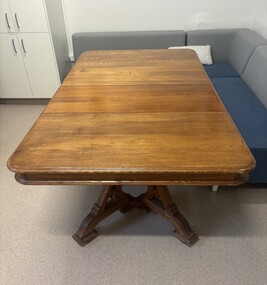
Functional object - Shire Of Braybrook Table
... Early settlement clustered around Solomon’s Ford on the Maribyrnong River, a key crossing for travelers heading to Geelong, Williamstown, and the goldfields. ...Early settlement clustered around Solomon’s Ford on the Maribyrnong River, a key crossing for travelers heading to Geelong, Williamstown, and the goldfields. ...The Shire of Braybrook (1871–1951) was a vast, semi‑rural municipality stretching from Melton to West Melbourne, centred on the old Braybrook village at Solomon’s Ford. It transformed dramatically with the arrival of railways, the rise of Braybrook Junction/Sunshine, and the industrial boom driven by H.V. McKay’s Harvester Works. The area was first organised as the Braybrook Road District on 28th May 1860, after a public meeting at the Shamrock Hotel in Albion. The district was enormous, extending from Melton to Dynon Road on the West Melbourne swamp. Early settlement clustered around Solomon’s Ford on the Maribyrnong River, a key crossing for travelers heading to Geelong, Williamstown, and the goldfields. On 23rd January 1871, the Road District became the Shire of Braybrook. Council meetings were initially held in Maidstone, reflecting the early population centres. The Braybrook Shire Hall in Deer Park was built in 1885. That 1885 building was the first official hall and council offices for the Shire of Braybrook, long before the municipality shifted its centre of gravity toward Sunshine. It stood near the Deer Park Hotel and served as the administrative heart of the shire during the late 19th century. The Braybrook Shire Hall at Deer Park effectively closed as a council headquarters in 1930, when the Shire of Braybrook shifted its administrative centre to Sunshine. In 1951, the Shire of Braybrook was renamed the City of Sunshine, reflecting the shift of population and industry eastward. In 1994 - 1995 the Kennett Government reduced Victoria’s councils from 210 to 78, the largest restructuring of local government in the state’s history and this part of the City of Sunshine became the City of Brimbank. It is believed this extension table came from the Shire of Braybrook Shire Office located in Ballarat Road, Deer Park, opposite the Deer Park Hotel. Over the years this extension table was used in the Shire of Braybrook Shire Office Ballarat Road Deer Park, the Shire of Braybrook and City of Sunshine Memorial Hall Hampshire Road Sunshine and in the City of Sunshine Municipal Offices Alexandra Avenue Sunshine. When the City of Sunshine Municipal Offices in Alexandra Avenue, Sunshine closed down, this table was were presented to the Sunshine & District Historical Society by the City of Brimbank. The table is still in use by the staff at The Hunt Club Community Arts Centre, Ballarat Road, Deer Park.This table is one of the few remaining items that still connects us to the early days of the Shire of Braybrook.Wood extension table with two extension leaves and carved legs.shire of braybrook, shire of braybrook offices, ballarat road, deer park -
 Sunshine and District Historical Society Incorporated
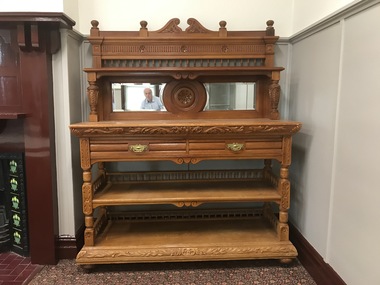
Functional object - Shire Of Braybrook Sideboard
... Early settlement clustered around Solomon’s Ford on the Maribyrnong River, a key crossing for travelers heading to Geelong, Williamstown, and the goldfields. ...Early settlement clustered around Solomon’s Ford on the Maribyrnong River, a key crossing for travelers heading to Geelong, Williamstown, and the goldfields. ...The Shire of Braybrook (1871–1951) was a vast, semi‑rural municipality stretching from Melton to West Melbourne, centred on the old Braybrook village at Solomon’s Ford. It transformed dramatically with the arrival of railways, the rise of Braybrook Junction/Sunshine, and the industrial boom driven by H.V. McKay’s Harvester Works. The area was first organised as the Braybrook Road District on 28th May 1860, after a public meeting at the Shamrock Hotel in Albion. The district was enormous, extending from Melton to Dynon Road on the West Melbourne swamp. Early settlement clustered around Solomon’s Ford on the Maribyrnong River, a key crossing for travelers heading to Geelong, Williamstown, and the goldfields. On 23rd January 1871, the Road District became the Shire of Braybrook. Council meetings were initially held in Maidstone, reflecting the early population centres. The Braybrook Shire Hall in Deer Park was built in 1885. That 1885 building was the first official hall and council offices for the Shire of Braybrook, long before the municipality shifted its centre of gravity toward Sunshine. It stood near the Deer Park Hotel and served as the administrative heart of the shire during the late 19th century. The Braybrook Shire Hall at Deer Park effectively closed as a council headquarters in 1930, when the Shire of Braybrook shifted its administrative centre to Sunshine. In 1951, the Shire of Braybrook was renamed the City of Sunshine, reflecting the shift of population and industry eastward. In 1994 - 1995 the Kennett Government reduced Victoria’s councils from 210 to 78, the largest restructuring of local government in the state’s history and this part of the City of Sunshine became the City of Brimbank. It is believed this extension table came from the Shire of Braybrook Shire Office located in Ballarat Road, Deer Park, opposite the Deer Park Hotel. Over the years this sideboard was used in the Shire of Braybrook Shire Office Ballarat Road Deer Park, the Shire of Braybrook and City of Sunshine Memorial Hall Hampshire Road Sunshine and in the City of Sunshine Municipal Offices Alexandra Avenue Sunshine where it was used in the Mayoral's council chambers. When the City of Sunshine Municipal Offices in Alexandra Avenue, Sunshine closed down, this sideboard was presented to the Sunshine & District Historical Society by the City of Brimbank.This sideboard is one of the few remaining items that still connects us to the early days of the Shire of Braybrook.French renaissance styled carved walnut sideboard with mirrored backplate.shire of braybrook, shire of braybrook offices, ballarat road, deer park -
 Sunshine and District Historical Society Incorporated
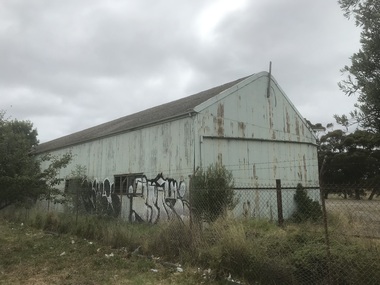
Photograph - Braybrook Photographs 2021, John Alchin, 2021
... River...Myalla Street...South Road...3LO Radio Transmitter...Central West Shopping Centre...National Springs...Ashley Hotel...ETA Factory...La Porchetta...Braybrook Hotel...Klipspringer...Harkrome...Steeden Engineering...Sunshine VRI Bowling Club...RecWest...Kinder Smith Reserve...Marj Laffin...Salvation Army Hall...Quang Minh Buddhist Temple...Burke Street...Ramon Vila Pavilion...Solomon Ford...5580.01 - Ashley St - Former 3LO - AWA Frequency changing building 2021 Photo 01.JPG 5580.02 - Ashley St 65- 67 Braybrook - Central West Shopping Centre 2021 Photo 02.JPG 5580.03 - Ashley St 185 - 195 Braybrook - Former National Springs 2021 Photo 01.JPG 5580.04 - Ballarat Rd 226 Braybrook - Ashley Hotel Ballarat Rd 2021 Photo 01.JPG 5580.05 - Ballarat Rd 234 Braybrook 2021 Photo 01.JPG 5580.06 - Ballarat Rd 234 Braybrook 2021 Photo 02.JPG 5580.07 - Ballarat Rd 244 - 246 Braybrook 2021 Photo 01.JPG 5580.08 - Ballarat Rd 256 Braybrook - ETA Factory Facade 2021 Photo 02.JPG 5580.09 - Ballarat Rd 256 Braybrook - ETA Factory Facade 2021 Photo 04.JPG 5580.10 - Ballarat Rd 261 Braybrook - La Porchetta 2021 Photo 01.JPG 5580.11 - Ballarat Rd 272 Braybrook - Former Holden Car Dealership 2021 Photo 01.JPG 5580.12 - Ballarat Rd 282 Braybrook 2021 Photo 02.JPG 5580.13 - Ballarat Rd 286 - 288 Braybrook 2021 Photo 01.JPG 5580.14 - Ballarat Rd 288 - 290 Braybrook 2021 Photo 01.JPG 5580.15 - Ballarat Rd 290 - 292 Braybrook 2021 Photo 01.JPG 5580.16 - Ballarat Rd 306 - 308 Braybrook 2021 Photo 01.JPG 5580.17 - Ballarat Rd 353 Braybrook - Braybrook Hotel 2021 Photo 01.JPG 5580.18 - Ballarat Rd 353 Braybrook - Braybrook Hotel 2021 Photo 02.JPG 5580.19 - Ballarat Rd 353 Braybrook - Braybrook Hotel 2021 Photo 03.JPG 5580.20 - Ballarat Rd 353 Braybrook - Braybrook Hotel Blue Stone Bar Sign 2021 Photo 01.JPG 5580.21 - Beachley St 23 - 33 Braybrook - Shops 2021 Photo 01.JPG 5580.22 - Beachley St 23 - 33 Braybrook - Shops 2021 Photo 02.JPG 5580.23 - Braybrook Commons Community Gardens Skinner Reserve 2021 Photo 01.JPG 5580.24 - Cranwell St 40 Braybrook - Klipspringer 2021 Photo 02.JPG 5580.25 - Darnley St 83 Braybrook 2021 Photo 01.JPG 5580.26 - Duke St 144 Braybrook 2021 Photo 01.JPG 5580.27 - Evans St 1 Braybrook - Harkrome Quality Electroplaters 2021 Photo 01.JPG 5580.28 - Evans St 9 Braybrook 2021 Photo 01.JPG 5580.29 - Gilbert St 8 Braybrrok - Steeden Engineering Co Pty Ltd 2021 Photo 01.JPG 5580.30 - Hampden St Factory Demolishment 2021 Photo 01.JPG 5580.31 - Kent St Braybrook - Sunshine VRI Bowling Club 2021 Photo 01.JPG 5580.32 - Kent St Braybrook - Sunshine VRI Bowling Club 2021 Photo 02.JPG 5580.33 - Kent St Braybrook - Sunshine VRI Bowling Club 2021 Photo 03.JPG 5580.34 - Lily st Braybrook - RecWest 2021 Photo 01.JPG 5580.35 - Maribyrnong River Temple to Temple Trail Sign 2021 Photo 01.JPG 5580.36 - Maribyrnong River Braybrook 2021 Photo 01.JPG 5580.37 - Marj Laffin Scoreboard Kinder Smith Reserve Lily St Braybrook 2021 Photo 01.JPG 5580.38 - Myalla St 40 Braybrook - Salvation Army Hall 2021 Photo 01.JPG 5580.39 - Myalla St 40 Braybrook - Salvation Army Hall 2021 Photo 02.JPG 5580.40 - Quang Minh Buddhist Temple Burke St Braybrook 2021 Photo 01.JPG 5580.41 - Quang Minh Buddhist Temple Gardens Braybrook 2021 Photo 04.JPG 5580.42 - Ramon Vila Pavilion Kinder Smith Reserve Lily St Braybrook 2021 Photo 01.JPG 5580.43 - Solomon Ford Maribyrnong River 2021 Photo 01.JPG 5580.44 - South Rd 204 Braybrook - Caroline Chisholm College Braybrook 2021 Photo 01.JPG 5580.45 - South Rd 204 Braybrook - Caroline Chisholm College Quinn Auditorium Braybrook 2021 Photo 01.JPG 5580.46 - William Barak Sign Duke St Reserve Braybrook 2021 Photo 01.JPG ...Ballarat Road Ashley Street Beachkey Street Cranwell Street Darnley Street Duke Street Evans Street Gilbert Street Hampden Street Kent Street Lily Street Maribyrnong River Myalla Street South Road 3LO Radio Transmitter Central West Shopping Centre National Springs Ashley Hotel ETA Factory La Porchetta Braybrook Hotel Klipspringer Harkrome Steeden Engineering Sunshine VRI Bowling Club RecWest Kinder Smith Reserve Marj Laffin Salvation Army Hall Quang Minh Buddhist Temple Burke Street Ramon Vila Pavilion Solomon Ford Caroline Chisholm College William Barak Aboriginal Aborigine First Nation Braybrook 5580.01 - Ashley St - Former 3LO - AWA Frequency changing building 2021 Photo 01.JPG 5580.02 - Ashley St 65- 67 Braybrook - Central West Shopping Centre 2021 Photo 02.JPG 5580.03 - Ashley St 185 - 195 Braybrook - Former National Springs 2021 Photo 01.JPG 5580.04 - Ballarat Rd 226 Braybrook - Ashley Hotel Ballarat Rd 2021 Photo 01.JPG 5580.05 - Ballarat Rd 234 Braybrook 2021 Photo 01.JPG 5580.06 - Ballarat Rd 234 Braybrook 2021 Photo 02.JPG 5580.07 - Ballarat Rd 244 - 246 Braybrook 2021 Photo 01.JPG 5580.08 - Ballarat Rd 256 Braybrook - ETA Factory Facade 2021 Photo 02.JPG 5580.09 - Ballarat Rd 256 Braybrook - ETA Factory Facade 2021 Photo 04.JPG 5580.10 - Ballarat Rd 261 Braybrook - La Porchetta 2021 Photo 01.JPG 5580.11 - Ballarat Rd 272 Braybrook - Former Holden Car Dealership 2021 Photo 01.JPG 5580.12 - Ballarat Rd 282 Braybrook 2021 Photo 02.JPG 5580.13 - Ballarat Rd 286 - 288 Braybrook 2021 Photo 01.JPG 5580.14 - Ballarat Rd 288 - 290 Braybrook 2021 Photo 01.JPG 5580.15 - Ballarat Rd 290 - 292 Braybrook 2021 Photo 01.JPG 5580.16 - Ballarat Rd 306 - 308 Braybrook 2021 Photo 01.JPG 5580.17 - Ballarat Rd 353 Braybrook - Braybrook Hotel 2021 Photo 01.JPG 5580.18 - Ballarat Rd 353 Braybrook - Braybrook Hotel 2021 Photo 02.JPG 5580.19 - Ballarat Rd 353 Braybrook - Braybrook Hotel 2021 Photo 03.JPG 5580.20 - Ballarat Rd 353 Braybrook - Braybrook Hotel Blue Stone Bar Sign 2021 Photo 01.JPG 5580.21 - Beachley St 23 - 33 Braybrook - Shops 2021 Photo 01.JPG 5580.22 - Beachley St 23 - 33 Braybrook - Shops 2021 Photo 02.JPG 5580.23 - Braybrook Commons Community Gardens Skinner Reserve 2021 Photo 01.JPG 5580.24 - Cranwell St 40 Braybrook - Klipspringer 2021 Photo 02.JPG 5580.25 - Darnley St 83 Braybrook 2021 Photo 01.JPG 5580.26 - Duke St 144 Braybrook 2021 Photo 01.JPG 5580.27 - Evans St 1 Braybrook - Harkrome Quality Electroplaters 2021 Photo 01.JPG 5580.28 - Evans St 9 Braybrook 2021 Photo 01.JPG 5580.29 - Gilbert St 8 Braybrrok - Steeden Engineering Co Pty Ltd 2021 Photo 01.JPG 5580.30 - Hampden St Factory Demolishment 2021 Photo 01.JPG 5580.31 - Kent St Braybrook - Sunshine VRI Bowling Club 2021 Photo 01.JPG 5580.32 - Kent St Braybrook - Sunshine VRI Bowling Club 2021 Photo 02.JPG 5580.33 - Kent St Braybrook - Sunshine VRI Bowling Club 2021 Photo 03.JPG 5580.34 - Lily st Braybrook - RecWest 2021 Photo 01.JPG 5580.35 - Maribyrnong River Temple to Temple Trail Sign 2021 Photo 01.JPG 5580.36 - Maribyrnong River Braybrook 2021 Photo 01.JPG 5580.37 - Marj Laffin Scoreboard Kinder Smith Reserve Lily St Braybrook 2021 Photo 01.JPG 5580.38 - Myalla St 40 Braybrook - Salvation Army Hall 2021 Photo 01.JPG 5580.39 - Myalla St 40 Braybrook - Salvation Army Hall 2021 Photo 02.JPG 5580.40 - Quang Minh Buddhist Temple Burke St Braybrook 2021 Photo 01.JPG 5580.41 - Quang Minh Buddhist Temple Gardens Braybrook 2021 Photo 04.JPG 5580.42 - Ramon Vila Pavilion Kinder Smith Reserve Lily St Braybrook 2021 Photo 01.JPG 5580.43 - Solomon Ford Maribyrnong River 2021 Photo 01.JPG 5580.44 - South Rd 204 Braybrook - Caroline Chisholm College Braybrook 2021 Photo 01.JPG 5580.45 - South Rd 204 Braybrook - Caroline Chisholm College Quinn Auditorium Braybrook 2021 Photo 01.JPG 5580.46 - William Barak Sign Duke St Reserve Braybrook 2021 Photo 01.JPG Collection of digital photographs Photograph Braybrook Photographs 2021 John Alchin ...Braybrook was originally part of the former Shire of Braybrook and later the City of Sunshine. However, in 1994, Victoria underwent council amalgamations, which resulted in Braybrook being incorporated into the City of Maribyrnong. The suburb of Braybrook continues to attract considerable attention from the residents of City of Brimbank, particularly its historical features, the old buildings and distinctive streetscapes that characterise the area.To capture the essence of Braybrook in 2021, a series of photographs were taken. These images document a range of buildings, street scenes, and other notable points of interest throughout the suburb, providing a visual record of its unique character.5580.01 - Ashley St - Former 3LO - AWA Frequency changing building 2021 Photo 01.JPG 5580.02 - Ashley St 65- 67 Braybrook - Central West Shopping Centre 2021 Photo 02.JPG 5580.03 - Ashley St 185 - 195 Braybrook - Former National Springs 2021 Photo 01.JPG 5580.04 - Ballarat Rd 226 Braybrook - Ashley Hotel Ballarat Rd 2021 Photo 01.JPG 5580.05 - Ballarat Rd 234 Braybrook 2021 Photo 01.JPG 5580.06 - Ballarat Rd 234 Braybrook 2021 Photo 02.JPG 5580.07 - Ballarat Rd 244 - 246 Braybrook 2021 Photo 01.JPG 5580.08 - Ballarat Rd 256 Braybrook - ETA Factory Facade 2021 Photo 02.JPG 5580.09 - Ballarat Rd 256 Braybrook - ETA Factory Facade 2021 Photo 04.JPG 5580.10 - Ballarat Rd 261 Braybrook - La Porchetta 2021 Photo 01.JPG 5580.11 - Ballarat Rd 272 Braybrook - Former Holden Car Dealership 2021 Photo 01.JPG 5580.12 - Ballarat Rd 282 Braybrook 2021 Photo 02.JPG 5580.13 - Ballarat Rd 286 - 288 Braybrook 2021 Photo 01.JPG 5580.14 - Ballarat Rd 288 - 290 Braybrook 2021 Photo 01.JPG 5580.15 - Ballarat Rd 290 - 292 Braybrook 2021 Photo 01.JPG 5580.16 - Ballarat Rd 306 - 308 Braybrook 2021 Photo 01.JPG 5580.17 - Ballarat Rd 353 Braybrook - Braybrook Hotel 2021 Photo 01.JPG 5580.18 - Ballarat Rd 353 Braybrook - Braybrook Hotel 2021 Photo 02.JPG 5580.19 - Ballarat Rd 353 Braybrook - Braybrook Hotel 2021 Photo 03.JPG 5580.20 - Ballarat Rd 353 Braybrook - Braybrook Hotel Blue Stone Bar Sign 2021 Photo 01.JPG 5580.21 - Beachley St 23 - 33 Braybrook - Shops 2021 Photo 01.JPG 5580.22 - Beachley St 23 - 33 Braybrook - Shops 2021 Photo 02.JPG 5580.23 - Braybrook Commons Community Gardens Skinner Reserve 2021 Photo 01.JPG 5580.24 - Cranwell St 40 Braybrook - Klipspringer 2021 Photo 02.JPG 5580.25 - Darnley St 83 Braybrook 2021 Photo 01.JPG 5580.26 - Duke St 144 Braybrook 2021 Photo 01.JPG 5580.27 - Evans St 1 Braybrook - Harkrome Quality Electroplaters 2021 Photo 01.JPG 5580.28 - Evans St 9 Braybrook 2021 Photo 01.JPG 5580.29 - Gilbert St 8 Braybrrok - Steeden Engineering Co Pty Ltd 2021 Photo 01.JPG 5580.30 - Hampden St Factory Demolishment 2021 Photo 01.JPG 5580.31 - Kent St Braybrook - Sunshine VRI Bowling Club 2021 Photo 01.JPG 5580.32 - Kent St Braybrook - Sunshine VRI Bowling Club 2021 Photo 02.JPG 5580.33 - Kent St Braybrook - Sunshine VRI Bowling Club 2021 Photo 03.JPG 5580.34 - Lily st Braybrook - RecWest 2021 Photo 01.JPG 5580.35 - Maribyrnong River Temple to Temple Trail Sign 2021 Photo 01.JPG 5580.36 - Maribyrnong River Braybrook 2021 Photo 01.JPG 5580.37 - Marj Laffin Scoreboard Kinder Smith Reserve Lily St Braybrook 2021 Photo 01.JPG 5580.38 - Myalla St 40 Braybrook - Salvation Army Hall 2021 Photo 01.JPG 5580.39 - Myalla St 40 Braybrook - Salvation Army Hall 2021 Photo 02.JPG 5580.40 - Quang Minh Buddhist Temple Burke St Braybrook 2021 Photo 01.JPG 5580.41 - Quang Minh Buddhist Temple Gardens Braybrook 2021 Photo 04.JPG 5580.42 - Ramon Vila Pavilion Kinder Smith Reserve Lily St Braybrook 2021 Photo 01.JPG 5580.43 - Solomon Ford Maribyrnong River 2021 Photo 01.JPG 5580.44 - South Rd 204 Braybrook - Caroline Chisholm College Braybrook 2021 Photo 01.JPG 5580.45 - South Rd 204 Braybrook - Caroline Chisholm College Quinn Auditorium Braybrook 2021 Photo 01.JPG 5580.46 - William Barak Sign Duke St Reserve Braybrook 2021 Photo 01.JPG ballarat road, ashley street, beachkey street, cranwell street, darnley street, duke street, evans street, gilbert street, hampden street, kent street, lily street, maribyrnong river, myalla street, south road, 3lo radio transmitter, central west shopping centre, national springs, ashley hotel, eta factory, la porchetta, braybrook hotel, klipspringer, harkrome, steeden engineering, sunshine vri bowling club, recwest, kinder smith reserve, marj laffin, salvation army hall, quang minh buddhist temple, burke street, ramon vila pavilion, solomon ford, caroline chisholm college, william barak, aboriginal, aborigine, first nation, braybrook -
 Sunshine and District Historical Society Incorporated
Photograph - Maribyrnong River and Valley
... Photocopy of Photograph Maribyrnong Munitions Factory 1938|Newspaper article Brimbank Messenger 29 October 2002 Our bond with the Maltese|Newspaper article The Herald Friday 24 February 1989 Yes Melbourne does have another river|Typed report History of Maribyrnong Steering Committee Reports|Typed notes of Steering Committee History of Maribyrnong Meeting held 7 June 1989|Typed notes 27 April 1989 History of Maribyrnong Steering Committtee Meeting|Typed notes of Steering Committee 5 April 1989|Typed notes of Steering Committee 1 March 1989|Typed notes of Steering Committee 11 January 1989|Typed notes 23 August 1988 Local History|Typed notes of Steering Committee 28 Febuary 1989|Typed report 17 November 1988 A History of Maribyrnong|Extract First Contacts I Primi Contenti|Extract Chapter 2 Maribyrnong on the map|Typed Report Migrant impact The early settlement of Maribyrnong|Photocopy of photographs Your family's photos are Maribyrnong's heritage|Typed report Maribyrnong A pictorial history|Typed report Maribyrnong History Outline|Typed report A History of Maribyrnong General Brief for the Author|Handwritten notes Research for Sunshine Council Project|Letter 18 August 1988 The History Institute|Typed report Copyright|Newspaper article Star 7 December 2004 Council moves to avert disaster|Newspaper article Brimbank Messenger 4 July 2000 Platypus potential|Newspaper article |Advocate 7 July 1993 New river bridge|Letter to Waterways and Parks division Metropolitan Parks 11 April 1985 Potential uses of Bluestone buildings|Typed Memorandum 21 January 1985 History of the Site of the Marie Hill Centre|Typed report The Ford Maribyrnong River|Typed letter from Legislative Council 6 January 1982 regarded rezoning|Extract of Poem The Haunted Castle at Maribyrnong by Martha Coxhead|Handwritten note Evan Crick Hotel dates|Brochure Historic Parkland Van Ness Avenue Sunshine|Typed notes Maribyrnong River Valley Braybrook February 1992|Typed letter 1 June 1983 Humes Site from Melbourne and Metropolitan Board of Works|Typed l etter 31 May 1982 from Historic Buildings Preservation Council re the fomer Melbourne Meat Preserving Company buildings and former Humes Pipes Site Van Ness Avenue Maribyrnong|Flyer 3 February 1803 Charles Grimes 175th Anniversary 5 February 1978|Newspaper articles Melbourne must not forget its other river|Newspaper article Sunshine Advocatge 24 February 1982 Hearing on Humes rezoning|Newspaper article Public Meeting on Future Development Plans for the former Humes site|Huge Banner Development Plan for Maribyrnong River|Newspaper article Advocate 22 February 2000 Greedy developers|Newspaper article Advocate 17 April 1996 River estate plan set for amendment|Newspaper article Advocate 8 February 2000 Bridging concern|Newspaper article Western Times 1 March 2000 Developers plan riles river residents|Newspaper article Advocate 20 February 1974 Maribyrnong a paradise|Newspaper article Messenger 15 February 2000 Plan rushed residents|Newspaper article Advocate 1 June 1983 Get tough policy on Valley|Newspaper article The Herald 11 December 1981 A community is up in arms over a threat to Victoria's heritage The battle over the bluestone. ...Maribyrnong River Maribyrnong Valley Photocopy of Photograph Maribyrnong Munitions Factory 1938|Newspaper article Brimbank Messenger 29 October 2002 Our bond with the Maltese|Newspaper article The Herald Friday 24 February 1989 Yes Melbourne does have another river|Typed report History of Maribyrnong Steering Committee Reports|Typed notes of Steering Committee History of Maribyrnong Meeting held 7 June 1989|Typed notes 27 April 1989 History of Maribyrnong Steering Committtee Meeting|Typed notes of Steering Committee 5 April 1989|Typed notes of Steering Committee 1 March 1989|Typed notes of Steering Committee 11 January 1989|Typed notes 23 August 1988 Local History|Typed notes of Steering Committee 28 Febuary 1989|Typed report 17 November 1988 A History of Maribyrnong|Extract First Contacts I Primi Contenti|Extract Chapter 2 Maribyrnong on the map|Typed Report Migrant impact The early settlement of Maribyrnong|Photocopy of photographs Your family's photos are Maribyrnong's heritage|Typed report Maribyrnong A pictorial history|Typed report Maribyrnong History Outline|Typed report A History of Maribyrnong General Brief for the Author|Handwritten notes Research for Sunshine Council Project|Letter 18 August 1988 The History Institute|Typed report Copyright|Newspaper article Star 7 December 2004 Council moves to avert disaster|Newspaper article Brimbank Messenger 4 July 2000 Platypus potential|Newspaper article |Advocate 7 July 1993 New river bridge|Letter to Waterways and Parks division Metropolitan Parks 11 April 1985 Potential uses of Bluestone buildings|Typed Memorandum 21 January 1985 History of the Site of the Marie Hill Centre|Typed report The Ford Maribyrnong River|Typed letter from Legislative Council 6 January 1982 regarded rezoning|Extract of Poem The Haunted Castle at Maribyrnong by Martha Coxhead|Handwritten note Evan Crick Hotel dates|Brochure Historic Parkland Van Ness Avenue Sunshine|Typed notes Maribyrnong River Valley Braybrook February 1992|Typed letter 1 June 1983 Humes Site from Melbourne and Metropolitan Board of Works|Typed l etter 31 May 1982 from Historic Buildings Preservation Council re the fomer Melbourne Meat Preserving Company buildings and former Humes Pipes Site Van Ness Avenue Maribyrnong|Flyer 3 February 1803 Charles Grimes 175th Anniversary 5 February 1978|Newspaper articles Melbourne must not forget its other river|Newspaper article Sunshine Advocatge 24 February 1982 Hearing on Humes rezoning|Newspaper article Public Meeting on Future Development Plans for the former Humes site|Huge Banner Development Plan for Maribyrnong River|Newspaper article Advocate 22 February 2000 Greedy developers|Newspaper article Advocate 17 April 1996 River estate plan set for amendment|Newspaper article Advocate 8 February 2000 Bridging concern|Newspaper article Western Times 1 March 2000 Developers plan riles river residents|Newspaper article Advocate 20 February 1974 Maribyrnong a paradise|Newspaper article Messenger 15 February 2000 Plan rushed residents|Newspaper article Advocate 1 June 1983 Get tough policy on Valley|Newspaper article The Herald 11 December 1981 A community is up in arms over a threat to Victoria's heritage The battle over the bluestone. ...Photocopy of Photograph Maribyrnong Munitions Factory 1938|Newspaper article Brimbank Messenger 29 October 2002 Our bond with the Maltese|Newspaper article The Herald Friday 24 February 1989 Yes Melbourne does have another river|Typed report History of Maribyrnong Steering Committee Reports|Typed notes of Steering Committee History of Maribyrnong Meeting held 7 June 1989|Typed notes 27 April 1989 History of Maribyrnong Steering Committtee Meeting|Typed notes of Steering Committee 5 April 1989|Typed notes of Steering Committee 1 March 1989|Typed notes of Steering Committee 11 January 1989|Typed notes 23 August 1988 Local History|Typed notes of Steering Committee 28 Febuary 1989|Typed report 17 November 1988 A History of Maribyrnong|Extract First Contacts I Primi Contenti|Extract Chapter 2 Maribyrnong on the map|Typed Report Migrant impact The early settlement of Maribyrnong|Photocopy of photographs Your family's photos are Maribyrnong's heritage|Typed report Maribyrnong A pictorial history|Typed report Maribyrnong History Outline|Typed report A History of Maribyrnong General Brief for the Author|Handwritten notes Research for Sunshine Council Project|Letter 18 August 1988 The History Institute|Typed report Copyright|Newspaper article Star 7 December 2004 Council moves to avert disaster|Newspaper article Brimbank Messenger 4 July 2000 Platypus potential|Newspaper article |Advocate 7 July 1993 New river bridge|Letter to Waterways and Parks division Metropolitan Parks 11 April 1985 Potential uses of Bluestone buildings|Typed Memorandum 21 January 1985 History of the Site of the Marie Hill Centre|Typed report The Ford Maribyrnong River|Typed letter from Legislative Council 6 January 1982 regarded rezoning|Extract of Poem The Haunted Castle at Maribyrnong by Martha Coxhead|Handwritten note Evan Crick Hotel dates|Brochure Historic Parkland Van Ness Avenue Sunshine|Typed notes Maribyrnong River Valley Braybrook February 1992|Typed letter 1 June 1983 Humes Site from Melbourne and Metropolitan Board of Works|Typed l etter 31 May 1982 from Historic Buildings Preservation Council re the fomer Melbourne Meat Preserving Company buildings and former Humes Pipes Site Van Ness Avenue Maribyrnong|Flyer 3 February 1803 Charles Grimes 175th Anniversary 5 February 1978|Newspaper articles Melbourne must not forget its other river|Newspaper article Sunshine Advocatge 24 February 1982 Hearing on Humes rezoning|Newspaper article Public Meeting on Future Development Plans for the former Humes site|Huge Banner Development Plan for Maribyrnong River|Newspaper article Advocate 22 February 2000 Greedy developers|Newspaper article Advocate 17 April 1996 River estate plan set for amendment|Newspaper article Advocate 8 February 2000 Bridging concern|Newspaper article Western Times 1 March 2000 Developers plan riles river residents|Newspaper article Advocate 20 February 1974 Maribyrnong a paradise|Newspaper article Messenger 15 February 2000 Plan rushed residents|Newspaper article Advocate 1 June 1983 Get tough policy on Valley|Newspaper article The Herald 11 December 1981 A community is up in arms over a threat to Victoria's heritage The battle over the bluestone. The Melbourne Meat Preserving Works|Typed report Historic Workplace Humes Site Van Ness Avenue Maribyrnong|Typed letter 1 December 1967 Explosives Factory Maribyrnong|Typed report Racing colours Rose and Black|Newspaper article The Age 28 April 1982 The western maze|Typed Minutes 4 July 1983 Meeting of the Lower Maribyrnong Conservation Group|Typed Constitution of the Lower Maribyrnong Valley Conservation Group|Typed Submission 29 April 1982 To City of Sunshine for Historic buildings preservation council classifications sub committee|Typed Minutes of Lower Maribyrnong Valley Conservation Group 26 August 1982|Typed Application for Membership form Lower Maribyrnong Valley Conservation Group|Typed Submission for a Financial Grant to the Charles Grimes 175th Anniversary Re enactment Committee|Typed Annual General Meeting 5 July 1984 Lower Maribyrnong Valley Conservation Group|Typed letter 30 July 1980 Humes Site|Typed Proposal Bluestone building|Typed Letter from University of Melbourne 11 December 1980 Meat Preserving companys works|Brochure Pipemakers Park|Typed notes Elizabeth McKinnon Mosaic mural artist|Newspaper article Sunshine Advocate 10 November 1993 Heritage site rediscovered|Newspaper article The Age 7 September 1996 Dreamtime in an industrial garden|Newspaper article The Western Times 6 December 1989 The peoples historiian|Typed report The Saltwater River Powder Magazine Jacks Magazine|Typed letter from Henry Laskowski Sunshine City Council Engineer / Planner to Gwen Goedecke Re: Melbourne Metropolitan Planning Scheme Amendment No 157 Maribyrnong Valley 26th November 1981|Newspaper article The Advocate 13th September Council to buy vital river land|Newspaper article The Age 4th September 1978 Tight controls urged over Maribyrnong|Newspaper article The Age 27th April 1988 Metropolitan Region Planning Scheme Amendment RL11|Melbourne Metropolitan Board of Works M.M.B.W. Concept plan for Maribyrnong River Development Media Release 25th January 1984|City of Sunshine The Maribyrnong River Ideas for the River Valley|Newspaper Article The Advocate 14 March 1979 River Valley Land Purchasemaribyrnong river, maribyrnong valley -
 Stawell Historical Society Inc
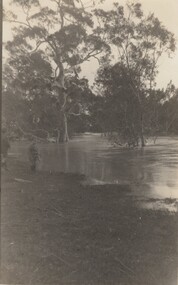
Photograph, Whitehall Property Greens Creek
... river on the left. 31. Whitehall from the side. Building in centre behind David is separater room. 2 roomed hut to left of separater room and remains of mens' hut chimney. Photo 16 taken from similar spot. 20 Sep 1992 32. Benjamin Roe (Col Hutchings grandson) in the Carpenters' shop. The family lived in this building after the fire in the 1870's. Whitehall 20 Sep 1992 33. Ford...river on the left. 31. Whitehall from the side. Building in centre behind David is separater room. 2 roomed hut to left of separater room and remains of mens' hut chimney. Photo 16 taken from similar spot. 20 Sep 1992 32. Benjamin Roe (Col Hutchings grandson) in the Carpenters' shop. The family lived in this building after the fire in the 1870's. Whitehall 20 Sep 1992 33. Ford ...Hutchings family 1. Wimmera River in flood below Whitehall running a banker c. 1920. Ted & Col Hutchings in foreground. 2. Wimmera River in flood looking downstream. No date but possibly same time as no. 1. from same place. 3. Looking over the Wimmera River to Island paddock towards Greens Creek 4. Wimmera River half a banker at Whitehall 5. Wimmera River in flood upstream from carpenter's shop looking towards engine house at Whitehall 5a. Wimmera River in flood. Left to right - blacksmith shop and carpenters' shop. 5b. Taken from the same spot with Emily & Ada Hole, E G (Ted) & Col Hutchings. Blacksmith shop & carpenters' shop, Whitehall. 5c. Wimmera River upstream from the carpenters' shop. Foreground is possibly Belladonna lilies which were all over the river bank in 1992. Whitehall. 5d. Looking downstream towards the loose boxes, Whitehall. 5e. Blacksmiths' shop and carpenters' shop from the pumping station. Wimmera River, Whitehall. 6. Wimmera River in flood at Whitehall. 7. Wimmera River half a banker in front of old hut at Whitehall. 8. Wimmera River Emily Hayes, Edward G (Ted) Hutchings & Colin J Hutchings. 9. Morrl-Morrl - Greens Creek Road opposite back paddock. Whitehall. Black Ford in distance. c. 1919 10. Whitehall woolshed north east aspect, Drive to the right of photo 11. Whitehall woolshed - north east aspect showing the drive to the right 11a. Whitehall woolshed - north aspect 11b. Same tree near woolshed 11c. Same tree again in centre, other trees came up after the 23 flood. Woolshed to the right out of photo. 12. Whitehall woolshed - south aspect, sheep entrance end 13. Whitehall. left to right, Stackyard, stables in the centre and the Wimmera River behind following the trees. 14. Whitehall horse paddock c. 1920. left to right, Machinery shed, stable in the centre. Homestead to the right in distance. There is no windmill. 15. Load of wool from Whitehall woolshed to right. 16. Whitehall c. 1920 before the windmill. left to right, garage and mens' hut. Wimmera river runs along the tree line. 16a. Stables, garage and mens' hut after the construction of the windmill. River behind. 17. Whitehall c. 1922. Note windmill addition. Garage to left, Mens' Hut to right. Jack Donnelly & Edward G (Ted) Hutchings with pet lambs. River behind trees. 18. Whitehall gardens. Summer house to the right, pine tree lined drive in the centre background. Ted & Col Hutchings on the lawn. C. 1920 19. Edward G. (Ted) & Colin J. Hutchings in Whitehall garden. Wimmera River in the background. The building behind the fence is the carpenters' shop which the family lived in while house was rebuilt after fire 15 Jan 1877 20. Whitehall c. 1920. left to right, cattle yard, killing house, Wimmera river behind the fence, and the loose box on the right. Black Orpington chooks in foreground. 21. Bay window (original blinds) in the master bedroom. Whitehall 20 Sep 1992 22. Master bedroom (original wallpaper) Joyce & Col Hutchings, Moyu, Ben & Rebecca Roe 20 Sep 1992 23. Col & Ted's bedroom (original) Marble mantlepiece had been removed. Whitehall. 20 Sep 1992 24. Whitehall kitchen. Large yellow meat oven to left of stove, bread oven far left, extreme right is oven where milk heated to skim cream. Chimney was a central one shared with meat oven. Bread oven chimney separate. 20 Sep 1992 25. Whitehall dairy, made of natural stone with dried brick corners. Entrance behind creeper which is over trellis. 20 Sep 1992. This building still remains in 1 Jun 2023 26. Inside charcoal lined meat cellar. Bottom right is concrete vat for pickling meat in brine. Top of brickwork slightly above ground level. Whitehall 20 Sep 1992 27. Fire foreground was stable flooring which was to left of photo. Machinery shed (thatch roof). 4 posts far left remains of cowshed. Large post in centre foreground is the gate post of corral. River to right. 20 Sep 1992 28. Whitehall machinery shed. Posts on far right are cow shed. Over the river is the island paddock. Wimmera river runs behind machinery shed. 20 Sep 1992 29. Posts of 10 sided corral. Killing house by side of gum tree in centre of photo on far side of corral. To left is one of the bales of the cowshed. Whitehall. 20 Sep 1992 29a. Similar photo in the 1920's. To the right is horsebreaking corral, then cow shed, loose box, haystacks and stable on left. Whitehall. 30. Dining room fire place put in the open fire of the mens' hut, only the chimney remains. To the left is the drive & river. Rebecca Roe, Col Hutchings granddaughter. 20 Sep 1992 30a. Looking down the Whitehall Drive. Mens' Hut (Jack Donnelly in doorway) and garage far left. 1920's 30b. The Drive, Whitehall taken from in front of the mens' hut. Wimmera River on the left. Gum tree on left still there 20 Sep 1992. 30c. Reverse from 30a. Whitehall drive from the front gate looking towards the mens' hut and garage. c. 1926 30d. Curly Donohue leaving for Warracknabeal. Ex mail contractor Omeo to Bright Victoria. C. 1926 30e. Looking down the drive towards front gate. Mens' hut on the right, river on the left. 31. Whitehall from the side. Building in centre behind David is separater room. 2 roomed hut to left of separater room and remains of mens' hut chimney. Photo 16 taken from similar spot. 20 Sep 1992 32. Benjamin Roe (Col Hutchings grandson) in the Carpenters' shop. The family lived in this building after the fire in the 1870's. Whitehall 20 Sep 1992 33. Ford across the Wimmera River at Whitehall (River abt. 5 feet higher than normal) 20 Sep 1992 33a. Wimmera River, Whitehall 34. Site of old bridge before Col Hutchings time. Tree in foreground to right still has bolt from bridge work protuding. A large post was in the centre of photo to make equal distance. 20 Sep 1992 35. Entrance to the old ford. Colin J Hutchings & his daughter, Moyu Roe. Wimmera River, Whitehall 20 Sep 1992 36. Summer house at Whitehall 20 Sep 1992 looking down to the orchard, dark green trees in distance old fruit trees. 36a. Edward & Colin Hutchings in front of the Summer house, Whitehall c. 1921 36b. Summer house looking towards front gate. Whitehall. 36c. Grey thrush in nest box which can be seen in previous photo with summer house in the background. Whitehall. 36d. Summer house from the orchard side. Whitehall. 37a. South side of Whitehall. First window Edith Sutherland's room, 2nd window, Ted & Col's room, bay window master bedroom 38. Taken in middle of front path looking towards front gate. Edith Sutherland in garden. Date palm in centre, cotton palm to left. Whitehall c. 1920's 38a. Garden at Whitehall taken from near the cotton palm. 39. Whitehall 20 Sep 1992 Bay window-master bed, small window to r. of bay-Colin Hutchings born in, front door, window to right-dining room, round the corner- drawing room, window on right, spare bed, verandah on left is spare bed. 39a. Whitehall c. 1920's Date palm on the right. 39b. Win, Colin T & Colin J Hutchings. Date palm in background. Whitehall 1943 39c. Edward George, Colin Thomas, Elizabeth Ambler & Colin James Hutchings wearing RAAF uniform. Date Palm in background. Whitehall c. 1943 39c. Front garden of Whitehall looking from the front right side of the house towards the drive & Wimmera River. Date palm on right, cotton palm on left 20 Sep 1992 40. Taken from bottom left corner of front garden looking towards the summer house. Cotton palm on right. River to the left. 41. Elizabeth A Hutchings beside master bedroom window. Whitehall c. 1920 42. Whitehall (photo of a painting by Wallace) owned by Colin T Hutchings 1982. 42a. Whitehall painting by Wallace after restoration now owned by Nick Hutchings 2021 42b. Whitehall c. 1923 42c. Taken from the side garden looking towards the right side of house. Front door is to the left out of photo. The cotton palm is to the left. c. 1923 43. Signpost showing Whitehall 20 Sep 1992, All ground up to the tree line behind the signpost was Whitehall property. 44. Colin T. Hutchings age 9 mths. Mar 1943 Whitehall 45. Colin James, Elizabeth Ambler & Edward George Hutchings. Front garden by the date palm, Whitehall c. 1939-40 45a. Colin James, Edward George, Edward Thomas Hutchings & E. Winifred May & Barney (dog) Whitehall. c. 1939-40. 45b. Colin James & Colin Thomas Hutchings during drought & World War ll c. 1944-45 in front of cotton palm, date palm to right. 46. Garden at Whitehall. Jack Donnelly on the hand mower. Cotton palm on left, date palm behind Jack and roof of carpenters shop to right. 47. Colin J Hutchings on tractor, E. Tom Hutchings behind. Whitehall, c. 1933 48. Jack Donnelly (Tad) & Colin J. Hutchings. Cotton palm to right. Whitehall c. 1917-18 49. Edward G (Ted) & Colin J Hutchings with cockatoo outside the dairy in rear garden. Whitehall c. 1923 50. Taken from the windmill looking across the roof of the mens' hut to the garden, orchard and drive in Winter time. House is behind the trees to right, Wimmera River to the left out of picture. Whitehall. 50a. Not labelled by Col Hutchings. It is an aerial shot looking towards the house in the trees & seems to be taken from the top of a tree...on the river side. 51. E. Tom Hutchings & George Chambers dam sinking. Whitehall. 51a. Tom Hutchings & George Chambers dam sinking. Whitehall. 51b. E. Tom Hutchings dam sinking. 52. Emily Hayes & Ada Hole (sisters) with Tom, Col & Ted Hutchings at the woolshed. 53. E T (Tom) Hutchings on reaper & binder. Whitehall. 54. Orchard looking towards the house. Carpenters' shop and river on the right. Whitehall. 54a. Orchard looking from the house, dark trees in background form part of the drive. 55. Grasshopper plague, Christmas Day 1933. Whitehall 56. Frost on the front lawn, Whitehall. 57. Little red hen & chicks with the river in the background 58. Edward (Ted) G. Hutchings muscovy ducks, hay shed and trees along the river in the background. 58a. Edward (Ted) G Hutchings muscovy ducks. 59. Swimming in the Wimmera River, either Ted or Col Hutchings in the foreground. 60. Looking towards the fowl house and pigsty, Whitehall. 61. Snake on the path, Whitehall. c. 1923 61a. E. Tom Hutchings killing a snake, Whitehall. c. 1923 61b. E. Tom Hutchings killing a snake, Whitehall. c. 1923 62. Notice of clearing sale, Stawell News & Pleasant Creek Chronicle on 5 Apr 1916 where the stock & whole of the household furniture was to be sold by James Hutchings widow. 63. Back to Greens Creek 7 Jun 1987 Colin J Hutchings left and Belle Kindred centre looking at photo 64. Back to Greens Creek 7 Jun 1987 Colin J Hutchings centre, Graham Stewart holding photograph on the right. 65. Colin J Hutchings & Bill Walker. Back to Greens Creek 7 Jun 1987 66. Colin J Hutchings delivering a speech before the plaque unveiling. Back to Greens Creek 7 Jun 1987 67. Graeme Williamson & Colin J Hutchings (2 'old boys') Greens Creek School Site 7 Jun 1987 68. Graeme Williamson talking to Moyu Roe (Hutchings) in background is May Williamson. Back to Greens Creek 7 Jun 1987 69. Greens Creek SS, Edward (Ted) & Colin J Hutchings attended. 70. Original students of first Greens Creek School 7 Jun 1987 Back row left 1. Kindred 3. Colin J Hutchings 4,5,6 not known 7. Graeme Williamson Sitting left 1. Not an original 2,3,4, not known 5. Belle Kindred 71. Terrier at Greens Creek State School 72. The new school students Back to Greens Creek 7 Jun 1987. Perry twins standing in centre and the teacher kneeling front left. 73. Will Rees water colour 1925 signature 74. Will Rees water colour 1925 75. Shearing at Kirkellar. Allen Simpson's 76. Back to Greens Creek 7 Jun 1987 Colin J Hutchings left and Belle Kindred centre looking at photo 77. Back to Greens Creek 7 Jun 1987 Colin J Hutchings centre, Graham Stewart holding photograph on the right. 78. Colin J Hutchings & Bill Walker. Back to Greens Creek 7 Jun 1987 79. Colin J Hutchings delivering a speech before the plaque unveiling. Back to Greens Creek 7 Jun 1987 80. Graeme Williamson & Colin J Hutchings (2 'old boys') Greens Creek School Site 7 Jun 1987 81. Graeme Williamson talking to Moyu Roe (Hutchings) in background is May Williamson. Back to Greens Creek 7 Jun 1987 82. Greens Creek SS, Edward (Ted) & Colin J Hutchings attended. 83. Original students of first Greens Creek School 7 Jun 1987 Back row left 1. Kindred 3. Colin J Hutchings 4,5,6 not known 7. Graeme Williamson Sitting left 1. Not an original 2,3,4, not known 5. Belle Kindred 84. Shearing at Kirkellar. Allen Simpson's 85. Terrier at Greens Creek State School 86. The new school students Back to Greens Creek 7 Jun 1987. Perry twins standing in centre and the teacher kneeling front left. Digital Copy of Parish Maps Kara Karahomestead -
 Marysville & District Historical Society
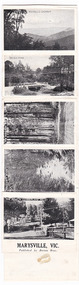
Photograph (item) - Black and white photographs, Valentine Publishing Co. Pty. Ltd, Marysville, Vic, 1923-1963
... river (image 2)...the acheron way (image 3)...the old ford...After Thomas' death in 1911, his sons Fred and Frank took over the family business and renamed it Barton Bros. the road to cumberland valley (image 1) taggerty river (image 2) the acheron way (image 3) the old ford (image 4) nicholl's lookout (image 5) main street (image 6) mount margaret (image 7) stevenson falls (image 8) cumberland falls (image 9) keppel's falls (image 10) acheron way (image 11) marysville victoria barton bros souvenir valentine publishing co thomas john barton ewen hugh cameron francis adam barton frederick barton A fold-out set of 11 miniature black and white photographs of scenic attractions taken in and around Marysville in Victoria. ...A series of black and white photographs of scenic attractions taken in and around Marysville in Victoria that was published by the Barton Bros, Marysville and printed by Valentines Publishing Co as a souvenir of Marysville.A series of black and white photographs of scenic attractions taken in and around Marysville in Victoria that was published by the Barton Bros, Marysville and printed by Valentines Publishing Co as a souvenir of Marysville. Thomas Barton was one of the earliest settlers in Marysville and with 16 children and numerous descendants the name of Barton is synonymous with Marysville. Thomas John Barton, along with his business partner, Ewen Hugh Cameron, opened a butcher/abattoirs in Marysville in 1864. This was the first shop in Marysville. They supplied meat and other items to the miners along the Woods Point road. Thomas Barton was an active community member and was a key organiser in setting up the school in Marysville in 1870. After Thomas' death in 1911, his sons Fred and Frank took over the family business and renamed it Barton Bros. the road to cumberland valley (image 1), taggerty river (image 2), the acheron way (image 3), the old ford (image 4), nicholl's lookout (image 5), main street (image 6), mount margaret (image 7), stevenson falls (image 8), cumberland falls (image 9), keppel's falls (image 10), acheron way (image 11), marysville, victoria, barton bros, souvenir, valentine publishing co, thomas john barton, ewen hugh cameron, francis adam barton, frederick barton -
 Marysville & District Historical Society
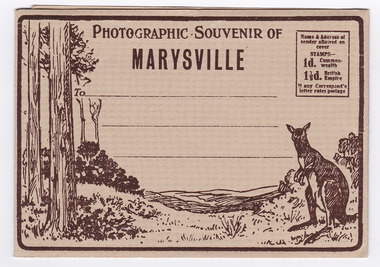
Postcard (item) - Black and white photographs, Barton Bros, Photographic Souvenir of Marysville, 1923-1963
... river (image 5)...mount margaret (image 6)...mount gordan (image 7)...nicholl's lookout (image 8)...the old ford...After Thomas' death in 1911, his sons Fred and Frank took over the family business and renamed it Barton Bros. marysville victoria barton bros acheron way (image 1) keppel's falls (image 2) cumberland falls (image 3) stevenson falls (image 4) taggerty river (image 5) mount margaret (image 6) mount gordan (image 7) nicholl's lookout (image 8) the old ford (image 9) valentine publishing co souvenir postcard thomas barton ewen hugh cameron francis adam barton frederick barton Name & Address of/ sender allowed on/ cover STAMPS-/ 1d. ...A series of nine black and white photographs of scenic attractions taken in and around Marysville in Victoria that was published by the Barton Bros, Marysville and printed by Valentines Publishing Co as a souvenir of Marysville.A series of nine black and white photographs of scenic attractions taken in and around Marysville in Victoria that was published by the Barton Bros, Marysville, and printed by Valentines Publishing Co as a souvenir of Marysville. Thomas Barton was one of the earliest settlers in Marysville and with 16 children and numerous descendants, the name of Barton is synonymous with Marysville. Thomas John Barton, along with his business partner, Ewen Hugh Cameron, opened a butcher/abattoirs in Marysville in 1864. This was the first shop in Marysville. They supplied meat and other items to the miners along the Woods Point road. Thomas Barton was an active community member and was a key organiser in setting up the school in Marysville in 1870. After Thomas' death in 1911, his sons Fred and Frank took over the family business and renamed it Barton Bros. Name & Address of/ sender allowed on/ cover STAMPS-/ 1d. Common-wealth/ 1 1/2d. British Empire If any Correspond'e/ letter rates postage From Published by BARTON BROS., Marysvillemarysville, victoria, barton bros, acheron way (image 1), keppel's falls (image 2), cumberland falls (image 3), stevenson falls (image 4), taggerty river (image 5), mount margaret (image 6), mount gordan (image 7), nicholl's lookout (image 8), the old ford (image 9), valentine publishing co, souvenir, postcard, thomas barton, ewen hugh cameron, francis adam barton, frederick barton -
 Marysville & District Historical Society
Postcard (item) - Black and white photographs, Barton Bros, Photographic View Booklet of MARYSVILLE, 1923-1963
... river (image 5)...mount margaret (image 6)...mount gordan (image 7)...nicholl's lookout (image 8)...the old ford...After Thomas' death in 1911, his sons Fred and Frank took over the family business and renamed it Barton Bros. marysville victoria barton bros acheron way (image 1) keppel's falls (image 2) cumberland falls (image 3) stevenson falls (image 4) taggerty river (image 5) mount margaret (image 6) mount gordan (image 7) nicholl's lookout (image 8) the old ford (image 9) postcard valentine publishing co souvenir thomas barton francis adam barton frederick barton ewen hugh cameron To From Published by BARTON BROS., Marysville Fold out postcard which encloses nine black and white images of scenic attractions in and around Marysville in Victoria. ...A series of nine black and white photographs of scenic attractions taken in and around Marysville in Victoria that was published by the Barton Bros, Marysville and printed by Valentines Publishing Co as a souvenir of Marysville.A series of black and white photographs of scenic attractions taken in and around Marysville in Victoria that was published by the Barton Bros, Marysville and printed by Valentines Publishing Co as a souvenir of Marysville. Thomas Barton was one of the earliest settlers in Marysville and with 16 children and numerous descendants, the name of Barton is synonymous with Marysville. Thomas John Barton, along with his business partner, Ewen Hugh Cameron, opened a butcher/abattoirs in Marysville in 1864. This was the first shop in Marysville. They supplied meat and other items to the miners along the Woods Point road. Thomas Barton was an active community member and was a key organiser in setting up the school in Marysville in 1870. After Thomas' death in 1911, his sons Fred and Frank took over the family business and renamed it Barton Bros. To From Published by BARTON BROS., Marysvillemarysville, victoria, barton bros, acheron way (image 1), keppel's falls (image 2), cumberland falls (image 3), stevenson falls (image 4), taggerty river (image 5), mount margaret (image 6), mount gordan (image 7), nicholl's lookout (image 8), the old ford (image 9), postcard, valentine publishing co, souvenir, thomas barton, francis adam barton, frederick barton, ewen hugh cameron -
 Marysville & District Historical Society
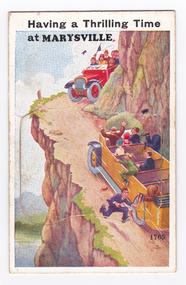
Postcard (item) - Novelty postcard, Valentine Publishing Co. Pty. Ltd, Having a Thrilling Time at Marysville, 1940's-1960's
... ford (image 8)...the acheron way (image 9)...taggerty river...A novelty postcard with pull-out strip of 11 miniature photographs that was produced by the Valentine Publishing Co as a souvenir of Marysville. marysville victoria postcard souvenir valentine publishing co acheron way (image 1) keppel's falls (image 2) cumberland falls (image 3) stevenson falls (image 4) mount margaret (image 5) main st (image 6) nicholl's lookout (image 7) the old ford (image 8) the acheron way (image 9) taggerty river (image 10) the road to cumberland valley (image 11) Having a Thrilling Time/ at MARYSVILLE 1765 PRINTED PAPER/ MAILING NOVELTY/ SHAPE PASSED BY THE G.P.O./ FOR PRINTED PAPER POSTAGE RATE/ Only Name and Address of Sender Allowed/ If any other writing, Letter Postage is required/ TO OPEN RAISE FLAP From VALENTINE'S "MAIL NOVELTY" POST CARD. ...A novelty postcard with pull-out strip of 11 miniature photographs that was produced by the Valentine Publishing Co as a souvenir of Marysville.A novelty postcard with pull-out strip of 11 miniature photographs that was produced by the Valentine Publishing Co as a souvenir of Marysville.Having a Thrilling Time/ at MARYSVILLE 1765 PRINTED PAPER/ MAILING NOVELTY/ SHAPE PASSED BY THE G.P.O./ FOR PRINTED PAPER POSTAGE RATE/ Only Name and Address of Sender Allowed/ If any other writing, Letter Postage is required/ TO OPEN RAISE FLAP From VALENTINE'S "MAIL NOVELTY" POST CARD. COPYRIGHT Printed in Great Britain Shape Passed/ by G.P.O./ for/ Printed Paper/ Postage Rate/ 34-2 Tomarysville, victoria, postcard, souvenir, valentine publishing co, acheron way (image 1), keppel's falls (image 2), cumberland falls (image 3), stevenson falls (image 4), mount margaret (image 5), main st (image 6), nicholl's lookout (image 7), the old ford (image 8), the acheron way (image 9), taggerty river (image 10), the road to cumberland valley (image 11) -
 Marysville & District Historical Society
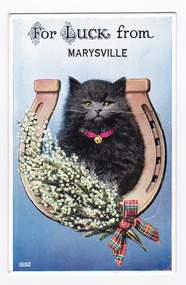
Postcard (item) - Novelty postcard, Valentine Publishing Co. Pty. Ltd, FOR LUCK from MARYSVILLE, 1940's-1960's
... river (image 2)...acheron way (image 3)...the old ford...A novelty postcard with pull-out strip of 9 miniature photographs that was produced by the Valentine Publishing Co as a souvenir of Marysville. marysville victoria souvenir postcard valentine publishing co cumberland valley road (image 1) taggerty river (image 2) acheron way (image 3) the old ford marysville (image 4) nicholl's lookout (image 5) main street marysville (image 6) mount margaret (image 7) stevenson falls (image 8) cumberland falls (image 9) FOR LUCK from/ MARYSVILLE 1852 VALENTINE'S/ MAILING NOVELTY From VALENTINE'S "MAILING NOVELTY" POSTCARD. ...A novelty postcard with pull-out strip of 9 miniature photographs that was produced by the Valentine Publishing Co as a souvenir of Marysville.A novelty postcard with pull-out strip of 9 miniature photographs that was produced by the Valentine Publishing Co as a souvenir of Marysville.FOR LUCK from/ MARYSVILLE 1852 VALENTINE'S/ MAILING NOVELTY From VALENTINE'S "MAILING NOVELTY" POSTCARD. COPYRIGHT. Postal Rates/ within Australia Enclosed in/ Envelope 2 1/2"/ Sent Open/ with only/ Name and/ Address of/ Sender 1 1/2 Mt Kitchener House/ Marysville/ 31.1.51 Dear Nancy & Albert/ Well I thought that while I had a/ chance I would drop you a few lines to/ let you know that we are having a good/ time. I read in the Herald last night about/ Uncle Will's death, but he had suffered such/ a lot, that I guess he is better off. When/ Dad & I went to see him last Tues week/ he really looked dreadful. This is a very/ nice place to stay the meals and accommod-/ ation is very nice & they are a very nice/ crowd staying here. Beryl & I went to Alexander/ yesterday with some friends of Beryl's and tomorrow/ we are going the Reefton Spur trip, ? and the Eildon Weir/ trip and then Frid the Cumberland Valley Trip./ Well I must close so for the present lots of Love/ Violetmarysville, victoria, souvenir, postcard, valentine publishing co, cumberland valley road (image 1), taggerty river (image 2), acheron way (image 3), the old ford marysville (image 4), nicholl's lookout (image 5), main street marysville (image 6), mount margaret (image 7), stevenson falls (image 8), cumberland falls (image 9) -
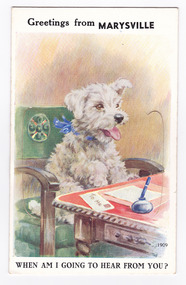 Marysville & District Historical Society
Postcard (item) - Novelty postcard, Valentine Publishing Co. Pty. Ltd, Greetings from MARYSVILLE-WHEN AM I GOING TO HEAR FROM YOU?, 1940s-1960s
... ford (image 8)...the acheron way (image 9)...taggerty river...A novelty postcard with pull-out strip of 11 miniature photographs that was produced by the Valentine Publishing Co as a souvenir of Marysville. marysville victoria postcard souvenir valentine publishing co acheron way (image 1) keppel's falls (image 2) cumberland falls (image 3) stevenson falls (image 4) mount margaret (Image 5) main st (image 6) nicholl's lookout (image 7) the old ford (image 8) the acheron way (image 9) taggerty river (image 10) the road to cumberland valley (image 11) Greetings from MARYSVILLE WHEN AM I GOING TO HEAR FROM YOU? ...A novelty postcard with pull-out strip of 11 miniature photographs that was produced by the Valentine Publishing Co as a souvenir of Marysville.A novelty postcard with pull-out strip of 11 miniature photographs that was produced by the Valentine Publishing Co as a souvenir of Marysville.Greetings from MARYSVILLE WHEN AM I GOING TO HEAR FROM YOU? PRINTED PAPER MAILING NOVELTY TO OPEN RAISE FLAP From VALENTINE'S "MAIL NOVELTY" POST CARD. COPYRIGHT. Printed in Great Britain Tomarysville, victoria, postcard, souvenir, valentine publishing co, acheron way (image 1), keppel's falls (image 2), cumberland falls (image 3), stevenson falls (image 4), mount margaret (image 5), main st (image 6), nicholl's lookout (image 7), the old ford (image 8), the acheron way (image 9), taggerty river (image 10), the road to cumberland valley (image 11) -
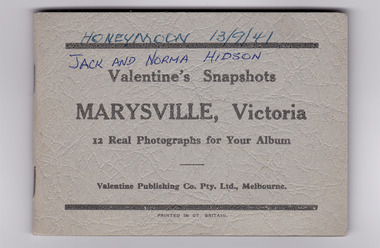 Marysville & District Historical Society
Photograph (item) - Black and white photographs, Valentine Publishing Co. Pty. Ltd, Valentine's Snapshots MARYSVILLE, Victoria, 1923-1963
... river marysville no. 7...mount gordon marysville no. 8...the old ford...Published by the Valentine Publishing Co as a souvenir of Marysville. cora lynn falls marysville no. 1 stevenson's falls marysville no. 2 keppels falls marysville no. 2 cumberland falls marysville no. 3 main street marysville cumberland falls marysville no. 5 taggerty river marysville no. 7 mount gordon marysville no. 8 the old ford marysville no. 9 nicholls lookout marysville no. 10 taggerty river marysville no. 11 on the acheron way to marysville no. 12 souvenir valentine publishing co marysville victoria Valentine's Snapshots/ MARYSVILLE, Victoria/ 12 Real Photographs for Your Album/ Valentine Publishing Co. ...This collection of photographs shows various scenes around Marysville and surrounds such as waterfalls and rivers. Valentines snapshots were done of many places world wide, and packaged in a convenient size to be posted.Early photographs of Marysville and surrounds. Published by the Valentine Publishing Co as a souvenir of Marysville.Valentine's Snapshots/ MARYSVILLE, Victoria/ 12 Real Photographs for Your Album/ Valentine Publishing Co. Pty. Ltd., Melbourne./ PRINTED IN GT. BRITAIN HONEYMOON 13/9/41/ JACK AND NORMA HIDSONcora lynn falls marysville no. 1, stevenson's falls marysville no. 2, keppels falls marysville no. 2, cumberland falls marysville no. 3, main street marysville, cumberland falls marysville no. 5, taggerty river marysville no. 7, mount gordon marysville no. 8, the old ford marysville no. 9, nicholls lookout marysville no. 10, taggerty river marysville no. 11, on the acheron way to marysville no. 12, souvenir, valentine publishing co, marysville, victoria -
Marysville & District Historical Society
THE TRIANGLE NEWS-VOL 39 NO 26-JULY 13 2012
... ford...church notices...parkinsons victoria ambassadors of hope...marysville golf report...goulburn river...marysville victoria australia loan subsidies still on offer for marysville & triangle marysville & triangle investment subsidary for affected bushfire areas regional arts fund steel pan bands receiving funding for international festivals what's on when in july the committee of management of the gallipoli park precinct marysville community market creative triangle murrindindi shire council shire tennis club growth support alexandra junior soccer club advertisements vale stephen franzi-ford church notices parkinsons victoria ambassadors of hope marysville golf report goulburn river high country rail trail rising power and gas bills marysville pharmacy marysville medical clinic mayor's chair adventurous cooks marysville community golf & bowls club trivia and pasta intrepid triangle bushwalkers sample wines alexandra library midnight express dance taggerty hall alexandra cinema real estate council's rating review strategy yea council chambers lake mountain alpine resort ann thoma 1995 reflections on history marysville & district historical society national emergency medal nominations marysviile steel band festival 2013 THE TRIANGLE NEWS-VOL 39 NO 26-JULY 13 2012 ...marysville, victoria, australia, loan subsidies still on offer for marysville & triangle, marysville & triangle investment subsidary for affected bushfire areas, regional arts fund, steel pan bands receiving funding for international festivals, what's on when in july, the committee of management of the gallipoli park precinct, marysville community market, creative triangle, murrindindi shire council, shire tennis club growth support, alexandra junior soccer club, advertisements, vale stephen franzi-ford, church notices, parkinsons victoria ambassadors of hope, marysville golf report, goulburn river high country rail trail, rising power and gas bills, marysville pharmacy, marysville medical clinic, mayor's chair, adventurous cooks, marysville community golf & bowls club, trivia and pasta, intrepid triangle bushwalkers, sample wines, alexandra library, midnight express dance, taggerty hall, alexandra cinema, real estate, council's rating review strategy, yea council chambers, lake mountain alpine resort, ann thoma 1995 reflections on history, marysville & district historical society, national emergency medal nominations, marysviile steel band festival 2013 -
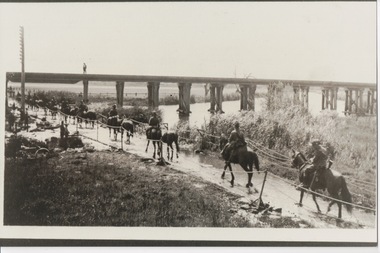 Lara RSL Sub Branch
Photograph, Set 4 photographs. and others for Torquay Light Horse camp, 1940
... They arrived at the Geelong racecourse for watering in the Barwon River and then were ridden across the ford at the breakwater and began their 11 mile trek to Torquay. ...They arrived at the Geelong racecourse for watering in the Barwon River and then were ridden across the ford at the breakwater and began their 11 mile trek to Torquay. ...These images capture for all time Light Horsemen travelling through Geelong on their way to camp at Torquay for the last Group meeting in Australia . information following - details obtained from .........https://torquayhistory.com/light-horse-brigade/ On Australia Day, 1997, Sir John Young unveiled this plaque on Point Danger, Torquay. Torquay history, Light Horse Training Camp, WW2 Plaque at Pt. Danger Note----- (See images to view plaque) The plaque identifies a significant event in Torquay’s history and the sentiments of ‘change’ for the Light Horse Brigade – from horses to machines. In 1940 the four Light Horse Regiments (4th, 8th, 13th and 20th), some 5000 Light Horse and 2000 horses camped and trained at Torquay. Three other regiments, formerly mounted on horses, were also at Torquay ‘mounted’ on privately owned trucks and cars. Division troops included Artillery, Engineers, Signals, Field Ambulance and other branches of the Army necessary to enable a Division to function. It wasn’t just the sheer numbers of men coming to this little town that made the event significant, it was also the fact that the men of the Light Horse were dramatic, almost glamorous figures and it is easy to see their exploits as some splendid adventure. Horses have played a special role in the story of Australia. They were the only means of transport across this huge country, so it was necessary for everyone to have the ability to ride a horse. When war broke out in 1899 between Britain and the Boers of South Africa (“Boer” was Dutch for “farmer”) Australia sent troops to fight. At first Britain was wary of using untried, unprofessional colonial cavalrymen but soon saw that the slouch-hatted Australian “bushmen” were a match for the fast-moving and unconventional mounted commandos of the Boers. The Australians proved themselves to be expert rough-riding horsemen and good shots. Bush life had hardened them to go for long periods with little food and water. They also showed remarkable ability to find their way in a strange country and use its features for cover, in both attack and defence. By 1914, when Australia joined the war against Germany, there were 23 Light Horse regiments of militia volunteers. Many men from these units joined the Light Horse regiments of the Australian Imperial Force (AIF). Men were given remounts (if not using their own horses) – army horses bought by Commonwealth purchasing officers from graziers and breeders. These were called “walers” because they were a New South Wales stockhorse type – strong, great-hearted animals with the strains of the thoroughbred and semi-draught to give them speed, strength and stamina. On 1st November, 1914, Australia’s First Infantry Division and the first four Light Horse regiments sailed for England in a fleet of transport ships. The first of the Light Horse arrived at Gallipoli in May without their horses. Back with their horses after Gallipoli, they were formidable combatants across the Sinai and Palestine. Some British commanders observed that the light horseman moved with a “lazy, slouching gait, like that of a sleepy tiger” but described how the promise of battle “changes that careless gait, into a live athletic swing that takes him over the ground much quicker than other troops”. They had Light Horse, Torquay, training campdeveloped a reputation as formidable infantrymen. The Turks called them “the White Ghurkas” – a reference to their deadly skill with the bayonet. The Arabs called them “The Kings of the Feathers”. The plume had originally been a battle honour of the Queensland Mounted Infantry for their work in the shearer’s strike of 1891. During WW1 it was adopted by almost all the Light Horse Regiments. It was the proud badge of the light horseman. The most famous of their battles was the attack on Beersheba- the charge of the 4th Light Horse Brigade. Mounted infantrymen and their superb walers had carried out one of the most successful cavalry charges in history – against what seemed impossible odds. They surprised the Turks by charging cavalry-style, when they would normally have ridden close to an objective then dismounted to fight. The fall of Beersheba swung the battle tide against the Turks in Palestine; and changed the history of the Middle East. While 19 men from the Surf Coast Shire served with the 4th Light Horse over the course of WW1, only four were involved in the charge of Beersheba- John GAYLARD, Philip QUINN.(Winchelsea); Wallace FINDLAY (Anglesea); Harry TRIGG (Bambra). After the war, Light Horse units played a key role in the Australian Government’s compulsory military training programme. The Citizen Military Forces (C.M.F.) thrived on the glamour of the wartime Light Horse tradition, ignoring the possibility that motor vehicles would soon replace the horses. When training was no longer compulsory, the C.M.F. regiments declined and horses became more of a luxury during the 1930s depression years of poverty and unemployment. Some regiments were motorised. Then, in 1939, Australia joined Britain in another world war. Training was increased for the militia at both home bases and regional training camps. The camp at Torquay in 1940, commanded by Major General Rankin, was at Divisional strength. By the end of the camp some felt that the Division was ready for active service. Gradually, over the next four years, the Australian Light Horse units were mounted on wheels and tracks and the horses were retired. Six men enlisted at the Torquay camp and another 57 men and women enlisted at Torquay for service in WW2. Those who served in the Militia provided valuable Officers and NCOs and men for the armed services during the war. Each infantry division of the 2nd AIF had a Light Horse regiment attached to it. But the day of the Australian mounted soldier hadn’t quite passed. During World War II, Australia’s 6th Cavalry Regiment formed a mounted unit they called “The Kelly Gang” which did valuable scouting work. In New Guinea, a mounted Light Horse Troop did patrol duty and helped carry supplies. Some fully equipped walers were flown into Borneo for reconnaissance in rugged mountain country. But by the end of the war, in 1945, the horse had disappeared from the Australian Army. References: Australian Light Horse Association www.lighthorse.org.au National Australia Archives Australian War Memorial Surf Coast Shire WW1 memorials www.togethertheyserved.com The Light horse- a Cavalry under Canvas Light Horse, Training Camp, Torquay, WW2 Late in 1939 it was decided to set up a Lighthorse training camp in Torquay to train both men and horses for the battles of the Second World War. Horses, men and equipment came on special trains from all over Victoria and NSW, and as you would expect horseman came from areas such as Omeo and Sale, the Wimmera and the Western District. They arrived at the Geelong racecourse for watering in the Barwon River and then were ridden across the ford at the breakwater and began their 11 mile trek to Torquay. Light Horse, Training Camp, Torquay, WW2 Tent city By the end of January 1940 the camp at Torquay accommodated some 5000 men and 2500 horses of the Second Cavalry Division. The rows of horses, tents and huts near Blackgate Road were quite a sight. While the cavalrymen engaged in exercises on the land and on the beaches, many of the troops took over the Torquay School for special training of men and officers. Mr Bob Pettit local farmer and Councillor for the Barrabool Shire, wrote about the Light horse in the Surf Coast Community News in 1985 saying “They used to travel about the district riding four abreast in one long convoy. To my annoyance they went through my property and shut all the gates behind them. I had certain gates open to let stock in to the water holes and it would take me three -quarters of an hour to follow the horsemen up and put all the gates right again” he continued “the men from the Light Horse were here when the fire went through in March 1940. He recalled an incident when early one morning, as some one blew the bugle, a soldier putting a white sheet on the line frightened the horses. They panicked and ran off in all directions. Six went over the cliff near Bird Rock, five were never found, and the rest were gathered up after nearly a fortnight in the bush around Addiscott and Anglesea" Light Horse, Training Camp, Torquay, WW2, Geelong Parade Geelong parade The training camp culminated in a parade through the streets of Geelong on March 12th 1940. The salute was given at the Town Hall and the troops continued on a route to the You Yang’s for a training exercise. Note-----(see media section for photograph) The Camp was abandoned in mid 1940 as it was deemed unsuitable for training during winter and the cost of a permanent camp could not be justified if it could not be used all year. Historic.......Rare,,,Interpretive.Sepia photographs.set of four ....post card size ....Horses &LighthorsemenNo 1, Lighthorsemen Regiment Geelong 1940......No 2 Light Horse at Breakwater Geelong 1938 to 1940....No 3 Light Horse at Breakwater Geelong 1938 to 1940.....No 4 Light Horse crossing Breakwater camped at Geelong Showgrounds. These markings are on reverse of photographs.light horsemengeelong 1940., world war 2 -
 Flagstaff Hill Maritime Museum and Village
Weapon - Historic Rifles, Royal Small Arms Factory, 1877-1900
... WOODFORD POLICE: - The small settlement at Woodford was established in the 1840s around the Merri River where there was a ford across the water and a bridge from 1848 to 1851. ...WOODFORD POLICE: - The small settlement at Woodford was established in the 1840s around the Merri River where there was a ford across the water and a bridge from 1848 to 1851. ...Martini-Henry Artillery Carbin rifles were made by the Royal Small Arms Factory at Enfield, Britain, from 1877 until 1900. Many were distributed to the British Colonies, including this pair, which was allocated to the Woodford Police, Victoria Police District of Warrnambool, Southwest Victoria. The Carbine model rifles were shorter than the standard rifles and more suited to mounted police and troopers. It is likely that in the early 20th century, Victoria Police replaced the two carbines with more modern firearms, and the outdated guns were stored in the stables. The rifles were left there and likely forgotten about due to changes in police staff. In 1915, police authorities announced that they would be replacing patrol horses with bicycles and would also close some smaller police stations. This affected Woodford Police Station, which closed in 1917. The forgotten firearms remained in the stables and were noticed by schoolboy Robert Jellie in 1940 and seen again in 1946. In 1995, the property was sold by the Education Department to a private owner. The Woodford Community donated the pair of Martini-Henry Carbines to the Victoria Police Museum in the late 1990s for mounting and display, which was funded by the Victoria Police Historical Society Inc. The decorative wood and glass display case and frame were designed to preserve the significant history of the guns. On November 1st 1999, the display was presented to Warrnambool Police and the local community due to the historical significance of the Woodford Police Station. In 2025, these items were formally deaccessioned by the Victoria Police Museum, and ownership was transferred to the Warrnambool Police Station. On March 10th, 2025, the display was transferred to Flagstaff Hill Maritime Museum and Village, where the historical story of the Martini-Henry Carbines could continue to be preserved and accessed by local families, the community, visitors to the area, and online visitors. WOODFORD POLICE: - The small settlement at Woodford was established in the 1840s around the Merri River where there was a ford across the water and a bridge from 1848 to 1851. The area was settled very early in Victoria’s history, and the river crossing provided travellers with access to the early route between Port Fairy (named Belfast at that time), Warrnambool and Melbourne. Occasionally, a Warrnambool police trooper would ride through Woodford and the district. In December 1854, Woodford Police barracks and stables were built on the hill by the Merri River on Bridge Road east, where Jubilee Park now stands. A local mounted trooper kept law and order in the area. In 1856, a lock-up was installed, and the first Woodford Police Station was in action in 1857. By 1871, the police station had been moved from the hill to land across the Merri River bridge, on the southern side of Bridge Road west, near Mill Street. In 1890, the police residence there was replaced by a stone Edwardian-style building with the stables and lock-up behind it and the old police station at the rear. The police continued to have a presence in Woodford until it was closed by the Police Commissioner in July 1917 for economic reasons. The residence was used for government housing until 1923, when it was taken over by the Education Department for the school teacher’s home. In 1995, it became privately owned. THE MARTINI-HENRY ARTILLERY CARBINE: - The Martini-Henry rifles were made in Britain from 1871 at the Royal Small Arms factory at Enfield and were stamped with the symbol of the Royal Cipher (Crown over VR) over ENFIELD to identify their origin. They were named after two of several people who helped design this method: Swiss Friederich von Martini and Scotsman Alexander Henry. The design was breech-loaded, and the inner barrel was rifled. A thumb rest was incorporated into the top right of the bullet receiver’s chamber. The small teardrop lever on the right side of the rifle showed whether the rifle was ready to be shot. In 1877, the shorter, lighter-weight Carbine version of the firearm was produced for mounted troops and artillery. Its official name was “Carbine, B.L., Rifled, Martini-Henry.” The bullets were slightly lighter in weight than those used for the longer rifle. The sight position was adjusted for the shorter gun, and wings were added to the sight on the tip, making it easier to slide the rifle back into a saddle bag. Some of the later Carbines also had leather sight covers screwed to the stock to prevent them from catching on the saddle bags. The Carbines had accessories available, such as barrel extensions with bayonets and swivels for adding slings. The Martini-Henry Carbine designs were later modified to fire the British .303 ammunition. Eventually, by 1900, the Martini-Henry Carbines were replaced by the Lee Enfield gun design. The pair of Martini-Henry Carbine firearms represents policing in the early pre-1900 days of colonial settlement; Woodford was one of the first townships settled in Victoria, and it had a police presence from 1854 until 1917. The rifles and display provide a historic connection between the location of Woodford and relatives and associates. The carbine rifles show a stage in the evolution of weapon design, adapted to suit mounted troops, and adding features to streamline use and storage. The ammunition was also improved during this progression. The carbines are important for their connection to policing law and order in a remote area. They are significant for their association with the township of Woodford, which was important to travel in the southwest Victoria district, providing access across a river for a road between Port Fairy and Melbourne, and later Warrnambool, and supplying food, goods and accommodation for the travellers. A pair of mounted rifles is mounted behind glass in a timer case, accompanied by a framed display of two photographs and an account of the rifles’ history. The case and display each have a horizontal board with a gently curved edge and carved decorations added. The identical firearms are British-made Martini Henry Carbine breach-loaded rifled guns, supplied by Britain to its Colonial troops from around 1877. The rifles are lever-action, single-shot .500 calibre weapons. They have a teardrop lever on their right side. They were used by Victoria Police mounted troops at the Woodford Police Station, Victoria. The black and white photographs were taken in 1946. The left photograph has a circled area; the right photograph is an enlarged view of the circled area, showing the Woodford Police Station in detail. The printed text is on textured paper with the Victoria Police watermark. It gives a summary of the rifle’s history. There is an inscription on the left photograph. Left photograph, handwritten in white pen: “WOODFORD” Document’s print: “During the late 1840s the small town of Woodford grew around the crossing of the Merri River on the Melbourne/Port Fairy Rad. Woodford was proclaimed a township in 1854 and a police quarters was established there in 1857. The police station remained until 1917 when it was closed and police service from then on was provided from Warrnambool. The building was then used as a school residence and is now privately owned. In !940 Robert JELLIE, then a schoolboy, observed two rifles mounted on the wall of the disused stable at the rear of the old police building. Following the devastating flood of 1946 (see photograph above) the rifles were again seen in the room next to the stable but were not seen again until the building was sold by the Education Department many years later. It was a recognition of the historical value of the rifles which led to their donation to the Warrnambool Police Complex. The rifles have been authenticated by the Victoria Police Armoury as being Victoria Police issue some time before 1900. The rifles are an identical pair of the famous British-made Martini Henry, a .500 inch calibre military weapon widely used by British Colonial troops. Victoria Police and the wider community of Warrnambool are indebted to the members of the Woodford community for their fine gesture in donating the rifles for mounting so that their historical importance can be preserved and they can be displayed for generations to come. This display was funded by the Victoria Police Historical Society Incorporated, and presented on the first day of November, 1999.”flagstaff hill maritime museum and village, great ocean road, shipwreck coast, martini henry, victoria police, woodford police station, rifle, carbine, display case, british, martini henry carbine, breech-loaded, rifled, colonial, single-shot, .500 calibre, weapon, gun, 1877, troops, mounted troops, merri river, victoria police woodford, victoria police warrnambool, victoria police melbourne, police quarters, robert jellie, school residence, stable, 1946 flood, victoria police armoury, identical pair, british colonial troops, victoria police historical society incorporated, woodford, bicycles, found by a schoolboy, edwardian-style building, victoria police museum, warrnambool police station
