
Showing 321 items matching "forms of aircraft"
-
 Moorabbin Air Museum
Book - Aerodyamics, Everybody's Aviation Guide
... ...Forms of aircraft...Aerodynamics Early aeronautic history Forms of aircraft Lighter than air - balloons & dirigibles How an aircraft flies Airplane parts & their function Fuselage forms & landing gears Wing arrangement & construction Power requirements/engine types & engine location Propellers Equilibrium & control Air records Overview of aeronautics & aerodynamics in simple terms, circa 1928 Everybody's Aviation Guide Book Aerodyamics ...Overview of aeronautics & aerodynamics in simple terms, circa 1928non-fictionOverview of aeronautics & aerodynamics in simple terms, circa 1928early aeronautic history, forms of aircraft, lighter than air - balloons & dirigibles, how an aircraft flies, airplane parts & their function, fuselage forms & landing gears, wing arrangement & construction, power requirements/engine types & engine location, propellers, equilibrium & control, air records -
Moorabbin Air Museum
Document (item) - Inlcudes airworthiness guides on weight and balance control, Weight control of aircraft forms and guidance instructions
... Weight control of aircraft forms and guidance instructions...Weight control of aircraft forms and guidance instructions Document Inlcudes airworthiness guides on weight and balance control ... -
 Moorabbin Air Museum
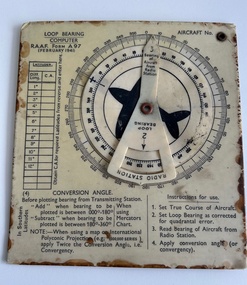
Instrument (item) - Loop Bearing Computer RAAF Form A97
... Loop Bearing Computer RAAF Form A97,used for aircraft navigation....Loop Bearing Computer RAAF Form A97,used for aircraft navigation. Loop Bearing Computer RAAF Form A97 Instrument Loop Bearing Computer RAAF Form A97 ... -
 National Vietnam Veterans Museum (NVVM)
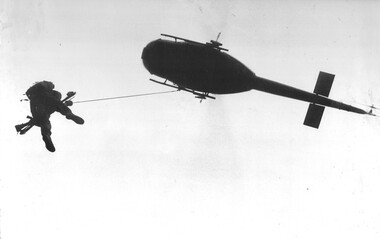
Photograph, Gibbons, Denis, Medivaced Out
... A black and white photograph of a Huey "Slick" aircraft, of the RAAF's No.9 Squadron, winches a wounded Digger from 8 RAR during Operation North West of the Australian Task Force. The Huey helicopter in its many forms...Photograph Huey Helicopter RAAF 9 Squadron Digger 8 RAR Operation North West Australian Task Force Gibbons Collection Catalogue Denis Gibbons A black and white photograph of a Huey "Slick" aircraft, of the RAAF's No.9 Squadron, winches a wounded Digger from 8 RAR during Operation North West of the Australian Task Force. The Huey helicopter in its many forms ...Denis Gibbons (1937 – 2011) Trained with the Australian Army, before travelling to Vietnam in January 1966, Denis stayed with the 1st Australian Task Force in Nui Dat working as a photographer. For almost five years Gibbons toured with nine Australian infantry battalions, posting compelling war images from within many combat zones before being flown out in late November 1970 after sustaining injuries. The images held within the National Vietnam Veterans Museum make up the Gibbons Collection. A black and white photograph of a Huey "Slick" aircraft, of the RAAF's No.9 Squadron, winches a wounded Digger from 8 RAR during Operation North West of the Australian Task Force. The Huey helicopter in its many forms was the close support aircraft for the troops on operations in Vietnam.photograph, huey helicopter, raaf, 9 squadron, digger, 8 rar, operation north west, australian task force, gibbons collection catalogue, denis gibbons -
 National Vietnam Veterans Museum (NVVM)
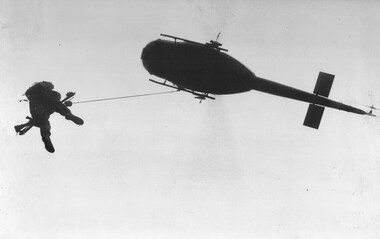
Photograph, Gibbons, Denis, Medivaced Out
... A black and white photograph of a Huey 'slick' aircraft from the RAAF's 9 Squadron, winching a wounded Digger from 8 RAR during 'Operation North West' of the Australian Task Force. The Huey helicopter in its many forms...Photograph 9 Squadron RAAF 1 ATF Nui Dat 8 RAR Digger Operation North West Huey Helicopter Gibbons Collection Catalogue Denis Gibbons Photographer Vietnam War Wounded soldier A black and white photograph of a Huey 'slick' aircraft from the RAAF's 9 Squadron, winching a wounded Digger from 8 RAR during 'Operation North West' of the Australian Task Force. The Huey helicopter in its many forms ...Denis Gibbons (1937 – 2011) Trained with the Australian Army, before travelling to Vietnam in January 1966, Denis stayed with the 1st Australian Task Force in Nui Dat working as a photographer. For almost five years Gibbons toured with nine Australian infantry battalions, posting compelling war images from within many combat zones before being flown out in late November 1970 after sustaining injuries. The images held within the National Vietnam Veterans Museum make up the Gibbons Collection.A black and white photograph of a Huey 'slick' aircraft from the RAAF's 9 Squadron, winching a wounded Digger from 8 RAR during 'Operation North West' of the Australian Task Force. The Huey helicopter in its many forms was the close support aircraft for the troops on operations in Vietnam.photograph, 9 squadron, raaf, 1 atf, nui dat, 8 rar, digger, operation north west, huey helicopter, gibbons collection catalogue, denis gibbons, photographer, vietnam war, wounded soldier -
Moorabbin Air Museum
Document (item) - Roger Alder Collection See Description for list of items
... Log book Engine log book -Ministry of Civil Aviation. M.C.A. FORM 28. Book Aircraft Recognition. Photographs, silhouettes & details of 100 military aeroplanes. ...Log book Engine log book -Ministry of Civil Aviation. M.C.A. FORM 28. Book Aircraft Recognition. Photographs, silhouettes & details of 100 military aeroplanes. ... -
Moorabbin Air Museum
Machine - CAC CA-1 Wirraway A20-10, 1939
... Description: The Commonwealth Aircraft Corporation (CAC) was formed in 1936 to manufacture aircraft in Australia. ...Description: The Commonwealth Aircraft Corporation (CAC) was formed in 1936 to manufacture aircraft in Australia. ...Historical Details: The AARG aircraft was delivered in September 1939 as the 8th production Wirraway and numbered A20-10 ( A20-1 and A20-2 being the imported NA-16 aircraft), and was initially allocated to No. 22 General Purpose Squadron at Richmond in NSW, however 12 months. Description: The Commonwealth Aircraft Corporation (CAC) was formed in 1936 to manufacture aircraft in Australia. The first General Manager of CAC was Lawrence Wackett whose innovative aircraft design was to be seen throughout his time at CAC. The Wirraway was the. Level of Importance: National -
Frankston RSL Sub Branch
Drift Recorder, W & G, A M Drift Recorder MKII, 1930 - 1939
... Refer to the following extracts for information about bomb drift: "Crosswinds brought into the bombing problem a new factor, "drift" In order to fly a given ground track in a crosswind, an aircraft had to "crab" into the wind; the angle formed between the aircraft's true heading and its ground track was called the "drift angle" In a crosswind, the bomb would impact directly behind the aircraft and along its longitudinal axis at the moment of release. ...Refer to the following extracts for information about bomb drift: "Crosswinds brought into the bombing problem a new factor, "drift" In order to fly a given ground track in a crosswind, an aircraft had to "crab" into the wind; the angle formed between the aircraft's true heading and its ground track was called the "drift angle" In a crosswind, the bomb would impact directly behind the aircraft and along its longitudinal axis at the moment of release. ...Purpose built mechanical calculation machine for determining the drift of aircraft when operating in crosswind conditions. This device has an eyepiece and a prismatic periscope for viewing a distant feature being tracked. This device has calibrated rotary scales for height, speed (in KNOTS and MPH), and an adjustment to preset the 'crab angle' of the aircaft for cross wind compensation. The device can be opened for cleaning or maintenance purposes. Refer to the following extracts for information about bomb drift: "Crosswinds brought into the bombing problem a new factor, "drift" In order to fly a given ground track in a crosswind, an aircraft had to "crab" into the wind; the angle formed between the aircraft's true heading and its ground track was called the "drift angle" In a crosswind, the bomb would impact directly behind the aircraft and along its longitudinal axis at the moment of release. But this meant that the bomb would strike the ground at some point downwind of the aircraft's ground track. Thus, in order to score a hit, the bomber had to fly a ground track that ran upwind of the target." "Air resistance acting on a bomb after release caused it to lag behind the drop point and hit somewhere behind the bomber. The distance from a point beneath the aircraft at the instant of bomb impact to the point of bomb impact was called "trail." Trail increased as the bomber's airspeed increased or as its altitude increased. Furthermore, since different bombs encountered different resistance in the air, trail was also a factor of bomb shape."A. M. Drift Recorder MKII REF. No 6B/190 No 2668/41 X/ 3606 3E4H28 -
 Flagstaff Hill Maritime Museum and Village
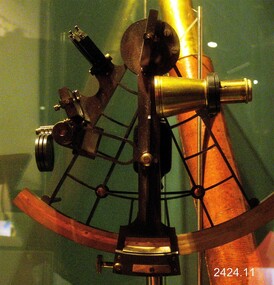
Instrument - Sextant, Late 20th Century
... aircraft instruments. Following the London office's destruction in the Blitz of 1941, a collaboration was entered into with Kelvin, Bottomley & Baird Ltd resulting in the establishing “Marine Instruments Ltd”. Following the formal amalgamation of Kelvin, Bottomley & Baird Ltd and Henry Hughes & Sons Ltd in 1947 to form...aircraft instruments. Following the London office's destruction in the Blitz of 1941, a collaboration was entered into with Kelvin, Bottomley & Baird Ltd resulting in the establishing “Marine Instruments Ltd”. Following the formal amalgamation of Kelvin, Bottomley & Baird Ltd and Henry Hughes & Sons Ltd in 1947 to form ...In 1941, the scientific instrument manufacturing firms of Henry Hughes & Son Ltd, London, England, and Kelvin Bottomley & Baird Ltd, Glasgow, Scotland, came together to form Kelvin & Hughes Ltd. Kelvin Company History: The origins of the company lie in the highly successful and strictly informal relationship between William Thomson (1824-1907), Professor of Natural Philosophy at Glasgow University from 1846-1899 and James White, a Glasgow optical maker. James White (1824-1884) founded the firm of James White, an optical instrument maker in Glasgow in 1850 and was involved in supplying and mending apparatus for Thomson university laboratory and working with him on experimental constructions. White was declared bankrupt in August 1861 and released several months later. In 1870, White was largely responsible for equipping William Thomson laboratory in the new University premises at Gilmore hill. From 1876, he was producing accurate compasses for metal ships to Thomson design during this period and this became an important part of his business in the last years of his life. He was also involved in the production of sophisticated-sounding machinery that Thomson had designed to address problems encountered laying cables at sea, helping to make possible the first transatlantic cable connection. At the same time, he continued to make a whole range of more conventional instruments such as telescopes, microscopes and surveying equipment. White's association with Thomson continued until he died. After his death, his business continued under the same name, being administered by Matthew Edwards (until 1891 when he left to set up his own company. Thomson who became Sir William Thomson and then Baron Kelvin of Largs in 1892, continued to maintain his interest in the business after James White's death. In 1884 raising most of the capital needed to construct and equip new workshops in Cambridge Street, Glasgow. At these premises, the company continued to make the compass Thomson had designed during the 1870s and to supply it in some quantity, especially to the Admiralty. At the same time, the firm became increasingly involved in the design, production and sale of electrical apparatus. In 1899, Lord Kelvin resigned from his University chair and became, in 1900, a director in the newly formed limited liability company Kelvin & James White Ltd which had acquired the business of James White. At the same time Kelvin's nephew, James Thomson Bottomley (1845-1926), joined the firm. In 1904, a London branch office was opened which by 1915 had become known as Kelvin, White & Hutton Ltd. Kelvin & James White Ltd underwent a further change of name in 1913, becoming Kelvin Bottomley & Baird Ltd. Hughes Company History: Henry Hughes & Sons were founded in 1838 in London as a maker of chronographic and scientific instruments. The firm was incorporated as “Henry Hughes & Sons Ltd” in 1903. In 1923, the company produced its first recording echo sounder and in 1935 a controlling interest in the company was acquired by S Smith & Son Ltd resulting in the development and production of marine and aircraft instruments. Following the London office's destruction in the Blitz of 1941, a collaboration was entered into with Kelvin, Bottomley & Baird Ltd resulting in the establishing “Marine Instruments Ltd”. Following the formal amalgamation of Kelvin, Bottomley & Baird Ltd and Henry Hughes & Sons Ltd in 1947 to form Kelvin & Hughes Ltd. Marine Instruments Ltd then acted as regional agents in the UK for Kelvin & Hughes Ltd who were essentially now a part of Smith's Industries Ltd founded in 1944 and the successors of S. Smith & Son Ltd. Kelvin & Hughes Ltd went on to develop various marine radar and echo sounders supplying the Ministry of Transport, and later the Ministry of Defence. The firm was liquidated in 1966 but the name was continued as Kelvin Hughes, a division of the Smiths Group. In 2002, Kelvin Hughes continues to produce and develop marine instruments for commercial and military. G. Falconer Company History: G Falconer (Hong Kong Ltd) appear to have had a retail presence in Hong Kong since 1885, according to the company website, and currently have a shop in the Peninsula Hotel. G Falconer was the Hong Kong selling agent for several British companies. Ross Ltd of 111 New Bond St London was one and the other was Kelvins Nautical Instruments. Falconers were primarily watchmakers, jewellers and diamond merchants.They were also agents for Admiralty Charts, Ross binoculars and telescopes, and sold English Silverware and High Class English Jewellery. In 1928 the company was operating from the Union Building opposite the Hong Kong general post office. It is unclear if the item is an original Sextant made by Kelvin prior to his amalgamation with Henry Hughes & Sons in 1941 as Kelvin appears to have only made compasses up to this date. If the Sextant can be established that it was made by Kelvin then it is very significant and a rare item made for and distributed through their Hong Kong selling agents G Falconer Ltd. There are many Sextants advertised for sale stating "Kelvin & Hughes 1917 model sextant". These can be regarded as replicas as the company was not formed until 1941 and production of marine instruments was not fully under way until after the war in 1947. Further investigation needs to be undertaken to accurately determine the provenance of this item. As the writer currently has the impression that the subject object was possibly made by Kelvin and Hughes in the mid to late 20th century or is a replica made by an unknown maker in the late 1970s. Purchased as an exhibition of marine navigational instruments for the Flagstaff Hill museum. The Sextant is a brass apparatus with filters and telescope lens, and comes with a wooden felt lined storage box. It is a doubly reflecting navigation instrument that measures the angular distance between two visible objects. The primary use of a sextant is to measure the angle between an astronomical object and the horizon for the purposes of celestial navigation.G Falconer and Co. Hong Kong (retailers of nautical equipmentflagstaff hill, warrnambool, shipwrecked-coast, flagstaff-hill, flagstaff-hill-maritime-museum, maritime-museum, shipwreck-coast, flagstaff-hill-maritime-village, sextant, kelvin & hughes ltd, hong kong, navigational instrument, g falconer, mariner's quadrants -
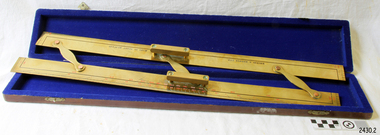 Flagstaff Hill Maritime Museum and Village
Parallel Rule, 1947-1950
... aircraft instruments. Following the London office's destruction in the Blitz of 1941, a collaboration was entered into with Kelvin, Bottomley & Baird Ltd resulting in the establishing “Marine Instruments Ltd”. Following the formal amalgamation of Kelvin, Bottomley & Baird Ltd and Henry Hughes & Sons Ltd in 1947 to form...aircraft instruments. Following the London office's destruction in the Blitz of 1941, a collaboration was entered into with Kelvin, Bottomley & Baird Ltd resulting in the establishing “Marine Instruments Ltd”. Following the formal amalgamation of Kelvin, Bottomley & Baird Ltd and Henry Hughes & Sons Ltd in 1947 to form ...Navigators use parallel rule with maps and charts for plotting a specific course on a chart. One long edge is used with the compass rose on the chart, aligning the centre of the rose with the desired direction around the edge of the rose. The compass bars are then ‘walked’ in and out across the map to the desired location so that lines can be plotted to represent the direction to be travelled. Kelvin Company History: The origins of the company lie in the highly successful and strictly informal relationship between William Thomson (1824-1907), Professor of Natural Philosophy at Glasgow University from 1846-1899 and James White, a Glasgow optical maker. James White (1824-1884) founded the firm of James White, an optical instrument maker in Glasgow in 1850 and was involved in supplying and mending apparatus for Thomson university laboratory and working with him on experimental constructions. White was declared bankrupt in August 1861 and released several months later. In 1870, White was largely responsible for equipping William Thomson laboratory in the new University premises at Gilmore hill. From 1876, he was producing accurate compasses for metal ships to Thomson design during this period and this became an important part of his business in the last years of his life. He was also involved in the production of sophisticated sounding machinery that Thomson had designed to address problems encountered laying cables at sea, helping to make possible the first transatlantic cable connection. At the same time, he continued to make a whole range of more conventional instruments such as telescopes, microscopes and surveying equipment. White's association with Thomson continued until he died. After his death, his business continued under the same name, being administered by Matthew Edwards until 1891 when he left to set up his own company. Thomson who became Sir William Thomson and then Baron Kelvin of Largs in 1892, continued to maintain his interest in the business after James White's death in 1884, raising most of the capital needed to construct and equip new workshops in Cambridge Street, Glasgow. At these premises, the company continued to make the compass Thomson had designed during the 1870s and to supply it in some quantity, especially to the Admiralty. At the same time, the firm became increasingly involved in the design, production and sale of electrical apparatus. In 1899, Lord Kelvin resigned from his University chair and became, in 1900, a director in the newly formed limited liability company Kelvin & James White Ltd which had acquired the business of James White. At the same time Kelvin's nephew, James Thomson Bottomley (1845-1926), joined the firm. In 1904, a London branch office was opened which by 1915 had become known as Kelvin, White & Hutton Ltd. Kelvin & James White Ltd underwent a further change of name in 1913, becoming Kelvin Bottomley & Baird Ltd. Hughes Company History: Henry Hughes & Sons were founded in 1838 in London as a maker of chronographic and scientific instruments. The firm was incorporated as “Henry Hughes & Sons Ltd” in 1903. In 1923, the company produced its first recording echo sounder and in 1935 a controlling interest in the company was acquired by S Smith & Son Ltd resulting in the development and production of marine and aircraft instruments. Following the London office's destruction in the Blitz of 1941, a collaboration was entered into with Kelvin, Bottomley & Baird Ltd resulting in the establishing “Marine Instruments Ltd”. Following the formal amalgamation of Kelvin, Bottomley & Baird Ltd and Henry Hughes & Sons Ltd in 1947 to form Kelvin & Hughes Ltd. Marine Instruments Ltd then acted as regional agents in the UK for Kelvin & Hughes Ltd who were essentially now a part of Smith's Industries Ltd founded in 1944 and the successors of S Smith & Son Ltd. Kelvin & Hughes Ltd went on to develop various marine radar and echo sounders supplying the Ministry of Transport, and later the Ministry of Defence. The firm was liquidated in 1966 but the name was continued as Kelvin Hughes, a division of the Smiths Group. In 2002, Kelvin Hughes continues to produce and develop marine instruments for commercial and military. This model parallel map ruler is a good example of the commercial diversity of navigational instruments made by Kelvin & Hughes after World War II. It was made in numbers for use by shipping after the second world war and is not particularly rare or significant for it's type. Also it was made no earlier than 1947 as the firms of Kelvin, Bottomley & Baird Ltd and Henry Hughes & Sons Ltd who took over from Smith & Sons were not amalgamated until 1947. It can therefor be assumed that this ruler was made during the company's transitional period to Kelvin & Hughes from Smith Industries Ltd.Brass parallel rule in wooden box with blue felt lining.Rule inscribed on front "Kelvin & Hughes Ltd" " Made in Great Britain"flagstaff hill, warrnambool, shipwrecked-coast, flagstaff-hill, flagstaff-hill-maritime-museum, maritime-museum, shipwreck-coast, flagstaff-hill-maritime-village, parallel rule, kelvin & hughes ltd, map ruler, plot direction, navigation, maps, echo sounder, kelvin & james white, lord kelvin, baron kelvin of largs, scientific instrument -
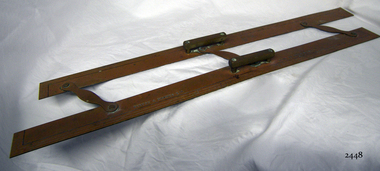 Flagstaff Hill Maritime Museum and Village
Parallel Rule, 1947-1955
... form Kelvin & Hughes Ltd. Hughes Company History: Henry Hughes & Sons were founded in 1838 in London as a maker of chronographic and scientific instruments. The firm was incorporated as “Henry Hughes & Sons Ltd” in 1903. In 1923, the company produced its first recording echo sounder and in 1935 a controlling interest in the company was acquired by S Smith & Son Ltd resulting in the development and production of marine and aircraft instruments. ...form Kelvin & Hughes Ltd. Hughes Company History: Henry Hughes & Sons were founded in 1838 in London as a maker of chronographic and scientific instruments. The firm was incorporated as “Henry Hughes & Sons Ltd” in 1903. In 1923, the company produced its first recording echo sounder and in 1935 a controlling interest in the company was acquired by S Smith & Son Ltd resulting in the development and production of marine and aircraft instruments. ...History/Context: In 1947, the scientific instrument manufacturing firms of Henry Hughes & Son Ltd, London, England, and Kelvin Bottomley & Baird Ltd, Glasgow, Scotland, came together to form Kelvin & Hughes Ltd. Hughes Company History: Henry Hughes & Sons were founded in 1838 in London as a maker of chronographic and scientific instruments. The firm was incorporated as “Henry Hughes & Sons Ltd” in 1903. In 1923, the company produced its first recording echo sounder and in 1935 a controlling interest in the company was acquired by S Smith & Son Ltd resulting in the development and production of marine and aircraft instruments. Following the London office's destruction in the Blitz of 1941, a collaboration was entered into with Kelvin, Bottomley & Baird Ltd resulting in the establishing “Marine Instruments Ltd”. Following the formal amalgamation of Kelvin, Bottomley & Baird Ltd and Henry Hughes & Sons Ltd in 1947 to form Kelvin & Hughes Ltd. Marine Instruments Ltd then acted as regional agents in the UK for Kelvin & Hughes Ltd who were essentially now a part of Smith's Industries Ltd founded in 1944 and the successors of S. Smith & Son Ltd. Kelvin & Hughes Ltd went on to develop various marine radar and echo sounders supplying the Ministry of Transport, and later the Ministry of Defence. The firm was liquidated in 1966 but the name was continued as Kelvin Hughes, a division of the Smiths Group. In 2002, Kelvin Hughes continues to produce and develop marine instruments for commercial and military use. (See Note section this document for further information on the company's origins)This model parallel map ruler is a good example of the commercial diversity of navigational instruments made by Kelvin & Hughes after world war 2. It was made in numbers for use by shipping after the second world war and is not particularly rare or significant for its type. Also, it was made no earlier than 1947 as the firms of Kelvin, Bottomley & Baird Ltd and Henry Hughes & Sons Ltd who took over from Smith & Sons were not amalgamated until 1947. It can there for be assumed that this ruler was made during the company's transitional period to Kelvin & Hughes from Smith Industries Ltd.Metal parallel rule with Kelvin & Hughes Ltd, Made in Great Britain imprinted, numerous measurements, two handles and 3 hinges.flagstaff hill, warrnambool, shipwrecked-coast, flagstaff-hill, flagstaff-hill-maritime-museum, maritime-museum, shipwreck-coast, flagstaff-hill-maritime-village, parallel rule, kelbin & hughes ltd, metal parallel rule -
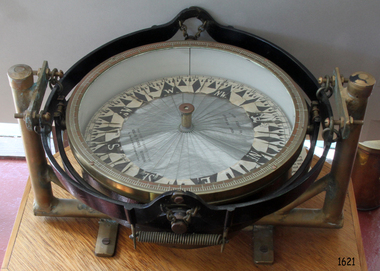 Flagstaff Hill Maritime Museum and Village
Compass, 1947-1950
... aircraft instruments. Following the London office's destruction in the Blitz of 1941, a collaboration was entered into with Kelvin, Bottomley & Baird Ltd resulting in the establishing Marine Instruments Ltd. Following the formal amalgamation of Kelvin, Bottomley & Baird Ltd and Henry Hughes & Sons Ltd in 1947 to form...aircraft instruments. Following the London office's destruction in the Blitz of 1941, a collaboration was entered into with Kelvin, Bottomley & Baird Ltd resulting in the establishing Marine Instruments Ltd. Following the formal amalgamation of Kelvin, Bottomley & Baird Ltd and Henry Hughes & Sons Ltd in 1947 to form ...Kelvin Company History: The origins of the company lie in the highly successful, if strictly informal, the relationship between William Thomson (1824-1907), Professor of Natural Philosophy at Glasgow University from 1846-1899 and James White, a Glasgow optical maker. James White (1824-1884) founded the firm of James White, who was an optical instrument maker in Glasgow in 1850. He was involved in supplying and mending apparatus for Thomson's university laboratory and working with him on experimental constructions. White was actually declared bankrupt in August 1861 and released several months later. In 1870, White was largely responsible for equipping William Thomson's laboratory in the new University premises at Gilmore hill. From 1876, he was producing accurate compasses for metal ships to Thomson's design during this period and this became an important part of his business in the last years of his life. He was also involved in the production of sophisticated sounding machinery that Thomson had designed to address problems encountered laying cables at sea, helping to make possible the first transatlantic cable connection. At the same time, he continued to make a whole range of more conventional instruments such as telescopes, microscopes and surveying equipment. White's association with Thomson continued until he died. After his death, his business continued under the same name, being administered by Matthew Edwards (until 1891 when he left to set up his own company). Thomson, who became Sir William Thomson and then Baron Kelvin of Largs in 1892, continued to maintain his interest in the business after James White's death in 1884, raising most of the capital needed to construct and equip new workshops in Cambridge Street, Glasgow. At these premises, the company continued to make the compass Thomson had designed during the 1870s and to supply it in some quantity, especially to the Admiralty. At the same time, the firm became increasingly involved in the design, production and sale of electrical apparatus. In 1899, Lord Kelvin resigned from his University chair and became, in 1900, a director in the newly formed limited liability company Kelvin & James White Ltd which had acquired the business of James White. At the same time Kelvin's nephew, James Thomson Bottomley (1845-1926), joined the firm. In 1904, a London branch office was opened which by 1915 had become known as Kelvin, White & Hutton Ltd . Kelvin & James White Ltd underwent a further change of name in 1913, becoming Kelvin Bottomley & Baird Ltd . Hughes Company History: Henry Hughes & Sons was founded in 1838 in London as a maker of chronographic and scientific instruments. The firm was incorporated as Henry Hughes & Sons Ltd in 1903. In 1923, the company produced its first recording echo sounder and in 1935, a controlling interest in the company was acquired by S Smith & Son Ltd resulting in the development and production of marine and aircraft instruments. Following the London office's destruction in the Blitz of 1941, a collaboration was entered into with Kelvin, Bottomley & Baird Ltd resulting in the establishing Marine Instruments Ltd. Following the formal amalgamation of Kelvin, Bottomley & Baird Ltd and Henry Hughes & Sons Ltd in 1947 to form Kelvin & Hughes Ltd., Marine Instruments Ltd then acted as regional agents in the UK for Kelvin & Hughes Ltd who were essentially now a part of Smith's Industries Ltd founded in 1944 and the successors of S Smith & Son Ltd. Kelvin & Hughes Ltd went on to develop various marine radar and echo sounders supplying the Ministry of Transport, and later the Ministry of Defence. The firm was liquidated in 1966 but the name was continued as Kelvin Hughes, a division of the Smiths Group. In 2002, Kelvin Hughes continues to produce and develop marine instruments for commercial and military use. This model compass is a good example of the commercial type of instruments made by Kelvin & Hughes after the world war 2, it was made in numbers for use on various types of shipping after the second world war and is not particularly rare or significant for it's type. Also it was made no earlier than 1947 as the firms of Kelvin, Bottomley & Baird Ltd and Henry Hughes & Sons Ltd who took over from Smith & Sons were not amalgamated until 1947. Given that Smith and Sons is engraved on the compass with Kelvin & Hughes it can be assumed that this compass was made during the company's transitional period to Kelvin & Hughes.Compass, marine or ship's card compass, gimble mounted, with inscriptions. Type is Lord Kelvin 10 inch compass card. Made in Great Britain by Kelvin Hughes Division of S. Smith & Sons (England) Ltd. "LORD KELVIN 10.", "COMPASS GRID", "MANUFACTURED IN GREAT BRITAIN BY", "KELVIN HUGHES DIVISION", "S. Smith & Sons (England) Ltd".flagstaff hill, warrnambool, shipwrecked-coast, flagstaff-hill, flagstaff-hill-maritime-museum, maritime-museum, shipwreck-coast, flagstaff-hill-maritime-village, marine compass, gimble compass, ship's compass, lord kelvin compass, smith and sons england ltd, henry hughes & son ltd london england, kelvin bottomley & baird ltd glasgow scotland, kelvin & hughes ltd, navigation instrument, scientific instrument, william thomson, james white, baron kelvin of largs -
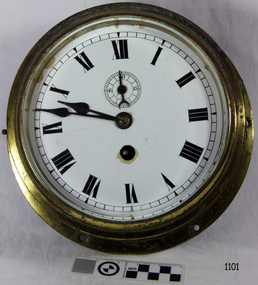 Flagstaff Hill Maritime Museum and Village
Clock, 1940's
... formed a new company, Smiths English Clocks Ltd., as the Clock and Watch division of S Smith & Sons (Motor Accessories) Ltd. This is the start of "Smiths Clocks" because this is when they began to manufacture domestic clocks in quantity. Moreover, they set out to produce these clocks at a price that the average householder could afford. S Smith & Sons (Motor Accessories) was at this time was the main company in the Smiths group of companies and their business developed both in the motor vehicle field and outside it. Smiths began to make automatic pilots for aircraft...formed a new company, Smiths English Clocks Ltd., as the Clock and Watch division of S Smith & Sons (Motor Accessories) Ltd. This is the start of "Smiths Clocks" because this is when they began to manufacture domestic clocks in quantity. Moreover, they set out to produce these clocks at a price that the average householder could afford. S Smith & Sons (Motor Accessories) was at this time was the main company in the Smiths group of companies and their business developed both in the motor vehicle field and outside it. Smiths began to make automatic pilots for aircraft ...Smiths began with a craftsman named Samuel Smith who in 1851 opened a shop in Newington Causeway, London, where he made and sold watches, clocks and precision instruments. Samuel had a son, Samuel Jnr who was apprenticed in his fathers business. Samuel Jnr eventually opened his own business at 85 Strand and later opened other premises at 9 Strand, Trafalgar Square and 68 Piccadilly. In 1899 he turned his business into a private limited company, S. Smith & Son Ltd. Samuel Jnr son, Sir Allan Gordon-Smith, joined him as Manager at 9 Strand in 1903 and laid the foundation of the vast Smiths organisation of the future, leading the company towards the supply of accessories for the then developing motor industry making car clocks and the first speedometers patented in 1904. In July 1914 a new company was formed under the name S. Smith & Sons (Motor Accessories) Ltd., to take over the motor accessory business of S. Smith and Son Ltd. and this became the main company of the group which eventually grew to become Smiths Industries Ltd. The original company S Smith and Sons Ltd., continued as jewelers and clock and watchmakers until 1930 when the company was taken over by Bravingtons retail jeweller chain. In 1931 Smiths decided to enter the domestic clock market and formed a new company, Smiths English Clocks Ltd., as the Clock and Watch division of S Smith & Sons (Motor Accessories) Ltd. This is the start of "Smiths Clocks" because this is when they began to manufacture domestic clocks in quantity. Moreover, they set out to produce these clocks at a price that the average householder could afford. S Smith & Sons (Motor Accessories) was at this time was the main company in the Smiths group of companies and their business developed both in the motor vehicle field and outside it. Smiths began to make automatic pilots for aircraft and, through the acquisition of a majority interest in Henry Hughes & Sons Ltd., entered the field of marine instruments. During the war from 1939 to 1945, Smiths' production expanded. There was a demand for motor, aircraft and marine instruments for the Services and the production of industrial instruments and it is at this time that our item was made. In 1944 many changes were made to the Smiths' organisation. The name of the principal company was changed from S Smith & Sons (Motor Accessories) to S. Smith & Sons (England) Ltd. and four new subsidiary selling companies were set up. These were Smiths Motor Accessories Ltd., Smiths Aircraft Instruments Ltd., Smiths Industrial Instruments Ltd., and Smiths English clocks Ltd. The manufacture of clocks and watches ceased in 1979 and 1983 saw Smiths withdraw from producing items for the motor industry.An item that is now regarded as a vintage, sought by horology collectors worldwide and is in excellent condition. The item is unique in that it was made specifically for ships by the Smith company a well known British clock manufacture. Its provenance is well established and it was made during the world war II era specifically for merchant and naval vessels of the time. Naval brass ships bulkhead clock. The clock face is of white enamel with black Roman numerals, an outer minutes ring and black steel hands. There is a subsidiary seconds dial with sweeping hand just above the centre and a fast/slow adjustment lever above that. There is no manufactures name on the dial. There are a beveled glass and brass hinged lid to the front of the clock. The clock is housed in a heavy brass case with screw holes around the circumference for mounting. There are no markings on the clock or mechanism flagstaff hill, warrnambool, shipwrecked-coast, flagstaff-hill, flagstaff-hill-maritime-museum, maritime-museum, shipwreck-coast, flagstaff-hill-maritime-village, s smith and sons, clock, maritime clocks, clock makers, bulkhead clock -
 Flagstaff Hill Maritime Museum and Village
Functional object - Binnacle and Magnetic Compass
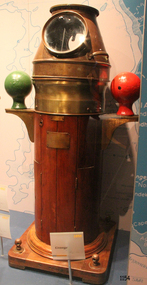
... form Kelvin & Hughes Ltd. Hughes Company History: Henry Hughes & Sons were founded in 1838 in London as a maker of chronographic and scientific instruments. The firm was incorporated as “Henry Hughes & Sons Ltd” in 1903. In 1923, the company produced its first recording echo sounder and in 1935 a controlling interest in the company was acquired by S Smith & Son Ltd resulting in the development and production of marine and aircraft instruments. ...form Kelvin & Hughes Ltd. Hughes Company History: Henry Hughes & Sons were founded in 1838 in London as a maker of chronographic and scientific instruments. The firm was incorporated as “Henry Hughes & Sons Ltd” in 1903. In 1923, the company produced its first recording echo sounder and in 1935 a controlling interest in the company was acquired by S Smith & Son Ltd resulting in the development and production of marine and aircraft instruments. ...In 1947, the scientific instrument manufacturing firms of Henry Hughes & Son Ltd, London, England, and Kelvin Bottomley & Baird Ltd, Glasgow, Scotland, came together to form Kelvin & Hughes Ltd. Hughes Company History: Henry Hughes & Sons were founded in 1838 in London as a maker of chronographic and scientific instruments. The firm was incorporated as “Henry Hughes & Sons Ltd” in 1903. In 1923, the company produced its first recording echo sounder and in 1935 a controlling interest in the company was acquired by S Smith & Son Ltd resulting in the development and production of marine and aircraft instruments. Following the London office's destruction in the Blitz of 1941, a collaboration was entered into with Kelvin, Bottomley & Baird Ltd resulting in the establishing “Marine Instruments Ltd”. Following the formal amalgamation of Kelvin, Bottomley & Baird Ltd and Henry Hughes & Sons Ltd in 1947 to form Kelvin & Hughes Ltd. Marine Instruments Ltd then acted as regional agents in the UK for Kelvin & Hughes Ltd who were essentially now a part of Smith's Industries Ltd founded in 1944 and the successors of S. Smith & Son Ltd. Kelvin & Hughes Ltd went on to develop various marine radar and echo sounders supplying the Ministry of Transport, and later the Ministry of Defence. The firm was liquidated in 1966 but the name was continued as Kelvin Hughes, a division of the Smiths Group. In 2002, Kelvin Hughes continues to produce and develop marine instruments for commercial and military use. (See Note section this document for further information on the company's origins) This model binnacle and compass is a good example of the commercial diversity of navigational instruments made by Kelvin & Hughes after world war 2. It was made in numbers for use by shipping after the second world war and is not particularly rare or significant for its type. Also, it was made no earlier than 1947 as the firms of Kelvin, Bottomley & Baird Ltd and Henry Hughes & Sons Ltd who took over from Smith & Sons were not amalgamated until 1947. It can there for be assumed that this item was made during the company's transitional period to Kelvin & Hughes from Smith Industries Ltd.Mid 20th century ship's binnacle with Kelvin Hughes/ F. Fuselli Genova 8 inch diameter (glass) compass on gimballed ring. Round, teak wood pedestal with mounted brass compensating sphere brackets and painted iron balls one green the other red. Heavy brass helmet style compass cover with hinged front door and removable top for compass viewing and natural lighting. A single handle is located on the side and single burner on the opposite side. Retains an old finish and some wear to the pedestal base. Binnacle marked Serial No 163 "Veritas" Made by Kelvin Hughes Compass marked "Kelvin Hughes & Made in Great Britain Serial No 760 C J"flagstaff hill, warrnambool, shipwrecked-coast, flagstaff-hill, flagstaff-hill-maritime-museum, maritime-museum, shipwreck-coast, flagstaff-hill-maritime-village -
 Frankston RSL Sub Branch
Trench Art, 1940s
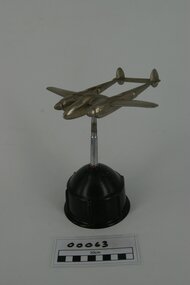
... The aircraft is supported by a central, chromed bullet vertically mounted on the bakelite base to form a stand. ...The aircraft is supported by a central, chromed bullet vertically mounted on the bakelite base to form a stand. ...Miniature model of a WW2 era Lockheed P-38 Lightning twin engine aircraft mounted on a bakelite base. The aircraft is supported by a central, chromed bullet vertically mounted on the bakelite base to form a stand. The plane and central support have been made from chromed metal materials. The RAAF was equipped with a small number of these aircraft, commencing in 1942, which were used for front line photographic reconnaissance duty. The first version of the Lockheed P-38 was introduced in 1941 by the USA Lockheed aircraft company as a heavy fighter.Nilplane, trench art, p-38, lightning, lockheed, lockheed lightning, souvenir -
 Frankston RSL Sub Branch
Trench Art
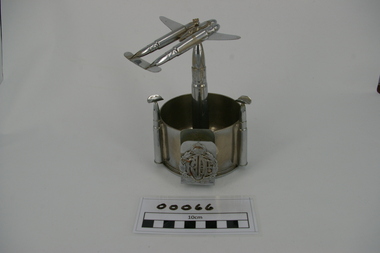
... The aircraft is supported by a 0.50 inch calibre bullet fixed to the inside of a section of an artillery case which forms the base. ...The aircraft is supported by a 0.50 inch calibre bullet fixed to the inside of a section of an artillery case which forms the base. ...Made by Cpl. Charlie Dawes 116777 R.A.A.F from parts got while serving at Goodenough and Thursday Isalnds WW2Miniature model of a WW2 era Lockheed P-38 Lightning twin engine aircraft mounted on a trench art ashtray made from various used munitions. This model was made during WW2 by Corporal Cyril 'Charlie' Dawes, RAAF service number 116777, from parts found whilst serving at Goodenough and Thursday Islands in the Torres Strait. The aircraft is supported by a 0.50 inch calibre bullet fixed to the inside of a section of an artillery case which forms the base. The base has three 0.303 inch calibre bullets attached vertically around the circumference and a metal matchbox holder with a RAAF hat badge insignia attached to the front. The items have been made from chromed metal materials. The RAAF was equipped with a small number of these aircraft, commencing in 1942, which were used for front line photographic reconnaissance duty. The first version of the Lockheed P-38 was introduced in 1941 by the USA Lockheed aircraft company as a heavy fighter.RAAF chrome cap badge (WW2 era with the kings crown)plane, trench art, ashtray -
 Lara RSL Sub Branch
Photograph, RAAF 1912 Deperdussin Aircraft
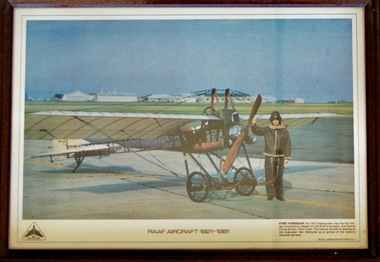
... In the early days of flying in France, Armand Deperdussin and his aircraft designer, M. Bechereau, formed the Societe Pour Appareils Deperdussin, and designed and produced Deperdussin monoplanes of advanced design for the period. ...In the early days of flying in France, Armand Deperdussin and his aircraft designer, M. Bechereau, formed the Societe Pour Appareils Deperdussin, and designed and produced Deperdussin monoplanes of advanced design for the period. ...In the early days of flying in France, Armand Deperdussin and his aircraft designer, M. Bechereau, formed the Societe Pour Appareils Deperdussin, and designed and produced Deperdussin monoplanes of advanced design for the period. In 1912, the Australian Government ordered from the British Deperdussin Aeroplane Company, two single-seat trainers, Type A with 35hp Anzani Y-type three cylinder engine. These two aircraft were in the first batch of four aircraft ordered by the Commonwealth Government (the other two aircraft were BE-type biplanes). The recorded cost of the Deperdussin was 480 pounds each. The serial number CFS 5 identifies this aircraft as the 5th Australian Military aircraft. It is the oldest existing Australian aircraft. either military or civilian. Rectangular shaped glass covered picture frame with photo of the plane and pilot.RAAF AIRCRAFT 1921-1981. FIRST FOREBEAR The 1912 Deperdussin was the first military monoplane ordered for the RAAFs ancestor, the Central Flying School, Point cook.This historic aircraft is retained at the Australian War Memorial as a symbol of the nation's airpower genesis.deperdussin monoplane, australian military aircraft, lara r.s.l. australian flying corps, 1912 aircraft. -
 Flagstaff Hill Maritime Museum and Village
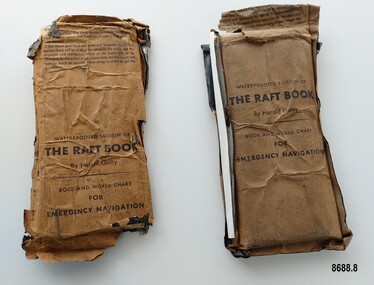
Booklet - Book and World Chart for Emergency Navigation, George Grady Press, The Raft Book, 1943
... Two early inventions of his were his air sextant and a ground speed and drift indicator which formed the basis of the automatic pilot which later came to be standard equipment on most aircraft. ...Two early inventions of his were his air sextant and a ground speed and drift indicator which formed the basis of the automatic pilot which later came to be standard equipment on most aircraft. ...Harold Gatty was born on January 5th, 1903 in Campbell Town, Tasmania. He was a navigator and aviation pioneer. He began his career learning navigation at the age of 14 as a midshipman at the Royal Australian Naval College but withdrew after three years and became an apprenticed ship's officer with the Patrick Steamship Company of Sydney. After W. W. 1 he joined the Australian Merchant Navy where he learned the constellations while standing night watch and became an expert in celestial navigation while serving on many ships sailing between Australia and California. In 1927 he moved to California and opened a navigation school and also a laboratory repairing navigational equipment. At this time he became very interested in air navigation and was aware of the limitations of existing methods and instruments for aerial navigation. He began researching ways of improving aerial navigation. Two early inventions of his were his air sextant and a ground speed and drift indicator which formed the basis of the automatic pilot which later came to be standard equipment on most aircraft. He worked with several record breaking pilots including Ann Morrow Lindbergh (who went on to serve as a navigator for her husband Charles Lindbergh), helped Wiley Post break the world record circumnavigating the Earth, invented a new method of "dead reckoning" that revolutionised the ability to fly safely through cloudy conditions without drifting off course and famously navigated a small plane (whilst trying to cross the Pacific) over 1900 km through fog (with no radio) and using only his dead reckoning techniques, back to their starting point in Japan after they developed fuel problems. In 1932 Gatty received the Distinguished Flying Cross from President Hoover. In 1934 Gatty formed the South Seas Commercial Company with Donald Douglas with the aim to deliver air services to the islands of the South Pacific. The Company was sold to Pan Am but he continued to work for them. In 1935 he went on a sailing expedition investigating several small islands in the South Pacific and was briefly marooned on Baker Island. He was able to use his extensive knowledge of seabird habits to save the crew. He was also very interested in the ability of the Polynesians to navigate using the stars. During the Second World War Gatty was given the honorary rank of Group Captain in the Royal Australian Air Force (RAAF) and worked for the U. S. Army Air Forces (USAAF) in the South Pacific. In 1943 he moved to Washington where he developed a survival book (The Raft Book) specifically for boat crews or air crews flying over the Pacific to help them survive and navigate their life rafts in remote areas of the ocean. The original book was 152 pages long however a condensed version was made which consisted of a 64 page booklet, combined map and star chart and calendar strip enclosed in a waterproof slipcase, to be placed in life rafts for emergency use. The booklet included navigational advice and ideas such as ocean currents, estimation of distance, using a compass, measurement of angles, recognising and steering by the stars, land indications from sea birds, migration of sea birds and insects, sounds from the land, the scent of the land and ocean currents and the colour of the sea etc. After W.W.2 Gatty moved to Fiji and formed Fiji Airways (which later became Air Pacific). Harold Gatty died in August 1957.The two copies of "The Raft Book" are significant as they are a written summary of the many methods of sea navigation (both modern and historical) that existed in the 1940's. They are also a record of Harold Gatty, who played a significant role in the development of modern day aerial navigation using his understanding of different sea navigational techniques.Two rectangular brown packets with waterproof coverings (oiled paper) titled "The Raft Book" by Harold Gatty. Each packet contains a folded 64 page paper booklet with detailed instructions for navigating a small craft in open seas, a folded chart (with a map of the world and oceans, well known constellations, latitude and longitude charts, Greenwich time and a scale for string lengths and Harp scale) and a long folded paper calendar strip.Front of package - "WATERPROOFED EDITION OF/ THE RAFT BOOK / By Harold Gatty / BOOK AND WORLD CHART / FOR / EMERGENCY NAVIGATION / To open envelope tear along above line. If the envelope is used again fold the flap to keep contents dry. 1. This envelope contains a book, chart and tape for emergency navigation. The contents are folded to take up the least possible space and therefore should not be removed until needed. 2. if the chart and tape are immersed in water for a long period, there will be a slight variation in the scale but the strength and resistence to tear of the paper will not be changed. In the event of long immersion, dry the chart and tape as much as possible before using in order to in order to get the greatest accuracy in scale. Front of booklet - THE RAFT BOOK / LORE OF THE SEA AND SKY /By Harold Gatty IMPORTANT FOR YOUR SECURITY/Upon abandoning ship you may have to be your own navigator. Take the following pre/cautions for your own safety:/ Carry a good type of pocket watch / keep it wound and have it running on Greenwich (England) / Time, which you can get from the navigating officer. / Keep track of the date at Greenwich; and on a 24-hour basis, / know whether the time is, say, 6 hours (6 A.M.) showing on / your watch, or 18 hours (6P.M.) Greenwich. / PROECT YOUR WATCH. GET A RUBBER SACK FOR IT (OBTAIN FROM PHARMACIST) AND KEEP IT DRY / KEEP A PENCIL IN YOUR POCKET/ POSITION OF SHIP WHEN ABANDONED PRINTED IN UNITED STATES OF AMERICA GEORGE GRADY PRESS, NEW YORK/COPYRIGHT, 1943, BY HAROLD AND FENNA GATTYflagstaff hill maritime museum and village, shipwreck coast, warrnambool, the raft book, harold gatty, book and world chart for emergency navigation, ww 2, ww ii, navigation, air navigation, aerial navigation, lindbergh, wiley post, dead reckoning, south seas commercial company, u.s. army airforce, usaaf, survival book, life rafts, sea navigation, emergency navigation, fiji airways, harp scale -
 Montmorency–Eltham RSL Sub Branch
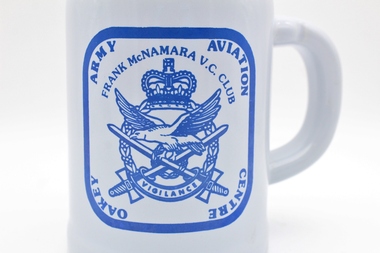
Memorabilia - Cup
... formed in October 1943 at Oakey, Queensland. It was built with the purpose of providing a maintenance facility: the units would erect, repair and insect aircrafts and engines. ...formed in October 1943 at Oakey, Queensland. It was built with the purpose of providing a maintenance facility: the units would erect, repair and insect aircrafts and engines. ...The Oakey Army Aviation Centre is a training facility formed in October 1943 at Oakey, Queensland. It was built with the purpose of providing a maintenance facility: the units would erect, repair and insect aircrafts and engines. At the end of the war in 1945, the depot was used to store surplus aircraft. In early 1946, the RAAF Station Oakey was disbanded and categorised ‘to be retained but not maintained’. Since then, the RAAF Station Oakey facilities have been used few times for some minor activities. Although there are no information relating to the owner or usage of the cup; it holds historic significance for its direct link with the Australian Army Aviation Centre in Oakey and its involvement in World War II; and more generally for its link to the Australian Army.Large white cup with a handle; decorated with a blue ink symbol (displaying a crown and below it, a bird handling two swords) and blue ink inscriptions (from the Army Aviation Centre Oakey). Inscription on top: 'Frank McNamara VC Club' Inscription at the bottom of the symbol: 'Vigilance' Inscription circling the symbol: 'Army Aviation Centre Oakey' -
 Montmorency–Eltham RSL Sub Branch
Model - Bristol Beaufighter (scale model)
... The aircraft depicted is a DAP MK 21 Beaufighter of 93 Squadron RAAF. The squadron formed in January 1945 and was disbanded in August 1946. ...The aircraft depicted is a DAP MK 21 Beaufighter of 93 Squadron RAAF. The squadron formed in January 1945 and was disbanded in August 1946. ...The aircraft depicted is a DAP MK 21 Beaufighter of 93 Squadron RAAF. The squadron formed in January 1945 and was disbanded in August 1946. It saw little combat in WW2.1/72 scale model of a Bristol Beaufighter Mk 21 as built by the Australian Dept of Aircraft Production in 1944.beaufighter -
 Flagstaff Hill Maritime Museum and Village
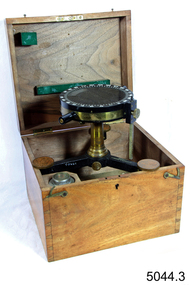
Instrument - Azimuth Compass, Early 20th Century
... aircraft which was patented in 1920. In 1946 the company went private and in 1948 the company was made public, and by 1950 Negretti and Zambra had 821 employees in Britain. In order to increase production and to safeguard future development in 1964, they purchased a modern factory at Aylesbury for all their production. In 1981 Negretti and Zambra were taken over by a group of financial institutions in the form...aircraft which was patented in 1920. In 1946 the company went private and in 1948 the company was made public, and by 1950 Negretti and Zambra had 821 employees in Britain. In order to increase production and to safeguard future development in 1964, they purchased a modern factory at Aylesbury for all their production. In 1981 Negretti and Zambra were taken over by a group of financial institutions in the form ...Negretti and Zambra 1850-1980s were optical instrument makers and mathematical instrument makers based in London, England. The firm of Negretti and Zambra was established in 1850 by Henry Negretti and Joseph Zambra who had formed a partnership. Their skill was immediately apparent when exhibiting at the 1851 Great Exhibition at Hyde Park, they were the only English instrument makers to receive a prize medal for meteorological instruments, resulting in their appointment as instrument makers to the queen, Greenwich observatory, and the British Meteorological Society. In 1853, when the Crystal Palace was re-erected in Sydenham, Negretti and Zambra became the official photographers of the Crystal Palace Company, which allowed them to photograph the interior and grounds of the new building. The firm made use of this access to produce a number of stereographs. Between 1855 and 1857 Negretti and Zambra commissioned photographer Pierre Rossier to travel to China to document the Second Opium War. Although Rossier subsequently was unable to accompany to Anglo-French forces in that campaign, he nevertheless produced a number of stereographs and other photographs of China, Japan, the Philippines and Siam (now Thailand), which Negretti and Zambra published and that represented the first commercial photographs of those countries. In 1856 Negretti and Zambra sponsored a photographic expedition to Egypt, Nubia and Ethiopia conducted by Francis Firth. In 1864 Negretti and Zambra (themselves) photographed Shakespeare's House at Stratford on Avon. A sepia photograph was then pasted onto card 4" × 2.5". This was then presented to visitors to the Crystal Palace to enable them to compare it with the model erected by Mr E. T. Parr in the Centre Transept. The card itself is headed "Crystal Palace April 23rd 1864." That year they also published a book, titled A Treatise on Meteorological Instruments, (which was reprinted in 1995). Throughout World War One Negretti and Zambra were entirely engaged in the production of various instruments for the Ministry of Munitions. They developed many instruments for the Air Ministry including a mercury-in-steel distance thermometer for taking the oil and air temperatures in aircraft which was patented in 1920. In 1946 the company went private and in 1948 the company was made public, and by 1950 Negretti and Zambra had 821 employees in Britain. In order to increase production and to safeguard future development in 1964, they purchased a modern factory at Aylesbury for all their production. In 1981 Negretti and Zambra were taken over by a group of financial institutions in the form of Western Scientific Instruments and in 1985 the company was acquired by Meggitt Holdings.The subject compass is just one type of the many marine and scientific, optical items this company produced over it’s life time. Negretti and Zambra were prolific manufactures of types of items as well as being very prominent in photography pioneering new innervation's and sponsoring expeditions to little known countries to document peoples daily lives and culture through photography.Azimuth compass on tripod in a fitted wooden box with a round spirit level included, lid of box has three indented circles where the legs of the compass fit when it is set up for use. Stamped "C.M.O. 9" on with Maker Negretti & Zambra London.flagstaff hill, warrnambool, flagstaff-hill, flagstaff-hill-maritime-museum, shipwreck-coast, flagstaff-hill-maritime-village, azimuth compass, nautical instrument, negretti & zambra london, navigational instrument, compass -
 Orbost & District Historical Society
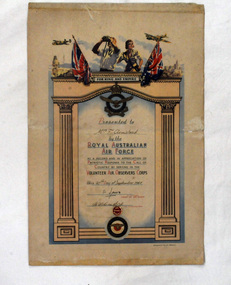
certificate, 1945
... The Volunteer Air Observers Corps was an Australian air defence organisation of World War II.It was formed on 31 December 1941 to support the Royal Australian Air Force by sighting and observing aircraft over Australia.It swiftly established observation posts across Australia and provided information to the RAAF's regional air control posts. ...The Volunteer Air Observers Corps was an Australian air defence organisation of World War II.It was formed on 31 December 1941 to support the Royal Australian Air Force by sighting and observing aircraft over Australia.It swiftly established observation posts across Australia and provided information to the RAAF's regional air control posts. ...The Volunteer Air Observers Corps was an Australian air defence organisation of World War II.It was formed on 31 December 1941 to support the Royal Australian Air Force by sighting and observing aircraft over Australia.It swiftly established observation posts across Australia and provided information to the RAAF's regional air control posts. As the threat to Australia declined its role was expanded to include coast watching, assisting air traffic control and weather reporting. The corps was staffed by civilian volunteers and reached a peak strength of 24,000 personnel and 2,656 observation posts in 1944. After the end of the war the VAOC was reduced to a cadre in December 1945 and was disbanded on 10 April 1946. The Volunteer Air Observers Corps was an Australian air defence organisation of World War II. This certificate is a record of the participation of members of the Orbost district. Anita Armistead, wife of Francis Armistead had a son, Sydney, who served as a gunner in Malaysia during WW11.A certificate of service awarded to Mrs F. Armistead for being a volunteer in the Air Observers Corps. It was awarded on 20 Sept, 1945 for one year's service.For King and Empire Presented to Mrs F. Armistead by the ROYAL AUSTRALIAN AIR FORCE As a record and in appreciation of patriotic response to the call of country by serving in the VOLUNTEER AIR OBSERVERS CORPS This 20th day of September 1945 signed G. Jones Air Vice Marshall Chief of Air Staff signed ? Unit Commanding Officercertificate ww11 air-observers-corps -
 Bendigo Military Museum
Photograph - RA Svy Project C4 Aerodist Operation, Eastern & Western Arnhem Land, NT, 1967, 1968
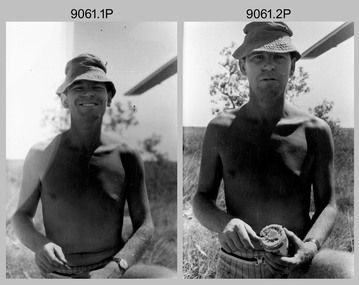
... aircraft as an intermediate station. Lower order geodetic results could be achieved by survey network trilateration. The measured distances between stations formed survey networks from which each station’s latitude and longitude was computed. ...aircraft as an intermediate station. Lower order geodetic results could be achieved by survey network trilateration. The measured distances between stations formed survey networks from which each station’s latitude and longitude was computed. ...This is a set of 26 photographs of Royal Australian Survey Corps (RA Svy) personnel from Central Comd Fd Svy Unit (Adelaide) on Aerodist survey operation - Project C4 in Eastern Arnhem Land, Northern Territory in 1967 (photos .4P to .26P) and in Western Arnhem Land, Northern Territory in 1968 (photos .1P to .3P). Photos of personnel were taken either at the operations base at Numbulwar or the main base at Gove (Nhulunbuy). RA Svy conducted nineteen Aerodist operations for 12 years from 1964 to 1975. Aerodist MRC2 was a tellurometer-based system adapted for aircraft to accurately measure distances between non-intervisible ground survey stations, using the aircraft as an intermediate station. Lower order geodetic results could be achieved by survey network trilateration. The measured distances between stations formed survey networks from which each station’s latitude and longitude was computed. Aerodist MRC2 was RA Svy’s major horizontal control survey tool for mainly medium scale topographic mapping (scale 1:100,000 Class A being spatially accurate to within 50 metres) in PNG, northern NT, north-west WA, Kalimantan Barat (West) Indonesia, Sumatra Indonesia, Gulf of Carpentaria and Cape York, QLD. In 1967, the Aerodist MRC2 Master equipment was installed in the aircraft featured in this set of photos, Executive Air Services’ (Essendon VIC) Grand Aero Commander VH-EXX. It was the same aircraft type and company contracted to Division of National Mapping for Aerodist MRC2 surveys. From July to October 1967 the aircraft was attached to Central Comd Fd Svy Unit (Adelaide - Major Don Ridge) on Project C4 eastern-Arnhem Land NT, where 317 Aerodist lines measuring 17,300 line miles were successfully completed. This was the most productive Aerodist project thus far. The most common helicopter used by RA Svy up to 1972 was the civilian Bell 47G-2 and the Sioux Light Observation Helicopters (LOH), the Australian Army’s equivalent featured in this photo set. These light observation helicopters had a limiting load carrying capacity of up to about 500 pounds. By comparison, one Aerodist team including two people weighed up to 1,500 pounds. In 1968, after completion of the Kimberley Aerodist Operation project, the Aerodist system in VH-EXX was immediately deployed to western-Arnhem Land NT for Central Comd Fd Svy Unit (Adelaide - Major Don Ridge) to complete the mapping control across northern NT from mid-July to October. The Aerodist MRC2 Remote antenna seen in Photos .24P to .26P is mounted on a 20 foot pole tower. The antenna direction was controlled by wires/ropes to the two arms under the dish at right angles. The antenna elevation could be changed to the vertical for aircraft height checks as seen in photo .25P. Source: Royal Australian Survey Corps – Aerodist Years 1964-1975 by Peter Jensen. Refer to Item 6449.30P for more photos taken during these Aerodist survey operations.This is a set of 26 photographs of Royal Australian Survey Corps (RA Svy) personnel on Aerodist survey operations in Eastern Arnhem Land, Northern Territory in 1967 and Western Arnhem Land, Northern Territory in 1968. The photographs are on 35mm negative film and scanned at 96 dpi. They are part of the Army Survey Regiment’s Collection. .1) to .2) – Photo, black & white, 1968, unidentified soldier with an opened can of food, possibly bully beef. .3) – Photo, black & white, 15 Aug 1968, aerial view of terrain taken from a helicopter in vicinity of MILINGIMBI SIERRA. .4) – Photo, black & white, 1967, aerial view of an island taken from a helicopter. .5) & .6) – Photo, black & white, 1967, unidentified soldier driving a Haflinger 4x4 Light utility vehicle with trailer. .7) – Photo, black & white, 1967, unidentified surveyors taking vertical measurements with a leveling instrument and staff. .8) – Photo, black & white, 1967, Australian Army Sioux Light Observation Helicopter (LOH) with float removed. .9) to .11) – Photo, black & white, 1967, Australian Army Sioux Light Observation Helicopter (LOH) with floats. .12) – Photo, black & white, 1967, civilian Bell 47G-2 helicopter (Australian Army Sioux LOH equivalent) refuelled. .13) – Photo, black & white, 1967, survey station on coastline surrounded by white plastic aerial photographic identification panels lined with rocks. .14) & .15) – Photo, black & white, 1967, soldier (possibly a signaller from RA Sigs) operating a radio. .16) – Photo, black & white, 1967, Central Comd Fd Svy Unit Operations Section tent, Main Base Gove (Nhulunbuy) L to R: SPR Harry Dunn, WO1 Pat Wood BEM. .17) – Photo, black & white, 1967, Central Comd Fd Svy Unit Operations Section tent, Main Base Gove (Nhulunbuy) L to R: unidentified, WO1 Pat Wood BEM. .18) – Photo, black & white, 1967, Central Comd Fd Svy Unit Operations Section, Main Base Gove (Nhulunbuy), unidentified Australian Army Catering Corps cook preparing meals. .19) – Photo, black & white, 1967, Central Comd Fd Svy Unit Operations Section, Main Base Gove (Nhulunbuy) mess tent in readiness for meals. .20) – Photo, black & white, 1967, Bank of batteries in transit boxes undergoing recharging using generators. .21) – Photo, black & white, 1967, A topographic survey identification plaque set in a concrete block being weighed using a set of scales hanging from slaughtering gallows. .22) – Photo, black & white, 1967, CPL (Geoff or Gary) Larkin operating the remote Aerodist MRC2 ground instrument at Veronica Island, located north of Nhulunbuy. .23) – Photo, black & white, 1967, L to R: CPL (Geoff or Gary) Larkin with unidentified surveyor operate the remote Aerodist MRC2 ground instrument at Venica Island, located north of Nhulunbuy. .24) & .25 – Photo, black & white, 1967, The Aerodist MRC2 Remote antenna. .26) – Photo, black & white, 1967, The Aerodist MRC2 Remote antenna.The following photos are annotated in black ink on edge of film negative: .3P – ’15 Aug ’68, 2000’, 1-C18 ’68 MILINGIMBI SIERRA’ .4P – ’U462’ .8P – ‘1-C3/67 Float Removed’ .13P – ‘U477 10-C3/67 .20P - ‘2-C3/67 Bank of Chargers’ .21P - ‘3-C3/67 Gallows & Scales’ .22P - ‘0462 VERONICA ISLAND NT, CPL Larkin’ .23P - ‘0462 VERONICA ISLAND NT’ .24P - ‘4-C3/67 20’ Aerodist Tower’ .25P - ‘5-C3/67 20’ Aerodist Tower’ .26P - ‘6-C3/67 20’ Aerodist Tower’royal australian survey corps, rasvy, army survey regiment, army svy regt, fortuna, asr, aerodist, surveying, central comd fd svy unit -
 Bendigo Military Museum
Manual - MOVEMENT PLANNING HANDOUT, Australian Army
... form of shield. On top is a banner with words "Army School of. At the bottom is the word "Transport". It has approx 44 pages of black and white photos and specifications of equipment. i.e. Aircraft...form of shield. On top is a banner with words "Army School of. At the bottom is the word "Transport". It has approx 44 pages of black and white photos and specifications of equipment. i.e. Aircraft ...This is a book made by Army School of Transport. The cover is a thin cardboard, coloured brown. Printing is in black ink. In the centre is a form of shield. On top is a banner with words "Army School of. At the bottom is the word "Transport". It has approx 44 pages of black and white photos and specifications of equipment. i.e. Aircraft, Trucks, APC road rovers, Trailers, Tractors, Graders, Water Craft etc.passchendaele barracks trust, transport, planning, equipment specs -
 Bendigo Military Museum
Document - LOGBOOK, RAAF Log Book, 6.1938
... Form P/P 138 SECRET RAAF Observer's, Air Gunner's and W/T Operators Flying Log Book. Blue buckram cover, black print. Rear of the book has remnants of an aviation article used as a cover, coloured picture. Inside is flying data ie dates, aircraft ...Item relates to Arthur Thomas MANLY No 431130 RAAF. Refer Cat No 3710 for his service details.RAAF Observer's, Air Gunner's and W/T Operators Flying Log Book. Blue buckram cover, black print. Rear of the book has remnants of an aviation article used as a cover, coloured picture. Inside is flying data ie dates, aircraft number, pilot of A/C, duty, flying hours, remarks (includes patrols & action).Handwritten bottom front in black ink: Name: MANLY. A T Glued inside: 1 page summary of his operational tour RAAF Form P/P 138 SECRETdocuments, ww2, raaf -
 Waverley RSL Sub Branch
Plaque 4 Sqn.R.A.A.F. Hospital, R.A.A.F. Hospital
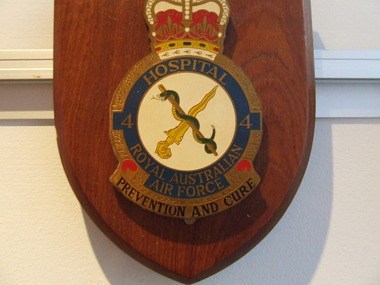
... formed at Point Cook, Victoria, in October 1916. After embarking for England to complete its training, the squadron deployed to France in December 1917. From the outset, No 4 Squadron aircraft...formed at Point Cook, Victoria, in October 1916. After embarking for England to complete its training, the squadron deployed to France in December 1917. From the outset, No 4 Squadron aircraft ...No 4 Squadron, Australian Flying Corps, formed at Point Cook, Victoria, in October 1916. After embarking for England to complete its training, the squadron deployed to France in December 1917. From the outset, No 4 Squadron aircraft regularly engaged the Red Baron's elite 'Flying Circus' and, in spite of their lack of experience, quickly gained the ascendancy over the German squadron. During its brief war service, No 4 Squadron destroyed some 128 enemy aircraft and spawned a total of eleven aces. The squadron's highest scoring airman was Captain Cobby who, in addition to shooting down 29 aircraft, also destroyed 13 observation balloons. World War II saw No 4 Squadron Wirraways deployed to Port Moresby in support of Australian troops fighting in the New Guinea jungles. In their slow and vulnerable aircraft, losses from anti-aircraft fire were high, however, this never deterred the Wirraway crews from completing their assigned tasks. This aggressive spirit was exemplified by Pilot Officer Archer and his crewman, Sergeant Coulston, who, while on a reconnaissance mission, found themselves above a Japanese Zero fighter. Despite operating a vastly inferior aircraft, Pilot Officer Archer dived to the attack and shot down the enemy aircraft. In June 1943, No 4 Squadron received its first Boomerang fighters and continued to support Allied troops during the Cape Gloucester landings before moving to Morotai. No 4 Squadron ended the war in Borneo and returned to Australia in November 1945, where it was renamed No 3 Squadron - thus closing the chapter on a very distinguished and proud unit. Summary of Unit Name(s) Start Date End Date No. 4 RAAF Hospital, Butterworth 06/06/1966 06/06/1966 No. 4 RAAF Hospital, Butterworth 03/07/1966 No. 4 RAAF Hospital, Butterworth 01/08/1966 01/08/1966 No. 4 RAAF Hospital, Butterworth 05/09/1966 No. 4 RAAF Hospital, Butterworth 29/09/1966 No. 4 RAAF Hospital, Butterworth 29/10/1966 29/10/1966 http://www.airforce.gov.au/raafmuseum/research/units/4sqn.htmWooden Plaque 15cm x 13cm with insignia of 4 Sqn.R.A.A.F. Hospital 4 Sqn R.A.A.F. Hospital r.a.a.f. 4 squadron, butterworth, r.a.a.f. hospital -
 Bendigo Military Museum
Equipment - PROPELLER, Test Propeller for Aircraft engine
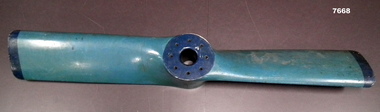
... aircraft. It is painted blue with birch tips. It has a large centre hole of 8 cm diameter. It has 8 bolt holes of 18 mm diameter. The propeller tips are squared (ie not tapered). One side of the blades have an aeronautical curved form...aircraft. It is painted blue with birch tips. It has a large centre hole of 8 cm diameter. It has 8 bolt holes of 18 mm diameter. The propeller tips are squared (ie not tapered). One side of the blades have an aeronautical curved form ...This was used as a dummy propeller when test running aircraft engines.This is a heavy wooden propeller for an aircraft. It is painted blue with birch tips. It has a large centre hole of 8 cm diameter. It has 8 bolt holes of 18 mm diameter. The propeller tips are squared (ie not tapered). One side of the blades have an aeronautical curved form.aircraft maintenance, propeller -
 Bendigo Military Museum
Book - LOG BOOK, RAAF, RAAF, Aircraft W/T Log, 1938
... Form A72 (June 1938). Wireless Operators W/T Log Book for use in enclosed cockpits. Ruled inside with similar headings. Plain khaki front cover with black print. Aircraft ...RAAF Form A72 (June 1938). Wireless Operators W/T Log Book for use in enclosed cockpits. Ruled inside with similar headings. Plain khaki front cover with black print.Handwritten front cover: “G W A MARRIOTT KYABRAM’ Handwritten Inside: Pencil written texts.military history - records, documents - military, w/t training, raaf -
 Bendigo Military Museum
Document - LOG BOOK, FLYING, RAAF, 1942
... Form A.18. Inside are a large number of pages covering such subjects as; Pilot Certification, Aircraft flown, Hours, Locations. ...Form A.18. Inside are a large number of pages covering such subjects as; Pilot Certification, Aircraft flown, Hours, Locations. ...Ronald Leslie Schorey Dickinson RAAF No 439212. He initially enlisted as a RAAF Cadet age 16 years on 27.2.1942, Cpl 17.11.1942, Sgt 17.6.1943, S/Sgt 8.10.1943. At age 18 he enlists on 29.2.1944 with the rank A/C 2 and soon with the rank LAC (leading Aircraftsman). He is posted to places like Geraldton & Kalgoorlie WA, Benalla & Tocumwal VIC. From 23.9.1945 he is listed with postings at 54 Mile NT, Darwin in two different units, Winellie and Ransford. He is discharged with the rank of LAC on 20.5.1946. Records are hard to follow but it appears he could have been Aircrew as an LAC. Refer also Cat No 7263PThis is a hard cover book. The colour of the front cover is a purplish hue. The spine has a blue buckram binding. It was Airforce Form A.18. Inside are a large number of pages covering such subjects as; Pilot Certification, Aircraft flown, Hours, Locations. Dates - range from 1944-2017. Possibly some pages are missing. 1942 - 1944. It has records for RAAF Flying and Civilian Flying Post WW2.Written on bottom of book pages is name "DICKINSON R.L.S.raaf, flying log -
Frankston RSL Sub Branch
Collection, J R Clancy
... Aircraft Regiment. Municipalities in Australia recognised their residents who enlisted in World Wars by the issue of some form of recognition. ...The recipient of this medal is believed to be VX44669 Private James Robert Clancy of Thougla Upper which was in the Shire of Upper Murray. Private Clancy was born in Sandy Creek on 30 August 1903 enlisted in the Army on 8 July 1940 and was discharged on 8 March 1943. He served in the Signals Section of the 2nd Australian Anti-Aircraft Regiment.Municipalities in Australia recognised their residents who enlisted in World Wars by the issue of some form of recognition. This is a nice example of a medallic form of such recognition.A collection of items presented by the family of WWll Australian Army serviceman James Robert Clancy VX44669. Clancy was a signalman in the 2/2 Heavy Anti-Aircraft Regiment. Refer to items 00456.1, 00456.2, 00456.3 and 00456.4.
