
Showing 143 items matching "foster family"
-
 Whitehorse Historical Society Inc.
Document, Brain Family, 2001
... ...Foster Family...Brain Family Brain Reginald N Brain George Brain Donald Nielson Moore Family Foster Family Harrison Family Documents relating to the family history of the Brain family of Blackburn. ...Documents relating to the family history of the Brain family of Blackburn.Documents relating to the family history of the Brain family of Blackburn. Includes register reports, photos, certificates and articles.Documents relating to the family history of the Brain family of Blackburn. brain family, brain, reginald n, brain, george, brain, donald nielson, moore family, foster family, harrison family -
 Greensborough Historical Society
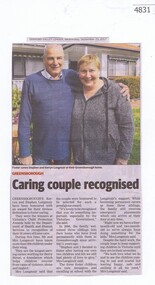
Newspaper Clipping, Diamond Valley Leader, Caring couple recognised, 20/09/2017
... ...longmuir family...foster...Greensborough's Kerryn and Stephen Longmuir have been honoured with an award for their tireless dedication to foster caring. greensborough victoria's child protection award longmuir family foster care News article 1 page, black text, colour image. ...Greensborough's Kerryn and Stephen Longmuir have been honoured with an award for their tireless dedication to foster caring.News article 1 page, black text, colour image.greensborough, victoria's child protection award, longmuir family, foster care -
 Bendigo Historical Society Inc.
Photograph - FOSTER AND WILSON COLLECTION: PHOTOGRAPH
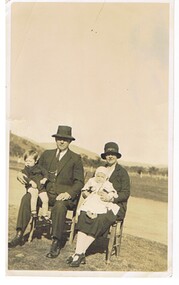
... ...family...Foster...PHOTOGRAPH Portrait family Foster & Wilson Collection Photograph Sepia photograph of a family. ...Sepia photograph of a family. The mother & father are sitting on wooden chairs. The father is wearing a three piece suit and watch chain and has a young boy on his knee. The mother is wearing a dark dress, below knee length, and hat. She is holding a baby. Written on the back: Dear Kath & Harry, How are you all down there. All are well here. Am sending you a photo of the family group. Hoping all are well. Love from Nell.photograph, portrait, family, foster & wilson collection, photograph -
 Bendigo Historical Society Inc.
Photograph - FOSTER AND WILSON COLLECTION: PHOTOGRAPHS
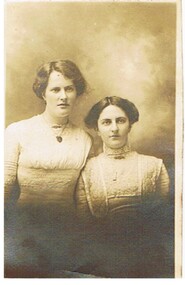
... ...family...Foster...PERSON Family family Foster & Wilson Collection Photograph Shaped, brown wooden picture frame with rectangular picture in the centre and an oval one on each side of it. ...Shaped, brown wooden picture frame with rectangular picture in the centre and an oval one on each side of it. At each end are carved wooden gumnuts which have been glued on. Some pieces are missing. The left photo is a sepia, waist high portrait of two young women. Both are wearing lacy type dresses with high necklines. One is wearing a locket? and the other a brooch. The centre photo is a young woman sitting at a window. She is wearing a lacy type dress and a bracelet on her right arm and also a ring. There are some flowers in a vase and on her lap. The photo on the right is of an older woman wearing a dark embroidered high neck dress with a white frill collar. She has a brooch at the neckline. Also a waist high portrait.person, family, family, foster & wilson collection, photograph -
Glen Eira Historical Society
Document - Laundries
... Foster Street... Campbell Family...Elsternwick Economy Laundry Point Nepean Road Presbyterian Church Orphanages Regent Lodge St John’s Presbyterian Church Glen Huntly Road Foster Street Campbell Family Bristol Carnegie Collis M Mrs Glen Eira Road Cutland E Mrs 'Kennington' Riddell Parade 'Kooyong' 'Primrose' Martin Street Wadekin A Mrs Murrumbeena Road Murrumbeena 'Waverly' Hawthorn Road Caulfield North Paynting Harold Rosstown Road Gardenvale Road Glen Eira Road Caulfield Elsternwick Girls' Home Regent Street Presbyterian Womens Mission Union Recipe books Document Laundries ...Newspaper cutting of workers at the Economy Laundry in Elsternwick, 1938, source unknown, taken by Harold Paynting. Typed recollections by Felicity Campbell dated 02/04/2007 and further research by Claire Barton from SANDS AND MCDOUGAL’S 1942 edition, dated 02/07/2013, noting other boundaries in Caulfield municipality.elsternwick, economy laundry, point nepean road, presbyterian church, orphanages, regent lodge, st john’s presbyterian church, glen huntly road, foster street, campbell family, bristol, carnegie, collis m mrs, glen eira road, cutland e mrs, 'kennington', riddell parade, 'kooyong', 'primrose', martin street, wadekin a mrs, murrumbeena road, murrumbeena, 'waverly', hawthorn road, caulfield north, paynting harold, rosstown road, gardenvale road, glen eira road, caulfield, elsternwick girls' home, regent street, presbyterian womens mission union, recipe books -
Whitehorse Historical Society Inc.
Document, Mrs Aumann of Junction Road, Blackburn North, 15/01/1986
... Family...White (Mrs)...Sommerscales (Mr)...Foster...Aumann Family Junction Road Blackburn North Ander Les Croft Family Mitchell Family Kendall Family White (Mrs) Sommerscales (Mr) Foster Charlie Barnes Family Le Gerche Family Platt Family Eriksson Edgar Breusch Bert Closter Charlie Mrs Aumann speaks to Keith Rooney and tells that her husband purchased the property in 1920 paying 500 ponds for 10 acres. ...Mrs Aumann speaks to Keith Rooney and tells that her husband purchased the property in 1920 paying 500 ponds for 10 acres. They grew apples, pears and peaches, also she remembers neighbours properties.aumann family, junction road, blackburn north, ander, les, croft family, mitchell family, kendall family, white (mrs), sommerscales (mr), foster, charlie, barnes family, le gerche family, platt family, eriksson, edgar, breusch, bert, closter, charlie -
Whitehorse Historical Society Inc.
Article, Vermont Primary School, 1/03/1936 12:00:00 AM
... ...Foster sisters...Brown Family...Fairbank Bob Matters John Foster sisters Brown Family Brown Jane Brown Lizzie Brown Annie Brown Nellie Letter To The Editor of 'The Age' - Vermont School, 1885. ...Letter To The Editor of 'The Age' - Vermont School, 1885.Letter To The Editor of 'The Age' - Vermont School, 1885. With photo.|Note- Worksheet and actual item missing. 28 May 2002. P.S.Letter To The Editor of 'The Age' - Vermont School, 1885. primary schools, vermont primary school no. 1022, brown, john, tymms, nellie, mcclair, bessie, course, martha, madden sisters, stutely, bella, kemp, sarah, fairbank, l., bishop brothers, foster, cyril, clifford, b., fairbank, bob, matters, john, foster sisters, brown family, brown, jane, brown, lizzie, brown, annie, brown, nellie -
 Ballarat Tramway Museum
Negative - SECV Bsllarat trams 20 & 30 in Main St, Wal Jack, 27/12/1962
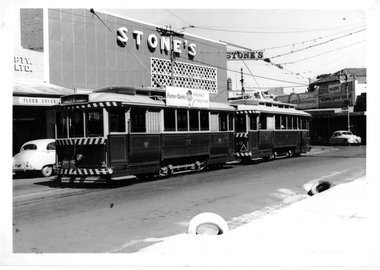
... No. 20 has a roof advertisement for "Foster Clark's family foods" See image i2 for rear of photograph. ...No. 20 has a roof advertisement for "Foster Clark's family foods" See image i2 for rear of photograph. ...Photograph of trams No. 20 and 30 in Main St, Ballarat with the Stones building in the background. Both trams are heading into the city. 27-12-1961. In the background is the Verna Cake Shop. No. 20 has a roof advertisement for "Foster Clark's family foods" See image i2 for rear of photograph. See image i3 for hi res scan of print. See image i4 for hi res scan of negativeYields information about the appearance of Stones corner and trams in the early 1960'sNegative and Digital image from the Wal Jack Ballarat Album On rear of photograph in ink "SEC, Ballarat Nos. 20 and 30 in Main St Ballarat East (9.10am), 27-12-61" and Wal Jack stamp in top right hand corner with number "T1238" written in.trams, tramways, main st, stones corner, tram 20, tram 30 -
 Melbourne Tram Museum
Photograph - Set of two Black & White Photograph/s, 1950's? to 1960's
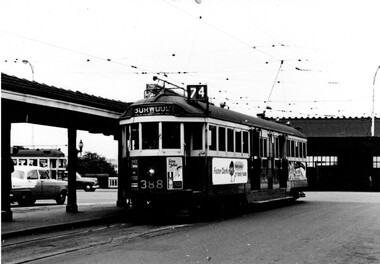
... Has adverts for Long John whiskey, Apex Ford, and Foster Clarks family food. .2 - W2 337 just after arrival with the conductor about to raise the pole front pole. ...Has adverts for Long John whiskey, Apex Ford, and Foster Clarks family food. .2 - W2 337 just after arrival with the conductor about to raise the pole front pole. ...Black and white photograph of W2 's at the Batman Ave terminus late 1950's to early 1960's. .1 - W2 388 with destination of Burwood, route 74 with Flinders St station Swanston St awning in the background. Has adverts for Long John whiskey, Apex Ford, and Foster Clarks family food. .2 - W2 337 just after arrival with the conductor about to raise the pole front pole. Has passengers leave and boarding the tram from across the roadway. Showing route 76. Has advert on the drivers panel for Remy Martin Brandy. Printed on Fujichrome paper. Not known who took the photograph or when it was printed.Stamped in black ink on back "TMSV Sales"trams, tramways, batman ave, conductors, burwood, tram 388, tram 337 -
 Bendigo Historical Society Inc.
Newspaper - Bendigo Advertiser Article - Rowing for 150 years, Sat 04 June 2022
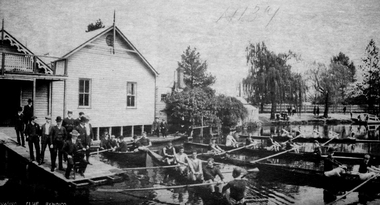
... The club emphasizes inclusivity, welcoming juniors, women, men, and masters, and fostering a family-friendly, socially responsible culture.The ethos of volunteerism and community connection is central to the club's identity and future aspirations. ...The club emphasizes inclusivity, welcoming juniors, women, men, and masters, and fostering a family-friendly, socially responsible culture.The ethos of volunteerism and community connection is central to the club's identity and future aspirations. ...Rowing was introduced to Bendigo in 1872 by John Godfrey, who built the first wooden skiff and promoted the sport locally. The Sandhurst and Bendigo Rowing Clubs were formed in 1873, with Lake Weeroona's creation in 1879 providing a permanent home for the club. BRC members have competed nationally and internationally, including at the Commonwealth and Olympic Games. Notable achievements include women from Bendigo winning the Henley on the Maribyrnong three years in a row during the 1930s, challenging gender norms in sport. Key athletes such as Hannah Every-Hall and Neville Howell have played significant roles in the club's development and reputation. The club emphasizes inclusivity, welcoming juniors, women, men, and masters, and fostering a family-friendly, socially responsible culture.The ethos of volunteerism and community connection is central to the club's identity and future aspirations. The club has survived challenges such as droughts, wars, and the COVID-19 pandemic, consistently adapting and continuing its activities. Physical mementos and historical relics are preserved and celebrated, especially during milestone events like the 150th anniversary. 1872 the First skiff built and rowing demonstrated in Bendigo.1879: Lake Weeroona created.1927: Club officially named Bendigo Rowing Club.1969: Revitalization led by Olympic gold medallist Neville Howell.1992: Jason Day represents Australia at the Barcelona Olympics.2012: Hannah Every-Hall competes at the London Olympics.2022: 150th anniversary celebration.Bendigo Advertiser Article - Rowing for 150 years, Sat 04 June 2022, by Anthony Pinder This item contains the following documents: 3486.61a Colour photo of current Bendigo Rowing Club President Lynda Davis and Jesse Sherwood in the club rooms 3486.61b Colour photo of four members in a kayak 3486.61c Colour photo of Livia Rosaia exercising 3486.61d Black and white photo of the Bendigo Rowers in 1905 at the old sheds which were situated at the Nolan St end of Lake Weeroona 3486.61e Bendigo Advertiser Article - Rowing for 150 years bendigo, bendigo rowing club, john godfrey, lake weeroona -
 Sunshine and District Historical Society Incorporated
Newsletter - Sunshine City Council Residential Newsletter Reports, Sunshine City Council, (i) December 1988 (2) July 1990
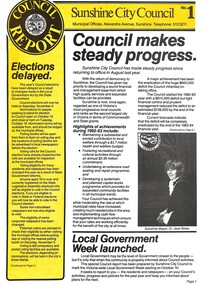
... Council Report No 14 Headings July 1999|Council Electrions in August|West Sunshine Community Centre|Waste Paper Pick Ups End|Other Recycling News|Marie Mill Community Centre|Location of Polling Places|Family services|Foster Care|Family Support|Emergency Crisis Assistance| Financial counselling|Family Counselling|Vice Regal Visit to Sunshine|Out of School Hours Programs|About the Library|The Hunt Club community Centre|Leisure and Swimming Centrews|Labour Market Programs...Council Report No 14 Headings July 1999|Council Electrions in August|West Sunshine Community Centre|Waste Paper Pick Ups End|Other Recycling News|Marie Mill Community Centre|Location of Polling Places|Family services|Foster Care|Family Support|Emergency Crisis Assistance| Financial counselling|Family Counselling|Vice Regal Visit to Sunshine|Out of School Hours Programs|About the Library|The Hunt Club community Centre|Leisure and Swimming Centrews|Labour Market Programs Collection of Sunshine City Council Reports that were distributed to residents Newsletter Sunshine City Council Residential Newsletter Reports Sunshine City Council ...Distributed to residents and rate payersSunshine City Council. Council Report No 12 Headings December 1988|A message from your Mayor Ian Mill|Making millions from Sunshines garbage|Tip tickets|Use Proper garbage bins|Waster Paper pickup service|Council acts to minimise hardship on rates|Sunshines Management Team|$1.5 million for Nursing Home|Sunshine District Centre will boost Commerce|Government Grants|Hunt Club lives againFree help in Family Planning|August Election results|Mayor and Mayoress meet the Pope|Mayor meets Asian delegates|Librays new computer linkup gives better cheaper service|Council services in the holidays|A new Fitness Centre free to use anytime|Sunshines Sports Calendar Girls|Sunshines Own Postcard|Sunshine City Council. Council Report No 14 Headings July 1999|Council Electrions in August|West Sunshine Community Centre|Waste Paper Pick Ups End|Other Recycling News|Marie Mill Community Centre|Location of Polling Places|Family services|Foster Care|Family Support|Emergency Crisis Assistance| Financial counselling|Family Counselling|Vice Regal Visit to Sunshine|Out of School Hours Programs|About the Library|The Hunt Club community Centre|Leisure and Swimming Centrews|Labour Market Programssunshine city council -
 Broadmeadows Historical Society & Museum
Photograph - Group Photograph, Picnic Under the Pavilion, 1990
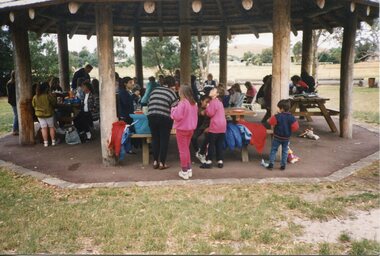
... families, and staff gathered under a wooden pavilion, engaging in festive activities that marked the end of the school year. Jacana Primary School was established in 1959 to serve the growing suburban community of Jacana, part of Melbourne’s post-war urban expansion. The school became a central institution in the area, not only for education but also for fostering...families, and staff gathered under a wooden pavilion, engaging in festive activities that marked the end of the school year. Jacana Primary School was established in 1959 to serve the growing suburban community of Jacana, part of Melbourne’s post-war urban expansion. The school became a central institution in the area, not only for education but also for fostering ...This photograph documents a moment from the 1990 Jacana Primary School Christmas picnic, likely held at Greenvale Reservoir Park, a popular recreational area in Melbourne’s northern suburbs. The image shows students, families, and staff gathered under a wooden pavilion, engaging in festive activities that marked the end of the school year. Jacana Primary School was established in 1959 to serve the growing suburban community of Jacana, part of Melbourne’s post-war urban expansion. The school became a central institution in the area, not only for education but also for fostering social bonds among families from diverse backgrounds. Annual events like the Christmas picnic were key to the school’s ethos, promoting inclusivity, celebration, and connection to nature. Greenvale Reservoir Park, where the picnic was likely held, offered a scenic and accessible venue for such gatherings. Its open spaces and family-friendly amenities made it an ideal location for school events, reinforcing the school’s commitment to outdoor learning and community engagement. The photograph is historically significant as it reflects broader trends in public education during the late 20th century in Melbourne’s outer suburbs—particularly the role of schools in building community identity and supporting intergenerational relationships. It also captures the spirit of Jacana Primary School before its closure in the early 2000s, preserving a visual memory of its contribution to local life.This photograph, taken during the 1990 Jacana Primary School Christmas picnic at Greenvale Reservoir Park, holds cultural and historical significance as a visual record of community life and educational values in Melbourne’s northern suburbs during the late 20th century. It captures a moment of joyful gathering under a wooden pavilion, where students, families, and staff came together to celebrate the end of the school year. Jacana Primary School, established in 1959, served as a cornerstone of the Jacana community until its closure in the early 2000s. Events such as the annual Christmas picnic were central to the school’s identity, fostering inclusiveness, friendship, and a strong sense of belonging. The choice of Greenvale Reservoir Park reflects the school’s connection to local landscapes and its commitment to accessible, outdoor learning experiences. The image is significant not only for its depiction of school traditions but also for its broader representation of how public education in Melbourne’s outer suburbs supported social cohesion, local identity, and intergenerational connection. It stands as a testament to the enduring values of joy, community, and inclusivity that defined Jacana Primary School and its legacy within the region.Photograph on glossy paper of a group children in the park.PH18289 (crossed out) PH-4209 (crossed out) PH-4868jacana primary school, christmas picnic, 1990, jacana, christmas party -
 Sunshine and District Historical Society Incorporated
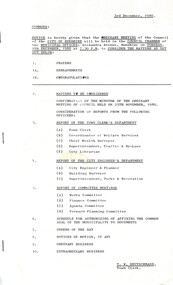
Administrative record - City of Sunshine - Commissioner Mr Alexander Alex George Gillon Collection 1976 - 1982 - Notice of ordinary meeting of the council 9th December 1980, City of Sunshine, 3rd December 1980
... Johns College Report of Rainbow Workshop Supplementary Valuations Land Transfer 88 Station Road Deer Park Sunshine Swimming Pool Learners Pool Heating Golf Course South Side of Maribyrnong River Proposed Link with the Essendon Golf Course Sealing of General Rate Year Ending 30th September 1980 Date of Ordinary Meetings of Council Report of the Co-Ordinator of Welfare Services Purchase of Land Randall Street Maribyrnong Funding for Teenage Holiday Programmes Emergency Foster Care Family Day Care Local Youth Affairs Council's Forum International Year of the Disable Federal Government Funding of Child Care Programmes Victorian Transport Study Lonie Report Sunshine CYSS Report of the Chief Health Surveyor Authorisation of Officers Under Summary Offences Act 1966 Issuing of Septic Tank Approval Notices Application for Septic Tank Systems Subsidies for Infant Welfare Sisters Weights and Measures Practical Experience Health Act Registrations Prosecution Proceedings Sunshine Magistrates Court Health Act Registrations for 1981 Health Act Registration Late Fee Application for Transfer of Proprietorship of Premises Under the Health Act Smorgan Consolidated Industries (Paper Plant) "Black Liquor" Process Refuse By-Law Enforcement Report of the Superintendent Traffic & By-Laws Jumble Sale Albion Rovers Soccer Club Sunshine Commonwealth Offices Devonshire Road Sunshine Dog Act Court Proceedings Parking and Traffic Infringements Dog Act Authority Under Sections 695 (10) of the Local Government Act 1958 Disposal of Derelict Vehicles Proposed Procession St. ...Johns College Report of Rainbow Workshop Supplementary Valuations Land Transfer 88 Station Road Deer Park Sunshine Swimming Pool Learners Pool Heating Golf Course South Side of Maribyrnong River Proposed Link with the Essendon Golf Course Sealing of General Rate Year Ending 30th September 1980 Date of Ordinary Meetings of Council Report of the Co-Ordinator of Welfare Services Purchase of Land Randall Street Maribyrnong Funding for Teenage Holiday Programmes Emergency Foster Care Family Day Care Local Youth Affairs Council's Forum International Year of the Disable Federal Government Funding of Child Care Programmes Victorian Transport Study Lonie Report Sunshine CYSS Report of the Chief Health Surveyor Authorisation of Officers Under Summary Offences Act 1966 Issuing of Septic Tank Approval Notices Application for Septic Tank Systems Subsidies for Infant Welfare Sisters Weights and Measures Practical Experience Health Act Registrations Prosecution Proceedings Sunshine Magistrates Court Health Act Registrations for 1981 Health Act Registration Late Fee Application for Transfer of Proprietorship of Premises Under the Health Act Smorgan Consolidated Industries (Paper Plant) "Black Liquor" Process Refuse By-Law Enforcement Report of the Superintendent Traffic & By-Laws Jumble Sale Albion Rovers Soccer Club Sunshine Commonwealth Offices Devonshire Road Sunshine Dog Act Court Proceedings Parking and Traffic Infringements Dog Act Authority Under Sections 695 (10) of the Local Government Act 1958 Disposal of Derelict Vehicles Proposed Procession St. ...Notice of Ordinary Meeting of the Council 9th December 1980 Report of the Town Clerk's Department Report of the Town Clerk Kiosk Sunshine Swimming Pool Professional Indemnity Insurance Proposed Technical School for Keilor Rate Recovery Sale Lot 88 Balfour Avenue Sunshine North Deed of Release Advertising Contracts Increase in Ceiling Municipal Association Committees Nomination of Representative Proposed Closure Dobson Crescent Braybrook St. Johns College Report of Rainbow Workshop Supplementary Valuations Land Transfer 88 Station Road Deer Park Sunshine Swimming Pool Learners Pool Heating Golf Course South Side of Maribyrnong River Proposed Link with the Essendon Golf Course Sealing of General Rate Year Ending 30th September 1980 Date of Ordinary Meetings of Council Report of the Co-Ordinator of Welfare Services Purchase of Land Randall Street Maribyrnong Funding for Teenage Holiday Programmes Emergency Foster Care Family Day Care Local Youth Affairs Council's Forum International Year of the Disable Federal Government Funding of Child Care Programmes Victorian Transport Study Lonie Report Sunshine CYSS Report of the Chief Health Surveyor Authorisation of Officers Under Summary Offences Act 1966 Issuing of Septic Tank Approval Notices Application for Septic Tank Systems Subsidies for Infant Welfare Sisters Weights and Measures Practical Experience Health Act Registrations Prosecution Proceedings Sunshine Magistrates Court Health Act Registrations for 1981 Health Act Registration Late Fee Application for Transfer of Proprietorship of Premises Under the Health Act Smorgan Consolidated Industries (Paper Plant) "Black Liquor" Process Refuse By-Law Enforcement Report of the Superintendent Traffic & By-Laws Jumble Sale Albion Rovers Soccer Club Sunshine Commonwealth Offices Devonshire Road Sunshine Dog Act Court Proceedings Parking and Traffic Infringements Dog Act Authority Under Sections 695 (10) of the Local Government Act 1958 Disposal of Derelict Vehicles Proposed Procession St. Pauls Parish Report of the City Librarian Report of the Melton Branch Librarian Corio Street Branch Library National Conference on Multiculturalism and Libraries 8th to 11th November 1980 Report Report of the City Engineer & Planner Industrial Development Code for the City of Sunshine Planning Permit Application Sonley Street Kindergarten Maidstone Planning Permit Ground and First Floor Offices 237 & 239 - 24 Hampshire Road Sunshine Planning Permit Application Service Premises 250 McIntyre Road Sunshine North Planning Permit Application Illuminated Sky Sign Corner Glengala Road and Evelyn Crescent Sunshine West Planning Permit Application Alterations to Existing Shops Highpoint West Shopping Centre Lots 8, 9, 10, 11, 13 and Part 12 Rosamond Road Maribyrnong Planning Permit Application Four Flats 225 Main Road West St. Albans Planning Permit Bank Corner Hampshire Road and Devonshire Road Sunshine Planning Permit Application Transport Depot and Grain Store Francis Street Brooklyn Strata Subdivision 46 Monash Street Sunshine Strata Subdivision 53 Hertford Road Sunshine Plan of Subdivision Denton Avenue, Cavell Close and Maroondah Court St. Albans Prestressed Beam Lawrence Street Ardeer Footbridge Tenders Transfer of Reserves Westerngate Estate Installation of Fire Hydrants Transport Regulation Board Sunshine Bus Lines Pty Ltd Application to Change Route No 450 Sunshine to Ardeer St. Albans Road Footpath (East Side) Albion Station to B.T.M. Tubemakers Request by St. Albans South Progress Association Traffic Engineering Measures Accident Analysis Programme South Road Street Proposed Lighting Scheme by City of Footscray Electricity Supply Department Rochester Street to Darnley Street Braybrook Tariffs Public Lighting Sale of Surplus Equipment Appleby Avenue (Appleby Court) Private Street Scheme Boundary Road reconstruction East of Fitzgerald Road Laverton North St. Albans Heights Primary School Request for Regular Maintenance Proposed Roundabouts Northumberland Road / Suffolk Road and Northumberland Road / Warwick Road Sunshine North Air Conditioning Municipal Offices Proposed Public Toilet Block Ballarat Road Deer Park Report of the Building Surveyor Underground Tanks 199 Ballarat Road Maidstone Location of Building 63 Westmoreland Road Sunshine North Location of Building 8 Tullaroop Court St. Albans Building Over Easement 11 Jeffrey Close St. Albans Schedule for Authorising of Affixing the Common Seal of the Municipality to Documents Orders of the Day Accounts Submitted for Payment as at 30th November 1980balfour avenue, sunshine north, dobson crescent, sunshine, station road, deer park, sunshine swimming pool, kennedy street, st. johns college, essendon golf course, randall street, maribyrnong, smorgan consolidated industries, somerville road, tottenham, albion rovers soccer club, devonshire road, hampshire road, mcintyre road, glengala road, evelyn crescent, sunshine west, highpoint west shopping, rosamond road, main road west, st. albans, francis street, brooklyn, monash street, hertford road, denton avenue, cavell close, maroondah court, lawrence street, lawrence street bridge, ardeer, sunshine bus lines, st. albans road, b.t.m. tubemakers, south road, rochester street, darnley street, appleby avenue, appleby court, fitzgerald road, boundary road, st. albans heights primary school, norwich street, northumberland road, suffolk road, warwick road, ballarat road, maidstone, westmoreland road, tullaroop court, jeffrey close -
 Sunshine and District Historical Society Incorporated
Administrative record - City of Sunshine - Commissioner Mr Alexander Alex George Gillon Collection 1976 - 1982 - Minutes of the ordinary meeting of council held on 9th December 1980, City of Sunshine, 9th December 1980
... Johns College Report of Rainbow Workshop Supplementary Valuations Land Transfer 88 Station Road Deer Park Sunshine Swimming Pool Learners Pool Heating Golf Course South Side of Maribyrnong River Proposed Link with the Essendon Golf Course Sealing of General Rate Year Ending 30th September 1980 Date of Ordinary Meetings of Council Report of the Co-Ordinator of Welfare Services Purchase of Land Randall Street Maribyrnong Funding for Teenage Holiday Programmes Emergency Foster Care Family Day Care Local Youth Affairs Council's Forum International Year of the Disable Federal Government Funding of Child Care Programmes Victorian Transport Study Lonie Report Sunshine CYSS Report of the Chief Health Surveyor Authorisation of Officers Under Summary Offences Act 1966 Issuing of Septic Tank Approval Notices Application for Septic Tank Systems Subsidies for Infant Welfare Sisters Weights and Measures Practical Experience Health Act Registrations Prosecution Proceedings Sunshine Magistrates Court Health Act Registrations for 1981 Health Act Registration Late Fee Application for Transfer of Proprietorship of Premises Under the Health Act Smorgan Consolidated Industries (Paper Plant) "Black Liquor" Process Refuse By-Law Enforcement Report of the Superintendent Traffic & By-Laws Jumble Sale Albion Rovers Soccer Club Sunshine Commonwealth Offices Devonshire Road Sunshine Dog Act Court Proceedings Parking and Traffic Infringements Dog Act Authority Under Sections 695 (10) of the Local Government Act 1958 Disposal of Derelict Vehicles Proposed Procession St. ...Johns College Report of Rainbow Workshop Supplementary Valuations Land Transfer 88 Station Road Deer Park Sunshine Swimming Pool Learners Pool Heating Golf Course South Side of Maribyrnong River Proposed Link with the Essendon Golf Course Sealing of General Rate Year Ending 30th September 1980 Date of Ordinary Meetings of Council Report of the Co-Ordinator of Welfare Services Purchase of Land Randall Street Maribyrnong Funding for Teenage Holiday Programmes Emergency Foster Care Family Day Care Local Youth Affairs Council's Forum International Year of the Disable Federal Government Funding of Child Care Programmes Victorian Transport Study Lonie Report Sunshine CYSS Report of the Chief Health Surveyor Authorisation of Officers Under Summary Offences Act 1966 Issuing of Septic Tank Approval Notices Application for Septic Tank Systems Subsidies for Infant Welfare Sisters Weights and Measures Practical Experience Health Act Registrations Prosecution Proceedings Sunshine Magistrates Court Health Act Registrations for 1981 Health Act Registration Late Fee Application for Transfer of Proprietorship of Premises Under the Health Act Smorgan Consolidated Industries (Paper Plant) "Black Liquor" Process Refuse By-Law Enforcement Report of the Superintendent Traffic & By-Laws Jumble Sale Albion Rovers Soccer Club Sunshine Commonwealth Offices Devonshire Road Sunshine Dog Act Court Proceedings Parking and Traffic Infringements Dog Act Authority Under Sections 695 (10) of the Local Government Act 1958 Disposal of Derelict Vehicles Proposed Procession St. ...Minutes of the Ordinary Meeting of Council held on 9th December 1980 Report of the Town Clerk's Department Report of the Town Clerk Kiosk Sunshine Swimming Pool Professional Indemnity Insurance Proposed Technical School for Keilor Rate Recovery Sale Lot 88 Balfour Avenue Sunshine North Deed of Release Advertising Contracts Increase in Ceiling Municipal Association Committees Nomination of Representative Proposed Closure Dobson Crescent Braybrook St. Johns College Report of Rainbow Workshop Supplementary Valuations Land Transfer 88 Station Road Deer Park Sunshine Swimming Pool Learners Pool Heating Golf Course South Side of Maribyrnong River Proposed Link with the Essendon Golf Course Sealing of General Rate Year Ending 30th September 1980 Date of Ordinary Meetings of Council Report of the Co-Ordinator of Welfare Services Purchase of Land Randall Street Maribyrnong Funding for Teenage Holiday Programmes Emergency Foster Care Family Day Care Local Youth Affairs Council's Forum International Year of the Disable Federal Government Funding of Child Care Programmes Victorian Transport Study Lonie Report Sunshine CYSS Report of the Chief Health Surveyor Authorisation of Officers Under Summary Offences Act 1966 Issuing of Septic Tank Approval Notices Application for Septic Tank Systems Subsidies for Infant Welfare Sisters Weights and Measures Practical Experience Health Act Registrations Prosecution Proceedings Sunshine Magistrates Court Health Act Registrations for 1981 Health Act Registration Late Fee Application for Transfer of Proprietorship of Premises Under the Health Act Smorgan Consolidated Industries (Paper Plant) "Black Liquor" Process Refuse By-Law Enforcement Report of the Superintendent Traffic & By-Laws Jumble Sale Albion Rovers Soccer Club Sunshine Commonwealth Offices Devonshire Road Sunshine Dog Act Court Proceedings Parking and Traffic Infringements Dog Act Authority Under Sections 695 (10) of the Local Government Act 1958 Disposal of Derelict Vehicles Proposed Procession St. Pauls Parish Report of the City Librarian Report of the Melton Branch Librarian Corio Street Branch Library National Conference on Multiculturalism and Libraries 8th to 11th November 1980 Report Report of the City Engineer & Planner Industrial Development Code for the City of Sunshine Planning Permit Application Sonley Street Kindergarten Maidstone Planning Permit Ground and First Floor Offices 237 & 239 - 24 Hampshire Road Sunshine Planning Permit Application Service Premises 250 McIntyre Road Sunshine North Planning Permit Application Illuminated Sky Sign Corner Glengala Road and Evelyn Crescent Sunshine West Planning Permit Application Alterations to Existing Shops Highpoint West Shopping Centre Lots 8, 9, 10, 11, 13 and Part 12 Rosamond Road Maribyrnong Planning Permit Application Four Flats 225 Main Road West St. Albans Planning Permit Bank Corner Hampshire Road and Devonshire Road Sunshine Planning Permit Application Transport Depot and Grain Store Francis Street Brooklyn Strata Subdivision 46 Monash Street Sunshine Strata Subdivision 53 Hertford Road Sunshine Plan of Subdivision Denton Avenue, Cavell Close and Maroondah Court St. Albans Prestressed Beam Lawrence Street Ardeer Footbridge Tenders Transfer of Reserves Westerngate Estate Installation of Fire Hydrants Transport Regulation Board Sunshine Bus Lines Pty Ltd Application to Change Route No 450 Sunshine to Ardeer St. Albans Road Footpath (East Side) Albion Station to B.T.M. Tubemakers Request by St. Albans South Progress Association Traffic Engineering Measures Accident Analysis Programme South Road Street Proposed Lighting Scheme by City of Footscray Electricity Supply Department Rochester Street to Darnley Street Braybrook Tariffs Public Lighting Sale of Surplus Equipment Appleby Avenue (Appleby Court) Private Street Scheme Boundary Road reconstruction East of Fitzgerald Road Laverton North St. Albans Heights Primary School Request for Regular Maintenance Proposed Roundabouts Northumberland Road / Suffolk Road and Northumberland Road / Warwick Road Sunshine North Air Conditioning Municipal Offices Proposed Public Toilet Block Ballarat Road Deer Park Report of the Building Surveyor Underground Tanks 199 Ballarat Road Maidstone Location of Building 63 Westmoreland Road Sunshine North Location of Building 8 Tullaroop Court St. Albans Building Over Easement 11 Jeffrey Close St. Albans Schedule for Authorising of Affixing the Common Seal of the Municipality to Documents Orders of the Day Accounts Submitted for Payment as at 30th November 1980 Extraordinary Business Report of the Chief Health Surveyor Catherine Yeung Community Nurse Report of the City Engineer & Planner Planning Permit Application 74 Lot Residential Subdivision Opie Road St. Albans Planning Permit Application 3 Flats Lots 23 & 25 Madden Street Maidstone Planning Permit Application Extensions to School Classrooms Land bounded by Churchill Avenue, Dobson Crescent and Darnley Street Planning Permit Application Restaurant, Service Premises and Associated Signs Red Rooster 204 - 210 Ballarat Road Maidstone Planning Permit Application Enforcement Factory and Petrol Filling Station Lots 13, 14, 15 & 16 North West Corner Ballarat Road and Glencairn Avenue Deer Park Planning Permit Application Two Lot Subdivision Ballarat Road Albion Planning Permit Application Junk Yard Scrap Metal Maida Avenue Sunshine North Planning Permit Application Warehouse Lots 30 & 31 Cromer Avenue Sunshine Planning Permit Application Display Home Centre Furlong Road St. Albans Planning Permit Application Factory Warehouse 4 Arvona Avenue Sunshine North Planning Permit Application Factory Renovation South West Corner Somerville Road and Tottenham Parade Planning Permit Application Bus Depot Lot 1 Emu Road Maidstone Planning Permit Application 4 Flats Lot 31 Bardsley Street Sunshine West Planning Permit Application Grain Storage Depot Stage 2 Francis Street Brooklyn Planning Permit Application Factory Warehouse North West Corner Ballarat Road and Lacy Street Braybrook Planning Permit Application Ground and Forst Floor Offices 239 - 241 Hampshire Road Sunshine Planning Permit Application Factory Lot 30 Frederick Street Brooklyn Planning Permit Application Service Premises Alterations Lot 2 Rosamond Road Maidstone Planning Permit Application 2 Flats 185A Main Road West St. Albans Planning Permit Application Clothing Manufacturer 67 Dumfries Street Deer Park Planning Permit Application Factory Display and Sales Lot 39 Reid Street Ardeer Planning Permit Application Extensions to Secondary School Marian College Glengala Road Sunshine West Planning Permit Application Promotion Panel Sign Lots 1, 6 and 7 Berkshire Road Sunshine North Planning Permit Application Shop Bank and Offices 288 Hampshire Road Sunshine Planning Permit Application Brick Store 75 Wright Street Sunshine Planning Permit Application Erection of New Multiple Sclerosis Residential and Day Attendance Centre Furlong Road St. Albans Planning Permit Application Warehouse Alterations 22 St. Albans Road St. Albans Planning Permit Application Junk Yard Lot 5 McIntyre Road Sunshine North Planning Permit Application Water Purification Plant Press Filter Platform Smorgon Consolidated Industries Meat and Paper Pty Ltd Planning Permit Application Bread and Cake Stall Level 2 Highpoint West Shopping Centre Rosamond Road Maribyrnong Planning Permit Application Hot Bread Kitchen Glengala Road Sunshine West Planning Permit Application Alterations to Service Station Lot 1 Ballarat Road Braybrook Planning Permit Application Market Extensions Level 1 Highpoint West Shopping Centre Rosamond Road Maribyrnong Planning Permit Application Laboratory and Offices Ballarat Road Sunshine Planning Permit Application Petrol Filling Station and Hotel Neale Road Deer Park Report of the Building Surveyor Building Over Easement 3 Droitwich Crescent Deer Park Building Over Easement 20 Hook Street St. Albans Building Over Easement 191 Wright Street Sunshine Building Over Easement 288 Station Road St. Albans Building Over Easement and Location of Building 11 Thwaites Street Sunshine Location of Building Lot 132 Hargreaves Crescent Braybrook Location of Building Lot 1 Station Road Deer Parkbalfour avenue, sunshine north, dobson crescent, sunshine, station road, deer park, sunshine swimming pool, kennedy street, st. johns college, churchill avenue, braybrook, maribyrnong river, essendon golf course, randall street, maribyrnong, smorgan consolidated industries, somerville road, tottenham, albion rovers soccer club, devonshire road, corio street branch library, corio street, sonley street kindergarten, sonley street, maidstone, mcintyre road, glengala road, evelyn crescent, sunshine west, highpoint west shopping centre, rosamond road, main road west, st. albans, francis street, brooklyn, monash street, hertford road, denton avenue, cavell close, maroondah court, lawrence street, lawrence street bridge, ardeer, sunshine bus lines, st. albans road, st. albans south progress association, b.t.m. tubemakers, south road, rochester street, darnley street, appleby avenue, appleby court, boundary road, fitzgerald road, laverton north, st. albans heights primary school, norwich street, northumberland road, suffolk road, warwick road, ballarat road, tullaroop court, jeffrey close, opie road, albanvale, madden street, red rooster, glencairn avenue, maida avenue, cromer avenue, furlong road, arvona avenue, tottenham parade, emu road, bardsley street, lacy street, frederick street, dumfries street, reid street, marian college, berkshire road, wright street, neale road, droitwich crescent, hook street, thwaites street, hargreaves crescent -
The Beechworth Burke Museum
Audio - Oral History, Jennifer Williams, Mrs Helen Jackson, 9th March 2000
... Jackson spent her time as a devoted full-time mother raising her family of biological and foster children where she has fond memories of Beechworth being a safe and fun place to live - "Oh it was, life was fun!". ...Jackson spent her time as a devoted full-time mother raising her family of biological and foster children where she has fond memories of Beechworth being a safe and fun place to live - "Oh it was, life was fun!". ...Mrs. Helen Jackson, originally from Melbourne, moved to Beechworth in the 1950s for the purpose of her husband's employment with the Mayday Hills asylum as a vegetable gardener. Living in Beechworth for over 40 years, Mrs. Jackson spent her time as a devoted full-time mother raising her family of biological and foster children where she has fond memories of Beechworth being a safe and fun place to live - "Oh it was, life was fun!". This oral history recording was part of a project conducted by Jennifer Williams in the year 2000 to capture the everyday life and struggles in Beechworth during the twentieth century. This project involved recording seventy oral histories on cassette tapes of local Beechworth residents which were then published in a book titled: Listen to what they say: voices of twentieth century Beechworth. These cassette tapes were digitised in July 2021 with funds made available by the Friends of the Burke.The oral history record of Mrs. Helen Jackson is a representative insight into life in Beechworth from the 1950s onwards, specifically in the descriptions of commerce, business, family, and leisure activities for residents of the town during the post-war period until the present day. Mrs. Jackson's recollections have a social value to the town of Beechworth as a local perspective on its development and contributes to its cultural and social history. This oral history account is socially and historically significant as it is a part of a broader collection of interviews conducted by Jennifer Williams which were published in the book 'Listen to what they say: voices of twentieth-century Beechworth.' While the township of Beechworth is known for its history as a gold rush town, these accounts provide a unique insight into the day-to-day life of the town's residents during the 20th century, many of which will have now been lost if they had not been preserved.This is a digital copy of a recording that was originally captured on a cassette tape. The cassette tape is black with a horizontal white strip and is currently stored in a clear flat plastic rectangular container. It holds up 40 minutes of recordings on each side.Mrs Helen Jackson /listen to what they say, beechworth, oral history, burke museum, jackson, helen jackson, linda peacock, mayday hills -
Marysville & District Historical Society
Document (item) - Research document, Judith Vimpani, Marysville Pitmans at Kooringa, 2017
... A research document outlining the history of the Pitman Family who owned and operated Kooringa Guesthouse in Marysville. marysville victoria australia kooringa frederick webb cuzens brothers betha wilhelmina christina unmack minnie webb t.e. foster edgar charles webb clarence thomas pitman jacob pitman sir isaac pitman caroline anna blood newenham henry newenham pitman carrie rosalind persse pitman reginald william stringer alice burton pitman clarence edward pitman newenham mueller pitman olive birch constance may pitman olive dora blakeney pitman gwendoline de Burch Pitman kooringa guesthouse lilian may shelton thomas henry branchflower wilbur anderson peter mackey caroline anna pitman document A research document outlining the history of the Pitman Family who owned and operated Kooringa Guesthouse in Marysville. ...A research document outlining the history of the Pitman Family who owned and operated Kooringa Guesthouse in Marysville.A research document outlining the history of the Pitman Family who owned and operated Kooringa Guesthouse in Marysville.marysville, victoria, australia, kooringa, frederick webb, cuzens brothers, betha wilhelmina christina unmack, minnie webb, t.e. foster, edgar charles webb, clarence thomas pitman, jacob pitman, sir isaac pitman, caroline anna blood newenham, henry newenham pitman, carrie rosalind persse pitman, reginald william stringer, alice burton pitman, clarence edward pitman, newenham mueller pitman, olive birch, constance may pitman, olive dora blakeney pitman, gwendoline de burch pitman, kooringa guesthouse, lilian may shelton, thomas henry branchflower, wilbur anderson, peter mackey, caroline anna pitman, document -
 Marysville & District Historical Society
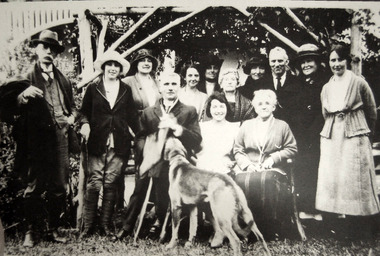
Photograph (item) - Black and white photograph, Unknown
... Family who owned and operated Kooringa Guesthouse in Marysville. The original house was built in 1914 for Frederick Webb by the Cuzens Brothers. marysville victoria australia kooringa frederick webb cuzens brothers betha wilhelmina christina unmack minnie webb t.e. foster edgar charles webb clarence thomas pitman jacob pitman sir isaac pitman caroline anna blood newenham henry newenham pitman carrie rosalind persse pitman reginald william stringer alice burton pitman clarence edward pitman newenham mueller pitman olive birch constance may pitman olive dora blakeney pitman gwendoline de Burch Pitman kooringa guesthouse lilian may shelton thomas henry branchflower wilbur anderson peter mackey caroline anna pitman A digital copy of a black and white photograph of the Pitman Family who owned and operated Kooringa Guesthouse in Marysville. ...A digital copy of a black and white photograph of the Pitman Family who owned and operated Kooringa Guesthouse in Marysville. The original house was built in 1914 for Frederick Webb by the Cuzens Brothers.A digital copy of a black and white photograph of the Pitman Family who owned and operated Kooringa Guesthouse in Marysville. The original house was built in 1914 for Frederick Webb by the Cuzens Brothers.marysville, victoria, australia, kooringa, frederick webb, cuzens brothers, betha wilhelmina christina unmack, minnie webb, t.e. foster, edgar charles webb, clarence thomas pitman, jacob pitman, sir isaac pitman, caroline anna blood newenham, henry newenham pitman, carrie rosalind persse pitman, reginald william stringer, alice burton pitman, clarence edward pitman, newenham mueller pitman, olive birch, constance may pitman, olive dora blakeney pitman, gwendoline de burch pitman, kooringa guesthouse, lilian may shelton, thomas henry branchflower, wilbur anderson, peter mackey, caroline anna pitman -
Federation University Historical Collection
Book, Child and Family Services Ballarat Inc. Annual Report, 2015-2016
... Elizabeth marsden michelle smith arthur kenny avenue of honour legacy and research centre ballarat orphanage horses foster children adoption kinship care residential care wozzles wearhouse Black soft covered report featuring a child's eyes framed with paint covered hands. In 2015 CAFS celebrated 150 years. Child and Family ...Black soft covered report featuring a child's eyes framed with paint covered hands. In 2015 CAFS celebrated 150 years. elizabeth marsden, michelle smith, arthur kenny avenue of honour, legacy and research centre, ballarat orphanage, horses, foster children, adoption, kinship care, residential care, wozzles wearhouse -
 Flagstaff Hill Maritime Museum and Village
Book, To-Night at 8.30
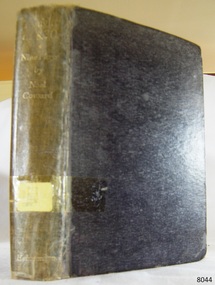
... foster an informed citizenry. The Warrnambool Mechanics' Institute publication collection is of both local and state significance. warrnambool shipwrecked-coast flagstaff-hill flagstaff-hill-maritime-museum maritime-museum shipwreck-coast flagstaff-hill-maritime-village shipwrecked-artefact book pattison collection warrnambool library warrnambool mechanics’ institute ralph eric pattison corangamite regional library service warrnambool city librarian mechanics’ institute library victorian library board warrnambool books and records warrnambool children’s library great ocean road to-night at 830 noel coward We Were Dancing The Astonished Heart. Red Peppers Hands Across the Sea Fumed Oak Shadow Play Ways and Means Still Life Family ...This item is from the ‘Pattison Collection’, a collection of books and records that was originally owned by the Warrnambool Mechanics’ Institute, which was founded in Warrnambool in 1853. By 1886 the Warrnambool Mechanics’ Institute (WMI) had grown to have a Library, Museum and Fine Arts Gallery, with a collection of “… choice productions of art, and valuable specimens in almost every branch and many wonderful national curiosities are now to be seen there, including historic relics of the town and district.” It later included a School of Design. Although it was very well patronised, the lack of financial support led the WMI in 1911 to ask the City Council to take it over. In 1935 Ralph Pattison was appointed as City Librarian to establish and organise the Warrnambool Library as it was then called. When the WMI building was pulled down in 1963 a new civic building was erected on the site and the new Warrnambool Library, on behalf of the City Council, took over all the holdings of the WMI. At this time some of the items were separated and identified as the ‘Pattison Collection’, named after Ralph Pattison. Eventually the components of the WMI were distributed from the Warrnambool Library to various places, including the Art Gallery, Historical Society and Flagstaff Hill. Later some were even distributed to other regional branches of Corangamite Regional Library and passed to and fro. It is difficult now to trace just where all of the items have ended up. The books at Flagstaff Hill Maritime Village generally display stamps and markings from Pattison as well as a variety of other institutions including the Mechanics’ Institute itself. RALPH ERIC PATTISON Ralph Eric Pattison was born in Rockhampton, Queensland, in 1891. He married Maude Swan from Warrnambool in 1920 and they set up home in Warrnambool. In 1935 Pattison accepted a position as City Librarian for the Warrnambool City Council. His huge challenge was to make a functional library within two rooms of the Mechanics’ Institute. He tirelessly cleaned, cleared and sorted a disarrayed collection of old books, jars of preserved specimens and other items reserved for exhibition in the city’s museum. He developed and updated the library with a wide variety of books for all tastes, including reference books for students; a difficult task to fulfil during the years following the Depression. He converted all of the lower area of the building into a library, reference room and reading room for members and the public. The books were sorted and stored using a cataloguing and card index system that he had developed himself. He also prepared the upper floor of the building and established the Art Gallery and later the Museum, a place to exhibit the many old relics that had been stored for years for this purpose. One of the treasures he found was a beautiful ancient clock, which he repaired, restored and enjoyed using in his office during the years of his service there. Ralph Pattison was described as “a meticulous gentleman whose punctuality, floorless courtesy and distinctive neat dress were hallmarks of his character, and ‘his’ clock controlled his daily routine, and his opening and closing of the library’s large heavy doors to the minute.” Pattison took leave during 1942 to 1945 to serve in the Royal Australian Navy, Volunteer Reserve as Lieutenant. A few years later he converted one of the Museum’s rooms into a Children’s Library, stocking it with suitable books for the younger generation. This was an instant success. In the 1950’s he had the honour of being appointed to the Victorian Library Board and received more inspiration from the monthly conferences in Melbourne. He was sadly retired in 1959 after over 23 years of service, due to the fact that he had gone over the working age of council officers. However he continued to take a very keen interest in the continual development of the Library until his death in 1969. WARRNAMBOOL PUBLIC LIBRARY The Warrnambool Mechanics’ Institute (WMI) was formed by a voluntary community group in 1863, within six years of Warrnambool’s beginnings, and its Reading Room opened in 1854. The WMI operated until 1963, at which time it was one of the oldest Mechanics’ Institutes in Victoria. Mechanics’ Institutes offered important services to the public including libraries, reading rooms and places to display and store collections of all sorts such as curiosities and local historical relics. In 1886 a Museum and Fine Arts Gallery were added to the WMI and by the beginning of the 20th century there was also a billiards room and a School of Art. By this time all Mechanics’ Institutes in country Victoria had museums attached. Over the years the Warrnambool Mechanics’ Institute Library was also known as the Warrnambool Public Library the Warrnambool Library and the Free Library. Early funding from the government was for the “Free Library”. The inscription in a book “Science of Man” was for the “Warrnambool Public Library”, donated by Joseph Archibald in 1899. Another inscription in the book “Catalogue of Plants Under Cultivation in the Melbourne Botanic Gardens 1 & 2, 1883” was presented to the “Warrnambool Library” and signed by the author W.R. Guilfoyle. In 1903 the Warrnambool Public Library decided to add a Juvenile Department to library and stock it with hundreds of books suitable for youth. In 1905 the Public Library committee decided to update the collection of books and added 100 new novels plus arrangements for the latest novels to be included as soon as they were available in Victoria. In July 1911 the Warrnambool Council took over the management of the Public Library, Art Gallery, Museum and Mechanics’ Institute and planned to double the size of the then-current building. In 1953, when Mr. R. Pattison was Public Librarian, the Warrnambool Public Library’s senior section 10,000 of the 13,000 books were fiction. The children’s section offered an additional 3,400 books. The library had the equivalent of one book per head of population and served around 33 percent of the reading population. The collection of books was made up of around 60 percent reference and 40 percent fiction. The library was lending 400 books per day. In 1963 the Warrnambool City Council allocated the site of the Mechanics’ Institute building, which included the Public Library, Museum and Art Gallery, for the new Municipal Offices and the Collections were dispersed until 1971. The Warrnambool Library took over the Mechanics’ Institute Library’s holdings on behalf of the Warrnambool City Council. Since the closure of the Warrnambool Mechanics’ Institute the exact location and composition of the original WMI books and items has become unclear. Other materials have been added to the collection, including items from Terang MI, Warrnambool Court House and Customs House. Many of the books have been identified as the Pattison Collection, named after the Librarian who catalogued and numbered the books during his time as Warrnambool Public Librarian in the time before the Mechanics’ Institute closed. It seems that when Warrnambool became part of the Corangamite Regional Library some of the books and materials went to its head office in Colac and then back to Warrnambool where they were stored at the Art Gallery for quite some time. Some then went to the Warrnambool Historical Society, some stayed at the Art Gallery and some were moved to Flagstaff Hill Maritime Village. The various stamps and labels on the books held at Flagstaff Hill show the variety of the collection’s distribution and origin. The books in the collection at Flagstaff Hill Maritime Village date from the 1850’s to the late 1950’s and include rare and valuable volumes. Many of the books are part of the “Pattison Collection” after the Warrnambool’s Public Librarian, Mr. R. Pattison. WARRNAMBOOL'S MECHANICS' INSTITUTE Warrnambool's Mechanics' Institute (or Institution as it was sometimes called) was one of the earliest in Victoria. On 17th October 1853 a meeting was held where it was resolved to request the Lieutenant Governor of the Colony to grant land for the erection of a Mechanics' Institutes building. A committee was formed at the meeting and Richard Osburne chaired the first meeting of this committee. The land on the North West corner of Banyan and Merri Streets was granted but there were no funds to erect the building. The Formal Rights of the Warrnambool Mechanics' Institute's encompassed its aims and these were officially adopted in1859; "This Institution has for its object the diffusion of literary, scientific, and other useful knowledge amongst its members, excluding all controversial subjects, religious or political. These objects are sought to be obtained by means of a circulating library, a reading room, the establishment of classes, debates, and the occasional delivery of lectures on natural and experimental philosophy, mechanics, astronomy, chemistry, natural history, literature, and the useful and ornamental arts, particularly those which have a more immediate reference to the colony." The Warrnambool Mechanics' Institute opened its first reading room in November1884 in the National School building at the corner of Banyan and Timor Streets. The Institute was funded by member subscription, payable on a quarterly, half yearly or yearly basis. Samuel Hannaford, the Manager of the Warrnambool Bank of Australasia, was the first Honorary Secretary of the Mechanics' Institutes, and an early President and Vice-President. He also gave several of the early lectures in the Reading Room. Another early Secretary, Librarian and lecturer was Marmaduke Fisher, the teacher at the National School. Lecture topics included The Poets and Poetry of Ireland', 'The Birth and Development of the Earth', 'The Vertebrae - with Remarks on the pleasures resulting from the study of Natural History' and 'Architecture'. In 1856 the Reading Room was moved to James Hider's shop in Timor Street, and by 1864 it was located in the bookshop of Davies and Read. In the 1860's the Mechanics' Institute struggled as membership waned but in 1866, after a series of fund raising efforts, the committee was able to purchase land in Liebig Street, on a site then called Market Square, between the weighbridge and the fire station. A Mechanics' Institute building was opened at this site in August 1871. The following year four more rooms were added to the main Reading Room and in 1873 the Artisan School of Design was incorporated into the Institute. The same year Joseph Archibald established a Museum; however it deteriorated when he was transferred to Bendigo in 1877. In 1880, with Archibald's return to Warrnambool, the Museum was re-established, and in 1885 a new building was built at the back of the Institute to accommodate the re-created School of Design, the Art Gallery and the Museum. In 1887 the Museum section was moved to the former court house in Timor Street (for some time the walls of the building formed part of the TAFE cafeteria but all is now demolished)). In 1911 the Museum was transferred back to the original building and the management of the Mechanics' Institute was handed over to the Warrnambool City Council. The Museum and Art Gallery became one and housed many fine works of art, and the Library continued to grow. The building was well patronised, with records showing that at the beginning of the 20th century there were between 500 and 800 visitors. During World War One the monthly figures were in the thousands, with 3,400 people visiting in January 1915. The Museum was a much loved Institution in Warrnambool until the contents of the Museum and Art Gallery were removed to make room for the Warrnambool City Council Engineers' Department. The contents were stored but many of the items were scattered or lost. When the original building was demolished the site became occupied by the Civic Centre, which included the new City Library. (The library was temporarily located in the old Palais building in Koroit Street.) In the process of reorganisation the Collection was distributed amongst the community groups: -The new City Library took some of the historic books and some important documents, historic photographs and newspapers. -The Art Gallery kept the 19th Century art collection and some of the artefacts from the museum. -The Historic Society has some items -The State Museum has some items -Some items were destroyed -Flagstaff Hill Maritime Village has old newspapers, Government Gazettes, most of the Mechanics' Institute Library, ledgers and documents connected to the Mechanics' Institute Library, some framed and unframed art works and some photographs. The Warrnambool Mechanics' Institute Library book collection is deemed to be of great importance because it is one of the few collections in an almost intact state, and many of the books are now very rare and of great value. The Pattison Collection, along with other items at Flagstaff Hill Maritime Village, was originally part of the Warrnambool Mechanics' Institute’s collection. The Warrnambool Mechanics’ Institute Collection is primarily significant in its totality, rather than for the individual objects it contains. Its contents are highly representative of the development of Mechanics' Institute libraries across Australia, particularly Victoria. A diversity of publications and themes has been amassed, and these provide clues to our understanding of the nature of and changes in the reading habits of Victorians from the 1850s to the middle of the 20th century. The collection also highlights the Warrnambool community’s commitment to the Mechanics’ Institute, reading, literacy and learning in the regions, and proves that access to knowledge was not impeded by distance. These items help to provide a more complete picture of our community’s ideals and aspirations. The Warrnambool Mechanics Institute book collection has historical and social significance for its strong association with the Mechanics Institute movement and the important role it played in the intellectual, cultural and social development of people throughout the latter part of the nineteenth century and the early twentieth century. The collection of books is a rare example of an early lending library and its significance is enhanced by the survival of an original collection of many volumes. The Warrnambool Mechanics' Institute’s publication collection is of both local and state significance. SIGNIFICANCE The Warrnambool Mechanics' Institute Collection is primarily significant in its totality, rather than for the individual objects it contains. Its contents are highly representative of the development of Mechanics' Institute libraries across Australia, particularly Victoria. A diversity of publications and themes has been amassed, and these provide clues to our understanding of the nature of and changes in the reading habits of Victorians from the 1850s to the middle of the 20th century. The collection also highlights the Warrnambool community’s commitment to the Mechanics’ Institute, and to reading, literacy and learning in the regions, and proves that access to knowledge was not impeded by distance. These items help to provide a more complete picture of our community’s ideals and aspirations. As with many Mechanics' Institutes in Australia, the one which operated in Warrnambool was established and overseen for many years by key individuals associated with the development of the city itself. The WMI publication collection is historically significant because of its association with local people, places and the key historical themes in the development of Warrnambool of rural development, industry, farming, education, and community. The collection documents and illustrates the changing interests, focus and tastes of Victorians, especially those in regional cities. Generally the individual items in the collection are not particularly rare, as examples of all probably exist in other public collections in Victoria. It is primarily because there are so very few surviving Mechanics' Institute collections in Victoria, which lends this overall collection its significance. Many items in the WMI Collection have the potential to support further research, both as individual objects and through the collection in its entirety. This material is significant for its ability to assist in the interpretation of the history of the area and adds to the general understanding of the development of the township. Many components of the WMI publication collection complement and reinforce the Flagstaff Hill Maritime Museum Collection, the Warrnambool Art Gallery Collection, and that in the Warrnambool Historical Society, and also contribute to a clearer understanding of the original Warrnambool Mechanics' Institute collections. This will greatly enhance the appreciation of the few surviving Mechanics' Institute collections across Victoria, and also in New South Wales. The similarities and differences between the small number of collections that have survived can provide further insights into how the people of Victoria in general, and Warrnambool in particular, constructed a civic culture of adult learning to foster an informed citizenry. The Warrnambool Mechanics' Institute publication collection is of both local and state significance. To-Night at 830 Play Titles 1)We Were Dancing 2) The Astonished Heart 3) "Red Peppers" 4) Hands Across the Sea 5) Fumed Oak 6) Shadow Play 7) Ways and Means 8) Still Life 9) Family Album Author: Noel Coward Publisher: William Heinemann Ltd Date: 1937Label on spine cover with typed text PAT 822 COW Pastedown front endpaper has sticker from Warrnambool Public Library covered by a sticker from Corangamite Regional Library Service Front loose endpaper has a stamp from Corangamite Regional Library Service Fly paper has a stamp from Warrnambool Mechanics Institute warrnambool, shipwrecked-coast, flagstaff-hill, flagstaff-hill-maritime-museum, maritime-museum, shipwreck-coast, flagstaff-hill-maritime-village, shipwrecked-artefact, book, pattison collection, warrnambool library, warrnambool mechanics’ institute, ralph eric pattison, corangamite regional library service, warrnambool city librarian, mechanics’ institute library, victorian library board, warrnambool books and records, warrnambool children’s library, great ocean road, to-night at 830, noel coward, we were dancing, the astonished heart., red peppers, hands across the sea, fumed oak, shadow play, ways and means, still life, family album -
 Greensborough Historical Society
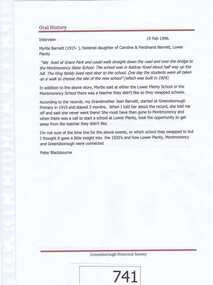
Oral History Transcript, Myrtle Barnett 19/02/1996, 19/2/1996
... fostered daughter of Caroline & Ferdinand Barnett; Lower Plenty. Interviewed on 19 Feb 1996 by Peter Blackbourn. "We lived at Grace Park and could walk straight down the road and over the bridge to the Montmorency State School. The school was in Rattray Rd about half way up the hill. The King family...fostered daughter of Caroline & Ferdinand Barnett; Lower Plenty. Interviewed on 19 Feb 1996 by Peter Blackbourn. "We lived at Grace Park and could walk straight down the road and over the bridge to the Montmorency State School. The school was in Rattray Rd about half way up the hill. The King family ...Oral history Myrtle Barnett ( 1915- ); fostered daughter of Caroline & Ferdinand Barnett; Lower Plenty. Interviewed on 19 Feb 1996 by Peter Blackbourn. "We lived at Grace Park and could walk straight down the road and over the bridge to the Montmorency State School. The school was in Rattray Rd about half way up the hill. The King family lived next door to the school. One day the students were all taken on a walk to choose the site of the new school (which was built in 1924). In addition to the above story; Myrtle said at either the Lower Plenty School or the Montmorency School there was a teacher they didn’t like so they swapped schools. My Grandmother Jean Barnett; started at Greensborough Primary in 1919 and stayed 3 months. When I told her about this; she told me off and said she never went there! She must have then gone to Montmorency and when there was a call to start a school at Lower Plenty; took the opportunity to get away from the teacher they didn’t like. I’m not sure of the time line for the above events; or which school they swapped to but I thought it gave a little insight into the 1920’s and how Lower Plenty; Montmorency and Greensborough were connected."Transcript of Oral History. barnett family, myrtle barnett -
 The Beechworth Burke Museum
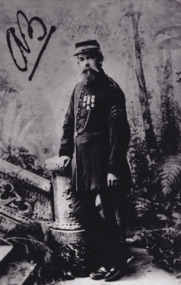
Photograph, c1885
... Foster during this visit and returned to Australia in March 1863. With his coach line established, and leaving it under management, he moved around the north east of Victoria establishing and building shops and the Star Hotel and Theatre in Chiltern in 1866. In 1869 he moved to Melbourne for a few years in which time he built the Eastern Arcade in Bourke Street. In 1876 the family...Foster during this visit and returned to Australia in March 1863. With his coach line established, and leaving it under management, he moved around the north east of Victoria establishing and building shops and the Star Hotel and Theatre in Chiltern in 1866. In 1869 he moved to Melbourne for a few years in which time he built the Eastern Arcade in Bourke Street. In 1876 the family ...This carte de visite was taken of Hiram Crawford in fire brigade uniform taken by Stewart & CO., Melbourne. Hiram Crawford was Captain of the Beechworth Volunteer Fire Brigade for twenty-five years. Hiram arrived in Australia at the age of 21 in August 1853. He mined for short time at Back Creek Bendigo, then went to the Ovens where he sought gold in Spring Creek, Buckland and 3 Mile. After moving to Albury for 18 months he married Anna, moved to Woolshed and was there for two years mining gold. After discovering his fortune he formed Crawford and Co. Coaching Lines in Beechworth in late 1856. It was this company which became the longest surviving coaching business in the State of Victoria. Hiram and Anna had two daughters. Anna died in March 1862 and in May Hiram left from Melbourne to return to the United States on a visit. Hiram married Martha Foster during this visit and returned to Australia in March 1863. With his coach line established, and leaving it under management, he moved around the north east of Victoria establishing and building shops and the Star Hotel and Theatre in Chiltern in 1866. In 1869 he moved to Melbourne for a few years in which time he built the Eastern Arcade in Bourke Street. In 1876 the family returned to Beechworth for a few years eventually moving to Everton where Hiram grew hops, tobacco, fruit trees and established the largest lemon orchard at that time in Australia. Hiram spent a considerable amount of his time helping to develop the North East of the State not only in his private endeavours but as a public figure. Among his many achievements a few are listed - Councillor, Mayor of Chiltern and Beechworth, President of the Shire on two occasions, Director of many mining companies, Inaugural Chairman and Director of the Beechworth Gas Company roles he held for over 20 years, Foundation member of Beechworth Pottery, Committee member of the Beechworth Hospital, Captain/Superintendent of the Vol. Fire Brigade for over 20 years, Foundation, Life member of and on the State Fire Brigade Board for many years, President of the North Eastern Railway League in Chiltern On a personal level Hiram was involved in lodges including St. Johns #14, Beechworth. and had several grazing properties in the Ovens area. He had the Forest Park Hotel at Carboor, the Creamery at Carboor, and grazing land on which the Milawa Creamery was built during his ownership. He was a committee member for 3 committees duirng the 1888 International Exhibition in Melbourne. Hiram had many voyages around the world studying irrigation, hop growing, tobacco growing and drying. During his retirement in Melbourne Hiram purchased many properties in the Elsternwick area and acted as an Estate Agent. After the death of his second wife Martha, Hiram married for the third time in 1912 to Sophia Maude Heatley. Crawford and Co continued until 1921. [Taken from HighCountryHeritage.com.au]Black and white reproduction of a studio portrait of Hiram Crawford in fire brigade uniform, printed on gloss photographic paper and bordered with a white frame.Badge on uniform sleeve reads: CAPTAIN / BVFB Obverse: AB/ Stewart & CO./ Melbourne Reverse: Hiram Collection/ BMM2435burke museum, emergency services, beechworth, carte de visite, black and white, fire brigade, hiram crawford, stewart & co., melbourne. -
 Orbost & District Historical Society
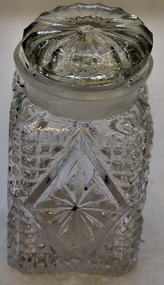
glass container, first half 20th century
... family and the wider community. Mary Gilbert, B.E.M. was devoted to Orbost. She taught in Orbost for 40 years. She fostered ...Used as a pickle bottle by Mary Gilbert, local historian and Orbost high school teacher. . Mary Isabelle Gilbert was born in 1905 in Orbost, Australia. She was born to John Gilbert and Annie Cameron Gilbert, and had seven sisters and one brother. Four siblings died at a young age. .She was a teacher historian loved and respected by her family and the wider community.Mary Gilbert, B.E.M. was devoted to Orbost. She taught in Orbost for 40 years. She fostered the Orbost Historical Society and initiated the establishment of the Orbost Museum.Cut glass square shaped bottle with lid (202.2). Square designs with large diamond shape in centre.glass-container gilbert-mary -
 City of Moorabbin Historical Society (Operating the Box Cottage Museum)
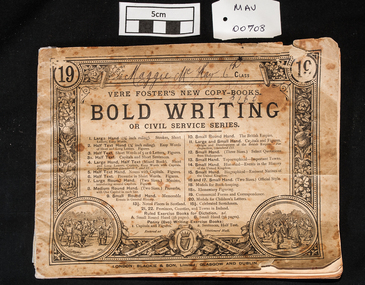
Education kit - Vere Foster's New Copy-Book No 19, Bold Writing or Civil Service Series, c1890
... Foster's Copy Books were sold. The series of books taught children the alphabet and writing. Copy books for older children taught basic business studies and book-keeping. The family ...This copy book was used by Maggie McKay in 1902 when in 6th Grade at Meeniyan State School (no 3165) and was learning to write in the approved manner. Vere Henry Louis Foster (1819-1900), an educationist, philanthropist, and humanist, who worked devotedly to improve the situation of the Irish poor, published a series of these copy books to improve writing skills, as better literacy and penmanship meant better chances of employment. The books were first published in 1865 and were sold for 1 penny, a fraction of what they cost to produce. In the first year alone one million Foster's Copy Books were sold. The series of books taught children the alphabet and writing. Copy books for older children taught basic business studies and book-keeping.The family of Maggie McKay were early settlers in Moorabbin ShireA school writing copy book with 14 pages divided so that the student copied the text on one half of the page. VERE FOSTERS NEW COPY BOOKS / BOLD WRITING / OR CIVIL SERVICE SERIES London BLACKIE & SON Glasgow and Dublin market gardners, pioneers, early settlers, mooorabbin, brighton, east brighton, bentleigh, correspondence, writing equipment, pen and ink, education, vere foster, irish -
 Greensborough Historical Society
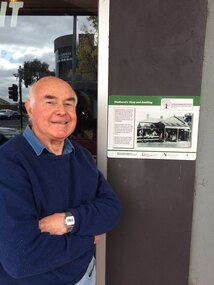
Photograph - Digital Image, Chris Foster, Medhurst's shop and dwelling (Main Street Plaques Project), 17/05/2018
... Foster view the plaque of Medhurst's shop and dwelling on Grimshaw Street Greensborough. The Main Street Plaques Project placed historical information about original Greensborough buildings as close to the original site as possible. Further information available on the GHS website. The Plaques were made possible through a Greensborough RSL Grant. main street plaques project medhurst family ...In 2018, Greensborough Historical Society placed plaques in the Main Street area of Greensborough. In these photographs, GHS President Noel Withers and GHS member Chris Foster view the plaque of Medhurst's shop and dwelling on Grimshaw Street Greensborough.The Main Street Plaques Project placed historical information about original Greensborough buildings as close to the original site as possible. Further information available on the GHS website. The Plaques were made possible through a Greensborough RSL Grant.Digital copy of 2 colour photographs.main street plaques project, medhurst family, medhurst's fruit shop, grimshaw street greensborough -
 Greensborough Historical Society
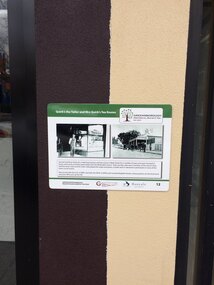
Photograph - Digital Image, Chris Foster, Quirk the tailor and Mrs Quirk's tearoom, Greensborough (Main Street Plaques Project), 17/05/2018
... Foster, accompanied by GHS President Noel Withers, has photographed the installation of the 'Quirk the Tailor and Mrs Quirk's Tearoom' plaque on Main Street Greensborough. The Main Street Plaques Project placed historical information about original Greensborough buildings as close to the original site as possible. Further information available on the GHS website. The Plaques were made possible through a Greensborough RSL Grant. main street plaques project main street greensborough quirk family ...In 2018, Greensborough Historical Society placed plaques in the Main Street area of Greensborough. In these photographs, GHS member Chris Foster, accompanied by GHS President Noel Withers, has photographed the installation of the 'Quirk the Tailor and Mrs Quirk's Tearoom' plaque on Main Street Greensborough. The Main Street Plaques Project placed historical information about original Greensborough buildings as close to the original site as possible. Further information available on the GHS website. The Plaques were made possible through a Greensborough RSL Grant.Digital copy of 2 colour photographs.main street plaques project, main street greensborough, quirk family -
 Ringwood and District Historical Society
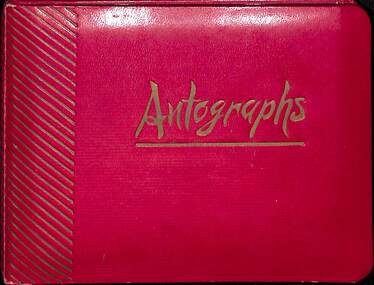
Ephemera - Packet, Gwen Reed nee Woodford family memorabilia, Circa 1880s to c1980s
... Reed, 9 Laurence Grove, Ringwood East Vic. 3135 Birth Certificate District of Balmoral, Victoria – Sonia Woodford b.1856 (Issued 1987) Death Certificate District of Stawell, Vic – Archibald Brown d.1914 Marriage Certificate District of Hamilton, Vic – John Brown & Margaret Dale m.1895 Coroner’s Post-Mortem report – Edward John Reed d.1981 Family Data Tree (Family Tree) William Walker/Elizabeth Silk, Hamilton Vic & children b.1842-1862 Newspaper clipping – May & Archibald Brown drowned at North Hamilton, 1887 Pictorial Souvenir – Selected Views of Mount Gambier to Miss L. Boyce, postmarked 1959 Hand-written poems/song lyrics by Gwen Reed (4 pages) Newspaper extract - Weekly Times Magazine Section “At Hamilton”, 1937 Photograph – “My mother standing with Foster parents” Photograph of Gracie (?) ...Reed, 9 Laurence Grove, Ringwood East Vic. 3135 Birth Certificate District of Balmoral, Victoria – Sonia Woodford b.1856 (Issued 1987) Death Certificate District of Stawell, Vic – Archibald Brown d.1914 Marriage Certificate District of Hamilton, Vic – John Brown & Margaret Dale m.1895 Coroner’s Post-Mortem report – Edward John Reed d.1981 Family Data Tree (Family Tree) William Walker/Elizabeth Silk, Hamilton Vic & children b.1842-1862 Newspaper clipping – May & Archibald Brown drowned at North Hamilton, 1887 Pictorial Souvenir – Selected Views of Mount Gambier to Miss L. Boyce, postmarked 1959 Hand-written poems/song lyrics by Gwen Reed (4 pages) Newspaper extract - Weekly Times Magazine Section “At Hamilton”, 1937 Photograph – “My mother standing with Foster parents” Photograph of Gracie (?) ...Collection of various family and personal documents, photographs, and early 1900s greeting cards. Papers of Gwen Reed from Edith Graham of Ware Cres, Ringwood East. (Provided by Nicki Shea, Granddaughter of Stan & Jo Bridgman of Eastwood Cycles) Contents: Hand-written notes – Woodford Family Tree, by Gwen Reed Autograph book with entries "To Gwen" Bookmark - with name "Lorrie B" Christmas card to May with love from George 1906 Christmas card from May to George 1906 Christmas card from Edie to Gwen (Cousin Ede) Christmas card from Dot to Gwen 1925 (from Dot Grundy, dc'd) Christmas card from Ollie S to Gwen 1924 Happy New Year card to Gwen from Grandma (Woodford) Christmas card from Mum & Ethel to Gwen 1926 Christmas card to Gwen from Emily (Gawith, Jeparit East) Christmas card from Olive to Gwen 1919 (Olive Janetski, Jeparit East) Christmas card from Hilda (Obst) to Gwen 1929 Postcard to Miss G Woodford "Bygalorie Park" Tullibigeal PO NSW (To Gwen from Effie - Effie Robson, Jeparit East) Christmas card to Gwennie from C. S. Graham 1915 (School teacher) Christmas card from Mum to May & George Christmas postcard from Grandfather to Gwenny Christmas card to Dear Daddie from Gwen Christmas card from May with love to George Christmas card from Nellie Parker (Nell Rodgers - Albury) to Gwen 1924 Greeting card from Hilda to Gwen 1919 (Hilda Obst Jeparit East) Christmas card from Ethel to Gwen 1927 Christmas card from Anne (MCGrath) to Gwen Christmas card from S. Hoober(?) (School teacher, Bygalorie) to Mr & Mrs Woodford, Gwen & Ollie) 1924 Christmas card from May and George to Mum and Dad 1925 Christmas card to Gwen Syd & Family from May Dad & Kiddies (Stepmother) Christmas card from George to May 1907 Postcard (signed Dulcie) to Mrs G. Reed, 9 Laurence Grove, East Ringwood Vic 3055 postmarked 1993 Envelope (only) addressed to Mrs. G. Reed, 9 Laurence Grove, Ringwood East Vic. 3135 Birth Certificate District of Balmoral, Victoria – Sonia Woodford b.1856 (Issued 1987) Death Certificate District of Stawell, Vic – Archibald Brown d.1914 Marriage Certificate District of Hamilton, Vic – John Brown & Margaret Dale m.1895 Coroner’s Post-Mortem report – Edward John Reed d.1981 Family Data Tree (Family Tree) William Walker/Elizabeth Silk, Hamilton Vic & children b.1842-1862 Newspaper clipping – May & Archibald Brown drowned at North Hamilton, 1887 Pictorial Souvenir – Selected Views of Mount Gambier to Miss L. Boyce, postmarked 1959 Hand-written poems/song lyrics by Gwen Reed (4 pages) Newspaper extract - Weekly Times Magazine Section “At Hamilton”, 1937 Photograph – “My mother standing with Foster parents” Photograph of Gracie (?) Grandma (?) Murray (?) Photograph of costumed performers Photograph of child Photograph of lady at John Mansell dispensary (Chemist at Forest Hill Vic?) Postcard photograph – Gwen & Ethel Woodford Photograph of grave – Victoria May Woodford (died 1957 aged 56 years) Photograph of grave – William Woodford and Sarah Woodford Photograph of un-named male Photograph of baby on chair Photograph – “Myself. Hope you like it May" Photograph (colour) – un-named group on train at Currumbin Qld Photograph – 2 un-named girls Autographs include Arthur Young Rosie Sturgess Joff Ellen Carlu Carter Toni Lamond Dick Curtis Billy Daniels Margaret Whiting Horrie Dargie Duo Moreno Therese Talbert Richard Gray Three Apollos Robert Leeman -
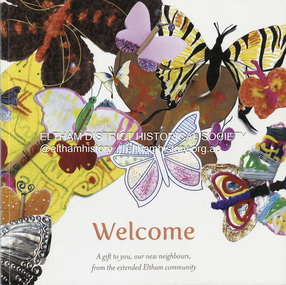 Eltham District Historical Society Inc
Book, Nina Kelabora, Welcome : a gift to you, our new neighbours, from the extended Eltham community / produced by Nina Kelabora (graphic designer) and Lara McKinley (principal photographer), December 2016
... Media Media Releases • Eltham elders take to social media to welcome refuges, video goes viral; Wednesday 28 October 2016 • Eltham locals use their bodies to say WELCOME to refugees; 1 October 2016 • Community group welcomes Minister’s decision so refugees can call Eltham home; 5 October 2016 • Locals answer far-right “Battle for Eltham” with butterflies: thousand of them; 5 November 2016 Newspaper articles • Group fosters goodwill; organisation works to assist refugees; Brittany Shanahan; Diamond Valley Leader, Wednesday, August 17, 2016, p3 • Refugees are welcome (Gillian); Care is for the elderly alone (Fred); Plenty of positives in plan (Kirstin); Open your hearts and doors (Alison); Flood of families a worry (Cath), Conversations, Diamond Valley Leader, Wednesday, August 17, 2016, p11 • Support refugee housing; Diamond Valley Leader, Pamela Nash via Facebook, Janet R. ...Media Media Releases • Eltham elders take to social media to welcome refuges, video goes viral; Wednesday 28 October 2016 • Eltham locals use their bodies to say WELCOME to refugees; 1 October 2016 • Community group welcomes Minister’s decision so refugees can call Eltham home; 5 October 2016 • Locals answer far-right “Battle for Eltham” with butterflies: thousand of them; 5 November 2016 Newspaper articles • Group fosters goodwill; organisation works to assist refugees; Brittany Shanahan; Diamond Valley Leader, Wednesday, August 17, 2016, p3 • Refugees are welcome (Gillian); Care is for the elderly alone (Fred); Plenty of positives in plan (Kirstin); Open your hearts and doors (Alison); Flood of families a worry (Cath), Conversations, Diamond Valley Leader, Wednesday, August 17, 2016, p11 • Support refugee housing; Diamond Valley Leader, Pamela Nash via Facebook, Janet R. ...In 2016 the Welcome to Eltham community project started to welcome Syrian refugees into the community and made Welcome Butterflies to say welcome to them. In addition to the physical book, EDHS also holds several hundred digital images pertaining to the development of the Welcome to Eltham campaign, photographs, artworks and graphic designs, which resulted in the publication of this book. EDHS also holds further material from the period 2016 to 2017 associated with the Welcome to Eltham campaign group. Contents: 1. Welcome Book Welcome Book includes selected page extracts and images as published December 2016 Contents: • Greetings to our Country P2 • Offering P8 • Your neighbours P10 • Rotary P39 • Eltham Baptist Church P44 • Eltham Farmers Market stall holders P48 • The Eltham community P54 • Surrounding communities P60 • Our Lady Help of Christians Primary School P64 • Nillumbik Greens P66 • Our Lady Help of Christians Church Eltham P68 • Catholic Care Eltham P70 • St Vincent’s P71 • Montmorency South Primary School P72 • Victoria Police P73 • Catholic Ladies College P74 • Warrandyte P76 • Eltham Toy Library P78 • Eltham-Montmorency Uniting Church P82 • Gingerbread P84 • Scouts P86 • Eltham businesses P89 • Surrounding communities P96 • The Seed P101 2. Administration 1. Welcome to Eltham Infant Plan, Purpose and Scope (Aug. 2016) 2. Circle of Friends; A draft proposal from Welcome to Eltham, 26 August 2016 3. Welcome to Eltham; a resident support group for refugees settling in Eltham (Sep. 2016) 4. Welcome to Eltham; Purpose and Scope (Sep. 2016) 5. Welcome to Eltham Plan (Sep. 2016); 10 pages typed of tasks broken into four categories, 10 pages 6. Welcome to Eltham Team/Volunteer organisation structure, volunteers’ skills assessment and role assignments, strategies, 11 pages 7. Briefing Document: Refugees being welcomed in Eltham, 2 Oct. 2016; 5 pages 8. Public Engagement Plan, 2 Oct. 2016; 2 pages 9. Welcome to Eltham 2016 Review, Values and Structure, 2017 10. Welcome to Eltham Incorporated Financial Report July 2016 – June 2017; 3 pages 11. Letter: Nina Kelabora and Welcome to Eltham Team to Bolton Street Fruit Market re offer to provide fresh fruit, 30 Jun. 2017 12. Welcome to Eltham Incorporated Annual Report 2016–2017; Oct. 2017; 4 pages 13. Certificate: Jagajaga Community Australia Day Award 2018 to Nina Kelabora, signed Jenny Macklin MP, Federal Member for Jagajaga 14. Certificate: Jagajaga Community Australia Day Award 2018 to Welcome to Eltham, signed Jenny Macklin MP, Federal Member for Jagajaga 15. Letter: Simon Le Plastrier, Principal, Eltham College to Nina Kelabora, 20 April 2018 offering congratulations for the work achieved by Welcome to Eltham group 16. Photo: River pebble covered in spray paint of multiple colours. The rock was used to hold down templates for painting butterflies on the footpaths near Andrew park as a counter to protesters assembling for the ‘Battle for Eltham’ demonstration on 5 November 2016 17. Photo: Welcome to Eltham team member, Gillian Essex 18. Photo: Welcome to Eltham team member, Kirsten Bate 19. Photo: Welcome to Eltham team member, Lara McKinley 20. Photo: Welcome to Eltham team member, Nina Kelabora 21. Photo: Welcome to Eltham team member, Sarah Hooten 22. Incorporation • AGM-minutes-2017 • Certificate of Incorporation • Mission and Values • Ordinary Business of the AGM 2017 • Welcome to Eltham Rules 23. Advocacy • Eltham Butterfly Effect Corflute panel design 5 November 2016 Rally • MemeFest PowerPoint presentation 23 November 2016 • Oxfam PowerPoint presentation 16 June 2017 • Eltham Rotary PowerPoint presentation 1 June 2017 • Welcome to Eltham Gift Card artwork 3. Artwork • Logo: Welcome to Eltham • 12 artworks by children of the Eltham Child Care Co-Operative (ECCC) o Me at the Immigration Museum by Ethan B. o Immigration Museum by Edie o Me with my family and lots of hearts by Charlotte o My suitcase like the refugees we learnt about with Bec by Jarvis o Me at the football with my friends by Harley o My suitcase if I had to leave the country by Ellen o Me at the park near the library by Chloe o Books at the library by Addison o Ethan’s grandfather who died in the war and this is him in his grave by Ethan o A nursery by Annabel o The age care home we visit by Ari o This is my mum the Ranger by Mia • Butterfly Effect, Ona Henderson 2016, inscribed “Dedicated to Nina, in appreciation of your butterfly effect for ‘Welcome to Eltham’; reproduced p1 • Ona and Sid gifting her artwork for use by the campaign; reproduced p1 • Duat and Iuk, Mandy Nicholson, Wurundjeri woman; reproduced p3 • These hands welcome you to Australia, Mungo, Warrandyte resident; reproduced p9 • The Library by Rose; reproduced p15 • Welcome to Eltham from Maia; reproduced p19 • Billy, Warrandyte resident; reproduced p20 • Through my window, Janet Boddy; reproduced p23 • Eryn and Lachie, Eltham residents; reproduced p25 • Eva, Eltham resident; reproduced p29 • This is the community hall across from my house by Cinta; reproduced p30 • Welcome, Brenda, Eltham resident; reproduced p34 • Flying over Kerry Crescent, Kerry, Eltham resident; reproduced p38 • A dragon called 'fat' from Joe, 6; reproduced p42 • A rainbow-heart-welcome from Trixie, 8; reproduced p42 • A lovely message from Sarah; reproduced p53 • Monique; reproduced p56 • Tom; reproduced p56 • Josh; reproduced p56 • Chloe; reproduced p56 • Jack; reproduced p57 • Mia; reproduced p57 • Ann Curry, Montmorency resident; reproduced p60 • From Mia: "Keep your head up high and be confident. I'm sure that you will soon find that Eltham is a very nice place and I hope you can have a happy life."; reproduced p77 • Amy; reproduced p79 • Ben; reproduced p80 • Welcome, Kayla, Warrandyte resident; reproduced p94 • Lucas; reproduced p98 • Ale; reproduced p98 • Grace; reproduced p99 • Hugo; reproduced p99 4. Australian-Syrian Charity • ASC – Certificate of Appreciation; Awarded from Australian-Syrian Charity presented to Welcome to Eltham Group by Rev. Fr. Samir Haddad, ASC president, 30 Sep. 2016 including two images of Father Samir and WTE organiser, Nina Kelabora 5. Butterflies • 148 images of handcrafted butterflies and artwork of butterflies edited for reproduction throughout the Welcome to Eltham book and for use on other placards, gift cards and promotional materials including the original source photographs (232 total) • 128 other images of butterflies submitted or photographed installed at various locations around Eltham • 11 images of metal butterfly artworks created by Linda MacAulay and Tim Read showing the works during creation at Bend of Isles and at initial install at the roundabout on Main Road at Luck Street then at the final install to greet the new arrivals and residents alike at St Vincents Aged Care Services (since demolished). 6. Eltham and Surrounds Residents and Local Businesses • 195 photos (157 published in book) submitted by local residents and businesses with people holding Welcome to Eltham placards including: Eltham Farmer’s Market, Eltham Baptist Church, CatholicCare Eltham, Nillumbik Greens, Hurstbridge Wattle Festival, Our Lady Help of Christians Eltham, Our Lady Help of Christians Primary School, Montmorency South Primary School, Warrandyte Primary School, Bronnie Hattam, Mayor, Nillumbik Shire Council, Vicki Ward, MP for Eltham, Jenny Macklin, Member for Jagajaga, Bend of Isles, Eltham Toy Library, Eltham Library, Eltham-Montmorency Uniting Church, Catholic Ladies College (CLC), First Eltham North Scouts, Warrandyte Primary School, Ona Henderson and many individuals and businesses. 7. Events • Alistair Knox Park, 12 August 2016 • Syrian Community Dinner, 30 September 2016 • Pop up Picnic, Eltham North Adventure Playground, 1 October 2016 • Alistair Knox Park, 7 October 2016 • At Our Lady of Help of Christians, 7 October 2016 • Andrew Park Butterfly Effect v Battle for Eltham, 5 November 2016 • City Rally, 5 November 2016 • Eltham Library Children’s Garden, 12 November 2016 • Eltham Festival, 13 November 2016 • Welcome Book Fundraiser, St Margaret’s Church, 11 December 2016 • Nillumbik International Women’s Day Dinner 9 March 2017 • Bush Dance, 17 June 2017 • Eltham Police Morning Tea, 29 July 2017 8. House warmers • Approximately 40 images of gift care items donated (food, drink, blankets, etc) intended as housewarming hampers 9. Media Media Releases • Eltham elders take to social media to welcome refuges, video goes viral; Wednesday 28 October 2016 • Eltham locals use their bodies to say WELCOME to refugees; 1 October 2016 • Community group welcomes Minister’s decision so refugees can call Eltham home; 5 October 2016 • Locals answer far-right “Battle for Eltham” with butterflies: thousand of them; 5 November 2016 Newspaper articles • Group fosters goodwill; organisation works to assist refugees; Brittany Shanahan; Diamond Valley Leader, Wednesday, August 17, 2016, p3 • Refugees are welcome (Gillian); Care is for the elderly alone (Fred); Plenty of positives in plan (Kirstin); Open your hearts and doors (Alison); Flood of families a worry (Cath), Conversations, Diamond Valley Leader, Wednesday, August 17, 2016, p11 • Support refugee housing; Diamond Valley Leader, Pamela Nash via Facebook, Janet R. Body, Eltham, Glenise Michaelson, Montmorency; Letters (online), 5 October 2016 • Refugees find a haven, and, Groups to fundraise for arrivals; Wednesday, October 12, 2016, p5 • Site for resettlement of refugees on a flood plane (Jacquie Bellchambers); Accommodating young families from a foreign culture in an established western culture retirement home will only lead to both parties feeling …. (Margit Alm); Great news for our community … (Nean Tatnal); Conversations, Diamond Valley Leader, Wednesday, October 12, 2016, p19 • Refugee scrap looms; daughter of Eltham aged-care resident upset as extreme group hijacks debate; Brittany Shanahan. Diamond Valley Leader, Wednesday, October 26, 2016, p1 • Many ready to welcome refugees into community (Megan Anne) and others; Conversations, Diamond Valley Leader, Wednesday, October 26, 2016, p20 • On a wing and a prayer; Chris Vedelago, Tammy Mills and Mark Hawthorne; Sunday Age, November 6, 2016, p3. – It was billed as the “Battle for Eltham”, but in te end the butterflies carried the day. • Rally hits trade; Diamond Valley Leader, Wednesday, November 9, 2016, p1 • Protests bad for business; Brittany Shanahan; Diamond Valley Leader, Wednesday, November 9, 2016, p8 • Police earn praise for keeping protest calm; Re: Battle for Eltham rally (Maree Quinlan) and others; Conversations, Diamond Valley Leader, Wednesday, November 9, 2016, p14 • Butterflies to counter anti-Muslim protest; Bianca Hall and Marissa Calligeros, The Age, November 5, 2016 • Rally created challenges but it’s time to move on; Re: Battle for Eltham rally (Local Area Commander Acting Inspector Danielle Leemon) and others; Conversations, Diamond Valley Leader, Wednesday, November 16, 2016, p19 • Praise for warm welcome (Linda Jajawi) and others also photo “Officers from Eltham police station welcomed newly arrived refugees to the community”; Conversations, Diamond Valley Leader, Wednesday, August 9, 2017, p15 • Refugees welcomed; Diamond Valley Leader, n.d. 2017, p12 • Refugee plan riles; Retirement centre residents voice concerns; Brittany Shanahan, Diamond Valley Leader; n.d. 2016 Facebook Responses • Responses top frequent Facebook comments regarding the housing of refugees in aged care at Eltham 10. Placards and Promotional Flyers • Selection of placard images and Welcome to Eltham Gift Card artwork 11. St Vincents • Two hand drawn sketches showing plan views of proposed front and rear units at St Vincents to be used by refugees 12. Videos • Feisties; several local seniors read online comments made by objectors and offer their own opinions; 00.02.28 • Tour of unit at St Vincents, 31 July 2016; 00.00.44 • Drone view of people creating Welcome sign at Eltham North Adventure Playground, 14 September 2016; 00.00.14 • Launching of the butterflies (campaign); Nina Kelabora releases the first butterfly into the wild; 00.00.24 • Gillian Essex, Welcome to Eltham, discussing counter strategy to protest demonstration (Battle for Eltham) scheduled for later in the day; 5 November 2016; 00.01.45 • Glenise Michaelson, Eltham local for 69 years discussing counter strategy to protest demonstration (Battle for Eltham) scheduled for later in the day; 5 November 2016; 00.01.30 • The Butterfly Effect, counter strategy to protesters 5 November 2016 Battle for Eltham rally; 00.02.24 with ten associated photos of the seniors involved; 31 October 2016 • Butterfly art ninjas 1 (15 secs), 2 (26 secs) and 3 (14 secs), showing the butterflies remaining in existence on the paths around Andrew Park, 16 November 2016 • Butterfly capture and release with Nina Kelabora– butterflies around Andrew Park relocated to the Children’s garden at Eltham Library, 17 November 2016; 00.00.28eltham (vic.), welcome to eltham (vic.), syrian refugees, refugees, social life and customs, butterflies, welcome butterflies, nina kelabora collection -
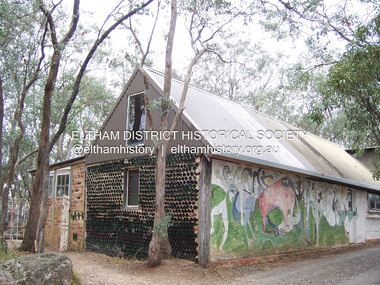 Eltham District Historical Society Inc
Photograph - Digital Photograph, Marguerite Marshall, Art Gallery at Clifton Pugh's Artists' Colony, Dunmoochin, Barreenong Road, Cottles Bridge, 5 February 2008
... La Trobe University in Victoria stores and curates the art collection and organises its exhibition around Australia.2 The Foundation aims to protect and foster the natural environment and to provide residences, studios and community art facilities at a minimal cost for artists and environmental researchers. They reside at the non-profit organisation for a year at minimal cost. The buildings, some decorated with murals painted by Pugh and including a gallery, were constructed by Pugh, family...La Trobe University in Victoria stores and curates the art collection and organises its exhibition around Australia.2 The Foundation aims to protect and foster the natural environment and to provide residences, studios and community art facilities at a minimal cost for artists and environmental researchers. They reside at the non-profit organisation for a year at minimal cost. The buildings, some decorated with murals painted by Pugh and including a gallery, were constructed by Pugh, family ...Art Gallery with mural painted by Clifton Pugh (1924-1990) at his Artists' Colony, Dunmoochin, Barreenong Road, Cottles Bridge. Following military service in the second world war, Clifton Pugh studied under artist Sir William Dargie at the National Gallery School in Melbourne as well as Justus Jorgensen, founder of Montsalvat. For a while he lived on the dole but also worked packing eggs for the Belot family saving sufficient to purchase six acres (2.4 ha) of land at Barreenong Road, Cottles Bridge. He accumulated more land and persuaded several other artists and friends to buy land nearby, resulting in a property of approximately 200 acres, stablishing it as one of the first artistic communes in Australia alongside Montsalvat in Eltham. It was around 1951 that Pugh felt he had '"done moochin' around" and so the name of the property evolved. He bought timber from Alistair Knox to build his house on the crest of a hill. Inspired by local goldminer's huts, it was a one room wattle-and-daub structure with dirt floor. Over the years it expanded with thick adobe walls made from local clay, high ceilings and stone floors. All materials other than the local earth were sourced from second hand materials, most found at wreckers' yards. Artists from across the nation were drawn to Dunmoochin, with several setting up houses and shacks on the property, maintaining their independence but sharing their artistic zeal. Artists who worked or resided at Dunmoochin included Mirka Mora, John Perceval, Albert Tucker, Fred Williams, Charles Blackman, Arthur Boyd and John Olsen. In 2002, Pugh's house along with its treasure trove of art and a library of some 20,000 books was destroyed by fire. Traces of Pugh's home remain with the presence of the Victorian doorframe archway with leadlight of intricate design, procured from a demolished Melbourne mansion; and two bronze life-sized female statues created by Pugh and cast by Matcham Skipper. In place of Pugh's house rose two double-storey mud-brick artists' studios topped with corrugated iron rooves curved like the wings of a bird with accommodation for seven. The original studios, gallery and other buildings survived the fire. Covered under Heritage Overlay, Nillumbik Planning Scheme. Published: Nillumbik Now and Then / Marguerite Marshall 2008; photographs Alan King with Marguerite Marshall.; p153 It’s not surprising that artist Clifton Pugh was drawn to Cottles Bridge to establish his artists’ colony Dunmoochin. Undisturbed by the clamour of modern life at Barreenong Road, Pugh was surrounded by the Australian bush he loved, and where his ashes were later scattered. The 200 acres (81ha) of bushland, broken by glimpses of rolling hills, has more than 50 species of orchids and Pugh shared his property with native animals including kangaroos, emus, phascogales, wombats, and diverse bird life. Pugh encouraged these creatures to join him in the bush by creating, with Monash University, a holding station where the animals were raised. Dunmoochin inspired Pugh for such paintings as in a book on orchids and the Death of a Wombat series.1 But his love for the bush was accompanied by the fear that Europeans were destroying it and much of his painting illustrated this fear and his plea for its conservation.2 However it was his house rather than the surrounding bush that was to be destroyed. Tragically in 2002 Pugh’s house, with its treasure of art and library of 20,000 art books, was destroyed by fire. Traces of the beauty of Pugh’s home still remain, however, in the magnificent Victorian doorframe archway with leadlight of intricate design procured from a demolished Melbourne mansion; and two bronze life-sized female statues created by Pugh and cast by Matcham Skipper. Now in place of Pugh’s house, are two double-storey mud-brick artists’ studios topped with corrugated roofs curved like birds’ wings, with accommodation for seven. The original studios, gallery and other buildings remain.3 Pugh grew up on his parents’ hobby farm at Briar Hill and attended the Briar Hill Primary School, then Eltham High School and later Ivanhoe Grammar. At 15 he became a copy boy for the Radio Times newspaper, then worked as a junior in a drafting office. Pugh was to have three wives and two sons. After serving in World War Two in New Guinea and Japan, Pugh studied under artist Sir William Dargie, at the National Gallery School in Melbourne.4 Another of his teachers was Justus Jörgensen, founder of Montsalvat the Eltham Artists’ Colony. Pugh lived on the dole for a while and paid for his first six acres (2.4ha) at Barreenong Road by working as an egg packer for the Belot family. Pugh accumulated more land and persuaded several other artists and friends to buy land nearby, resulting in the 200 acre property. They, too, purchased their land from the Belot family by working with their chickens. Around 1951 Pugh felt he had ‘Done moochin’ around’ and so the name of his property was born. Pugh bought some used timber from architect Alistair Knox to build his house on the crest of a hill. Inspired by local goldminers’ huts it was a one-room wattle-and-daub structure with a dirt floor. It was so small that the only room he could find for his telephone was on the fork of a tree nearby.5 Over the years the mud-brick house grew to 120 squares in the style now synonymous with Eltham. It had thick adobe walls (sun-dried bricks) made from local clay, high ceilings and stone floors with the entire structure made of second-hand materials – most found at wreckers’ yards. Pugh’s first major show in Melbourne in 1957, established him as a distinctive new painter, breaking away from the European tradition ‘yet not closely allied to any particular school of Australian painting’.6 Pugh became internationally known and was awarded the Order of Australia. He won the Archibald Prize for portraiture three times, although he preferred painting the bush and native animals. In 1990 not long before he died, Pugh was named the Australian War Memorial’s official artist at the 75th anniversary of the landing at Gallipoli. Today one of Pugh’s legacies is the Dunmoochin Foundation, which gives seven individual artists or couples and environmental researchers the chance to work in beautiful and peaceful surroundings, usually for a year. By November 2007, more than 80 people had taken part, and the first disabled artist had been chosen to reside in a new studio with disabled access.1 In 1989, not long before Pugh died in 1990 of a heart attack at age 65, he established the Foundation with La Trobe University and the Victorian Conservation Trust now the Trust for Nature. Pugh’s gift to the Australian people – of around 14 hectares of bushland and buildings and about 550 art works – is run by a voluntary board of directors, headed by one of his sons, Shane Pugh. La Trobe University in Victoria stores and curates the art collection and organises its exhibition around Australia.2 The Foundation aims to protect and foster the natural environment and to provide residences, studios and community art facilities at a minimal cost for artists and environmental researchers. They reside at the non-profit organisation for a year at minimal cost. The buildings, some decorated with murals painted by Pugh and including a gallery, were constructed by Pugh, family and friends, with recycled as well as new materials and mud-bricks. The Foundation is inspired by the tradition begun by the Dunmoochin Artists’ Cooperative which formed in the late 1950s as one of the first artistic communes in Australia. Members bought the land collaboratively and built the seven dwellings so that none could overlook another. But, in the late 1960s, the land was split into private land holdings, which ended the cooperative. Dunmoochin attracted visits from the famous artists of the day including guitarists John Williams and Segovia; singer and comedian Rolf Harris; comedian Barry Humphries; and artists Charles Blackman, Arthur Boyd and Mirka Mora. A potters’ community, started by Peter and Helen Laycock with Alma Shanahan, held monthly exhibitions in the 1960s, attracting local, interstate and international visitors – with up to 500 attending at a time.3 Most artists sold their properties and moved away. But two of the original artists remained into the new millennium as did relative newcomer Heja Chong who built on Pugh’s property (now owned by the Dunmoochin Foundation). In 1984 Chong brought the 1000-year-old Japanese Bizan pottery method to Dunmoochin. She helped build (with potters from all over Australia) the distinctive Bizan-style kiln, which fires pottery from eight to 14 days in pine timber, to produce the Bizan unglazed and simple subdued style. The kiln, which is rare in Australia, is very large with adjoining interconnected ovens of different sizes, providing different temperatures and firing conditions. Frank Werther, who befriended Pugh as a fellow student at the National Gallery Art School in Melbourne, built his house off Barreenong Road in 1954. Werther is a painter of the abstract and colourist style and taught art for about 30 years. Like so many in the post-war years in Eltham Shire, as it was called then, Werther built his home in stages using mud-brick and second-hand materials. The L-shaped house is single-storey but two-storey in parts with a corrugated-iron pitched roof. The waterhole used by the Werthers for their water supply is thought to be a former goldmining shaft.4 Alma Shanahan at Barreenong Road was the first to join Pugh around 1953. They also met at the National Gallery Art School and Shanahan at first visited each weekend to work, mainly making mud-bricks. She shared Pugh’s love for the bush, but when their love affair ended, she designed and built her own house a few hundred yards (metres) away. The mud-brick and timber residence, made in stages with local materials, is rectangular, single-storey with a corrugated-iron roof. As a potter, Shanahan did not originally qualify as an official Cooperative member.This collection of almost 130 photos about places and people within the Shire of Nillumbik, an urban and rural municipality in Melbourne's north, contributes to an understanding of the history of the Shire. Published in 2008 immediately prior to the Black Saturday bushfires of February 7, 2009, it documents sites that were impacted, and in some cases destroyed by the fires. It includes photographs taken especially for the publication, creating a unique time capsule representing the Shire in the early 21st century. It remains the most recent comprehenesive publication devoted to the Shire's history connecting local residents to the past. nillumbik now and then (marshall-king) collection, art gallery, clifton pugh, dunmoochin, cottlesbridge, cottles bridge, barreenong road -
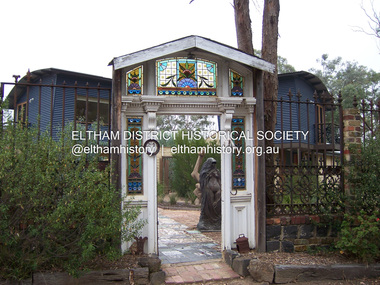 Eltham District Historical Society Inc
Photograph - Digital Photograph, Marguerite Marshall, Doorway of Clifton Pugh's former house at Dunmoochin, Barreenong Road, Cottles Bridge, 5 February 2008
... La Trobe University in Victoria stores and curates the art collection and organises its exhibition around Australia.2 The Foundation aims to protect and foster the natural environment and to provide residences, studios and community art facilities at a minimal cost for artists and environmental researchers. They reside at the non-profit organisation for a year at minimal cost. The buildings, some decorated with murals painted by Pugh and including a gallery, were constructed by Pugh, family...La Trobe University in Victoria stores and curates the art collection and organises its exhibition around Australia.2 The Foundation aims to protect and foster the natural environment and to provide residences, studios and community art facilities at a minimal cost for artists and environmental researchers. They reside at the non-profit organisation for a year at minimal cost. The buildings, some decorated with murals painted by Pugh and including a gallery, were constructed by Pugh, family ...Following military service in the second world war, Clifton Pugh studied under artist Sir William Dargie at the National Gallery School in Melbourne as well as Justus Jorgensen, founder of Montsalvat. For a while he lived on the dole but also worked packing eggs for the Belot family saving sufficient to purchase six acres (2.4 ha) of land at Barreenong Road, Cottles Bridge. He accumulated more land and persuaded several other artists and friends to buy land nearby, resulting in a property of approximately 200 acres, stablishing it as one of the first artistic communes in Australia alongside Montsalvat in Eltham. It was around 1951 that Pugh felt he had '"done moochin' around" and so the name of the property evolved. He bought timber from Alistair Knox to build his house on the crest of a hill. Inspired by local goldminer's huts, it was a one room wattle-and-daub structure with dirt floor. Over the years it expanded with thick adobe walls made from local clay, high ceilings and stone floors. All materials other than the local earth were sourced from second hand materials, most found at wreckers' yards. Artists from across the nation were drawn to Dunmoochin, with several setting up houses and shacks on the property, maintaining their independence but sharing their artistic zeal. Artists who worked or resided at Dunmoochin included Mirka Mora, John Perceval, Albert Tucker, Fred Williams, Charles Blackman, Arthur Boyd and John Olsen. In 2002, Pugh's house along with its treasure trove of art and a library of some 20,000 books was destroyed by fire. Traces of Pugh's home remain with the presence of the Victorian doorframe archway with leadlight of intricate design, procured from a demolished Melbourne mansion; and two bronze life-sized female statues created by Pugh and cast by Matcham Skipper. In place of Pugh's house rose two double-storey mud-brick artists' studios topped with corrugated iron rooves curved like the wings of a bird with accommodation for seven. The original studios, gallery and other buildings survived the fire. Covered under Heritage Overlay, Nillumbik Planning Scheme. Published: Nillumbik Now and Then / Marguerite Marshall 2008; photographs Alan King with Marguerite Marshall.; p155 It’s not surprising that artist Clifton Pugh was drawn to Cottles Bridge to establish his artists’ colony Dunmoochin. Undisturbed by the clamour of modern life at Barreenong Road, Pugh was surrounded by the Australian bush he loved, and where his ashes were later scattered. The 200 acres (81ha) of bushland, broken by glimpses of rolling hills, has more than 50 species of orchids and Pugh shared his property with native animals including kangaroos, emus, phascogales, wombats, and diverse bird life. Pugh encouraged these creatures to join him in the bush by creating, with Monash University, a holding station where the animals were raised. Dunmoochin inspired Pugh for such paintings as in a book on orchids and the Death of a Wombat series.1 But his love for the bush was accompanied by the fear that Europeans were destroying it and much of his painting illustrated this fear and his plea for its conservation.2 However it was his house rather than the surrounding bush that was to be destroyed. Tragically in 2002 Pugh’s house, with its treasure of art and library of 20,000 art books, was destroyed by fire. Traces of the beauty of Pugh’s home still remain, however, in the magnificent Victorian doorframe archway with leadlight of intricate design procured from a demolished Melbourne mansion; and two bronze life-sized female statues created by Pugh and cast by Matcham Skipper. Now in place of Pugh’s house, are two double-storey mud-brick artists’ studios topped with corrugated roofs curved like birds’ wings, with accommodation for seven. The original studios, gallery and other buildings remain.3 Pugh grew up on his parents’ hobby farm at Briar Hill and attended the Briar Hill Primary School, then Eltham High School and later Ivanhoe Grammar. At 15 he became a copy boy for the Radio Times newspaper, then worked as a junior in a drafting office. Pugh was to have three wives and two sons. After serving in World War Two in New Guinea and Japan, Pugh studied under artist Sir William Dargie, at the National Gallery School in Melbourne.4 Another of his teachers was Justus Jörgensen, founder of Montsalvat the Eltham Artists’ Colony. Pugh lived on the dole for a while and paid for his first six acres (2.4ha) at Barreenong Road by working as an egg packer for the Belot family. Pugh accumulated more land and persuaded several other artists and friends to buy land nearby, resulting in the 200 acre property. They, too, purchased their land from the Belot family by working with their chickens. Around 1951 Pugh felt he had ‘Done moochin’ around’ and so the name of his property was born. Pugh bought some used timber from architect Alistair Knox to build his house on the crest of a hill. Inspired by local goldminers’ huts it was a one-room wattle-and-daub structure with a dirt floor. It was so small that the only room he could find for his telephone was on the fork of a tree nearby.5 Over the years the mud-brick house grew to 120 squares in the style now synonymous with Eltham. It had thick adobe walls (sun-dried bricks) made from local clay, high ceilings and stone floors with the entire structure made of second-hand materials – most found at wreckers’ yards. Pugh’s first major show in Melbourne in 1957, established him as a distinctive new painter, breaking away from the European tradition ‘yet not closely allied to any particular school of Australian painting’.6 Pugh became internationally known and was awarded the Order of Australia. He won the Archibald Prize for portraiture three times, although he preferred painting the bush and native animals. In 1990 not long before he died, Pugh was named the Australian War Memorial’s official artist at the 75th anniversary of the landing at Gallipoli. Today one of Pugh’s legacies is the Dunmoochin Foundation, which gives seven individual artists or couples and environmental researchers the chance to work in beautiful and peaceful surroundings, usually for a year. By November 2007, more than 80 people had taken part, and the first disabled artist had been chosen to reside in a new studio with disabled access.1 In 1989, not long before Pugh died in 1990 of a heart attack at age 65, he established the Foundation with La Trobe University and the Victorian Conservation Trust now the Trust for Nature. Pugh’s gift to the Australian people – of around 14 hectares of bushland and buildings and about 550 art works – is run by a voluntary board of directors, headed by one of his sons, Shane Pugh. La Trobe University in Victoria stores and curates the art collection and organises its exhibition around Australia.2 The Foundation aims to protect and foster the natural environment and to provide residences, studios and community art facilities at a minimal cost for artists and environmental researchers. They reside at the non-profit organisation for a year at minimal cost. The buildings, some decorated with murals painted by Pugh and including a gallery, were constructed by Pugh, family and friends, with recycled as well as new materials and mud-bricks. The Foundation is inspired by the tradition begun by the Dunmoochin Artists’ Cooperative which formed in the late 1950s as one of the first artistic communes in Australia. Members bought the land collaboratively and built the seven dwellings so that none could overlook another. But, in the late 1960s, the land was split into private land holdings, which ended the cooperative. Dunmoochin attracted visits from the famous artists of the day including guitarists John Williams and Segovia; singer and comedian Rolf Harris; comedian Barry Humphries; and artists Charles Blackman, Arthur Boyd and Mirka Mora. A potters’ community, started by Peter and Helen Laycock with Alma Shanahan, held monthly exhibitions in the 1960s, attracting local, interstate and international visitors – with up to 500 attending at a time.3 Most artists sold their properties and moved away. But two of the original artists remained into the new millennium as did relative newcomer Heja Chong who built on Pugh’s property (now owned by the Dunmoochin Foundation). In 1984 Chong brought the 1000-year-old Japanese Bizan pottery method to Dunmoochin. She helped build (with potters from all over Australia) the distinctive Bizan-style kiln, which fires pottery from eight to 14 days in pine timber, to produce the Bizan unglazed and simple subdued style. The kiln, which is rare in Australia, is very large with adjoining interconnected ovens of different sizes, providing different temperatures and firing conditions. Frank Werther, who befriended Pugh as a fellow student at the National Gallery Art School in Melbourne, built his house off Barreenong Road in 1954. Werther is a painter of the abstract and colourist style and taught art for about 30 years. Like so many in the post-war years in Eltham Shire, as it was called then, Werther built his home in stages using mud-brick and second-hand materials. The L-shaped house is single-storey but two-storey in parts with a corrugated-iron pitched roof. The waterhole used by the Werthers for their water supply is thought to be a former goldmining shaft.4 Alma Shanahan at Barreenong Road was the first to join Pugh around 1953. They also met at the National Gallery Art School and Shanahan at first visited each weekend to work, mainly making mud-bricks. She shared Pugh’s love for the bush, but when their love affair ended, she designed and built her own house a few hundred yards (metres) away. The mud-brick and timber residence, made in stages with local materials, is rectangular, single-storey with a corrugated-iron roof. As a potter, Shanahan did not originally qualify as an official Cooperative member.This collection of almost 130 photos about places and people within the Shire of Nillumbik, an urban and rural municipality in Melbourne's north, contributes to an understanding of the history of the Shire. Published in 2008 immediately prior to the Black Saturday bushfires of February 7, 2009, it documents sites that were impacted, and in some cases destroyed by the fires. It includes photographs taken especially for the publication, creating a unique time capsule representing the Shire in the early 21st century. It remains the most recent comprehenesive publication devoted to the Shire's history connecting local residents to the past. nillumbik now and then (marshall-king) collection, art gallery, clifton pugh, dunmoochin, cottlesbridge, cottles bridge, barreenong road -
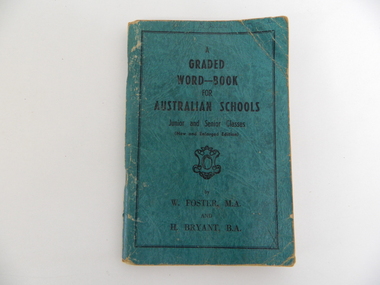 Kiewa Valley Historical Society
Book - Spelling, A Graded Word-Book For Australian Schools
... Educational book used for teaching Spelling circa 1950s - 1960s Historical: Comparative with educational books of different eras. education. word study. spelling. davies family A / Graded / Word-Book / for / Australian Schools / Junior and Senior Classes / (New on Enlarged Edition) / emblem / by / W. Foster ...Educational book used for teaching Spelling circa 1950s - 1960sHistorical: Comparative with educational books of different eras. An emerald green book with black writing (printed) with a thin and thick black line around the perimeter. Bound by 2 staplesA / Graded / Word-Book / for / Australian Schools / Junior and Senior Classes / (New on Enlarged Edition) / emblem / by / W. Foster, M.A. / and / H. Bryant, B. A.education. word study. spelling., davies family
