
Showing 8 items matching "framlingham east"
-
 Warrnambool and District Historical Society Inc.
Map (series) - Local Parish Maps, Local Government maps 1942 and three fire maps
... ...Framlingham East...The following maps are in the collection: Belfast; Brucknell; Caramut; Cooramook; Framlingham East; Framlingham West; Garvoc; Laang; Kangertong; Meerai, Minjah North; Minjah; Minhamite; Nullawarre; Narrawaturk; Nirranda; Paaratte; Panmure; Purnim; Quamby North; Tallangatta; Quamby; Timboon; Wangoom; Willatook; Woolsthorpe; Yangery; Yarpturk; Ecklin; Yeth- Youang. ...The following maps are in the collection: Belfast; Brucknell; Caramut; Cooramook; Framlingham East; Framlingham West; Garvoc; Laang; Kangertong; Meerai, Minjah North; Minjah; Minhamite; Nullawarre; Narrawaturk; Nirranda; Paaratte; Panmure; Purnim; Quamby North; Tallangatta; Quamby; Timboon; Wangoom; Willatook; Woolsthorpe; Yangery; Yarpturk; Ecklin; Yeth- Youang. ...These show the Western District in detail with property owners named . The fire maps have properties which are numbered.western district maps, belfast, brucknell, caramut, cooramook, framlingham east, framlingham west, garvoc, laang, kangertong, meerai, minjah north, minjah, minhamite, nullawarre, narrawaturk, nirranda, paaratte, panmure, purnim, quamby north, tallangatta, quamby, timboon, wangoom, willatook, woolsthorpe, yangery, yarpturk, ecklin, yeth- youang.western district maps, belfast, brucknell, caramut, cooramook, framlingham east, framlingham west, garvoc, laang, kangertong, meerai, minjah north, minjah, minhamite, nullawarre, narrawaturk, nirranda, paaratte, panmure, purnim, quamby north, tallangatta, quamby, timboon, wangoom, willatook, woolsthorpe, yangery, yarpturk, ecklin, yeth- youang. -
 Warrnambool and District Historical Society Inc.
Book, Exercise book Winnie Goodall, Early 20th century
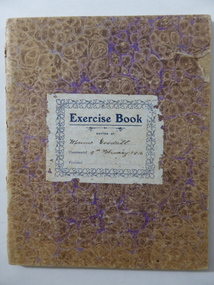
... Eventually they had a property named Wanstead on the Allansford Road in East Warrnambool. One son, William, was an early manager of the Framlingham Aboriginal Settlement. ...Eventually they had a property named Wanstead on the Allansford Road in East Warrnambool. One son, William, was an early manager of the Framlingham Aboriginal Settlement. ...This exercise book has been used by Winnifred (Winnie) Goodall in 1916 when she was a pupil at the Warrnambool Technical School. The material in the book mostly consists of letter-writing practice for business purposes. The Goodalls were pioneer settlers in the Warrnambool district with William and Ellen Goodall arriving in the area in the late 1840s. Eventually they had a property named Wanstead on the Allansford Road in East Warrnambool. One son, William, was an early manager of the Framlingham Aboriginal Settlement. Another son, Thomas, was a Warrnambool law clerk and Winnie, (born 1901 to mother Leah), was his granddaughter. The Warrnambool Technical School was established in 1913.This exercise book is of interest as an example of school work completed by a Warrnambool Technical School student in 1916. It is also of interest because it belonged to Winnie Goodall, a member of an important pioneering family in the Warrnambool district. This is a school exercise book with a cardboard cover and 17 double pages. The cover has a mottled pattern of brown and mauve and the pages have been attached by metal staples but the staples have been removed. The pages have blue ruled lines with handwritten material in blue and black ink. Some of the pages have red hand-drawn lines. The cover is slightly torn. On the first page two cartoon sketches from a newspaper have been pasted in. The front cover has a printed label in blue and white colouring pasted on, with handwritten information on the label. There is a has a circular black , white and blue logo pasted on the inside front cover.‘Exercise Book Written by Winnie Goodall, Commenced 9th February 1916’. Inside cover Logo: Sons of Temperance Warrnambool Division Instituted March 11 1870 Be Firm and Faithful Love Purity Fidelity winnifred goodall, warrnambool technical school, sons of temperance warrnambool -
 Warrnambool and District Historical Society Inc.
Book, Poems - Australian poetry lovers society, 1952
... He also recorded some of the history of Framlingham, a small settlement about 24 kilometres north east of Warrnambool. ...He also recorded some of the history of Framlingham, a small settlement about 24 kilometres north east of Warrnambool. ...This book was published in 1952 by the Australian Poetry Lovers’ Society. This group was based in Melbourne and was founded in 1934 by George and Ethel Fielding. In 1973 a member, Harry Hastings Pearce, wrote a history of the society. This 1952 volume contains two poems by Thomas Terrington (born 1897) - ‘Henry Lawson’ and ‘Stella’. Tom Terrington was a well-known local poet and writer from Framlingham. He has been described as a ‘rhymster of flair and skill’. He was a self-taught person with little formal education and he worked at various jobs until he took over the general store at Framlingham in his middle age. He also recorded some of the history of Framlingham, a small settlement about 24 kilometres north east of Warrnambool. The identity of ‘Fred’ in the inscription is not known. This book is of interest because it contains two poems written by Tom Terrington, a local 20th century writer and poet. This is a soft cover book of 50 pages. The cover is green with black printing and an image of two kookaburras on the front cover. The book has poems by 18 writers and a black and white photograph on page 10 of the late George Fielding. The cover is somewhat soiled. The book has been stapled but the staples have been removed. The inscription is handwritten in black ink. ‘To Fred with best wishes from Tom Terrington Framlingham 21.11.52’ tom terrington, history of framlingham -
 Warrnambool and District Historical Society Inc.
Book, Love sweetens truth, 1880s
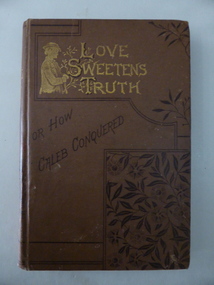
... East Melbourne in 1887. The Principals of the school were the Misses Singleton and their father, Dr John Singleton was a practising doctor in Warrnambool from 1860 to 1865. He had an important influence on Warrnambool, establishing several Total Abstinence Societies and campaigning for improved health conditions for pastoral workers in the district and the aborigines at Framlingham. ...East Melbourne in 1887. The Principals of the school were the Misses Singleton and their father, Dr John Singleton was a practising doctor in Warrnambool from 1860 to 1865. He had an important influence on Warrnambool, establishing several Total Abstinence Societies and campaigning for improved health conditions for pastoral workers in the district and the aborigines at Framlingham. ...This book was a prize awarded to Miss Middleton, a pupil at Ormiston House College, East Melbourne in 1887. The Principals of the school were the Misses Singleton and their father, Dr John Singleton was a practising doctor in Warrnambool from 1860 to 1865. He had an important influence on Warrnambool, establishing several Total Abstinence Societies and campaigning for improved health conditions for pastoral workers in the district and the aborigines at Framlingham. In Melbourne Dr Singleton and his wife worked tirelessly for the underprivileged. He established many institutions for the less fortunate, including the Prisoners’ Aid Society, the Children’s Hospital, lending libraries, cottages for widows, shelters for homeless men and women, a society for the protection of animals and the Collingwood Free Medical Dispensary. He died in 1891 at Ormiston House, his daughters’ school and home. It is not known which of the Singleton daughters ran the school and no information has been found on Miss Middleton. This book is of considerable interest as it has a close connection to Dr John Singleton, important not only in the social history of Melbourne but also in the history of Warrnambool. This is a hard cover book of 160 pages with 16 pages at the back of the book of advertisements for other books published by the Religious Tract Society. The cover is brown with a sketch of a young man and lettering in gold and an ornamental floral pattern on the front cover. The gold lettering and the ornamental floral pattern are also on the spine. The book has 13 chapters with ornamental scrolls and initials at the beginning and end of each chapter. There are also some full page black and white sketches in the book, with the one at the front of the book covered by a piece of tissue paper. The book plate at the front of the book is white with a gold border pasted onto the page and handwritten details have been added in black ink. The book is a little scuffed at the edges of the cover. ‘Ormiston House College, East Melbourne, Principals, The Misses Singleton, Prize for Writing and Maps in Upper Third Class Awarded to Miss Middleton, Christmas 1887.’ dr john singleton, ormiston house, history of warrnambool -
 Warrnambool and District Historical Society Inc.
Book, A selection of Poems, Mid 1930s
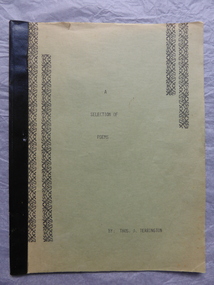
... Framlingham is a small settlement 25 kilometres north east of Warrnambool. ...Framlingham is a small settlement 25 kilometres north east of Warrnambool. ...This booklet of poems has been compiled by Thomas Terrington. Born in 1897 Tom Terrington worked at dairying, fencing, carpentering and woodcutting before taking over the Framlingham store when he was in his forties. He was a scholarly person with a wide knowledge of English literature. He was a well-known local poet and a member of the Australian Poetry Lovers’ Society. He wrote extensively on local history and his unpublished ‘History of Framlingham’ is in the State Library. Framlingham is a small settlement 25 kilometres north east of Warrnambool. This booklet is of interest as it contains some of the poems written by Tom Terrington, an important resident of Framlingham in the 20th century. This is a soft cover book of 24 pages. The cover is green with black decorative borders and black binding. The pages have black printing on green paper. The last few pages are missing. The cover is faded and a little torn. There are ornamental scrolls and patterns in black throughout the pages. tom terrington, history of framlingham -
 Warrnambool and District Historical Society Inc.
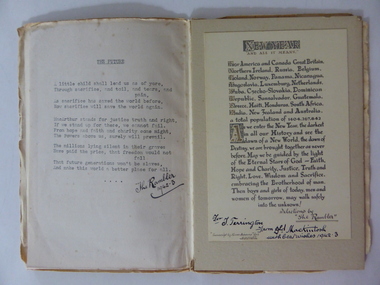
Card, Poems The Future The Rambler, 1942
... These two items were sent in the 1940s to Tom Terrington of Framlingham (about 28 kilometres north east of Warrnambool) from Donald Mackintosh. ...These two items were sent in the 1940s to Tom Terrington of Framlingham (about 28 kilometres north east of Warrnambool) from Donald Mackintosh. ...These two items were sent in the 1940s to Tom Terrington of Framlingham (about 28 kilometres north east of Warrnambool) from Donald Mackintosh. Tom Terrington (b.1897) worked at various jobs until he took over the Framlingham store in the 1940s. He was a scholarly person with a wide knowledge of English literature. He wrote poetry and researched and wrote extensively on Framlingham history. Donald Mackintosh (1866-1951) was Australia’s first Olympic shooting gold medallist. He competed in trapshooting events all over the world, winning 30 gold medals, making a considerable amount of money and holding the world trapshooting championship title from 1903 to 1908. He was a keen photographer and wrote poetry under the name of ‘The Rambler’. This small folder is of great interest as it contains a poem sent to Tom Terrington by Donald Mackintosh (The Rambler). Tom Terrington is important in Framlingham’s history and his friendship with Donald Mackintosh, an Australian and world trapshooting champion and a poet is of considerable interest. The tone of the poem echoes also the despondency felt by Australians during the darkest days of World War Two. This is a piece of cream thickened paper folded in two with a typed copy of a poem pasted on the inside of the paper and a copy of a prose piece typed in ornate script and pasted on to a piece of cardboard and enclosed in the cream folder. Both of the typed items have handwritten messages at the bottom of the text. The cream folder is a little crumpled and stained. ‘The Rambler 1942-3’ ‘For T. Terrington from Dld Mackintosh with best wishes 1942-3’tom terrington, donald mackintosh -
 Warrnambool and District Historical Society Inc.
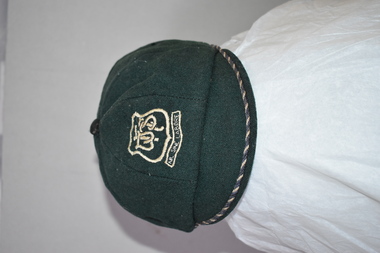
Hat, School W'bool High School, Early 1930s
... The Goodall family has been in the Warrnambool area since the mid 1850s including being at the farm, ‘Wanstead’ in East Warrnambool and at Framlingham in the 19th century where William Goodall was the manager of the aboriginal settlement. ...The Goodall family has been in the Warrnambool area since the mid 1850s including being at the farm, ‘Wanstead’ in East Warrnambool and at Framlingham in the 19th century where William Goodall was the manager of the aboriginal settlement. ...This is a Warrnambool High School cap from the 1930s. Warrnambool High School was established in 1907 with a farm site in Merrivale and it was also in several sites in the main town area, with the longest occupancy in Hyland Street. In 1961 the school moved to its present location in Albert Park (Grafton Road). The High School amalgamated with Warrnambool North Technical School in 1995 to form Warrnambool College. Malcolm Goodall, the owner of the cap, was born in 1917 and died in 2010. He lived in Coulstock Street and he worked in the tinning department of Nestles. The Goodall family has been in the Warrnambool area since the mid 1850s including being at the farm, ‘Wanstead’ in East Warrnambool and at Framlingham in the 19th century where William Goodall was the manager of the aboriginal settlement. This cap is of interest as an example of the boys’ uniform at Warrnambool High School in the 1930s and as a memento of Malcolm Goodall. His ancestors were pioneers in the Warrnambool district.This is a boy’s cap made of dark green cloth with octagonal sections and a cloth button on top. The peak is edged with navy and cream cord. The centre front of the cap has a school badge with the school initials and motto. The inside of the cap is lined with black cloth with a cream centre and has the cap seller’s business details and the name of the owner of the cap. Some of the printed material here is indecipherable. The stitching is worn in some places. W.H.S. Sine Labore V. Becker Boys Shop & Hosiery Parlour Warrnambool Name: M. Goodall warrnambool high school, goodall family, history of warrnambool -
![Scene near Corranderrk Station / [by] Nicholas Caire, circa 1876](/media/collectors/550653872162f11fb04854aa/items/57774ae0d0cdd10a5c12f2d7/item-media/57774b61d0cdd10a5c132dac/item-fit-380x285.jpg?cb=6) Kew Historical Society Inc
Kew Historical Society IncPhotograph, Anglo-Australasian Photographic Company, Scene near Corranderrk Station, c. 1876
... The other two were secular government controlled reserves: Framlingham which, like Lake Condah, was established for the Mara-speaking Gunditjmara and Kirrae-wurrung people of south-west Victoria; and Coranderrk, located about 60 kilometres north-east of Melbourne, for the Kulin clans of central Victoria. ...The other two were secular government controlled reserves: Framlingham which, like Lake Condah, was established for the Mara-speaking Gunditjmara and Kirrae-wurrung people of south-west Victoria; and Coranderrk, located about 60 kilometres north-east of Melbourne, for the Kulin clans of central Victoria. ...Nicholas Caire was born on Guernsey in the Channel Islands in 1837. He arrived in Adelaide with his parents in about 1860. In 1867, following photographic journeys in Gippsland, he opened a studio in Adelaide. From 1870 to 1876 he lived and worked in Talbot in Central Victoria. In 1876 he purchased T. F. Chuck's studios in the Royal Arcade Melbourne. In 1885, following the introduction of dry plate photography, he began a series of landscape series, which were commercially successful. As a photographer, he travelled extensively through Victoria, photographing places few of his contemporaries had previously seen. He died in 1918. Reference: Jack Cato, 'Caire, Nicholas John (1837–1918)', Australian Dictionary of Biography. The 1860s marked the beginning of the era of reserves and missions. Six Aboriginal reserves were established during the 1860s. These were under the control of the Board for the Protection of Aborigines. Four were Christian missions receiving government aid. These were Lake Tyers (Anglican) and Ramahyuck (Presbyterian/Moravian) in eastern Victoria for the Gunai/Kurnai clans; Ebenezer (Moravian) in north-west Victoria for the clans of the Wimmera and Lower Murray; and Lake Condah (Anglican) in south-west Victoria. The other two were secular government controlled reserves: Framlingham which, like Lake Condah, was established for the Mara-speaking Gunditjmara and Kirrae-wurrung people of south-west Victoria; and Coranderrk, located about 60 kilometres north-east of Melbourne, for the Kulin clans of central Victoria. In 1863, after a period of devastation to the Kulin people, Coranderrk was established at the junction of the Yarra River and Badger Creek. Reference: http://coranderrk.com/, accessed 24 December 2016An original, rare photograph from the series 'Views of Victoria: General Series' by the photographer, Nicholas Caire (1837-1918). The series of 60 photographs that comprise the series was issued c. 1876 and reinforced a neo-Romantic view of the Australian landscape to which a growing nationalist movement would respond. Nicholas Caire was active as a photographer in Australia from 1858 until his death in 1918. His vision of the Australian bush and pioneer life had a counterpart in the works of Henry Lawson and other nationalist poets, authors and painters.Albumen silver photograph mounted on boardprinted in ink on support l.c.: SCENE NEAR "CORRANDERRK" STATION. / COPYRIGHT REGISTERED. printed in ink on support reverse c.: VIEWS OF VICTORIA. / (GENERAL SERIES.) / No. 9. / SCENE NEAR "CORRANDERRK" STATION. / This scene was taken from the hill near Rourke's Bridge, on the Healesville Road, and displays in the foreground / the River Yarra. The roadway which is seen in the mid-distance has lately been constructed by the Government, / as the old tracks which formerly existed, were liable to be swamped by the periodical overflowing of the River. Mount / Ridell can be seen in the extreme distance immediately behind the roadway. / Corranderrk is the local habitation / for the natives of this district, and is situated on the right hand side of the picture, about a mile and a half / from the roadway. printed in ink on support reverse l.c.l.: J.W. FORBES, Agent, printed in ink on support reverse l.c.: ANGLO-AUSTRALASIAN PHOTOGRAPHIC COMPANY, MELBOURNE. printed in ink on support reverse l.c.r.: 10 Temple Court, Collins Street West.nicholas caire (1837-1918), coranderrk aboriginal station, aborigine, yarra river, badger creek, first peoples, aboriginal and torres straight islander
