
Showing 113 items matching "francis brothers"
-
 Bendigo Historical Society Inc.
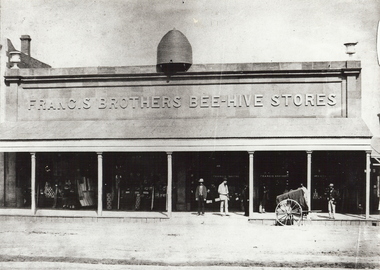
Photograph - FRANCIS BROTHERS BEEHIVE STORES, 1850's ?
... FRANCIS BROTHERS BEEHIVE STORES......francis brothers beehive stores...Black and white (copy): front of Francis Brothers Beehive Stores. Verandah at front, model of Beehive on top. ...ORGANIZATION Business francis brothers beehive stores Francis Brothers. ...Black and white (copy): front of Francis Brothers Beehive Stores. Verandah at front, model of Beehive on top. Three men standing on verandah, Batchelder wagon on right ? (Batchelder photos of Bendigo are 1861). See Research field for further information.Batchelderorganization, business, francis brothers beehive stores, francis brothers. beehive stores. francis, william. francis, richard. -
 Bendigo Historical Society Inc.
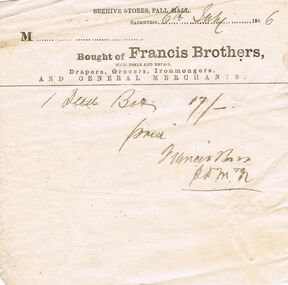
Document - ANCIENT ORDER OF FORESTERS NO 3770 COLLECTION: RECEIPT
... ... Francis Brothers...Box for 17/-. Bought of Francis Brothers. Beehive Stores, Pall Mall. Paid....Box for 17/-. Bought of Francis Brothers. Beehive Stores, Pall Mall. Paid. ...Account/receipt dated 6 ? 1866 for 1 ? Box for 17/-. Bought of Francis Brothers. Beehive Stores, Pall Mall. Paid.societies, aof, correspondence, ancient order of foresters no 3770 collection - receipt, beehive stores, francis brothers -
 Bendigo Historical Society Inc.
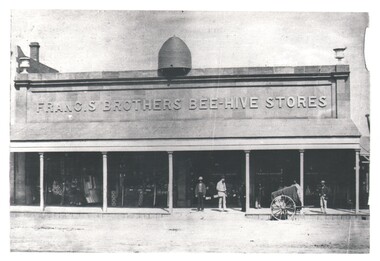
Photograph - WES HARRY COLLECTION: BEE - HIVE STORES, 1861
... ...Francis Brothers...Above the verandah in raised lettering is ' Franc.s ( Francis) Brothers Beehive Stores, There are two decorative urns on each side of the parapet and in the middle is a stylized representation of a Beehive....BUILDINGS Commercial beehive stores Francis Brothers Beehive Stores Pall Mall Batchelder Photograph of a single storied stone shop front with a wide verandah over the wooden footpath. ...Photograph of a single storied stone shop front with a wide verandah over the wooden footpath. Above the verandah in raised lettering is ' Franc.s ( Francis) Brothers Beehive Stores, There are two decorative urns on each side of the parapet and in the middle is a stylized representation of a Beehive.Batchelderbuildings, commercial, beehive stores, francis brothers, beehive stores, pall mall -
 Bendigo Historical Society Inc.
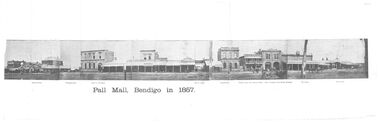
Photograph - BLACK AND WHITE PANORAMIC PHOTOGRAPH OF PALL MALL BENDIGO IN 1857
... Hall of Commerce / Mining Exchange / the Beehive - Francis Brothers Beehive Stores/ Pikes Corner / B Morey Saddler / ...Black and white fold - out Panoramic Composite photograph of Pall mall Bendigo in 1857 on cream, aged paper showing the Shamrock hotel, Williamson St, Bank of Australasia, site of Arcade, Colonial Bank, Victoria Hotel (now National bank), Hall of Commerce (now Mining Exchange), the Beehive - Francis Brothers Beehive Stores, Pikes Corner, B Morey Saddler, Blythe & Inglis Family Grocer Provisions dealer, Horse Bazaar Cattle sale Yard, Jones & Shiress Chemists, horses and carts- enclosed in envelope addressed to 'Mrs Reube P Lumbe C/- Bethlehem Home for Aged Taylor St Specimen Hill...BENDIGO Streetscape pall mall Pall mall Bendigo in 1857 / Shamrock hotel / Colonial Bank / Victoria Hotel / Hall of Commerce / Mining Exchange / the Beehive - Francis Brothers Beehive Stores/ Pikes Corner / B Morey Saddler / Blythe & Inglis Family Grocer Provisions dealer / Jones & Shiress Chemists / Horse Bazaar Cattle sale Yard Black and white fold - out Panoramic Composite photograph of Pall mall Bendigo in 1857 on cream, aged paper showing the Shamrock hotel, Williamson St, Bank of Australasia, site of Arcade, Colonial Bank, Victoria Hotel (now National bank), Hall of Commerce (now Mining Exchange), the Beehive - Francis Brothers Beehive Stores, Pikes Corner, B Morey Saddler, Blythe & Inglis Family Grocer Provisions dealer, Horse Bazaar Cattle sale Yard, Jones & Shiress Chemists, horses and carts- enclosed in envelope addressed to 'Mrs Reube P Lumbe C/- Bethlehem Home for Aged Taylor St Specimen Hill Photograph BLACK AND WHITE PANORAMIC PHOTOGRAPH OF PALL MALL BENDIGO IN 1857 ...Black and white fold - out Panoramic Composite photograph of Pall mall Bendigo in 1857 on cream, aged paper showing the Shamrock hotel, Williamson St, Bank of Australasia, site of Arcade, Colonial Bank, Victoria Hotel (now National bank), Hall of Commerce (now Mining Exchange), the Beehive - Francis Brothers Beehive Stores, Pikes Corner, B Morey Saddler, Blythe & Inglis Family Grocer Provisions dealer, Horse Bazaar Cattle sale Yard, Jones & Shiress Chemists, horses and carts- enclosed in envelope addressed to 'Mrs Reube P Lumbe C/- Bethlehem Home for Aged Taylor St Specimen Hillbendigo, streetscape, pall mall, pall mall bendigo in 1857 / shamrock hotel / , colonial bank / victoria hotel /, hall of commerce / mining exchange / the beehive - francis brothers beehive stores/ pikes corner / b morey saddler / , blythe & inglis family grocer provisions dealer / jones & shiress chemists /, horse bazaar cattle sale yard -
 Bendigo Historical Society Inc.
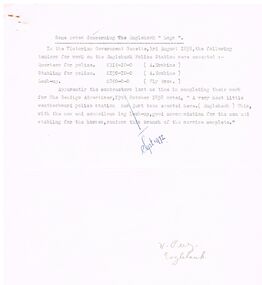
Document - RESEARCH NOTES: ONE TREE HILL, STORMWATER CHANNEL, ANTHONY TROILLOPE, HORSE TRAMWAY TO GOLDEN SQUARE
... ... Francis Brothers...DOCUMENT Various Notes Eaglehawk Logs Bendigo Advertiser 19/10/1858 Damaging the Stormwater Channel Bendigo Advertiser 11/8/1872 Harneys Bridge Gas Works Constable Rogers Constable James Bradley Joch John O'C Hattam One Tree Hill Ryan Trollope's Fabulous Bendigo Anthony Trollope 'Trollope’s Australia' Nelson Press Alex H Stone Bendigo Advertiser 5/7/1897 Mr Peter Ellis Cr Hoskins Horse Tramway Historical Society Water Wheel Flour Mill June Parry Mr Pat Wodetzki Mr Leo Wodetzki Neil Murray Mr K Hester Mr Wes Harry Mr I Hendry Mr henry Jackson Mr Connelly Mr Irons Mr Harney Dr Smith Dr Hoyle Rev Dr Bachaus Rev Dr Nish Rev Joseph Dare Hon Angus Mackay Mr Haverfield Mr J K Robshaw W P Neal Mr George Lansell Hon J H Abbott M L C MR J Casey Dr James Boyd Dr Atkinson Dr Easie Mr T H Henderson Old Beehive Francis Brothers Mr John Crowley MR Jacob Cohn Art Gallery Mr Hugh McDevitt Mr Alexander Bayne Mr F Sciallero Camp Reserve Hon W I Winter-Irvine MR George Avery Fletcher Great Central Goldfield of Victoria Safety Cages Bendigo Advertiser J H Seymour Mr Horwood New Chum and Victoria Tribute Company James Watson Seymour's Patent Safety Cage Londerry Tribute National Show Sandhurst H Banfield Mr A Llewllyn 'Dear Old Bendigo' Thomas Bracken Mr William Heffernan Mr Edward (Ned) Ryan Mr Samuel Bastard Mr Charles Bird McPherson and Co Fern Hill Club Mr George Tolhurst Tolhurst Brothers Union Bank Mr Lawrence Ryan Mr Shadrack Jones Charley Armstrong Armstrong Brothers Mr Abraham Solomen Mr Bladiere Mr R T Wheeler Typed and handwritten notes. ...Typed and handwritten notes. Mentioned are: - Some Notes Concerning The Eaglehawk Logs, Damaging the Stormwater Channel, where some Chinese were digging away the Creek, the cutting down of the giant gum tree which gave One Tree Hill its name, How Anthony Trollope saw Bendigo in the 1870's, A Proposed Horse Tramway to Golden Square, Society’s' Trip to Bridgewater Flour Mill, A talk on a trip to Malaya by Mr D Hester, Society News and Happenings, Old Bendigonians and Safety Cages,document, various notes, eaglehawk logs, bendigo advertiser 19/10/1858, damaging the stormwater channel, bendigo advertiser 11/8/1872, harneys bridge, gas works, constable rogers, constable james bradley, joch, john o'c hattam, one tree hill, ryan, trollope's fabulous bendigo, anthony trollope, 'trollope’s australia', nelson press, alex h stone, bendigo advertiser 5/7/1897, mr peter ellis, cr hoskins, horse tramway, historical society, water wheel flour mill, june parry, mr pat wodetzki, mr leo wodetzki, neil murray, mr k hester, mr wes harry, mr i hendry, mr henry jackson, mr connelly, mr irons, mr harney, dr smith, dr hoyle, rev dr bachaus, rev dr nish, rev joseph dare, hon angus mackay, mr haverfield, mr j k robshaw, w p neal, mr george lansell, hon j h abbott, m l c, mr j casey, dr james boyd, dr atkinson, dr easie, mr t h henderson, old beehive, francis brothers, mr john crowley, mr jacob cohn, art gallery, mr hugh mcdevitt, mr alexander bayne, mr f sciallero, camp reserve, hon w i winter-irvine, mr george avery fletcher, great central goldfield of victoria, safety cages, bendigo advertiser, j h seymour, mr horwood, new chum and victoria tribute company, james watson, seymour's patent safety cage, londerry tribute, national show sandhurst, h banfield, mr a llewllyn, 'dear old bendigo', thomas bracken, mr william heffernan, mr edward (ned) ryan, mr samuel bastard, mr charles bird, mcpherson and co, fern hill club, mr george tolhurst, tolhurst brothers, union bank, mr lawrence ryan, mr shadrack jones, charley armstrong, armstrong brothers, mr abraham solomen, mr bladiere mr r t wheeler -
 Bendigo Historical Society Inc.
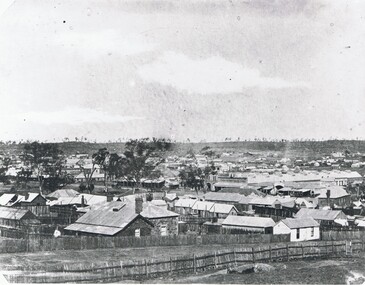
Photograph - STREETSCAPE: BENDIGO, 1857 ?
... In image on parapet of building in middle distance ' Francis Brothers Beehive Stores'...In image on parapet of building in middle distance ' Francis Brothers Beehive Stores' Photograph STREETSCAPE: BENDIGO ...Black and white photograph. View of Bendigo Many small buildings, weatherboard, stone, paling. Trees on horizon, Beehive stores in middle distance. Rough vertical stick fences, fencs in foreground. Taken from high ground. In image on parapet of building in middle distance ' Francis Brothers Beehive Stores'A. Fox ( James Lerk 11.2.2000 )place, streetscape, bendigo -
 Glenelg Shire Council Cultural Collection
Photograph - Photograph - Claremont, n.d
... Stephen George Henty had Claremont built in 1852 and rented the property to his brother Francis. Claremont is on Julia Street...Stephen George Henty had Claremont built in 1852 and rented the property to his brother Francis. Claremont is on Julia Street Claremont Julia Street Stephen Henty Photograph of Claremont, Portland. ...Stephen George Henty had Claremont built in 1852 and rented the property to his brother Francis. Claremont is on Julia StreetPhotograph of Claremont, Portland.claremont, julia street, stephen henty -
 Bendigo Military Museum
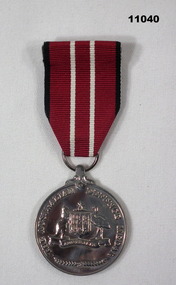
Award - THE AUSTRALIAN DEFENCE MEDAL
... S124975) who enlisted in the Navy along with his twin brother Francis on 10 October 1978....S124975) who enlisted in the Navy along with his twin brother Francis on 10 October 1978. O'Donahoo Collection Paul O'Donahoo Australian Service Medal Award Engraved around rim of medal: 'S124975 P.P. ...Part of the O'Donahoo Collection. Medal issued to Mr. Paul O'Donahoo (No. S124975) who enlisted in the Navy along with his twin brother Francis on 10 October 1978.Circular silver coloured medal with red, white and black striped ribbon attached. Silver colour clasp on back of ribbon. Name and number of recipient engraved around rim of medal. Obverse features Australia Coat of Arms with 'THE AUSTRALIAN SERVICE MEDAL' around the edge. reverse features words 'FOR SERVICE' below a Queen's Crown wreath of wattle surrounding words and crown.Engraved around rim of medal: 'S124975 P.P. O'Donahoo'.o'donahoo collection, paul o'donahoo, australian service medal, award -
 Bendigo Historical Society Inc.
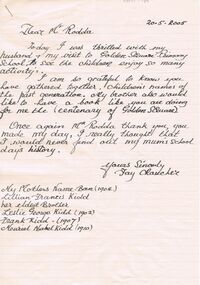
Document - GOLDEN SQUARE LAUREL STREET P.S. COLLECTION: LETTER RE LILLIAN FRANCIS KIDD
... Mentions her mother born 1904: Lillian Francis Kidd, her eldest brother Leslie George Kidd (1902) Frank Kidd (1907) Muriel Mabel Kidd (1910)...Mentions her mother born 1904: Lillian Francis Kidd, her eldest brother Leslie George Kidd (1902) Frank Kidd (1907) Muriel Mabel Kidd (1910) Document GOLDEN SQUARE LAUREL STREET P.S. ...Letter from Fay Roucher thanking Shane Rodda for 125th. Celebrations. Mentions her mother born 1904: Lillian Francis Kidd, her eldest brother Leslie George Kidd (1902) Frank Kidd (1907) Muriel Mabel Kidd (1910)bendigo, education, golden square primary school -
 Bendigo Military Museum
Memorabilia - ARCHIVAL FOLDER, WW1, Francis GRIFFITHS and Margaret GRIFFITHS, From 1914-1918
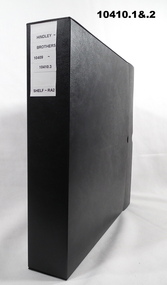
... This archive folder pertains to three brothers; FRANCIS GRANT HINDLEY Regiment No. 790 58th Battalion. ...This archive folder pertains to three brothers; FRANCIS GRANT HINDLEY Regiment No. 790 58th Battalion. ...This archive folder pertains to three brothers; FRANCIS GRANT HINDLEY Regiment No. 790 58th Battalion. HAROLD HINDLEY Regiment No. 2570 5th Infantry Battalion Field Ambulance JOHN JAMES HINDLEY Regiment No. 27747 21st Battalion. Refer Cat No 1776.3P for their full service histories.1. Folder - archival, black plastic with three D-ring holders, clear plastic archival sleeves containing original documents, transcribed text and photocopied information. Contained within the plastic sleeves are- -an information sheet. - original newspaper cuttings - photocopies of an original newspaper cutting. - typewritten correspondence. - photocopies of correspondence. - original black and white photograph postcards. - original service records - photocopies of original service records. - original handwritten letters with transcribed typed text of letters. - original postcards with handwritten letters with transcribed typed text. 2. Box - black plastic archival box for archival folder. Rectangular shape with flaps to fold and secure. 3. USB Stick - black and blue plastic with attached purple plastic label with split ring. Handwritten details on paper insert. Stored inside archival folder.2. Box - embossed in plastic "Archival survival". 3. USB stick plastic label, handwritten black ink pen "HINDLEY BROTHERS/ WAR HISTORY 1914-1918".memorabilia, ww1, hindley brothers -
 Bendigo Military Museum
Award - MEDAL SET WW1, Post 1919
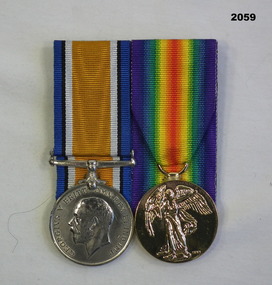
... Refer 2060.2 re his brother Francis Charles Wicks KIA....Refer 2060.2 re his brother Francis Charles Wicks KIA. medals military "4626 Pte J.H Wicks 7 BN A.I.F" Medal set, court mounted, set of (2) re J.H Wicks. 1. 1914-15 Star. 2. ...James Henry Wicks, (born Eaglehawk, enlisted Bendigo) Regt No 4626 enlisted in 14th Reinforcements to the 7th Battalian AIF on 12.7.15 age 40 years 8 months. Embarked for Eygpt 28.1.16, transfered to 57th Batt 2.4.16, embarked for France 17.6.16, transfer to 15 MG Coy 27.7.16, discharged from the AIF on 22.8.19. Refer 2060.2 re his brother Francis Charles Wicks KIA.Medal set, court mounted, set of (2) re J.H Wicks. 1. 1914-15 Star. 2. War medal 1914-18, replica not engraved."4626 Pte J.H Wicks 7 BN A.I.F"medals, military -
 Bendigo Military Museum
Literary work - HINDLEY, WW1, Francis GRIFFITHS and Margaret GRIFFITHS, "THE WAR HISTORY OF THE HINDLEY BROTHERS IN THE FIRST WORLD WAR 1914-1918"
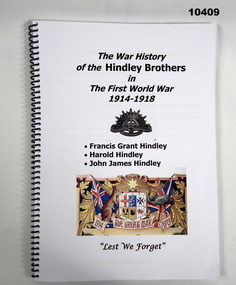
... This literary work pertains to three brothers; FRANCIS GRANT HINDLEY Regiment No. 790 58th Battalion. ...This literary work pertains to three brothers; FRANCIS GRANT HINDLEY Regiment No. 790 58th Battalion. ...This literary work pertains to three brothers; FRANCIS GRANT HINDLEY Regiment No. 790 58th Battalion. HAROLD HINDLEY Regiment No. 2570 5th Infantry Battalion - Field Ambulance. JOHN JAMES HINDLEY Regiment No. 2747 21st Battalion. From donation sheet " It is our desire that this information be freely available for purposes of research and to enable the war experiences of the three Hindley Brothers to be told to future generations". Refer Cat No 1776.3P for their full service histories.Literary work presented in a facsimile book form with clear plastic front cover over title page and black colour cardboard back cover. Black plastic spiral binding. Title page has black ink print, illustrated with Rising Sun Badge and a colour illustration from a WW1 certificate with two flags shield with states emblem, Kangaroo and Emu. The words "1914, THE GREAT WAR 1919" on scroll bottom. 167 pages, cut, plain white paper. Illustrated with many examples of black and white and colour of photographs, document's, certificates, handwritten letters, postcards, diary notes, telegrams, newspaper cuttings etc. Facsimile copy book available on USB stick.publication, book, ww1, hindley brothers -
 Kew Historical Society Inc
Clothing - Black chalk-striped outfit, 1870
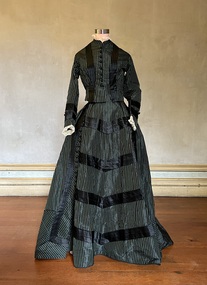
... In 1834, Francis’ older brother, Edward, sailed from Launceston in Van Diemen’s Land to what was to become Portland in the western part of Port Phillip District [Victoria]. ...In 1834, Francis’ older brother, Edward, sailed from Launceston in Van Diemen’s Land to what was to become Portland in the western part of Port Phillip District [Victoria]. ...This outfit belonged to Mary Ann Henty [nee Lawrence] (1821-81), the wife of Francis Henty (1815-89). Her husband, Francis Henty, was the youngest son of Thomas Henty, who with his family, their retainers and property moved to the Australian colonies between 1829 and 1832. In 1834, Francis’ older brother, Edward, sailed from Launceston in Van Diemen’s Land to what was to become Portland in the western part of Port Phillip District [Victoria]. Francis, together with the first flock of Merino sheep [in Victoria], followed some months later. The first and second generations of the Henty family established vast pastoral properties in the Western part of the Port Phillip District. Francis Henty managed ‘Merino Downs’ near Casterton, while also living in his retirement at ‘Field Place' in Kew.The Henty Collection of nineteenth and twentieth century clothing, including outerwear and underwear, was collected, stored and exhibited over time by female family members descended from Francis and Mary Ann Henty. During the twentieth century, items from the collection were modelled in two fashion parades by various descendants [1937, 1959]. The items in the collection are historically and aesthetically significant, with provenance provided by oral and written tradition within or held by the family. A number of the items in the collection are very rare survivors, and provide researchers with the evidence needed to reconstruct the lives of notable women in the Port Phillip District [later Victoria] during the nineteenth and early twentieth century.A two-piece silk taffeta chalk-striped afternoon dress worn by Mary Ann Henty, aged 49, in the period when she lived at Merino Downs near Portland. The outfit has bands of black silk and rows of fabric covered buttons on the bodice and skirt. Measurements (mm): BODICE: Girth - Neck 355.6, Chest 889, Waist 736.6, Hip 863.6, Cuff 254, Hem circumference 2032. Vertical - Front neck to hem 419.1, Front waist to hem 152.4, Back neck to hem 558.8, Back waist to hem190.5 , Sleeve length 584.2. Horizontal - Neck to sleeve head 165.1, Chest back 330.2, Underarm to underarm 406.4. SKIRT Girth - Waist 609.6, Hip 1270, Hem circumference 4064. Vertical - Front waist to hem 1117.6, Back waist to hem 1371.6.francis henty, fashion -- 1870s, women's clothing, afternoon dresses, mary ann (lawrence) henty -
 Kew Historical Society Inc
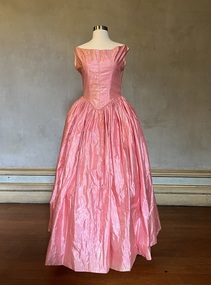
Clothing - Pink silk evening dress, c.1842
... In 1834, Francis’ older brother, Edward, sailed from Launceston in Van Diemen’s Land to what was to become Portland in the western part of Port Phillip District [Victoria]. ...In 1834, Francis’ older brother, Edward, sailed from Launceston in Van Diemen’s Land to what was to become Portland in the western part of Port Phillip District [Victoria]. ...This dress is believed to have belonged to Mary Ann Henty [nee Lawrence] (1821-81), the wife of Francis Henty (1815-89). Her husband, Francis Henty, was the youngest son of Thomas Henty, who with his family, their retainers and property moved to the Australian colonies between 1829 and 1832. In 1834, Francis’ older brother, Edward, sailed from Launceston in Van Diemen’s Land to what was to become Portland in the western part of Port Phillip District [Victoria]. Francis, together with the first flock of Merino sheep [in Victoria], followed some months later. The first and second generations of the Henty family established vast pastoral properties in the Western part of the Port Phillip District. Francis Henty managed ‘Merino Downs’ near Casterton, while also living in his retirement at ‘Field Place' in Kew. The Henty Collection of nineteenth and twentieth century clothing, including outerwear and underwear, was collected, stored and exhibited over time by female family members descended from Francis and Mary Ann Henty. During the twentieth century, items from the collection were modelled in two fashion parades by various descendants [1937, 1959]. The items in the collection are historically and aesthetically significant, with provenance provided by oral and written tradition within or held by the family. A number of the items in the collection are very rare survivors, and provide researchers with the evidence needed to reconstruct the lives of notable women in the Port Phillip District [later Victoria] during the nineteenth and early twentieth century.A one-piece, lustrous silk taffeta evening dress, lined with polished cotton, probably owned by Mary Ann Henty, and later by her daughter, Alice. The V-waist line of the dress and the dimensions of the skirt are comparable to Mary Ann’s wedding dress. The bodice in contrast is less structured. At a later stage, the sleeves were removed. Measurements (mm): BODICE: Girth - Neck 914.4, Chest 863.6, Waist 685.8, Hip 863.6, Hem circumference 3302. Vertical - Front neck to hem 1371.6, Front waist to hem 1092.2, Back neck to hem 1384.3, Back waist to hem 1079.5 Horizontal - Neck to sleeve head 44.45, Chest back 431.8, Underarm to underarm 431.8.mary ann lawrence, francis henty, evening dresses, henty collection, fashion -- 1840s -
 Kew Historical Society Inc
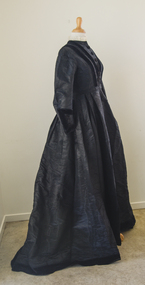
Clothing - Black moiré silk faille day dress, 1880
... In 1834, Francis’ older brother, Edward, sailed from Launceston in Van Diemen’s Land to what was to become Portland in the western part of Port Phillip District [Victoria]. ...In 1834, Francis’ older brother, Edward, sailed from Launceston in Van Diemen’s Land to what was to become Portland in the western part of Port Phillip District [Victoria]. ...This dress belonged to Mary Ann Henty [nee Lawrence] (1821-81), the wife of Francis Henty (1815-89). Her husband, Francis Henty, was the youngest son of Thomas Henty, who with his family, their retainers and property moved to the Australian colonies between 1829 and 1832. In 1834, Francis’ older brother, Edward, sailed from Launceston in Van Diemen’s Land to what was to become Portland in the western part of Port Phillip District [Victoria]. Francis, together with the first flock of Merino sheep [in Victoria], followed some months later. The first and second generations of the Henty family established vast pastoral properties in the Western part of the Port Phillip District. Francis Henty managed ‘Merino Downs’ near Casterton, while also living in his retirement at ‘Field Place' in Kew. The Henty Collection of nineteenth and twentieth century clothing, including outerwear and underwear, was collected, stored and exhibited over time by female family members descended from Francis and Mary Ann Henty. During the twentieth century, items from the collection were modelled in two fashion parades by various descendants [1937, 1959]. The items in the collection are historically and aesthetically significant, with provenance provided by oral and written tradition within or held by the family. A number of the items in the collection are very rare survivors, and provide researchers with the evidence needed to reconstruct the lives of notable women in the Port Phillip District [later Victoria] during the nineteenth and early twentieth century.A two-piece, moiré silk faille day dress, owned and worn by Mary Ann Henty, aged 59, while resident at Field Place, Kew. The fitted and panelled bodice on the day dress features wide velvet ribbon, hand sewn to form ‘V’ detailing at front and back. The front bodice hook and eye closure is decorated with handmade velvet covered buttons. The high round neckline is trimmed with pleated ivory fine tulle lace. The wide long sleeves of the bodice are also trimmed with velvet ribbon and buttons forming exquisite cuff detailing. The full length skirt and train are tucked into a fitted waistline band. The hemline is hand finished with wide velvet ribbon. A separate attached peplum is worn over the full bustle of the skirt. Measurements (mm): DRESS: Girth - Neck 355.6, Chest 889, Waist 673.1, Cuff 279.4, Hem circumference 4292.6. Vertical - Front neck to hem 1447.8, Front waist to hem 1117.6, Back neck to hem 1765.3, Back waist to hem 1346.2 , Sleeve length 590.55. Horizontal - Neck to sleeve head 196.85, Chest back 469.9, Underarm to underarm 457.2. PEPLUM Girth - Waist 711.2, Hem circumference 1066.8. Vertical - Back waist to hem 406.4.mary ann lawrence, francis henty, fashion -- 1880s, day dresses, women's clothing -
 Kew Historical Society Inc
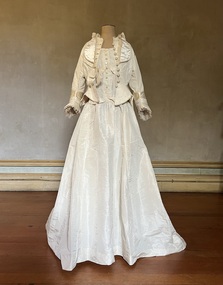
Clothing - Ivory silk and satin wedding dress and jacket, 1876-1944
... In 1834, Francis’ older brother, Edward, sailed from Launceston in Van Diemen’s Land to what was to become Portland in the western part of Port Phillip District [Victoria]. ...In 1834, Francis’ older brother, Edward, sailed from Launceston in Van Diemen’s Land to what was to become Portland in the western part of Port Phillip District [Victoria]. ...Alice Henty (1852-1932) was the third daughter of Francis and Mary Ann Henty. her father was the youngest son of Thomas Henty, who with his family, their retainers and property moved to the Australian colonies between 1829 and 1832. In 1834, Francis’ older brother, Edward, sailed from Launceston in Van Diemen’s Land to what was to become Portland in the western part of Port Phillip District [Victoria]. Francis, together with the first flock of Merino sheep [in Victoria], followed some months later. The first and second generations of the Henty family established vast pastoral properties in the Western part of the Port Phillip District. Francis Henty managed ‘Merino Downs’ near Casterton, while also living with his wife following his retirement at ‘Field Place' in Kew. The Henty Collection of nineteenth and twentieth century clothing, including outerwear and underwear, was collected, stored and exhibited over time by female family members descended from Francis and Mary Ann Henty. During the twentieth century, items from the collection were modelled in two fashion parades by various descendants [1937, 1959]. The items in the collection are historically and aesthetically significant, with provenance provided by oral and written tradition within or held by the family. A number of the items in the collection are very rare survivors, and provide researchers with the evidence needed to reconstruct the lives of notable women in the Port Phillip District [later Victoria] during the nineteenth and early twentieth century.Alice Henty’s wedding dress, made in 1876 for her marriage to John Hindson was remodelled in 1943 for the wedding of her granddaughter, Alice Henty Hindson to Norman Lithgow Tait at Holy Trinity, Kew. It was worn again by Margaret Henty Hindson (1918-2000) at her marriage to Dougald Webster Matheson at St Paul's Church, Henty in 1944. The two piece dress has a low décolletage shaped with a collar from which two curved panels drop. The fastenings for the bodice are buttons covered with the same fabric. The bodice is completed with two full length sleeves. The full skirt is slightly flattened at the front with a long train. In contrast, the ivory silk, silk faille and satin bodice with long tails remained unaltered. The front closure of the jacket has handmade embroidered buttonholes and covered buttons. The pleated collar and sleeves are decorated with gathered silk tulle. The jacket features long tails. alice frances (henty) hindson, women's clothing, wedding dresses, margaret henty hindson -
![Ivory silk and lace wedding dress [bodice]](/media/collectors/550653872162f11fb04854aa/items/644fb461495d06a04226c26a/item-media/644fb5fd495d06a04226db5d/item-fit-380x285.jpg?cb=6) Kew Historical Society Inc
Kew Historical Society IncClothing - Ivory silk crepe and lace bodice, 1912
... In 1834, Francis’ older brother, Edward, sailed from Launceston in Van Diemen’s Land to what was to become Portland in the western part of Port Phillip District [Victoria]. ...In 1834, Francis’ older brother, Edward, sailed from Launceston in Van Diemen’s Land to what was to become Portland in the western part of Port Phillip District [Victoria]. ...This bodice was part of the wedding outfit worn by Grace Burland at her marriage to John Henty Hindson in 1912. Her husband's grandfather, Francis Henty, was the youngest son of Thomas Henty, who with his family, their retainers and property moved to the Australian colonies between 1829 and 1832. In 1834, Francis’ older brother, Edward, sailed from Launceston in Van Diemen’s Land to what was to become Portland in the western part of Port Phillip District [Victoria]. Francis, together with the first flock of Merino sheep [in Victoria], followed some months later. The first and second generations of the Henty family established vast pastoral properties in the Western part of the Port Phillip District. Francis Henty managed ‘Merino Downs’ near Casterton, while also living in his retirement at ‘Field Place' in Kew.The Henty Collection of nineteenth and twentieth century clothing, including outerwear and underwear, was collected, stored and exhibited over time by female family members descended from Francis and Mary Ann Henty. During the twentieth century, items from the collection were modelled in two fashion parades by various descendants [1937, 1959]. The items in the collection are historically and aesthetically significant, with provenance provided by oral and written tradition within or held by the family. A number of the items in the collection are very rare survivors, and provide researchers with the evidence needed to reconstruct the lives of notable women in the Port Phillip District [later Victoria] during the nineteenth and early twentieth century.Silk crepe wedding bodice decorated with Mechlin lace, pearls and jet, which was worn by Grace Burland at her marriage to John Henty Hindson in 1912. A report in Punch [12 September 1912] described her outfit as “... white crepe de chene finished with Mechlin lace and pearl trimming; also pearl crescent brooch (gift of the bridegroom' s mother).” Mechlin lace or Point de Malines is an old bobbin lace, one of the best-known Flemish laces, originally produced in Mechelen, Belgium. Used for women's clothing, it was popular until the first decade of the twentieth century. The high silk net neckline is finished with pearls. These are repeated on the loose fitted diagonal ornamentation on the front and back which is finished with pearl and jet beading. Similar ornamentation finishes the elbow length sleeves. [The wedding skirt is not part of the donation]. wedding dresses, women's clothing, fashion -- 1910s, bodices, grace burland -
 Kew Historical Society Inc
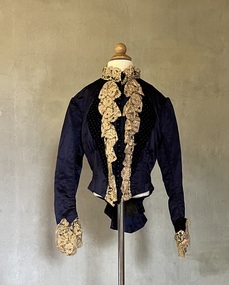
Clothing - Midnight blue silk and velvet bodice
... In 1834, Francis’ older brother, Edward, sailed from Launceston in Van Diemen’s Land to what was to become Portland in the western part of Port Phillip District [Victoria]. ...In 1834, Francis’ older brother, Edward, sailed from Launceston in Van Diemen’s Land to what was to become Portland in the western part of Port Phillip District [Victoria]. ...This bodice, belonging to Alice (Henty) Hindson has traditionally been identified as a travelling jacket by her descendants. Alice Hindson was the youngest daughter of Francis Henty and Mary Ann (Lawrence) Henty. Alice's father, Francis Henty, was the youngest son of Thomas Henty, who with his family, their retainers and property moved to the Australian colonies between 1829 and 1832. In 1834, Francis’ older brother, Edward, sailed from Launceston in Van Diemen’s Land to what was to become Portland in the western part of Port Phillip District [Victoria]. Francis, together with the first flock of Merino sheep [in Victoria], followed some months later. The first and second generations of the Henty family established vast pastoral properties in the Western part of the Port Phillip District. Francis Henty managed ‘Merino Downs’ near Casterton, while also living in his retirement at ‘Field Place' in Kew. The Henty Collection of nineteenth and twentieth century clothing, including outerwear and underwear, was collected, stored and exhibited over time by female family members descended from Francis and Mary Ann Henty. During the twentieth century, items from the collection were modelled in two fashion parades by various descendants [1937, 1959]. The items in the collection are historically and aesthetically significant, with provenance provided by oral and written tradition within or held by the family. A number of the items in the collection are very rare survivors, and provide researchers with the evidence needed to reconstruct the lives of notable women in the Port Phillip District [later Victoria] during the nineteenth and early twentieth century.Alice (Henty) Hindson's midnight blue sateen bodice is highlighted using velvet lapels, cuffs, and a rear bow. The velvet, in contrast to the plain midnight blue sateen, is embellished [in the weave] with pink and navy spots. Joined at the front with 23 round domed buttons, hooks and eyes are used to close the neckline. The bodice also features coffee-coloured lace at the front and on the cuffs, which may have been added later. The bodice has some condition issues, missing one cuff and the lace on the cuffs needing re-attaching. The inside of the bodice is heavily boned, complete with a floral chintz lining. Measurements (mm): BODICE: Girth - Neck 355.6, Chest 812.8, Waist 660.4, Hip 685.8, Cuff 228.6 Vertical - From neck to hem 406.4, Front waist to hem 152.4, Back neck to hem 546.1, Back waist to hem 228.6, Sleeve length 533.4. Horizontal - Neck to sleeve head 114.3, Cross back 266.7, Underarm to underarm 368.3.alice hindson, alice henty, bodices, women's clothing, alice (henty) hindson -
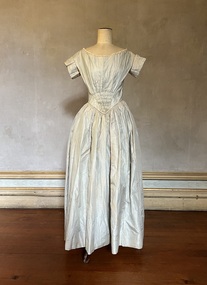 Kew Historical Society Inc
Clothing - Grey silk wedding dress, 1842
... In 1834, Francis’ older brother, Edward, sailed from Launceston in Van Diemen’s Land to what was to become Portland in the western part of Port Phillip District [Victoria]. ...In 1834, Francis’ older brother, Edward, sailed from Launceston in Van Diemen’s Land to what was to become Portland in the western part of Port Phillip District [Victoria]. ...This wedding gown was worn by Mary Ann Lawrence at 8.00am on 5 January 1842 at St John's Church, Launceston, when she married Francis Henty. The couple were to catch the tide on their way to Portland two hours later. Francis Henty was the youngest son of Thomas Henty, who with his family, their retainers and property moved to the Australian colonies between 1829 and 1832. In 1834, Francis’ older brother, Edward, sailed from Launceston in Van Diemen’s Land to what was to become Portland in the western part of Port Phillip District [Victoria]. Francis, together with the first flock of Merino sheep [in Victoria], followed some months later. The first and second generations of the Henty family established vast pastoral properties in the Western part of the Port Phillip District. Francis Henty managed ‘Merino Downs’ near Casterton, while also living in his retirement at ‘Field Place' in Kew. The Henty Collection of nineteenth and twentieth century clothing, including outerwear and underwear, was collected, stored and exhibited over time by female family members descended from Francis and Mary Ann Henty. During the twentieth century, items from the collection were modelled in two fashion parades by various descendants [1937, 1959]. The items in the collection are historically and aesthetically significant, with provenance provided by oral and written tradition within or held by the family. A number of the items in the collection are very rare survivors, and provide researchers with the evidence needed to reconstruct the lives of notable women in the Port Phillip District [later Victoria] during the nineteenth and early twentieth century.Mary Ann Lawrence's grey silk wedding gown has a v-line waist and a partly smocked bodice. It is lined with muslin throughout. It has hand-tatted cotton lace and handmade piping around the neck and bodice and pleated short sleeves. There was originally trimming on the skirt which was removed at a later date. Orange blossom made of chamois and tiny coiled springs originally decorated the neckline. The outfit was complemented by a bonnet to which a Limerick lace veil was attached. MEASUREMENTS (MM): GIRTH - Neck 914, Chest 812.8, Waist 660.4, Cuff 330.2, Hem circumference 3200.4. VERTICAL - Front neck to hem 1270, Front waist to hem 1016, Back neck to hem 1320.8, Back waist to hem 1041.4, Sleeve length 114.3. HORIZONTAL - Neck to sleeve head 50.8, Chest back 406.4, Underarm to underarm 406.4.mary ann lawrence, francis henty, wedding dresses, fashion -- 1840s, women's clothing -
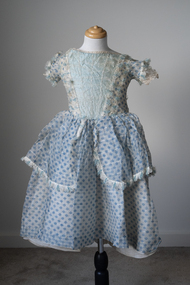 Kew Historical Society Inc
Clothing - Girl's dress, 1858
... In 1834, Francis’ older brother, Edward, sailed from Launceston in Van Diemen’s Land to what was to become Portland in the western part of Port Phillip District [Victoria]. ...In 1834, Francis’ older brother, Edward, sailed from Launceston in Van Diemen’s Land to what was to become Portland in the western part of Port Phillip District [Victoria]. ...This dress belonged to Alice Frances Henty (1852-1932) the youngest daughter of Francis Henty (1815-89) and his wife Mary Ann Henty [nee Lawrence] (1821-81). It is recorded that Alice wore the dress at the age of six. Alice's father, Francis Henty, was the youngest son of Thomas Henty, who with his family, their retainers and property moved to the Australian colonies between 1829 and 1832. In 1834, Francis’ older brother, Edward, sailed from Launceston in Van Diemen’s Land to what was to become Portland in the western part of Port Phillip District [Victoria]. Francis, together with the first flock of Merino sheep [in Victoria], followed some months later. The first and second generations of the Henty family established vast pastoral properties in the Western part of the Port Phillip District. Francis Henty managed ‘Merino Downs’ near Casterton, while also living in his retirement at ‘Field Place' in Kew. The Henty Collection of nineteenth and twentieth century clothing, including outerwear and underwear, was collected, stored and exhibited over time by female family members descended from Francis and Mary Ann Henty. During the twentieth century, items from the collection were modelled in two fashion parades by various descendants [1937, 1959]. The items in the collection are historically and aesthetically significant, with provenance provided by oral and written tradition within or held by the family. A number of the items in the collection are very rare survivors, and provide researchers with the evidence needed to reconstruct the lives of notable women in the Port Phillip District [later Victoria] during the nineteenth and early twentieth century.Girl's two-tone, one-piece cotton voile dress from the 1850s has a high round neck and short sleeves has a lace insert on the front of the bodice and matching lace at the rear. The layered skirt is bordered with lace. Measurements (mm): Girth - Neck 609.6, Chest 635, Waist 558.8, Cuff 203.2, Hem circumference 2108.2. Vertical - Front neck to hem 685.8, Front waist to hem 508, Back neck to hem 723.9, Back waist to hem 534.4, Sleeve length 63.5. Horizontal - Neck to sleeve head 38.1, Cross back 304.8, Underarm to underarm 406.4.fashion -- 1850s, children's clothing, alice frances henty -
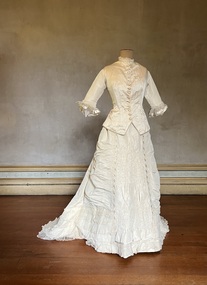 Kew Historical Society Inc
Clothing - Ivory silk and tulle bridesmaid's outfit, 1874
... In 1834, Francis’ older brother, Edward, sailed from Launceston in Van Diemen’s Land to what was to become Portland in the western part of Port Phillip District [Victoria]. ...In 1834, Francis’ older brother, Edward, sailed from Launceston in Van Diemen’s Land to what was to become Portland in the western part of Port Phillip District [Victoria]. ...This bridesmaid's dress was owned and first worn by Alice Frances Henty, the daughter of Francis Henty and Mary Ann (Lawrence) Henty. The outfit was worn at the marriage of her friend Miss Hopkins to Mr ST Staughnton in 1874. Alice's father, Francis Henty, was the youngest son of Thomas Henty, who with his family, their retainers and property moved to the Australian colonies between 1829 and 1832. In 1834, Francis’ older brother, Edward, sailed from Launceston in Van Diemen’s Land to what was to become Portland in the western part of Port Phillip District [Victoria]. Francis, together with the first flock of Merino sheep [in Victoria], followed some months later. The first and second generations of the Henty family established vast pastoral properties in the Western part of the Port Phillip District. Francis Henty managed ‘Merino Downs’ near Casterton, while also living in his retirement at ‘Field Place' in Kew. The Henty Collection of nineteenth and twentieth century clothing, including outerwear and underwear, was collected, stored and exhibited over time by female family members descended from Francis and Mary Ann Henty. During the twentieth century, items from the collection were modelled in two fashion parades by various descendants [1937, 1959]. The items in the collection are historically and aesthetically significant, with provenance provided by oral and written tradition within or held by the family. A number of the items in the collection are very rare survivors, and provide researchers with the evidence needed to reconstruct the lives of notable women in the Port Phillip District [later Victoria] during the nineteenth and early twentieth century.An ivory silk skirt and matching jacket worn by Alice Henty, aged 22, at the marriage of her friend Lizzie Hopkins and S.T. Staugnton in 1874. The ivory silk satin peplum jacket is boned, tailored, and fitted with many princess line panels. The front closure has handmade embroidered buttonholes and covered buttons. The collar and sleeves are decorated with gathered silk tulle frills. The peplum back features a silk cord bow decoration. The skirt with bustle and train features a central panel with hand ruching and silk satin piping. It is decorated with five rows of pleated silk tulle frills. Measurements (mm): PEPLUM JACKET Girth - Neck 317.5, Chest 914.4, Waist 698.5, Hip 965.2, Cuff 279.4, Hem circumference 1168.4. Vertical - From neck to hem 558.8, Front waist to hem 254, Back neck to hem 838.2, Back waist to hem 241.3, Sleeve length 279.4. Horizontal - Neck to sleeve head 165.1,Cross back 292.1, Underarm to underarm 393.7. SKIRT Girth - Waist 635, Hip 914.4, Hem circumference 3810. Vertical - Front waist to hem 1092.2, Back waist to hem 1701.8. fashion -- 1870s, alice frances (henty) hindson, women's clothing, bridesmaid's dresses -
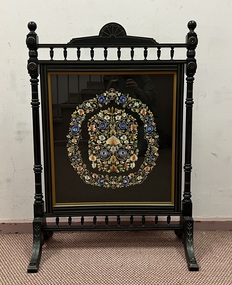 Kew Historical Society Inc
Furniture - Hand embroidered fire screen, 1900-1910
... In 1834, Francis’ older brother, Edward, sailed from Launceston in Van Diemen’s Land to what was to become Portland in the western part of Port Phillip District [Victoria]. ...In 1834, Francis’ older brother, Edward, sailed from Launceston in Van Diemen’s Land to what was to become Portland in the western part of Port Phillip District [Victoria]. ...This hand embroidered fire screen was embroidered by Winifred Caroline Henty Hindson (1887–1967), Elsie May Eliza Hindson (1880–1968) and Louisa (Louie) Charlotte Frances Hindson (1885–1963) three of the daughters of Alice Henty and John Hindson. Their grandfather, Francis Henty, was the youngest son of Thomas Henty, who with his family, their retainers and property moved to the Australian colonies between 1829 and 1832. In 1834, Francis’ older brother, Edward, sailed from Launceston in Van Diemen’s Land to what was to become Portland in the western part of Port Phillip District [Victoria]. Francis, together with the first flock of Merino sheep [in Victoria], followed some months later. The first and second generations of the Henty family established vast pastoral properties in the Western part of the Port Phillip District. Francis Henty managed ‘Merino Downs’ near Casterton, while also living in his retirement at ‘Field Place' in Kew.The Henty Collection of nineteenth and twentieth century clothing, including outerwear and underwear, was collected, stored and exhibited over time by female family members descended from Francis and Mary Ann Henty. During the twentieth century, items from the collection were modelled in two fashion parades by various descendants [1937, 1959]. The items in the collection are historically and aesthetically significant, with provenance provided by oral and written tradition within or held by the family. A number of the items in the collection are very rare survivors, and provide researchers with the evidence needed to reconstruct the lives of notable women in the Port Phillip District [later Victoria] during the nineteenth and early twentieth century. Multicoloured silk embroidered floral composition on a black fabric background created by Louisa, Elsie and Winifred Hindson. The embroidery is held behind glass and is protected by blackened wood at the back. The screen is suspended in an ebonized and gilded frame with two rows of spindle decoration. fire screens, women's work, embroidery - 20th century, elsie hindson, louisa hindson, winifred hindson -
 Kew Historical Society Inc
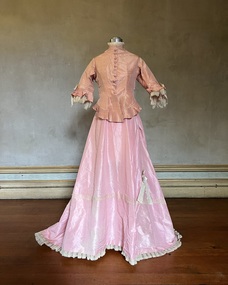
Clothing - Two-piece pink silk afternoon outfit, 1875
... In 1834, Francis’ older brother, Edward, sailed from Launceston in Van Diemen’s Land to what was to become Portland in the western part of Port Phillip District [Victoria]. ...In 1834, Francis’ older brother, Edward, sailed from Launceston in Van Diemen’s Land to what was to become Portland in the western part of Port Phillip District [Victoria]. ...This afternoon dress was owned and first worn in 1875 by Alice (Henty) Hindson, the daughter of Francis Henty and Mary Ann (Lawrence) Henty. The outfit was worn in the same year as Alice's marriage to John Hindson at Trinity Church, East Melbourne, and may have formed part of her trousseau. Alice's father, Francis Henty, was the youngest son of Thomas Henty, who with his family, their retainers and property moved to the Australian colonies between 1829 and 1832. In 1834, Francis’ older brother, Edward, sailed from Launceston in Van Diemen’s Land to what was to become Portland in the western part of Port Phillip District [Victoria]. Francis, together with the first flock of Merino sheep [in Victoria], followed some months later. The first and second generations of the Henty family established vast pastoral properties in the Western part of the Port Phillip District. Francis Henty managed ‘Merino Downs’ near Casterton, while also living in his retirement at ‘Field Place' in Kew. The Henty Collection of nineteenth and twentieth century clothing, including outerwear and underwear, was collected, stored and exhibited over time by female family members descended from Francis and Mary Ann Henty. During the twentieth century, items from the collection were modelled in two fashion parades by various descendants [1937, 1959]. The items in the collection are historically and aesthetically significant, with provenance provided by oral and written tradition within or held by the family. A number of the items in the collection are very rare survivors, and provide researchers with the evidence needed to reconstruct the lives of notable women in the Port Phillip District [later Victoria] during the nineteenth and early twentieth century.Alice (Henty) Hindson's afternoon dress is a two-piece, two-toned pink ensemble made of silk taffeta. The detailing is done with fine knife-pleated trims piped in ivory satin and decorated with ivory silk moiré bows on the bodice and skirt. The panelled peplum jacket is boned and the front button closure has hand-embroidered buttonholes with handmade covered buttons. The gathered full buttoned skirt falls into a train. The skirt is decorated with rows of ivory tulle corded lace and the hemline is edged with crisp fluted organza and tatted lace. Measurements (mm): BODICE: Girth - Neck 355.6, Chest 863.6, Waist 685.8, Hip 787.4, Cuff 304.8, Hem circumference 1422.4. Vertical - From neck to hem 546.1, Front waist to hem 241.3, Back neck to hem 609.6, Back waist to hem 355.6, Sleeve length 330.2. Horizontal - Neck to sleeve head 60, Underarm to underarm 419.1. SKIRT Girth - Waist 558.8, Hip 1473.2, Hem circumference 3911.6. Vertical - Front waist to hem 1092.2, Back waist to hem 1524. fashion -- 1870s, afternoon dresses, alice (henty) hindson, women's clothing -
 Kew Historical Society Inc
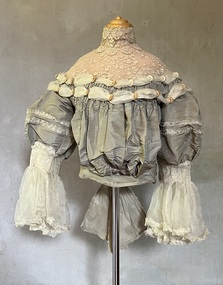
Clothing - Grey silk and lace bodice, 1875
... In 1834, Francis’ older brother, Edward, sailed from Launceston in Van Diemen’s Land to what was to become Portland in the western part of Port Phillip District [Victoria]. ...In 1834, Francis’ older brother, Edward, sailed from Launceston in Van Diemen’s Land to what was to become Portland in the western part of Port Phillip District [Victoria]. ...Alice Frances (Henty) Hindson's grey silk bodice is believed to be part of her 'going-away' outfit after her wedding to John Hindson on 15 April 1875. The bodice must have been a family favourite as it was used and amended over the years. Alice was the youngest daughter of Francis Henty and Mary Ann (Lawrence) Henty. Alice's father, Francis Henty, was the youngest son of Thomas Henty, who with his family, their retainers and property moved to the Australian colonies between 1829 and 1832. In 1834, Francis’ older brother, Edward, sailed from Launceston in Van Diemen’s Land to what was to become Portland in the western part of Port Phillip District [Victoria]. Francis, together with the first flock of Merino sheep [in Victoria], followed some months later. The first and second generations of the Henty family established vast pastoral properties in the Western part of the Port Phillip District. Francis Henty managed ‘Merino Downs’ near Casterton, while also living in his retirement at ‘Field Place' in Kew. The Henty Collection of nineteenth and twentieth century clothing, including outerwear and underwear, was collected, stored and exhibited over time by female family members descended from Francis and Mary Ann Henty. During the twentieth century, items from the collection were modelled in two fashion parades by various descendants [1937, 1959]. The items in the collection are historically and aesthetically significant, with provenance provided by oral and written tradition within or held by the family. A number of the items in the collection are very rare survivors, and provide researchers with the evidence needed to reconstruct the lives of notable women in the Port Phillip District [later Victoria] during the nineteenth and early twentieth century.The yoke is a bustier bodice, made of silk and silk organza with an insert of hand-tatted lace. The bodice is carefully boned and has a little padding in the bust line. It includes the name of the maker of the bodice as ‘Madame Jay, Brighton, 38 London Road’. The silk organza sleeves have hand shirring, trim, and frilled cuffs. The bodice is finished with a large, frilled bow at the back. Believed by the Henty family to be part of the ‘going away’ outfit worn by Alice Henty in 1875. Measurements (mm): BODICE: Girth - Neck 304.8, Chest 762, Waist 571.5, Cuff 127 Vertical - From neck to hem 381, Front waist to hem 152.4, Back neck to hem 419.1, Back waist to hem 228.6, Sleeve length 254. Horizontal - Neck to sleeve head 165.1, Cross back 457.2, Underarm to underarm 431.8.Mme Jay, Brighton Road, London [dressmaker]bodices, women's clothing, alice (henty) hindson, alice francés henty -
 Kew Historical Society Inc
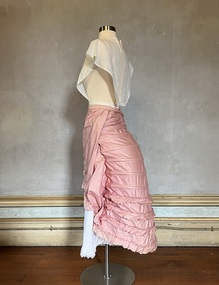
Clothing - Pink lobster-tail bustle, c. 1875
... In 1834, Francis’ older brother, Edward, sailed from Launceston in Van Diemen’s Land to what was to become Portland in the western part of Port Phillip District [Victoria]. ...In 1834, Francis’ older brother, Edward, sailed from Launceston in Van Diemen’s Land to what was to become Portland in the western part of Port Phillip District [Victoria]. ...This full length lobster tail bustle was owned and worn by Alice Frances Henty, the daughter of Francis Henty and Mary Ann (Lawrence) Henty. Bustles of this form date from the mid-1860s however this example probably dates from the mid 1870s, and perhaps from before her marriage to John Hindson in 1876. Alice's father, Francis Henty, was the youngest son of Thomas Henty, who with his family, their retainers and property moved to the Australian colonies between 1829 and 1832. In 1834, Francis’ older brother, Edward, sailed from Launceston in Van Diemen’s Land to what was to become Portland in the western part of Port Phillip District [Victoria]. Francis, together with the first flock of Merino sheep [in Victoria], followed some months later. The first and second generations of the Henty family established vast pastoral properties in the Western part of the Port Phillip District. Francis Henty managed ‘Merino Downs’ near Casterton, while also living in his retirement at ‘Field Place' in Kew.The Henty Collection of nineteenth and twentieth century clothing, including outerwear and underwear, was collected, stored and exhibited over time by female family members descended from Francis and Mary Ann Henty. During the twentieth century, items from the collection were modelled in two fashion parades by various descendants [1937, 1959]. The items in the collection are historically and aesthetically significant, with provenance provided by oral and written tradition within or held by the family. A number of the items in the collection are very rare survivors, and provide researchers with the evidence needed to reconstruct the lives of notable women in the Port Phillip District [later Victoria] during the nineteenth and early twentieth century.An exceptionally rare and fine, floor length, 'lobster tail' bustle that belonged to Alice Henty possibly worn with her two-piece pink silk gown but also with other dresses that she owned that required a bustle of this shape. The structure of the bustle includes an outer layer of polished cotton with inserted steel hoops and ties at the front. The lower four hoops have flounces of the same fabric. Overall, the bustle contains 12 hoops, crossed nearer the waist and semi-circular for the remainder of the undergarment. [One of the tapes of the bustle is imprinted with the word lockstitch. Elias Howe invented the lockstitch sewing machine in 1846.] Measurements (mm): BUSTLE: Girth - Waist 660 Vertical - Front waist to hem 914, Back waist to hem 965.fashion -- 1870s, alice frances (henty) hindson, women's clothing, bustles, underwear -
 Bendigo Historical Society Inc.
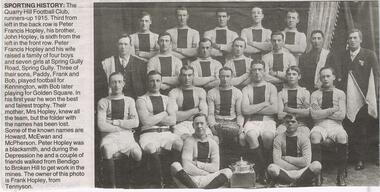
Newspaper - JENNY FOLEY COLLECTION: SPORTING HISTORY
... Third from left in the back row is Peter Francis Hopley, his brother, John Hopley, is sixth from the left in the front row. ...Third from left in the back row is Peter Francis Hopley, his brother, John Hopley, is sixth from the left in the front row. ...Bendigo Advertiser ''The way we were'' from Monday, December 13, 2004. Sporting history: the Quarry Hill football club, runners-up 1915. Third from left in the back row is Peter Francis Hopley, his brother, John Hopley, is sixth from the left in the front row. Peter Francis Hopley and his wife raised a family of four boys and seven girls at Spring Gully Road, Spring Gully. Three of their sons, Paddy, Frank and Bob, played football for Kennington, with Bob later playing for Golden Square. In the first year he won the best and fairest trophy. Some of the names are: Howard, McEwen and McPherson. Peter Hopley was a blacksmith and during the depression he and a couple of friends walked from Bendigo to Broken Hill to get work in the mines.newspaper, bendigo advertiser, the way we were -
 Kew Historical Society Inc
Photograph, J E & B L Rogers, 'Swinton', Swinton Avenue, c.1960
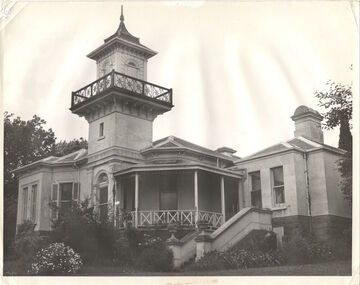
... Annabella's brother, Francis Johnson, bought the villa in 1876 and renamed it Swinton after his birthplace in Yorkshire. ...Annabella's brother, Francis Johnson, bought the villa in 1876 and renamed it Swinton after his birthplace in Yorkshire. ...This work forms part of the collection assembled by the historian Dorothy Rogers, that was donated to the Kew Historical Society by her son John Rogers in 2015. The manuscripts, photographs, maps, and documents were sourced by her from both family and local collections or produced as references for her print publications. Many were directly used by Rogers in writing ‘Lovely Old Homes of Kew’ (1961) and 'A History of Kew' (1973), or the numerous articles on local history that she produced for suburban newspapers. Most of the photographs in the collection include detailed annotations in her hand. The Rogers Collection provides a comprehensive insight into the working habits of a historian in the 1960s and 1970s. Together it forms the largest privately-donated collection within the archives of the Kew Historical Society."The land on which Swinton was later built was first purchased by John Bakewell in 1851 and later sold to Edmund Laskey Splatt in 1858. Splatt was a member of the first provisional committee of the National Bank of Australia in Melbourne and built the first house on the land naming it Laskey Villa. By 1863 the house was occupied by Herbert Henty. The Johnson family connection with the property began with the marriage in 1858 of Annabella Johnson to David Sym - owner of The Age newspaper and owner of the adjacent property Blytheswood. Annabella's brother, Francis Johnson, bought the villa in 1876 and renamed it Swinton after his birthplace in Yorkshire. The property was later owned by the artistic Colquhoun family. The house is one of the earliest examples of the Italianate style in Victoria - the outstanding element being the tower with its cantilevered walkway and heavily bracketed pyramidal tower. (Source: Victorian Heritage Database)"Swinton. Built about 1959-60. Chap.20 Swinton. Johnson - Col"swinton, swinton avenue (kew) -
Surrey Hills Historical Society Collection
Photograph, Parer family portrait
... Francis. Stephen preferred the outdoors and went to work on the family market garden in Box Hill. Joseph was the first Parer to arrive in Australia, in 1855. He and his brother...Francis. Stephen preferred the outdoors and went to work on the family market garden in Box Hill. Joseph was the first Parer to arrive in Australia, in 1855. He and his brother ...Members of the Parer family began arriving in Australia from 1852. By the 1890s several had settled in Surrey Hills and Box Hill. Identification is as follows: Back L to R: Phillip ( ), Stephen, Joseph, Francis. Front L to R: John, Tici, Eulalia, Tia. Phillip lived at 'Monserrat' in Mont Albert Road (land later subdivided so that house was renumbered as a Weybridge Street address. Stephen was was the youngest child of Antonio and Josefa Parer. He left for Australia when he was 17 years old and landed in Melbourne in 1888 and went straight to work at Parers’ Crystal Palace for his brother Francis. Stephen preferred the outdoors and went to work on the family market garden in Box Hill. Joseph was the first Parer to arrive in Australia, in 1855. He and his brother Francis created the Parer dynasty in Australia, bringing all the family members from Spain and offering them work in their hotels. Francis Parer was born in Alella in 1836 and left for Australia when he was 17. In partnership, he commenced a business of general produce dealers in Little Bourke Street. He later entered the hospitality business buying in partnership the ‘Spanish Restaurant’ on Elisabeth Street and later, the Victoria Restaurant on Bourke Street with his brothers. In 1870 he purchased 40 acres of land at Box Hill at £15 per acre. The property became a famous market garden where he grew all kinds of vegetables and orchards. It is believed the first tomatoes in Australia were grown there. Juan or John lived in 'Gerona' in Weybridge Street. Eulalia Parer married Marcus Clota at Alella on 9 September 1867 and came to Australia in 1876. They lived in Guildford and Union Roads. Tia Marieta married and lived in Guildford Road. There are many members of the family buried in Box Hill Cemetery. Black and white formal studio portrait of 8 members of the Parer family mounted on brown board. There are 4 men standing and one man and 3 women seated.White paper label stuck to rear: "THE ORIGINAL PARER FAMILY WHO SETTLED IN AUSTRALIA - 1852. / Photograph with compliments of SANS family."phillip parer, stephen parer, box hill cemetery, joseph parer, francis parer, john parer, tici parer, eulalia parer, tia parer, "monserrat" -
 Kew Historical Society Inc
Photograph, J E & B L Rogers, 'Swinton', Swinton Avenue, c.1960
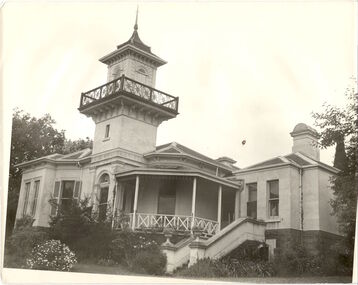
... Annabella's brother, Francis Johnson, bought the villa in 1876 and renamed it 'Swinton' after his birthplace in Yorkshire. ...Annabella's brother, Francis Johnson, bought the villa in 1876 and renamed it 'Swinton' after his birthplace in Yorkshire. ...'The land on which 'Swinton'was later built was first purchased by John Bakewell in 1851 and later sold to Edmund Laskey Splatt in 1858. Splatt was a member of the first provisional committee of the National Bank of Australia in Melbourne and built the first house on the land naming it 'Laskey Villa'. By 1863 the house was occupied by Herbert Henty. The Johnson family connection with the property began with the marriage in 1858 of Annabella Johnson to David Syme, owner of the Áge' newspaper and owner of the adjacent property 'Blytheswood'. Annabella's brother, Francis Johnson, bought the villa in 1876 and renamed it 'Swinton' after his birthplace in Yorkshire. The property was later owned by the artistic Colquhoun family. The house is one of the earliest examples of the Italianate style in Victoria - the outstanding element being the tower with its cantilevered walkway and heavily bracketed pryamidal tower.' Source: Victorian Heritage RegisterThis work forms part of the collection assembled by the historian Dorothy Rogers, that was donated to the Kew Historical Society by her son John Rogers in 2015. The manuscripts, photographs, maps, and documents were sourced by her from both family and local collections or produced as references for her print publications. Many were directly used by Rogers in writing ‘Lovely Old Homes of Kew’ (1961) and 'A History of Kew' (1973), or the numerous articles on local history that she produced for suburban newspapers. Most of the photographs in the collection include detailed annotations in her hand. The Rogers Collection provides a comprehensive insight into the working habits of a historian in the 1960s and 1970s. Together it forms the largest privately-donated collection within the archives of the Kew Historical SocietySwinton in Kew and its tower. This side of the house faces the Yarra River.swinton, laskey villa, swinton avenue, kew, dorothy rogers -
 Bendigo Military Museum
Album - PHOTOGRAPH & POSTCARD ALBUMS WW1
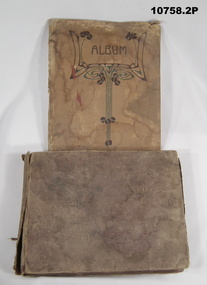
... Easily identified are Thomas Staley (served in WW1 & WW2) May Staley (Maiden name “EVERY”) Her 3 brothers Francis, George and Ernest Every. Miss Thomas (Janey) is May Staleys Auntie. ...Easily identified are Thomas Staley (served in WW1 & WW2) May Staley (Maiden name “EVERY”) Her 3 brothers Francis, George and Ernest Every. Miss Thomas (Janey) is May Staleys Auntie. ...Both Albums contain the Thomas & May Staley Collection WW1. Besides photos & postcards there are numerous other cards, articles from Newspapers, certificates covering numbers of people. There are photos re Soldiers with no identification, others with names & Regimental Numbers easily identifiable and can be matched to other photos and postcards. Easily identified are Thomas Staley (served in WW1 & WW2) May Staley (Maiden name “EVERY”) Her 3 brothers Francis, George and Ernest Every. Miss Thomas (Janey) is May Staleys Auntie. George and Ernest served in WW1. Many of the Soldiers come from around the Bendigo area notably White Hills and Epsom. Many are in the same Unit notably the 29th BN AIF. Thomas’s two sons WW2 are in the collection as well. Due to the content range of the Albums and local area the collection has been sorted into different categories as much as possible. There are 46 Catalogue No's, refer Catalogue No 10758.2P for all the collection to come up..1) Album. The front and back covers have newspaper articles glued in, they cover Poetry re the War eg: “A bit of Khaki”, “Here comes a Soldier”, “Bravo Australia”, “The wail of Belgium”, “The Prince of Peace”, “Our fallen heroes”. There are 3 articles re Pte George Every titled, A true Comrade”, “Welcome Home”, “Citizens Welcome”. The majority of the photos were related to WW1. .2) This album has space for 2 photos per page, there are 87postcards in place which relate to holidays in France and England mostly pre WW1. There are 21 lose photos and cards relating the same. Other items and various cards re WW1 were also in the album.photos, postcards, tmstaleycollection
