
Showing 606 items matching "francis were"
-
 Greensborough Historical Society
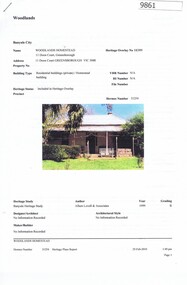
Document - Report, Allum Lovell & Associates, Woodlands Homestead: 11 Doon Court Greensborough, 25/02/2010
... ...francis were...Banyule Heritage Study 1999 regarding Woodlands Homestead 11 Doon Court, Greensborough This property has a heritage overlay woodlands estate briar hill doon court briar hill francis were banyule heritage study 3 pages, text and colour illustration Woodlands Homestead: 11 Doon Court Greensborough Document Report Allum Lovell & Associates ...Banyule Heritage Study 1999 regarding Woodlands Homestead 11 Doon Court, GreensboroughThis property has a heritage overlay3 pages, text and colour illustrationwoodlands estate, briar hill, doon court briar hill, francis were, banyule heritage study -
 Ringwood and District Historical Society
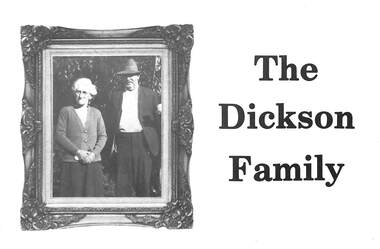
Book - The Dickson Family, The Dickson Family Ringwood 1861-1966
... Moses and Francis Dickson were orchardists in Ringwood in the early 1900s and were connected to other early families such as the Knee, Hardidge and Sargeant families....Moses and Francis Dickson were orchardists in Ringwood in the early 1900s and were connected to other early families such as the Knee, Hardidge and Sargeant families. ...Moses and Francis Dickson were orchardists in Ringwood in the early 1900s and were connected to other early families such as the Knee, Hardidge and Sargeant families.Photographic history of Moses and Frances Dickson. Booklet with white front cover with framed black and white photo and the Dickson Family printed on it. Picture of street on back - North Ringwood Shopping Strip c.1960s. -
 Greensborough Historical Society
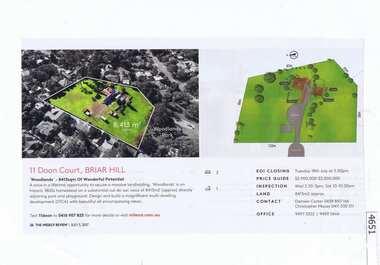
Newspaper Clipping, The Weekly Review, 'Woodlands': 11 Doon Court Briar Hill, 05/07/2017
... Agent: Miles Real Estate. Home of Francis Wellington Were in the 1920s...Agent: Miles Real Estate. Home of Francis Wellington Were in the 1920s doon court briar hill Red and black print, colour photograph. ...Sale notice for "Woodlands", 1800s homestead on 8413 sqm at 11 Doon Court Briar Hill. Agent: Miles Real Estate. Home of Francis Wellington Were in the 1920sRed and black print, colour photograph.doon court briar hill -
 Lakes Entrance Historical Society
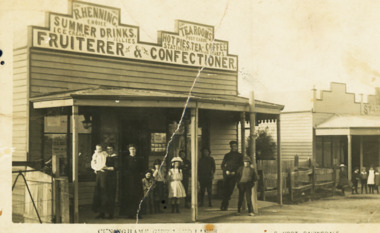
Postcard - Hennings Tea Room, S Vogt Bairnsdale, 1910 c
... on back of card Fish 32 Francis St Bairnsdale Hennings were early Lakes Entrance family...on back of card Fish 32 Francis St Bairnsdale Hennings were early Lakes Entrance family Businesses Genealogy People Cunninghame Gippsland Lakes Sepia toned postcard showing R Hennings Tea Rooms on Esplanade Cunninghame Group of ten adults and children outside shop with group of children outside next shop Lakes Entrance Victoria Postcard Hennings Tea Room S Vogt Bairnsdale ...on back of card Fish 32 Francis St Bairnsdale Hennings were early Lakes Entrance familySepia toned postcard showing R Hennings Tea Rooms on Esplanade Cunninghame Group of ten adults and children outside shop with group of children outside next shop Lakes Entrance VictoriaCunninghame Gippsland Lakesbusinesses, genealogy, people -
 Bendigo Historical Society Inc.
Newspaper - Fortuna Article - "Melody Maker", Jan 07 2008
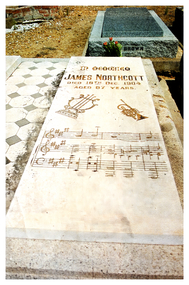
... William Francis and Richard Francis were founders of the Beehive store during the gold rush era. ...William Francis and Richard Francis were founders of the Beehive store during the gold rush era. ...James Northcott In 1867 married Miss Lansell sister of George Lansell. A prominent bandsman in Bendigo, recognized for his musical contributions and honored with a silver cornet in 1871. His grave in the Bendigo Cemetery features musical notes. William Francis and Richard Francis were founders of the Beehive store during the gold rush era. Peter Hoey Finn arrived during the goldfields, owned a store that burned down, and later carved the granite bowl of the Alexandra Fountain as a mason. Elizabeth Watson was he only woman known to have died in a mining accident in Bendigo, tragically killed in 1863 due to her dress getting caught in mining machinery. The monumental section of Bendigo Cemetery has had about 60,000 interments since 1854, with some graves containing up to six people.The cemetery is denominational, with burial locations historically determined by religion.Community and Historical Significance:Cemetery tours are offered at Bendigo, White Hills, Eaglehawk, and Kangaroo Flat as part of the Summer in the Parks program. Many Australians have a family connection to Bendigo, with an estimated one in seven families linked to the area.Prominent Graves in the Bendigo Cemetery Article - "Melody Maker" - The Bendigo Miner Thursday Jan 07 2008 This item contains the following: 11217.11a Colour Photo of The Grave of Bandsman James Northcott 11217.11b Colour Photo of The Grave of Sir John Quick, the federal member for Bendigo 1901-1913, died 1932 11217.11c Colour Photo of The Grave of Anne Caudle in whose honour the Ann Caudle Centre is named, died in 1865 11217.11d Colour Photo of a Father and Mother - Some graves contain up to six people 11217.11e Part of page 5 - Melody Makernon-fictionbendigo, fortuna, george lansell, james northcott, anne caudle, john quick, northcott band -
 Linton and District Historical Society Inc
Photograph, Mr. and Mrs. Francis O'Beirne and Family
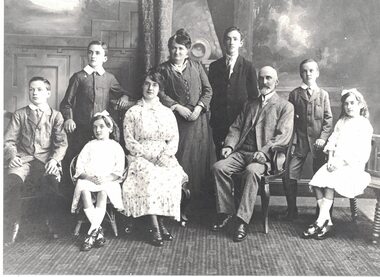
... Annie Elizabeth O'Meara and Francis William O'Beirne were married in 1897. Their children were Maria Kathleen, b. 1898, Francis John, b. 1899, Roger Henry, b. 1901, Clement Michael, b. 1902, Gerard Vincent, 1903, Annie Agnes 1906, Mary Josephine, b. 1907....Annie Elizabeth O'Meara and Francis William O'Beirne were married in 1897. Their children were Maria Kathleen, b. 1898, Francis John, b. 1899, Roger Henry, b. 1901, Clement Michael, b. 1902, Gerard Vincent, 1903, Annie Agnes 1906, Mary Josephine, b. 1907. ...Annie Elizabeth O'Meara and Francis William O'Beirne were married in 1897. Their children were Maria Kathleen, b. 1898, Francis John, b. 1899, Roger Henry, b. 1901, Clement Michael, b. 1902, Gerard Vincent, 1903, Annie Agnes 1906, Mary Josephine, b. 1907.Black and white copy of original photograph which shows Francis O'Beirne, his wife Annie (née Annie O'Meara) and their family.annie elizabeth o'beirne née o'meara, francis william o'beirne, maria kathleen o'beirne, francis john o'beirne, roger henry o'beirne, clement michael o'beirne, gerard vincent o'beirne, annie agnes o'beirne, mary josephine o'beirne -
 Kew Historical Society Inc
Badge - Fundraising Button, East Kew Citizens Sports Carnival: Admit 13 Dec. 1924, 1924
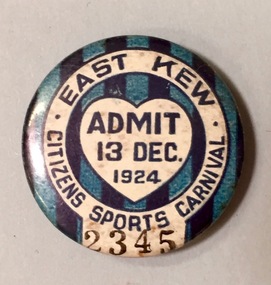
... Most of the ephemera assembled by Francis Rigg were patriotic buttons but also included come sporting event buttons including two associated with the East Kew Citizens Sports Carnival. ...Most of the ephemera assembled by Francis Rigg were patriotic buttons but also included come sporting event buttons including two associated with the East Kew Citizens Sports Carnival. ...Most of the ephemera assembled by Francis Rigg were patriotic buttons but also included come sporting event buttons including two associated with the East Kew Citizens Sports Carnival. The subdivision of the area now known as Kew East commenced before World War 1, but it was not until the 1920s that it became fully developed. At this time, there was a strong Progress Association and this body raised funds to purchase land and build the East Kew Citizen’s Hall in Normandy Road, the first stage of which was completed in 1922. This hall was designed to be extended, although this never occurred, and the building now forms part of the facilities of the East Kew Uniting Church. The ‘East Kew Citizens Sports Carnival’ may well have been a fundraiser event for the building fund. As far as is known, the carnival was only held for a couple of years.Frances Rigg was a local business identity in Kew, at one stage managing the local branch of the English, Scottish and Australian (ES&A) Bank at 175 High Street from c. 1920 until the 1940s. After Francis Rigg’s death, the collection of buttons and medallions was inherited by his son, Ken Rigg (1922-2014). The collection was subsequently donated to the Kew Historical Society in 2015 by Francis' grandson, Adrian Rigg, at the time of the Gallipoli & Beyond Commemoration in 2015. The collection covers a period of almost 40 years. The majority of the buttons are patriotic buttons, issued and sold during and immediately after the First World World War (1914-1918) to raise funds for national and overseas causes. The collection also includes a number of locally significant sporting event buttons and sporting club medallions, issued in the 1920s and 1930s.A circular badge produced for the East Kew Citizens Sports Carnival in 1924. The badge has a ground of vertical stripes in shades of blue. The name of the event is within a white circular band. A white shield in the centre includes the words “Admit” which would indicate that the badge was purchased and worn on the day of the carnival to indicate that the wearer had paid the admission fee."East Kew Citizens Sports Carnival / Admit 13 Dec. 1924"kew east, sport buttons -
 Kew Historical Society Inc
Badge - Fundraising Button, East Kew Citizens Sports Carnival, Admit 2nd December 1922, 1922
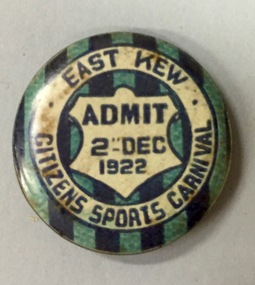
... Most of the ephemera assembled by Francis Rigg were patriotic buttons but also included come sporting event buttons including two associated with the East Kew Citizens Sports Carnival. ...Most of the ephemera assembled by Francis Rigg were patriotic buttons but also included come sporting event buttons including two associated with the East Kew Citizens Sports Carnival. ...Most of the ephemera assembled by Francis Rigg were patriotic buttons but also included come sporting event buttons including two associated with the East Kew Citizens Sports Carnival. The subdivision of the area now known as Kew East commenced before World War 1, but it was not until the 1920s that it became fully developed. At this time, there was a strong Progress Association and this body raised funds to purchase land and build the East Kew Citizen’s Hall in Normandy Road, the first stage of which was completed in 1922. This hall was designed to be extended, although this never occurred, and the building now forms part of the facilities of the East Kew Uniting Church. The ‘East Kew Citizens Sports Carnival’ may well have been a fundraiser event for the building fund. As far as is known, the carnival was only held for a couple of years.Frances Rigg was a local business identity in Kew, at one stage managing the local branch of the English, Scottish and Australian (ES&A) Bank at 175 High Street from c. 1920 until the 1940s. After Francis Rigg’s death, the collection of buttons and medallions was inherited by his son, Ken Rigg (1922-2014). The collection was subsequently donated to the Kew Historical Society in 2015 by Francis' grandson, Adrian Rigg, at the time of the Gallipoli & Beyond Commemoration in 2015. The collection covers a period of almost 40 years. The majority of the buttons are patriotic buttons, issued and sold during and immediately after the First World World War (1914-1918) to raise funds for national and overseas causes. The collection also includes a number of locally significant sporting event buttons and sporting club medallions, issued in the 1920s and 1930s.A circular button produced for the East Kew Citizens Sports Carnival in 1922. The button has a ground of vertical stripes in shades of blue. The name of the event is within a white circular band. A white shield in the centre that includes the words “Admit” would indicate that the badge was purchased and worn on the day of the carnival to indicate that the wearer had paid the admission fee. "East Kew Citizens Sports Carnival, Admit 2nd December 1922"east kew, east kew citizens sports carnival, sports, badge, numismatics, francis rigg -
 Mortlake and District Historical Society
Letter
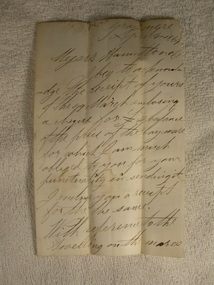
... The horse was purchased from Francis Jones at Grasmere some 45 kilometres distant. Francis Jones and descendants were closely associated with the settlement of Grasmere (district) and 'The Union', a well-known pastoral property still in existence today....The horse was purchased from Francis Jones at Grasmere some 45 kilometres distant. Francis Jones and descendants were closely associated with the settlement of Grasmere (district) and 'The Union', a well-known pastoral property still in existence today. ...This letter describes a business transaction of an item essential to conducting a mill in the days of the pioneers. The horse was purchased from Francis Jones at Grasmere some 45 kilometres distant. Francis Jones and descendants were closely associated with the settlement of Grasmere (district) and 'The Union', a well-known pastoral property still in existence today.The conduct of business in the 19th century could be slow and arduous. Horses were an essential component of business and communication. Their labour was pivotal to success and so their physical soundness (or otherwise) was vital. The horse trade was open to manipulation by the unscrupulous, selling unfit animals. Veterinary care and treatment was primitive, so a buyer could not be confident of a positive result, despite (as in this case) Jones' assurances of the triviality of the injury and Knights' capabilities. Handwritten letter on paper folden in half - water stained.Grasmere. April 4th 1864. Messrs. Hamilton & Co. I beg to acknowledge the receipt of yours of the 29th March enclosing a cheque for [pound sign] balance of the price of the bay mare for which I am much obliged to you for your punctuality in sending it. I enclose you a receipt for the the (sic) same. With reference to the swelling on the mares leg it could only have been there a very short time before you purchased her. It can easily be removed if the proper remedies are applied. M. Knights the veterinary surgeon will give you medicine that will remove it for a trifle. Hoping the mare will give you ample satisfaction. I am scy. (sic) [sincerely] yours respecfully Francis Jones. mortlake mill hamilton transport communication francis jones grasmere michael knights veterinary surgeon -
 Mentone Grammar School
Principal (1939-1960) John Jeffrey Thorold
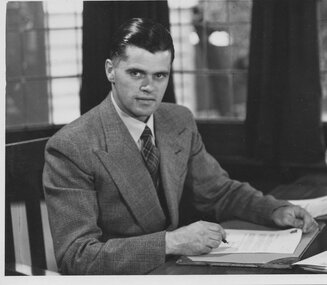
... Fortunes changed when the parent of a boarder offered financial support and together with the skeptical backing of Francis Wellington Were, father of J.J.'s step mother, Jessie, the School numbers grew during the war from 50 to 280. ...Fortunes changed when the parent of a boarder offered financial support and together with the skeptical backing of Francis Wellington Were, father of J.J.'s step mother, Jessie, the School numbers grew during the war from 50 to 280. ...In October 1939, on the sudden death of his father, Headmaster Charles C Thorold, son, John Jeffery (J.J.) Thorold, a 26-year-old accountant and sole beneficiary and executor was suddenly responsible for 42 students. Numbers had dwindled during the Depression and the situation was so dire, J.J. put the School up for sale. Fortunes changed when the parent of a boarder offered financial support and together with the skeptical backing of Francis Wellington Were, father of J.J.'s step mother, Jessie, the School numbers grew during the war from 50 to 280. The majority of the newcomers were boarders and evacuees from northern Australia as well as England. J.J. adopted the title Principal and worked tirelessly to build the school. He briefly appointed Arthur Burnaby as Headmaster before his search for a permanent Head resulted with the appointment of Lionel Ashley Large in 1945. -
 Kew Historical Society Inc
Badge, Come Back to God, 1915-1920
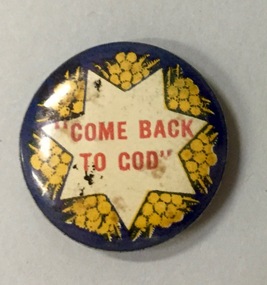
... Most of the civic and sporting ephemera assembled by Francis Rigg were patriotic buttons. The use of these buttons as a means of raising revenue through patriotic sentiment occurred soon after Australia pledged allegiance to Empire. ...Most of the civic and sporting ephemera assembled by Francis Rigg were patriotic buttons. The use of these buttons as a means of raising revenue through patriotic sentiment occurred soon after Australia pledged allegiance to Empire. ...Most of the civic and sporting ephemera assembled by Francis Rigg were patriotic buttons. The use of these buttons as a means of raising revenue through patriotic sentiment occurred soon after Australia pledged allegiance to Empire. Buttons reflected ‘public sentiment, courage, patriotism, generosity and several [un- named] virtues’ such as the martyred mother of a ‘fallen’ hero. Attention was paid to attractiveness of design, encoded symbolism and high quality of production. Expressing ‘loyalty’, they were tokens to be kept for perpetuity. Female labour was used to operate the die that compressed the tin backing, photographic print and celluloid cover together. The pin was applied by hand. Women, of all ages, entered into the spirit of voluntary sales. Often they were sold at the entry and exit points of major pedestrian thoroughfares. The women of Kew set up a kiosk in front of the Post Office and the Railway Station to solicit their round, oval and square shaped wares. Pride in salesmanship was affected by publishing the name of the woman and her fiscal achievement in the major newspapers of the day. The badges form part of a collection of ephemera originally purchased by Francis Horace Rigg (19/10/1882-05/03/1946) of 50 Belford Road, Kew (Vic.). Frances Rigg was a local business identity in Kew, ultimately managing the local branch of the English, Scottish and Australian (ES&A) Bank at 175 High Street, Kew from c. 1920 until the 1940s. After Francis Rigg’s death, the collection of buttons and badges was inherited by his son, Ken Rigg (14/11/1922-19/01/2014). The collection was subsequently donated to the Kew Historical Society in 2015 by his grandson Adrian Rigg during the Gallipoli and Beyond Commemoration.The collection covers a period of almost 40 years. The majority of the badges are patriotic buttons, issued and sold during and immediately after World War 1 to raise funds for national and overseas causes. The collection also includes a number of locally significant sporting event buttons and sporting club medallions, issued in the 1920s and 1930s.The use of common symbols for a range of purposes is sometimes a feature of wartime and post-war fundraising buttons. Like the ‘Hospital Day 1919’ badge, the ‘Come Back to God’ badge is within a seven pointed star on a dark blue ground with sprays of wattle; attempting to harness nationalism with religion.Come back to Godbutton -
 Kew Historical Society Inc
Badge - Fundraising Button, Hospital Day, 1914-1918
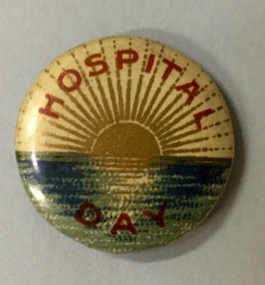
... Most of the civic and sporting ephemera assembled by Francis Rigg were patriotic buttons. The use of these buttons as a means of raising revenue through patriotic sentiment occurred soon after Australia pledged allegiance to Empire. ...Most of the civic and sporting ephemera assembled by Francis Rigg were patriotic buttons. The use of these buttons as a means of raising revenue through patriotic sentiment occurred soon after Australia pledged allegiance to Empire. ...Most of the civic and sporting ephemera assembled by Francis Rigg were patriotic buttons. The use of these buttons as a means of raising revenue through patriotic sentiment occurred soon after Australia pledged allegiance to Empire. Buttons reflected ‘public sentiment, courage, patriotism, generosity and several [un- named] virtues’ such as the martyred mother of a ‘fallen’ hero. Attention was paid to attractiveness of design, encoded symbolism and high quality of production. Expressing ‘loyalty’, they were tokens to be kept for perpetuity. Female labour was used to operate the die that compressed the tin backing, photographic print and celluloid cover together. The pin was applied by hand. Women, of all ages, entered into the spirit of voluntary sales. Often they were sold at the entry and exit points of major pedestrian thoroughfares. The women of Kew set up a kiosk in front of the Post Office and the Railway Station to solicit their round, oval and square shaped wares. Pride in salesmanship was affected by publishing the name of the woman and her fiscal achievement in the major newspapers of the day. The button forms part of a collection of ephemera originally purchased by Francis Horace Rigg (19/10/1882-05/03/1946) of 50 Belford Road, Kew (Vic.). Frances Rigg was a local business identity in Kew, ultimately managing the local branch of the English, Scottish and Australian (ES&A) Bank at 175 High Street, Kew from c. 1920 until the 1940s. After Francis Rigg’s death, the collection of buttons and badges was inherited by his son, Ken Rigg (14/11/1922-19/01/2014). The collection was subsequently donated to the Kew Historical Society in 2015 by his grandson Adrian Rigg during the Gallipoli and Beyond Commemoration. The collection covers a period of almost 40 years. The majority of the badges are patriotic buttons, issued and sold during and immediately after World War 1 to raise funds for national and overseas causes. The collection also includes a number of locally significant sporting event buttons and sporting club medallions, issued in the 1920s and 1930s.Round metal button in red, white, blue and gold showing a sun setting over the sea with words printed in red around border and on lower outer rim.hospital day, patriotic buttons, first world war (1914-18) -
 Emerald Museum & Nobelius Heritage Park
Photograph - Photo from Latter's Farm, c. 1920
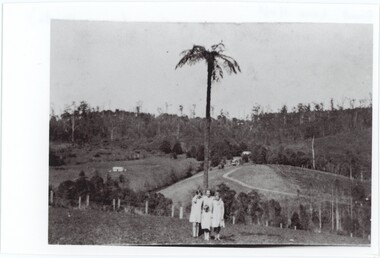
... Their parents were John Francis Hirst and Alice Maude....Their parents were John Francis Hirst and Alice Maude. This photograph captures a historical element of Emerald's landscape, featuring a significant Emerald family on a farm that has since been subdivided and developed. ...This photograph was taken in around 1920 at what was then the Hirst's farm (and later was owned by the Latter family). We believe that the child in the front of the photograph was likely Lana Hirst. Our notes indicate that the photographer was looking towards Charman Avenue and Caroline Crescent (at least, where they are today) from Emerald-Monbulk Road near the corner of Meadowview Lane. The other individuals in the photograph might be three of Lana's five older siblings (Leo, Jack, Dollie, Kath, Joe). Their parents were John Francis Hirst and Alice Maude.This photograph captures a historical element of Emerald's landscape, featuring a significant Emerald family on a farm that has since been subdivided and developed.This black and white photograph is a copy printed onto glossy photo paper, with the photograph uncentred between uneven white margins. A palm tree stands in the centre of the photograph, with four individuals directly in front of it. Three of the individuals are of similar heights, while one - likely a child - is significantly smaller. Over a fence in the background, the landscape dips into a valley before rising to a wooded hill on the horizon. There are handwritten annotations in blue pen on the reverse.Reverse, Handwritten: "Front Lana Hirst / Photo taken from Latter's farm (was Hirsts) / looking towards Charman Ave & Caroline Cres. / c. 1920"hirst family, lana hirst, farming -
 Warrnambool and District Historical Society Inc.
Booklet, Samuel Baulch and the Original Rose Park
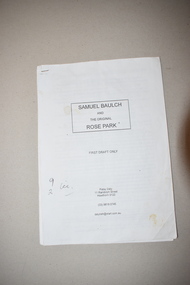
... Samuel Baulch’s parents, Francis and Ann Baulch were pioneer settlers in the Kirkstall area and Samuel worked at the Dunmore Station in the Macarthur area before purchasing the property he named Rose Park in the early 1870s. ...Samuel Baulch’s parents, Francis and Ann Baulch were pioneer settlers in the Kirkstall area and Samuel worked at the Dunmore Station in the Macarthur area before purchasing the property he named Rose Park in the early 1870s. ...This booklet contains the first draft of an article on Samuel Baulch’s acquisition of his property, Rose Park which was in the Macarthur/Hawkesdale district. Samuel Baulch’s parents, Francis and Ann Baulch were pioneer settlers in the Kirkstall area and Samuel worked at the Dunmore Station in the Macarthur area before purchasing the property he named Rose Park in the early 1870s. In the 1890s he acquired property in the Dunmore Estate. Samuel’s son, Stan Baulch, acquired sections of the Dunmore property after his father’s death and he named his section, Rose Park, a property to the west of the original Rose Park. This article is of historical interest and will be useful to researchers of local and family history. This is a booklet of 18 pages. It has a paper cover and the pages were originally stapled together but now have a plastic clip. The booklet has been home-produced and the material typed on a computer. Some of the pages are a little stained. samuel baulch, rose park, western victoria, history of warrnambool -
 Warrnambool and District Historical Society Inc.
Literary work - Antiquarian Book, Heroes of The United Service, 1901
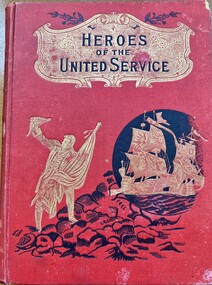
... were early settlers who farmed in the Mt Arapiles district. This book awarded to Arthur Jackman in 1901 for 4th form subjects of history, geography,Spelling and dictation. Sadly he died in September 1901 from meningitis following influenza and pneumonia and is buried with other members of the Jackman family at the Clear Lake cemetery near Horsham. The two schools mentioned on the name plate St Patrick's and St Francis...were early settlers who farmed in the Mt Arapiles district. This book awarded to Arthur Jackman in 1901 for 4th form subjects of history, geography,Spelling and dictation. Sadly he died in September 1901 from meningitis following influenza and pneumonia and is buried with other members of the Jackman family at the Clear Lake cemetery near Horsham. The two schools mentioned on the name plate St Patrick's and St Francis ...This book contains a number of stories which relate to heroes of the British Army and Navy . After a brief synopsis of the history of British military, it then commences from the conquest of Canada in 1759 and relates the stories of renown personnel through to the beginning of the 20th century.This book has a red cloth over card cover with black text mounted in a gold shield at the top of the cover with a gold figure of a sailor who is standing on black rocks. There is a gold image of two galleons inside a black circle. The spine has the title in black on a gold shield , similar to the front cover . The back cover is plain. It has 248 pages relating to the Armed Forces and 256 pages relating to naval stories.There are a number of colour plates and black and white drawings many depicting military scenes. Inside front and back covers are faced with brown and mustard coloured pages. There is a name plate inside the front cover. non-fictionThis book contains a number of stories which relate to heroes of the British Army and Navy . After a brief synopsis of the history of British military, it then commences from the conquest of Canada in 1759 and relates the stories of renown personnel through to the beginning of the 20th century.heroes of the united service, arthur jackman, jackman family, clear lake cemetery, jesuits st patricks college melbourne, jesuits st francis xavier melbourne, rector patrick keating -
 Warrnambool and District Historical Society Inc.
Article, Henry Pulteney Dana and his Native Police, 1970s
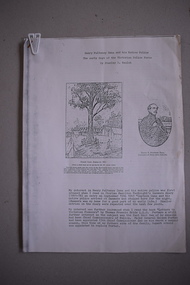
... The paternal grandparents of Stanley Samuel Baulch (1897-1980) were Francis and Ann Baulch, pioneer settlers in the Kirkstall area in the 1840s. ...The paternal grandparents of Stanley Samuel Baulch (1897-1980) were Francis and Ann Baulch, pioneer settlers in the Kirkstall area in the 1840s. ...This item is a copy of an article on Henry Dana and the Native Police of the 1840s and 50s in Victoria. Henry Dana’s police corps is regarded as the forerunner of today’s Victorian Police Force. The article was written by Stan Baulch when he was a member of the Warrnambool and District Historical Society, probably in the 1970s. The paternal grandparents of Stanley Samuel Baulch (1897-1980) were Francis and Ann Baulch, pioneer settlers in the Kirkstall area in the 1840s. Stan’s father, Samuel Baulch, established a property in the Macarthur/Hawkesdale area in the 1870s (Rose Park) and in 1893 bought the nearby property of Dunmore which had been established in the 1840s by Charles Hamilton MacKnight and partners. (It was when Stan Baulch was reading the 19th century diary of Charles MacKnight that he first came across the story of Henry Dana and the native police). Stan Baulch inherited part of the Dunmore estate on his father’s death and this he named Rose Park, using his father’s property’s name. Stan Baulch had a great interest in local history and as well as the article on Henry Dana he also produced a booklet on early bullocking and bullock-drivers in the Western District. This article is a copy so does not have any strong historical significance but another copy of it will be a useful file item in the collection of the Warrnambool and District Historical Society.This is an article of 8 foolscap pages, with the material in it being a typed copy. The first page has two photocopied illustrations. stanley baulch, rose park, western district,, victoria, history of warrnambool -
 Kew Historical Society Inc
Clothing - Grey silk wedding dress, 1842
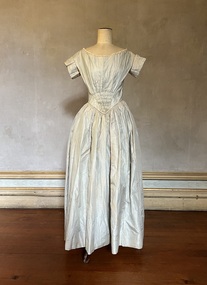
... This wedding gown was worn by Mary Ann Lawrence at 8.00am on 5 January 1842 at St John's Church, Launceston, when she married Francis Henty. The couple were to catch the tide on their way to Portland two hours later. ...This wedding gown was worn by Mary Ann Lawrence at 8.00am on 5 January 1842 at St John's Church, Launceston, when she married Francis Henty. The couple were to catch the tide on their way to Portland two hours later. ...This wedding gown was worn by Mary Ann Lawrence at 8.00am on 5 January 1842 at St John's Church, Launceston, when she married Francis Henty. The couple were to catch the tide on their way to Portland two hours later. Francis Henty was the youngest son of Thomas Henty, who with his family, their retainers and property moved to the Australian colonies between 1829 and 1832. In 1834, Francis’ older brother, Edward, sailed from Launceston in Van Diemen’s Land to what was to become Portland in the western part of Port Phillip District [Victoria]. Francis, together with the first flock of Merino sheep [in Victoria], followed some months later. The first and second generations of the Henty family established vast pastoral properties in the Western part of the Port Phillip District. Francis Henty managed ‘Merino Downs’ near Casterton, while also living in his retirement at ‘Field Place' in Kew. The Henty Collection of nineteenth and twentieth century clothing, including outerwear and underwear, was collected, stored and exhibited over time by female family members descended from Francis and Mary Ann Henty. During the twentieth century, items from the collection were modelled in two fashion parades by various descendants [1937, 1959]. The items in the collection are historically and aesthetically significant, with provenance provided by oral and written tradition within or held by the family. A number of the items in the collection are very rare survivors, and provide researchers with the evidence needed to reconstruct the lives of notable women in the Port Phillip District [later Victoria] during the nineteenth and early twentieth century.Mary Ann Lawrence's grey silk wedding gown has a v-line waist and a partly smocked bodice. It is lined with muslin throughout. It has hand-tatted cotton lace and handmade piping around the neck and bodice and pleated short sleeves. There was originally trimming on the skirt which was removed at a later date. Orange blossom made of chamois and tiny coiled springs originally decorated the neckline. The outfit was complemented by a bonnet to which a Limerick lace veil was attached. MEASUREMENTS (MM): GIRTH - Neck 914, Chest 812.8, Waist 660.4, Cuff 330.2, Hem circumference 3200.4. VERTICAL - Front neck to hem 1270, Front waist to hem 1016, Back neck to hem 1320.8, Back waist to hem 1041.4, Sleeve length 114.3. HORIZONTAL - Neck to sleeve head 50.8, Chest back 406.4, Underarm to underarm 406.4.mary ann lawrence, francis henty, wedding dresses, fashion -- 1840s, women's clothing -
 Warrnambool and District Historical Society Inc.
Document (Sketch Plan of Dunmore), Stan Baulch, 1972
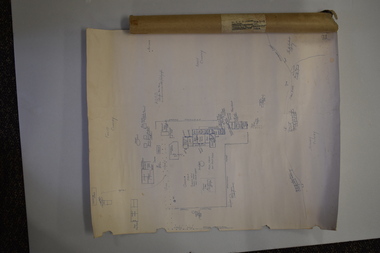
... The plan of Dunmore homestead shows interesting features such as the brick oven for bread making, the croquet lawn, the site of the aboriginal mia mias, the Turkish baths and the fowl house used later as a poison house. Francis and Ann Baulch were pioneer settlers in the Kirkstall area and their son Samuel worked at Dunmore in the Macarthur area before purchasing in the early 1870s the property he named Rose Park. ...The plan of Dunmore homestead shows interesting features such as the brick oven for bread making, the croquet lawn, the site of the aboriginal mia mias, the Turkish baths and the fowl house used later as a poison house. Francis and Ann Baulch were pioneer settlers in the Kirkstall area and their son Samuel worked at Dunmore in the Macarthur area before purchasing in the early 1870s the property he named Rose Park. ...This card has a sketch map showing the properties surrounding Dunmore on one side and a detailed sketch plan of Dunmore homestead in the early 1970s on the other side. The plan of Dunmore homestead shows interesting features such as the brick oven for bread making, the croquet lawn, the site of the aboriginal mia mias, the Turkish baths and the fowl house used later as a poison house. Francis and Ann Baulch were pioneer settlers in the Kirkstall area and their son Samuel worked at Dunmore in the Macarthur area before purchasing in the early 1870s the property he named Rose Park. In the 1890s he acquired property in the Dunmore estate and his son Stan Baulch gained a section of the Dunmore property after his father’s death. Stan Baulch named this Dunmore section, Rose Park, a property to the west of his father’s original Rose Park property. Stan Baulch was a long time member of the Warrnambool & District Historical Society and he contributed many local history articles and donated many local artefacts to the Society.This sketch plan is of interest as it tells us what the historic homestead of Dunmore in Western Victoria was like in the early 1970s. It will be useful for research. This is a sheet of white lightweight cardboard with a pencilled sketch on one side and a blue ink sketch plan of a house on the other side. The edges of the card have some torn sections. The card is enclosed in an oval cardboard cylinder (recycled and torn at the ends). Both the card and the cover have handwritten titles in ink. Dunmore Homestead & History by S. Baulch Dunmore Homestead drawn by Stan Baulch c.1972 dunmore property, western victoria, baulch family -
 National Wool Museum
Clothing - Paisley Shawl, 1800 - 1830
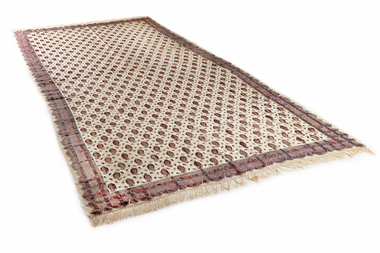
... - Donor, 2026 The Francis family were tenant farmers, and the donor speculated that the shawl could potentially have been a wedding gift from the land owners.... - Donor, 2026 The Francis family were tenant farmers, and the donor speculated that the shawl could potentially have been a wedding gift from the land owners. ...Shawl of Jane Francis (nee Piper) 1809-1891 This fine woven silk and woollen shawl is from Shetland, Scotland and belonged orginally to Jane Francis. Jane was born in Devon near the village of Bradworthy. She married Joseph Francis (1803-1878) in 1830 in the Bradworthy Parish, Devon, England and wore the shawl over her wedding dress on her wedding day. Jane and Joseph came to Geelong in 1853 with their family. Jane’s sister and brother were in Geelong and their eldest daughter Elizabeth had arrived in 1849. They arrived on the ship 'Euphemus' at Point Henry, Geelong, on July 20, 1853 and travelled across the bay in the steamer Duncan Hoyle. Jane was wearing the shawl on her arrival in Geelong. They went to live in Sharp Street Chilwell in a house owned by their son in law, John Price, which they later purchased. Jane became well known as a ‘midwife’ having had 10 children of her own. She is known to have delivered twin girls in Fyans Street; Ada and Myrtle Downie in 1884. Jane’s youngest son William (1848-1932) was a spinning master, timekeeper and pay clerk at the Victorian Woollen Mill (later the Godfrey Hirst Excelsior Number Two mill) and together with William Cook owned a wool scour on the Barwon River at Marnockvale. William’s grandson Arthur (1917-1992) was a wool classer undertaking his course at the Gordon Institute and became a wool valuer at Strachan & Co. For a time he taught part time in the Gordon course. Arthur’s son Robert was also a wool classer and worked at the Australian Wool Testing Authority. The shawl was used as a bed spread at 'Woodstock' by Jane's son William and then by his two children Laura and Eve. After their deaths, Eve in 1947 and Laura in 1963, the shawl was passed to their youngest sister Ethel (Effie) Frier (nee Francis). She had no children and it was passed on to grandniece Pat Norman (nee Hughan). Pat then passed the shawl to cousin Carollyn Williams (nee Francis) who donated the shawl to the National Wool Museum. - Donor, 2026 The Francis family were tenant farmers, and the donor speculated that the shawl could potentially have been a wedding gift from the land owners.Wool and silk fringed cream coloured shawl featuring a paisley pattern in tones of maroon, green, blue, brown and cream.shawl, 19th century, fashion, clothing, design, paisley, migration, geelong, point henry -
 City of Moorabbin Historical Society (Operating the Box Cottage Museum)
Photograph, black & white George Box 1808- 1867, c1855
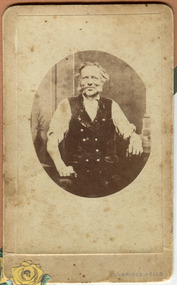
... George and son Henry paid their own fares while sons , Francis and John, were 'assisted passengers'. Their baby daughter Cecilia Lydia died a few days into the voyage.. ...George and son Henry paid their own fares while sons , Francis and John, were 'assisted passengers'. Their baby daughter Cecilia Lydia died a few days into the voyage.. ...George Box 1808-1867 an 'agricultural labourer', of Sussex England, married Mary Cripps in 1831 and with 3 three of their 4 four sons and 3 three of their 4 four daughters left Liverpool in the Sailing Ship 'Atlanta' in March 1856 to begin a new life in Melbourne, Victoria , Australia. George and son Henry paid their own fares while sons , Francis and John, were 'assisted passengers'. Their baby daughter Cecilia Lydia died a few days into the voyage.. Caroline Box, the eldest daughter, remained in England working as a cook until she joined the family in Australia in 1863. William Box 1834-1902, the eldest son of George Box, married Elizabeth Avis 1833- 1914 and they resided in Box Cottage 1865 -1914 where they established a market garden and raised 13 children. William and Elizabeth had emigrated in 1854 so George and sons probably worked on their market garden before setting up in Tucker Road and Patterson Road. Sadly Mary drowned in a water hole only 4 months after their arrival in Brighton. Mary suffered from headaches and had occasional fits and the coroner found she passed out and died while trying to ease the pain with cold water from a waterhole. It is supposed that Elizabeth helped him raise the children while he established his market garden. George died from Tetanus following an infected broken leg caused by falling from his dray in 1867. George and Mary were both buried in the Brighton Cemetery. Box Cottage Museum, a reconstruction of an early settler hut, is named after the Box family who resided there 1865 -1913 . George Box was the father of William Box who with his wife Elizabeth Avis Box and 13 children lived and farmed on the block of land in Jasper Road, East Brighton ( now McKinnon / Ormond) that was part of the Henry Dendy Special Survey 1841 Inscribed in Album : “ The early photos in this album were found by Mr (Laurie) Lewis when he was demolishing the Old Box Cottage. He gave them to Mrs Avis Box Eldridge who in turn gave them to me. They were not identified. I believe they rightly belong in the Cottage. I have attempted to identify them and present them in a way they can be preserved as a historical record of the era.” A B Leigh A black and white photograph of George Box taken in Tunbridge Wells, England c1855Photo at base ; TUNBRIDGE WELLS Album inside cover ; Donated to / Moorabbin / Historical Society / by / Avis Box Leigh box george, box mary, box william, box elizabeth, box alonzo, box mary louisa, dendy henry, were j b, dendy's special survey 1841, brighton, moorabbin, bentleigh, mckinnon, ormond, market gardeners, dairy farms, early settlers, pioneers, jasper road, gurr jabez, gurr eliza, pay henry, pay anna, ward willam, box henry, ward elizabeth emma, box john, sheldrake martha, rushall eleanor, box caroline, tetanus -
 Flagstaff Hill Maritime Museum and Village
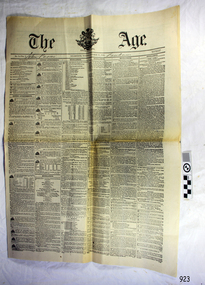
Newspaper - The Age, Francis Cooke, printer and publisher, 17-10-1854
... This edition was printed and published by Francis Cooke, for the publishers Francis Cooke & Co. at The Age Newspaper and General Printing Office, 21 Elizabeth Street, South Melbourne, in the Colony of Victoria, which came into being on July 1st, 1851. This edition of The Age newspaper is very significant as it is the first edition, printed 17th October 1854, and contains shipping news amongst may other topics in its eight pages. Newspapers were ...The newspaper is the very first edition of The Age. The central shield has the words "COLONY OF VICTORIA" printed below it. the handwritten script has the name John Pascoe, and the location of Fawner, a suburb of Melbourne. There are eight pages comprising of two large sheets, folded one inside the other and all sides printed on. This edition was printed and published by Francis Cooke, for the publishers Francis Cooke & Co. at The Age Newspaper and General Printing Office, 21 Elizabeth Street, South Melbourne, in the Colony of Victoria, which came into being on July 1st, 1851.This edition of The Age newspaper is very significant as it is the first edition, printed 17th October 1854, and contains shipping news amongst may other topics in its eight pages. Newspapers were very significant in Colonial times for a meas of communication throughout the colony. Newspaper, The Age newspaper, Vol. 1, No. 1, first edition, Tuesday October 17th 1854. eight pages. Large format. Inscription in script on top of first and last page. Handwritten in script "John Pascoe" "Fawkner" "COLONY OF VICTORIA" "PRINTED DAILY" "PRICE SIXPENCEflagstaff hill, warrnambool, shipwrecked-coast, flagstaff-hill, flagstaff-hill-maritime-museum, maritime-museum, shipwreck-coast, flagstaff-hill-maritime-village, the age, newspaper, melbourne, colony of victoria, first edition, 1854, john pascoe, fawkner -
 Flagstaff Hill Maritime Museum and Village
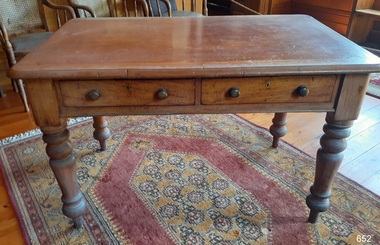
Furniture - Desk, Foy & Gibson, Circa 1880s
... were better prospects for expansion. He chose a place in Smith Street, Collingwood, a suburb of Melbourne, and started his business at the rear. In 1883 Foy retired, bringing in William Gibson as a partner, and then transferred his own share of the company to his son Francis Foy. ...were better prospects for expansion. He chose a place in Smith Street, Collingwood, a suburb of Melbourne, and started his business at the rear. In 1883 Foy retired, bringing in William Gibson as a partner, and then transferred his own share of the company to his son Francis Foy. ...The design of this small disc is from the Australian Colonial period. The cedar wood desk was made in Australian by Foy & Gibson in the 1880s, most probably in the business’s works in Collingwood, Victoria. The heavy brass locks fitted into the desk drawers were made by the famous Hobbs & Co of London, mid-late 19th century. In 1860 the business changed hands but the locks were still branded Hobbs & Co. The desk is branded with the symbol of Victoria’s Public Works Department. There is currently no information on when, where and by whom this desk was used. However, a very similar desk with Hobbs & Co. locks is on site at the Point Hicks Lightstation in Victoria and was formerly used by the Point Hicks head light keeper there. Other light stations also have similar desks from the P.W.D. (see also ‘Desk, Parks Victoria – Point Hicks Lightstation, Victorian Collections’.) HOBBS & CO., LONDON Alfred Charles Hobbs, 1812-1891, was American born. He became an executive salesman in 1840 for renowned lock manufacturer Day & Newell. His technique of exposing the weaknesses of people’s current locks was very successful in generating sales. He represented Day & Newell at London’s Great Exhibition of 1851, competing with other lock makers. Through the Exhibition he became famous for picking the best trusted Bramah and Chubb locks. Hobbs’ fame led him to found his own company in 1851 then register it in 1852 as Hobbs & Co., London. Hobbs was awarded the Telford Medal by the British Institution of Civil Engineers in 1854 for his paper 'On the Principles and Construction of Locks'. In 1855 the very successful company added partners and became Hobbs, Ashley and Co. In 1860, it traded under the name of Hobbs, Hart & Co. and was based in Cheapside London, where the business remained. Hobbs then returned to America, having sold the complete company to John Mathias Hart. He briefly returned to attend the 21st anniversary celebrations of the successful business in 1872. Hobbs kept himself busy in America, inventing and manufacturing firearm ammunition, for which he held several patents. He passed away there in 1891, a month after his 70th birthday. FOY & GIBSON Mark Foy wan an Irish draper who migrated to Bendigo, Victoria in 1858, attracted by the gold rush. He lived and worked in the area, establishing a drapery business. In the 1870s he moved to Melbourne where there were better prospects for expansion. He chose a place in Smith Street, Collingwood, a suburb of Melbourne, and started his business at the rear. In 1883 Foy retired, bringing in William Gibson as a partner, and then transferred his own share of the company to his son Francis Foy. Not long afterwards Francis sold his half share to Gibson, and the business continued under the name of Foy & Gibson. Francis Foy and he and his brother Mark Foy (junior) moved to Sydney. They established a business there in 1885, named after their father, Mark Foy. Gibson added to his business by starting his own manufacturing works from 1887, producing clothing, millinery, furniture, bedding and hardware for his stores. The factories, warehouses and stores complex became one of Victoria’s largest employers. He set up branches of his stores in Perth, Brisbane and Adelaide and two more branches in Melbourne. Foy & Gibson (usually referred to as Foys) became one of Australia’s largest retail department stores. In 1931 Foy’s little house in Collingwood was still part of the entrance to Foy & Gibson Emporium. In 1955 the company was bought out by Cox Brothers. Later on the stores were sold to various businesses such as David Jones, Woolworths and Harris Scarfe. In 1968 Cox Brothers went into receivership, ending almost 100 years of the business known as Foy’s. The former Foy & Gibson Complex is registered by Heritage Council Victoria. “Designed by William Pitt, this magnificent 19th and early 20th century complex of factories, warehouses and showrooms saw the production of a remarkable range of goods for Foy & Gibson, Melbourne’s earliest department store chain”. (Quoted from the Plaque erected by the Collingwood Historical Society 2007) P.W.D. – Public Works Department, Victoria The desk is stamped “P.W.D,” signifying that it is from the Public Works Department in Victoria, which operated from 1855-1987. The department was responsible for, among other things, the design and supply of office furniture and equipment for public buildings and organisations. This desk is significant historically as it originated from Foy & Gibson, a colonial Australian company that had a positive and strong impact on employment, manufacturing and retailing in Melbourne, Victoria and Australia. The significance of Foy & Gibson to Victoria’s and Australia’s history is marked by the Collingwood Complex being registered in both Heritage Victoria Register (H0755, H0897 and H0896) and National Trust Register (B2668). This locks on this desk are significant for their connection with their manufacturer, Hobbs & Co, who invented a lock that surpassed the security of any other locks produced in the mid-19th century. Desk; Australian Colonial cedar desk, honey coloured. Desktop has a wooden border with a rolled edge and a fitted timber centrepiece. The four tapered legs are tulip turned. Two half-width drawers fit side by side and extend the full depth of the desk. The drawers have dovetail joints. Each drawer has two round wooden knob handles, a keyhole and a fitted, heavy brass lever lock. Inscriptions are on the desktop, drawers, desk leg and lock. Made in Australia circa 1880 by Foy & Gibson, lock made by Hobbs & Co, London.Impressed into timber frame of one drawer “FOY & GIBSON” Impressed into lock “HOBBS & CO / LONDON”, “MACHINE MADE”, “LEVER” Impressed along the front edge of the desktop [indecipherable] text. Impressed into the timber of right front leg “P. W. D.” below a ‘crown’ symbol Handwritten in white chalk under a drawer “206” flagstaff hill, warrnambool, shipwrecked coast, flagstaff hill maritime museum, maritime museum, shipwreck coast, flagstaff hill maritime village, great ocean road, desk, cedar desk, colonial desk, 1880s desk, australian colonial furniture, furniture, office furniture, office equipment, australian made furniture, colonial furniture, colonial hardware, foy & gibson, alfred charles hobbs, hobbs & co london, hobs & co lever lock, cabinetry lock, machine made lever lock, p.w.d., public works department victoria, day & newell, great exhibition of 1851, bramah lock, chubb lock, telford medal 1854, cheapside london, mark foy, mark foy – bendigo draper, smith street collingwood, william gibson, foy & gibson emporium, foy & gibson complex, cox brothers -
 Flagstaff Hill Maritime Museum and Village
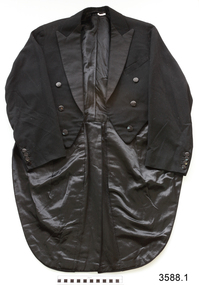
Formal suit, 1925
... were acquired second hand at the time when Dr Angus was in his early practice days. It is part of the “W.R. Angus Collection” that includes historical medical equipment, surgical instruments and material once belonging to Dr Edward Ryan and Dr Thomas Francis Ryan, (both of Nhill, Victoria) as well as Dr Angus’ own belongings. ...were acquired second hand at the time when Dr Angus was in his early practice days. It is part of the “W.R. Angus Collection” that includes historical medical equipment, surgical instruments and material once belonging to Dr Edward Ryan and Dr Thomas Francis Ryan, (both of Nhill, Victoria) as well as Dr Angus’ own belongings. ...This formal suit, comprising tails coat, trousers, waistcoat and shirt, is believed by Berry McDade (daughter of Dr Angus) to be the one donated to Flagstaff Hill Maritime Village by the family of Doctor William Roy Angus, Surgeon and Oculist, according to the doner.. There is another name on some of the garments, possibly because the suit components were acquired second hand at the time when Dr Angus was in his early practice days. It is part of the “W.R. Angus Collection” that includes historical medical equipment, surgical instruments and material once belonging to Dr Edward Ryan and Dr Thomas Francis Ryan, (both of Nhill, Victoria) as well as Dr Angus’ own belongings. The Collection’s history spans the medical practices of the two Doctors Ryan, from 1885-1926 plus that of Dr Angus, up until 1969. ABOUT THE “W.R.ANGUS COLLECTION” Doctor William Roy Angus M.B., B.S., Adel., 1923, F.R.C.S. Edin.,1928 (also known as Dr Roy Angus) was born in Murrumbeena, Victoria in 1901 and lived until 1970. He qualified as a doctor in 1923 at University of Adelaide, was Resident Medical Officer at the Royal Adelaide Hospital in 1924 and for a period was house surgeon to Sir (then Mr.) Henry Simpson Newland. Dr Angus was briefly an Assistant to Dr Riddell of Kapunda, then commenced private practice at Curramulka, Yorke Peninsula, SA, where he was physician, surgeon and chemist. In 1926, he was appointed as new Medical Assistant to Dr Thomas Francis Ryan (T.F. Ryan, or Tom), in Nhill, Victoria, where his experiences included radiology and pharmacy. In 1927 he was Acting House Surgeon in Dr Tom Ryan’s absence. Dr Angus had become engaged to Gladys Forsyth and they decided he would take time to further his studies overseas in the UK in 1927. He studied at London University College Hospital and at Edinburgh Royal Infirmary and in 1928, was awarded FRCS (Fellow from the Royal College of Surgeons), Edinburgh. He worked his passage back to Australia as a Ship’s Surgeon on the on the Australian Commonwealth Line’s SS Largs Bay. Dr Angus married Gladys in 1929, in Ballarat. (They went on to have one son (Graham 1932, born in SA) and two daughters (Helen (died 12/07/1996) and Berenice (Berry), both born at Mira, Nhill ) Dr Angus was a ‘flying doctor’ for the A.I.M. (Australian Inland Ministry) Aerial Medical Service in 1928 . The organisation began in South Australia through the Presbyterian Church in that year, with its first station being in the remote town of Oodnadatta, where Dr Angus was stationed. He was locum tenens there on North-South Railway at 21 Mile Camp. He took up this ‘flying doctor’ position in response to a call from Dr John Flynn; the organisation was later known as the Flying Doctor Service, then the Royal Flying Doctor Service. A lot of his work during this time involved dental surgery also. Between 1928-1932 he was surgeon at the Curramulka Hospital, Yorke Peninsula, South Australia. In 1933 Dr Angus returned to Nhill where he’d previously worked as Medical Assistant and purchased a share of the Nelson Street practice and Mira hospital from Dr Les Middleton one of the Middleton Brothers, the current owners of what was once Dr Tom Ryan’s practice. Dr L Middleton was House Surgeon to the Nhill Hospital 1926-1933, when he resigned. [Dr Tom Ryan’s practice had originally belonged to his older brother Dr Edward Ryan, who came to Nhill in 1885. Dr Edward saw patients at his rooms, firstly in Victoria Street and in 1886 in Nelson Street, until 1901. The Nelson Street practice also had a 2 bed ward, called Mira Private Hospital ). Dr Edward Ryan was House Surgeon at the Nhill Hospital 1884-1902 . He also had occasions where he successfully performed veterinary surgery for the local farmers too. Dr Tom Ryan then purchased the practice from his brother in 1901. Both Dr Edward and Dr Tom Ryan work as surgeons included eye surgery. Dr Tom Ryan performed many of his operations in the Mira private hospital on his premises. He too was House Surgeon at the Nhill Hospital 1902-1926. Dr Tom Ryan had one of the only two pieces of radiology equipment in Victoria during his practicing years – The Royal Melbourne Hospital had the other one. Over the years Dr Tom Ryan gradually set up what was effectively a training school for country general-practitioner-surgeons. Each patient was carefully examined, including using the X-ray machine, and any surgery was discussed and planned with Dr Ryan’s assistants several days in advance. Dr Angus gained experience in using the X-ray machine there during his time as assistant to Dr Ryan. Dr Tom Ryan moved from Nhill in 1926. He became a Fellow of the Royal Australasian College of Surgeons in 1927, soon after its formation, a rare accolade for a doctor outside any of the major cities. He remained a bachelor and died suddenly on 7th Dec 1955, aged 91, at his home in Ararat. Scholarships and prizes are still awarded to medical students in the honour of Dr T.F. Ryan and his father, Dr Michael Ryan, and brother, John Patrick Ryan. ] When Dr Angus bought into the Nelson Street premises in Nhill he was also appointed as the Nhill Hospital’s Honorary House Surgeon 1933-1938. His practitioner’s plate from his Nhill surgery states “HOURS Daily, except Tuesdays, Fridays and Saturday afternoons, 9-10am, 2-4pm, 7-8pm. Sundays by appointment”. This plate is now mounted on the doorway to the Port Medical Office at Flagstaff Hill Maritime Village, Warrnambool. Dr Edward Ryan and Dr Tom Ryan had an extensive collection of historical medical equipment and materials spanning 1884-1926 and when Dr Angus took up practice in their old premises he obtained this collection, a large part of which is now on display at the Port Medical Office at Flagstaff Hill Maritime Village in Warrnambool. During his time in Nhill Dr Angus was involved in the merging of the Mira Hospital and Nhill Public Hospital into one public hospital and the property titles passed on to Nhill Hospital in 1939. In 1939 Dr Angus and his family moved to Warrnambool where he purchased “Birchwood,” the 1852 home and medical practice of Dr John Hunter Henderson, at 214 Koroit Street. (This property was sold in1965 to the State Government and is now the site of the Warrnambool Police Station. ). The Angus family was able to afford gardeners, cooks and maids; their home was a popular place for visiting dignitaries to stay whilst visiting Warrnambool. Dr Angus had his own silk worm farm at home in a Mulberry tree. His young daughter used his centrifuge for spinning the silk. Dr Angus was appointed on a part-time basis as Port Medical Officer (Health Officer) in Warrnambool and held this position until the 1940’s when the government no longer required the service of a Port Medical Officer in Warrnambool; he was thus Warrnambool’s last serving Port Medical Officer. (The duties of a Port Medical Officer were outlined by the Colonial Secretary on 21st June, 1839 under the terms of the Quarantine Act. Masters of immigrant ships arriving in port reported incidents of diseases, illness and death and the Port Medical Officer made a decision on whether the ship required Quarantine and for how long, in this way preventing contagious illness from spreading from new immigrants to the residents already in the colony.) Dr Angus was a member of the Australian Medical Association, for 35 years and surgeon at the Warrnambool Base Hospital 1939-1942, He served as a Surgeon Captain during WWII1942-45, in Ballarat, Victoria, and in Bonegilla, N.S.W., completing his service just before the end of the war due to suffering from a heart attack. During his convalescence he carved an intricate and ‘most artistic’ chess set from the material that dentures were made from. He then studied ophthalmology at the Royal Melbourne Eye and Ear Hospital and created cosmetically superior artificial eyes by pioneering using the intrascleral cartilage. Angus received accolades from the Ophthalmological Society of Australasia for this work. He returned to Warrnambool to commence practice as an ophthalmologist, pioneering in artificial eye improvements. He was Honorary Consultant Ophthalmologist to Warrnambool Base Hospital for 31 years. He made monthly visits to Portland as a visiting surgeon, to perform eye surgery. He represented the Victorian South-West subdivision of the Australian Medical Association as its secretary between 1949 and 1956 and as chairman from 1956 to 1958. In 1968 Dr Angus was elected member of Spain’s Barraquer Institute of Barcelona after his research work in Intrasclearal cartilage grafting, becoming one of the few Australian ophthalmologists to receive this honour, and in the following year presented his final paper on Living Intrasclearal Cartilage Implants at the Inaugural Meeting of the Australian College of Ophthalmologists in Melbourne In his personal life Dr Angus was a Presbyterian and treated Sunday as a Sabbath, a day of rest. He would visit 3 or 4 country patients on a Sunday, taking his children along ‘for the ride’ and to visit with him. Sunday evenings he would play the pianola and sing Scottish songs to his family. One of Dr Angus’ patients was Margaret MacKenzie, author of a book on local shipwrecks that she’d seen as an eye witness from the late 1880’s in Peterborough, Victoria. In the early 1950’s Dr Angus, painted a picture of a shipwreck for the cover jacket of Margaret’s book, Shipwrecks and More Shipwrecks. She was blind in later life and her daughter wrote the actual book for her. Dr Angus and his wife Gladys were very involved in Warrnambool’s society with a strong interest in civic affairs. Their interests included organisations such as Red Cross, Rostrum, Warrnambool and District Historical Society (founding members), Wine and Food Society, Steering Committee for Tertiary Education in Warrnambool, Local National Trust, Good Neighbour Council, Housing Commission Advisory Board, United Services Institute, Legion of Ex-Servicemen, Olympic Pool Committee, Food for Britain Organisation, Warrnambool Hospital, Anti-Cancer Council, Boys’ Club, Charitable Council, National Fitness Council and Air Raid Precautions Group. He was also a member of the Steam Preservation Society and derived much pleasure from a steam traction engine on his farm. He had an interest in people and the community He and his wife Gladys were both involved in the creation of Flagstaff Hill, including the layout of the gardens. After his death (28th March 1970) his family requested his practitioner’s plate, medical instruments and some personal belongings be displayed in the Port Medical Office surgery at Flagstaff Hill Maritime Village, and be called the “W. R. Angus Collection”. The W.R. Angus Collection is significant for still being located at the site it is connected with, Doctor Angus being the last Port Medical Officer in Warrnambool. The collection of medical instruments and other equipment is culturally significant, being an historical example of medicine from late 19th to mid-20th century. Dr Angus assisted Dr Tom Ryan, a pioneer in the use of X-rays and in ocular surgery. Formal suit, worn by Dr Angus, Coat (.1): black double-breasted with tails, black round flat, shank buttons, quilting inside (under armholes), label "BRAHAM & CO / 614 ALDERSGATE ST E.C / Mr G Hobson, 1925 Aug". Trousers (.2): black, button fly, black braid stripe, nametag "J.C. RENYARD" stamped number on front right pocket lining "163332-2-3398F" Waistcoat (.3): black, 4x 4-holed black buttons. Shirt (.4); white cotton, long sleeves, round neck, long tailed, bib front, 4x button holes each side, stamp around neck "4.AM:25", label "THE AINSLY SHIRT", name in pen "R115 RENYARD", remnants of red cotton stitching on neck (W.R. Angus Collection)Jacket has label label "BRAHAM & CO / 614 ALDERSGATE ST E.C / Mr G Hobson, 1925 Aug Trousers nametag "J.C. RENYARD" stamped number on front right pocket lining "163332-2-3398F" Shirt has stamp around neck label "THE AINSLY SHIRT", name in pen "R115 RENYARDflagstaff hill, warrnambool, shipwrecked-coast, flagstaff-hill, flagstaff-hill-maritime-museum, maritime-museum, shipwreck-coast, flagstaff-hill-maritime-village, formal sout, tails suit, dr w r angus, the ailsley shirt, ophthalmology, formal clothing, mira hospital, nhill base hospital -
 Flagstaff Hill Maritime Museum and Village
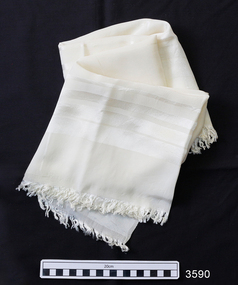
Scarf, 20th century
... were donated to Flagstaff Hill Maritime Village by the family of Doctor William Roy Angus, Surgeon and Oculist. It is part of the “W.R. Angus Collection” that includes historical medical equipment, surgical instruments and material once belonging to Dr Edward Ryan and Dr Thomas Francis Ryan, (both of Nhill, Victoria) as well as Dr Angus’ own belongings. ...were donated to Flagstaff Hill Maritime Village by the family of Doctor William Roy Angus, Surgeon and Oculist. It is part of the “W.R. Angus Collection” that includes historical medical equipment, surgical instruments and material once belonging to Dr Edward Ryan and Dr Thomas Francis Ryan, (both of Nhill, Victoria) as well as Dr Angus’ own belongings. ...This scarf was worn by Dr. W.R. Angus on formal occasions, together with his formal suit. Suit and scarf were donated to Flagstaff Hill Maritime Village by the family of Doctor William Roy Angus, Surgeon and Oculist. It is part of the “W.R. Angus Collection” that includes historical medical equipment, surgical instruments and material once belonging to Dr Edward Ryan and Dr Thomas Francis Ryan, (both of Nhill, Victoria) as well as Dr Angus’ own belongings. The Collection’s history spans the medical practices of the two Doctors Ryan, from 1885-1926 plus that of Dr Angus, up until 1969. ABOUT THE “W.R.ANGUS COLLECTION” Doctor William Roy Angus M.B., B.S., Adel., 1923, F.R.C.S. Edin.,1928 (also known as Dr Roy Angus) was born in Murrumbeena, Victoria in 1901 and lived until 1970. He qualified as a doctor in 1923 at University of Adelaide, was Resident Medical Officer at the Royal Adelaide Hospital in 1924 and for a period was house surgeon to Sir (then Mr.) Henry Simpson Newland. Dr Angus was briefly an Assistant to Dr Riddell of Kapunda, then commenced private practice at Curramulka, Yorke Peninsula, SA, where he was physician, surgeon and chemist. In 1926, he was appointed as new Medical Assistant to Dr Thomas Francis Ryan (T.F. Ryan, or Tom), in Nhill, Victoria, where his experiences included radiology and pharmacy. In 1927 he was Acting House Surgeon in Dr Tom Ryan’s absence. Dr Angus had become engaged to Gladys Forsyth and they decided he would take time to further his studies overseas in the UK in 1927. He studied at London University College Hospital and at Edinburgh Royal Infirmary and in 1928, was awarded FRCS (Fellow from the Royal College of Surgeons), Edinburgh. He worked his passage back to Australia as a Ship’s Surgeon on the on the Australian Commonwealth Line’s T.S.S. Largs Bay. Dr Angus married Gladys in 1929, in Ballarat. (They went on to have one son (Graham 1932, born in SA) and two daughters (Helen (died 12/07/1996) and Berenice (Berry), both born at Mira, Nhill ) Dr Angus was a ‘flying doctor’ for the A.I.M. (Australian Inland Ministry) Aerial Medical Service in 1928 . The organisation began in South Australia through the Presbyterian Church in that year, with its first station being in the remote town of Oodnadatta, where Dr Angus was stationed. He was locum tenens there on North-South Railway at 21 Mile Camp. He took up this ‘flying doctor’ position in response to a call from Dr John Flynn; the organisation was later known as the Flying Doctor Service, then the Royal Flying Doctor Service. A lot of his work during this time involved dental surgery also. Between 1928-1932 he was surgeon at the Curramulka Hospital, Yorke Peninsula, South Australia. In 1933 Dr Angus returned to Nhill where he’d previously worked as Medical Assistant and purchased a share of the Nelson Street practice and Mira hospital from Dr Les Middleton one of the Middleton Brothers, the current owners of what was once Dr Tom Ryan’s practice. Dr L Middleton was House Surgeon to the Nhill Hospital 1926-1933, when he resigned. [Dr Tom Ryan’s practice had originally belonged to his older brother Dr Edward Ryan, who came to Nhill in 1885. Dr Edward saw patients at his rooms, firstly in Victoria Street and in 1886 in Nelson Street, until 1901. The Nelson Street practice also had a 2 bed ward, called Mira Private Hospital ). Dr Edward Ryan was House Surgeon at the Nhill Hospital 1884-1902 . He also had occasions where he successfully performed veterinary surgery for the local farmers too. Dr Tom Ryan then purchased the practice from his brother in 1901. Both Dr Edward and Dr Tom Ryan work as surgeons included eye surgery. Dr Tom Ryan performed many of his operations in the Mira private hospital on his premises. He too was House Surgeon at the Nhill Hospital 1902-1926. Dr Tom Ryan had one of the only two pieces of radiology equipment in Victoria during his practicing years – The Royal Melbourne Hospital had the other one. Over the years Dr Tom Ryan gradually set up what was effectively a training school for country general-practitioner-surgeons. Each patient was carefully examined, including using the X-ray machine, and any surgery was discussed and planned with Dr Ryan’s assistants several days in advance. Dr Angus gained experience in using the X-ray machine there during his time as assistant to Dr Ryan. Dr Tom Ryan moved from Nhill in 1926. He became a Fellow of the Royal Australasian College of Surgeons in 1927, soon after its formation, a rare accolade for a doctor outside any of the major cities. He remained a bachelor and died suddenly on 7th Dec 1955, aged 91, at his home in Ararat. Scholarships and prizes are still awarded to medical students in the honour of Dr T.F. Ryan and his father, Dr Michael Ryan, and brother, John Patrick Ryan. ] When Dr Angus bought into the Nelson Street premises in Nhill he was also appointed as the Nhill Hospital’s Honorary House Surgeon 1933-1938. His practitioner’s plate from his Nhill surgery states “HOURS Daily, except Tuesdays, Fridays and Saturday afternoons, 9-10am, 2-4pm, 7-8pm. Sundays by appointment”. This plate is now mounted on the doorway to the Port Medical Office at Flagstaff Hill Maritime Village, Warrnambool. Dr Edward Ryan and Dr Tom Ryan had an extensive collection of historical medical equipment and materials spanning 1884-1926 and when Dr Angus took up practice in their old premises he obtained this collection, a large part of which is now on display at the Port Medical Office at Flagstaff Hill Maritime Village in Warrnambool. During his time in Nhill Dr Angus was involved in the merging of the Mira Hospital and Nhill Public Hospital into one public hospital and the property titles passed on to Nhill Hospital in 1939. In 1939 Dr Angus and his family moved to Warrnambool where he purchased “Birchwood,” the 1852 home and medical practice of Dr John Hunter Henderson, at 214 Koroit Street. (This property was sold in1965 to the State Government and is now the site of the Warrnambool Police Station. ). The Angus family was able to afford gardeners, cooks and maids; their home was a popular place for visiting dignitaries to stay whilst visiting Warrnambool. Dr Angus had his own silk worm farm at home in a Mulberry tree. His young daughter used his centrifuge for spinning the silk. Dr Angus was appointed on a part-time basis as Port Medical Officer (Health Officer) in Warrnambool and held this position until the 1940’s when the government no longer required the service of a Port Medical Officer in Warrnambool; he was thus Warrnambool’s last serving Port Medical Officer. (The duties of a Port Medical Officer were outlined by the Colonial Secretary on 21st June, 1839 under the terms of the Quarantine Act. Masters of immigrant ships arriving in port reported incidents of diseases, illness and death and the Port Medical Officer made a decision on whether the ship required Quarantine and for how long, in this way preventing contagious illness from spreading from new immigrants to the residents already in the colony.) Dr Angus was a member of the Australian Medical Association, for 35 years and surgeon at the Warrnambool Base Hospital 1939-1942, He served as a Surgeon Captain during WWII 1941-45, in Ballarat, Victoria, and in Bonegilla, N.S.W., completing his service just before the end of the war due to suffering from a heart attack. During his convalescence he carved an intricate and ‘most artistic’ chess set from the material that dentures were made from. He then studied ophthalmology at the Royal Melbourne Eye and Ear Hospital and created cosmetically superior artificial eyes by pioneering using the intrascleral cartilage. Angus received accolades from the Ophthalmological Society of Australasia for this work. He returned to Warrnambool to commence practice as an ophthalmologist, pioneering in artificial eye improvements. He was Honorary Consultant Ophthalmologist to Warrnambool Base Hospital for 31 years. He made monthly visits to Portland as a visiting surgeon, to perform eye surgery. He represented the Victorian South-West subdivision of the Australian Medical Association as its secretary between 1949 and 1956 and as chairman from 1956 to 1958. In 1968 Dr Angus was elected member of Spain’s Barraquer Institute of Barcelona after his research work in Intrasclearal cartilage grafting, becoming one of the few Australian ophthalmologists to receive this honour, and in the following year presented his final paper on Living Intrasclearal Cartilage Implants at the Inaugural Meeting of the Australian College of Ophthalmologists in Melbourne In his personal life Dr Angus was a Presbyterian and treated Sunday as a Sabbath, a day of rest. He would visit 3 or 4 country patients on a Sunday, taking his children along ‘for the ride’ and to visit with him. Sunday evenings he would play the pianola and sing Scottish songs to his family. One of Dr Angus’ patients was Margaret MacKenzie, author of a book on local shipwrecks that she’d seen as an eye witness from the late 1880’s in Peterborough, Victoria. In the early 1950’s Dr Angus, painted a picture of a shipwreck for the cover jacket of Margaret’s book, Shipwrecks and More Shipwrecks. She was blind in later life and her daughter wrote the actual book for her. Dr Angus and his wife Gladys were very involved in Warrnambool’s society with a strong interest in civic affairs. Their interests included organisations such as Red Cross, Rostrum, Warrnambool and District Historical Society (founding members), Wine and Food Society, Steering Committee for Tertiary Education in Warrnambool, Local National Trust, Good Neighbour Council, Housing Commission Advisory Board, United Services Institute, Legion of Ex-Servicemen, Olympic Pool Committee, Food for Britain Organisation, Warrnambool Hospital, Anti-Cancer Council, Boys’ Club, Charitable Council, National Fitness Council and Air Raid Precautions Group. He was also a member of the Steam Preservation Society and derived much pleasure from a steam traction engine on his farm. He had an interest in people and the community He and his wife Gladys were both involved in the creation of Flagstaff Hill, including the layout of the gardens. After his death (28th March 1970) his family requested his practitioner’s plate, medical instruments and some personal belongings be displayed in the Port Medical Office surgery at Flagstaff Hill Maritime Village, and be called the “W. R. Angus Collection”. The W.R. Angus Collection is significant for still being located at the site it is connected with, Doctor Angus being the last Port Medical Officer in Warrnambool. The collection of medical instruments and other equipment is culturally significant, being an historical example of medicine from late 19th to mid-20th century. Dr Angus assisted Dr Tom Ryan, a pioneer in the use of X-rays and in ocular surgery. Silk scarf, off white colour, embossed self patterned, fringed on 2 sides. This scarf was worn by Dr. W.R.Angus, together with his evening suit, on cold evenings in Warrnambool. flagstaff hill, warrnambool, shipwrecked-coast, flagstaff-hill, flagstaff-hill-maritime-museum, maritime-museum, shipwreck-coast, flagstaff-hill-maritime-village, great ocean road, dr w r angus, dr ryan, surgical instrument, t.s.s. largs bay, warrnambool base hospital, nhill base hospital, mira hospital, flying doctor, silk scarf, formal suit, formal attire 20th century, men's clothing -
 Flagstaff Hill Maritime Museum and Village
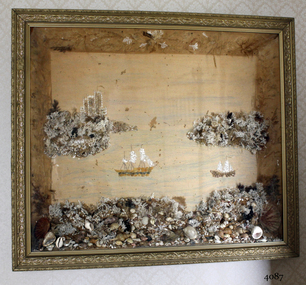
Artwork, other - Wall decoration, late 19th century
... She attended Mailor’s Flat State School where she was also a student teacher before, as family legend has it, she became a governess at “Injemiara” where her grandfather, Francis Freckleton, once owned land. Henry and Mary’s family of six, some of whom were born at Mailor’s Flat and later children at Wangoom, lived with their parents at Wangoom and Purnim west, where Henry died in 1933 and Mary Jane in 1940. ...She attended Mailor’s Flat State School where she was also a student teacher before, as family legend has it, she became a governess at “Injemiara” where her grandfather, Francis Freckleton, once owned land. Henry and Mary’s family of six, some of whom were born at Mailor’s Flat and later children at Wangoom, lived with their parents at Wangoom and Purnim west, where Henry died in 1933 and Mary Jane in 1940. ...This unusual wall decoration was created by Anna Wilson (nee Henry), daughter of pioneer John Stephenson Henry, who arrived in Australia from Ireland with his children in 1851. Family documents confirm that Anna most probably made the diorama for her sister-in-law, who married a member of the Giles family. The diorama was later given to Vera Giles who was a family friend and possibly related to Anna’s sister-in-law by marriage. The diorama is now part of the Giles Collection. Anna married William Wilson in 1860, who had arrived in Australia from County Tarrane in about 1850, aged 19. In 1869 they moved to their new property called ‘Glenlyall’ in Cooramook, north of Grassmere, Victoria, where he lived for 49 years until his death in 1918. He left behind a family of four sons and a daughter. The Giles Family There are many 19th century items of furniture, linen and crockery donated to Flagstaff Hill Maritime Village by Vera and Aurelin Giles. The items are associated with the Giles Family and are known as the “Giles Collection”. These items mostly came from the simple home of Vera’s parents-in-law, Henry Giles and his wife Mary Jane (nee Freckleton), whose photos are in the parlour. They married in 1880. Henry Giles was born at Tower Hill in 1858. He was a labourer on the construction of the Breakwater before leaving in 1895 to build bridges in N.S.W. for about seven years. Mary Jane was born in 1860 at Cooramook. She attended Mailor’s Flat State School where she was also a student teacher before, as family legend has it, she became a governess at “Injemiara” where her grandfather, Francis Freckleton, once owned land. Henry and Mary’s family of six, some of whom were born at Mailor’s Flat and later children at Wangoom, lived with their parents at Wangoom and Purnim west, where Henry died in 1933 and Mary Jane in 1940. The family of the creator Anna Wilson nee Henry and her husband William Wilson are of significance to the early history of Victoria and the South West of Victoria in particular, being pioneer families who farmed the land, built the towns and cities and contributed to their communities. The Giles family collection has social significance at a local level, because it illustrates the level of material support the Warrnambool community gave to Flagstaff Hill when the Museum was established. Wall decoration, diorama with decorative gild frame and glass front. The 3-dimensional seascape includes sailing boats, land and sea, all made from materials such as shells, coral and seaweed. The work was made by Anna Wilson. It is part of the Giles Collection.Noneflagstaff hill, warrnambool, shipwrecked-coast, flagstaff-hill, flagstaff-hill-maritime-museum, maritime-museum, shipwreck-coast, flagstaff-hill-maritime-village, giles collection, henry giles, tower hill, cooramook, warrnambool breakwater, mailor’s flat, wangoom, 19th century household goods, 19th century decor, 19th century handcraft, handcraft, wall hanging, diorama of a seascape -
 Flagstaff Hill Maritime Museum and Village
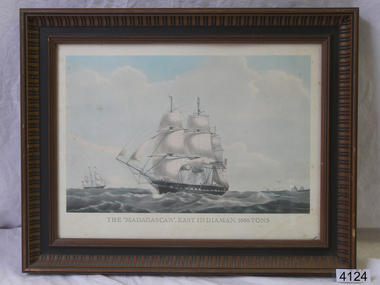
Print - Lithograph Picture, Madagascar Indiaman, Unknown
... were signed on. She then loaded a cargo that included wool, rice, and about two tonnes of gold valued at £240,000, and took on board about 110 passengers for London. On Wednesday 10 August, just as she was preparing to sail, police went on board and arrested a bushranger John Francis, who was later found to have been one of those responsible for robbing on 20th July the Melbourne Private Escort between the McIvor goldfield at Heathcote, Victoria and Kyneton. ...were signed on. She then loaded a cargo that included wool, rice, and about two tonnes of gold valued at £240,000, and took on board about 110 passengers for London. On Wednesday 10 August, just as she was preparing to sail, police went on board and arrested a bushranger John Francis, who was later found to have been one of those responsible for robbing on 20th July the Melbourne Private Escort between the McIvor goldfield at Heathcote, Victoria and Kyneton. ...Madagascar was a large British merchant ship built for the trade to India and China in 1837 that disappeared on a voyage from Melbourne to London in 1853. The disappearance of Madagascar was one of the great maritime mysteries of the 19th century and has probably been the subject of more speculation than any other 19th-century maritime puzzle, except for the Mary Celeste. Madagascar, the second Blackwall Frigate, was built for George and Henry Green at the Blackwall Yard, London, a shipyard that they co-owned with the Wigram family. A one-eighth share in the vessel was held throughout her 16-year career by her first master Captain William Harrison Walker Walker. Madagascar carried freight, passengers, and troops between England and India until the end of 1852. In addition to her normal crew, she also carried many boys being trained as officers for the merchant marine. Known as midshipmen from naval practice, their parents or guardians paid for their training, and they only received a nominal wage of usually a shilling a month. Due to the Victorian Gold Rush, Madagascar, under the command of Captain Fortescue William Harris, was sent to Melbourne with emigrants. She left Plymouth on 11 March 1853 and, after an uneventful passage of 87 days, reached Melbourne on 10 June. Fourteen of her 60 crew jumped ship for the diggings, and it is believed only about three replacements were signed on. She then loaded a cargo that included wool, rice, and about two tonnes of gold valued at £240,000, and took on board about 110 passengers for London. On Wednesday 10 August, just as she was preparing to sail, police went on board and arrested a bushranger John Francis, who was later found to have been one of those responsible for robbing on 20th July the Melbourne Private Escort between the McIvor goldfield at Heathcote, Victoria and Kyneton. On the following day, the police arrested two others, one on board the ship and the other as he was preparing to board. As a result of these arrests, Madagascar did not leave Melbourne until Friday 12 August 1853. After she left Port Phillip Heads Madagascar was never seen again. When the ship became overdue many theories were floated, including spontaneous combustion of the wool cargo, hitting an iceberg and, most controversially, being seized by criminal elements of the passengers and/or crew and scuttled, with the gold being stolen and the remaining passengers and crew murdered. There have been many rumors as to what happened to Madagascar over the years but what really happened is still a mystery. The lithograph was made around 1950 from an original painting of Madagascar a Vessel with a notorious past and is interesting and a significant item for the ships part in early Victorian history. The picture is it’s self not valuable or can be associated with a significant person in history. The interest lies in the events that are linked to the ship in the mid 19th century.Lithograph of the ship Madagascar, in a wooden frameThe Madagascar East Indiaman 1000 tonsflagstaff hill, warrnambool, shipwrecked-coast, flagstaff-hill, flagstaff-hill-maritime-museum, maritime-museum, shipwreck-coast, flagstaff-hill-maritime-village, lithograph, the madagascar, east indiaman -
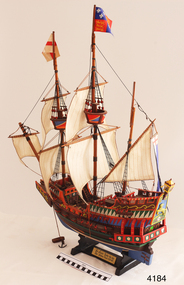 Flagstaff Hill Maritime Museum and Village
Craft - Ship Model, Golden Hind
... were the Swan, Marigold, Benedict and the Elizabeth. During this voyage, in 1578, Drake renamed the Pelican as the Golden Hind in honour of is patron. Sir Francis...were the Swan, Marigold, Benedict and the Elizabeth. During this voyage, in 1578, Drake renamed the Pelican as the Golden Hind in honour of is patron. Sir Francis ...This is a ship model of the Golden Hind. About the “Golden Hind” The English galleon “Golden Hind”, a mid-16th century Elizabethan warship, was launched in 1577. It was formerly known as the “Pelican”. The Golden Hind was the flagship of Captain Sir Frances Drake, in which he became the first Englishman to circumnavigate the world 1577-1580. Tonnage 100-150 tons Displacement 300 tons [fully loaded] Speed 8-15 knots Armament 22 guns Crew 80 sailors, 10 officers Built Aldeburgh, Suffolk, then moved to Plymouth, Devon in 1576 Type of ship Galleon; multi-decked ship (5 decks), square rigged, 3 masted sailing ship Estimated size Length - 70 feet (21.3m); Breadth – 19 feet (5.8m); Depth – 9 feet (2.7m) The Pelican set sail in 1577 on an expedition sponsored partly by Queen Elizabeth and Sir Christopher Hatten (whose family crest was a golden hind). His companion ships were the Swan, Marigold, Benedict and the Elizabeth. During this voyage, in 1578, Drake renamed the Pelican as the Golden Hind in honour of is patron. Sir Francis Drake [1544 – 1596] brought the Golden Hind home from his circumnavigation of the globe with looted gold, percelain, jewels and cash worth 35,000,000 million pounds in today’s money. It was the largest treasure every captured at that date. Only two ships returned – the “Golden Hind” and the “Elizabeth”. This Ship model of the galleon Golden Hind, the flagship of Captain Sir Frances Drake, represents the first circumnavigation of the globe by an Englishman.Ship model, the galleon Golden Hind on timber stand. Square rigged with 2 masts each with a flag and crow's nest. 22 guns on decks. Brown hull with green stripes and decorative coloured trimmings. Nameplate "Sir Francis Drake - his ship / The Golden Hind - 1577-1580". Emblem with animal golden hind, Tudor Rose and lamp above. Nameplate "Sir Francis Drake - his ship / The Golden Hind - 1577 - 1580"flagstaff hill, warrnambool, shipwrecked-coast, flagstaff-hill, flagstaff-hill-maritime-museum, maritime-museum, shipwreck-coast, flagstaff-hill-maritime-village, ship model, model ship, galleon golden hind 1577, galleon golden hinde 1577, galleon pelican 1577, 16th century galleon, 16th century warship, sir frances drake, captain frances drake, first englishman to circumnavigate the globe -
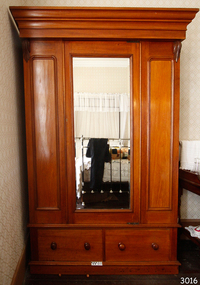 Flagstaff Hill Maritime Museum and Village
Furniture - Wardrobe, Late 19th to early 20th Century
... She attended Mailor's Flat State School where she was also a student teacher before, as a family legend has it, she became a governess at "Injemiara" where her grandfather, Francis Freckleton, once owned land. Henry and Mary’s family of six, some of whom were born at Mailor’s Flat and later children at Wangoom, lived with their parents at Wangoom and Purnim west, where Henry died in 1933 and Mary Jane in 1940. ...She attended Mailor's Flat State School where she was also a student teacher before, as a family legend has it, she became a governess at "Injemiara" where her grandfather, Francis Freckleton, once owned land. Henry and Mary’s family of six, some of whom were born at Mailor’s Flat and later children at Wangoom, lived with their parents at Wangoom and Purnim west, where Henry died in 1933 and Mary Jane in 1940. ...The original owner of the beautiful wardrobe was William Swinton Jr. (1860-1929) and was later given to a friend of the Giles family. It is part of the Giles Collection. William Swinton Jnr. was a Warrnambool Councilor 1903-20 and Mayor 1917-19, during which time Warrnambool declared a City (1918). William's father, William Swinton Snr. (c.1831-1901) arrived in Warrnambool in 1854 from Edinburgh, Scotland. He established the Swinton store in Timor Street in 1865 where it is still located. William Snr's grand-daughter, Doris Swinton (1904-1986) was one of Australia's most highly decorated nurses of World War 2 and for 16 years matron of the Warrnambool and District Base Hospital. There is a street in Warrnambool named after the Swinton family. The Giles Collection: There are many 19th century items of furniture, linen, and crockery donated to Flagstaff Hill Maritime Village by Vera and Aurelin Giles. The items are associated with the Giles Family and are known as the "Giles Collection". These items mostly came from the simple home of Vera's parents-in-law, Henry Giles and his wife Mary Jane (nee Freckleton), whose photos are in the parlour. They married in 1880. Henry Giles was born at Tower Hill in 1858. He was a labourer on the construction of the Breakwater before leaving in 1895 to build bridges in N.S.W. for about seven years. Mary Jane was born in 1860 at Cooramook. She attended Mailor's Flat State School where she was also a student teacher before, as a family legend has it, she became a governess at "Injemiara" where her grandfather, Francis Freckleton, once owned land. Henry and Mary’s family of six, some of whom were born at Mailor’s Flat and later children at Wangoom, lived with their parents at Wangoom and Purnim west, where Henry died in 1933 and Mary Jane in 1940. The wardrobe is also significant for its association with early Warrnambool history, being owned by William Swinton Jnr. who was a Warrnambool Councilor and Warrnambools first Mayor (1917-19) the son of an early colonial family, arriving in Warrnambool in 1854. The Giles family collection also has social significance at a local level, because it illustrates the level of material support the Warrnambool community gave to Flagstaff Hill when the Maritime Museum was established.Wardrobe, colonial, made of cedar wood. The doors of the wardrobe have a mirrored door between them and there are two large drawers below the doors, each drawer has two round wooden handles. The wardrobe was once owned by a William Swinton Jnr. It is now part of the Giles Collection.Noneflagstaff hill, warrnambool, shipwrecked-coast, maritime-museum, shipwreck-coast, flagstaff-hill-maritime-village, wardrobe, bedroom furniture, domestic furniture, william swinton jnr., warrnambool's first mayor, warrnambool mayor, giles collection, henry giles, tower hill, cooramook, warrnambool breakwater, mailor’s flat, wangoom, 19th century furniture, doris swinton, swinton street warrnambool -
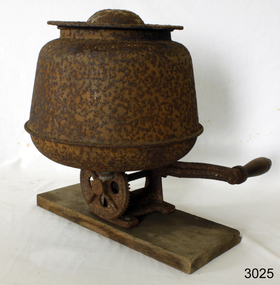 Flagstaff Hill Maritime Museum and Village
Domestic object - Butter Churn, Malleys Ltd, 1930-1950
... Francis Malley (1863-1932). This firm was located in the Sydney suburb of Alexandria, in McEvoy Street. They manufactured items for use in the dairy industry, as well as for hardware related to building and plumbing. Many of the Malley dairy products were...Francis Malley (1863-1932). This firm was located in the Sydney suburb of Alexandria, in McEvoy Street. They manufactured items for use in the dairy industry, as well as for hardware related to building and plumbing. Many of the Malley dairy products were ...This is a steel, bench-mounted, hand-operated (60 rpm) butter churn for making small amounts of butter from cream in the home. It was made by the Sydney firm of Malleys Ltd from the 1930s until the 1950s and came in 3 and 5 quart sizes. Malleys Ltd was established in about 1890 by Francis Malley (1863-1932). This firm was located in the Sydney suburb of Alexandria, in McEvoy Street. They manufactured items for use in the dairy industry, as well as for hardware related to building and plumbing. Many of the Malley dairy products were sold under the "Sunrise" name. Malley retired in 1912. In 1931 there were branches at Parramatta, Hurstville & North Sydney. Butter churns were machines used to produce butter by the violent agitation of separated cream. Depending on the design of the churn, the agitation would be variously achieved by a repetitive thrashing, centrifugal motion or internal paddles. Churns were typically constructed from wood, glass and cast-iron; with tin or steel commonly used for some fixtures. The subject item gives an insight into domestic life where butter was made in the home.Heavy red cast iron base, with a long handle, wooden grip, connected to a shaft along the base, thence, to a cog wheel, and gear, to a second shaft and paddle in a metal basin. Basin has lid, and hole in base with a screw cap to allow the draining of the butter milk. Designed to be placed on a bench, with the handle over the edge. Malleys is written in raised letters on the base, and on the handle, '60 rev. pr. min.'warrnambool, flagstaff-hill, flagstaff-hill-maritime-museum, shipwreck-coast, flagstaff-hill-maritime-village, malleys, butter churn, domestic object, dairy machine -
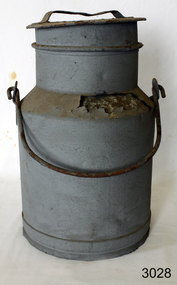 Flagstaff Hill Maritime Museum and Village
Domestic object - Milk Churn, Malleys Ltd, 1870-1932
... Francis Malley (1863-1932). This firm was located in the Sydney suburb of Alexandria, in McEvoy Street. They manufactured items for use in the dairy industry, as well as for hardware related to building and plumbing. Many of the Malley dairy products were...Francis Malley (1863-1932). This firm was located in the Sydney suburb of Alexandria, in McEvoy Street. They manufactured items for use in the dairy industry, as well as for hardware related to building and plumbing. Many of the Malley dairy products were ...Malleys Ltd was established in about 1890 by Francis Malley (1863-1932). This firm was located in the Sydney suburb of Alexandria, in McEvoy Street. They manufactured items for use in the dairy industry, as well as for hardware related to building and plumbing. Many of the Malley dairy products were sold under the "Sunrise" name. Malley retired in 1912. In 1931 there were branches at Parramatta, Hurstville & North Sydney. An early item made by an Australian manufacturer of dairy equipment in Australia specifically for the local market. The item gives an insight into early Australian manufacturing processes and is a significant part of Australian early social history.Milk Churn or Milk Can, Medium sized galvanised container to hold milk Malleysflagstaff hill, warrnambool, shipwrecked-coast, flagstaff-hill-maritime-museum, shipwreck-coast, flagstaff-hill-maritime-village, milk container, malleys ltd, dairy equipment
