
Showing 11 items matching "front lines of battle"
-
 Returned Nurses RSL Sub-branch
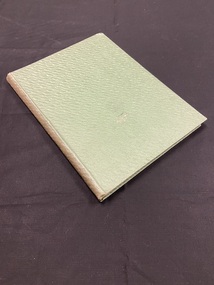
Book - Hardcover book, Cassell & Company, Australia in the Great War : the story told in pictures, 1918
... ...front lines of battle...WWI WW1 First World War World War 1914-1918 Australian Imperial Force AIF Australian Soldiers Repartriation Fund front lines of battle France Egypt London Great Britain A pictorial record of the Australian Imperial Force in France, Great Britain, Egypt and elsewhere during World War One. ...A pictorial record of the Australian Imperial Force in France, Great Britain, Egypt and elsewhere during World War One. First published in eight parts (one every four weeks) at a price designed to make it easy for everyone to purchase at the time. This edition presents the whole collection in one volume.Faded green hardback book with no markings on the spine or cover.non-fictionA pictorial record of the Australian Imperial Force in France, Great Britain, Egypt and elsewhere during World War One. First published in eight parts (one every four weeks) at a price designed to make it easy for everyone to purchase at the time. This edition presents the whole collection in one volume.wwi, ww1, first world war, world war 1914-1918, australian imperial force, aif, australian soldiers repartriation fund, front lines of battle, france, egypt, london, great britain -
 Federation University Historical Collection
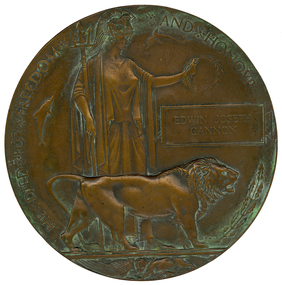
Medal - Numismatics, 'Dead Man's Penny' for Edwin Joseph 'Ted' Cannon, c1919
... Battle of Pozieres on the Western Front Ted Cannon worked with the Scout Platoon sketching the enemy's gun emplacements. Ted proved invaluable to the Brigade and brought he came under the attention of the Australian High Command. On 13 September 1916 Ted was given a special assignment for General C.B.B. White. Ted was sent out forward of the Old Mill at Verbrandenmolen (in the Ypres Salient) to draw a panorama of the German lines...Battle of Pozieres on the Western Front Ted Cannon worked with the Scout Platoon sketching the enemy's gun emplacements. Ted proved invaluable to the Brigade and brought he came under the attention of the Australian High Command. On 13 September 1916 Ted was given a special assignment for General C.B.B. White. Ted was sent out forward of the Old Mill at Verbrandenmolen (in the Ypres Salient) to draw a panorama of the German lines ...The Dead Man’s Penny is a commemorative medallion which was presented to the next-of-kin of the men and women from England and the Empire who died during World War One. The Dead Man’s Penny was accompanied by a letter from King George V, stating ‘I join with my grateful people in sending you this memorial of a brave life given for others in the Great War’.[http://nma.gov.au/blogs/education/2010/11/14/dead-mans-penny/] Popularly known as the "Dead Man’s Penny", because of the similarity in appearance to the somewhat smaller penny coin. 1,355,000 plaques were issued, which used a total of 450 tonnes of bronze, and continued to be issued into the 1930s to commemorate people who died as a consequence of the war. [http://en.wikipedia.org/wiki/Memorial_Plaque_(medallion)] It was decided that the design of the plaque was to be picked from submissions made in a public competition. Over 800 designs were submitted and the competition was won by the sculptor and medallist Edward Carter Preston with his design called Pyramus, receiving a first place prize of £250.[http://en.wikipedia.org/wiki/Memorial_Plaque_(medallion)] They were initially made at the Memorial Plaque Factory, 54/56 Church Road, Acton, W3, London from 1919. Early plaques did not have a number stamped on them but later ones have a number stamped behind the lion's back leg. [http://en.wikipedia.org/wiki/Memorial_Plaque_(medallion)] Ted Cannon's plaquette does not have a stamped number. Ted Cannon was a gifted artist and cartoonist who studied at the Ballarat School of Mines Technical Art School. During the Battle of Pozieres on the Western Front Ted Cannon worked with the Scout Platoon sketching the enemy's gun emplacements. Ted proved invaluable to the Brigade and brought he came under the attention of the Australian High Command. On 13 September 1916 Ted was given a special assignment for General C.B.B. White. Ted was sent out forward of the Old Mill at Verbrandenmolen (in the Ypres Salient) to draw a panorama of the German lines in the area from Hill 60 to The Bluff. It was a hazardous task and Ted was warned to be careful. Tragically he was sniped by an enemy machine-gunner and sustained severe abdominal wounds. Stretcher-bearers rushed him to the 17th Casualty Clearing Station where he was operated on by the doctors at 8.30 that night. With little chance of success, but ever resilient, Ted remained conscious almost to the end. He died early in the morning of the 14 September 1916. His body was buried in the large Military Cemetery at Lijssenthoek. The effects of the late Ted Cannon were returned to his parents. These were an autograph book, three brushes, prayer book, housewife, whistle, book, hymn book, curios. Another listing gives his effects as "identity disc, letters, photos, wallet, 2 books, Mexican Dollar, 1 cent (Ceylon), 3 German Straps, Fountain Pen, Cigarette-holder, Franc Note, 50 centimes Note, devotional book, mirror, rosary, scapula, metal ring, two combs, book of views, nail clippers, badges, tie clip, Egyptian stamp.[http://recordsearch.naa.gov.au/scripts/Imagine.asp?B=3202589] Ted Cannon was an only child. It is not known how the 'Dead Man's Penny' came into the ownership of the donor, but it is thought that it may have been left in a house owned by the donor's mother. Further information on Ted Cannon can be found at http://bih.ballarat.edu.au/index.php/Edwin_J._Cannon and http://www.ballarat.edu.au/about-ub/history/art-and-historical-collection/ub-honour-roll/c/edwin-joseph-ted-cannon-1895-1916Large bronze medallion or plaquette featuring an image of Lady Britannia surrounded by two dolphins (representing Britain’s sea power) and a lion (representing Britain) standing over a defeated eagle (symbolising Germany). Around the outer edge of the medallion are the words ‘He died for freedom and honour’. Next to Lady Britannia is the deceased solider’s name, with no rank provided to show equality in their sacrifice. (http://nma.gov.au/blogs/education/2010/11/14/dead-mans-penny) The plaque was distributed throughout the British Empire, and the first plaques were distributed in Australia in 1922 "Returned home" by W. & O. Mayne, 2013. ted cannon, edwin joseph cannon, cannon, world war 1, world war -
 Lara RSL Sub Branch
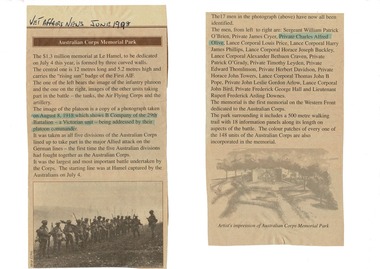
Veteran Affairs Newspaper article dated June 1998, Australian Corps Memorial Park - $1.3 million memorial at La Hamel for Australian World War 1 Soldiers
... Lines - the first time the five Australian Divisions had fought together as the Australian Corps. (Under Australian Command) It is the First memorial on the Western Front dedicated to the Australian Corps. The park surrounding it includes a 500 meter walking tril with 18 information panels along its length on aspects of the battle....Lines - the first time the five Australian Divisions had fought together as the Australian Corps. (Under Australian Command) It is the First memorial on the Western Front dedicated to the Australian Corps. The park surrounding it includes a 500 meter walking tril with 18 information panels along its length on aspects of the battle. ...Article of World War 1 Refer to carved life size soldier with machine gun in foyer and photograph at its feet.A4 sheet of white paper has two cut-out sections of Veteran Affairs Newspaper article dated June 1998 glued on. Title Australian Corps Memorial Park. Article covers a Memorial cost $1.3 million dollars for dedication on 4th July 1998 consisting of three curved memorial walls for Australian soldiers that died during Wold War 2. The photograph included in the article was taken on August 8, 1918 which shows B company of the 29th Battalion - a Victorian Unit - being addressed by their platoon Commander. All 5 Australian Divisions took part in the major Allied attack on the German Lines - the first time the five Australian Divisions had fought together as the Australian Corps. (Under Australian Command) It is the First memorial on the Western Front dedicated to the Australian Corps. The park surrounding it includes a 500 meter walking tril with 18 information panels along its length on aspects of the battle.Article was found in Veteran Affairs News dated June 1998, heading - Australian Corps Memorial Park.veteran affairs news article, a4 paper sheet -
 Eltham District Historical Society Inc
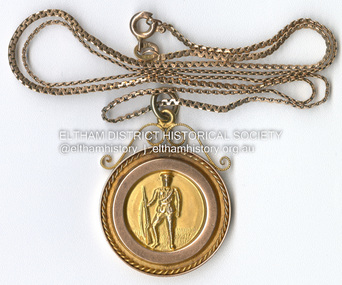
Photograph - Medal, Awarded to Spr. W. H. Orford by Shire of Eltham Welcome Home Committee, 1919
... He was a Tunneler and was part of an operation of a group of British miners (known as "Claykickers" or “Manchester Moles”) recruited during World War I to tunnel underneath no man's land and set bombs below the German front at the Battle of Messines in June 1917. 10,000 German soldiers were killed instantly after the detonation of explosives beneath their lines. ...He was a Tunneler and was part of an operation of a group of British miners (known as "Claykickers" or “Manchester Moles”) recruited during World War I to tunnel underneath no man's land and set bombs below the German front at the Battle of Messines in June 1917. 10,000 German soldiers were killed instantly after the detonation of explosives beneath their lines. ...Medal presented for their service to their country and local district to returning local servicemen from the Great War (First World War) by the Shire of Eltham Welcome Home Committee. This medal was presented to W.H. Orford. Spr. W.H. Orford From Eltham We Honour You Great War 1914 - 1919 Whilst the war ended in 1918, many servicemen did not return home till 1919. ORFORD William Henry - Munitions Worker Number 542 William Henry Orford enlisted 1 Feb 1916 and embarked for France 25 May 1916. He was a Tunneler and was part of an operation of a group of British miners (known as "Claykickers" or “Manchester Moles”) recruited during World War I to tunnel underneath no man's land and set bombs below the German front at the Battle of Messines in June 1917. 10,000 German soldiers were killed instantly after the detonation of explosives beneath their lines. The story was depicted in the film "The War Below". Doug Orford, William's nephew recalls William saying they could hear the Germans as they tunnelled below them within metres. A month later He was wounded in action with a gun shot wound to the scalp and face in July 1917. He disembarked back in Melbourne on September 5, 1919.ww1, 1919, aif, battle of messine, great war, medal, shire of eltham, tunneler, welcome home committee, william henry orford -
 Running Rabbits Military Museum operated by the Upwey Belgrave RSL Sub Branch
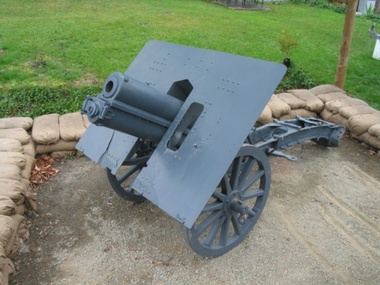
Skoda 7.5 cm Model 15, The Skoda 7.5 cm Gebirgskanone M15 mountain gun, 1911-1914
... Considering that the guns were designed to be disassembled it's not too surprising that they couldn't stand the abuse moving through the shell-pocketed front lines on the Western Front. This particular Gun was captured by Australian Soldiers at the Battle of ST Martins Wood near Ypres in the 3rd Battle for the Somme. ...The Germans bought some guns during World War I, but used them as infantry guns in direct support of the infantry where their light weight would allow them to move with the infantry. They complained that the guns were too fragile and didn't have a high enough muzzle velocity to act as an anti-tank gun. Considering that the guns were designed to be disassembled it's not too surprising that they couldn't stand the abuse moving through the shell-pocketed front lines on the Western Front.This particular Gun was captured by Australian Soldiers at the Battle of ST Martins Wood near Ypres in the 3rd Battle for the Somme. The German crew were all killed as were a number of AustraliansThe Skoda 7.5 cm Gebirgskanone M. 15 was a mountain gun used by Austria-Hungary in World War I. In German service it was known as the 7.5 cm GebK 15. Its development was quite prolonged as the Austrians couldn't decide on the specifications that they wanted. Initially they wanted a gun that could be broken-down into no more than 5 pack-animal loads to replace the various 7 cm mountain guns in service, but prolonged trials proved that the 7.5 cm M. 12 prototype to be the best gun. The guns were delivered beginning in April 1915 instead of the planned date of April 1914. For transport, the gun could be dismantled into 6 parts, generally carried in 4 loads. In addition, there was a gun shield fitted on some (perhaps many) such guns. ypres st martins wood skoda gun -
 Monbulk RSL Sub Branch
Book, Les Carlyon, The great war, 2006
... australian army - history world war 1914-1918 - campaigns - western front Les Carlyon's The Great War is the epic story of the fighting men who wove themselves into legend as part of the largest tragedy in Australian history - 179,000 dead and wounded - leaving a nation to mourn its fallen heroes in 'one long national funeral' into the 1930s and, now again, a century later. As he did with the best-seller Gallipoli, Carlyon leads the reader behind the lines, across the western front and other theatres of battle ...Les Carlyon's The Great War is the epic story of the fighting men who wove themselves into legend as part of the largest tragedy in Australian history - 179,000 dead and wounded - leaving a nation to mourn its fallen heroes in 'one long national funeral' into the 1930s and, now again, a century later. As he did with the best-seller Gallipoli, Carlyon leads the reader behind the lines, across the western front and other theatres of battle, and deep into the minds of the men who are witnesses to war. Having walked the fields of France, Belgium and Turkey on his quest for a truth beyond the myth, Carlyon weaves us a mesmerising narrative that shifts seamlessly from the hatching of grand strategies in the political salons of London and St Petersburg to the muddy, bloody trenches of Pozieres and Passchendaele where ordinary soldiers descended into a maelstrom unimaginable.index, bib, ill (plates), maps, ports, p.863.non-fictionLes Carlyon's The Great War is the epic story of the fighting men who wove themselves into legend as part of the largest tragedy in Australian history - 179,000 dead and wounded - leaving a nation to mourn its fallen heroes in 'one long national funeral' into the 1930s and, now again, a century later. As he did with the best-seller Gallipoli, Carlyon leads the reader behind the lines, across the western front and other theatres of battle, and deep into the minds of the men who are witnesses to war. Having walked the fields of France, Belgium and Turkey on his quest for a truth beyond the myth, Carlyon weaves us a mesmerising narrative that shifts seamlessly from the hatching of grand strategies in the political salons of London and St Petersburg to the muddy, bloody trenches of Pozieres and Passchendaele where ordinary soldiers descended into a maelstrom unimaginable. australian army - history, world war 1914-1918 - campaigns - western front -
 Monbulk RSL Sub Branch
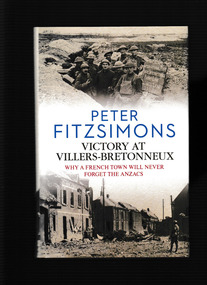
Book, Penguin Random House Australia Pty Ltd, Victory at Villers-Bretonneux : why a French town will never forget the Anzacs, 2016
... battle the world has ever seen. Across a 45-mile front, no fewer than two million German soldiers hurl themselves at the Allied lines, with the specific intention of driving all the way through to the town of Villers-Bretonneux, where their artillery can rain down shells on the key train hub of Amiens, thus throttling the Allied supply lines. ...It's early 1918, and after four brutal years, the fate of the Great War hangs in the balance. On the morning of 21 March 1918, the Kaiserschlacht (the Kaiser's battle) is launched. The biggest set-piece battle the world has ever seen. Across a 45-mile front, no fewer than two million German soldiers hurl themselves at the Allied lines, with the specific intention of driving all the way through to the town of Villers-Bretonneux, where their artillery can rain down shells on the key train hub of Amiens, thus throttling the Allied supply lines. For nigh on two weeks, the plan works brilliantly.The Germans are able to advance without check, as the exhausted British troops flee before them, together with tens of thousands of French refugees. In desperation, the British commander, General Douglas Haig, calls upon the Australian soldiers to stop the German onslaught and save Villers-Bretonneux. If the Australians can hold the line, the very gate to Amiens, then the Germans will not win the war. Arriving at Villers-Bretonneux just in time, the Australians launch a vicious counter-attack that hurls the enemy back the first time. And then, on Anzac Day 1918, when the town falls after all to the British defenders, it is again the Australians who are called on to save the day, the town, and the entire battle - even the warIndex, ill, bib, maps, p.764.It's early 1918, and after four brutal years, the fate of the Great War hangs in the balance. On the morning of 21 March 1918, the Kaiserschlacht (the Kaiser's battle) is launched. The biggest set-piece battle the world has ever seen. Across a 45-mile front, no fewer than two million German soldiers hurl themselves at the Allied lines, with the specific intention of driving all the way through to the town of Villers-Bretonneux, where their artillery can rain down shells on the key train hub of Amiens, thus throttling the Allied supply lines. For nigh on two weeks, the plan works brilliantly.The Germans are able to advance without check, as the exhausted British troops flee before them, together with tens of thousands of French refugees. In desperation, the British commander, General Douglas Haig, calls upon the Australian soldiers to stop the German onslaught and save Villers-Bretonneux. If the Australians can hold the line, the very gate to Amiens, then the Germans will not win the war. Arriving at Villers-Bretonneux just in time, the Australians launch a vicious counter-attack that hurls the enemy back the first time. And then, on Anzac Day 1918, when the town falls after all to the British defenders, it is again the Australians who are called on to save the day, the town, and the entire battle - even the war -
 Monbulk RSL Sub Branch
Book, Darren Paech, Adelaide to Alamein : based on the war diary of an Australian infantry officer, 2016
... Ivor served in the front lines in North Africa during the Siege of Tobruk, both battles of Alamein, and bore witness to some of the most violent fighting undertaken by Australian soldiers during the war. ...In June 1940, following the Nazi invasion of France, Ivor Paech, an ordinary primary school teacher from South Australia, enlisted in the Second AIF - the all-volunteer fighting component of the Australian Army in World War II. The unit he was assigned to would become Australia's most highly decorated infantry battalion of the conflict - the 2/48th Infantry Battalion. Ivor served in the front lines in North Africa during the Siege of Tobruk, both battles of Alamein, and bore witness to some of the most violent fighting undertaken by Australian soldiers during the war. This is Ivor's story, compiled by his grandson who is a former Army officer, based on the diary he kept during the conflict, background research and interviews with surviving members of the unitIll, maps, p.331.non-fictionIn June 1940, following the Nazi invasion of France, Ivor Paech, an ordinary primary school teacher from South Australia, enlisted in the Second AIF - the all-volunteer fighting component of the Australian Army in World War II. The unit he was assigned to would become Australia's most highly decorated infantry battalion of the conflict - the 2/48th Infantry Battalion. Ivor served in the front lines in North Africa during the Siege of Tobruk, both battles of Alamein, and bore witness to some of the most violent fighting undertaken by Australian soldiers during the war. This is Ivor's story, compiled by his grandson who is a former Army officer, based on the diary he kept during the conflict, background research and interviews with surviving members of the unitworld war 1939 – 1945 – campaigns – north africa – syria, world war 1939-1945 - personal narratives - australia -
 Victorian Interpretive Projects Inc.
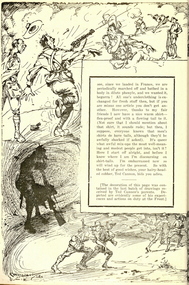
Cartoons, World War One Cartoons by Edwin Cannon
... Battle of Pozieres on the Western Front that Ted Cannon came into his own. His work with the Scout Platoon (under the command of Lieutenant Jack Rogers) sketching the enemy's gun emplacements proved invaluable to the Brigade and brought Ted to the attention of the Australian High Command. On 13 September 1916 Ted was given a special assignment for General C.B.B. White. Ted was sent out forward of the Old Mill at Verbrandenmolen (in the Ypres Salient) to draw a panorama of the German lines...Battle of Pozieres on the Western Front that Ted Cannon came into his own. His work with the Scout Platoon (under the command of Lieutenant Jack Rogers) sketching the enemy's gun emplacements proved invaluable to the Brigade and brought Ted to the attention of the Australian High Command. On 13 September 1916 Ted was given a special assignment for General C.B.B. White. Ted was sent out forward of the Old Mill at Verbrandenmolen (in the Ypres Salient) to draw a panorama of the German lines ...Edwin (Ted) Cannon was born at Ballarat on 30 July 1895, the only son of Edwin and Florence Cannon. He studied art at the Ballarat School of Mines Technical Art School. Ted displayed a talent for industrial design but it was his black and white work that 'drew' most attention. His cartoons and caricatures, heavily influenced by Phil May, were of a particularly high standard. During the Ballarat Exhibition of 1913 Ted's work was singled out for notice and he was awarded First Prize. After completing his art course Ted was employed as an assistant teacher at the Ballarat Technical Art School, before taking a position as cartoonist with the Ballarat Star newspaper at the end of 1914. With the war raging in Europe Ted discovered a darker aspect for his artwork, but, still, he could not resist depicting Turkey as a full-feathered, fez-wearing bird. In 1915 Ted was awarded the prestigious Victorian Education Department Senior Technical School Scholarship. Only months into his scholarship, Ted volunteered for the AIF. A keen member of the local 71st "City of Ballarat" Regiment Ted was already primed for a life in the army. He embarked from Port Melbourne on 23 November 1915 with reinforcements to the 6th Infantry Battalion bound for Egypt. It was during the Battle of Pozieres on the Western Front that Ted Cannon came into his own. His work with the Scout Platoon (under the command of Lieutenant Jack Rogers) sketching the enemy's gun emplacements proved invaluable to the Brigade and brought Ted to the attention of the Australian High Command. On 13 September 1916 Ted was given a special assignment for General C.B.B. White. Ted was sent out forward of the Old Mill at Verbrandenmolen (in the Ypres Salient) to draw a panorama of the German lines in the area from Hill 60 to The Bluff. It was a hazardous task and Ted was warned to be careful. Tragically he was sniped by an enemy machine-gunner and sustained severe abdominal wounds. Stretcher-bearers rushed him to the 17th Casualty Clearing Station where he was operated on by the doctors at 8.30 that night. With little chance of success, but ever resilient, Ted remained conscious almost to the end. He died early in the morning of the 14 September 1916. His body was buried in the large Military Cemetery at Lijssenthoek. See http://www.ballarat.edu.au/about-ub/history/art-and-historical-collection/ub-honour-roll/c/edwin-joseph-ted-cannon-1895-1916 Digital images of a number of cartoons published in the Ballarat School of Mines Students' Magazine, 1916. Ted Cannon sent cartoons home to Ballarat from the World War One front.edwin cannon, ted cannon, cartoons, world war, world war 1 -
 Victorian Interpretive Projects Inc.
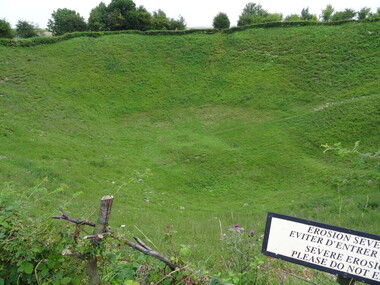
Photograph - Colour, Ann Gervasoni, Lochnagar Crater, 2014, 23/07/2017
... It was one of 19 mines that were placed beneath the German lines on the British section of the Somme front to assist the infantry advance at the start of the battle. ...It was one of 19 mines that were placed beneath the German lines on the British section of the Somme front to assist the infantry advance at the start of the battle. ...The mine was named after Lochnagar Street, the British trench from which the gallery was driven. It was one of 19 mines that were placed beneath the German lines on the British section of the Somme front to assist the infantry advance at the start of the battle. The Lochnagar mine was sprung at 7:28 a.m. on 1 July 1916 and left a crater 98 ft (30 m) deep and 330 ft (100 m) wide, which was captured and held by British troops. The attack on either flank was defeated by German small-arms and artillery fire, except on the extreme right flank and just south of La Boisselle, north of the Lochnagar Crater. The crater has been preserved as a memorial and a religious service is held each 1 July. (Wikipedia)A number of photographs of a crater which was created at the Somme, on the Western Front during World War One. lochnagar crater, tunnellers, the somme, world war one, western front, france -
 Bendigo Historical Society Inc.
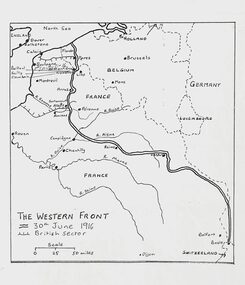
Map - Jack Lockett Collection: Copies of two maps of WW1 Battles
... Front spans from the North Sea to Switzerland. The other side is labeled POZIERES scale 1 inch to 500 yards. July to September 1916. There are numerous roads and trench lines. Map Jack Lockett Collection: Copies of two maps of WW1 Battles ...John Henry Lockett OAM (22 January 1891 – 25 May 2002) was the oldest man ever in Australia when he died aged 111 years, 123 days. As one of the last surviving veterans of World War I, he was acclaimed as a national hero during the last decade of his life. Lockett was born in the small Victorian town of Waanyarra, near Bendigo. He left school aged nine to work on a local farm. Later, he worked for his uncles in the Mallee. On 24 March 1916, he travelled to Mildura to enlist in the Australian Imperial Force. He served in France with the 38th Battalion, earning promotion to sergeant and was discharged on 20 September 1919. https://en.wikipedia.org/wiki/Jack_Lockett The 38th Battalion was formed on 1 March 1916 at a camp established on the Epsom Racecourse at Bendigo in Victoria. After training in both Australia and Britain, the 38th Battalion crossed to France in late November 1916 and moved into the trenches of the Western Front for the first time on 1 December.The 38th fought in its first major battle at Messines, in Belgium, between 7-9 June 1917. It fought in another two major attacks in this sector - the battle of Broodseinde on 4 October, and the battle of Passchendaele on 12 October. Belgium remained the focus of the 38th Battalion's activities for the next five months, until it was rushed south to France in late March 1918 to meet the German Army's Spring Offensive. The 38th participated in its last major action of the war between 29 September and 2 October 1918 as part of the Australian-American operation that breached the formidable defences of the Hindenburg Line along the St Quentin Canal. It was disbanded in April 1919. Source, Australian War Memorial https://www.awm.gov.au/collection/U51478 After the war, Jack returned to The Mallee and selected a 640 acres (260 ha) block of land in Linga, Victoria, deciding to make his living as a farmer. In 1923, he married Maybell Ingwerson and they had four children together. In 1963, the couple retired to Bendigo, leaving the farmland (which now covered more than 130,000 acres (53,000 ha), in the care of their children and grandchildren. Two photocopies of hand drawn maps on one A4 sheet of paper. One side labeled THE WESTERN FRONT 30th June 1916 British Sector Scale 1 inch to 50 miles. The Western Front spans from the North Sea to Switzerland. The other side is labeled POZIERES scale 1 inch to 500 yards. July to September 1916. There are numerous roads and trench lines. jack lockett, mabel ingwersen, 38th australian infantry battalion, w.w.1, mallee farming, pozieres 1916, the western front 1916
