
Showing 6 items matching "fruit preserving kitchen"
-
 University of Melbourne, Burnley Campus Archives
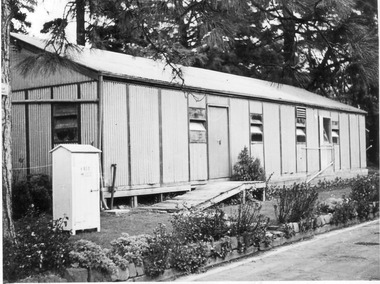
Photograph - Black and white print, E.M. Gibson, Army Hut, c. 1951
... ...fruit preserving kitchen...Temporary Fruit Preserving Kitchen & Store." E M Gibson...Temporary Fruit Preserving Kitchen & Store." E M Gibson Army Hut Photograph Black and white print E.M. ...Army Hut erected during building of new School. Black and white photograph of an "Army Hut erected during building of new School. Now functions as 1. PWD Store 2. Demonstration Room 3. Temporary Fruit Preserving Kitchen & Store." E M Gibson315/13army hut, e. m. gibson collection, construction administration building, crts classroom, pwd store, demonstration room, fruit preserving kitchen -
 Blacksmith's Cottage and Forge
Book-cookery, Preserving Fruit and Vegetables
... Cookery book used to preserve fruit and vegetables book domestic kitchen cookery recipes fruit vegetables preserving Department of Agriculture Victoria. ...Cookery book used to preserve fruit and vegetablesCream coloured paper recipe book. Soft paper cover, decorated with fruit and vegetables. Dept. of Agriculture coat of arms at top of cover page.Department of Agriculture Victoria. Bulletin No.43. Price 2/6dbook, domestic, kitchen, cookery, recipes, fruit, vegetables, preserving -
 Flagstaff Hill Maritime Museum and Village
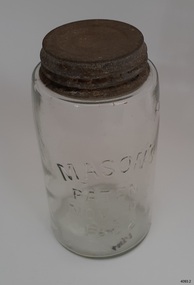
Container - Fruit Preserving Jar, John Landis Mason, 1858-1910
... An early item used in most kitchens by women who preserved fruit and vegetables before the arrival of refrigeration giving a snapshot into the domestic lives of families during the late 19th to early 20th century's and how they preserved food for later use without refrigeration. warrnambool flagstaff-hill flagstaff-hill-maritime-museum maritime-museum shipwreck-coast flagstaff-hill-maritime-village food preserving mason jar john landis mason domestic container glass jar fruit & vegetable jar domestic jar food preparation handmade glass blown glass Moulded into glass: MASON'S / PATENT / NOV 30TH / 1838" Preserving jar, glass, with metal screw top lid. ...The Masons patent of Nov 30th, 1858 phrase was originally embossed on countless glass fruit jars and canning jars, most ranging in age from circa 1858 to the mid-1910s. John Landis Mason was awarded patent No 22186, issued on November 30, 1858, by the U.S. Patent & Trademark Office it was termed an "Improvement in screw-neck bottles", for his invention concerning the process of creating a threaded screw-type closure on bottles and jars. Similar screw-threading had been done before on some bottles, but the process of forming the upper lip area of the container so that it was smooth, even, and sturdy enough for a lid of standard size to be screwed thereon was difficult and expensive to do properly, often with unsatisfactory results. His improvement revolutionized home canning in the United States and many other countries. In any case, throughout the next 60-odd years, production of jars with the Nov. 30, 1858 embossing continued at a high rate, with untold tens of millions being produced. The phrase was soon considered an important marketing device, adding to the perception of quality and reliability of the container to the average consumer. This perception continued to at least 1879 21 years after the patent was issued, nearly every glass bottle factory was likely producing their version. The 1880s and 1890s likely saw the peak of popularity of these jars. A considerable percentage have a mold number or letter on the base, a means of identifying the particular mold in use at the factory.An early item used in most kitchens by women who preserved fruit and vegetables before the arrival of refrigeration giving a snapshot into the domestic lives of families during the late 19th to early 20th century's and how they preserved food for later use without refrigeration. Preserving jar, glass, with metal screw top lid. Glass has side seams, impurities and slightly concave base. It has been hand blown into a mould. Inscription is moulded into glass. Moulded into glass: MASON'S / PATENT / NOV 30TH / 1838"warrnambool, flagstaff-hill, flagstaff-hill-maritime-museum, maritime-museum, shipwreck-coast, flagstaff-hill-maritime-village, food preserving, mason jar, john landis mason, domestic container, glass jar, fruit & vegetable jar, domestic jar, food preparation, handmade glass, blown glass -
 Flagstaff Hill Maritime Museum and Village
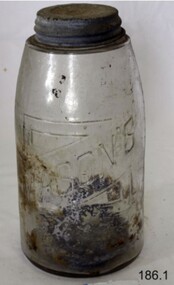
Container - Fruit Preserving Jar, John Landis Mason, 1858-1910
... An early item used in most kitchens by women who preserved fruit and vegetables before the arrival of refrigeration giving a snapshot into the domestic lives of families during the late 19th to early 20th century's and how they preserved food for later use without refrigeration. warrnambool flagstaff-hill flagstaff-hill-maritime-museum maritime-museum shipwreck-coast flagstaff-hill-maritime-village food preserving mason jar john landis mason domestic container glass jar fruit & vegetable jar food storage preserving jar "Mason's Patent Nov 30th 1858" Preserving glass jar. ...The Masons patent of Nov 30th, 1858 phrase was originally embossed on countless glass fruit jars and canning jars, most ranging in age from circa 1858 to the mid-1910s. John Landis Mason was awarded patent No 22186, issued on November 30, 1858, by the U.S. Patent & Trademark Office it was termed an "Improvement in screw-neck bottles", for his invention concerning the process of creating a threaded screw-type closure on bottles and jars. Similar screw-threading had been done before on some bottles, but the process of forming the upper lip area of the container so that it was smooth, even, and sturdy enough for a lid of standard size to be screwed thereon was difficult and expensive to do properly, often with unsatisfactory results. His improvement revolutionized home canning in the United States and many other countries. In any case, throughout the next 60-odd years, production of jars with the Nov. 30, 1858 embossing continued at a high rate, with untold tens of millions being produced. The phrase was soon considered an important marketing device, adding to the perception of quality and reliability of the container to the average consumer. This perception continued to at least 1879 21 years after the patent was issued, nearly every glass bottle factory was likely producing their version. The 1880s and 1890s likely saw the peak of popularity of these jars. A considerable percentage have a mold number or letter on the base, a means of identifying the particular mold in use at the factory.An early item used in most kitchens by women who preserved fruit and vegetables before the arrival of refrigeration giving a snapshot into the domestic lives of families during the late 19th to early 20th century's and how they preserved food for later use without refrigeration. Preserving glass jar. Glass lip with metal screw top lid. Inscription pressed into glass."Mason's Patent Nov 30th 1858"warrnambool, flagstaff-hill, flagstaff-hill-maritime-museum, maritime-museum, shipwreck-coast, flagstaff-hill-maritime-village, food preserving, mason jar, john landis mason, domestic container, glass jar, fruit & vegetable jar, food storage, preserving jar -
 Orbost & District Historical Society
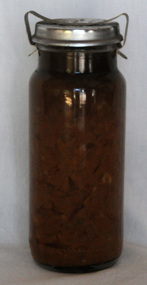
preserving jar, 1915 - 1975
... Preserving home produce in bottles is a method that applies heat to food in a closed glass home canning jar to stop the natural spoilage that would otherwise take place. It removes air from the jar to create a seal. he bottling process forms an air tight seal between the bottle and the lid. Residents of Orbost have long been self sufficient growing their own fruit and vegetables with earlier market gardeners They preserved their produce for use all year. Fowlers Vacola preserving kits were common in most kitchens ...This preserving jar was used in the first half of the 20th century to preserve cooked food - pickles. Preserving home produce in bottles is a method that applies heat to food in a closed glass home canning jar to stop the natural spoilage that would otherwise take place. It removes air from the jar to create a seal. he bottling process forms an air tight seal between the bottle and the lid. Residents of Orbost have long been self sufficient growing their own fruit and vegetables with earlier market gardeners They preserved their produce for use all year. Fowlers Vacola preserving kits were common in most kitchens.A brown glass Fowler's Vacola preserving jar filled with pickles. It is a No. 27 bottle with a size 3 metal clip. It has an 850ml capacity. The lid has metal tension clips which are secured during the canning process and are removed once a vacuum seal has formed. The lid is tin-plated with a lacquer coating, double-coated on the underside.On lid Fowlers Vacola Size 3 Top of jar- embossed with the words Fowlers Vacola food-preservation fowlers-vacola container-glass -
 Mont De Lancey
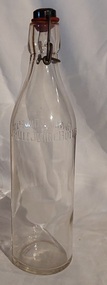
Domestic object - Glass Juice Bottle, Fowlers, c1900's
... preserving system started by English immigrant Joseph Fowler in Melbourne, Australia, in 1915. Vintage glass juice bottles with wire stoppers likely date to the late 19th or early 20th century, when they were developed to create a reusable, airtight seal for products like milk, juice, and other beverages. These bottles often used a "lightning" or "gravity" stopper, which relied on a wire bail and a rubber gasket to create a secure closure and keep contents fresh for longer periods, particularly in home kitchens. Beverage bottles Glass bottles Juice bottle Drink containers 'Fowlers One Pint Fruit ...Vintage Fowlers juice bottles are part of a home preserving system started by English immigrant Joseph Fowler in Melbourne, Australia, in 1915. Vintage glass juice bottles with wire stoppers likely date to the late 19th or early 20th century, when they were developed to create a reusable, airtight seal for products like milk, juice, and other beverages. These bottles often used a "lightning" or "gravity" stopper, which relied on a wire bail and a rubber gasket to create a secure closure and keep contents fresh for longer periods, particularly in home kitchens. A large clear glass Fowlers Fruit Juice bottle with a wire clip and black stopper with a red rubber seal. 'Fowlers One Pint Fruit Juice Bottle' stamped on the glass. On the bottom of the bottle is stamped 'F452' On top of the black stopper "Fowlers Vacola' beverage bottles, glass bottles, juice bottle, drink containers
