
Showing 75 items matching "furniture manufacture"
-
 Flagstaff Hill Maritime Museum and Village
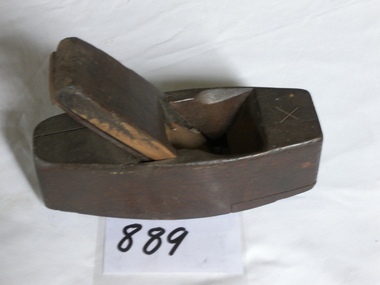
Tool - Smoothing Wood Plane Coffin Pattern, 18th to Early 19th Centuries
... ...Furniture Manufacture...Tools that were themselves hand made shows the craftsmanship used during this time not only to make a tool such as the subject item but also the craftsmanship needed to produce a decorative finish that was needed to be made for any timber furniture item. flagstaff hill warrnambool flagstaff-hill flagstaff-hill-maritime-museum maritime-museum shipwreck-coast flagstaff-hill-maritime-village Cabinet Makers Tools Woodworking Tools Wood Plane Smoothing Plane Timber Finishing Furniture Manufacture Stamped "MILLER". Inscribed "X" (probably the size) Wood smoothing plane known as a coffin plane due to it's shape, wood insert screwed on front of base. ...Being smaller than other bench planes, the coffin shaped smoothing plane is better able to work on smaller work pieces and around obstructions. Since the 1700s wooden smoothing planes have predominantly been 'coffin shaped' wider in the middle and slightly rounded making them more manoeuvrable. A vintage tool made by an unknown 18th or early 19th century woodworking tool maker. This item would have been made for individuals or cabinet makers that worked in wood and needed a tool that could produce a flat smooth finish to timber. These tools were used before routers and spindle moulders came into use in the late 19th and early 20th centuries before this time to produce either a decorative moulding or a smooth finish to furniture timber, door trims etc had to be accomplished using hand planing tools and in particular one of these types of planes. Traditionally wood planes were blocks of wear resistant hardwood, often beech or maple, which were worked to the shape of the intended moulding or had a flat blade use for achieving a flat and smooth finish to timber. The blade, or iron was likewise formed to the intended moulding profile or for smoothing and secured in the body of the plane with a wooden wedge. A traditional cabinetmakers shop might have many, perhaps hundreds, of moulding and flat bladed planes for a full range of work to be performed. Large crown mouldings required planes of six or more inches in width, which demanded great strength to push and often had additional peg handles on the sides, allowing the craftsman's apprentice or other worker to pull the plane ahead of the master who guided it. These vintage planes are well sought after by collectors of antique tools due to their rarity. A significant tool from the 18th to early 19th century that today is quite rare and sought after by collectors. It gives us a snapshot of how furniture and other decorative finishes were created on timber by the use of hand tools. Tools that were themselves hand made shows the craftsmanship used during this time not only to make a tool such as the subject item but also the craftsmanship needed to produce a decorative finish that was needed to be made for any timber furniture item. Wood smoothing plane known as a coffin plane due to it's shape, wood insert screwed on front of base. Stamped "MILLER". Inscribed "X" (probably the size)flagstaff hill, warrnambool, flagstaff-hill, flagstaff-hill-maritime-museum, maritime-museum, shipwreck-coast, flagstaff-hill-maritime-village, cabinet makers tools, woodworking tools, wood plane, smoothing plane, timber finishing, furniture manufacture -
 Hymettus Cottage & Garden Ballarat
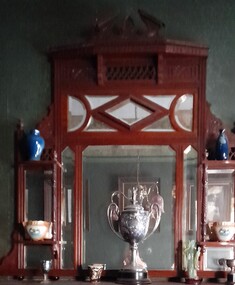
Furniture - Overmantle, Edwardian Overmantle
... An example of the furniture manufactured on the goldfields at Ballarat c.1900. ...An example of the furniture manufactured on the goldfields at Ballarat c.1900. ...An example of the furniture manufactured on the goldfields at Ballarat c.1900. Originally the business was established by Emanuel Steinfeld furniture manufacturer and retailer, who settled at Ballarat and in 1856 opened his furniture warehouse. Steinfeld left the Ballarat in 1881 and lived at St Kilda. He left his Ballarat business in the hands of two nephews, Sussman & Kornblum who continued the business in their own name.An example of colonial cabinet making in one of Ballarat's pioneering furniture manufacturing businesses that was founded in the 1850s. Backstamp of Sussman & Kornblum Ballaratballarat, jewish, cabinetmakers -
 Kiewa Valley Historical Society
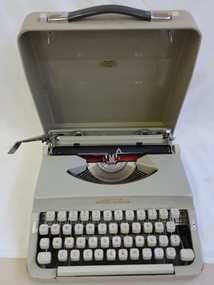
Typewriter - Portable
... CFM (Curvie Furniture Manufacturing). The Nakajima portable typewriters were imported in the 1970s. ...CFM (Curvie Furniture Manufacturing). The Nakajima portable typewriters were imported in the 1970s. ...These typewriters were imported fully assembled from Japan by CFM Industries. CFM (Curvie Furniture Manufacturing). The Nakajima portable typewriters were imported in the 1970s. Typewriters replaced hand written writing. Their benefits were that the work was written faster and was legible. The portable typewriter enabled the typist to take her typewriter with her. Typewriters have now been replaced by computers with the advantage of editing the work before the final copy is made and with the ability to add eg. photos, create different settings etc. Used by a resident of the Kiewa Valley in the 1970s.Beige hard plastic case with dark grey handle with chrome fittings and white buttons either side of the handle. Metal typewriter 'querty' key board, white keys with black inscriptions. Includes typewriter ribbonLabel inside cover for servicing. "CFM Industries Pty Ltd address, phone number" Label on back of typewriter for CFM Industriesportable typewriter -
 Flagstaff Hill Maritime Museum and Village
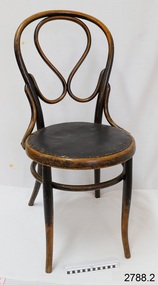
Furniture - Chair, 1900-1914
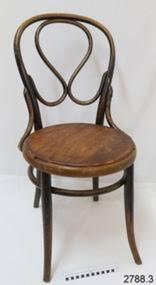
... Mundus bentwood chairs are among the most successful examples of early mass-produced furniture. The inventor of manufacturing chairs using this method was Gebrüder Thonet. ...Mundus bentwood chairs are among the most successful examples of early mass-produced furniture. The inventor of manufacturing chairs using this method was Gebrüder Thonet. ...Bentwood furniture is a type of furniture made by bending wooden rods into the required shape after they have been heated with steam. Mundus bentwood chairs are among the most successful examples of early mass-produced furniture. The inventor of manufacturing chairs using this method was Gebrüder Thonet. The subject item was made at Josef Jaworek small factory that produced bentwood chairs and was the only Polish member associated with the Mundus furniture company of Vienna. This company was founded in 1907 and Mundus went on to merge with J & J Kohn in August of 1914. Mundus furniture was a significant manufacturing company, active in several places in the Austro Hungarian Empire, at the end of the 19th century and early 20th century. Factories seem to have existed in multiple locations including Poland. Their products carry diverse labels, such as "Budapest", "Borlova", "Czechoslovakia", etc, some of the furniture was co-signed with "Jacob and Josef Kohn". Mundus also merged with Gebrüder Thonet in 1922 the inventor of the bentwood chair.The subject item is believed to be associated with the original Warrnambool Town Hall and would have been part of the buildings furnishings. The town Hall played a significant role in both local government and social events of local and district areas. It was not only a place for Council meetings but community events and social events. The item is significant as it is an early example of mass-produced manufactured furniture from a company in Austria that pioneered this type of furniture around the turn of the late 19th and early 20th centuries. This item is now regarded as a collector's piece giving it additional significance and interest.Bentwood chair (2 of 4), painted black, inner back is curled loop. Seat has leather cover, attached with studs. Ventilation holes under seat in star pattern. Splayed legs with bracing ring. Marks: pressed into some legs, under seat, paper label on rim under seat says the chair is made in Austrla.Marks: "3" is pressed into some legs, chalk letters under seat "RS", makers label, cream with dark print; on either side are 2 coins, top left coin has bust of a man, top right has an emblem with 1885 under it. Text of label "MOBEL-FABRIKEN / von / JOSEF JAWOREK / Teschen, osterr, Schlesien"flagstaff hill, warrnambool, flagstaff hill maritime museum, maritime museum, shipwreck coast, flagstaff hill maritime village, great ocean road, bentwood chair, café chair, restaurant chair, josef jaworek, austrian chairs, furniture, gebrüder thonet -
 Flagstaff Hill Maritime Museum and Village
Furniture - Chair, 1900-1914
... Mundus bentwood chairs are among the most successful examples of early mass-produced furniture. The inventor of manufacturing chairs using this method was Gebrüder Thonet. ...Mundus bentwood chairs are among the most successful examples of early mass-produced furniture. The inventor of manufacturing chairs using this method was Gebrüder Thonet. ...Bentwood furniture is a type of furniture made by bending wooden rods into the required shape after they have been heated with steam. Mundus bentwood chairs are among the most successful examples of early mass-produced furniture. The inventor of manufacturing chairs using this method was Gebrüder Thonet. The subject item was made at Josef Jaworek small factory that produced bentwood chairs and was the only Polish member associated with the Mundus furniture company of Vienna. This company was founded in 1907 and Mundus went on to merge with J & J Kohn in August of 1914. Mundus furniture was a significant manufacturing company, active in several places in the Austro Hungarian Empire, at the end of the 19th century and early 20th century. Factories seem to have existed in multiple locations including Poland. Their products carry diverse labels, such as "Budapest", "Borlova", "Czechoslovakia", etc, some of the furniture was co-signed with "Jacob and Josef Kohn". Mundus also merged with Gebrüder Thonet in 1922 the inventor of the bentwood chair.The subject item is believed to be associated with the original Warrnambool Town Hall and would have been part of the buildings furnishings. The town Hall played a significant role in both local government and social events of local and district areas. It was not only a place for Council meetings but community events and social events. The item is significant as it is an early example of mass-produced manufactured furniture from a company in Austria that pioneered this type of furniture around the turn of the late 19th and early 20th centuries. This item is now regarded as a collector's piece giving it additional significance and interest.Bentwood chair (3 of 4), painted black, inner back is curled loop. Seat is plain wood (replacing original). Splayed legs with bracing ring. Marks; Stamped into wood under seat, a small paper label and a label, cream with dark print. Paper label on rim under seat says the chair is made in Austria.Marks; Stamped into wood under seat is "49" and a small paper label with "49". Makers label, cream with dark print; on either side are 2 coins, top left coin has bust of a man, top right has an emblem with 1885 under it. Text of label "MOBEL-FABRIKEN / von / JOSEF JAWOREK / Teschen, osterr, Schlesien" flagstaff hill, warrnambool, flagstaff hill maritime museum, maritime museum, shipwreck coast, flagstaff hill maritime village, great ocean road, bentwood chair, café chair, restaurant chair, josef jaworek, austrian chairs, furniture, gebrüder thonet -
 Mission to Seafarers Victoria
Furniture - Sideboard, Buffet, Heinrich Friedrich Fischer, 1909-1912
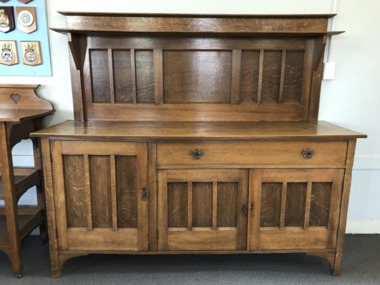
... The stamps in the drawer indicate the furniture was manufactured by H.F Fischer (Heinrich Friedrich Fischer). ...The stamps in the drawer indicate the furniture was manufactured by H.F Fischer (Heinrich Friedrich Fischer). ...This sideboard was originally used in the dining room of the Manse, the chaplains' residence. Upon completion of the Institute building in 1917, the Goldsmiths moved in after living for many uncomplaining years in a flat on Australia Wharf, which had “many disadvantages and discomforts”. The stamps in the drawer indicate the furniture was manufactured by H.F Fischer (Heinrich Friedrich Fischer). His store is mentioned in many advertisings as manufacturer and seller of furniture and was located at the 322 City Road address between 1909 and 1912 and is listed in the Sands & McDougall's in 1910. From 1913 his address changed to 308-310 City Road. The ‘European labour only’ stamp was a legal requirement in Victoria where it was set out in the Factories and Shops Act of 1896. Its purpose was to distinguish between furniture made in Victoria by Chinese workers and that made by Europeans, meaning Australians of European origin. To distinguish them, the European stamp was square or rectangular, the Chinese stamp was trianguler.It is not known when they were purchased or gifted and by whom. The facture is of quality, as indicated by the tenon and mortise joints of the drawers. The Wellers photographed the dining suite during his stay betwenn 1926-1929 (see item 1568).Wooden Oakwood Arts and Crafts sideboard 2 rectangular Stamps in purple ink in the drawer: " Manufactured by / H.F. Fischer/ 322 City Road / European Labour Only"manse, heritage listed, sideboard, arts and crafts, english, h.f. fischer, european labour, heinrish friedrich fischer, cabinetmaker -
 Flagstaff Hill Maritime Museum and Village
Furniture - Bentwood Chair, Mundas Furniture Manufactures, 1907 to 1920
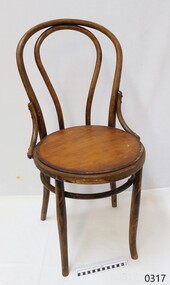
... Mundus furniture was a manufacturing company, active in several places in the Austro Hungarian Empire, at the end of the 19th century and early 20th century. ...Shipwreck Coast Flagstaff Maritime Museum Flagstaff Hill Village Bentwood Chairs Mundus Furniture Company Furniture Manufactured Furniture Vienna Austria Mundus Vienna Austria Bentwood Chair Furniture Bentwood Chair Mundas Furniture Manufactures ...Bentwood furniture is a type of furniture made by bending wooden rods into the required shape after they have been heated with steam. Mundus bentwood chairs are among the most successful examples of early mass-produced furniture. Mundus furniture was a manufacturing company, active in several places in the Austro Hungarian Empire, at the end of the 19th century and early 20th century. Factories seem to have existed in multiple locations, as the products carry diverse labels, such as "Budapest", "Borlova", "Czechoslovakia", etc. Some of the furniture was co-signed with "Jacob and Josef Kohn". In 1914 Mundus merged with J. & J. Kohn, and in 1922 with Gebrüder Thonet the inventor of the bentwood chair.The item is significant as it is an early example of mass-produced manufactured furniture from a company in Austria that pioneered this type of furniture around the turn of the 19th century. The item is now a collector's piece giving it additional significance.Bentwood ChairMundus Vienna Austriashipwreck coast, flagstaff maritime museum, flagstaff hill village, bentwood chairs, mundus furniture company, furniture, manufactured furniture, vienna austria -
 Emerald Museum & Nobelius Heritage Park
Tool - Plough Plane, Jenkins & Clark, Circa late 19th century
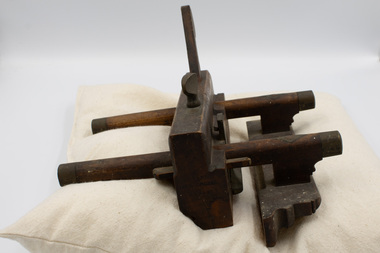
... This plough plane is a hand tool that was used to cut grooves or rabbets into wood, for example for furniture construction. It was manufactured in Birmingham by Jenkins & Clark and imported or taken to Australia most likely in the nineteenth century. ...This plough plane is a hand tool that was used to cut grooves or rabbets into wood, for example for furniture construction. It was manufactured in Birmingham by Jenkins & Clark and imported or taken to Australia most likely in the nineteenth century. ...This plough plane is a hand tool that was used to cut grooves or rabbets into wood, for example for furniture construction. It was manufactured in Birmingham by Jenkins & Clark and imported or taken to Australia most likely in the nineteenth century. The several names imprinted into the tool imply that it may have been used by several unique owners at different points in time - J.O. Hart, Micl (likely Michael) Orgill, and D. Brown. Names may have been imprinted in the tool to prevent confusion in settings with many workers supplying their own tools.Unknown donor but assumed to have been used locally.Wooden plough plane with brass fittings. Includes adjustable wooden clamp and removable wooden blade clamp. The blade slot cuts diagonally through the object. There are inscriptions on both shorter ends of the object.On side opposite blade slot: 'JENKINS/&/CLARK/J.O.HART/MICL ORGILL/J.O.HART/D. BROWN' On side near blade slot: 'D. BROWN/[upside-down] J.O.HART/MICL ORGILL/[upside-down] J.O.HART'plough plane, tools, jenkins & clark -
 Sunshine and District Historical Society Incorporated
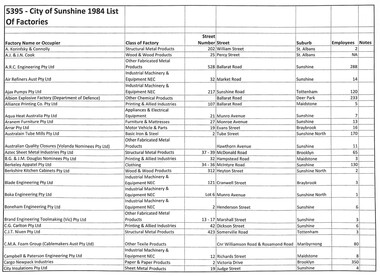
Archive - City of Sunshine 1984 List Of Factories, K.G. Wilson, L.R. Dryer & R.A. Scaramella, 1984
... Manufacturing Co. Pty Ltd G.W. Gregory Engineering (Aust) Pty Ltd General Printing Ink (Aust) Pty Ltd George Press Pty Ltd Griffiths & Beeren Pty Ltd Gubbata Nominess Pty Ltd Harkrome Electroplaters Pty Ltd Hills & Mason Pty Ltd Hydraulic Equipment & Cylinder Service Pty Ltd Hy-Du-Ex I.C.I. Australia Operations Pty Ltd I.H. Mono & Co. Idea General Engineering Industrial Engineering Invicta Group Industries Pty Ltd K. & B. Windows Pty Ltd K.C. Furniture...Manufacturing Co. Pty Ltd G.W. Gregory Engineering (Aust) Pty Ltd General Printing Ink (Aust) Pty Ltd George Press Pty Ltd Griffiths & Beeren Pty Ltd Gubbata Nominess Pty Ltd Harkrome Electroplaters Pty Ltd Hills & Mason Pty Ltd Hydraulic Equipment & Cylinder Service Pty Ltd Hy-Du-Ex I.C.I. Australia Operations Pty Ltd I.H. Mono & Co. Idea General Engineering Industrial Engineering Invicta Group Industries Pty Ltd K. & B. Windows Pty Ltd K.C. Furniture ...This list of factories in the City of Sunshine is an extract from a report by K.G. Wilson, L.R. Dryer & R.A. Scaramella, prepared for the Melbourne Western Region Commission (WRC). The Melbourne Western Region Commission was a major inter‑municipal planning and advocacy body operating across Melbourne’s western suburbs in the late 1970s and 1980s. It coordinated planning, heritage studies, and regional development across multiple councils. The Commission brought together a broad sweep of western-region councils City of Altona, City of Essendon, City of Footscray, City of Keilor, City of Sunshine, City of Williamstown, Shire of Bacchus Marsh, Shire of Melton & Shire of Werribee. The Melbourne Western Region Commission was one of the most important institutional predecessors to the region’s later heritage, planning, and community‑development frameworks.This report records the business name, type of industry and address of businesses operating in the City of Sunshine in 1984.Factory Name or Occupier A. Korinfsky & Connolly A.J. & J.N. Cook A.R.C. Engineering Pty Ltd Air Refiners Aust Pty Ltd Ajax Pumps Pty Ltd Albion Explosive Factory (Department of Defence) Alliance Printing Co. Pty Ltd Aqua Heat Australia Pty Ltd Aranem Furniture Pty Ltd Arrar Pty Ltd Australain Tube Mills Pty Ltd Australian Quality Closures (Volanda Nominees Pty Ltd) Aztec Sheet Metal Industries Pty Ltd B.G. & J.M. Douglas Nominees Pty Ltd Berkeley Appatel Pty Ltd Berkshire Kitchen Cabinets Pty Ltd Blade Engineering Pty Ltd Boka Engineering Pty Ltd Boneham Engineering Pty Ltd Brand Engineering Toolmaking (Vic) Pty Ltd C.G. Carlton Pty Ltd C.J.T. Niven Pty Ltd C.M.A. Foam Group (Cablemakers Aust Pty Ltd) Campbell & Paterson Engineering Pty Ltd Cargo Newpack Industries City Insulations Pty Ltd Classic Garage Construction Cliff Poole Industries Pty Ltd Collie Cooke Consolidated Conlo Constructions Pty Ltd Connor Shea & Co. Pty Ltd Consolidated Partition Industries Holding Pty Ltd Cosmoplitan Clothing Manfacturers Crea Fashions Pty Ltd Currie Furniture Manufacturing Pty Ltd D. Richardson & Son Ltd Dalco Hardware (Dalco Pty Ltd) Daveyduke Industries (Mimvic Nominees Pty Ltd) Debora Downs Pty Ltd Deer Park Engineering Pty Ltd Deer Park Flyscreens (Azzopardi & Associates Pty Ltd) Dieselflex Pty Ltd Donald Minahan Pty Ltd Drava Continental Butchers & Smallgoods Manufacturer Drilling Equipment (Van Dyke Pty Ltd) Dunham Welding Engineering Pty Ltd E. & F. Industries Pty Ltd E.P. Morrisey & Co. Pty Ltd Elite-Built Holdings Ltd Englehold Engineering Pty Ltd Everlast Steel Products Explosive Factory (Department of Defence Support) Extruded Metals Pty Ltd Exy-Fit Screens F. & D.M. Costa Pty Ltd F. & I. Pfeffer Holdings Pty Ltd F.J. Humphrey Pty Ltd Fallshaw Holdings Pty Ltd Ferrous Forgings Pty Ltd Fleet Engineering Pty Ltd Fletcher Chemical Co. Ltd Franklin Printing & Lithographic Co. Pty Ltd Fraser Cabinets Pty Ltd G. & L. Stone Pty Ltd G.A.M. Engineering Industries Pty Ltd G.P.I. Automotive Products Pty Ltd G.U.D. Manufacturing Co. Pty Ltd G.W. Gregory Engineering (Aust) Pty Ltd General Printing Ink (Aust) Pty Ltd George Press Pty Ltd Griffiths & Beeren Pty Ltd Gubbata Nominess Pty Ltd Harkrome Electroplaters Pty Ltd Hills & Mason Pty Ltd Hydraulic Equipment & Cylinder Service Pty Ltd Hy-Du-Ex I.C.I. Australia Operations Pty Ltd I.H. Mono & Co. Idea General Engineering Industrial Engineering Invicta Group Industries Pty Ltd K. & B. Windows Pty Ltd K.C. Furniture & Cabinets K.D.S. Manufacturing K.M. Tubular Industries (Aust) Pty Ltd K.P.T. Clothing Manufacturers (K.T.P. Fashions Pty Ltd) Kanga Engineering Pty Ltd Keilor Footwear Pty Ltd Kelgrif Patterns Pty Ltd Klipspringer Pty Ltd Krueger Transports Equipment Pty Ltd Langmar Pty Ltd Layton Granite Industries Pty Ltd Lesvos General Products (Gabbia Pty Ltd) Lewis Foundry Lysaght Durham Chemical Company (Austram Corporation Ltd) M.C.I. (Aust) Pty Ltd M.J. Billings M.S.M. Cabinets Pty Ltd Maidstone Cabinet Works Marble Art Company Marib Cutter Sharpening Service Massey-Ferguson (Aust) Ltd McIntyre Steel Industries (Vic) Pty Ltd Midway Press Business Forms Mirna Cabinets Manufacturers Pty Ltd Monsanto Aust Ltd Morgan Cabinets Morris Structural & Engineering Newroll Industries Pty Ltd North Sunshine Cases Novio Insulation (Vic) Pty Ltd Olex Cables (Dunlop Olympic Ltd) Ordnance Factory (Department of Defence Support) P. & S. Siegel Pty Ltd P.S. Fenech Pty Ltd Pacific Carpets Internations Pty Ltd Pattern Productions Pauls Woodworking Pty Ltd Penthouse Furniture Co. Pty Ltd Peter Bouris General Steel Work Pomona Printers Pty Ltd Presstool Manufacturing & Grinding R.E.M. Constructions Pty Ltd R.J. Thompson Nominees Pty Ltd R.M.D. Press Co. Pty Ltd Ralph McMay Ltd Reeco Industries Pty Ltd Regina Terrazzo Tile Robcliff Printing Rockwell Standard of Australia Ltd Saturn Quality Trailers Pty Ltd Sedco Pty Ltd & Sunshine Extrusion Die Co. Pty Ltd Sign City Pty Ltd Smithweld Pty Ltd Smorgan Consolidated Industries Solo Signs Spafco Pty Ltd Stafford Engineering Pty Ltd Star of Paris Pty Ltd Steel Improvement Pty Ltd Sunset Joinery Pty Ltd Sunshine Engineering Pty Ltd Sunshine Group Industries Pty Ltd Sunshine Joinery Pty Ltd Sunshine Metal Polishing Pty Ltd Sunshine Trailers Sunshine Vitreous Enamellers Pty Ltd Sunshine Wrought Iron Super Cartridge Superstyle Tubular Manufacturers Pty Ltd Talkprint Pty Ltd Tenderfoot Shoes Treble Printing Co. Trifoleum Pty Ltd Ultra Scales Pty Ltd United Scales Pty Ltd V.P. Hawthorne Nominees Pty Ltd Vinidex Tubemakers Pty Ltd Vitas Engineering W. & H. General Engineering Pty Ltd W. Pridham (Aust) (Peerless Processing Co Pty Ltd) W.G. Engels Pty Ltd W.L. Allen Foundry Co. Pty Ltd Wakefield Repetition & General Engineers Warren & Brown Co. (Repco Ltd) Westbury Joinery Co. Holdings Pty Ltd Western Containers Pty Ltd & Chanel Press Pty Ltd Westgate Engineering Westside Joinery Pty Ltd (The Bulman Family Trust) Westwork Industries Wiltshire Tools Pty Ltd Worsted Finishers (Aust) Pty Ltd melbourne western region commission -
 Flagstaff Hill Maritime Museum and Village
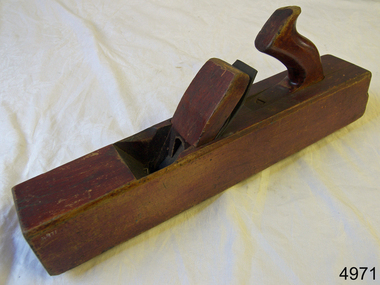
Tool - Wood Smoothing Plane, Late 19th to Early 20th century
... A Jack plane is used for smoothing timber that is used in the manufacture of furniture or other wooden objects. Traditionally, smoothing planes were blocks of wear-resistant hardwood, often beech or maple, which were worked to smooth or even out timber. ...A Jack plane is used for smoothing timber that is used in the manufacture of furniture or other wooden objects. Traditionally, smoothing planes were blocks of wear-resistant hardwood, often beech or maple, which were worked to smooth or even out timber. ...A Jack plane is used for smoothing timber that is used in the manufacture of furniture or other wooden objects. Traditionally, smoothing planes were blocks of wear-resistant hardwood, often beech or maple, which were worked to smooth or even out timber. The blade or iron was likewise secured in the body of the plane with a wooden wedge. A traditional cabinetmakers shop might have many, perhaps hundreds, of moulding and smoothing planes for the full range of work to be performed. Company History: The firm of Alexander Mathieson & Sons was one of the leading makers of hand tools in Scotland. Its success went hand in hand with the growth of the shipbuilding industries on the Firth of Clyde in the nineteenth century and the emergence of Glasgow regarded as the "second city of the Empire". It also reflected the firm's skill in responding to an unprecedented demand for quality tools by shipyards, cooperage's and other industries, both locally and far and wide. The year 1792 was deemed by the firm to be that of its foundation it was in all likelihood the year in which John Manners had set up his plane-making workshop on Saracen Lane off the Gallowgate in the heart of Glasgow, not far from the Saracen's Head Inn, where Dr Johnson and James Boswell had stayed on their tour of Scotland in 1773. Alexander Mathieson (1797–1851) is recorded in 1822 as a plane-maker at 25 Gallowgate, but in the following year at 14 Saracen's Lane, presumably having taken over the premises of John Manners. The 1841 national census described Alexander Mathieson as a master plane-maker at 38 Saracen Lane with his son Thomas Adam working as a journeyman plane-maker. In 1849 the firm of James & William Stewart at 65 Nicolson Street, Edinburgh was taken over and Thomas was put in charge of the business, trading under the name Thomas A. Mathieson & Co. as plane and edge-tool makers. Thomas's company acquired the Edinburgh edge-tool makers Charles & Hugh McPherson and took over their premises in Gilmore Street. The Edinburgh directory of 1856/7 the business is recorded as being Alexander Mathieson & Son, plane and edge-tool makers at 48 Nicolson Street and Paul's Work, Gilmore Street. The 1851 census records indicate that Alexander was working as a tool and plane-maker employing eight men. Later that year Alexander died and his son Thomas took over the business. Under the heading of an edge-tool maker in the 1852/3 (Post-Office Glasgow Annual Directory) the firm is now listed as Alexander Mathieson & Son. By the early 1850s, the business had moved to 24 Saracen Lane. The directory for 1857/8 records that the firm had moved again only a few years later to East Campbell Street, also off the Gallowgate, and that through further diversification was also manufacturing coopers' and tinmen's tools. The ten-yearly censuses log the firm's growth and in 1861 Thomas was a tool manufacturer employing 95 men and 30 boys; in 1871 he had 200 men working for him and in 1881 300 men. By 1899 the firm had been incorporated as Alexander Mathieson & Sons Ltd, even though only Alexander's son Thomas appears ever to have joined the firm. A vintage tool made by a well-known firm made for other firms and individuals that worked in wood. The tool was used for the smoothing of a piece of timber that was then used in some form of cabinet manufacture or wood working. A significant item from the mid to late 19th century that today is sought after by collectors. It gives us a snapshot of how furniture was made predominately by hand and with tools that were themselves hand made. Jack Plane; a wooden smoothing plane, made by Alex Mathieson & Son, Glasgow. Plane has inscriptions."Alex Mathieson & Son Glasgow" Stamped "GN" inside with a "W" on endflagstaff hill, warrnambool, shipwrecked-coast, flagstaff-hill, flagstaff-hill-maritime-museum, maritime-museum, shipwreck-coast, flagstaff-hill-maritime-village, jack plane, smoothing plane, woodworking tool, woodwork, cabinet making -
 Sunshine and District Historical Society Incorporated
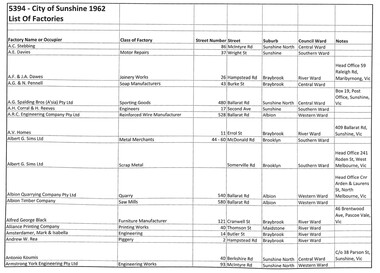
Archive - City of Sunshine 1962 List Of Factories, City of Sunshine, 1962
... Connor Shea & Company Pty Ltd Consilated Bearing Company Pty Ltd Consolidated Metal Products Co-Operative Farmers & Graziers (Direct Meat Supply Ltd) Corrougated Fibre Container Pty Ltd Crittall Manufacturing Company Crittall Manufacturing Company Crocuher & Sharpe Currie Furniture Manufacturing Company D. Pavlovic D. Richardson & Sons Pty Ltd D. ...Connor Shea & Company Pty Ltd Consilated Bearing Company Pty Ltd Consolidated Metal Products Co-Operative Farmers & Graziers (Direct Meat Supply Ltd) Corrougated Fibre Container Pty Ltd Crittall Manufacturing Company Crittall Manufacturing Company Crocuher & Sharpe Currie Furniture Manufacturing Company D. Pavlovic D. Richardson & Sons Pty Ltd D. ...This list of factories in the City of Sunshine is an extract from a report by City of Sunshine in 1962.This report records the business name, type of industry and address of businesses operating in the City of Sunshine in 1962.Factory Name or Occupier A.C. Stebbing A.E. Davies A.F. & J.A. Dawes A.G. & N. Pennell A.G. Spalding Bros (A'sia) Pty Ltd A.H. Corral & H. Reeves A.R.C. Engineering Company Pty Ltd A.V. Homes Albert G. Sims Ltd Albert G. Sims Ltd Albion Quarrying Company Pty Ltd Albion Timber Company Alfred George Black Alliance Printing Company Amsterdamer, Mark & Isabella Andrew W. Rea Antonio Koumis Armstrong York Engineering Pty Ltd Associated Rubber Company Pty Ltd Austral Bronze Company Pty Ltd Austral Standard Cables Pty Ltd B.A. Martin Baker & Taylor Pty Ltd Barnard Bros. Pty Ltd Bethell & Bradley Bill's Transport Services Pty Ltd Birmbaun Fairwell & Richter, Morka (Occ B. & R. Company) Boonspa Pty Ltd British Australia Carpet Manufacturing Company Brooklea Timber Company Brooklyn Motor Springs Works Broons Containers Ltd Broons Timber Pty Ltd C. & L.A. Dunt Letcher & Hartley C. Wolfenden & Company C.J.T. Niven Pty Ltd C.T. Wimble & Co. Pty Ltd C.V. Trowbridge Caluzzi, L. Canada Cycle & Motor Company Pty Ltd Canterbury, C.W. Connor Shea & Company Pty Ltd Consilated Bearing Company Pty Ltd Consolidated Metal Products Co-Operative Farmers & Graziers (Direct Meat Supply Ltd) Corrougated Fibre Container Pty Ltd Crittall Manufacturing Company Crittall Manufacturing Company Crocuher & Sharpe Currie Furniture Manufacturing Company D. Pavlovic D. Richardson & Sons Pty Ltd D. Ure D.J. & J. Bingham Dalco Pty Ltd Dalgety's Properties (Vic) Pty Ltd Dalgety's Stores Pty Ltd Darmas Welding Engineers Digby Leonard Stanley Dixon & Co. Pty Ltd Dover Machine Tools Pty Ltd Dycraft Ltd E. & F. Industries Pty Ltd E.G. Hallett E.J. Andrew E.N. Gordon Ecole Pty Ltd Edward Campbell & Son Pty Ltd ETA Foods Pty Ltd ETA Foods Pty Ltd Eunson & Bosse Everlast Steel Products Exors F.H. & L.G. Gilbert Estate Express Holdings Ltd Extruded Metals Pty Ltd Extruded Metals Pty Ltd F. Watkins Pty Ltd F. Watkins Snr. F.J. Clements F.J. Humphrey Fairway Scale & Tube Pty Ltd Ferron Industries Ficken Haliday & McClelland Pty Ltd Fletcher Chemical Company Franklin Press Frederick Heaviside Frederick Heaviside Frederick R. Marsh G. & F. Hortin G. Vargiu G. Wills & Co. Ltd G.Harris Builders Pty Ltd G.R. & L.M. Wilson George A. Backhouse Go Kart Manufacturing Company (Aust) Pty Ltd Guy Bros. Pty Ltd H. Hartley & J. White H.J. & D.J. Scoble H.J. Drayton Harland Engineering (Aust) Pty Ltd Harold Meggitt Ltd Harrison, L. Harvey-Little, E.J. Haxby Bros. Herlihy Bros. Hills & Mason Humes Ltd I. & P. Panel (K. Flack Tenant) I.H. Blacker Industrial Oxygen Company Pty Ltd Industrial Service Engineering J. & E. Montomery J. & O.E. Turnley J. Adler (National Springs) J. Adler (Owner) J. Flint J. Walker J.A. Lewis J.A. Short (Owner) Steel Craft Baby Cariages Pty Ltd J.A. Taylor J.A. Watson J.F. Lane J.H. Hutson J.H. Moffitt & N.D. McLean Norsun Motors J.H. Ralph J.H. Ryan J.H. Steel J.H. Story J.H. Warnock J.J. & D.M. Allan J.M. & A.L. Scanlon J.R. Parsons J.T. & A.W. Carter J.T. Carter James Herbert Sharp James Michael & E. Montgomery John Charles Duxson John Darling & Son Pty Ltd K. & B. Chapman K.M. Steel Products K.W. Thomas (Melb) Pty Ltd Kleins Holdings Ltd Kreglinger (Aust) Pty Ltd L. Baldwin L.E. Poole L.H. Plastersheet Manufacturing Company Pty Ltd L.H. Tonkin L.T. Cody Lanz Aust Pty Ltd Lenmax Constructions Pty Ltd Leroc Oil Company Pty Ltd Leslie John Guy Liquid Cartage Company Pty Ltd Lustre Cleaning M. & C. Gatt M. Dawydiuk Maidstone Ice Works Maidstone Plaster Company Maribyrnong Timber & Trucking Company Pty Ltd Marriott Heat Treatment Massey Ferguson Pty Ltd McPherson's Limited Mees. Nederlof Meggitt Limited Melon Investments Pty Ltd (Invicta Mills Pty Ltd) Mephalene Pty Ltd Mephan Ferguson Pty Ltd Metal Manufacturers Ltd Mills Scaffolds Mills, Robgrae Polishing Company Mobile Concrete Constructions Company Pty Ltd Monier Pipe Company Pty Ltd Monsanto Australia Pty Ltd Moorabbin Sand Pits Pty Ltd Morris McMahon Mr. Sneddon N.W. Riley National Forge Company National Motors Springs (Vic) Pty Ltd Nelson Nettlefold Pty Ltd Nilo Industries Pty Ltd Nobel A/sia Pty Lrd Norman Smorgan & Sons Pty Ltd Olympic Cables Pty Ltd Olympic Tyre & Rubber Company Pty Ltd Oversea Corporation (Aust) Ltd P. Sztogryn P.T. Cooper Pelaco Ltd Perfect Circle (Aust) Pty Ltd Perfect Trading Company Peter Mochrie Phoenix Foreworks Company Pty Ltd Polson Motor Parts Company Pty Ltd Prism Paints R. Popp & Z. Stepanek R. Simpson R.A.G. Kent R.G. & D. Mattinson R.J. & D.G. Layton R.M.D. Press Company Pty Ltd R.M.D. Press Company Pty Ltd Ralph McKay Ready Mix Concrete Victoria Pty Ltd Regal Quarries Pty Ltd Rheem Manufacturing Company (Aust) Pty Ltd Richard Williams Yeomans Richard, E. Robert Bodington Pty Ltd Rothmans of Pall Mall (Aust) Ltd Roy Francis Wood Rubbertex (Aust) Pty Ltd S. & G. Barlow S.M. Peters Sandhurst Estates Pty Ltd Sankey Benson Wheels Seabridge, William Alexander Selleys Chemical Manufacturer Company Pty Ltd Seven X Beverages Pty Ltd Sidney Cooke Pty Ltd Silicate & Dolmite Pty Ltd of Australia Smith Bros. Pty Ltd Smithwelds Pty Ltd Sonneham Southern Cross Windmills & Engines Standard Steel Company Pty Ltd Stanfield Steel Company Stanger Power Equipment Pty Ltd Stanley Quarries Pty Ltd Steedman, Ian Knollys Steel Improvements Company Pty Lrd Steelbilt (Vic) Pty Ltd Steels & Metals Pty Ltd Steelweld Pty Ltd Stramit Board Pty Ltd Sunbeam Corporation Ltd Sunshine Cabinet Works Sunshine Extrusion Die Sunshine Primary Exports Pty Ltd Sunshine Vitreous Enamellers Pty Ltd Sunshine Waste Company (Kagan Bros. Pty Ltd) Sunshine Waste Industries Swanston Engineering Pty Ltd T. & L. Cockram Pty Ltd T. O'Hare T. Zafis Tallamy & Marriott (Occ McPherson, Duncan Alexander) Taubans Group Factories Pty Ltd The Australian Wool Bureau The Lysaght Durham Chemical Company Pty Ltd Thomas Borthwick & Son (A'sia) Ltd Thomas Joseph Donohoe Thomas Walsh & Company Pty Ltd Tip Top Cordials Pty Ltd Tobin K. Wm. & V.M. Tyler Bros. Una Timber Industries Pty Ltd Unit Fabrications Pty Ltd (Occ. Didier, L.C.J.) V. Manhavac Vacu-Lug (N.S.W.) Pty Ltd Valentine Smith Victorian Steel Fabrications Vickers-Detroit Hydraulics Pty Ltd Victoria Road Pty Ltd Victorian Casing Company Pty Ltd Victorian Meter Laboratory Victorian Steel Fabrication Pty Ltd W. Janus & L. Taylor W. Pridham Pty Ltd W.G. Sullivan W.H. Dunham W.L. Allen Foundry Company W.M. Bruns W.T. Stembridge Wilcox Mofflin Ltd William Adams & Company Ltd William Atkins (Vic) Pty Ltd William Whitely & Sons (Aust) Pty Ltd Wiltshire File Company Wunderich - Humes Asbestos Pipes Pty Ltd Wunderich Ltd Zinc Oxide (Aust) Pty Ltd -
 Flagstaff Hill Maritime Museum and Village
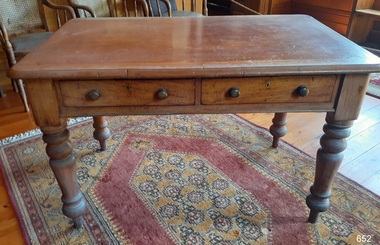
Furniture - Desk, Foy & Gibson, Circa 1880s
... Gibson added to his business by starting his own manufacturing works from 1887, producing clothing, millinery, furniture, bedding and hardware for his stores. ...Gibson added to his business by starting his own manufacturing works from 1887, producing clothing, millinery, furniture, bedding and hardware for his stores. ...The design of this small disc is from the Australian Colonial period. The cedar wood desk was made in Australian by Foy & Gibson in the 1880s, most probably in the business’s works in Collingwood, Victoria. The heavy brass locks fitted into the desk drawers were made by the famous Hobbs & Co of London, mid-late 19th century. In 1860 the business changed hands but the locks were still branded Hobbs & Co. The desk is branded with the symbol of Victoria’s Public Works Department. There is currently no information on when, where and by whom this desk was used. However, a very similar desk with Hobbs & Co. locks is on site at the Point Hicks Lightstation in Victoria and was formerly used by the Point Hicks head light keeper there. Other light stations also have similar desks from the P.W.D. (see also ‘Desk, Parks Victoria – Point Hicks Lightstation, Victorian Collections’.) HOBBS & CO., LONDON Alfred Charles Hobbs, 1812-1891, was American born. He became an executive salesman in 1840 for renowned lock manufacturer Day & Newell. His technique of exposing the weaknesses of people’s current locks was very successful in generating sales. He represented Day & Newell at London’s Great Exhibition of 1851, competing with other lock makers. Through the Exhibition he became famous for picking the best trusted Bramah and Chubb locks. Hobbs’ fame led him to found his own company in 1851 then register it in 1852 as Hobbs & Co., London. Hobbs was awarded the Telford Medal by the British Institution of Civil Engineers in 1854 for his paper 'On the Principles and Construction of Locks'. In 1855 the very successful company added partners and became Hobbs, Ashley and Co. In 1860, it traded under the name of Hobbs, Hart & Co. and was based in Cheapside London, where the business remained. Hobbs then returned to America, having sold the complete company to John Mathias Hart. He briefly returned to attend the 21st anniversary celebrations of the successful business in 1872. Hobbs kept himself busy in America, inventing and manufacturing firearm ammunition, for which he held several patents. He passed away there in 1891, a month after his 70th birthday. FOY & GIBSON Mark Foy wan an Irish draper who migrated to Bendigo, Victoria in 1858, attracted by the gold rush. He lived and worked in the area, establishing a drapery business. In the 1870s he moved to Melbourne where there were better prospects for expansion. He chose a place in Smith Street, Collingwood, a suburb of Melbourne, and started his business at the rear. In 1883 Foy retired, bringing in William Gibson as a partner, and then transferred his own share of the company to his son Francis Foy. Not long afterwards Francis sold his half share to Gibson, and the business continued under the name of Foy & Gibson. Francis Foy and he and his brother Mark Foy (junior) moved to Sydney. They established a business there in 1885, named after their father, Mark Foy. Gibson added to his business by starting his own manufacturing works from 1887, producing clothing, millinery, furniture, bedding and hardware for his stores. The factories, warehouses and stores complex became one of Victoria’s largest employers. He set up branches of his stores in Perth, Brisbane and Adelaide and two more branches in Melbourne. Foy & Gibson (usually referred to as Foys) became one of Australia’s largest retail department stores. In 1931 Foy’s little house in Collingwood was still part of the entrance to Foy & Gibson Emporium. In 1955 the company was bought out by Cox Brothers. Later on the stores were sold to various businesses such as David Jones, Woolworths and Harris Scarfe. In 1968 Cox Brothers went into receivership, ending almost 100 years of the business known as Foy’s. The former Foy & Gibson Complex is registered by Heritage Council Victoria. “Designed by William Pitt, this magnificent 19th and early 20th century complex of factories, warehouses and showrooms saw the production of a remarkable range of goods for Foy & Gibson, Melbourne’s earliest department store chain”. (Quoted from the Plaque erected by the Collingwood Historical Society 2007) P.W.D. – Public Works Department, Victoria The desk is stamped “P.W.D,” signifying that it is from the Public Works Department in Victoria, which operated from 1855-1987. The department was responsible for, among other things, the design and supply of office furniture and equipment for public buildings and organisations. This desk is significant historically as it originated from Foy & Gibson, a colonial Australian company that had a positive and strong impact on employment, manufacturing and retailing in Melbourne, Victoria and Australia. The significance of Foy & Gibson to Victoria’s and Australia’s history is marked by the Collingwood Complex being registered in both Heritage Victoria Register (H0755, H0897 and H0896) and National Trust Register (B2668). This locks on this desk are significant for their connection with their manufacturer, Hobbs & Co, who invented a lock that surpassed the security of any other locks produced in the mid-19th century. Desk; Australian Colonial cedar desk, honey coloured. Desktop has a wooden border with a rolled edge and a fitted timber centrepiece. The four tapered legs are tulip turned. Two half-width drawers fit side by side and extend the full depth of the desk. The drawers have dovetail joints. Each drawer has two round wooden knob handles, a keyhole and a fitted, heavy brass lever lock. Inscriptions are on the desktop, drawers, desk leg and lock. Made in Australia circa 1880 by Foy & Gibson, lock made by Hobbs & Co, London.Impressed into timber frame of one drawer “FOY & GIBSON” Impressed into lock “HOBBS & CO / LONDON”, “MACHINE MADE”, “LEVER” Impressed along the front edge of the desktop [indecipherable] text. Impressed into the timber of right front leg “P. W. D.” below a ‘crown’ symbol Handwritten in white chalk under a drawer “206” flagstaff hill, warrnambool, shipwrecked coast, flagstaff hill maritime museum, maritime museum, shipwreck coast, flagstaff hill maritime village, great ocean road, desk, cedar desk, colonial desk, 1880s desk, australian colonial furniture, furniture, office furniture, office equipment, australian made furniture, colonial furniture, colonial hardware, foy & gibson, alfred charles hobbs, hobbs & co london, hobs & co lever lock, cabinetry lock, machine made lever lock, p.w.d., public works department victoria, day & newell, great exhibition of 1851, bramah lock, chubb lock, telford medal 1854, cheapside london, mark foy, mark foy – bendigo draper, smith street collingwood, william gibson, foy & gibson emporium, foy & gibson complex, cox brothers -
 Flagstaff Hill Maritime Museum and Village
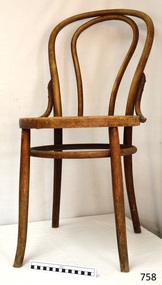
Furniture - Chair, Harnisch & Co, 1876-1918
... Furniture Factory in Neuschol (Beszterczebanya), Hungary, privileged makers for the Imperial and Royal Austrian-Hungarian Empire 1867 – 1918. Bentwood chairs are made by a process of wetting wood in water, bending it into curved shapes, then allowing it to dry so that the shape becomes permanent. This process originated by Michael Thonet, who had been given the right to bend wood into desired curves by the Austrian Courts in 1842. In 1856 he was granted a 13 year patent to manufacture...Furniture Factory in Neuschol (Beszterczebanya), Hungary, privileged makers for the Imperial and Royal Austrian-Hungarian Empire 1867 – 1918. Bentwood chairs are made by a process of wetting wood in water, bending it into curved shapes, then allowing it to dry so that the shape becomes permanent. This process originated by Michael Thonet, who had been given the right to bend wood into desired curves by the Austrian Courts in 1842. In 1856 he was granted a 13 year patent to manufacture ...The design of this pair (RN 758 & 759) is based on Thonet’s No. 18 chair, which was originally produced in 1876 by Thonet, and is still one of the best-selling designs for café and restaurant owners. It is elegant, sophisticated and durable. The label notes the design as “AUS MASSIV GEBOGENEM HOLZE vorm” which translates to “solid curved sandals shape”, a good description for the back of the chair. The chairs have marks, paper labels and symbols on them that show that the maker was Harnisch & Co., Neuschler (also called Banská Bystrica) Furniture Factory in Neuschol (Beszterczebanya), Hungary, privileged makers for the Imperial and Royal Austrian-Hungarian Empire 1867 – 1918. Bentwood chairs are made by a process of wetting wood in water, bending it into curved shapes, then allowing it to dry so that the shape becomes permanent. This process originated by Michael Thonet, who had been given the right to bend wood into desired curves by the Austrian Courts in 1842. In 1856 he was granted a 13 year patent to manufacture chairs and table legs of bent wood treated by steam or boiling water. In 1859 his company Gebruder Thonet produced his original design. Thonet’s early designs also featured hand carved or laminated wooden seats. His Model No. 14 produced in the 1850’s, was his most popular design. After Michael’s death in 1871 the family went on designing and producing chairs. The No. 18 chair was produced in 1876, one of a group of chars with back inserts consisting of curves and loops of bentwood. These bentwood chairs are believed to be associated with the either the original Warrnambool Town Hall or the Toc H Group in Warrnambool. The Warrnambool Town Hall played a significant role in the both the local government and the social events of local and district areas. It was a place for Council meetings, community events and entertainment, theatrical and musical.Chair, bentwood, 'French Bistro Chair' with a floral pattern carved in seat. Backrest has inverted U shape inside that extends to the seat. Supports on either side of backrest's base join to back of seat. Legs have a wooded bracing ring. Marks are embossed into rim under seat. Paper label, cream with black print, on rim; Right side of label has the symbol of Heraldic Shield. Text on label. Made by NEUSOHLER FABRIK FUR MOBEL, AUS MASSIV GEBOGENEM HOLZE, vorm. HARNISCH & Co, NEUSOHL (BESZTERCaZEBANYA) UNGARN ' Hand written under seat "T H" in black paint, "T H " in white chalk.Marks; pressed into rim under seat is "3", and "Crown [over] (N)", Paper label, cream with black print, on rim; Left side has Mark “N inside circle under crown”. Right side has symbol of Heraldic Shield. Text on label “Trade – K.u.K.- Mark / NEUSOHLER FABRIK FUR MOBEL/ AUS MASSIV GEBOGENEM HOLZE, vorm. HARNISCH&Co / NEUSOHL (BESZTERCaZEBANYA) UNGARN ' Hand written under seat "T H" in black paint, "T H " in white chalk. flagstaff hill, warrnambool, shipwrecked-coast, flagstaff-hill, flagstaff-hill-maritime-museum, maritime-museum, shipwreck-coast, flagstaff-hill-maritime-village, bentwood chair, café chair, restaurant chair, thonet design chair, neusohler fabrik fur nobel, k.u.k. approved manufacturer, hungry, harnisch & co, k.u.k., public hall chair, toc h -
 Flagstaff Hill Maritime Museum and Village
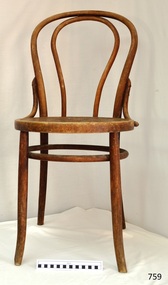
Furniture - Chair, Harnisch & Co, 1876-1918
... Furniture Factory in Neuschol (Beszterczebanya), Hungary, privileged makers for the Imperial and Royal Austrian-Hungarian Empire 1867 – 1918. Bentwood chairs are made by a process of wetting wood in water, bending it into curved shapes, then allowing it to dry so that the shape becomes permanent. This process originated by Michael Thonet, who had been given the right to bend wood into desired curves by the Austrian Courts in 1842. In 1856 he was granted a 13 year patent to manufacture...Furniture Factory in Neuschol (Beszterczebanya), Hungary, privileged makers for the Imperial and Royal Austrian-Hungarian Empire 1867 – 1918. Bentwood chairs are made by a process of wetting wood in water, bending it into curved shapes, then allowing it to dry so that the shape becomes permanent. This process originated by Michael Thonet, who had been given the right to bend wood into desired curves by the Austrian Courts in 1842. In 1856 he was granted a 13 year patent to manufacture ...The design of this pair (RN 758 & 759) is based on Thonet’s No. 18 chair, which was originally produced in 1876 by Thonet, and is still one of the best-selling designs for café and restaurant owners. It is elegant, sophisticated and durable. The label notes the design as “AUS MASSIV GEBOGENEM HOLZE vorm” which translates to “solid curved sandals shape”, a good description for the back of the chair. The chairs have marks, paper labels and symbols on them that show that the maker was Harnisch & Co., Neuschler (also called Banská Bystrica) Furniture Factory in Neuschol (Beszterczebanya), Hungary, privileged makers for the Imperial and Royal Austrian-Hungarian Empire 1867 – 1918. Bentwood chairs are made by a process of wetting wood in water, bending it into curved shapes, then allowing it to dry so that the shape becomes permanent. This process originated by Michael Thonet, who had been given the right to bend wood into desired curves by the Austrian Courts in 1842. In 1856 he was granted a 13 year patent to manufacture chairs and table legs of bent wood treated by steam or boiling water. In 1859 his company Gebruder Thonet produced his original design. Thonet’s early designs also featured hand carved or laminated wooden seats. His Model No. 14 produced in the 1850’s, was his most popular design. After Michael’s death in 1871 the family went on designing and producing chairs. The No. 18 chair was produced in 1876, one of a group of chars with back inserts consisting of curves and loops of bentwood. The popularity of the Bentwood chair, even now, is due to its versatility and timeless quality. Its style, whether varnished or painted, suits any room in the house. The lightweight chairs are also popular for café and restaurant seating, as well as for public gatherings. They can be easily moved around and grouped in a variety of ways to suit any occasion.Chair, bentwood, 'French Bistro Chair' with pattern carved in seat. Backrest has inverted U shape inside that extends to the seat. Supports on eitherside of backrest's base join to back of seat. Legs have a wooded bracing ring. Marks; pressed into rim under seat. Paper label, cream with black print, on rim. Right side of label has symbol of Heraldic Shield. Text on label. Made by Harnisch & Co.Marks; pressed into rim under seat is "3" and "4", and "Crown [over] N", Paper label, cream with black print, on rim; Left side has Mark “N inside circle under crown”. Right side has symbol of Heraldic Shield. Text on label “Trade – K.u.K.- Mark / NEUSOHLER FABRIK FUR MOBEL/ AUS MASSIV GEBOGENEM HOLZE, vorm. HARNISCH & Co / NEUSOHL (BESZTERCaZEBANYA) UNGARN ' Hand written under seat "T H" in black paint, "T H " in white chalk. flagstaff hill, flagstaff hill maritime museum and village, warrnambool, maritime museum, maritime village, great ocean road, shipwreck coast, bentwood chair, café chair, restaurant chair, meeting hall chair, thonet design chair, harnisch & co, k.u.k., neusohler fabrik fur nobel, approved manufacturer, neusohl (besztercazebanya) ungarn -
 Flagstaff Hill Maritime Museum and Village
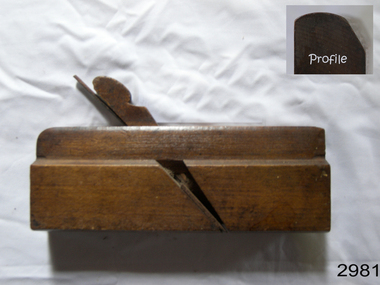
Tool - Wood moulding Plane, Auburn Tool Company, 1870 to 1893
... Although plane manufacturing was continued at Auburn until after 1907, after this merger the firm went under the name of the Ohio Tool Company. A significant item from the mid to late 19th century that today is quite rare and sought after by collectors. It gives us a snapshot of how furniture ...Moulding Plane: A moulding plane is a specialised plane used for making the complex shapes found in wooden mouldings that are used to decorate furniture or other wooden object. Traditionally, moulding planes were blocks of wear resistant hardwood, often beech or maple, which were worked to the shape of the intended moulding. The blade, or iron was likewise formed to the intended moulding profile and secured in the body of the plane with a wooden wedge. A traditional cabinetmakers shop might have many, perhaps hundreds, of moulding planes for the full range of work to be performed. Large crown mouldings required planes of six or more inches in width, which demanded great strength to push and often had additional peg handles on the sides, allowing the craftsman's apprentice or other worker to pull the plane ahead of the master who guided it. Auburn Tool Company: The Auburn Tool Company is known to exist from 1864 to 1893. George Casey reorganized the firm of Casey, Clark and Company as a joint-stock company in 1864, under the company name of Auburn Tool Company. The 1865 New York State Census noted the firm as a manufacturer of the plane, plane irons, and skates. The production that year was listed as 30,000 pairs of skates and 35,000 planes along with 25,000 dozen plane irons. The plane irons carried the trademark "Thistle". Both skates and plane irons were made from welded wrought iron and cast steel. The Auburn Tool Company was among the five leading plane manufacturing firms existing in the mid to late 19th century USA. Others were: H. Chapin's Son; Greenfield Tool Company; and Sandusky Tool Company. Auburn Tool Company, with these others, was also a founding member of the Plane Makers Association, organized around 1858 to fix prices. Most of the companies tools were manufactured by prisoners and in 1866 the firm was outbid for prison labour by J M Easterly and Co. After losing the contract with the prison authority they constructed a new building and continued in the plane manufacturing business with private labour. The 1870 US Census reported the firm had 21 machines, driven by water power, employing 66 males, producing annual products valued at us$70, 000. After A. Howland and Company was dissolved in 1874, the Auburn Tool Company again resumed using contract labour at the State Prison until 1877. The Auburn Tool Company merged with the Ohio Tool Company of Columbus, Ohio, on Nov 14, 1893. Although plane manufacturing was continued at Auburn until after 1907, after this merger the firm went under the name of the Ohio Tool Company. A significant item from the mid to late 19th century that today is quite rare and sought after by collectors. It gives us a snapshot of how furniture was made predominately by hand and with tools that were themselves hand made shows the craftsmanship used to make such a unique item. It also gives an insight into how many manufacturing companies bid for the rights to use prison labour to make their products at this time in our history. Decorative wood Moulding, plane Round type Auburn New York. Owner A Neudt Size 14 flagstaff hill, warrnambool, shipwrecked-coast, flagstaff-hill, flagstaff-hill-maritime-museum, maritime-museum, shipwreck-coast, flagstaff-hill-maritime-village -
 Flagstaff Hill Maritime Museum and Village
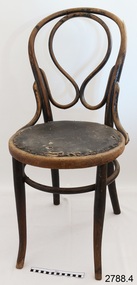
Chair, 1907-1914
... furniture factory in east Sinensia, which was at that time in Austria, from 1907 - 1914. Bentwood chairs are made by a process of wetting wood in water, bending it into curved shapes, then allowing it to dry so that the shape becomes permanent. This process originated by Michael Thonet, who had been given the right to bend wood into desired curves by the Austrian Courts in 1842. In 1856 he was granted a 13 year patent to manufacture...furniture factory in east Sinensia, which was at that time in Austria, from 1907 - 1914. Bentwood chairs are made by a process of wetting wood in water, bending it into curved shapes, then allowing it to dry so that the shape becomes permanent. This process originated by Michael Thonet, who had been given the right to bend wood into desired curves by the Austrian Courts in 1842. In 1856 he was granted a 13 year patent to manufacture ...The design of this set of four lightweight chairs is based on Thonet’s bentwood designs, which are still some of the best-selling designs for café and restaurant owners. It is elegant, sophisticated and durable. Some of these chairs still have their original seat, under which the letters “TH” or “RSL” are hand written. Flagstaff Hill has several bentwood chairs with these letters on them, in either chalk, black paint, or both. It is believed that the chairs were used in the original Warrnambool Town Hall, and later the RSL. The Town Hall was completed in 1891, built on the corners of Timor and Liebig Streets. (In 1977 the Town Hall was declared unsafe and was later replaced by the Warrnambool Performing Arts Centre.) Some of the chairs have marks, paper labels and symbols on them that show that the maker was Josef Jaworek, who had a small furniture factory in east Sinensia, which was at that time in Austria, from 1907 - 1914. Bentwood chairs are made by a process of wetting wood in water, bending it into curved shapes, then allowing it to dry so that the shape becomes permanent. This process originated by Michael Thonet, who had been given the right to bend wood into desired curves by the Austrian Courts in 1842. In 1856 he was granted a 13 year patent to manufacture chairs and table legs of bent wood treated by steam or boiling water. In 1859 his company Gebruder Thonet produced his original design. Thonet’s early designs also featured hand carved or laminated wooden seats. His Model No. 14 was produced in the 1850’s and his most popular design. After Michael’s death in 1871 the family went on designing and producing chairs. These bentwood chairs are believed to be associated with the original Warrnambool Town Hall. The Warrnambool Town Hall played a significant role in the both the local government and the social events of local and district areas. It was a place for Council meetings, community events and entertainment, theatrical and musical.Bentwood chair (4 of 4), painted black, inner back is curled loop, seat has leather cover attached with studs, ventilation holes under seat, legs are splayed and have a bracing ring. Marks: under seat, handwritten and stamped into wood.Marked with handwritten "TH", in both black paint & white chalk. Under rim is label printed "65" Stamped into wood on rim under chair "95".flagstaff hill, warrnambool, shipwrecked-coast, flagstaff-hill, flagstaff-hill-maritime-museum, maritime-museum, shipwreck-coast, flagstaff-hill-maritime-village, bentwood chair, café chair, restaurant chair, josef jaworek, austrian chairs, furniture -
 Flagstaff Hill Maritime Museum and Village
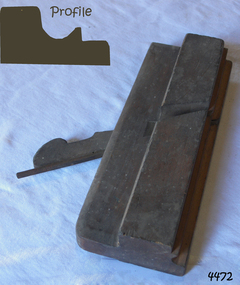
Tool - Plane, Early to Mid 19th Century
... It gives us a snapshot of how furniture was made predominately by hand and with tools that were themselves hand made shows the craftsmanship used to make such a unique item. It also gives an insight into how many manufacturing ...A moulding plane is a specialised plane used for making the complex shapes found in wooden mouldings that are used to decorate furniture or other wooden object. Traditionally, moulding planes were blocks of wear resistant hardwood, often beech or maple, which were worked to the shape of the intended moulding. The blade, or iron was likewise formed to the intended moulding profile and secured in the body of the plane with a wooden wedge. A traditional cabinetmakers shop might have many, perhaps hundreds, of moulding planes for the full range of work to be performed. Large crown mouldings required planes of six or more inches in width, which demanded great strength to push and often had additional peg handles on the sides, allowing the craftsman's apprentice or other worker to pull the plane ahead of the master who guided it.A significant item from the mid to late 19th century that today is quite rare and sought after by collectors. It gives us a snapshot of how furniture was made predominately by hand and with tools that were themselves hand made shows the craftsmanship used to make such a unique item. It also gives an insight into how many manufacturing companies bid for the rights to use prison labour to make their products at this time in our history. Moulding Plane T S Richards & Co. J Heath owner stamped. No 4/8 opposite endflagstaff hill, warrnambool, shipwrecked-coast, flagstaff-hill, flagstaff-hill-maritime-museum, maritime-museum, shipwreck-coast, flagstaff-hill-maritime-village, plane moulding, moulding plane, plane, j heath, t s richards & co -
 Flagstaff Hill Maritime Museum and Village
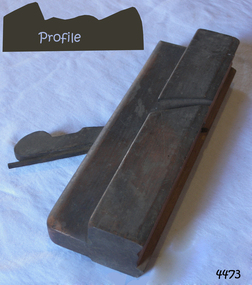
Tool - Moulding wood Plane, Mid to Late 19th Century
... manufacturing relocated to Sheffield. A vintage tool made by a well documented company, this item was made commercially for firms and individuals that worked in wood and needed a tool that could produce a ornamental finish to timber. The tool was used before routers and spindle moulders came into use after World War ll, a time when to produce a decorative moulding for a piece of furniture, door trims etc or other items had to be accomplished using hand tools and in particular one of these types of planes. ...A moulding plane is a specialised plane used for making the complex shapes found in wooden mouldings that are used to decorate furniture or other wooden objects. Traditionally, moulding planes were blocks of wear-resistant hardwood, often beech or maple, which were worked to the shape of the intended moulding. The blade or iron was likewise formed to the intended moulding profile and secured in the body of the plane with a wooden wedge. A traditional cabinetmakers shop might have many, perhaps hundreds, of moulding planes for the full range of work to be performed. Large crown mouldings required planes of six or more inches in width, which demanded great strength to push and often had additional peg handles on the sides, allowing the craftsman's apprentice or other workers to pull the plane ahead of the master who guided it. John Moseley & Son: Records indicate that before 1834, the firm is listed at number 16 New Street, London and according to an 1862 advertisement the shop had been established in New Street since 1730, The Sun insurance records from the time show that John Moseley was the possessor of a horse mill in the yard of his premises, which means that some kind of manufacturing was taking place, as the mill would have provided power to run a saw or perhaps a grinding wheel so the probability is that he did not just sell tools, he made them as well. John Moseley died in 1828 and his will he names his four sons: John, Thomas, William and Richard. To complicate matters he also had brothers with the same first names; brothers Richard (of Piccadilly) and William (of Peckham Rye) are named as two of the executors. Brother Thomas is not mentioned in this will, but became a minister and was one of the executors of brother Richard’s estate when he died in 1856. From John’s will, we also learn that, although the shop was in New Street, he resided in Lympstone, Devon. The family must have had a house in that county for quite some time as both sons Richard and William are baptised in Devon, although John and Thomas were baptised in London. In the 1841 and 1851 census records, we just find William in New Street, but in 1861 both William and Richard are listed there as toolmakers. That Richard was staying overnight at New Street was probably just accidental as in 1851 and 1871, we find him with his wife Jane and children in Clapham and Lambeth respectively. In 1851 Richard is listed as “assistant clerk cutlery warehouse” and in 1871 as “retired plane maker and cutler”. Although the actual place of work is not stated, one may assume he worked in the family business. 1862 is a year full of changes for the firm. In that year, William had a new property built at 27 Bedford Street. In the catalogue for the 1862 International Exhibition, 54 Broad Street (later 54-55 Broad Street) is listed for the first time, which may very well coincide with the split of the business into a retail and a wholesale branch. Around the same time, they must have moved from New Street to 17 & 18 King Street because their manufacturing premises had been pulled down to form the New Street from Cranbourne Street to King Street. In January 1865, William died and Richard continued the business. In 1867, the partnership he had with his son Walker and Thomas Elis Hooker, is dissolved. Richard continued tool making at King Street and Bedford Street. Richard retired somewhere between 1867 and 1871, but the business continued. The business is taken over by W M Marples & Sons and tools continued to be made in London until 1904 when manufacturing relocated to Sheffield. A vintage tool made by a well documented company, this item was made commercially for firms and individuals that worked in wood and needed a tool that could produce a ornamental finish to timber. The tool was used before routers and spindle moulders came into use after World War ll, a time when to produce a decorative moulding for a piece of furniture, door trims etc or other items had to be accomplished using hand tools and in particular one of these types of planes. These profiled planes came in various shapes and sizes to achieve a decorative finish. A significant tool from the mid to late 19th century that today is quite rare and sought after by collectors. It gives us a snapshot of how furniture and other decorative finishes were created on timber by the use of hand tools. Tools that were themselves hand made shows the craftsmanship used during this time not only to make a tool such as the subject item but also the craftsmanship needed to produce a decorative finish that was needed to be made for any timber item. Moulding Plane . J Moseley. maker and R Knight & J Heath also stamped stamped (Owners)flagstaff hill, warrnambool, shipwrecked-coast, flagstaff-hill, flagstaff-hill-maritime-museum, maritime-museum, shipwreck-coast, flagstaff-hill-maritime-village, plane moulding, moulding plane, plane, j heath, moseley -
 Flagstaff Hill Maritime Museum and Village
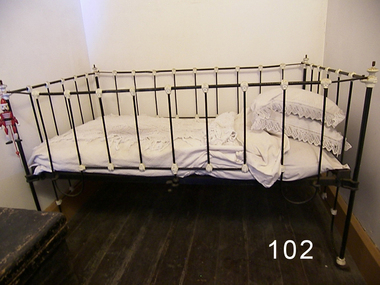
Furniture - Cot, Late 19th to early 20th century
... An relatively early domestic piece of furniture used as a babies cot giving a snapshot into domestic life around the end of the 19th century and beginning of the 20th. The item is not associated with a significant event, person or place and would have been common place in most homes of the time made by many different manufactures. flagstaff hill warrnambool flagstaff hill maritime museum maritime museum shipwreck coast flagstaff hill maritime village great ocean road cot metal cot iron bed None Cot, metal, with chrome knobs and removable sides. ...Iron beds made from metal or wrought iron have been around since the late 18th century when they were hand made by craftsmen and artisans. The iron castings were always hand poured and originated from sand cast molds, more ornate beds are associated with the Victorian period. Later in the Edwardian era cast iron beds and cots had much less decoration and were quite plain .An relatively early domestic piece of furniture used as a babies cot giving a snapshot into domestic life around the end of the 19th century and beginning of the 20th. The item is not associated with a significant event, person or place and would have been common place in most homes of the time made by many different manufactures.Cot, metal, with chrome knobs and removable sides. Has wheelsNoneflagstaff hill, warrnambool, flagstaff hill maritime museum, maritime museum, shipwreck coast, flagstaff hill maritime village, great ocean road, cot, metal cot, iron bed -
 Flagstaff Hill Maritime Museum and Village
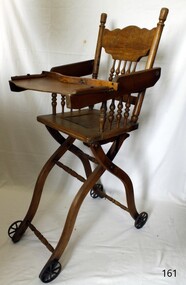
Furniture - Childs high chair, 1890 - 1900
... Many American manufactures made this type of wooden high chair called an “Eastlake” style and many did not mark their work so it is difficult to determine the subject items exact provenance. A significant item giving a snapshot into the evolution of children's furniture ...It appears that the earliest form of child's high chair is attributed to Jonathan Jacobs (1845-1919) a cabinet maker of Browningsville, Pennsylvania USA around the mid to late 19th century. However, children’s chairs from the 18th century and earlier were being used and are in many museum collections around the world that show woodworkers were adapting chair designs for younger users in Europe and America at this time.An early children's wooden high chair probably made in America around 1890-1900. Many American manufactures made this type of wooden high chair called an “Eastlake” style and many did not mark their work so it is difficult to determine the subject items exact provenance. A significant item giving a snapshot into the evolution of children's furniture and domestic life during the late Victorian era.Convertible pressed back Victorian era high chair with convertible frame, cast iron wheels, Carved picture of a child to back of seatflagstaff hill, warrnambool, shipwrecked coast, flagstaff hill maritime museum, shipwreck coast, flagstaff hill maritime village, great ocean road, high chair, potty chair, baby furniture, kitchen furniture -
 Flagstaff Hill Maritime Museum and Village
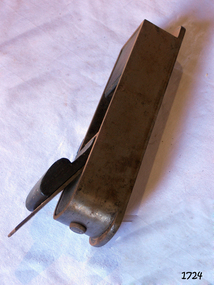
Tool - Wood Plane, Late 19th to early 20th century
... manufacturing relocated to Sheffield. A vintage tool made by a well-known company, this item was made commercially for firms and individuals that worked in wood and needed a tool that could remove large amounts of timber. These jack or dressing planes came in various shapes and sizes to achieve a flat and even finish to timber surfaces and came in many sizes. A significant tool from the mid to late 19th century that is still in use today with early models sought after by collectors. It gives us a snapshot of how furniture ...A moulding plane is a specialised plane used for making the complex shapes found in wooden mouldings that are used to decorate furniture or other wooden objects. Traditionally, moulding planes were blocks of wear-resistant hardwood, often beech or maple, which were worked to the shape of the intended moulding. The blade or iron was likewise formed to the intended moulding profile and secured in the body of the plane with a wooden wedge. A traditional cabinetmakers' shop might have many, perhaps hundreds, of moulding planes for the full range of work to be performed. Large crown mouldings required planes of six or more inches in width, which demanded great strength to push and often had additional peg handles on the sides, allowing the craftsman's apprentice or other workers to pull the plane ahead of the master who guided it. John Moseley & Son: Records indicate that before 1834, the firm is listed at number 16 New Street, London and according to an 1862 advertisement the shop had been established in New Street since 1730, The Sun insurance records from the time show that John Moseley was the possessor of a horse mill in the yard of his premises, which means that some kind of manufacturing was taking place, as the mill would have provided power to run a saw or perhaps a grinding wheel so the probability is that he did not just sell tools, he made them as well. John Moseley died in 1828 and his will named his four sons: John, Thomas, William and Richard. To complicate matters he also had brothers with the same first names; brothers Richard (of Piccadilly) and William (of Peckham Rye) are named as two of the executors. Brother Thomas is not mentioned in this will, but became a minister and was one of the executors of brother Richard's estate when he died in 1856. From John's will, we also learn that, although the shop was in New Street, he resided in Lympstone, Devon. The family must have had a house in that county for quite some time as both sons Richard and William are baptised in Devon, although John and Thomas were baptised in London. In the 1841 and 1851 census records, we just find William in New Street, but in 1861 both William and Richard are listed there as toolmakers. That Richard was staying overnight at New Street was probably just accidental as in 1851 and 1871, we find him with his wife Jane and children in Clapham and Lambeth respectively. In 1851 Richard is listed as “assistant clerk cutlery warehouse” and in 1871 as “retired plane maker and cutler”. Although the actual place of work is not stated, one may assume he worked in the family business. 1862 is a year full of changes for the firm. In that year, William had a new property built at 27 Bedford Street. In the catalogue for the 1862 International Exhibition, 54 Broad Street (later 54-55 Broad Street) is listed for the first time, which may very well coincide with the split of the business into a retail and a wholesale branch. Around the same time, they must have moved from New Street to 17 & 18 King Street because their manufacturing premises had been pulled down to form the New Street from Cranbourne Street to King Street. In January 1865, William died and Richard continued the business. In 1867, the partnership he had with his son Walker and Thomas Elis Hooker, is dissolved. Richard continued tool-making at King Street and Bedford Street. Richard retired somewhere between 1867 and 1871, but the business continued. The business is taken over by W M Marples & Sons and tools continued to be made in London until 1904 when manufacturing relocated to Sheffield.A vintage tool made by a well-known company, this item was made commercially for firms and individuals that worked in wood and needed a tool that could remove large amounts of timber. These jack or dressing planes came in various shapes and sizes to achieve a flat and even finish to timber surfaces and came in many sizes. A significant tool from the mid to late 19th century that is still in use today with early models sought after by collectors. It gives us a snapshot of how furniture and other finishes were created on timber by the use of cutting-edged hand tools. Tools that were themselves handmade show the craftsmanship used during this time not only to make a tool such as the subject item but also the craftsmanship needed to produce a decorative or even finish that was needed for the finishing of timber items.Jack Plane metal body with rose wood filler.Mosley & Sons London No 2flagstaff hill, warrnambool, flagstaff-hill, flagstaff-hill-maritime-museum, maritime-museum, shipwreck-coast, flagstaff-hill-maritime-village, john moseley & son, jack plane, woodworking tool, carpenders tools, cabinet makers tools -
 Flagstaff Hill Maritime Museum and Village
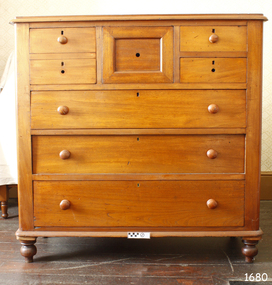
Furniture - Chest of drawers, Early 20th Century
... Item is significant as regards to it's possible age of manufacture believed to be early 20th century. flagstaff hill warrnambool shipwrecked-coast flagstaff-hill-maritime-museum shipwreck-coast None Cedar Chest of drawers, wooden varnished 4 narrow drawers, 2 sets on either side of a square drawer and 3 wide drawers. 4 turned legs. Furniture ...No information to indicate significance of item regards association with a historic or significant event, person, maker or place.Item is significant as regards to it's possible age of manufacture believed to be early 20th century.Cedar Chest of drawers, wooden varnished 4 narrow drawers, 2 sets on either side of a square drawer and 3 wide drawers. 4 turned legs.Noneflagstaff hill, warrnambool, shipwrecked-coast, flagstaff-hill-maritime-museum, shipwreck-coast -
 Flagstaff Hill Maritime Museum and Village
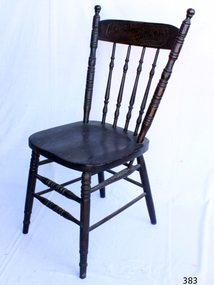
Domestic object - Chair, Early 20th Century
... furniture for anyone who could afford to buy it. Once the idea of privilege faded the chair speedily came into general use. Almost at once the chair began to change every few years to reflect the fashions of the day. Thomas Edward Bowdich visited the main Palace of the Ashanti Empire in 1819, and observed chairs engrossed with gold in the empire. In the 1880s, chairs became more common in American households and usually there was a chair provided for every family member to sit down to dinner. By the 1830s, factory-manufactured...furniture for anyone who could afford to buy it. Once the idea of privilege faded the chair speedily came into general use. Almost at once the chair began to change every few years to reflect the fashions of the day. Thomas Edward Bowdich visited the main Palace of the Ashanti Empire in 1819, and observed chairs engrossed with gold in the empire. In the 1880s, chairs became more common in American households and usually there was a chair provided for every family member to sit down to dinner. By the 1830s, factory-manufactured ...This chair is one of a set of three kitchen chairs once used by the Warrnambool Council. The chair has been used since antiquity, although for many centuries it was a symbolic article of state and dignity rather than an article for ordinary use. "The chair" is still used as the emblem of authority in the House of Commons in the United Kingdom and Canada, and in many other settings. In keeping with this historical connotation of the "chair" as the symbol of authority, committees, boards of directors, and academic departments all have a 'chairman' or 'chair'. Endowed professorships are referred to as chairs. It was not until the 16th century that chairs became common. Until then, people sat on chests, benches, and stools, which were the ordinary seats of everyday life. The number of chairs that have survived from an earlier date is exceedingly limited; most examples are of ecclesiastical, seigneurial or feudal origin. Chairs were in existence since at least the Early Dynastic Period of Egypt (c. 3100 BC). They were covered with cloth or leather, were made of carved wood, and were much lower than today's chairs – chair seats were sometimes only 10 inches (25 cm) high. In ancient Egypt, chairs appear to have been of great richness and splendour. Fashioned of ebony and ivory, or of carved and gilded wood, they were covered with costly materials, magnificent patterns and supported upon representations of the legs of beasts or the figures of captives. Generally speaking, the higher ranked an individual was, the taller and more sumptuous was the chair he sat on and the greater the honour. On state occasions, the pharaoh sat on a throne, often with a little footstool in front of it.[ The average Egyptian family seldom had chairs, and if they did, it was usually only the master of the household who sat on a chair. Among the better off, the chairs might be painted to look like the ornate inlaid and carved chairs of the rich, but the craftsmanship was usually poor. The earliest images of chairs in China are from 6th-century Buddhist murals and stele, but the practice of sitting in chairs at that time was rare. It was not until the 12th century that chairs became widespread in China. Scholars disagree on the reasons for the adoption of the chair. The most common theories are that the chair was an outgrowth of indigenous Chinese furniture, that it evolved from a camp stool imported from Central Asia, that it was introduced to China by Christian missionaries in the 7th century, and that the chair came to China from India as a form of Buddhist monastic furniture. In modern China, unlike Korea or Japan, it is no longer common to sit at floor level. In Europe, it was owing in great measure to the Renaissance that the chair ceased to be a privilege of state and became a standard item of furniture for anyone who could afford to buy it. Once the idea of privilege faded the chair speedily came into general use. Almost at once the chair began to change every few years to reflect the fashions of the day. Thomas Edward Bowdich visited the main Palace of the Ashanti Empire in 1819, and observed chairs engrossed with gold in the empire. In the 1880s, chairs became more common in American households and usually there was a chair provided for every family member to sit down to dinner. By the 1830s, factory-manufactured “fancy chairs” like those by Sears, Roebuck, and Co. allowed families to purchase machined sets. With the Industrial Revolution, chairs became much more available. The 20th century saw an increasing use of technology in chair construction with such things as all-metal folding chairs, metal-legged chairs, the Slumber Chair,[ moulded plastic chairs and ergonomic chairs. The recliner became a popular form, at least in part due to radio and television. The modern movement of the 1960s produced new forms of chairs: the butterfly chair (originally called the Hardoy chair), bean bags, and the egg-shaped pod chair that turns. It also introduced the first mass-produced plastic chairs such as the Bofinger chair in 1966. Technological advances led to moulded plywood and wood laminate chairs, as well as chairs made of leather or polymers. Mechanical technology incorporated into the chair enabled adjustable chairs, especially for office use. Motors embedded in the chair resulted in massage chairs.The set of chairs represents one of the most commonly used items providing comfort. It represents domestic furniture used in the late 19th and early 20th centuries in Australia, signified by its decoration of an Australian theme motif.Chair, wooden, varnished dark brown. Spokes for back support, front legs, and spokes joining legs are patterned turned wood. Backrest has a carved floral emblem with a kangaroo in the centre.Back rest: motif {floral emblem with a kangaroo in the centre]flagstaff hill, warrnambool, shipwrecked-coast, flagstaff-hill, flagstaff-hill-maritime-museum, maritime-museum, shipwreck-coast, flagstaff-hill-maritime-village, chair, dining, carpentry -
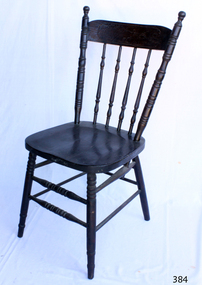 Flagstaff Hill Maritime Museum and Village
Domestic object - Chair, Early 20th Century
... furniture for anyone who could afford to buy it. Once the idea of privilege faded the chair speedily came into general use. Almost at once the chair began to change every few years to reflect the fashions of the day. Thomas Edward Bowdich visited the main Palace of the Ashanti Empire in 1819, and observed chairs engrossed with gold in the empire. In the 1880s, chairs became more common in American households and usually there was a chair provided for every family member to sit down to dinner. By the 1830s, factory-manufactured...furniture for anyone who could afford to buy it. Once the idea of privilege faded the chair speedily came into general use. Almost at once the chair began to change every few years to reflect the fashions of the day. Thomas Edward Bowdich visited the main Palace of the Ashanti Empire in 1819, and observed chairs engrossed with gold in the empire. In the 1880s, chairs became more common in American households and usually there was a chair provided for every family member to sit down to dinner. By the 1830s, factory-manufactured ...This chair is one of a set of three kitchen chairs once used by the Warrnambool Council. The chair has been used since antiquity, although for many centuries it was a symbolic article of state and dignity rather than an article for ordinary use. "The chair" is still used as the emblem of authority in the House of Commons in the United Kingdom and Canada, and in many other settings. In keeping with this historical connotation of the "chair" as the symbol of authority, committees, boards of directors, and academic departments all have a 'chairman' or 'chair'. Endowed professorships are referred to as chairs. It was not until the 16th century that chairs became common. Until then, people sat on chests, benches, and stools, which were the ordinary seats of everyday life. The number of chairs which have survived from an earlier date is exceedingly limited; most examples are of ecclesiastical, seigneurial or feudal origin. Chairs were in existence since at least the Early Dynastic Period of Egypt (c. 3100 BC). They were covered with cloth or leather, were made of carved wood, and were much lower than today's chairs – chair seats were sometimes only 10 inches (25 cm) high. In ancient Egypt, chairs appear to have been of great richness and splendour. Fashioned of ebony and ivory, or of carved and gilded wood, they were covered with costly materials, magnificent patterns and supported upon representations of the legs of beasts or the figures of captives. Generally speaking, the higher ranked an individual was, the taller and more sumptuous was the chair he sat on and the greater the honour. On state occasions, the pharaoh sat on a throne, often with a little footstool in front of it.[ The average Egyptian family seldom had chairs, and if they did, it was usually only the master of the household who sat on a chair. Among the better off, the chairs might be painted to look like the ornate inlaid and carved chairs of the rich, but the craftsmanship was usually poor. The earliest images of chairs in China are from 6th-century Buddhist murals and stele, but the practice of sitting in chairs at that time was rare. It was not until the 12th century that chairs became widespread in China. Scholars disagree on the reasons for the adoption of the chair. The most common theories are that the chair was an outgrowth of indigenous Chinese furniture, that it evolved from a camp stool imported from Central Asia, that it was introduced to China by Christian missionaries in the 7th century, and that the chair came to China from India as a form of Buddhist monastic furniture. In modern China, unlike Korea or Japan, it is no longer common to sit at floor level. In Europe, it was owing in great measure to the Renaissance that the chair ceased to be a privilege of state and became a standard item of furniture for anyone who could afford to buy it. Once the idea of privilege faded the chair speedily came into general use. Almost at once the chair began to change every few years to reflect the fashions of the day. Thomas Edward Bowdich visited the main Palace of the Ashanti Empire in 1819, and observed chairs engrossed with gold in the empire. In the 1880s, chairs became more common in American households and usually there was a chair provided for every family member to sit down to dinner. By the 1830s, factory-manufactured “fancy chairs” like those by Sears, Roebuck, and Co. allowed families to purchase machined sets. With the Industrial Revolution, chairs became much more available. The 20th century saw an increasing use of technology in chair construction with such things as all-metal folding chairs, metal-legged chairs, the Slumber Chair,[ moulded plastic chairs and ergonomic chairs. The recliner became a popular form, at least in part due to radio and television. The modern movement of the 1960s produced new forms of chairs: the butterfly chair (originally called the Hardoy chair), bean bags, and the egg-shaped pod chair that turns. It also introduced the first mass-produced plastic chairs such as the Bofinger chair in 1966. Technological advances led to moulded plywood and wood laminate chairs, as well as chairs made of leather or polymers. Mechanical technology incorporated into the chair enabled adjustable chairs, especially for office use. Motors embedded in the chair resulted in massage chairs.The set of chairs represents one of the most commonly used items providing comfort. It represents domestic furniture used in the late 19th and early 20th centuries in Australia, signified by its decoration of an Australian theme motif.Chair, wooden, one of a set of three. The kitchen chair has a dark brown varnish. The spokes for the back support, front legs, and joining legs are patterned turned wood. The backrest has a carved floral emblem with a kangaroo in the centre.Back rest: motif {floral emblem with a kangaroo in the centre]flagstaff hill, flagstaff hill maritime museum and village, warrnambool, maritime museum, maritime village, great ocean road, shipwreck coast, chair, kitchen chair, dining chair, carpentry, carving, australian motif -
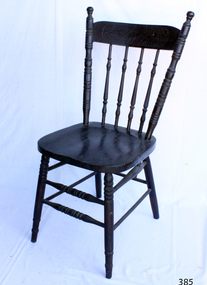 Flagstaff Hill Maritime Museum and Village
Domestic object - Chair, Early 20th Century
... furniture for anyone who could afford to buy it. Once the idea of privilege faded the chair speedily came into general use. Almost at once the chair began to change every few years to reflect the fashions of the day. Thomas Edward Bowdich visited the main Palace of the Ashanti Empire in 1819, and observed chairs engrossed with gold in the empire. In the 1880s, chairs became more common in American households and usually there was a chair provided for every family member to sit down to dinner. By the 1830s, factory-manufactured...furniture for anyone who could afford to buy it. Once the idea of privilege faded the chair speedily came into general use. Almost at once the chair began to change every few years to reflect the fashions of the day. Thomas Edward Bowdich visited the main Palace of the Ashanti Empire in 1819, and observed chairs engrossed with gold in the empire. In the 1880s, chairs became more common in American households and usually there was a chair provided for every family member to sit down to dinner. By the 1830s, factory-manufactured ...This chair is one of a set of three kitchen chairs once used by the Warrnambool Council. The chair has been used since antiquity, although for many centuries it was a symbolic article of state and dignity rather than an article for ordinary use. "The chair" is still used as the emblem of authority in the House of Commons in the United Kingdom and Canada, and in many other settings. In keeping with this historical connotation of the "chair" as the symbol of authority, committees, boards of directors, and academic departments all have a 'chairman' or 'chair'. Endowed professorships are referred to as chairs. It was not until the 16th century that chairs became common. Until then, people sat on chests, benches, and stools, which were the ordinary seats of everyday life. The number of chairs which have survived from an earlier date is exceedingly limited; most examples are of ecclesiastical, seigneurial or feudal origin. Chairs were in existence since at least the Early Dynastic Period of Egypt (c. 3100 BC). They were covered with cloth or leather, were made of carved wood, and were much lower than today's chairs – chair seats were sometimes only 10 inches (25 cm) high. In ancient Egypt, chairs appear to have been of great richness and splendour. Fashioned of ebony and ivory, or of carved and gilded wood, they were covered with costly materials, magnificent patterns and supported upon representations of the legs of beasts or the figures of captives. Generally speaking, the higher ranked an individual was, the taller and more sumptuous was the chair he sat on and the greater the honour. On state occasions, the pharaoh sat on a throne, often with a little footstool in front of it.[ The average Egyptian family seldom had chairs, and if they did, it was usually only the master of the household who sat on a chair. Among the better off, the chairs might be painted to look like the ornate inlaid and carved chairs of the rich, but the craftsmanship was usually poor. The earliest images of chairs in China are from 6th-century Buddhist murals and stele, but the practice of sitting in chairs at that time was rare. It was not until the 12th century that chairs became widespread in China. Scholars disagree on the reasons for the adoption of the chair. The most common theories are that the chair was an outgrowth of indigenous Chinese furniture, that it evolved from a camp stool imported from Central Asia, that it was introduced to China by Christian missionaries in the 7th century, and that the chair came to China from India as a form of Buddhist monastic furniture. In modern China, unlike Korea or Japan, it is no longer common to sit at floor level. In Europe, it was owing in great measure to the Renaissance that the chair ceased to be a privilege of state and became a standard item of furniture for anyone who could afford to buy it. Once the idea of privilege faded the chair speedily came into general use. Almost at once the chair began to change every few years to reflect the fashions of the day. Thomas Edward Bowdich visited the main Palace of the Ashanti Empire in 1819, and observed chairs engrossed with gold in the empire. In the 1880s, chairs became more common in American households and usually there was a chair provided for every family member to sit down to dinner. By the 1830s, factory-manufactured “fancy chairs” like those by Sears, Roebuck, and Co. allowed families to purchase machined sets. With the Industrial Revolution, chairs became much more available. The 20th century saw an increasing use of technology in chair construction with such things as all-metal folding chairs, metal-legged chairs, the Slumber Chair,[ moulded plastic chairs and ergonomic chairs. The recliner became a popular form, at least in part due to radio and television. The modern movement of the 1960s produced new forms of chairs: the butterfly chair (originally called the Hardoy chair), bean bags, and the egg-shaped pod chair that turns. It also introduced the first mass-produced plastic chairs such as the Bofinger chair in 1966. Technological advances led to moulded plywood and wood laminate chairs, as well as chairs made of leather or polymers. Mechanical technology incorporated into the chair enabled adjustable chairs, especially for office use. Motors embedded in the chair resulted in massage chairs.The set of chairs represents one of the most commonly used items providing comfort. It represents domestic furniture used in the late 19th and early 20th centuries in Australia, signified by its decoration of an Australian theme motif.Chair, wooden, one of a set of three. The kitchen chair has a dark brown varnish. The spokes for the back support, front legs, and joining legs are patterned turned wood. The backrest has a carved floral emblem with a kangaroo in the centre.Back rest: motif {floral emblem with a kangaroo in the centre]flagstaff hill, flagstaff hill maritime museum and village, warrnambool, maritime museum, maritime village, great ocean road, shipwreck coast, chair, kitchen chair, dining chair, carpentry, carving, australian motif -
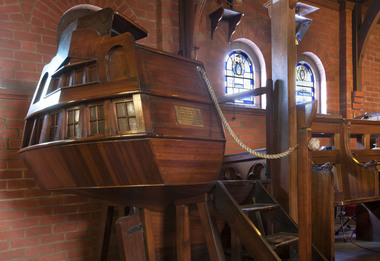 Mission to Seafarers Victoria
Furniture - Pulpit, Rodney Howard Alsop, 1909
... The dedication was performed by the Archbishop of Melbourne on the 26th January (date engraves on the plaque) This pulpit was designed by Melbourne architect Rodney Howard Alsop (1881-1932) and manufactured by William John Dalziel (furniture manufacturer). It was initially used in the first Mission in Central Melbourne, Siddeley St. ...The dedication was performed by the Archbishop of Melbourne on the 26th January (date engraves on the plaque) This pulpit was designed by Melbourne architect Rodney Howard Alsop (1881-1932) and manufactured by William John Dalziel (furniture manufacturer). It was initially used in the first Mission in Central Melbourne, Siddeley St. ...In 1909, assistant Chaplain Rev. Haire presented the Mission with an 'uncommonly artistic pulpit' in memory of his mother. A plaque in memory of Jane King Haire can be found on the side next to the steps. The dedication was performed by the Archbishop of Melbourne on the 26th January (date engraves on the plaque) This pulpit was designed by Melbourne architect Rodney Howard Alsop (1881-1932) and manufactured by William John Dalziel (furniture manufacturer). It was initially used in the first Mission in Central Melbourne, Siddeley St. It is located in the Chapel of Saint Peter of the Mission to Seafarers 717 Flinders St. complex since 1917 (State Heritage listed (H1496). This complex was designed by Walter Richmond Butler in 1916, and officially opened on 11 September 1917, a day '...of unusually kind weather', by the Governor of Victoria, the Honourable Sir Arthur Stanley. According to a later article published in 1950: The pulpit is a model, built to scale, of the stern of an old ship of the line in Lord Nelson's day. This pulpit is significant as it is housed in The Memorial Chapel of Saint Peter forming part of the State Heritage listed Mission to Seafarers Victoria complex. It was built in Melbourne of Australian timbers, and is one of only two known maritime inspired pulpits, both associated with Missions to Seamen of the early 20th C. the other is held in the ANMM Collection see link. Their statement of significance is worth quoting in part as it applies equally to this pulpit "...an extremely rare and unique example of such pulpits. It is highly significant as a wonderfully preserved example of a time when religion was preached to sailors for their spiritual guidance and temperance..." Rodney Howard Alsop was an important Melbourne architect of the Arts and Crafts movement. John William Dalziel had sailed from Liverpool to Melbourne in 1862. Seventeen years later Penman and Dalziel founded the business in Lonsdale Street West, and won recognition at the Indian and Colonial Exhibition in London in 1886. Penman and Dalziel were identified in 1937 as one of Melbourne’s early ‘skilled craftsmen’ and ‘leading names’ in the manufacture of fine furniture. He died in February 1918 in a railway accident.Timber pulpit built in the form of a ship's stern including a timber step ladder for access, a timber keel and rudder, a rope fixed from the pulpit to a post mounted to the floor, and a dedication plaque on the side of the pulpit. The pulpit sits on timber legs. It's likely to be the original rope: traditionally made coir rope with twisted fibres, covered with canvas supported by a thread. At lower end the rope is secured by a monkey fist know and at the top by a turk head knot.Inside the pulpit (right) is the cardboard label with the maker details: " On an attached plaque see 0678 To the greater glory of God and in ever loving memory of Jane King Haire. This pulpit is erected by her son. Blessed are the pure in heart. For they shall see God. St. Matt. V.8. 26.1.09mission, seafarers, melbourne, victoria, chapel, saint peter, pulpit, australian timber, stern, walter richmond butler, australian maritime history, reverend w.f. haire, rodney howard alsop (1881-1932), wright's lane, william john dalziel, gifts-1917, heritage listed -
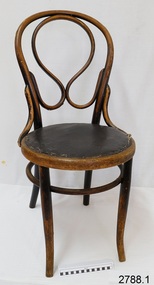 Flagstaff Hill Maritime Museum and Village
Chair, 1907-1914
... furniture factory in east Sinensia, which was at that time in Austria, from 1907 - 1914. Bentwood chairs are made by a process of wetting wood in water, bending it into curved shapes, then allowing it to dry so that the shape becomes permanent. This process originated by Michael Thonet, who had been given the right to bend wood into desired curves by the Austrian Courts in 1842. In 1856 he was granted a 13 year patent to manufacture...furniture factory in east Sinensia, which was at that time in Austria, from 1907 - 1914. Bentwood chairs are made by a process of wetting wood in water, bending it into curved shapes, then allowing it to dry so that the shape becomes permanent. This process originated by Michael Thonet, who had been given the right to bend wood into desired curves by the Austrian Courts in 1842. In 1856 he was granted a 13 year patent to manufacture ...The design of this set of four lightweight chairs is based on Thonet’s bentwood designs, which are still some of the best-selling designs for café and restaurant owners. It is elegant, sophisticated and durable. Some of these chairs still have their original seat, under which the letters “TH” or “RSL” are hand written. Flagstaff Hill has several bentwood chairs with these letters on them, in either chalk, black paint, or both. It is believed that the chairs were used in the original Warrnambool Town Hall, and later the RSL. The Town Hall was completed in 1891, built on the corners of Timor and Liebig Streets. (In 1977 the Town Hall was declared unsafe and was later replaced by the Warrnambool Performing Arts Centre.) Some of the chairs have marks, paper labels and symbols on them that show that the maker was Josef Jaworek, who had a small furniture factory in east Sinensia, which was at that time in Austria, from 1907 - 1914. Bentwood chairs are made by a process of wetting wood in water, bending it into curved shapes, then allowing it to dry so that the shape becomes permanent. This process originated by Michael Thonet, who had been given the right to bend wood into desired curves by the Austrian Courts in 1842. In 1856 he was granted a 13 year patent to manufacture chairs and table legs of bent wood treated by steam or boiling water. In 1859 his company Gebruder Thonet produced his original design. Thonet’s early designs also featured hand carved or laminated wooden seats. His Model No. 14 was produced in the 1850’s and his most popular design. After Michael’s death in 1871 the family went on designing and producing chairs. These bentwood chairs are believed to be associated with the original Warrnambool Town Hall. The Warrnambool Town Hall played a significant role in the both the local government and the social events of local and district areas. It was a place for Council meetings, community events and entertainment, theatrical and musical.Bentwood chair (1 of 4), painted black, inner back is curled loop. Seat is padded leather, attached by studs. Splayed legs. Patterned ventilation holes under seat. Under seat are various Marks; hand painted, printed on small piece of paper, stamped in wood.Under seat are various Marks; hand painted in black "TH", printed on small piece of paper "400", stamped in wood "400" flagstaff hill, warrnambool, shipwrecked coast, flagstaff hill maritime museum, maritime museum, shipwreck coast, flagstaff hill maritime village, great ocean road, bentwood chair, café chair, restaurant chair, josef jaworek, austrian chairs -
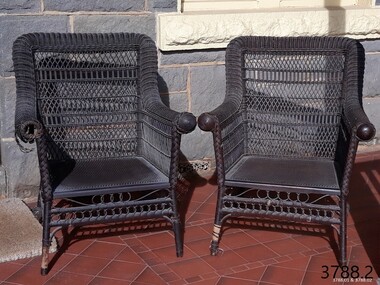 Flagstaff Hill Maritime Museum and Village
Furniture - Armchair, 1897-1921
... While its wooden furniture plant in Gardner, Massachusetts, closed in 1979, a branch in Menominee, Michigan, continued to manufacture metal outdoor seats, auditorium seats, and school furniture. ...While its wooden furniture plant in Gardner, Massachusetts, closed in 1979, a branch in Menominee, Michigan, continued to manufacture metal outdoor seats, auditorium seats, and school furniture. ...These cane chairs are one of many 19th-century items of furniture, linen and crockery donated to Flagstaff Hill Maritime Village by Vera and Aurelin Giles. The items are associated with Warrnambool and the Giles Family history. Items donated by the family have come to be known as the Giles Collection. Many items in the Lighthouse Keeper’s Cottage were donated by Vera and Aurelin Giles and mostly came from the home of Vera’s parents-in-law, Henry Giles and his wife Mary Jane (nee Freckleton), who married in 1880 and whose photos are on display in the parlour. Henry was born at Tower Hill in 1858 and was a labourer on the construction of the Warrnambool Breakwater before leaving in 1895 for around seven years to build bridges in NSW. Mary Jane was born in 1860 at Cooramook, and she attended Mailor’s Flat State School and where she eventually became a student teacher. After which she became a governess at “Injemiara”, where her grandfather, Francis Freckleton, had once owned land. Henry and Mary’s family consisted of six; some of the children were born at Mailor’s Flat, and later, some children were born at Wangoom. They lived with their parents at Wangoom and Purnim west, and this is where Henry died in 1933 and Mary Jane in 1940. Heywood & Wakefield Furniture Co: - The Heywood-Wakefield Company is an American furniture manufacturer established in 1897. It went on to become a major presence in the US. Its older products are considered collectibles and have been featured on television antique programs. The Heywood brothers established themselves in 1826 as furniture makers, and the Wakefield Company began in 1855 as a separate company. Both firms produced wicker and rattan furniture, and as these products became increasingly popular towards the end of the century, they became serious rivals. In 1897, the companies merged as Heywood Brothers & Wakefield Company (this name was changed to Heywood-Wakefield Company in 1921), purchasing Washburn-Heywood Chair Company in 1916, Oregon Chair Company in 1920, and Lloyd Manufacturing Company in 1921. While its wooden furniture plant in Gardner, Massachusetts, closed in 1979, a branch in Menominee, Michigan, continued to manufacture metal outdoor seats, auditorium seats, and school furniture. The Heywood-Wakefield Company Complex in Gardner was added to the National Historic Register in 1983. The South Beach Furniture Company acquired the rights to the name in 1994 and reproduces its wooden furniture. Both founding companies produced wicker and rattan furniture in the late 19th century. The wicker styles drew on the Aesthetic Movement and Japanese influences simpler designs arose in the wake of the Arts and Crafts Movement. The merged entity stayed abreast of wicker furniture trends by hiring designers such as Paul Frankl and Donald Deskey during the 1920s. Its furniture was exhibited at the 1933 Century of Progress exhibition and the 1964 New York World's Fair. During the 1930s and 1940s, Heywood-Wakefield began producing furniture using sleek designs based on French Art Deco.The Giles family collection has social significance at a local level because it illustrates the level of material support the Warrnambool community gave to Flagstaff Hill when the village and museum were established. The wicker furniture is a fine example of late 19th and early 20th century lightweight domestic furniture that is today a very collectible item and quite rare and valuable.Armchair: pair of wicker armchairs, painted dark brown. The open wicker weave pattern of a traditional Asian design extends from the seat up to the armrests and completely over the backrest, plus across the front of the chair below the seat. The seat is very firmly woven and fitted into a timber frame. A reinforcing pattern of wicker work covers the top edges of the armrests and backrest in one piece and folds around to the underside, referred to as rolled serpentine arms and back. The hollow ends of the armrests are filled with a circular knob of wicker work. The back legs are also completed with decorative wicker knobs. The frames are constructed from bamboo. One chair base (3788.1) has been strengthened with metal bracing. The other chair (3788.2) has the remnants of an orange manufacturer’s tag fixed to the base. The chairs were made from 1897 to 1921 by Heywood Brothers & Wakefield Company, USA. These chairs are part of the Giles Collection.Tag, orange with black print: “MANUFA - Heywood B – GARDNE”flagstaff hill, warrnambool, shipwrecked coast, flagstaff hill maritime museum, shipwreck coast, great ocean road, giles collection, giles family, henry and mary jane giles, tower hill, cooramook, warrnambool breakwater, mailor’s flat, wangoom, 19th century furniture, wicker armchairs, rolled serpentine wicker work, cane armchair, classic wicker furniture, victorian style furniture, domestic furniture late 19th century, chair, armchair, woven cane, wicker, rolled serpentine, manufa - heywood b – gardne, heywood brothers & wakefield company, usa -
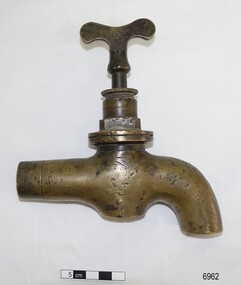 Flagstaff Hill Maritime Museum and Village
Functional object - Tap, mid-late 19th century
... manufacturing at the Cambray Works of Wattville Road, Handsworth. It was a light industrial engineering works and one of the owners was Robert Dudley Best’s father. Robert Dudley Best (1892-1984) later took over the business of Best & Lloyd. The company is still in business at Downing Street, Smethwick, Birmingham. In 1878, brass ship furniture...manufacturing at the Cambray Works of Wattville Road, Handsworth. It was a light industrial engineering works and one of the owners was Robert Dudley Best’s father. Robert Dudley Best (1892-1984) later took over the business of Best & Lloyd. The company is still in business at Downing Street, Smethwick, Birmingham. In 1878, brass ship furniture ...This type of large, brass tap is typical of the plumbing fittings manufactured in the late 19th and early 20th centuries. The tap has encrustations and concretion inside, showing that it had been in the sea for quite some time. The pipe leading to the spout is squashed, nicked and appears to have been sawn or broken off. It could have once been part of the plumbing from a ship, perhaps from one of the boilers used in the kitchen, for bathing or for laundry or cleaning. The name “BEST” on the tap signifies that it could have been made by Robert Best who began his Birmingham brass foundry c. 1840, and even though The information from the donor is that tap was given to her father (1906-1982) who lived in the Warrnambool district. It was likely given by a cray fisherman or diver, who said that the tap came from the Loch Ard shipwreck, wrecked on Mutton Bird Island, east of Port Campbell, Victoria, on 1st June 1878. This could easily be the case but there is no provenance for it. ROBERT BEST, BRASS FOUNDRY Circa 1840 Robert Best founded his brass foundry business and was referred to as a Brass Chandelier of Birmingham”. In 1864 an advertisement in the Journal of Gas Lighting, Water Supply, & Sanitary Improvement announces Best and Hobson, late Robert Best, 100 Charlotte Street Birmingham, manufacturers of Chandeliers, Brass and iron fittings, Steam and Water-cocks etc. gas apparatus of every description, Plumber's brass foundry, with works at Birmingham and Great Bridge, Staffordshire. In 1867 Best & Lloyd was formed, after Best and Hobson went into liquidation, manufacturing at the Cambray Works of Wattville Road, Handsworth. It was a light industrial engineering works and one of the owners was Robert Dudley Best’s father. Robert Dudley Best (1892-1984) later took over the business of Best & Lloyd. The company is still in business at Downing Street, Smethwick, Birmingham. In 1878, brass ship furniture and bell fittings stamped “BEST” was made by William Udal & Co., who advertised as manufacturers of BEST cast and stamped brass foundry goods. This large brass tap is typical of industrial tapware of the mid-late 19th and 20th centuries. The location of the tap, when found, is associated with the Warrnambool district and could have easily been from a shipwreck due to the encrustation found inside the tap. Due to its design and manufacturer, the tap is associated with the mid-late 19th and early 20th-century manufacture of plumbing fittings. Tap, brass, heavy-duty, with butterfly handle. The design and style are typical of the plumbing of the late 1800s. Inscription pressed into the handle, within rectangular border "BEST". Encrustation and concretion are inside the tap spout. “BEST” on one side of the tap handle (Also, a label from the donor attached to the tap “from the wreckage of the LOCH ARD")flagstaff hill, warrnambool, shipwrecked coast, flagstaff hill maritime museum, maritime museum, shipwreck coast, flagstaff hill maritime village, great ocean road, robert best brass foundry, best and hobson, best & llyod, birmingham brass foundry, brass tap, best brand tap, heavy duty brass tap, industrial brass tap, boiler tap, 19th century plumbing, 19th century tapware, 19th century plumbing fitting, tap with butterfly handle, tap salvaged from shipwreck, brass fittings, steam engine fittings, water-cock fitting -
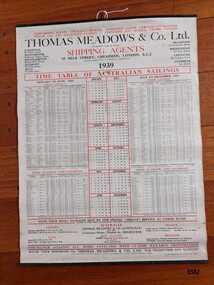 Flagstaff Hill Maritime Museum and Village
Poster - Shipping Timetable, Barclay and Fry Ltd. London, Time Table of Australian Sailings, circa 1939
... manufacturing and shipping landscape. Thomas Meadows & Company Ltd moved to offices in Milk Street, London in 1854 (where they remained until 1969 when they moved out of the city to Leytonstone) and continued in the freight business until 1987 when the company was acquired by Rockwell International Freight. The growth of Thomas Meadows & Company Ltd coincided with the growth and development of the colony of Victoria with an increasing need for the transporting of large numbers of people as well as important goods required by the growing colony - furniture, spirits, food, clothing, agricultural implements, household items etc. ...manufacturing and shipping landscape. Thomas Meadows & Company Ltd moved to offices in Milk Street, London in 1854 (where they remained until 1969 when they moved out of the city to Leytonstone) and continued in the freight business until 1987 when the company was acquired by Rockwell International Freight. The growth of Thomas Meadows & Company Ltd coincided with the growth and development of the colony of Victoria with an increasing need for the transporting of large numbers of people as well as important goods required by the growing colony - furniture, spirits, food, clothing, agricultural implements, household items etc. ..."Freight forwarding" is the arranging of the shipping of goods from their point of origin to their final destination. Freight Forwarders worked as an intermediary between companies that needed to ship products and the shipping and transportation firms that could ensure delivery. A key element of "freight forwarding" was the advice and professional handling of documentation and customs requirements provided. Early "freight forwarders" tended to be innkeepers who forwarded on the luggage of their hotel guests. One of the first "freight forwarding" companies was established by Thomas Meadows in 1836 which made it one of the earliest freight companies in Europe. More reliable rail and steamships were beginning to be used to transport goods and this created a demand for the new "freight forwarding" industry. The combination of railroads and steamships became very important in the late 19th and early 20th century. International shipments became common and freight forwarding that could handle their complexity became an integral part of the manufacturing and shipping landscape. Thomas Meadows & Company Ltd moved to offices in Milk Street, London in 1854 (where they remained until 1969 when they moved out of the city to Leytonstone) and continued in the freight business until 1987 when the company was acquired by Rockwell International Freight. The growth of Thomas Meadows & Company Ltd coincided with the growth and development of the colony of Victoria with an increasing need for the transporting of large numbers of people as well as important goods required by the growing colony - furniture, spirits, food, clothing, agricultural implements, household items etc. In the late 1840's only two or three overseas ships a month visited Melbourne but by late 1852 (after gold was discovered) more than a dozen ships arrived each week. By 1939, Thomas Meadows & Co. Ltd. had offices in Canada, U.S.A., New Zealand, France, Belgium and in Flinders Street Melbourne. This poster was sold by "Smarts Authorised Newsagency" in 1988 in Warrnambool - a business that had been owned by Neil and Shirley Smart at 168 Timor Street, Warrnambool since 1976. Previously it had been "Reed's Newsagency and Book Shop" (a local business established by William Reed circa 1912 and known as "William Reed Bookseller and Stationer"). The original owners, Reed's Newsagency and Bookshop were operating the shop in 1939 which suggests the poster may have been on display (for the information of their customers) in their shop at that time. This poster is significant through its association with Thomas Meadows and Co. Ltd. who is considered to be the founder of the "freight forwarding" industry in the early 19th century. It is an example of advertising used by shipping agents in the mid-19th to early 20th centuries. Its information includes the addresses of the firm's different offices in the U.K. and abroad, ships, shipping lines and ports used and the timetable the vessels were likely to follow. It is also significant through its association with a well known and long standing local Warrnambool business.A 1939 Timetable of "Australian Sailings" produced by the shipping agents Thomas Meadows and Co Ltd. It lists all their ships (plus dates and ports) sailing from the UK to Australia as well as the addresses of their offices in other cities in the U.K., Canada, U.S.A., Australia, New Zealand, France and Belgium. It has three vertical columns depicting (from left to right) January to June sailings, a simple 1939 calendar and their July to December 1939 sailings. The poster is attached on the top and bottom to two thin black metal strips. The top strip has a metal ring with a hole. A stamped label on the back of the poster has the name, telephone number and address of Smarts newsagency plus the date.Front of poster - "FORWARDING AGENTS. INSURANCE BROKERS.PASSENGER AGENTS.CARTAGE CONTRACTORS / MOTOR CAR AND MACHINERY PACKERS.FURNITURE AND GENERALEXPORT PACKERS" "THOMAS MEADOWS & CO Ltd." "ESTABLISHED OVER 100 YEARS" "SHIPPING AGENTS / 35 MILK STREET, CHEAPSIDE, LONDON, E.C.2" "PACKING WAREHOUSES IN LONDON & MANCHESTER" "1939" "TIME TABLE OF AUSTRALIAN SAILINGS" "JANUARY TO JUNE, 1939/ FROM LONDON" "JULY TO DECEMBER, 1939 / FROM LONDON" "HAVE YOUR SMALL PACKAGES SENT BY OUR SPECIAL "SMALLS" SERVICE AT LOWER RATES/RATES TO PORT ONLY OR INCLUDING DELIVERY THROUGHOUT AUSTRALIA" "INSURANCE AGAINST ALL RISKS EFFECTED WITH CLAIMS PAYABLE DESTINATION" "ROUTE YOUR SHIPMENTS VIA THOMAS MEADOWS & CO LTD. FOR PROMPTNESS AND ECONOMY" Stamp on back of poster - "SMART'S AUTHORISED NEWSAGENCY' "168 Timor Street, Warrnambool 3280" "Telephone: (055) 62 2092" "12 DEC 1988" Sticker at bottom - "51"flagstaff hill maritime museum and village, great ocean road, shipping, shipping agents, freight forwarding, freight, shipping time table, thomas meadows & co. ltd., thomas meadows shipping agent, shipping and forwarding agent, smart's newsagency, warrnambool, warrnambool newsagency, chart, poster, smart's authorised newsagency, neil and shirley smart, william reed, reed's newsagency and bookshop
