
Showing 33 items matching "gasometer"
-
 City of Moorabbin Historical Society (Operating the Box Cottage Museum)
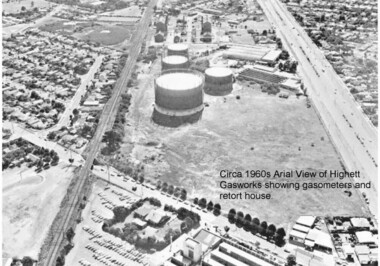
Photograph - Photographs of Highett Gasworks, Gasometer, Retort House and Coal Store at Highett Gasworks, 1974 and 1960
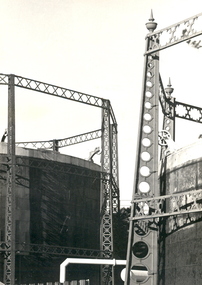
... Gasometer, Retort House and Coal Store at Highett Gasworks......gasometer...Gasometers resulted from complex engineering design evolving from primitive gasholders first used in 1824 in England to power street lights. ...Gasometers resulted from complex engineering design evolving from primitive gasholders first used in 1824 in England to power street lights. ...Gasometers resulted from complex engineering design evolving from primitive gasholders first used in 1824 in England to power street lights. The 20th century gasometer, (as used at the Highett Gasworks), was comprised of a series of large interconnected, telescopic, cylindrical vessels or lifts, which rose and fell depending on the volume of gas stored. The gasholder operated on a basic principle of a gas-filled floating vessel, rising and falling in a seal of water. The Highett Gasworks had its beginning in 1939 but its beginnings commenced sixty-two years earlier when the privately owned Brighton Gas Company was floated in 1877. By 1880 the company was performing well and making excellent profits. The company was welcomed by residents wanting to replace the shadowy light of a kerosene lamp with the bright luminescence of "modern" gas lamps. The land developers of the day were also keen supporters. But by 1884 people became disgrunted because either the gas had not reached them yet or because the quality of the supply had diminished due to the increasing use. In 1885 a second private gas company, the Central Brighton and Moorabbin Gas Co, Chaired by "Tommy" Bent was floated and for many years the two gas companies enjoyed a shared monopoly in supplying gas from their New Street Works. In the 1930s the company expanded its gas production facilities to Highett where it had purchased 45 acres of land adjacent to the Melbourne-Frankston railway line. A gasholder with a capacity of 750,000 cubic feet was erected on the Highett land in 1927 and connected with high pressure mains to the Brighton works. Three years later the company directors decided to proceed with the construction of a vertical retort house and coal store. Following a "lull" during the Great Depression work recommenced in 1936 and by 1939 the first complete gas-making plant was completed, and gas making commenced. Over the next twenty one years other significant extensions occurred, including an amenities block to accomodate 100 workers. In 1969 Esso commenced the introduction of natural gas to residents homes and the gradual decommissioning of the Highett Gasworks commenced. Part of the old Highett Gasworks site is now a council owned parkThe photos of the Higett Gasworks, now demolished, recall their long history, that originated in the 1800s with the production of gas to supply homes with a new, much improved light source, and later it's other applications such as for stoves etc. The arrival of gas in the Shire of Moorabbin was a huge step forward that encouraged further building and development in the area.Three Photographs of the Highett Gasworks. Two are coloured photos taken in 1974, and one is black and white taken in the 1960s. All are in good conditionOn the back of the two coloured photographs "Highett Gasworks 1974" No inscription on the black and white aerial photograph.brighton, moorabbin, highett, bent thomas, gasometer, highett gasworks, engineering design, brighton gas company, central brighton and moorabbin gas company, great depression, lamp kerosene -
 Geoffrey Kaye Museum of Anaesthetic History
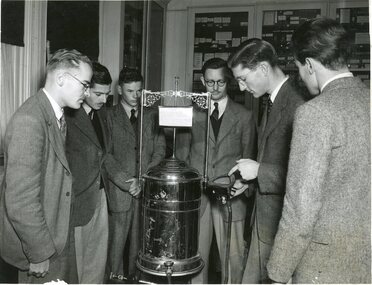
Photograph, c1940s
... ...gasometer...Black and white photograph depicting six male figures standing around a c1870 nitrous oxide gasometer. The second man from the right is holding and pointing to an inhaler connected to the gasometer, demonstrating it to the dental students....•Black paper label which has separated from the photograph, written in white ink: A GASOMETER (C.1870) IS DEMONSTRATED TO DENTAL STUDENTS...•Black paper label which has separated from the photograph, written in white ink: A GASOMETER (C.1870) IS DEMONSTRATED TO DENTAL STUDENTS Black and white photograph depicting six male figures standing around a c1870 nitrous oxide gasometer. ...Possibly part of a series of photographs taken at the Geoffrey Kaye Museum when it was located at the University of Melbourne in the late 1940s.Black and white photograph depicting six male figures standing around a c1870 nitrous oxide gasometer. The second man from the right is holding and pointing to an inhaler connected to the gasometer, demonstrating it to the dental students.•Handwritten in blue ink on reverse and underlined: Frame 11. •Handwritten in grey pencil on reverse: 12. [11 has been crossed out.] •Handwritten in blue ink on reverse: 5 (i) (c). •Black paper label which has separated from the photograph, written in white ink: A GASOMETER (C.1870) IS DEMONSTRATED TO DENTAL STUDENTSdental students, gasometer, nitrous oxide -
 Port Melbourne Historical & Preservation Society
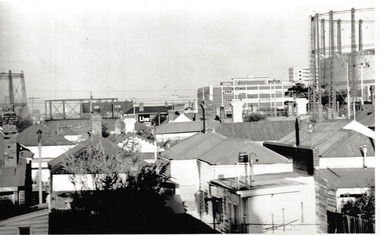
Photograph - Elevated view to Gasometers & Albert Park High School, Reverend Donald LANGFORD, June 1973
... ...Gasometer...Taken from a vantage point- possibly Holy Trinity Manse -the typical 197'0's Port Melbourne roof lines are the foreground with the still erected gasometers and original Albert Park High School can be seen in the distance....B & W photograph taken before the gasometers were removed & Albert Park High School rebuilt as Albert Park College....Built Environment - Industrial Education - Secondary Schools Gasometer Demolitions June 1973 B & W photograph taken before the gasometers were removed & Albert Park High School rebuilt as Albert Park College. ...Taken from a vantage point- possibly Holy Trinity Manse -the typical 197'0's Port Melbourne roof lines are the foreground with the still erected gasometers and original Albert Park High School can be seen in the distance.B & W photograph taken before the gasometers were removed & Albert Park High School rebuilt as Albert Park College.June 1973built environment - industrial, education - secondary schools, gasometer, demolitions -
 Port Melbourne Historical & Preservation Society
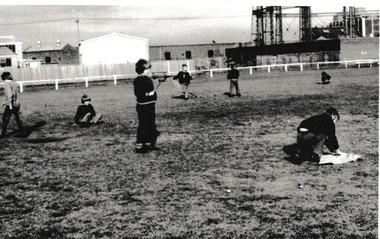
Photograph - Cubs at Lagoon Reserve Port Melbourne, Reverend Donald LANGFORD, 19 Aug 1975
... ...Gasometer...On the right hand rear of the photograph can be seen still standing Gasometer. ...On the right hand rear of the photograph can be seen still standing Gasometer. Built Environment - Industrial Gasometer Lagoon Reserve Built Environment - Recreational Facilities June 1973 B & W photograph of Lagoon Reserve with Cubs learning kite flying. ...Port Melbourne cub scouts on lagoon Reserve. On the right hand rear of the photograph can be seen still standing Gasometer. B & W photograph of Lagoon Reserve with Cubs learning kite flying.June 1973built environment - industrial, gasometer, lagoon reserve, built environment - recreational facilities -
 Port Melbourne Historical & Preservation Society
Photograph - Dismantling gasometer, corner Graham and Pickles Streets, Port Melbourne
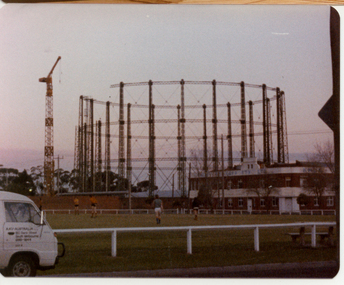
... ...Gasometer...Colour print of dismantling of large gasometer on corner of Graham and Pickles Streets Port Melbourne in the 1970s. ...Lagoon Reserve Gasometer Utilities - Gas Built Environment - Commercial Colour print of dismantling of large gasometer on corner of Graham and Pickles Streets Port Melbourne in the 1970s. ...Colour print of dismantling of large gasometer on corner of Graham and Pickles Streets Port Melbourne in the 1970s. Footballers on Lagoon Reserve in the foreground, with Knox Schlapp building adjacent.lagoon reserve, gasometer, utilities - gas, built environment - commercial -
 Port Melbourne Historical & Preservation Society
Photograph - Graham Street towards Albert Park, Reverend Donald LANGFORD, June 1973
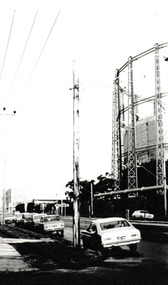
... ...Gasometer...Taken from the corner of Seisman Place looking towards Albert Park, the photograph was taken before the demolition of the gasometer shown on the on right. The original Albert Park High School can be seen behind the Pickles Street sign....Taken from the corner of Seisman Place looking towards Albert Park, the photograph was taken before the demolition of the gasometer shown on the on right. The original Albert Park High School can be seen behind the Pickles Street sign. ...Taken from the corner of Seisman Place looking towards Albert Park, the photograph was taken before the demolition of the gasometer shown on the on right. The original Albert Park High School can be seen behind the Pickles Street sign.B & W photograph of Graham Street, Port Melbourne looking towards Pickles Street.built environment - industrial, transport - roads, education - secondary schools, gasometer, demolitions -
 Port Melbourne Historical & Preservation Society
Photograph - House, 2 McCormack Street, Port Melbourne, Janet and Allen Walsh, 1973
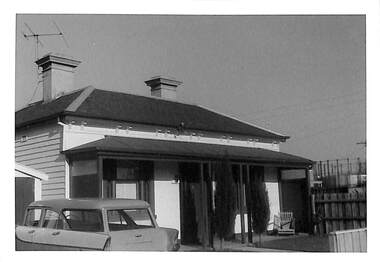
... House on McCormack St Gasometer in background...Shot in 1973 with particular interest in architecture Janet WALSH Allen WALSH Built Environment - Domestic McCormack Street Identified and dated on back in ink House on McCormack St Gasometer in background Photograph House, 2 McCormack Street, Port Melbourne Janet and Allen Walsh ...Shot in 1973 with particular interest in architectureHouse on McCormack St Gasometer in backgroundIdentified and dated on back in inkjanet walsh, allen walsh, built environment - domestic, mccormack street -
 Bendigo Historical Society Inc.
Slide - BENDIGO & EASTER FAIR, c1968
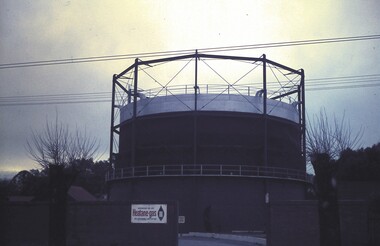
... Bendigo Gas Works, Weeroona Ave, Bendigo. Gasometer...SLIDE Bendigo bendigo gas works Bendigo Gas Works Bendigo Gas Works, Weeroona Ave, Bendigo. Gasometer Slide BENDIGO & EASTER FAIR ...Bendigo Gas Works, Weeroona Ave, Bendigo. Gasometerslide, bendigo, bendigo gas works, bendigo gas works -
 Bendigo Historical Society Inc.
Slide - BENDIGO BUILDINGS, Nov 1960
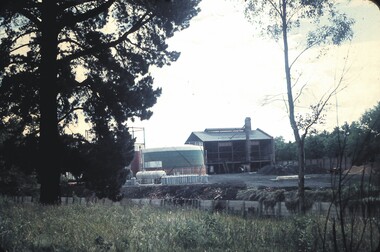
... Bendigo Buildings. Bendigo Gasometer (gas works)....Bendigo Buildings. Bendigo Gasometer (gas works). Slide BENDIGO BUILDINGS. ...Slide. Bendigo Buildings. Bendigo Gasometer (gas works).slide, bendigo, bendigo buildings., bendigo buildings. -
 Geoffrey Kaye Museum of Anaesthetic History
Equipment - Nitrous oxide gasometer, Buffalo Dental Manufacturing Company, 1876-1901
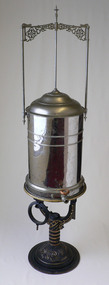
... gasometer...The main component of the nitrous oxide gasometer is a reflective white metal urn-shaped chamber from which an outlet valve and circular moulded tap allows for the flow of gas. ...gasometer nitrous oxide storage anaesthesia dentistry chloroform ether B.D.M. ...The main component of the nitrous oxide gasometer is a reflective white metal urn-shaped chamber from which an outlet valve and circular moulded tap allows for the flow of gas. A rectangular frame sits atop the chamber and comprises ornately decorated metal flourishes and three white metal anchoring pipes, two attached to each side of the chamber and one attached to the centre of the two-tiered, domed lid. The gasometer sits atop a Y-shaped cast iron stand, ornately decorated with metallic golden brass paint, with a circular base. There is also a black cast iron ring that is attached to the stand. Manufactured by Buffalo Dental Manufacturing Company, Buffalo NY.Inscription on base. "B.D.M. CO, BUFFALO N.Y." Inscription on vertical. "1 2 3" Inscription on upper side of top ring. "J. DEMAREST//PAT.FEB.15.1876." Inscription on lower side of top ring. "15"gasometer, nitrous oxide, storage, anaesthesia, dentistry, chloroform, ether, b.d.m. co -
 Port Melbourne Historical & Preservation Society
Photograph - Port Melbourne Baseball Club, 1st Nine Premiers, 1961
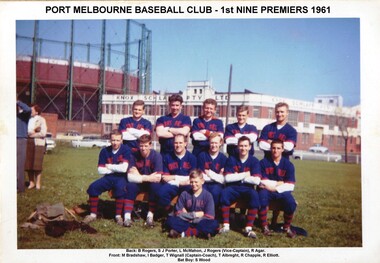
... ...Gasometer...Background to team on Lagoon reserve shows the Knox Schlapps building and gasometer...Background to team on Lagoon reserve shows the Knox Schlapps building and gasometer Photograph Port Melbourne Baseball Club, 1st Nine Premiers ...Back: B ROGERS, S J PORTER, L McMAHON, J ROGERS (Vice-Captain), R AGAR Front: I BADGER, T WIGNALL (Captain Coach). T ALBREGHT, R CHAPPLE, R ELLIOTT Bat boy: S WOODColour team photo of Port Melbourne Baseball Club - 1st Nine Premiers 1961. Background to team on Lagoon reserve shows the Knox Schlapps building and gasometersport - baseball, utilities - gas, built environment - industrial, built environment - commercial, parks and gardens, port melbourne baseball club, b rogers, s j porter, l mcmahon, j rogers, r agar, m bradshaw, i badger, t wignall, t albreght, r chapple, s wood, gasometer, knox schlapp pty ltd, lagoon reserve, r elliott -
 Port Melbourne Historical & Preservation Society
Photograph - Gasworks, 1890s
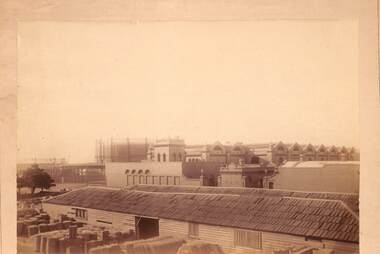
... Large sepia print, gasworks buildings with bottle works in foreground and gasometers in background, c1890s...Gasworks Built Environment - Industrial Bottle Works Large sepia print, gasworks buildings with bottle works in foreground and gasometers in background, c1890s Photograph Gasworks ...Large sepia print, gasworks buildings with bottle works in foreground and gasometers in background, c1890sgasworks, built environment - industrial, bottle works -
 Port Melbourne Historical & Preservation Society
Photograph - Harold 'Dags' BROWN, Lagoon Reserve, Port Melbourne
... Lasercopy of view of Harold 'Dags' BROWN in Lagoon Reserve C1945, Gasometers and building in distance...Harold Brown (Dags) in ink Lasercopy of view of Harold 'Dags' BROWN in Lagoon Reserve C1945, Gasometers and building in distance Photograph Harold 'Dags' BROWN, Lagoon Reserve, Port Melbourne ...Lasercopy of view of Harold 'Dags' BROWN in Lagoon Reserve C1945, Gasometers and building in distanceOn back "unknown lagoon Reserve" in pencil. Harold Brown (Dags) in inksport - australian rules football, harold 'dags' brown, lagoon reserve -
 Port Melbourne Historical & Preservation Society
Photograph - Gasometers and Lagoon Reserve
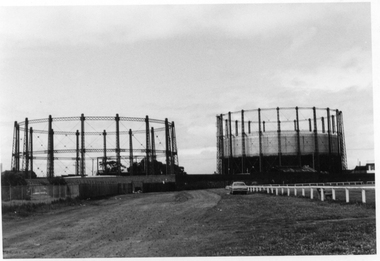
... 1970's B&W Photo showing two gasometers with Lagoon Reserve in foreground...Utilities - Gas Built Environment - Industrial Gasworks Lagoon Reserve 1970's B&W Photo showing two gasometers with Lagoon Reserve in foreground Photograph Gasometers and Lagoon Reserve ...1970's B&W Photo showing two gasometers with Lagoon Reserve in foregroundutilities - gas, built environment - industrial, gasworks, lagoon reserve -
 Port Melbourne Historical & Preservation Society
Photograph - Lagoon Harbour, Henry Martin Whatty, late 1800s - early 1900s
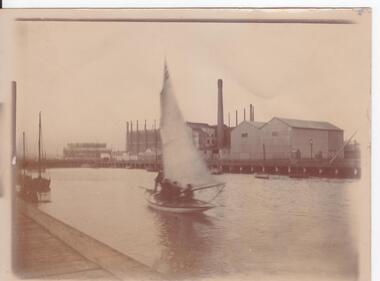
... Digital copy of a B&W photograph of a sailboat on Lagoon Harbour with factories and gasometers in the background....Henry Martin WHATTY Sandridge Lagoon Industry - Gas & Coal Built Environment - Industrial Digital copy of a B&W photograph of a sailboat on Lagoon Harbour with factories and gasometers in the background. Photograph Lagoon Harbour Henry Martin Whatty ...Henry Martin WHATTY grew up in Port Melbourne during the 1870s and 1880s. He loved boats and boating and many of his photographs reflect his nautical interests. Digital copy of a B&W photograph of a sailboat on Lagoon Harbour with factories and gasometers in the background.henry martin whatty, sandridge lagoon, industry - gas & coal, built environment - industrial -
 Port Melbourne Historical & Preservation Society
Photograph - Port Melbourne beach front from Station Pier, February, Marie Hillier, Feb 1960
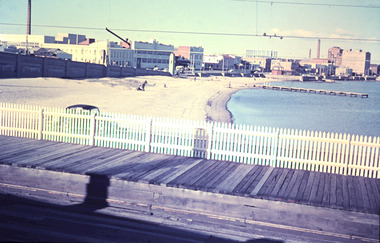
... ...Gasometer...Image shows part of Centenary Bridge; Swallow and Ariell buildings including chimney (since demolished); London Hotel; Princes St drain pier; Graham St gasometer in background; Sandridge Bay Towers; rotunda. ...Image shows part of Centenary Bridge; Swallow and Ariell buildings including chimney (since demolished); London Hotel; Princes St drain pier; Graham St gasometer in background; Sandridge Bay Towers; rotunda. ...Digital image taken from Station Pier, in February 1960, looking east along beachfront. Image shows part of Centenary Bridge; Swallow and Ariell buildings including chimney (since demolished); London Hotel; Princes St drain pier; Graham St gasometer in background; Sandridge Bay Towers; rotunda. Station pier shows raised pedestrian walkway, vehicle on lower level and rails that extend from station.built environment - commercial, built environment - industrial, natural environment - beaches and foreshore, piers and wharves - station pier, centenary bridge, london family hotel, band rotunda, swallow & ariell ltd, gasometer, sandridge towers, piers and wharves - miscellaneous -
 Federation University Historical Collection
Photograph - Photorgraphs - Black and White, Aerial Photographs around the Ballarat School of Mines, Pre 1967
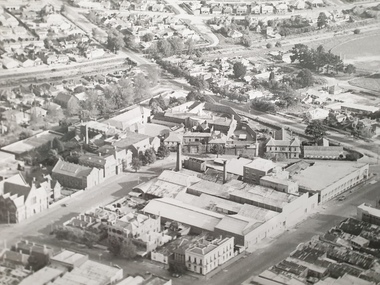
... ...gasometer...Shows Ballarat School of Mines, Ballarat Gaol, Ballarat Girls' Technical School, gasometers, White Flat, Yarrowee Channel. 8251.3 & .4 & .5 - Black and white photograph taken from an aeroplane over Ballarat. ...Shows Ballarat School of Mines, Ballarat Gaol, Ballarat Girls' Technical School, gasometers, White Flat, Yarrowee Channel. 8251.3 & .4 & .5 - Black and white photograph taken from an aeroplane over Ballarat. ...Ballarat School of Mines is in Lydiard Street South, in close proximity to White Flat oval. 3821.1 & .2 - Black and white photograph taken from an aeroplane over Ballarat. Shows Ballarat School of Mines, Ballarat Gaol, Ballarat Girls' Technical School, gasometers, White Flat, Yarrowee Channel. 8251.3 & .4 & .5 - Black and white photograph taken from an aeroplane over Ballarat. Shows Ballarat School of Mines, Ballarat Gaol, Ballarat Junior Technical School, Albert Street, Gaol garden, Manchester Unity Hall ballarat school of mines, aerial photograph, hickman street, white flat oval, former ballarat gaol, ballarat girls' technical school, gasometer, aeroplane, white flat, armstrong street south, ballarat gaol, manchester university hall -
Port Melbourne Historical & Preservation Society
Postcard - Gasworks, Gas Holder Explosion, 1920
... One from a set of six postcards related to the Gasworks and produced from early images by the City of Port Phillip: Gasometer explosion Easter, 1920...industry utilities - gas south melbourne gasworks disaster - explosion Cards have three logos: Gasworks Arts, City of Port Phillip, Gas and Fuel Corporation One from a set of six postcards related to the Gasworks and produced from early images by the City of Port Phillip: Gasometer explosion Easter, 1920 Gas Holder Explosion Postcard Gasworks City of Port Phillip ...One from a set of six postcards related to the Gasworks and produced from early images by the City of Port Phillip: Gasometer explosion Easter, 1920Cards have three logos: Gasworks Arts, City of Port Phillip, Gas and Fuel Corporationindustry, utilities - gas, south melbourne gasworks, disaster - explosion -
Port Melbourne Historical & Preservation Society
Photograph - Helen Thomas on the beach at Port Melbourne
... B&W photo of Helen Thomas, aged about 10, on beach at foot of Johnston Street or Esplanade West, with gasometer in Graham Street in the background....sport swimming natural environment - beaches and foreshore helen thomas B&W photo of Helen Thomas, aged about 10, on beach at foot of Johnston Street or Esplanade West, with gasometer in Graham Street in the background. ...B&W photo of Helen Thomas, aged about 10, on beach at foot of Johnston Street or Esplanade West, with gasometer in Graham Street in the background.sport, swimming, natural environment - beaches and foreshore, helen thomas -
 Port Melbourne Historical & Preservation Society
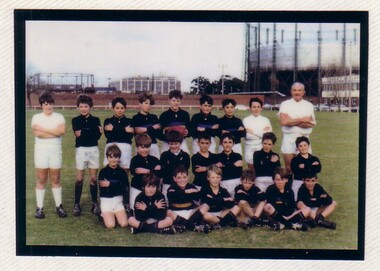
Photograph - St Joseph's football team, Lagoon Reserve, Port Melbourne, 1960s
... St Joseph's football team on Lagoon Reserve, 1960's. Large gasometer on corner of Graham and Pickles St at back right. ...Education - Primary Schools Sport - Australian Rules Football St Josephs Catholic Primary School Religion - Roman Catholic Church (St Josephs) Lagoon Reserve St Joseph's football team on Lagoon Reserve, 1960's. Large gasometer on corner of Graham and Pickles St at back right. ...St Joseph's football team on Lagoon Reserve, 1960's. Large gasometer on corner of Graham and Pickles St at back right. Colour photo.education - primary schools, sport - australian rules football, st josephs catholic primary school, religion - roman catholic church (st josephs), lagoon reserve -
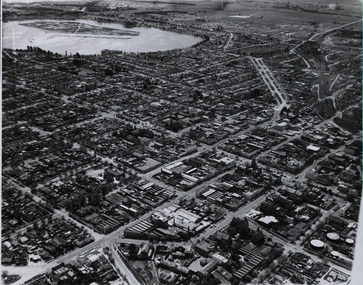 Federation University Historical Collection
Photograph - Photograph - Black and White, Aerial photograph of Ballarat, including the Ballarat School of Mines Campus, c1960
... Four black and white aerial photograph of Ballarat, including the Ballarat School of Mines Campus, former Ballarat Gaol, Lake Wendouree, Ballarat Gasometers, M.B. John Valves (Lydiard Street)...ballarat aerial ballarat school of mines ballarat gaol balllarat brewery lake wendouree Wendouree Four black and white aerial photograph of Ballarat, including the Ballarat School of Mines Campus, former Ballarat Gaol, Lake Wendouree, Ballarat Gasometers, M.B. John Valves (Lydiard Street) Aerial photograph of Ballarat, including the Ballarat School of Mines Campus Photograph Photograph - Black and White ...Four black and white aerial photograph of Ballarat, including the Ballarat School of Mines Campus, former Ballarat Gaol, Lake Wendouree, Ballarat Gasometers, M.B. John Valves (Lydiard Street)ballarat, aerial, ballarat school of mines, ballarat gaol, balllarat brewery, lake wendouree, wendouree -
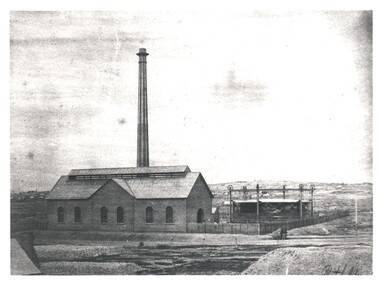 Bendigo Historical Society Inc.
Photograph - WES HARRY COLLECTION: BENDIGO GASWORKS, 1861?
... It shows a large brick factory with a very tall smokestack and a gasometer on the right hand side. It is situated in open country with only a few dwellings visible in the background....It shows a large brick factory with a very tall smokestack and a gasometer on the right hand side. It is situated in open country with only a few dwellings visible in the background. ...Photograph of the Bendigo Gasworks company in Bridge street Sandhurst. It shows a large brick factory with a very tall smokestack and a gasometer on the right hand side. It is situated in open country with only a few dwellings visible in the background.Batchelderbuildings, commercial, gasworks, bendigo gasworks, bridge street -
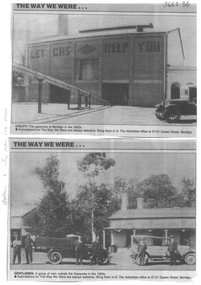 Bendigo Historical Society Inc.
Photograph - Bendigo Gasworks, 2014, 2018
... Image of the gasworks in the 1920's, showing a large brick building with decorative brickwork insert 'Let Gas Help You'; group of men outside the gasworks in the 1920's - two cars in front of house and workers in front of a gasometer at Gasworks in the 1920's. ...Image of the gasworks in the 1920's, showing a large brick building with decorative brickwork insert 'Let Gas Help You'; group of men outside the gasworks in the 1920's - two cars in front of house and workers in front of a gasometer at Gasworks in the 1920's. Photograph Bendigo Gasworks ...The Bendigo Gas Works are one of around three remaining intact 19th century gas works in the world, and the only one in Australia. It is on the Victorian Heritage Register and regarded by Institution of Engineers Australia as an internationally significant example of an entire provincial gasworks The Bendigo Gasworks operated from 1860 until 1973 when natural gas was introduced and remain as they were at the time of closure; a treasure of industrial heritage frozen in time. It is an internationally significant example of an entire provincial gasworks. It has the only horizontal gas-producing retorts in Australia. Coal Gas was manufactured here from 1860 and operated continuously until the introduction of natural gas in 1973. The works were operated by the Bendigo Gas Company until purchased by the Gas and Fuel Corporation in 1958 at which time they were supplying 3,500 consumers. During the Second World War the works were expanded by the Ministry of Munitions to serve the Bendigo Ordinance Factory. The original works were constructed during 1859-1860 under the direction of engineer Alexander Kennedy Smith (1824 - 1881) and developed in a period of growth by W. A. Simco, General Manager 1922-1939. ( Engineering Heritage Australia: ttps://heritage.engineersaustralia.org.au/wiki/Place:Bendigo_Gas_Works) The site is on the Victorian Heritage Register (VHR) Number H0781 Two page photocopy, three photos of the Bendigo Gasworks, submitted to the 'Bendigo Advertiser' The Way We Were, series of images. Image of the gasworks in the 1920's, showing a large brick building with decorative brickwork insert 'Let Gas Help You'; group of men outside the gasworks in the 1920's - two cars in front of house and workers in front of a gasometer at Gasworks in the 1920's. sandhurst, bendigo, gas works, heritage listing, tourism, entertainment, science and engineering, bendigo city council, retorts, coal -
 Federation University Historical Collection
Photograph - Photograph - Black and White, Geoff Biddington, Views of Ballarat, 1967
... ...gasometer...Licensed grocer (Corner Eyre and Lyons Street South) featuring Ballarat Bertie Sign 4. Cast Iron Gasometer Frames 5. Former Ballarat Supreme Court (Ballarat School of Mines Electrical Engineering 6. ...Licensed grocer (Corner Eyre and Lyons Street South) featuring Ballarat Bertie Sign 4. Cast Iron Gasometer Frames 5. Former Ballarat Supreme Court (Ballarat School of Mines Electrical Engineering 6. ...These images were taken by Geoff Biddington who was highly active in the Ballarat Branch of the National Trust. Twenty two black and white photographic views of Ballarat by Geoff Biddington. 1. Ballarat Mechanics' Institute 2. 18-20 Lyons Street south, Ballarat 3. Licensed grocer (Corner Eyre and Lyons Street South) featuring Ballarat Bertie Sign 4. Cast Iron Gasometer Frames 5. Former Ballarat Supreme Court (Ballarat School of Mines Electrical Engineering 6. Telegraph Station (Castlemaine?) 7. Ballarat Fine Art Gallery (later Art Gallery of Ballarat) 8. Former Ballarat Police Station, Camp Street 9. Former Baptist Church, Dawson Street 10. Craig's Hotel Lamp 11-13. Goller's, Camp Street 14. Old Post Box- Crown on Top 15. Former Ballarat Gaol Gates 16. Golden Point Football Club Rooms, Main Road 17. Ballarat Fire Station, Ballarat East 18. Ballarat Town Hall Tower 19. Ballan Hotel 20. Building on Inglis street, Ballan 21. Ballan News Building (Est 1872) 22. Adam Lindsay Gordon Cottagebiddington, ballarat mechanics' institute, ballaarat mechanics' institute, mechanics institute, gasometer, ballarat police station, police, baptist church, craig's hotel, goller, post box, crown, golden point, ballarat town hall, ballan hotel, adam lindsay gordon cottage, ballarat gaol gates, wrought iron, bluestone, ballarat bertie, orlando, penfolds, signwriting, licensed grover, ballarat bitter, craig's royal hotel lamp, craig's hotel -
Victorian Interpretive Projects Inc.
Photograph - Black and White, Ballarat, c1854
... On the left the chimney and gasometer indicate the corner of Dana Street and Albert Street. ...On the left the chimney and gasometer indicate the corner of Dana Street and Albert Street. ...The town you see had over 50,000 people. Bridge Street on the left is well established. The crude pans and cradles of the early “diggers’ were already giving way to steam power and the deep shafts of the “miners”. Money and machinery were needed to get to the deeper leads, and the smoke stacks of the great company mines can be seen across the photo.Four black and white photographs placed together to make a panorama of Ballarat looking towards Mt Warrenheip. On the left the chimney and gasometer indicate the corner of Dana Street and Albert Street. This is now the Ballarat Law Courts. The photograph is behind glass in a black frame. These four photographs were taken from the slope of the Ballarat School of Mines where the Uniting Church now stands. When joined they give a panoramic view of one of the world’s richest alluvial goldfields. The Waterloo Mine was one of the first deep shafts and was sunk at the foot of the Dana Street hill. Its tailings are seen in the second photo from left. The following was typed and placed with the framed image. Ballarat Circa 1858 This is the most significant of the photographs of early Ballarat. The photographer stood on the slope near S.M.B. where the Wesley Church now stands and took four pictures. When joined them have this panoramic view of one of the world's richest alluvial goldfields. Seven years earlier this landscape was empty. The town you see had over 50,000 people. Bridge Street on the left is well established the Ballarat gas Company stands on the same place as today. The crude pans and cradles of the early "diggers" were already giving way to steam power and the deep shafts of the :"miners". Money and machinery were needed to get to the deeper leads, and the smoke stacks of the great company mines can be seen across the photo. The Waterloo mines was one of the first deep shafts and was sunk at the foot of the Dana Street hill. Its tailings are seen in the second photo from the left. ballarat, ballarat townscape, panorama, waterloo mine -
 City of Moorabbin Historical Society (Operating the Box Cottage Museum)
Photographs, x3 Colour,, Highett Gasworks c1974, 1974
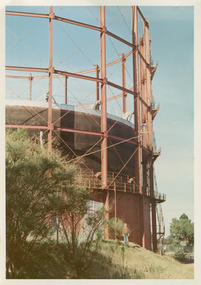
... However after conversion of 450,000 homes to Natural Gas the Highett site was redundant. The gasometers were removed 1978. Moorabbin Council obtained part of the land for public recreation purposes...However after conversion of 450,000 homes to Natural Gas the Highett site was redundant. The gasometers were removed 1978. Moorabbin Council obtained part of the land for public recreation purposes. ( Dr. ...3 of 5 photographs of the Highett Gasworks c 1974 The Brighton Gas Company was established 1877 by local residents including Thomas Bent. Initially all went well for residents as gas light replaced kerosene lamps and street lights were installed. However disruption to supply, poor quality and failure to reach all house lead to dissatisfaction. Thomas Bent therefore began the Central Brighton and Moorabbin Gas Company 1885 and a price war ensued. This was unsustainable and the two companies amalgamated in 1877 supplying gas from the New Street Works site. 1930 this Company expanded to Highett where it had purchased 45 acres adjacent to the train line. 1927 a gas holder was built connected to the Brighton works 1936 construction began on a complete gas-making unit and the Highett Gasworks, Nepean Highway, began supply 1939. 1950 an extension program was completed. However by 1965 , with the discovery of Natural Gas offshore in Bass Strait, changes to Gas distribution were apparent. At first some of the facilities at Highett were used to distribute the gas piped from Sale, Gippsland. However after conversion of 450,000 homes to Natural Gas the Highett site was redundant. The gasometers were removed 1978. Moorabbin Council obtained part of the land for public recreation purposes. ( Dr. G Whitehead KCC Historian ) c2012 the Moorabbin Justice Centre / Magistrates Court of Victoria was built and further development of the area for apartments proceeds. The establishment of the Brighton Gas Company 1877 and the Highett Gasworks 1885 brought bright lighting to houses, businesses and streets in Moorabbin Shire and cooking ovens and heating improved the living conditions of residents. 3 x Colour photographs of the Highett Gasworks c1970bass strait gas, highett gasworks, brighton gasworks 1877, central brighton and moorabbin gas company 1885, whitehead dr. graham, magistrates court of victoria, horse drawn carts, toll gates brighton, motor cars 1900, steam engines, early settlers, bentleigh, parish of moorabbin, city of moorabbin, county of bourke, moorabbin roads board, shire of moorabbin, henry dendy's special survey 1841, were j.b.; bent thomas, o'shannassy john, king richard, charman stephen, highett william, ormond francis, maynard dennis, market gardeners, vineyards, orchards -
 Ballarat Tramway Museum
Photograph - Digital image Set of 10, Tony Smith, 19/09/1971 12:00:00 AM
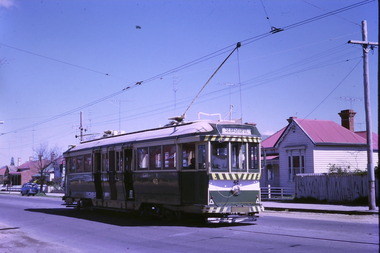
... Has the Dickins and the Gasometer in the background. the conductor adjusting the trolley ropes. .7 - 39 running from Bridge St into Sturt St - as above. .8 - 34 and 39? ...Has the Dickins and the Gasometer in the background. the conductor adjusting the trolley ropes. .7 - 39 running from Bridge St into Sturt St - as above. .8 - 34 and 39? ...Yields information about Ballarat Tramways and trams prior to the closure of the tramway system.Set of 10 digital images of Ballarat trams prior to closure, scanned from original slides by Tony Smith, 1971 prior to closure of the system. This set of slides appears to be the last day of operations - 19/9/1971 .1 - 40 in Drummond St Nth. near Macarthur St, showing Sebastopol. .2 - 35 turning from Drummond St north into Sturt St with the Southern Cross hotel in the background. Note the shoes in the overhead. .3 - 42 in Drummond St North, showing Special, nearing Sturt St. .4 - 42 turning into Sturt St, with the Shell Service station on the left. .5 - 42 reversing on the Lydiard St Nth crossover with the post office in the background. Tram showing Sebastopol. .6 - 39 reversing at Grenville St, tram showing Special. Has the Dickins and the Gasometer in the background. the conductor adjusting the trolley ropes. .7 - 39 running from Bridge St into Sturt St - as above. .8 - 34 and 39? parked in the City Loop. Has Patersons furniture, Gear Chemist and Edments stores in the background. .9 - 43 showing special at the Sturt and Lydiard St stop with 39? about to leave Lydiard St Nth. Has the post office in the background. .10 - 40 at the Lydiard St North terminus, with passengers boarding. Cemetery gates in the background.trams, tramways, drummond st nth, macarthur st, sturt st, closure, lydiard st nth, grenville st, city loop, closure, tram 40, tram 35, tram 42, tram 39, tram 34 -
Port Melbourne Historical & Preservation Society
Document - Calendar 2020, Historic Port Melbourne - a then and now calendar 2020, September 2019
... ...Gasometer...Researched, written and designed by Pat GRAINGER and PMHPS members State Savings Bank of Victoria Morley's Coal Depot Pier Hotel Starbucks Coffee Gasometer HMAS Lonsdale The Bethel Turnbull Furniture Warehouse Tjngari Built Environment Swallow & Ariell Ltd Henry DAVENPORT Perce McGuire WHITE Perce WHITE Ronald 'Bunna' WALSH Religion - Anglican (Holy Trinity) Joshua Brothers Distillery Fox and Hay Mission to Seafarers Fishermans Bend Spider Web Nightclub Business and Traders Theresa CLAY Johnny Allsorts Pawnbroker Sandridge Lagoon John Bichard GRUT Maskell & McNab Memorial "Historic Port Melbourne - a then and now calendar 2020" Produced by PMHPS. ...Researched, written and designed by Pat GRAINGER and PMHPS members"Historic Port Melbourne - a then and now calendar 2020" Produced by PMHPS. Black and white photo on cover of wagons loaded with a shipment from Swallow & Ariell 1915 PMHPS logo at bottom left corner.state savings bank of victoria, morley's coal depot, pier hotel, starbucks coffee, gasometer, hmas lonsdale, the bethel, turnbull furniture warehouse, tjngari, built environment, swallow & ariell ltd, henry davenport, perce mcguire white, perce white, ronald 'bunna' walsh, religion - anglican (holy trinity), joshua brothers distillery, fox and hay, mission to seafarers, fishermans bend, spider web nightclub, business and traders, theresa clay, johnny allsorts pawnbroker, sandridge lagoon, john bichard grut, maskell & mcnab memorial -
 Flagstaff Hill Maritime Museum and Village
Functional object - Light Bracket, Before 1878
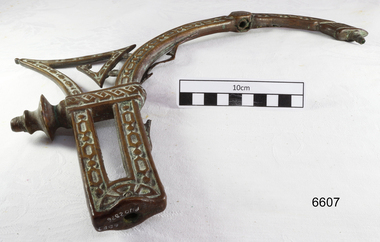
... In 1841 Sydney was the first to be gas-lit with 23 street lamps, 106 hotel lamps, and 200 private residences connected to the Darlinghurst “gasometer” by an underground network of metal pipes. ...In 1841 Sydney was the first to be gas-lit with 23 street lamps, 106 hotel lamps, and 200 private residences connected to the Darlinghurst “gasometer” by an underground network of metal pipes. ...This pressed brass artefact is a highly decorative side bracket for distancing a gas lamp flame from the internal wall of a building. It is hollow and made of light gauge metal, with an innovative aesthetic design, but no internal piping to transport gas. It was recovered from the wreck of the LOCH ARD. There are similar artefacts in the Flagstaff Hill collection. The LOCH ARD left Gravesend (London) on 2 March 1878, bound for Melbourne, with a crew of 37, 17 passengers, and a diverse and valuable cargo of manufactured goods, luxury items, and refined metal. Some of the cargo was destined for display at Melbourne’s first International Exhibition in 1880. At 3 am, 1 June 1878, the ship was wrecked against the high limestone cliffs of Mutton Bird Island on Victoria’s south west coast near Port Campbell. Only two people survived the disaster — Tom Pearce, a male crew member, and Eva Carmichael, a female passenger. The cargo proved too difficult to salvage in the vessel’s exposed condition and was largely written off. The manifest of goods in the LOCH ARD’s holds included “Fittings gas (4 cases)”. The gas lighting of streets, public buildings, and the dwellings of wealthier private citizens was already well-advanced in the cities and major towns of the Australian colonies. In 1841 Sydney was the first to be gas-lit with 23 street lamps, 106 hotel lamps, and 200 private residences connected to the Darlinghurst “gasometer” by an underground network of metal pipes. “The dim days of oil and tallow are gone by!” pronounced one newspaper, flushed with civic pride. The 1850s Gold Rush promoted a similar attitude of confidence and affluence in the Colony of Victoria. In 1855 Melbourne was connected to its own system of subterranean gas pipes despite the same high rates of 25 shillings per 1000 cubic feet being charged, (reduced to 15 shillings in 1865 with cheaper sources of coal). By1858 Kyneton had its own gasworks to light the town (fuelled by eucalyptus leaves) and Geelong followed suit in 1860. Had the LOCH ARD reached its intended destination in 1878, it is probable that the 4 cases of brass gas light fittings on board would have found a ready market.The LOCH ARD shipwreck is of State significance — Victorian Heritage Register S417. The gas light bracket is an example of lamp fittings and plumbing from the late 19th century.A pressed brass lighting bracket recovered from the wreck of the LOCH ARD. It would be used for attaching, but simultaneously offsetting, a gas nozzle to a wall. Highly decorative in an unusually ‘modern’ or ‘art-deco’ style, with sweeping curves dissected by angular geometric pattern, and supporting a short, vertical bar with a gas nozzle on top. It is constructed of light gauge metal, with splitting along seams, and some delicate tracery is missing. Outer surface has been polished, removing sediment, but greenish oxidation remains in dents and joins. warrnambool, shipwreck coast, flagstaff hill, shipwrecked coast, flagstaff hill maritime village, flagstaff hill maritime museum, shipwreck artefact, maritime museum, gas lamps, gas lighting, gas works, brass fittings, gas pipes, loch ard, 1878 shipwreck, victorian affluence, colonial gas lighting -
 Flagstaff Hill Maritime Museum and Village
Functional object - Gas Fitting, Before 1878
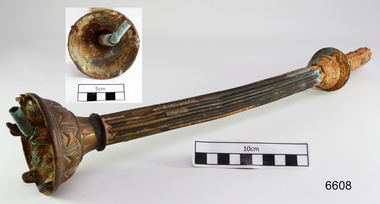
... In 1841 Sydney was the first to be gas lit with 23 street lamps, 106 hotel lamps, and 200 private residences connected to the Darlinghurst “gasometer” by an underground network of metal pipes. ...In 1841 Sydney was the first to be gas lit with 23 street lamps, 106 hotel lamps, and 200 private residences connected to the Darlinghurst “gasometer” by an underground network of metal pipes. ...The artefact is a short cross-section of part of a functional part of a brass fitting that suspended a gas lamp, providing structural support, and internally, supplying the gas for its ignition. It combines elegant design with the elements required for safe and efficient delivery of gas. It was recovered from the LOCH ARD shipwreck site. There are similar artefacts in the Flagstaff Hill collection. The LOCH ARD left Gravesend (London) on 2 March 1878, bound for Melbourne, with a crew of 37, 17 passengers, and a diverse and valuable cargo of manufactured goods, luxury items, and refined metal. Some of the cargo was intended for Melbourne’s first International Exhibition to be held in 1880. At 3 am, 1 June 1878, the ship was wrecked against the high limestone cliffs of Mutton Bird Island on Victoria’s south west coast near Port Campbell. Only two people survived the disaster — Tom Pearce, a male crew member, and Eva Carmichael, a female passenger. The cargo proved too difficult to salvage in the vessel’s exposed condition and was largely written off. The manifest of goods in the LOCH ARD’s holds included “Fittings gas (4 cases)”. The gas lighting of streets, public buildings, and the dwellings of wealthier private citizens, was already well advanced in the cities and major towns of the Australian colonies. In 1841 Sydney was the first to be gas lit with 23 street lamps, 106 hotel lamps, and 200 private residences connected to the Darlinghurst “gasometer” by an underground network of metal pipes. “The dim days of oil and tallow are gone by!” pronounced one newspaper, flushed with civic pride. The 1850s Gold Rush promoted a similar attitude of confidence and affluence in the Colony of Victoria. In 1855 Melbourne was connected to its own system of subterranean gas pipes despite the same high rates of 25 shillings per 1000 cubic feet being charged, (reduced to 15 shillings in 1865 with cheaper sources of coal). By1858 Kyneton had its own gasworks to light the town (fuelled by eucalyptus leaves) and Geelong followed suit in 1860. Had the LOCH ARD reached its intended destination in 1878, it is probable that the 4 cases of brass gas light fittings on board would have found a ready market.The gas fitting is significant for its association with the LOCH ARD shipwreck, which is of State significance and is listed on the Victorian Heritage Register S417. The fitting is an example of a late 19th-century plumbing and light fitting.A pressed brass gas light fitting, recovered from the wreck of the LOCH ARD. The elegant and functional fitting extends from an ornate 8cm diameter ceiling flange, and comprises two short lengths of fluted column pipe with a brass joiner that are severed (cut off) at the end. Within this decorative outer layer of 3cm diameter is a full length brass tube liner, which is in turn protecting a narrow 0.75cm copper gas pipe that also runs full length. The artefact is generally unrestored with reddish/cream sandstone concretion, but is in good condition.warrnambool, shipwreck coast, flagstaff hill, shipwrecked coast, flagstaff hill maritime village, flagstaff hill maritime museum, shipwreck artefact, maritime museum, gas lamps, gas lighting, gas works, brass fittings, gas pipes, loch ard, 1878 shipwreck, victorian affluence, colonial gas lighting
