
Showing 11 items matching "geneva convention"
-
 4th/19th Prince of Wales's Light Horse Regiment Unit History Room
Booklet, Lane Printing Pty Ltd, Unit Guide to the 1949 Geneva Conventions for the Protection of War Victims (Modified for Australia), 1950's
... Geneva Convention...A soft covered publication to acquaint all ranks with the principles of the Geneva Conventions for the protection of war victims, and to draw attention those provisions likely to concern ordinary units in the field...Geneva Convention DSN 7610-010-1863 A soft covered publication to acquaint all ranks with the principles of the Geneva Conventions for the protection of war victims, and to draw attention those provisions likely to concern ordinary units in the field Unit Guide to the 1949 Geneva Conventions for the Protection of War Victims (Modified for Australia) Booklet Lane Printing Pty Ltd ...A soft covered publication to acquaint all ranks with the principles of the Geneva Conventions for the protection of war victims, and to draw attention those provisions likely to concern ordinary units in the fieldDSN 7610-010-1863geneva convention -
 Returned Nurses RSL Sub-branch
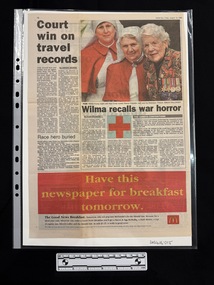
Newspaper - Newspaper clipping, Ross Brundrett, Wilma recalls war horror, Friday, 13 August 1999
... ...Geneva Convention...Her talk was part of the commemoration of the 50th anniversary of the revised Geneva Conventions....Her talk was part of the commemoration of the 50th anniversary of the revised Geneva Conventions. WWII World War 2 World War Two WWll Australian Army Nursing Service AANS Bangka Island SS Vyner Brooke Wilma Elizabeth Forster Oram Wilma Elizabeth Forster Young Geneva Convention Page of a newspaper with multiple headlined articles, a colour photograph, logo and advertisement. ...Article and photograph relating to former nurse Wilma Young recounting her experiences as a survivor of the sinking of the SS Vyner Brooke and her time as a Japanese prisoner of war (POW) on Bangka Island Indonesia. Her talk was part of the commemoration of the 50th anniversary of the revised Geneva Conventions.Page of a newspaper with multiple headlined articles, a colour photograph, logo and advertisement. Photograph of three women looking at the camera, two are in nurses uniforms with white wimples and the third wearing a multicoloured jacket with four medals and various pins attached.wwii, world war 2, world war two, wwll, australian army nursing service, aans, bangka island, ss vyner brooke, wilma elizabeth forster oram, wilma elizabeth forster young, geneva convention -
 Bendigo Military Museum
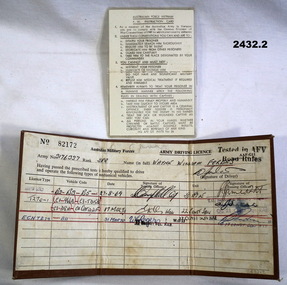
Accessory - CARD - LICENCE, 1) c.1970; .2) 27.8.1969
... On white background 1 side details the handling of POW's under the Geneva Convention 1949. Side 2 is a list of key phases in English & Vietnamese. ...On white background 1 side details the handling of POW's under the Geneva Convention 1949. Side 2 is a list of key phases in English & Vietnamese. ...Items belonged to Wayne William Forbes No 3176337 RAE. Refer Cat No 754 for service history also 2586. Part of an extensive collection including his fathers..1) Card, Australian Force Vietnam PW Instruction Card (Prisoner of War). On white background 1 side details the handling of POW's under the Geneva Convention 1949. Side 2 is a list of key phases in English & Vietnamese. Card is a plastic sealed sheath. .2) Army Drivers Licence, brown canvas outer, folds in 3. Inside details the particulars of W FORBES..2) 3176337 - SPR - Wayne William FORBES Licence No 82172documents - cards, licences, military history - army -
 Bendigo Military Museum
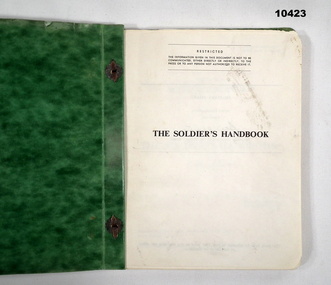
Book - THE SOLDIERS HANDBOOK
... Annexes A. The Geneva Conventions. B. Code of conduct if taken POW...Annexes A. The Geneva Conventions. B. Code of conduct if taken POW Book, green cardboard covers, pages are held in via two metal fasteners so pages can be added. ...Collection re G.A. Jones 3790932 refer cat No 10053.2P for his service details. The book covers 14 chapters, History of the Australian Army - The Army today - Conditions of Service - Living in the Barracks and Security - Dress, Drill - Notes on basic Equipment and safety - Shooting - map Reading - Fieldcraft - Health and Hygiene - First Aid - Communications. Annexes A. The Geneva Conventions. B. Code of conduct if taken POWBook, green cardboard covers, pages are held in via two metal fasteners so pages can be added. "Amendment No 1 Army headquarters Canberra ACT 1/3/69", 147 pages, photos, sketches, weapons, uniforms, colour pages of Awards and Rank insignia. -
 Returned Nurses RSL Sub-branch
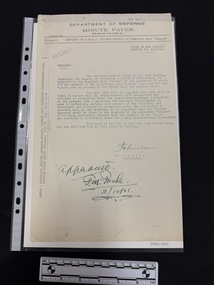
Document - Copy of Department of The Army Minute Paper, Department of the Army, Despatch of A.A.M.C Reinforcements by Hospital Ship "Oranje", 19411231
... Concern was raised and investigation being undertaken to ensure the 224 V.A.Ds. to be on board the Oranje would be protected under the Geneva International Convention before their intended departure in January of the following year....Concern was raised and investigation being undertaken to ensure the 224 V.A.Ds. to be on board the Oranje would be protected under the Geneva International Convention before their intended departure in January of the following year. ...Copy of file no. 38-422-418 from the National Archives of Australia being a despatch relating to 394 personnel departing on the Hospital Ship Oranje to serve in the Middle East. Concern was raised and investigation being undertaken to ensure the 224 V.A.Ds. to be on board the Oranje would be protected under the Geneva International Convention before their intended departure in January of the following year.Foolscap copy of a Department of the Army Minute Paper report with information on the source along the left hand edge.'38-422-418' [Blue ink on left hand side]wwii, ww2, world war 2, voluntary aid detachment, middle east -
 Kew Historical Society Inc
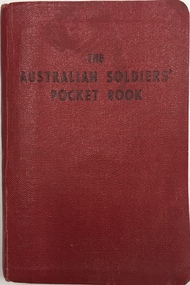
Book, Brown, Prior, Anderson Pty Ltd, The Australian Soldiers' Pocket Book : Containing useful information for Australian soldiers, 1940
... The 128-page pocket-sized book could be carried everywhere and provided Australian soldiers with a wide range of useful information about the requirements of war service and many other important details such as: The Laws and Customs of War - including Geneva Convention guidelines, notes on spies and insignia of rank; Things a Soldier should Know - including over 60 points; Signaling - including flags, morse code, shipboard bell times and time zone; Decorations Awarded to Australians in the Great War; Arabic and Japanese words; First Aid for gas injuries etc.; Australian Historical Events, facts and figures etc.; and Conduct Overseas - including expectations of behaviour when representing Australia. ...The 128-page pocket-sized book could be carried everywhere and provided Australian soldiers with a wide range of useful information about the requirements of war service and many other important details such as: The Laws and Customs of War - including Geneva Convention guidelines, notes on spies and insignia of rank; Things a Soldier should Know - including over 60 points; Signaling - including flags, morse code, shipboard bell times and time zone; Decorations Awarded to Australians in the Great War; Arabic and Japanese words; First Aid for gas injuries etc.; Australian Historical Events, facts and figures etc.; and Conduct Overseas - including expectations of behaviour when representing Australia. ...Booklet produced in 1940 for members of the 2nd AIF by the Australian Comforts Fund Victorian Division. The 128-page pocket-sized book could be carried everywhere and provided Australian soldiers with a wide range of useful information about the requirements of war service and many other important details such as: The Laws and Customs of War - including Geneva Convention guidelines, notes on spies and insignia of rank; Things a Soldier should Know - including over 60 points; Signaling - including flags, morse code, shipboard bell times and time zone; Decorations Awarded to Australians in the Great War; Arabic and Japanese words; First Aid for gas injuries etc.; Australian Historical Events, facts and figures etc.; and Conduct Overseas - including expectations of behaviour when representing Australia. non-fictionaustralian comforts fund (victoria), second world war 1939-1945, hugh george ferguson -
 4th/19th Prince of Wales's Light Horse Regiment Unit History Room
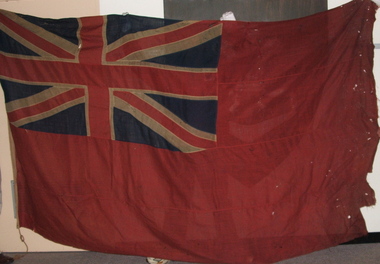
Flag - Red Ensign, Surgeons' Banner, 1850 (estimated)
... The treaty was called the Geneva Convention. This Convention was concerned only with soldiers wounded on the battlefield. ...Red Ensign 1801 design. - The British red ensign was altered in 1801 to include the change to the design of the Union Jack. British legislation required, with a few exceptions, that all merchant shipping throughout the British Empire fly the British Red Ensign, without any defacement or modification. The ensign is sometimes referred to as the red duster. The Royal Navy stopped using the Red Ensign in 1864. This red ensign was used by the Surgeons of the Kyneton District Mounted Rifles to indicate their location. The Banner is a large red ensign mounted on a 10 foot long polished wooden pike. The Banner was used by the Kyneton District Mounted Rifles, later The Royal Volunteer Cavalry Regiment (Prince of Wales Hussars), then Prince of Wales Victorian Light Horse, ancestor units of the modern day 4th /19th Prince of Wales’s Light Horse Regiment. In the binding is the inscription ‘Kyneton Prince of Wales Light Horse’ and three names: Surg-Major S Smith MRSLE, Dr McMillan, and Maj Thirkettle. These surgeons played a significant role in the military and civil affairs of Kyneton. Dr McMillan Dr McMillan was the first surgeon but left KPWLH 2-3 months after its formation and little else is known of him. Surgeon-Major Samuel Smith 1836 Born, Scotland 1857 Surgeon to the Hon. Hudson Bay Company. Ship “Prince Arthur” from London to Moose Fort, Hudson Bay. June 13 – Aug. 24 1857. 1858 Appointed Medical Officer of large immigrant ship to Port Phillip 1859 Appointed Assistant District Coroner, Castlemaine 1859 Appointed to Castlemaine Hospital 1862 Appointed first resident surgeon and manager of Kyneton Hospital Foundation member of Kyneton District Mounted Rifles 1874 Appointed Surgeon-Major Kyneton Volunteer Prince of Wales Light Horse Conducted a private practice in Kyneton. 1909 Died 8 November 1909, aged 73 years Samuel Smith was a Life Governor of Castlemaine Benevolent Asylum, a member of St Andrews Presbyterian Church, a Mark Master Mason of the Edward Coulson Lodge No 17, Kyneton. He also had a notable collection of stuffed native birds and animals of which he had great knowledge. Major Thirkettle 1855 Major Thirkettle arrived in Kyneton Established a timber merchant and ironmongery business in Kyneton with Robert Burton. 1857 By 1857 he was practising as an architect. His house is still standing in Yaldwin St, West Kyneton. 1860 Joined the Prince of Wales Light Horse 1863 Joined Rifle Volunteers and appointed Captain. On their disbandment he was made Honorary Major. 1864 Won Queen’s prize for rifle shooting. Major Thirkettle was noted for his skill with woodwork. He won many prizes and orders of merit for his models of yachts It is believed likely that he made the wooden pike with its metal head (now missing). He was Tyler of the Zetland Lodge, also Secretary of the MUIOOF and Bowling Club. 1904 Died in Kyneton, aged 75 years Protection for medical services The Surgeons’ Banner indicated the location of the Regimental Aid Post. The use of this device in the 1860’s overlapped the adoption of the Red Cross which became the symbol for the protection of sick and wounded soldiers. In 1864 twelve European nations signed a treaty stating that in future wars they would care for all sick and wounded military personnel, regardless of nationality. They would also recognise the neutrality of medical personnel, hospitals and ambulances identified by the emblem of a red cross on a white background. The treaty was called the Geneva Convention. This Convention was concerned only with soldiers wounded on the battlefield. Over the years, however, it has been expanded to cover everyone caught up in conflicts but not actually taking an active part in the fighting. The Surgeons’ Banner complements the Colours of the Kyneton District Mounted Rifles, also held by the Unit History Room, in presenting the colonial period of the Regiment’s history. Provenance It is believed that the Banner was manufactured in Britain and brought to Australia by Samuel Smith. After the disbanding of Colonial units, the Banner was in the care of the Shire of Kyneton until presented to the 4/19 Prince of Wales’s Light Horse Regiment on 14 September 1986 on the occasion of the Regiment exercising its right of freedom of entry to the city. There are many examples of Regimental and King’s/Queen’s Colours held by various organisations. However A Surgeons’ Banner such as this is rare, if not unique, in Australia. A large red ensign, post 1801 design. - The British red ensign was altered in 1801 to include the change to the design of the Union Jack. British legislation required, with a few exceptions, that all merchant shipping throughout the British Empire fly the British Red Ensign, without any defacement or modification. The ensign is sometimes referred to as the red duster. The Royal Navy stopped using the Red Ensign in 1864. On the binding is the inscription: "Kyneton Prince of Wales Light Horse", and three names - Surgeon Major S Smith MRSLE Dr McMillan Major Thirkettleheraldry, red ensign, surgeons banner, kyneton district mounted rifles -
 National Vietnam Veterans Museum (NVVM)
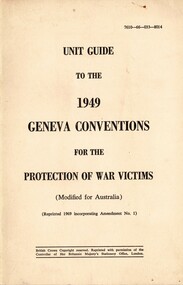
Booklet, Australian Army, Australian Army: Unit Guide to the 1949 Geneva Conventions for the Protection of War Victims (Modified for Australia), 1969
... Australia - Armed Forces - Service manuals Geneva Conventions War Victims A cream coloured cardboard cover with black information. ...A cream coloured cardboard cover with black information. The top right hand side reads 7610-66-033-8014. There are two rusty metal staples down the left hand side.australia - armed forces - service manuals, geneva conventions, war victims -
Moorabbin Air Museum
Document (Item) - Protocol 1 To The 1949 Geneva Conventions & The Implications For Australian Air Forces
... Document Protocol 1 To The 1949 Geneva Conventions & The Implications For Australian Air Forces ...Description: ISBN: 0 642 20428 4 Date: Aug 1994 Author: Cpt. Gary Waters Publisher: Air power Studies Centre Binding: Perm - Softcover Level of Importance: National. -
 Returned Nurses RSL Sub-branch
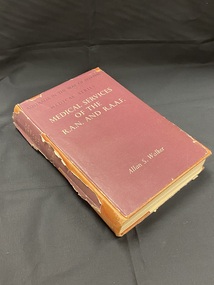
Book - Hardcover book, Allan S. Walker, Medical services of the R.A.N. and R.A.A.F. : with a section on women in the Army Medical Services, 1961
... It also contains chapters on hospital ships, the Geneva Conventions and rehabilitation. The Royal Adelaide Hospital is mentioned several times throughout the book. ...The book covers the work of naval and air force medical services and of the women's service in the Australian Army Medical Corps. It also contains chapters on hospital ships, the Geneva Conventions and rehabilitation. The Royal Adelaide Hospital is mentioned several times throughout the book. [From Trove]Cloth bound hardcover book without a dust jacket. non-fiction The book covers the work of naval and air force medical services and of the women's service in the Australian Army Medical Corps. It also contains chapters on hospital ships, the Geneva Conventions and rehabilitation. The Royal Adelaide Hospital is mentioned several times throughout the book. [From Trove] australian army medical corps, hospital ships, hospitals, medical units, training -
 Returned Nurses RSL Sub-branch
Book - Hardcover book, Australian War Memorial Canberra, Medical services of the R.A.N. and R.A.A.F. : with a section on women in the Army Medical Services, 1961
... It also contains chapters on hospital ships, the Geneva Conventions and rehabilitation. The Royal Adelaide Hospital is mentioned several times throughout the book. ...The book covers the work of naval and air force medical services and of the women's service in the Australian Army Medical Corps. It also contains chapters on hospital ships, the Geneva Conventions and rehabilitation. The Royal Adelaide Hospital is mentioned several times throughout the book. [From Trove]Burgundy cloth-bound book with torn burgundy dust-jacket. Series title printed in black across the top of the cover and title printed in white across the centre. Author's name printed in white across the bottom of the cover. The spine contains the same information, it is quite worn and marked.non-fictionThe book covers the work of naval and air force medical services and of the women's service in the Australian Army Medical Corps. It also contains chapters on hospital ships, the Geneva Conventions and rehabilitation. The Royal Adelaide Hospital is mentioned several times throughout the book. [From Trove]australian army medical corps, hospital ships, hospitals, medical units, trainiing
