
Showing 90 items matching "german pioneers"
-
 Whitehorse Historical Society Inc.
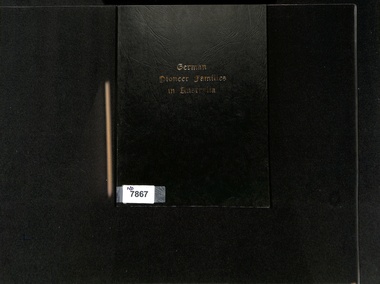
Book - German Pioneers in Australia, 1935 Reprinted 1983
... German Pioneers in Australia...A book documenting a selection of former pioneer families in Australia from 1844 Winter Heindrick Wilhelm Fankhauser David Daniel Fankhauser George Frederick Fankhauser George Henry Fankhauser Frederick William Tainton Rose Selina Fankhauser Arthur Albert Fankhauser Alfred Richard Fankhauser David Ernest Fankhauser Robert Christian Shepherd Esther Ruby Fankhauser John Butler Maling Fankhauser Stanley Charles Fankhauser Walter John Fankhauser John August Black bound book of 144 pages documenting 103 Germans who immigrated to Australia from 1844 Book German Pioneers in Australia Geo A. ...A book documenting a selection of former pioneer families in Australia from 1844Black bound book of 144 pages documenting 103 Germans who immigrated to Australia from 1844winter heindrick wilhelm, fankhauser david daniel, fankhauser george frederick, fankhauser george henry, fankhauser frederick william, tainton rose selina, fankhauser arthur albert, fankhauser alfred richard, fankhauser david ernest, fankhauser robert christian, shepherd esther ruby, fankhauser john butler maling, fankhauser stanley charles, fankhauser walter john, fankhauser john august -
 Whitehorse Historical Society Inc.
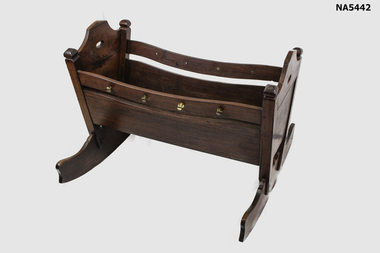
Furniture - Cradle, C 1845
... Made by early German pioneer in Barossa Valley, SA C 1845....Traditional German style Also has a green string attached to a cream tag with ' German Pioneer cradle in cedar Jarrah and Acasia C. 1845 Barrossa Valley SA'...Made by early German pioneer in Barossa Valley, SA C 1845. Cradle German Baby Large wooden baby cradle with rockers on base - dark brown colour wood. ...Purchased at Antiques Fair, Melvern Town Hall 1974. Made by early German pioneer in Barossa Valley, SA C 1845.Large wooden baby cradle with rockers on base - dark brown colour wood. Has 4 brass knobs on both sides of the cradle. Traditional German style Also has a green string attached to a cream tag with ' German Pioneer cradle in cedar Jarrah and Acasia C. 1845 Barrossa Valley SA'cradle, german, baby -
 Whitehorse Historical Society Inc.
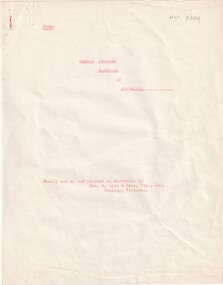
Document, German Settlers of Doncaster
... Information from 'German Pioneer Families in Australia' of early settlers....Information from 'German Pioneer Families in Australia' of early settlers. ...Information from 'German Pioneer Families in Australia' of early settlers.Information from 'German Pioneer Families in Australia' of early settlers.Information from 'German Pioneer Families in Australia' of early settlers.schramm's cottage, von schramm, max rev., orchardists, thiele, henry, lutheran church, athenaeum, john gottfried, anna may, hanke, louise ida, karoline bertha, ernst john, carl william, finger, karl hernrich, christian benjamin, charles henry, ernest f., caroline emma, august, dorothea, ferdinand, eric, neumann, johanne louise, johann, fankhauser, george, john, schramm, rachel, rhoda, joseph, ada, victor, schramm albert, walter, hubert -
 Ballarat Heritage Services
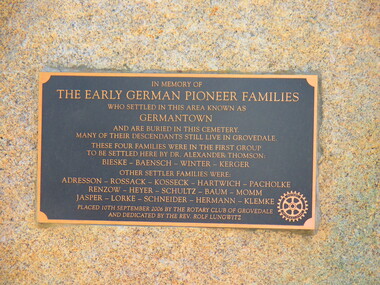
Photograph - Photograph - Colour, Headstones in Germantown Cemetery, 2019, 23/03/2019
... ...german pioneers...The Grovedale Cemetery was formerly known as the Germantown Cemetery, and is administered by Geelong Cemeteries Trust. gravedale cemetery germantown cemetery geelong cemeteries trust george heyer clara elizabeth heyer george hever alfred theodor hever auguste lemke henry lemke ann lemke wilhelmina lemke ennes lemke german pioneers bieske baensch winter kerger adresson rossack kosseck hartwich pacholke renzow heyer schultz baum momm jasper lorke schneider hermann klemke german-australians heinrich renzow anna rostna ernestine winter ernest albert paech heinrich wilhelm winter johannes paech adelena paech john pacholke h. pacholke henry pacholke adolph pohl emielie pohl theo pohl cottlor walter luise walter plier g.o. pacholke grace dorothy pacholke karl josef stotz donald hartwick albert spain carl voss ludwig averland susan elizabeth haverland phillip alfred jasper rudolph jasper ernestine jasper emma emilie rossack carl gotlierb rossack anna louisa schneider frederick schneider agnes winter martha winter paul wilhelm winter max george grossman emma matilda grossman emma matilda bieske emma emilie andressen leo bieske albert bieske john frederick rossack louisa emma rossack margaret hartwick dora baum u. joseph baum johanna cready johanna hartwich wilhelm heinrich winter heinrick r. winter a. dora m. sectig gustav julius kosseck ernest c. rosser leslie charles rossack frank charles rossack george rossack leonard julius kosseck anna amanda kosseck anna amanda wolter james kennedy paton florence may paton ivy victoria baensch margaret baensch godfrey baensch friederich albert lehmann elsie emma lehmann elsie emma grossmann j.j. kerger alice mary kerger charles edward klemke marian joyce klemke lulu rossack ellen victoria rossack william harry rossack may elizabeth rossack clara rossack a.s. maude momm Colour photographs of each headstones in Germantown Cemetery (or Grovedale Cemetery). ...The Grovedale Cemetery was formerly known as the Germantown Cemetery, and is administered by Geelong Cemeteries Trust.Colour photographs of each headstones in Germantown Cemetery (or Grovedale Cemetery).gravedale cemetery, germantown cemetery, geelong cemeteries trust, george heyer, clara elizabeth heyer, george hever, alfred theodor hever, auguste lemke, henry lemke, ann lemke, wilhelmina lemke, ennes lemke, german pioneers, bieske, baensch, winter, kerger, adresson, rossack, kosseck, hartwich, pacholke, renzow, heyer, schultz, baum, momm, jasper, lorke, schneider, hermann, klemke, german-australians, heinrich renzow, anna rostna, ernestine winter, ernest albert paech, heinrich wilhelm winter, johannes paech, adelena paech, john pacholke, h. pacholke, henry pacholke, adolph pohl, emielie pohl, theo pohl, cottlor walter, luise walter, plier, g.o. pacholke, grace dorothy pacholke, karl josef stotz, donald hartwick, albert spain, carl voss, ludwig averland, susan elizabeth haverland, phillip alfred jasper, rudolph jasper, ernestine jasper, emma emilie rossack, carl gotlierb rossack, anna louisa schneider, frederick schneider, agnes winter, martha winter, paul wilhelm winter, max george grossman, emma matilda grossman, emma matilda bieske, emma emilie andressen, leo bieske, albert bieske, john frederick rossack, louisa emma rossack, margaret hartwick, dora baum, u. joseph baum, johanna cready, johanna hartwich, wilhelm heinrich winter, heinrick r. winter, a. dora m. sectig, gustav julius kosseck, ernest c. rosser, leslie charles rossack, frank charles rossack, george rossack, leonard julius kosseck, anna amanda kosseck, anna amanda wolter, james kennedy paton, florence may paton, ivy victoria baensch, margaret baensch, godfrey baensch, friederich albert lehmann, elsie emma lehmann, elsie emma grossmann, j.j. kerger, alice mary kerger, charles edward klemke, marian joyce klemke, lulu rossack, ellen victoria rossack, william harry rossack, may elizabeth rossack, clara rossack, a.s. maude momm -
 Whitehorse Historical Society Inc.
Document, Fankhauser Family, 1935
... Photocopied extracts from 'German Pioneer Families', Geelong, 1935 (1983 reprint). ...Photocopied extracts from 'German Pioneer Families', Geelong, 1935 (1983 reprint). ...Photocopied extracts from 'German Pioneer Families', Geelong, 1935 (1983 reprint).Photocopied extracts from 'German Pioneer Families', Geelong, 1935 (1983 reprint). Chiefly members of the Fankhauser family. Marked index lists holdings.Photocopied extracts from 'German Pioneer Families', Geelong, 1935 (1983 reprint). fankhauser family, germans in australia -
 Wodonga & District Historical Society Inc
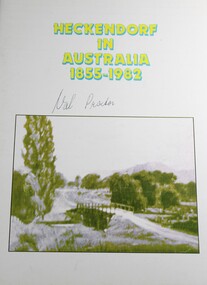
Book - Heckendorf in Australia 1855 - 1982
... ...wodonga pioneers...german...heckendorf family wodonga pioneers german migration to australia A Genealogical study of the Families of Frederick Heckendorf and a Record of Their Descendants, 1808-1982, 127 Years in Australia. ...A Genealogical study of the Families of Frederick Heckendorf and a Record of Their Descendants, 1808-1982, 127 Years in Australia. In 1855, Frederick and Julianna Heckendorf and their children departed Hamburg on the SS Steinwarder for a new life in Australia. In 1869, they moved to Wodonga and it wasn't long before they set up a dairy farm at Willow Park. One hundred years later, the farm was in the hands of Fredrick's great grandson Les Boyes. In the 1970s the land was acquired by the Albury-Wodonga Development Corporation, which had the goal of developing Albury-Wodonga into a major inland city.non-fictionA Genealogical study of the Families of Frederick Heckendorf and a Record of Their Descendants, 1808-1982, 127 Years in Australia. In 1855, Frederick and Julianna Heckendorf and their children departed Hamburg on the SS Steinwarder for a new life in Australia. In 1869, they moved to Wodonga and it wasn't long before they set up a dairy farm at Willow Park. One hundred years later, the farm was in the hands of Fredrick's great grandson Les Boyes. In the 1970s the land was acquired by the Albury-Wodonga Development Corporation, which had the goal of developing Albury-Wodonga into a major inland city.heckendorf family, wodonga pioneers, german migration to australia -
Whitehorse Historical Society Inc.
Article, German past, 1992
... Nunawading's links with pioneering German orchardists are well documented. ...Nunawading's links with pioneering German orchardists are well documented. ...Nunawading's links with pioneering German orchardists are well documented.Nunawading's links with pioneering German orchardists are well documented. An exhibition of photos, books and manuscripts is on display at the State Library.Nunawading's links with pioneering German orchardists are well documented.orchards, germans in australia -
 The 5th/6th Battalion Royal Victoria Regiment Historical Collection
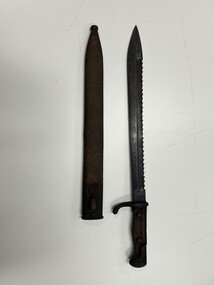
Weapon - Bayonet, M1898/O5s sawback "Butcher" bayonet
... Used in WW1 by German soldiers, primarily pioneer troops and NCOs. Often had their teeth removed due to negative conotations associated with allied propaganda. ...A small number of pioneers and certain non-commissioned officers of the German Army were issued a bayonet with a sawback edge, known as the S or m.S. ...Used in WW1 by German soldiers, primarily pioneer troops and NCOs. Often had their teeth removed due to negative conotations associated with allied propaganda. ...Used in WW1 by German soldiers, primarily pioneer troops and NCOs. Often had their teeth removed due to negative conotations associated with allied propaganda. Many German soldiers were advised not to use the sawback bayonet as they believed that if caught with it they could be summarily executed Know as a saw back bayonet or a butchers knifeDark steel bayonet with substantial 37 cm (15 in) blade. Woodne grips are missing and steel on grop is significantly rusted. Saw back edge with 2 rows of 29 teeth, The quilion bends down toward the hanle Unlike many other bayontes this bayonet does not have a muzzel ring it instead has a long t shaped gove in the handle, Mauser avoided one since these altered the vibration harmonics of the barrel when fired, affecting accuracy. All the bayonets featured quillons that curved back towards the hilt. These were much less effective at catching the opposing blade than the forward-swept quillons used by some other nations. A small number of pioneers and certain non-commissioned officers of the German Army were issued a bayonet with a sawback edge, known as the S or m.S. ("mit Säge", with saw). Many such bayonets had their teeth ground down in response to negative Allied propaganda. There is a heavily rusted, all steel scabbardWAFFENFABRIK MAUSER A.G OBERNDORF a.N5/6 rvr, bayonet, ww1, german, western front -
 Bendigo Historical Society Inc.
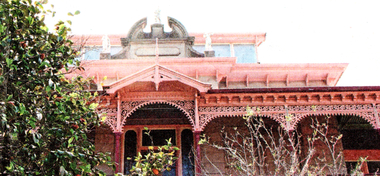
Newspaper - Fortuna Articles - "Time to Honour Pioneers", May 01 2009
... The document advocates for greater recognition of German pioneers, suggesting Fortuna Villa as a venue for a museum or display to celebrate their legacy, inspired by the example of the Chinese Museum in Bendigo. ...The document advocates for greater recognition of German pioneers, suggesting Fortuna Villa as a venue for a museum or display to celebrate their legacy, inspired by the example of the Chinese Museum in Bendigo. ...Germans were the third largest ethnic group on the Bendigo goldfields in the mid-19th century, numbering 2,000–3,000 by 1860. Many were experienced miners from the Harz mountains and led the development of quartz mining at Sandhurst. Christopher Ballerstedt, a German miner, established a successful quartz mining operation and built Fortuna Villa, later sold to George Lansell. Other notable German names include Wittscheibe, Koch, Killian, Ketterer, Roeder, and Mueller, who contributed to mining and local society. German architects, especially William Vahland, played a major role in shaping Bendigo’s architecture, including work on Fortuna Villa. Germans contributed to Bendigo’s cultural life, with several daughters of German-born residents achieving international fame as opera singers. The community was active in commerce, wine production, trades, and professions (e.g., priests, chemists, mayors). Despite some families anglicizing their names during World War I, many German surnames remain prominent in Bendigo. The document advocates for greater recognition of German pioneers, suggesting Fortuna Villa as a venue for a museum or display to celebrate their legacy, inspired by the example of the Chinese Museum in Bendigo. The author urges the community to preserve and showcase the stories, artifacts, and memorabilia of all Bendigo’s pioneers, emphasizing the importance of remembering the city’s immigrant past. Beverley Carter is the author of the document and is introduced as a retired secondary school teacher, part-time journalist, reviewer, and editor. She is a member of Bendigo's Lansell family and is currently writing a comprehensive history of her family, covering their European and English origins and their role in Bendigo's development. Carter's 'Fortuna Glimpses' series focuses on the life of mining magnate George Lansell and his home, Fortuna Articles - "Time to Honour Pioneers" May 01 2009 The Bendigo Advertiser by Bevely Carter, picture by Julian Prowd This item contains the following: 11217.39a Colour Photo of Fortuna. 11217.39b Part of Page 17 - "Time to Honour Pioneers"non-fictionbendigo, fortuna, george lansell, beverley carter -
 Bendigo Historical Society Inc.
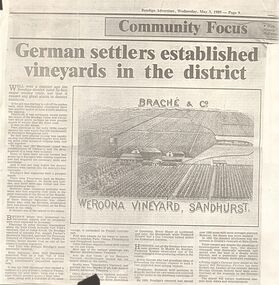
Newspaper - GERMAN HERITAGE SOCIETY COLLECTION: NEWSPAPER CUTTINGS
... Mentioned are German Society plans memorial to its pioneers, German contribution to Bendigo, German dinner an outstanding success, German settlers established vineyards in the district and German Society plans to remember its pioneers. ...Mentioned are German Society plans memorial to its pioneers, German contribution to Bendigo, German dinner an outstanding success, German settlers established vineyards in the district and German Society plans to remember its pioneers. ...Photocopies of five newspaper cuttings from 11/5/1988 to 20/6/1990 mentioning the German Society by Bendigo Advertiser writer Maurie McDonald. Mentioned are German Society plans memorial to its pioneers, German contribution to Bendigo, German dinner an outstanding success, German settlers established vineyards in the district and German Society plans to remember its pioneers. One cutting has a photo of an ornate bookcase which was made for a Miss Pike. It was the work of a German tradesman, Mr C Nagle. Another has a sketch? Of the Brache & Co Weroona Vineyard, Sandhurst. It also mentions a number of early vineyards. These cuttings were held in an extra copy of the drawing of the man with the wine barrels (8803.33).bendigo, clubs, bendigo heritage, german heritage society collection - newspaper cuttings, bendigo advertiser 11/5/1988, 3/5/1989, 6/9/1989, 20/6/1990, maurie mcdonald, daryl pinder, peter hyett, glen schier, josef mika, ian walder, bendigo library, peggy & bill schlotterlein, annita schlotterlein, renate & hans ruemelin, michael ruemelin, max drechsler, vin drechsler, dr david stolz, rosemary schulz, mrs june stolz, ali zvirgzdins, eva mika, johann detleff kahland, eugene sandner, glen schier, lydia & josef aniolkowksi, helen, christa & dieter scharenberg, brache & co, weroona vineyard sandhurst, dr backhaus, bruhn, pohl, mannes' strathfieldsaye vineyard, hercynia vineyard, greiffenhagen, wittschiebe's vineyard, carl august heine, adventure vineyard, scheuffle, streckfuss, henry mayer, frederick kramer, frederick klemm, kahland, miss pike, mr c nagle, johann gottfried tabias christopher ballerstedt, gustavus von tempsky, ken wust, frank cusack, clem schmidt, dorothy strauch, ausrey drechsler, reg schleiger, ian weibegen, ron meurer, bill mannes tim iser, neil mertens -
 Flagstaff Hill Maritime Museum and Village
Instrument - Compass and Housing, 1880-1900
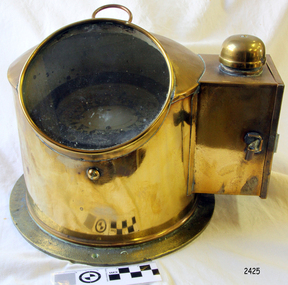
... The item was made by an early pioneer and innovator of marine navigation and instrument making. flagstaff hill warrnambool shipwrecked-coast flagstaff-hill flagstaff-hill-maritime-museum maritime-museum shipwreck-coast flagstaff-hill-maritime-village compass and housing w hartmann binnacle Georg Hechelmann navigational instrument ship compass Made by W Hartmann/Georg Hechelmann of Hamburg, No 7208 Compass and Housing; the brass housing, with side light box, insides a fluid dampening gimble compass. The maker is W Hermann/Georg Hechelmann, of Hamburg, Germany ...This compass was used to determine directions using a free-moving magnetised needle, indicating north and south. W Hartmann was a compass maker located in Hamburg Germany some of his compasses are marked “Gehna” and “Nautica”. There is no information available regards W Hartmann, his successor in the business was “Georg Hechelmann” a marine instrument maker of which Gehna is an acronym of his name. In 1874 he patented an improved version of “Lord Kelvin Thomson’s” compass design of a paper rose with magnets hung on silk threads. It appears he worked in his shop from around 1878 until probably 1905. The company he founded "Gehna" is today a substantial international marine corporation and is still based in Hamburg. A rare example of an early binnacle and compass probably used on a sailing vessel. It is a significant item not only for it’s rarity but also because it demonstrates the progress of marine navigational instrument development in the late 19th century. The item was made by an early pioneer and innovator of marine navigation and instrument making. Compass and Housing; the brass housing, with side light box, insides a fluid dampening gimble compass. The maker is W Hermann/Georg Hechelmann, of Hamburg, Germany. The inscription ioncludes the number of the compass.Made by W Hartmann/Georg Hechelmann of Hamburg, No 7208flagstaff hill, warrnambool, shipwrecked-coast, flagstaff-hill, flagstaff-hill-maritime-museum, maritime-museum, shipwreck-coast, flagstaff-hill-maritime-village, compass and housing, w hartmann, binnacle, georg hechelmann, navigational instrument, ship compass -
 City of Moorabbin Historical Society (Operating the Box Cottage Museum)
Photograph - Wedding Photograph, Alonzo and Mary Box, Box, Alonzo and Mary, 1918
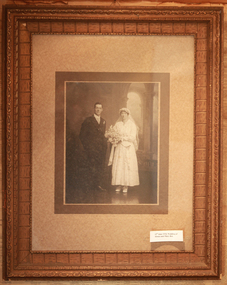
... Alonzo Box, who lived in Oakleigh, was the nephew of William and Elizabeth Box, a pioneer settler of Dendy's Special Survey 1841 who purchased 'Box Cottage ' in 1865 and lived there until 1914. Alonzo Box married Mary Kloster/ Closter in 1918. On the Marriage Certificate Mary Box has spelt "Closter" with a "C" and not the "K" of her German heritage. ...Alonzo Box, who lived in Oakleigh, was the nephew of William and Elizabeth Box, a pioneer settler of Dendy's Special Survey 1841 who purchased 'Box Cottage ' in 1865 and lived there until 1914. Alonzo Box married Mary Kloster/ Closter in 1918. On the Marriage Certificate Mary Box has spelt "Closter" with a "C" and not the "K" of her German heritage. ...Alonzo Box, who lived in Oakleigh, was the nephew of William and Elizabeth Box, a pioneer settler of Dendy's Special Survey 1841 who purchased 'Box Cottage ' in 1865 and lived there until 1914. Alonzo Box married Mary Kloster/ Closter in 1918. On the Marriage Certificate Mary Box has spelt "Closter" with a "C" and not the "K" of her German heritage. This marriage was taking place during World War 1. Many immigrants would have altered their name at that time. The Box family were early pioneers of the district and raised their family in reconstructed 'Box Cottage'. They established a market garden and sold produce to the Melbourne markets for the colony's increasing population.A large, glass covered, wooden-framed, wedding photograph of Alonzo and Mary Box (nee Kloster/ Closter),married June 12th 1918 is displayed in the reconstructed 'Box Cottage' Museum, Joyce Park, Ormond, Victoria. At front base of mounting of photograph 'Muntz Malvern' is stamped. On back of photograph is written, unsigned, 'Mr & Mrs Alonzo Box/ June 12th 1918/ (Mary Kloster )/photographs, brighton, moorabbin, malvern, box william, box elizabeth, box alonzo, box mary, oakleigh, muntz -
 City of Moorabbin Historical Society (Operating the Box Cottage Museum)
Functional object - Sewing Machine, Melber, Early 20th Century
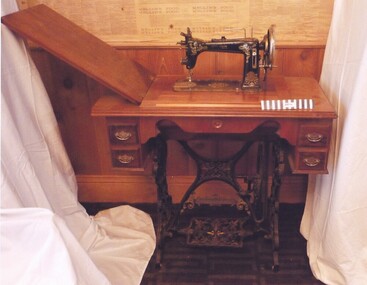
... pioneer settler The machine was bought in 1909, and is a good example of its kind. This type of sewing machine was widely used in many homes, in an era when hand-made clothes were the “norm.”, and clothes were mended, or ‘re-made’ into another garment. The cottage has both the Receipt, cat 00004.1 and Guarantee, cat 00004.2, for the sewing machine. This machine was possibly built by Wertheim Pty Ltd Hugo Wertheim (1854 – 1919) arrived in Melbourne in 1875. He became a successful agent for sewing machines manufactured by his father’s cousin Joseph Wertheim in Frankfurt, Germany...pioneer settler The machine was bought in 1909, and is a good example of its kind. This type of sewing machine was widely used in many homes, in an era when hand-made clothes were the “norm.”, and clothes were mended, or ‘re-made’ into another garment. The cottage has both the Receipt, cat 00004.1 and Guarantee, cat 00004.2, for the sewing machine. This machine was possibly built by Wertheim Pty Ltd Hugo Wertheim (1854 – 1919) arrived in Melbourne in 1875. He became a successful agent for sewing machines manufactured by his father’s cousin Joseph Wertheim in Frankfurt, Germany ...Melber sewing machines were first sold in Australia in the late 1870s. The 'Box Cottage' Melber Treadle Sewing Machine was owned by Mary Box, nee Kloster / Closter, wife of Alonzo Box , the nephew of William and Elizabeth Box who purchased 'Box Cottage' in 1865 from a pioneer settler The machine was bought in 1909, and is a good example of its kind. This type of sewing machine was widely used in many homes, in an era when hand-made clothes were the “norm.”, and clothes were mended, or ‘re-made’ into another garment. The cottage has both the Receipt, cat 00004.1 and Guarantee, cat 00004.2, for the sewing machine. This machine was possibly built by Wertheim Pty Ltd Hugo Wertheim (1854 – 1919) arrived in Melbourne in 1875. He became a successful agent for sewing machines manufactured by his father’s cousin Joseph Wertheim in Frankfurt, Germany. Hugo married Joseph’s daughter Sophie Emilie and they settled in Richmond Melbourne Australia. Hugo made many trips back to the main factory in Germany and, with extensive advertising, established a thriving business for sewing machines, bicycles, pianos under various ‘brand names’ - Wertheim, Electra, Planet, Griffin, Hapsburg. It has been said that Dame Nellie Melba preferred a Wertheim piano for her performances. In 1908 Hugo opened a large piano factory in Bendigo St Richmond, Victoria and his son Herbert maintained the business until 1935 The sewing machine was donated in 1985 by, a descendant of the Box family. The machine is complete, and in good condition. William and Elizabeth Box purchased 'Box Cottage' in 1865 from a pioneer settler who had bought part of the land noted in Dendy's Special Survey 1841 Brighton. They raised their family there and established a market garden to supply produce to the population of Melbourne. Their nephew Alonzo married Mary Kloster/ Closter in 1918 and she brought with her this 'Melber' sewing machine that she used to provide clothing for the family. 'Melber'Treadle Sewing Machine that was owned by Mary Box, nee Kloster/ Closter. It was bought in 1909, and it is a good example of its kind. This type of sewing machine was widely used in many homes, in an era when hand-made clothes were the “norm.”, and clothes were mended, or ‘re-made’ into another garment. The Box Cottage Museum has both the Receipt, and Guarantee for the sewing machine. 'MELBER' stamped on sewing machine.dendys special survey, treadle sewing machine, box cottage, mary kloster, alonzo box, melber, wertheim hugo, wertheim sewing machine manufacturer, richmond melbourne victoria, -
 City of Moorabbin Historical Society (Operating the Box Cottage Museum)
Certificate - Wedding Certificate Alonzo Box, June 1918
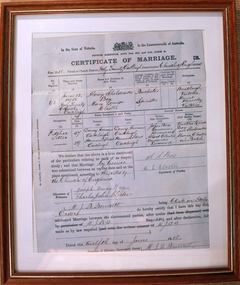
... German immigrant Gardeners and Mary was born in Mount Waverley ,Victoria 1889. This marriage was taking place during World War 1 when many immigrants would have altered the spelling of their name. Alonzo Box, who lived in Oakleigh, was the nephew of William and Elizabeth Box, pioneer ...Original Marriage Certificate of Alonzo and Mary Box nee Closter (Kloster) June 12th 1918. Alonzo was the nephew of William and Elizabeth Box who settled in Moorabbin Parish in 1865 and developed a market garden and raised their family . On the Marriage Certificate Mary Box has spelt her Maiden name "Closter" with a "C" and not the " K" of her German heritage. Albert and Maria Kloster nee Bolch, were German immigrant Gardeners and Mary was born in Mount Waverley ,Victoria 1889. This marriage was taking place during World War 1 when many immigrants would have altered the spelling of their name.Alonzo Box, who lived in Oakleigh, was the nephew of William and Elizabeth Box, pioneer market gardeners who resided in 'Box Cottage' 1865 -1914 His occupation is stated as "Pitcher Setter' i.e one who laid pavers, (Pavior), or blue-stone pitchers. It would have been a specialised work requiring skills much the same as a brick layer. In a developing Shire this would have been a very necessary job used in gutter laying, drainage works etc.. Original Marriage Certificate of Alonzo and Mary Box nee Closter (Kloster) June 12th 1918 enclosed in a glass covered, wooden frame.'In the State of Victoria/ - (Coat of Arms) - In the Commomwealth of Australia/ FOURTH SCHEDULE, ACTS Nos. 2691 and 2720, - FORM B/ CERTIFICATE OF MARRIAGE/ with date and signatures of participants.brighton, moorabbin, anglican, box william, box elizabeth, box alonzo, box mary, box john, box martha, pitcher setter, pavoir, oakleigh, government victoria, german immigrants -
 City of Moorabbin Historical Society (Operating the Box Cottage Museum)
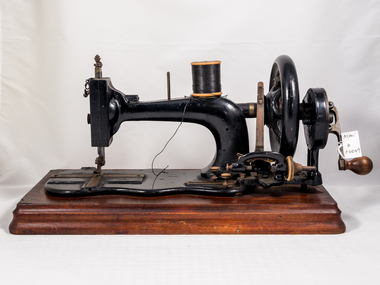
Functional object - Wertheim Sewing Machine, c1880
... A sewing machine was a necessary part of each home. melbourne clothing brighton moorabbin germany piano pioneers richmond bentleigh dressmaking market gardeners early settlers craftwork sewing machines wertheim hugo wertheim joseph 'WERTHEIM' across body of machine A Wertheim hand–crank sewing machine c1880. ...Hugo Wertheim (1854–1919) arrived in Melbourne in 1875. He became a successful agent for sewing machines manufactured by his father’s cousin Joseph Wertheim in Frankfurt, Germany. Hugo married Joseph’s daughter Sophie Emilie and they settled in Melbourne. Hugo made many trips back to the main factory in Germany and, with extensive advertising, established a thriving business for sewing machines, bicycles, pianos under various ‘brand names’ - Wertheim, Electra, Planet, Griffin, Hapsburg. It has been said that Dame Nellie Melba preferred a Wertheim piano for her performances. In 1908 Hugo opened a large piano factory in Bendigo St Richmond, Victoria. His son Herbert maintained the business until the factory closed in 1935.The pioneer settlers and market gardeners of Moorabbin Shire had to be self reliant and made their own clothing and utensils. This sewing machine was one of many items they used to exhibit the skill and craftsmanship of the women in these families. A sewing machine was a necessary part of each home.A Wertheim hand–crank sewing machine c1880. The hand machine was operated by turning the handle. The hand machine could also be fitted to a stand with table and draws, the machine could then be used by hand or foot. This type of sewing machine was widely used in many homes, in an era when hand-made clothes were the “norm”, and clothes were mended, or ‘re-made’ into another garment 'WERTHEIM' across body of machinemelbourne, clothing, brighton, moorabbin, germany, piano, pioneers, richmond, bentleigh, dressmaking, market gardeners, early settlers, craftwork, sewing machines, wertheim hugo, wertheim joseph -
 City of Moorabbin Historical Society (Operating the Box Cottage Museum)
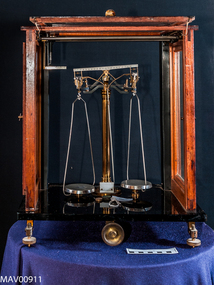
Scales, Gold, Apothecary, Analytical in Glass Case c1880, c1880
... Gottingen made fine precision scientific scales for use by assayers, jewellers, chemists, gold buyers rtc. scales balance precision measures gold pharmacy precious metals jewellery gottingen germany sartorious f moorabin bentleigh cheltenham early settlers gold miners pioneers market gardeners ballarat bendigo imperial measure troy weight D.R.PATENT / GOTTINGER PRAZISIONSWAGENFABRIK G.m.b.H. / GOTTINGEN On upright V over GPW A 2 pan analytical, scientific or pharmaceutical beam balance scale made in Gottingen Germany c 1880. ...A pair of scales or dishes in which objects to be weighed and the weights / masses against which to weigh them are placed is an "Apparatus for weighing. The pan, or each of the pans, of a balance." Its parts include a fulcrum, a beam that balances on it, two pans at the ends of the beam to hold the materials to be weighed, and counter-balancing weights. Gottingen made fine precision scientific scales for use by assayers, jewellers, chemists, gold buyers rtc. A 2 pan analytical, scientific or pharmaceutical beam balance scale made in Gottingen Germany c 1880. These scales are encased in a mahogany framed glass cabinet and Graded 0 -9 9-0D.R.PATENT / GOTTINGER PRAZISIONSWAGENFABRIK G.m.b.H. / GOTTINGEN On upright V over GPW scales, balance, precision measures, gold, pharmacy, precious metals, jewellery, gottingen germany, sartorious f, moorabin, bentleigh, cheltenham, early settlers, gold miners, pioneers, market gardeners, ballarat, bendigo, imperial measure, troy weight -
 City of Moorabbin Historical Society (Operating the Box Cottage Museum)
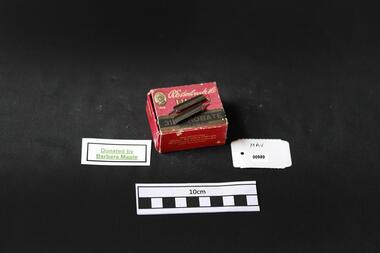
Education, Pen Nibs ' R. Esternbrook Co. Ltd, 20thC
... pioneered mass production of steel pens in 1822; prior to that the quill pen had been the most common form of writing instrument. His brother William Mitchell later set up his own pen making business in St Paul's square. The Mitchell family is credited as being the first manufacturers to use machines to cut pen nibs, which greatly sped up the process. Germany...pioneered mass production of steel pens in 1822; prior to that the quill pen had been the most common form of writing instrument. His brother William Mitchell later set up his own pen making business in St Paul's square. The Mitchell family is credited as being the first manufacturers to use machines to cut pen nibs, which greatly sped up the process. Germany ...Dip pens emerged in the early 19th century, when they replaced quill pens. They were generally used prior to the development of fountain pens in the later 19th century, and are now mainly used in illustration, calligraphy, and comics. A nib pen usually consists of a metal nib with capillary channels like those of fountain pen nibs, mounted on a handle or holder, often made of wood. Other materials can be used for the holder, including bone, metal and plastic. Generally speaking, dip pens have no ink reservoir; therefore the user has to recharge the ink from an ink bowl or bottle in order to continue drawing or writing. Birmingham, England was home to many of the first dip pen manufacturers. John Mitchell pioneered mass production of steel pens in 1822; prior to that the quill pen had been the most common form of writing instrument. His brother William Mitchell later set up his own pen making business in St Paul's square. The Mitchell family is credited as being the first manufacturers to use machines to cut pen nibs, which greatly sped up the process. Germany 1842 began at the factory of Heintze & Blanckertz in Berlin By 1860 there were about 100 companies making steel nibs in Birmingham, but 12 large firms dominated the trade. Dip pens are rarely used now for regular writing, most commonly having been replaced by fountain pens, rollerball pens, or ballpoint pens. However, dip pens are still appreciated by artists, as they can make great differences between thick and thin lines, and generally write more smoothly than other types of pens. Dip pens are also preferred by calligraphers for fine writing. Richard Esterbrook was a Cornish Quaker from England who saw an opportunity in the United States to manufacture Steel Pens. In 1856 R.Esterbrook traveled to the US to set up shop as 'The Steel Pen Manufacturing Company' where Richard made these steel pens by hand using special tools and machines (mostly that Richard had to invent). In 1858 he was able to establish himself as the sole pen manufacturer in the USA and he changed the company name to 'The Esterbrook Steel Pen Mfg. Co.' The company settled down in Camden, New Jersey. Quality was a key factor in his success. His steel pens were versatile, long lasting, and came in many different styles to fit the varied writing styles of the public. Sadly, Richard Esterbrook didn't see the 'empire' his company was to become as he passed away in Atlanta on October 12th 1895 . in 1896 they started an Esterbrook branch in England to join the ranks of the other main pen manufactures in Birmingham . In 1912 the company had gotten so large that they erected a 5 story building, just to continue manufacturing pens. By 1920 the fountain pen was fast becoming more popular amongst people who were tired of 'dipping.' To meet this demand the company manufactured its first fountain pen. In 1930 the company sought less expensive means of manufacturing pens because gold and 'jewel' tips were too expensive and in this same year they began selling fountain pens in England . The Esterbrook Company began using the metal Iridium which they called 'Durachrome.' To meet the fountain pen demand the company reformed as 'The Esterbrook Hazel Pens Ltd.' In 1940 war had come to strike a blow at the Esterbrook company. On November 19th 1940 their England location was hit by an incendiary bomb destroying half of the location! To make matters worse, when putting out the fire using a human water bucket chain, someone accidentally grabbed a bucket of paraffin and set the place further ablaze. Oddly enough, the company was able to rebuild the structure during the war. However, the government had placed a stipulation that 50% of its capacity was to be used for government related purposes. In 1947 the company bought out John Mitchell and the American branch had already acquired Hazel Pen Co. The company re-formed again as 'The Esterbrook Pen Company.' This is the last company name the dip pen nibs were manufactured under. A box of Steel dipping nibs for writing pensOn Box; Photo of man / R. Esternbrook Co. / PENS / PROBATEsteel nibs, writing pens, education, schools, writing, caligraphy, artists, moorabbin, bentleigh, cheltenham, dip pens, inkwells, fountain pens, mitchell john, birmingham england, esternbrook richard, maple barbara -
 City of Moorabbin Historical Society (Operating the Box Cottage Museum)
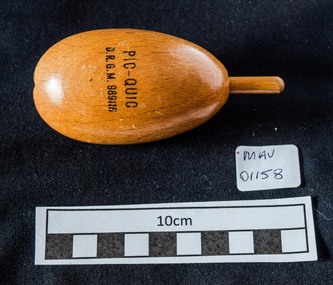
Sewing Equipment , wooden 'Pic-Quic', 20thC
... Germany might have been stamped with this D.R.G.M. designation. This Quic Pic was used by the family of Ailsa Hunt in mid 20thC The women of the post World War 11 estates made clothes and furnishings as their families settled in Bentleigh, McKinnon, Moorabbin ,Ormond in City of Moorabbin c1950s clothing, haberdashery, crochet, doilies, brighton, moorabbin, pioneers, dressmaking, market gardeners, early settlers, craftwork , bentleigh, lacework, moorabbin shire, hunt ailsa, dairy farms, fruit orchards 'PIC - QUIC' DRGM 989116 A wooden egg shaped tool with enclosed steel hook for darning stockings c1950 Sewing Equipment , wooden 'Pic-Quic' DRGM ...The wooden egg has a tiny metal latch hook inserted in the middle (same design as rug making tools). There is a groove down one side. A stocking or knitted fabric is stretched around the egg with the "ladder" in line with the groove. The latch hook is used to pick up the loops in knitted fabric to repair the fault. D.R.G.M., is not a German patent but was instead a way for inventors to register a product’s design or function in all states within Germany. From 1891 to 1952, products manufactured in Germany might have been stamped with this D.R.G.M. designation. This Quic Pic was used by the family of Ailsa Hunt in mid 20thCThe women of the post World War 11 estates made clothes and furnishings as their families settled in Bentleigh, McKinnon, Moorabbin ,Ormond in City of Moorabbin c1950s A wooden egg shaped tool with enclosed steel hook for darning stockings c1950'PIC - QUIC' DRGM 989116clothing, haberdashery, crochet, doilies, brighton, moorabbin, pioneers, dressmaking, market gardeners, early settlers, craftwork , bentleigh, lacework, moorabbin shire, hunt ailsa, dairy farms, fruit orchards -
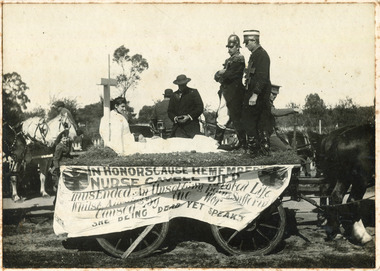 City of Moorabbin Historical Society (Operating the Box Cottage Museum)
Photograph - 'Edith Cavell Tableau' Easter Parade Cheltenham 1916, 1916
... World War 1 1914-1918 had a devastating impact on many early settler families whose sons had volunteered to serve in AIF. 1916 many of these young men were returning injured or had been killed overseas The Community rallied around to support these men and their families by holding fund raising events like the Carnival cheltenham brass band 1916, ww1 1914-1918, cavell edith, friendly societies, protestant alliance friendly society, moorabbin, cheltenham, dendy henry, dendy's special survey 1841, assisted emigrants early settlers, pioneers, market gardeners, marigold flowers, pharmacy, charman stephen, gettens mary, charman harriet, methodist church, primitive methodists, box william, box elizabeth, state schools, education, moorabbin shire, moorabbin roads board, city of moorabbin, kingston city council cheltenham brass band 1916 ww1 1914-1918 cavell edith friendly societies protestant alliance friendly society moorabbin cheltenham dendy henry dendy's special survey 1841 assisted emigrants early settlers pioneers market gardeners marigold flowers pharmacy charman stephen gettens mary charman harriet methodist church primitive methodists box william box elizabeth state schools education moorabbin shire moorabbin roads board city of moorabbin kingston city council Front Handwritten ; Procession ( part of ) to honour Sister Edith Cavell an English nurse executed by the Germans in Brussels (BELG.) in 1914 (1st World War) Black & White photograph of a decorated float with a Tableau ' The Murder of Nurse Edith Cavell' in the Friendly Societies Carnival Cheltenham 1916 Photograph 'Edith Cavell Tableau' Easter Parade Cheltenham 1916 Professional photographer ...The Friendly Societies Carnival at Mentone on Easter Monday, 1916 during WW1 was arranged to showcase the local activities and raise funds for the 'Discharged Wounded Soldiers Fund' = £140 was raised. As elsewhere in Australia most of the local young men had enlisted in the AIF and some were coming home wounded - many were killed on overseas battlefields. This Parade was led by the Cheltenham Brass Band, followed by the Friendly Societies AOF, IOR, HACBS, PAFS, and ANA. The PAFS - Protestant Alliance Friendly Society - had 2 entries 'Fruit & Vegetable Display' and 'The Murder of Nurse Edith Cavell' both floats won their category. Ella Allnutt portrayed Nurse Cavell. The Carnival gave prizes for sports events on the Mentone Oval and a concert was held at night at the Mentone Ice Skating Rink. "The Cheltenham P.A.F.S. had, as their tableaux, the murder of Nurse Cavell, in which Miss E. Allnutt took the roll of the nurse and other participants were Miss V. Rose and Messrs. A. Clark, F. Robinson, E. Hutchins, S. Butler and A. Biehl." 1916 'MOORABBIN'S PATRIOTIC CARNIVAL.', Brighton Southern Cross, 29 April, p. 2. World War 1 1914-1918 had a devastating impact on many early settler families whose sons had volunteered to serve in AIF. 1916 many of these young men were returning injured or had been killed overseas The Community rallied around to support these men and their families by holding fund raising events like the CarnivalBlack & White photograph of a decorated float with a Tableau ' The Murder of Nurse Edith Cavell' in the Friendly Societies Carnival Cheltenham 1916Front Handwritten ; Procession ( part of ) to honour Sister Edith Cavell an English nurse executed by the Germans in Brussels (BELG.) in 1914 (1st World War)cheltenham brass band 1916, ww1 1914-1918, cavell edith, friendly societies, protestant alliance friendly society, moorabbin, cheltenham, dendy henry, dendy's special survey 1841, assisted emigrants early settlers, pioneers, market gardeners, marigold flowers, pharmacy, charman stephen, gettens mary, charman harriet, methodist church, primitive methodists, box william, box elizabeth, state schools, education, moorabbin shire, moorabbin roads board, city of moorabbin, kingston city council, cheltenham brass band 1916, ww1 1914-1918, cavell edith, friendly societies, protestant alliance friendly society, moorabbin, cheltenham, dendy henry, dendy's special survey 1841, assisted emigrants early settlers, pioneers, market gardeners, marigold flowers, pharmacy, charman stephen, gettens mary, charman harriet, methodist church, primitive methodists, box william, box elizabeth, state schools, education, moorabbin shire, moorabbin roads board, city of moorabbin, kingston city council -
City of Moorabbin Historical Society (Operating the Box Cottage Museum)
Manufactured Object, Torch small, bakelite, 'Zeiler' Germany, 20thC
... This small bakelite torch made by 'Zeiler' Germany was used by Gladys Reed late 20thC Gladys Reed was a member of the Ormond Choral Society c 1950. who performed plays and musicals the City of Moorabbin Gladys Reed was a member of the Ormond Choral Society c 1950. who performed plays and musicals the City of Moorabbin and she used this small bakelite torch. tools, flashlight, reed gladys, reed george, clark judy, blow torches, blow lamps, welding, brazing, jewellery, cookery, soldering, nyberg carl, sievert max, stockholm, sweden, spirit fuel, kerosene, gas fuel, moorabbin, bentleigh, cheltenham, market gardeners, pioneers, early settlers, plumbing, carpenters, Man.Obj. ...This small bakelite torch made by 'Zeiler' Germany was used by Gladys Reed late 20thC Gladys Reed was a member of the Ormond Choral Society c 1950. who performed plays and musicals the City of Moorabbin Gladys Reed was a member of the Ormond Choral Society c 1950. who performed plays and musicals the City of Moorabbin and she used this small bakelite torch. Man.Obj. Torch small, bakelite, 'Zeiler' Germany tools, flashlight, reed gladys, reed george, clark judy, blow torches, blow lamps, welding, brazing, jewellery, cookery, soldering, nyberg carl, sievert max, stockholm, sweden, spirit fuel, kerosene, gas fuel, moorabbin, bentleigh, cheltenham, market gardeners, pioneers, early settlers, plumbing, carpenters, -
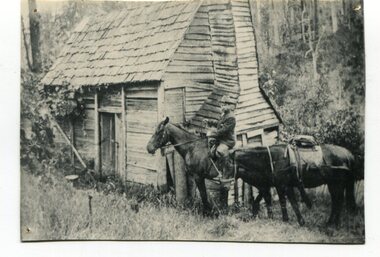 Orbost & District Historical Society
black and white photograph, early 20th century
... Germany. He left for Australia in August 1884. after various jobs and exploartions he travelled to South Gippsland in 1889. He got a job on the railways and then worked as a carpenter in Leongatha where he was an early builder of the township. He journeyed with a mate to the Murrungowar area and became one of the first pioneers...Germany. He left for Australia in August 1884. after various jobs and exploartions he travelled to South Gippsland in 1889. He got a job on the railways and then worked as a carpenter in Leongatha where he was an early builder of the township. He journeyed with a mate to the Murrungowar area and became one of the first pioneers ...This appears to be a photograph of Augustus Willhelm Scharlemann who was born on 16th July 1861, at Celle, Uetze, Province of Hanover, Germany. He left for Australia in August 1884. after various jobs and exploartions he travelled to South Gippsland in 1889. He got a job on the railways and then worked as a carpenter in Leongatha where he was an early builder of the township. He journeyed with a mate to the Murrungowar area and became one of the first pioneers when he selected land at Glen Arte, Upper Murrungowar in 1891. On 21st December, 1899, he became a naturalised Australian. At Murrungowar he bred a champion hunter which, when sold, won 400 prizes in two years, taking prizes at Melbourne, Sydney and Adelaide in 1911-12. He married Margaret Agnew Gray, daughter of Rev. William and Mrs. Annie Gray, at the Manse, Orbost, on 24th November 1909, and there were three children born to the couple: Elfriede Louisa Wilhelmina, born 10th October 1910, decd. 1917. Rotha Margaret, born 23rd November 1913. Donald Ross, born 22nd March 1922. After leaving Murrungowar in 1922 the family moved to Orbost where Billie did carpentry for several years. In 1929 he became curator of the Orbost Bowling Green, a position he held until about 1937. He died on 6th June 1940, and was buried on 7th June 1940, at 10 a.m. by Presbyterian Rev. J. G. Bucknall. (info. John Phillips October 2008 Newsletter)This is a pictorial record of Augustus Willhelm Scharlemann. an early settler of Murrugowar, which was a small township east of Orbost.A copy of a black / white photograph of a wooden cabin in a bush setting. On the right side there is a man on a horse holding the reins to another horse.murrungowar scharlemann-augustus-willhelm -
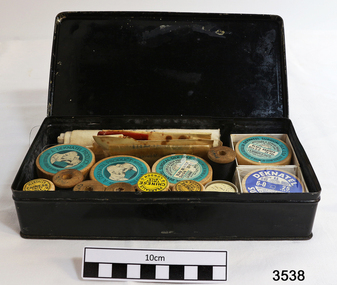 Flagstaff Hill Maritime Museum and Village
Equipment - Surgical silks and sutures, Teleflex (manufacturers of Deknatel), Early 1900s
... Dr Angus assisted Dr Tom Ryan, a pioneer in the use of X-rays and in ocular surgery. flagstaff hill warrnambool shipwrecked-coast flagstaff-hill flagstaff-hill-maritime-museum maritime-museum shipwreck-coast flagstaff-hill-maritime-village surgical silks and sutures dr w r angus medical equipment surgical instrument dr ryan ophthalmology s.s. largs bay warrnambool base hospital nhill base hospital flying doctor medical history medical treatment mira hospital medical education sutures surgical silk ‘MEDRAFIL, Dr MULLER- MEERNACH, Nr O, MADE IN GERMANY.’ printed on one of the paper bags in the box containing a suture bobbin. ...Through many millennia, various suture materials were used or proposed. Needles were made of bone or metals such as silver, copper, and aluminium bronze wire. Sutures were made of plant materials (flax, hemp and cotton) or animal material (hair, tendons, arteries, muscle strips and nerves, silk, and catgut).[citation needed] The earliest reports of surgical suture date to 3000 BC in ancient Egypt, and the oldest known suture is in a mummy from 1100 BC. A detailed description of a wound suture and the suture materials used in it is by the Indian sage and physician Sushruta, written in 500 BC. The Greek father of medicine, Hippocrates, described suture techniques, as did the later Roman Aulus Cornelius Celsus. The 2nd-century Roman physician Galen described sutures made of surgical gut or catgut. In the 10th century, the catgut suture along with the surgery needle were used in operations by Abulcasis. The gut suture was similar to that of strings for violins, guitars, and tennis racquets and it involved harvesting sheep or cow intestines. Catgut sometimes led to infection due to a lack of disinfection and sterilization of the material. Joseph Lister endorsed the routine sterilization of all suture threads. He first attempted sterilization with the 1860s "carbolic catgut," and chromic catgut followed two decades later. Sterile catgut was finally achieved in 1906 with iodine treatment. The next great leap came in the twentieth century. The chemical industry drove production of the first synthetic thread in the early 1930s, which exploded into production of numerous absorbable and non-absorbable synthetics. The first synthetic absorbable was based on polyvinyl alcohol in 1931. Polyesters were developed in the 1950s, and later the process of radiation sterilization was established for catgut and polyester. Polyglycolic acid was discovered in the 1960s and implemented in the 1970s. Today, most sutures are made of synthetic polymer fibers. Silk and, rarely, gut sutures are the only materials still in use from ancient times. In fact, gut sutures have been banned in Europe and Japan owing to concerns regarding bovine spongiform encephalopathy. Silk suture is still used today, mainly to secure surgical drains. https://en.wikipedia.org/wiki/Surgical_suture#:~:text=Sutures%20were%20made%20of%20plant,a%20mummy%20from%201100%20BC. This tin contains a variety of surgical threads and accessories that were used by Dr W.R.Angus. It was donated to Flagstaff Hill Maritime Village by the family of Doctor William Roy Angus, Surgeon and Oculist. It is part of the “W.R. Angus Collection” that includes historical medical equipment, surgical instruments and material once belonging to Dr Edward Ryan and Dr Thomas Francis Ryan, (both of Nhill, Victoria) as well as Dr Angus’ own belongings. The Collection’s history spans the medical practices of the two Doctors Ryan, from 1885-1926 plus that of Dr Angus, up until 1969. ABOUT THE “W.R.ANGUS COLLECTION” Doctor William Roy Angus M.B., B.S., Adel., 1923, F.R.C.S. Edin.,1928 (also known as Dr Roy Angus) was born in Murrumbeena, Victoria in 1901 and lived until 1970. He qualified as a doctor in 1923 at University of Adelaide, was Resident Medical Officer at the Royal Adelaide Hospital in 1924 and for a period was house surgeon to Sir (then Mr.) Henry Simpson Newland. Dr Angus was briefly an Assistant to Dr Riddell of Kapunda, then commenced private practice at Curramulka, Yorke Peninsula, SA, where he was physician, surgeon and chemist. In 1926, he was appointed as new Medical Assistant to Dr Thomas Francis Ryan (T.F. Ryan, or Tom), in Nhill, Victoria, where his experiences included radiology and pharmacy. In 1927 he was Acting House Surgeon in Dr Tom Ryan’s absence. Dr Angus had become engaged to Gladys Forsyth and they decided he would take time to further his studies overseas in the UK in 1927. He studied at London University College Hospital and at Edinburgh Royal Infirmary and in 1928, was awarded FRCS (Fellow from the Royal College of Surgeons), Edinburgh. He worked his passage back to Australia as a Ship’s Surgeon on the on the Australian Commonwealth Line’s SS Largs Bay. Dr Angus married Gladys in 1929, in Ballarat. (They went on to have one son (Graham 1932, born in SA) and two daughters (Helen (died 12/07/1996) and Berenice (Berry), both born at Mira, Nhill ) Dr Angus was a ‘flying doctor’ for the A.I.M. (Australian Inland Ministry) Aerial Medical Service in 1928 . The organisation began in South Australia through the Presbyterian Church in that year, with its first station being in the remote town of Oodnadatta, where Dr Angus was stationed. He was locum tenens there on North-South Railway at 21 Mile Camp. He took up this ‘flying doctor’ position in response to a call from Dr John Flynn; the organisation was later known as the Flying Doctor Service, then the Royal Flying Doctor Service. A lot of his work during this time involved dental surgery also. Between 1928-1932 he was surgeon at the Curramulka Hospital, Yorke Peninsula, South Australia. In 1933 Dr Angus returned to Nhill where he’d previously worked as Medical Assistant and purchased a share of the Nelson Street practice and Mira hospital from Dr Les Middleton one of the Middleton Brothers, the current owners of what was once Dr Tom Ryan’s practice. Dr L Middleton was House Surgeon to the Nhill Hospital 1926-1933, when he resigned. [Dr Tom Ryan’s practice had originally belonged to his older brother Dr Edward Ryan, who came to Nhill in 1885. Dr Edward saw patients at his rooms, firstly in Victoria Street and in 1886 in Nelson Street, until 1901. The Nelson Street practice also had a 2 bed ward, called Mira Private Hospital ). Dr Edward Ryan was House Surgeon at the Nhill Hospital 1884-1902 . He also had occasions where he successfully performed veterinary surgery for the local farmers too. Dr Tom Ryan then purchased the practice from his brother in 1901. Both Dr Edward and Dr Tom Ryan work as surgeons included eye surgery. Dr Tom Ryan performed many of his operations in the Mira private hospital on his premises. He too was House Surgeon at the Nhill Hospital 1902-1926. Dr Tom Ryan had one of the only two pieces of radiology equipment in Victoria during his practicing years – The Royal Melbourne Hospital had the other one. Over the years Dr Tom Ryan gradually set up what was effectively a training school for country general-practitioner-surgeons. Each patient was carefully examined, including using the X-ray machine, and any surgery was discussed and planned with Dr Ryan’s assistants several days in advance. Dr Angus gained experience in using the X-ray machine there during his time as assistant to Dr Ryan. Dr Tom Ryan moved from Nhill in 1926. He became a Fellow of the Royal Australasian College of Surgeons in 1927, soon after its formation, a rare accolade for a doctor outside any of the major cities. He remained a bachelor and died suddenly on 7th Dec 1955, aged 91, at his home in Ararat. Scholarships and prizes are still awarded to medical students in the honour of Dr T.F. Ryan and his father, Dr Michael Ryan, and brother, John Patrick Ryan. ] When Dr Angus bought into the Nelson Street premises in Nhill he was also appointed as the Nhill Hospital’s Honorary House Surgeon 1933-1938. His practitioner’s plate from his Nhill surgery states “HOURS Daily, except Tuesdays, Fridays and Saturday afternoons, 9-10am, 2-4pm, 7-8pm. Sundays by appointment”. This plate is now mounted on the doorway to the Port Medical Office at Flagstaff Hill Maritime Village, Warrnambool. Dr Edward Ryan and Dr Tom Ryan had an extensive collection of historical medical equipment and materials spanning 1884-1926 and when Dr Angus took up practice in their old premises he obtained this collection, a large part of which is now on display at the Port Medical Office at Flagstaff Hill Maritime Village in Warrnambool. During his time in Nhill Dr Angus was involved in the merging of the Mira Hospital and Nhill Public Hospital into one public hospital and the property titles passed on to Nhill Hospital in 1939. In 1939 Dr Angus and his family moved to Warrnambool where he purchased “Birchwood,” the 1852 home and medical practice of Dr John Hunter Henderson, at 214 Koroit Street. (This property was sold in1965 to the State Government and is now the site of the Warrnambool Police Station. ). The Angus family was able to afford gardeners, cooks and maids; their home was a popular place for visiting dignitaries to stay whilst visiting Warrnambool. Dr Angus had his own silk worm farm at home in a Mulberry tree. His young daughter used his centrifuge for spinning the silk. Dr Angus was appointed on a part-time basis as Port Medical Officer (Health Officer) in Warrnambool and held this position until the 1940’s when the government no longer required the service of a Port Medical Officer in Warrnambool; he was thus Warrnambool’s last serving Port Medical Officer. (The duties of a Port Medical Officer were outlined by the Colonial Secretary on 21st June, 1839 under the terms of the Quarantine Act. Masters of immigrant ships arriving in port reported incidents of diseases, illness and death and the Port Medical Officer made a decision on whether the ship required Quarantine and for how long, in this way preventing contagious illness from spreading from new immigrants to the residents already in the colony.) Dr Angus was a member of the Australian Medical Association, for 35 years and surgeon at the Warrnambool Base Hospital 1939-1942, He served as a Surgeon Captain during WWII1942-45, in Ballarat, Victoria, and in Bonegilla, N.S.W., completing his service just before the end of the war due to suffering from a heart attack. During his convalescence he carved an intricate and ‘most artistic’ chess set from the material that dentures were made from. He then studied ophthalmology at the Royal Melbourne Eye and Ear Hospital and created cosmetically superior artificial eyes by pioneering using the intrascleral cartilage. Angus received accolades from the Ophthalmological Society of Australasia for this work. He returned to Warrnambool to commence practice as an ophthalmologist, pioneering in artificial eye improvements. He was Honorary Consultant Ophthalmologist to Warrnambool Base Hospital for 31 years. He made monthly visits to Portland as a visiting surgeon, to perform eye surgery. He represented the Victorian South-West subdivision of the Australian Medical Association as its secretary between 1949 and 1956 and as chairman from 1956 to 1958. In 1968 Dr Angus was elected member of Spain’s Barraquer Institute of Barcelona after his research work in Intrasclearal cartilage grafting, becoming one of the few Australian ophthalmologists to receive this honour, and in the following year presented his final paper on Living Intrasclearal Cartilage Implants at the Inaugural Meeting of the Australian College of Ophthalmologists in Melbourne In his personal life Dr Angus was a Presbyterian and treated Sunday as a Sabbath, a day of rest. He would visit 3 or 4 country patients on a Sunday, taking his children along ‘for the ride’ and to visit with him. Sunday evenings he would play the pianola and sing Scottish songs to his family. One of Dr Angus’ patients was Margaret MacKenzie, author of a book on local shipwrecks that she’d seen as an eye witness from the late 1880’s in Peterborough, Victoria. In the early 1950’s Dr Angus, painted a picture of a shipwreck for the cover jacket of Margaret’s book, Shipwrecks and More Shipwrecks. She was blind in later life and her daughter wrote the actual book for her. Dr Angus and his wife Gladys were very involved in Warrnambool’s society with a strong interest in civic affairs. Their interests included organisations such as Red Cross, Rostrum, Warrnambool and District Historical Society (founding members), Wine and Food Society, Steering Committee for Tertiary Education in Warrnambool, Local National Trust, Good Neighbour Council, Housing Commission Advisory Board, United Services Institute, Legion of Ex-Servicemen, Olympic Pool Committee, Food for Britain Organisation, Warrnambool Hospital, Anti-Cancer Council, Boys’ Club, Charitable Council, National Fitness Council and Air Raid Precautions Group. He was also a member of the Steam Preservation Society and derived much pleasure from a steam traction engine on his farm. He had an interest in people and the community He and his wife Gladys were both involved in the creation of Flagstaff Hill, including the layout of the gardens. After his death (28th March 1970) his family requested his practitioner’s plate, medical instruments and some personal belongings be displayed in the Port Medical Office surgery at Flagstaff Hill Maritime Village, and be called the “W. R. Angus Collection”. The repair of open wounds is essential to prevent infection and death. The W.R. Angus Collection is significant for still being located at the site it is connected with, Doctor Angus being the last Port Medical Officer in Warrnambool. The collection of medical instruments and other equipment is culturally significant, being an historical example of medicine from late 19th to mid-20th century. Dr Angus assisted Dr Tom Ryan, a pioneer in the use of X-rays and in ocular surgery. Black tin with hinged lid, containing reels and packets of surgical silk, gut and metal suture threads, scalpel blades, chamois and metal blade holder with tensioned chamois piece across top. (W.R. Angus Collection)‘MEDRAFIL, Dr MULLER- MEERNACH, Nr O, MADE IN GERMANY.’ printed on one of the paper bags in the box containing a suture bobbin. 'PEARSALL'S LONDON' printed on some bobbins. 'J A DEKNATEL & SON INC, QUEENS VILLAGE, LONG ISLAND NEW YORK' printed on others.flagstaff hill, warrnambool, shipwrecked-coast, flagstaff-hill, flagstaff-hill-maritime-museum, maritime-museum, shipwreck-coast, flagstaff-hill-maritime-village, surgical silks and sutures, dr w r angus, medical equipment, surgical instrument, dr ryan, ophthalmology, s.s. largs bay, warrnambool base hospital, nhill base hospital, flying doctor, medical history, medical treatment, mira hospital, medical education, sutures, surgical silk -
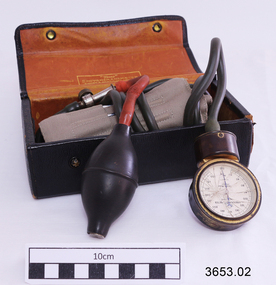 Flagstaff Hill Maritime Museum and Village
Instrument - Sphygmomanometer, Riester, 1948 -1969
... Dr Angus assisted Dr Tom Ryan, a pioneer in the use of X-rays and in ocular surgery. flagstaff hill flagstaff hill warrnambool maritime museum shipwreck coast flagstaff hill maritime village great ocean road sphygmomanometer chemist equipment dr w.r. angus medical instrument warrnambool base hospital medical treatment medical history "Patent 9535. No. 39370". Gold maker's stamp " "TYCOS" "SPHYGMOMANOMETER / SHORT & MASON LTD. LONDON / company’s logo”. Cloth label sewn on cuff "GERMANY ...This blood pressure monitor (sphygmomanometer) belonged to Dr William Roy Angus, surgeon and oculist. It was donated to Flagstaff Hill Maritime Village by his daughter, Berry McDade in January 2015. . It is part of the “W.R. Angus Collection” that includes historical medical equipment, surgical instruments and material once belonging to Dr Edward Ryan and Dr Thomas Francis Ryan, (both of Nhill, Victoria) as well as Dr Angus’ own belongings. The Collection’s history spans the medical practices of the two Doctors Ryan, from 1885-1926 plus that of Dr Angus, up until 1969. The approximate manufacture date of the blood pressure monitor coincides with the time when Doctor William Roy Angus had his practice in Warrnambool. The company Short & Mason Ltd. London used the brand name TYCOS between 1907-1969 and Rudolf Riester (the brand on the cuff) formed the company ‘Riester” in Germany in 1948, where he developed and produced the first mercury blood pressure monitors. In 1939 Dr Angus and his family moved to Warrnambool where he purchased “Birchwood,” the 1852 home and medical practice of Dr John Hunter Henderson, at 214 Koroit Street. (This property was sold in1965 to the State Government and is now the site of the Warrnambool Police Station.). Dr Angus was appointed on a part-time basis as Port Medical Officer (Health Officer) in Warrnambool and held this position until the 1940’s when the government no longer required the service of a Port Medical Officer in Warrnambool; he was thus Warrnambool’s last serving Port Medical Officer. (The duties of a Port Medical Officer were outlined by the Colonial Secretary on 21st June, 1839 under the terms of the Quarantine Act. Masters of immigrant ships arriving in port reported incidents of diseases, illness and death and the Port Medical Officer made a decision on whether the ship required Quarantine and for how long, in this way preventing contagious illness from spreading from new immigrants to the residents already in the colony.) Dr Angus was a member of the Australian Medical Association, for 35 years and surgeon at the Warrnambool Base Hospital 1939-1942, He served as a Surgeon Captain during WWII1942-45, in Ballarat, Victoria, and in Bonegilla, N.S.W., completing his service just before the end of the war due to suffering from a heart attack. During his convalescence he carved an intricate and ‘most artistic’ chess set from the material that dentures were made from. He then studied ophthalmology at the Royal Melbourne Eye and Ear Hospital and created cosmetically superior artificial eyes by pioneering using the intrascleral cartilage. Angus received accolades from the Ophthalmological Society of Australasia for this work. He returned to Warrnambool to commence practice as an ophthalmologist, pioneering in artificial eye improvements. He was Honorary Consultant Ophthalmologist to Warrnambool Base Hospital for 31 years. He made monthly visits to Portland as a visiting surgeon, to perform eye surgery. He represented the Victorian South-West subdivision of the Australian Medical Association as its secretary between 1949 and 1956 and as chairman from 1956 to 1958. In 1968 Dr Angus was elected member of Spain’s Barraquer Institute of Barcelona after his research work in Intrasclearal cartilage grafting, becoming one of the few Australian ophthalmologists to receive this honour, and in the following year presented his final paper on Living Intrasclearal Cartilage Implants at the Inaugural Meeting of the Australian College of Ophthalmologists in Melbourne. In his personal life Dr Angus was a Presbyterian and treated Sunday as a Sabbath, a day of rest. He would visit 3 or 4 country patients on a Sunday, taking his children along ‘for the ride’ and to visit with him. Sunday evenings he would play the pianola and sing Scottish songs to his family. One of Dr Angus’ patients was Margaret MacKenzie, author of a book on local shipwrecks that she’d seen as an eye witness from the late 1880’s in Peterborough, Victoria. In the early 1950’s Dr Angus, painted a picture of a shipwreck for the cover jacket of Margaret’s book, Shipwrecks and More Shipwrecks. She was blind in later life and her daughter wrote the actual book for her. Dr Angus and his wife Gladys were very involved in Warrnambool’s society with a strong interest in civic affairs. Their interests included organisations such as Red Cross, Rostrum, Warrnambool and District Historical Society (founding members), Wine and Food Society, Steering Committee for Tertiary Education in Warrnambool, Local National Trust, Good Neighbour Council, Housing Commission Advisory Board, United Services Institute, Legion of Ex-Servicemen, Olympic Pool Committee, Food for Britain Organisation, Warrnambool Hospital, Anti-Cancer Council, Boys’ Club, Charitable Council, National Fitness Council and Air Raid Precautions Group. He was also a member of the Steam Preservation Society and derived much pleasure from a steam traction engine on his farm. He had an interest in people and the community. He and his wife Gladys were both involved in the creation of Flagstaff Hill, including the layout of the gardens. After his death (28th March 1970) his family requested his practitioner’s plate, medical instruments and some personal belongings be displayed in the Port Medical Office surgery at Flagstaff Hill Maritime Village, and be called the “W. R. Angus Collection”. The W.R. Angus Collection is significant for still being located at the site it is connected with, Doctor Angus being the last Port Medical Officer in Warrnambool.. The collection of medical instruments and other equipment is culturally significant, being an historical example of medicine from late 19th to mid-20th century. Dr Angus assisted Dr Tom Ryan, a pioneer in the use of X-rays and in ocular surgery. Sphygmomanometer (blood pressure meter), from the collection of W.R. Angus. Brand TYCOS by Short & Mason Ltd, London. The case is of black leather with press-stud closure, lined in brown leather with gilded maker's embossing inside lid. The meter has a grey fabric cuff attached to two black rubber tubes, one tube has a pump bulb on a short brown extension tube on the end, the other has a round meter with glass covered dial on the end. Dial registers 20 – 300. There are maker's details on both meter and box."Patent 9535. No. 39370". Gold maker's stamp " "TYCOS" "SPHYGMOMANOMETER / SHORT & MASON LTD. LONDON / company’s logo”. Cloth label sewn on cuff "GERMANY / RIESTER"flagstaff hill, flagstaff hill warrnambool, maritime museum, shipwreck coast, flagstaff hill maritime village, great ocean road, sphygmomanometer, chemist equipment, dr w.r. angus, medical instrument, warrnambool base hospital, medical treatment, medical history -
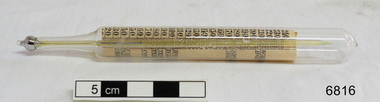 Flagstaff Hill Maritime Museum and Village
Instrument - Thermometer, 20th century
... Dr Angus assisted Dr Tom Ryan, a pioneer in the use of X-rays and in ocular surgery. flagstaff hill warrnambool shipwrecked coast flagstaff hill maritime museum maritime museum shipwreck coast flagstaff hill maritime village great ocean road dr w r angus dr ryan surgical instrument t.s.s. largs bay warrnambool base hospital nhill base hospital mira hospital flying doctor medical treatment scientific instrument medical instrument thermometer heat measurement dr forbes specifications german made thermometer Paper label inside thermometer has "Dr Forbes Specifications." ...Thermometer made to the specifications of Dr. Forbes. Used to measuring temperatures from freezing to boiling. It was donated to Flagstaff Hill Maritime Village by the family of Doctor William Roy Angus, Surgeon and Oculist. It is part of the “W.R. Angus Collection” that includes historical medical equipment, surgical instruments and material once belonging to Dr Edward Ryan and Dr Thomas Francis Ryan, (both of Nhill, Victoria) as well as Dr Angus’ own belongings. The Collection’s history spans the medical practices of the two Doctors Ryan, from 1885-1926 plus that of Dr Angus, up until 1969. ABOUT THE “W.R.ANGUS COLLECTION” Doctor William Roy Angus M.B., B.S., Adel., 1923, F.R.C.S. Edin.,1928 (also known as Dr Roy Angus) was born in Murrumbeena, Victoria in 1901 and lived until 1970. He qualified as a doctor in 1923 at University of Adelaide, was Resident Medical Officer at the Royal Adelaide Hospital in 1924 and for a period was house surgeon to Sir (then Mr.) Henry Simpson Newland. Dr Angus was briefly an Assistant to Dr Riddell of Kapunda, then commenced private practice at Curramulka, Yorke Peninsula, SA, where he was physician, surgeon and chemist. In 1926, he was appointed as new Medical Assistant to Dr Thomas Francis Ryan (T.F. Ryan, or Tom), in Nhill, Victoria, where his experiences included radiology and pharmacy. In 1927 he was Acting House Surgeon in Dr Tom Ryan’s absence. Dr Angus had become engaged to Gladys Forsyth and they decided he would take time to further his studies overseas in the UK in 1927. He studied at London University College Hospital and at Edinburgh Royal Infirmary and in 1928, was awarded FRCS (Fellow from the Royal College of Surgeons), Edinburgh. He worked his passage back to Australia as a Ship’s Surgeon on the on the Australian Commonwealth Line’s T.S.S. Largs Bay. Dr Angus married Gladys in 1929, in Ballarat. (They went on to have one son (Graham 1932, born in SA) and two daughters (Helen (died 12/07/1996) and Berenice (Berry), both born at Mira, Nhill ) Dr Angus was a ‘flying doctor’ for the A.I.M. (Australian Inland Ministry) Aerial Medical Service in 1928 . The organisation began in South Australia through the Presbyterian Church in that year, with its first station being in the remote town of Oodnadatta, where Dr Angus was stationed. He was locum tenens there on North-South Railway at 21 Mile Camp. He took up this ‘flying doctor’ position in response to a call from Dr John Flynn; the organisation was later known as the Flying Doctor Service, then the Royal Flying Doctor Service. A lot of his work during this time involved dental surgery also. Between 1928-1932 he was surgeon at the Curramulka Hospital, Yorke Peninsula, South Australia. In 1933 Dr Angus returned to Nhill where he’d previously worked as Medical Assistant and purchased a share of the Nelson Street practice and Mira hospital from Dr Les Middleton one of the Middleton Brothers, the current owners of what was once Dr Tom Ryan’s practice. Dr L Middleton was House Surgeon to the Nhill Hospital 1926-1933, when he resigned. [Dr Tom Ryan’s practice had originally belonged to his older brother Dr Edward Ryan, who came to Nhill in 1885. Dr Edward saw patients at his rooms, firstly in Victoria Street and in 1886 in Nelson Street, until 1901. The Nelson Street practice also had a 2 bed ward, called Mira Private Hospital ). Dr Edward Ryan was House Surgeon at the Nhill Hospital 1884-1902 . He also had occasions where he successfully performed veterinary surgery for the local farmers too. Dr Tom Ryan then purchased the practice from his brother in 1901. Both Dr Edward and Dr Tom Ryan work as surgeons included eye surgery. Dr Tom Ryan performed many of his operations in the Mira private hospital on his premises. He too was House Surgeon at the Nhill Hospital 1902-1926. Dr Tom Ryan had one of the only two pieces of radiology equipment in Victoria during his practicing years – The Royal Melbourne Hospital had the other one. Over the years Dr Tom Ryan gradually set up what was effectively a training school for country general-practitioner-surgeons. Each patient was carefully examined, including using the X-ray machine, and any surgery was discussed and planned with Dr Ryan’s assistants several days in advance. Dr Angus gained experience in using the X-ray machine there during his time as assistant to Dr Ryan. Dr Tom Ryan moved from Nhill in 1926. He became a Fellow of the Royal Australasian College of Surgeons in 1927, soon after its formation, a rare accolade for a doctor outside any of the major cities. He remained a bachelor and died suddenly on 7th Dec 1955, aged 91, at his home in Ararat. Scholarships and prizes are still awarded to medical students in the honour of Dr T.F. Ryan and his father, Dr Michael Ryan, and brother, John Patrick Ryan. ] When Dr Angus bought into the Nelson Street premises in Nhill he was also appointed as the Nhill Hospital’s Honorary House Surgeon 1933-1938. His practitioner’s plate from his Nhill surgery states “HOURS Daily, except Tuesdays, Fridays and Saturday afternoons, 9-10am, 2-4pm, 7-8pm. Sundays by appointment”. This plate is now mounted on the doorway to the Port Medical Office at Flagstaff Hill Maritime Village, Warrnambool. Dr Edward Ryan and Dr Tom Ryan had an extensive collection of historical medical equipment and materials spanning 1884-1926 and when Dr Angus took up practice in their old premises he obtained this collection, a large part of which is now on display at the Port Medical Office at Flagstaff Hill Maritime Village in Warrnambool. During his time in Nhill Dr Angus was involved in the merging of the Mira Hospital and Nhill Public Hospital into one public hospital and the property titles passed on to Nhill Hospital in 1939. In 1939 Dr Angus and his family moved to Warrnambool where he purchased “Birchwood,” the 1852 home and medical practice of Dr John Hunter Henderson, at 214 Koroit Street. (This property was sold in1965 to the State Government and is now the site of the Warrnambool Police Station. ). The Angus family was able to afford gardeners, cooks and maids; their home was a popular place for visiting dignitaries to stay whilst visiting Warrnambool. Dr Angus had his own silk worm farm at home in a Mulberry tree. His young daughter used his centrifuge for spinning the silk. Dr Angus was appointed on a part-time basis as Port Medical Officer (Health Officer) in Warrnambool and held this position until the 1940’s when the government no longer required the service of a Port Medical Officer in Warrnambool; he was thus Warrnambool’s last serving Port Medical Officer. (The duties of a Port Medical Officer were outlined by the Colonial Secretary on 21st June, 1839 under the terms of the Quarantine Act. Masters of immigrant ships arriving in port reported incidents of diseases, illness and death and the Port Medical Officer made a decision on whether the ship required Quarantine and for how long, in this way preventing contagious illness from spreading from new immigrants to the residents already in the colony.) Dr Angus was a member of the Australian Medical Association, for 35 years and surgeon at the Warrnambool Base Hospital 1939-1942, He served as a Surgeon Captain during WWII1942-45, in Ballarat, Victoria, and in Bonegilla, N.S.W., completing his service just before the end of the war due to suffering from a heart attack. During his convalescence he carved an intricate and ‘most artistic’ chess set from the material that dentures were made from. He then studied ophthalmology at the Royal Melbourne Eye and Ear Hospital and created cosmetically superior artificial eyes by pioneering using the intrascleral cartilage. Angus received accolades from the Ophthalmological Society of Australasia for this work. He returned to Warrnambool to commence practice as an ophthalmologist, pioneering in artificial eye improvements. He was Honorary Consultant Ophthalmologist to Warrnambool Base Hospital for 31 years. He made monthly visits to Portland as a visiting surgeon, to perform eye surgery. He represented the Victorian South-West subdivision of the Australian Medical Association as its secretary between 1949 and 1956 and as chairman from 1956 to 1958. In 1968 Dr Angus was elected member of Spain’s Barraquer Institute of Barcelona after his research work in Intrasclearal cartilage grafting, becoming one of the few Australian ophthalmologists to receive this honour, and in the following year presented his final paper on Living Intrasclearal Cartilage Implants at the Inaugural Meeting of the Australian College of Ophthalmologists in Melbourne In his personal life Dr Angus was a Presbyterian and treated Sunday as a Sabbath, a day of rest. He would visit 3 or 4 country patients on a Sunday, taking his children along ‘for the ride’ and to visit with him. Sunday evenings he would play the pianola and sing Scottish songs to his family. One of Dr Angus’ patients was Margaret MacKenzie, author of a book on local shipwrecks that she’d seen as an eye witness from the late 1880’s in Peterborough, Victoria. In the early 1950’s Dr Angus, painted a picture of a shipwreck for the cover jacket of Margaret’s book, Shipwrecks and More Shipwrecks. She was blind in later life and her daughter wrote the actual book for her. Dr Angus and his wife Gladys were very involved in Warrnambool’s society with a strong interest in civic affairs. Their interests included organisations such as Red Cross, Rostrum, Warrnambool and District Historical Society (founding members), Wine and Food Society, Steering Committee for Tertiary Education in Warrnambool, Local National Trust, Good Neighbour Council, Housing Commission Advisory Board, United Services Institute, Legion of Ex-Servicemen, Olympic Pool Committee, Food for Britain Organisation, Warrnambool Hospital, Anti-Cancer Council, Boys’ Club, Charitable Council, National Fitness Council and Air Raid Precautions Group. He was also a member of the Steam Preservation Society and derived much pleasure from a steam traction engine on his farm. He had an interest in people and the community He and his wife Gladys were both involved in the creation of Flagstaff Hill, including the layout of the gardens. After his death (28th March 1970) his family requested his practitioner’s plate, medical instruments and some personal belongings be displayed in the Port Medical Office surgery at Flagstaff Hill Maritime Village, and be called the “W. R. Angus Collection”. The W.R. Angus Collection is significant for still being located at the site it is connected with, Doctor Angus being the last Port Medical Officer in Warrnambool. The collection of medical instruments and other equipment is culturally significant, being an historical example of medicine from late 19th to mid-20th century. Dr Angus assisted Dr Tom Ryan, a pioneer in the use of X-rays and in ocular surgery. Thermometer, glass, part of the W.R. Angus Collection. Scale 15 - 240, "Dr Forbes Specifications." Made in Germany. "Freezing" up to "Warm Boil" Paper label inside thermometer has "Dr Forbes Specifications." Made in Germany. "Freezing" up to "Warm Boil" flagstaff hill, warrnambool, shipwrecked coast, flagstaff hill maritime museum, maritime museum, shipwreck coast, flagstaff hill maritime village, great ocean road, dr w r angus, dr ryan, surgical instrument, t.s.s. largs bay, warrnambool base hospital, nhill base hospital, mira hospital, flying doctor, medical treatment, scientific instrument, medical instrument, thermometer, heat measurement, dr forbes specifications, german made thermometer -
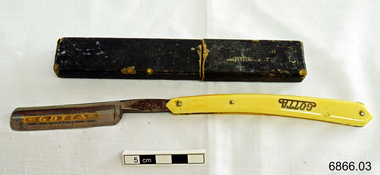 Flagstaff Hill Maritime Museum and Village
Domestic object - Razor, 1900's
... pioneer in the use of X-rays and in ocular surgery. Flagstaff Hill Warrnambool Shipwrecked coast Flagstaff Hill Maritime Museum Maritime Museum Shipwreck coast Flagstaff Hill Maritime Village Great Ocean Road Dr W R Angus Dr Ryan cut-throat razor gotta razor german made razor personal effects 1900's grooming equipment 1900's Embossed on box "No. 42 / DES GERMAN MANUFACTURE", on handle "GOTTA", on blade "HAMBURG RING / REG. ...This cut-throat razor was donated to Flagstaff Hill Maritime Village by the family of Doctor William Roy Angus, Surgeon and Oculist. It is part of the “W.R. Angus Collection” includes historical medical equipment, surgical instruments and material once belonging to Dr Edward Ryan and Dr Thomas Francis Ryan, (both of Nhill, Victoria) as well as Dr Angus’ own belongings. The Collection’s history spans the medical practices of the two Doctors Ryan, from 1885-1926 plus that of Dr Angus, up until 1969. ABOUT THE “W.R.ANGUS COLLECTION” Doctor William Roy Angus M.B., B.S., Adel., 1923, F.R.C.S. Edin.,1928 (also known as Dr Roy Angus) was born in Murrumbeena, Victoria in 1901 and lived until 1970. He qualified as a doctor in 1923 at University of Adelaide, was Resident Medical Officer at the Royal Adelaide Hospital in 1924 and for a period was house surgeon to Sir (then Mr.) Henry Simpson Newland. Dr Angus was briefly an Assistant to Dr Riddell of Kapunda, then commenced private practice at Curramulka, Yorke Peninsula, SA, where he was physician, surgeon and chemist. In 1926, he was appointed as new Medical Assistant to Dr Thomas Francis Ryan (T.F. Ryan, or Tom), in Nhill, Victoria, where his experiences included radiology and pharmacy. In 1927 he was Acting House Surgeon in Dr Tom Ryan’s absence. Dr Angus had become engaged to Gladys Forsyth and they decided he further his studies overseas in the UK in 1927. He studied at London University College Hospital and at Edinburgh Royal Infirmary and in 1928, was awarded FRCS (Fellow from the Royal College of Surgeons), Edinburgh. He worked his passage back to Australia as a Ship’s Surgeon on the on the Australian Commonwealth Line’s T.S.S. Largs Bay. Dr Angus married Gladys in 1929, in Ballarat. (They went on to have one son (Graham 1932, born in SA) and two daughters (Helen (died 12/07/1996) and Berenice (Berry), both born at Mira, Nhill ) According to Berry, her mother Gladys made a lot of their clothes. She was very talented and did some lovely embroidery including lingerie for her trousseau and beautifully handmade baby clothes. Dr Angus was a ‘flying doctor’ for the A.I.M. (Australian Inland Ministry) Aerial Medical Service in 1928 . Its first station was in the remote town of Oodnadatta, where Dr Angus was stationed. He was locum tenens there on North-South Railway at 21 Mile Camp. He took up this ‘flying doctor’ position in response to a call from Dr John Flynn; the organisation was later known as the Flying Doctor Service, then the Royal Flying Doctor Service. A lot of his work during this time involved dental surgery also. Between 1928-1932 he was surgeon at the Curramulka Hospital, Yorke Peninsula, South Australia. In 1933 Dr Angus returned to Nhill and purchased a share of the Nelson Street practice and Mira hospital (a 2 bed ward at the Nelson Street Practice) from Dr Les Middleton one of the Middleton Brothers, the current owners of what previously once Dr Tom Ryan’s practice. Dr Tom and his brother had worked as surgeons included eye surgery. Dr Tom Ryan performed many of his operations in the Mira private hospital on his premises. He had been House Surgeon at the Nhill Hospital 1902-1926. Dr Tom Ryan had one of the only two pieces of radiology equipment in Victoria during his practicing years – The Royal Melbourne Hospital had the other one. Over the years Dr Tom Ryan had gradually set up what was effectively a training school for country general-practitioner-surgeons. Each patient was carefully examined, including using the X-ray machine, and any surgery was discussed and planned with Dr Ryan’s assistants several days in advance. Dr Angus gained experience in using the X-ray machine there during his time as assistant to Dr Ryan. When Dr Angus bought into the Nelson Street premises in Nhill he was also appointed as the Nhill Hospital’s Honorary House Surgeon 1933-1938. His practitioner’s plate from his Nhill surgery is now mounted on the doorway to the Port Medical Office at Flagstaff Hill Maritime Village, Warrnambool. When Dr Angus took up practice in the Dr Edward and Dr Tom Ryan’s old premises he obtained their extensive collection of historical medical equipment and materials spanning 1884-1926. A large part of this collection is now on display at the Port Medical Office at Flagstaff Hill Maritime Village in Warrnambool. In 1939 Dr Angus and his family moved to Warrnambool where he purchased “Birchwood,” the 1852 home and medical practice of Dr John Hunter Henderson, at 214 Koroit Street. (This property was sold in1965 to the State Government and is now the site of the Warrnambool Police Station. and an ALDI sore is on the land that was once their tennis court). The Angus family was able to afford gardeners, cooks and maids; their home was a popular place for visiting dignitaries to stay whilst visiting Warrnambool. Dr Angus had his own silk worm farm at home in a Mulberry tree. His young daughter used his centrifuge for spinning the silk. Dr Angus was appointed on a part-time basis as Port Medical Officer (Health Officer) in Warrnambool and held this position until the 1940’s when the government no longer required the service of a Port Medical Officer in Warrnambool; he was thus Warrnambool’s last serving Port Medical Officer. (Masters of immigrant ships arriving in port reported incidents of diseases, illness and death and the Port Medical Officer made a decision on whether the ship required Quarantine and for how long, in this way preventing contagious illness from spreading from new immigrants to the residents already in the colony.) Dr Angus was a member of the Australian Medical Association, for 35 years and surgeon at the Warrnambool Base Hospital 1939-1942, He served as a Surgeon Captain during WWII1942-45, in Ballarat, Victoria, and in Bonegilla, N.S.W., completing his service just before the end of the war due to suffering from a heart attack. During his convalescence he carved an intricate and ‘most artistic’ chess set from the material that dentures were made from. He then studied ophthalmology at the Royal Melbourne Eye and Ear Hospital and created cosmetically superior artificial eyes by pioneering using the intrascleral cartilage. Angus received accolades from the Ophthalmological Society of Australasia for this work. He returned to Warrnambool to commence practice as an ophthalmologist, pioneering in artificial eye improvements. He was Honorary Consultant Ophthalmologist to Warrnambool Base Hospital for 31 years. He made monthly visits to Portland as a visiting surgeon, to perform eye surgery. He represented the Victorian South-West subdivision of the Australian Medical Association as its secretary between 1949 and 1956 and as chairman from 1956 to 1958. In 1968 Dr Angus was elected member of Spain’s Barraquer Institute of Barcelona after his research work in Intrasclearal cartilage grafting, becoming one of the few Australian ophthalmologists to receive this honour, and in the following year presented his final paper on Living Intrasclearal Cartilage Implants at the Inaugural Meeting of the Australian College of Ophthalmologists in Melbourne In his personal life Dr Angus was a Presbyterian and treated Sunday as a Sabbath, a day of rest. He would visit 3 or 4 country patients on a Sunday, taking his children along ‘for the ride’ and to visit with him. Sunday evenings he would play the pianola and sing Scottish songs to his family. One of Dr Angus’ patients was Margaret MacKenzie, author of a book on local shipwrecks that she’d seen as an eye witness from the late 1880’s in Peterborough, Victoria. In the early 1950’s Dr Angus, painted a picture of a shipwreck for the cover jacket of Margaret’s book, Shipwrecks and More Shipwrecks. She was blind in later life and her daughter wrote the actual book for her. Dr Angus and his wife Gladys were very involved in Warrnambool’s society with a strong interest in civic affairs. He had an interest in people and the community They were both involved in the creation of Flagstaff Hill, including the layout of the gardens. After his death (28th March 1970) his family requested his practitioner’s plate, medical instruments and some personal belongings be displayed in the Port Medical Office surgery at Flagstaff Hill Maritime Village, and be called the “W. R. Angus Collection”. The W.R. Angus Collection is significant for still being located at the site it is connected with, Doctor Angus being the last Port Medical Officer in Warrnambool. The collection of medical instruments and other equipment is culturally significant, being an historical example of medicine from late 19th to mid-20th century. Dr Angus assisted Dr Tom Ryan, a pioneer in the use of X-rays and in ocular surgery. Cut-throat razor, part of the W.R. Angus Collection. Razor model No. 42, steel blade, in dark cardboard box, with bone handle, arrow shaped end; blade swings inside the handle. Razor made in Germany with blade made in Sheffield, England, in early 1900’s.Embossed on box "No. 42 / DES GERMAN MANUFACTURE", on handle "GOTTA", on blade "HAMBURG RING / REG. GOTTA REG. / SUPER FINE" and "FINEST SHEFFIELD STEEL / FORGED AND - - - HOLLOW / GROUND IN GERMANY" flagstaff hill, warrnambool, shipwrecked coast, flagstaff hill maritime museum, maritime museum, shipwreck coast, flagstaff hill maritime village, great ocean road, dr w r angus, dr ryan, cut-throat razor, gotta razor, german made razor, personal effects 1900's, grooming equipment 1900's -
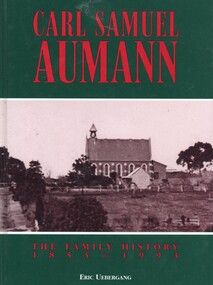 Ringwood and District Historical Society
Book, Carl Samuel Aumann - The Family History 1853-1993, 1993
... German families of Doncaster as "Father" Aumann. Their hard work made the foundation for a prosperous country." Front cover: Bismark Street (Victoria Street), Doncaster. Lutheran Church and the home of Carl Aumann alongside the church. Hard cover book by Eric Uebergang. This book pays tribute to the Aumann pioneers ...Hard cover book by Eric Uebergang. This book pays tribute to the Aumann pioneers in Australia and records details of their lives and those of their descendants to the year 1993, following a meeting of descendants in East Doncaster in 1992 and a family reunion in 1993 at the Lutheran Church in Doncaster, Victoria."Dedicated to the Memory of Carl Samuel Aumann, who with his family, made the arduous journey to Australia, to an unknown land. Known to the early German families of Doncaster as "Father" Aumann. Their hard work made the foundation for a prosperous country." Front cover: Bismark Street (Victoria Street), Doncaster. Lutheran Church and the home of Carl Aumann alongside the church. -
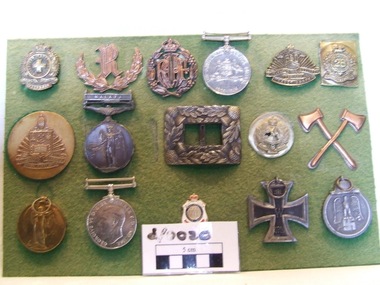 Waverley RSL Sub Branch
Badge Board
... Pioneers, Victory Medal 14-18,St. Bernards College Cadet Badge, 26th Light Horse, R.S.L. badge,Iron Cross, ?German...Pioneers, Victory Medal 14-18,St. Bernards College Cadet Badge, 26th Light Horse, R.S.L. badge,Iron Cross, ?German ...Badge Board shows Badges of Units from WWIBadge Board with mounted badges: Volunteer Cadets,Unknown,R.A.A.F. Service Medal 39-45,Melbourne Grammar,General Service Medal 18-62 with Malaya bar,Highland belt buckle,8th Light Horse,Pioneers, Victory Medal 14-18,St. Bernards College Cadet Badge, 26th Light Horse, R.S.L. badge,Iron Cross, ?German Service Medalh15cm w20cmmedal, badge -
 Waverley RSL Sub Branch
Painting Roy Longmore, RoyLongmore
... Germans appeared over a hill armed with machine guns and opened fire. Jerry riddled me, knocking me flat on my back, and the last I heard was 'Longy's had it, they got him.'" Fortunately, his fellow soldiers saw him move and rescued him.[3] Lance Sergeant (LSgt) and returned to Australia on 16 March 1919 as a member of the 2nd Pioneer Battalion.[2] Civilian life[edit] After returning to Australia in 1919, his injuries made returning to farm work impossible, so he drove a taxi in Melbourne. ...Germans appeared over a hill armed with machine guns and opened fire. Jerry riddled me, knocking me flat on my back, and the last I heard was 'Longy's had it, they got him.'" Fortunately, his fellow soldiers saw him move and rescued him.[3] Lance Sergeant (LSgt) and returned to Australia on 16 March 1919 as a member of the 2nd Pioneer Battalion.[2] Civilian life[edit] After returning to Australia in 1919, his injuries made returning to farm work impossible, so he drove a taxi in Melbourne. ...Longmore set aside his life as a farm-hand in Geelong, Victoria, when he enlisted in the Australian Imperial Force at age 21. Private (Pte) Roy Longmore, 3rd Reinforcements, 21st Battalion, of Bannockburn, Victoria enlisted on 13 July 1915; and he embarked from Melbourne aboard HMAT Anchises on 26 August 1915.[2] After training in Egypt, was sent to the Battle of Gallipoli where he was a tunnel digger with the 2nd Division, burrowing underneath the Turkish positions and laying mines. After evacuation from Turkey, he fought at Pozières, Armentières, and Villers-Bretonneux.[1] He was wounded three times in France and was momentarily given up for dead when he was shot as the Armistice in November 1918, approached. He later recalled, "We were patrolling in a gully when suddenly half a dozen Germans appeared over a hill armed with machine guns and opened fire. Jerry riddled me, knocking me flat on my back, and the last I heard was 'Longy's had it, they got him.'" Fortunately, his fellow soldiers saw him move and rescued him.[3] Lance Sergeant (LSgt) and returned to Australia on 16 March 1919 as a member of the 2nd Pioneer Battalion.[2] Civilian life[edit] After returning to Australia in 1919, his injuries made returning to farm work impossible, so he drove a taxi in Melbourne. Another change caused by the war was more telling. Before, he had hunted rabbits; but he later explained that when he returned home, he no longer had an appetite for firing at anything alive.[3] Longmore married and had one son, Eric.[1] The one-time LSgt Longmore died peacefully in his sleep at a Burwood Nursing Home aged 107 on 21 June 2001. He was the second last Anzac to die.[2] At his death, Australia honored him one final time with a state funeral.[3] Australian "legend"[edit] In 2000, Longmore was recognized as one of the "Australian Legends." His name and photograph were honored as part of an annual series of commemorative postage stamps issued by Australia Post since 1997. The stamps commemorate living Australians "who have made lifetime contributions to the development of Australia's national identity and character".[4] Longmore lived to fully enjoy this honor.[3] Longmore's 45-cent Legend stamp displays the soldier's portrait as a young man, photographed just prior to his departure for Gallipoli. Formal photographs of the other two ANZAC centenarians complete this stamp set. In addition, a fourth stamp features the 1914-15 star medal which was presented to all those who fought in campaigns during those war years.[5] These stamps, designed by Cathleen Cram of the Australia Post Design Studio, commemorate the story of events and people shaping contemporary Australia.[6] The Longmore stamp honors him as an individual and as a representative of all 68,000 soldiers at Gallipoli whose actions affected Australia's evolving self-image.[7] http://en.wikipedia.org/wiki/Roy_LongmoreFramed painting of Roy Longmore wooden frame glass fronted -
 Eltham District Historical Society Inc
Slide, The Society's parade float outside 63 Batman Road, Eltham, 11 Aug 1979
... Following the success of this event, it was considered that future parades were an important annual event for the society to participate in. eltham festival parade parade floats pioneers of eltham eltham district historical society shire of eltham historical society 35 mm colour positive transparency Mount - Agfachrome Professional black (Germany) 4 dots The Society's parade float outside 63 Batman Road, Eltham Slide Slide ...The fifth Eltham Community Festival was held 11-20 August 1979. The theme of the festival was “Along the Main Road” and was the first time the Shire of Eltham Historical Society (forerunner of the Etham District Historical Society) entered a float in the Festival Grand Parade. The Society's participation in this year's Eltham Community Festival was highly successful. We arranged an exhibition in the Eltham Library on the theme of ''Along the Main Road" and our float in the Festival Grand Parade "Pioneers of Eltham" won the prize donated by Pegasus Interiors for the best Eltham theme. The success of the float was due mainly to the efforts of Joh Ebeli. Joh was entirely responsible for the design and artistic work on the float and with help from Geoffery Loftus-Hills and Mark Gough actually constructed it. Society members and friends together with members of the Victorian Folk Music Club completed the picture, riding on and walking with the float in the parade. Mrs. Opal Smith and Mrs. B. Brinkkotter organized many of the costumes for participating members and Mrs. Phyllis Macdonald made the arrangements with the Victorian Folk Music Club. Thanks were also due to Mr. P. Quirke of Research Fruit Supply for the loan of his truck and to Eltham Hardware and Plumbing Supplies for the donation of materials for construction of the float. The $50.00 prize was shared with the Victorian Folk Music Club. Following the success of this event, it was considered that future parades were an important annual event for the society to participate in. 35 mm colour positive transparency Mount - Agfachrome Professional black (Germany) 4 dotseltham festival, parade, parade floats, pioneers of eltham, eltham district historical society, shire of eltham historical society -
 Eltham District Historical Society Inc
Slide, The Society's parade float outside 63 Batman Road, Eltham, 11 Aug 1979
... Following the success of this event, it was considered that future parades were an important annual event for the society to participate in. eltham festival parade parade floats pioneers of eltham eltham district historical society shire of eltham historical society 35 mm colour positive transparency Mount - Agfachrome Professional black (Germany) 4 dots The Society's parade float outside 63 Batman Road, Eltham Slide Slide ...The fifth Eltham Community Festival was held 11-20 August 1979. The theme of the festival was “Along the Main Road” and was the first time the Shire of Eltham Historical Society (forerunner of the Etham District Historical Society) entered a float in the Festival Grand Parade. The Society's participation in this year's Eltham Community Festival was highly successful. We arranged an exhibition in the Eltham Library on the theme of ''Along the Main Road" and our float in the Festival Grand Parade "Pioneers of Eltham" won the prize donated by Pegasus Interiors for the best Eltham theme. The success of the float was due mainly to the efforts of Joh Ebeli. Joh was entirely responsible for the design and artistic work on the float and with help from Geoffery Loftus-Hills and Mark Gough actually constructed it. Society members and friends together with members of the Victorian Folk Music Club completed the picture, riding on and walking with the float in the parade. Mrs. Opal Smith and Mrs. B. Brinkkotter organized many of the costumes for participating members and Mrs. Phyllis Macdonald made the arrangements with the Victorian Folk Music Club. Thanks were also due to Mr. P. Quirke of Research Fruit Supply for the loan of his truck and to Eltham Hardware and Plumbing Supplies for the donation of materials for construction of the float. The $50.00 prize was shared with the Victorian Folk Music Club. Following the success of this event, it was considered that future parades were an important annual event for the society to participate in. 35 mm colour positive transparency Mount - Agfachrome Professional black (Germany) 4 dotseltham festival, parade, parade floats, pioneers of eltham, eltham district historical society, shire of eltham historical society
