
Showing 52 items matching "german settlers"
-
 Bendigo Historical Society Inc.
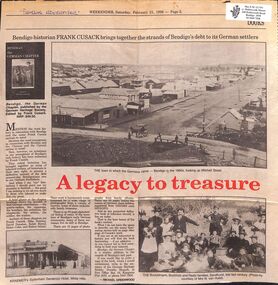
Ephemera - Newspaper clipping relating to German settlers in Bendigo
... Newspaper clipping relating to German settlers in Bendigo....Ephemera Newspaper clipping relating to German settlers in Bendigo. ...Newspaper clipping. February, 1998. Article reports on Frank Cusack's book titled 'Bendigo the German Chapter'. Ribbon from the 'National Council Women Bendigo'. Golden Anniversary - 50 years. 1948-1998. The National Council of Women of Victoria (NCWVIC) was founded in Victoria, Australia, in 1902 with Janet Clarke as the founding president. The organisation is a branch of the National Council of Women of Australia, and the International Council of Women. It is an umbrella group for a number of associated member organisations and aims to progress women's issues and women's rights in the state of Victoria.national council women, cusack, german -
 Whitehorse Historical Society Inc.
Document, German Settlers of Doncaster
... German Settlers of Doncaster...Information from 'German Pioneer Families in Australia' of early settlers....German Settlers of Doncaster Document Document ...Information from 'German Pioneer Families in Australia' of early settlers.Information from 'German Pioneer Families in Australia' of early settlers.Information from 'German Pioneer Families in Australia' of early settlers.schramm's cottage, von schramm, max rev., orchardists, thiele, henry, lutheran church, athenaeum, john gottfried, anna may, hanke, louise ida, karoline bertha, ernst john, carl william, finger, karl hernrich, christian benjamin, charles henry, ernest f., caroline emma, august, dorothea, ferdinand, eric, neumann, johanne louise, johann, fankhauser, george, john, schramm, rachel, rhoda, joseph, ada, victor, schramm albert, walter, hubert -
 Federation University Historical Collection
Book, The Germans in Australia, 1985, 1985
... Yellow hard covered book of 182 pages on German settlers in Australia....german-australians barossa valley germany germans world war one world war two immigration silesia posen prussia ferdinand von mueller krummow hamilton ludwig leichardt bernard holtermann bethany hahndorf lutheran anna ey amalie dietrich maria heller ruth ihle tanunda refugees dunera Yellow hard covered book of 182 pages on German settlers in Australia. The Germans in Australia, 1985 Book Book ...Yellow hard covered book of 182 pages on German settlers in Australia.german-australians, barossa valley, germany, germans, world war one, world war two, immigration, silesia, posen, prussia, ferdinand von mueller, krummow, hamilton, ludwig leichardt, bernard holtermann, bethany, hahndorf, lutheran, anna ey, amalie dietrich, maria heller, ruth ihle, tanunda, refugees, dunera -
Bendigo Historical Society Inc.
Book - "Bendigo the German Chapter", Frank Cusack, 1998
... ...German settlers...German community German settlers Quartz mining Signed in blue ink by the editor "Frank Cusack 6.2.'98" Black soft cover book. ...Black soft cover book. Edited by Frank Cusack. The front cover has a reproduction of a painting of Theodore and Christopher Ballerstedt.(SLV). The back cover has a photograph of Frank Cusack. Includes black and white illustrations and photographs. 275 pp. Published by the German Heritage Society. 1998. Printed by Richard Cambridge, Bendigo.Signed in blue ink by the editor "Frank Cusack 6.2.'98"german community, german settlers, quartz mining -
 The Beechworth Burke Museum
Photograph, c1999/2000
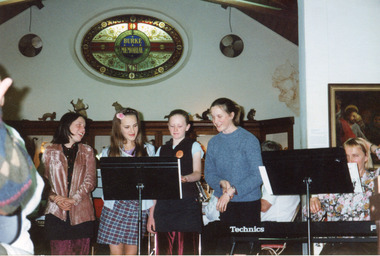
... ...european settlers...german...'Liedertafel' is a German tradition that accompanied European settlers to Australia. ...'Liedertafel' is a German tradition that accompanied European settlers to Australia. ...This photograph depicts female singers accompanied by members of the Beechworth Band at a 'Liedertafel' concert in the main hall at the Burke Museum in 1999. The concert related to an exhibition titled, 'From the Liedertafel to the Skating Rink: Entertainment in Beechworth 1852 - early 1900s', which celebrated the rich and diverse entertainments that were part of Beechworth life in the nineteenth and early twentieth centuries. 'Liedertafel' is a German tradition that accompanied European settlers to Australia. It refers to a friendly society of men united by an enthusiasm for singing. The Beechworth Liedertafel was established 14 March 1894 at the London Tavern, Camp Street, Beechworth, by president, Mr. A.A. Billson, and a visiting conductor, Mr. H. Fielder. The Beechworth Brass Band was formed by Mr. H. Vandenberg in 1887. Marching bands, choirs, circus acts, theatrical performances, races, and seasonal activities, such as Mr. Spiller's roller skating rink, which was founded in the late 1860s, were among the entertainments on offer in Beechworth.This photograph of the Beechworth Band playing at the Burke Museum is historically significant for the information it conveys about an exhibition at the Burke Museum between September and November 1999. The use of the contemporary Beechworth Band in a 'Liedertafel' performance provides insight into curatorial approaches at the turn of the twenty-first century and improves our understanding of how exhibitions use objects in the Burke Museum's Collection to tell stories about the past in the present. The image is historically and socially significant for attesting to the enduring appeal of local musical associations, which were a popular means of entertainment that fostered social connections among settlers from diverse ethnic backgrounds. Liedertafel choirs were originally male-only, therefore, the presence of female singers at the 1999 exhibition reflects progressive social and community values with regard to gender and inclusion.Rectangular colour photograph printed on matte photographic paper.Reverse: 7030 / Label: Burke Museum / Liedertafel Exh / Emily Messen, Luetta / Schier, Hannah / Routledge, Sarah / McKinley 2000 (?) / 2000 (?) / liedertafel, beechworth band, burke museum, exhibition 1999, from the liedertafel to the skating rink, entertainment in beechworth 1852 - early 1900s, past exhibitions, performances at the burke museum, european settlers, german community, german choral societies, brass bands, male choir, colonial passtimes, colonial entertainments, cultural traditions, gold rush, immigration, beechworth's german heritage, london tavern beechworth, camp st beechworth, beechworth historic district, beechworth's first brick tavern, spiller's skating rink, vandenberg's beechworth brass band, benevolent societies, intellectual societies, protestantism, billson brewery beechworth, teetotallism, fancy dress carnivals, skating carnivals, fundraising societies, german musicians, crimean war, beechworth german association, freemasonry, yma's, beechworth athenaeum, beechworth skating rink -
 Friends of Westgarthtown
Functional object - Rim Lock and Key, c.1850
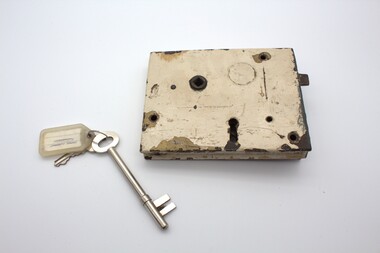
... This example formed part of the fabric of the Ziebell's Farmhouse, one of the earliest surviving German settler homes in Victoria, and provides insight into the construction methods and everyday domestic life of the Ziebell family....This example formed part of the fabric of the Ziebell's Farmhouse, one of the earliest surviving German settler homes in Victoria, and provides insight into the construction methods and everyday domestic life of the Ziebell family. ...Rim locks were commonly used on domestic buildings throughout the nineteenth and early twentieth centuries. This example formed part of the fabric of the Ziebell's Farmhouse, one of the earliest surviving German settler homes in Victoria, and provides insight into the construction methods and everyday domestic life of the Ziebell family.Painted metal rim lock with associated metal key. The rectangular lock case retains traces of its original cream-coloured paint and exhibits wear consistent with long-term use. The lock was removed from one of the doors of Ziebell's Farmhouse and is representative of the original fittings used throughout the nineteenth-century dwelling. -
 Bendigo Historical Society Inc.
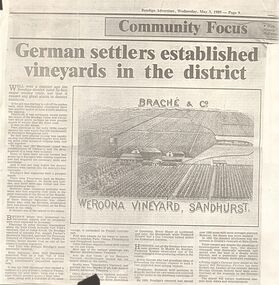
Newspaper - GERMAN HERITAGE SOCIETY COLLECTION: NEWSPAPER CUTTINGS
... Mentioned are German Society plans memorial to its pioneers, German contribution to Bendigo, German dinner an outstanding success, German settlers established vineyards in the district and German Society plans to remember its pioneers. ...Mentioned are German Society plans memorial to its pioneers, German contribution to Bendigo, German dinner an outstanding success, German settlers established vineyards in the district and German Society plans to remember its pioneers. ...Photocopies of five newspaper cuttings from 11/5/1988 to 20/6/1990 mentioning the German Society by Bendigo Advertiser writer Maurie McDonald. Mentioned are German Society plans memorial to its pioneers, German contribution to Bendigo, German dinner an outstanding success, German settlers established vineyards in the district and German Society plans to remember its pioneers. One cutting has a photo of an ornate bookcase which was made for a Miss Pike. It was the work of a German tradesman, Mr C Nagle. Another has a sketch? Of the Brache & Co Weroona Vineyard, Sandhurst. It also mentions a number of early vineyards. These cuttings were held in an extra copy of the drawing of the man with the wine barrels (8803.33).bendigo, clubs, bendigo heritage, german heritage society collection - newspaper cuttings, bendigo advertiser 11/5/1988, 3/5/1989, 6/9/1989, 20/6/1990, maurie mcdonald, daryl pinder, peter hyett, glen schier, josef mika, ian walder, bendigo library, peggy & bill schlotterlein, annita schlotterlein, renate & hans ruemelin, michael ruemelin, max drechsler, vin drechsler, dr david stolz, rosemary schulz, mrs june stolz, ali zvirgzdins, eva mika, johann detleff kahland, eugene sandner, glen schier, lydia & josef aniolkowksi, helen, christa & dieter scharenberg, brache & co, weroona vineyard sandhurst, dr backhaus, bruhn, pohl, mannes' strathfieldsaye vineyard, hercynia vineyard, greiffenhagen, wittschiebe's vineyard, carl august heine, adventure vineyard, scheuffle, streckfuss, henry mayer, frederick kramer, frederick klemm, kahland, miss pike, mr c nagle, johann gottfried tabias christopher ballerstedt, gustavus von tempsky, ken wust, frank cusack, clem schmidt, dorothy strauch, ausrey drechsler, reg schleiger, ian weibegen, ron meurer, bill mannes tim iser, neil mertens -
 Lions Club of Maldon Inc.
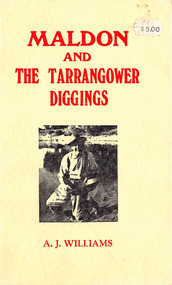
Book, A Concise History of Maldon and the Tarrangower Diggings, 1979
... Mention of Chinese on Tarrangower, and German and Italian settlers. ...Mention of Chinese on Tarrangower, and German and Italian settlers. maldon tarrangower gold victoria Book of 86 Pages A Concise History of Maldon and the Tarrangower Diggings Book Book Jeffrey Zilles Albert James WIlliams ...Concise historical record of events rather than people. Contents include early settlement, gold discovery in 1853, early water problems, public institutions. Mention of Chinese on Tarrangower, and German and Italian settlers. Book of 86 Pagesmaldon, tarrangower, gold, victoria -
 Bendigo Historical Society Inc.
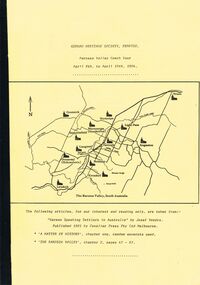
Document - GERMAN HERITAGE SOCIETY COLLECTION: BAROSSA VALLEY COACH TOUR 1994, 8th - 10th April, 1994
... Articles taken from 'German Speaking Settlers in Australia' by Josef Vondra, Published 1981 by Cavalier Press Pty Ltd Melbourne. ...Articles taken from 'German Speaking Settlers in Australia' by Josef Vondra, Published 1981 by Cavalier Press Pty Ltd Melbourne. ...Bound collection with a yellow front cover and a buff back cover. Barossa Valley Coach Tour, April 8th to April 10th, 1984. The front has a line map of The Barossa Valley, South Australia. Articles taken from 'German Speaking Settlers in Australia' by Josef Vondra, Published 1981 by Cavalier Press Pty Ltd Melbourne. 'A Matter of History' chapter one, random excerpts used. 'The Barossa Valley', chapter 2, pages 47 - 67. Mentioned in the booklet are the German settlement in the Barossa Valley, the arrival of the Germans in Australia and some of the reasons which led up to why they left their homeland.document, memo, german heritage society, german heritage society collection - barossa valley coach tour 1994, josef vondra, cavalier press pty ltd -
 Friends of Westgarthtown
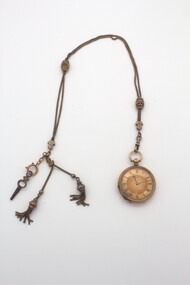
Accessory - Fobwatch, Chain and Key, c.1856-1890
... Believed to have belonged to either Elizabeth Ziebell (née Sprenger, 1836–1892) wife of Carl Chrsitian Ziebell or Amelia Alice Ziebell (née Bodycoat 1870-1948) wife of Albert Heinrich Ziebell, the watch provides a personal link to the women of the early Ziebell family and to domestic and social life within Westgarthtown’s German settler community. Women’s watches of this era were both functional and fashionable, commonly worn on a long necklace chain, suspended from a chatelaine at the waist, or attached to a decorative bodice brooch. ...Believed to have belonged to either Elizabeth Ziebell (née Sprenger, 1836–1892) wife of Carl Chrsitian Ziebell or Amelia Alice Ziebell (née Bodycoat 1870-1948) wife of Albert Heinrich Ziebell, the watch provides a personal link to the women of the early Ziebell family and to domestic and social life within Westgarthtown’s German settler community. Women’s watches of this era were both functional and fashionable, commonly worn on a long necklace chain, suspended from a chatelaine at the waist, or attached to a decorative bodice brooch. ...This finely crafted women’s gold fob watch, made by Robert Stauffer & Fils of La Chaux-de-Fonds, Switzerland, is an elegant example of mid-19th-century Swiss watchmaking. Its engraved floral motifs, protected beneath glass and repeated on the reverse, reflect the refinement and skill associated with one of Europe’s foremost horological centers. Believed to have belonged to either Elizabeth Ziebell (née Sprenger, 1836–1892) wife of Carl Chrsitian Ziebell or Amelia Alice Ziebell (née Bodycoat 1870-1948) wife of Albert Heinrich Ziebell, the watch provides a personal link to the women of the early Ziebell family and to domestic and social life within Westgarthtown’s German settler community. Women’s watches of this era were both functional and fashionable, commonly worn on a long necklace chain, suspended from a chatelaine at the waist, or attached to a decorative bodice brooch. Such pieces served as markers of refinement, femininity and social standing. The tiny winding key is central to the object’s significance. Before stem-winding mechanisms became standard in the 1870s, watches were wound and set by inserting a small key into an arbor at the back of the case. The survival of both the watch and its original key strengthens their historical integrity and deepens understanding of 19th-century personal technology. Donated to Ziebell’s Farmhouse Museum in 2025 by Kristina Colic (née Ziebell) and her father Mervyn Turner Ziebell, the watch holds strong familial and interpretive value, enriching the museum’s representation of women’s heritage, adornment and craftsmanship within the Ziebell family. Robert Stauffer & Fils of La Chaux-de-Fonds, Switzerland -
 The Beechworth Burke Museum
Photograph, 1999
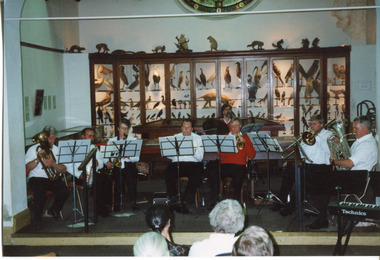
... 'Liedertafel' is a tradition that accompanied German settlers to Australia. It refers to a friendly society of men united by an enthusiasm for singing. ...'Liedertafel' is a tradition that accompanied German settlers to Australia. It refers to a friendly society of men united by an enthusiasm for singing. ...This photograph depicts members of the Beechworth Band at a 'Liedertafel' concert in the main hall at the Burke Museum in 1999. The concert was associated with an exhibition titled, 'From the Liedertafel to the Skating Rink: Entertainment in Beechworth 1852 - early 1900s', which celebrated the rich and diverse entertainments that were a part of Beechworth life in the nineteenth and early twentieth centuries. Marching bands, choirs, circus acts, theatrical performances, races, and seasonal activities, such as Mr. Spiller's roller skating rink, founded in the late 1860s, were among the attractions on offer. 'Liedertafel' is a tradition that accompanied German settlers to Australia. It refers to a friendly society of men united by an enthusiasm for singing. The Beechworth Brass Band was formed by Mr. H. Vandenberg in 1887. The Beechworth Liedertafel was established 14 March 1894 at the London Tavern, Camp Street, Beechworth, by Mr. A.A. Billson, and a visiting conductor, Mr. H. Fielder. German clubs, complete with marching bands, athletics associations and Liedertafel choirs, were centres of social activity attracting wide audiences not limited to members of their own ethnicity. Alfred Arthur Billson was the youngest son of Mr. George Billson, who served as Beechworth’s mayor between 1869-1871. In 1872, George purchased the Oven’s Brewery in Last Street, which became Billson’s Brewery, one of the oldest continuing beverage manufacturers in Australia. An active member of Beechworth’s cultural, business and political life around the turn of the century, A.A. Billson served on Beechworth Shire Council from 1884 to 1893, and from 1895 to 1910, with three terms as president (1888–89, 1899–1901, 1908–09). He founded the Beechworth Progress Association in 1891 and produced an ‘Illustrated Guide to Beechworth and Vicinity’ to develop tourism potential. This photograph of the Beechworth Band playing at the Burke Museum is historically significant for the information it conveys about an exhibition at the Burke Museum between September and November 1999. The use of the contemporary Beechworth Band in a 'Liedertafel' performance provides insight into curatorial approaches at the turn of the twenty-first century and improves our understanding of how exhibitions use objects in the Burke Museum's Collection to tell stories about the past in the present. The image is historically and socially significant for attesting to the enduring appeal of local musical associations, which were a popular means of entertainment that fostered social connections among settlers from diverse ethnic backgrounds. Rectangular colour photograph printed on matte photographic paper. Reverse: 7029 / Label: 7029 / Source / Burke Museum / Beechworth / Band / 1999/2000 /liedertafel, beechworth band, burke museum, from the liedertafel to the skating rink, entertainment in beechworth 1852 - early 1900s, gold rush, immigration, beechworth's german heritage, london tavern beechworth, beechworth's first brick tavern, spiller's skating rink, vandenberg's beechworth brass band, protestantism, teetotallism, skating carnivals, beechworth german association, yma's, beechworth skating rink, progress societies, billson's brewery, german-australians, beechworth progess association, lodges, freemasonry, colonial australia -
 Bendigo Historical Society Inc.
Photograph - Eurofest Choir, 2005-2019
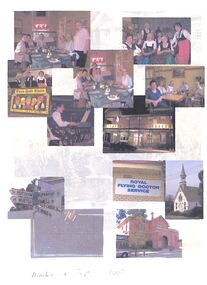
... LIBRARY HAS A COLLECTION OF GERMAN RESEARCH MATERIAL AND DOCUMENTS ABOUT THE GERMAN SETTLERS ON THE GOLDFIELDS.' 'Heidi gave explanations of the folk songs the Eurofest ensemble performed'. ...LIBRARY HAS A COLLECTION OF GERMAN RESEARCH MATERIAL AND DOCUMENTS ABOUT THE GERMAN SETTLERS ON THE GOLDFIELDS.' 'Heidi gave explanations of the folk songs the Eurofest ensemble performed'. ...Eurofest Choir photographs of events - concerts and birthdays. All pages are A4 size. a Twelve photographs of Eurofest Choir Dimboola Trip 2005. b Group of twelve photographs of Eurofest Choir Trip to Dimboola 2005. c Four photographs of performances by Eurofest Choir 2010 and 2011. d Six photographs of Eurofest Ensemble performing in Goldfields Library during Cultural Diversity Week 2011. e Group of nine photographs taken at launch of DVD 'Our Stories German Immigrants in Bendigo -The Second Chapter' on 25th June 2011. f Nine photographs from the launch of DVD 'Our Stories German Immigrants in Bendigo - The Second Chapter'. g Twelve photographs from events at which the Eurofest Choir performed in 2016. h Ten photographs of Eurofest VChoir at Spring Gully Primary School and a farewell to Ekkehart and Brigitta. i Six photographs of Eurofest Choir at 35th Anniversary of Bushdance and Music Club. j Three photographs of Eurofest choir. One of choir entertaining at Bentley Nursing Home and other two of Christmas 2019.a 'Dimboola Trip 2005'. Left side of page 'Euro-Fest Choir'. Photograph of sign lower right 'Royal Flying Doctor Service'. Lower left photograph of sign 'Horsham 56, Rupanyup 21, Murtoa 26, Stawell 74, St Arnaud 68'. b Lower left photograph street sign 'Horsham 56, Rupanyup 21, Murtoa 26, Stawell 74, St Arnaud 68'. Lowest left photograph 'Minyip Town Square. An Australian Bicentennial Project to commemorate the Nations Bicentenary'. c 'Eurofest Ensemble and German Friendship Society in action around Bendigo'. 'Christmas break up 2010'. 'Carols in Anne Caudle Centre'. 'Celebrating Heidi's Birthday in January 2011'. d. 'CULTURAL DIVERSITY WEEK 2011 IS HELD AGAIN THIS YEAR IN MARCH 19TH-26TH. EUROFEST ENSEMBLE SANG IN THE GOLDFIELDS LIBRARY ON TUESDAY 22ND MARCH FROM 1PM TO 1.30 PM. LIBRARY HAS A COLLECTION OF GERMAN RESEARCH MATERIAL AND DOCUMENTS ABOUT THE GERMAN SETTLERS ON THE GOLDFIELDS.' 'Heidi gave explanations of the folk songs the Eurofest ensemble performed'. 'Between brackets of German folksongs on recorders played items by Kester and Liesbeth'. 'Wayne Blandford accompanied a few songs with the Hohner accordion'. e Top centre '25th June 2011' Top left 'Bendigo High School students recite German poetry'. Top right 'Elfi sings Wien.,Wien, nur du... with pianist Margaret'. Middle centre 'Above Heidi Teague (Secretary of German Friendship Society) MC for the Launch of Our Stories German immigrants in Bendigo - The Second Chapter'. Right centre 'On right Mayor Cr Rod Fyffe, launching the DVD. On left Di Parker with Heidi Teague, who were instrumental in the production of the DVD'. Bottom centre 'Below- Speakers; Bob Schultz (President of German Heritage Society) and Michael van Vliet (Multicultural Affairs and Citizenship)'. f Top left 'Peter Weert, our past pianist has helped the choir on occasions and was our accompanist for the recorded songs on the DVD'. Bottom left 'Jamie Roberts produced and directed the documentary featuring the story of eight German Immigrants'. Top right ' Bendigo Advertiser, Monday June 27, 2011. German stories told. Cultural: Rod Fyffe and Heidi Teague at the launch of the documentary.' g '2016. Luncheons during the year, including Christmas in July, Christmas Tide and events celebrated with music and visiting and cheering up the elderly with German music'. h 'A lovely shared meal at the home of Margie to farewell Ekkehart and Brigitta for their contributions in music and baked cakes. We will miss you and may you both be blessed in your new city'. '6th Nov 2013. Eurofest Choir sharing German music with Spring Gully School students'. i 'Eurofest Choir at 35th Anniversary of Bushdance and Music Club. A great atmosphere and jovial International evening. 19th July 2014'. j ' With Euro Fest Choir, we entertained Trudie Frachsdorf and Ankie Driesen, and others, who enjoyed the German Folk songs, intermingled with a couple of Dutch songs of Daar bij die Molen and Het Kleine Cafe, 30th August 2019 at Bentley Nursing Home, Bendigo'. Back of two photographs: 'German Christmas Luncheon 2019'. german friendship society, germans in bendigo, heidi teague collection, eurofest, heidi teague, birthdays, christmas, concerts -
 Flagstaff Hill Maritime Museum and Village
Instrument - Concertina, Lachenal and Co, 1879-1933
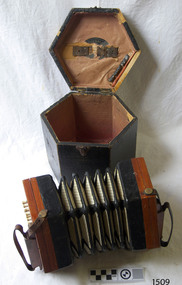
... German-made ones. It seems that the company ceased business in 1933. This concertina, made in the late 19th to early 20th century, represents the portable musical entertainment of the early settlers in the colony of Australia. ...Louis Lachenal manufactured concertinas for C Wheatstone & Co. from around 1848-1858 in a combined home and manufactory in Cheswick, England. He then establish up his own business 'Lachenal's' at 8 Little James Street in London. In 1863 the firm began advertising both 'Anglo and English concertinas, which were more expensive. Lachenal passed away in 1861, so his wife Elizabeth took over the business. The firm was sold to a group of five businessmen in about 1873 and in 1874 the firm became ‘Lachenal & Co.’ A Trade Mark application was made by Richard Ballinger on behalf of Lachenal & Co. on 31st August 1878 and the Number 19,555 was published in the Trade Mark Journal January 8, 1879. The symbol was an English-style reed-shoe with the words 'Trade Mark' and 'English Make'. It was stamped on the right-hand rail (handle) of the Lachenal Anglos, to distinguish them from the German-made ones. It seems that the company ceased business in 1933.This concertina, made in the late 19th to early 20th century, represents the portable musical entertainment of the early settlers in the colony of Australia. Concertina, six sided, 21 buttons, with fitted case. Wooden ends have carved cut-outs and leather straps attached to brass buttons. Five-fold bellows have light coloured sides with reinforced edges and corners. Constructed with steel reeds and bone key-buttons. Wooden, black fabric-covered hexagonal case with triangular metal catch, two brass hinges, leather handle and faded red lining. Inscriptions on label inside lid and on wooden ends of bellows. Lachenal, Anglo design, made by Lachenal & Co. of London. Label within oval cut-out "LACHENAL & Co / PATENT CONCERTINA / MANUFACTURERS / LONDON", Label inside lid " - CHENAL -", Impressed into wood STEEL REEDS", "ENGLAND", "TRADE MARK ENGLISH MAKE [reed-shoe symbol]" , (originally marked with Number "98030" )flagstaff hill, warrnambool, shipwrecked-coast, flagstaff-hill, flagstaff-hill-maritime-museum, maritime-museum, shipwreck-coast, flagstaff-hill-maritime-village, concertina, squeeze box, musical instrument, london, english make, trade mark 15222, english-style reed, richard ballinger, louis lachenal, concertina manufacturer, reed-shoe, lachenal anglo, lachenal & co, lachenal -
 The Beechworth Burke Museum
Photograph
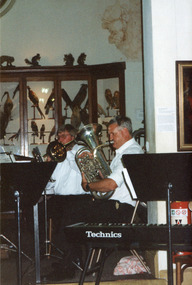
... 'Liedertafel' is a German tradition that accompanied European settlers to Australia. ...'Liedertafel' is a German tradition that accompanied European settlers to Australia. ...This photograph depicts two members of the Beechworth Band at a 'Liedertafel' concert in the main hall at the Burke Museum in 1999. The concert related to an exhibition titled, 'From the Liedertafel to the Skating Rink: Entertainment in Beechworth 1852 - early 1900s', which celebrated the rich and diverse entertainments that were a part of Beechworth life in the nineteenth and early twentieth centuries. 'Liedertafel' is a German tradition that accompanied European settlers to Australia. It refers to a friendly society of men united by an enthusiasm for singing. The Beechworth Liedertafel was established 14 March 1894 at the London Tavern, Camp Street, Beechworth, by president, Mr. A.A. Billson, and a visiting conductor, Mr. H. Fielder. The Beechworth Brass Band was formed by Mr. H. Vandenberg in 1887. Marching bands, choirs, processions, circus acts, theatrical performances, races, fancy dress and roller skating carnivals, were among the vibrant and diverse entertainments offered in Beechworth during the gold rush period. Race meetings were revived with a gala atmosphere at Baarmutha on New Year's Day and Easter Monday in the early 1880s. 'Spiller's Skating Rink', which premiered at St. Georges Hall in August 1869, was accompanied by the 'Beechworth Fire and Drum band'. In 1888, Beechworth had two skating rinks in operation, the Columbia Elite at Oddfellow's Hall, and the Beechworth Skating Rink, corner Camp and Last Streets, Beechworth. Vandenberg's Beechworth Brass Band was reported to have provided musical entertainment for patrons at both venues.This photograph of the Beechworth Band playing at the Burke Museum is historically significant for the information it conveys about an exhibition at the Burke Museum between September and November 1999. The use of the contemporary Beechworth Band in a 'Liedertafel' performance provides insight into curatorial approaches at the turn of the twenty-first century and improves our understanding of how exhibitions use objects in the Burke Museum's Collection to tell stories about the past in the present. The story of Liedertafel's and Beechworth Brass Band is historically and socially significant for understanding the role played by German immigrants in building Victorian communities. In settler communities, cultural associations centred on artistic, recreational and sporting activities not only provided a popular means of entertainment, but fostered social cohesion among settlers from diverse ethnic backgrounds.Rectangular colour photograph printed on matte photographic paper. Obverse (On keyboard): Technics / Reverse: 7028 / Label: Liedertafel / exh. / Beechworth / Band / 1999/2000 /liedertafel, beechworth band, burke museum, from the liedertafel to the skating rink, entertainment in beechworth 1852 - early 1900s, gold rush, immigration, beechworth's german heritage, london tavern beechworth, beechworth's first brick tavern, spiller's skating rink, vandenberg's beechworth brass band, protestantism, teetotallism, skating carnivals, beechworth german association, yma's, beechworth skating rink, progress societies, billson's brewery, german-australians, roller skating history -
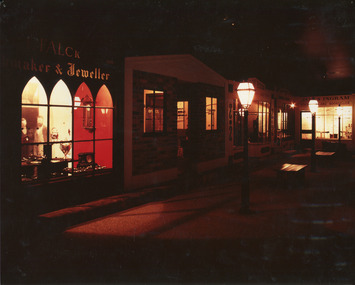 The Beechworth Burke Museum
Photograph, 1990s--estimated
... settlers, William Turner and CF Falck's Watchmaker and Jeweller store, and James Ingram's news agency and bookshop. William Turner was originally a goldfields official who became a commissioner on the Ovens goldfield, and later a resident warden, at times performing magisterial duties and chairing the Local Court. Charles Frederick Falck, born in Korlin, Germany ...Taken in 1990, this photograph depicts a row of shops in Beechworth, with the shopfront of watchmaker and jewellers, William Turner and C.F. Falck, in the foreground, and newsagent and bookseller James Ingram's shop in the background.This photograph is of social significance to the Beechworth community in depicting the Street of Shops, the creation of curator, Roy Harvey, which opened in 1979 at Burke Museum. According to the Indigo Shire Council webpage for Burke Museum, this addition 'began a new period of collecting with Roy Harvey calling to the community for donations. The response resulted in an influx of material adding to the town history/ development and local identities collections. The Shops and their contents reflect another period in museology.' The historic shopfronts in this image portray those of local settlers, William Turner and CF Falck's Watchmaker and Jeweller store, and James Ingram's news agency and bookshop. William Turner was originally a goldfields official who became a commissioner on the Ovens goldfield, and later a resident warden, at times performing magisterial duties and chairing the Local Court. Charles Frederick Falck, born in Korlin, Germany, in 1833, a skilled watchmaker and jeweller, ran the jewellery business from 1862. Along with William Turner and Melbourne barrister, George Milner Stephen, he prepared a dazzling display of gems and jewellery from Beechworth for the Royal Society's Exhibition in Melbourne in 1865. This act signposted Beechworth's progress as a nineteenth-century gold rush town with a population of around 3000. In the mid-1850s, newsagent James Ingram established a newsagency and supplied papers and stationary to the goldfields. He and bookseller R.T. Vale stocked a wide range of literary, historical and religious works, textbooks, periodicals and newspapers, as well as hosting a reading and writing room on Camp Street{?}. James Ingram was a 'devoted instigator and supporter of the town's welfare institutions', who raised funds for to establish a hospital, primary school and benevolent asylum, and assisted people who'd fallen on hard times with his wife. He was also a mainstay of the early Baptist church, holding meetings in his house. He died in 1928, six weeks short of his 100th birthday. Ingram's Rock, north-west of Beechworth near where he lived in later life, was named after him. Colour rectangular photograph printed on matte photographic paper.Obverse: FALCK 1880 / maker & Jeweller/ WARDENS OFFICE/COACHING OFFICE/ EST. ??55/ ????ON HOUSE/ JAMES INGRAM/ NEWS?????? AND BOOKSELLER/ TOYS visible above shopfront in left foreground. Reverse: Catalogue item number 3305 pencilled in top right-hand corner.beechworth, beechworth historic shops, william turner, cf falck, james ingram, turner and falck watchmaker and jeweller, james ingram newsagent and bookseller, burke museum, promoting settlement, marketing and retailing, living in country towns, making regional centres, preserving traditions and commemorating, beechworth founders, victorian gold rush towns, beechworth pioneers, ingram's rock, 1860s beechworth, street of shops, roy harvey -
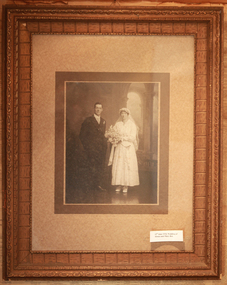 City of Moorabbin Historical Society (Operating the Box Cottage Museum)
Photograph - Wedding Photograph, Alonzo and Mary Box, Box, Alonzo and Mary, 1918
... settler of Dendy's Special Survey 1841 who purchased 'Box Cottage ' in 1865 and lived there until 1914. Alonzo Box married Mary Kloster/ Closter in 1918. On the Marriage Certificate Mary Box has spelt "Closter" with a "C" and not the "K" of her German heritage. ...settler of Dendy's Special Survey 1841 who purchased 'Box Cottage ' in 1865 and lived there until 1914. Alonzo Box married Mary Kloster/ Closter in 1918. On the Marriage Certificate Mary Box has spelt "Closter" with a "C" and not the "K" of her German heritage. ...Alonzo Box, who lived in Oakleigh, was the nephew of William and Elizabeth Box, a pioneer settler of Dendy's Special Survey 1841 who purchased 'Box Cottage ' in 1865 and lived there until 1914. Alonzo Box married Mary Kloster/ Closter in 1918. On the Marriage Certificate Mary Box has spelt "Closter" with a "C" and not the "K" of her German heritage. This marriage was taking place during World War 1. Many immigrants would have altered their name at that time. The Box family were early pioneers of the district and raised their family in reconstructed 'Box Cottage'. They established a market garden and sold produce to the Melbourne markets for the colony's increasing population.A large, glass covered, wooden-framed, wedding photograph of Alonzo and Mary Box (nee Kloster/ Closter),married June 12th 1918 is displayed in the reconstructed 'Box Cottage' Museum, Joyce Park, Ormond, Victoria. At front base of mounting of photograph 'Muntz Malvern' is stamped. On back of photograph is written, unsigned, 'Mr & Mrs Alonzo Box/ June 12th 1918/ (Mary Kloster )/photographs, brighton, moorabbin, malvern, box william, box elizabeth, box alonzo, box mary, oakleigh, muntz -
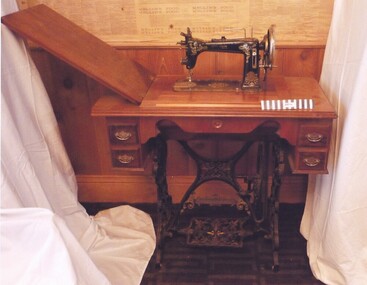 City of Moorabbin Historical Society (Operating the Box Cottage Museum)
Functional object - Sewing Machine, Melber, Early 20th Century
... settler The machine was bought in 1909, and is a good example of its kind. This type of sewing machine was widely used in many homes, in an era when hand-made clothes were the “norm.”, and clothes were mended, or ‘re-made’ into another garment. The cottage has both the Receipt, cat 00004.1 and Guarantee, cat 00004.2, for the sewing machine. This machine was possibly built by Wertheim Pty Ltd Hugo Wertheim (1854 – 1919) arrived in Melbourne in 1875. He became a successful agent for sewing machines manufactured by his father’s cousin Joseph Wertheim in Frankfurt, Germany...settler The machine was bought in 1909, and is a good example of its kind. This type of sewing machine was widely used in many homes, in an era when hand-made clothes were the “norm.”, and clothes were mended, or ‘re-made’ into another garment. The cottage has both the Receipt, cat 00004.1 and Guarantee, cat 00004.2, for the sewing machine. This machine was possibly built by Wertheim Pty Ltd Hugo Wertheim (1854 – 1919) arrived in Melbourne in 1875. He became a successful agent for sewing machines manufactured by his father’s cousin Joseph Wertheim in Frankfurt, Germany ...Melber sewing machines were first sold in Australia in the late 1870s. The 'Box Cottage' Melber Treadle Sewing Machine was owned by Mary Box, nee Kloster / Closter, wife of Alonzo Box , the nephew of William and Elizabeth Box who purchased 'Box Cottage' in 1865 from a pioneer settler The machine was bought in 1909, and is a good example of its kind. This type of sewing machine was widely used in many homes, in an era when hand-made clothes were the “norm.”, and clothes were mended, or ‘re-made’ into another garment. The cottage has both the Receipt, cat 00004.1 and Guarantee, cat 00004.2, for the sewing machine. This machine was possibly built by Wertheim Pty Ltd Hugo Wertheim (1854 – 1919) arrived in Melbourne in 1875. He became a successful agent for sewing machines manufactured by his father’s cousin Joseph Wertheim in Frankfurt, Germany. Hugo married Joseph’s daughter Sophie Emilie and they settled in Richmond Melbourne Australia. Hugo made many trips back to the main factory in Germany and, with extensive advertising, established a thriving business for sewing machines, bicycles, pianos under various ‘brand names’ - Wertheim, Electra, Planet, Griffin, Hapsburg. It has been said that Dame Nellie Melba preferred a Wertheim piano for her performances. In 1908 Hugo opened a large piano factory in Bendigo St Richmond, Victoria and his son Herbert maintained the business until 1935 The sewing machine was donated in 1985 by, a descendant of the Box family. The machine is complete, and in good condition. William and Elizabeth Box purchased 'Box Cottage' in 1865 from a pioneer settler who had bought part of the land noted in Dendy's Special Survey 1841 Brighton. They raised their family there and established a market garden to supply produce to the population of Melbourne. Their nephew Alonzo married Mary Kloster/ Closter in 1918 and she brought with her this 'Melber' sewing machine that she used to provide clothing for the family. 'Melber'Treadle Sewing Machine that was owned by Mary Box, nee Kloster/ Closter. It was bought in 1909, and it is a good example of its kind. This type of sewing machine was widely used in many homes, in an era when hand-made clothes were the “norm.”, and clothes were mended, or ‘re-made’ into another garment. The Box Cottage Museum has both the Receipt, and Guarantee for the sewing machine. 'MELBER' stamped on sewing machine.dendys special survey, treadle sewing machine, box cottage, mary kloster, alonzo box, melber, wertheim hugo, wertheim sewing machine manufacturer, richmond melbourne victoria, -
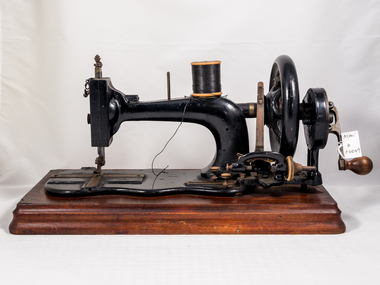 City of Moorabbin Historical Society (Operating the Box Cottage Museum)
Functional object - Wertheim Sewing Machine, c1880
... Germany and, with extensive advertising, established a thriving business for sewing machines, bicycles, pianos under various ‘brand names’ - Wertheim, Electra, Planet, Griffin, Hapsburg. It has been said that Dame Nellie Melba preferred a Wertheim piano for her performances. In 1908 Hugo opened a large piano factory in Bendigo St Richmond, Victoria. His son Herbert maintained the business until the factory closed in 1935. The pioneer settlers ...Hugo Wertheim (1854–1919) arrived in Melbourne in 1875. He became a successful agent for sewing machines manufactured by his father’s cousin Joseph Wertheim in Frankfurt, Germany. Hugo married Joseph’s daughter Sophie Emilie and they settled in Melbourne. Hugo made many trips back to the main factory in Germany and, with extensive advertising, established a thriving business for sewing machines, bicycles, pianos under various ‘brand names’ - Wertheim, Electra, Planet, Griffin, Hapsburg. It has been said that Dame Nellie Melba preferred a Wertheim piano for her performances. In 1908 Hugo opened a large piano factory in Bendigo St Richmond, Victoria. His son Herbert maintained the business until the factory closed in 1935.The pioneer settlers and market gardeners of Moorabbin Shire had to be self reliant and made their own clothing and utensils. This sewing machine was one of many items they used to exhibit the skill and craftsmanship of the women in these families. A sewing machine was a necessary part of each home.A Wertheim hand–crank sewing machine c1880. The hand machine was operated by turning the handle. The hand machine could also be fitted to a stand with table and draws, the machine could then be used by hand or foot. This type of sewing machine was widely used in many homes, in an era when hand-made clothes were the “norm”, and clothes were mended, or ‘re-made’ into another garment 'WERTHEIM' across body of machinemelbourne, clothing, brighton, moorabbin, germany, piano, pioneers, richmond, bentleigh, dressmaking, market gardeners, early settlers, craftwork, sewing machines, wertheim hugo, wertheim joseph -
 City of Moorabbin Historical Society (Operating the Box Cottage Museum)
Functional object - Laundry Eqipment , 'ACME' clothes wringer, mid 20thC
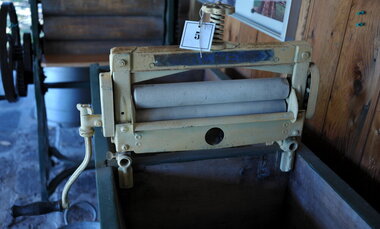
... The Exchange Hotel Nepean Highway Cheltenham was a well established meeting place for Moorabbin Shire settlers by 1915 moorabbin bentleigh cheltenham laundry equipment washing washing mangles washing machines ACME 14 INCH / on hand crank is list of patents for Great Britain, USA, Aust. NZ, Germany ...This ACME portable clothes wringer could be attached to a wash trough or hand washing machine to remove excess water from the washing. It was much less cumbersome that the earlier Mangles used for this purposeMost homes of 20th C in City of Moorabbin would have had one of these ACME wringers . It greatly eased the washday burden of the women. The Exchange Hotel Nepean Highway Cheltenham was a well established meeting place for Moorabbin Shire settlers by 1915A metal clothes wringer with side hand crank and 2 rollers that could be attached by screw clamps to a wash trough or washing machine for removing excess water from washing. The pressure of 2 rollers was controlled by a screw on the top of machine that could be loosened or tightened according to the material being passed through.ACME 14 INCH / on hand crank is list of patents for Great Britain, USA, Aust. NZ, Germany, Belgium, Sweden moorabbin, bentleigh, cheltenham, laundry equipment, washing, washing mangles, washing machines -
 Greensborough Historical Society
Photograph - Digital Image, Grave of Victor and Mary Bonsak, Greensborough Cemetery, 11/04/1891
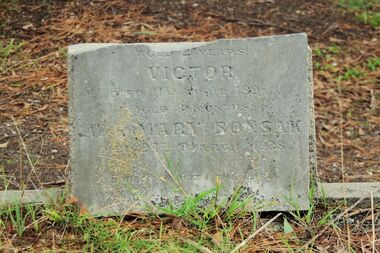
... German birth, applied for a Certificate of Naturalization in Eltham on 13th April 1905. She had 10 children (4 boys and 6 daughters) . Her sister (maybe) Sarah Jane Bonsak (1881-1978) married George Arthur Iredale in 1908. A Bonzak Family lived near the Partington Family of Willis Vale. Greensborough Cemetery was created when land was given for the cemetery by Mr William Poulter, a local settler ...Grave of Victor Bonsak (died 11/04/1891) and Mary Bonsak (b1878 died 24/03/1938) in Plot# N3 Greensborough Cemetery. Johann George Bonzak arrived at Port Phillip on December 19th 1849, from Germany. Mary Bonzak, of German birth, applied for a Certificate of Naturalization in Eltham on 13th April 1905. She had 10 children (4 boys and 6 daughters) . Her sister (maybe) Sarah Jane Bonsak (1881-1978) married George Arthur Iredale in 1908. A Bonzak Family lived near the Partington Family of Willis Vale.Greensborough Cemetery was created when land was given for the cemetery by Mr William Poulter, a local settler, about 1864. The cemetery holds the graves of many early settlers in the district. Digital copy of colour photograph of Greensborough Cemeteryvictor bonsak, mary bonsak -
 City of Moorabbin Historical Society (Operating the Box Cottage Museum)
Personal Effects, cut-throat razor “Kings Crown’, 20thC
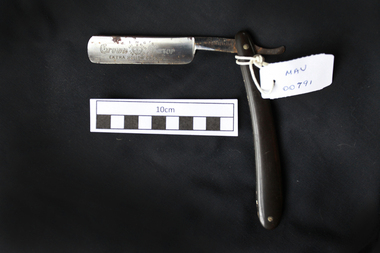
... King's Crown™ cut-throat razors, straight razors, shaving equipment, steel blades, swords, weyersberg family, king crown pty ltd., solingen, germany, early settlers, market gardeners, moorabbin, bentleigh, cheltenham, on blade ; KING'S / CROWN 'a crown trademark' RAZOR / EXTRA HOLLOW GROUND around 'trademark' ; SET READY FOR USE on steel handle; MADE IN GERMANY A folding cut-throat razor Personal Effects, cut-throat razor “Kings Crown’ Kings Crown Manufacturing Company ...KING RAZOR MFG. CO.Pittsburgh, Pennsylvania; moved to Indiana, Pennsylvania in 1911.ca. 1904 - 1919 Marked "Made in Germany", although the company's offices were located at 118 E. 28th Street, New York City. ca. 1934-1943 Used the "THE KING OF RAZORS REGISTERED TRADEMARK" trademark. 47-1/2 and Trademark: Crown and Wolf. For 500 years the Weyersberg family has been producing the finest blades in the world. For centuries the King’s Crown™ mark has been synonymous with exacting precision, hand-craftsmanship and quality. For the first few hundred years the blades, made in Solingen, Germany (the “City of Blades”), were for swords. As times changed, the Weyersberg family transitioned into making cut throat razors. The Greb. Weyersberg™ family business.continue to place our mark on each and every product sold as we have done since first being able to register it in 1774. For over a 100 years, the straight razors continue to be produced in Solingen (Germany). King's Crown™A folding cut-throat razoron blade ; KING'S / CROWN 'a crown trademark' RAZOR / EXTRA HOLLOW GROUND around 'trademark' ; SET READY FOR USE on steel handle; MADE IN GERMANYcut-throat razors, straight razors, shaving equipment, steel blades, swords, weyersberg family, king crown pty ltd., solingen, germany, early settlers, market gardeners, moorabbin, bentleigh, cheltenham, -
 City of Moorabbin Historical Society (Operating the Box Cottage Museum)
Personal Effects, Cut-throat razor ‘Sinfonie’, c1900 -1930
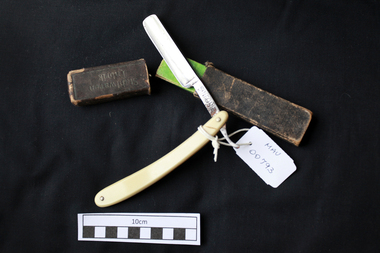
... Straight razors require considerable skill to hone and strop, and require more care during shaving cut-throat razors, straight razors, shaving equipment, steel blades, stoll gebruder ltd., Solingen germany, cutlers, steel manufacturers, ‘Sinfonie’ trade mark, early settlers, market gardeners, moorabbin, bentleigh, cheltenham, on blade 'SINFONIE' on case; Stahlwaron / Fabrik A man's cut-throat razor that folds to protect blade inside handle. with a case Personal Effects, Cut-throat razor ‘Sinfonie’ Gebrüder Stoll ...Gebrüder Stoll, Central-Stahlwarenfabrik Founded in 1889 . Solingen-Foche in 1900- 1930. Names: ‘Gallop’, ‘Pedecor’ (Dedecor?), ‘Sinfonie’, ‘Stoll’, ‘Stoll Brothers’. The parts of a straight razor and their function are described as follows: The narrow end of the blade rotates on a pin called the pivot, between two protective pieces called the scales or handle. The upward curved metal end of the narrow part of the blade beyond the pivot is called the tang and acts as a lever to help raise the blade from the handle. One or two fingers resting on the tang also help stabilize the blade while shaving. The narrow support piece between the tang and the main blade is called the shank, but this reference is often avoided because it can be confusing. The shank sometimes features decorations and the stamp of the country of origin. The top side and the underside of the shank can sometimes exhibit indentations known as fluting, or jimps for a more secure grip. The curved lower part of the main blade from the shank to the cutting edge is called the shoulder. The point where the shoulder joins the cutting edge is called the heel. A thick strip of metal running transversely at the junction where the main blade attaches to the shank is called the stabiliser. Although straight razors were once the principal method of manual shaving, they have been largely overshadowed by the safety razor, which incorporates a disposable blade. Electric razors of various types have also been an available alternative, especially since the 1950s. Straight razors require considerable skill to hone and strop, and require more care during shaving A man's cut-throat razor that folds to protect blade inside handle. with a caseon blade 'SINFONIE' on case; Stahlwaron / Fabrikcut-throat razors, straight razors, shaving equipment, steel blades, stoll gebruder ltd., solingen germany, cutlers, steel manufacturers, ‘sinfonie’ trade mark, early settlers, market gardeners, moorabbin, bentleigh, cheltenham, -
 City of Moorabbin Historical Society (Operating the Box Cottage Museum)
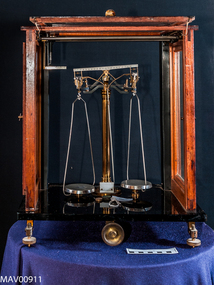
Scales, Gold, Apothecary, Analytical in Glass Case c1880, c1880
... Gottingen made fine precision scientific scales for use by assayers, jewellers, chemists, gold buyers rtc. scales balance precision measures gold pharmacy precious metals jewellery gottingen germany sartorious f moorabin bentleigh cheltenham early settlers gold miners pioneers market gardeners ballarat bendigo imperial measure troy weight D.R.PATENT / GOTTINGER PRAZISIONSWAGENFABRIK G.m.b.H. / GOTTINGEN On upright V over GPW A 2 pan analytical, scientific or pharmaceutical beam balance scale made in Gottingen Germany c 1880. ...A pair of scales or dishes in which objects to be weighed and the weights / masses against which to weigh them are placed is an "Apparatus for weighing. The pan, or each of the pans, of a balance." Its parts include a fulcrum, a beam that balances on it, two pans at the ends of the beam to hold the materials to be weighed, and counter-balancing weights. Gottingen made fine precision scientific scales for use by assayers, jewellers, chemists, gold buyers rtc. A 2 pan analytical, scientific or pharmaceutical beam balance scale made in Gottingen Germany c 1880. These scales are encased in a mahogany framed glass cabinet and Graded 0 -9 9-0D.R.PATENT / GOTTINGER PRAZISIONSWAGENFABRIK G.m.b.H. / GOTTINGEN On upright V over GPW scales, balance, precision measures, gold, pharmacy, precious metals, jewellery, gottingen germany, sartorious f, moorabin, bentleigh, cheltenham, early settlers, gold miners, pioneers, market gardeners, ballarat, bendigo, imperial measure, troy weight -
 City of Moorabbin Historical Society (Operating the Box Cottage Museum)
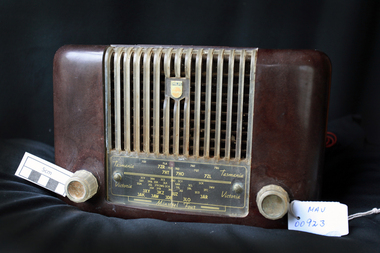
Communication Devices, radio, 'Phillips', c1930
... PHI broadcast in Dutch to the Dutch East Indies (now Indonesia) while PCJJ broadcast in English, Spanish and German to the rest of the world. phillips radio amsterdam holland moorabbin cheltenham bentleigh market gardeners early settlers radio sets Front : PHILLIPS / Model 13B 'Minstrel Four' A brown, mantel radio set, 'Phillips' Model 13B. ...Koninklijke Philips N.V. (Royal Philips, commonly known as Philips) is a Dutch multinational engineering and electronics conglomerate headquartered in Amsterdam. It was founded in Eindhoven in 1891 by Gerard Philips and his father Frederik. It is one of the largest electronics companies in the world. On 11 March 1927 Philips went on the air with shortwave radio station PCJJ (later PCJ) which was joined in 1929 by sister station PHI. PHI broadcast in Dutch to the Dutch East Indies (now Indonesia) while PCJJ broadcast in English, Spanish and German to the rest of the world.A brown, mantel radio set, 'Phillips' Model 13B. It has 2 tuning knobs and a clear grill. The flex has been removed.Front : PHILLIPS / Model 13B 'Minstrel Four'phillips radio, amsterdam holland, moorabbin, cheltenham, bentleigh, market gardeners, early settlers, radio sets -
 City of Moorabbin Historical Society (Operating the Box Cottage Museum)
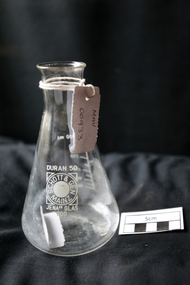
Manufactured Glass, Pharmacy beaker, c1950
... Germany taken over by the DDR State both using same trade name. Legal action for 30 years resolved in 1980 - split name. Berlin Wall 1989, Factories reunited 1991 pharmacy medications medicines glass manufacturing glass works early settlers moorabbin bentleigh cheltenham jenaer glaswerk schott & gen company west germany east germany berlin wall ww2 1939-45 schott otto zeiss roderich Front : DURAN 50 / SCHOTT & GEN / MAINZ / JENA (ER) GLAS 300 Back : PYREX 300 A pharmaceutical clear glass beaker with graduation 100ml -300ml DURAN 50 Manufactured Glass, Pharmacy beaker Schott & Gen Glass Manufacturers Ltd ...Otto Schott, a chemist and glass engineer, had the vision of uniform production ie making glass items that would resemble one another. At the end of the eighteenth century, with most glass items still created by hand, the quality of output was still a guessing game. Schott was the first to render this an industrial certainty. 1884 Otto Schott, Ernst Abbe and Carl and Roderich Zeiss found the Schott & Associates Glass Technology Laboratory in Jena, Germany. Glastechnisches Laboratorium Schott & Gen was born. Production started in 1886. Original products included optical and thermometer glasses. The following year, a crucial discovery was made: borosilicate, a heat and chemically resistant glass. By it’s 25th year anniversary, the company had grown from an experimental glass factory into an internationally renowned manufacturer of optical and industrial glasses. Soon to be added was fiolax, tube-shaped glass used for vials, ampoules and syringes thus allowing the company to play a significant role in supplying Europe's nascent pharmaceutical industry. Post WW2 USA Army opens new factory in Mainz, West Germany and factory in Jena , East Germany taken over by the DDR State both using same trade name. Legal action for 30 years resolved in 1980 - split name. Berlin Wall 1989, Factories reunited 1991A pharmaceutical clear glass beaker with graduation 100ml -300ml DURAN 50Front : DURAN 50 / SCHOTT & GEN / MAINZ / JENA (ER) GLAS 300 Back : PYREX 300pharmacy, medications, medicines, glass manufacturing, glass works, early settlers, moorabbin, bentleigh, cheltenham, jenaer glaswerk schott & gen company, west germany, east germany, berlin wall, ww2 1939-45, schott otto, zeiss roderich -
 City of Moorabbin Historical Society (Operating the Box Cottage Museum)
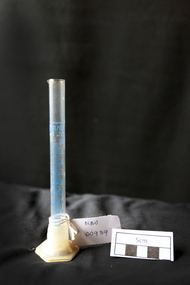
Manufactured glass, graduated cylinder 10ml, c1948 - 1991
... When the Berlin Wall comes down in 1989 Germany is united once again and in 1991 the company is joined and the Jena factory is brought up-to-date by 1994. pharmacy medications medicines glass manufacturing glass works early settlers moorabbin bentleigh cheltenham jenaer glaswerk schott & gen company west germany east germany berlin wall ww2 1939-45 schott otto zeiss roderich borosilicate glass glass cylinders laboratory glass agr / ? ...Otto Schott, a chemist and glass engineer, had the vision of uniform production ie making glass items that would resemble one another. At the end of the eighteenth century, with most glass items still created by hand, the quality of output was still a guessing game. Schott was the first to render this an industrial certainty. 1884 Otto Schott, Ernst Abbe and Carl and Roderich Zeiss found the Schott & Associates Glass Technology Laboratory in Jena, Germany. Glastechnisches Laboratorium Schott & Gen was born. Production started in 1886. The following year, a crucial discovery was made: borosilicate, a heat and chemically resistant glass.By it’s 25th year anniversary, the company had grown from an experimental glass factory into an internationally renowned manufacturer of optical and industrial glasses. Soon to be added was fiolax, tube-shaped glass used for vials, ampoules and syringes thus allowing the company to play a significant role in supplying Europe's nascent pharmaceutical industry. During WW2 Company was taken over for military use, and in 1945 given to the Russians as East Germany - GDR. , US troops transfer the "brain trust" of Jenaer Glas to Mainz in West and In Jena , East Germany, in 1948 the company became a state-owned "property of the people." The West German company becomes Schott Glaswerk, while the people in Jena, GDR, shorten their name to Jenaer Glaswerk. When the Berlin Wall comes down in 1989 Germany is united once again and in 1991 the company is joined and the Jena factory is brought up-to-date by 1994.This 10ml clear glass, graduated cylinder for laboratory tests, set in a plastic pentagonal base, is made of borosilicate glass. It has a pouring lip. The wide pentagonal shaped base provides stability and makes the cylinder roll-resistant. agr / ? TRS 10/0.1 / B Tol + - 0.1 / ml in 20'C / GDR pharmacy, medications, medicines, glass manufacturing, glass works, early settlers, moorabbin, bentleigh, cheltenham, jenaer glaswerk schott & gen company, west germany, east germany, berlin wall, ww2 1939-45, schott otto, zeiss roderich, borosilicate glass, glass cylinders, laboratory glass -
 City of Moorabbin Historical Society (Operating the Box Cottage Museum)
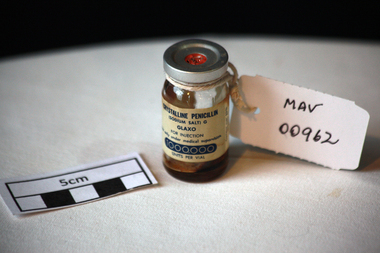
Manufactured Glass, bottle 'Crystalline Penicillin', December 1955
... The development of penicillin for use as a medicine is attributed to the Australian Nobel laureate Howard Walter Florey, together with the German Nobel laureate Ernst Chain and the English biochemist Norman Heatley pharmacy medicines penicillin early settlers market gardeners moorabbin bentleigh cheltenham manufactured glass bottles glaxo laboratories melbourne Front: CRYSTALLINE PENICILLIN / ( SODIUM SALT) G / GLAXO / FOR INJECTION / Use only under medical supervision / 1000000 / UNITS PER VIAL. ...Penicillin is a group of antibiotics derived from Penicillium fungi, including penicillin G, procaine penicillin, benzathine penicillin, and penicillin V. Penicillin antibiotics are historically significant because they are the first drugs that were effective against many previously serious diseases, such as syphilis, and infections caused by staphylococci and streptococci. Penicillins are still widely used today, though many types of bacteria have now become resistant. All penicillins are β-lactam antibiotics and are used in the treatment of bacterial infections caused by susceptible, usually Gram-positive, organisms. The development of penicillin for use as a medicine is attributed to the Australian Nobel laureate Howard Walter Florey, together with the German Nobel laureate Ernst Chain and the English biochemist Norman Heatley A clear glass bottle with a metal fixed top in which the central rubber disc has been pierced by a needle .Front: CRYSTALLINE PENICILLIN / ( SODIUM SALT) G / GLAXO / FOR INJECTION / Use only under medical supervision / 1000000 / UNITS PER VIAL. Left side : Refrigeration unnecessary....MANFD. DEC. 1955 / EXPIRY DEC. 1958 / POTENCY 1667 / IU/MG / BATCH 269. Right side :Contains over 90% / penicillin G / Contains no preservatives / GLAXO LABORATORIES / (AUST.) PTY. LTD. / Melbourne Sydneypharmacy, medicines, penicillin, early settlers, market gardeners, moorabbin, bentleigh, cheltenham, manufactured glass, bottles, glaxo laboratories melbourne -
 City of Moorabbin Historical Society (Operating the Box Cottage Museum)
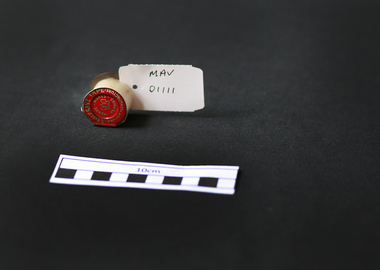
Manufactured Objects, adhesive surgical tape, 20thC
... German company Beiersdorf AG. Larger scale manufacturing of similar medical tapes began in 1874 by Robert Wood Johnson and George Seaburg in East Orange, NJ. (Johnson & Johnson Pty). 1921, Earle Dickson, who bought cotton for Johnson & Johnson, fixed a piece of gauze to some cloth backed tape and the first Band-Aid ® was invented. medical dressings early settlers, moorabbin, cheltenham. bentleigh, johnson & johnson pty ltd adhesive surgical tape, around wheel: ADHESIVE TAPE MANUFACTURED / MINDS MAKES REPAIRS Symbol of a butterfly in centre A roll of white adhesive surgical tape on a metal reel width 2cm Manufactured Objects, adhesive surgical tape Unrecorded ...Surgical tape or medical tape is a type of pressure-sensitive adhesive tape used in medicine and first aid to hold a bandage or other dressing onto a wound. These tapes usually have a hypoallergenic adhesive which is designed to hold firmly onto skin, dressing materials, and underlying layers of tape, but to remove easily without damaging the skin. Surgical tape is often white because it contains zinc oxide, which is added to help prevent infections. In 1845, Dr. Horace Day made the first crude surgical tape. It was created by combining India rubber, pine gum, turpentine, litharge (a yellow lead oxide), and turpentine extract of cayenne pepper and then applying that mixture to strips of fabric. It was the first “rubber-based” adhesive tape called Leukoplast for the German company Beiersdorf AG. Larger scale manufacturing of similar medical tapes began in 1874 by Robert Wood Johnson and George Seaburg in East Orange, NJ. (Johnson & Johnson Pty). 1921, Earle Dickson, who bought cotton for Johnson & Johnson, fixed a piece of gauze to some cloth backed tape and the first Band-Aid ® was invented. A roll of white adhesive surgical tape on a metal reel width 2cmaround wheel: ADHESIVE TAPE MANUFACTURED / MINDS MAKES REPAIRS Symbol of a butterfly in centre medical dressings, early settlers, moorabbin, cheltenham. bentleigh, johnson & johnson pty ltd, adhesive surgical tape, -
 City of Moorabbin Historical Society (Operating the Box Cottage Museum)
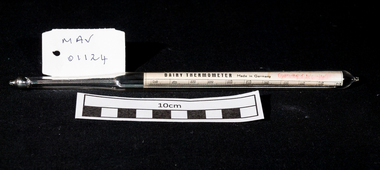
Dairy Equipment, thermometer, 20thC
... Early settler families owned a 'House cow' to provide milk ,cream, cheese for their families A typical milk thermometer used by early settlers in Moorabbin Shire c1900 early settlers, market gardeners, dairy farmers, milk products, cheese making, thermometers, cooking utensils, kitchenware, castiron cooking pots, blacksmiths, slow cooking, moorabbin shire, bentleigh, mckinnon, highett, cheltenham,mcewan james pty ltd, melbourne, bunnings pty ltd, DAIRY THERMOMETER / MADE IN GERMANY A graduated Dairy thermometer Dairy Equipment, thermometer ...Dairy Thermometers are used for testing the temperature of milk while making yogurts and cheese. Early settler families owned a 'House cow' to provide milk ,cream, cheese for their familiesA typical milk thermometer used by early settlers in Moorabbin Shire c1900A graduated Dairy thermometerDAIRY THERMOMETER / MADE IN GERMANY early settlers, market gardeners, dairy farmers, milk products, cheese making, thermometers, cooking utensils, kitchenware, castiron cooking pots, blacksmiths, slow cooking, moorabbin shire, bentleigh, mckinnon, highett, cheltenham,mcewan james pty ltd, melbourne, bunnings pty ltd, -
 City of Moorabbin Historical Society (Operating the Box Cottage Museum)
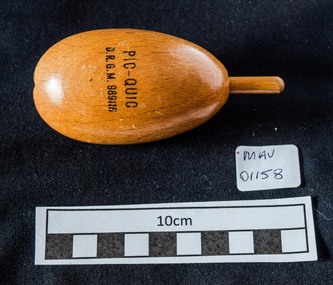
Sewing Equipment , wooden 'Pic-Quic', 20thC
... Germany might have been stamped with this D.R.G.M. designation. This Quic Pic was used by the family of Ailsa Hunt in mid 20thC The women of the post World War 11 estates made clothes and furnishings as their families settled in Bentleigh, McKinnon, Moorabbin ,Ormond in City of Moorabbin c1950s clothing, haberdashery, crochet, doilies, brighton, moorabbin, pioneers, dressmaking, market gardeners, early settlers, craftwork , bentleigh, lacework, moorabbin shire, hunt ailsa, dairy farms, fruit orchards 'PIC - QUIC' DRGM 989116 A wooden egg shaped tool with enclosed steel hook for darning stockings c1950 Sewing Equipment , wooden 'Pic-Quic' DRGM ...The wooden egg has a tiny metal latch hook inserted in the middle (same design as rug making tools). There is a groove down one side. A stocking or knitted fabric is stretched around the egg with the "ladder" in line with the groove. The latch hook is used to pick up the loops in knitted fabric to repair the fault. D.R.G.M., is not a German patent but was instead a way for inventors to register a product’s design or function in all states within Germany. From 1891 to 1952, products manufactured in Germany might have been stamped with this D.R.G.M. designation. This Quic Pic was used by the family of Ailsa Hunt in mid 20thCThe women of the post World War 11 estates made clothes and furnishings as their families settled in Bentleigh, McKinnon, Moorabbin ,Ormond in City of Moorabbin c1950s A wooden egg shaped tool with enclosed steel hook for darning stockings c1950'PIC - QUIC' DRGM 989116clothing, haberdashery, crochet, doilies, brighton, moorabbin, pioneers, dressmaking, market gardeners, early settlers, craftwork , bentleigh, lacework, moorabbin shire, hunt ailsa, dairy farms, fruit orchards
