
Showing 6 items matching "german war birds"
-
 Flagstaff Hill Maritime Museum and Village
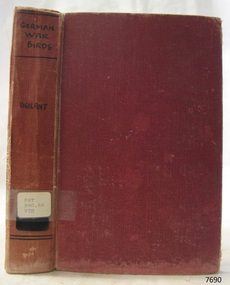
Book, German War Birds
... German War Birds......German War Birds...German War Birds Author: Vigilante Publisher: John Hamilton Date: 1933...Warrnambool Shipwrecked-coast Flagstaff-Hill Flagstaff-Hill-Maritime-Museum Maritime-Museum Shipwreck-coast Flagstaff-Hill-Maritime-Village Shipwrecked-artefact Book Pattison Collection Warrnambool Library Warrnambool Mechanics’ Institute Ralph Eric Pattison Corangamite Regional Library Service Warrnambool City Librarian Mechanics’ Institute Library Victorian Library Board Warrnambool books and records Warrnambool Children’s Library Great Ocean Road German War Birds Vigilante Label on spine cover with typed text PAT 940.44 VIG Pastedown front endpaper has sticker from Warrnambool Public Library coveered by a sticker from Corangamite Regional Library Service German War Birds Author: Vigilante Publisher: John Hamilton Date: 1933 German War Birds Book ...This item is from the ‘Pattison Collection’, a collection of books and records that was originally owned by the Warrnambool Mechanics’ Institute, which was founded in Warrnambool in 1853. By 1886 the Warrnambool Mechanics’ Institute (WMI) had grown to have a Library, Museum and Fine Arts Gallery, with a collection of “… choice productions of art, and valuable specimens in almost every branch and many wonderful national curiosities are now to be seen there, including historic relics of the town and district.” It later included a School of Design. Although it was very well patronised, the lack of financial support led the WMI in 1911 to ask the City Council to take it over. In 1935 Ralph Pattison was appointed as City Librarian to establish and organise the Warrnambool Library as it was then called. When the WMI building was pulled down in 1963 a new civic building was erected on the site and the new Warrnambool Library, on behalf of the City Council, took over all the holdings of the WMI. At this time some of the items were separated and identified as the ‘Pattison Collection’, named after Ralph Pattison. Eventually the components of the WMI were distributed from the Warrnambool Library to various places, including the Art Gallery, Historical Society and Flagstaff Hill. Later some were even distributed to other regional branches of Corangamite Regional Library and passed to and fro. It is difficult now to trace just where all of the items have ended up. The books at Flagstaff Hill Maritime Village generally display stamps and markings from Pattison as well as a variety of other institutions including the Mechanics’ Institute itself. RALPH ERIC PATTISON Ralph Eric Pattison was born in Rockhampton, Queensland, in 1891. He married Maude Swan from Warrnambool in 1920 and they set up home in Warrnambool. In 1935 Pattison accepted a position as City Librarian for the Warrnambool City Council. His huge challenge was to make a functional library within two rooms of the Mechanics’ Institute. He tirelessly cleaned, cleared and sorted a disarrayed collection of old books, jars of preserved specimens and other items reserved for exhibition in the city’s museum. He developed and updated the library with a wide variety of books for all tastes, including reference books for students; a difficult task to fulfil during the years following the Depression. He converted all of the lower area of the building into a library, reference room and reading room for members and the public. The books were sorted and stored using a cataloguing and card index system that he had developed himself. He also prepared the upper floor of the building and established the Art Gallery and later the Museum, a place to exhibit the many old relics that had been stored for years for this purpose. One of the treasures he found was a beautiful ancient clock, which he repaired, restored and enjoyed using in his office during the years of his service there. Ralph Pattison was described as “a meticulous gentleman whose punctuality, floorless courtesy and distinctive neat dress were hallmarks of his character, and ‘his’ clock controlled his daily routine, and his opening and closing of the library’s large heavy doors to the minute.” Pattison took leave during 1942 to 1945 to serve in the Royal Australian Navy, Volunteer Reserve as Lieutenant. A few years later he converted one of the Museum’s rooms into a Children’s Library, stocking it with suitable books for the younger generation. This was an instant success. In the 1950’s he had the honour of being appointed to the Victorian Library Board and received more inspiration from the monthly conferences in Melbourne. He was sadly retired in 1959 after over 23 years of service, due to the fact that he had gone over the working age of council officers. However he continued to take a very keen interest in the continual development of the Library until his death in 1969. The Pattison Collection, along with other items at Flagstaff Hill Maritime Village, was originally part of the Warrnambool Mechanics' Institute’s collection. The Warrnambool Mechanics’ Institute Collection is primarily significant in its totality, rather than for the individual objects it contains. Its contents are highly representative of the development of Mechanics' Institute libraries across Australia, particularly Victoria. A diversity of publications and themes has been amassed, and these provide clues to our understanding of the nature of and changes in the reading habits of Victorians from the 1850s to the middle of the 20th century. The collection also highlights the Warrnambool community’s commitment to the Mechanics’ Institute, reading, literacy and learning in the regions, and proves that access to knowledge was not impeded by distance. These items help to provide a more complete picture of our community’s ideals and aspirations. The Warrnambool Mechanics Institute book collection has historical and social significance for its strong association with the Mechanics Institute movement and the important role it played in the intellectual, cultural and social development of people throughout the latter part of the nineteenth century and the early twentieth century. The collection of books is a rare example of an early lending library and its significance is enhanced by the survival of an original collection of many volumes. The Warrnambool Mechanics' Institute’s publication collection is of both local and state significance. German War Birds Author: Vigilante Publisher: John Hamilton Date: 1933Label on spine cover with typed text PAT 940.44 VIG Pastedown front endpaper has sticker from Warrnambool Public Library coveered by a sticker from Corangamite Regional Library Servicewarrnambool, shipwrecked-coast, flagstaff-hill, flagstaff-hill-maritime-museum, maritime-museum, shipwreck-coast, flagstaff-hill-maritime-village, shipwrecked-artefact, book, pattison collection, warrnambool library, warrnambool mechanics’ institute, ralph eric pattison, corangamite regional library service, warrnambool city librarian, mechanics’ institute library, victorian library board, warrnambool books and records, warrnambool children’s library, great ocean road, german war birds, vigilante -
 Coal Creek Community Park & Museum
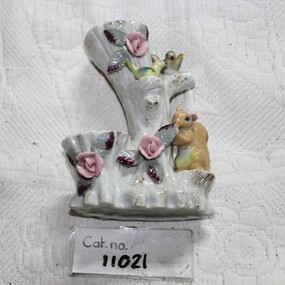
Domestic object - Porcelain 'tree trunk' vase with squirrel and flowers, c.1940s-1950s
... German-made porcelain trinkets, export of which was halted due to the war's impact of people's perception of Germany as a country at that time. Commonalities are a white glossy surface, hand-painted details and gold highlights. The Japanese pieces differ in that their casting is not as crisp, and there is often roughly-textured decorative spots of applied grit or extrusions. none Small porcelain 'tree trunk' vase, white gloss glaze with a figural squirrel and 2 birds. ...After WWII, Japan became an export centre for many items, mostly under heavy US investment. They provided the market with an extensive range of mass-produced and affordable pieces. Pieces are typically unmarked, or else simply say 'Japan' in a fine red ink. These items were designed to replicate German-made porcelain trinkets, export of which was halted due to the war's impact of people's perception of Germany as a country at that time. Commonalities are a white glossy surface, hand-painted details and gold highlights. The Japanese pieces differ in that their casting is not as crisp, and there is often roughly-textured decorative spots of applied grit or extrusions. Small porcelain 'tree trunk' vase, white gloss glaze with a figural squirrel and 2 birds. Flowers dotted about, hand-painted. Unmarked, likely made in Japan circa 1940s 1950s. Condition note: broken on back.none -
 Tatura Irrigation & Wartime Camps Museum
Article - Wall Hanging, 1940-1945
... Her godmother, another internee, Friedel Dehnel (Tante Fiffi) made the hanging for Else-Lore & wrote out the poem on the back for her. tatura ww2 camp 3 internee camps toys internment camp handcraft Poem in German, on paper attached to back: Wenn ich, o Kindlein, vor Dir stehe, wenn ich im Fraum Dich Tachelu sehe, wie Du ergluhst so wunderbar, da ahne ich mit susBem Grauen: durst ich in Deine Traume schauen, dann war neir alles, alles klar. Handmade wooden plywood wall hanging, painted, of sleeping blonde haired baby dressed in light blue laying in a cradle painted dark blue (with red heart) with checked red & white curtains & bird (robin red-breast) atop the curtains. ...Else-Lore Oertel, with her mother, was a German internee in Camp 3 A as a child, from 1940-1945. Her godmother, another internee, Friedel Dehnel (Tante Fiffi) made the hanging for Else-Lore & wrote out the poem on the back for her.Handmade wooden plywood wall hanging, painted, of sleeping blonde haired baby dressed in light blue laying in a cradle painted dark blue (with red heart) with checked red & white curtains & bird (robin red-breast) atop the curtains. Cream bed furnishings, grey floor area. Back has leather attachment for hanging on wall. There is a poem in German written on the back.Poem in German, on paper attached to back: Wenn ich, o Kindlein, vor Dir stehe, wenn ich im Fraum Dich Tachelu sehe, wie Du ergluhst so wunderbar, da ahne ich mit susBem Grauen: durst ich in Deine Traume schauen, dann war neir alles, alles klar.tatura, ww2, camp 3, internee camps, toys, internment camp handcraft -
 Wangaratta RSL Sub Branch
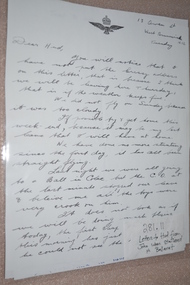
Letter - Letters x 2
... Germany also in 1944. See also 237 and 240. pilot kia killed in action dfc distinguished flying cross wwii world war two air force John to Hud Photocopy of two handwritten letters on letterhead depicting bird in flight below a crown. ...Two letters on RAAF letterhead paper one dated 1/11/1941 from Jack to Hud. From collection of photographs and cuttings dedicated to the memory of WILKINSON JOHN HUDSON : Service Number - 400444 : Date of birth - 18 Feb 1914 : Place of birth - RUTHERGLEN VIC : Place of enlistment - MELBOURNE : Next of Kin - WILKINSON HUDSON. Wilkinson was awarded the distinguished flying cross in March 1944 and tragically killed in action over Germany also in 1944. See also 237 and 240. Photocopy of two handwritten letters on letterhead depicting bird in flight below a crown.John to Hudpilot, kia, killed in action, dfc, distinguished flying cross, wwii, world war two, air force -
 Ballarat Heritage Services
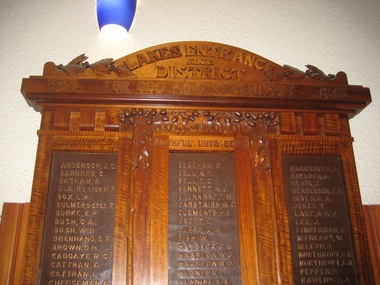
Photograph - Photograph - Colour, Clare Gervasoni, Lakes Entrance and District Honour Board, 27/08/2017
... German, Johann Christian Treede, after which he continued in business on his own. He also participated in the activities of Melbourne’s Deutscher Turnverein. During the first quarter of the current century he became the major exponent in the field of furniture and woodwork of the cult of nationalism, and was renowned for his carvings, many of them in the art nouveau style, of Australian animals, birds, trees and flowers. The two most common types of Australian timber in his work are mountain ash and blackwood. Lakes Entrance Robert Prenzel World War ...This honor board was made by Robert Prenzel (1866–1941) who was born and trained in Prussia, and migrated to Australia arriving in Melbourne on 24th November on the steamer Habsburg. In Melbourne Prenzel first worked for the German sculptor and modeller Otto Waschatz, decorating private homes and public buildings. From 1891-1901 Prenzel worked in partnership with another German, Johann Christian Treede, after which he continued in business on his own. He also participated in the activities of Melbourne’s Deutscher Turnverein. During the first quarter of the current century he became the major exponent in the field of furniture and woodwork of the cult of nationalism, and was renowned for his carvings, many of them in the art nouveau style, of Australian animals, birds, trees and flowers. The two most common types of Australian timber in his work are mountain ash and blackwood.Colour photographs of a beautifully carved World War One Honour Board by Robert Prenzel.lakes entrance, robert prenzel, world war one, lakes entrance honour board -
 Ballarat Heritage Services
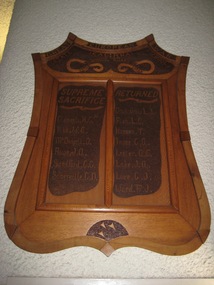
Photograph - Photograph - Colour, Clare Gervasoni, Kalimna Honour Board, 27/08/2017
... German, Johann Christian Treede, after which he continued in business on his own. He also participated in the activities of Melbourne’s Deutscher Turnverein. During the first quarter of the current century he became the major exponent in the field of furniture and woodwork of the cult of nationalism, and was renowned for his carvings, many of them in the art nouveau style, of Australian animals, birds, trees and flowers. The two most common types of Australian timber in his work are mountain ash and blackwood. world war ...This honor board was made by Robert Prenzel (1866–1941) who was born and trained in Prussia, and migrated to Australia arriving in Melbourne on 24th November on the steamer Habsburg. In Melbourne Prenzel first worked for the German sculptor and modeller Otto Waschatz, decorating private homes and public buildings. From 1891-1901 Prenzel worked in partnership with another German, Johann Christian Treede, after which he continued in business on his own. He also participated in the activities of Melbourne’s Deutscher Turnverein. During the first quarter of the current century he became the major exponent in the field of furniture and woodwork of the cult of nationalism, and was renowned for his carvings, many of them in the art nouveau style, of Australian animals, birds, trees and flowers. The two most common types of Australian timber in his work are mountain ash and blackwood.Colour photographs of a beautifully carved World War One Honour Board carved by Robert Prenzel.world war one, kalimna, kalimna honour board, h. clements, w.a. fish, d. mcdougall, j.a. rowe, c.c. sandford, c.d. somerville, l.j. cowlishaw, l.c. fish, t. hanson, c.a. innes, a.c. lester, j.a. lake, g.j. ward
