
Showing 57 items matching "get involved"
-
 Whitehorse Historical Society Inc.
Pamphlet, Get Involved, 2015/16
... Get Involved...Local volunteering opportunities 2015/16 in Whitehorse. Get Involved Pamphlet Pamphlet ...Local volunteering opportunities 2015/16 in Whitehorse.Local volunteering opportunities 2015/16 in Whitehorse.Local volunteering opportunities 2015/16 in Whitehorse.city of whitehorse, voluntary workers -
Marysville & District Historical Society
THE TRIANGLE NEWS-VOL 36 NO 21-JUNE 12 2009
... ...get involved...marysville victoria australia surviving koalas released at taggerty community counselling rooms at taggerty store marysville central weekly update james fraga cumberland site ann & simon cuzens what's on when marysville cricket club free advice in marysville taggerty progress group meeting consumer affairs victoria visiting marysville alexandra visitor information centre marysville & triangle development group (matdg) moving on get involved rebuilding marysville urban planning marysville lions club new birth maxx garnet advertisements marysville art show councillor comment mobile library positions vacant tourism recovery funding lions triangle tool library church notices triangle arts group buxton primary school house signs ready for pick up marysville medical clinic THE TRIANGLE NEWS-VOL 36 NO 21-JUNE 12 2009 ...marysville, victoria, australia, surviving koalas released at taggerty, community counselling rooms at taggerty store, marysville central weekly update, james fraga, cumberland site, ann & simon cuzens, what's on when, marysville cricket club, free advice in marysville, taggerty progress group meeting, consumer affairs victoria visiting marysville, alexandra visitor information centre, marysville & triangle development group (matdg), moving on, get involved, rebuilding, marysville urban planning, marysville lions club, new birth maxx garnet, advertisements, marysville art show, councillor comment, mobile library, positions vacant, tourism recovery funding, lions triangle tool library, church notices, triangle arts group, buxton primary school, house signs ready for pick up, marysville medical clinic -
 City of Greater Bendigo - Civic Collection
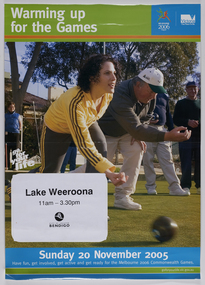
Poster - Advertising poster, Warming up for the Games, 2005
... t; Warming up for the games. ll; (Sticker) Lake Weeroona / 11.00am - 3.30pm / City of Greater Bendigo b; 20th November 2005. Have fun, get involved and get active for the Melbourne 2006 Commonwealth Games....City of Greater Bendigo Tourism City of Greater Bendigo Community Partnerships Commonwealth Games 2006 City of Greater Bendigo Events t; Warming up for the games. ll; (Sticker) Lake Weeroona / 11.00am - 3.30pm / City of Greater Bendigo b; 20th November 2005. Have fun, get involved and get active for the Melbourne 2006 Commonwealth Games. ...The 2006 Commonwealth Games, officially the XVIII Commonwealth Games and commonly known as Melbourne 2006, was an international multi-sport event for members of the Commonwealth held in Melbourne, Australia between 15 and 26 March 2006. It was the fourth time Australia had hosted the Commonwealth Games. Glossy colour poster advertising the upcoming Commonwealth Games, depicting women in foreground and man behind lawn bowling. t; Warming up for the games. ll; (Sticker) Lake Weeroona / 11.00am - 3.30pm / City of Greater Bendigo b; 20th November 2005. Have fun, get involved and get active for the Melbourne 2006 Commonwealth Games.city of greater bendigo tourism, city of greater bendigo community partnerships, commonwealth games 2006, city of greater bendigo events -
 Bendigo Historical Society Inc.
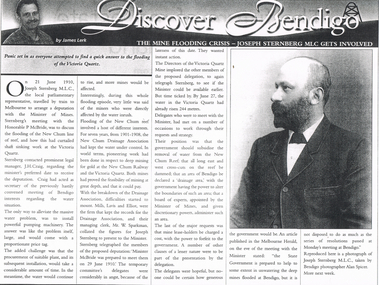
Newspaper - LONG GULLY HISTORY GROUP COLLECTION: THE MINE FLOODING CRISIS - VICTORIA QUARTZ
... Copy of an article in the Bendigo Weekly titled The Mine Flooding Crisis - Joseph Sternberg MLC gets involved by James Lerk. Joseph Sternberg MLC travelled to Melbourne to arrange a deputation with the Minister of Mines to discuss the flooding of the New Chum line of reef. ...BENDIGO History long gully history group The Long Gully History Group - Bendigo Weekly James Lerk Victoria Quartz Joseph Sternberg the Honorable P McBride J H Craig New Chum Reef New Chum Drainage Association New Chum Railway Mills Lavis and Elliot Mr W Sparkman Melbourne Herald Alan Spicer Copy of an article in the Bendigo Weekly titled The Mine Flooding Crisis - Joseph Sternberg MLC gets involved by James Lerk. Joseph Sternberg MLC travelled to Melbourne to arrange a deputation with the Minister of Mines to discuss the flooding of the New Chum line of reef. ...Copy of an article in the Bendigo Weekly titled The Mine Flooding Crisis - Joseph Sternberg MLC gets involved by James Lerk. Joseph Sternberg MLC travelled to Melbourne to arrange a deputation with the Minister of Mines to discuss the flooding of the New Chum line of reef. Pumping was mentioned but it would be expensive and would take time and the water would keep rising. They would also have to find a suitable pumping plant. The New Chum Drainage Association had kept the water under control. Delegates wanted the Government to subsidise the removal of the water.bendigo, history, long gully history group, the long gully history group - bendigo weekly, james lerk, victoria quartz, joseph sternberg, the honorable p mcbride, j h craig, new chum reef, new chum drainage association, new chum railway, mills lavis and elliot, mr w sparkman, melbourne herald, alan spicer -
 Ringwood and District Historical Society
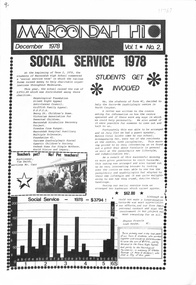
Newsletter, Maroondah High School - Newsletter Vol 1. No. 2 December 1978
... Black and White printed Foolscap sized newsletter (8 pages) Articles include: SOCIAL SERVICE 1978 - Students get involved, by Sharon Francis and Leah Broom, 4C THE BOYFRIEND® (School musical production) by various students, with photos THE CAMPS PROGRAM - Form reports (Julie Firth, Camps Co-ordinator), Form 6 Inverloch Camp (Deidre Wilson), Home Economics Camp (Julie Bernhardt), Biolgy Goes Bush, Tours 1979 (R. ...Black and White printed Foolscap sized newsletter (8 pages) Articles include: SOCIAL SERVICE 1978 - Students get involved, by Sharon Francis and Leah Broom, 4C THE BOYFRIEND® (School musical production) by various students, with photos THE CAMPS PROGRAM - Form reports (Julie Firth, Camps Co-ordinator), Form 6 Inverloch Camp (Deidre Wilson), Home Economics Camp (Julie Bernhardt), Biolgy Goes Bush, Tours 1979 (R. ...Black and White printed Foolscap sized newsletter (8 pages) Articles include: SOCIAL SERVICE 1978 - Students get involved, by Sharon Francis and Leah Broom, 4C THE BOYFRIEND® (School musical production) by various students, with photos THE CAMPS PROGRAM - Form reports (Julie Firth, Camps Co-ordinator), Form 6 Inverloch Camp (Deidre Wilson), Home Economics Camp (Julie Bernhardt), Biolgy Goes Bush, Tours 1979 (R. Bateman) PORT OF MELBOURNE EXCURSION by David Lee DISCIPLINE by D. R. Syer (Acting Principal) SPORT '78 - articles by R. Prior (Coach), D. Taylor. Giselle Teasdale 1C -
 Falls Creek Historical Society
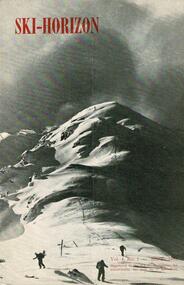
Journal - Ski-Horizon Vol 4 No 1
... Victoria were getting involved in skiing. The Wodonga Scouts had made several trips to Falls Creek and the Yarrawonga Scouts were planning to join in. ...Victoria were getting involved in skiing. The Wodonga Scouts had made several trips to Falls Creek and the Yarrawonga Scouts were planning to join in. ...Ski-Horizon is the official journal of the Federation of Victorian Ski Clubs which began publication in 1949. The were 26 original member clubs which included Albury Ski Club, Bogong Ski Club, Myrtleford Ski Club, Tallangatta and District Ski Club and Wangaratta Ski Club. Two pioneers of Falls Creek, Tom Mitchell, M.L.A., and Martin Romuld were Vice-Presidents of the Federation.This Journal is significant because it documents the early development of skiing in Victoria.The journal features stories and events chronicling developments in Victoria and internationally. Items related to the Falls Creek Area in this issue include:- Page 1:- The Annual Albury Ski Club Ball was to be held at "Toonallook" on Saturday 22nd November and host Fred Griffith was hoping a contingent from Melbourne would attend. Boy Scouts in N.E. Victoria were getting involved in skiing. The Wodonga Scouts had made several trips to Falls Creek and the Yarrawonga Scouts were planning to join in. Based on the success of the recent N.E.D.S.A. team to New Zealand it also seemed likely that a New Zealand provincial team would visit Falls Creek in 1953.tom mitchell m.l.a., toonallook, fred griffith -
Glen Eira Historical Society
Article - South Metro Junior Football League
... This file contains five items An article from the Caulfield/Port Phillip leader on the development of the South Metro Junior Football League, dated 21/02/2012 An article from the Glen Eira News on the South Metro Junior Football League providing girls with an opportunity to be involved in football, dated May 2012 An article from the Herald Sun on the increase of interest of girls in playing football, dated 24/05/2012 A flyer for a “Chick Kick” Day to encourage young girls to get involved in Australian Rules football in the South Metro Junior Football League An article from the Caulfield/Port Phillip leader on the resignation of the Southern Football Leagues CEO, dated 19/06/2012...This file contains five items An article from the Caulfield/Port Phillip leader on the development of the South Metro Junior Football League, dated 21/02/2012 An article from the Glen Eira News on the South Metro Junior Football League providing girls with an opportunity to be involved in football, dated May 2012 An article from the Herald Sun on the increase of interest of girls in playing football, dated 24/05/2012 A flyer for a “Chick Kick” Day to encourage young girls to get involved in Australian Rules football in the South Metro Junior Football League An article from the Caulfield/Port Phillip leader on the resignation of the Southern Football Leagues CEO, dated 19/06/2012 Glen Eira Clubs Associations Societies Football Clubs Football Associations Sporting Clubs Sports Recreations Competitions Leisure Cultural events Cultural activities Cannizzo David South Metro Junior Football League Cultural establishments Australian Rules Football AFL Auskick 'Chick Kick' Day Caulfield/Port Phillip Leader Glen Eira News Herald Sun Kurdas Chyloe Southern Football League Holdsworth Wayne Seymour Mark Children's sports Moorabbin Women in sports Moorabbin Saints Junior Football League Article South Metro Junior Football League ...This file contains five items An article from the Caulfield/Port Phillip leader on the development of the South Metro Junior Football League, dated 21/02/2012 An article from the Glen Eira News on the South Metro Junior Football League providing girls with an opportunity to be involved in football, dated May 2012 An article from the Herald Sun on the increase of interest of girls in playing football, dated 24/05/2012 A flyer for a “Chick Kick” Day to encourage young girls to get involved in Australian Rules football in the South Metro Junior Football League An article from the Caulfield/Port Phillip leader on the resignation of the Southern Football Leagues CEO, dated 19/06/2012glen eira, clubs, associations, societies, football clubs, football associations, sporting clubs, sports, recreations, competitions, leisure, cultural events, cultural activities, cannizzo david, south metro junior football league, cultural establishments, australian rules football, afl auskick, 'chick kick' day, caulfield/port phillip leader, glen eira news, herald sun, kurdas chyloe, southern football league, holdsworth wayne, seymour mark, children's sports, moorabbin, women in sports, moorabbin saints junior football league -
 Flagstaff Hill Maritime Museum and Village
Ceramic - Beer Stein, Reinhold Merkelbach, 1945 to 1964
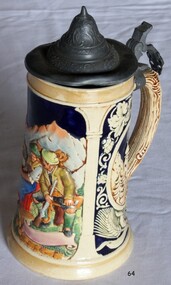
... Reinhold Merkelbach was founded in 1845 by Wilhelm Merkelbach, a descendent of a long line of German potters, and the company eventually took the name of his son Wilhelm Reinhold Merkelbach, who left school early to get involved with the family business. The company became a major name in German ceramics, especially in the Jugendstil style. ...Reinhold Merkelbach was founded in 1845 by Wilhelm Merkelbach, a descendent of a long line of German potters, and the company eventually took the name of his son Wilhelm Reinhold Merkelbach, who left school early to get involved with the family business. The company became a major name in German ceramics, especially in the Jugendstil style. ...This mug was made by Reinhold Merkelbach. Reinhold Merkelbach was founded in 1845 by Wilhelm Merkelbach, a descendent of a long line of German potters, and the company eventually took the name of his son Wilhelm Reinhold Merkelbach, who left school early to get involved with the family business. The company became a major name in German ceramics, especially in the Jugendstil style. The company produced a large number of collectable beer steins in the late 18th and early 19th centuries, including a number of so-called “character steins.” In 1882, the firm began producing art pottery, which at that time was enjoying a revival and new appreciation in Europe in general and in Germany in particular. Reinhold Merkelbach produced ceramic objects both with and without pewter hardware but rarely altered its manufacturing techniques. Many of its products were destined for use at pubs, bars, or breweries as well as in the homes of Germany’s beer-drinking populace. It had a retail location in Munich and also sold products through its factory warehouse. In 1971, half of the company’s ownership was sold to W. Goebel KG and the firm’s name changed officially to Merkelbach Manufaktur GmbH & Co. KG. Goebel ultimately purchased the other half of the business before members of the Merkelbach family, along with a handful of collectors and former staff members, repurchased the factory in 1988. In 2007, Judith Merkelbach Engelmann decided to close the firm; demand for ceramics had been decreasing and the next generation of the family had no interest in maintaining the business. Luckily, Reinhold Merkelbach transferred its moulds to Töpferei Girmscheid Höhr-Grenzhausen to ensure that its best-known pieces of Jugendstil art pottery and steins would continue to be available to interested consumers and collectors.This beer stein was made around the mid-20th century by a popular German maker. It fits in with the context of maritime village life. At this current time, there is no particular connection with people, places and events. The German beer stein is made from ceramic ironstone. It has a bell-shaped hinged pewter lid with a leaf-shaped thumb lever. The lid has a pattern stamped on it. The design on the mug includes a woman in bright colours, a man holding a musket, and buildings in mountain settings. There are inscriptions on the mug. Marked "Made in Germany" "RM" "4070" (underside of mug) "05" to the side of mug flagstaff hill, warrnambool, shipwrecked coast, flagstaff hill maritime museum, maritime museum, shipwreck coast, flagstaff hill maritime village, great ocean road, beer stein, ceramic beer stein, reinhold merkelbach, drinking vessel -
 Department of Energy, Environment and Climate Action
Painting - Conrad Wood
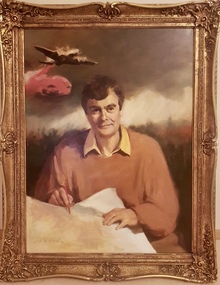
... He even managed to get involved in cloud seeding experiments for forest fire suppression and for improving water yield. ...He even managed to get involved in cloud seeding experiments for forest fire suppression and for improving water yield. ...Conrad Wood (Woody) graduated from the Victorian School of Forestry in 1957, and after postings with the Forests Commission Victoria (FCV) at Swifts Creek and Sirex surveys, he gravitated into the Forest Protection Division in Head Office in the early 1960s. He championed the setting up of proper contractual arrangements for aviation and was involved in implementing the first ongoing, organised contracts for firebombing in eastern Victoria in the 1960s. An early recipient of a prestigious Churchill Fellowship, Woody travelled extensively throughout 1969 in North America and Europe studying aviation in forestry and firefighting. Afterwards he was very active amongst the Churchill alumni. Woody had a passion for innovation and new technology and was instrumental in introducing new aircraft types and new approaches for forest firefighting and forest management. Amongst many other things, he played a major role in organising the trial of a RAAF C130 equipped with MAFFS for firebombing in south-eastern Australia in 1982-84, even piloting the lead plane. His inimitable style was crucial in successfully bringing together the cultures of the myriad organisations involved. Con advocated for the introduction of helicopters. He developed aerial fertilising and seeding techniques for forest management. He even managed to get involved in cloud seeding experiments for forest fire suppression and for improving water yield. Along with aviation, Conrad was passionate about literature, football, politics, food, drink, motorbikes, gardening and Glen Iris, to name a few. He was a committed campaigner on social justice issues and for many years read for vision-impaired people on public radio. He died in 2014. This painting of Woody by notable Australian artist Joyce McGrath OAM (also a Churchill Fellow) was done in the 1980s. Joyce asked Conrad to sit for this portrait which she planned to enter the Doug Moran National Portrait Prize. The portrait hung in Churchill House in Canberra, but when a new building was erected, it was returned to the artist/owner. The painting is now owned by Clare Harwood and is on permanent loan to the Forests Commission Retired Personnel Association (FCRPA) and is displayed at DEECA's Altona Museum.Painting of Conrad Wood by Australian artist Joyce McGrath OAMbushfire, bushfire aviation -
 Eltham District Historical Society Inc
Photograph - Digital Photograph, Joan Castledine, Opening Day, Guzman y Gomez - Eltham, 963 Main Road, 3 December 2025
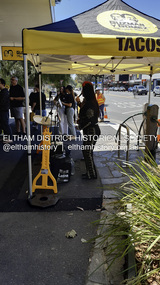
... We’re still hiring and can’t wait to get involved with the community, fuelling local sports clubs with delicious GYG meals and epic merch,” added Konrad Reich."...We’re still hiring and can’t wait to get involved with the community, fuelling local sports clubs with delicious GYG meals and epic merch,” added Konrad Reich." ...The Guzman y Gomez Mexican fast-food chain opened their Eltham store at 963 Main Road on December 3, 2025 with fanfare and special promotions that attracted large crowds lining up to get a taste all day long. The appearance of the store in terms of the chain’s usual signage had to be toned down to some degree to comply with Eltham’s local planning requirements. Some excerpts from the Guzman y Gomez website post about the event: Eltham… You Absolutely Smashed It! Massive crowds, big energy and an unforgettable opening day. (2025, December 8). Retrieved from https://www.guzmanygomez.com.au/eltham-you-absolutely-smashed-it/ "Eltham, what a day! Opening day for our new GYG Eltham restaurant was nothing short of incredible, and we want to extend a huge thank you to everyone who came down to celebrate. From $5 Burritos and Bowls to free coffee and lots of exclusive GYG merch, the good vibes rolled non-stop from early morning through to dinner!" "The energy kicked off bright and early with the Mayor of Eltham [sic], John Dumaresq, arriving at 7am to officially cut the yellow ribbon and help launch the opening of GYG Eltham. It was an exciting way to open the doors and of course, the mayor enjoyed a delicious and clean GYG brekkie burrito!" "Behind GYG Eltham is Andre and Konrad Reich, a local father and son team who have a passion for great food, great people and making a real difference in the community. Opening a GYG has been a long-time dream for the pair, and they’ve been waiting years for this to happen!" "Thanks to the restaurant’s prime location right next to the train station, guests were hopping off public transport and walking straight into GYG for lunch and dinner. The after-school rush was huge, with local students and young people flooding in to take advantage of the $5 Burritos and Bowls." "In true GYG spirit, the opening of Eltham has created 50 new local jobs, with the team already growing fast. Andre and Konrad are passionate about building a fun, supportive crew who live and breathe GYG’s ‘Got Your Back’ value." "“As part of our opening, we’ve welcomed a number of local crew — for some, this will be their very first job. We’re proud to show them what GYG is all about while delivering incredible food and an outstanding guest experience. We’re still hiring and can’t wait to get involved with the community, fuelling local sports clubs with delicious GYG meals and epic merch,” added Konrad Reich."joan castledine collection, 963 main road, eltham shops, guzman y gomez - eltham, main road eltham, opening day, restaurants, john dumaresq, konrad reich, andre reich, youth employment, nillumbik shire mayor -
 Surrey Hills Historical Society Collection
Photograph, Exterior of Henry Jamieson Radio Business, 145 Union Road, Surrey Hills
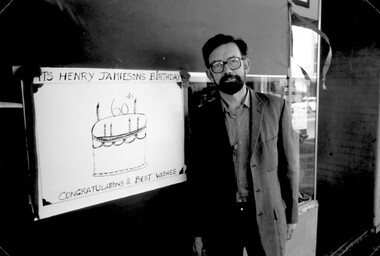
... Henry always had an interest in music and became involved in getting the radio station 3MBS established in Kew. ...Henry always had an interest in music and became involved in getting the radio station 3MBS established in Kew. ...Henry was born in View Street and then Newton Street. He went to Box Hill Grammar School. Before his marriage he lived in Mont Albert Road. Adrian Knowles had started a radio shop at 145 Union Road in the 1940s and Henry joined him later continuing the business in his own name. Henry always had an interest in music and became involved in getting the radio station 3MBS established in Kew. For some years Henry and a co-producer presented a prime time Saturday evening programme and also an early morning one.A black and white photograph of a man with dark hair, wearing dark rimmed glasses and a suit coat, is standing beside a white board someone has decorated for Henry Jamieson's 60th birthday.(mr) henry jamieson, view street, newton street, box hill grammar school, mont albert road, union road, surrey hills, 3mbs, adrian knowles -
 Melton City Libraries
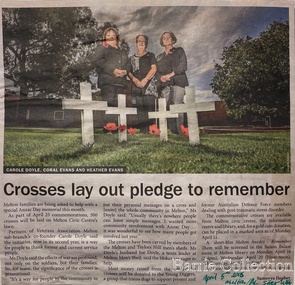
Newspaper, Crosses lay out pledge to remember, 2015
... Such were the numbers of people getting involved that branches were also established in Toolern Vale and Rockbank. ...Such were the numbers of people getting involved that branches were also established in Toolern Vale and Rockbank. ..."The outbreak of World War I in August 1914 had an immediate impact on communities across Australia, and it was no different in Melton. Young men began enlisting immediately, and Australia’s initial offer of 20,000 troops was soon exceeded by Victorian enlistments alone. Over the four years of the war, approximately 114,000 Victorians enlisted and around 91,000 servicemen and women were sent overseas. They came not just from Melbourne, but from all over the state; from farms, small towns and suburban areas. They included locals, newly arrived migrants and Indigenous people. The Australian home front was a hive of activity throughout the war, and the Melton community played its part. Following the announcement that Australia was joining the war with Great Britain and its allies on 5 August 1914, the Melton community lost no time in launching into action. A meeting ‘to assist the Red Cross fund’ was held in the Melton Mechanics’ Institute hall on 18 August – just days after the outbreak of the war. Collectors were appointed for each corner of the shire and individual donations were made. A Melton branch of the Australian Red Cross Society was formed in June 1915 and focused its energies on raising funds to purchase material that was used to make clothes for sick and wounded soldiers. A depot was established in Melton to collect clothing and other ‘comfort’ items for the soldiers – including reading material, tobacco, linen, canned foods and soap – and to coordinate the branch’s work and activities. Local cab driver Percival Stubbs volunteered to transport all the packages to the Melton railway station, until he enlisted and departed for the front in 1916. Such were the numbers of people getting involved that branches were also established in Toolern Vale and Rockbank. Regular community events were held to farewell soldiers who were leaving on active service and to welcome those who returned home. Gunner Robert (Bob) Wynne, whose uncle’s family ran the general store in Toolern Vale, was presented with a pair of field glasses (binoculars), a gold watch, inscribed locket and autographed letter by the Toolern Vale community before he set sail for the front in 1916. His mother noted that he ‘sailed away in good spirits with a smile till out of sight’. From June 1915 to June 1919, the Melton Red Cross branch donated 2,156 pairs of socks, 1,357 shirts, 425 kit bags, 251 pillowslips, 224 towels and 121 pairs of pajamas. Countless fundraising events were held, including jumble fairs, concerts and gift evenings. Local schools also encouraged students to contribute through fund-raising and making and collecting comforts for the soldiers. People across the country engaged in similar activities, but Victoria’s rural communities found unique ways of contributing. In Melton, people were encouraged to send rabbits and hares ‘in good condition’ to an exporter in Spencer Street, for export to Belgium ‘for the relief of those suffering". Special Anzac Memorial article featured in the Star Weeklylocal identities, war -
 Uniting Church Archives - Synod of Victoria
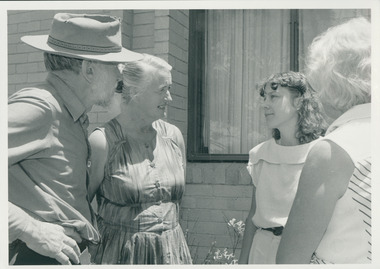
Photograph, undated c.1980s
... Fred loved to get involved with the day-to-day activities of his people, to develop a deeper relationship and greater understanding. ...Fred loved to get involved with the day-to-day activities of his people, to develop a deeper relationship and greater understanding. ...Rosalie Rayment originally trained and worked as an Occupational Therapist. Following completion of studies in Theology she worked for 11 years with the Church in Thailand. Rosalie was ordained in 1988. Fred Vanclay B.D., Dip AgS. ordained 1964 in the Presbyterian Church. Served: Queensland 1961 - 1975; Victoria 1976 - 1985 Vermont - Parkmore; Northern Territory Tennant-Barkly Patrol 1985 - 1993. Died in 2016. Adapted from the eulogy given by his son, Jerry Vanclay One of Fred’s first placements as a minister was in Mackay, North Queensland. Mackay was a wonderful place for Fred, his wife Donna and their young family. They all loved the beaches and the bush, and the children completed a significant part of their schooling there. Whilst posted in Mackay, Fred and Donna enjoyed long road trips in their modest HR Holden sedan, with the family, to Uluru, to Broome via the Borroloola Track, and down the Birdsville Track to the Flinders ranges; along the way, developing the bushcraft that would stand them in good stead later in the Tennant-Barkly Patrol. After many years in ministry in Mackay, then in Vermont, Victoria, Fred and Donna were called to the Tennant-Barkly Patrol in the Northern Territory, where he served for eight years, probably Fred’s most satisfying years. All Fred’s parishes were welcoming and rewarding, but Fred said on more than one occasion that he had a special love for the Patrol. He felt that in an urban congregation, he ministered mainly to those who came to Church, but in the Patrol he ministered to everyone, and especially to those in need. Fred loved to get involved with the day-to-day activities of his people, to develop a deeper relationship and greater understanding. Some remarked that when Fred helped, everything took longer, but they loved him and his assistance nonetheless. Fred was proud to follow in the footsteps of his predecessor Padre Fred McKay, and sometimes joked that he was “Fred the 2nd”, not Fred McKay, but “Fred from Mackay”. During his last few weeks in hospital, Fred liked to reminisce on his time in the Patrol. He joked about how he surprised the selection panel with his knowledge of bush tracks and outstations – knowledge that he had gained on those long road trips from Mackay. He reflected that many aspects of his life were good preparation for his time in the Patrol. After their Patrol, Fred and Donna retired to Mt Waverley, in Melbourne, but they were both restless in retirement, and undertook supply ministries in Wedderburn, Kerang and North Cairns, and made several long journeys into the interior and into their beloved Patrol [in Tennant Creek] – as well as frequent visits to their eight grandchildren and two great-grandchildren, and occasional trips to Europe to reunite with distant family. They never tired of ministering and adventuring, but as age and infirmity progressively clipped their wings, they travelled more in spirit and less by car. Despite the many celebrations that he blessed – baptisms, marriages, and funerals – Fred never sought the limelight, and I think he would be surprised by our gathering today. I can almost hear him saying “Don’t make a fuss; just say a heartfelt prayer together”. – Jerry Vanclay Informal B & W gloss photo of Rev. Fred Vanclay, his wife Donna, Rosalie Rayment (later ordained) and Frances CrawfordRev F Vanclay, wife Donna and Rosalie Rayment who was later ordained -
 Sunshine and District Historical Society Incorporated
Archive - Brimbank City Council
... Newspaper Article Brimbank Messenger 5 May 1998 titled Struggling in Brimbank|Flyer Brimbank City Council titled Melbourne 2006 Commonwealth Games Getting Involved 2005|Flyer Brimbank City Council titled Melbourne 2006 Commonwealth Games Getting Involved 2006|Brimbank City Council Rates Update 2001 and 2002|Brimbank City Council sports and recreation program 2001 terms 3 and 4|Brimbank City Council Community Festival Launching Brimbank's Program for the Melbourne 2006 Commonwealth Games|Newspaper Article Independent 31 March 1998 titled Brimbank's new CEO likes west's community pride|Newspaper Article Independent 18 March 1997 titled How the residents of Brimbank voted|Newspaper Article The Advocate 22 November 1995 titled Brimbank the pride of the city and Council on target for cost reductions|Brimbank City Council Corporate Plan 1999 to 2000|Brimbank City Council Corporate Plan 1998 to 2001|Mayor and Councillors for Wards|Newspaper Article Brimbank Messenger 20 February 2001 titled Facts and figures that build a picture of our lives|Brimbank City Council Sunshine Beyond 2020 Preliminary for discussion Only|Newspaper Article The Advocate titled Brimbank Heritage|Draft Strategic Statement Brimbank City Council Shaping Brimbank's Future August 1996|Brimbank Update 2000 to 2001|Letter from Brimbank City Council 19 December 1997 Invitation to Constitutional Convention on the Republic chaired by John Cain|Brochure Brimbank City Council Sunshine town centre business Directory|Flyer Brimbank City Council Changing the Brimbank Story Invest In You|Letter to Anne Best from Brimbank City Council 10 March 2008 Confirming your participation in the Community Expo|Flyer Brimbank Commonwealth Games Festival Celebrating the 2006 Melbourne Commonwealth Games 19 March 2006|City of Sunshine Bulletin No 1 Local Government Reforms The Future of Sunshine Amalgamation|City of Brimbank Draft Street Tree Policy John Patrick Landscape Architects September 1998|2004 Brimbank Community Calendar Kororoit Creek 1925 to Kororoit Creek 2003|Letter from Brimbank City Council to Sunshine Historical Society 24 May 1999 Draft Street Tree Policy|Newspaper Article The Advocate 15 July 2003 titled 7% rate plan at Brimbank|Newspaper Article The Advocate 3 February 2004 titled Keilor Icon Historian activist names our Citizen of the year Susan Jennison|Newspaper Article Brimbank Leader 27 January 2004 titled Australia Day Honours Astonished surprised delighted|Newspaper Article Star 27 January 2004 titled Citizen of the year surprise for Susan|Around Brimbank April 2000 Volume 6 Number 3 A Safer Brimbank|Newspaper Article The Advocate 21 March 2000 titled Five new faces on the council Change of guard|Brimbank City Council Open Space Plan District 5 South East February 2000|Around Brimbank March 2000 Volume 6 Number 2 Special Festival and Election Issue|Brimbank City Council Facts about your Neighbourhood|Brimbank City Council Corporate Plan 2002 to 2005 Council Plan and 2002 and 2003 Annual Business Plan|Brimbank City Council Your rates at work February to June 2003|Brimbank City Council General Local Law 2002|Brimbank City Council Annual Report 2000 to 2001|Newspaper Article Advocate 8 May 1996 titled Preserving our history|Brimbank City Council Rates update 2002 to 2003|City of Brimbank Suburbs 2001|Handwritten note Mayors City of Brimbank from March 1997 to 2005|Brimbank City Council Cultural Plan and Community Consultation 10 September 2004|Brimbank City Council Cultural Plan Focus Group Sessions 10 September 2004|Summary of Design Intent Sunshine district centre Streetscape Design Project November 1996|Struggling in Brimbank|Melbourne 2006 Commonwealth Games|Newspaper Article 12th March 2024 titled Old council eye-sore - Former Sunshine Council Municipal Offices Alexandra Avenue|Newspaper Artilce 9th January 2024 Abandoning January 26 - Brimbank Council will no longer hold citizenship cermonies on January 26|Brimbank Writers & Readers Festival 14th - 23rd March 2024|Council Amalgamation|Proposed Ward Names for the Municipality of Brimbank - Compass Directions, Place Names, Koori "Aborginal" Names, Pioneers and former Prominent Citizen's names & Names of Historic Buildings or Features|What's on at Brimbank Libraries Imagine, Explore, Discover, Connect January - March 2024|Brimbank Community Festival|Brimkbanks new CEO Marilyn Duncan|Brink Sports & Recreation Porogram 2001|Brimbank City Council Corporate Plan 1995 to 2000|Brimbank City Council Corporate Plan 1997 to 2001|Brimbank City Council Annual Report 1998 to 1999|Brimbank City Council Annual Report 1999 to 2000|Sunshine Beyond 2020 Ideas for Sunshine Master Plan|Brimbank Heritage|Shaping Brimbanks Future Municipal Strategic Statement August 1996|City of Brimbank Street Tree Policy Draft September 1998|Brimbank Community Profile April 1999|Brimbank's Community Plan 2000 - 2005|Sunshine Town Centre Hampshire Rd Master Plan October 2012|Your Brimbank Newsletter Autumn 2011|Sunshine Rising Revitalising Our Town Cenre Autumn 2013|Sunshine Rising Revitalising Our Town Cenre Spring 2013|City of Brimbank Submission to the Metropolitan Planning Strategy March 2003|Constitution Convention on the Public invite from Brimbank City Council to S&DHS 1997...City of Brimbank Newspaper Article Brimbank Messenger 5 May 1998 titled Struggling in Brimbank|Flyer Brimbank City Council titled Melbourne 2006 Commonwealth Games Getting Involved 2005|Flyer Brimbank City Council titled Melbourne 2006 Commonwealth Games Getting Involved 2006|Brimbank City Council Rates Update 2001 and 2002|Brimbank City Council sports and recreation program 2001 terms 3 and 4|Brimbank City Council Community Festival Launching Brimbank's Program for the Melbourne 2006 Commonwealth Games|Newspaper Article Independent 31 March 1998 titled Brimbank's new CEO likes west's community pride|Newspaper Article Independent 18 March 1997 titled How the residents of Brimbank voted|Newspaper Article The Advocate 22 November 1995 titled Brimbank the pride of the city and Council on target for cost reductions|Brimbank City Council Corporate Plan 1999 to 2000|Brimbank City Council Corporate Plan 1998 to 2001|Mayor and Councillors for Wards|Newspaper Article Brimbank Messenger 20 February 2001 titled Facts and figures that build a picture of our lives|Brimbank City Council Sunshine Beyond 2020 Preliminary for discussion Only|Newspaper Article The Advocate titled Brimbank Heritage|Draft Strategic Statement Brimbank City Council Shaping Brimbank's Future August 1996|Brimbank Update 2000 to 2001|Letter from Brimbank City Council 19 December 1997 Invitation to Constitutional Convention on the Republic chaired by John Cain|Brochure Brimbank City Council Sunshine town centre business Directory|Flyer Brimbank City Council Changing the Brimbank Story Invest In You|Letter to Anne Best from Brimbank City Council 10 March 2008 Confirming your participation in the Community Expo|Flyer Brimbank Commonwealth Games Festival Celebrating the 2006 Melbourne Commonwealth Games 19 March 2006|City of Sunshine Bulletin No 1 Local Government Reforms The Future of Sunshine Amalgamation|City of Brimbank Draft Street Tree Policy John Patrick Landscape Architects September 1998|2004 Brimbank Community Calendar Kororoit Creek 1925 to Kororoit Creek 2003|Letter from Brimbank City Council to Sunshine Historical Society 24 May 1999 Draft Street Tree Policy|Newspaper Article The Advocate 15 July 2003 titled 7% rate plan at Brimbank|Newspaper Article The Advocate 3 February 2004 titled Keilor Icon Historian activist names our Citizen of the year Susan Jennison|Newspaper Article Brimbank Leader 27 January 2004 titled Australia Day Honours Astonished surprised delighted|Newspaper Article Star 27 January 2004 titled Citizen of the year surprise for Susan|Around Brimbank April 2000 Volume 6 Number 3 A Safer Brimbank|Newspaper Article The Advocate 21 March 2000 titled Five new faces on the council Change of guard|Brimbank City Council Open Space Plan District 5 South East February 2000|Around Brimbank March 2000 Volume 6 Number 2 Special Festival and Election Issue|Brimbank City Council Facts about your Neighbourhood|Brimbank City Council Corporate Plan 2002 to 2005 Council Plan and 2002 and 2003 Annual Business Plan|Brimbank City Council Your rates at work February to June 2003|Brimbank City Council General Local Law 2002|Brimbank City Council Annual Report 2000 to 2001|Newspaper Article Advocate 8 May 1996 titled Preserving our history|Brimbank City Council Rates update 2002 to 2003|City of Brimbank Suburbs 2001|Handwritten note Mayors City of Brimbank from March 1997 to 2005|Brimbank City Council Cultural Plan and Community Consultation 10 September 2004|Brimbank City Council Cultural Plan Focus Group Sessions 10 September 2004|Summary of Design Intent Sunshine district centre Streetscape Design Project November 1996|Struggling in Brimbank|Melbourne 2006 Commonwealth Games|Newspaper Article 12th March 2024 titled Old council eye-sore - Former Sunshine Council Municipal Offices Alexandra Avenue|Newspaper Artilce 9th January 2024 Abandoning January 26 - Brimbank Council will no longer hold citizenship cermonies on January 26|Brimbank Writers & Readers Festival 14th - 23rd March 2024|Council Amalgamation|Proposed Ward Names for the Municipality of Brimbank - Compass Directions, Place Names, Koori "Aborginal" Names, Pioneers and former Prominent Citizen's names & Names of Historic Buildings or Features|What's on at Brimbank Libraries Imagine, Explore, Discover, Connect January - March 2024|Brimbank Community Festival|Brimkbanks new CEO Marilyn Duncan|Brink Sports & Recreation Porogram 2001|Brimbank City Council Corporate Plan 1995 to 2000|Brimbank City Council Corporate Plan 1997 to 2001|Brimbank City Council Annual Report 1998 to 1999|Brimbank City Council Annual Report 1999 to 2000|Sunshine Beyond 2020 Ideas for Sunshine Master Plan|Brimbank Heritage|Shaping Brimbanks Future Municipal Strategic Statement August 1996|City of Brimbank Street Tree Policy Draft September 1998|Brimbank Community Profile April 1999|Brimbank's Community Plan 2000 - 2005|Sunshine Town Centre Hampshire Rd Master Plan October 2012|Your Brimbank Newsletter Autumn 2011|Sunshine Rising Revitalising Our Town Cenre Autumn 2013|Sunshine Rising Revitalising Our Town Cenre Spring 2013|City of Brimbank Submission to the Metropolitan Planning Strategy March 2003|Constitution Convention on the Public invite from Brimbank City Council to S&DHS 1997 Collection of documents relating to the Brimbank City Council Archive Brimbank City Council ...Newspaper Article Brimbank Messenger 5 May 1998 titled Struggling in Brimbank|Flyer Brimbank City Council titled Melbourne 2006 Commonwealth Games Getting Involved 2005|Flyer Brimbank City Council titled Melbourne 2006 Commonwealth Games Getting Involved 2006|Brimbank City Council Rates Update 2001 and 2002|Brimbank City Council sports and recreation program 2001 terms 3 and 4|Brimbank City Council Community Festival Launching Brimbank's Program for the Melbourne 2006 Commonwealth Games|Newspaper Article Independent 31 March 1998 titled Brimbank's new CEO likes west's community pride|Newspaper Article Independent 18 March 1997 titled How the residents of Brimbank voted|Newspaper Article The Advocate 22 November 1995 titled Brimbank the pride of the city and Council on target for cost reductions|Brimbank City Council Corporate Plan 1999 to 2000|Brimbank City Council Corporate Plan 1998 to 2001|Mayor and Councillors for Wards|Newspaper Article Brimbank Messenger 20 February 2001 titled Facts and figures that build a picture of our lives|Brimbank City Council Sunshine Beyond 2020 Preliminary for discussion Only|Newspaper Article The Advocate titled Brimbank Heritage|Draft Strategic Statement Brimbank City Council Shaping Brimbank's Future August 1996|Brimbank Update 2000 to 2001|Letter from Brimbank City Council 19 December 1997 Invitation to Constitutional Convention on the Republic chaired by John Cain|Brochure Brimbank City Council Sunshine town centre business Directory|Flyer Brimbank City Council Changing the Brimbank Story Invest In You|Letter to Anne Best from Brimbank City Council 10 March 2008 Confirming your participation in the Community Expo|Flyer Brimbank Commonwealth Games Festival Celebrating the 2006 Melbourne Commonwealth Games 19 March 2006|City of Sunshine Bulletin No 1 Local Government Reforms The Future of Sunshine Amalgamation|City of Brimbank Draft Street Tree Policy John Patrick Landscape Architects September 1998|2004 Brimbank Community Calendar Kororoit Creek 1925 to Kororoit Creek 2003|Letter from Brimbank City Council to Sunshine Historical Society 24 May 1999 Draft Street Tree Policy|Newspaper Article The Advocate 15 July 2003 titled 7% rate plan at Brimbank|Newspaper Article The Advocate 3 February 2004 titled Keilor Icon Historian activist names our Citizen of the year Susan Jennison|Newspaper Article Brimbank Leader 27 January 2004 titled Australia Day Honours Astonished surprised delighted|Newspaper Article Star 27 January 2004 titled Citizen of the year surprise for Susan|Around Brimbank April 2000 Volume 6 Number 3 A Safer Brimbank|Newspaper Article The Advocate 21 March 2000 titled Five new faces on the council Change of guard|Brimbank City Council Open Space Plan District 5 South East February 2000|Around Brimbank March 2000 Volume 6 Number 2 Special Festival and Election Issue|Brimbank City Council Facts about your Neighbourhood|Brimbank City Council Corporate Plan 2002 to 2005 Council Plan and 2002 and 2003 Annual Business Plan|Brimbank City Council Your rates at work February to June 2003|Brimbank City Council General Local Law 2002|Brimbank City Council Annual Report 2000 to 2001|Newspaper Article Advocate 8 May 1996 titled Preserving our history|Brimbank City Council Rates update 2002 to 2003|City of Brimbank Suburbs 2001|Handwritten note Mayors City of Brimbank from March 1997 to 2005|Brimbank City Council Cultural Plan and Community Consultation 10 September 2004|Brimbank City Council Cultural Plan Focus Group Sessions 10 September 2004|Summary of Design Intent Sunshine district centre Streetscape Design Project November 1996|Struggling in Brimbank|Melbourne 2006 Commonwealth Games|Newspaper Article 12th March 2024 titled Old council eye-sore - Former Sunshine Council Municipal Offices Alexandra Avenue|Newspaper Artilce 9th January 2024 Abandoning January 26 - Brimbank Council will no longer hold citizenship cermonies on January 26|Brimbank Writers & Readers Festival 14th - 23rd March 2024|Council Amalgamation|Proposed Ward Names for the Municipality of Brimbank - Compass Directions, Place Names, Koori "Aborginal" Names, Pioneers and former Prominent Citizen's names & Names of Historic Buildings or Features|What's on at Brimbank Libraries Imagine, Explore, Discover, Connect January - March 2024|Brimbank Community Festival|Brimkbanks new CEO Marilyn Duncan|Brink Sports & Recreation Porogram 2001|Brimbank City Council Corporate Plan 1995 to 2000|Brimbank City Council Corporate Plan 1997 to 2001|Brimbank City Council Annual Report 1998 to 1999|Brimbank City Council Annual Report 1999 to 2000|Sunshine Beyond 2020 Ideas for Sunshine Master Plan|Brimbank Heritage|Shaping Brimbanks Future Municipal Strategic Statement August 1996|City of Brimbank Street Tree Policy Draft September 1998|Brimbank Community Profile April 1999|Brimbank's Community Plan 2000 - 2005|Sunshine Town Centre Hampshire Rd Master Plan October 2012|Your Brimbank Newsletter Autumn 2011|Sunshine Rising Revitalising Our Town Cenre Autumn 2013|Sunshine Rising Revitalising Our Town Cenre Spring 2013|City of Brimbank Submission to the Metropolitan Planning Strategy March 2003|Constitution Convention on the Public invite from Brimbank City Council to S&DHS 1997city of brimbank -
 Bendigo Military Museum
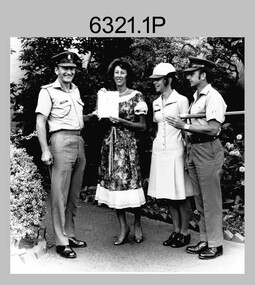
Photograph - Army Survey Regiment – Presentation to Charity Organisation, 1984
... Tracy, like all other Miss Australia candidates work hard for the Spastic Society in fundraising activities. Getting further involved in fundraising, Tracy and her strong committee have organised a 6km fun run for Sunday August 19. ...Tracy, like all other Miss Australia candidates work hard for the Spastic Society in fundraising activities. Getting further involved in fundraising, Tracy and her strong committee have organised a 6km fun run for Sunday August 19. ...These photographs of a presentation to a charity organisation were taken in the grounds of Fortuna Villa, Army Survey Regiment in 1984. SPR Tracy (Parker) Ash was the unit’s Miss Golden North section entrant in the Miss Australia Quest. MAJ Bob Roche, RSM Bob Mason and SPR Parker presented a fundraising cheque to the unidentified representative from the Spastic Society. The the newspaper article is from the Bendigo Advertiser. The following wording is taken from the article: ‘Tracy Parker is a sapper in the Army, and a cartographic technician stationed at Fortuna, Bendigo. Originally from Melbourne, Tracy, 23, is the latest entrant in the Miss Golden North segment of the Miss Australia Quest. The highlight of Tracy’s quest will be an open day at Fortuna, once the magnificent home of Bendigo’s Quartz King, George Lansell. This open day at Fortuna, on Sunday, August 26, between 10 am and 4 pm, will give district residents a rare opportunity of inspecting this magnificent building and its gardens. Tracy said there will be handicrafts, rides, competitions and refreshments available at the open day. The main attraction, apart from the building and gardens, would be a hot air balloon. Admission to the open day would be: Adults $2, children and pensioners $1, family party $5. All proceeds from the open day at Fortuna will go to the Spastic Society. Tracy, like all other Miss Australia candidates work hard for the Spastic Society in fundraising activities. Getting further involved in fundraising, Tracy and her strong committee have organised a 6km fun run for Sunday August 19. Entry forms are available at Bendigo sports stores, and at the end of the fun run will be a barbecue. Apart from her vocation in the Army, and fundraising for the Spastic Society, Tracy Parker has a great love of horses, and associated activities of riding, jumping and showing her horses. Tracy is keen to do well in her fundraising, and with the Australian Army, or more particularly, the ranks of Fortuna behind her, Tracy looks like succeeding.’The first three items are photographs of a presentation to a charity organisation at the Army Survey Regiment, Bendigo in 1984. The fourth item is an article from the Bendigo Advertiser describing Army Survey Regiment’s fund-raising activities. The photographs were printed on photographic paper and are part of the Army Survey Regiment’s Collection. The photographic proof prints were scanned at 600 dpi. Photos .1P and .2P were scanned at 300 dpi. The newspaper article was scanned at 762 dpi. .1) to .3P) - Photo, black & white, 1984, L to R: MAJ Bob Roche, Regional Coordinator Mrs Jan Lamborn, SPR Tracy (Parker) Ash, RSM WO1 Bob Mason. .4) – Bendigo Advertiser newspaper article with photo, black & white, 1984, SPR Tracy (Parker) Ash. .1P to .2P – ‘Presentation of Certificate of Appreciation from Spastic Society. Presented by Regional Coordinator Mrs Jan Lamborn to MAJ Roche, SPR Tracy Ash (entrant in Miss Australia Quest (1984) and WO1 Mason.' .3P – No personnel identified. .4P – SPR Tracy Parker named in newspaper article.royal australian survey corps, rasvy, army survey regiment, army svy regt, fortuna, asr -
 Puffing Billy Railway
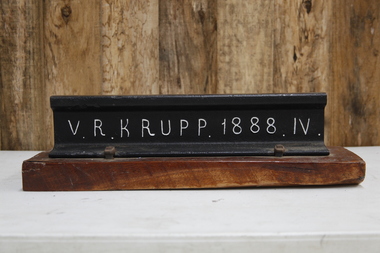
V. R. Krupp 1888. IV. Rail, 1888
... From 1878 August Thyssen starts to get involved in processing the products manufactured by Thyssen & Co., including the fabrication of pipes for gas lines. ...From 1878 August Thyssen starts to get involved in processing the products manufactured by Thyssen & Co., including the fabrication of pipes for gas lines. ...60lbs rail that was used throughout the Victorian rail network. In 1887 Gibbs, Bright and Co. had a contract with Victorian Railways for railway and canal construction and supply of Krupp Rails. Gibbs, Bright and Co were merchant bankers and shipping agents and merchants who where also Directors of the GWR ( Great Western Railway ) and the Ship The "Great Britain" in England Gibbs, Bright and Company had principally been involved in shipping and trading, mainly in the West Indies, but following the discovery of gold in Victoria they established an office in Melbourne and soon became one of the leading shipping agents and merchants in the Colony. They expanded into passenger shipping and soon established offices in Brisbane, Sydney, Newcastle, Adelaide and Perth as well as launching passenger services between England, Mauritius and New Zealand. Gibbs, Bright also held a number of financial agencies from British mortgage, finance and investment companies as well as representing several British insurance companies in Australia. In addition they conducted a growing import business as well as an export business that included livestock, dairy produce, wool and flour. Also the company played a substantial part in the development of Australia's mineral resources, starting with lead in 1895, and later venturing into tin, gold, copper, cement and super phosphates. In Australia, after WWI, many of the larger companies were managing their own import and export so Gibbs, Bright and Company tended to focus its Agency business on smaller companies while expanding their interest into other markets such as timber, wire netting, zinc, stevedoring, road transport, marine salvage, gold mining as well as mechanical, structural, electrical and marine engineering. The Company's shipping interests continued to grow as well and still formed a major part of its business. In 1948 the parent company in England took the major step from tradition when they changed the business from a partnership into a private limited company. The name was the same, Antony Gibbs and Sons Limited, and in practice the effect of the change was very little. Some of the firm's branches and departments had already become limited companies and the formation of a parent company simplified the structure. The Australian operation was in time changed to Gibbs Bright & Co Pty Ltd in 1963. In 1848 Alfred Krupp becomes the sole proprietor of the company which from 1850 experiences its first major growth surge. In 1849 his equally talented brother Hermann (1814 - 1879) takes over the hardware factory Metallwarenfabrik in Berndorf near Vienna, which Krupp had established together with Alexander Schöller six years earlier. The factory manufactures cutlery in a rolling process developed by the brothers. Krupp's main products are machinery and machine components made of high-quality cast steel, especially equipment for the railroads, most notably the seamless wheel tire, and from 1859 to an increased extent artillery. To secure raw materials and feedstock for his production, Krupp acquires ore deposits, coal mines and iron works. On Alfred Krupp's death in 1887 the company employs 20,200 people. His great business success is based on the quality of the products, systematic measures to secure sales, the use of new cost-effective steel-making techniques, good organization within the company, and the cultivation of a loyal and highly qualified workforce among other things through an extensive company welfare system. From 1878 August Thyssen starts to get involved in processing the products manufactured by Thyssen & Co., including the fabrication of pipes for gas lines. In 1882 he starts rolling sheet at Styrum, for which two years later he sets up a galvanizing shop. The foundation stone for Maschinenfabrik Thyssen & Co. is laid in 1883 with the purchase of a neighboring mechanical engineering company. In 1891 August Thyssen takes the first step toward creating a vertical company at the Gewerkschaft Deutscher Kaiser coal mine in [Duisburg-]Hamborn, which he expands to an integrated iron and steelmaking plant on the River Rhine. Just before the First World War he starts to expand his group internationally (Netherlands, UK, France, Russia, Mediterranean region, Argentina). info from The company thyssenkrupp - History https://www.thyssenkrupp.com/en/company/history/the-founding-families/alfred-krupp.htmlHistoric - Victorian Railways - Track Rail - made by Krupp in 1888Section of VR Krupp 1888 Rail mounted on a piece of varnished wood. Rail made of ironpuffing billy, krupp, rail, victorian railways -
 Flagstaff Hill Maritime Museum and Village
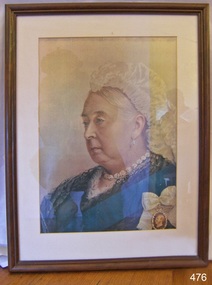
Print - Portrait of Queen Victoria, Hoy Art Picture Framing, Original probably painted in 1887 or 1897 to commemorate 50 or 60 years on the throne
... get her way. She was a very strong supporter of the Empire, which brought her closer both to Disraeli and to the Marquess of Salisbury, her last Prime Minister. Although conservative in some respects - like many at the time she opposed giving women the vote - on social issues, she tended to favour measures to improve the lot of the poor, such as the Royal Commission on housing. She also supported many charities involved...get her way. She was a very strong supporter of the Empire, which brought her closer both to Disraeli and to the Marquess of Salisbury, her last Prime Minister. Although conservative in some respects - like many at the time she opposed giving women the vote - on social issues, she tended to favour measures to improve the lot of the poor, such as the Royal Commission on housing. She also supported many charities involved ...Queen Victoria was born at Kensington Palace, London, on 24 May 1819. She was the only daughter of Edward, Duke of Kent, the fourth son of George III. Her father died shortly after her birth and she became heir to the throne because the three uncles who were ahead of her in the succession - George IV, Frederick Duke of York, and William IV - had no legitimate children who survived. Warmhearted and lively, Victoria had a gift for drawing and painting; educated by a governess at home, she was a natural diarist and kept a regular journal throughout her life. On William IV's death in 1837, she became Queen at the age of 18. Queen Victoria is associated with Britain's great age of industrial expansion, economic progress and, especially, empire. At her death, it was said, Britain had a worldwide empire on which the sun never set. In the early part of her reign, she was influenced by two men: her first Prime Minister, Lord Melbourne, and then her husband, Prince Albert, whom she married in 1840. Both men taught her much about how to be a ruler in a 'constitutional monarchy, in which the monarch had very few powers but could use much influence. Albert took an active interest in the arts, science, trade and industry; the project for which he is best remembered was the Great Exhibition of 1851, the profits from which helped to establish the South Kensington museums complex in London. Her marriage to Prince Albert produced nine children between 1840 and 1857. Most of her children married into other Royal families in Europe. Edward VII (born 1841), married Alexandra, daughter of Christian IX of Denmark. Alfred, Duke of Edinburgh and of Saxe-Coburg and Gotha (born 1844) married Marie of Russia. Arthur, Duke of Connaught (born 1850) married Louise Margaret of Prussia. Leopold, Duke of Albany (born 1853) married Helen of Waldeck-Pyrmont. Victoria, Princess Royal (born 1840) married Friedrich III, German Emperor. Alice (born 1843) married Ludwig IV, Grand Duke of Hesse and by Rhine. Helena (born 1846) married Christian of Schleswig-Holstein. Louise (born 1848) married John Campbell, 9th Duke of Argyll. Beatrice (born 1857) married Henry of Battenberg. Victoria bought Osborne House (later presented to the nation by Edward VII) on the Isle of Wight as a family home in 1845, and Albert bought Balmoral in 1852. Victoria was deeply attached to her husband and she sank into depression after he died, aged 42, in 1861. She had lost a devoted husband and her principal trusted adviser in affairs of state. For the rest of her reign she wore black. Until the late 1860s she rarely appeared in public; although she never neglected her official Correspondence, and continued to give audiences to her ministers and official visitors, she was reluctant to resume a full public life. She was persuaded to open Parliament in person in 1866 and 1867, but she was widely criticised for living in seclusion and quite a strong republican movement developed. Seven attempts were made on Victoria's life, between 1840 and 1882 - her courageous attitude towards these attacks greatly strengthened her popularity. With time, the private urgings of her family and the flattering attention of Benjamin Disraeli, Prime Minister in 1868 and from 1874 to 1880, the Queen gradually resumed her public duties. In foreign policy, the Queen's influence during the middle years of her reign was generally used to support peace and reconciliation. In 1864, Victoria pressed her ministers not to intervene in the Prussia-Denmark war, and her letter to the German Emperor (whose son had married her daughter) in 1875 helped to avert a second Franco-German war. On the Eastern Question in the 1870s - the issue of Britain's policy towards the declining Turkish Empire in Europe - Victoria (unlike Gladstone) believed that Britain, while pressing for necessary reforms, ought to uphold Turkish hegemony as a bulwark of stability against Russia, and maintain bi-partisanship at a time when Britain could be involved in war. Victoria's popularity grew with the increasing imperial sentiment from the 1870s onwards. After the Indian Mutiny of 1857, the government of India was transferred from the East India Company to the Crown, with the position of Governor-General upgraded to Viceroy, and in 1877 Victoria became Empress of India under the Royal Titles Act passed by Disraeli's government. During Victoria's long reign, direct political power moved away from the sovereign. A series of Acts broadened the social and economic base of the electorate. These acts included the Second Reform Act of 1867; the introduction of the secret ballot in 1872, which made it impossible to pressurise voters by bribery or intimidation; and the Representation of the Peoples Act of 1884 - all householders and lodgers in accommodation worth at least £10 a year, and occupiers of land worth £10 a year, were entitled to vote. Despite this decline in the Sovereign's power, Victoria showed that a monarch who had a high level of prestige and who was prepared to master the details of political life could exert an important influence. This was demonstrated by her mediation between the Commons and the Lords, during the acrimonious passing of the Irish Church Disestablishment Act of 1869 and the 1884 Reform Act. It was during Victoria's reign that the modern idea of the constitutional monarch, whose role was to remain above political parties, began to evolve. But Victoria herself was not always non-partisan and she took the opportunity to give her opinions, sometimes very forcefully, in private. After the Second Reform Act of 1867, and the growth of the two-party (Liberal and Conservative) system, the Queen's room for manoeuvre decreased. Her freedom to choose which individual should occupy the premiership was increasingly restricted. In 1880, she tried, unsuccessfully, to stop William Gladstone - whom she disliked as much as she admired Disraeli and whose policies she distrusted - from becoming Prime Minister. She much preferred the Marquess of Hartington, another statesman from the Liberal party which had just won the general election. She did not get her way. She was a very strong supporter of the Empire, which brought her closer both to Disraeli and to the Marquess of Salisbury, her last Prime Minister. Although conservative in some respects - like many at the time she opposed giving women the vote - on social issues, she tended to favour measures to improve the lot of the poor, such as the Royal Commission on housing. She also supported many charities involved in education, hospitals and other areas. Victoria and her family travelled and were seen on an unprecedented scale, thanks to transport improvements and other technical changes such as the spread of newspapers and the invention of photography. Victoria was the first reigning monarch to use trains - she made her first train journey in 1842. In her later years, she became the symbol of the British Empire. Both the Golden (1887) and the Diamond (1897) Jubilees, held to celebrate the 50th and 60th anniversaries of the Queen's accession, were marked with great displays and public ceremonies. On both occasions, Colonial Conferences attended by the Prime Ministers of the self-governing colonies were held. Despite her advanced age, Victoria continued her duties to the end - including an official visit to Dublin in 1900. The Boer War in South Africa overshadowed the end of her reign. As in the Crimean War nearly half a century earlier, Victoria reviewed her troops and visited hospitals; she remained undaunted by British reverses during the campaign: 'We are not interested in the possibilities of defeat; they do not exist.' Victoria died at Osborne House on the Isle of Wight, on 22 January 1901 after a reign which lasted almost 64 years, then the longest in British history. Her son, Edward VII succeeded her. She was buried at Windsor beside Prince Albert, in the Frogmore Royal Mausoleum, which she had built for their final resting place. Above the Mausoleum door are inscribed Victoria's words: "Farewell best beloved, here, at last, I shall rest with thee, with thee in Christ I shall rise again." Source: https://www.royal.uk/queen-victoria This picture captures Queen Victoria in her later years. It may well have been painted to commemorate her Golden Anniversary in 1887, or her Diamond Anniversary in 1897.Picture, print, reproduction of a drawing or photograph of Queen Victoria. She is wearing a dark-coloured dress, white headdress and a diamond necklace and earrings. On her left shoulder is the Royal Order of Victoria and Albert, awarded to female members of the British Royal Family and female courtiers. There are four grades or classes of this Royal Order as well as the Sovereign's Badge, which is exclusive to her. Also across her left shoulder, is a blue riband representing the Order of the Garter. The picture is in a medium-coloured timber frame with a white string across the width at the rear. The label says it was framed by Hoy Art, Warrnambool. The signature of the Queen is on the picture but is not obvious since the picture has been re-framed."HOY ART / PICTURE FRAMING / 48 Kepler St, Warrnambool 3280 / Phone (055) 62 8022" Signature (hidden by new framing) "Victoria H.R.S."flagstaff hill, warrnambool, shipwrecked-coast, flagstaff-hill, flagstaff-hill-maritime-museum, maritime-museum, shipwreck-coast, flagstaff-hill-maritime-village, picture of queen victoria, queen victoria, the royal order of victoria and albert, the order of the garter, hoy art -
 Ringwood and District Historical Society
Photograph - Parkwood Secondary College, Ringwood North, Victoria, 14 Digitised Images from Bogong School Camp - 2001 - Field Studies
... involved not only students from our school but also Kuranjang Secondary College in Melton. The students did a range of activities, including initiative activities, games, high ropes course, field studies, environmental studies, canoeing, rock climbing (indoor and outdoor), abseiling, mountain bike riding and a trip up to the high plains. The students also got to experience snow, some even getting...involved not only students from our school but also Kuranjang Secondary College in Melton. The students did a range of activities, including initiative activities, games, high ropes course, field studies, environmental studies, canoeing, rock climbing (indoor and outdoor), abseiling, mountain bike riding and a trip up to the high plains. The students also got to experience snow, some even getting ...School Magazine Transcript: "On the 15th of October, 23 Year 9 students headed off to Camp Bogong situated near Falls Creek. The camp involved not only students from our school but also Kuranjang Secondary College in Melton. The students did a range of activities, including initiative activities, games, high ropes course, field studies, environmental studies, canoeing, rock climbing (indoor and outdoor), abseiling, mountain bike riding and a trip up to the high plains. The students also got to experience snow, some even getting bogged in the snow on a minibus. All in all, the students enjoyed the week spent up at Bogong, not only having fun and enjoying the activities but also making life long friends." -
 Ringwood and District Historical Society
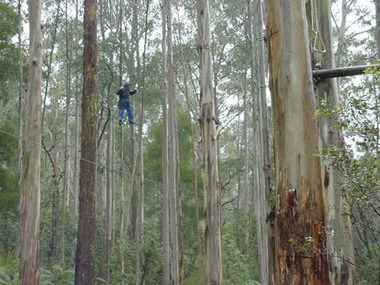
Photograph - Parkwood Secondary College, Ringwood North, Victoria, 10 Digitised Images from Bogong School Camp - 2001 - High Ropes
... involved not only students from our school but also Kuranjang Secondary College in Melton. The students did a range of activities, including initiative activities, games, high ropes course, field studies, environmental studies, canoeing, rock climbing (indoor and outdoor), abseiling, mountain bike riding and a trip up to the high plains. The students also got to experience snow, some even getting...involved not only students from our school but also Kuranjang Secondary College in Melton. The students did a range of activities, including initiative activities, games, high ropes course, field studies, environmental studies, canoeing, rock climbing (indoor and outdoor), abseiling, mountain bike riding and a trip up to the high plains. The students also got to experience snow, some even getting ...School Magazine Transcript: "On the 15th of October, 23 Year 9 students headed off to Camp Bogong situated near Falls Creek. The camp involved not only students from our school but also Kuranjang Secondary College in Melton. The students did a range of activities, including initiative activities, games, high ropes course, field studies, environmental studies, canoeing, rock climbing (indoor and outdoor), abseiling, mountain bike riding and a trip up to the high plains. The students also got to experience snow, some even getting bogged in the snow on a minibus. All in all, the students enjoyed the week spent up at Bogong, not only having fun and enjoying the activities but also making life long friends." -
 Ringwood and District Historical Society
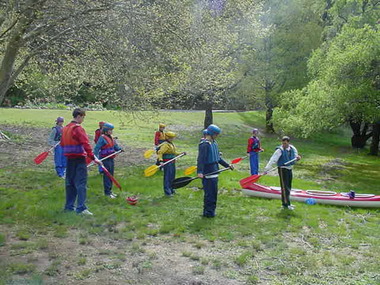
Photograph - Parkwood Secondary College, Ringwood North, Victoria, 8 Digitised Images from Bogong School Camp - 2001 - Kayaking
... involved not only students from our school but also Kuranjang Secondary College in Melton. The students did a range of activities, including initiative activities, games, high ropes course, field studies, environmental studies, canoeing, rock climbing (indoor and outdoor), abseiling, mountain bike riding and a trip up to the high plains. The students also got to experience snow, some even getting...involved not only students from our school but also Kuranjang Secondary College in Melton. The students did a range of activities, including initiative activities, games, high ropes course, field studies, environmental studies, canoeing, rock climbing (indoor and outdoor), abseiling, mountain bike riding and a trip up to the high plains. The students also got to experience snow, some even getting ...School Magazine Transcript: "On the 15th of October, 23 Year 9 students headed off to Camp Bogong situated near Falls Creek. The camp involved not only students from our school but also Kuranjang Secondary College in Melton. The students did a range of activities, including initiative activities, games, high ropes course, field studies, environmental studies, canoeing, rock climbing (indoor and outdoor), abseiling, mountain bike riding and a trip up to the high plains. The students also got to experience snow, some even getting bogged in the snow on a minibus. All in all, the students enjoyed the week spent up at Bogong, not only having fun and enjoying the activities but also making life long friends." -
 Ringwood and District Historical Society
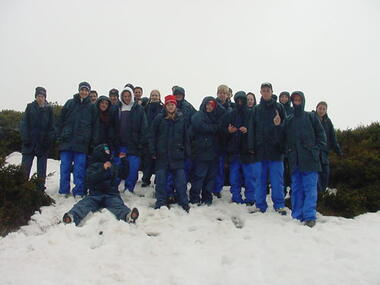
Photograph - Parkwood Secondary College, Ringwood North, Victoria, 7 Digitised Images from Bogong School Camp - 2001 - High Plains Snow Tour
... involved not only students from our school but also Kuranjang Secondary College in Melton. The students did a range of activities, including initiative activities, games, high ropes course, field studies, environmental studies, canoeing, rock climbing (indoor and outdoor), abseiling, mountain bike riding and a trip up to the high plains. The students also got to experience snow, some even getting...involved not only students from our school but also Kuranjang Secondary College in Melton. The students did a range of activities, including initiative activities, games, high ropes course, field studies, environmental studies, canoeing, rock climbing (indoor and outdoor), abseiling, mountain bike riding and a trip up to the high plains. The students also got to experience snow, some even getting ...School Magazine Transcript: "On the 15th of October, 23 Year 9 students headed off to Camp Bogong situated near Falls Creek. The camp involved not only students from our school but also Kuranjang Secondary College in Melton. The students did a range of activities, including initiative activities, games, high ropes course, field studies, environmental studies, canoeing, rock climbing (indoor and outdoor), abseiling, mountain bike riding and a trip up to the high plains. The students also got to experience snow, some even getting bogged in the snow on a minibus. All in all, the students enjoyed the week spent up at Bogong, not only having fun and enjoying the activities but also making life long friends." -
 The Beechworth Burke Museum
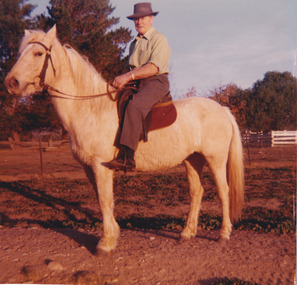
Audio - Oral History, Jennifer Williams, Mr Albert (Bert) Nankervis, 15th March 2000
... In this oral history, Albert discusses his life as a farmer in Wooragee, including his role in getting electricity to Beechworth, as well as his participation in the Young Farmer’s Association Immigration Scheme, which provided work experience to migrants in order for them to learn how to farm. This oral history recording was part of a project conducted by Jennifer Williams in the year 2000 to capture the everyday life and struggles in Beechworth during the twentieth century. This project involved...In this oral history, Albert discusses his life as a farmer in Wooragee, including his role in getting electricity to Beechworth, as well as his participation in the Young Farmer’s Association Immigration Scheme, which provided work experience to migrants in order for them to learn how to farm. This oral history recording was part of a project conducted by Jennifer Williams in the year 2000 to capture the everyday life and struggles in Beechworth during the twentieth century. This project involved ...Mr Albert (Bert) Nankervis was born at Thougla, in the Upper Murray, in 1903. He had a large family and was one of eight children, four boys and four girls. He and his family moved to a farm in Wooragee named ‘Wattle Grove’ in 1918 after his father returned from serving as a soldier in World War One. The family established ‘Wattle Grove’ as a dairy farm as Beechworth has a high demand for milk and little supply. They had 25 milk cows that were hand milked every morning in order to provide milk for approximately 100 customers in the town, with any extra going to the butter factory at Springhurst. Albert married Floré Lilias Hardy in 1930 and they had two sons, Phillip and Barry. In this oral history, Albert discusses his life as a farmer in Wooragee, including his role in getting electricity to Beechworth, as well as his participation in the Young Farmer’s Association Immigration Scheme, which provided work experience to migrants in order for them to learn how to farm. This oral history recording was part of a project conducted by Jennifer Williams in the year 2000 to capture the everyday life and struggles in Beechworth during the twentieth century. This project involved recording seventy oral histories on cassette tapes of local Beechworth residents which were then published in a book titled: Listen to what they say: voices of twentieth century Beechworth. These cassette tapes were digitised in July 2021 with funds made available by the Friends of the Burke. Mr Albert (Bert) Nankervis’s account of his life in Wooragee and the local area, including Beechworth, during the early 20th century is historically and socially significant to the cultural heritage of the region. He details his life as a farmer and milkman in the early 20th century, particularly the interwar period (1918-1939), but also discusses life after the Second World War, including employing young migrant men to train them as farmers through the Young Farmer’s Association. This oral history account is socially and historically significant as it is a part of a broader collection of interviews conducted by Jennifer Williams which were published in the book 'Listen to what they say: voices of twentieth-century Beechworth.' While the township of Beechworth is known for its history as a gold rush town, these accounts provide a unique insight into the day-to-day life of the town's residents during the 20th century, many of which will have now been lost if they had not been preserved. This is a digital copy of a recording that was originally captured on a cassette tape. The cassette tape is black with a horizontal white strip and is currently stored in a clear flat plastic rectangular container. It holds up 45 minutes of recordings on each side.Mr Albert (Bert) Nankervis / albert nankervis, bert nankervis, nankervis, wattle grove, wooragee, dairy farm beechworth, dairy farm, dairy factories beechworth, dairying, milkman, oral history, springhurst, butter factory, electricity, rural life, farming and agriculture, farm, farm work, cow, cattle, jersey cattle, interwar period, first world war, second world war, wwi, wwii, greatest generation, centenarian, nonagenarian, 1920s, 1930s beechworth, thougla, upper murray, murray, lucyvale, benalla -
 Flagstaff Hill Maritime Museum and Village
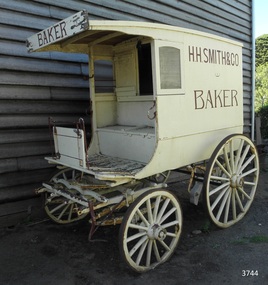
Vehicle - Wagon, H.H. Smith & Co. Baker, Circa 1930s - 1940s
... involved in many local organisations including the Warrnambool Surf Life Saving Club and the Road Race Committee. He died in 1985, lauded as being one of Warrnambool’s “most distinguished civic leaders”. It has been said that the baker injured in World War II invented a special contraption to enable him to get...involved in many local organisations including the Warrnambool Surf Life Saving Club and the Road Race Committee. He died in 1985, lauded as being one of Warrnambool’s “most distinguished civic leaders”. It has been said that the baker injured in World War II invented a special contraption to enable him to get ...This baker’s wagon or cart transported and delivered bread and other baked goods in the Warrnambool area. It currently has advertising for H.H. Smith & Co. Henry Huntington Smith (1857-1941) owned and operated his Warrnambool bakery in the late 19th and early 20th century. However, the design of the wagon is similar to those used by local bakers in the 1930s and 1940s and probably originated from Stephenson’s Bakery in Warrnambool, which operated around that time. The wagon’s original internal shelves were removed in the early days of Flagstaff Hill so that children could have rides around the village in a horse-driven cart. BAKERS’ HISTORY There were many bakeries in Warrnambool in the 19th to mid-20th century. Each bread bakery made horse and cart deliveries in its allocated zone. SMITH’S BAKERY; – as shown on the wagon’s signage. Henry Huntington Smith (1857-1941) was born and educated in Warrnambool. He worked at Davis’ steam biscuit factory in Timor Street before he began his own bakery business in 1885 near the corner of Fairy and Koroit Streets. A few years later Smith built a new bakery on the corner of Fairy and Lava Street where it still stands today (2025) as Monaghan’s Pharmacy. The building was designed by James McLeod in 1892 as a bakehouse, shop and residence for Smith The address was known locally as Smith’s Corner. Next door to the bakery, at 136 Fairy Street, were stables built by Jobbins and McLeod in 1886 for William Cust. A photograph in the archives of the Warrnambool and District Historical Society shows the 1892 building with four fancy horse-drawn wagons on the street with white-clad drivers and a promotional stand erected with 5 bakers in uniform and the signage “H H Smith & Co, Pastry Cooks and Confectioners”. One of the wagons appears to have “H H Smith” painted on the side. H.H. Smith & Co. placed an Advertisement in the Weekly Times in December 1896 promoting its business as bakers, confectioners and pastry cooks, praising their shop as an ‘ornament to the town’ with ‘neat appointments’ and ‘dainty decorations’. It also boasted of supplying a large number of customers within a twelve-mile radius of Warrnambool. In November 1919 The Warrnambool Standard announced the marriage of Henry H Smith, Mayor of Warrnambool, to Jeannie Samson-Goodman in East Adelaide. In the same newspaper was a notice that Frank Crossley was to open as baker and pastry cook in H.H. Smith’s premises. As well as being the proprietor of the H.H. Smith Bakery, Henry Huntington Smith was a Councillor for the Warrnambool Municipality from 1913 to 1937 and Mayer for two terms. In December 1919 during his first term as Mayor, he was honoured for the work he had done with returning soldiers after World War I, receiving a document in recognition of this work, presented by the Mothers, Wives and Sisters of returned soldiers. Smith was very interested and involved in the community in many roles, including being the Vice President of the first Warrnambool and District Historical Society. STEPHENSON’S BAKERY: – believed to be the past owner of the wagon. The last owner of the bakery was Harold Stephenson. Stephenson was enlisted in the A.I.F. and was invalided home in 1943 before the end of the Second World War. He also served as a Councillor from 1958 to 1976, during which time he served six terms as Mayor for the City of Warrnambool (1966-1973) while he had the bakery. He was very involved in many local organisations including the Warrnambool Surf Life Saving Club and the Road Race Committee. He died in 1985, lauded as being one of Warrnambool’s “most distinguished civic leaders”. It has been said that the baker injured in World War II invented a special contraption to enable him to get up into the wagon and that he alerted his customers that he was in their vicinity by blowing a whistle. The customers would come out and choose their bread from the back of his wagon then pay him for it. However, another account is given by a man who once earned pocket money by helping the baker on his rounds. He says that it was Stephenson, the owner and manager of the bakery, and not the delivery baker who received a significant injury during the war, making him unable to climb the stairs of his upstairs accommodation at the bakery, therefore causing him to sleep downstairs. At this time in the early to late 1940 Stephenson’s bakery had three wagons, one for each of the delivery rounds. The wagons were painted black and yellow. Two of the drivers were Stan Lake and Ali (Alec) Dean who both had wagons with the covered cabin design. The third driver was Bill Lake who had a flat wagon. Stan Lake delivered in the area around Lava and Koroit Streets, Ali Dean had another round and Bill Lake had the Dennington area. Bread continued to be delivered into the 1960s but by this time the delivery vehicles were motorised. The goods produced at Stephenson’s bakery included bread baked in different shaped tins such as High Tin, Sandwich and Vienna. Some shapes were easily divided into half by breaking them apart, therefore the baker could make two-quarter loaves from a half loaf, satisfying different needs. There was the option of white or brown bread, sweet buns, fruit buns and Boston buns. The baker’s assistant was known to take great delight in ‘trimming’ the broken halves of excess bread and crust, enjoying his treat. THE BAKERY PREMISES: – Southeast corner of Fairy and Lava Streets, Warrnambool. The building retains the original cast iron veranda. Above the veranda, a motif of a wheat sheaf in ornamental plaster can be seen. Inside the building, there are still some of the original fittings. The building was classified by the National Trust in August 1979. After the Second World War, an official system of zoning was introduced as a fair way for the baking industry to operate. In 1949 different pricing was introduced by the Government for either delivered or retail purchased bread. Many of the small local bakeries went out of business after the Government banned zoning. The way was made open for the larger bread manufacturers to enter the local market with cheaper prices. Some of those companies were Mc Queens, Tip Top, Twisties, and Sunicrust, (Mc Queens ‘new’ bakery building was where the current Toyworld shop now stands, is, in the Ozone carpark.) O’Grady’s Bakery, later changing hands and known as Burkes Bakery, was on Fairy Street near the Timor Street intersection, on the North West side. There was also a bakery named Almay. The baker’s wagon is significant because of its association with H.H. Smith’s Bakery in Warrnambool.. The H.H. Smith’s Bakery building on the corner of Fairy and Lava Streets, built in 1892, is classified by the National Trust, August 1979. Smith Street Warrnambool was named after Henry Huntington Smith, who was a Warrnambool Councillor 1913 – 1937 and Mayor 1919 – 1921. Baker’s wagon, often referred to as a baker’s cart. Four wheeled horse-drawn delivery wagon, front wheels smaller than rear wheels. Wagon is clad with metal sheets and lined with varnished timber panels. Wheels have metal rims, wooden spokes and rear wheels have wooden brake pads. Horse shaft is timber with metal fittings. Front has a metal lamp holder, brake lever, metal hand grips and decorative metal foot plates. The wagon has suspension leaves on back and sides and double suspension leaves on the front. Driver’s area at front has a roof, glass side windows and wooden box seat with hinged compartment accessing wagon storage area. Door above back of seat has buckled leather handgrip strap attached, door slides open for access to wagon area. Back of wagon has a wooden step and a split door; top door has ventilation louvers, both doors have metal latches. Wagon is painted cream with brown trim and signage and green step. Remnants of red and green paint are visible; underside of seat panel is painted grey. Wagon advertises H.H. Smith & Co. Baker, a Warrnambool business established in 1885, but is of a more modern design seen around 1930’s and 1940’s and most likely belonging to Stephenson's bakery. Brown signwriting on sides of wagon “H.R. SMITH & CO. / BAKER” Brown signwriting across front of wagon “BAKER” warrnambool, shipwrecked-coast, flagstaff-hill, flagstaff-hill-maritime-museum, maritime-museum, shipwreck-coast, flagstaff-hill-maritime-village, shipwrecked-artefact, great ocean road, baker’s wagon, h.h. smith baker, warrnambool, henry h smith, jeannie samson-goodman, frank crossley, mayor of city of warrnambool, vice president of warrnambool and district historical society, stephenson’s bakery warrnambool, harold stephenson, warrnambool surf life saving club, road race committee, national trust building, stan lake, bill lake, ali dean, 19th and 20th century bakers, davies steam biscuit factory warrnambool, james mcleod building designer, jobbins and mcleod, william cust, h h smith & co, pastry cooks and confectioners, bakery trade, bread delivery wagon -
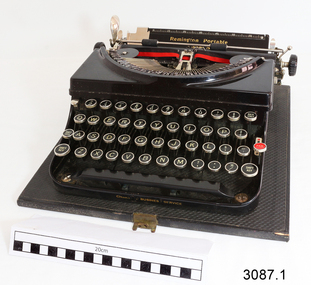 Flagstaff Hill Maritime Museum and Village
Machine - Typewriter, 1930's
... involved in Church activities, particularly in lay administration and lay preaching in the Baptist Church, and the typewriter gained a lot of after-hours use. The family actively supported overseas Missions in India, SE Asia, and Africa. After the sale of the business in 1996, Audrey took the typewriter home for her community activities (David got a computer). In the 1980’s David volunteered as the Clock Repairer at Flagstaff Hill for the historical instruments. In the early days this took some long hours to get...involved in Church activities, particularly in lay administration and lay preaching in the Baptist Church, and the typewriter gained a lot of after-hours use. The family actively supported overseas Missions in India, SE Asia, and Africa. After the sale of the business in 1996, Audrey took the typewriter home for her community activities (David got a computer). In the 1980’s David volunteered as the Clock Repairer at Flagstaff Hill for the historical instruments. In the early days this took some long hours to get ...This "Remington Portable Model 5, Remington Business Service" typewriter is in very good working order and was donated in its case complete with its Operating Instructions and a Touch Method typing instruction book. The typewriter was owned by William Sack, owner of the business Sacks Jewellers at 115 Liebig Street, Warrnambool. He commenced trading in the early 1900’s; and used this typewriter in the business from its purchase date, around 1931, through until about 1996. William and his wife June had three children, Eric, Audrey and David. The children were owners/partners of Sack’s Jewellers after William’s passing in 1976. Eric and David were ‘owners of the business’, with Audrey carrying out much of the clerical work. Eric died in about 1984 and David sold the practise in 1996. During the 65 years of business the typewriter was used for all the normal applications of a jeweller’s; preparing invoices, guarantees, taxation records. But in addition the four members of the Sack family were very involved in Church activities, particularly in lay administration and lay preaching in the Baptist Church, and the typewriter gained a lot of after-hours use. The family actively supported overseas Missions in India, SE Asia, and Africa. After the sale of the business in 1996, Audrey took the typewriter home for her community activities (David got a computer). In the 1980’s David volunteered as the Clock Repairer at Flagstaff Hill for the historical instruments. In the early days this took some long hours to get the clocks working, but in recent years he has just been ‘on call’ if needed. He is an alert 85 year old and just in the last 12 months has given up a busy schedule of Sunday Lay Preaching around the district. (2015)The typewriter is of local significance, being previously owned and used by Sacks Jewellers, a local business that had been in operation for about 100 years.Typewriter, Remington, "Remington Portable Model 5, Remington Business Service". Typewriter is in black, textured hard case with lock and key. Case has leather carry handle. Company has USA, copyright 1931.Includes Operating Instructions for the Remington Portable Models 5 and 5T. Remington Typewriter Company. "Remington Portable Model 5, Remington Business Service". flagstaff hill, warrnambool, shipwrecked coast, flagstaff hill maritime museum, maritime museum, shipwreck coast, flagstaff hill maritime village, great ocean road, typewriter, remington business services, office equipment, business equipment, office communication, sack’s jewellers warrnambool, warrnambool business, remington typewriter company, touch typing, william sack, david sack, warrnambool baptist church -
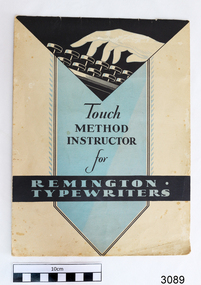 Flagstaff Hill Maritime Museum and Village
Book, Touch Method Instructor for Remington Typewriters, c. 1931
... involved in Church activities, particularly in lay administration and lay preaching in the Baptist Church, and the typewriter gained a lot of after-hours use. The family actively supported overseas Missions in India, SE Asia, and Africa. After the sale of the business in 1996, Audrey took the typewriter home for her community activities (David got a computer). In the 1980’s David volunteered as the Clock Repairer at Flagstaff Hill for the historical instruments. In the early days this took some long hours to get...involved in Church activities, particularly in lay administration and lay preaching in the Baptist Church, and the typewriter gained a lot of after-hours use. The family actively supported overseas Missions in India, SE Asia, and Africa. After the sale of the business in 1996, Audrey took the typewriter home for her community activities (David got a computer). In the 1980’s David volunteered as the Clock Repairer at Flagstaff Hill for the historical instruments. In the early days this took some long hours to get ...The instruction book was donated together with a typewriter and manual by David Sack, previous owner of Sack's Jewellers, Liebig St in Warrnambool. The typewriter and books were owned by William Sack, owner of the business Sacks Jewellers at 115 Liebig Street, Warrnambool. He commenced trading in the early 1900’s; and used this typewriter in the business from its purchase date, around 1931, through until about 1996. William and his wife June had three children, Eric, Audrey and David. The children were owners/partners of Sack’s Jewellers after William’s passing in 1976. Eric and David were ‘owners of the business’, with Audrey carrying out much of the clerical work. Eric died in about 1984 and David sold the practise in 1996. During the 65 years of business the typewriter was used for all the normal applications of a jeweller’s; preparing invoices, guarantees, taxation records. But in addition the four members of the Sack family were very involved in Church activities, particularly in lay administration and lay preaching in the Baptist Church, and the typewriter gained a lot of after-hours use. The family actively supported overseas Missions in India, SE Asia, and Africa. After the sale of the business in 1996, Audrey took the typewriter home for her community activities (David got a computer). In the 1980’s David volunteered as the Clock Repairer at Flagstaff Hill for the historical instruments. In the early days this took some long hours to get the clocks working, but in recent years he has just been ‘on call’ if needed. He is an alert 85 year old and just in the last 12 months has given up a busy schedule of Sunday Lay Preaching around the district. (2015) The typewriter and instruction books are of local significance, being previously owned and used in a local business for about 100 years.Book, Touch Method Instructor for Remington Typewriters. Published by Remington Typewriter Company, printed in U.S.A. Copyright 1931. Soft cover, cream with black and blue panels, drawing of a hand with fingers above typewriter keys. Lesson book for teaching touch typing.flagstaff hill, warrnambool, shipwrecked coast, flagstaff hill maritime museum, maritime museum, shipwreck coast, flagstaff hill maritime village, great ocean road, typing instructor, typing lesson book, sack’s jewellers warrnambool, remington typewriter company, william sack, david sack, warrnambool baptist church, warrnambool history -
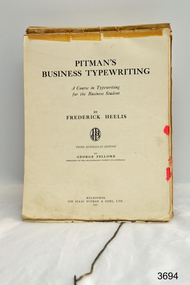 Flagstaff Hill Maritime Museum and Village
Book - Textbook, Pitman's Business Typing, 1937
... involved in Church activities, particularly in lay administration and lay preaching in the Baptist Church, and the typewriter gained a lot of after-hours use. The family actively supported overseas Missions in India, SE Asia, and Africa. After the sale of the business in 1996, Audrey took the typewriter home for her community activities (David got a computer). In the 1980’s David volunteered as the Clock Repairer at Flagstaff Hill for the historical instruments. In the early days this took some long hours to get...involved in Church activities, particularly in lay administration and lay preaching in the Baptist Church, and the typewriter gained a lot of after-hours use. The family actively supported overseas Missions in India, SE Asia, and Africa. After the sale of the business in 1996, Audrey took the typewriter home for her community activities (David got a computer). In the 1980’s David volunteered as the Clock Repairer at Flagstaff Hill for the historical instruments. In the early days this took some long hours to get ...This Pitman’s Business Typing textbook was owned by Audrey Sack and was donated by David Sack at the same time as a typewriter in its case plus accessories (refer to RN 3087). Audrey was the daughter of William Sack, owner of the business Sacks Jewellers at 115 Liebig Street, Warrnambool. William commenced trading in the early 1900’s; and the typewriter was used by Audrey in the business from the late 1930’s through to about 1996 when the business was sold. William and his wife June had three children, Eric, Audrey and David. The children were owners/partners of Sack’s Jewellers after William’s passing in 1976. Eric and David were ‘owners of the business’, with Audrey carrying out much of the clerical work. Eric died in about 1984 and David sold the practise in 1996. During the 65 years of business the typewriter was used for all the normal applications of a jeweller’s; preparing invoices, guarantees, taxation records. But in addition the four members of the Sack family were very involved in Church activities, particularly in lay administration and lay preaching in the Baptist Church, and the typewriter gained a lot of after-hours use. The family actively supported overseas Missions in India, SE Asia, and Africa. After the sale of the business in 1996, Audrey took the typewriter home for her community activities (David got a computer). In the 1980’s David volunteered as the Clock Repairer at Flagstaff Hill for the historical instruments. In the early days this took some long hours to get the clocks working, but in recent years he has just been ‘on call’ if needed. He is an alert 85 year old and just in the last 12 months has given up a busy schedule of Sunday Lay Preaching around the district. (2015) The textbook is associated with the typewriter, which is of local significance, being previously owned and used in a local business for about 100 years.Textbook, "Pitman's Business Typing". Brown paper covered, hard cover, published in 1937. Book has attached cord to enable it to stand during use. Book belonged to Audrey Sack.Handwriten name "Audrey Sack, … Warrnambool …WHS" (Warrnambool High School) 18/8/15"flagstaff hill, warrnambool, shipwrecked coast, flagstaff hill maritime museum, maritime museum, shipwreck coast, flagstaff hill maritime village, great ocean road, typewriter, touch typing, office communications, sack’s jewellers warrnambool, william sack, david sack, audrey sack, typing textbook -
 Flagstaff Hill Maritime Museum and Village
Book - Student Exercise Book, Audrey Sack, student, Commercial Principles, 1938-1939
... involved in Church activities, particularly in lay administration and lay preaching in the Baptist Church, and the typewriter gained a lot of after-hours use. The family actively supported overseas Missions in India, SE Asia, and Africa. After the sale of the business in 1996, Audrey took the typewriter home for her community activities (David got a computer). In the 1980’s David volunteered as the Clock Repairer at Flagstaff Hill for the historical instruments. In the early days this took some long hours to get...involved in Church activities, particularly in lay administration and lay preaching in the Baptist Church, and the typewriter gained a lot of after-hours use. The family actively supported overseas Missions in India, SE Asia, and Africa. After the sale of the business in 1996, Audrey took the typewriter home for her community activities (David got a computer). In the 1980’s David volunteered as the Clock Repairer at Flagstaff Hill for the historical instruments. In the early days this took some long hours to get ...This exercise book was owned by Audrey Sack and was donated by David Sack at the same time as a typewriter in its case plus accessories (refer to RN 3087). It has hand written notes of Commercial Principles class lessons from Warrnambool High School, written by Audrey Sack including pages dated 1938 and 1939. Audrey was the daughter of William Sack, owner of the business Sacks Jewellers at 115 Liebig Street, Warrnambool. William commenced trading in the early 1900’s; and the typewriter was used by Audrey in the business from the late 1930’s through to about 1996 when the business was sold. William and his wife June had three children, Eric, Audrey and David. The children were owners/partners of Sack’s Jewellers after William’s passing in 1976. Eric and David were ‘owners of the business’, with Audrey carrying out much of the clerical work. Eric died in about 1984 and David sold the practise in 1996. During the 65 years of business the typewriter was used for all the normal applications of a jeweller’s; preparing invoices, guarantees, taxation records. But in addition the four members of the Sack family were very involved in Church activities, particularly in lay administration and lay preaching in the Baptist Church, and the typewriter gained a lot of after-hours use. The family actively supported overseas Missions in India, SE Asia, and Africa. After the sale of the business in 1996, Audrey took the typewriter home for her community activities (David got a computer). In the 1980’s David volunteered as the Clock Repairer at Flagstaff Hill for the historical instruments. In the early days this took some long hours to get the clocks working, but in recent years he has just been ‘on call’ if needed. He is an alert 85 year old and just in the last 12 months has given up a busy schedule of Sunday Lay Preaching around the district. (2015)The exercise book is associated with a typewriter and text book, which is of local significance, being previously owned and used in a local business established for about 100 years.Book, student's exercise book with brown paper cover over soft cover. White pages have printed blue lines. Notes written in script with nib pen. Correction marks are on some pages. The book has entries from front to just past the centre pages, the turned upside down and written from back to almost centre pages. It belong to Autrey Sack, who was a Commercial Practices student at Warrnambool High School. Handwritten ink pen inscriptions are on the front cover and within the book. Notes are dated as 1938 and 1939."Commercial Principles" "Audrey Sack /. Commercial / W.H.S."flagstaff hill, warrnambool, flagstaff hill maritime museum, maritime museum, shipwreck coast, flagstaff hill maritime village, great ocean road, commercial principles, warrnambool high school, sack’s jewellers warrnambool, william sack, david sack, audrey sack, sack’s jewellers, exercise book, student notes, business education -
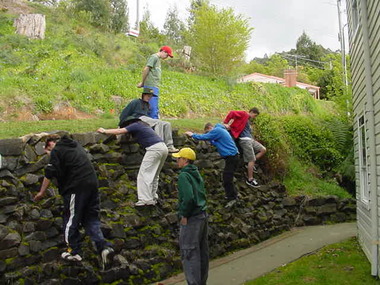 Ringwood and District Historical Society
Photograph - Parkwood Secondary College, Ringwood North, Victoria, 16 Digitised Images from Bogong School Camp - 2001 - Climbing Activities
... involved not only students from our school but also Kuranjang Secondary College in Melton. The students did a range of activities, including initiative activities, games, high ropes course, field studies, environmental studies, canoeing, rock climbing (indoor and outdoor), abseiling, mountain bike riding and a trip up to the high plains. The students also got to experience snow, some even getting...involved not only students from our school but also Kuranjang Secondary College in Melton. The students did a range of activities, including initiative activities, games, high ropes course, field studies, environmental studies, canoeing, rock climbing (indoor and outdoor), abseiling, mountain bike riding and a trip up to the high plains. The students also got to experience snow, some even getting ...School Magazine Transcript: "On the 15th of October, 23 Year 9 students headed off to Camp Bogong situated near Falls Creek. The camp involved not only students from our school but also Kuranjang Secondary College in Melton. The students did a range of activities, including initiative activities, games, high ropes course, field studies, environmental studies, canoeing, rock climbing (indoor and outdoor), abseiling, mountain bike riding and a trip up to the high plains. The students also got to experience snow, some even getting bogged in the snow on a minibus. All in all, the students enjoyed the week spent up at Bogong, not only having fun and enjoying the activities but also making life long friends." -
 Eltham District Historical Society Inc
Journal, Peter Doughtery, ArtStreams: News in arts and cultural heritage; Vol. 3, No. 4, Aug-Sep 1998, 1998
... Vol. 3, No. 4, Aug-Sep 1998 CONTENTS THE GREAT DAREBIN MUSIC EXPO Celebrating cultural diversity 3 THE FINAL TOUCH Dangers of inappropriate picture framing 6 BOOK REVIEW Michele Lonsdale reviews Raymond Gaita's Romulus May Father 9 A NEW FACE IN ELTHAM ARTS From Brown's Town, Jamaica, to Eltham Wiregrass 10 BANYULE YOUTH ART AWARDS Young artists throw down the gauntlet 12 CD REVIEWS Authentic and Get A Handle On It 14 PHOTOGRAPHY John Fitzgerald's first exhibition 16 SHORT STORY Girl in a Yellow Sweater by Morag Kirk 18 POETRY REVIEW Ray Liversidge reviews Ian McBryde 22 THEATRE Carolyn Pickett at Heidelberg Theatre company 23 DAG HOUSE ON HIGH STREET New home for Darebin Arts Action Group 24 SIGMUND JORGENSEN DINES OUT Food and wine as culture 25 POETRY Sandy Jeffs' Poems From the Madhouse 27 RAY MOONEY PLAY REVIEW 27 THEATRE Alabaster Youth Theatre and Daniel Kahans at La Mama 28, 29 WINING, DINING & ENTERTAINING 30 PICASSO AND TUCKER AT HEIDE 32 "Peter Dougherty has been involved in the local art scene for many years. ...Vol. 3, No. 4, Aug-Sep 1998 CONTENTS THE GREAT DAREBIN MUSIC EXPO Celebrating cultural diversity 3 THE FINAL TOUCH Dangers of inappropriate picture framing 6 BOOK REVIEW Michele Lonsdale reviews Raymond Gaita's Romulus May Father 9 A NEW FACE IN ELTHAM ARTS From Brown's Town, Jamaica, to Eltham Wiregrass 10 BANYULE YOUTH ART AWARDS Young artists throw down the gauntlet 12 CD REVIEWS Authentic and Get A Handle On It 14 PHOTOGRAPHY John Fitzgerald's first exhibition 16 SHORT STORY Girl in a Yellow Sweater by Morag Kirk 18 POETRY REVIEW Ray Liversidge reviews Ian McBryde 22 THEATRE Carolyn Pickett at Heidelberg Theatre company 23 DAG HOUSE ON HIGH STREET New home for Darebin Arts Action Group 24 SIGMUND JORGENSEN DINES OUT Food and wine as culture 25 POETRY Sandy Jeffs' Poems From the Madhouse 27 RAY MOONEY PLAY REVIEW 27 THEATRE Alabaster Youth Theatre and Daniel Kahans at La Mama 28, 29 WINING, DINING & ENTERTAINING 30 PICASSO AND TUCKER AT HEIDE 32 "Peter Dougherty has been involved in the local art scene for many years. As publisher and editor of the arts magazine Artstreams, his comments on the various branches of the arts are widely respected. His "The Arts" column in the Diamond Valley Leader presents a brief summary for a much wider cross section of the local community. Peter also operates his own gallery and the Artstreams Cafe at the St Andrews market. Peter has a wealth of knowledge about present day and historical aspects of local art and artists." - Eltham District Historical Society Newsletter No. 161, March 2005Colour front and back cover with feature articles and literary pieces with photographs and advertisements printed in black and white. 36 pages, 30 cm. Vol. 1, no. 1 (Nov. 1996) - Vol. 10, no. 5 (summer ed. 2005/06) art streams, john fitzgerald, annie keil-taggart, just add water, melanie shanahan, darebinn music expo, ruby hunter, cretan brotherhood dance academy, tim nikolsky, margaret leighton, paper moon, alfie massoud, conga pa gozar, neville crawford, framing, dymocks booksellers, raimond gaita, michelle lonsdale, eltham wiregrass gallery, charmaine sheppard, banyule young artists award, brett wood, rebecca james, saramcfarland, michael hebden, heath warwick, michelle wood, victoria ashton, pietro ristorante grossi, la mama theatre, robbie greig, nerida kirov, george kirov, mathew arnold, john skinner, jeff buckland, laurie strickland, eltham high school, montsalvat, eltham library community gallery, alan marshall short story award, morag kirk, dynamic vegies, jenni mitchell, ruth johnstone, la trobe university art museum, ian mcbryde, ray liversidge, heidelberg thearte company, carolyn pickett, darebin artists action group, sigmund jorgensen, sandy jeffs, la piazza restaurant bar & cafe, adams of north riding, llobex image wizards, yarra valley country club, daniel kahans, bulleen art & garden centre, museum of modern art at heide, monty deli & catering services, albert tucker, volumes -
 Eltham District Historical Society Inc
Journal, Peter Doughtery, ArtStreams: Arts in Banyule, Darebin, Manningham, Nillumbik, Whittlesea & Yarra; Vol. 5, No. 6 (sic - 5), Summer Issue 2000, 2000
... Vol. 5, No. 6 (5), Summer Issue 2000 CONTENTS John Perceval and Helen Daniel 2 Two who served their communities well Gateway Sculpture Project 3 New public art in Manningham The Artary Project 5 Getting onto the net Tucker: Australian Gothic 6 Albert and Barbara Tucker's gift to Australia Short Story 8 Learning Curves Interview 10 Elizabeth James on drawing Open Studios 12 40 artists welcome the public Banyule Youth Awards 18 Support for emerging young artists Not Just a Pretty Place 20 Nillumbik art in Public Places CD Reviews 22 Book Reviews 23 Australian Classical Music 24 Elizabeth Scarlett Theatre Reviews 25 Artin About 26 Wining & Dining 30 Book Review 32 Artist's Services 32 "Peter Dougherty has been involved in the local art scene for many years. ...Vol. 5, No. 6 (5), Summer Issue 2000 CONTENTS John Perceval and Helen Daniel 2 Two who served their communities well Gateway Sculpture Project 3 New public art in Manningham The Artary Project 5 Getting onto the net Tucker: Australian Gothic 6 Albert and Barbara Tucker's gift to Australia Short Story 8 Learning Curves Interview 10 Elizabeth James on drawing Open Studios 12 40 artists welcome the public Banyule Youth Awards 18 Support for emerging young artists Not Just a Pretty Place 20 Nillumbik art in Public Places CD Reviews 22 Book Reviews 23 Australian Classical Music 24 Elizabeth Scarlett Theatre Reviews 25 Artin About 26 Wining & Dining 30 Book Review 32 Artist's Services 32 "Peter Dougherty has been involved in the local art scene for many years. As publisher and editor of the arts magazine Artstreams, his comments on the various branches of the arts are widely respected. His "The Arts" column in the Diamond Valley Leader presents a brief summary for a much wider cross section of the local community. Peter also operates his own gallery and the Artstreams Cafe at the St Andrews market. Peter has a wealth of knowledge about present day and historical aspects of local art and artists." - Eltham District Historical Society Newsletter No. 161, March 2005Colour front and back cover with feature articles and literary pieces with photographs and advertisements printed in black and white. 36 pages, 30 cm. Vol. 1, no. 1 (Nov. 1996) - Vol. 10, no. 5 (summer ed. 2005/06) art streams, public art, sentinal, river peel, manningham, artary project, plenty views golf park, albert tucker, barbara tucker, kinglake gallery, bulleen art & garden centre, st andrews gallery, steve flanagan, eltham wiregrass gallery, elizabeth james, willy wonka's ice cream gourmet food, nillumbik artists' open studios, accadia ceramics, alan martin, alan sartori, attunga, veronica holland, leanne mooney, sally nihill, bend of islands, michael skewes, elizabeth vercoe, creek house studio, syd tunn, ona henderson, chris pittard, mary lou pittard, diamond creek living & learning centre, drew gregory, jane annois, jane trikojus, jenni mitchell, grace mitchell, mervyn hannan, girraeen studio, jill forrest, kangaroo studios, peter burns, jules burns, muddy waters studio, nel ten wolde, overbank end, kay steventon, kim tarpey, reg cox, robert phillips studio, stained glass studio, shan shnookal, matthew holderness, ray macminn, jane viola, john hewish, open pottery studios, linda detoma, judith roberts, cassandra tobias, christian benetto, kevina-jo smith, julianne piko, hugh crosthwaite, sarah slater, peter doyle, stuart sinclair, carly young, lenister farm, not just a pretty place, kangaroo house, dynamic vegies, old bakery cottage bookshop, nick charles, felicity nottingham, michael mcgirr, eltham little theatre, heidelberg theartre company, montsalvat, recherche, ken eckerall, thompsons pharmacy, st andrews market, 2000 banyule young artists award, heide museum of modern art
