
Showing 36 items matching "girls boots"
-
 Upper Yarra Museum
Footwear - girls
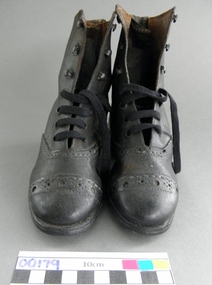
... girls boots...Pair of black leather girls boots, they have been embossed at the start of the toe cap, and would be more expensive than plain leather....girls boots footware feet protection Pair of black leather girls boots, they have been embossed at the start of the toe cap, and would be more expensive than plain leather. ...Pair of black leather girls boots, they have been embossed at the start of the toe cap, and would be more expensive than plain leather.girls boots, footware, feet protection -
 Upper Yarra Museum
Footwear - girls
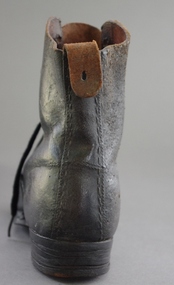
... girls boots...Pair of Girls School Boots, made with leather,they are lace up boots with 8 eyes at the bottom and 6 loop at the top for the laces....girls boots footware feet protection Pair of Girls School Boots, made with leather,they are lace up boots with 8 eyes at the bottom and 6 loop at the top for the laces. ...Pair of Girls School Boots, made with leather,they are lace up boots with 8 eyes at the bottom and 6 loop at the top for the laces.girls boots, footware, feet, protection -
 Flagstaff Hill Maritime Museum and Village
Footwear - Boots, 1900s
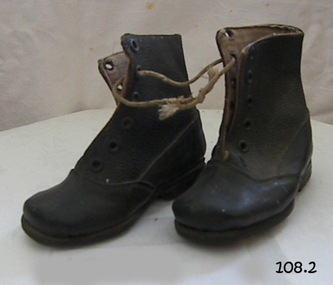
... One pair of Antique Victorian/Edwardian young boys-young girls shoes / boots. The boots are a black leather which lace up the front, laces missing bottom soles are leather...Boots are unable to be linked to a significant person, family or event. flagstaff hill warrnambool shipwrecked coast flagstaff hill maritime museum shipwreck coast flagstaff hill maritime village great ocean road boots children's boots footware None One pair of Antique Victorian/Edwardian young boys-young girls shoes / boots. ...Boots are believed to be one of the earliest shoes created when the evolution of footwear had begun. Boots form the building blocks of modern footwear which were merely a two-piece unit covering the foot and lower leg, a century ago. Throughout history, the importance of boots has been about fulfilling the needs of the wearer to be in sync with the prevailing culture. Boots were initially made of various materials like cotton, wool, silk, fur, felt, and leather (including caribou hide and sealskin. Around1000 B.C.E., men wore simple boots made of untanned leather with the fur turned in against the leg to keep it warm. These baglike boots were simple in design and then leashed to the leg by just a thong of leather. A mass produced pair of children's boots from the first quarter of the 20th century no significance other than the items age giving a snapshot into footwear of the period. Boots are unable to be linked to a significant person, family or event.One pair of Antique Victorian/Edwardian young boys-young girls shoes / boots. The boots are a black leather which lace up the front, laces missing bottom soles are leatherNoneflagstaff hill, warrnambool, shipwrecked coast, flagstaff hill maritime museum, shipwreck coast, flagstaff hill maritime village, great ocean road, boots, children's boots, footware -
 Bendigo Historical Society Inc.
Photograph - TWO BABIES: PORTRAIT, 1900 ?
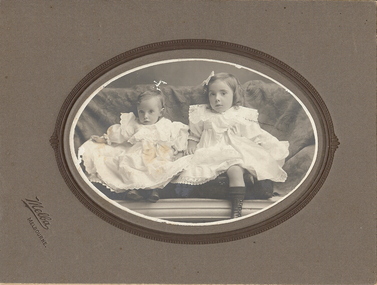
... Two young girls sitting on couch. Pale dresses with frills, lace, sashes, dark socks and boots. ...Two young girls sitting on couch. Pale dresses with frills, lace, sashes, dark socks and boots. ...black and white photograph on grey board. Oval shaped image with embossed surround. Two young girls sitting on couch. Pale dresses with frills, lace, sashes, dark socks and boots. Older girl with bow in hair. Melba MELBOURNE on front'Melba/Melbourne ' embossed on front bottom leftperson, family, two babies -
 Orbost & District Historical Society
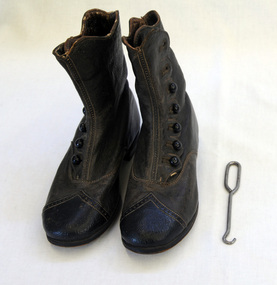
child's boots and hook, late 19th -early 20th century
... These were probably worn by a young girl as most girls wore side-button boots while the boys wore front-laced ones. ...These were probably worn by a young girl as most girls wore side-button boots while the boys wore front-laced ones. ...These were probably worn by a young girl as most girls wore side-button boots while the boys wore front-laced ones. The buttonhook was used to facilitate the closing of shoes, gloves or other apparel that uses buttons as fasteners. To use, the hook end is inserted through the buttonhole to capture the button by the shank and draw it through the opening.This item reflects the footwear fashion worn by children in the late 19th to early 20th century.Two small black leather boots. They are side buttoning boots with seven buttons (left boot is missing two). The button hook is metal.On sole : size 6footwear shoes boots -
 Flagstaff Hill Maritime Museum and Village
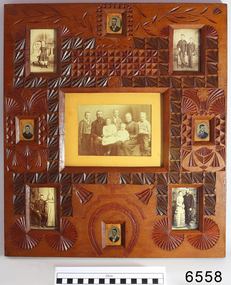
Photograph - Portraits, c. 1904
... The little girl with black boots on is Betty Stone's grandmother. ...The little girl with black boots on is Betty Stone's grandmother. ...Ann Dale (nee Lees) was given this frame by her younger brother Thomas Chamberlain Lees, who was eighteen at that time. Thomas was the youngest son and seventh child of Lees and Sarah (nee Chamberlain) Lees. Ann loved her little brother’s artistic talents, which are demonstrated in this frame he designed and carefully carved for her. Thomas had cleverly finished the back with timber pieces around the images, and a section of a 1904 calendar. His “GOOD LUCK” is below the image of Ann, her husband Ellis Dale and their five children, c 1900. Sadly, Thomas died in 1911, aged 25. Ellis Dale’s father, William, was a quarryman who sailed from Yorkshire to Australia in 1852. He later bought land for Dale’s Quarries on the edge of Warrnambool in the area of Dale and Aberline roads. From the age of about eleven, Ellis and his brother worked in the quarry beside their father. In 1890 Ellis Dale married Ann Lees. Ann had lived nearby at Wangoom with her parents, Lees and Sarah Lees, who had had her photograph taken when she was a little girl, wearing her black dress. Ellis built a bluestone cottage for himself and Ann on his father’s land in Dales Road. He later added weatherboard rooms, and they named their finished home “Latrigg”. Early in their marriage Ellis recycled some empty dynamite boxes from their quarry to build a cupboard with drawers for Ann’s flat irons and other ironing equipment. The cupboard was used by future generations until recently, when Ann’s granddaughter, Betty Stone, donated it as part of the Chamberlain Dale Lees Collection. It is now in the kitchen of the Port Medical Office. Chamberlain Dale Lees family – local Colonial Pioneers Centre: Ellis Dale and Ann (nee Lees) and their five children - c 1900. Sons lvor William, Robert Ellis, Alfred John, and daughters - Elsie Mary Dale, and Daisy Elvena Dale. Top Left: Ann Lees - c 1868, (the little girl in the black dress) Top Right: William Dale Jnr. and Ellis Dale - c 1871 Lower Left: Ellis Dale and Ann (nee Lees), married 22 Jan. 1890 Lower Right: William Dale Jnr. and Agnes (nee Gillies), married 1883 Oval Photographs: unidentified but presumed to be family members [NB Spelling of Ann Dale – The spelling of Ann’s name has been confirmed by Betty Stone as being “Ann” (Not Anne), by phone conversation with Flagstaff Hill Maritime Village, K P 14th April 2014] (Note: For additional information please refer to Betty Stone’s book “Pioneers and Places - A History of three Warrnambool Pioneering Families” ie. Chamberlain, Dale and Lees Families)This item is associated with the families of Chamberlain, Dale and Lees. These families are listed in the "Pioneers' Register" for Warrnambool Township and Shire, 1835-1900, published by A.I.G.S. Warrnambool Branch. The handmade frame is a unique example of clever craftsmanship and carving skills used by early pioneers with limited access to materials.Family photographs, nine, set into carved, solid wood frame, stained and lacquered. Carving includes leaves, flowers, a horseshoe and a ribbon with the words "GOOD LUCK" Photographs are of the Lees family of Wangoom, from the 'Chamberlain Dale Lees Collection’ Made by Thomas Lees for his sister, Ann. The little girl with black boots on is Betty Stone's grandmother. The back of the frame has a London calendar dated 1904.Words in carved ribbon "GOOD LUCK" Calendar for the year 1904flagstaff hill, warrnambool, shipwrecked coast, flagstaff hill maritime museum, maritime museum, shipwreck coast, flagstaff hill maritime village, great ocean road, chamberlain, dale, lees, stone, betty stone, warrnambool pioneers, thomas lees, wangoom, ann dale, ellis dale, flagstaff hill, warrnambool, shipwrecked coast, flagstaff hill maritime museum, maritime museum, shipwreck coast, flagstaff hill maritime village, great ocean road, chamberlain, dale, lees, stone, betty stone, warrnambool pioneers, thomas lees, wangoom, ann dale, ellis dale, thomas chamberlain lees, handmade photograph frame, carved photograph frame, dynamite -
 Streatham and District Historical Society
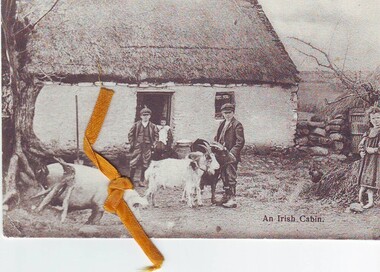
Post Card, 1914-1918
... How would you like a little home like this one no cows to milk only goats no horses to drive only donkies & it looks as though the girls have no boots to clean by this card but there is some first class sig hias this one has taken a purge he must be an Ulsty show. ...How would you like a little home like this one no cows to milk only goats no horses to drive only donkies & it looks as though the girls have no boots to clean by this card but there is some first class sig hias this one has taken a purge he must be an Ulsty show. ...Paper card with a picture of a house with a thatched roof. There is a stone wall and two trees that are beginning to blossom. There are four children two boys and two girls. One girl has no footwear. One boy is holding a goat. There are two goats a large pig and chicken in the picture. The words" An Irish Cabin" appears on the lower left side and a Orange ribbon has been attatched to the lower right side."Dear Bess I suppose you think I an never going to answer your pursuit but I thought I would do so while here in Belfast cause I know you have a lot of time for the Micks. How would you like a little home like this one no cows to milk only goats no horses to drive only donkies & it looks as though the girls have no boots to clean by this card but there is some first class sig hias this one has taken a purge he must be an Ulsty show. Love from Donald -
 Marysville & District Historical Society
THE TRIANGLE NEWS-VOL 3 NO 5-MARCH 10 1978
... girl guides l.a....swimming club...marysville kindergarten roster...marysville primary school mothers' club...cricket club wind up...fruit salad farm...royal welcome...boots...marysville victoria australia buxton tragedy-gail greatorex thanks sister molly community care centre births elizabeth ackerman finishes course wanted to buy happy birthday wanted 1st marysville girl guides l.a. swimming club marysville kindergarten roster marysville primary school mothers' club cricket club wind up fruit salad farm royal welcome boots mcleod auction sale alexandra high school mothers' club wirreanda committee marysville football club for sale senior citizens who is henry? ...marysville, victoria, australia, buxton tragedy-gail greatorex, thanks sister molly, community care centre, births, elizabeth ackerman finishes course, wanted to buy, happy birthday, wanted, 1st marysville girl guides l.a., swimming club, marysville kindergarten roster, marysville primary school mothers' club, cricket club wind up, fruit salad farm, royal welcome, boots mcleod, auction sale, alexandra high school mothers' club, wirreanda committee, marysville football club, for sale, senior citizens, who is henry?, duck season, golf club, bowls, marysville lions club, maths tutoring in your home -
 Orbost & District Historical Society
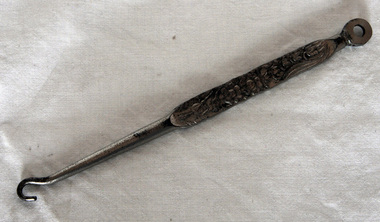
button hook, 1895 – 1905
... This hook is most likely to have been used to do up boots Women and young girls generally wore boots that were either front laced or side buttoned, particularly in the period from the 1870s . ...Button hooks were used to fastens buttons on boots and long gloves. It is a tool used for the closing of shoes, gloves or other apparel that uses buttons as fasteners. The steel hook end is inserted through the buttonhole to capture the button by the shank and draw it through the opening. This hook is most likely to have been used to do up bootsWomen and young girls generally wore boots that were either front laced or side buttoned, particularly in the period from the 1870s . Buttonhooks were needed to do up the buttons on buttoned boots and were used by poking the metal hook through the buttonhole, grabbing the button and pulling it through the eyelet. This item is an example of a commonly used accessory no longer relevant.A button hook made of metal with a beaten silver handle ornately decorated with scrolls and foliate design. At the top is a small ring on the handle end. This could have been for a lady to attach the item to her chatelaine at her belt, or on a necklace. clothing footwear gaiters boots button-hook -
 Kiewa Valley Historical Society
Photo - Family dressed in the fashion of the early 1900s
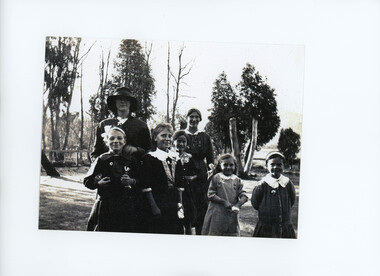
... Girls dresses were knee length with trimmings of lace and ribbon. Collars were often removable for ease of washing. Leather lace-up boots...Girls dresses were knee length with trimmings of lace and ribbon. Collars were often removable for ease of washing. Leather lace-up boots ...During the early 1900s little girls' dresses were fashioned on the style worn by older women. Girls dresses were knee length with trimmings of lace and ribbon. Collars were often removable for ease of washing. Leather lace-up boots and woollen stocking or socks were usually worn with these dresses. A pinafore or apron would be worn over the dresses to help keep them clean. Girls' hair was kept long, with curls and tied with ribbons.Boys' clothing was fashioned on sailor suits, blouses/shirts with a collar and trousers or knickerbockers. Woollen jackets, shirts and ties were suitable attire for older boys. Children's fashion of this time was dictated by long lasting durability, local manufacture, earthy colours and ease of mobility. Because of the long distance to haberdashery stores, the majority of children's garments would have been hand made by a local seamstress, mother or relation.Black and white photo of a family with 5 children in the foreground with trees in the background.children's clothing -
 Kiewa Valley Historical Society
Boots, circa 1940s to 1950s
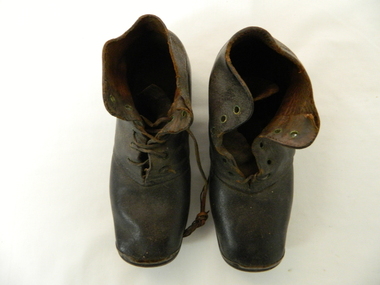
... boots suggests that it was not purchased locally or from any large town. It may have been introduced by a wandering caravan trader in clothes and shoes. In this era of rural development shoes, especially children footwear, were regarded as a longer term requirement that only required the soles and heels to be replaced. Multiple shoe types were not common only basics that could be handed down. The policy of one main work/play shoe and one church shoe (special occasion) was the norm at this point in history. Worn by Everil Fisher (girl ...The construction of these boots suggests that it was not purchased locally or from any large town. It may have been introduced by a wandering caravan trader in clothes and shoes. In this era of rural development shoes, especially children footwear, were regarded as a longer term requirement that only required the soles and heels to be replaced. Multiple shoe types were not common only basics that could be handed down. The policy of one main work/play shoe and one church shoe (special occasion) was the norm at this point in history.Worn by Everil Fisher (girl) at Dederang in 1880. They have 'copper toes' and are 'Hob Nail' These items although very basic were what the region required and was applicable to all levels of society at this time. Durability and no fashion infiltration from larger cities resulted in a spartan attitude to basic living requirements. The rural regions of this area were more in focus to the character of the person rather than what was worn. The personal interactions of everyone in the region were more "true blue" than that of the cities. The concept of "mate-ship' far outweighed the type of fashion being wornBrown/Black ankle high boot for child age 4 (approx). Tongue and six eyelets with broken leather laces. Hob Nail visible on soles and heel. Copper Toes. costume, children's footwear, boots, anklets -
 Streatham and District Historical Society
Picture Post Card, Oman Family
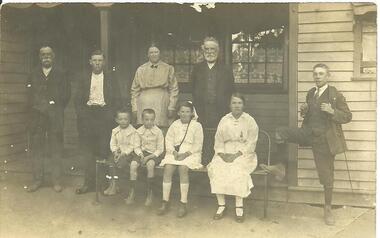
... Both boys have a boat neck collar on their shirts and button up boots on. One girl has a light coloured dress with a money purse across one shoulder, her hair tied up with a ribbon. ...Both boys have a boat neck collar on their shirts and button up boots on. One girl has a light coloured dress with a money purse across one shoulder, her hair tied up with a ribbon. ...This picture shows a group of people outside of a weatherboard house. There are four persons sitting on a metal seat. Two male and two female. Both boys have a boat neck collar on their shirts and button up boots on. One girl has a light coloured dress with a money purse across one shoulder, her hair tied up with a ribbon. The older girl has white uniform on with watch hanging from the bolice, her hair is up. A youth is standing leaning on the house with his thumbs in his vest holding a whip. He has on foot resting on the seat and is wearing short pants and boots. Standing behind the seat is a large framed women wearing a dress with her hair up and a man wearing a suit with facial hair, hands behind his back. To the side another youth with his hands in his pants. Next to him another man with his hands behind his back, dressed in a suit with facial hair. Lace can be seen on the windows.Shows a typical family and housing of the period.Black and white rectangular picture post card.In black ink, stamped on back "Post Card, Correspondence, Address. Written in black ink " Robert Oman, Clifton, Jack, Roy, Jean, Gladys, Evelyn, Father John, Mother. R Oman 5 Locjhart Ter Edwardstown SA". In blue pen "Dos Dunn". -
 Bendigo Historical Society Inc.
Photograph - HILDA HILL COLLECTION: BLACK AND WHITE PHOTO, 1919-1924
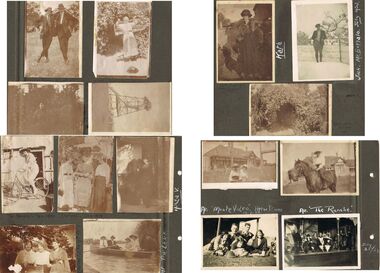
... Three ladies, the lady on the left is wearing a white dress with a black belt and holding in her right hand a small bag with a handle, the middle lady is wearing a dress of another colour with three strips of material at different levels on the front and holding her hands at her waist, also wearing lace up boots, lady to the right is wearing a white blouse and a dark skirt and her hands behind her back, background is garden, 'Durvol' December 1919. Photo of young girl...Three ladies, the lady on the left is wearing a white dress with a black belt and holding in her right hand a small bag with a handle, the middle lady is wearing a dress of another colour with three strips of material at different levels on the front and holding her hands at her waist, also wearing lace up boots, lady to the right is wearing a white blouse and a dark skirt and her hands behind her back, background is garden, 'Durvol' December 1919. Photo of young girl ...Hilda Hill Collection. Combination of Sepia and Black & White Photos. (Total 16.) two men with arms on each others shoulders, both with legs crossed, background shows large group of people and large trees, Hibernian Picnic November 19th 1919. Elderly lady holding two bird cages with birds therein standing in front of large flowering bush, the lady is dressed in all white and her hat lies on the ground in front of her, the hat appears to have flowers on the brim. Mrs Mc'Rosebower' October 1919. Hilda V. Standing with a background of shrubbery, wearing a dark dress, photo not very clear, 'The Ranche' March 1921. The Pinnacle One Tree Hill, people on the top lookout area and the wooden staircase for access, note the iron roof at the first level to provide shelter at ground level, April 1920. Lady on a ladies bicycle, dressed in geometric patterned dress, in front of an old shed with a corrugated iron roof. The bicycle has a front and rear mudguard, 'The Ranche' January 1920. Three ladies, the lady on the left is wearing a white dress with a black belt and holding in her right hand a small bag with a handle, the middle lady is wearing a dress of another colour with three strips of material at different levels on the front and holding her hands at her waist, also wearing lace up boots, lady to the right is wearing a white blouse and a dark skirt and her hands behind her back, background is garden, 'Durvol' December 1919. Photo of young girl dressed in black standing next to a small bush with her back to a house exterior wall, to the left is a white wall, NO Details.Three ladies standing beneath a large tree arm in arm, left girl is wearing a white top with a black belt and dark skirt, Centre girl is wearing a white top and dark skirt, girl at right wearing coloured? Dress with matching sash belt,'Durvol' December 19th 1919. Two men and three ladies in a rowing boat on lake Weeroona, both men are wearing dark suits and hats, the ladies are all in light coloured clothing and also wearing large brimmed hats. Kath wearing a black dress with a fox skin stole and holding a large bag in her right hand in garden setting, left background is a corrugated iron fence with wooden top rail, to the right is the wall of a building, September 1919 'the Ranche'. Jack wearing a black coat and jodhpurs with a white high neck jumper leaning on a wire and netting farm type fence, Mt. Buffalo July 1923. Photo of a 'Rosebower' in a garden corner, right shows part of a picket fence, wear and tear indicates that a gate may be in the fence accessible through the bower, October 1919. Two ladies holding tennis racquets, dressed in white blouses with one dark dress and the other a lighter shade sitting on stool inside a netted tennis court, both ladies are wearing large brimmed hats, background is a house with a water tank on the left end, three decorative chimneys, tiled roof, decorative panelling below the guttering, 'Kilmuir' October 1919. Lady on dark coloured horse, the lady is wearing a white blouse and jodhpurs and a large brimmed hat, background is house showing a bow window three chimneys and a small portion of the decorative fretwork below the gutter line of the verandah, 'Kilmuir' October 1919. Two young men dressing collar and tie one wearing a coat and three young ladies reclining on the ground, girl on the left is wearing a light coloured dress white blouse and cardigan, middle girl wearing a short sleeved top, right lady is wearing white blouse and dark coat, in foreground there appears to be a pudding meat and a wine bottle, left edge another male can be partially seen lying on the ground with a bottle in his left hand, at 'Monte Video' after dinner 18 July 1924. Ten people sitting and standing on a veranda, 'The Ranche', celebrating an event, small 4 wheel table with food, person front left holding a white cup and saucer, July 1924.australia, history, victoria post war touring boom, http://www.yourbrisbanepastandpresent.com/2012_02_01_archive.html -
 Bendigo Historical Society Inc.
Photograph - PETER ELLIS COLLECTION: GRAVEL HILL PRIMARY SCHOOL
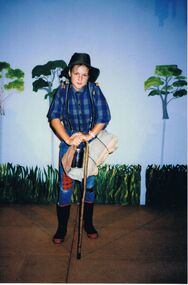
... Girl dressed as Swagman. Corks hanging on hat. Check shirt. Walking stick. Swag bedroll. Torn jeans gum boots, billy can. ...Girl dressed as Swagman. Corks hanging on hat. Check shirt. Walking stick. Swag bedroll. Torn jeans gum boots, billy can. ...Colour photograph. Girl dressed as Swagman. Corks hanging on hat. Check shirt. Walking stick. Swag bedroll. Torn jeans gum boots, billy can. Gravel Hill Primary School. 1988 Production 'The Wallaby Track''.photo, individual, young male -
 Bendigo Historical Society Inc.
Photograph - HILDA HILL COLLECTION: BLACK AND WHITE PHOTOS, 1921-1922
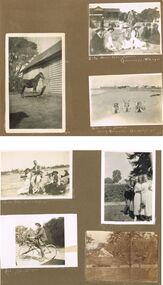
... Cyril Fred Mollie Doreen in a conga line the boys in grey suits and the girls in white, one has circular bands on her skirt, hedge in near back ground, gable roofed building and trees further back,'Durvol' January 1922. Hal wearing dark coat and jodhpurs long boots...Cyril Fred Mollie Doreen in a conga line the boys in grey suits and the girls in white, one has circular bands on her skirt, hedge in near back ground, gable roofed building and trees further back,'Durvol' January 1922. Hal wearing dark coat and jodhpurs long boots ...Series of Black & White Images of Hill Family in the years 1921-1922. Total 7 Photos. Darkie the horse tethered to stable. Zita, Nora, Rita & Doreen one Zita is dressed in black with white scarf around her neck and wearing a dark coloured hat, other three are all dressed in white Nora has a dark hat and other two have broad brimmed hats, Rita and Doreen have black ribbons hanging from their necks, to the right are a man and lady seated on the ground and in dark clothing, a man with a pipe in his mouth and wearing a grey suit and hat in background, lady in black and lady in white looking in other directions, background has grandstand with gab le roof and fronted by a white picket fence and people sitting at tables and chairs, trees in right background, Queenscliff February 1921. Rita Nora Doreen lying face down on the beach, girl on left has dark hat on, background shows large shed and other housing with fences, 'Merry Mermaids' Queenscliff 1921.Four girls and one male, three girls dressed in white, one in dark colour, two have light coloured hats and two have dark colour hats, one girl dressed in dark colour, male is wearing white trousers and college coat with stripes, background shows skyline of the nearby city and beach buildings, two men occupy a seat right back ground and dressed in dark clothing, Queenscliff 1921. Cyril Fred Mollie Doreen in a conga line the boys in grey suits and the girls in white, one has circular bands on her skirt, hedge in near back ground, gable roofed building and trees further back,'Durvol' January 1922. Hal wearing dark coat and jodhpurs long boots sitting astride a bicycle, something balanced between the handlebars and on the top bar, paling fence with vine hanging overhead other plants in the corner of the yard, December 24 1921. Doreen riding in a billy cart and pulled by a large dog along a pathway, Doreen is wearing all white, background is bushes and hedge with large tree, Dog is dark colour, 'I'm coming' January 1921.Hilda Hill Personal Collectionaustralia, history, post war life -
 Bendigo Historical Society Inc.
Photograph - HARRIS COLLECTION: PHOTO TWO FEMALES
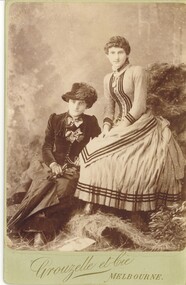
... girl. Dark dress , blouse top with bow below chin and one on chest. Buttoned boots of each girl can be seen. ...girl. Dark dress , blouse top with bow below chin and one on chest. Buttoned boots of each girl can be seen. ...Two seated young female studio photograph. Family resemblance suggests Sisters. Right hand side. Pleated pale dress buttoned up front, closed neck with silver chain necklace and locket. Left hand side girl. Dark dress , blouse top with bow below chin and one on chest. Buttoned boots of each girl can be seen. Printed on front. Grouzelle et Cie, Melbourne. Monogram on reverse. GFC.Grouzelle et Cie Melbournephotograph, person, female -
 Bendigo Historical Society Inc.
Photograph - CHILDRENS PORTRAIT
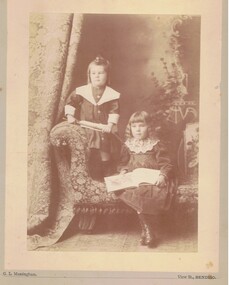
... girls, one standing, the other seated on coach type chair. Large Sailor collar, white cuffs on one frock, large buttons on front, lace collar and smocking on the other, lace up boots. ...girls, one standing, the other seated on coach type chair. Large Sailor collar, white cuffs on one frock, large buttons on front, lace collar and smocking on the other, lace up boots. ...Sepia toned photo on fawn board. 2 small girls, one standing, the other seated on coach type chair. Large Sailor collar, white cuffs on one frock, large buttons on front, lace collar and smocking on the other, lace up boots. Plant stand with arrangement in background, tapestry screen top right, curtain folds on the left. One Girl holding open book, the other a 'whip' type object. Inscription: Below image 'G.L.Massingham View St, Bendigo'.G.L.Massingham View St Bendigoperson, family, 2 girls portrait -
 Bendigo Historical Society Inc.
Photograph - EAGLEHAWK STATE SCHOOL, 1902 - 10?
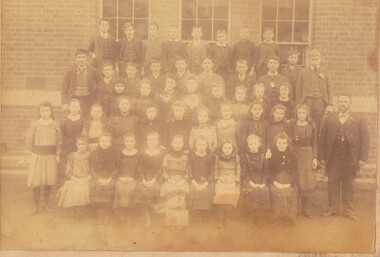
... Boys are dressed in collars and sashes, girls dressed in below-knee dresses with high necks with long sleeves and sashes. They have black lisle stockings and ankle length boots. ...Boys are dressed in collars and sashes, girls dressed in below-knee dresses with high necks with long sleeves and sashes. They have black lisle stockings and ankle length boots. ...Eaglehawk State School opened as a National School in 1854, with the first classes held in a tent. A timber schoolhouse was built in 1856. In 1862 it became a common school and then in 1873 was designated as a State School. Despite continual extensions, the school became too small and the present brick building was built in 1874.Black and white photo on board. School Photo. 46 students, 1 teacher.( 18 boys + 28 girls) standing in 5 rows in front of a brick wall, with 3 multiple-paned sash windows. Boys are dressed in collars and sashes, girls dressed in below-knee dresses with high necks with long sleeves and sashes. They have black lisle stockings and ankle length boots. The teacher is wearing a 3 piece suit with a fob pocket watch and Butterfly collar. He has a goatee beard and moustache. Girls have long hair, tied back from faces. Inscription: Miss L Hall/3,a Black 4/- (Hand Written in Pencil). Faint traces of writing in centre of mounting board (Miss Mall?)organization, education, eaglehawk state school -
 Bendigo Historical Society Inc.
Photograph - COHN BROS BREWERY PICNIC GROUP PHOTOGRAPH, 7th March, 1903
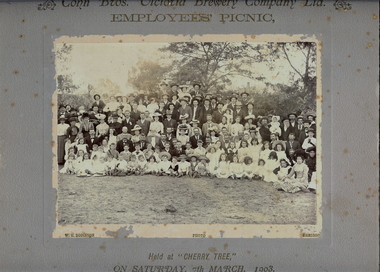
... Boys in long socks and boots, garments with sailor type collard. Girls in frilly dresses and some with aprons. ...Boys in long socks and boots, garments with sailor type collard. Girls in frilly dresses and some with aprons. ...Black and white photograph on grey mount board. Cohn Bros. Vic. Brewery Picnic. Men dressed in suits and various styles of hats, females in dress of the period (1903). Large hats with decorations. Boys in long socks and boots, garments with sailor type collard. Girls in frilly dresses and some with aprons. Inscriptions: Printed on mount at front 'Cohn Bros. Victoria Brewery Col. Ltd. Employees Picnic, held at Cherry Tree on Saturday 7th March, 1903', 'Magnus Cohn, Julius Cohn (central)', hand written on back. 'From WL Newell 30/07/1974 (written in black lead pencil), 'Royal Historical society of Victoria, Bendigo Branch' in circular stamp (on reverse). History: Previous Acc. No. GP25WH Robinson Photo, Bendigoperson, group, cohn's brewery, see also 2001.201.01, 2001.202.01, 2001.203.01, 2001.207.01, 2001, 208.01 -
 Bendigo Historical Society Inc.
Photograph - SUNDAY SCHOOL PICNIC, Approx., 1900 ?
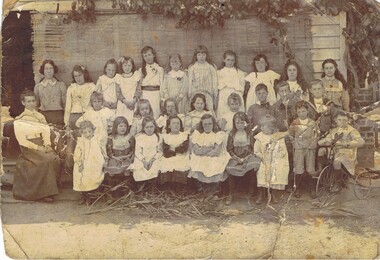
... Some girls in pinafores, black stockings and boots. Boys in sailor suits and boots....Some girls in pinafores, black stockings and boots. Boys in sailor suits and boots. ...Sepia photo of three rows of school children on Sunday School picnic, teacher at left. Child at front right on tricycle. 28 children, 1 adult. In background, bamboo blind hanging in front of weatherboard wall, brick chimney ? at right. Grapevine ? at right and top. In foreground lying on ground reed stalks ? Some girls in pinafores, black stockings and boots. Boys in sailor suits and boots.person, group, sunday school picnic -
 Bendigo Historical Society Inc.
Photograph - FIVE GIRLS, 1910 ?
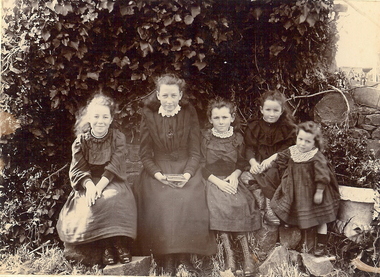
... PERSON Group girls sepia toned photograph of five females, three children on left and two adolescents. Four with lace up boots, child on right with shoes. ...sepia toned photograph of five females, three children on left and two adolescents. Four with lace up boots, child on right with shoes. All wearing dark dresses, four with lace coillars. All are bareheaded. Eldest holds book at her lap. Stone fence ? And creeper in backgroundperson, group, girls -
 Bendigo Historical Society Inc.
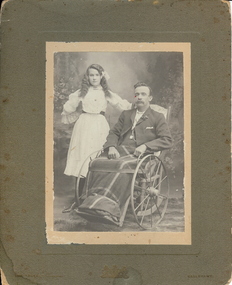
Photograph - FATHER AND DAUGHTER PORTRAIT, 1900 - 1912 ?
... Girl has long hair with bow, pale cress and dark stockings, boots and belt. ...Girl has long hair with bow, pale cress and dark stockings, boots and belt. ...sepia photograph mounted on brown card. Man in wheelchair with adolescent girl standing on the left. Man has moustache, wearing waistcoad, jacket, chain and albert, button hole. Wheelchair has iron wheels, wooden frame, leather straps around man's knwws and ankles, which are covered with a check rug. Girl has long hair with bow, pale cress and dark stockings, boots and belt. On front of photo embossed: 'The Royal/Eaglehawk''The Royal' Eag;lehawkperson, family, father and daughter -
 Bendigo Historical Society Inc.
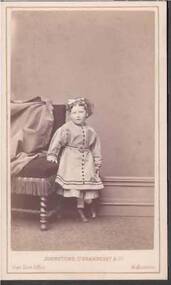
Photograph - PORTRAIT OF A CHILD
... girl Portrait of a Child Johnstone O'Shannessy & Co. Johnstone, O'Shannessy & Co.,3 Bourke St. East, Melbourne Small portrait of a child standing beside a chair with her right hand resting on the chair. She is wearing a striped coat with buttons down the front and two dark bands near the hem. Her dress is below the coat. She is wearing boots ...Small portrait of a child standing beside a chair with her right hand resting on the chair. She is wearing a striped coat with buttons down the front and two dark bands near the hem. Her dress is below the coat. She is wearing boots and has a ribbon in her curly hair. Photographer's name and address on the front and back of the photo mount. Printing on the front is gold and is black on the back. Also a gold border around the photo.Johnstone, O'Shannessy & Co.,3 Bourke St. East, Melbournephotograph, portrait, girl, portrait of a child, johnstone o'shannessy & co. -
 Bendigo Historical Society Inc.
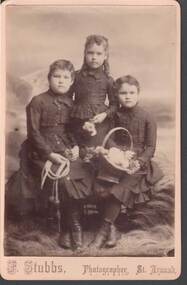
Photograph - PORTRAIT OF THREE GIRLS
... Of the two girls seated, one is wearing above ankle height lace up boots, and the other is wearing the same length button up boots. ...Of the two girls seated, one is wearing above ankle height lace up boots, and the other is wearing the same length button up boots. ...Cabinet Portrait of Three Girls. The girls are wearing the same type of dress/uniform. Two girls are seated and one is standing behind them. Of the two girls seated, one is wearing above ankle height lace up boots, and the other is wearing the same length button up boots. All the girls have something in their hands, the one at the back has some flowers, the one on the left has a skipping rope, and the one on the right has a basket of flowers.F. Stubbs, St. Arnaudphotograph, portrait, female group, portrait of three girls, f stubbs st arnaud -
 Bendigo Historical Society Inc.
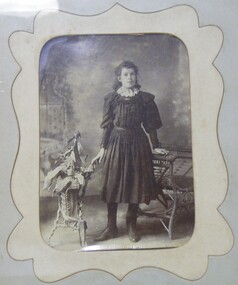
Photograph - PHOTOGRAPH OF YOUNG GIRL, 1890
... Studio photograph of a young girl in knee length frock with lace collar, puffed sleeves and button up boots. ...PERSON Individual portrait young girl Allan Paris portraits Allan Paris Panel Studio photograph of a young girl in knee length frock with lace collar, puffed sleeves and button up boots. ...Studio photograph of a young girl in knee length frock with lace collar, puffed sleeves and button up boots. Standing beside a wicker chair and plant stand, mounted under glass in a brown wooden frame with gold edging upon a grey card with cream inside border, markings upon photo read 'Allan Paris Panel, 318 Smith Street, Collingwood'Allan Paris Panelperson, individual, portrait, young girl, allan paris, portraits -
 Ithacan Historical Society
Photograph, Thalia Paizis, 1907
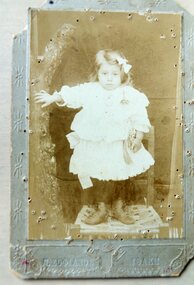
... A photograph of a sepia studio photograph of a little girl standing on a chair. She is wearing an embroidered dress and little lace up boots. ...Written across the bottom of the photo: Sofianos Ithaca 1925 A photograph of a sepia studio photograph of a little girl standing on a chair. She is wearing an embroidered dress and little lace up boots. ...The photo is of Thalia Paizis taken in Ithaca in 1907. Thalia left Ithaca as very young child together with her mother, Chrisaida, to be reunited with her father, Nicholas Paizis in Perth W.A. Nicholas had left Ithaca prior to Thalia's birth in 1905 and established a successful business in Perth, W.A. Thalia went back to Greece in 1921 and eventually returned to Australia where she married Anastasios Papadopoulos in 1929 and settled in Melbourne. Thalia and Anastasios were the parents of Irini Pappas who was well known and highly regarded actor in Melbourne's Greek community.A photograph of a sepia studio photograph of a little girl standing on a chair. She is wearing an embroidered dress and little lace up boots. The original photograph is backed onto a decorative grey embossed board. Written across the bottom of the photo: Sofianos Ithaca 1925 -
 Stawell Historical Society Inc
Book, Education Department of Victoria, School Paper 1931 & 1933 & 3 Supplements, 1930's
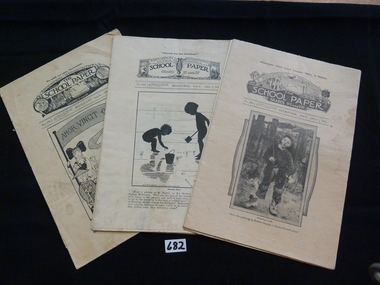
... 2 Paper booklets & 3, 4 page, supplements. 0682 has a photo of a boy holding a stick wearing unlaced boots, (after the painting by Bastien Lepage) 0682-1 is a supplement with a Picture of girls in a large room sitting in front of electric sewing machines. 0682-2 supplement: Contains photo of a certificate from the Victorian State Schools League of Kindness. 0682-3 Black and white drawing of two children in silhouette. on the beach with bucket and spade.0682-4 Supplement a picture of a variety of toys. 0682-5. drawing of children of different nationalities....Melbourne Price 1d [Nov. 1 1931. 2 Paper booklets & 3, 4 page, supplements. 0682 has a photo of a boy holding a stick wearing unlaced boots, (after the painting by Bastien Lepage) 0682-1 is a supplement with a Picture of girls in a large room sitting in front of electric sewing machines. 0682-2 supplement: Contains photo of a certificate from the Victorian State Schools League of Kindness. 0682-3 Black and white drawing of two children in silhouette. on the beach with bucket and spade.0682-4 Supplement a picture of a variety of toys. 0682-5. drawing of children of different nationalities. ...The School Paper published monthly. Cost 1 Penny (2 Cents) Used in State Schools2 Paper booklets & 3, 4 page, supplements. 0682 has a photo of a boy holding a stick wearing unlaced boots, (after the painting by Bastien Lepage) 0682-1 is a supplement with a Picture of girls in a large room sitting in front of electric sewing machines. 0682-2 supplement: Contains photo of a certificate from the Victorian State Schools League of Kindness. 0682-3 Black and white drawing of two children in silhouette. on the beach with bucket and spade.0682-4 Supplement a picture of a variety of toys. 0682-5. drawing of children of different nationalities.0682: Midwinter. Days grow Longer. - Signs of Spring. Education Department. Victoria Australia The School Paper Grades VII and VIII. No 369. Melbourne Price 1d [July 1 1931. 0682-1: Supplement to the School Paper - Grades VII and VIII July 1931. 1. Made in Australia. 80. Girls and Womans Wear. 0682-2: Supplement to the School Paper - All Grades July 1931.1 The Protection of Animals. 0682-3: Hurrah for the Holidays Education Department. Victoria Australia The School Paper Grades III and IV. No 403. Melbourne Price 1d [Dec 1 1931. 0682-4: Supplement For the School Paper - Grades III and IV December 1931. 1.Made In Australia 85. Toys. 0682-5: No Cold, No Care, November Education Department. Victoria Australia The School Paper Grades V and VI. No 409. Melbourne Price 1d [Nov. 1 1931.stawell education -
 Tatura Irrigation & Wartime Camps Museum
Book - Paperback Book, The Merry Mis-Adventures of Meg & Peg, 2021
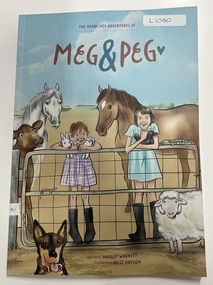
... The other girls has a blue dress, gum boots and holding a black duck. ...The other girls has a blue dress, gum boots and holding a black duck. ...Author Margot Warnett grew up on a Dairy farm just outside TaturaA4 size paperback book with predominantly blue sky and an illustration of two girls standing on a wire farm gate. One girls has a purple check dress on, black gum boots and holding a white rabbit. The other girls has a blue dress, gum boots and holding a black duck. A white and brown horse, a calf, a sheep and farm dog and a lizard are also in the picture. The two girls are also pictured on the back cover.Written by Margot Warnett Illustrated by Julie Haysomwarnett, book, children, meg and peg, dairy farm -
 Chelsea & District Historical Society Inc
Photograph - Carrum General Store, Ramsays, 1900
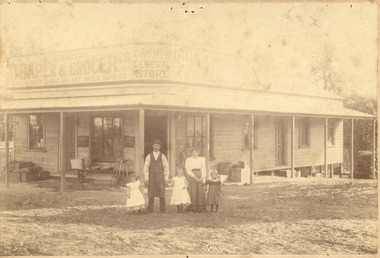
... RAMSAY DRAPER&GROCER ETC COOL SUMMER DRINKS HOT - WATER SUPPLIED IRON BOOTS Sepia photo of Carrum General Stores, with wares on display on the verandah. The shopkeeper, his wife and three young girls are standing in front of the store. ...Sepia photo of Carrum General Stores, with wares on display on the verandah. The shopkeeper, his wife and three young girls are standing in front of the store. The store was situated opposite the Carrum Station.CARRUM GENERAL STORE W. RAMSAY DRAPER&GROCER ETC COOL SUMMER DRINKS HOT - WATER SUPPLIED IRON BOOTSgeneral store, carrum general store, carrum, shop -
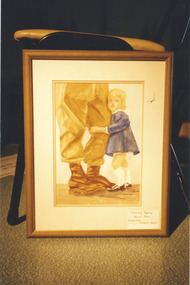 Melbourne Legacy
Photograph, Daddy's Home, 1995
... 'The picture is titled "Daddy's Home" and depicts the lower half of a serviceman dressed in khaki trousers and combat boots. Hugging his leg is a little girl in a blue dress. Words really don't describe the situation - seeing is better. ...'The picture is titled "Daddy's Home" and depicts the lower half of a serviceman dressed in khaki trousers and combat boots. Hugging his leg is a little girl in a blue dress. Words really don't describe the situation - seeing is better. ...Photograph of a painting by Mrs Fonce Kerr that was donated to Legacy. It was exhibited at the Legacy Widows' Arts and Crafts Exhibition in 1995. The article mentions Mrs Kerr was the ex-President of the Waverley Legacy Widows' Club. 'The picture is titled "Daddy's Home" and depicts the lower half of a serviceman dressed in khaki trousers and combat boots. Hugging his leg is a little girl in a blue dress. Words really don't describe the situation - seeing is better. It is a nostalgic depiction of considerable meaning to all members of our Legacy family - widows, dependents and Legatees. Mrs Kerr has generously presented the picture to Legacy - it will hang in the First Floor Dining Room.' A record of when the painting was given to Legacy.Colour photo x 1 of a painting a girl welcoming her father home and an article about the painting in the Answer.answer, painting
