
Showing 40 items matching "glass metal industries"
-
 Canterbury History Group
Document - Plaques, 1989
... ...Glass metal Industries...Plaques Plaques Policy Grant Agreement Information on Plaques Glass metal Industries 12 A4 pages and one postcard plus one walk around the plaques leaflet Document Plaques ...12 A4 pages and one postcard plus one walk around the plaques leafletplaques, plaques policy, grant agreement, information on plaques, glass metal industries -
 Flagstaff Hill Maritime Museum and Village
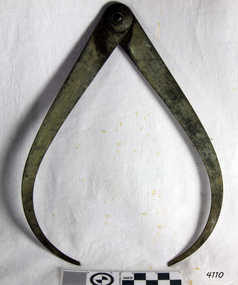
Calipers, Moore & Wright, 1925-1935
... industries. These items are now collectible and quite rare as a result are sought by tool collectors in the USA and UK. flagstaff hill warrnambool shipwrecked-coast flagstaff-hill flagstaff-hill-maritime-museum maritime-museum shipwreck-coast flagstaff-hill-maritime-village calipers callipers external calipers outer caliper Pottery Tools masonry Tools Glass making Tools External measurement Impressed into the metal "L A J S" (Probably the owner and company that used the item nothing to do with manufacturing) ‘Firm Joint’ external measuring calipers believed made by Moore & Wright. ...Established in 1906, Frank Moore soon became well known amongst discerning tradespeople for the quality & accuracy of his tools. The Company was acquired by John Shaw & Son in 1945 & James Neill & Co in 1970. Currently part of the Bower Meteorology UK Group, they still produce superb tools & measuring instruments in Sheffield. The subject item is made from high-grade carbon silver tool steel with the patented 'Firm Lock' joint, that identifies the maker as Moore & Wright.A tool used for external measurement of items made by a maker who patented the "firm lock" jointing system now used on many different types of tools in many different industries. These items are now collectible and quite rare as a result are sought by tool collectors in the USA and UK.‘Firm Joint’ external measuring calipers believed made by Moore & Wright. Impressed into the metal "L A J S" (Probably the owner and company that used the item nothing to do with manufacturing) flagstaff hill, warrnambool, shipwrecked-coast, flagstaff-hill, flagstaff-hill-maritime-museum, maritime-museum, shipwreck-coast, flagstaff-hill-maritime-village, calipers, callipers, external calipers, outer caliper, pottery tools, masonry tools, glass making tools, external measurement -
 Flagstaff Hill Maritime Museum and Village
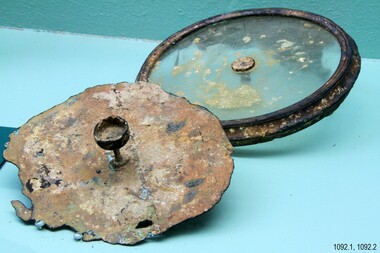
Instrument - Ship Compass Sections, 1886
... industry. The compass sections are also significant for belonging to the compass of the Falls of Halladale. It was a critical part of the ship's equipment. warrnambool shipwrecked-coast flagstaff-hill flagstaff-hill-maritime-museum shipwreck-coast flagstaff-hill-maritime-village compass sections falls of halladale wreck of halladale ship compass None Compass sections, two; brass disc with a round object on a pedestal, together with a glass disc with a metal frame and insert in the centre. ...A ship's compass played an extremely important role in navigating the ship from the port to its destination. If there was a slight inaccuracy in its calibration the ship could miss its destination and crash or be wrecked. The Falls of Halladale was an iron-hulled, four-masted barque, used as a bulk carrier of general cargo. She left New York in August 1908 bound for Melbourne and Sydney. In her hold was general cargo consisting of roofing tiles, barb wire, stoves, oil, and benzene as well as many other manufactured items. After three months at sea and close to her destination, a navigational error caused the Falls of Halladale to be wrecked on a reef off the Peterborough headland on the 15th of November, 1908. The captain and 29 crew members survived, but her cargo was largely lost, despite two salvage attempts in 1908-09 and 1910. The Court of Marine Inquiry in Melbourne ruled that the foundering of the ship was entirely due to Captain David Wood Thomson's navigational error, not too technical failure of the Clyde-built ship. The Falls of Halladale was built in1886 by Russell & Co., at Greenock shipyards on the River Clyde, Scotland for Wright, Breakenridge & Co of Glasgow. She was one of several designs of Falls Line of ships named after waterfalls in Scotland. The company had been founded between 1870- 1873 as a partnership between Joseph Russell, Anderson Rodger, and William Todd Lithgow. During the period 1882-92 Russell & Co. standardised designs, which sped up their building process so much that they were able to build 271 ships during that time. The Falls of Halladale had a sturdy construction built to carry maximum cargo and able to maintain full sail in heavy gales, one of the last of the 'windjammers' that sailed the Trade Route. She and her sister ship, the Falls of Garry, were the first ships in the world to include fore and aft lifting bridges. Previous to this, heavily loaded vessels could have heavy seas break along the full length of the deck, causing serious injury or even death to those on deck. The new, raised catwalk-type decking allowed the crew to move above the deck in stormy conditions. The Falls of Halladale shipwreck is listed on the Victorian Heritage (No. S255). She was one of the last ships to sail the Trade Routes from Europe and the Americas. Also of significance is that the vessel was one of the first ships to have fore and aft lifting bridges as a significant safety feature still in use on modern vessels today. The subject model is an example of an International Cargo Ship used during the 19th and early 20th centuries to transport goods worldwide and represents aspects of Victoria’s shipping industry. The compass sections are also significant for belonging to the compass of the Falls of Halladale. It was a critical part of the ship's equipment. Compass sections, two; brass disc with a round object on a pedestal, together with a glass disc with a metal frame and insert in the centre. Both items were recovered from compass on the wreck of Falls of Halladale. Nonewarrnambool, shipwrecked-coast, flagstaff-hill, flagstaff-hill-maritime-museum, shipwreck-coast, flagstaff-hill-maritime-village, compass sections, falls of halladale, wreck of halladale, ship compass -
 The Beechworth Burke Museum
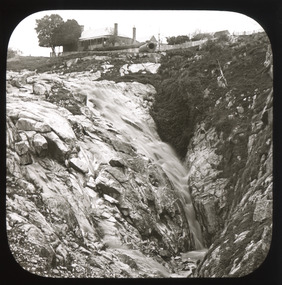
Photograph - Lantern Slide, c1900
... Burke Museum Beechworth Lantern Slide Slide Glass Slide Plate Burke Museum Collection Photograph Monochrome indigo shire north-east victoria spring creek falls beechworth gorge louis chevalier nicholas chevalier lumber industry timber industry 1850s construction building mill mills waterfall Thin translucent sheet of glass with a square image printed on the front and framed in a black backing. It is held together by metals ...This image shows the gorge adjacent to Beechworth in approximately 1900. Although the exact location of the photograph is yet to be determined, the present-day Beechworth Gorge Walk includes views of the Cascades at the point at which Spring Creek flows into the valley on the level below. Gold-sluicing techniques in use in the town during periods of active gold extraction may have altered the landscape since the photograph was taken, however. In the 1850s a mill was built at the top of the Spring Creek falls by Russian-born Louis Chevalier, brother of artist Nicholas Chevalier. The mill supplied the town with lumber that supported the town's initial construction boom. Lantern slides, sometimes called 'magic lantern' slides, are glass plates on which an image has been secured for the purpose of projection. Glass slides were etched or hand-painted for this purpose from the Eighteenth Century but the process became more popular and accessible to the public with the development of photographic-emulsion slides used with a 'Magic Lantern' device in the mid-Nineteenth Century. Photographic lantern slides comprise a double-negative emulsion layer (forming a positive image) between thin glass plates that are bound together. A number of processes existed to form and bind the emulsion layer to the base plate, including the albumen, wet plate collodion, gelatine dry plate and woodburytype techniques. Lantern slides and magic lantern technologies are seen as foundational precursors to the development of modern photography and film-making techniques.This glass slide is significant because it provides insight into Beechworth's built environment and natural landscape in the early Twentieth Century, around the time of Australia's Federation. It is also an example of an early photographic and film-making technology in use in regional Victoria in the time period.Thin translucent sheet of glass with a square image printed on the front and framed in a black backing. It is held together by metals strips to secure the edges of the slide.burke museum, beechworth, lantern slide, slide, glass slide, plate, burke museum collection, photograph, monochrome, indigo shire, north-east victoria, spring creek falls, beechworth gorge, louis chevalier, nicholas chevalier, lumber industry, timber industry, 1850s, construction, building, mill, mills, waterfall -
 Flagstaff Hill Maritime Museum and Village
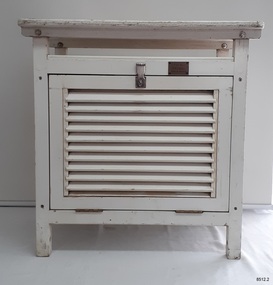
Equipment - Stevenson Screen, Thomas Stevenson, ca. 1910
... metal bracket that fits across the screw holes on the screen’s internal frame. The glass-covered Relative Humidity (RH) sensor was made by the renowned precision instrument maker, Rotronic AG of Switzerland, which was founded in 1965. The firm made its first electronic temperature and humidity instrument in 1967. Meteorological records have been collected in Australia from the 1800s. The records were collated, published and used as a basis for weather forecasts. Many sectors, such as maritime and agriculture industries...metal bracket that fits across the screw holes on the screen’s internal frame. The glass-covered Relative Humidity (RH) sensor was made by the renowned precision instrument maker, Rotronic AG of Switzerland, which was founded in 1965. The firm made its first electronic temperature and humidity instrument in 1967. Meteorological records have been collected in Australia from the 1800s. The records were collated, published and used as a basis for weather forecasts. Many sectors, such as maritime and agriculture industries ...Stevenson screens were first introduced in Australia in the 1880s and were widely installed by 1910. The screens have been used to shelter and protect thermometers and other meteorological instruments from rain and direct heat while the holes and double-louvre walls allowed air to flow around them. Sometimes other meteorological instruments were included in the weather stations, so there were different Stevenson Screen sizes. This authentic, original Stevenson screen was previously owned by the Australian Bureau of Meteorology and was used for many years for weather readings at the Cape Otway Light Station in southwest Victoria. The Lighthouse Keepers recorded the readings for minimum and maximum temperatures at 9 a.m. every day from January 1865 until April 1994. The equipment was sheltered in a Stevenson Screen from 1902 until April 15 1994, when the mercury thermometer was replaced by a platinum resistance probe within an Automatic Weather Station (AWS). This Stevenson screen is one of the two screens that then became redundant. The other Stevenson screen was kept to display to visitors. Lightkeepers were no longer required at the Cape Otway Light station either, due to the automated system. The meteorological instruments donated with the screen were used for measuring temperature and humidity. They are mounted on a metal bracket that fits across the screw holes on the screen’s internal frame. The glass-covered Relative Humidity (RH) sensor was made by the renowned precision instrument maker, Rotronic AG of Switzerland, which was founded in 1965. The firm made its first electronic temperature and humidity instrument in 1967. Meteorological records have been collected in Australia from the 1800s. The records were collated, published and used as a basis for weather forecasts. Many sectors, such as maritime and agriculture industries, have relied on these figures for making important decisions. The quality and placement of the meteorological instruments used to measure temperature and humidity are of utmost importance for accuracy. In early colonial times, there were no national standards for meteorological instruments that would allow for accurate figures and comparisons. Once the Bureau of Meteorology was established (around 1908 to 1910) the department installed Stevenson screens throughout Australia, many at lighthouses and light stations, and the measuring instruments were standardised. The Stevenson Screen was named after its inventor, Scottish Civil Engineer Thomas Stevenson (1818-1887) who was also the father of Robert Louis Stevenson, author. Stevenson developed the small thermometer screen around 1867. It had double-louvred walls around the sides and a top of two asbestos sheets with an air space between them and was thickly painted with a white coating that reflected the sun’s rays. This design was modified in 1884 by Edward Mawley of the Royal Meteorological Society. Standards were set for the locations of the screens and instruments, including their distance above ground level and the direction the door faced.Stevenson screens played a significant part in providing a standardised shelter for all meteorological instruments used by the Australian Bureau of Meteorology from about 1910 until 1994. The readings from the instruments gave the meteorological statistics on which weather forecasts throughout Australia were based. This Stevenson screen was used locally at Cape Otway, along the Great Ocean Road in southwest Victoria, so contributed towards our local forecasts and weather warnings.Stevenson screen, original, from the Australian Bureau of Meteorology’s weather station at the Cape Otway Lighthouse. The screen is a white wooden cupboard with a slanted cover raised above the top. The top has ten drilled ventilation holes, and the sides and door are made of downward-slanting double louvres. Two brass hinges join the door to the lower edge of the screen and a metal fitting at the top edge allows for a padlock closure. The screen is supported on four short legs, each with a hole drilled from side to side for fitting to a frame. Inside the screen are two wooden frames fitted with hooks and screws. The floor has three boards; one across the back and one across the front at the same level, and a board wider than the space between these boards is fitted higher, overlapping them slightly. Inside the screen, a pair of electronic instruments with short electric cables is mounted on a metal bracket with drilled holes in it. One of the instruments is a Relative Humidity (RH) probe. It is 26 cm long and is a glass tube with a filter on one end and an electrical connection on the other. It has inscriptions on its label, showing that was made by Rotronic AG, Switzerland. The other instrument is a Resistance Temperature Device (RTD) thermometer. It is 22.5 cm long and has a narrow metal probe joined to a hexagonal metal fitting. A brass plate on the front of the screen has impressed inscriptions. The screen is Serial Number 01/C0032, Catalogue Number 235862.Stamped into brass plate "CAT. NO. / 253862 / SERIAL NO. 01/C0032" On instrument’s electrical fitting; “CD2” [within oval ‘+’ above S] “Serie693 op65 / 220/380V~16A” On instrument’s glass; “rotronic ag” “SWISS MADE” “CE / CH-8303 / Bassersdorf” Symbol for [BARCODE] “ART NO MP 101A_T4-W4W” “POWER 4.8.30VDC“ “OP. RANGE: 0-100%RH/-40+60° C” “OUT H 0-100% 0-1V” “OUT T -40+60°C -0.4..+0.6V” “SERIE NO 19522 009”flagstaff hill maritime museum and village, warrnambool, maritime museum, maritime village, great ocean road, shipwreck coast, cotton region shelter, instrument shelter, thermometer shelter, thermoscreen, thermometer screen, measuring instruments, meteorological instrument, weather recording, weather station, lighthouse equipment, light station equipment, stevenson screen, marine instruments, mercury thermometer, platinum resistance probe, aws, automatic weather station, rotronic ag, swiss made, meteorological device, weather forecast, weather prediction, weather records, meteorological forecast, meteorological record, australian bureau of meteorology, bureau of meteorology, bureau, bom, relative humidity, rh, relative humidity probe, resistance temperature device, rtd, thermometer, temperature, humidity, cape otway, cape otway lighthouse, cape otway light station, rotronic, switzerland, swiss instrument, thomas stevenson, double-louvered walls, edward mawley, royal meteorological society, 01/c0032, serial number, cat. no. 235862, serial no. 01/c00323 -
 City of Moorabbin Historical Society (Operating the Box Cottage Museum)
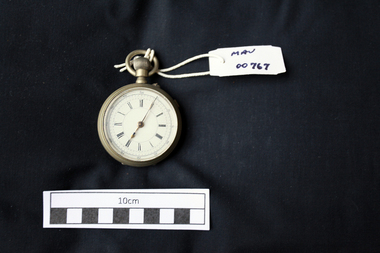
Watches, pocket watch, c1900
... Watch manufacture was becoming streamlined; the Japy family of Schaffhausen, Switzerland, led the way in this, and soon afterwards the newborn American watch industry developed much new machinery, so that by 1865 the American Watch Company (afterwards known as Waltham) could turn out more than 50,000 reliable watches each year. watches brighton cheltenham moorabbin bentleigh early settlers pioneers Back: of case ; a shield inside 2 circles This silver plated pocket watch with an open glass face has black roman numerals on a white dial , gold hour hands and a blue second hand. The winding stem is at 12 o’clock and has a metal ...A pocket watch is a watch that is made to be carried in a pocket, as opposed to a wristwatch, which is strapped to the wrist.. They were the most common type of watch from their development in the 16th century until wristwatches became popular after World War I The first stem-wind and stem-set pocket watches were sold during the Great Exhibition in London in 1851 and the first owners of these new kinds of watches were Queen Victoria and Prince Albert. Stem-wind, stem-set movements are the most common type of watch-movement found in both vintage and modern pocket watches.In 1857 the American Watch Company in Waltham, Massachusetts introduced the Waltham Model 57, the first to use interchangeable parts which cut the cost of manufacture and repair. Most Model 57 pocket watches were in a coin silver. Watch manufacture was becoming streamlined; the Japy family of Schaffhausen, Switzerland, led the way in this, and soon afterwards the newborn American watch industry developed much new machinery, so that by 1865 the American Watch Company (afterwards known as Waltham) could turn out more than 50,000 reliable watches each year.This silver plated pocket watch with an open glass face has black roman numerals on a white dial , gold hour hands and a blue second hand. The winding stem is at 12 o’clock and has a metal ring for attachment to a chain. Back: of case ; a shield inside 2 circleswatches, brighton, cheltenham, moorabbin, bentleigh, early settlers, pioneers -
 Glenelg Shire Council Cultural Collection
Print, Angela Gee, Tuna Fishing Pt Lincoln, 1986
... industry. Mounted without a matt in a pale blue metal frame with glass glazing....industry. Mounted without a matt in a pale blue metal frame with glass glazing. ...UnknownFive portraits of male figures in five square at top of print. Each man is in a different pose, with a blue wash background. Underneath are hand-written inscriptions identifying them as different people involved in the tuna-fising industry. The bottom part of the print is a handwritten short essay on the tuna-fishing industry. Mounted without a matt in a pale blue metal frame with glass glazing.Front: 9/40 (lower left) Tuna Fishing, Pt Lincoln (lower centre) Angela Gee '86 (lower right) (pencil) Back: (no inscriptions) -
 Orbost & District Historical Society
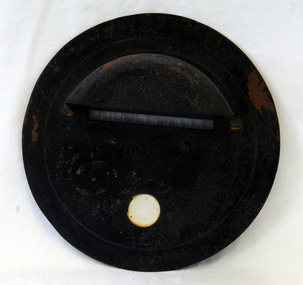
blackout shield, Lucas Industries, WW 11
... metal disc painted black - car light blackout shield. It has a small glass slot in front and a scooped out front to cover the light. blackout shield Lucas Industries ...By 1941, the threat of Japanese invasion caused restrictions to daily life. Blackouts became the norm. To prevent identification from enemy planes all lights had to be turned down, including car headlights that had to be covered to minimize light exposure. In Australia more relaxed regulations led to the Australian air raid precautions being dubbed the “brownout”. These shields limited the amount of light emitted by a vehicle. To drive at night without them was an offence; however, the increase in road accidents led to the removal of headlight masks everywhere in Australia south of Rockhampton from 15 February 1943. These shields, though not rare, evoke a period of restrictions, fear, rationing and confinement.A circular metal disc painted black - car light blackout shield. It has a small glass slot in front and a scooped out front to cover the light.ww11 blackout-shield -
 Orbost & District Historical Society
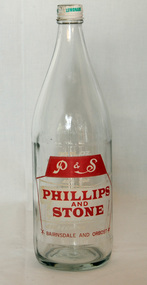
bottle, before 1975
... This bottle is an example of a product manufacture by a local industry no longer existing. bottle phillips-and-stone beverage lemonade container Lid - Lemonade Base - AGM M 6 inside a circle 9 Front - 30 fl ozs Back - Manufactured by Preservative added M21 A1 P & S Phillips and Stone 28 flavour LOK Ask for Bairnsdale and Orbost Phillips and Stone Preservative added Refreshing drinks Artificially coloured and flavoured Bairnsdale and Orbost A clear glass bottle with a metal screw cap. on the front is a painted red and white label. ...Dross Drossou sold his cordial manufacturing business to Phillips and Stone, a Bairnsdale company, in 1948. Phillips and Stone continued to manufacture soft drinks at Orbost until the early 1970's when the factory became a distribution centre. It closed as a distribution centre in 1978 and later served as the headquarters of the Orbost State Emergency Service. The site of the Cordial Factory now forms part of a carpark. A deposit on the bottles was added to all sales as they left the factory. The returned bottles were washed and the old label removed. The inside was cleaned by pushing the bottle onto a revolving brush. The reusing of the bottles went on until the bottle was broken or the top became chipped. This bottle is an example of a product manufacture by a local industry no longer existing.A clear glass bottle with a metal screw cap. on the front is a painted red and white label. It contained lemonade.Lid - Lemonade Base - AGM M 6 inside a circle 9 Front - 30 fl ozs Back - Manufactured by Preservative added M21 A1 P & S Phillips and Stone 28 flavour LOK Ask for Bairnsdale and Orbost Phillips and Stone Preservative added Refreshing drinks Artificially coloured and flavoured Bairnsdale and Orbost bottle phillips-and-stone beverage lemonade container -
 Cheese World Museum
Butter Churn, Taco butter churn, 1880 (estimated)
... Glass) Makes butter equal to the best wooden churn, and quicker. Prices-2 qts, 9/6; 3 quts, 13/3; 4 qts, 14/6 each.' butter allansford dairy industry dairy utensils butter churns kraft foods ltd taco 'Taco Burnley England' on turning mechanism on lid, 'British Foreign Pats Pending' on reverse. 'Made in England' imprinted on base. Paper label attached to base 'Kraft Foods Ltd' 'M.G.' Taco butter churn with square clear glass jar with round mouth and round green painted metal ...These glass churns came in several different sizes. A 3 and 1/2 pint vessel could churn 2 pints of cream into butter. A similar glass churn is advertised in the mail order catalogue for D & W Chandler Ltd, Melbourne. Issue No.49, page 168. Listed as 'Butter machines (Glass) Makes butter equal to the best wooden churn, and quicker. Prices-2 qts, 9/6; 3 quts, 13/3; 4 qts, 14/6 each.'Taco butter churn with square clear glass jar with round mouth and round green painted metal lid with a small wedge of airholes. The lid has a round turning mechanism with attached wooden handle. A shaft with a metal paddle goes down into the jar to beat the cream. A paper label is attached to the bottom.'Taco Burnley England' on turning mechanism on lid, 'British Foreign Pats Pending' on reverse. 'Made in England' imprinted on base. Paper label attached to base 'Kraft Foods Ltd' 'M.G.'butter, allansford, dairy industry, dairy utensils, butter churns, kraft foods ltd, taco -
 Orbost & District Historical Society
bottle, C 1970's
... This bottle is an example of a product manufacture by a local industry no longer existing. beverages Phillips-Stone bottle On glass -"manuf. by Phillips & Stone, Bairnsdale & Orbost 52361 preservative added, artificially coloured & flavoured 850ml" On lid - "Lemonade" A tall clear glass cordial bottle with a red printed label on the front of the bottle, It has a metal lid. bottle Phillips & Stone ...Dross Drossou established a cordial factory in Orbost in the 1930s. He sold his cordial manufacturing business to Phillips and Stone, a Bairnsdale company, in 1948. Glass bottles were refillable until the 1960s, creating a demand for their collection and onsale back to beverage manufacturers via ‘bottle merchants’. A deposit on the bottles was added to all sales as they left the factory. The returned bottles were washed and the old label removed. The inside was cleaned by pushing the bottle onto a revolving brush. The reusing of the bottles went on until the bottle was broken or the top became chipped. Phillips & stone operated a cordial factory in Orbost. This bottle is an example of a product manufacture by a local industry no longer existing.A tall clear glass cordial bottle with a red printed label on the front of the bottle, It has a metal lid.On glass -"manuf. by Phillips & Stone, Bairnsdale & Orbost 52361 preservative added, artificially coloured & flavoured 850ml" On lid - "Lemonade"beverages phillips-stone bottle -
Warrnambool and District Historical Society Inc.
Functional object - car lantern, Joseph Lucas Ltd. Birmingham, England, Lucas King of the Road Lantern, c.1930
... Industries LUCAS No. 636 KING of the ROAD JOS.LUCAS LTD. B'HAM This is a metal lantern which is much rusted but which may have been chrome or nickel plated. It has a lighting mechanism enclosed in glass ...This lantern or lamp was used for lighting an automobile or motor cycle in the 1920s or 1930s. It could also have been used in a household or carried by a person. It was made by the English firm of Joseph Lucas Ltd., a business founded in 1860 which originally made scoops, buckets and plant holders. In 1875 it began the production of lamps and in the early 20th century made automotive components. Today after having merged with a North American company it makes components for the automotive and aerospace industries. The term 'King of the Road' was reserved for products that were regarded as the most prestigious and the ones commanding the highest price. This lamp was advertised as one that 'will not blow out in the toughest gale'.This item is retained as an interesting example of the lighting used for cars and bicycles early in the 20th century.This is a metal lantern which is much rusted but which may have been chrome or nickel plated. It has a lighting mechanism enclosed in glass, a handle on the top, a winding screw on the side, an oil container and a metal plaque on the base. LUCAS No. 636 KING of the ROAD JOS.LUCAS LTD. B'HAMcar components, automobile lighting, lucas industries, -
 Warrnambool and District Historical Society Inc.
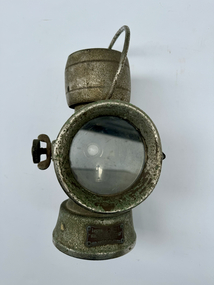
Functional object - Motor Cycle Lamp, Joseph Lucas Ltd, Birmingham, England, 1922
... industries. This item is retained as an example of motor cycle lighting that would have been used locally in the 1920s. motor cycle lamps Joseph Lucas Ltd vintage vehicle parts Lucas Chieftain 1922 This is a metal lamp with a round base, a cylindrical body and a rounded lighting mechanism enclosed in glass. ...This lamp was produced in 1922 as a lighting mechanism for a motor cycle. It is a Lucas lamp, with the trade name 'Chieftain'. The firm of Joseph Lucas Industries was established in 1860 in England, initially making scoops, buckets and plant holders. In 1875 it began making lamps for ships and after 1902 lamps and other components for motorised vehicles. Today, after merging with a North American company, it is a maker of components for both the automotive and the aerospace industries. This item is retained as an example of motor cycle lighting that would have been used locally in the 1920s.This is a metal lamp with a round base, a cylindrical body and a rounded lighting mechanism enclosed in glass. There is a screw lid on top of the oil container, a mechanism for attaching the lamp to the vehicle and two small round glass buttons on either side of the lighting area. The lamp has traces of silver colouring but is very rusty. There is an old card containing some handwriting attached to the lamp.Lucas Chieftain 1922motor cycle lamps, joseph lucas ltd, vintage vehicle parts -
 Kiewa Valley Historical Society
Relay Protection Instrument, Circa 1950's
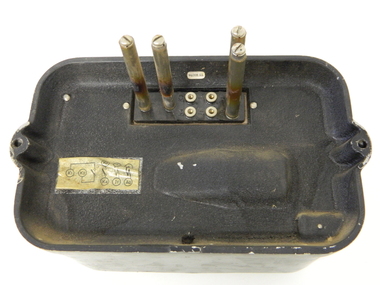
... This evolution in the valley created a change, not only in the "physical" landscape but also the socio-economic expansion which permitted other "tourist" based industries into the valley. kiewa hydro electricity scheme victorian state electricity commission relays generators On the top section of the front panel "ASEA" to the left "Made in Sweden" and to the right "Frabrique en Suede" below this "RIS" below this a graph and next to it two columns of numbers and a pointer for each set This protection relay unit has a black painted metal shell with four copper enclosed "prongs" fastened to the rear of the housing(from a bake-lite plate) . Between these "prongs" are four "empty" points allowing additional "screw on" bases. The front glass ...This protection relay apparatus (a large electrical fuse), which permits the easy monitoring and disconnection of faulty electrical apparatus connected to the large SEC Victoria Hydro Scheme's electrical power producing generators. These generators are powered by the hydro force of "stored" water at a higher altitude. The establishment of both the NSW and Victorian Hydro Schemes was achieved from the early 1900's to the 1960's. At this point in time the need for additional power sources to quench both an industrial and domestic demand for electricity was purely an economic and not and environmental (carbon reduction) factor. This hydro scheme was instigated by "the Government of the day" as a bold move and was the major force of the World War II refugee and "technical" workforce inclusion of skilled and unskilled migration into the Australian environment. Although this mass "invasion" of workers with families was thought of in some circles as intrusive, the expansion of population post war years and its integration into the Australian rural sector, produced the multi- lingual multi-cultural diversity of later years.This protection relay is very significant to the Kiewa Valley as its use was introduced during the Kiewa Hydro Scheme. Although only a small apparatus it was part of the explosion of human resources into the valley. This influx of population transformed the region from that of a basically quiet rural region to one which evolved into both an industrial and a larger residential community. This evolution in the valley created a change, not only in the "physical" landscape but also the socio-economic expansion which permitted other "tourist" based industries into the valley.This protection relay unit has a black painted metal shell with four copper enclosed "prongs" fastened to the rear of the housing(from a bake-lite plate) . Between these "prongs" are four "empty" points allowing additional "screw on" bases. The front glass enclosed meter and recorder allows for the identification and automatic disconnection of any faulty equipment connected to the main power generator. This equipment acts similarly to a modern day circuit breaker found on the electrical circuit boards of residential homes.On the top section of the front panel "ASEA" to the left "Made in Sweden" and to the right "Frabrique en Suede" below this "RIS" below this a graph and next to it two columns of numbers and a pointer for each setkiewa hydro electricity scheme, victorian state electricity commission, relays, generators -
Port Melbourne Historical & Preservation Society
Furniture - Display case from J Kitchen & Sons musuem, 1980s
... industry - manufacturing celebrations fetes and exhibitions business and traders - soaps/candles j kitchen & sons pty ltd Large glass and metal display case with front sliding glass doors, lockable. ...Large glass and metal display case with front sliding glass doors, lockable. From the Kitchen's museumindustry - manufacturing, celebrations fetes and exhibitions, business and traders - soaps/candles, j kitchen & sons pty ltd -
 Warrnambool and District Historical Society Inc.
Container - Bottle, Reeves Stopper bottle, 1950s
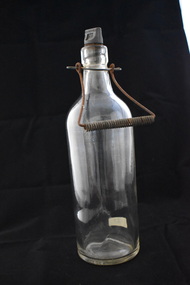
... industry in Warrnambool for over 100 years. Reeves Cordial Factory, Warrnambool Cordial Manufacturing in Warrnambool History of Warrnambool ‘R.V.Reeves R.V.R.’ (twice) This is a clear glass lemonade bottle with a round base, a rounded body and a smaller circular neck with a screw top stopper made of composite material. A metal ...This bottle comes from the Warrnambool aerated water factory of Reg Reeves. This factory, in Koroit Street, Warrnambool, was established in the 1860s as the Union Cordial Factory by John Davis and then bought by John Fletcher in 1885. Fletcher’s business continued until 1930 when it was bought by Ralph Reeves. Coming to Warrnambool about 1900, Ralph Reeves managed a Banyan Street, Warrnambool cordial factory which had been established by John Rowley. Ralph Reeves bought a business in 1916 at Hamilton and sold it in 1929 to concentrate on the Warrnambool business. Reeves was joined by his son Reg in Warrnambool and Reg operated the business from 1946 to 1972. The trade name of Reeves was still used after Reg Reeves died and continued on for some years. This bottle is of interest as an example of a lemonade bottle form Reeves Cordial Factory in Warrnambool. The Reeves family operated this business in Warrnambool for 40 years. Cordial manufacturing was an important industry in Warrnambool for over 100 years. This is a clear glass lemonade bottle with a round base, a rounded body and a smaller circular neck with a screw top stopper made of composite material. A metal handle is attached to the neck section and it has a coil of metal on the handle for easier handling. The stopper has the name of the manufacturer of the soft drink. ‘R.V.Reeves R.V.R.’ (twice)reeves cordial factory, warrnambool, cordial manufacturing in warrnambool, history of warrnambool -
 Warrnambool and District Historical Society Inc.
Soda Syphon, Fletcher, c 1930 (contents of syphon)
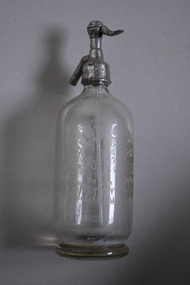
... industry in Warrnambool for over 100 years. cordial manufacturing in warrnambool fletcher history of warrnambool ‘J. Fletcher Trade Mark Warrnambool’ ‘J. Fletcher’ ‘British Syphon Mfg Co. Ltd London’ This is a clear glass soda syphon with a round sold base and a rounded body and a metal ...This soda syphon is a device for dispensing carbonated or soda water. The valve allows portion of the contents to be dispensed whilst maintaining the pressure inside to keep the rest of the contents from going flat. The bottle is marked ‘J. Fletcher’. John Fletcher worked as a boy at Rowley’s cordial factory in Banyan Street, Warrnambool. He then worked for John Davis who had established the Union Cordial Factory in Koroit Street, Warrnambool in the 1860s. In 1885 John Fletcher bought the Davis business and operated it until 1930. John Fletcher sold the business to Ralph Reeves and as Reeves initially used Fletcher bottles and syphons, the contents of the bottle could have come from the time of either John Fletcher or Ralph Reeves. This syphon is of interest as it comes from a mid 20th century cordial factory in Warrnambool. Cordial manufacturing was an important industry in Warrnambool for over 100 years. This is a clear glass soda syphon with a round sold base and a rounded body and a metal pump and valve mechanism affixed to the top opening. A glass tube is inside the bottle and is part of the pump mechanism. The top metal section is very corroded. The side of the bottle has the Fletcher trademark - the stylized letters J and F. ‘J. Fletcher Trade Mark Warrnambool’ ‘J. Fletcher’ ‘British Syphon Mfg Co. Ltd London’ cordial manufacturing in warrnambool, fletcher, history of warrnambool -
 Warrnambool and District Historical Society Inc.
Soda Sypon, John Fletcher/Ralph Reeves, J. F. Fletcher, Mid 20th century (contents of bottles)
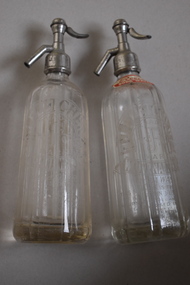
... industry in Warrnambool for over100 years. Cordial Manufacturing in Warrnambool history of warrnambool ‘J. Fletcher’ “J. Fletcher Trade Mark Warrnambool’ ‘Soda Water’ ‘This syphon is the property of John Fletcher Warrnambool and cannot be legally used by others’ ‘British Syphon Co. Ltd. London Reg. No 762’. ‘Reeves Soda Water’ (one bottle only) These are two soda syphons made of glass with heavy round bases and ridged surfaces on the bottle bodies. The metal ...These two soda syphons were used to dispense soda water. They are marked ‘J. Fletcher’ with one of the bottles having the extra label of ‘Reeves’. The bottles come from the cordial factory in Koroit Street, Warrnambool. John Fletcher worked as a young boy in Rowley’s cordial factory in Banyan Street, Warrnambool and then worked for John Davis who had established the Union Cordial Factory in Koroit Street in the 1860s. John Fletcher bought the Davis business in 1885 and operated this factory until 1930. He then sold to Ralph Reeves who initially used the Fletcher bottles and syphons. At least one of these syphons comes from the Koroit Street factory during the proprietorship of Ralph Reeves.These soda syphons are of interest as they come from a local Warrnambool cordial factory in Koroit Street. Cordial manufacturing was an important industry in Warrnambool for over100 years. These are two soda syphons made of glass with heavy round bases and ridged surfaces on the bottle bodies. The metal tops contain the pump and valve mechanisms and the inside of the bottles have glass tubes attached to the top mechanisms. The sides of the bottle have the Fletcher trade mark symbol of the stylized letters J and F, Both metal tops are corroded. Both bottles contain a small amount of liquid.‘J. Fletcher’ “J. Fletcher Trade Mark Warrnambool’ ‘Soda Water’ ‘This syphon is the property of John Fletcher Warrnambool and cannot be legally used by others’ ‘British Syphon Co. Ltd. London Reg. No 762’. ‘Reeves Soda Water’ (one bottle only) cordial manufacturing in warrnambool, history of warrnambool -
 Warrnambool and District Historical Society Inc.
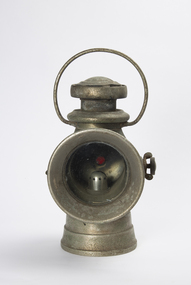
Functional object - Portable lamp, Lucas Industries, c 1900
... Industries LUCAS No. 722 KING OF THE ROAD JOS. LUCAS LTD. This is a brass lantern with a circular glass piece in the middle front, and a top metal mechanism with a handle. ...This portable lamp was manufactured by the Lucas Industries, a company in Birmingham, England that first produced lamps after 1875. It could have domestic use or be attached to cars or bicycles early in the 20th Century to provide light at night. The lighting fluid was oil. This object is an interesting example of lighting for cars and bicycles and in the home in the late 19th and early 20th Centuries.This is a brass lantern with a circular glass piece in the middle front, and a top metal mechanism with a handle. Inside the circular opening is a domed jet with holes for lighting the lamp. On the sides there are various mechanisms for turning the light up and down, opening the front glass and opening the bottom to allow filling of the lighting fluid. The item is corroded on the exterior. The top has air vents to permit the vapours to escape. On the side is the maker's name LUCAS No. 722 KING OF THE ROAD JOS. LUCAS LTD. vintage lighting, lucas industries -
 National Wool Museum
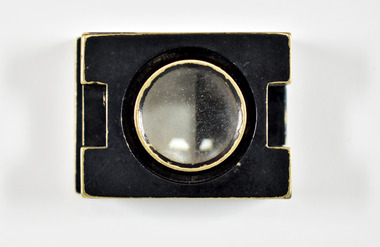
Functional object - Magnifying Lens, c.1930s
... These men from Flanders enjoyed a cosmopolitan society augmented by diplomats, European bankers and shipping-line executives for various countries and a handful of scientists and academics. wool buyer magnifying glass magnifying lens burrs René Dupuche John Dupuche migrants Masurel Fils French Belgian Flanders working life sheep industry wool industry agriculture Small black metal magnifying lens with three fold design and two hinges. ...This item was inherited from the donor's father, René Dupuche. John Dupuche, writes: This magnifying glass was used to remove the burrs and thorns that wool-buyers tended to get in their fingers when examining bales of wool. The open end was placed on the finger since the thorn was sometimes buried under the skin. The buyer looked through the magnifying glass and with tweezers or a pin removed the thorn which had rendered the finger inoperative. The wool-buyers needed the sensitivity of their fingers to appraise the suitability of the wool, as buyers had for centuries past, measuring the length of the staple, feeling and counting the crimps in the fibre, its finesse, softness, elasticity and strength, assessing the colour, watching for extraneous matter such as dust or seeds which would not be welcome by manufacturers half-way across the world. Their skills took years to acquire. Knowledgeable buyers were invaluable to their employers, since they were able to evaluate to the last percentage the yield of a bale. My father, René Dupuche, was the ‘principal buyer’ from 1927-1966 in Victoria, South Australia and Tasmania for the international wool company ‘Masurel Fils’ which was one of the largest wool businesses in Europe. It was based in the north of France, in Tourcoing, one of the major wool centres of the world. He was sent to Australia as a young man at the age of 23 and took part in the ‘golden era’ of wool in Australia, and the eventual replacement of hands-on appraisal by ‘core-testing’. Masurel Fils was one of the dozens of French and Belgian firms operating in Australia. These men from Flanders enjoyed a cosmopolitan society augmented by diplomats, European bankers and shipping-line executives for various countries and a handful of scientists and academics.Small black metal magnifying lens with three fold design and two hinges. One panel contains a circular glass lens, the centre panel has a circular hole, and the third panel has a square hole with three lines on each side.wool buyer, magnifying glass, magnifying lens, burrs, rené dupuche, john dupuche, migrants, masurel fils, french, belgian, flanders, working life, sheep industry, wool industry, agriculture -
 Williamstown Historical Society Inc
Souvenir - Glasses, drinking
... glass is a souvenir from the 'All Australian Exhibition' held at the Royal Exhibition Building in Melbourne, from Spetember to November 1913. The exhibition featured only Australian made products, including food and drinks and household items, as well as metal and leatherwork. It aimed to highlight the quality and range of the Australian manufacturing industry...glass is a souvenir from the 'All Australian Exhibition' held at the Royal Exhibition Building in Melbourne, from Spetember to November 1913. The exhibition featured only Australian made products, including food and drinks and household items, as well as metal and leatherwork. It aimed to highlight the quality and range of the Australian manufacturing industry ...This drinking glass is a souvenir from the 'All Australian Exhibition' held at the Royal Exhibition Building in Melbourne, from Spetember to November 1913. The exhibition featured only Australian made products, including food and drinks and household items, as well as metal and leatherwork. It aimed to highlight the quality and range of the Australian manufacturing industry on both a small and large scale.Souvenir pressed glass drinking glass, with a rising sun design and ruby coloured highlights.Engraved on rim: "All Australian Exhibition 1913" On opposite side the initials : "J.G." -
 Ballarat Tramway Museum
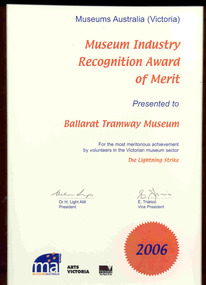
Certificate - Framed Certificate, Museums Australia, "Museum Industry Award of Merit", May. 2006
... Framed Certificate, black frame, glass front, fibre board back and swing out stand with metal clips, titled "Museum Industry Award of Merit", awarded to the BTM as part of the 2006 MIRA Awards on 25-5-2006. ...Industry Recognition Award, by Museums Australia for its achievements in replacing the sub-station and fundraising. The Certificate of the award. Trams tramways BTM Substation Awards Museums Australia Framed Certificate, black frame, glass front, fibre board back and swing out stand with metal clips, titled "Museum Industry Award of Merit", awarded to the BTM as part of the 2006 MIRA Awards on 25-5-2006. ...Significant for the BTM in winning a Museum Industry Recognition Award, by Museums Australia for its achievements in replacing the sub-station and fundraising. The Certificate of the award.Framed Certificate, black frame, glass front, fibre board back and swing out stand with metal clips, titled "Museum Industry Award of Merit", awarded to the BTM as part of the 2006 MIRA Awards on 25-5-2006. Sub titled "The Lightning Strike". Award presented by Museums Australia, Vic Div. Has logos for Museums Australia, Arts Victoria, Vic. Govt. Logo. Signed by Dr. Helen Light as President and Elizabeth Triarico as Vice President. Refer to June 2006 issue of Fares Please! for ceremony photographs.trams, tramways, btm, substation, awards, museums australia -
Inglewood & District Historical Society
Functional object - Lamp - Kerosene, TABLE LAMP, Circa 1930
... Metal spinning. Manufactured in USA by Aladdin Industries. Table Lamp. Kerosene.Brass Nickel plated Base and Bowl. Tall Glass ...Used by the Wodetzki family (Mrs A.) of Bridgewater for household lighting - circa 1930 to 1950Table Lamp. Kerosene.Brass Nickel plated Base and Bowl. Tall Glass Aladdin Chimney. Glass shade - clear glass bottom with milk glass top.Moulded base, blown shade. Metal spinning. Manufactured in USA by Aladdin Industries. lamp, wodetzki -
 Mont De Lancey
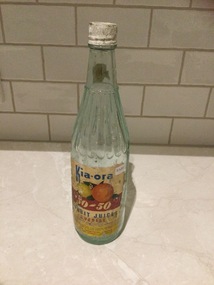
Container - Glass bottle
... Kia-ora Industries Limited, Melbourne - Sydney - Australia". Pale green glass bottle with white, metal, screw-on lid. ...Pale green glass bottle with white, metal, screw-on lid. It has a beige-coloured label with red and blue writing, and a picture of an orange and a lemon, green leaves and one white flower.On the label: "Kia-ora 50 - 50 Fruit Juice Cordial, made from oranges and lemons. 26 FL. OZ NET. Preservatives: This food contains not more than 2 grains of sulphur dioxide to the pint. Kia-ora Industries Limited, Melbourne - Sydney - Australia".containers, bottles -
Linton and District Historical Society Inc
Functional object - Clock, Smiths Industries, Wall clock from Linton Post Office, [1940s?]
... glass panel. Clock is not in working order. Mechanism behind clock face inside casing, encased in metal cover. Small knob at bottom for adjusting time. Wall clock from Linton Post Office Functional object Clock Smiths Industries ...This clock was used in the Linton Post Office until it closed in 2014. It is not known when the clock was installed, presumably after 1939, when electricity came to Linton. The Post Office was purpose built in 1880. Miss Georgina Montgomery was the first postmistress.Large, round, electric wall clock with bakelite casing and white dial, Arabic numerals, protective glass panel. Clock is not in working order. Mechanism behind clock face inside casing, encased in metal cover. Small knob at bottom for adjusting time."SMITHS / SECTRIC" on dial beneath the number 12. "MADE IN ENGLAND" in small letters beneath the number 6.wall clocks, linton post office -
 Federation University Historical Collection
Book, The MIneral Industry its Statistics, Technology and Trade during 1919 and 1920 and 1927 and 1928
... metal industry...minerals...united states...canada...china...france...germany...italy...japan...russia...south america...spain...sweden...united kingdom...ireland...coins...Cuba...blast furnaces...Gold...Lead production...Manganese...opals...silver...+...alumite...antinomy...cobalt...coke...copper ore...iron...lead...limestone flux...managanese...shale...silver-lead...tin...zinc...abrasives...chemical industry...gems...precious stones...dividends...akalies...salt...earthernware...glass...Used at the Ballarat School of Mines Mining statistics technology trades metal industry minerals united states canada china france germany italy japan russia south america spain sweden united kingdom ireland coins Cuba blast furnaces Gold Lead production Manganese opals silver + alumite antinomy cobalt coke copper ore iron lead limestone flux managanese shale silver-lead tin zinc abrasives chemical industry gems precious stones dividends akalies salt earthernware glass petroleum aluminium bismuth tungsten This volume includes Australasia, and lists each state seperately , as well as New Zealand, It also lists Bismoth, Chome iron ore, coal, copper, gold, lead, mineral industry growth, alumite, antinomy, cobalt, coke, copper ore, gold, iron, lead, limestone flux, managanese, shale, silver, silver-lead, tin and zinc Red hard cloth covered book of 900 pages. ...This volume includes Australasia, and lists each state seperately , as well as New Zealand, It also lists Bismoth, Chome iron ore, coal, copper, gold, lead, mineral industry growth, alumite, antinomy, cobalt, coke, copper ore, gold, iron, lead, limestone flux, managanese, shale, silver, silver-lead, tin and zincRed hard cloth covered book of 900 pages. Includes contents and index.non-fictionThis volume includes Australasia, and lists each state seperately , as well as New Zealand, It also lists Bismoth, Chome iron ore, coal, copper, gold, lead, mineral industry growth, alumite, antinomy, cobalt, coke, copper ore, gold, iron, lead, limestone flux, managanese, shale, silver, silver-lead, tin and zinc mining, statistics, technology, trades, metal industry, minerals, united states, canada, china, france, germany, italy, japan, russia, south america, spain, sweden, united kingdom, ireland, coins, cuba, blast furnaces, gold, lead production, manganese, opals, silver, +, alumite, antinomy, cobalt, coke, copper ore, iron, lead, limestone flux, managanese, shale, silver-lead, tin, zinc, abrasives, chemical industry, gems, precious stones, dividends, akalies, salt, earthernware, glass, petroleum, aluminium, bismuth, tungsten -
 Federation University Historical Collection
Book, The Mineral Industry its Statistics, Technology and Trade during 1929
... metal industry...minerals...united states...canada...china...france...germany...italy...japan...russia...south america...spain...sweden...united kingdom...ireland...coins...Cuba...blast furnaces...Gold...Lead production...Manganese...opals...silver...+...alumite...antinomy...cobalt...coke...copper ore...iron...lead...limestone flux...managanese...shale...silver-lead...tin...zinc...abrasives...chemical industry...gems...precious stones...dividends...akalies...salt...earthernware...glass...Used at the Ballarat School of Mines Mining statistics technology trades metal industry minerals united states canada china france germany italy japan russia south america spain sweden united kingdom ireland coins Cuba blast furnaces Gold Lead production Manganese opals silver + alumite antinomy cobalt coke copper ore iron lead limestone flux managanese shale silver-lead tin zinc abrasives chemical industry gems precious stones dividends akalies salt earthernware glass petroleum aluminium bismuth tungsten This volume includes Australasia, and lists each state seperately , as well as New Zealand, It also lists Bismoth, Chome iron ore, coal, copper, gold, lead, mineral industry growth, alumite, antinomy, cobalt, coke, copper ore, gold, iron, lead, limestone flux, managanese, shale, silver, silver-lead, tin and zinc Red hard cloth covered book of 845 pages. ...This volume includes Australasia, and lists each state seperately , as well as New Zealand, It also lists Bismoth, Chome iron ore, coal, copper, gold, lead, mineral industry growth, alumite, antinomy, cobalt, coke, copper ore, gold, iron, lead, limestone flux, managanese, shale, silver, silver-lead, tin and zincRed hard cloth covered book of 845 pages. Includes contents and index.non-fictionThis volume includes Australasia, and lists each state seperately , as well as New Zealand, It also lists Bismoth, Chome iron ore, coal, copper, gold, lead, mineral industry growth, alumite, antinomy, cobalt, coke, copper ore, gold, iron, lead, limestone flux, managanese, shale, silver, silver-lead, tin and zinc mining, statistics, technology, trades, metal industry, minerals, united states, canada, china, france, germany, italy, japan, russia, south america, spain, sweden, united kingdom, ireland, coins, cuba, blast furnaces, gold, lead production, manganese, opals, silver, +, alumite, antinomy, cobalt, coke, copper ore, iron, lead, limestone flux, managanese, shale, silver-lead, tin, zinc, abrasives, chemical industry, gems, precious stones, dividends, akalies, salt, earthernware, glass, petroleum, aluminium, bismuth, tungsten -
 Federation University Historical Collection
Book, The Mineral Industry Its Statistics, Technology and Trade during 1926
... metal industry...minerals...united states...canada...china...france...germany...italy...japan...russia...south america...spain...sweden...united kingdom...ireland...coins...Cuba...blast furnaces...Gold...Lead production...Manganese...opals...silver...+...alumite...antinomy...cobalt...coke...copper ore...iron...lead...limestone flux...managanese...shale...silver-lead...tin...zinc...abrasives...chemical industry...gems...precious stones...dividends...akalies...salt...earthernware...glass...Used at the Ballarat School of Mines Mining statistics technology trades metal industry minerals united states canada china france germany italy japan russia south america spain sweden united kingdom ireland coins Cuba blast furnaces Gold Lead production Manganese opals silver + alumite antinomy cobalt coke copper ore iron lead limestone flux managanese shale silver-lead tin zinc abrasives chemical industry gems precious stones dividends akalies salt earthernware glass petroleum aluminium bismuth tungsten This volume includes Australasia, and lists each state seperately , as well as New Zealand, It also lists Bismoth, Chome iron ore, coal, copper, gold, lead, mineral industry growth, alumite, antinomy, cobalt, coke, copper ore, gold, iron, lead, limestone flux, managanese, shale, silver, silver-lead, tin and zinc Red hard cloth covered book of 878 pages. ...This volume includes Australasia, and lists each state seperately , as well as New Zealand, It also lists Bismoth, Chome iron ore, coal, copper, gold, lead, mineral industry growth, alumite, antinomy, cobalt, coke, copper ore, gold, iron, lead, limestone flux, managanese, shale, silver, silver-lead, tin and zincRed hard cloth covered book of 878 pages. Includes contents and index.non-fictionThis volume includes Australasia, and lists each state seperately , as well as New Zealand, It also lists Bismoth, Chome iron ore, coal, copper, gold, lead, mineral industry growth, alumite, antinomy, cobalt, coke, copper ore, gold, iron, lead, limestone flux, managanese, shale, silver, silver-lead, tin and zinc mining, statistics, technology, trades, metal industry, minerals, united states, canada, china, france, germany, italy, japan, russia, south america, spain, sweden, united kingdom, ireland, coins, cuba, blast furnaces, gold, lead production, manganese, opals, silver, +, alumite, antinomy, cobalt, coke, copper ore, iron, lead, limestone flux, managanese, shale, silver-lead, tin, zinc, abrasives, chemical industry, gems, precious stones, dividends, akalies, salt, earthernware, glass, petroleum, aluminium, bismuth, tungsten -
 Federation University Historical Collection
Book, The Mineral Industry its Statistics, Technology and Trade during 1917
... metal industry...minerals...united states...canada...china...france...germany...italy...japan...russia...south america...spain...sweden...united kingdom...ireland...coins...Cuba...blast furnaces...Gold...Lead production...Manganese...opals...silver...+...alumite...antinomy...cobalt...coke...copper ore...iron...lead...limestone flux...managanese...shale...silver-lead...tin...zinc...abrasives...chemical industry...gems...precious stones...dividends...akalies...salt...earthernware...glass...Used at the Ballarat School of Mines Mining statistics technology trades metal industry minerals united states canada china france germany italy japan russia south america spain sweden united kingdom ireland coins Cuba blast furnaces Gold Lead production Manganese opals silver + alumite antinomy cobalt coke copper ore iron lead limestone flux managanese shale silver-lead tin zinc abrasives chemical industry gems precious stones dividends akalies salt earthernware glass petroleum This volume includes Australasia, and lists each state seperately , as well as New Zealand, It also lists Bismoth, Chome iron ore, coal, copper, gold, lead, mineral industry growth, alumite, antinomy, cobalt, coke, copper ore, gold, iron, lead, limestone flux, managanese, shale, silver, silver-lead, tin and zinc Red hard cloth covered book of 928 pages. ...This volume includes Australasia, and lists each state seperately , as well as New Zealand, It also lists Bismoth, Chome iron ore, coal, copper, gold, lead, mineral industry growth, alumite, antinomy, cobalt, coke, copper ore, gold, iron, lead, limestone flux, managanese, shale, silver, silver-lead, tin and zincRed hard cloth covered book of 928 pages. Includes contents and index.non-fictionThis volume includes Australasia, and lists each state seperately , as well as New Zealand, It also lists Bismoth, Chome iron ore, coal, copper, gold, lead, mineral industry growth, alumite, antinomy, cobalt, coke, copper ore, gold, iron, lead, limestone flux, managanese, shale, silver, silver-lead, tin and zinc mining, statistics, technology, trades, metal industry, minerals, united states, canada, china, france, germany, italy, japan, russia, south america, spain, sweden, united kingdom, ireland, coins, cuba, blast furnaces, gold, lead production, manganese, opals, silver, +, alumite, antinomy, cobalt, coke, copper ore, iron, lead, limestone flux, managanese, shale, silver-lead, tin, zinc, abrasives, chemical industry, gems, precious stones, dividends, akalies, salt, earthernware, glass, petroleum -
Federation University Historical Collection
Book, The Mineral Industry its Statistics, Technology and Trade during 1918
... metal industry...minerals...united states...canada...china...france...germany...italy...japan...russia...south america...spain...sweden...united kingdom...ireland...coins...Cuba...blast furnaces...Gold...Lead production...Manganese...opals...silver...+...alumite...antinomy...cobalt...coke...copper ore...iron...lead...limestone flux...managanese...shale...silver-lead...tin...zinc...abrasives...chemical industry...gems...precious stones...dividends...akalies...salt...earthernware...glass...Used at the Ballarat School of Mines Mining statistics technology trades metal industry minerals united states canada china france germany italy japan russia south america spain sweden united kingdom ireland coins Cuba blast furnaces Gold Lead production Manganese opals silver + alumite antinomy cobalt coke copper ore iron lead limestone flux managanese shale silver-lead tin zinc abrasives chemical industry gems precious stones dividends akalies salt earthernware glass petroleum aluminium bismuth tungsten This volume includes Australasia, and lists each state seperately , as well as New Zealand, It also lists Bismoth, Chome iron ore, coal, copper, gold, lead, mineral industry growth, alumite, antinomy, cobalt, coke, copper ore, gold, iron, lead, limestone flux, managanese, shale, silver, silver-lead, tin and zinc Red hard cloth covered book of 937 pages. ...This volume includes Australasia, and lists each state seperately , as well as New Zealand, It also lists Bismoth, Chome iron ore, coal, copper, gold, lead, mineral industry growth, alumite, antinomy, cobalt, coke, copper ore, gold, iron, lead, limestone flux, managanese, shale, silver, silver-lead, tin and zincRed hard cloth covered book of 937 pages. Includes contents and index.non-fictionThis volume includes Australasia, and lists each state seperately , as well as New Zealand, It also lists Bismoth, Chome iron ore, coal, copper, gold, lead, mineral industry growth, alumite, antinomy, cobalt, coke, copper ore, gold, iron, lead, limestone flux, managanese, shale, silver, silver-lead, tin and zinc mining, statistics, technology, trades, metal industry, minerals, united states, canada, china, france, germany, italy, japan, russia, south america, spain, sweden, united kingdom, ireland, coins, cuba, blast furnaces, gold, lead production, manganese, opals, silver, +, alumite, antinomy, cobalt, coke, copper ore, iron, lead, limestone flux, managanese, shale, silver-lead, tin, zinc, abrasives, chemical industry, gems, precious stones, dividends, akalies, salt, earthernware, glass, petroleum, aluminium, bismuth, tungsten
