
Showing 36 items matching "gold pouch"
-
 Flagstaff Hill Maritime Museum and Village
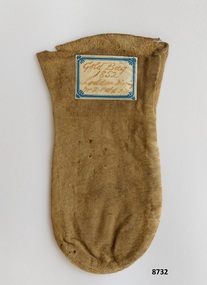
Functional object - Gold pouch, circa 1852
... Gold pouch......gold pouch...This is a small leather gold bag or pouch with a handwritten label identifying it as once used by a miner during the Victorian gold rush to hold gold dust or nuggets. ...Functional object Gold pouch ...This is a small leather gold bag or pouch with a handwritten label identifying it as once used by a miner during the Victorian gold rush to hold gold dust or nuggets. It identifies the "Loddon Diggings" which was a rich alluvial goldfield along the Loddon River and its tributaries in Victoria, Australia, which saw a massive influx of prospectors starting in late 1851.This item is from the 1850's goldrush - a significance time in Victoria's history.An elongated vase shaped, kid skin, pouch with handwritten labels on both sides (a rectangular label on the front and an oval label with square corners on the back) and a curved bottom edge. It has a sewn edge along one side and along the bottom edge. The top of the back edge is slightly higher than the front edge.Front - "Gold bag / 1852 / Loddon Digging / Mr D Pats 2/90?" Back - "Gold Bag/ Loddon / 1853"flagstaff hill maritime museum and village, warrnambool, great ocean road, shipwreck coast, gold pouch, gold, loddon goldfields, gold rush -
 Eltham District Historical Society Inc
Medallion, Shire of Eltham et al, Medallion and pouch, In Commemoration, The Shire of Elham, 1871-1994, 1994
... Bronze coloured medallion approx 4 cm diameter in a clear plastic sleeve and green felt pouch with gold coloured tie Two copies...Parts of the Shire were redistributed to Banyule Shire and a new Nillumbik Shire was formed which took in Eltham township. shire of eltham medallion Bronze coloured medallion approx 4 cm diameter in a clear plastic sleeve and green felt pouch with gold coloured tie Two copies Medallion and pouch, In Commemoration, The Shire of Elham, 1871-1994 Medallion Shire of Eltham Nillumbik Shire Council ...This medallion was struck to commemorate the Shire of Eltham, 1871 to 1994; issued upon cessation of the Shire of Eltham as a local government body following the widespread dismissal of councils throughout Melbourne by the Kennett Liberal Government. Parts of the Shire were redistributed to Banyule Shire and a new Nillumbik Shire was formed which took in Eltham township.Bronze coloured medallion approx 4 cm diameter in a clear plastic sleeve and green felt pouch with gold coloured tie Two copiesshire of eltham, medallion -
 Ballarat RSL Sub-Branch Inc.
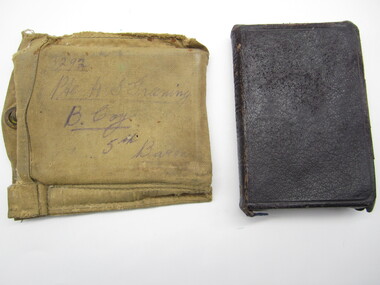
New Testament (in pouch)
... Pocket New Testament with navy ribbon bookmark attached to top of spine, pages edged in gold, in canvas pouch with metal press stud. Interior inscriptions include lists of places where Private Greening traveled on service as well as a personal message. ...Pouch - "3292 Pte H S Greening. B Coy 5th Battn" Testament - Front & back - List of towns/cities & dates; Names, service numbers & addresses Inscription - "To my dearest brother Charlie, as a loving keepsake from Nellie. Knowing that whenever you look at it you will think of those who love you and who will always be thinking of you. God grant you good health and a safe return. Your loving sister, Nellie" Pocket New Testament with navy ribbon bookmark attached to top of spine, pages edged in gold ...This object relates to Herbert Swain Greening. He was born on 1/01/1891 in Ballarat, Victoria. Herbert Swain served in the AIF (3292) enlisting on 13/07/1915 in Ballarat, Victoria before being discharged from duties with the 5 Battalion as a Army Non-Commissioned Private on 15/02/1918, being determined medically unfit for service. Herbert Swain sustained a gunshot wound to his wrist during service. Herbert Swain Greening's next of kin is Mrs. M. Greening - Mother. Herbert Greening was awarded the 1914-1915 Star, British War Medal, Victory Medal.Pocket New Testament with navy ribbon bookmark attached to top of spine, pages edged in gold, in canvas pouch with metal press stud. Interior inscriptions include lists of places where Private Greening traveled on service as well as a personal message. Pouch - "3292 Pte H S Greening. B Coy 5th Battn" Testament - Front & back - List of towns/cities & dates; Names, service numbers & addresses Inscription - "To my dearest brother Charlie, as a loving keepsake from Nellie. Knowing that whenever you look at it you will think of those who love you and who will always be thinking of you. God grant you good health and a safe return. Your loving sister, Nellie"first world war, world war one, the great war, 1914 - 1918, literature, ballarat rsl, ballarat -
 Bendigo Military Museum
Accessory - WALLET & PHOTOGRAPH
... .1) Leatherette wallet, blue, containing 6 pouches. 4 pouches labelled with gold lettering. One pouch contains a small photo of a lady holding a bunch of flowers. ...Wallets Photos RAAF Embossed in gold, front, bottom right corner: RAAF wings & initials F.G.D. .1) Leatherette wallet, blue, containing 6 pouches. 4 pouches labelled with gold lettering. ...Wallet owned by Item re Frederick Gardner DAVEY containing a amall photo of his wife. Item re Frederick Gardner DAVEY DFC No 410533 RAAF. Refer Reg No 3536P for his service details..1) Leatherette wallet, blue, containing 6 pouches. 4 pouches labelled with gold lettering. One pouch contains a small photo of a lady holding a bunch of flowers. Wallet is lined with blue cloth. Cover is embossed with RAAF wings & the initials of the owner. .2) Small photo of a lady holding a bunch of flowers. Embossed in gold, front, bottom right corner: RAAF wings & initials F.G.D.wallets, photos, raaf -
 Flagstaff Hill Maritime Museum and Village
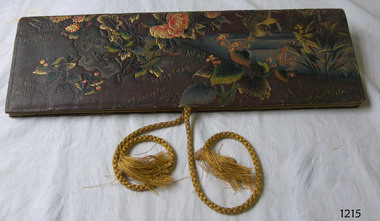
Stationery holder
... Outside is textured and has gold, green and red painted design on brown. Pouch is tied together with gold cord and tassel...Outside is textured and has gold, green and red painted design on brown. Pouch is tied together with gold cord and tassel Stationery holder ...Stationery holder, rectangular floral fabric decorative holder with satin sleeves inside. Opens like a book. Outside is textured and has gold, green and red painted design on brown. Pouch is tied together with gold cord and tasselflagstaff hill, warrnambool, shipwrecked-coast, flagstaff-hill, flagstaff-hill-maritime-museum, maritime-museum, shipwreck-coast, flagstaff-hill-maritime-village -
 Upper Yarra Museum
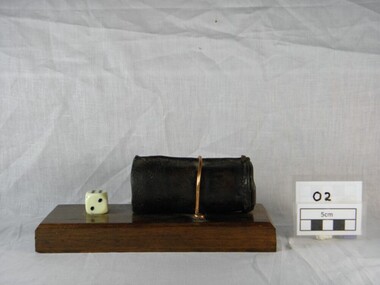
Gaming Accessory, Untitled, 1890 (estimated)
... Gold Field circa 1890 app. Donated by Susan Issacs. Leather Dice Holder and Dice mounted on wooden base, leather dice holder is original. dice and wooden base is a mock up.(there is a small hole in the leather pouch ...This Dice holder from the Woods Point goldfields would have been used to while away the time in the evenings, and the odd moments of time off during the day, children may have had use of it also, but would have had to be very careful not to lose the dice , because they would have been in big, big trouble. if the dice was lost !This item is of some significance because of its rareity and oral history passed on with the Item.Leather Dice Holder and Dice mounted on wooden base, leather dice holder is original. dice and wooden base is a mock up.(there is a small hole in the leather pouch 1.5cm from the bottom 2.5cm from the base, the hole is .2cm in size )W F Pickersgill Warburton 1960, Woods Point Gold Field circa 1890 app. Donated by Susan Issacs.recreation, leather, dice, dice holder, game, woods point, w f, pickersgill, mrs isaacs, mrs susan isaacs, yarra junction, gold field, game accessory gambling -
 Flagstaff Hill Maritime Museum and Village
Container - Surgical Instrument Case, mid 20th century
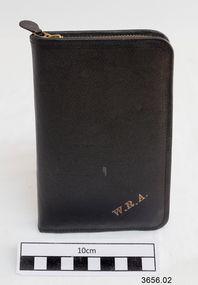
... pouch with metal zipper closure, part of the W.R. Angus Collection. Inside is a removable white fabric insert with loops for storing surgical instruments, attached with press studs. Initials are embossed on the case in gold...Dr Angus assisted Dr Tom Ryan, a pioneer in the use of X-rays and in ocular surgery. flagstaff hill warrnambool shipwrecked coast flagstaff hill maritime museum maritime museum shipwreck coast flagstaff hill maritime village great ocean road dr w r angus dr ryan surgical instrument t.s.s. largs bay warrnambool base hospital nhill base hospital mira hospital flying doctor medical treatment surgical instrument case surgical kit portable surgical instruments medical carry case medical instruments and accessories Gold print initials across corner on outside of case "W.R.A.". Maker's stamp on internal clot (Illegible). Surgical instrument case, black leather pouch with metal zipper closure, part of the W.R. ...This surgical instrument case belonged to Dr. W.R. Angus, who had many portable medical and surgical sets in his possession. The case was donated to Flagstaff Hill Maritime Village by the family of Doctor William Roy Angus, Surgeon and Oculist. It is part of the “W.R. Angus Collection” that includes historical medical equipment, surgical instruments and material once belonging to Dr Edward Ryan and Dr Thomas Francis Ryan, (both of Nhill, Victoria) as well as Dr Angus’ own belongings. The Collection’s history spans the medical practices of the two Doctors Ryan, from 1885-1926 plus that of Dr Angus, up until 1969. ABOUT THE “W.R.ANGUS COLLECTION” Doctor William Roy Angus M.B., B.S., Adel., 1923, F.R.C.S. Edin.,1928 (also known as Dr Roy Angus) was born in Murrumbeena, Victoria in 1901 and lived until 1970. He qualified as a doctor in 1923 at University of Adelaide, was Resident Medical Officer at the Royal Adelaide Hospital in 1924 and for a period was house surgeon to Sir (then Mr.) Henry Simpson Newland. Dr Angus was briefly an Assistant to Dr Riddell of Kapunda, then commenced private practice at Curramulka, Yorke Peninsula, SA, where he was physician, surgeon and chemist. In 1926, he was appointed as new Medical Assistant to Dr Thomas Francis Ryan (T.F. Ryan, or Tom), in Nhill, Victoria, where his experiences included radiology and pharmacy. In 1927 he was Acting House Surgeon in Dr Tom Ryan’s absence. Dr Angus had become engaged to Gladys Forsyth and they decided he would take time to further his studies overseas in the UK in 1927. He studied at London University College Hospital and at Edinburgh Royal Infirmary and in 1928, was awarded FRCS (Fellow from the Royal College of Surgeons), Edinburgh. He worked his passage back to Australia as a Ship’s Surgeon on the on the Australian Commonwealth Line’s T.S.S. Largs Bay. Dr Angus married Gladys in 1929, in Ballarat. (They went on to have one son (Graham 1932, born in SA) and two daughters (Helen (died 12/07/1996) and Berenice (Berry), both born at Mira, Nhill ) Dr Angus was a ‘flying doctor’ for the A.I.M. (Australian Inland Ministry) Aerial Medical Service in 1928 . The organisation began in South Australia through the Presbyterian Church in that year, with its first station being in the remote town of Oodnadatta, where Dr Angus was stationed. He was locum tenens there on North-South Railway at 21 Mile Camp. He took up this ‘flying doctor’ position in response to a call from Dr John Flynn; the organisation was later known as the Flying Doctor Service, then the Royal Flying Doctor Service. A lot of his work during this time involved dental surgery also. Between 1928-1932 he was surgeon at the Curramulka Hospital, Yorke Peninsula, South Australia. In 1933 Dr Angus returned to Nhill where he’d previously worked as Medical Assistant and purchased a share of the Nelson Street practice and Mira hospital from Dr Les Middleton one of the Middleton Brothers, the current owners of what was once Dr Tom Ryan’s practice. Dr L Middleton was House Surgeon to the Nhill Hospital 1926-1933, when he resigned. [Dr Tom Ryan’s practice had originally belonged to his older brother Dr Edward Ryan, who came to Nhill in 1885. Dr Edward saw patients at his rooms, firstly in Victoria Street and in 1886 in Nelson Street, until 1901. The Nelson Street practice also had a 2 bed ward, called Mira Private Hospital ). Dr Edward Ryan was House Surgeon at the Nhill Hospital 1884-1902 . He also had occasions where he successfully performed veterinary surgery for the local farmers too. Dr Tom Ryan then purchased the practice from his brother in 1901. Both Dr Edward and Dr Tom Ryan work as surgeons included eye surgery. Dr Tom Ryan performed many of his operations in the Mira private hospital on his premises. He too was House Surgeon at the Nhill Hospital 1902-1926. Dr Tom Ryan had one of the only two pieces of radiology equipment in Victoria during his practicing years – The Royal Melbourne Hospital had the other one. Over the years Dr Tom Ryan gradually set up what was effectively a training school for country general-practitioner-surgeons. Each patient was carefully examined, including using the X-ray machine, and any surgery was discussed and planned with Dr Ryan’s assistants several days in advance. Dr Angus gained experience in using the X-ray machine there during his time as assistant to Dr Ryan. Dr Tom Ryan moved from Nhill in 1926. He became a Fellow of the Royal Australasian College of Surgeons in 1927, soon after its formation, a rare accolade for a doctor outside any of the major cities. He remained a bachelor and died suddenly on 7th Dec 1955, aged 91, at his home in Ararat. Scholarships and prizes are still awarded to medical students in the honour of Dr T.F. Ryan and his father, Dr Michael Ryan, and brother, John Patrick Ryan. ] When Dr Angus bought into the Nelson Street premises in Nhill he was also appointed as the Nhill Hospital’s Honorary House Surgeon 1933-1938. His practitioner’s plate from his Nhill surgery states “HOURS Daily, except Tuesdays, Fridays and Saturday afternoons, 9-10am, 2-4pm, 7-8pm. Sundays by appointment”. This plate is now mounted on the doorway to the Port Medical Office at Flagstaff Hill Maritime Village, Warrnambool. Dr Edward Ryan and Dr Tom Ryan had an extensive collection of historical medical equipment and materials spanning 1884-1926 and when Dr Angus took up practice in their old premises he obtained this collection, a large part of which is now on display at the Port Medical Office at Flagstaff Hill Maritime Village in Warrnambool. During his time in Nhill Dr Angus was involved in the merging of the Mira Hospital and Nhill Public Hospital into one public hospital and the property titles passed on to Nhill Hospital in 1939. In 1939 Dr Angus and his family moved to Warrnambool where he purchased “Birchwood,” the 1852 home and medical practice of Dr John Hunter Henderson, at 214 Koroit Street. (This property was sold in1965 to the State Government and is now the site of the Warrnambool Police Station. ). The Angus family was able to afford gardeners, cooks and maids; their home was a popular place for visiting dignitaries to stay whilst visiting Warrnambool. Dr Angus had his own silk worm farm at home in a Mulberry tree. His young daughter used his centrifuge for spinning the silk. Dr Angus was appointed on a part-time basis as Port Medical Officer (Health Officer) in Warrnambool and held this position until the 1940’s when the government no longer required the service of a Port Medical Officer in Warrnambool; he was thus Warrnambool’s last serving Port Medical Officer. (The duties of a Port Medical Officer were outlined by the Colonial Secretary on 21st June, 1839 under the terms of the Quarantine Act. Masters of immigrant ships arriving in port reported incidents of diseases, illness and death and the Port Medical Officer made a decision on whether the ship required Quarantine and for how long, in this way preventing contagious illness from spreading from new immigrants to the residents already in the colony.) Dr Angus was a member of the Australian Medical Association, for 35 years and surgeon at the Warrnambool Base Hospital 1939-1942, He served as a Surgeon Captain during WWII 1941-45, in Ballarat, Victoria, and in Bonegilla, N.S.W., completing his service just before the end of the war due to suffering from a heart attack. During his convalescence he carved an intricate and ‘most artistic’ chess set from the material that dentures were made from. He then studied ophthalmology at the Royal Melbourne Eye and Ear Hospital and created cosmetically superior artificial eyes by pioneering using the intrascleral cartilage. Angus received accolades from the Ophthalmological Society of Australasia for this work. He returned to Warrnambool to commence practice as an ophthalmologist, pioneering in artificial eye improvements. He was Honorary Consultant Ophthalmologist to Warrnambool Base Hospital for 31 years. He made monthly visits to Portland as a visiting surgeon, to perform eye surgery. He represented the Victorian South-West subdivision of the Australian Medical Association as its secretary between 1949 and 1956 and as chairman from 1956 to 1958. In 1968 Dr Angus was elected member of Spain’s Barraquer Institute of Barcelona after his research work in Intrasclearal cartilage grafting, becoming one of the few Australian ophthalmologists to receive this honour, and in the following year presented his final paper on Living Intrasclearal Cartilage Implants at the Inaugural Meeting of the Australian College of Ophthalmologists in Melbourne In his personal life Dr Angus was a Presbyterian and treated Sunday as a Sabbath, a day of rest. He would visit 3 or 4 country patients on a Sunday, taking his children along ‘for the ride’ and to visit with him. Sunday evenings he would play the pianola and sing Scottish songs to his family. One of Dr Angus’ patients was Margaret MacKenzie, author of a book on local shipwrecks that she’d seen as an eye witness from the late 1880’s in Peterborough, Victoria. In the early 1950’s Dr Angus, painted a picture of a shipwreck for the cover jacket of Margaret’s book, Shipwrecks and More Shipwrecks. She was blind in later life and her daughter wrote the actual book for her. Dr Angus and his wife Gladys were very involved in Warrnambool’s society with a strong interest in civic affairs. Their interests included organisations such as Red Cross, Rostrum, Warrnambool and District Historical Society (founding members), Wine and Food Society, Steering Committee for Tertiary Education in Warrnambool, Local National Trust, Good Neighbour Council, Housing Commission Advisory Board, United Services Institute, Legion of Ex-Servicemen, Olympic Pool Committee, Food for Britain Organisation, Warrnambool Hospital, Anti-Cancer Council, Boys’ Club, Charitable Council, National Fitness Council and Air Raid Precautions Group. He was also a member of the Steam Preservation Society and derived much pleasure from a steam traction engine on his farm. He had an interest in people and the community He and his wife Gladys were both involved in the creation of Flagstaff Hill, including the layout of the gardens. After his death (28th March 1970) his family requested his practitioner’s plate, medical instruments and some personal belongings be displayed in the Port Medical Office surgery at Flagstaff Hill Maritime Village, and be called the “W. R. Angus Collection”. The W.R. Angus Collection is significant for still being located at the site it is connected with, Doctor Angus being the last Port Medical Officer in Warrnambool. The collection of medical instruments and other equipment is culturally significant, being an historical example of medicine from late 19th to mid-20th century. Dr Angus assisted Dr Tom Ryan, a pioneer in the use of X-rays and in ocular surgery. Surgical instrument case, black leather pouch with metal zipper closure, part of the W.R. Angus Collection. Inside is a removable white fabric insert with loops for storing surgical instruments, attached with press studs. Initials are embossed on the case in gold “W.R.A.”. The cloth insert has a maker’s stamp on it (illegible).Gold print initials across corner on outside of case "W.R.A.". Maker's stamp on internal clot (Illegible).flagstaff hill, warrnambool, shipwrecked coast, flagstaff hill maritime museum, maritime museum, shipwreck coast, flagstaff hill maritime village, great ocean road, dr w r angus, dr ryan, surgical instrument, t.s.s. largs bay, warrnambool base hospital, nhill base hospital, mira hospital, flying doctor, medical treatment, surgical instrument case, surgical kit, portable surgical instruments, medical carry case, medical instruments and accessories -
 Flagstaff Hill Maritime Museum and Village
Functional object - Spectacles and case, c. 1969
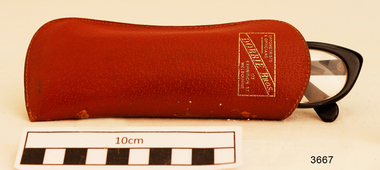
... pouch. Inscription is stamped into frame and printed in gold lettering on the case. ...Inscriptions read on spectacles;“52 (square) 18” and “RODENSTOCK > ELBA < 130“ and printed in gold lettering on the pouch “DOBBIE BROS. / OPTOMETRISTS & OPTICIANS / 173 EXHIBITION ST. ...Dr Angus assisted Dr Tom Ryan, a pioneer in the use of X-rays and in ocular surgery. flagstaff hill warrnambool shipwrecked coast flagstaff hill maritime museum maritime museum shipwreck coast flagstaff hill maritime village great ocean road dr w r angus dr ryan surgical instrument t.s.s. largs bay warrnambool base hospital nhill base hospital mira hospital flying doctor medical treatment spectacles and case optical testing optometrist examination dobbie bros melbourne Inscriptions read on spectacles;“52 (square) 18” and “RODENSTOCK > ELBA < 130“ and printed in gold lettering on the pouch “DOBBIE BROS. / OPTOMETRISTS & OPTICIANS / 173 EXHIBITION ST. ...The history of spectacles The earliest form of spectacles are generally agreed to have been invented in Northern Italy in the thirteenth century. Over hundreds of years of innovation and refinement, they have been perfected into the stylish and functional designs you see today worn by millions of people to correct their eyesight. Here's a look at the key moments that defined the history of spectacles. Thirteenth century - Rivet spectacles The earliest form of spectacles was simply two mounted lenses riveted together at the handle ends. They had no sides and were secured to the face by clamping the nose between the rims, some of which had notches which may have been intended to improve the grip. Even then the wearer could only keep them in place by remaining relatively still and would normally support them with the hand. These spectacles contained convex lenses for the correction of presbyopic long-sightedness and were generally suited only to those few who lived beyond their forties and had the ability to read. Sixteenth century - Nose spectacles Nose spectacles were in more common use by the early sixteenth century. These often had a bow-shaped continuous bridge, almost of a modern appearance, that was sometimes flexible depending upon the material, for example leather or whalebone. The bridge was as much an area to be gripped as to rest on the nose. Spectacles were still usually held in place with the hand whilst being used temporarily for a brief period of reading or close inspection. By now the lenses could be used to correct both long and short sight. The general design changed little through the seventeenth century, though certain refinements increased the flexibility and comfort for some wearers. In some localised areas, notably in Spain, people experimented with ear loops made of string. This allowed them to walk around with their spectacles on. Eighteenth century - Temple glasses Only in the eighteenth century did the first modern eyewear, or ‘glasses’ as we would understand them, start to appear. The lenses might be glass, rock crystal or any other transparent mineral substance and were prone to smashing if the spectacles fell off, so there was an impetus to develop frames that could be worn continuously and would stay in place. London optician Edward Scarlett is credited with developing the modern style of spectacles which were kept in place with arms, known as ‘temples’. These were made of iron or steel and gripped the side of the head but did not yet hook over the ears because often the ears were concealed beneath a powdered wig, such as was fashionable at the time. As temples developed they were made with wide ring ends through which the wearer could pass a ribbon, thus tying the spectacles securely to the head. As spectacles were no longer primarily for use in sedentary activities, people began to be noticed out and about in their spectacles and might come to be identified as a ‘spectacle wearer’. By the end of the eighteenth century, people who needed correction for both distance and near could choose bifocals. Nineteenth century - Pince-nez Pince-nez were a nineteenth century innovation that literally translates as ‘pinching the nose’. They had a spring clip to retain the item in place under its own tension. Sometimes this clip was too tight and the wearer struggled to breathe. If it was too loose the pince-nez could fall off so, for safety and security, they were often connected to the wearer's clothing by a cord or a chain to avoid them being dropped or lost. Pince-nez were sometimes chosen by people who felt that large spectacles were too prominent and drew attention to a physical defect. They were also suitable for mounting lenses that could correct astigmatism. Twentieth century spectacles Spectacle wearing continued to become more widespread, key developments being the supply of spectacles to troops in the First World War, cheaper spectacles being subsidised through insurance schemes arranged by friendly societies, and the beginning of the National Health Service in 1948, when free spectacles were made available to all who might benefit from them. This normalised spectacle wearing and led to a significant increase in the scale of production. Entirely separate categories of women’s spectacles and sports eyewear both emerged in the 1930s. The latter half of the twentieth century saw spectacles become more fashionable and stylish as frames with different shapes, materials, and colours became available. Plastics frames, in particular, allowed a greater choice of colours and textured finishes. Plastic lenses were more durable and could be made lighter and thinner than glass, spurring a renewed interest in rimless designs. Designer eyewear bearing popular high-street brand names encouraged patients to regard spectacles as a desirable commodity, even as a fashion accessory, not just a disability aid. https://www.college-optometrists.org/the-british-optical-association-museum/the-history-of-spectacles These spectacles and case were used by Dr. Angus in his surgery in Warrnambool to test patients' eye sight. They were donated to Flagstaff Hill Maritime Village by the family of Doctor William Roy Angus, Surgeon and Oculist. It is part of the “W.R. Angus Collection” that includes historical medical equipment, surgical instruments and material once belonging to Dr Edward Ryan and Dr Thomas Francis Ryan, (both of Nhill, Victoria) as well as Dr Angus’ own belongings. The Collection’s history spans the medical practices of the two Doctors Ryan, from 1885-1926 plus that of Dr Angus, up until 1969. ABOUT THE “W.R.ANGUS COLLECTION” Doctor William Roy Angus M.B., B.S., Adel., 1923, F.R.C.S. Edin.,1928 (also known as Dr Roy Angus) was born in Murrumbeena, Victoria in 1901 and lived until 1970. He qualified as a doctor in 1923 at University of Adelaide, was Resident Medical Officer at the Royal Adelaide Hospital in 1924 and for a period was house surgeon to Sir (then Mr.) Henry Simpson Newland. Dr Angus was briefly an Assistant to Dr Riddell of Kapunda, then commenced private practice at Curramulka, Yorke Peninsula, SA, where he was physician, surgeon and chemist. In 1926, he was appointed as new Medical Assistant to Dr Thomas Francis Ryan (T.F. Ryan, or Tom), in Nhill, Victoria, where his experiences included radiology and pharmacy. In 1927 he was Acting House Surgeon in Dr Tom Ryan’s absence. Dr Angus had become engaged to Gladys Forsyth and they decided he would take time to further his studies overseas in the UK in 1927. He studied at London University College Hospital and at Edinburgh Royal Infirmary and in 1928, was awarded FRCS (Fellow from the Royal College of Surgeons), Edinburgh. He worked his passage back to Australia as a Ship’s Surgeon on the on the Australian Commonwealth Line’s T.S.S. Largs Bay. Dr Angus married Gladys in 1929, in Ballarat. (They went on to have one son (Graham 1932, born in SA) and two daughters (Helen (died 12/07/1996) and Berenice (Berry), both born at Mira, Nhill ) Dr Angus was a ‘flying doctor’ for the A.I.M. (Australian Inland Ministry) Aerial Medical Service in 1928 . The organisation began in South Australia through the Presbyterian Church in that year, with its first station being in the remote town of Oodnadatta, where Dr Angus was stationed. He was locum tenens there on North-South Railway at 21 Mile Camp. He took up this ‘flying doctor’ position in response to a call from Dr John Flynn; the organisation was later known as the Flying Doctor Service, then the Royal Flying Doctor Service. A lot of his work during this time involved dental surgery also. Between 1928-1932 he was surgeon at the Curramulka Hospital, Yorke Peninsula, South Australia. In 1933 Dr Angus returned to Nhill where he’d previously worked as Medical Assistant and purchased a share of the Nelson Street practice and Mira hospital from Dr Les Middleton one of the Middleton Brothers, the current owners of what was once Dr Tom Ryan’s practice. Dr L Middleton was House Surgeon to the Nhill Hospital 1926-1933, when he resigned. [Dr Tom Ryan’s practice had originally belonged to his older brother Dr Edward Ryan, who came to Nhill in 1885. Dr Edward saw patients at his rooms, firstly in Victoria Street and in 1886 in Nelson Street, until 1901. The Nelson Street practice also had a 2 bed ward, called Mira Private Hospital ). Dr Edward Ryan was House Surgeon at the Nhill Hospital 1884-1902 . He also had occasions where he successfully performed veterinary surgery for the local farmers too. Dr Tom Ryan then purchased the practice from his brother in 1901. Both Dr Edward and Dr Tom Ryan work as surgeons included eye surgery. Dr Tom Ryan performed many of his operations in the Mira private hospital on his premises. He too was House Surgeon at the Nhill Hospital 1902-1926. Dr Tom Ryan had one of the only two pieces of radiology equipment in Victoria during his practicing years – The Royal Melbourne Hospital had the other one. Over the years Dr Tom Ryan gradually set up what was effectively a training school for country general-practitioner-surgeons. Each patient was carefully examined, including using the X-ray machine, and any surgery was discussed and planned with Dr Ryan’s assistants several days in advance. Dr Angus gained experience in using the X-ray machine there during his time as assistant to Dr Ryan. Dr Tom Ryan moved from Nhill in 1926. He became a Fellow of the Royal Australasian College of Surgeons in 1927, soon after its formation, a rare accolade for a doctor outside any of the major cities. He remained a bachelor and died suddenly on 7th Dec 1955, aged 91, at his home in Ararat. Scholarships and prizes are still awarded to medical students in the honour of Dr T.F. Ryan and his father, Dr Michael Ryan, and brother, John Patrick Ryan. ] When Dr Angus bought into the Nelson Street premises in Nhill he was also appointed as the Nhill Hospital’s Honorary House Surgeon 1933-1938. His practitioner’s plate from his Nhill surgery states “HOURS Daily, except Tuesdays, Fridays and Saturday afternoons, 9-10am, 2-4pm, 7-8pm. Sundays by appointment”. This plate is now mounted on the doorway to the Port Medical Office at Flagstaff Hill Maritime Village, Warrnambool. Dr Edward Ryan and Dr Tom Ryan had an extensive collection of historical medical equipment and materials spanning 1884-1926 and when Dr Angus took up practice in their old premises he obtained this collection, a large part of which is now on display at the Port Medical Office at Flagstaff Hill Maritime Village in Warrnambool. During his time in Nhill Dr Angus was involved in the merging of the Mira Hospital and Nhill Public Hospital into one public hospital and the property titles passed on to Nhill Hospital in 1939. In 1939 Dr Angus and his family moved to Warrnambool where he purchased “Birchwood,” the 1852 home and medical practice of Dr John Hunter Henderson, at 214 Koroit Street. (This property was sold in1965 to the State Government and is now the site of the Warrnambool Police Station. ). The Angus family was able to afford gardeners, cooks and maids; their home was a popular place for visiting dignitaries to stay whilst visiting Warrnambool. Dr Angus had his own silk worm farm at home in a Mulberry tree. His young daughter used his centrifuge for spinning the silk. Dr Angus was appointed on a part-time basis as Port Medical Officer (Health Officer) in Warrnambool and held this position until the 1940’s when the government no longer required the service of a Port Medical Officer in Warrnambool; he was thus Warrnambool’s last serving Port Medical Officer. (The duties of a Port Medical Officer were outlined by the Colonial Secretary on 21st June, 1839 under the terms of the Quarantine Act. Masters of immigrant ships arriving in port reported incidents of diseases, illness and death and the Port Medical Officer made a decision on whether the ship required Quarantine and for how long, in this way preventing contagious illness from spreading from new immigrants to the residents already in the colony.) Dr Angus was a member of the Australian Medical Association, for 35 years and surgeon at the Warrnambool Base Hospital 1939-1942, He served as a Surgeon Captain during WWII 1941-45, in Ballarat, Victoria, and in Bonegilla, N.S.W., completing his service just before the end of the war due to suffering from a heart attack. During his convalescence he carved an intricate and ‘most artistic’ chess set from the material that dentures were made from. He then studied ophthalmology at the Royal Melbourne Eye and Ear Hospital and created cosmetically superior artificial eyes by pioneering using the intrascleral cartilage. Angus received accolades from the Ophthalmological Society of Australasia for this work. He returned to Warrnambool to commence practice as an ophthalmologist, pioneering in artificial eye improvements. He was Honorary Consultant Ophthalmologist to Warrnambool Base Hospital for 31 years. He made monthly visits to Portland as a visiting surgeon, to perform eye surgery. He represented the Victorian South-West subdivision of the Australian Medical Association as its secretary between 1949 and 1956 and as chairman from 1956 to 1958. In 1968 Dr Angus was elected member of Spain’s Barraquer Institute of Barcelona after his research work in Intrasclearal cartilage grafting, becoming one of the few Australian ophthalmologists to receive this honour, and in the following year presented his final paper on Living Intrasclearal Cartilage Implants at the Inaugural Meeting of the Australian College of Ophthalmologists in Melbourne In his personal life Dr Angus was a Presbyterian and treated Sunday as a Sabbath, a day of rest. He would visit 3 or 4 country patients on a Sunday, taking his children along ‘for the ride’ and to visit with him. Sunday evenings he would play the pianola and sing Scottish songs to his family. One of Dr Angus’ patients was Margaret MacKenzie, author of a book on local shipwrecks that she’d seen as an eye witness from the late 1880’s in Peterborough, Victoria. In the early 1950’s Dr Angus, painted a picture of a shipwreck for the cover jacket of Margaret’s book, Shipwrecks and More Shipwrecks. She was blind in later life and her daughter wrote the actual book for her. Dr Angus and his wife Gladys were very involved in Warrnambool’s society with a strong interest in civic affairs. Their interests included organisations such as Red Cross, Rostrum, Warrnambool and District Historical Society (founding members), Wine and Food Society, Steering Committee for Tertiary Education in Warrnambool, Local National Trust, Good Neighbour Council, Housing Commission Advisory Board, United Services Institute, Legion of Ex-Servicemen, Olympic Pool Committee, Food for Britain Organisation, Warrnambool Hospital, Anti-Cancer Council, Boys’ Club, Charitable Council, National Fitness Council and Air Raid Precautions Group. He was also a member of the Steam Preservation Society and derived much pleasure from a steam traction engine on his farm. He had an interest in people and the community He and his wife Gladys were both involved in the creation of Flagstaff Hill, including the layout of the gardens. After his death (28th March 1970) his family requested his practitioner’s plate, medical instruments and some personal belongings be displayed in the Port Medical Office surgery at Flagstaff Hill Maritime Village, and be called the “W. R. Angus Collection”. The W.R. Angus Collection is significant for still being located at the site it is connected with, Doctor Angus being the last Port Medical Officer in Warrnambool. The collection of medical instruments and other equipment is culturally significant, being an historical example of medicine from late 19th to mid-20th century. Dr Angus assisted Dr Tom Ryan, a pioneer in the use of X-rays and in ocular surgery. Spectacles and case, from the W.R. Angus Collection and used by Dr. Angus for testing the sight of his patients. Black rimmed spectacles in tan, open ended pouch. Inscription is stamped into frame and printed in gold lettering on the case. c. 1969 Inscriptions read on spectacles;“52 (square) 18” and “RODENSTOCK > ELBA < 130“ and printed in gold lettering on the pouch “DOBBIE BROS. / OPTOMETRISTS & OPTICIANS / 173 EXHIBITION ST. MELBOURNE”flagstaff hill, warrnambool, shipwrecked coast, flagstaff hill maritime museum, maritime museum, shipwreck coast, flagstaff hill maritime village, great ocean road, dr w r angus, dr ryan, surgical instrument, t.s.s. largs bay, warrnambool base hospital, nhill base hospital, mira hospital, flying doctor, medical treatment, spectacles and case, optical testing, optometrist examination, dobbie bros melbourne -
 Flagstaff Hill Maritime Museum and Village
Money Belt, c. 1942
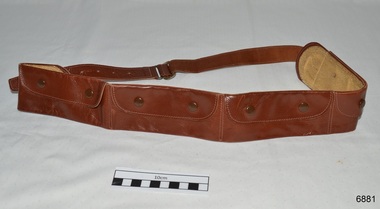
... Brown leather money belt, genuine calf, lined, 4 pouches with stud closure flaps included. Issued to W.R. Angus in WWII and part of the W.R. Angus Collection. Gold...Gold embossed “GENUINE CALF” under silver coloured buckle. Hand written inside of belt “W.R. ANGUS / 61-3 9803 5228” Brown leather money belt, genuine calf, lined, 4 pouches with stud closure flaps included. ...This money belt was issued to Dr W.R. Angus when he served in the Army 1942-1945 as a medical officer at Ballarat, Victoria, and Bonegilla, N.S.W.. (Surgeon Captain A.A.M.C., 108 A.G.H., and 106 A.G.H., Captain A.A.M.C. retired list.) The belt was donated to Flagstaff Hill Maritime Village by the family of Doctor William Roy Angus, Surgeon and Oculist. It is part of the “W.R. Angus Collection” that includes historical medical equipment, surgical instruments and material once belonging to Dr Edward Ryan and Dr Thomas Francis Ryan, (both of Nhill, Victoria) as well as Dr Angus’ own belongings. The Collection’s history spans the medical practices of the two Doctors Ryan, from 1885-1926 plus that of Dr Angus, up until 1969. ABOUT THE “W.R.ANGUS COLLECTION” Doctor William Roy Angus M.B., B.S., Adel., 1923, F.R.C.S. Edin.,1928 (also known as Dr Roy Angus) was born in Murrumbeena, Victoria in 1901 and lived until 1970. He qualified as a doctor in 1923 at University of Adelaide, was Resident Medical Officer at the Royal Adelaide Hospital in 1924 and for a period was house surgeon to Sir (then Mr.) Henry Simpson Newland. Dr Angus was briefly an Assistant to Dr Riddell of Kapunda, then commenced private practice at Curramulka, Yorke Peninsula, SA, where he was physician, surgeon and chemist. In 1926, he was appointed as new Medical Assistant to Dr Thomas Francis Ryan (T.F. Ryan, or Tom), in Nhill, Victoria, where his experiences included radiology and pharmacy. In 1927 he was Acting House Surgeon in Dr Tom Ryan’s absence. Dr Angus had become engaged to Gladys Forsyth and they decided he further his studies overseas in the UK in 1927. He studied at London University College Hospital and at Edinburgh Royal Infirmary and in 1928, was awarded FRCS (Fellow from the Royal College of Surgeons), Edinburgh. He worked his passage back to Australia as a Ship’s Surgeon on the on the Australian Commonwealth Line’s T.S.S. Largs Bay. Dr Angus married Gladys in 1929, in Ballarat. (They went on to have one son (Graham 1932, born in SA) and two daughters (Helen (died 12/07/1996) and Berenice (Berry), both born at Mira, Nhill ) According to Berry, her mother Gladys made a lot of their clothes. She was very talented and did some lovely embroidery including lingerie for her trousseau and beautifully handmade baby clothes. Dr Angus was a ‘flying doctor’ for the A.I.M. (Australian Inland Ministry) Aerial Medical Service in 1928 . Its first station was in the remote town of Oodnadatta, where Dr Angus was stationed. He was locum tenens there on North-South Railway at 21 Mile Camp. He took up this ‘flying doctor’ position in response to a call from Dr John Flynn; the organisation was later known as the Flying Doctor Service, then the Royal Flying Doctor Service. A lot of his work during this time involved dental surgery also. Between 1928-1932 he was surgeon at the Curramulka Hospital, Yorke Peninsula, South Australia. In 1933 Dr Angus returned to Nhill and purchased a share of the Nelson Street practice and Mira hospital (a 2 bed ward at the Nelson Street Practice) from Dr Les Middleton one of the Middleton Brothers, the current owners of what previously once Dr Tom Ryan’s practice. Dr Tom and his brother had worked as surgeons included eye surgery. Dr Tom Ryan performed many of his operations in the Mira private hospital on his premises. He had been House Surgeon at the Nhill Hospital 1902-1926. Dr Tom Ryan had one of the only two pieces of radiology equipment in Victoria during his practicing years – The Royal Melbourne Hospital had the other one. Over the years Dr Tom Ryan had gradually set up what was effectively a training school for country general-practitioner-surgeons. Each patient was carefully examined, including using the X-ray machine, and any surgery was discussed and planned with Dr Ryan’s assistants several days in advance. Dr Angus gained experience in using the X-ray machine there during his time as assistant to Dr Ryan. When Dr Angus bought into the Nelson Street premises in Nhill he was also appointed as the Nhill Hospital’s Honorary House Surgeon 1933-1938. His practitioner’s plate from his Nhill surgery is now mounted on the doorway to the Port Medical Office at Flagstaff Hill Maritime Village, Warrnambool. When Dr Angus took up practice in the Dr Edward and Dr Tom Ryan’s old premises he obtained their extensive collection of historical medical equipment and materials spanning 1884-1926. A large part of this collection is now on display at the Port Medical Office at Flagstaff Hill Maritime Village in Warrnambool. In 1939 Dr Angus and his family moved to Warrnambool where he purchased “Birchwood,” the 1852 home and medical practice of Dr John Hunter Henderson, at 214 Koroit Street. (This property was sold in1965 to the State Government and is now the site of the Warrnambool Police Station. and an ALDI sore is on the land that was once their tennis court). The Angus family was able to afford gardeners, cooks and maids; their home was a popular place for visiting dignitaries to stay whilst visiting Warrnambool. Dr Angus had his own silk worm farm at home in a Mulberry tree. His young daughter used his centrifuge for spinning the silk. Dr Angus was appointed on a part-time basis as Port Medical Officer (Health Officer) in Warrnambool and held this position until the 1940’s when the government no longer required the service of a Port Medical Officer in Warrnambool; he was thus Warrnambool’s last serving Port Medical Officer. (Masters of immigrant ships arriving in port reported incidents of diseases, illness and death and the Port Medical Officer made a decision on whether the ship required Quarantine and for how long, in this way preventing contagious illness from spreading from new immigrants to the residents already in the colony.) Dr Angus was a member of the Australian Medical Association, for 35 years and surgeon at the Warrnambool Base Hospital 1939-1942, He served as a Surgeon Captain during WWII1942-45, in Ballarat, Victoria, and in Bonegilla, N.S.W., completing his service just before the end of the war due to suffering from a heart attack. During his convalescence he carved an intricate and ‘most artistic’ chess set from the material that dentures were made from. He then studied ophthalmology at the Royal Melbourne Eye and Ear Hospital and created cosmetically superior artificial eyes by pioneering using the intrascleral cartilage. Angus received accolades from the Ophthalmological Society of Australasia for this work. He returned to Warrnambool to commence practice as an ophthalmologist, pioneering in artificial eye improvements. He was Honorary Consultant Ophthalmologist to Warrnambool Base Hospital for 31 years. He made monthly visits to Portland as a visiting surgeon, to perform eye surgery. He represented the Victorian South-West subdivision of the Australian Medical Association as its secretary between 1949 and 1956 and as chairman from 1956 to 1958. In 1968 Dr Angus was elected member of Spain’s Barraquer Institute of Barcelona after his research work in Intrasclearal cartilage grafting, becoming one of the few Australian ophthalmologists to receive this honour, and in the following year presented his final paper on Living Intrasclearal Cartilage Implants at the Inaugural Meeting of the Australian College of Ophthalmologists in Melbourne In his personal life Dr Angus was a Presbyterian and treated Sunday as a Sabbath, a day of rest. He would visit 3 or 4 country patients on a Sunday, taking his children along ‘for the ride’ and to visit with him. Sunday evenings he would play the pianola and sing Scottish songs to his family. One of Dr Angus’ patients was Margaret MacKenzie, author of a book on local shipwrecks that she’d seen as an eye witness from the late 1880’s in Peterborough, Victoria. In the early 1950’s Dr Angus, painted a picture of a shipwreck for the cover jacket of Margaret’s book, Shipwrecks and More Shipwrecks. She was blind in later life and her daughter wrote the actual book for her. Dr Angus and his wife Gladys were very involved in Warrnambool’s society with a strong interest in civic affairs. He had an interest in people and the community They were both involved in the creation of Flagstaff Hill, including the layout of the gardens. After his death (28th March 1970) his family requested his practitioner’s plate, medical instruments and some personal belongings be displayed in the Port Medical Office surgery at Flagstaff Hill Maritime Village, and be called the “W. R. Angus Collection”. The W.R. Angus Collection is significant for still being located at the site it is connected with, Doctor Angus being the last Port Medical Officer in Warrnambool. The collection of medical instruments and other equipment is culturally significant, being an historical example of medicine from late 19th to mid-20th century. Dr Angus assisted Dr Tom Ryan, a pioneer in the use of X-rays and in ocular surgery. The collection of Army objects is an example of items issued to Doctors and Surgeons in the Medical Services of the Australian Army in World War 2. Brown leather money belt, genuine calf, lined, 4 pouches with stud closure flaps included. Issued to W.R. Angus in WWII and part of the W.R. Angus Collection. Gold embossed label. Hand written inscription with name and serial number. Gold embossed “GENUINE CALF” under silver coloured buckle. Hand written inside of belt “W.R. ANGUS / 61-3 9803 5228”flagstaff hill, warrnambool, shipwrecked coast, flagstaff hill maritime museum, maritime museum, shipwreck coast, flagstaff hill maritime village, great ocean road, dr w r angus, dr ryan, military money belt, surgeon captain, royal australian army, military service australian army, wwii uniform, world war 2 -
 Glenelg Shire Council Cultural Collection
Medal, n.d
... a) Victoria 150th medal, gold coloured, 150th logo on one side and 'IN RECOGNITION OF AN HONOURED CITIZEN OF VICTORIA' on the other. In small clear plastic pouch. b) Letter accompanying a) from Premier of Victoria c) Certificate accompanying a) and b). a), b) & c) presented to Victorians born before Jan 1st 1901...This medal was struck to commemorate the 150th anniversary of the State of Victoria. medal numismatics 150 Victoria celebration a) Victoria 150th medal, gold coloured, 150th logo on one side and 'IN RECOGNITION OF AN HONOURED CITIZEN OF VICTORIA' on the other. In small clear plastic pouch. b) Letter accompanying a) from Premier of Victoria c) Certificate accompanying a) and b). a), b) & c) presented to Victorians born before Jan 1st 1901 Medal Medal ...This medal was struck to commemorate the 150th anniversary of the State of Victoria.a) Victoria 150th medal, gold coloured, 150th logo on one side and 'IN RECOGNITION OF AN HONOURED CITIZEN OF VICTORIA' on the other. In small clear plastic pouch. b) Letter accompanying a) from Premier of Victoria c) Certificate accompanying a) and b). a), b) & c) presented to Victorians born before Jan 1st 1901medal, numismatics, 150 victoria, celebration -
Glenelg Shire Council Cultural Collection
Souvenir - Pen, n.d
... Pen, in suede pouch, black with gold trims, gold lettering on clip. 150th logo on end....Front: 'City of Portland' - gold Pen, in suede pouch, black with gold trims, gold lettering on clip. 150th logo on end. ...Pen, in suede pouch, black with gold trims, gold lettering on clip. 150th logo on end.Front: 'City of Portland' - gold -
 Bendigo Military Museum
Memorabilia - MIRROR & WALLET, C.1939 - 45
... Mirrors Leather Pouches Signalling WWII World War Two Second World War Wallets On wallet in gold, “Good luck” Shaving mirror in leather wallet. .1) Wallet made of brown leather stamped in gold. .2) Polished metal mirror Memorabilia MIRROR & WALLET ...Belonged to Keith David Livingston VX136969 2nd AIF. Refer 1911P for service history.Shaving mirror in leather wallet. .1) Wallet made of brown leather stamped in gold. .2) Polished metal mirrorOn wallet in gold, “Good luck”mirrors, leather, pouches, signalling, wwii, world war two, second world war, wallets -
Port Melbourne Historical & Preservation Society
Domestic object - Coasters, Port Melbourne Bowling Club, 1970s
... Four aluminium coasters from the collection of the late Fred WINDUSS - two gold plated and two silver plated, with Port Melbourne Bowling Club insignia; mounted on blue felt in a black card pouch. ...From the collection of the late Fred Winduss Sport - Lawn Bowls Frederick Robert WINDUSS Port Melbourne Bowling Club Four aluminium coasters from the collection of the late Fred WINDUSS - two gold plated and two silver plated, with Port Melbourne Bowling Club insignia; mounted on blue felt in a black card pouch. ...From the collection of the late Fred WindussFour aluminium coasters from the collection of the late Fred WINDUSS - two gold plated and two silver plated, with Port Melbourne Bowling Club insignia; mounted on blue felt in a black card pouch. Impression of Yarra River with West Gate Bridge in foreground and City in background, edge of a bowl on right handsport - lawn bowls, frederick robert winduss, port melbourne bowling club -
 National Vietnam Veterans Museum (NVVM)
Print - In a Gold Timber Frame is a Coloured Print with a White Matt of Several Items of Clothing and a Black and White Photograph, 'Let Time Redeem' by Alfred Engel
... In a gold timber frame with white matt is a coloured print depicting contents of soldiers closet, which includes a green cotton drill shirt with a red poppy in the left hand pocket, a pair of black leather boots, Vietnam service medals, dog tags, canvas water bag, knife if it leather pouch, rifle casings, giggle hat, torch, small teddy bear etc/...Print Memorbilia Alfred Engel - Artist Let Time Redeem Print No:102/1000 Signed In a gold timber frame with white matt is a coloured print depicting contents of soldiers closet, which includes a green cotton drill shirt with a red poppy in the left hand pocket, a pair of black leather boots, Vietnam service medals, dog tags, canvas water bag, knife if it leather pouch, rifle casings, giggle hat, torch, small teddy bear etc/ 'Let Time Redeem' by Alfred Engel Print In a Gold Timber Frame is a Coloured Print with a White Matt of Several Items of Clothing and a Black and White Photograph. ...Leading Australian Realist artist, Alfred Engel painted "Let Time Redeem" inspired by the memories and mementos of a close mate - A Vietnam veteran. He has captured the experience in a way that will be extremely moving to the vast majority of vets. Alfred has kindly donated the copyright, and allowed a limited edition of 1000 prints, all proceeds of which are to be donated to support the work of Vietnam Veterans organizations.In a gold timber frame with white matt is a coloured print depicting contents of soldiers closet, which includes a green cotton drill shirt with a red poppy in the left hand pocket, a pair of black leather boots, Vietnam service medals, dog tags, canvas water bag, knife if it leather pouch, rifle casings, giggle hat, torch, small teddy bear etc/Print No:102/1000 Signed print, memorbilia, alfred engel - artist, let time redeem -
 National Vietnam Veterans Museum (NVVM)
Equipment - Sewing kit, Army
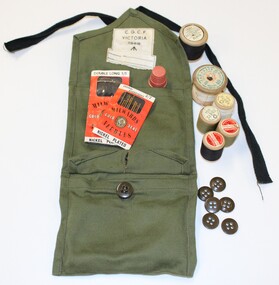
... Inside pouch on upper compartment, the makers tag is displayed 'C.G.C.F VICTORIA 1968' Needle Kit is branded with the makers - Millwards - Gold Seal - Nickel Plated - Needles Cotton Reels are branded - J & P Coates-blended thread for buttons...Sewing Kit 1968 House wife sewing kit 12th Field Regiment Ian Ahearn collection 235307 Royal Regiment Of Australian Artillery Lt Ian Francis Ahearn Housewife Inside pouch on upper compartment, the makers tag is displayed 'C.G.C.F VICTORIA 1968' Needle Kit is branded with the makers - Millwards - Gold Seal - Nickel Plated - Needles Cotton Reels are branded - J & P Coates-blended thread for buttons Sewing Kit , 1 x 1968 'Housewife' sewing kit pouch comprising of: 6 Buttons / 2 x packs of needles/1 x plastic thimble / 6 wooden x cotton reels with 3 x different coloured thread (black, white, khaki green) Pouch has two compartments, one compartment with button closure, and one compartment with two black ties for closure. ...The 'Sewing Kit' and its contents was a standard issue item as used by servicemen during the conflict in Vietnam (1962-1973). This kit belonged to Lt Ian Francis Ahearn (235307) , Royal Regiment of Australian Artillery Service Number 235307, 12th Field Regiment 19 Feb 1968 to 04 Feb 1969. This item was donated by I F Ahearn, who served as a Lieutenant with the Royal Regiment of Australian Artillery, 12th Field Regiment in 1968-9. On the 16th May 2025 the Governor General of Australia awarded Colonel Ian Francis Ahearn OAM (Retd) the Distinguished Service Medal for distinguished leadership in warlike operations as the Gun Position Officer with 102nd Field Battery during the Battle of Fire Support Patrol Base Coral from 12 to 16 May 1968.Sewing Kit , 1 x 1968 'Housewife' sewing kit pouch comprising of: 6 Buttons / 2 x packs of needles/1 x plastic thimble / 6 wooden x cotton reels with 3 x different coloured thread (black, white, khaki green) Pouch has two compartments, one compartment with button closure, and one compartment with two black ties for closure. Inside pouch on upper compartment, the makers tag is displayed 'C.G.C.F VICTORIA 1968' Needle Kit is branded with the makers - Millwards - Gold Seal - Nickel Plated - Needles Cotton Reels are branded - J & P Coates-blended thread for buttonssewing kit, 1968 house wife sewing kit, 12th field regiment, ian ahearn collection, 235307, royal regiment of australian artillery, lt ian francis ahearn, housewife -
National Vietnam Veterans Museum (NVVM)
Functional Object, Ration pack (x2) gold plated tin
... Ration pack 1) metal tin with the following contents - curry powder pouch, matches, instant coffee, several unidentified pouches. 2) closed tin 2x food ration tins Ration pack (x2) gold plated tin Functional Object Functional Object ...1) metal tin with the following contents - curry powder pouch, matches, instant coffee, several unidentified pouches. 2) closed tin 2x food ration tinsration pack -
Coal Creek Community Park & Museum
Tobacco plug
... Rectangular shaped pouch of tobacco, cream coloured with red text and gold decoration. ...Ready Rubbed, fine cut Rectangular shaped pouch of tobacco, cream coloured with red text and gold decoration. ...Rectangular shaped pouch of tobacco, cream coloured with red text and gold decoration. Harbour Bar, Special Virginia tobacco. Ready Rubbed, fine cut -
 Bendigo Military Museum
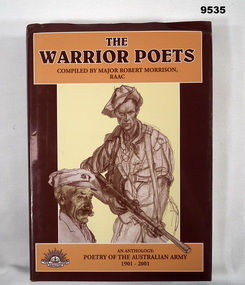
Book - ANTHOLOGY, ARMY, 1901 - 2001, Major Robert MORRISON RAAC, "THE WARRIOR POETS", 2001
... gold colour print on spine. Dust cover - paper, gloss finish. Brown, pale yellow and white print on front, spine and back. Front illustration - sepia tones drawings of two men, poet and soldier, with Bren Gun. Back illustration sepia tone drawing of AWAS Typist. 435 pages - cut, plain white paper. Illustrated black and white, sepia and colour photographs, paintings, sketches and line drawings. End papers - back - CD in clear plastic pouch...gold colour print on spine. Dust cover - paper, gloss finish. Brown, pale yellow and white print on front, spine and back. Front illustration - sepia tones drawings of two men, poet and soldier, with Bren Gun. Back illustration sepia tone drawing of AWAS Typist. 435 pages - cut, plain white paper. Illustrated black and white, sepia and colour photographs, paintings, sketches and line drawings. End papers - back - CD in clear plastic pouch ...Item in collection of "William John SULLIVAN", VX57829. Refer Cat. No. 9523P for his service details. From book cover; THE WARRIOR POETS, AN ANTHOLOGY: POETRY OF THE AUSTRALIAN ARMY 1901-2001.Hard cover book with a dust cover. Hard cover - cardboard, with adhered orange colour buckram, gold colour print on spine. Dust cover - paper, gloss finish. Brown, pale yellow and white print on front, spine and back. Front illustration - sepia tones drawings of two men, poet and soldier, with Bren Gun. Back illustration sepia tone drawing of AWAS Typist. 435 pages - cut, plain white paper. Illustrated black and white, sepia and colour photographs, paintings, sketches and line drawings. End papers - back - CD in clear plastic pouch adhesive taped to page.books, army, anthology, william john sullivan -
 Chiltern Athenaeum Trust
Reserve Forces Day Council Boer War Commemorative Round Medallion (for descendants) 2012 issue, 2012
... gold', appearing as surrounds for the inscription. The neck ribbon is in the colours of the Queen’s official service medal, all enclosed in a presentation pouch. ...gold', appearing as surrounds for the inscription. The neck ribbon is in the colours of the Queen’s official service medal, all enclosed in a presentation pouch. ...Reserve Forces Day Council Boer War Commemorative Medallion 2012 Descendant Medallion with ribbon suitable medallion has been struck to allow descendants and supporters to honour those who served in this all-but forgotten conflict 100 years ago. The Reserve Forces Day Council recognises it was a War fought in the main by Reservists. Permanent forces were small in number with only a Permanent Force Artillery unit and a number of staff officers and soldiers serving in the war. The Reserve Forces Day Council’s objective is to "Raise the profile of the Reserve Forces and to thank serving and former members for their service, and their families and employers for their essential support." This medallion has been struck for descendants and in memory of those Soldiers who fought in the War. The "In Memory" medallion is oval 50mm high by 40 mm wide and bears the inscription "BOER WAR 1899-1902" bordering the face within a colour infill and a clear cover of epoxy. The central image is of an Australian soldier in a uniform of the era. The attractive medallion is 'gold', appearing as surrounds for the inscription. The neck ribbon is in the colours of the Queen’s official service medal, all enclosed in a presentation pouch. A space on the reverse side of the Medallion provides for a personal message to be engraved at a later time. An example is "Presented to Leslie Perrett Descendant of Tpr Frederick Avard, NSW Lancers who died in combat 10 October 1900". The Medallion may be worn at memorial ceremonies and will become a family keepsake. It does not matter on which side your ancestor fought, or if the soldier fought in a unit from elsewhere in the then Empire. The Medallion marks an Australian connection, and shows your support for your ancestor's achievement.Associated with the 110th anniversary of the Boer War 1899 to 1902. A descendant's medal issued as a commemorative by the Reserve Forces Day Council in 2012. A round enamel and epoxy medallion issued by the Reseve Forces Day Council for descendants to remember the 110th anniversary of the Boer War and their descendants contribution. The Medallion is round measuring 40mm x 40mm and has the Boer War Campaign Red, Blue and Orange coloured ribbon attached, The medallion has a gold and red border with a photograph of a Boer War Soldier contained in the middle of the medallion. Surrounding wording on the medallion is : Boer War 1899-1902 A War Fought By Reservists. The bottom of the medallion has the letters RFD 2012 (which stands for the Reserve Forces Day National Council). The medallion has a gold and red border with a photograph of a Boer War Soldier contained in the middle of the medallion. Surrounding wording on the medallion is : Boer War 1899-1902 A War Fought By Reservists. The bottom of the medallion has the letters RFD 2012 (which stands for the Reserve Forces Day National Council). boer war descendant's medallion 2012, boer war commemorative medallion, reserve forces day national council boer war commemorative, boer war associated 1899 to 1902 -
 Uniting Church Archives - Synod of Victoria
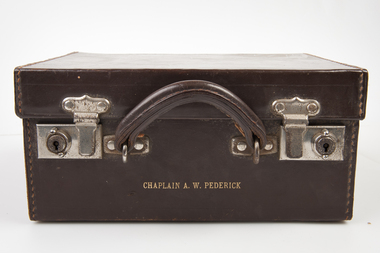
Travelling Communion Set, c1940s
... pouches in the lid. Two bottles with cork and silver lids are in fitted compartments inside the box which also contains a small white embroidered cloth. There is embossed gold...pouches in the lid. Two bottles with cork and silver lids are in fitted compartments inside the box which also contains a small white embroidered cloth. There is embossed gold ...The Rev A W Pederick was a chaplain who served in the New Guinea Campaign during WWII. His service included the Kokoda Trail. Brown leather carry case with a brown metal base, a carry handle and two lockable latches on the font. The box has a blue velvet lining. The box holds a paten, diameter 12.0 cm, and a wafer tin which are held in pouches in the lid. Two bottles with cork and silver lids are in fitted compartments inside the box which also contains a small white embroidered cloth. There is embossed gold lettering on the front of the box. The box also holds a letter from the Rev Douglas W Risstrom."CHAPLAIN A. W. PEDERICK" inside the lid: "The gift of the Methodist Padres Auxiliary of Australia"portable communion set, rev a w pederick -
 Wangaratta RSL Sub Branch
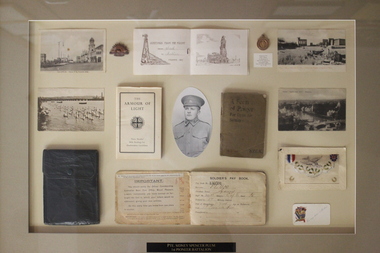
Mixed media - Framed photograph and objects, Pte Sidney Spencer Plum
... Items include oval photo of Sidney Plum in the centre surrounded by four post cards, one embroidered post card of a dove with an envelope in it's beak with the Union Jack and French flag, a Greetings From The Front" booklet, "The Armour of Light" bible, "A Form of Prayer for open air services" book, Soldier's Pay Book, a "To my dear Mother" card, a black leather pouch, a rising sun badge, round gold medallion. ...Includes oval photo of Sidney Plum in the centre surrounded by four post cards, one embroidered post card of a dove with an envelope in it's beak with the Union Jack and French flag, a Greetings From The Front" booklet, "The Armour of Light" bible, "A Form of Prayer for open air services" book, Soldier's Pay Book, a "To my dear Mother" card, a black leather pouch, a risen sun badge, round gold coloured medalion. Frame has a donation plaque....Items include oval photo of Sidney Plum in the centre surrounded by four post cards, one embroidered post card of a dove with an envelope in it's beak with the Union Jack and French flag, a Greetings From The Front" booklet, "The Armour of Light" bible, "A Form of Prayer for open air services" book, Soldier's Pay Book, a "To my dear Mother" card, a black leather pouch, a rising sun badge, round gold medallion. A framed montage of personal items belonging to Private Sydney Spencer PLUM compiled by his family to honour his memory and service. ...Collection of personal effects that belonged to Private SIdney Spencer Plum, 3431 1st Pioneer Battalion. SIdney was born on 3/1/1894 at Dockers Plains via Wangaratta. He attended both North Wangaratta and Dockers Plains schools. He was a Blacksmith aged 21 years when he enlisted on 12/6/1915 and embarked on 11/10/1915 on board HMAT Nestor. He was wounded three times and was discharged from the AIF on 16/3/1919. Items include oval photo of Sidney Plum in the centre surrounded by four post cards, one embroidered post card of a dove with an envelope in it's beak with the Union Jack and French flag, a Greetings From The Front" booklet, "The Armour of Light" bible, "A Form of Prayer for open air services" book, Soldier's Pay Book, a "To my dear Mother" card, a black leather pouch, a rising sun badge, round gold medallion. A framed montage of personal items belonging to Private Sydney Spencer PLUM compiled by his family to honour his memory and service. In addition to general military issue the remaining items were most likely purchased whilst on leave in France and England during the first world war. Postcards particularly embroidered postcards were sent home to loved ones and friends.Framed Collection of personal effects - Private Sidney Spencer Plum, 1st Pioneer Battalion. Includes oval photo of Sidney Plum in the centre surrounded by four post cards, one embroidered post card of a dove with an envelope in it's beak with the Union Jack and French flag, a Greetings From The Front" booklet, "The Armour of Light" bible, "A Form of Prayer for open air services" book, Soldier's Pay Book, a "To my dear Mother" card, a black leather pouch, a risen sun badge, round gold coloured medalion. Frame has a donation plaque.Front: Pte Sidney Spencer Plum, 1st Pioneer Battalion. Donated by Max & Hilary (Plum) Ryan and Sylvia Reed (Plum) of Wangarattaa Back: Wangaratta Picture Framers 9 Oct 2003. Also has messages from front postcards; Dear Mother, Just a few lines to let you know that I am alright hoping that you and all the rest is well too. We have had three fogs over here and it is very cold at night. I was picked in Cairo and they had some Turkey Officers an a German spy in gaol there. I wrote to Aunt Nelline. I got two letters from Alf. Maude Saxby hasnt wrote to me since I was up there on final leave. I get the letters quicker. I got Alf photos all right. I will be having Christmas in London. Well I think this is all this. I remain you son Sid. Tell Alf to send me over the Age so I can see how the war is going. I suppose Dad and the rest is busy harvesting now. Glad to hear that you got the photos all right. I think this is all this time from Sid same address as before. Dear Mother, Just a few lines to let you know that I am keeping well hoping that you and every body is the same. We have some great fogs over here, it rained all one night. We had a very good Christmas we got a billy issued to us and it had every thing in it. The Captain of our company gave me a Christmas pudding. All the same I wished I were back in Australia again. I think this is all this time. Yours truely son Sid, 25/12/15plum, sidney, world war 1, postcards, embroidered postcard, soldier's pay book, leather pouch, bible, prayer book, sydney -
 Wangaratta RSL Sub Branch
Domestic object - Shaving Mirror in Leather Pouch
... Brown leather pouch with a green map of Australia, gold Southern Cross and "Good Luck" engraved into it. ...Small metal piece used as shaving mirror in the field. shaving mirror leather metal "Good Luck" engraved into the leather, plus a map of Australia and the Southern Cross Brown leather pouch with a green map of Australia, gold Southern Cross and "Good Luck" engraved into it. ...Small metal piece used as shaving mirror in the field. Brown leather pouch with a green map of Australia, gold Southern Cross and "Good Luck" engraved into it. Inside the pouch contains a silver piece of metal used as a shaving mirror with a leather tag attached."Good Luck" engraved into the leather, plus a map of Australia and the Southern Crossshaving mirror, leather, metal -
 Embroiderers Guild, Victoria
Textile - Embroidered with Goldwork Liturgical Burse, Elizabeth Elvin, 20th century
... pouch, or pocketbook. Embroidery Ecclesiastical England Metal thread 20th century Elizabeth Elvin 4 Harmar Close Wokingham, Berkshire, UK A burse is a flat, square, fabric-covered case in which a folded corporal cloth is carried to and from an altar in church. The background material is a slub silk with the design worked in browns, black and golds ...A burse is a stiffened, often embroidered square cloth case used in Christian liturgy to hold the corporal (a linen cloth) during Communion services, usually matching the Mass vestments. It is placed on top of the veiled chalice and sometimes used to carry the Eucharist to the sick. Synonyms include purse, pouch, or pocketbook.A burse is a flat, square, fabric-covered case in which a folded corporal cloth is carried to and from an altar in church. The background material is a slub silk with the design worked in browns, black and golds. Black and gold cord around the edge. Design has an off centre cross worked in gold with 4 arches in various rich materials and canvas embroidery. Elizabeth Elvin 4 Harmar Close Wokingham, Berkshire, UKembroidery, ecclesiastical, england, metal thread, 20th century -
 Moorabbin Air Museum
Accessory (item) - Consolidated Vultee Service Dept. Document Pouch
... gold lettering. Consolidated Vultee Service Dept. Document Pouch.Leather 360mm x 250mm Consolidated Vultee Service Dept. Document Pouch ...Consolidated Vultee Service Department in gold lettering. -
 Whitehorse Historical Society Inc.
Functional object - Pen
... Brown and Gold pen with inscription to celebrate 140th anniversary 1861 - 2001 of Burwood East Primary School. Pen has a black velvet pouch....Pen is a sample of pens for sale to commemorate the 140th anniversary of Burwood East Primary School. civic mementoes souvenirs Brown and Gold pen with inscription to celebrate 140th anniversary 1861 - 2001 of Burwood East Primary School. Pen has a black velvet pouch. ...Pen is a sample of pens for sale to commemorate the 140th anniversary of Burwood East Primary School.Brown and Gold pen with inscription to celebrate 140th anniversary 1861 - 2001 of Burwood East Primary School. Pen has a black velvet pouch.civic mementoes, souvenirs -
 Tennis Australia
Personal items, Circa 1925
... Gold retractable swizzle stick with tennis racquet motif. In custom pouch and gift box, branded underside lid: CADO/PARIS/MADE IN FRANCE. ...Tennis Gold retractable swizzle stick with tennis racquet motif. In custom pouch and gift box, branded underside lid: CADO/PARIS/MADE IN FRANCE. ...Gold retractable swizzle stick with tennis racquet motif. In custom pouch and gift box, branded underside lid: CADO/PARIS/MADE IN FRANCE. Materials: Gold/Metal, Metal composite, Cardboard, Velvettennis -
 Mont De Lancey
Domestic object - Material Storage Box
... Inside the box there are: a)1 cream-coloured silk, handstitched bird pouch, with a gold-coloured patterned edging. The bird has 2 gold-coloured bead eyes. b) 1 square purple cloth perfume sachet containing rosemary. c) 1 small, glass-covered, coloured picture of a girl in a green and orange dress, with a pigeon on her shoulder. ...Inside the box there are: a)1 cream-coloured silk, handstitched bird pouch, with a gold-coloured patterned edging. The bird has 2 gold-coloured bead eyes. b) 1 square purple cloth perfume sachet containing rosemary. c) 1 small, glass-covered, coloured picture of a girl in a green and orange dress, with a pigeon on her shoulder. ...Rectangular, beige, cloth-covered box with lid. It has a green, pink and red floral pattern overall. The lining and the inside of the lid is of a pale green fabric. A fine, pale green cord and knot braid decorates the edges of the lid. Inside the box there are: a)1 cream-coloured silk, handstitched bird pouch, with a gold-coloured patterned edging. The bird has 2 gold-coloured bead eyes. b) 1 square purple cloth perfume sachet containing rosemary. c) 1 small, glass-covered, coloured picture of a girl in a green and orange dress, with a pigeon on her shoulder. She is feding some birds and chickens.containers, storage boxes -
Tarnagulla History Archive
File containing photocopied extracts from the Bendigonian newspaper, Extracts from 1906-1907
... pouch' folder. Contains 100-200 A3 pages. Label indicates 'Excellent Poseidon Gold Rush References'. ...pouch' folder. Contains 100-200 A3 pages. Label indicates 'Excellent Poseidon Gold Rush References'. ...David Gordon Collection. Blue plastic 'pouch' folder. Contains 100-200 A3 pages. Label indicates 'Excellent Poseidon Gold Rush References'. -
 Mont De Lancey
Textile - Wall Bag, Unknown
... The pouch has a crimson, satin lining, gold-colouring backing and brown and black braid edging....The pouch has a crimson, satin lining, gold-colouring backing and brown and black braid edging. ...Beige, diagonal-shaped wall hanging pouch to hold letters and papers, with tapestry floral pattern and white and silver beading. The pouch has a crimson, satin lining, gold-colouring backing and brown and black braid edging.pouches, wall hangings -
 Mont De Lancey
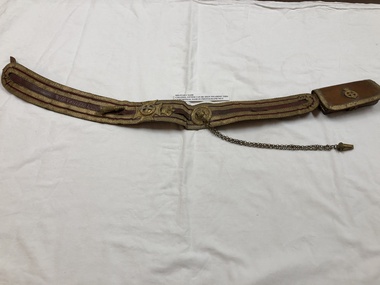
Ceremonial Military Sash
... Heavily decorated leather ceremonial Military sash, with pouch and brass whistle and chain. Pouch decorated with gold and burgundy braid, and metal leaf pattern on ends....Heavily decorated leather ceremonial Military sash, with pouch and brass whistle and chain. Pouch decorated with gold and burgundy braid, and metal leaf pattern on ends. ...Belonged to Colonel Otter.Heavily decorated leather ceremonial Military sash, with pouch and brass whistle and chain. Pouch decorated with gold and burgundy braid, and metal leaf pattern on ends.Pouch: Crown Crest Sash: Pro Deo Et Patria. Cross with star and crown edging.military decorations, military uniforms, ceremonial clothing
