
Showing 4 items matching "gold wire embroidery"
-
 Sir Reginald Ansett Transport Museum
Hat
... ...gold wire embroidery...hostess cap worn by Airlines of South Australia staff south australian hostess cap wool plaid gold wire embroidery olive green No visible evidence of manufacturer or owner Airlines of South Australia hostess cap without peak. ...early (1940s?) hostess cap worn by Airlines of South Australia staffAirlines of South Australia hostess cap without peak. Light & dark olive green plaid pattern. Fine wool (blend?). Oval-shaped crown narrower & lower at front / broader & higher at rear. Olive green bemsilk lining & matching grosgrain sweatband. Matching fabric emblem 7cm high on left front, featuring metallic gold thread embroidery of 3mm thick initials "S" & "A " on crimson background with gold embroidered wings above. No visible evidence of manufacturer or ownersouth australian, hostess cap, wool plaid, gold wire embroidery, olive green -
 Montmorency–Eltham RSL Sub Branch
Headwear - Cap, Peaked, US Army Dress Blue
... gold oak leaves and thin leather edging. Black leather chip-strap is secured by two gilt buttons, 17 mm diameter, embossed with a hunting horn surrounded by a wreath of laurel. The sky blue hatband is edged with 2 mm wide gold embroidery. The inner headband is brown leather-like material and the lining is red fabric.Under the lining a metal tab supports the crown at the front of the cap and crown edge is reinforced by wire. ...gold oak leaves and thin leather edging. Black leather chip-strap is secured by two gilt buttons, 17 mm diameter, embossed with a hunting horn surrounded by a wreath of laurel. The sky blue hatband is edged with 2 mm wide gold embroidery. The inner headband is brown leather-like material and the lining is red fabric.Under the lining a metal tab supports the crown at the front of the cap and crown edge is reinforced by wire. ...Believed to be US Army Infantry dress blue uniform cap introduced in 1954 Black peaked cap with patent leather peak. Peak is blue underside, and black upper with a row of gold oak leaves and thin leather edging. Black leather chip-strap is secured by two gilt buttons, 17 mm diameter, embossed with a hunting horn surrounded by a wreath of laurel. The sky blue hatband is edged with 2 mm wide gold embroidery. The inner headband is brown leather-like material and the lining is red fabric.Under the lining a metal tab supports the crown at the front of the cap and crown edge is reinforced by wire. The cap badge is missing (2 off 32 mm center holes) noneheadgear -
 Kew Historical Society Inc
Evening Dress & Jacket, Smaragd of Melbourne, 1965-75
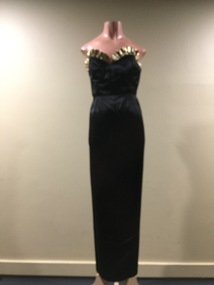
... The textured gold work is indicative of heavy bullion embroidery—a technique utilizing twisted, coiled metallic wire threads couched into dense, sculptural relief patterns to catch light. ...The textured gold work is indicative of heavy bullion embroidery—a technique utilizing twisted, coiled metallic wire threads couched into dense, sculptural relief patterns to catch light. ...Operating heavily in the late mid-century, Smaragd of Melbourne was a premium boutique Australian label that catered to high-end social calendars, formal galas, and evening wear markets. During this era, Melbourne was firmly established as Australia’s fashion manufacturing capital. Labels like Smaragd competed directly with high-end European and American imports by offering local consumers equivalent luxury, using specialized, imported embellishments and meticulous, small-batch boutique construction. This ensemble is typical of mid-to-late 20th-century Australian fashion design, showcasing the exceptional structural tailoring and high-glamour aesthetic of the period. The inclusion of the matching cropped jacket reflects the transitional styling of late-1960s to 1970s evening wear, designed for formal modesty that could be removed for evening events. The use of heavy bullion embroidery or relief passamanerie highlights the reliance of local couture houses on advanced, labor-intensive hand-finishing techniques. This level of craftsmanship stands in stark contrast to the mass-manufacturing shift that would dominate the global fashion industry in the decades to follow. As an "Exclusive of Melbourne" garment, the piece holds strong regional significance to the history of the Australian textile trade. The preserved, illustrated "mod-style" label serves as an excellent artifact of graphic design history, capturing the youthful, playful marketing shift that defined the post-war youth culture boom in Australia.Two-piece evening ensemble comprising a strapless column gown and a coordinating cropped evening jacket. The floor-length gown features a highly structured, fitted bodice with internal boning and a classic sweetheart neckline. The skirt is tailored into a sleek, narrow column silhouette. The accompanying long-sleeved satin jacket is cropped to fit precisely over the gown’s waistline, featuring a rounded neckline, a concealed front closure, and tailored sleeves. Crafted from a heavy, high-sheen black evening fabric (consistent with silk or premium synthetic satin/mikado blend of the era). he neckline of the jacket (and the underlying gown) features a heavy, raised, three-dimensional metallic embellishment. The textured gold work is indicative of heavy bullion embroidery—a technique utilizing twisted, coiled metallic wire threads couched into dense, sculptural relief patterns to catch light. The garment contains a woven fabric manufacturer's label reading "Smaragd Exclusive of Melbourne / Size 12". The label is distinguished by a blue, stylized graphic illustration of a wide-eyed, curly-haired "mod doll," characteristic of commercial art from the late 1960s to mid-1970s.Label: SMARAGD EXCLUSIVE OF MELBOURNE. SIZE 12fashion - australia - melbourne, smaragd of melbourne, women's clothing, evening dresses, fashion design, clothing -- 1970s -
 Embroiderers Guild, Victoria
Accessory - Indian Goldwork Handbag, Early 20th century
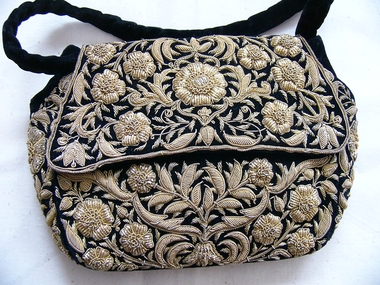
... gold embroidery: 1. Key Aspects of Zardozi Embroidery: Origin and Meaning: The term "Zardozi" comes from the Persian words "zar" (gold) and "dozi" (embroidery), literally meaning "sewing with gold". Materials Used: Traditionally, threads were made of pure gold or silver, but modern zardozi typically uses copper wires with a gold or silver polish, often blended with silk threads, sequins, and crystals. ...gold embroidery: 1. Key Aspects of Zardozi Embroidery: Origin and Meaning: The term "Zardozi" comes from the Persian words "zar" (gold) and "dozi" (embroidery), literally meaning "sewing with gold". Materials Used: Traditionally, threads were made of pure gold or silver, but modern zardozi typically uses copper wires with a gold or silver polish, often blended with silk threads, sequins, and crystals. ...Known as Karchob it is divided into 2 types of gold embroidery: 1. Key Aspects of Zardozi Embroidery: Origin and Meaning: The term "Zardozi" comes from the Persian words "zar" (gold) and "dozi" (embroidery), literally meaning "sewing with gold". Materials Used: Traditionally, threads were made of pure gold or silver, but modern zardozi typically uses copper wires with a gold or silver polish, often blended with silk threads, sequins, and crystals. The Process: Adda: The fabric is stretched tightly over a wooden frame, known as an adda, to facilitate precise, delicate work. Aari Needle: Artisans often use a hook-ended needle, similar to a crochet needle, called an aari, to make intricate stitches. Techniques: Specialized techniques include Dabka (coiled wire) and Kasab (twisted wire) to create raised, three-dimensional motifs. Common Motifs: Designs often feature intricate floral patterns, leaves, paisley, and geometric shapes inspired by nature and architecture. 2. Key details about Kamdani embroidery: Technique: It is often called a "lighter version" of Zardozi. It involves using a needle to insert flat metallic wires (badla) through the fabric, making tiny stitches that sparkle, often creating dots, paisleys, or floral patterns. Origin: The craft originated in the Indian subcontinent, specifically developing in Lucknow, India. Materials: Originally done with pure gold or silver threads, modern Kamdani often uses synthetic metallic threads or beads for affordability. Application: It is commonly featured on luxurious textiles, including georgette, chiffon, and cotton, frequently worn as formal wedding wear (sarees, dupattas, and kurtas). Types of Work: It is often referred to by related terms such as Mukaish, Badla, or Fardi work.Gold embroidery all over bag except under flap. Intricate design on flowers in very typical of the variety of metal threads. Velvet handles with black silk lining with press-studs in both corners of the flap. Decorative beaded tassel at base. Intricate design of flowers in typical design known as Karchob.embroidery, bags, 1900-20, india, goldwork
