
Showing 14 items matching "grain elevators board"
-
 Bendigo Historical Society Inc.
Document - TERRY DAVIDSON COLLECTION: GRAIN ELEVATORS BOARD OF VICTORIA
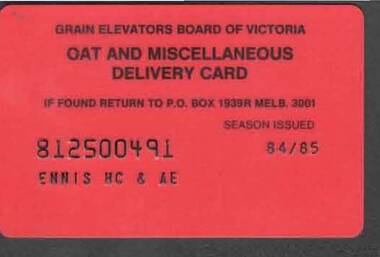
... TERRY DAVIDSON COLLECTION: GRAIN ELEVATORS BOARD OF VICTORIA......Grain Elevators Board...Terry Davidson collection -Grain Elevators Board of Victoria - red plastic Oat and Miscellaneous Delivery card .If found return to P.O. ...DOCUMENT Grain Elevators Board Terry Davidson collection -Grain Elevators Board of Victoria - red plastic Oat and Miscellaneous Delivery card .If found return to P.O. ...Terry Davidson collection -Grain Elevators Board of Victoria - red plastic Oat and Miscellaneous Delivery card .If found return to P.O. Box 1939R Melb 3001 season issued 84/85 Ennis HC & A E . CPE Security card.document, grain elevators board -
 Bendigo Historical Society Inc.
Document - TERRY DAVIDSON COLLECTION: GRAIN ELEVATORS BOARD OF VICTORIA
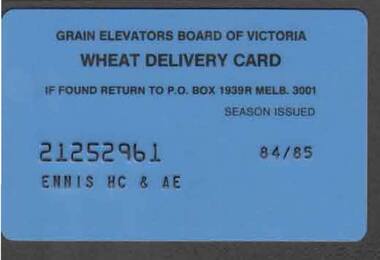
... TERRY DAVIDSON COLLECTION: GRAIN ELEVATORS BOARD OF VICTORIA......Grain Elevators Board...Terry Davidson collection -Grain Elevators Board of Victoria - 2 x blue plastic Wheat Delivery cards .If found return to P.O. ...DOCUMENT Grain Elevators Board Terry Davidson collection -Grain Elevators Board of Victoria - 2 x blue plastic Wheat Delivery cards .If found return to P.O. ...Terry Davidson collection -Grain Elevators Board of Victoria - 2 x blue plastic Wheat Delivery cards .If found return to P.O. Box 1939R Melb 3001 season issued 84/85 Ennis HC & A E . CPE Security card.document, grain elevators board -
 Bendigo Historical Society Inc.
Document - BENDIGO SALEYARDS COLLECTION: THE BENDIGO SALEYARDS ECONOMIC VIABILITY STUDY
... ... Grain Elevators Board Dept...Kate Millard Loddon Campaspe Planning Authority Street Ryan and Associates Bendigo City Council Strathfieldsaye Shire Council Department of Industry Technology & Resources National Library of Australia Meldrum Burows & Partners Core Wilson Sayer Town Planning Appeals Panel CES Victorian Farmers and Graziers Association Stock Agents Association Department of Agriculture Department of Industry Technology & Resources Department of Conservation Forests and Land Cr Jock Comini RCA Depot Wellsford Rifle Range Bendigo Airport Bendigo Field Naturalists Club Mr David Kennedy Mr John Brumby Mr John Radford Neil O'Keefe Bendigo East Progress Association Bendigo East Traders Trades Hall Council Mr Tom Uren Mr Frank Wilkes Mr Bruce Reid Mr K I M Wright Mr E T Ebery Bendigo Pastoral Council of the VFGA Victorian Meatworks Association Bendigo Stock & Station Agents Association Rutlands Transport Mr Don Pickles Country Abattoirs & Wholesalers Association Association of Victoria Meat and Allied Trade Federation of Australia Bendigo Saleyards Advisory Committee Bendigo Residents & Ratepayers Association A H & N Graham Mrs P Unmack Australian Bureau of Statistics Mr Lloyd Houlden Cr C Rodda Mr Jolly Mr Tony Milanese Dr Robert Carter University of Melbourne Bendigo College of TAFE T Matthews A S & R D Rutland John Kerr J Talbot G L O'Sullivan Penney & Lang Pty Ltd Graeme Pickering Pickhall J W & Sons R A Plant W K Schmidt T J Vick K & J Wignall A E Wright G Chapman A J Gillies P G & M M Harris Ian R Hollingsworth B Kennedy S Letcher S & D K Letcher P M Llewellyn L G Mason Boyer R T Connally M F Kennedy & Mortlock Nevins J P R W Johnstone W J Keith B D Kelly Notman R Pitts A J & C A Pitts Mervyn L & Co Rowe W O Warren K M Associated Stock & Station Agents Dalgety Farmers Ltd Elders DSM Estates Ellis Nuttall & Co Gallagher G D Hamilton Real Estate McGregor Ralph H & Co McKean W & Co Miller Turner Livestock Co Vains E M & Co Victorian Producers Hill M J & Co Bennetts Meats Comell Bros Davis B & D Hardwick G F & V C Penney & Lang P/L Tendercut Meats Northern Seed Supply Co Bendigo Fertilizers Agri Business Pty Ltd Agrilink Consulting Group Pty Ltd Acil Aust Pty Ltd McGowan & Associates Chapman W C Talbot E J McCulloch W & Sons Pty Ltd K V Equipment Commercial Egg Producers Assoc Co-op Monsanto Aust Ltd Balmer Bryan R Barry I J Bath L Clarke B J Treacy K M Turner J M Bendigo Mower Serv Pty Ltd Everlast Concrete Tank tyLtd Wicks Bros canvas Goods Don McArthur Bendigo Communications Transcom Emdell Pty Ltd Epsom Pharmaceutical Supplies Sandhurst Fencing Pty Ltd Arnolds Gates & Fencing R Furniss Carne Neville AWA & UNICLA AJM Refrigeration bendigo Concrete Sawing Service Hamilton R J Hearpes T W J E Brown Campey DR A R Fyffe J J Kangaroo Flat Vet Clinic Ottrey K E Bendigo Sprinkler Installations Milnes Irrigation Onga Pumpshop Barastoc Products Bush's Produce Stores Epsom Produce K M M Pty Ltd Bendigo Grain Co Eaglehawk Chaff Mills Grain Elevators Board Dept Bonneys Pest Control Knights Pest Control Brown Wk & L d Bendigo Sewerage Authority Bendigo Water Board ACI Computer Services Leham Donald A E Hueffer & Associates Wolmoke Planners P Langley Mr Ken Strachan Mr Evan Jones Mr Peter Byrnes Mr Wayne Street Street Ryan & Associates 140 Loose pages titled The Bendigo Saleyards Economic Viability Study. ...140 Loose pages titled The Bendigo Saleyards Economic Viability Study. Report written by Kate Millard on behalf of the Bendigo Development Committee Inc. Contents include: Chapter 1 - Background Information, Chapter 1 - Present Operations at the Saleyards, Chapter 3 - Economic Factors, Chapter 4 - Environmental Factors, Chapter 5 - Selling Techniques, Chapter 6 - Employment Study, Management and Sundry Issues, Chapter 7 - Survey of Farmers and Saleyard Users in the 'Catchment Area', and Chapter 8 - Recommendations of the Report. Includes diagrams and maps. Recommendations printed on dark yellow paper.bendigo, council, cattle markets, bendigo saleyards collection - the bendigo saleyards economic viability study, bendigo development committee inc., kate millard, loddon campaspe planning authority, street, ryan and associates, bendigo city council, strathfieldsaye shire council, department of industry technology & resources, national library of australia, meldrum burows & partners, core wilson sayer, town planning appeals panel, ces, victorian farmers and graziers association, stock agents association, department of agriculture, department of industry technology & resources, department of conservation forests and land, cr jock comini, rca depot, wellsford rifle range, bendigo airport, bendigo field naturalists club, mr david kennedy, mr john brumby, mr john radford, neil o'keefe, bendigo east progress association, bendigo east traders, trades hall council, mr tom uren, mr frank wilkes, mr bruce reid, mr k i m wright, mr e t ebery, bendigo pastoral council of the vfga, victorian meatworks association, bendigo stock & station agents association, rutlands transport, mr don pickles, country abattoirs & wholesalers association association of victoria, meat and allied trade federation of australia, bendigo saleyards advisory committee, bendigo residents & ratepayers association, a h & n graham, mrs p unmack australian bureau of statistics, mr lloyd houlden, cr c rodda, mr jolly, mr tony milanese, dr robert carter, university of melbourne, bendigo college of tafe, t matthews, a s & r d rutland, john kerr, j talbot, g l o'sullivan, penney & lang pty ltd, graeme pickering, pickhall j w & sons, r a plant, w k schmidt, t j vick, k & j wignall, a e wright, g chapman, a j gillies, p g & m m harris, ian r hollingsworth, b kennedy, s letcher, s & d k letcher, p m llewellyn, l g mason, boyer r t, connally m f, kennedy & mortlock, nevins j p, r w johnstone, w j keith, b d kelly, notman r, pitts a j & c a, pitts mervyn l & co, rowe w o, warren k m, associated stock & station agents, dalgety farmers ltd, elders dsm estates, ellis nuttall & co, gallagher g d, hamilton real estate, mcgregor ralph h & co, mckean w & co, miller turner livestock co, vains e m & co, victorian producers, hill m j & co, bennetts meats, comell bros, davis b & d, hardwick g f & v c, penney & lang p/l, tendercut meats, northern seed supply co, bendigo fertilizers, agri business pty ltd, agrilink consulting group pty ltd, acil aust pty ltd, mcgowan & associates, chapman w c, talbot e j, mcculloch w & sons pty ltd, k v equipment, commercial egg producers assoc co-op, monsanto aust ltd, balmer bryan r, barry i j, bath l, clarke b j, treacy k m, turner j m, bendigo mower serv pty ltd, everlast concrete tank tyltd, wicks bros, canvas goods, don mcarthur, bendigo communications, transcom, emdell pty ltd, epsom pharmaceutical supplies, sandhurst fencing pty ltd, arnolds gates & fencing, r furniss, carne neville, awa & unicla, ajm refrigeration, bendigo concrete sawing service, hamilton r j, hearpes t w, j e brown, campey dr a r, fyffe j j, kangaroo flat vet clinic, ottrey k e, bendigo sprinkler installations, milnes irrigation, onga pumpshop, barastoc products, bush's produce stores, epsom produce, k m m pty ltd, bendigo grain co, eaglehawk chaff mills, grain elevators board dept, bonneys pest control, knights pest control, brown wk & l d, bendigo sewerage authority, bendigo water board, aci computer services, leham donald, a e hueffer & associates, wolmoke planners, p langley, mr ken strachan, mr evan jones, mr peter byrnes, mr wayne street, street ryan & associates -
 Dookie Historical Society
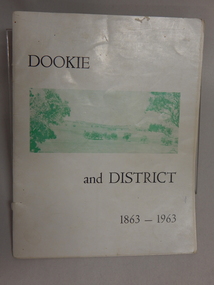
Soft Cover Dookie District History Book - Width 18.5cm x Height 24cm Consist of 33 pages (not numbered), The General Committee Organising the Dookie Back To, Dookie and District 1863 - 1963, Easter 1963 "WATERWHEEL PRESS,"
... Back Cover - An aerial view of Dookie as it is today, showing the Grain Elevators Board wheat silos under construction (lower right foreground). ...Back Cover - An aerial view of Dookie as it is today, showing the Grain Elevators Board wheat silos under construction (lower right foreground). ...Soft Cover Historical Book - White Background with 2 green and white soft aerial photographs of prominent landmarks at Dookie. Front Cover - Mount Major on the left and Saddleback on the right. Back Cover - An aerial view of Dookie as it is today, showing the Grain Elevators Board wheat silos under construction (lower right foreground). -
 Melbourne Tram Museum
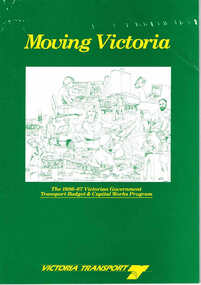
Book, Ministry of Transport, "Moving Victoria", 1986
... Foreword by Tom Roper, Minister, details new initiatives, eg Jolimont Decentralisation, Port Melbourne - St Kilda light rail, Overseas initiatives, Transport funding, costs, industry, employment, the Ministry and its authorities, including Ports and Grain Elevators Board and the State Bicycle Committee. ...Foreword by Tom Roper, Minister, details new initiatives, eg Jolimont Decentralisation, Port Melbourne - St Kilda light rail, Overseas initiatives, Transport funding, costs, industry, employment, the Ministry and its authorities, including Ports and Grain Elevators Board and the State Bicycle Committee. ...Thirty two page book/booklet titled "Moving Victoria", providing information on the 1986-1987 Victorian Government Transport Budget and Capital Works Program. Has the Victoria Transport logo on the base of the front cover. Foreword by Tom Roper, Minister, details new initiatives, eg Jolimont Decentralisation, Port Melbourne - St Kilda light rail, Overseas initiatives, Transport funding, costs, industry, employment, the Ministry and its authorities, including Ports and Grain Elevators Board and the State Bicycle Committee. Information provided for: Metropolitan Transport Authority - The Met Road Construction Authority State Transport Authority Road Traffic Authority See Reg Item 1774.5 for the 1987 - 1988 version..trams, tramways, minister for transport, metropolitan transit authority, state transport authority -
 Melbourne Tram Museum
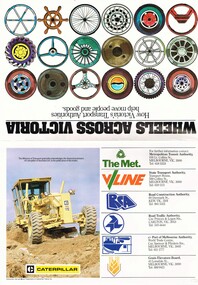
Pamphlet, Victoria Transport, "Wheels across Victoria", c1985
... V/Line, GEB and Ports, Grain Elevators Board and the various port authorities. ...V/Line, GEB and Ports, Grain Elevators Board and the various port authorities. ...Pamphlet, folded A2 size sheet to A4 landscape, full colour printed, titled "Wheels across Victoria", sub-titled "How Victoria's Transport Authorities help move people and goods" Provides information on the activities of the Road Construction Authority, Road Traffic Authority, Metropolitan Transit Authority, RCA, RTA, MTA. V/Line, GEB and Ports, Grain Elevators Board and the various port authorities. On the inside has a introduction by the Minister for Transport Tom Roper and a game for up to 6 people moving markers from Gippsland to the NW corner of the state. Uses a dice. Published by Victoria Transport with the assistance of Caterpillar Australia ltd. Has the various authority logos.trams, tramways, rta, rca, vline, mta, victorian government -
 Charlton Golden Grains Museum Inc
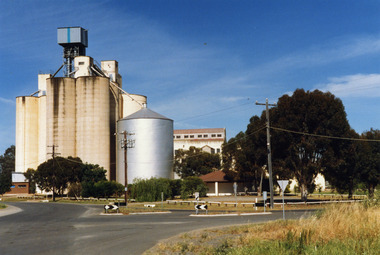
Photograph, Charlton Shire, Charlton Flour Mill, c.1987
... In 1977, the **Grain Elevators Board** took over the site as a grain receival depot, building a large elevator tower that surpassed the height of the original buildings. ...In 1977, the **Grain Elevators Board** took over the site as a grain receival depot, building a large elevator tower that surpassed the height of the original buildings. ...A previous mill had operated in Charlton by Mr. W.E. Foreman on the banks of the Avoca River and was acquired in 1919 by Noske Bros. The present Flour Mill was built by Noske Bros and opened in May 1927. It was taken over by the Grain Elevator Board in the 1970s. Noske's Flour Mill, with its commanding presence and towering silos, has long **dominated the Charlton skyline** and remains a significant landmark, even though it no longer mills flour. The mill's history is deeply intertwined with the development of Charlton and the grain industry of the surrounding district. The foundation for the mill's presence was laid in 1919 when Messrs Noske Bros. Pty. Ltd., already owning mills in Horsham, Nhill, and Murray Bridge, acquired G. H. Foreman’s Mill located by the Avoca River. The founder, **T. J. Noske**, was an early pioneer of flour exporting, expanding his milling business after unexpectedly acquiring the Horsham mill. ### A State-of-the-Art Operation The original mill by the river operated until August 1926 before being closed and dismantled. Plans were well underway for a **new, state-of-the-art mill** to be located at the former Cobb and Co site. In 1927, the new mill began operation. It was one of the largest in the state, boasting a capacity of three tons of flour per hour, a 250 h.p. diesel engine, and three initial silos. The mill quickly gained a reputation for **excellence** for both its design and its flour, which was sold successfully in local and overseas markets. ### Periods of Expansion and Trial The mill continued to grow, reflecting the importance of the local agricultural industry. Between 1940 and 1941, **nine new silos** were built, adding bulk receival points. In the record-breaking 1968 season, the mill received a colossal wheat intake of **695,000 bushels**. However, the mill also faced setbacks. On January 21, 1949, disaster struck when a **large fire** erupted in the storage shed, which contained 500 tons of bagged flour ready for export and new flour bags. The blaze was so intense that smoke was visible as far away as Wycheproof, and it threatened to destroy the entire mill. Thanks to the monumental efforts of the Charlton, St. Arnaud, Wycheproof, and Wedderburn Brigades, who ran the main pump almost continuously for 26 hours, the damage was contained, though the estimated loss was a substantial £60,000. ### Transformation of the Site At its peak, the mill was a major employer, providing work for approximately 65–70 men. But after over 45 years of operation, flour production at the mill ceased on October 25, 1973. Noske Industries Ltd. sought to adapt, converting the operation to a less successful stock feed production centre. In 1977, the **Grain Elevators Board** took over the site as a grain receival depot, building a large elevator tower that surpassed the height of the original buildings. The site eventually returned to private hands and, since 2000, has been owned and operated as a primary grain receival site for **GrainCorp**, cementing its continued, vital role in Charlton's agricultural life. Colour photograph of Charlton Flour Mill and silos. Intersection of Kaye & Davies Streets in the foreground. One large silver silo and three taller greyish concrete silos to the left. Three other cream coloured silos behind. There are pipes and sheds on top of the silos. There is a cream single story building to the right of the silver silo and a multi-storey building behind with eight window in the upper level. There is a small red brick building on the far left of the photo.w.e. foreman, noske bros, flour mill charlton, business, industry -
 Charlton Golden Grains Museum Inc
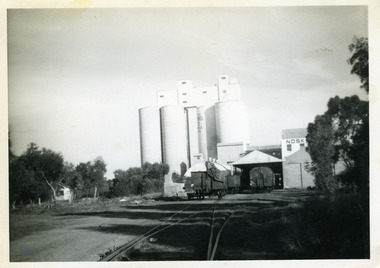
Photograph, c.1960
... In 1977, the **Grain Elevators Board** took over the site as a grain receival depot, building a large elevator tower that surpassed the height of the original buildings. ...In 1977, the **Grain Elevators Board** took over the site as a grain receival depot, building a large elevator tower that surpassed the height of the original buildings. ...Noske's mill in mid 1960s. Noske's Flour Mill, with its commanding presence and towering silos, has long **dominated the Charlton skyline** and remains a significant landmark, even though it no longer mills flour. The mill's history is deeply intertwined with the development of Charlton and the grain industry of the surrounding district. The foundation for the mill's presence was laid in 1919 when Messrs Noske Bros. Pty. Ltd., already owning mills in Horsham, Nhill, and Murray Bridge, acquired G. H. Foreman’s Mill located by the Avoca River. The founder, **T. J. Noske**, was an early pioneer of flour exporting, expanding his milling business after unexpectedly acquiring the Horsham mill. ### A State-of-the-Art Operation The original mill by the river operated until August 1926 before being closed and dismantled. Plans were well underway for a **new, state-of-the-art mill** to be located at the former Cobb and Co site. In 1927, the new mill began operation. It was one of the largest in the state, boasting a capacity of three tons of flour per hour, a 250 h.p. diesel engine, and three initial silos. The mill quickly gained a reputation for **excellence** for both its design and its flour, which was sold successfully in local and overseas markets. ### Periods of Expansion and Trial The mill continued to grow, reflecting the importance of the local agricultural industry. Between 1940 and 1941, **nine new silos** were built, adding bulk receival points. In the record-breaking 1968 season, the mill received a colossal wheat intake of **695,000 bushels**. However, the mill also faced setbacks. On January 21, 1949, disaster struck when a **large fire** erupted in the storage shed, which contained 500 tons of bagged flour ready for export and new flour bags. The blaze was so intense that smoke was visible as far away as Wycheproof, and it threatened to destroy the entire mill. Thanks to the monumental efforts of the Charlton, St. Arnaud, Wycheproof, and Wedderburn Brigades, who ran the main pump almost continuously for 26 hours, the damage was contained, though the estimated loss was a substantial £60,000. ### Transformation of the Site At its peak, the mill was a major employer, providing work for approximately 65–70 men. But after over 45 years of operation, flour production at the mill ceased on October 25, 1973. Noske Industries Ltd. sought to adapt, converting the operation to a less successful stock feed production centre. In 1977, the **Grain Elevators Board** took over the site as a grain receival depot, building a large elevator tower that surpassed the height of the original buildings. The site eventually returned to private hands and, since 2000, has been owned and operated as a primary grain receival site for **GrainCorp**, cementing its continued, vital role in Charlton's agricultural life.Black and white photograph with white border.charlton, business, noske's, flour mill -
 Charlton Golden Grains Museum Inc
Postcard, A view of Charlton. The seasons greeting from Charlton, c.1946
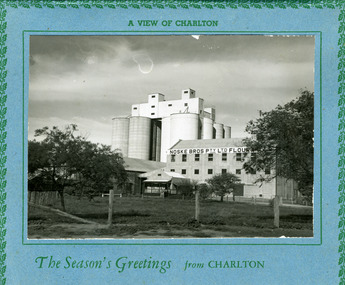
... In 1977, the **Grain Elevators Board** took over the site as a grain receival depot, building a large elevator tower that surpassed the height of the original buildings. ...In 1977, the **Grain Elevators Board** took over the site as a grain receival depot, building a large elevator tower that surpassed the height of the original buildings. ...Eight silos added in 1940s. Noske's Flour Mill, with its commanding presence and towering silos, has long **dominated the Charlton skyline** and remains a significant landmark, even though it no longer mills flour. The mill's history is deeply intertwined with the development of Charlton and the grain industry of the surrounding district. The foundation for the mill's presence was laid in 1919 when Messrs Noske Bros. Pty. Ltd., already owning mills in Horsham, Nhill, and Murray Bridge, acquired G. H. Foreman’s Mill located by the Avoca River. The founder, **T. J. Noske**, was an early pioneer of flour exporting, expanding his milling business after unexpectedly acquiring the Horsham mill. ### A State-of-the-Art Operation The original mill by the river operated until August 1926 before being closed and dismantled. Plans were well underway for a **new, state-of-the-art mill** to be located at the former Cobb and Co site. In 1927, the new mill began operation. It was one of the largest in the state, boasting a capacity of three tons of flour per hour, a 250 h.p. diesel engine, and three initial silos. The mill quickly gained a reputation for **excellence** for both its design and its flour, which was sold successfully in local and overseas markets. ### Periods of Expansion and Trial The mill continued to grow, reflecting the importance of the local agricultural industry. Between 1940 and 1941, **nine new silos** were built, adding bulk receival points. In the record-breaking 1968 season, the mill received a colossal wheat intake of **695,000 bushels**. However, the mill also faced setbacks. On January 21, 1949, disaster struck when a **large fire** erupted in the storage shed, which contained 500 tons of bagged flour ready for export and new flour bags. The blaze was so intense that smoke was visible as far away as Wycheproof, and it threatened to destroy the entire mill. Thanks to the monumental efforts of the Charlton, St. Arnaud, Wycheproof, and Wedderburn Brigades, who ran the main pump almost continuously for 26 hours, the damage was contained, though the estimated loss was a substantial £60,000. ### Transformation of the Site At its peak, the mill was a major employer, providing work for approximately 65–70 men. But after over 45 years of operation, flour production at the mill ceased on October 25, 1973. Noske Industries Ltd. sought to adapt, converting the operation to a less successful stock feed production centre. In 1977, the **Grain Elevators Board** took over the site as a grain receival depot, building a large elevator tower that surpassed the height of the original buildings. The site eventually returned to private hands and, since 2000, has been owned and operated as a primary grain receival site for **GrainCorp**, cementing its continued, vital role in Charlton's agricultural life.Large landscape black and white photo set on a blue card backing. The card has a green holly leaf pattern embossed on the edge.A view of Charlton. The Season's Greetings from Charlton.charlton, noske bros, noske's, flour mill -
 Charlton Golden Grains Museum Inc
Photograph - Lithograph, Rider & Mercer, Views of Charlton
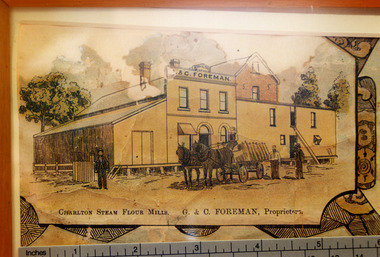
... In 1977, the **Grain Elevators Board** took over the site as a grain receival depot, building a large elevator tower that surpassed the height of the original buildings. ...In 1977, the **Grain Elevators Board** took over the site as a grain receival depot, building a large elevator tower that surpassed the height of the original buildings. ...Close up photograph of part of the Charlton Lithograph showing the Charlton Steam Power Flour Mill of G & C Foreman. Located in on the bank of the Avoca river. The mill owners attempted to dam the river during the 1870s. The mill was built in 1876 as recorded by the local traveling correspondent . Foreman's flour mill established 1876 at the west end of High Street. Sold to Norske in 1925. Replaced by Noske's Flour Mill on Kays Street in 1927. Noske's Flour Mill, with its commanding presence and towering silos, has long **dominated the Charlton skyline** and remains a significant landmark, even though it no longer mills flour. The mill's history is deeply intertwined with the development of Charlton and the grain industry of the surrounding district. The foundation for the mill's presence was laid in 1919 when Messrs Noske Bros. Pty. Ltd., already owning mills in Horsham, Nhill, and Murray Bridge, acquired G. H. Foreman’s Mill located by the Avoca River. The founder, **T. J. Noske**, was an early pioneer of flour exporting, expanding his milling business after unexpectedly acquiring the Horsham mill. ### A State-of-the-Art Operation The original mill by the river operated until August 1926 before being closed and dismantled. Plans were well underway for a **new, state-of-the-art mill** to be located at the former Cobb and Co site. In 1927, the new mill began operation. It was one of the largest in the state, boasting a capacity of three tons of flour per hour, a 250 h.p. diesel engine, and three initial silos. The mill quickly gained a reputation for **excellence** for both its design and its flour, which was sold successfully in local and overseas markets. ### Periods of Expansion and Trial The mill continued to grow, reflecting the importance of the local agricultural industry. Between 1940 and 1941, **nine new silos** were built, adding bulk receival points. In the record-breaking 1968 season, the mill received a colossal wheat intake of **695,000 bushels**. However, the mill also faced setbacks. On January 21, 1949, disaster struck when a **large fire** erupted in the storage shed, which contained 500 tons of bagged flour ready for export and new flour bags. The blaze was so intense that smoke was visible as far away as Wycheproof, and it threatened to destroy the entire mill. Thanks to the monumental efforts of the Charlton, St. Arnaud, Wycheproof, and Wedderburn Brigades, who ran the main pump almost continuously for 26 hours, the damage was contained, though the estimated loss was a substantial £60,000. ### Transformation of the Site At its peak, the mill was a major employer, providing work for approximately 65–70 men. But after over 45 years of operation, flour production at the mill ceased on October 25, 1973. Noske Industries Ltd. sought to adapt, converting the operation to a less successful stock feed production centre. In 1977, the **Grain Elevators Board** took over the site as a grain receival depot, building a large elevator tower that surpassed the height of the original buildings. The site eventually returned to private hands and, since 2000, has been owned and operated as a primary grain receival site for **GrainCorp**, cementing its continued, vital role in Charlton's agricultural life.Colour photo taken of a small portion of the Charlton Lithograph. Showing the Charlton Steam Flour Mill of G. C. Foreman.Charlton Steam Flour Mills. G & C Foreman proprietors.lithograph, business, industry, charlton, flour mill, noske bros, foreman -
 Charlton Golden Grains Museum Inc
Photograph, c.1948
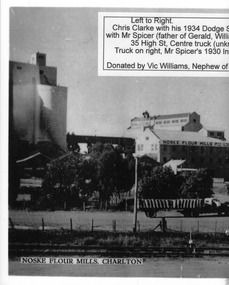
... In 1977, the **Grain Elevators Board** took over the site as a grain receival depot, building a large elevator tower that surpassed the height of the original buildings. ...In 1977, the **Grain Elevators Board** took over the site as a grain receival depot, building a large elevator tower that surpassed the height of the original buildings. ...Black and white photo copied and enlarged from small photo which was part of a set produced in c.1948. Chris Clarke with his 1934 Dodge semi trailer and W Spicer in his 1930 International truck line up to unload wheat at Noske's mill. Noskes flour mill built in 1927 with extra silos added in 1940's.Photo enlarged by Vic Williams of Bendigo nephew of Chris Clarke transport driver. Noske's Flour Mill, with its commanding presence and towering silos, has long **dominated the Charlton skyline** and remains a significant landmark, even though it no longer mills flour. The mill's history is deeply intertwined with the development of Charlton and the grain industry of the surrounding district. The foundation for the mill's presence was laid in 1919 when Messrs Noske Bros. Pty. Ltd., already owning mills in Horsham, Nhill, and Murray Bridge, acquired G. H. Foreman’s Mill located by the Avoca River. The founder, **T. J. Noske**, was an early pioneer of flour exporting, expanding his milling business after unexpectedly acquiring the Horsham mill. ### A State-of-the-Art Operation The original mill by the river operated until August 1926 before being closed and dismantled. Plans were well underway for a **new, state-of-the-art mill** to be located at the former Cobb and Co site. In 1927, the new mill began operation. It was one of the largest in the state, boasting a capacity of three tons of flour per hour, a 250 h.p. diesel engine, and three initial silos. The mill quickly gained a reputation for **excellence** for both its design and its flour, which was sold successfully in local and overseas markets. ### Periods of Expansion and Trial The mill continued to grow, reflecting the importance of the local agricultural industry. Between 1940 and 1941, **nine new silos** were built, adding bulk receival points. In the record-breaking 1968 season, the mill received a colossal wheat intake of **695,000 bushels**. However, the mill also faced setbacks. On January 21, 1949, disaster struck when a **large fire** erupted in the storage shed, which contained 500 tons of bagged flour ready for export and new flour bags. The blaze was so intense that smoke was visible as far away as Wycheproof, and it threatened to destroy the entire mill. Thanks to the monumental efforts of the Charlton, St. Arnaud, Wycheproof, and Wedderburn Brigades, who ran the main pump almost continuously for 26 hours, the damage was contained, though the estimated loss was a substantial £60,000. ### Transformation of the Site At its peak, the mill was a major employer, providing work for approximately 65–70 men. But after over 45 years of operation, flour production at the mill ceased on October 25, 1973. Noske Industries Ltd. sought to adapt, converting the operation to a less successful stock feed production centre. In 1977, the **Grain Elevators Board** took over the site as a grain receival depot, building a large elevator tower that surpassed the height of the original buildings. The site eventually returned to private hands and, since 2000, has been owned and operated as a primary grain receival site for **GrainCorp**, cementing its continued, vital role in Charlton's agricultural life.Black and white photo copied and enlarged from small photo.charlton, flour mill, noske's, noske bros -
 Charlton Golden Grains Museum Inc
Photograph, c.1948
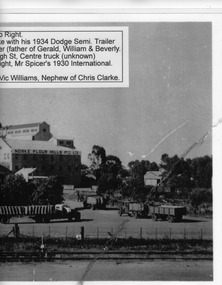
... In 1977, the **Grain Elevators Board** took over the site as a grain receival depot, building a large elevator tower that surpassed the height of the original buildings. ...In 1977, the **Grain Elevators Board** took over the site as a grain receival depot, building a large elevator tower that surpassed the height of the original buildings. ...Black and white photo copied and enlarged from small photo which was part of a set produced in c.1948. Chris Clarke with his 1934 Dodge semi trailer and W Spicer in his 1930 International truck line up to unload wheat at Noske's mill. Noskes flour mill built in 1927 with extra silos added in 1940's. Photo enlarged by Vic Williams of Bendigo nephew of Chris Clarke transport driver. Noske's Flour Mill, with its commanding presence and towering silos, has long **dominated the Charlton skyline** and remains a significant landmark, even though it no longer mills flour. The mill's history is deeply intertwined with the development of Charlton and the grain industry of the surrounding district. The foundation for the mill's presence was laid in 1919 when Messrs Noske Bros. Pty. Ltd., already owning mills in Horsham, Nhill, and Murray Bridge, acquired G. H. Foreman’s Mill located by the Avoca River. The founder, **T. J. Noske**, was an early pioneer of flour exporting, expanding his milling business after unexpectedly acquiring the Horsham mill. ### A State-of-the-Art Operation The original mill by the river operated until August 1926 before being closed and dismantled. Plans were well underway for a **new, state-of-the-art mill** to be located at the former Cobb and Co site. In 1927, the new mill began operation. It was one of the largest in the state, boasting a capacity of three tons of flour per hour, a 250 h.p. diesel engine, and three initial silos. The mill quickly gained a reputation for **excellence** for both its design and its flour, which was sold successfully in local and overseas markets. ### Periods of Expansion and Trial The mill continued to grow, reflecting the importance of the local agricultural industry. Between 1940 and 1941, **nine new silos** were built, adding bulk receival points. In the record-breaking 1968 season, the mill received a colossal wheat intake of **695,000 bushels**. However, the mill also faced setbacks. On January 21, 1949, disaster struck when a **large fire** erupted in the storage shed, which contained 500 tons of bagged flour ready for export and new flour bags. The blaze was so intense that smoke was visible as far away as Wycheproof, and it threatened to destroy the entire mill. Thanks to the monumental efforts of the Charlton, St. Arnaud, Wycheproof, and Wedderburn Brigades, who ran the main pump almost continuously for 26 hours, the damage was contained, though the estimated loss was a substantial £60,000. ### Transformation of the Site At its peak, the mill was a major employer, providing work for approximately 65–70 men. But after over 45 years of operation, flour production at the mill ceased on October 25, 1973. Noske Industries Ltd. sought to adapt, converting the operation to a less successful stock feed production centre. In 1977, the **Grain Elevators Board** took over the site as a grain receival depot, building a large elevator tower that surpassed the height of the original buildings. The site eventually returned to private hands and, since 2000, has been owned and operated as a primary grain receival site for **GrainCorp**, cementing its continued, vital role in Charlton's agricultural life.Black and white photocharton, business, noske bros, flour mill -
 Victorian Interpretive Projects Inc.
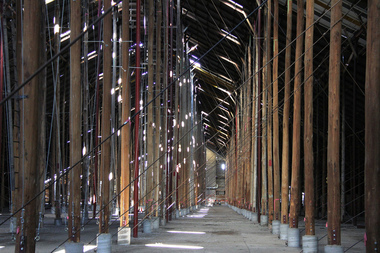
Photograph - digital, LJ Gervasoni, Murtoa Stick Shed 00031, 13/08/2011
... Following its establishment in 1935 the Victorian Grain Elevators Board (GEB) planned a network of 160 concrete silos in country locations, connected by rail to the shipping terminal at Geelong. ...Following its establishment in 1935 the Victorian Grain Elevators Board (GEB) planned a network of 160 concrete silos in country locations, connected by rail to the shipping terminal at Geelong. ...From the Victorian Heritage Register statement of significance H0791 The Marmalake/Murtoa Grain Store, originally the No.1 Murtoa Shed, is located within the Murtoa Grain Terminal, adjacent to the grain elevator tower and railway line. The shed is 280m long, 60m wide and 19m high at the ridge with a capacity of 3.4 million bushels. The hipped corrugated iron roof of the shed is supported on approximately 600 unmilled hardwood poles set in a concrete slab floor and braced with iron tie rods. These poles are the reason for use of the term "stick shed". With its vast gabled interior and the long rows of poles the space has been likened to the nave of a cathedral. An elevator at one end took wheat from railway trucks to ridge level where it was distributed by conveyor along the length of the shed, creating a huge single mound of grain. Braced internal timber bulkheads on either side took the lateral thrust of the wheat, and conveyors at ground level outside the bulkheads took wheat back to the elevator for transport elsewhere. Wheat had been handled in jute bags from the start of the Victorian wheat industry in the mid nineteenth century. Bulk storage had been developed in North America from the early 1900s. NSW began building substantial concrete silos from 1920-21. In Western Australia, farmers' co-operatives, who had to supply their own bulk storage from 1934-5, pioneered the use of low-cost horizontal sheds of timber and corrugated iron for bulk storage. Following its establishment in 1935 the Victorian Grain Elevators Board (GEB) planned a network of 160 concrete silos in country locations, connected by rail to the shipping terminal at Geelong. By the outbreak of the Second World War there was a worldwide glut of wheat, and Australia soon had a massive surplus which it was unable to export. Only 48 silos had been established under the Victorian Silo Scheme so far, and wartime material and labour restrictions prevented progress with this scheme. The storage deficit had become an emergency by 1941 as Britain obtained its imports from North America, rather than over the lengthy and difficult shipping route from Australia. In 1941 the GEB, under chairman and general manager Harold Glowrey, proposed large temporary versions of the horizontal bulk storage sheds already in use in Western Australia. The proposal was approved by the Victorian Wheat and Woolgrowers Association, who considered the use of shed storages as a longer term proposition. After initial resistance from the Australian Wheat Board, some of whose members represented wheat bagging interests, the Commonwealth and Victorian governments agreed to split the costs, and Murtoa was chosen as a suitable site for the first emergency storage. The main contractor, Green Bros, commenced work on the No.1 Murtoa Shed in September 1941, deliveries of bulk wheat began in January 1942, and the store was full by June of the same year. In the following years the Council for Scientific and Industrial Research (later CSIRO) conducted valuable research and experiment on the impacts and control of insect pests at the Murtoa No.1 shed. With these discoveries, and the development of more effective pesticides, use of the No.1 shed and the larger No.2 shed, erected in 1942/43, continued for many years. The No.2 shed was demolished in 1975. By the 1990s, pest resistance to pesticides and requirements for both pest free and insecticide free grain rendered open storage of this type unviable. The No. 1 store was also becoming increasingly expensive to maintain, and its use was phased out from 1989.Image of the Marmalake/Murtoa Grain Store which is of historical, architectural, scientific (technical) and social significance to the State of VictoriaDigital colour image of the interior of the Marmaduke . Murtoa grain storage facility better known as the Stick Shed. The shed was constructed in World War Two to store grain. The supporting columns are trees.marmalake, murtoa grain store, wheat store, stick shed, murtoa -
 Sunshine and District Historical Society Incorporated
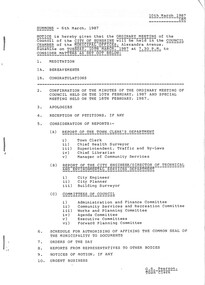
Administrative record - City of Sunshine Council Meetings 1986 - 1994 - Notice of Ordinary Meeting 10th March 1987, City of Sunshine, 6th March 1987
... Albans Plan of Surrender of Easement 592 Western Highway (Ballarat Road) Albion Report of the Building Surveyor Show Cause Notice 24 Chicago Street Maribyrnong Above Ground Tank Grain Elevators Board Sunshine Terminal Wright Street Sunshine Show Cause Notice 15 Beech Court Sunshine West Beech Court 32 Knight Avenue Sunshine North Siting of Open Garage 8 Diamond Avenue Albanvale Show Cause Notice Beech Court 9 Apollo Place Ardeer Show Cause Notice 154 Neale Road Deer Park Show Cause Notice 28 Cleveland Street St. ...Albans Plan of Surrender of Easement 592 Western Highway (Ballarat Road) Albion Report of the Building Surveyor Show Cause Notice 24 Chicago Street Maribyrnong Above Ground Tank Grain Elevators Board Sunshine Terminal Wright Street Sunshine Show Cause Notice 15 Beech Court Sunshine West Beech Court 32 Knight Avenue Sunshine North Siting of Open Garage 8 Diamond Avenue Albanvale Show Cause Notice Beech Court 9 Apollo Place Ardeer Show Cause Notice 154 Neale Road Deer Park Show Cause Notice 28 Cleveland Street St. ...Notice of Ordinary Meeting 10th March 1987 Report of the Town Clerk's Department Report of the Town Clerk Accounts for Payment as at 15th February 1987 The New Western Independent Newspaper to Replace the Now Closed Western Independent Newspaper Request to Use Roadways Essendon District Tri-Antulas Triathlon Club Chifley Drive and Coulson Gardens Heart Health Awareness Programme National Hearth Foundation of Australia Lease of Council Land to Sunshine & District Helping Hand Association Furlong Road Australia Post Municipal Association of Victoria (M.A.V.) Chief Executive Officer St. John Ambulance Land for Headquarters Notice of Motion Possible Locations Fraser Street Bus Depot, Land Adjacent to Deer Park Club, Land Adjacent to Sunshine Ambulance Station Westmoreland Road, Sassella Park & George Street Ports & Harbour Development Notice of Motion Rate Recovery Sale Lot 204 George Street Maidstone Nuclear Free Zone Local Authorities Conference Perugia Italy October 1986 Loan 177 Refinancing of Loan 163 Sunshine Community Committee Bicentenary 1988 Municipal Representation on the Melbourne & Metropolitan Board of Works Vesting of Crown Land Reserves in Council More Park & Pennell Reserve Roads & Streets Trading Occupational Health and Safety Domiciliary Workers Workcare Family Day Care Scheme Loan 179 Discontinued Road Reserve and Right of Way East of Beachley Street North of Turner Crescent Braybrook Discontinued Right of Way Between Anderson Road, Durham Road, Derby Road and Graham Street Sunshine Report of Chief Health Surveyor Registration of Premises Health Act & Food Act Registration Transfers Health Act & Food Act Prosecution Proceedings Sunshine Magistrates Court Use of Property 11 Davey Street Sunshine West Report of the Superintendent Traffic & By-Laws Court Proceedings Sunshine Magistrates Court ANZAC Commemoration March Change of Name St. Albans Special School to Furlong Park School & Pre-School Centre Change of Name Highpoint West Post Office to Highpoint City Post Office Proposed Procession Scout Association of Australia by Sunshine District Report of the Chief Librarian History of Sunshine by Prue McGoldrick Commonwealth Assistance for Public Libraries (CAPLS) Campaign Sunshine Art Collection 3WRB Community Radio Station Report of the Acting Manager Community Services Disability Services Programme Bridging the Gap Project Change in Method of Calculation CEP DEIR Region sponsor Contribution Fresh start in the Park Braybrook - Maidstone Community Health Centre Neighborhood Watch Appeal Against Council Decision Regarding Holiday Programme West Sunshine Castley Hall Redevelopment Committee Marie Mill Community Centre Purchase of Equipment Marie Mill Community Centre Sunshine West Community Centre Sunshine West Community Centre Management Committee Marie Mill Community Centre Minutes of Meeting Home & Community Care Program Home Help Grant Ceiling 1986/87 Report of the City Engineer Smorgan Consolidated Industries New Development Waste Disposal Proposed New Tip Jones Road Brooklyn Braybrook - Maidstone Public Tenants Union Community Bus Maintenance House of Sunshine Additions & Alterations Corio Street and Watt Street Portable Changerooms Chaplin Reserve Anderson Road Sunshine Development of Billingham Reserve Deer Park Notice of Motion Proposed Footscray Institute of Technology Sciences Park Renovations and Restoration of The Hunt Club Ballarat Road Deer Park Maribyrnong Viaduct Fencing Pedestrian Operated Signals Ballarat Road (East of Leonard Street) Sunshine Installation of Audio Tactile Pedestrian Facility Quinn Street Private Street Scheme Variations Deer Park Certificate of Completion Quinn Street Private Street Scheme Deer Park Metropolitan Street Name Signing Programme Traffic Control Items Tenders Two Amenities Caravan Proposed Alterations to Existing Separators and Medians in Geelong Road Between Holmwood Road and Somerville Road Brooklyn New Sunshine Fire Station McIntyre Road (East & West) Parking Prohibition Sunshine North Stanford Street (East Side) 90 Degree Angle Parking Sunshine Quinn Street Private Street Scheme Stage 2 Deer Park Proposed Lease of Railway Land off Anderson Road Sunshine Tenders for Fencing Station Road Deer Park Proposed Car Park on Railway Land Lot 2 St. Albans Road St. Albans Station Road Widening Gladstone Street to Furlong Road St. Albans Paramount Road / Somerville Road Intersection Fairbairn Road Private Street Scheme Sunshine West Report of the City Planner Enforcement of Metropolitan Planning Scheme Inspection of Use of Property 11 Davey Street Ardeer Planning Permit Application Truck Parking 18 Baynton Avenue Sunshine North Planning Permit Application Truck Parking 22 Baynton Avenue Sunshine North Planning Permit Application Truck Parking 24 Baynton Avenue Sunshine North Planning Permit Application Factory Lot 10 Tottenham Parade Brooklyn Planning Permit Application Enforcement of the Planning Scheme Amusement Parlour 113 Durham Road Sunshine Maribyrnong Advisory Committee Rezoning Land West of Kororoiit Creek and North of the Western Highway Shire of Melton Planning Permit Application Car Park Lot 53 Cromer Avenue Sunshine North Planning Permit Application Extension of Place of Assembly Dutch Australian Community Council 96 Cromer Avenue Sunshine North Planning Permit Application Health Centre 57 Dickson Street Sunshine Planning Permit Recreation Centre Lot 2 McKechnie Street North East Corner of Gratz Street St. Albans Planning Permit Application Double Sided Promotional Panel Sign Sunshine Road Tottenham Planning Permit Application Double Sided Promotional Panel Sign Sunshine Road Tottenham Planning Permit Application Double Sided Promotional Panel Sign Tilburn Road Deer Park Planning Permit Application Extension to Existing Shops 87 - 89 McIntyre Road Sunshine North Planning Permit Application Convenience Shop, Petrol Filling Station Restaurant, 10 Cinema Complex and Medical Centre 2/72 Neale Road Deer Park Planning Permit Application Alterations to Flats Lot 4 to 8 The Gables Albion Planning Permit Application Motel / Restaurant and Caretaker's Residence Lots 3 & 4 Ballarat Road North West Corner Miles Street Deer Park Planning Permit Application Motor Repair Station 58 Omar Street Maidstone Sunshine District Centre Road Works Planning Permit Application Livestock Sale Yards 690 Geelong Road North East Corner Old Geelong Road Brooklyn Planning Permit Application Private Rubbish Tip Associated Quarries Pty Ltd Market Road Quarry Market Road Sunshine Delegated Matters Removal of Easement Lot 21 Camperdown Avenue and Lot 22 Cary Street Sunshine North Plan of Subdivision Corner Robinsons Road and Ballarat Road Deer Park Plan of Proposed Strata Subdivision 1 White Street Maribyrnong Plan of Consolidation F.B. Transport Amanda Road Tottenham Plan of Consolidation Smogan Consolidated Industries Somerville Road Footscray West Plan of Consolidation Lots 5 & 6 McIntyre Road Sunshine North Plan of Consolidation Lots 1 & 2 Adams Street South East Corner Disraeli Street St. Albans Plan of Consolidation lots 4 & 5 Jefferson Street South West Corner Disraeli Street St. Albans Plan of Strata Subdivision lot 2 Corner McKechnie Street and Gratz Street St. Albans Plan of Surrender of Easement 592 Western Highway (Ballarat Road) Albion Report of the Building Surveyor Show Cause Notice 24 Chicago Street Maribyrnong Above Ground Tank Grain Elevators Board Sunshine Terminal Wright Street Sunshine Show Cause Notice 15 Beech Court Sunshine West Beech Court 32 Knight Avenue Sunshine North Siting of Open Garage 8 Diamond Avenue Albanvale Show Cause Notice Beech Court 9 Apollo Place Ardeer Show Cause Notice 154 Neale Road Deer Park Show Cause Notice 28 Cleveland Street St. Albans Show Cause Notice 1D Bell Street Sunshine West Show Cause Notice 7 Nova Avenue Deer Park Dangerous Building 16 Cypress Avenue Brooklyn Show Cause Notice 25 Chatsworth Avenue Ardeer Show Cause Notice 11 Concord Circuit Albanvale Show Cause Notice 50 Ford Avenue Sunshine North Show Cause Notice 553 Geelong Road Brooklyn Show Cause Notice 40 Joan Street Ardeer Show Cause Notice 49 Denton Avenue St. Albans Show Cause Notice 41 Mulhall Drive St. Albans Show Cause Notice 1 White Street Maribyrnong Show Cause Notice 74 Ford Avenue Sunshine North Show Cause Notice 11 Davey Street Sunshine West Schedule for Authorising of Affixing the Common Seal of the Municipality to Documents Orders of the Day West Sunshine Community Centre Show Cause Notice 19 Second Avenue Sunshine Show Cause Notice 34 Harris Street St. Albans Confidential Report Council Polices Consideration of a Petition on behalf of 45 Residents of Maribyrnong in Relation to Objecting to the Establishment of a Night Club at the Angler's Hotel Notice of Motions Sunshine Leisure Centre Contingency Account Cleaning Kerb & Channel and Drainage Pits Referendum Ceding of Brooklyn to Altona Road Surface Maintenance Management of Child Care Centres Financial Return Child Care Centres Finance Manager Council Auspiced Services Removal of Rubbish 2 Derrimut Street Albion Slogan Sunshine Multicultural City of Victoria Sand & Dust Menace Corner Sunshine Avenue and McIntyre Road Sunshine North 125 Durham Road Sunshine Traffic lights Corner McIntyre Road, Furlong Road and Berkshire Road Sunshine North Deer Park Football Club Pavilion Nuclear Free Zones Palm Sunday Peace Celebrations Seed Patenting and Plant Variety Rights Toxic Waste Disposal Facilityessendon district tri-antulas triathlon club, chifley drive, coulson gardens, maribyrnong, sunshine & district helping hand association, furlong road, sunshine north, fraser street, deer park club, westmoreland road, sassella park, george street, sunshine, ballarat road, deer park, more park, esmond street, ardeer, pennell reserve, burke street, braybrook, beachley street, turner crescent, anderson road, durham road, derby road, graham street, davey street, st. albans special school, furlong park school & pre-school centre, highpoint west post office, highpoint city post office, 3wrb community radio station, braybrook - maidstone community health centre, marie mill community centre, randall street, sunshine west community centre, kermeen street, sunshine west, smorgan consolidated industries, jones road, brooklyn, braybrook - maidstone public tenants union, house of sunshine, corio street, watt street, chaplin reserve, billingham reserve, the hunt club, leonard street, the hunt club hotel, quinn street, holmwood road, somerville road, sunshine fire station, mcintyre road, stanford street, station road, st. albans road, st. albans, paramount road, fairbairn road, baynton avenue, tottenham parade, kororoiit creek, western highway, cromer avenue, dutch australian community council, dickson street, mckechnie street, gratz street, sunshine road, tottenham, tilburn road, neale road, the gables, albion, miles street, omar street, maidstone, geelong road, old geelong road, associated quarries, market road, camperdown avenue, cary street, robinsons road, white street, amanda road, adams street, disraeli street, jefferson street, chicago street, wright street, beech court, knight avenue, diamond avenue, albanvale, apollo place, cleveland street, bell street, nova avenue, cypress avenue, chatsworth avenue, concord circuit, ford avenue, joan street, denton avenue, mulhall drive, second avenue, harris street, angler's hotel, anglers way, derrimut street, sunshine avenue, berkshire road, deer park football club, john mcleod reserve
