
Showing 53 items matching "gramophone needles"
-
 Greensborough Historical Society
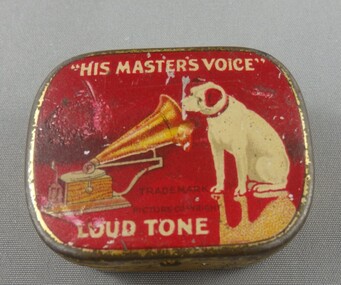
Gramophone Needles, His master's voice, His Master's Voice Gramophone needles in tin, 1950c
... Gramophone Needles...His Master's Voice Gramophone needles in tin.......gramophone needles...Gramophone needles (stylus) used in gramophones which played 78 rpm shellac records. ...Metal box containing brass gramophone needles..."His Master's Voice" Loud tone English gramophone needles, manufactured for the Gramophone Company Limited, Sydney N. ...Metal box containing brass gramophone needles His Master's Voice Gramophone needles in tin. ...Gramophone needles (stylus) used in gramophones which played 78 rpm shellac records. Tin has the His Masters Voice dog on lid.Metal box containing brass gramophone needles"His Master's Voice" Loud tone English gramophone needles, manufactured for the Gramophone Company Limited, Sydney N. S. W.his masters voice, styluses (audio), gramophone needles -
 Warrnambool and District Historical Society Inc.
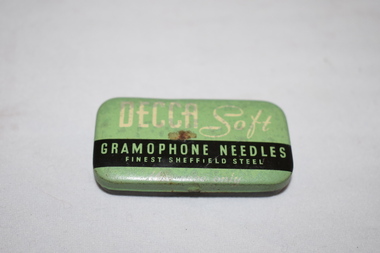
Gramophone Needles, Tin of Gramophone Needles, 1940s
... Gramophone Needles...Tin of Gramophone Needles...This tin of gramophone needles was produced to be used in conjunction with a Decca Gramophone. ...Inside the tin is black paper lining and inside the lining are about 50 gramophone steel needles. This is not a full tin. The needles are in good condition but the tin is a little rusty...‘Decca Soft Gramophone Needles Finest Sheffield Steel Use Once Only’ ...This tin of gramophone needles was produced to be used in conjunction with a Decca Gramophone. ...This tin of gramophone needles was produced to be used in conjunction with a Decca Gramophone. The Decca company was founded in 1914 by Barnett Samuel and Sons and their gramophone as patented as the world’s first portable gramophone. The company became known as the Decca Gramophone Company in 1928. Portable gramophones became very popular, especially with the soldiers in World War One. Today the gramophone is largely a collector’s item and has been replaced by more sophisticated sound systems. These needles and their box are of interest as an example of a recreation product in the past. Gramophones were found extensively in homes up to the 1950s. This is a small rectangular-shaped tin with rounded edges. It has a hinged lid painted green on the top. The top has printed material in green, black and white lettering. Inside the tin is black paper lining and inside the lining are about 50 gramophone steel needles. This is not a full tin. The needles are in good condition but the tin is a little rusty‘Decca Soft Gramophone Needles Finest Sheffield Steel Use Once Only’ gramophones, history of warrnambool -
 Warrnambool and District Historical Society Inc.
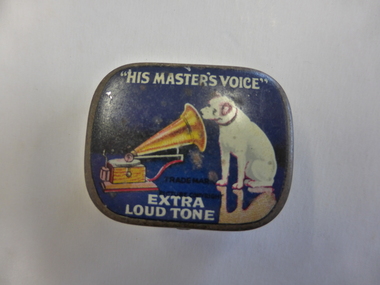
Tins, Gramophone Needles HMV, Early and mid 20th century
... Gramophone Needles HMV...gramophone needles...These gramophone needles were manufactured by The Gramophone Company Limited for use in gramophones that had an arm in which to insert a needle to play an old shellac record. ...Inside the tin are about 150 metal gramophone needles, most of them being a little rusted. ....1 Front of box: ‘His Master’s Voice, Extra Loud Tone’ Back of box: Approximately 200 English gramophone needles manufactured by The Gramophone Company Limited, Sydney, Australia’. ...These gramophone needles were manufactured by The Gramophone Company Limited for use in gramophones that had an arm in which to insert a needle to play an old shellac record. ...These gramophone needles were manufactured by The Gramophone Company Limited for use in gramophones that had an arm in which to insert a needle to play an old shellac record. The Gramophone Company was an early recording company based in the United Kingdom and was the parent organization for the His Master’s Voice label of recording devices. The company was founded in 1897 and merged in 1931 with another company to form E.M.I. (Electric and Musical Industries) but the name The Gramophone Company continued in Britain until the 1970s. Gramophones were a popular household item from the late 19th century until the mid 20th century when more sophisticated recording and playing devices were invented. These gramophone needles is of some interest as an example of entertainment devices of the past. It will be useful for display. .1This is a metal box with a lid containing an image of a dog and a phonograph (‘His Master’s Voice’) painted in white and brown on a dark blue background. Inside the tin are about 150 metal gramophone needles, most of them being a little rusted. The needles are covered with a sheet of brown paper with yellow printing. The tin itself is rusted and the printing is discoloured. There is a paper sticker on the back of the box with an early catalogue number (almost obliterated). .2 Small rectangular plastic container with picture of white polar bear with blue background. It contains approximately 30 needles which have red ends and silver points. .3 small plastic bag with a number of needles..1 Front of box: ‘His Master’s Voice, Extra Loud Tone’ Back of box: Approximately 200 English gramophone needles manufactured by The Gramophone Company Limited, Sydney, Australia’. Inside: ‘Use each point once only’ (printed twice). .2 50 semi- permanent needles on front of box. On bottom Made in Germany. gramophone needles, warrnambool, e.m.i., electric and musical industries -
 Orbost & District Historical Society
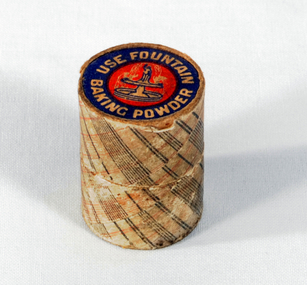
gramophone needles
... gramophone needles...gramophone-needles audio his-master's-voice...One small "His Master's Voice" tin of gramophone needles. One small round baking powder box of gramophone needles....One small round baking powder box of gramophone needles. gramophone needles The Gramophone Company Ltd ...One small "His Master's Voice" tin of gramophone needles. One small round baking powder box of gramophone needles.Tin lid - His Masters voice Loud Tone Round lid - Use Fountain Baking Powdergramophone-needles audio his-master's-voice -
 Emerald Museum & Nobelius Heritage Park
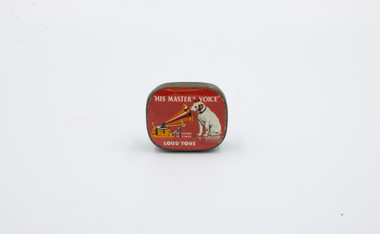
Container - Tin for Gramophone Needles, The Gramophone Company Limited, 1899 - c. 1931
... Tin for Gramophone Needles...It is unclear exactly when the artwork began to appear on gramophone needles. This specific tin was almost certainly made between 1899 - when the trademark was acquired - and 1931, when the Gramophone Company merged with the English Columbia Graphophone Company to form Electric and Musical Industries Ltd (EMI). ...The red background is punctuated by white lettering, announcing the brand name and type of gramophone needle inside - 'Loud Tone'. The exposed metallic surface elsewhere on the tin is heavily tarnished everywhere except for parts of the bottom of the tin (which may have been exposed less than the rest of the tin if it was stored face-up). ...Front: " "HIS MASTER'S VOICE" / REGISTERED / TRADE MARK / LOUD TONE" Stop Side: "MADE IN Gt BRITAIN" Reverse: "APPROXIMATELY / 200 ENGLISH / GRAMOPHONE / NEEDLES / THE GRAMOPHONE / COMPANY LIMITED"...Container Tin for Gramophone Needles The Gramophone Company Limited ...The Gramophone Company Limited acquired Francis Barraud's 1898 "His Master's Voice" artwork in 1899, after Edison Bell manager James Hough declined to purchase the artwork by stating that "dogs don't listen to phonographs." William Barry Owen of the Gramophone Company purchased the trademark on the condition that the original phonograph be replaced with a gramophone, and began using the artwork first in catalogues and gramophone machines, and in 1909 on record labels. It is unclear exactly when the artwork began to appear on gramophone needles. This specific tin was almost certainly made between 1899 - when the trademark was acquired - and 1931, when the Gramophone Company merged with the English Columbia Graphophone Company to form Electric and Musical Industries Ltd (EMI). However, the Gramophone Company was still used in some cases after this point, so it is not impossible that this tin could come from later. Gramophone needles were typically worn out after only one or a few uses, necessitating the purchasing of tins like this one filled with hundreds of needles to allow for constant replacements. "His Master's Voice" was an iconic brand in Australia for much of the 20th century, from the time of the Gramophone Company (when gramophones were still in use) through the subsequent EMI and HMV brands and the popularity of record players.This small tin is decorated with a red-painted lid surface, depicting Nipper the dog - an iconic symbol of the company - curiously looking into a gramophone. The red background is punctuated by white lettering, announcing the brand name and type of gramophone needle inside - 'Loud Tone'. The exposed metallic surface elsewhere on the tin is heavily tarnished everywhere except for parts of the bottom of the tin (which may have been exposed less than the rest of the tin if it was stored face-up). There is also partly faded, black lettering on the bottom of the tin, and a label on the stop side (opposite the hinge). The tin opens with a hinge, though it is now quite difficult to open. The inside of the tin is empty and undecorated, with similarly tarnished metallic surfaces.Front: " "HIS MASTER'S VOICE" / REGISTERED / TRADE MARK / LOUD TONE" Stop Side: "MADE IN Gt BRITAIN" Reverse: "APPROXIMATELY / 200 ENGLISH / GRAMOPHONE / NEEDLES / THE GRAMOPHONE / COMPANY LIMITED"music, 20th century -
 Mont De Lancey
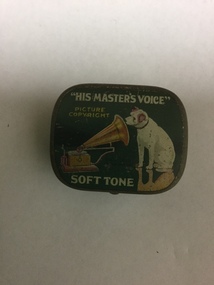
Gramophone needles, Gramophone Co. Ltd
... Gramophone needles...Green tin with picture of dog and gramophone on front, containing approximately 200 English gramophone needles. Used in gramophones which played 78 rpm shellac records....Gramophone needles Gramophone Co. Ltd. ...His Masters Voice - Soft tone.Green tin with picture of dog and gramophone on front, containing approximately 200 English gramophone needles. Used in gramophones which played 78 rpm shellac records.styluses (audio), gramophones -
 Greensborough Historical Society
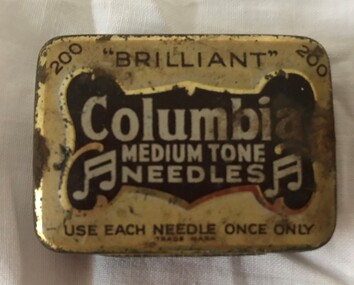
Gramophone Needles, Columbia medium tone needles, 1950s
... Gramophone Needles...These single-use gramophone needles were used for playing acetone/lacquer discs...These single-use gramophone needles were used for playing acetone/lacquer discs "Brilliant Columbia medium tone needles. ...These single-use gramophone needles were used for playing acetone/lacquer discsHinged tin, lid painted in cream, brown and gold, containing 20 stainless steel needles"Brilliant Columbia medium tone needles. Use each needle once only" -
 Flagstaff Hill Maritime Museum and Village
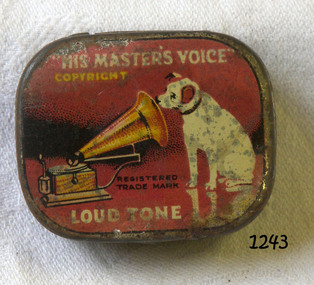
Gramophone needles
... Gramophone needles...Gramophone needles container for 1 time use only."...Colour mainly red. Gramophone needles ...Gramophone needles container for 1 time use only."His Majesty's Voice" copyright Loud Tone. Has hinge lid. Top of lid has advertising design of dog looking into speaker. Colour mainly red.flagstaff hill, warrnambool, shipwrecked-coast, flagstaff-hill, flagstaff-hill-maritime-museum, maritime-museum, shipwreck-coast, flagstaff-hill-maritime-village -
 Tatura Irrigation & Wartime Camps Museum
Gramophone Needles
... Gramophone Needles...(In tin): approx. 200 gramophone English needles, "His Master's Voice" trademark|(In packet): High fidelity long playing needles...Packet of 10 high fidelity needles, unopened. Gramophone Needles ...Manufactured for the gramophone company by "His Master's Voice"A. Small tin with single play needles.|B. Packet of 10 high fidelity needles, unopened.(In tin): approx. 200 gramophone English needles, "His Master's Voice" trademark|(In packet): High fidelity long playing needlestatura, music (recorded), musical, instruments, accessory -
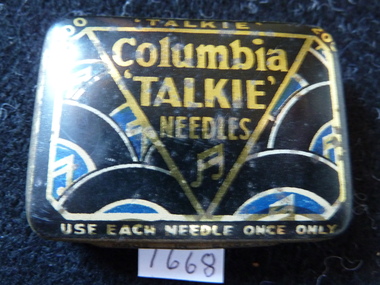 Stawell Historical Society Inc
Memorabilia - Realia
... Columbia 'Talkie' Gramophone Needles (one tin of)...Stawell Columbia 'Talkie' Gramophone Needles (one tin of) Memorabilia Realia ...Columbia 'Talkie' Gramophone Needles (one tin of)stawell -
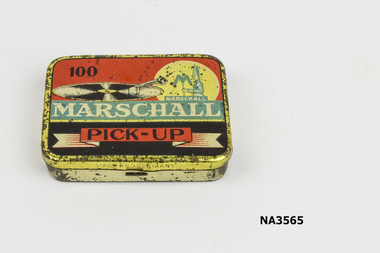 Whitehorse Historical Society Inc.
Container - Gramophone needle tin, not known
... Gramophone needle tin...Tin box for pick up record player gramophone needles...musical instruments accessories Marschell Pick- up needles Tin box for pick up record player gramophone needles Container Gramophone needle tin ...Tin box for pick up record player gramophone needlesMarschell Pick- up needlesmusical instruments, accessories -
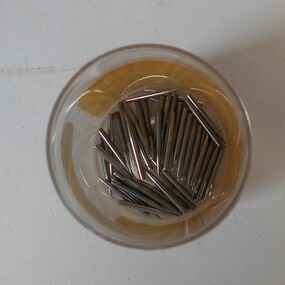 Bendigo Historical Society Inc.
Functional object - Needles for gramophone
... Needles for gramophone...Now used to store spare needles for a gramophone. There are forty-five needles. ... for a gramophone. There are forty-five needles. Errol Bovaird Collection Functional object Needles for gramophone ...Small plastic container from the Bendigo & Northern District Base Hospital. Originally it contained tablets. Now used to store spare needles for a gramophone. There are forty-five needles. Errol Bovaird Collectionmusic, gramophone, stylus -
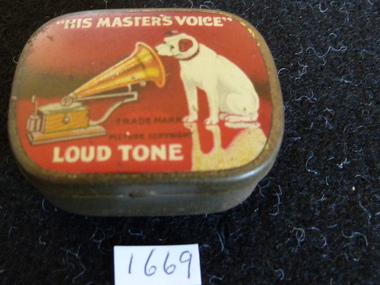 Stawell Historical Society Inc
Memorabilia - Realia, c1920
... "His Masters Voice" Loud Tone Gramophone 200 Needles in Red tin...Stawell "His Masters Voice" Loud Tone Gramophone 200 Needles in Red tin Memorabilia Realia ..."His Masters Voice" Loud Tone Gramophone 200 Needles in Red tinstawell -
The Ed Muirhead Physics Museum
Engine, Micro-ruling engine, Wm Stone #1
... A scriber made of a gramophone needle is in place over the glass slide on a ruling table. ...A scriber made of a gramophone needle is in place over the glass slide on a ruling table. ...From attached information on display: This engine was designed to explore the nature and magnitude of mechanical defects in ruling engines. It was used to cut simple rulings for the calibration of microscope fields of view.First micro-ruling engine made (1934), by Stone, with flat rectangular iron base and wheel mechanism. A scriber made of a gramophone needle is in place over the glass slide on a ruling table. A second holder for a diamond lies beside the instrument. -
 Federation University Historical Collection
Equipment - Musical Object, Gramophone
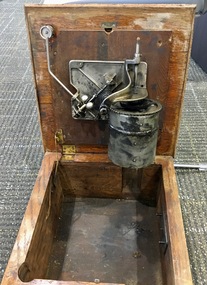
... gramophone...recording company...united kingdom...typewriter...william owen...fred gaisberg...horn...needle...Timber gramophone box with turntable, needle arm, clamp and horn. ...No winder. .2) - m14/57 - gramophone clamp for horn .3) - m14/45 - gramophone arm with needle .4) - m222 - gramophone horn Turntable pad very worn Gramophone Equipment Musical Object The Gramophone Company Ltd ...The Gramophone Company Limited, based in the United Kingdom, was one of the early recording companies. It was founded in 1898. That same year Fred Gaisberg moved from the United States to London to set up the first disc recording tudio in Europe. In 1900 William Owen, an English man, gained the manufacturing rights for the Lambert Typewriter Company and the Gramophone Company and for a few years was renamed the Gramophone & Typewriter Ltd.Timber gramophone box with turntable, needle arm, clamp and horn. No winder. .2) - m14/57 - gramophone clamp for horn .3) - m14/45 - gramophone arm with needle .4) - m222 - gramophone horn Turntable pad very wornSticker on side of box "The Gramophone Company Ltd City Road, Finsbury Square, London (Great Britain, Germany, France, Belgium, Russia)"gramophone, recording company, united kingdom, typewriter, william owen, fred gaisberg, horn, needle arm, turntable, horn clamp, gramophone company -
 Flagstaff Hill Maritime Museum and Village
Gramophone
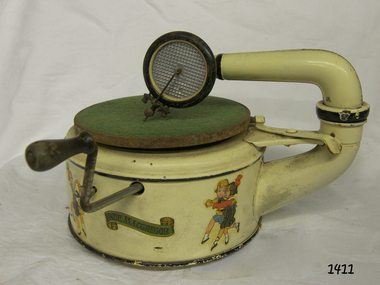
... Gramophone marked "Wee MacGregor" on the side. Constructed from metal, painted creamy white. It has a cranking handle with a thick but hollow swivelling arm to which a metal disc is attached from which the needle protrudes. ...needle protrudes. Pictures of children dancing are depicted on the sides. Gramophone ...The portable gramophone was used to play music from disc audio records.Gramophone marked "Wee MacGregor" on the side. Constructed from metal, painted creamy white. It has a cranking handle with a thick but hollow swivelling arm to which a metal disc is attached from which the needle protrudes. Pictures of children dancing are depicted on the sides.On side "WEE MACGREGOR", In disc where needle is connected- "GES GES CL"flagstaff hill, warrnambool, shipwrecked-coast, flagstaff-hill, flagstaff-hill-maritime-museum, maritime-museum, shipwreck-coast, flagstaff-hill-maritime-village, gramophone, wee macgregor, music player, sound equipment, record player, home entertainment -
 Flagstaff Hill Maritime Museum and Village
Audio - Gramophone Record, Parlophone Co. Ltd, John Go And Put Your Trousers On, Early-to-mid 20th century
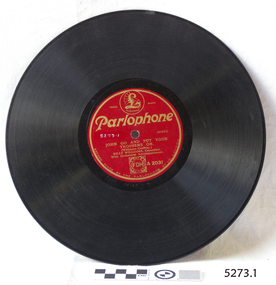
... A gramophone machine reproduced the sound by spinning the record on a turntable at a specified number of rotations per minute (RPM) and using a stylus or needle to transfer the vibration via a membrane to a speaker, which amplified the sound. ...A gramophone machine reproduced the sound by spinning the record on a turntable at a specified number of rotations per minute (RPM) and using a stylus or needle to transfer the vibration via a membrane to a speaker, which amplified the sound. ...Thomas Edison (1847–1931), an American, invented the phonograph in 1877, making it possible to record sound waves vertically and reproduce them on a wax cylinder so they could be heard again. Later, the German American, Emile Berliner (1851-1929), improved on Edison’s principles, greatly increasing the quality of the reproduced sounds with his invention of the gramophone in 1887, which recorded the sound waves laterally onto a flat shellac disc, or ‘record’. Records could be mass-produced in a factory where audio recordings were converted to a physical copy of that recording on a plate-sized disc. A gramophone machine reproduced the sound by spinning the record on a turntable at a specified number of rotations per minute (RPM) and using a stylus or needle to transfer the vibration via a membrane to a speaker, which amplified the sound. Berliner helped set up affiliated businesses overseas. One of his representatives was William Barry Owen (1860–1914), who, on 23 February 1889, partnered with Edmund Trevor Lloyd Williams (1859–1946) in England to register The Gramophone Company. His Master’s Voice (HMV) soon became the company’s major recording label, popular worldwide. The label's logo, a dog looking into a gramophone horn, looking for his master’s voice, was based on a painting by English artist Francis Barraud, which featured a terrier called Nipper beside a gramophone. Early gramophone records were mostly made from a material referred to as shellac, a natural ingredient combined with slate powder, and a filler of manilla copal, wood resin, carnauba wax, and carbon black. Although Bakelite seemed a useful, synthetic product, it was unsuccessful as a product for records. Around the time of World War II, lightweight, flexible synthetic vinyl records began replacing shellac records. Common diameters of records: 7 inch, 10 inch, 12 inch and 16 inch Revolutions Per Minute include: 33 1/3, 45, 78 Minutes per side of record: 3, 5.5, 7, 8, 9, 12, 15 and 22 Labels, in minutes per side: Single Play 3-5 min, Extended Play (EP) 7-12 min, Long Play (LP) 12-22 min This gramophone represents a step in the evolution of recording sound. In the 19th century, the human voice was first recorded on wax cylinders and replayed. It was the beginning of a new era in sound. Then, in the 1880s, voice could be recorded onto flat discs like this record, reliably reproduced and replayed many times, even on portable devices. Later, in the mid-20th century the following generation of electronic audio recording began, and later that century, digital recording gave even better reproduction. The record represents a popular means of entertainment for personal and social activities, as well as in some businesses. Shellac gramophone record, red label. Title: John Go And Put Your Trousers On Artist: Billy Williams Publisher: Parlophone Co Ltd, London Number: 41413 Size: 10 inch"A2031"flagstaff hill, warrnambool, maritime village, maritime museum, flagstaff hill maritime museum and village, shipwreck coast, great ocean road, gramophone, phonograph, sound waves, record, reproduction, audio record, music, sound, thomas edison, emile berliner, 1887, shellac, rpm, william barry owen, edmund trevor lloyd williams, the gramophone company, his master’s voice, hmv, francis barraud, nipper, 10 inch, parlophone co ltd, london, john go and put your trousers on, billy williams -
 Flagstaff Hill Maritime Museum and Village
Audio - Gramophone Record, Brunswick Records, The Old Fiddlers Song, Early-to-mid 20th century
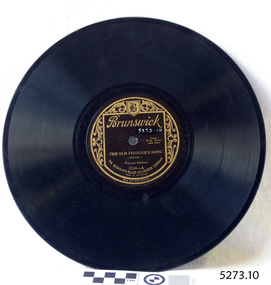
... A gramophone machine reproduced the sound by spinning the record on a turntable at a specified number of rotations per minute (RPM) and using a stylus or needle to transfer the vibration via a membrane to a speaker, which amplified the sound. ...A gramophone machine reproduced the sound by spinning the record on a turntable at a specified number of rotations per minute (RPM) and using a stylus or needle to transfer the vibration via a membrane to a speaker, which amplified the sound. ...Thomas Edison (1847–1931), an American, invented the phonograph in 1877, making it possible to record sound waves vertically and reproduce them on a wax cylinder so they could be heard again. Later, the German American, Emile Berliner (1851-1929), improved on Edison’s principles, greatly increasing the quality of the reproduced sounds with his invention of the gramophone in 1887, which recorded the sound waves laterally onto a flat shellac disc, or ‘record’. Records could be mass-produced in a factory where audio recordings were converted to a physical copy of that recording on a plate-sized disc. A gramophone machine reproduced the sound by spinning the record on a turntable at a specified number of rotations per minute (RPM) and using a stylus or needle to transfer the vibration via a membrane to a speaker, which amplified the sound. Berliner helped set up affiliated businesses overseas. One of his representatives was William Barry Owen (1860–1914), who, on 23 February 1889, partnered with Edmund Trevor Lloyd Williams (1859–1946) in England to register The Gramophone Company. His Master’s Voice (HMV) soon became the company’s major recording label, popular worldwide. The business based the label's logo of a dog looking into a gramophone horn for ‘his master’s voice’ was based on a painting by English artist Francis Barraud, which featured a terrier called Nipper beside a gramophone. Early gramophone records were mostly made from a material referred to as shellac, a natural ingredient combined with slate powder, and a filler of manilla copal, wood resin, carnauba wax, and carbon black. Although Bakelite seemed a useful, synthetic product, it was unsuccessful as a product for records. Around the time of World War II, lightweight, flexible synthetic vinyl records began replacing shellac records. Common diameters of records: 7 inch, 10 inch, 12 inch and 16 inch Revolutions Per Minute include: 33 1/3, 45, 78 Minutes per side of record: 3, 5.5, 7, 8, 9, 12, 15 and 22 Labels, in minutes per side: Single Play 3-5 min, Extended Play (EP) 7-12 min, Long Play (LP) 12-22 min This gramophone represents a step in the evolution of recording sound. In the 19th century, the human voice was first recorded on wax cylinders and replayed. It was the beginning of a new era in sound. Then, in the 1880s, voice could be recorded onto flat discs like this record, reliably reproduced and replayed many times, even on portable devices. Later, in the mid-20th century the following generation of electronic audio recording began, and later that century, digital recording gave even better reproduction. The record represents a popular means of entertainment for personal and social activities, as well as in some businesses. Shellac gramophone record with a black and gold label. Title: The Old Fiddlers Song Artist: Vernon Delhart, tenor Publisher: Brunswick Number:3234-A Size: 10 inchflagstaff hill, warrnambool, maritime village, maritime museum, flagstaff hill maritime museum and village, shipwreck coast, great ocean road, gramophone, phonograph, sound waves, record, reproduction, audio record, music, sound, thomas edison, emile berliner, 1887, shellac, rpm, william barry owen, edmund trevor lloyd williams, the gramophone company, his master’s voice, hmv, francis barraud, nipper, 10 inch, brunswick records, 3234-a, the old fiddlers song, vernon delhart (tenor) -
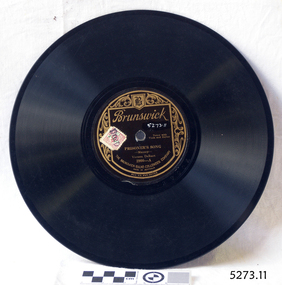 Flagstaff Hill Maritime Museum and Village
Audio - Gramophone Record, Brunswick Records, Prisoner's Song, Early-to-mid 20th century
... A gramophone machine reproduced the sound by spinning the record on a turntable at a specified number of rotations per minute (RPM) and using a stylus or needle to transfer the vibration via a membrane to a speaker, which amplified the sound. ...A gramophone machine reproduced the sound by spinning the record on a turntable at a specified number of rotations per minute (RPM) and using a stylus or needle to transfer the vibration via a membrane to a speaker, which amplified the sound. ...Thomas Edison (1847–1931), an American, invented the phonograph in 1877, making it possible to record sound waves vertically and reproduce them on a wax cylinder so they could be heard again. Later, the German American, Emile Berliner (1851-1929), improved on Edison’s principles, greatly increasing the quality of the reproduced sounds with his invention of the gramophone in 1887, which recorded the sound waves laterally onto a flat shellac disc, or ‘record’. Records could be mass-produced in a factory where audio recordings were converted to a physical copy of that recording on a plate-sized disc. A gramophone machine reproduced the sound by spinning the record on a turntable at a specified number of rotations per minute (RPM) and using a stylus or needle to transfer the vibration via a membrane to a speaker, which amplified the sound. Berliner helped set up affiliated businesses overseas. One of his representatives was William Barry Owen (1860–1914), who, on 23 February 1889, partnered with Edmund Trevor Lloyd Williams (1859–1946) in England to register The Gramophone Company. His Master’s Voice (HMV) soon became the company’s major recording label, popular worldwide. The business based the label's logo of a dog looking into a gramophone horn for ‘his master’s voice’ was based on a painting by English artist Francis Barraud, which featured a terrier called Nipper beside a gramophone. Early gramophone records were mostly made from a material referred to as shellac, a natural ingredient combined with slate powder, and a filler of manilla copal, wood resin, carnauba wax, and carbon black. Although Bakelite seemed a useful, synthetic product, it was unsuccessful as a product for records. Around the time of World War II, lightweight, flexible synthetic vinyl records began replacing shellac records. Common diameters of records: 7 inch, 10 inch, 12 inch and 16 inch Revolutions Per Minute include: 33 1/3, 45, 78 Minutes per side of record: 3, 5.5, 7, 8, 9, 12, 15 and 22 Labels, in minutes per side: Single Play 3-5 min, Extended Play (EP) 7-12 min, Long Play (LP) 12-22 min This gramophone represents a step in the evolution of recording sound. In the 19th century, the human voice was first recorded on wax cylinders and replayed. It was the beginning of a new era in sound. Then, in the 1880s, voice could be recorded onto flat discs like this record, reliably reproduced and replayed many times, even on portable devices. Later, in the mid-20th century the following generation of electronic audio recording began, and later that century, digital recording gave even better reproduction. The record represents a popular means of entertainment for personal and social activities, as well as in some businesses. Shellac gramophone record with a black and gold label. Title: Prisoner's Song Artist: Vernon Dalhart, tenor Publisher: Brunswick Records Number: A-2900 Size: 10 inchOn label, white sticker with red printflagstaff hill, warrnambool, maritime village, maritime museum, flagstaff hill maritime museum and village, shipwreck coast, great ocean road, gramophone, phonograph, sound waves, record, reproduction, audio record, music, sound, thomas edison, emile berliner, 1887, shellac, rpm, william barry owen, edmund trevor lloyd williams, the gramophone company, his master’s voice, hmv, francis barraud, nipper, 10 inch, brunswick records, a-2900, prisoner's song, vernon dalhart (tenor) -
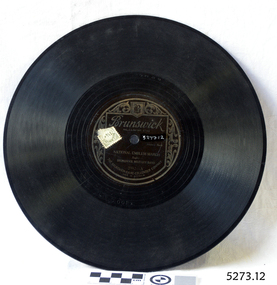 Flagstaff Hill Maritime Museum and Village
Audio - Gramophone Record, Brunswick Records, National Emblem March, Early-to-mid 20th century
... A gramophone machine reproduced the sound by spinning the record on a turntable at a specified number of rotations per minute (RPM) and using a stylus or needle to transfer the vibration via a membrane to a speaker, which amplified the sound. ...A gramophone machine reproduced the sound by spinning the record on a turntable at a specified number of rotations per minute (RPM) and using a stylus or needle to transfer the vibration via a membrane to a speaker, which amplified the sound. ...Thomas Edison (1847–1931), an American, invented the phonograph in 1877, making it possible to record sound waves vertically and reproduce them on a wax cylinder so they could be heard again. Later, the German American, Emile Berliner (1851-1929), improved on Edison’s principles, greatly increasing the quality of the reproduced sounds with his invention of the gramophone in 1887, which recorded the sound waves laterally onto a flat shellac disc, or ‘record’. Records could be mass-produced in a factory where audio recordings were converted to a physical copy of that recording on a plate-sized disc. A gramophone machine reproduced the sound by spinning the record on a turntable at a specified number of rotations per minute (RPM) and using a stylus or needle to transfer the vibration via a membrane to a speaker, which amplified the sound. Berliner helped set up affiliated businesses overseas. One of his representatives was William Barry Owen (1860–1914), who, on 23 February 1889, partnered with Edmund Trevor Lloyd Williams (1859–1946) in England to register The Gramophone Company. His Master’s Voice (HMV) soon became the company’s major recording label, popular worldwide. The business based the label's logo of a dog looking into a gramophone horn for ‘his master’s voice’ was based on a painting by English artist Francis Barraud, which featured a terrier called Nipper beside a gramophone. Early gramophone records were mostly made from a material referred to as shellac, a natural ingredient combined with slate powder, and a filler of manilla copal, wood resin, carnauba wax, and carbon black. Although Bakelite seemed a useful, synthetic product, it was unsuccessful as a product for records. Around the time of World War II, lightweight, flexible synthetic vinyl records began replacing shellac records. Common diameters of records: 7 inch, 10 inch, 12 inch and 16 inch Revolutions Per Minute include: 33 1/3, 45, 78 Minutes per side of record: 3, 5.5, 7, 8, 9, 12, 15 and 22 Labels, in minutes per side: Single Play 3-5 min, Extended Play (EP) 7-12 min, Long Play (LP) 12-22 min This gramophone represents a step in the evolution of recording sound. In the 19th century, the human voice was first recorded on wax cylinders and replayed. It was the beginning of a new era in sound. Then, in the 1880s, voice could be recorded onto flat discs like this record, reliably reproduced and replayed many times, even on portable devices. Later, in the mid-20th century the following generation of electronic audio recording began, and later that century, digital recording gave even better reproduction. The record represents a popular means of entertainment for personal and social activities, as well as in some businesses. Shellac gramophone record with a black and gold label. Title: National Emblem March Artist: Brunswick Military Band Publisher: Brunswick Number: A2002 Size: 10 inchOn the label is a cream coloured stamp with printed detailsflagstaff hill, warrnambool, maritime village, maritime museum, flagstaff hill maritime museum and village, shipwreck coast, great ocean road, gramophone, phonograph, sound waves, record, reproduction, audio record, music, sound, thomas edison, emile berliner, 1887, shellac, rpm, william barry owen, edmund trevor lloyd williams, the gramophone company, his master’s voice, hmv, francis barraud, nipper, 10 inch, brunswick records, a2002, national emblem march, brunswick military band -
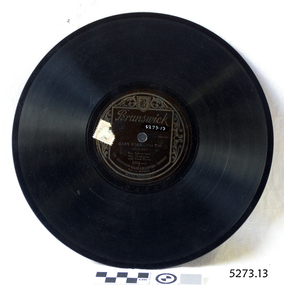 Flagstaff Hill Maritime Museum and Village
Audio - Gramophone Record, Brunswick Records, Baby Face
... A gramophone machine reproduced the sound by spinning the record on a turntable at a specified number of rotations per minute (RPM) and using a stylus or needle to transfer the vibration via a membrane to a speaker, which amplified the sound. ...A gramophone machine reproduced the sound by spinning the record on a turntable at a specified number of rotations per minute (RPM) and using a stylus or needle to transfer the vibration via a membrane to a speaker, which amplified the sound. ...Thomas Edison (1847–1931), an American, invented the phonograph in 1877, making it possible to record sound waves vertically and reproduce them on a wax cylinder so they could be heard again. Later, the German American, Emile Berliner (1851-1929), improved on Edison’s principles, greatly increasing the quality of the reproduced sounds with his invention of the gramophone in 1887, which recorded the sound waves laterally onto a flat shellac disc, or ‘record’. Records could be mass-produced in a factory where audio recordings were converted to a physical copy of that recording on a plate-sized disc. A gramophone machine reproduced the sound by spinning the record on a turntable at a specified number of rotations per minute (RPM) and using a stylus or needle to transfer the vibration via a membrane to a speaker, which amplified the sound. Berliner helped set up affiliated businesses overseas. One of his representatives was William Barry Owen (1860–1914), who, on 23 February 1889, partnered with Edmund Trevor Lloyd Williams (1859–1946) in England to register The Gramophone Company. His Master’s Voice (HMV) soon became the company’s major recording label, popular worldwide. The business based the label's logo of a dog looking into a gramophone horn for ‘his master’s voice’ was based on a painting by English artist Francis Barraud, which featured a terrier called Nipper beside a gramophone. Early gramophone records were mostly made from a material referred to as shellac, a natural ingredient combined with slate powder, and a filler of manilla copal, wood resin, carnauba wax, and carbon black. Although Bakelite seemed a useful, synthetic product, it was unsuccessful as a product for records. Around the time of World War II, lightweight, flexible synthetic vinyl records began replacing shellac records. Common diameters of records: 7 inch, 10 inch, 12 inch and 16 inch Revolutions Per Minute include: 33 1/3, 45, 78 Minutes per side of record: 3, 5.5, 7, 8, 9, 12, 15 and 22 Labels, in minutes per side: Single Play 3-5 min, Extended Play (EP) 7-12 min, Long Play (LP) 12-22 min Shellac gramophone record with a black and gold label. Title: Baby Face Artist: Foxtrot by Ben Selvin and his Orchestra Publisher: Brunswick Number: A-3253 Size: 10 inchWhite sticker on the labelflagstaff hill, warrnambool, maritime village, maritime museum, flagstaff hill maritime museum and village, shipwreck coast, great ocean road, gramophone, phonograph, sound waves, record, reproduction, audio record, music, sound, thomas edison, emile berliner, 1887, shellac, rpm, william barry owen, edmund trevor lloyd williams, the gramophone company, his master’s voice, hmv, francis barraud, nipper, 10 inch, brunswick records, a-3253, baby face, foxtrot, ben selvin and his orchestra -
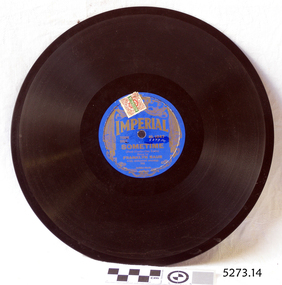 Flagstaff Hill Maritime Museum and Village
Audio - Gramophone Record, Imperial Records, Sometime, Early-to-mid 20th century
... A gramophone machine reproduced the sound by spinning the record on a turntable at a specified number of rotations per minute (RPM) and using a stylus or needle to transfer the vibration via a membrane to a speaker, which amplified the sound. ...A gramophone machine reproduced the sound by spinning the record on a turntable at a specified number of rotations per minute (RPM) and using a stylus or needle to transfer the vibration via a membrane to a speaker, which amplified the sound. ...Thomas Edison (1847–1931), an American, invented the phonograph in 1877, making it possible to record sound waves vertically and reproduce them on a wax cylinder so they could be heard again. Later, the German American, Emile Berliner (1851-1929), improved on Edison’s principles, greatly increasing the quality of the reproduced sounds with his invention of the gramophone in 1887, which recorded the sound waves laterally onto a flat shellac disc, or ‘record’. Records could be mass-produced in a factory where audio recordings were converted to a physical copy of that recording on a plate-sized disc. A gramophone machine reproduced the sound by spinning the record on a turntable at a specified number of rotations per minute (RPM) and using a stylus or needle to transfer the vibration via a membrane to a speaker, which amplified the sound. Berliner helped set up affiliated businesses overseas. One of his representatives was William Barry Owen (1860–1914), who, on 23 February 1889, partnered with Edmund Trevor Lloyd Williams (1859–1946) in England to register The Gramophone Company. His Master’s Voice (HMV) soon became the company’s major recording label, popular worldwide. The business based the label's logo of a dog looking into a gramophone horn for ‘his master’s voice’ was based on a painting by English artist Francis Barraud, which featured a terrier called Nipper beside a gramophone. Early gramophone records were mostly made from a material referred to as shellac, a natural ingredient combined with slate powder, and a filler of manilla copal, wood resin, carnauba wax, and carbon black. Although Bakelite seemed a useful, synthetic product, it was unsuccessful as a product for records. Around the time of World War II, lightweight, flexible synthetic vinyl records began replacing shellac records. Common diameters of records: 7 inch, 10 inch, 12 inch and 16 inch Revolutions Per Minute include: 33 1/3, 45, 78 Minutes per side of record: 3, 5.5, 7, 8, 9, 12, 15 and 22 Labels, in minutes per side: Single Play 3-5 min, Extended Play (EP) 7-12 min, Long Play (LP) 12-22 min This gramophone represents a step in the evolution of recording sound. In the 19th century, the human voice was first recorded on wax cylinders and replayed. It was the beginning of a new era in sound. Then, in the 1880s, voice could be recorded onto flat discs like this record, reliably reproduced and replayed many times, even on portable devices. Later, in the mid-20th century the following generation of electronic audio recording began, and later that century, digital recording gave even better reproduction. The record represents a popular means of entertainment for personal and social activities, as well as in some businesses. Shellac gramophone record with a blue and gold label. Title: Sometime Artist: Franklyn Baur, tenor, solo Publisher: Imperial Records Number:1547 Size: 14 inchWhite paper stamp with gold, red and green printflagstaff hill, warrnambool, maritime village, maritime museum, flagstaff hill maritime museum and village, shipwreck coast, great ocean road, gramophone, phonograph, sound waves, record, reproduction, audio record, music, sound, thomas edison, emile berliner, 1887, shellac, rpm, william barry owen, edmund trevor lloyd williams, the gramophone company, his master’s voice, hmv, francis barraud, nipper, imperial record, 1547, sometime, tenor solo, franklyn baur, 14 inch -
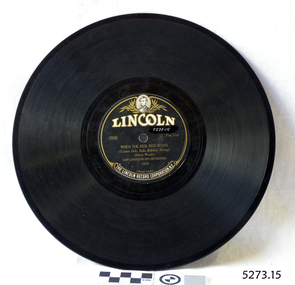 Flagstaff Hill Maritime Museum and Village
Audio - Gramophone Record, Lincoln Record Corporation, When The Red, Red Robin, Early-to-mid 20th century
... A gramophone machine reproduced the sound by spinning the record on a turntable at a specified number of rotations per minute (RPM) and using a stylus or needle to transfer the vibration via a membrane to a speaker, which amplified the sound. ...A gramophone machine reproduced the sound by spinning the record on a turntable at a specified number of rotations per minute (RPM) and using a stylus or needle to transfer the vibration via a membrane to a speaker, which amplified the sound. ...Thomas Edison (1847–1931), an American, invented the phonograph in 1877, making it possible to record sound waves vertically and reproduce them on a wax cylinder so they could be heard again. Later, the German American, Emile Berliner (1851-1929), improved on Edison’s principles, greatly increasing the quality of the reproduced sounds with his invention of the gramophone in 1887, which recorded the sound waves laterally onto a flat shellac disc, or ‘record’. Records could be mass-produced in a factory where audio recordings were converted to a physical copy of that recording on a plate-sized disc. A gramophone machine reproduced the sound by spinning the record on a turntable at a specified number of rotations per minute (RPM) and using a stylus or needle to transfer the vibration via a membrane to a speaker, which amplified the sound. Berliner helped set up affiliated businesses overseas. One of his representatives was William Barry Owen (1860–1914), who, on 23 February 1889, partnered with Edmund Trevor Lloyd Williams (1859–1946) in England to register The Gramophone Company. His Master’s Voice (HMV) soon became the company’s major recording label, popular worldwide. The business based the label's logo of a dog looking into a gramophone horn for ‘his master’s voice’ was based on a painting by English artist Francis Barraud, which featured a terrier called Nipper beside a gramophone. Early gramophone records were mostly made from a material referred to as shellac, a natural ingredient combined with slate powder, and a filler of manilla copal, wood resin, carnauba wax, and carbon black. Although Bakelite seemed a useful, synthetic product, it was unsuccessful as a product for records. Around the time of World War II, lightweight, flexible synthetic vinyl records began replacing shellac records. Common diameters of records: 7 inch, 10 inch, 12 inch and 16 inch Revolutions Per Minute include: 33 1/3, 45, 78 Minutes per side of record: 3, 5.5, 7, 8, 9, 12, 15 and 22 Labels, in minutes per side: Single Play 3-5 min, Extended Play (EP) 7-12 min, Long Play (LP) 12-22 min This gramophone represents a step in the evolution of recording sound. In the 19th century, the human voice was first recorded on wax cylinders and replayed. It was the beginning of a new era in sound. Then, in the 1880s, voice could be recorded onto flat discs like this record, reliably reproduced and replayed many times, even on portable devices. Later, in the mid-20th century the following generation of electronic audio recording began, and later that century, digital recording gave even better reproduction. The record represents a popular means of entertainment for personal and social activities, as well as in some businesses. Shellac gramophone record with a black and gold label. Title: When The Red, Red Robin Artist: Sammy Lanin and his Orchestra Publisher: Lincoln Record Corporation, N.Y. Number:2528 Size: 10 inchflagstaff hill, warrnambool, maritime village, maritime museum, flagstaff hill maritime museum and village, shipwreck coast, great ocean road, gramophone, phonograph, sound waves, record, reproduction, audio record, music, sound, thomas edison, emile berliner, 1887, shellac, rpm, william barry owen, edmund trevor lloyd williams, the gramophone company, his master’s voice, hmv, francis barraud, nipper, lincoln record corporation, new york, 2528, when the red red robin, sammy lanin and his orchestra, 10 inch -
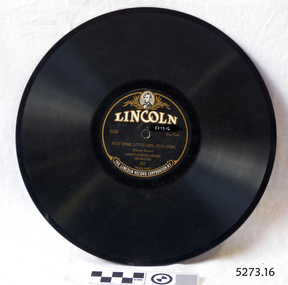 Flagstaff Hill Maritime Museum and Village
Audio - Gramophone Record, Lincoln Record Corporation, Stay Home Little Girl, Stay Home, Early-to-mid 20th century
... A gramophone machine reproduced the sound by spinning the record on a turntable at a specified number of rotations per minute (RPM) and using a stylus or needle to transfer the vibration via a membrane to a speaker, which amplified the sound. ...A gramophone machine reproduced the sound by spinning the record on a turntable at a specified number of rotations per minute (RPM) and using a stylus or needle to transfer the vibration via a membrane to a speaker, which amplified the sound. ...Thomas Edison (1847–1931), an American, invented the phonograph in 1877, making it possible to record sound waves vertically and reproduce them on a wax cylinder so they could be heard again. Later, the German American, Emile Berliner (1851-1929), improved on Edison’s principles, greatly increasing the quality of the reproduced sounds with his invention of the gramophone in 1887, which recorded the sound waves laterally onto a flat shellac disc, or ‘record’. Records could be mass-produced in a factory where audio recordings were converted to a physical copy of that recording on a plate-sized disc. A gramophone machine reproduced the sound by spinning the record on a turntable at a specified number of rotations per minute (RPM) and using a stylus or needle to transfer the vibration via a membrane to a speaker, which amplified the sound. Berliner helped set up affiliated businesses overseas. One of his representatives was William Barry Owen (1860–1914), who, on 23 February 1889, partnered with Edmund Trevor Lloyd Williams (1859–1946) in England to register The Gramophone Company. His Master’s Voice (HMV) soon became the company’s major recording label, popular worldwide. The business based the label's logo of a dog looking into a gramophone horn for ‘his master’s voice’ was based on a painting by English artist Francis Barraud, which featured a terrier called Nipper beside a gramophone. Early gramophone records were mostly made from a material referred to as shellac, a natural ingredient combined with slate powder, and a filler of manilla copal, wood resin, carnauba wax, and carbon black. Although Bakelite seemed a useful, synthetic product, it was unsuccessful as a product for records. Around the time of World War II, lightweight, flexible synthetic vinyl records began replacing shellac records. Common diameters of records: 7 inch, 10 inch, 12 inch and 16 inch Revolutions Per Minute include: 33 1/3, 45, 78 Minutes per side of record: 3, 5.5, 7, 8, 9, 12, 15 and 22 Labels, in minutes per side: Single Play 3-5 min, Extended Play (EP) 7-12 min, Long Play (LP) 12-22 min This gramophone represents a step in the evolution of recording sound. In the 19th century, the human voice was first recorded on wax cylinders and replayed. It was the beginning of a new era in sound. Then, in the 1880s, voice could be recorded onto flat discs like this record, reliably reproduced and replayed many times, even on portable devices. Later, in the mid-20th century the following generation of electronic audio recording began, and later that century, digital recording gave even better reproduction. The record represents a popular means of entertainment for personal and social activities, as well as in some businesses. Shellac gramophone record with a coloured label. Title: Stay Home Little Girl, Stay Home Artist: Johnny Johnson and his Orchestra. Publisher: The Lincoln Record Corporation, N.Y. 2516 Number:797 Size: 10 inchflagstaff hill, warrnambool, maritime village, maritime museum, flagstaff hill maritime museum and village, shipwreck coast, great ocean road, gramophone, phonograph, sound waves, record, reproduction, audio record, music, sound, thomas edison, emile berliner, 1887, shellac, rpm, william barry owen, edmund trevor lloyd williams, the gramophone company, his master’s voice, hmv, francis barraud, nipper, lincoln record corporation n.y. 2516, stay home little girl stay home, johnny johnson and his orchestra, 797, 10 inch -
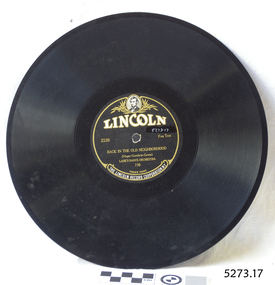 Flagstaff Hill Maritime Museum and Village
Audio - Gramophone Record, Lincoln Record Corporation, Back In The Old Neighborhood, Early-to-mid 20th century
... A gramophone machine reproduced the sound by spinning the record on a turntable at a specified number of rotations per minute (RPM) and using a stylus or needle to transfer the vibration via a membrane to a speaker, which amplified the sound. ...A gramophone machine reproduced the sound by spinning the record on a turntable at a specified number of rotations per minute (RPM) and using a stylus or needle to transfer the vibration via a membrane to a speaker, which amplified the sound. ...Thomas Edison (1847–1931), an American, invented the phonograph in 1877, making it possible to record sound waves vertically and reproduce them on a wax cylinder so they could be heard again. Later, the German American, Emile Berliner (1851-1929), improved on Edison’s principles, greatly increasing the quality of the reproduced sounds with his invention of the gramophone in 1887, which recorded the sound waves laterally onto a flat shellac disc, or ‘record’. Records could be mass-produced in a factory where audio recordings were converted to a physical copy of that recording on a plate-sized disc. A gramophone machine reproduced the sound by spinning the record on a turntable at a specified number of rotations per minute (RPM) and using a stylus or needle to transfer the vibration via a membrane to a speaker, which amplified the sound. Berliner helped set up affiliated businesses overseas. One of his representatives was William Barry Owen (1860–1914), who, on 23 February 1889, partnered with Edmund Trevor Lloyd Williams (1859–1946) in England to register The Gramophone Company. His Master’s Voice (HMV) soon became the company’s major recording label, popular worldwide. The business based the label's logo of a dog looking into a gramophone horn for ‘his master’s voice’ was based on a painting by English artist Francis Barraud, which featured a terrier called Nipper beside a gramophone. Early gramophone records were mostly made from a material referred to as shellac, a natural ingredient combined with slate powder, and a filler of manilla copal, wood resin, carnauba wax, and carbon black. Although Bakelite seemed a useful, synthetic product, it was unsuccessful as a product for records. Around the time of World War II, lightweight, flexible synthetic vinyl records began replacing shellac records. Common diameters of records: 7 inch, 10 inch, 12 inch and 16 inch Revolutions Per Minute include: 33 1/3, 45, 78 Minutes per side of record: 3, 5.5, 7, 8, 9, 12, 15 and 22 Labels, in minutes per side: Single Play 3-5 min, Extended Play (EP) 7-12 min, Long Play (LP) 12-22 min This gramophone represents a step in the evolution of recording sound. In the 19th century, the human voice was first recorded on wax cylinders and replayed. It was the beginning of a new era in sound. Then, in the 1880s, voice could be recorded onto flat discs like this record, reliably reproduced and replayed many times, even on portable devices. Later, in the mid-20th century the following generation of electronic audio recording began, and later that century, digital recording gave even better reproduction. The record represents a popular means of entertainment for personal and social activities, as well as in some businesses. Shellac gramophone record with a black and gold label. Title: Back In The Old Neighbourhood Artist: Lane's Dance Orchestra. Publisher: The Lincoln Record Corporation, N.Y. 2138 Number:738 Size: 10 inchflagstaff hill, warrnambool, maritime village, maritime museum, flagstaff hill maritime museum and village, shipwreck coast, great ocean road, gramophone, phonograph, sound waves, record, reproduction, audio record, music, sound, thomas edison, emile berliner, 1887, shellac, rpm, william barry owen, edmund trevor lloyd williams, the gramophone company, his master’s voice, hmv, francis barraud, nipper, the lincoln record corporation n.y. 2138, back in the old neighbourhood, lane's dance orchestra, 738 -
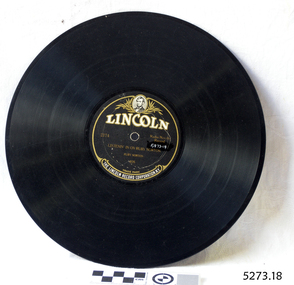 Flagstaff Hill Maritime Museum and Village
Audio - Gramophone Record, Lincoln Record Corporation, Listenin In On Ruby Norton, Early-to-mid 20th century
... A gramophone machine reproduced the sound by spinning the record on a turntable at a specified number of rotations per minute (RPM) and using a stylus or needle to transfer the vibration via a membrane to a speaker, which amplified the sound. ...A gramophone machine reproduced the sound by spinning the record on a turntable at a specified number of rotations per minute (RPM) and using a stylus or needle to transfer the vibration via a membrane to a speaker, which amplified the sound. ...Thomas Edison (1847–1931), an American, invented the phonograph in 1877, making it possible to record sound waves vertically and reproduce them on a wax cylinder so they could be heard again. Later, the German American, Emile Berliner (1851-1929), improved on Edison’s principles, greatly increasing the quality of the reproduced sounds with his invention of the gramophone in 1887, which recorded the sound waves laterally onto a flat shellac disc, or ‘record’. Records could be mass-produced in a factory where audio recordings were converted to a physical copy of that recording on a plate-sized disc. A gramophone machine reproduced the sound by spinning the record on a turntable at a specified number of rotations per minute (RPM) and using a stylus or needle to transfer the vibration via a membrane to a speaker, which amplified the sound. Berliner helped set up affiliated businesses overseas. One of his representatives was William Barry Owen (1860–1914), who, on 23 February 1889, partnered with Edmund Trevor Lloyd Williams (1859–1946) in England to register The Gramophone Company. His Master’s Voice (HMV) soon became the company’s major recording label, popular worldwide. The business based the label's logo of a dog looking into a gramophone horn for ‘his master’s voice’ was based on a painting by English artist Francis Barraud, which featured a terrier called Nipper beside a gramophone. Early gramophone records were mostly made from a material referred to as shellac, a natural ingredient combined with slate powder, and a filler of manilla copal, wood resin, carnauba wax, and carbon black. Although Bakelite seemed a useful, synthetic product, it was unsuccessful as a product for records. Around the time of World War II, lightweight, flexible synthetic vinyl records began replacing shellac records. Common diameters of records: 7 inch, 10 inch, 12 inch and 16 inch Revolutions Per Minute include: 33 1/3, 45, 78 Minutes per side of record: 3, 5.5, 7, 8, 9, 12, 15 and 22 Labels, in minutes per side: Single Play 3-5 min, Extended Play (EP) 7-12 min, Long Play (LP) 12-22 min This gramophone represents a step in the evolution of recording sound. In the 19th century, the human voice was first recorded on wax cylinders and replayed. It was the beginning of a new era in sound. Then, in the 1880s, voice could be recorded onto flat discs like this record, reliably reproduced and replayed many times, even on portable devices. Later, in the mid-20th century the following generation of electronic audio recording began, and later that century, digital recording gave even better reproduction. The record represents a popular means of entertainment for personal and social activities, as well as in some businesses. Shellac gramophone record with a black and gold label. Title: Listenin" In On Ruby Norton Artist: Ruby Norton. Publisher: The Lincoln Record Corporation N.Y. Number:2174 835 Size: 10 inchflagstaff hill, warrnambool, maritime village, maritime museum, flagstaff hill maritime museum and village, shipwreck coast, great ocean road, gramophone, phonograph, sound waves, record, reproduction, audio record, music, sound, thomas edison, emile berliner, 1887, shellac, rpm, william barry owen, edmund trevor lloyd williams, the gramophone company, his master’s voice, hmv, francis barraud, nipper, the lincoln record corporation n.y. 2174, listenin in on ruby norton, ruby norton, 835, 10 inch -
 Flagstaff Hill Maritime Museum and Village
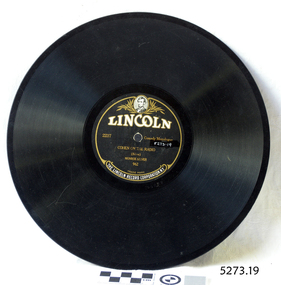
Audio - Gramophone Record, Lincoln Record Corporation, Cohen On The Radio, Early-to-mid 20th century
... A gramophone machine reproduced the sound by spinning the record on a turntable at a specified number of rotations per minute (RPM) and using a stylus or needle to transfer the vibration via a membrane to a speaker, which amplified the sound. ...A gramophone machine reproduced the sound by spinning the record on a turntable at a specified number of rotations per minute (RPM) and using a stylus or needle to transfer the vibration via a membrane to a speaker, which amplified the sound. ...Thomas Edison (1847–1931), an American, invented the phonograph in 1877, making it possible to record sound waves vertically and reproduce them on a wax cylinder so they could be heard again. Later, the German American, Emile Berliner (1851-1929), improved on Edison’s principles, greatly increasing the quality of the reproduced sounds with his invention of the gramophone in 1887, which recorded the sound waves laterally onto a flat shellac disc, or ‘record’. Records could be mass-produced in a factory where audio recordings were converted to a physical copy of that recording on a plate-sized disc. A gramophone machine reproduced the sound by spinning the record on a turntable at a specified number of rotations per minute (RPM) and using a stylus or needle to transfer the vibration via a membrane to a speaker, which amplified the sound. Berliner helped set up affiliated businesses overseas. One of his representatives was William Barry Owen (1860–1914), who, on 23 February 1889, partnered with Edmund Trevor Lloyd Williams (1859–1946) in England to register The Gramophone Company. His Master’s Voice (HMV) soon became the company’s major recording label, popular worldwide. The business based the label's logo of a dog looking into a gramophone horn for ‘his master’s voice’ was based on a painting by English artist Francis Barraud, which featured a terrier called Nipper beside a gramophone. Early gramophone records were mostly made from a material referred to as shellac, a natural ingredient combined with slate powder, and a filler of manilla copal, wood resin, carnauba wax, and carbon black. Although Bakelite seemed a useful, synthetic product, it was unsuccessful as a product for records. Around the time of World War II, lightweight, flexible synthetic vinyl records began replacing shellac records. Common diameters of records: 7 inch, 10 inch, 12 inch and 16 inch Revolutions Per Minute include: 33 1/3, 45, 78 Minutes per side of record: 3, 5.5, 7, 8, 9, 12, 15 and 22 Labels, in minutes per side: Single Play 3-5 min, Extended Play (EP) 7-12 min, Long Play (LP) 12-22 min This gramophone represents a step in the evolution of recording sound. In the 19th century, the human voice was first recorded on wax cylinders and replayed. It was the beginning of a new era in sound. Then, in the 1880s, voice could be recorded onto flat discs like this record, reliably reproduced and replayed many times, even on portable devices. Later, in the mid-20th century the following generation of electronic audio recording began, and later that century, digital recording gave even better reproduction. The record represents a popular means of entertainment for personal and social activities, as well as in some businesses. Shellac gramophone record with a black and gold label. Title: Cohen On The Radio Artist: Monroe Silver Publisher: The Lincoln Record Corporation N.Y. 2237 Number:962 Size: 10 inchflagstaff hill, warrnambool, maritime village, maritime museum, flagstaff hill maritime museum and village, shipwreck coast, great ocean road, gramophone, phonograph, sound waves, record, reproduction, audio record, music, sound, thomas edison, emile berliner, 1887, shellac, rpm, william barry owen, edmund trevor lloyd williams, the gramophone company, his master’s voice, hmv, francis barraud, nipper, the lincoln record corporation n.y. 2237, cohen on the radio, monroe silver, no 962, 10 inch -
 Flagstaff Hill Maritime Museum and Village
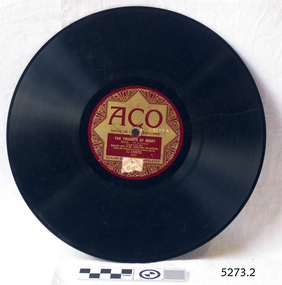
Audio - Gramophone Record, ACO, The Triumph of Right, Early-to-mid 20th century
... A gramophone machine reproduced the sound by spinning the record on a turntable at a specified number of rotations per minute (RPM) and using a stylus or needle to transfer the vibration via a membrane to a speaker, which amplified the sound. ...A gramophone machine reproduced the sound by spinning the record on a turntable at a specified number of rotations per minute (RPM) and using a stylus or needle to transfer the vibration via a membrane to a speaker, which amplified the sound. ...Thomas Edison (1847–1931), an American, invented the phonograph in 1877, making it possible to record sound waves vertically and reproduce them on a wax cylinder so they could be heard again. Later, the German American, Emile Berliner (1851-1929), improved on Edison’s principles, greatly increasing the quality of the reproduced sounds with his invention of the gramophone in 1887, which recorded the sound waves laterally onto a flat shellac disc, or ‘record’. Records could be mass-produced in a factory where audio recordings were converted to a physical copy of that recording on a plate-sized disc. A gramophone machine reproduced the sound by spinning the record on a turntable at a specified number of rotations per minute (RPM) and using a stylus or needle to transfer the vibration via a membrane to a speaker, which amplified the sound. Berliner helped set up affiliated businesses overseas. One of his representatives was William Barry Owen (1860–1914), who, on 23 February 1889, partnered with Edmund Trevor Lloyd Williams (1859–1946) in England to register The Gramophone Company. His Master’s Voice (HMV) soon became the company’s major recording label, popular worldwide. The business based the label's logo of a dog looking into a gramophone horn for ‘his master’s voice’ was based on a painting by English artist Francis Barraud, which featured a terrier called Nipper beside a gramophone. Early gramophone records were mostly made from a material referred to as shellac, a natural ingredient combined with slate powder, and a filler of manilla copal, wood resin, carnauba wax, and carbon black. Although Bakelite seemed a useful, synthetic product, it was unsuccessful as a product for records. Around the time of World War II, lightweight, flexible synthetic vinyl records began replacing shellac records. Common diameters of records: 7 inch, 10 inch, 12 inch and 16 inch Revolutions Per Minute include: 33 1/3, 45, 78 Minutes per side of record: 3, 5.5, 7, 8, 9, 12, 15 and 22 Labels, in minutes per side: Single Play 3-5 min, Extended Play (EP) 7-12 min, Long Play (LP) 12-22 min This gramophone represents a step in the evolution of recording sound. In the 19th century, the human voice was first recorded on wax cylinders and replayed. It was the beginning of a new era in sound. Then, in the 1880s, voice could be recorded onto flat discs like this record, reliably reproduced and replayed many times, even on portable devices. Later, in the mid-20th century the following generation of electronic audio recording began, and later that century, digital recording gave even better reproduction. The record represents a popular means of entertainment for personal and social activities, as well as in some businesses. Shellac gramophone record with a crimson and gold label. Title: The Triumph of Right Artist: H.M. Welsh Guards Publisher: ACO England Number: G15875 Size: 10 inchflagstaff hill, warrnambool, maritime village, maritime museum, flagstaff hill maritime museum and village, shipwreck coast, great ocean road, gramophone, phonograph, sound waves, record, reproduction, audio record, music, sound, thomas edison, emile berliner, 1887, shellac, rpm, william barry owen, edmund trevor lloyd williams, the gramophone company, his master’s voice, hmv, francis barraud, nipper, 10 inch, the triumph of right, h.m. welsh guards, aco england -
 Flagstaff Hill Maritime Museum and Village
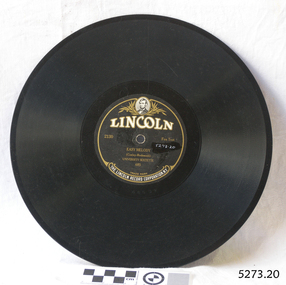
Audio - Gramophone Record, Lincoln Record Corporation, Easy Melody, Early-to-mid 20th century
... A gramophone machine reproduced the sound by spinning the record on a turntable at a specified number of rotations per minute (RPM) and using a stylus or needle to transfer the vibration via a membrane to a speaker, which amplified the sound. ...A gramophone machine reproduced the sound by spinning the record on a turntable at a specified number of rotations per minute (RPM) and using a stylus or needle to transfer the vibration via a membrane to a speaker, which amplified the sound. ...Thomas Edison (1847–1931), an American, invented the phonograph in 1877, making it possible to record sound waves vertically and reproduce them on a wax cylinder so they could be heard again. Later, the German American, Emile Berliner (1851-1929), improved on Edison’s principles, greatly increasing the quality of the reproduced sounds with his invention of the gramophone in 1887, which recorded the sound waves laterally onto a flat shellac disc, or ‘record’. Records could be mass-produced in a factory where audio recordings were converted to a physical copy of that recording on a plate-sized disc. A gramophone machine reproduced the sound by spinning the record on a turntable at a specified number of rotations per minute (RPM) and using a stylus or needle to transfer the vibration via a membrane to a speaker, which amplified the sound. Berliner helped set up affiliated businesses overseas. One of his representatives was William Barry Owen (1860–1914), who, on 23 February 1889, partnered with Edmund Trevor Lloyd Williams (1859–1946) in England to register The Gramophone Company. His Master’s Voice (HMV) soon became the company’s major recording label, popular worldwide. The business based the label's logo of a dog looking into a gramophone horn for ‘his master’s voice’ was based on a painting by English artist Francis Barraud, which featured a terrier called Nipper beside a gramophone. Early gramophone records were mostly made from a material referred to as shellac, a natural ingredient combined with slate powder, and a filler of manilla copal, wood resin, carnauba wax, and carbon black. Although Bakelite seemed a useful, synthetic product, it was unsuccessful as a product for records. Around the time of World War II, lightweight, flexible synthetic vinyl records began replacing shellac records. Common diameters of records: 7 inch, 10 inch, 12 inch and 16 inch Revolutions Per Minute include: 33 1/3, 45, 78 Minutes per side of record: 3, 5.5, 7, 8, 9, 12, 15 and 22 Labels, in minutes per side: Single Play 3-5 min, Extended Play (EP) 7-12 min, Long Play (LP) 12-22 min This gramophone represents a step in the evolution of recording sound. In the 19th century, the human voice was first recorded on wax cylinders and replayed. It was the beginning of a new era in sound. Then, in the 1880s, voice could be recorded onto flat discs like this record, reliably reproduced and replayed many times, even on portable devices. Later, in the mid-20th century the following generation of electronic audio recording began, and later that century, digital recording gave even better reproduction. The record represents a popular means of entertainment for personal and social activities, as well as in some businesses. Shellac gramophone record with a black and gold label. Title: Easy Melody Artist: University Sextette Publisher: The Lincoln Record Corporation N.Y. Number:2130 685 Size: 10 inchflagstaff hill, warrnambool, maritime village, maritime museum, flagstaff hill maritime museum and village, shipwreck coast, great ocean road, gramophone, phonograph, sound waves, record, reproduction, audio record, music, sound, thomas edison, emile berliner, 1887, shellac, rpm, william barry owen, edmund trevor lloyd williams, the gramophone company, his master’s voice, hmv, francis barraud, nipper, the lincoln record corporation n.y., 2130, easy melody, university sextette, 685 -
 Flagstaff Hill Maritime Museum and Village
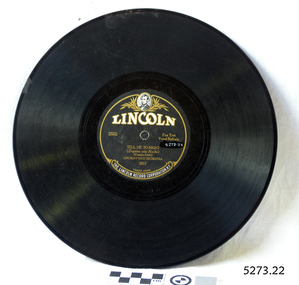
Audio - Gramophone Record, Lincoln Record Corporation, Tell Me To-Night, Early-to-mid 20th century
... A gramophone machine reproduced the sound by spinning the record on a turntable at a specified number of rotations per minute (RPM) and using a stylus or needle to transfer the vibration via a membrane to a speaker, which amplified the sound. ...A gramophone machine reproduced the sound by spinning the record on a turntable at a specified number of rotations per minute (RPM) and using a stylus or needle to transfer the vibration via a membrane to a speaker, which amplified the sound. ...Thomas Edison (1847–1931), an American, invented the phonograph in 1877, making it possible to record sound waves vertically and reproduce them on a wax cylinder so they could be heard again. Later, the German American, Emile Berliner (1851-1929), improved on Edison’s principles, greatly increasing the quality of the reproduced sounds with his invention of the gramophone in 1887, which recorded the sound waves laterally onto a flat shellac disc, or ‘record’. Records could be mass-produced in a factory where audio recordings were converted to a physical copy of that recording on a plate-sized disc. A gramophone machine reproduced the sound by spinning the record on a turntable at a specified number of rotations per minute (RPM) and using a stylus or needle to transfer the vibration via a membrane to a speaker, which amplified the sound. Berliner helped set up affiliated businesses overseas. One of his representatives was William Barry Owen (1860–1914), who, on 23 February 1889, partnered with Edmund Trevor Lloyd Williams (1859–1946) in England to register The Gramophone Company. His Master’s Voice (HMV) soon became the company’s major recording label, popular worldwide. The business based the label's logo of a dog looking into a gramophone horn for ‘his master’s voice’ was based on a painting by English artist Francis Barraud, which featured a terrier called Nipper beside a gramophone. Early gramophone records were mostly made from a material referred to as shellac, a natural ingredient combined with slate powder, and a filler of manilla copal, wood resin, carnauba wax, and carbon black. Although Bakelite seemed a useful, synthetic product, it was unsuccessful as a product for records. Around the time of World War II, lightweight, flexible synthetic vinyl records began replacing shellac records. Common diameters of records: 7 inch, 10 inch, 12 inch and 16 inch Revolutions Per Minute include: 33 1/3, 45, 78 Minutes per side of record: 3, 5.5, 7, 8, 9, 12, 15 and 22 Labels, in minutes per side: Single Play 3-5 min, Extended Play (EP) 7-12 min, Long Play (LP) 12-22 min This gramophone represents a step in the evolution of recording sound. In the 19th century, the human voice was first recorded on wax cylinders and replayed. It was the beginning of a new era in sound. Then, in the 1880s, voice could be recorded onto flat discs like this record, reliably reproduced and replayed many times, even on portable devices. Later, in the mid-20th century the following generation of electronic audio recording began, and later that century, digital recording gave even better reproduction. The record represents a popular means of entertainment for personal and social activities, as well as in some businesses. Shellac gramophone record with a black and gold label. Title: Tell Me To-Night Artist: Lincoln Dance Orchestra. Publisher: The Lincoln Record Corporation N.Y. 2552 Number:2057 Size: 10 inchflagstaff hill, warrnambool, maritime village, maritime museum, flagstaff hill maritime museum and village, shipwreck coast, great ocean road, gramophone, phonograph, sound waves, record, reproduction, audio record, music, sound, thomas edison, emile berliner, 1887, shellac, rpm, william barry owen, edmund trevor lloyd williams, the gramophone company, his master’s voice, hmv, francis barraud, nipper, the lincoln record corporation n.y. 2552, tell me to-night, lincoln dance orchestra, 2057
